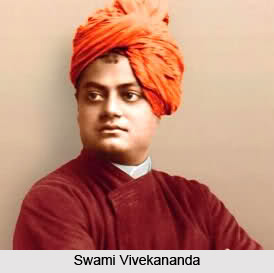
(The following online lecture is given as a part of the Indian Consulate of New York’s special celebration on January 12, 2022.)
Pujya Swami Sarvapriyanandaji, Honorable acting Indian consul general Dr. Varun Jeph, Shri Vipul Dev ji, Mr. Jay Atta, and friends:
I sincerely thank the Indian Consulate of New York for inviting me to participate in this online panel discussion, celebrating the legacy of Swami Vivekananda.
With salutation to Swami Vivekananda, I will pray for the good of all, a prayer needed most during this pandemic time:

May all be happy, may all be healthy, may good come to all, may no one suffer.

Om peace, peace be unto us, peace be unto all beings.
Swami Vivekananda said that whenever we sit down for our prayer, we have to sit in a straight prayer posture, and the first thing we must do is to send a current of holy thought to all creation in the east, west, north, south, above and below.
He continued, “The more we pray for the good of all, the better we will feel for ourselves. We will find at last, that the easiest way to make ourselves healthy is to see that others are healthy, and the easiest way to make ourselves happy is to see that others are happy.”
January 12, 2022, is Swami Vivekananda’s 159th birthday. Swami Vivekananda was ever young. He passed away at the age of 39, but within a few years, his life and teachings have made a big positive impact on people all over the world and he had inspired millions of people.
Personally, Swami Vivekananda is my hero, my role model, my guide, and my inspiration.
Who was Swami Vivekananda? He was a prophet, a saint, one of the Saptarshi, a messenger (as he had said, “Buddha had a message for the East, I have a message for the West), a social reformer, a patriot, a visionary, a wonderful teacher, sincere student, a proud disciple, a devotee, a voice without a form, a poet, a musician, a wrestler, and many more.
As Shri Adi Shankaracharya has logically established the principles of Vedanta in his Brahma Sutra commentary, Swami Vivekananda has established these Vedanta principles in the modern scientific language. He showed that the search of the scientists in the external world for the truth and the search of the Rishis in the internal world for the truth is the same and they both are going to meet at the same point.
Swami Vivekananda’s teachings are eternal and universal. They are applicable to all people all over the world.
Today, I will briefly talk about Swami Vivekananda’s teachings on education. His thoughts on education are original, unique, and thought-provoking. I will look into 5 questions:
(1) What is education?
Swami Vivekananda said, “Education is not the amount of information that is put into your brain and runs riot there, undigested all your life. We must have life-building, man-making, character-building, assimilation of ideas. If you have assimilated five ideas and made them your life and character, you have more education than any person who has got by heart a whole library. If education were identical with information, the libraries would be the greatest sages in the world and encyclopedias the Rishis.”
Unfortunately, growing up in a society where the sign of success is measured in terms of how much money one makes, students hardly appreciate the underlying beauty of any subject and cannot appreciate the wonders of life the education can present.
Also, a school or college degree does not help build our character. It does not teach us how to manage our life’s problems; for example, how to control our emotions, how to face adverse situations in life, how to develop patience, and how to deal with others.
(2) What do we mean by “learning”?
For Swamiji, “learning” is “uncovering”. He said, “Education is the manifestation of the perfection already in man (human being).”
This is a little deeper concept. According to Swamiji, all knowledge is within us. We just have to uncover it. Swamiji explained by an example. He said that an apple fell. That gave a suggestion to Newton. He then rearranged all his thoughts in his mind and he ‘found’ or ‘discover’ a new link called ‘gravitation’.
It is amazing to see how Swamiji’s thoughts were echoed by scientists. I will give you one example. My Ph. D. adviser, Prof. Eldon Dyer, was a very well-known mathematician. He used to make fun of ‘the so-called popular religion’. However, one day to my surprise, he told me, “We cannot create new mathematics. The mathematics is all laid out. We just have to uncover it.”
(3) How do children learn?
Swamiji said: “We cannot teach anyone.” As the way a plant grows by itself, a child educates itself. For a plant, what we could do is to prepare the soil, give water, remove weeds, and provide enough light. Then, the plant grows by itself. Similarly, to a child, we can just create a learning environment, remove the obstacles, and the child will learn by itself.
In addition, he said, ‘Negative thoughts weaken human beings.’ We should not put down children. Kind words and encouragement help the child to learn.
(4) What should we learn first?
Swami Vivekananda said, “If I had to do my education over again, I would develop the power of concentration and detachment, and then with a perfect instrument I could collect all the facts at will.” He said that as the rays of the sun gathered through a magnifying glass burn a paper when a mind is focused on any subject, it reveals its knowledge.
(5) What should be the outcome of education?
According to Swamiji, through Education, we must develop physical, mental, intellectual, moral, and spiritual strength. We must develop an all-round character.
Swamiji said, ““What I want is muscles of iron and nerves of steel, inside which dwells a mind made out of the same material from which the thunderbolt is made.”
He said that strength is the one thing needed most. Strength is the remedy and medicine for all our problems and miseries.
Swamiji told one youngster, who was physically weak, to go and play soccer to understand Bhagavad Gita better.
Swami Vivekananda’s life and teachings are a huge reservoir of inspiring ideas. I will conclude with very important teaching of Swami Vivekananda regarding the goal of life. He said,
“Each soul is potentially divine. The goal is to manifest this divinity within by controlling nature: external and internal. Do this either by work, or worship, or psychic control, or philosophy – by one, or more, or all of these – and be free.”
To realize and manifest this divinity, at Vivekananda Vidyapith, we learn, practice, and teach youngsters the four yogas: Jnana Yoga, Karma Yoga, Bhakti Yoga, and Raja Yoga. We ask them to do regular prayers, Japa, and meditation; read inspiring books, seek holy company, practice values, and do unselfish service.
Our students know that to achieve this goal we have to work hard and never give up. At the end of our Saturday and Sunday morning prayers, they all enthusiastically say:
Arise! Awake! And stop not till the goal is reached!

I salute to Swami Vivekananda who is the king of the Yogis, resplendent as the sun, the embodiment of Existence-Knowledge-Bliss Absolute, and the remover of the sufferings of mankind.
Thank you.
Note: One may find the video of the program at https://www.facebook.com/indiainnewyork
The title says, “
Celebrating the Legacy of Swami Vivekananda#AzadiKaAmritMahotsav…
 mahendrajani