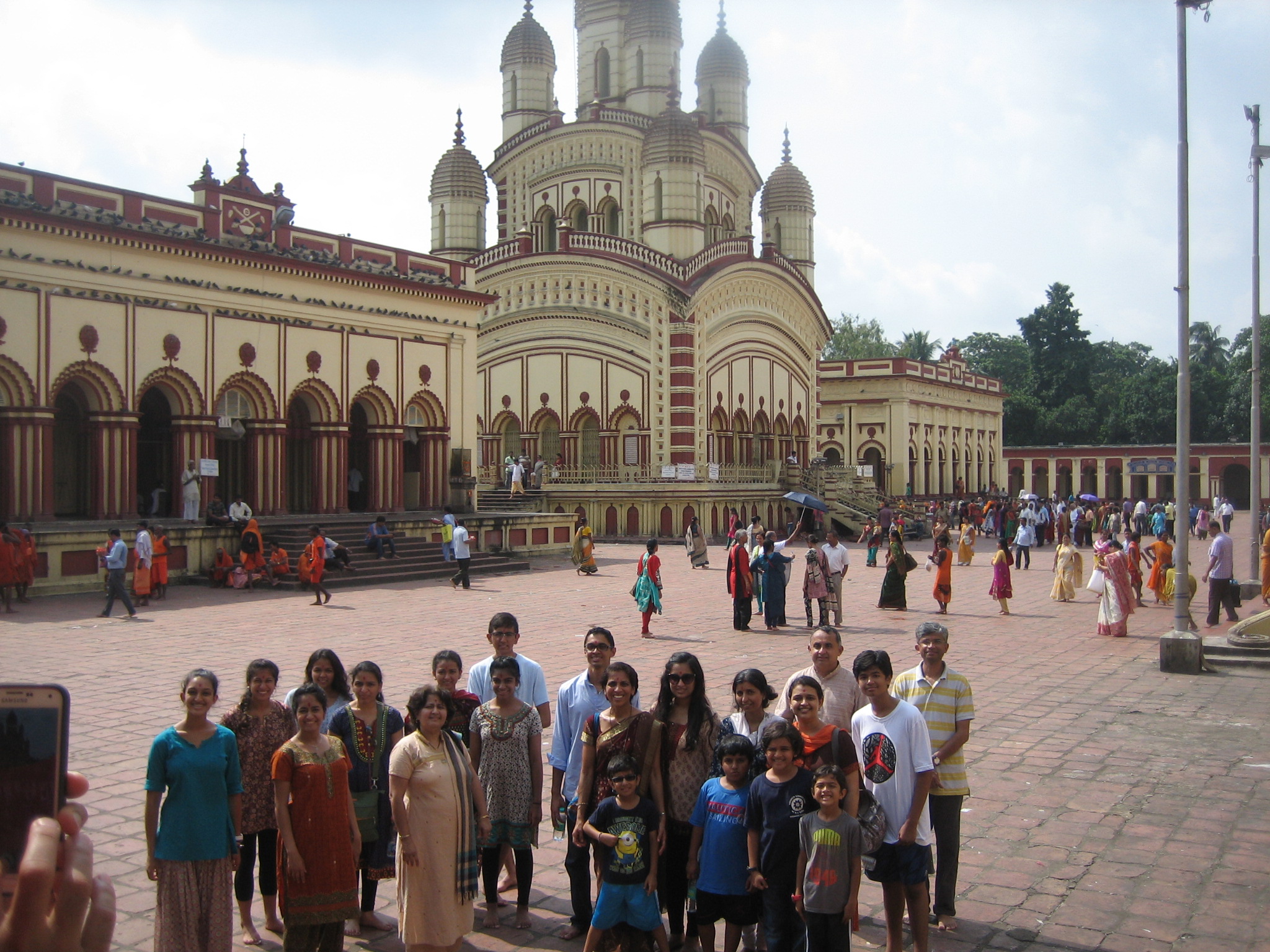
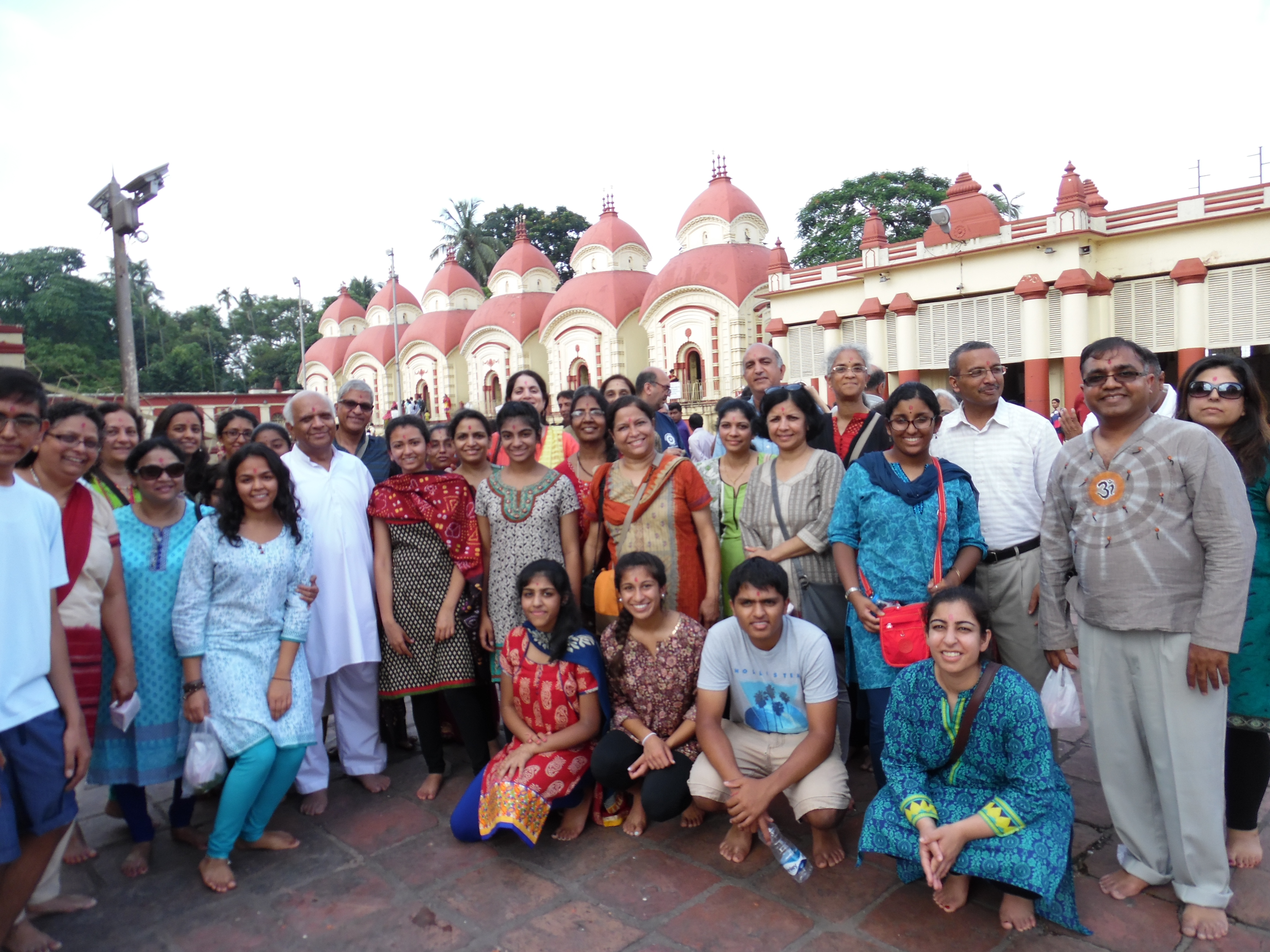
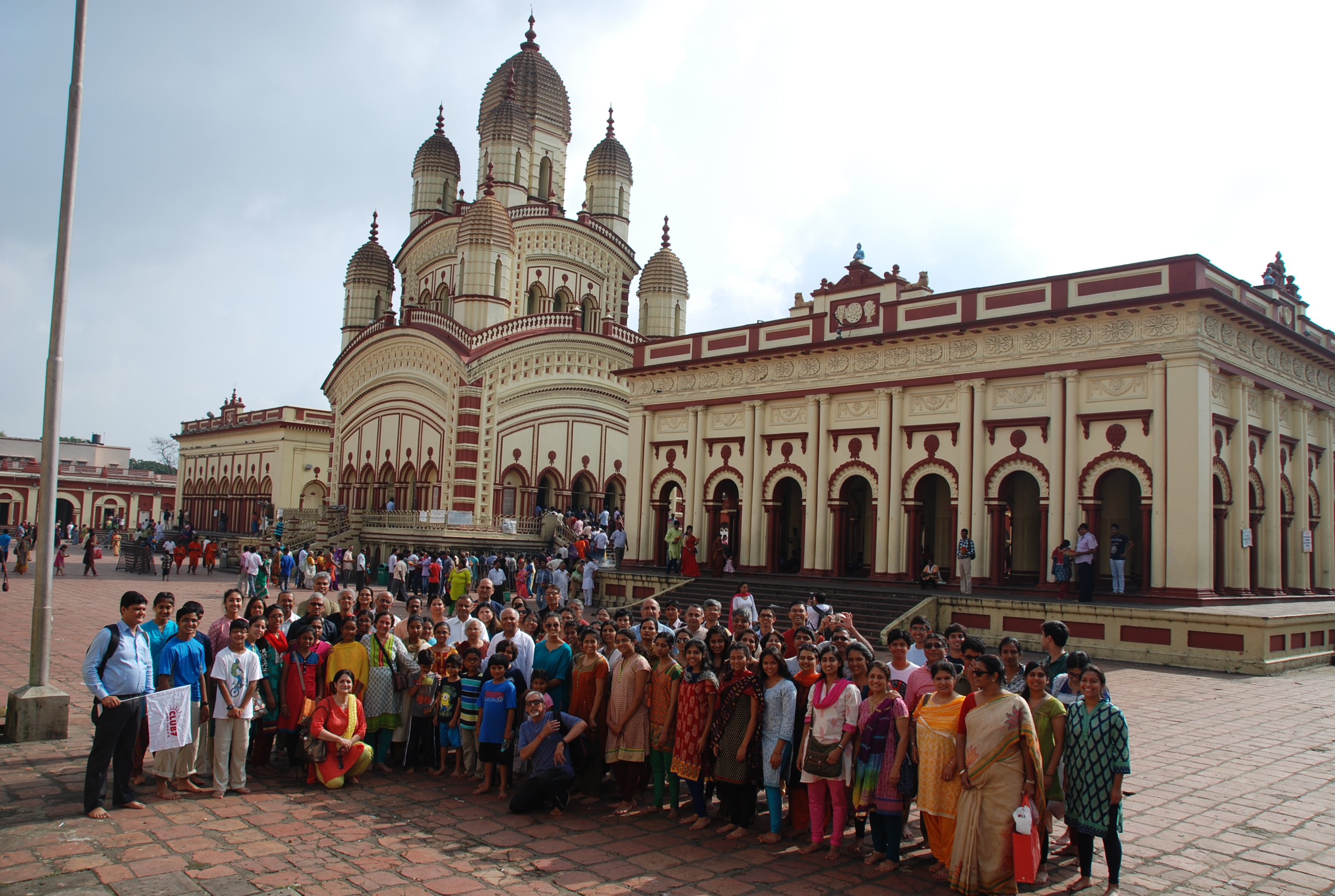
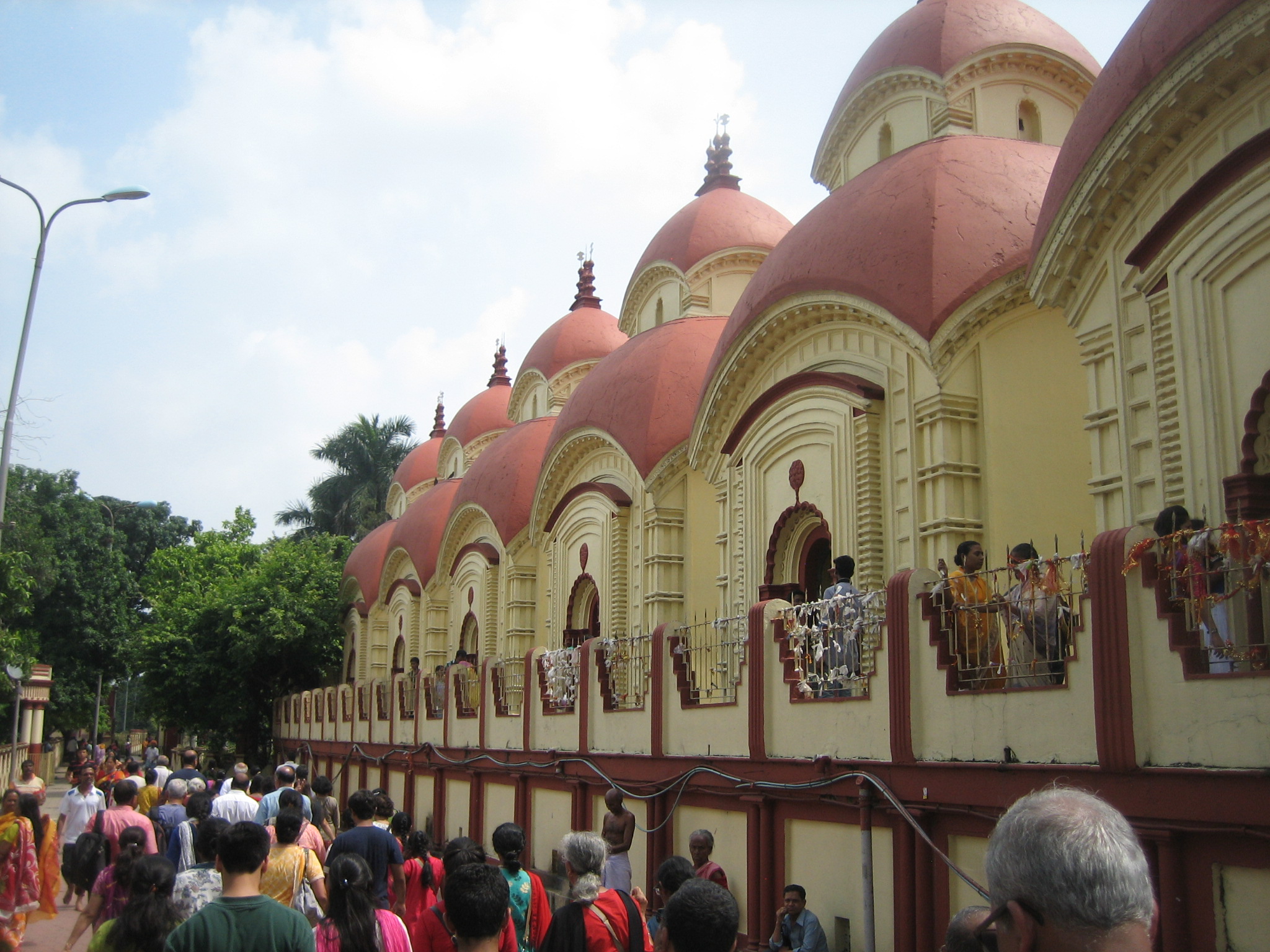
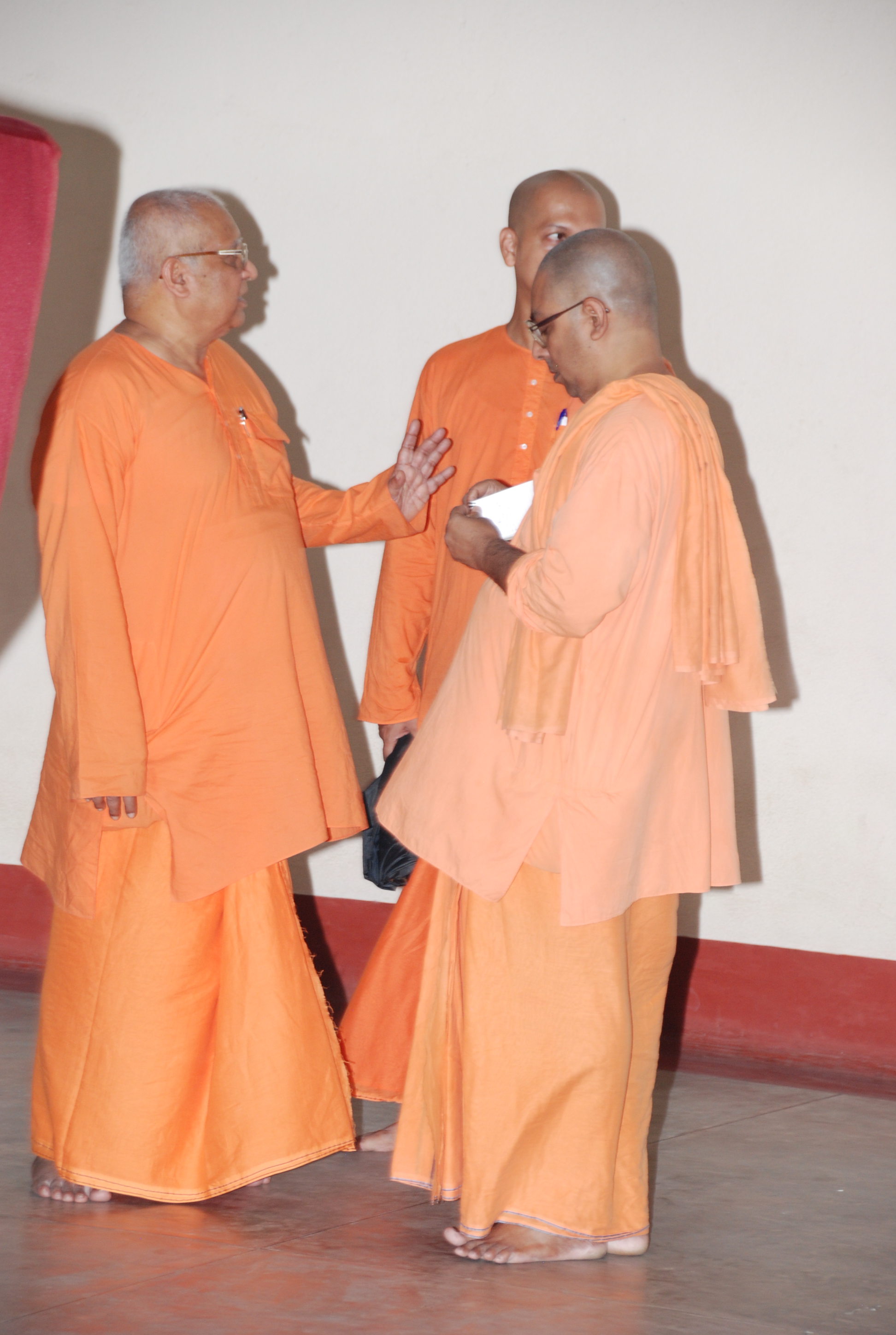
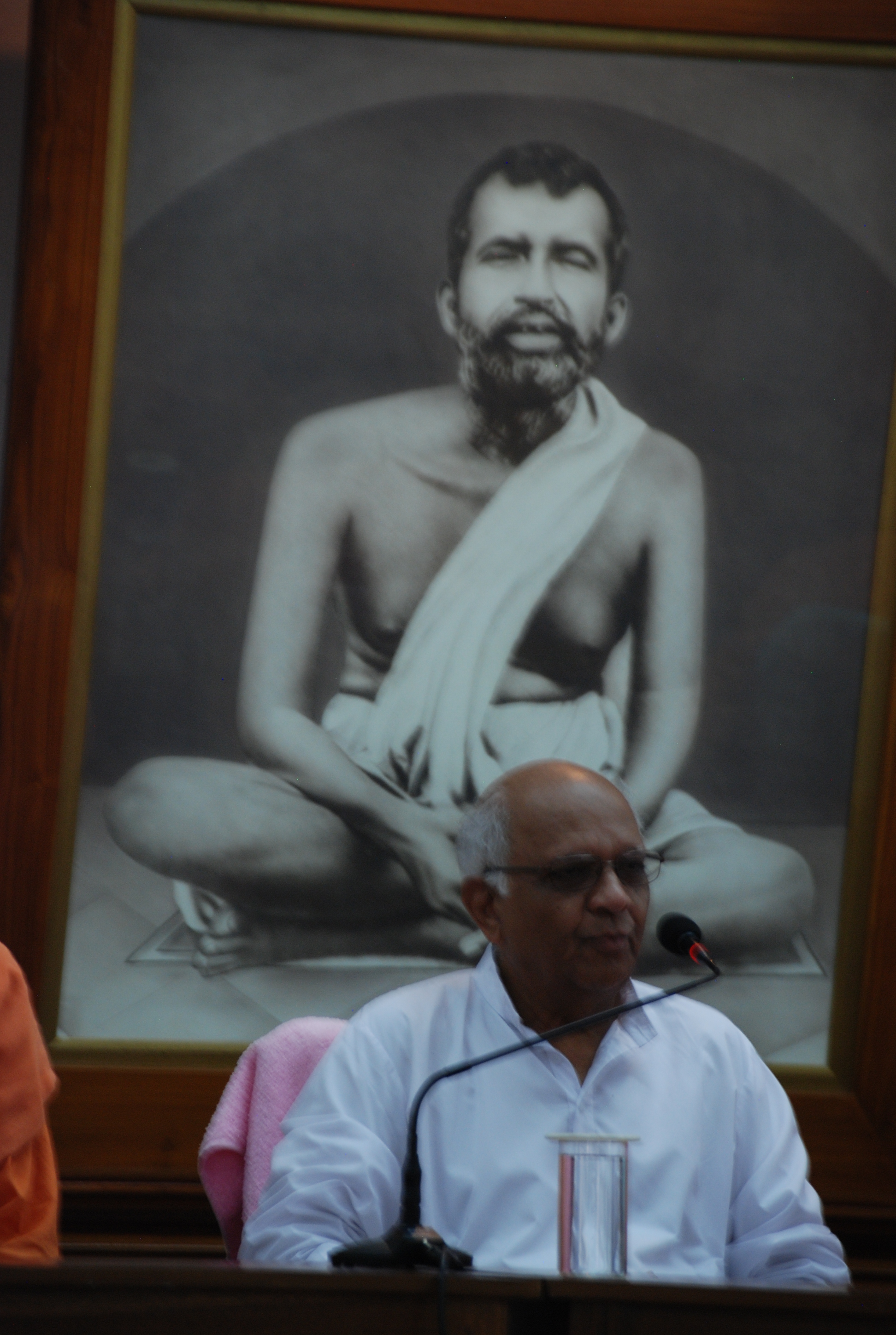
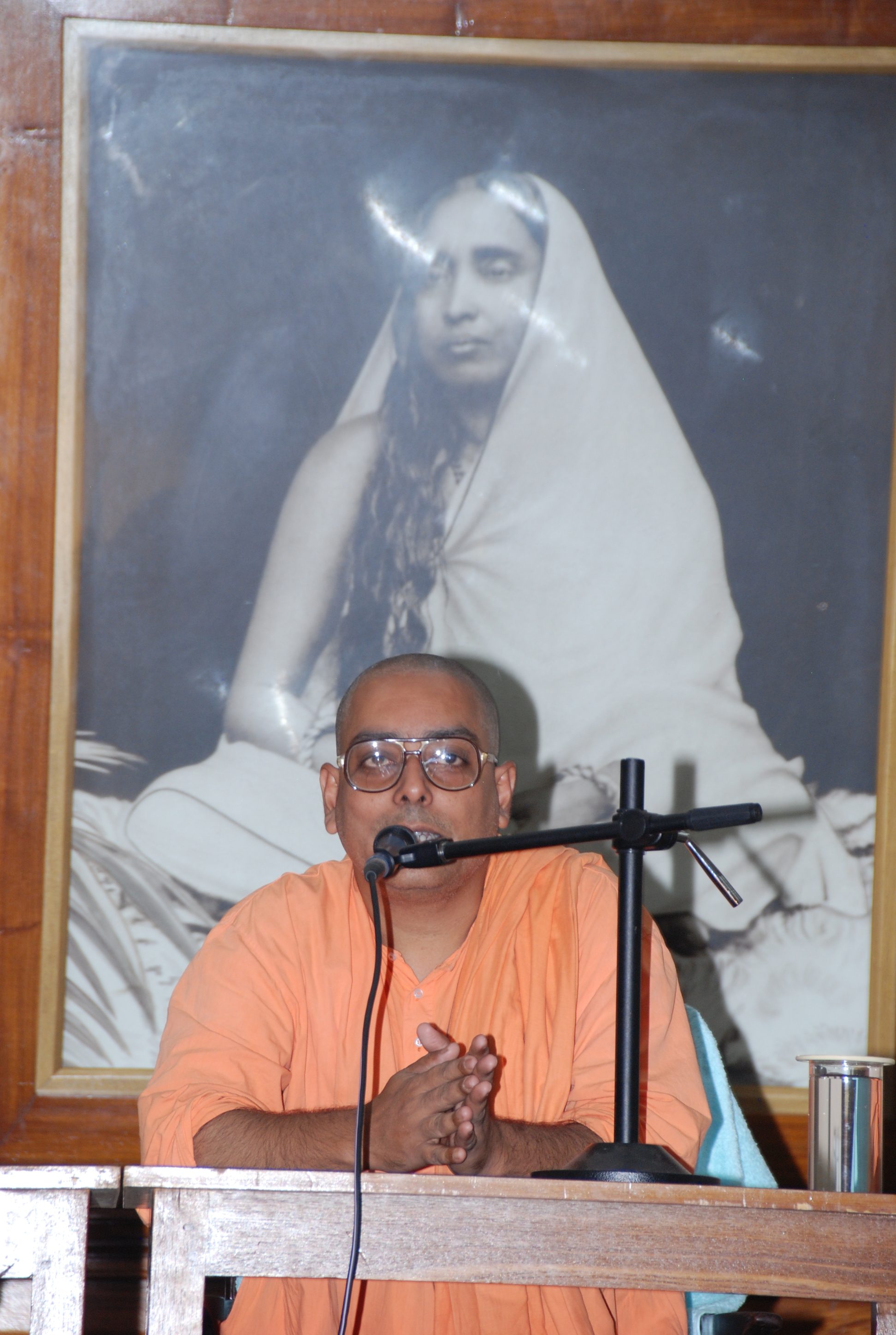
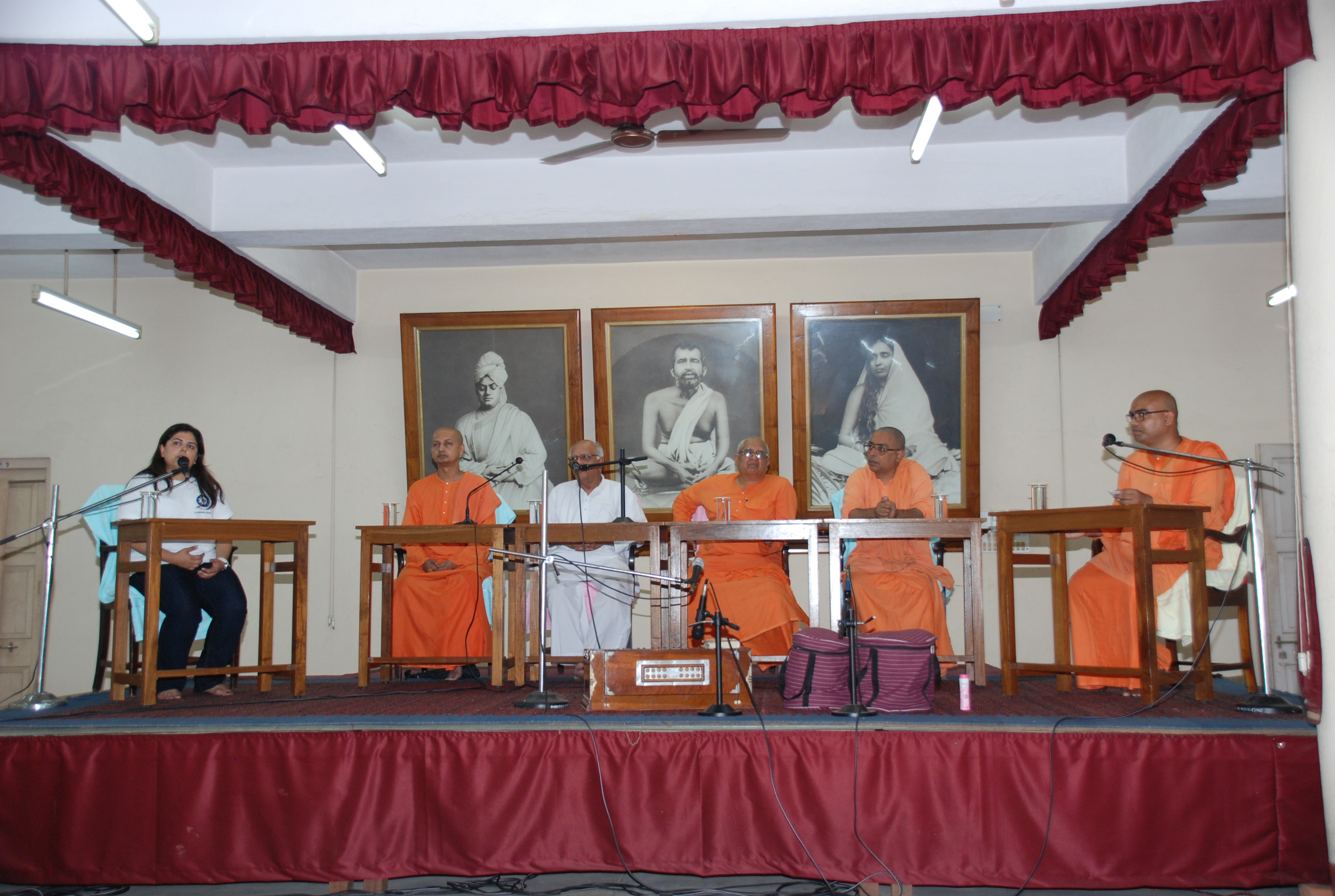
Belur Math Pilgrimage – 2015, Day – 1 Afternoon and Evening

August 3, 2015

Bus-ride to The Institute of Culture at Golpark:

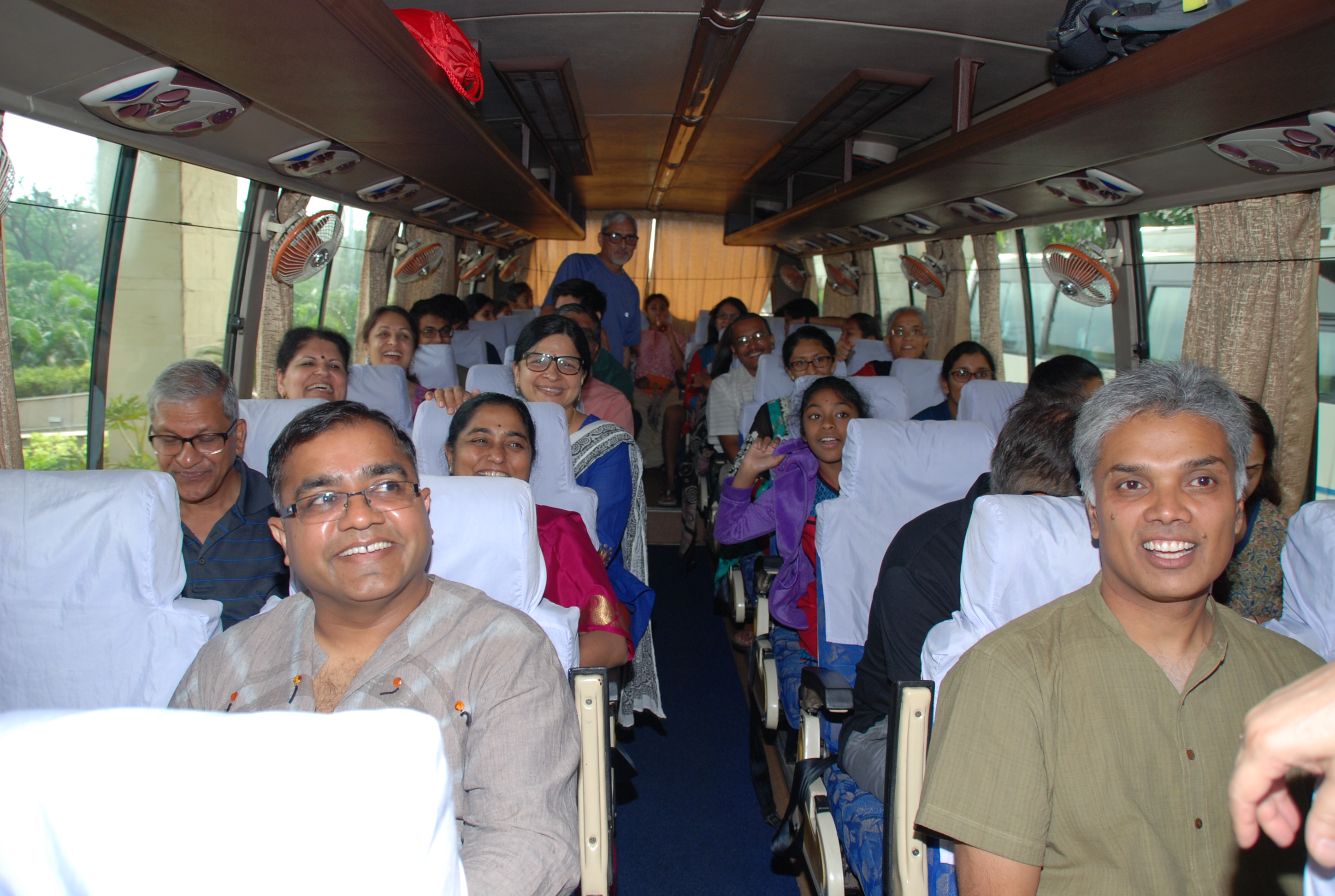
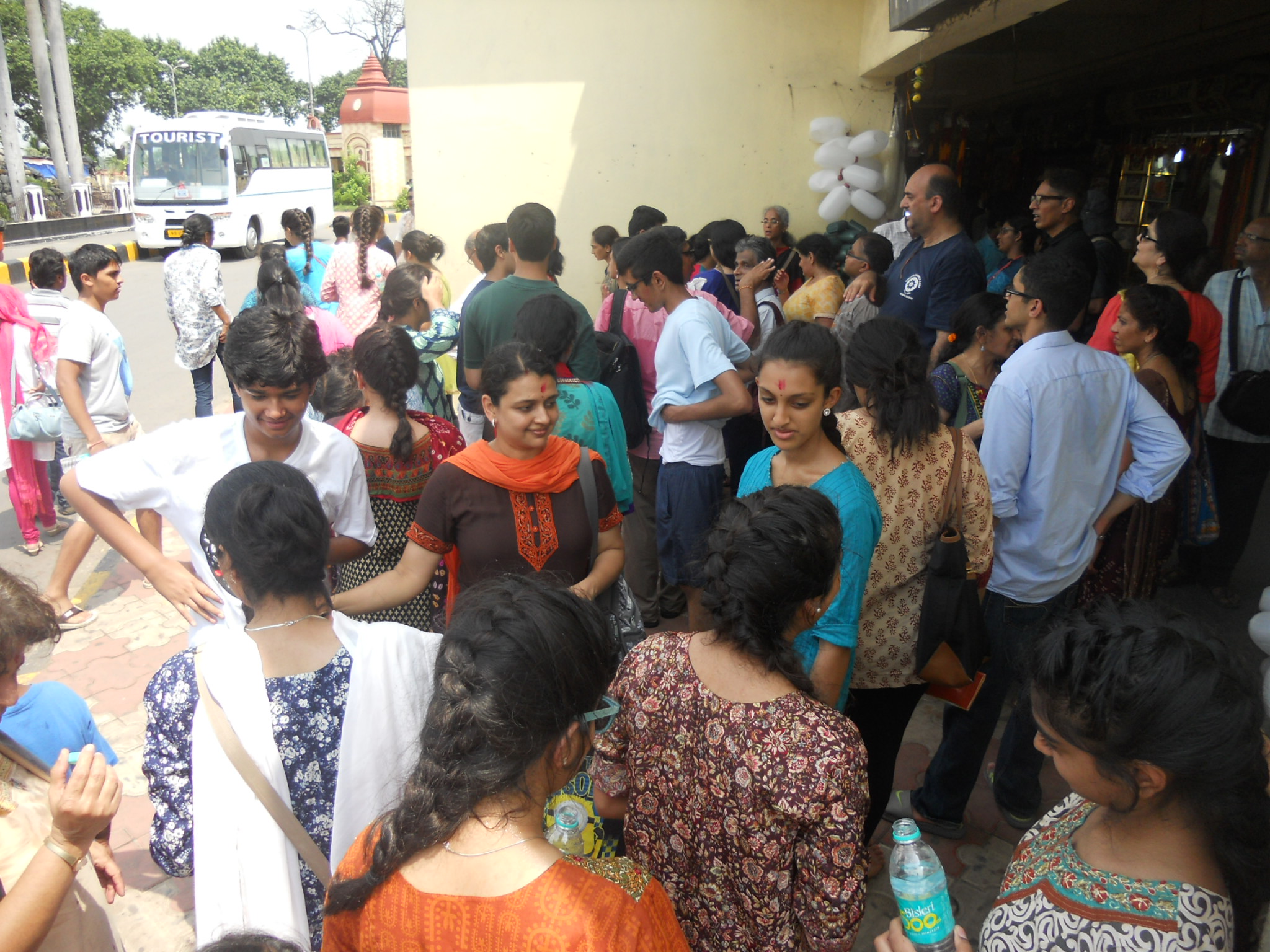
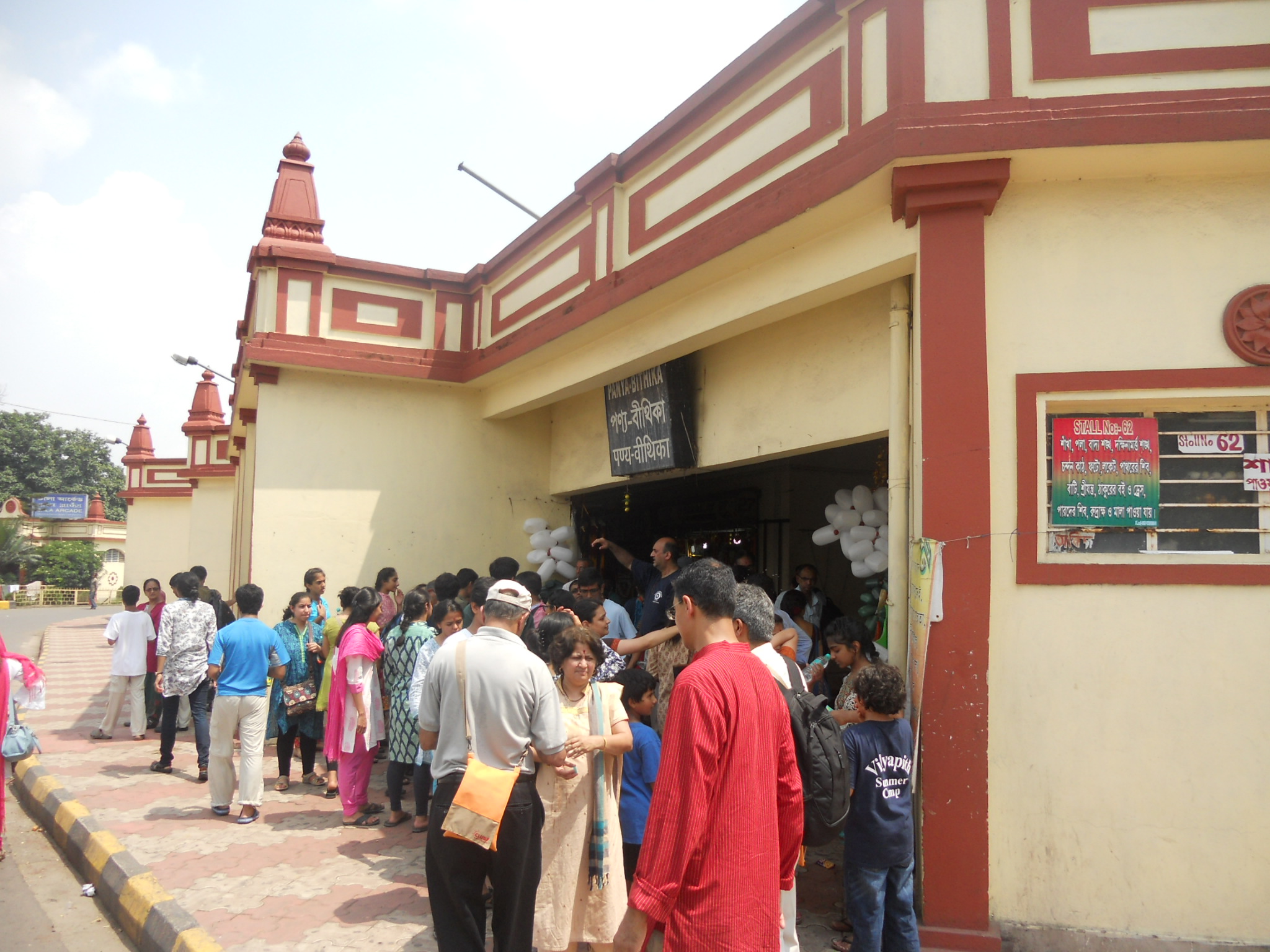
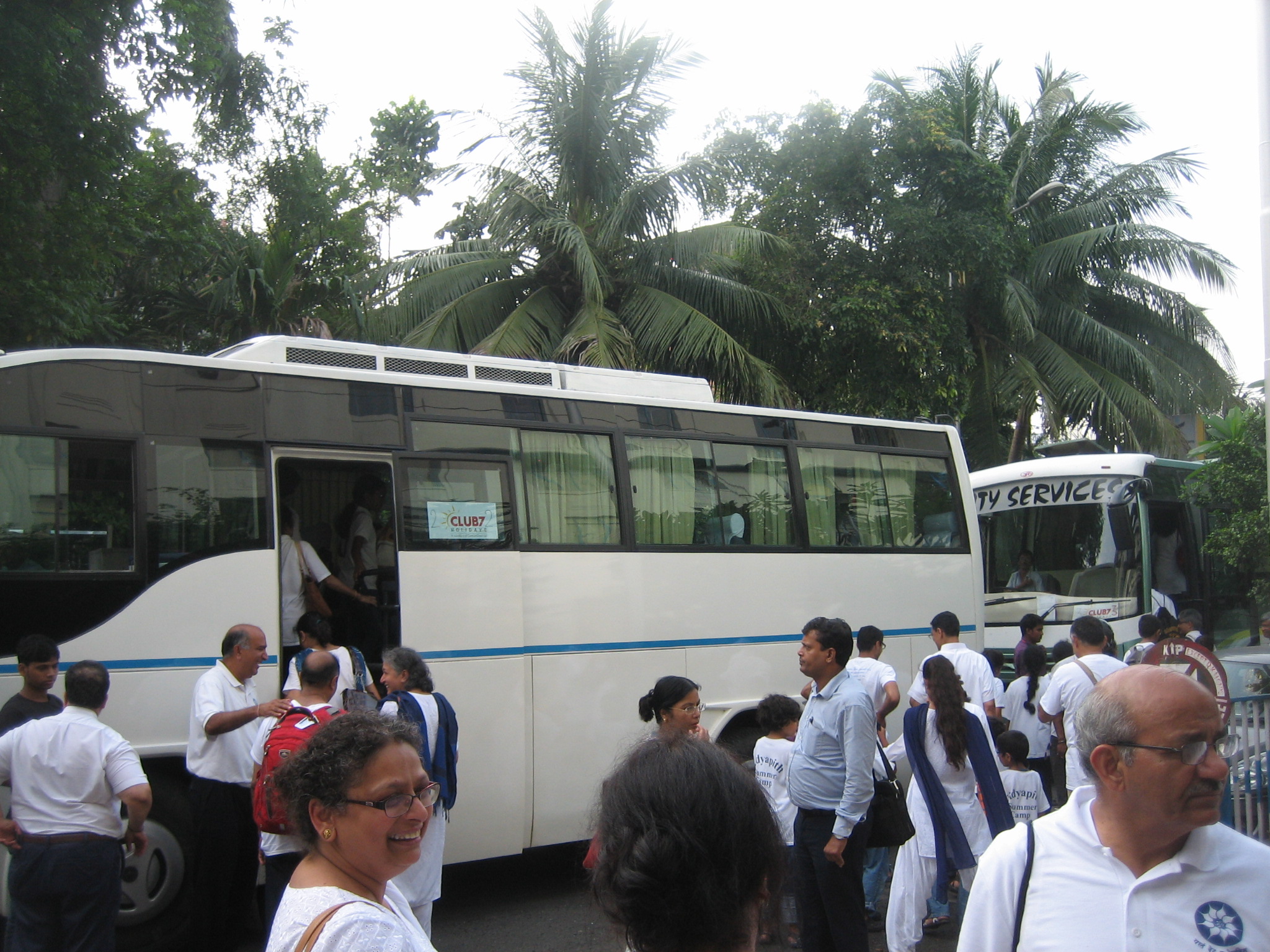
After having a wonderful time, scrumptious meal, and feeling fully satisfied with the first part of our pilgrimage at the Belur Math, we all got into our assigned buses and headed to the Ramakrishna Mission Institute of Culture.  The bus ride was about an hour and half to the Institute.  It was not the distance, but the traffic and narrow roads, which added to the time.  However, our pilgrims made the most of it and there was nothing to worry about.  The air-conditioning in the buses was at full blast and the reclining cushioned chairs were very comfortable.  Some caught up with their sleep while others sang bhajans and dhuns.  The “Bhajans and Dhuns Book,” which was specially made for the pilgrimage, was very handy.  It helped all to join in on the singing.

0203

The Ramakrishna Mission Institute of Culture:

The Ramakrishna Mission Institute of Culture is a branch of Ramakrishna Mission which started its activities in 1938.  It was established to promote the study of culture in general, encompassing all cultures developed in the world.  The Institute has a number of departments including a school of languages, a Center for Indological Studies and Research, and a publication department.  The Institute invites scholars from all over India and abroad, and supports their boarding and lodging. It maintains a large library which provides useful material to the scholars for their studies and research.

The Ramakrishna Mission Institute of Culture also has a wonderful Museum and an Art Gallery, which includes a number of valuable artifacts.  Furthermore, it conducts a P. G. Diploma Course for the Appreciation of Indian Art, runs the Sarada Devi School of Fine Arts and Crafts for children, and organizes an Annual Exhibition of Art and other conferences and cultural programs throughout the year.

At the Institute of Culture:

04

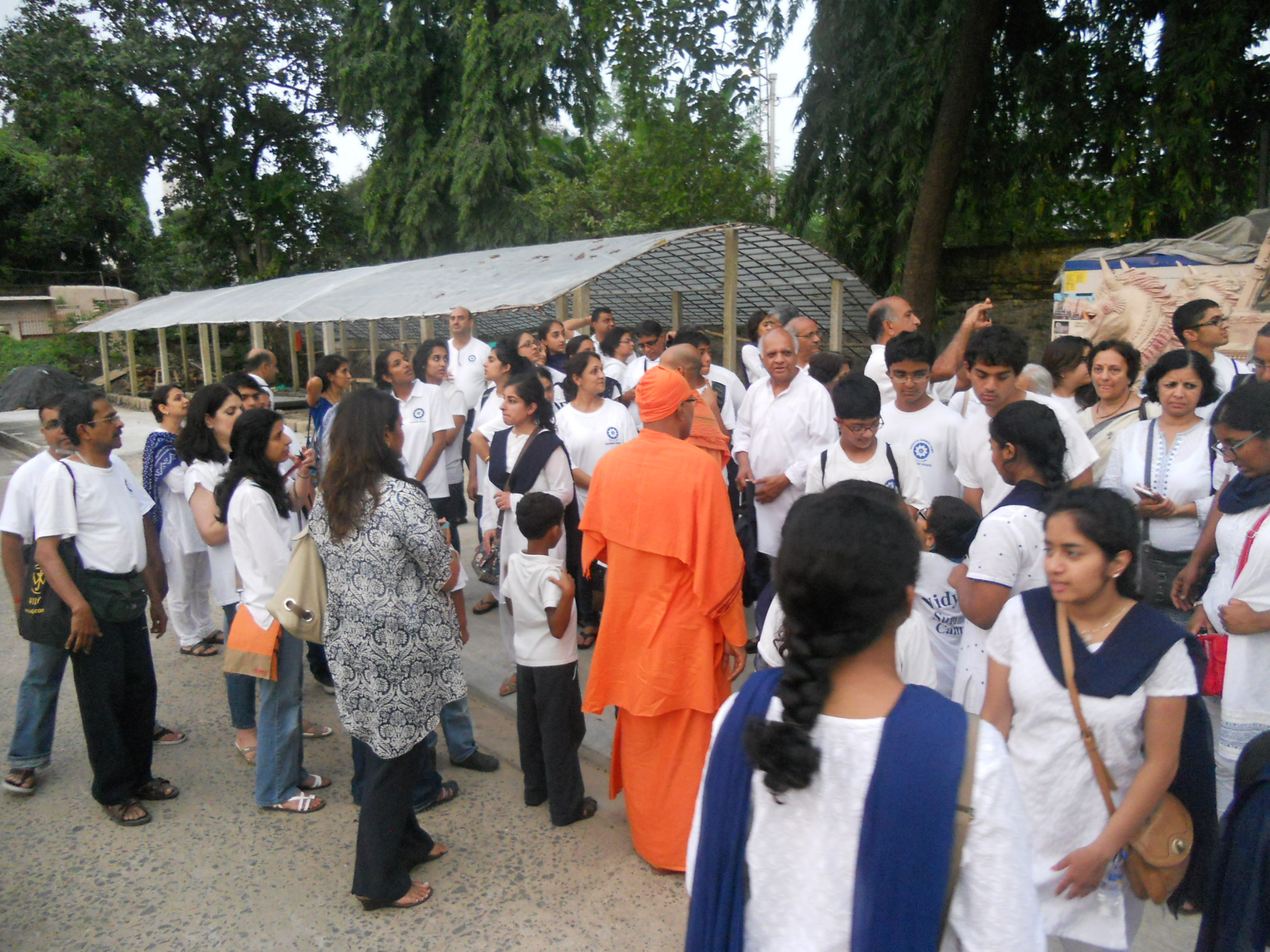
All 100 of us (91 Vidyapith pilgrims + guides + Club 7 members) soon arrived at the main entrance of the Institute.  We entered and eagerly awaited Revered Tapan Maharaj who shortly came running in to greet us.  It was an air-conditioned building.  All were feeling very comfortable.

With his loving smile he welcomed us and asked us to go to the museum.  Some took elevators, but most decided to walk on the staircase as we all needed some exercise.

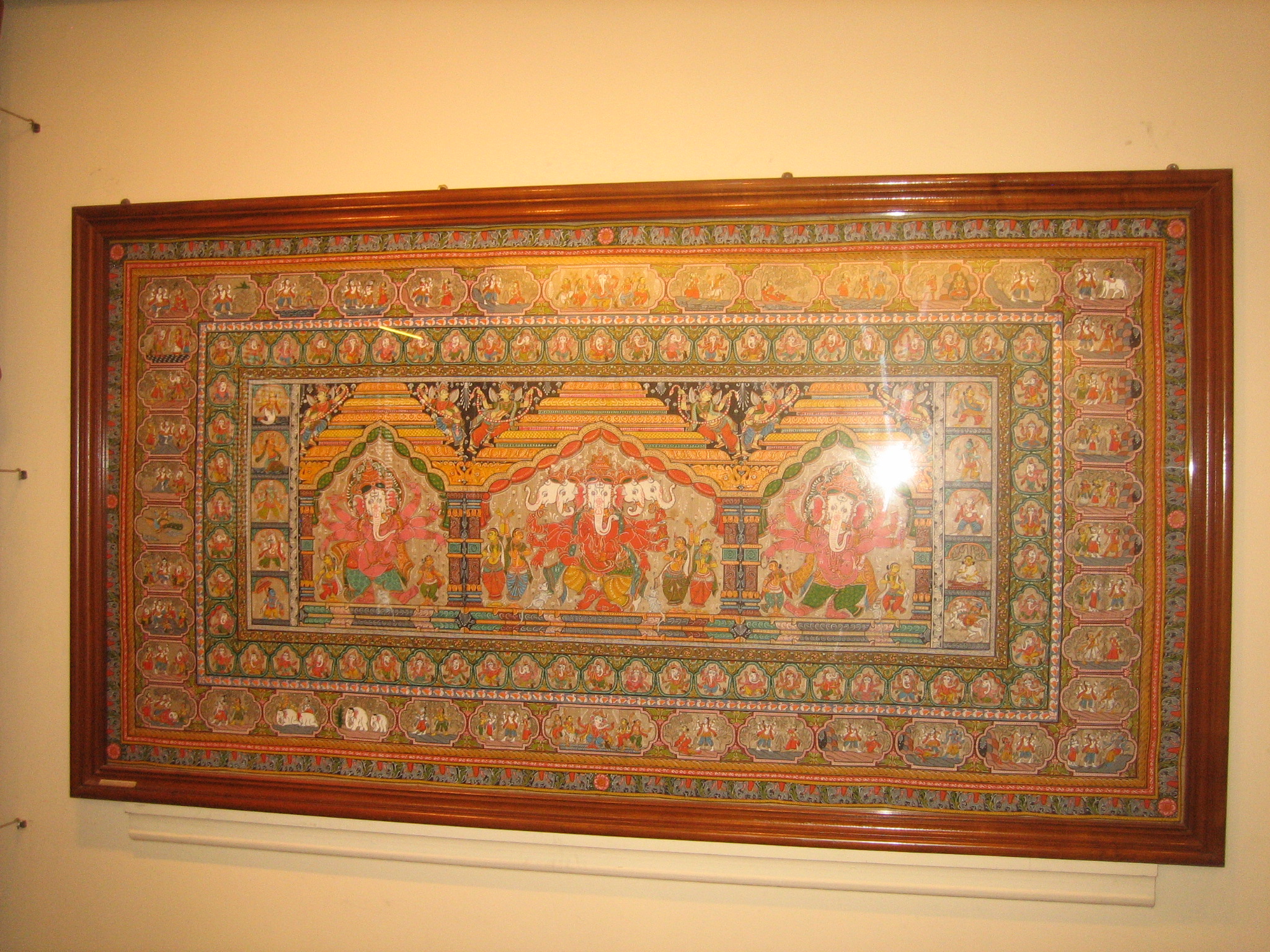
We entered a beautiful museum, which housed a collection of rare and valuable pieces from renowned artists.  This collection included sketches by the famous painter Nandalal Basu. Sri Ramakrishna had visited Nanadalal Basu’s house to see his paintings. As we walked through the exhibit, we delved into the rich Bengali art culture. We looked at some beautiful art pieces of deities, different types of textiles, and Bengali saris.

05 06 07 08 09

After the museum, we visited the large library to get a feeling of the Institute’s research activities.  The library was filled with scholars and students. Lined against the walls were classic novels, encyclopedias, and non-fiction writings from around the world.

Rev. Swami Suparnandaji’s lecture:

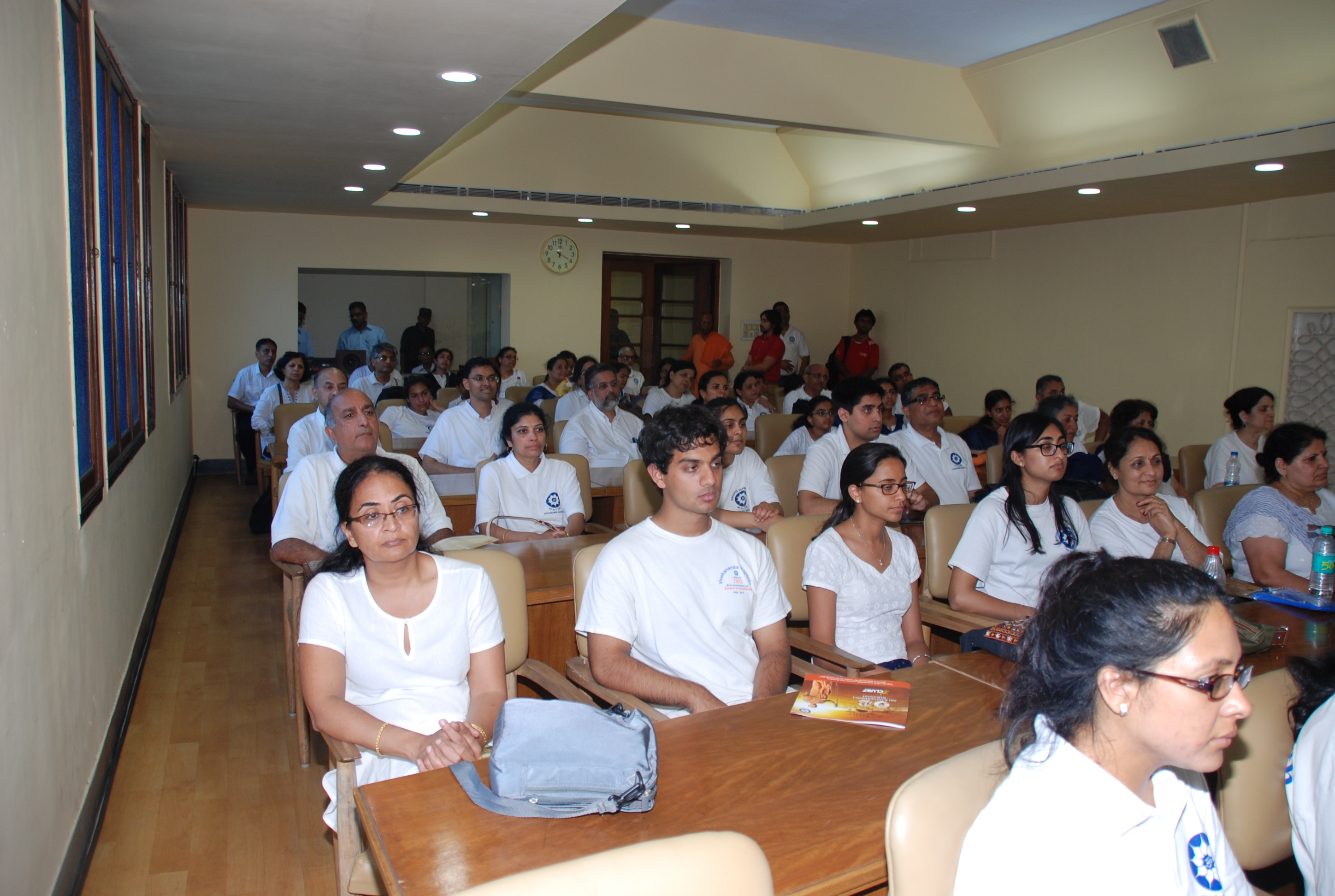
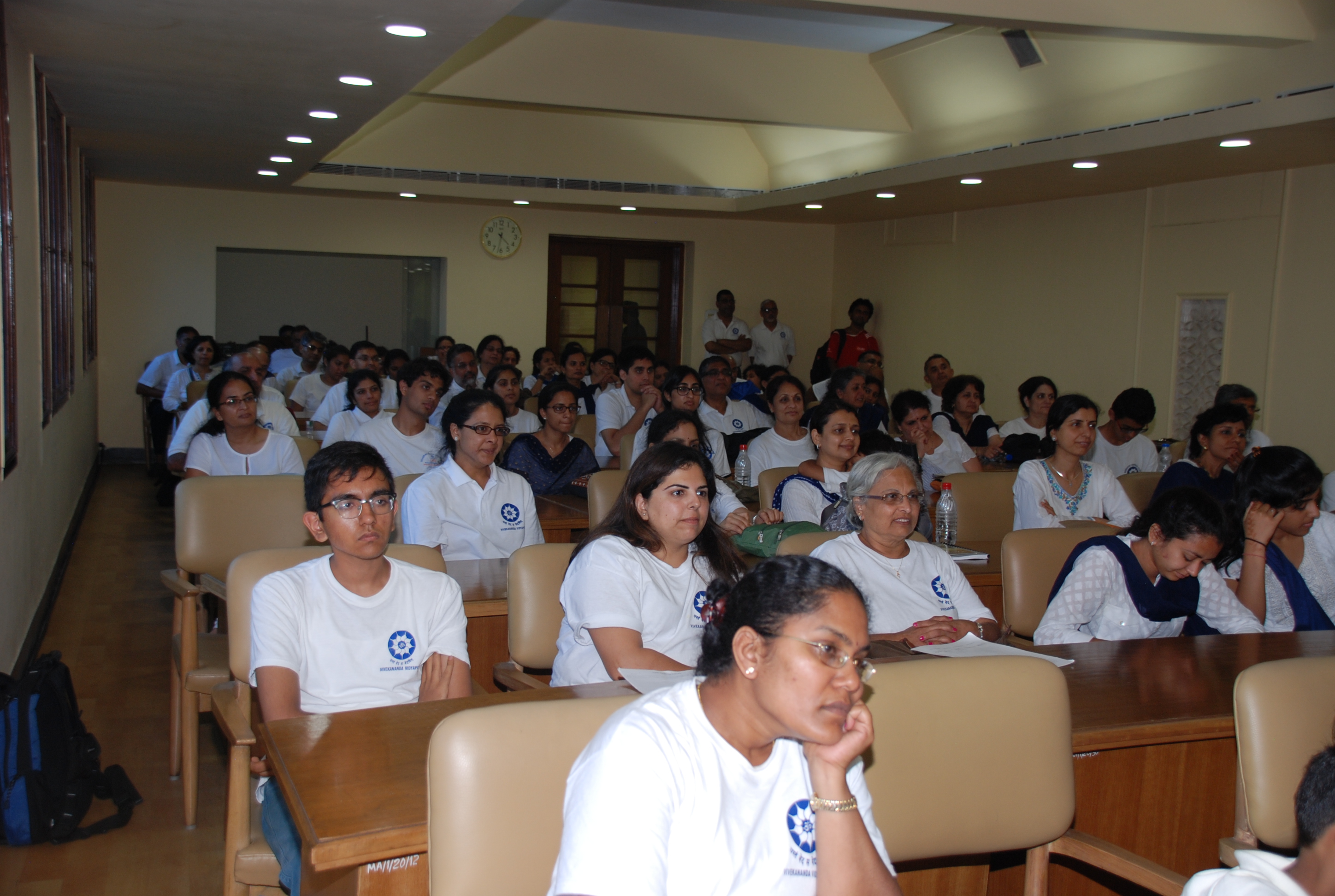
After browsing the library at the Institute, we were lead to a lecture hall (which was big enough to fit us all!). As we waited for Rev. Swami Suparnandaji, Trupti Aunty and others started singing “Rama bhajo bhai Rama bhajo, Rama bhajo bhai Rama, Rama bhajo bhai Rama Sita Rama bhajo bhai Rama.”

1110

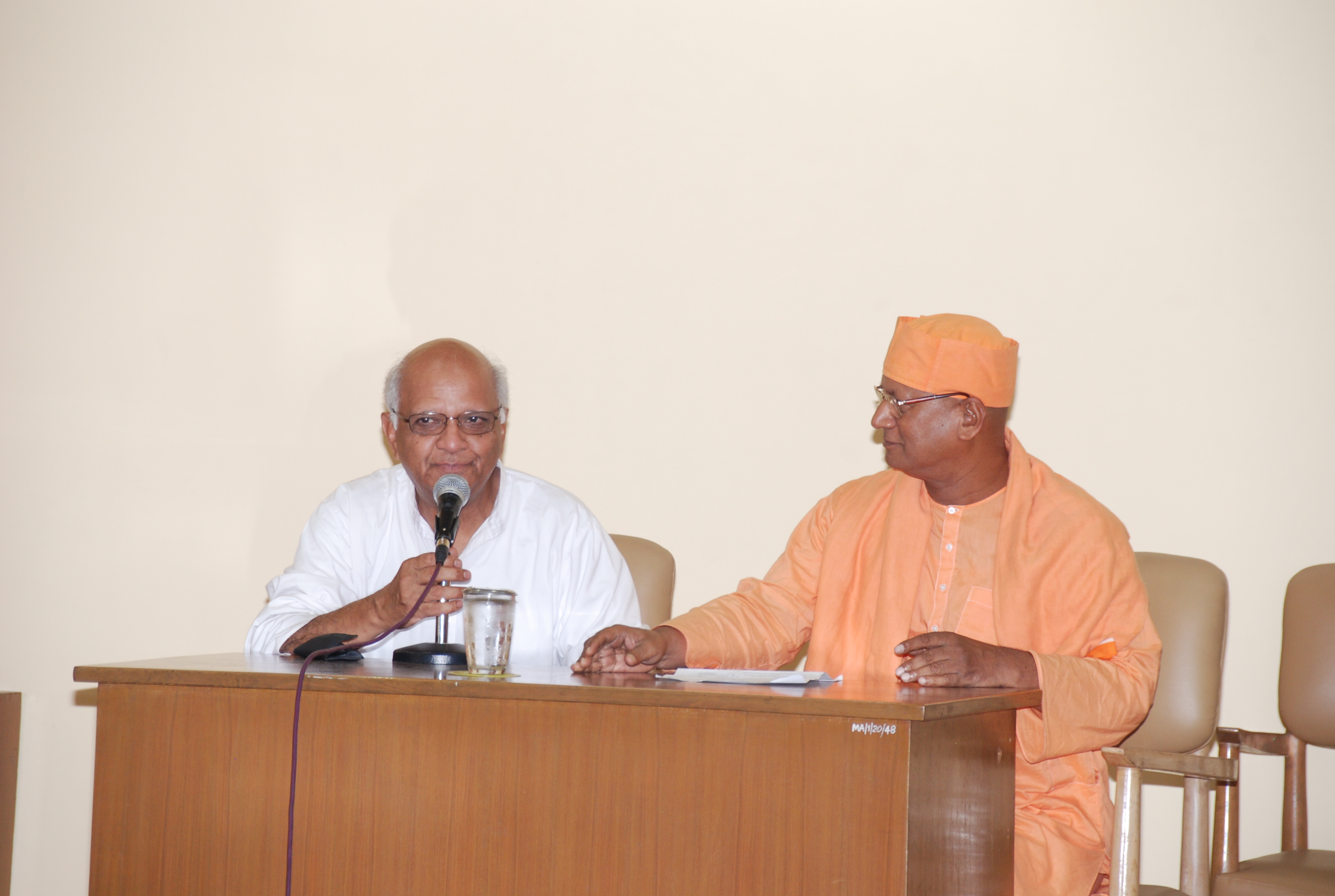
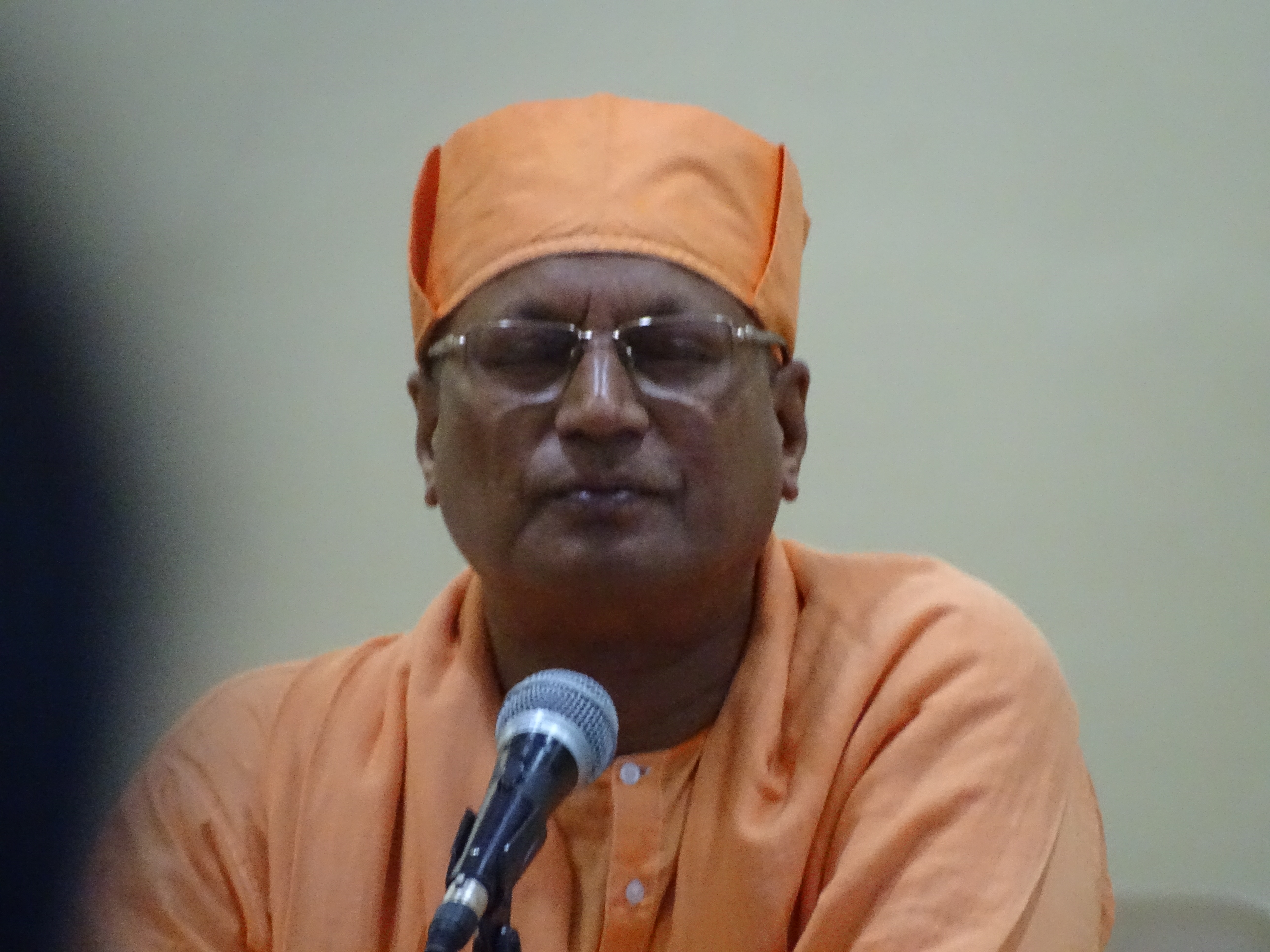
Two chairs and a table were set on the stage.  Finally, the hall started cooling down and Rev. Swami Suparnanandaji, the Head of the Ramakrishna Mission Institute of Culture, arrived.  He asked Uncle to sit on the second chair next to him on the stage.

12 13

14

Uncle introduced Rev. Swami Suparnanandaji and thanked him for giving his valuable time to share his thoughts with us. Rev. Swami Suparnanandaji talked about the importance of having a spiritual guru as well as practicing meditation and pranayama to help us manifest that divinity within. He further discussed how we think we are seeing with our eyes but actually we are seeing with our minds. That is why in the dream state we are not looking at the dream with our eyes but with our minds. Hence, if we have a pure mind we can see things in their true nature.  Rev. Swami Suparnanandaji asked if Dr. Vandana Jani (Aunty) was in the audience.  Finding that she had not accompanied the group to come to India, the Swami jokingly said that is the reason why Dr. Mahendra Jani (Uncle) is very quiet 🙂

After Rev Swami Suparnanandaji spoke, Rev. Tapan Maharaj quickly took us to a room where tea and some refreshments including a pound-cake were ready for us.  We all enjoyed the snack and came outside the building where the buses were waiting for us.  Rev. Tapan Maharaj personally came in the bus to tell us come again! We were moved by his infinite love for us.  He waited until all the buses left.

16 17

We were supposed to go to Hyatt for a small break.  But, it was getting late and we decided to go straight to Yogodyan.  We were worried that it was going to be a long day without a break.  But, to our surprise, all including young children were in good spirit and were ready for Yogodyan.

Yogodyan:

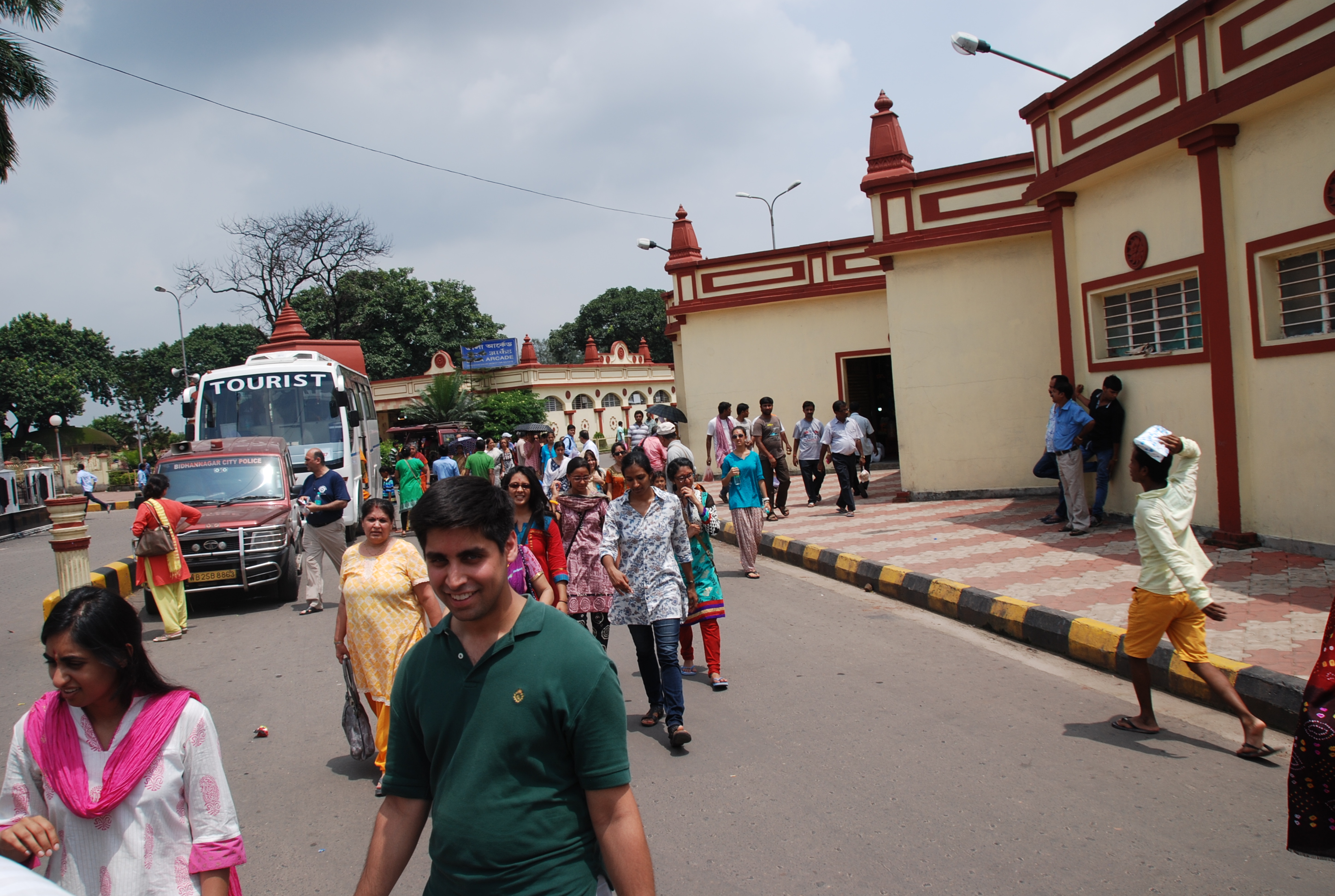
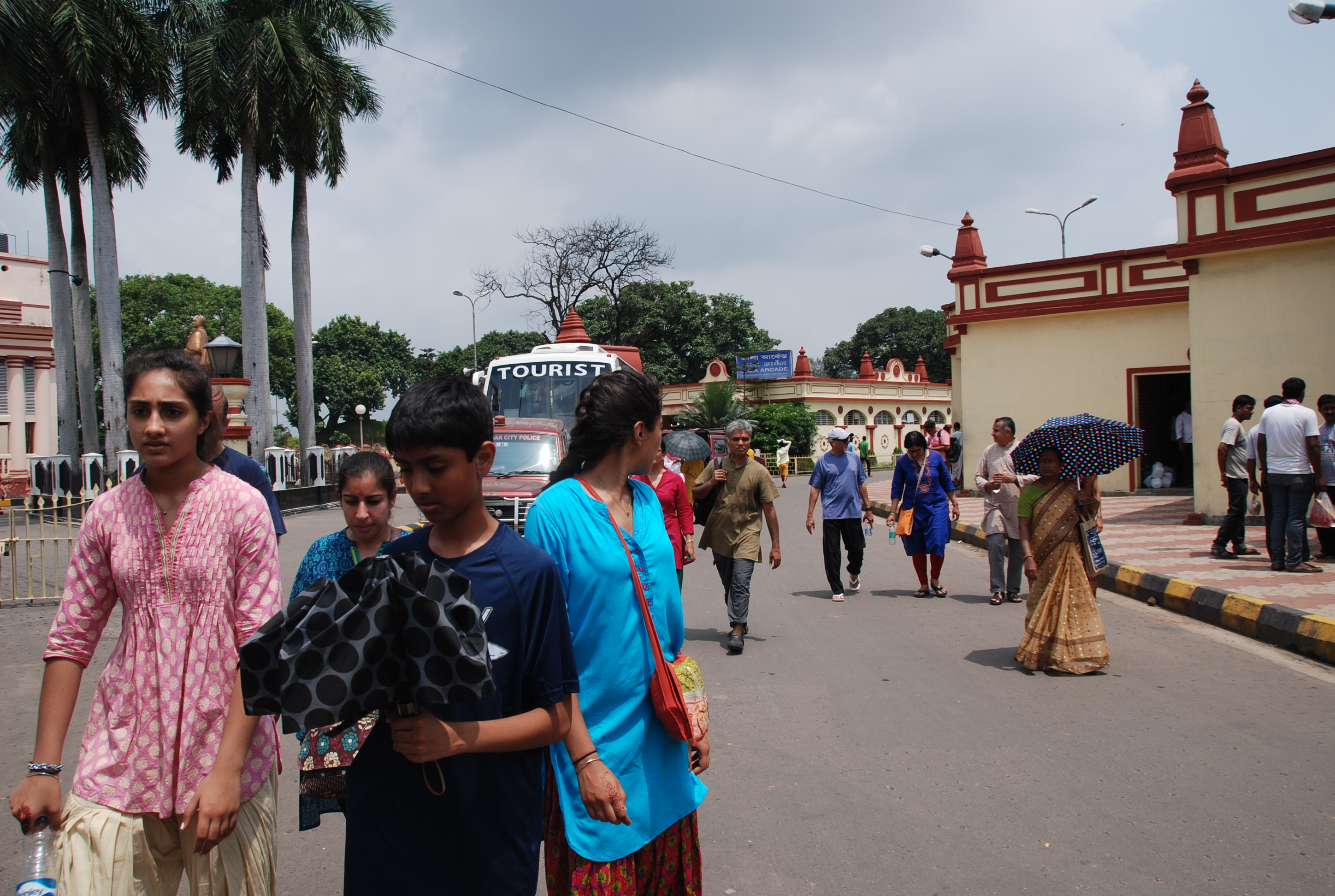
The bus ride to Yogodyan was not long.

knr_gav

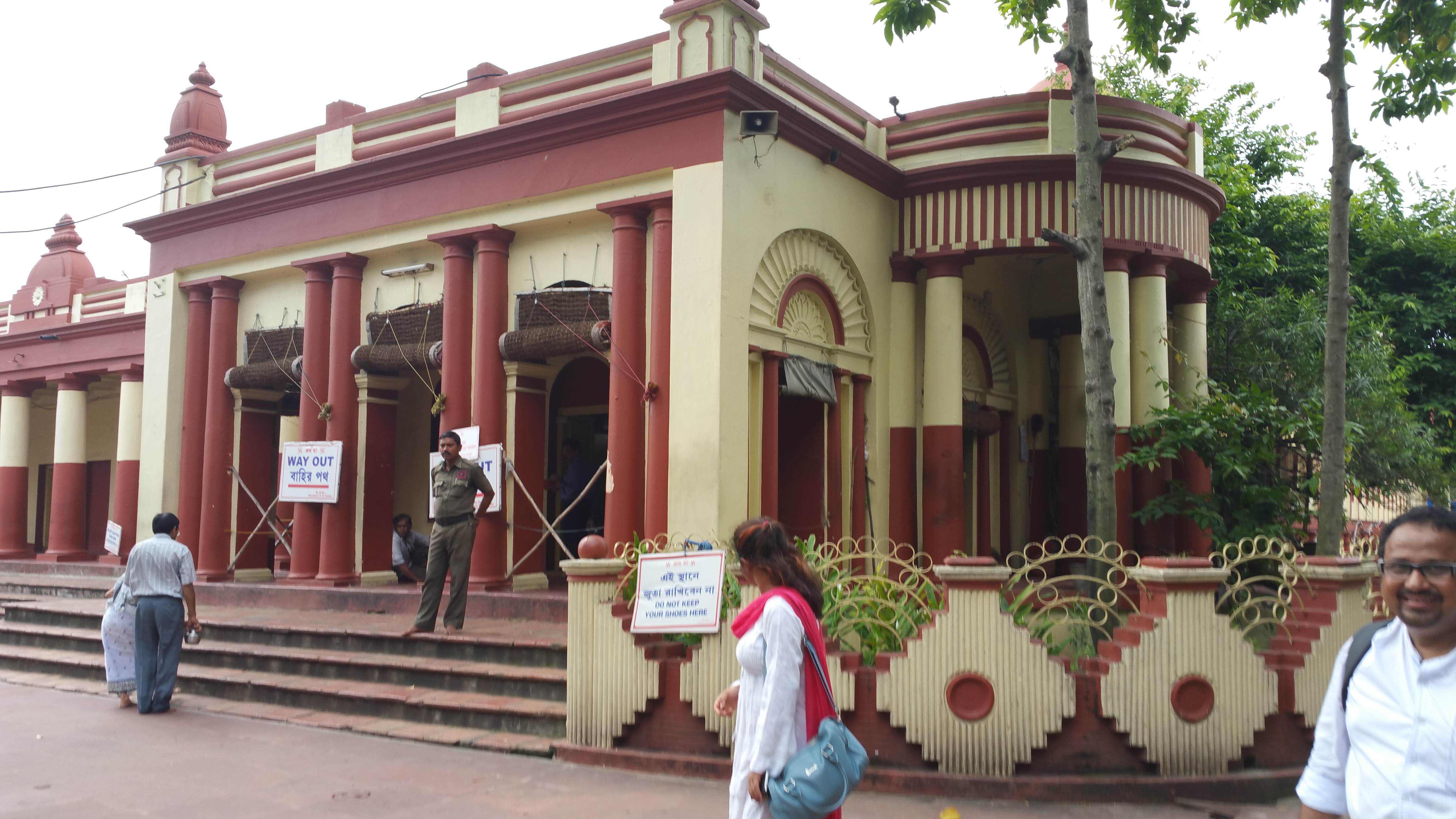
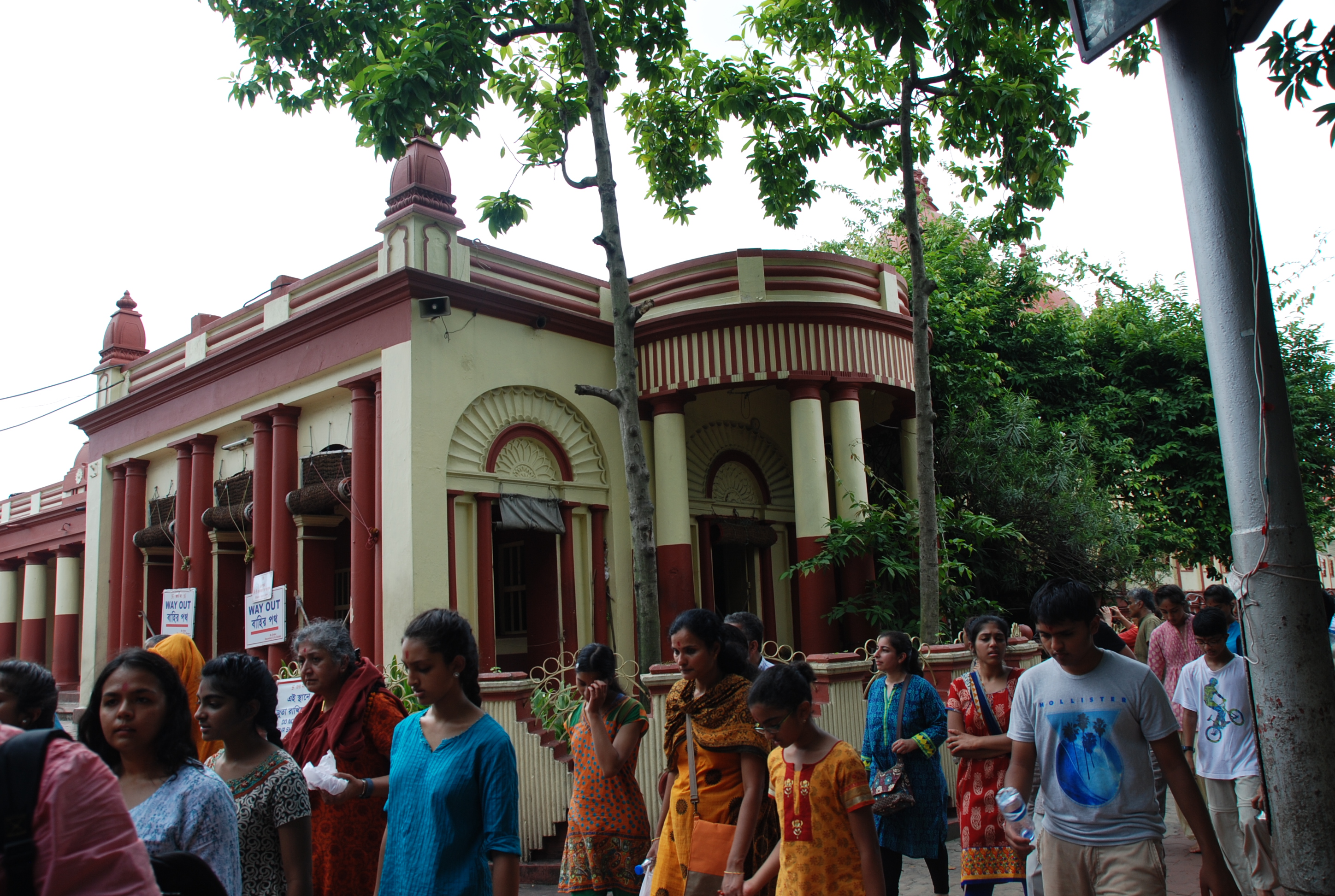
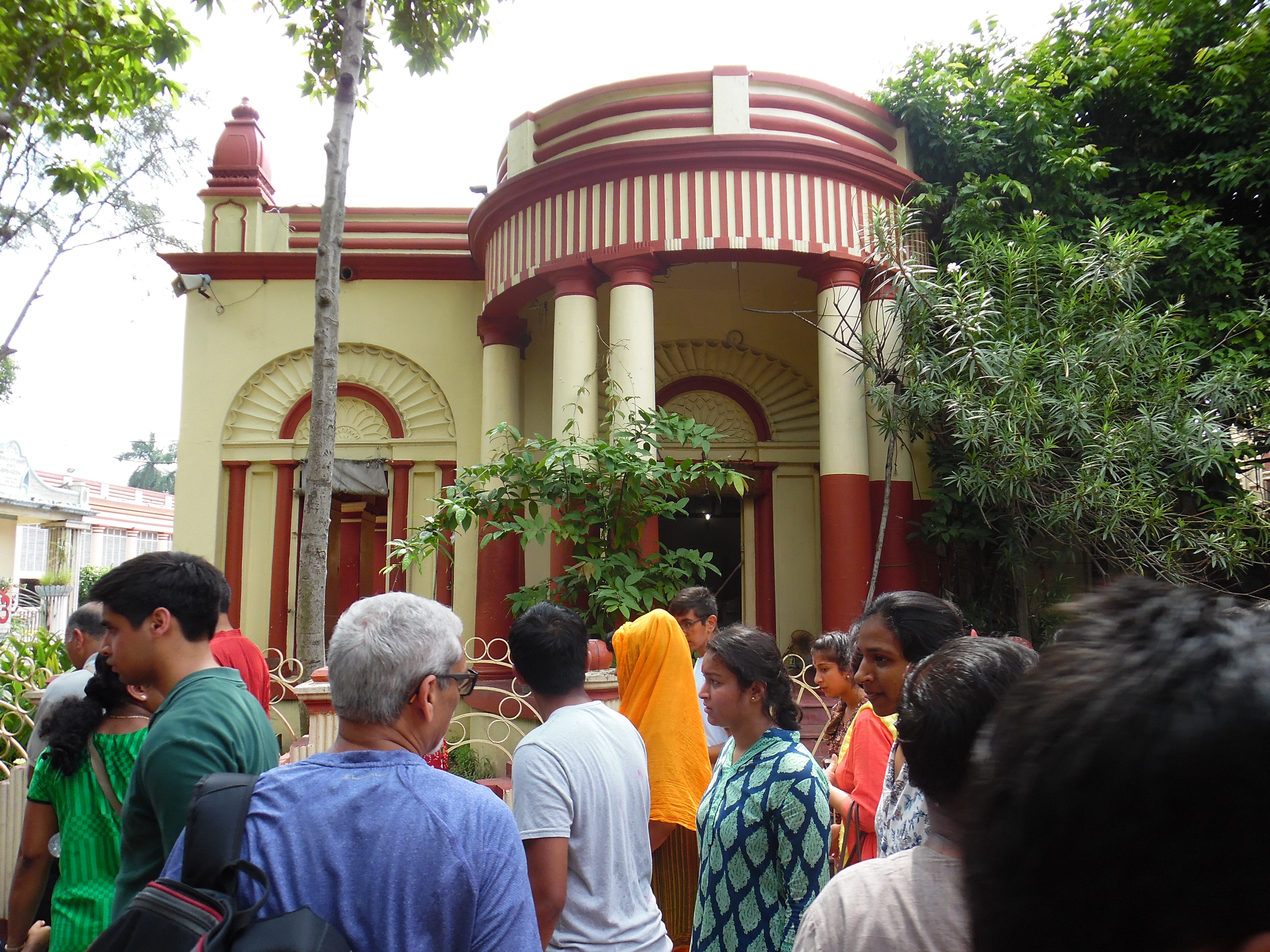
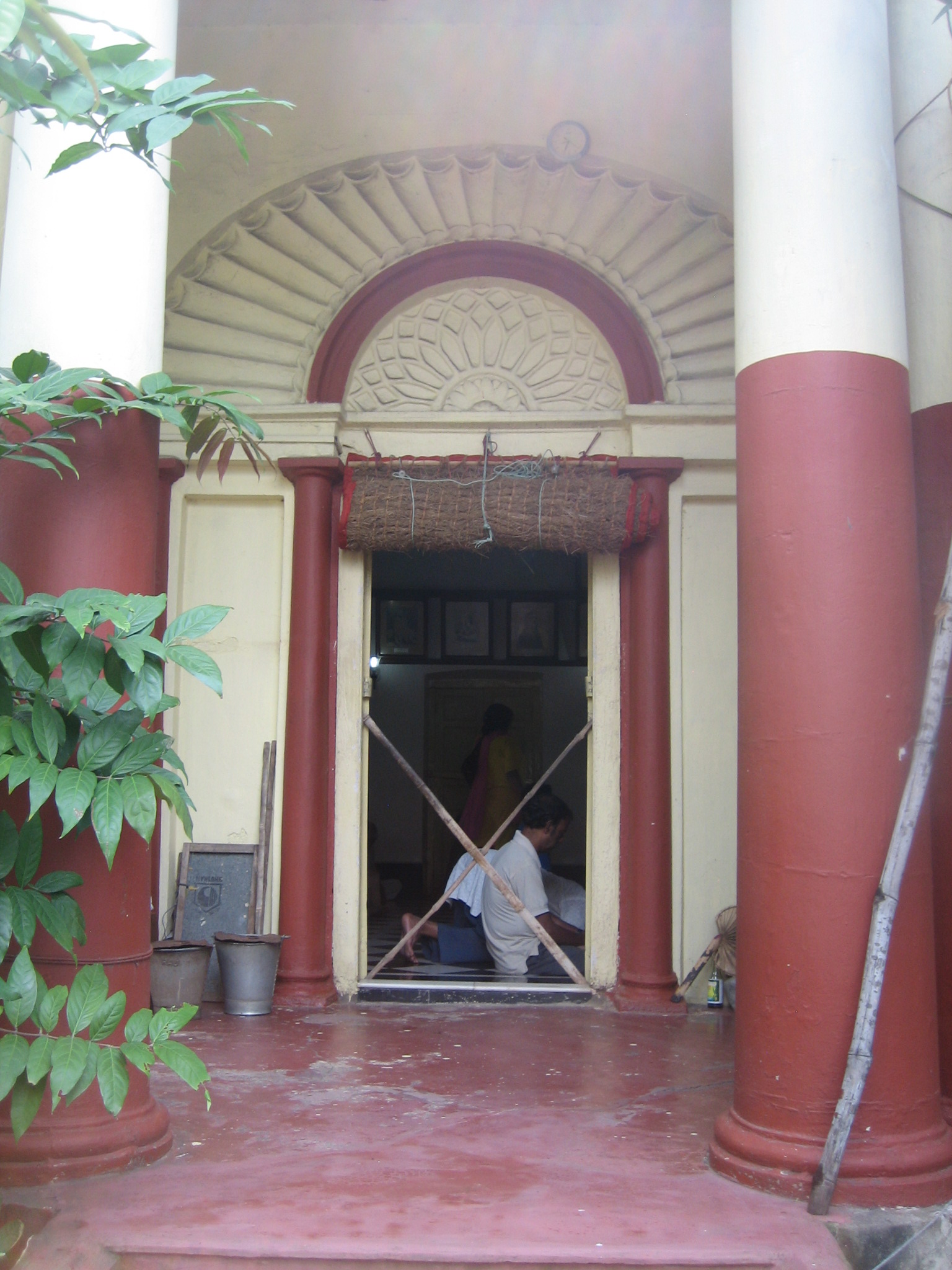
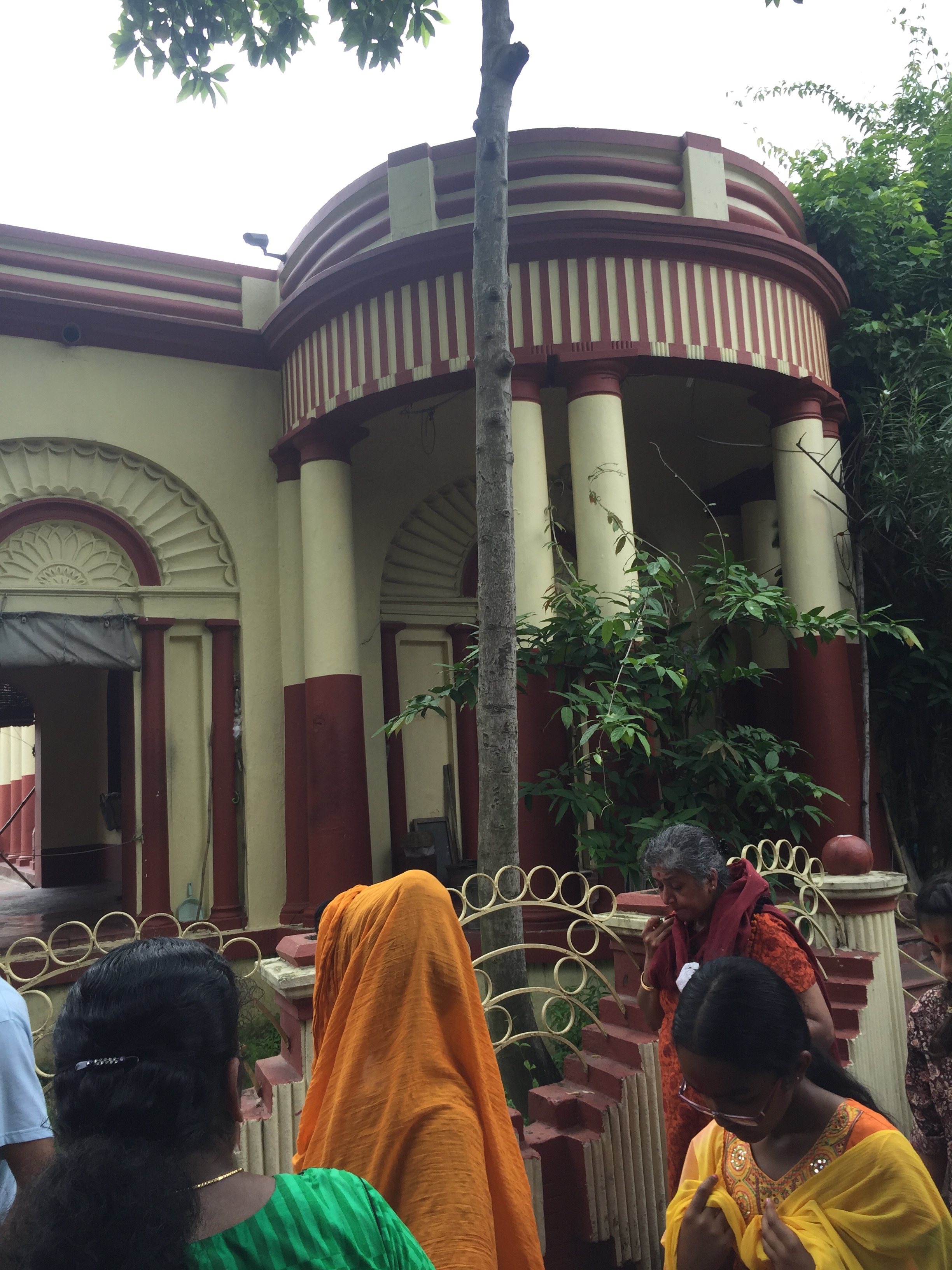
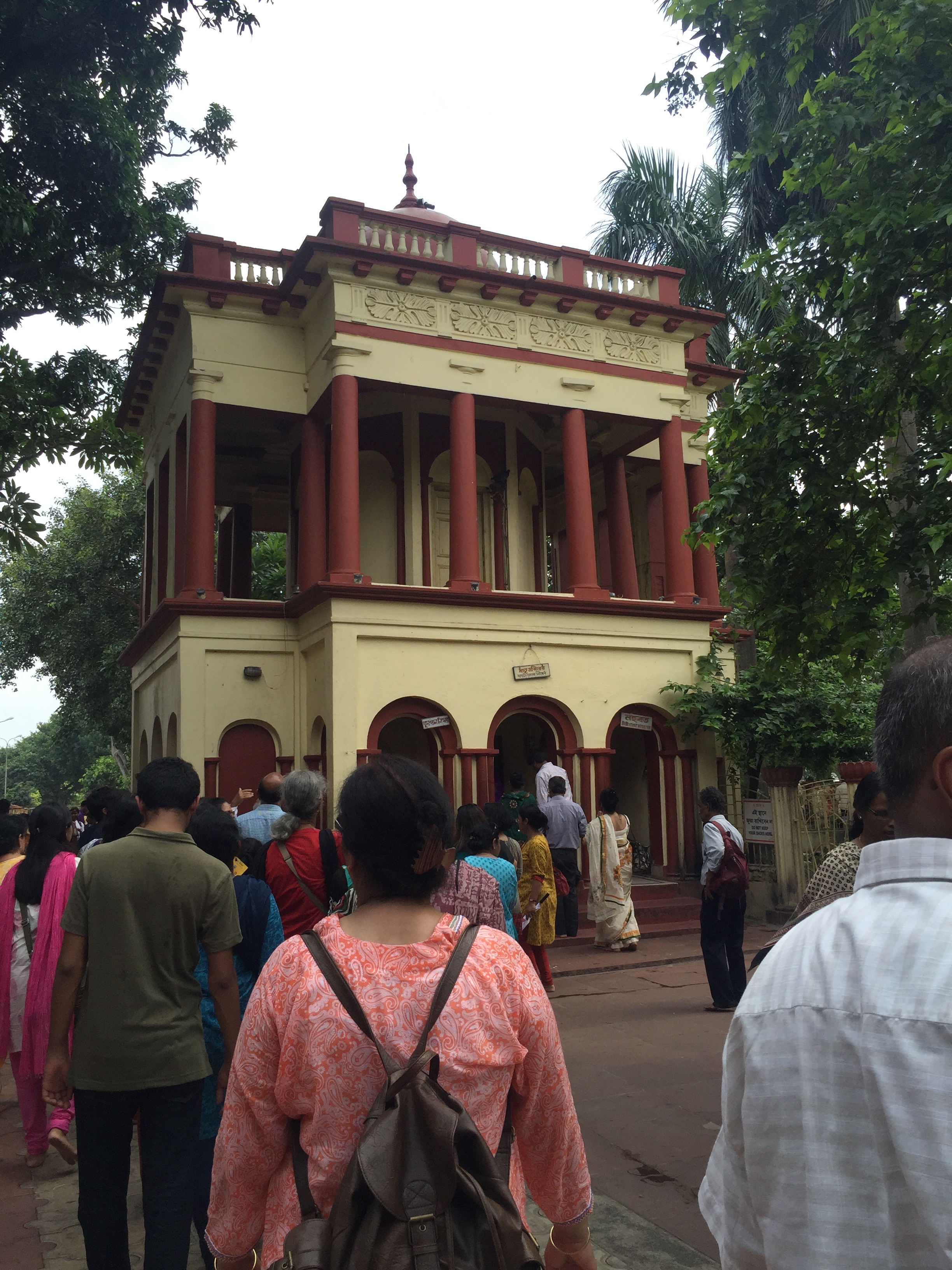
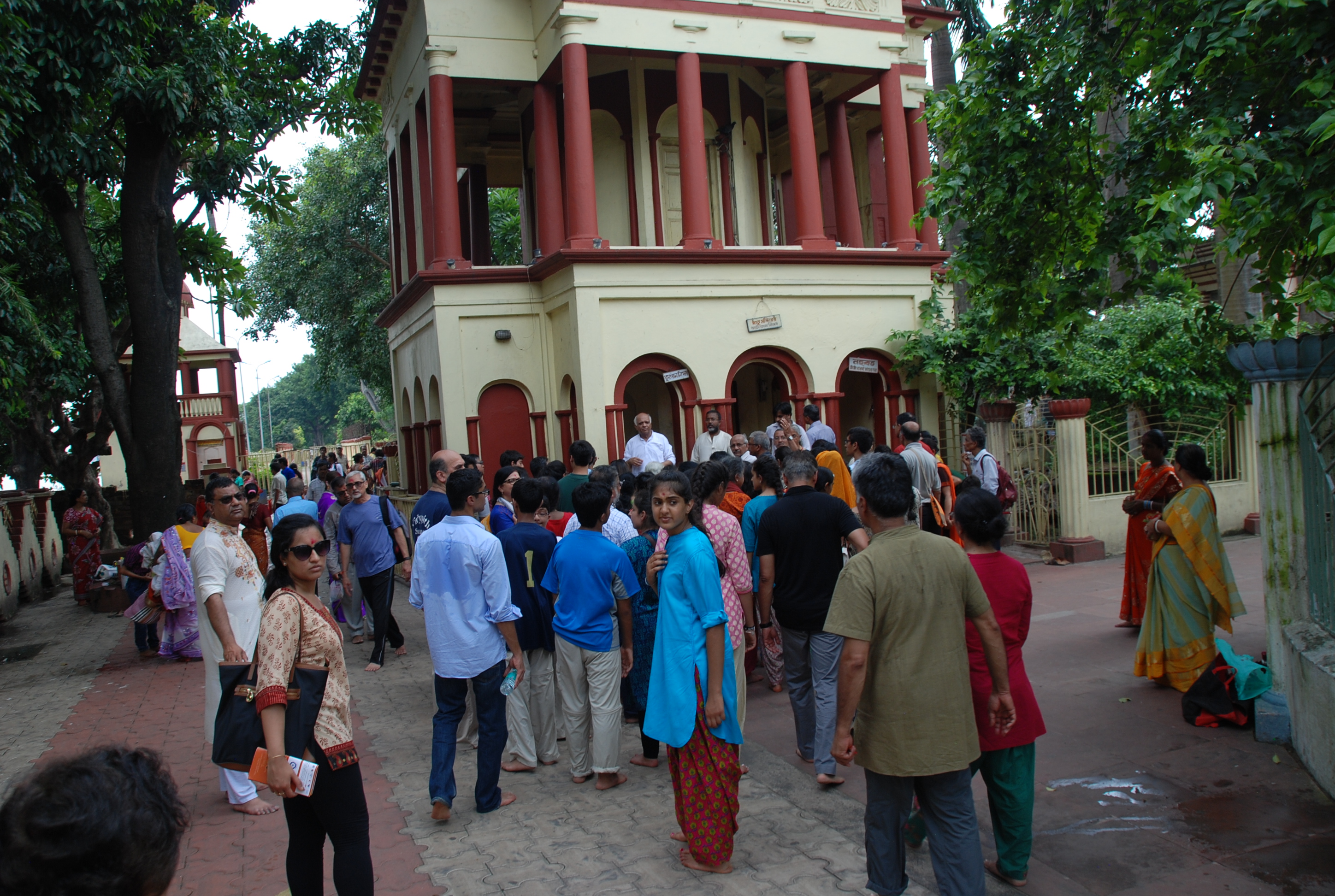
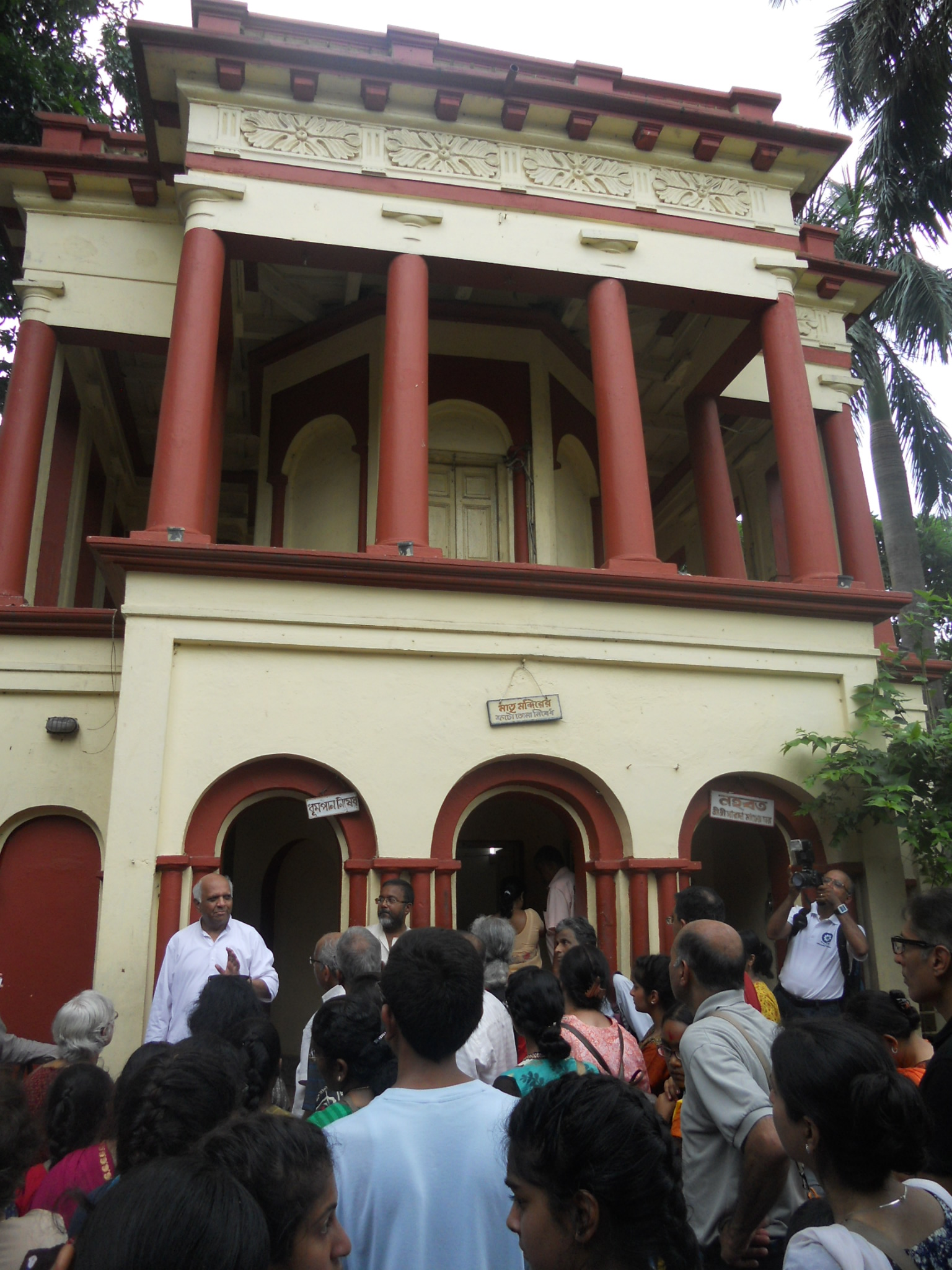
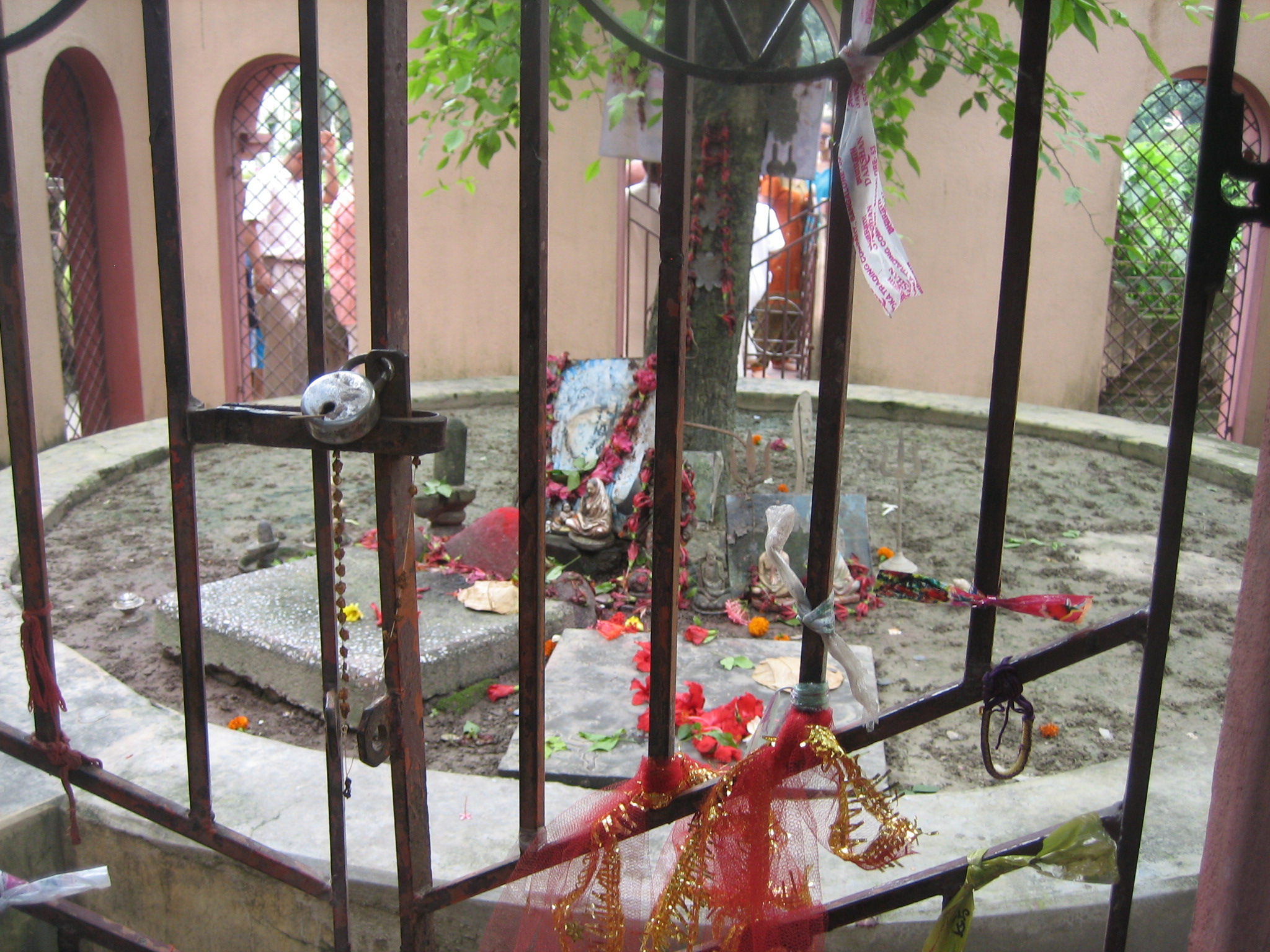
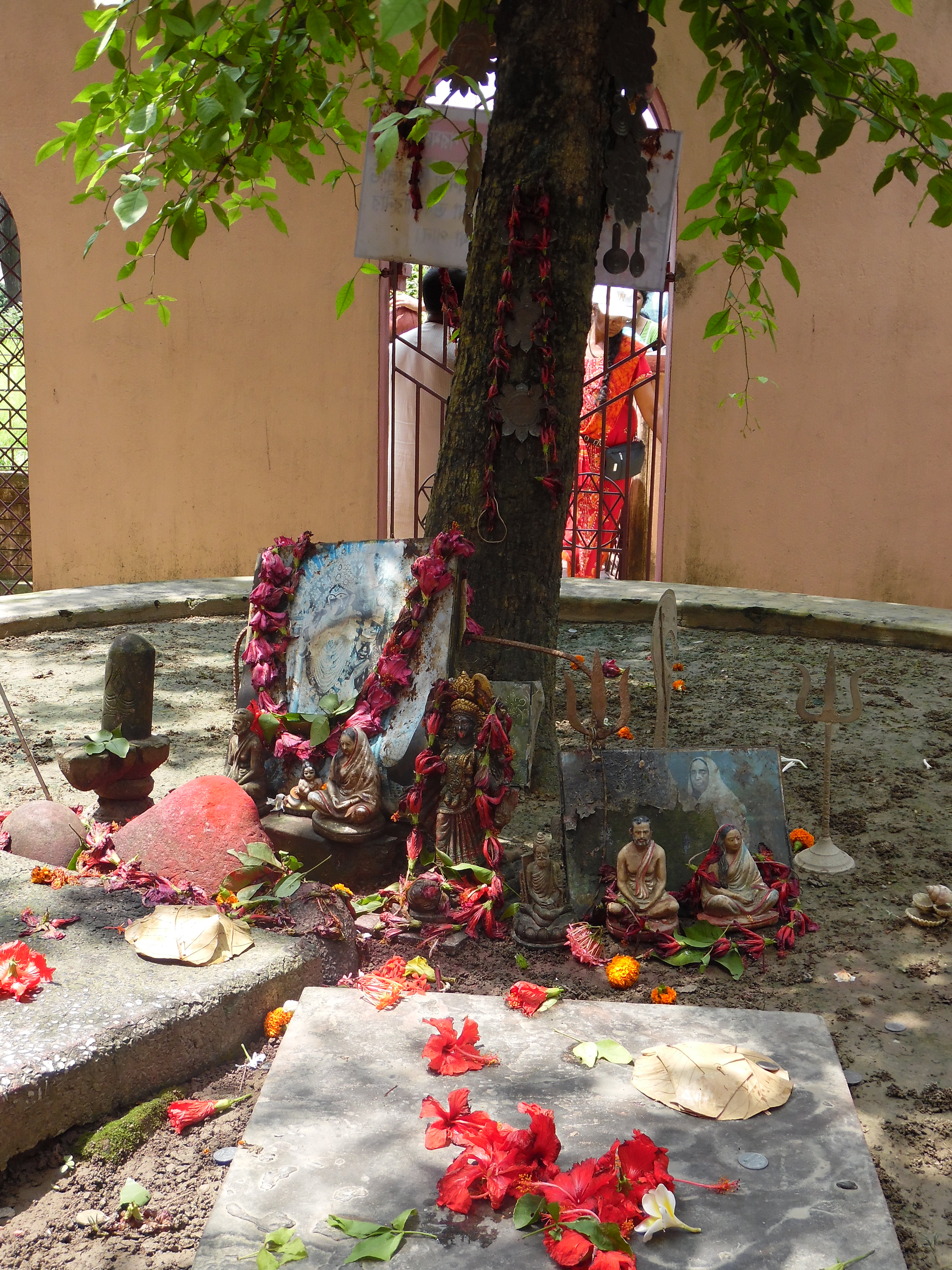
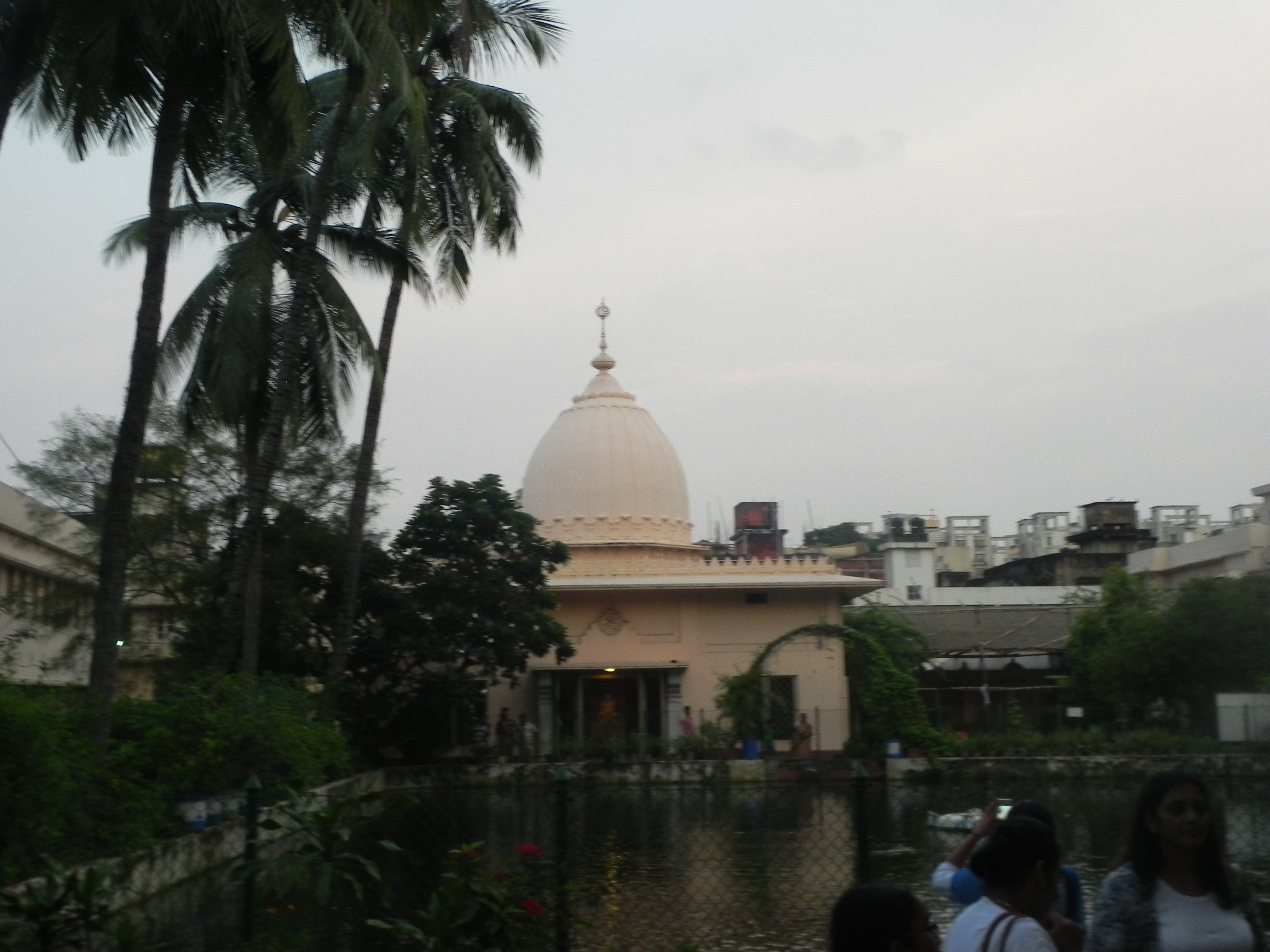
Yogodyan was originally a garden house (like a retreat home) of Ramachandra Dutta, a great householder devotee of Sri Ramakrishna.  He was the instrument to introduce many youngsters and devotees to Sri Ramakrishna.  On Wednesday, December 26, 1883 Sri Ramakrishna visited this house.  He liked the place and said that “It is a fine place.  You can easily meditate on God here.”  Sri Ramakrishna sat in one room of the house and had taken refreshments.  At this spot, some of Sri Ramakrishna’s relics were kept in the ground and the present temple was built here.  Holy Mother Sri Sarada Devi, Swami Vivekananda and other disciples of Sri Ramakrishna had visited this place several times.

18

On our way from the bus to Yogodyan, we saw the Charitable Dispensary run by Ramakrishna Math, Yogodyan.  Two Revered Swamis of Yogodyan, Swami Shivapremanandaji (Shiv Sankar Maharaj) and Swami Sarvasukhanandaji (Tilok maharaj), welcomed us lovingly and took us to a recently new building of Yogodyan where underprivileged students had opportunities to learn computer programming.

19

Swami Vivekananda’s chariot:

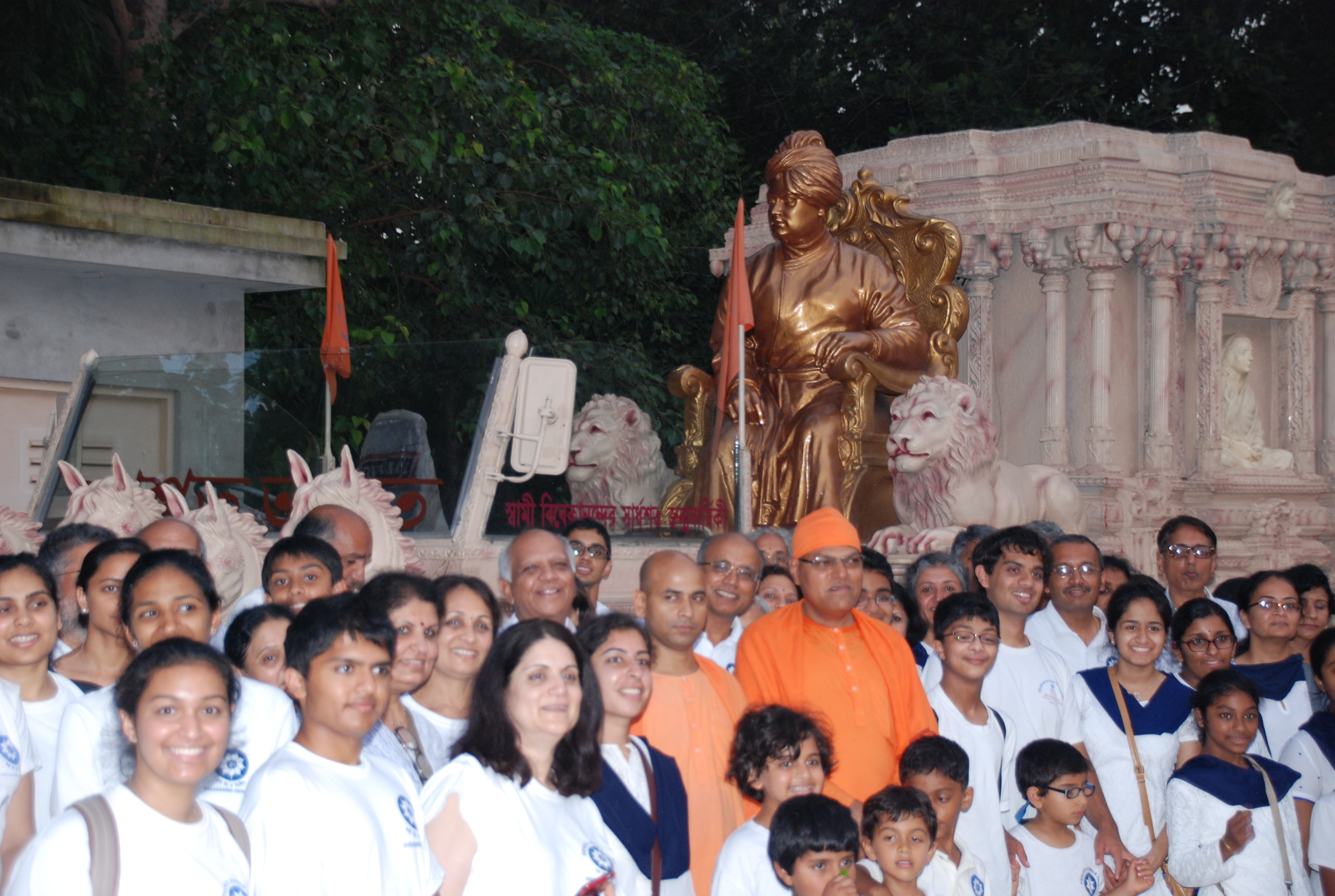
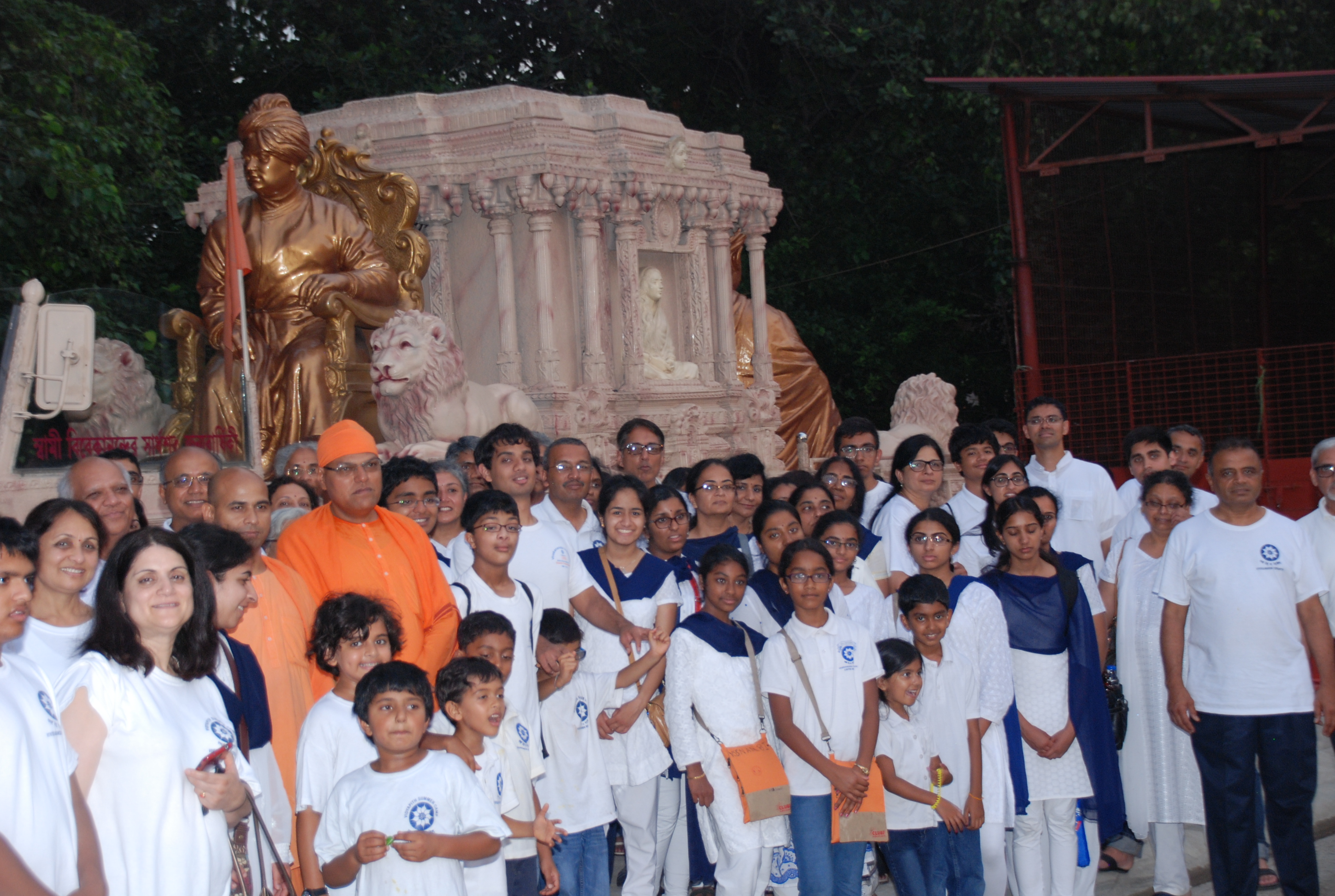
Then, as we walked towards Yogodyan’s temple, we saw a motor-running chariot with very majestic statue of Swami Vivekananda sitting in a throne-like chair.

SV Chariot

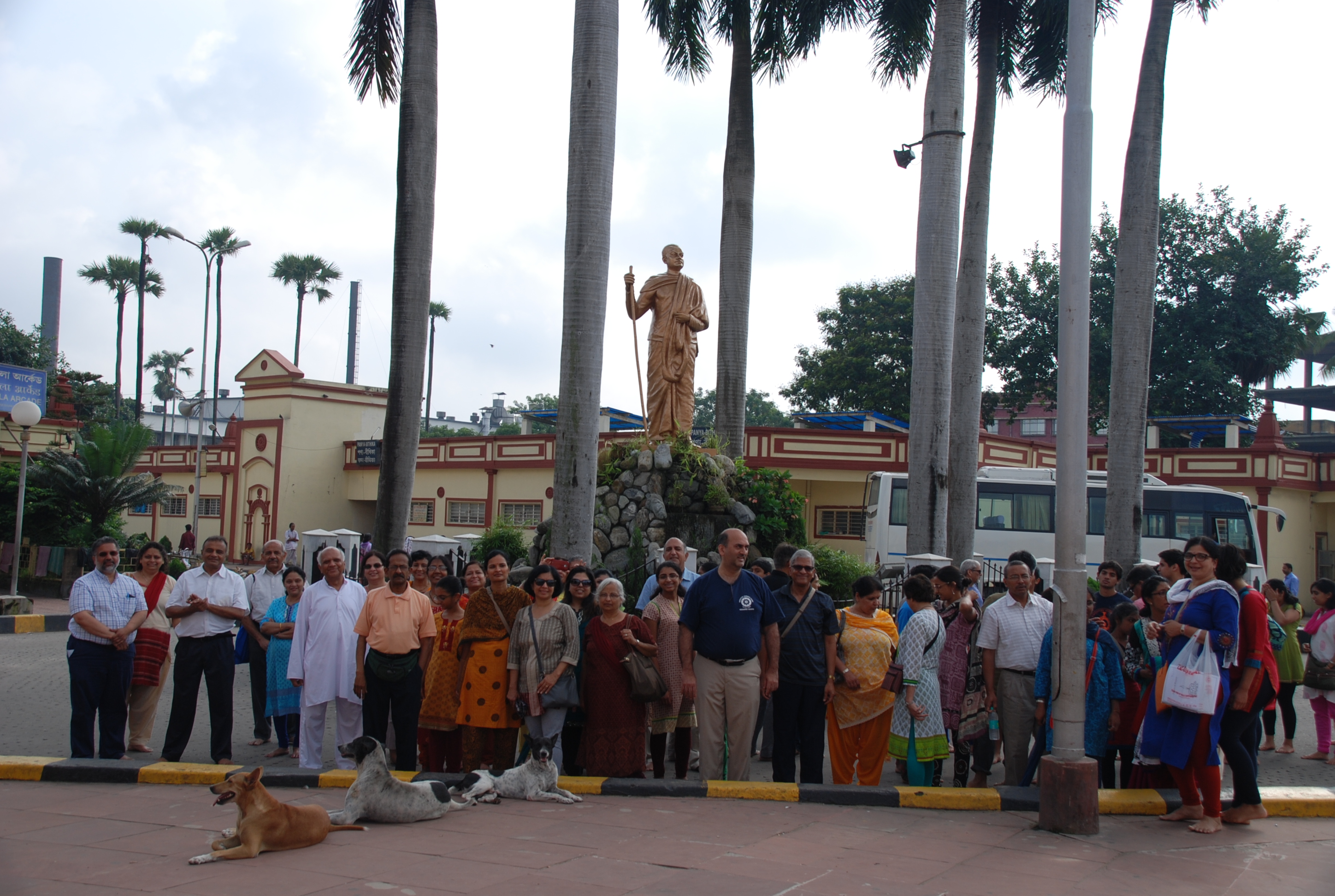
During Swami Vivekananda’s 150th birth-anniversary celebration, this chariot had traveled all over West Bengal.  All of us were attracted by grandeur of this chariot and thought that it is a great idea to take a group picture in front of it to capture this moment in our life-long memory.

20

2122

24 25

26(2)

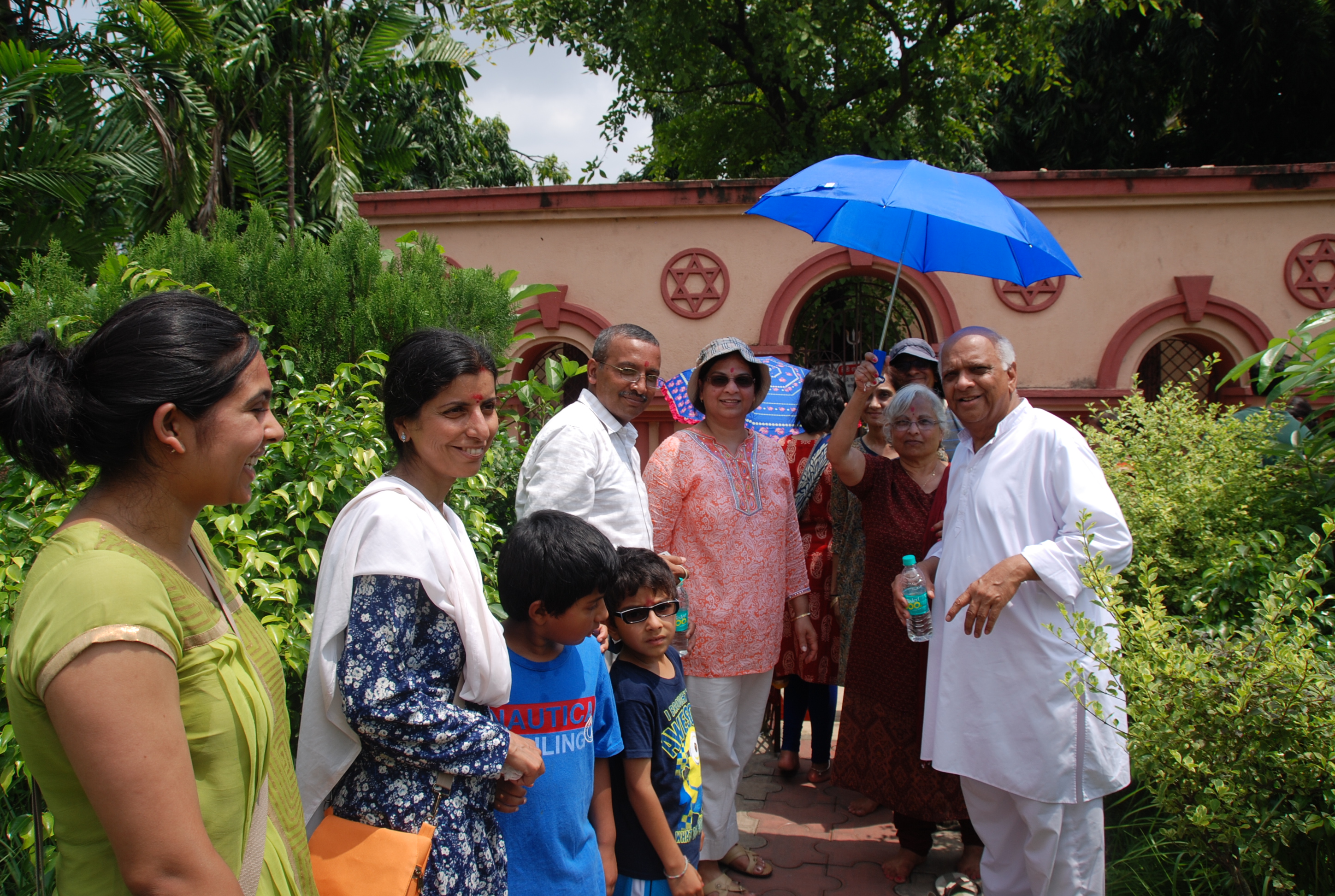
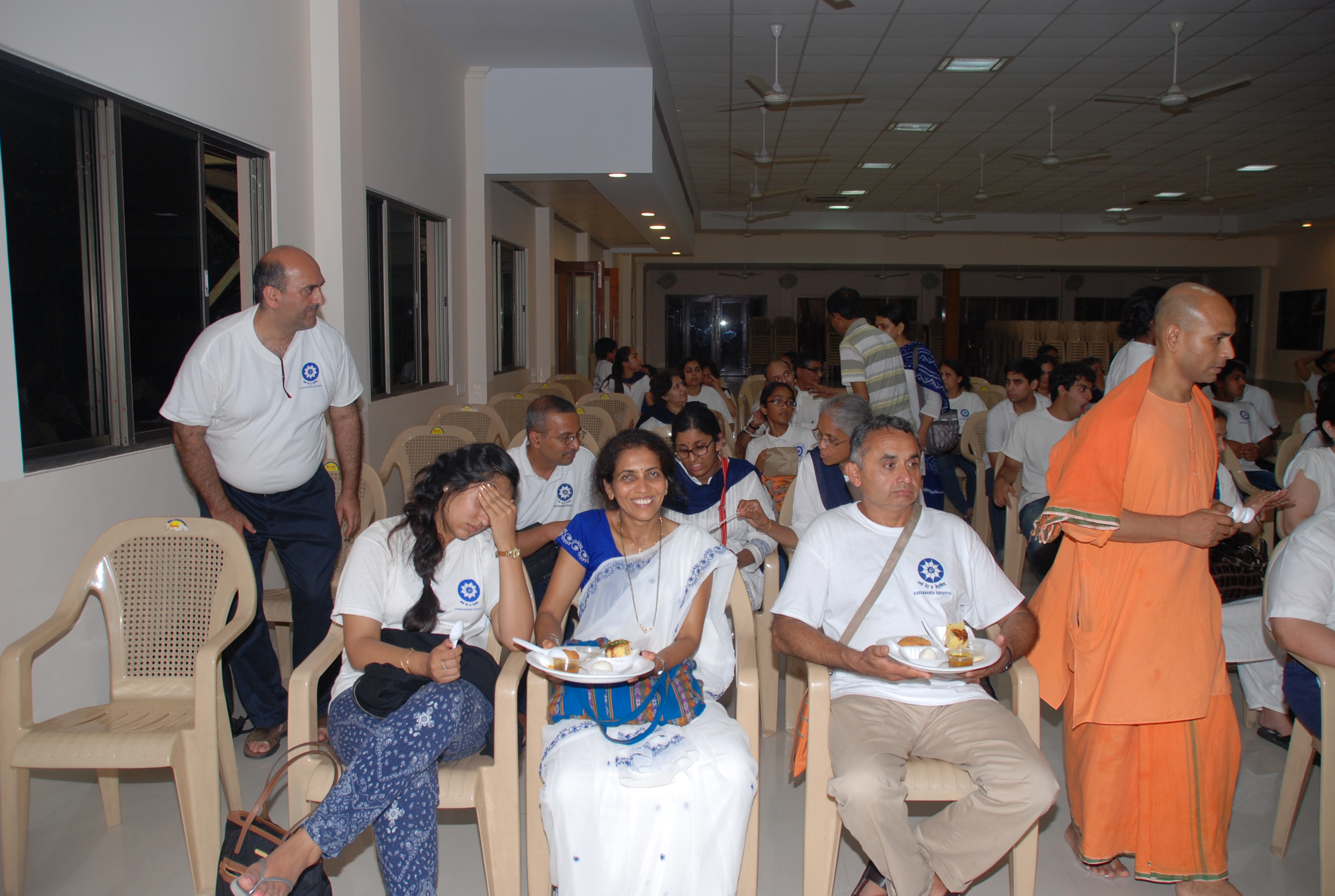
After our picture, the Swamis took us to a reception hall where refreshment including freshly made “Khamans,”  “Sandesh,” soft drinks, water, and tea were ready for us.  Rev. Swami Pradhanananda (Suhas Maharaj) had taken care of our refreshments. Many enthusiastic volunteers lovingly served us.  The Swamis made sure that we all were served to our full satisfaction.  Here again, the Swamis had gone out of their way to welcome us and with so much love and care kept all the refreshments ready for us.  We felt nothing but the grace of Thakur, Maa, and Swamiji.

26 27

Arati:

Altar

28(2)

Now it was time for evening arati at Yogodyan. As we sat in the prayer hall, we found several students with white uniforms (dhoti, kurta, and a wrapper) nicely sitting in front of the altar.  It was like Vivekananda Vidyapith’s prayer hall.  A few of the students were taking care of the sound system and the instruments going to be used in the arati.  One little boy (most likely a 3rd or 4th grader) came with a stick and a small gong that he was going to play.  He carefully put the gong in the exact place which was designated for it and sat in a prayerful posture.  We soon realized that all of the students were sitting in prayerful posture.  We learned that these are the students of Vivekananda Balak Sangha (Vivekananda Group of Young Boys).

images

Arati began.  The singing of arati was mainly conducted by the students.  There was a professional mridangam player accompanying the singing.  The singing of arati was similar to the Belur Math arati singing.  The slow paced singing of “Khandan Bhava Bandhan…” was followed by a fast pace of the whole “Khandan Bhava Bandhan…”   and “Namo Namo Prabhu…”  Those who were observing the students found that the young boy with the gong never missed a beat! They then sang “Om Hri Ritam…” and “Sarva Mangal Mangalye…” All of the Vivekananda Vidyapith pilgrims enjoyed the arati as they knew the words.

29 28

After the arati, Rev. Shiv Sankar Maharaj asked us to sing something.   As an offering of our own, with Uncle leading us, the Vidyapithers sang “Jaya Vireshwara…” accompanied by the skilled mridangist from the Mission.

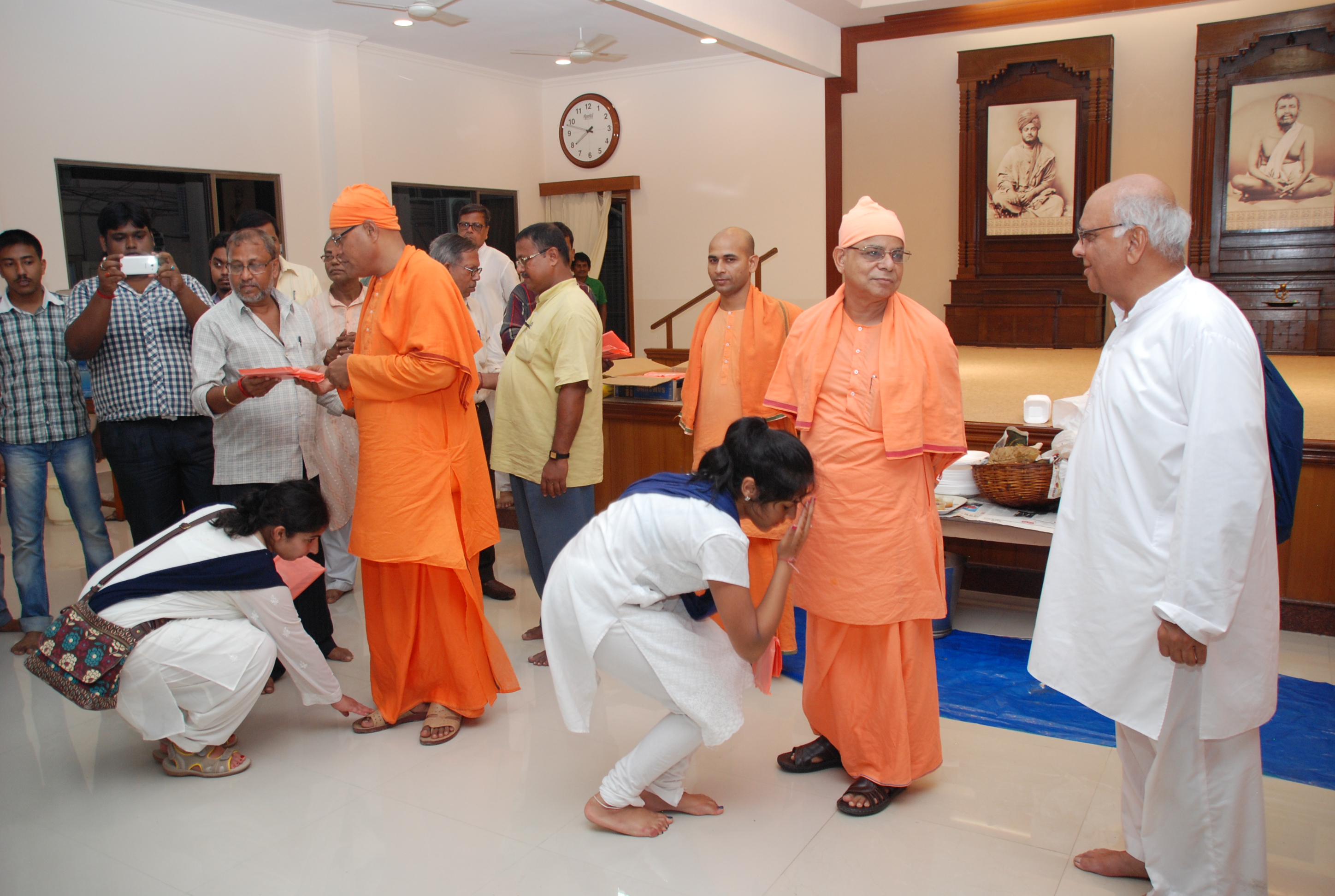
After saluting Thakur, Maa, and Swamiji, we all gathered again in the hall to take a leave of the Swamis.  To our surprise, we found that they had gift ready for each individual of Vivekananda Vidyapith.  Uncle had requested Swaami Nityamuktananda (Ganesh Maharaj), Spiritual Head of Ramakrishna Math, Yogodyan, to bless us all.  He was kind enough to come to the hall. He gave gifts to the remaining people and blessed us all.  Their love for all of us and joy of giving the gifts were visible on their faces.

30 31 32 33 35 37 38 39

Going to Hyatt:

40

As we came to the end of a spiritual day, we headed back to the Hyatt. The bus ride was short.  Given the long day, we thought that most of the people will not come for dinner, but almost all came and enjoyed the dinner and each other’s company.  We were physically tired, but mentally elated remembering so many uplifting moments of the day and the love of all Ramakrishna Mission Swamis.

41 42 43

After dinner, we all quickly went to our rooms for a good night’s sleep as we had to get up early the next day for breakfast and our trip to Dakshineshwar.

(The original report was prepared by Priya Parikh and Bindi Parikh.)

Belur Math Pilgrimage – 2015, Day -1 Morning

At the Belur Math

August 3, 2015

Miracle:

Most of the pilgrims woke up in the morning and kept looking at the sky.  Rain was in the forecast and it had been pouring for several days. There was one question lingering in the minds of all:  Is it going to rain today?  We were wondering if it would be a washout after all of the logistical trouble, all of the expenses, and all of the arrangements made. However, to our surprise there was not a single cloud in the sky.  Sunrise filled the sky with light. We all felt that this must be a miracle.  God’s blessings were on us.

Breakfast:

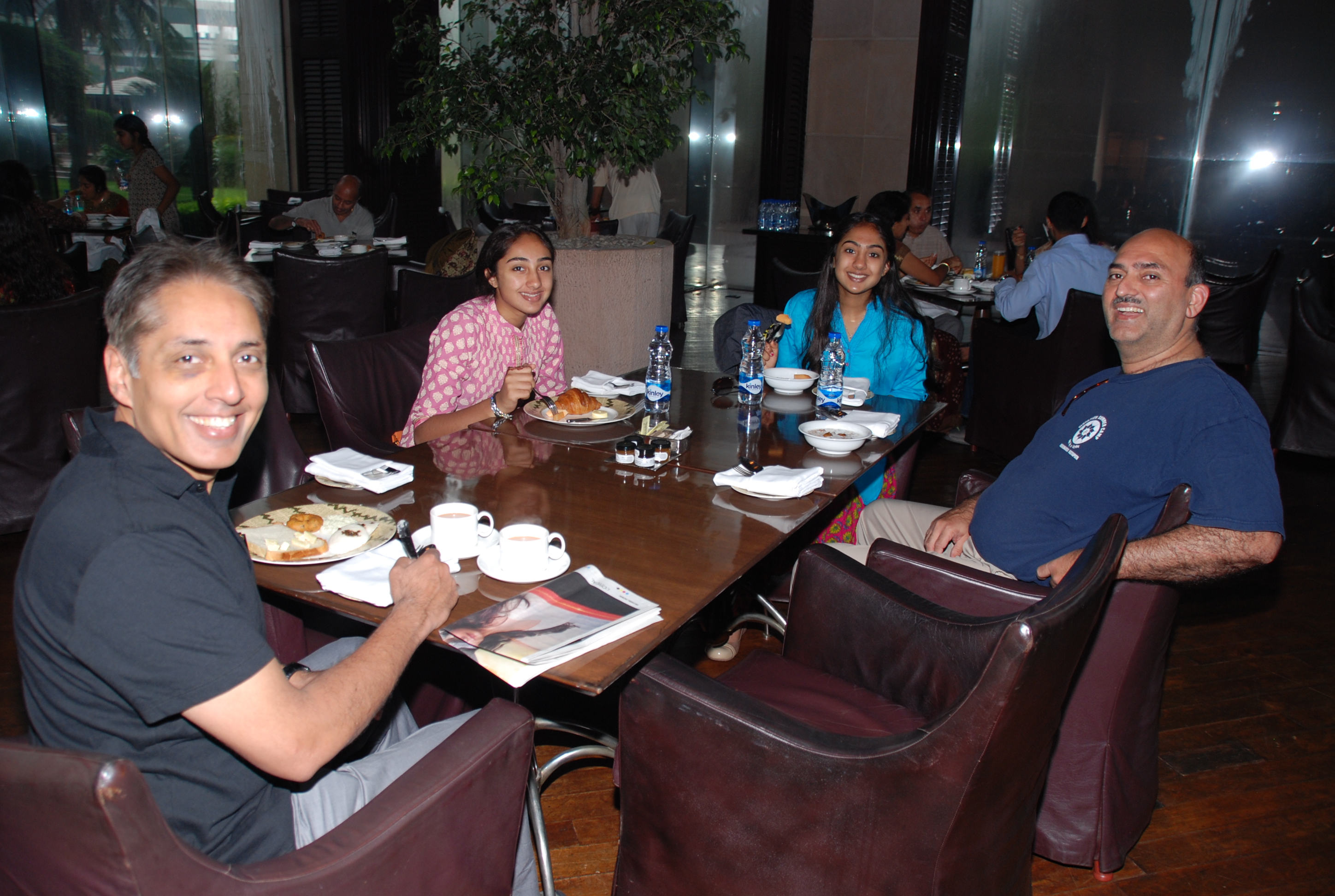
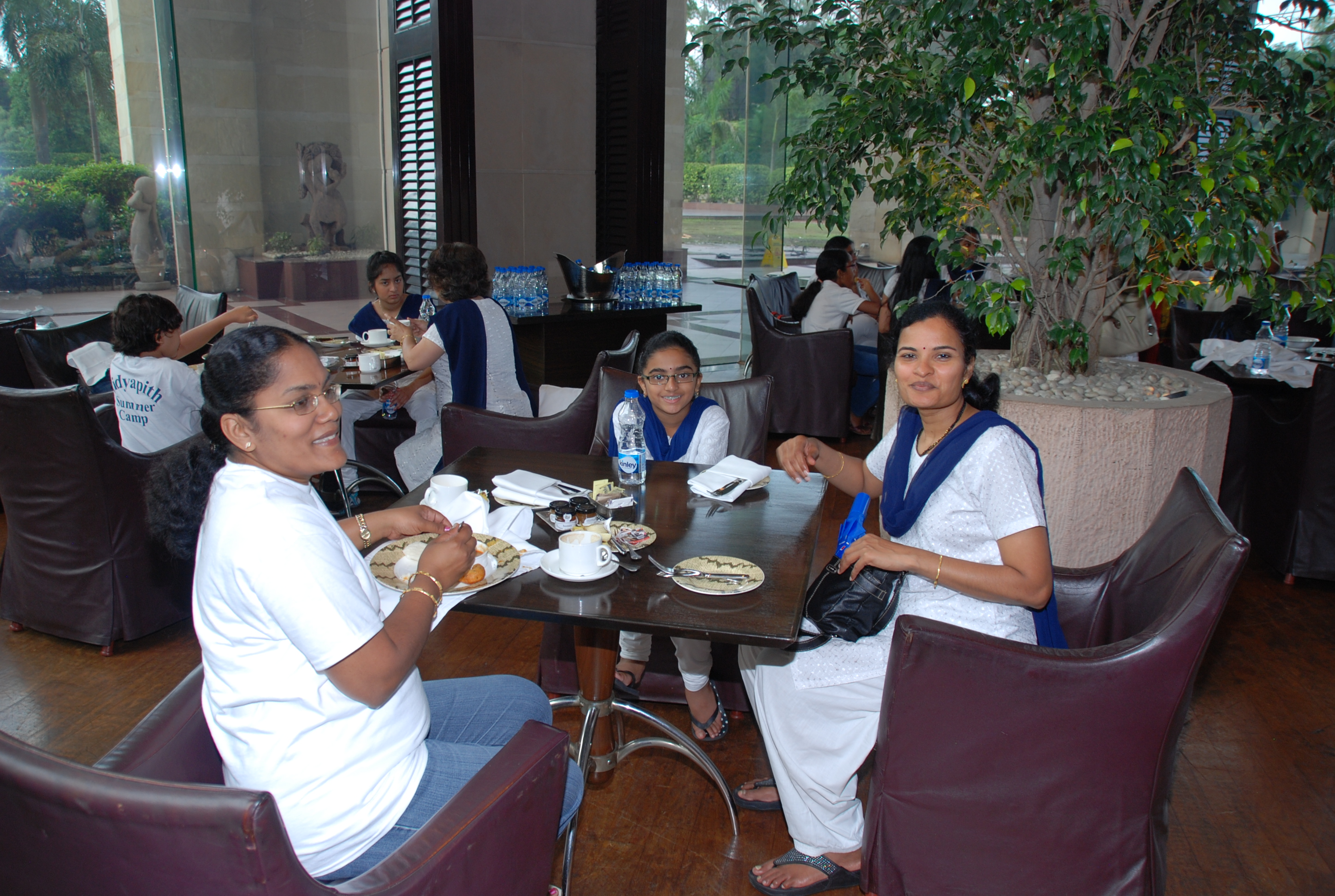
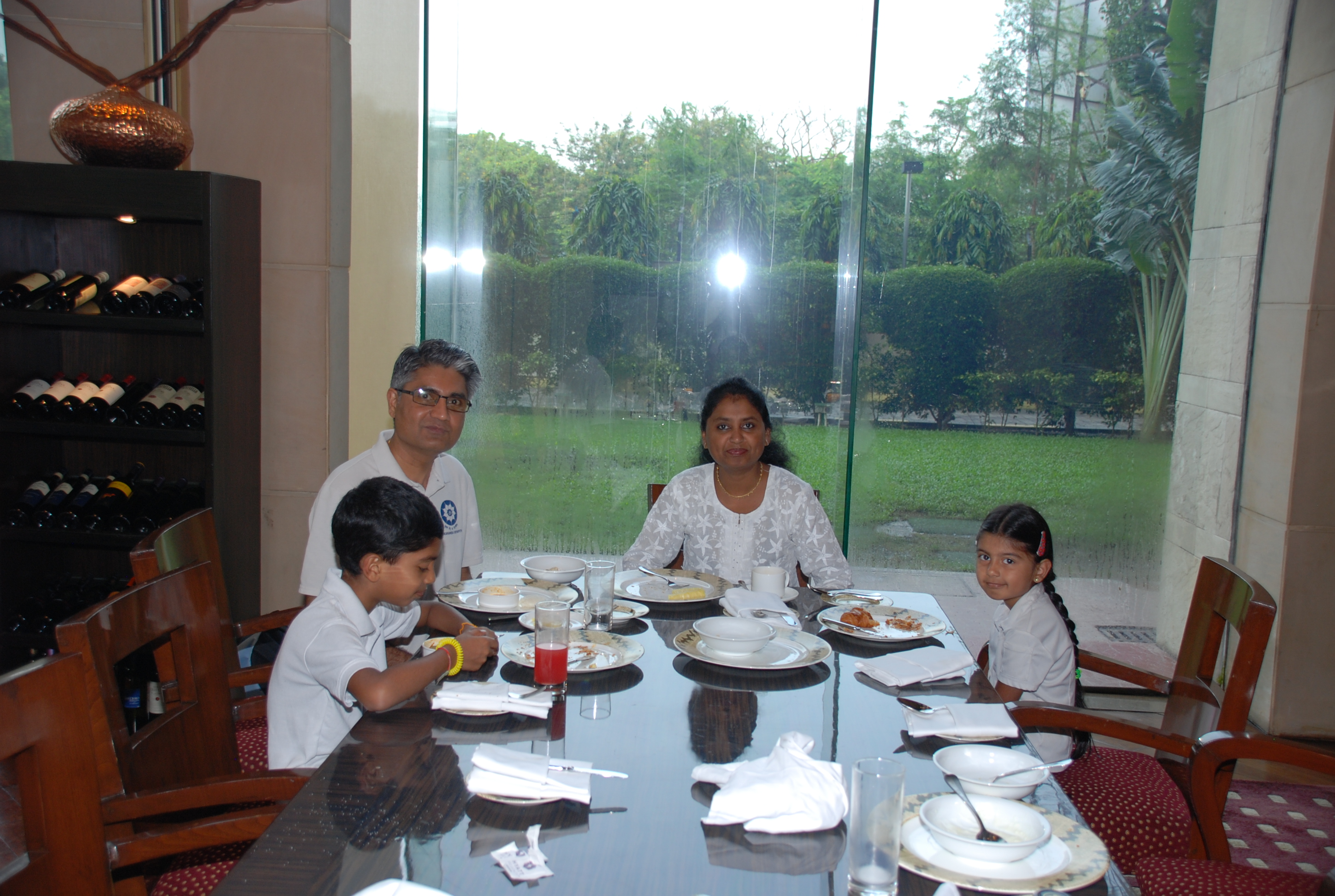
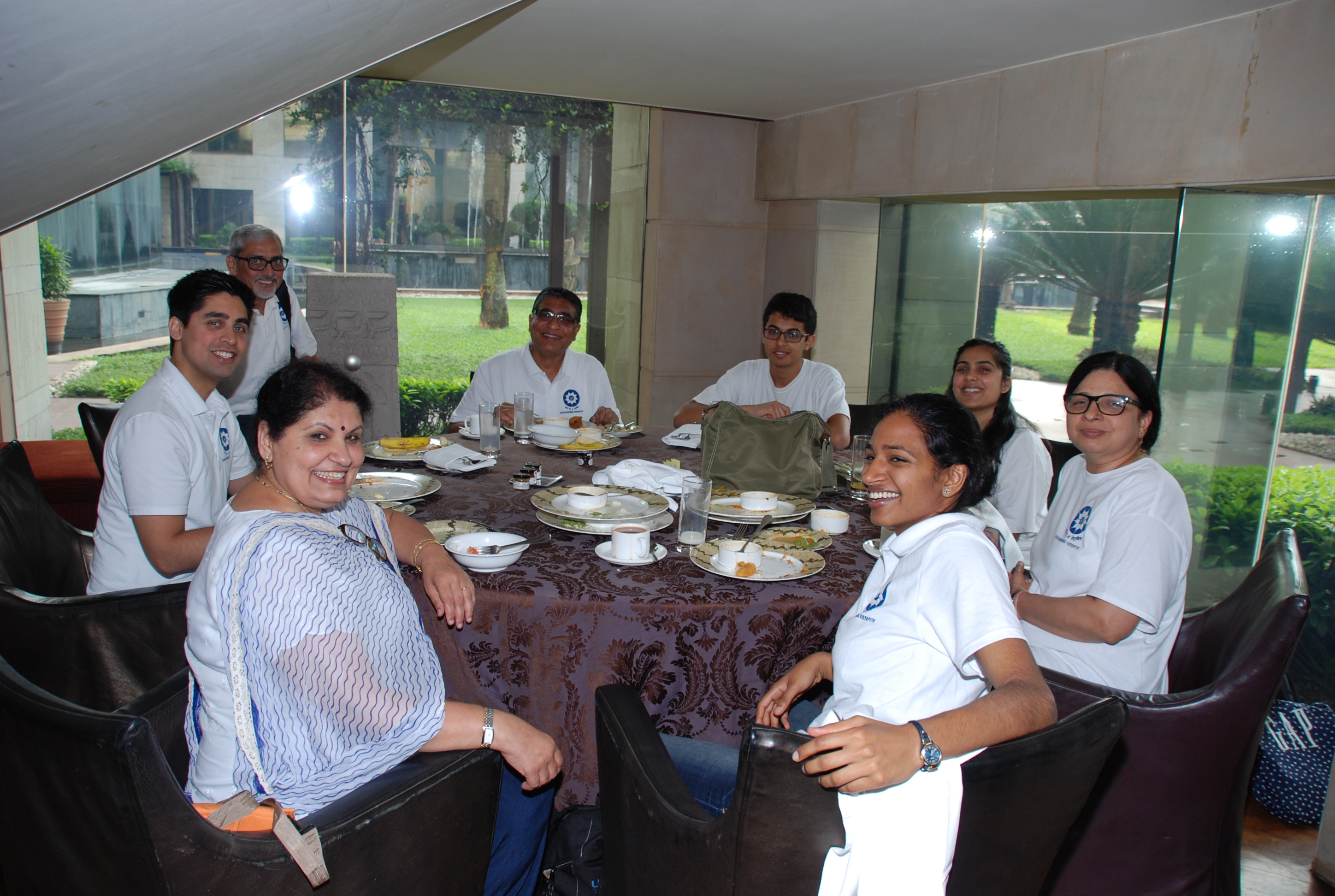
Our first full day of the pilgrimage started at an early 5:45 am. All 91 pilgrims made their way down to the Hyatt’s “Guchhi” restaurant, our breakfast location for the week. The room was a sea of white and blue Vidyapith uniforms. Our pilgrims were walking here and there excited to see each other and excited to taste the variety of items we had for breakfast. Many were still fighting off jetlag, but the aromas of dosas, parathas, muffins, and fresh fruit kept everyone energized.

DSC_9983 DSC_9984 DSC_9985 DSC_9986 DSC_9987 DSC_9988 DSC_9989 DSC_9990 DSC_9991 DSC_9992 DSC_9993 DSC_9994 DSC_9995 DSC_9996 DSC_9997 DSC_9998

On the buses:

DSC_0003DSC_0002

At 6:45, all of us gathered in the lobby of the hotel and divided into our 7 groups. Group by group, we left the hotel lobby at 7:00 and entered the luxury buses we were going to ride all week. The buses were excellent and we even discovered that seats were recliners!

DSC_0004

The group for each bus was arranged beforehand, making it was very easy for all of us to board.  As soon as the buses started, each bus gave a loud joyful cheer:  “Jai Shree Maha Mayi ki Jai!” “Jai Shree Guru Maharajji ki jai!” “Jai Shree Swamiji Maharajji ki jai!” “Jai Ganga Mayiki Jai!” “Jai Saba Santana ki jai!” Meaning: “Victory to Great Mother Sri Sarada Devi, to Sri Ramakrishna, to Swami Vivekananda, to Mother Ganga and to all the Saints!”  These cheers came from the hearts of all. We were eager to start our trip and moreover there was not a single cloud in the sky or a trace of rain. All thanked God for this beautiful weather.  Three buses now set foot for Belur Math.

The bus rides began with our Pranam Mantras, Sri Ramakrishna Suprabhatam, and our morning Vidyapith prayer.  This prepared all of our minds for this special pilgrimage.  The ride to Belur Math was about one hour long. The bus weaved through the highways and local streets of Kolkata.  Each bus had three club7 representatives:  an assistant for the driver, a tour guide, and an individual who would be in constant communication with the other buses, the main office and the destination. During the rides, we would listen to the guide’s notes on each destination and in between we would sing various dhoons, bhajans, and hymns.

At the Belur Math:

The buses arrived at Belur Math after an hour. We had received special permission by the Belur Math office to allow our buses go inside the heart of the Belur Math Campus, by the shoekeeping room and the bookstore.  As we walked out of the bus and into the Belur Math campus, we were welcomed by the revered Tapas Maharaj, a swamiji who is in charge of the Belur Math Office.

Tapas Maharaj had such a glow on his face – pleased to see the Vivekananda Vidyapith group he had heard much about. Swami Girishananda, the Manager Maharaj of Belur Math, having been to our Vidyapith himself, had taken a special interest in our pilgrimage group and had arranged everything to make our trip to Belur Math smooth, welcoming, and spiritually fruitful.  Mr. Prakash Chakraborty from Queens, New York, USA also had contacted several Swamis to inform them about the Vidyapith activities and had requested them to do whatever they can to make our pilgrimage most memorable.

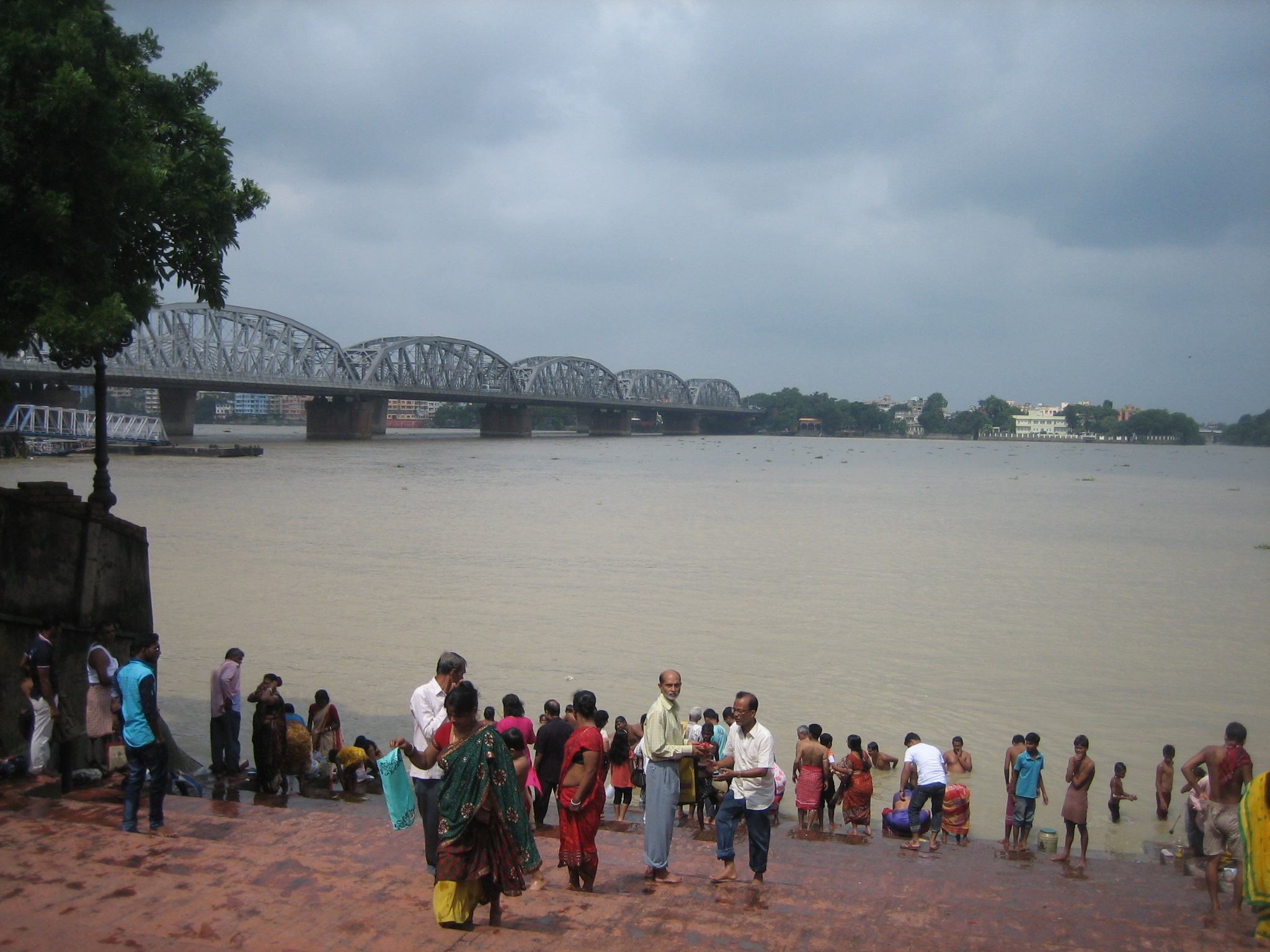
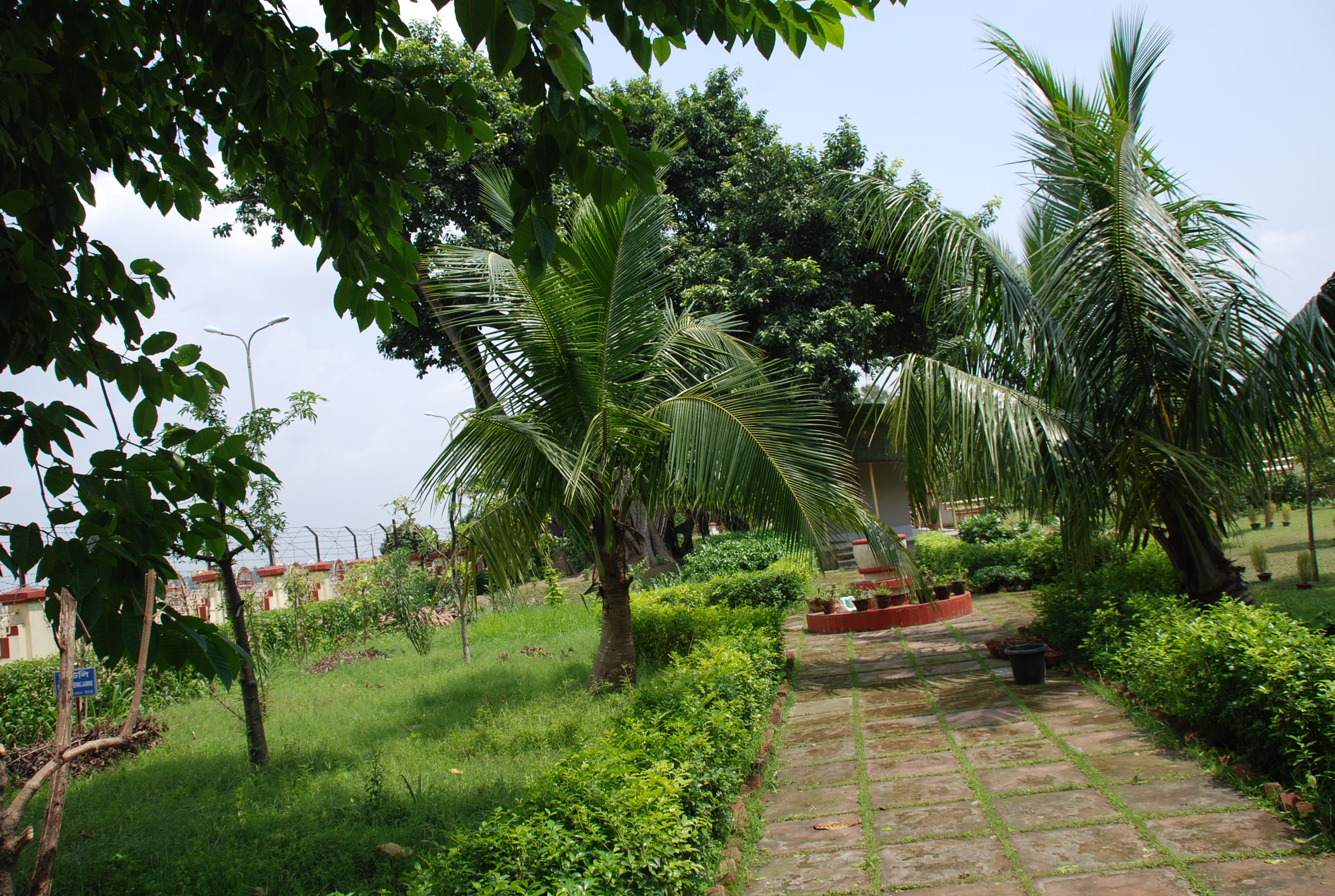
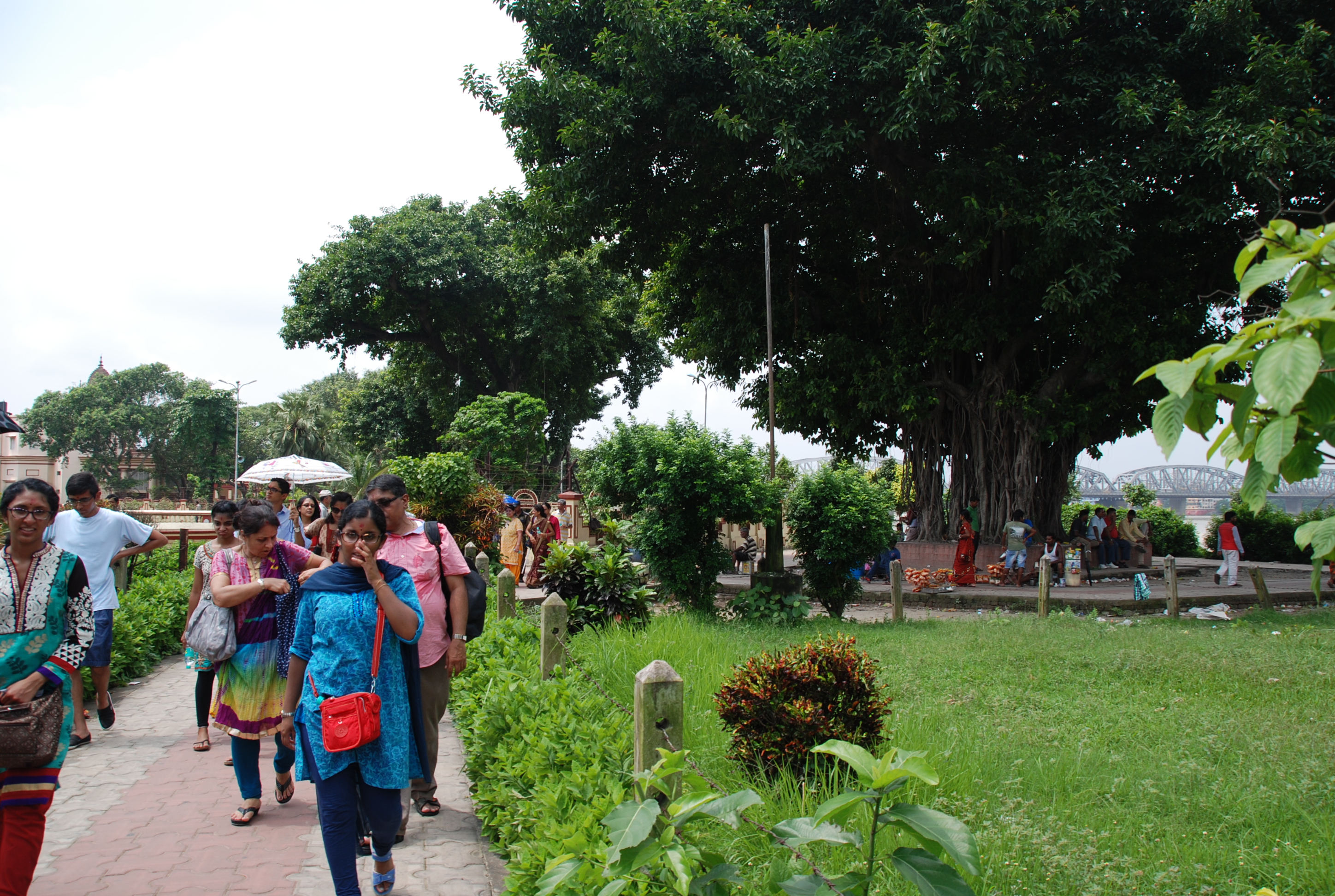
We walked from the buses to a special place near Belur Math’s main office to leave our shoes.  While walking on the Belur Math campus, everyone was greatly impressed by the serenity and cleanliness of the place.  Mother Ganga was flowing on one side.  Three small temples stood on the bank of the Ganga.  Green grass and trees added the serenity in the environment.  The centrally located main temple was calling all to go inside.  Many had goose bumps as they remembered that Holy Mother Sri Saradadevi, Swami Vivekananda and several direct disciples had walked on this ground and had done great austerities here.

Our Honorable Guide:

Revered Tapas Maharaj introduced us to the revered Swami Sarvapriyananda, who to our great surprise was going to be our guide for the day. Swami Sarvapriyananda is a renowned swami who is famous for his lectures (especially those recorded on the Internet).

Main Temple

Our first stop at Belur Math was the main temple of the complex.  Revered Swami Sarvapriyananda led us to the temple.

Belur Math - 2

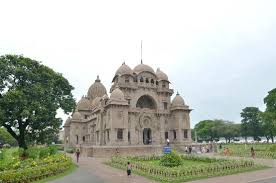
The main temple of the Belur Math was a beautiful site. In fact, the architecture of the temple was designed by Swami Vivekananda himself. The design included concepts from various religions including Hinduism, Buddhism, Christianity, and Islam. Placed on the front entrance of the Math was the Ramakrishna Mission symbol, also designed by Swami Vivekananda. The symbol displays a swan sitting on the waves of water, lotus, the sun and a cobra. The swan represents our true spiritual Self, the water represents karma yoga, the lotus represents bhakti yoga, the sun represents Jnana yoga and the cobra represents raja yoga. Thus showing that there are four main paths to which one can manifest his/her divinity.

BM Temple Sri Ramakrishna-2

As we entered the main entrance of the main temple, we saw a white marble statue of Sri Ramakrishna beautifully adorned with a cloth and a garland. The atmosphere was very serene as we can hear the worship-mantras chanted by a Swami who was doing worship of Sri Ramakrishna. We felt that Sri Ramakrishna was present in person and was very happy to see us all.  A few devotees also remembered Sri Ramakrishna’s words that “Loren! I will go wherever you take me.” When establishing Belur Math, Swami Vivekananda had brought Sri Ramakrishna’s relics to Belur Math with great reverence and had done worship as if he was present in person. We could feel the importance of this place as we saluted Sri Ramakrishna.

After saluting, we sat down to do japa and meditation.  When we closed our eyes, we could feel Sri Ramakrishna’s presence throughout the hall.  Half an hour passed unnoticed.

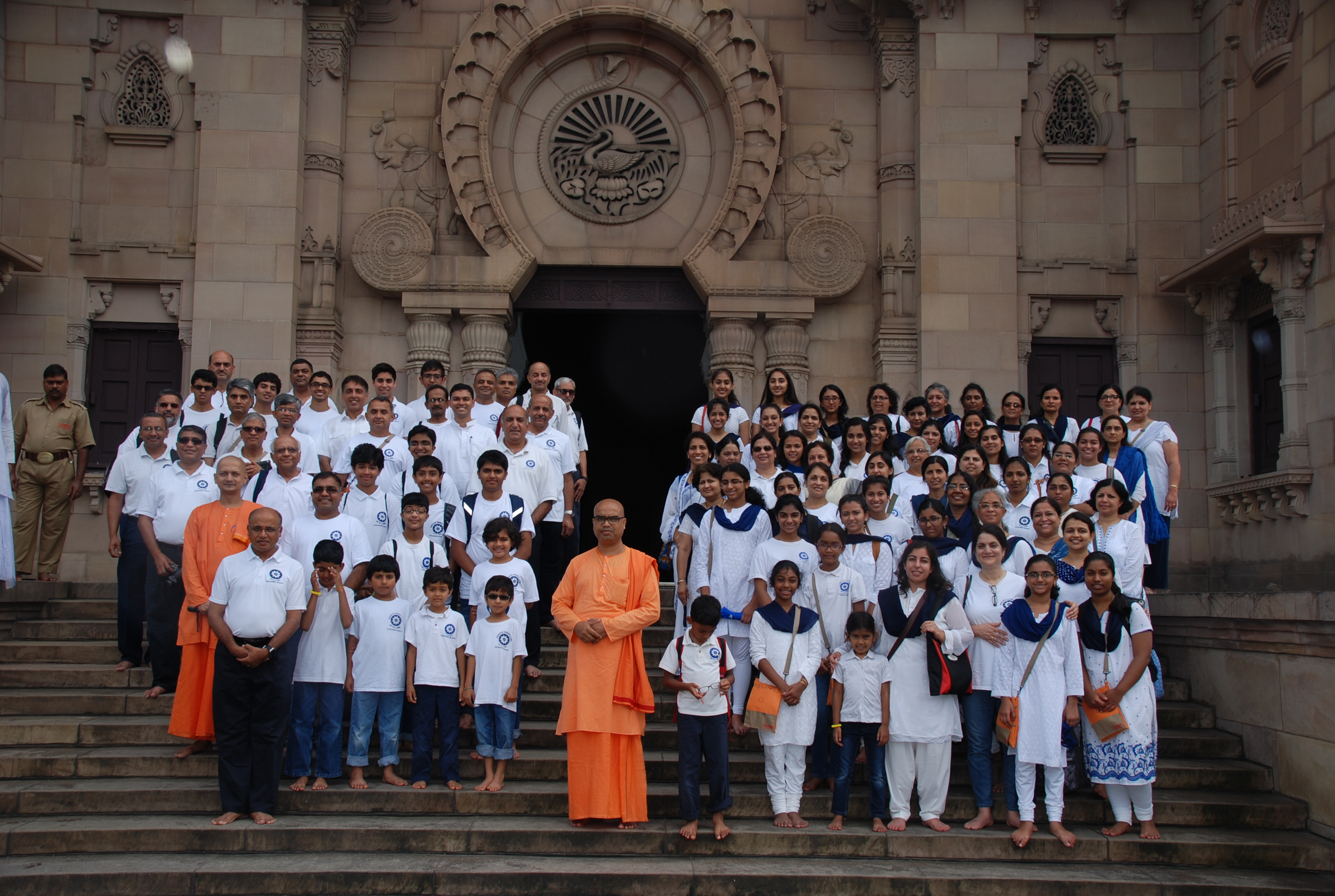
After the japa and meditation, we walked out through the main entrance of the temple. Tapas Maharaj and Swami Sarvapriyanandaji told us that we can take a picture in front of the Belur Math Temple.  Swami Sarvapriyananda told us to stand on the steps on either side of the entrance, keeping the entry way unblocked so Sri Ramakrishna could also join us.  Tapas Maharaj and Swami Sarva Priyananda knew that this will be a life-long memory for all of us.

DSC_0008

The Old Temple and Swamiji’s room:

After the picture, Tapas Maharaj and Swami Sarvapriyananda led us to the Belur Math office courtyard. Here, there were two buildings. One included the old shrine, the prayer room where Sri Ramakrishna was worshipped before the main temple was built. It was here that Swami Vivekananda and Holy Mother worshipped Sri Ramakrishna after his passing away.

thakur_oldtemple

In the nearby building was Swamiji’s room, which gave a wonderful view of the Ganga nearby. In that room laid many belongings of Swami Vivekananda, including the tanpura and mrudungam Swamiji used to play! Can you just imagine the melodious bhajans and dhoons sung by Swamiji? This was also the same room where Swamiji went into Nirvikalpa Samadhi.

images

Visit to Water Treatment Plant:

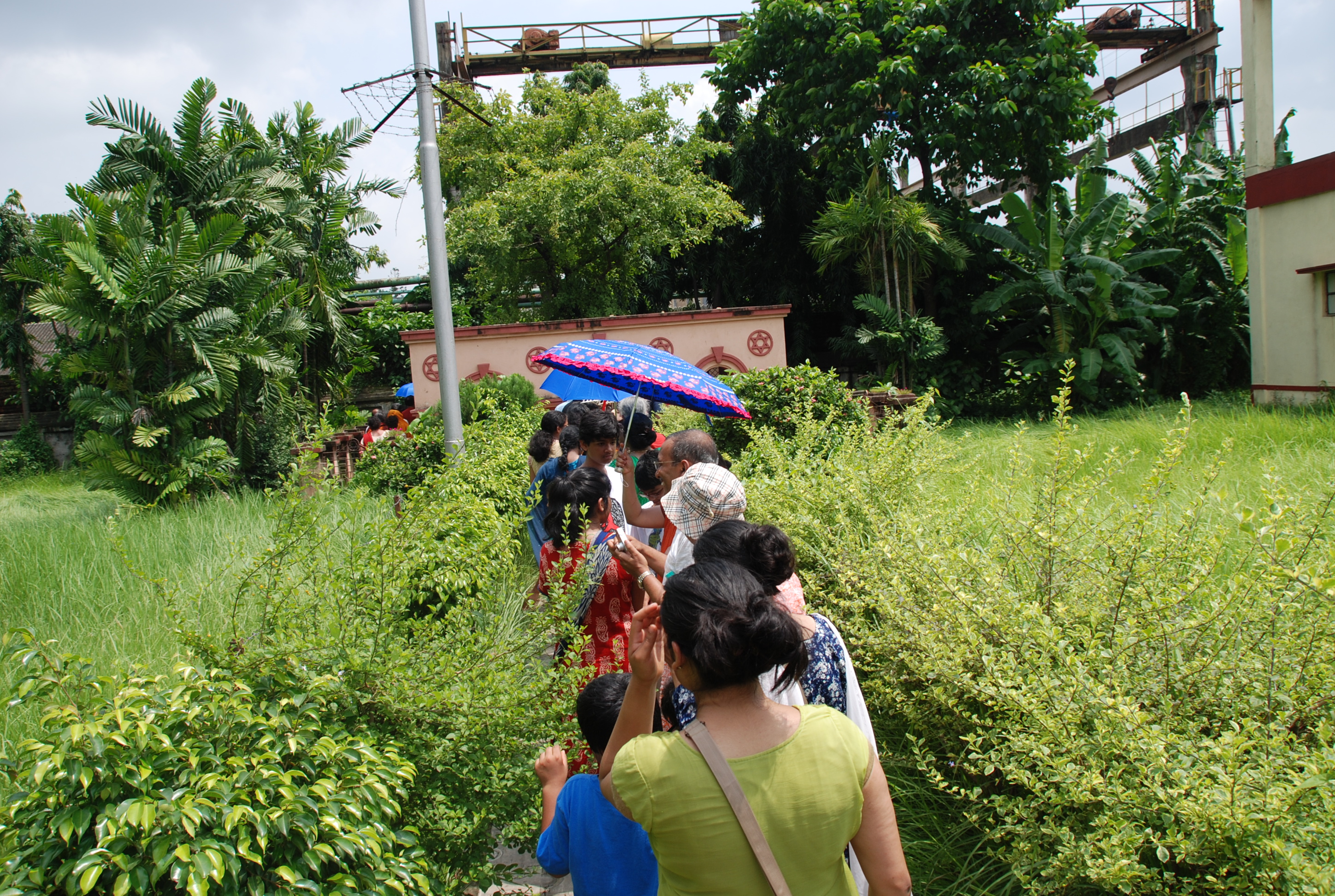
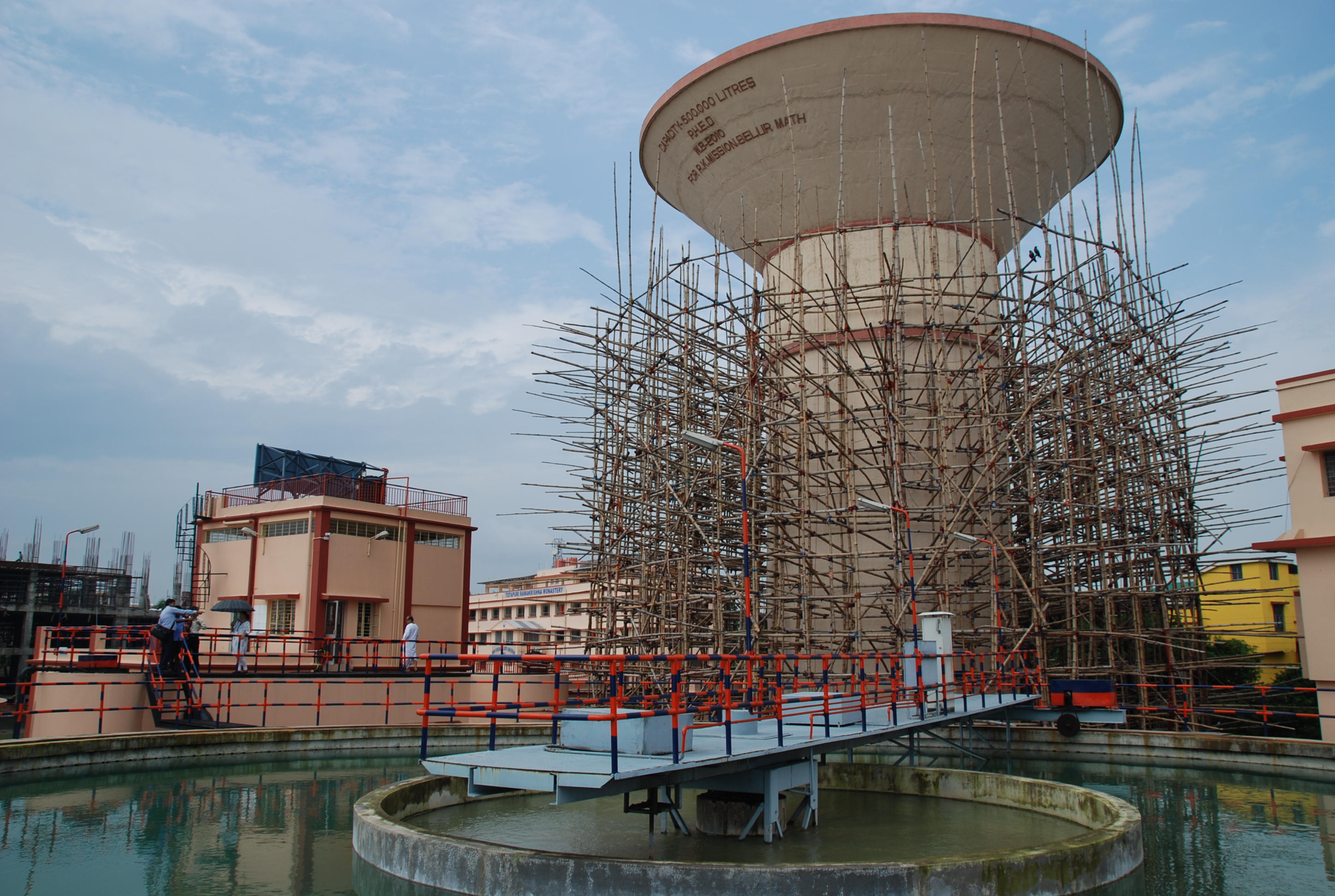
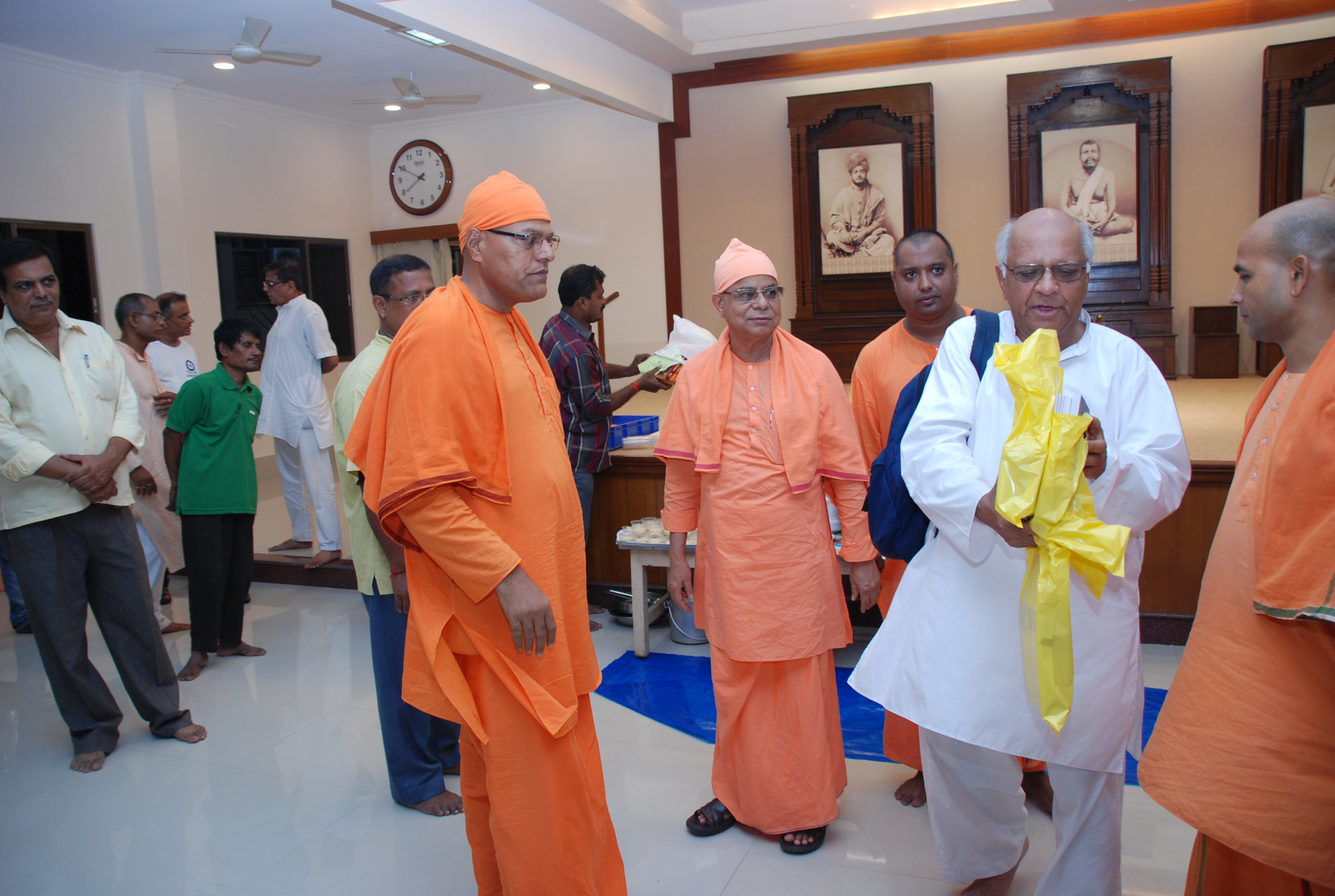
When both groups finished visiting the old temple and Swamij’s room, Swami Girishananda told us that he had arranged our visit to the Ramakrishna Mission Water Treatment plant, which is located within Belur Math premises. On the way there, some of the students and parents took “totos” (long golf carts) to the water plant location while others walked. The Ramakrishna Water Treatment plant was a service effort started by the Swamis that provides clean water to all of Belur Math as well as the local community surrounding it. The process, which is very detailed and intricate, essentially pumps Ganga water into a filtration system to be purified. The water is distilled through the use of chlorine gas and sand. The purified water eventually serves people in the area. This plant was the vision of the Manager Maharaj Swami Girishanandaji. It was so wonderful to gain the opportunity to see swamis practicing karma yoga and service firsthand.
DSC_0014 DSC_0017 DSC_0051 DSC_0055 DSC_0052 DSC_0050 IMG_0579 IMG_0583 IMG_0588 IMG_0589

Totapuri Ramakrishna Monastery:

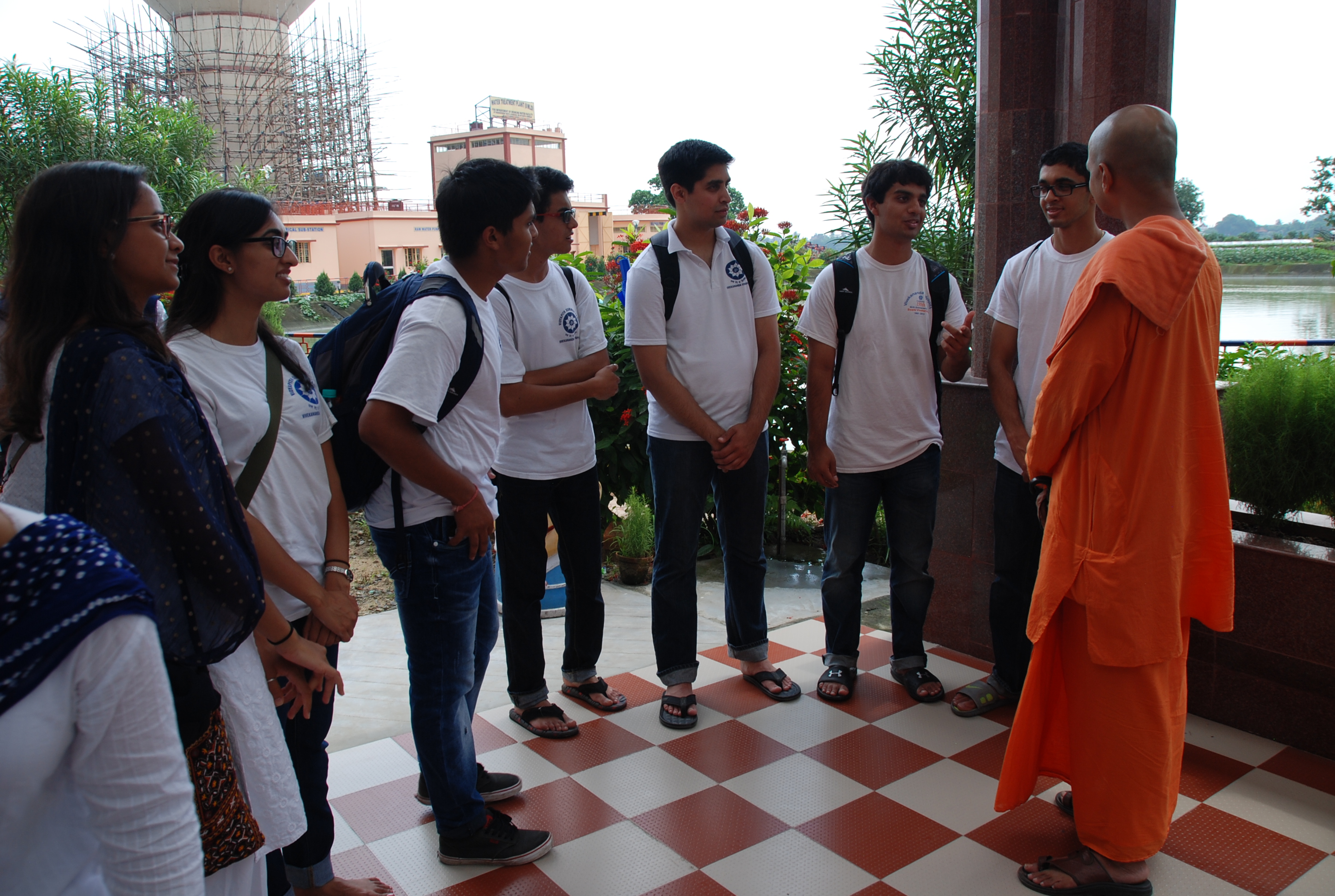
Following the plant visit, Swami Sarvapriyananda took us to the sadhu’s quarters, also called “Totapuri Ramakrishna Monastery.”

DSCN6624

DSC_0063 DSC_0065

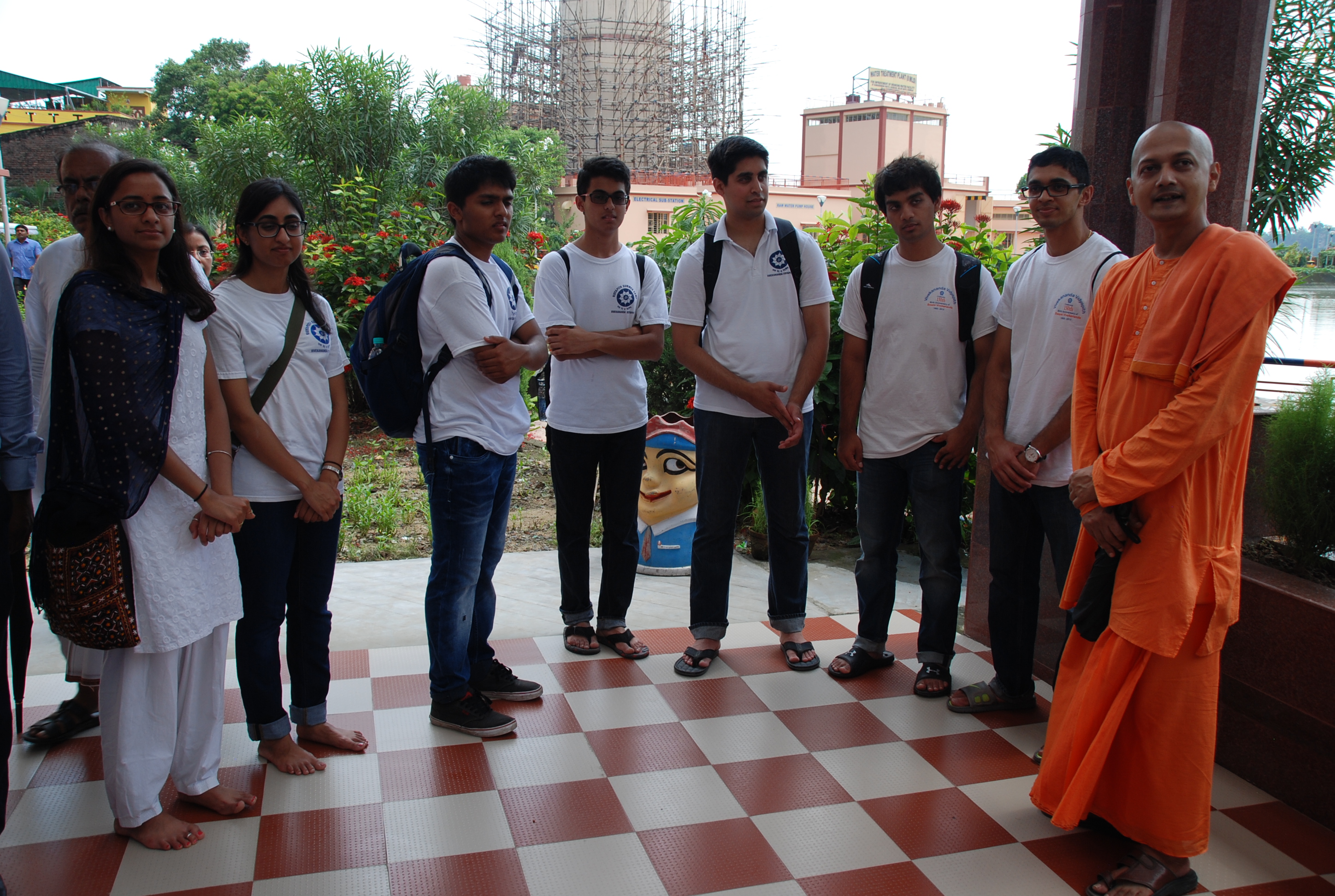
Students enjoying conversations with Swami Sarvapriyananda

DSC_0069

Uncle With Swami who takes care of the Water Treatment Plant

This was Swami Girishanandaji’s project and he lovingly told us that many of you had contributed towards this building.

We were also shown the construction site of a 3-story dining facility to serve devotees who visit Belur Math. For many years, Belur Math would serve Prasad to thousands of devotees during celebrations. This would finally give them a proper facility to serve as Mother would have wished!.

DSC_0050

DSC00054

Construction of the dining facility is all the way on the left corner of the first picture and on the slight right of the Belur Math Temple.

Delicious Snack:

At the Totapuri Sadhus quarters, we were served delicious samosas and caramel candy to add some sweetness! When we finished our snack, Swami Sarvepriyananda took us to the three temples and memorial place of all several direct disciples located on the bank of Ganga.

DSC_0068

DSCN6626

Three Temples:

In addition to the main temple, there are other temples on the Belur Math campus: Swami Brahmananda’s temple, Holy Mother Sri Sarada Devi’s temple and Swami Vivekananda’s temple.

IMG_0598 Swamiji's Temple

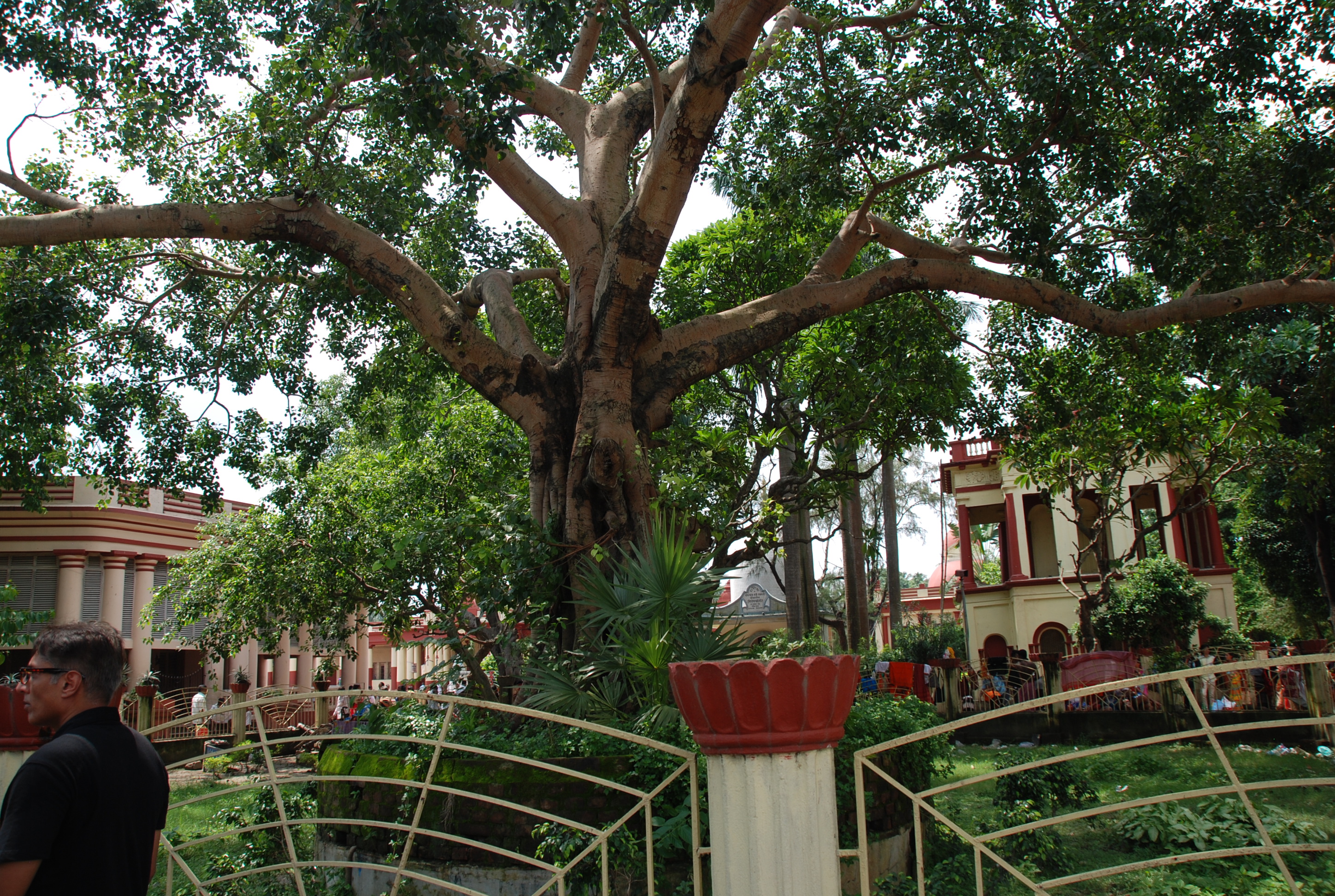
We visited each temple. Holy Mother’s in particular was beautiful. It is actually the only temple on the campus that is facing the Ganga.  We offered our salutations at each temple.  Divine fervor was in the air and Mother Ganga only was added to it, her spirituality and waters traveling all the way to Gangotri.  After visiing the three temples, we saw the tree under which Swami Vivekananda used to sit.

samadhipith

Nearby is a memorial of direct disciples of Sri Ramakrishna.  Through this entire visit, many of us remembered life incidents and teachings of the direct disciples.  Devotees who were visiting first time felt that everything they had read and studied about Sri Ramakrishna, Holy Mother Sri Sarada Devi, Swami Vivekananda, and direct disciples of Sri Ramakrishna was becoming even more real and tangible.

three temples

On left is Swamiji’s temple, Middle is Holy Mother’s temple and on right is Swami Brahmananda’s temple

Offering salutations to Senior Swamis:

Next, we were told that Swami Suhitanandaji, General Secretary of Belur Math would receive our Vidyapith group.

DSC_0078 DSC_0076

One by one, we all saluted Swami Suhitanandaji and Swami Girishanandaji. They received us so lovingly and even talked to us all.

DSC_0095 DSC_0094

We were then informed that Swami Smarananandaji, Vice President of Belur Math would receive us as well! We were so lucky for this opportunity. Just couple of days ago on a rainy Gurupurnima, hundreds of devotees had to wait for hours to offer lotuses to Swami Smarananandaji. We considered ourselves fortunate to get this opportunity without waiting for long time in a line. Swami Smarananandaji talked to us about his pleasant experiences of guiding youth groups.

Going to Old Math:

After saluting to Swami Smarananda, we all were led to the Nilambar Babu’s house. This was the “Old Math.”  Before Belur Math, the “Atmarama” (the relics of Sri Ramakrishna) was worshipped here.

DSC_0070

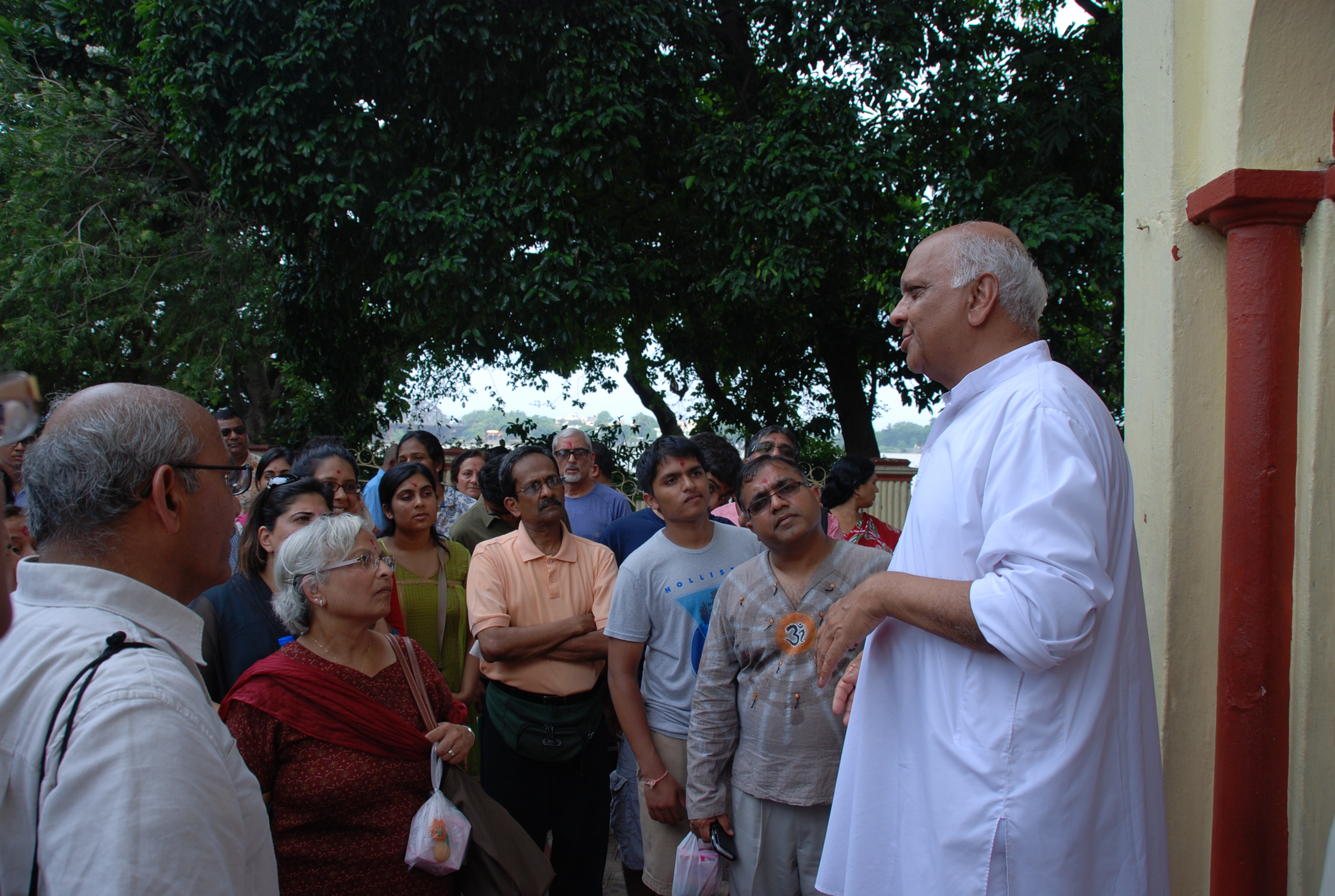
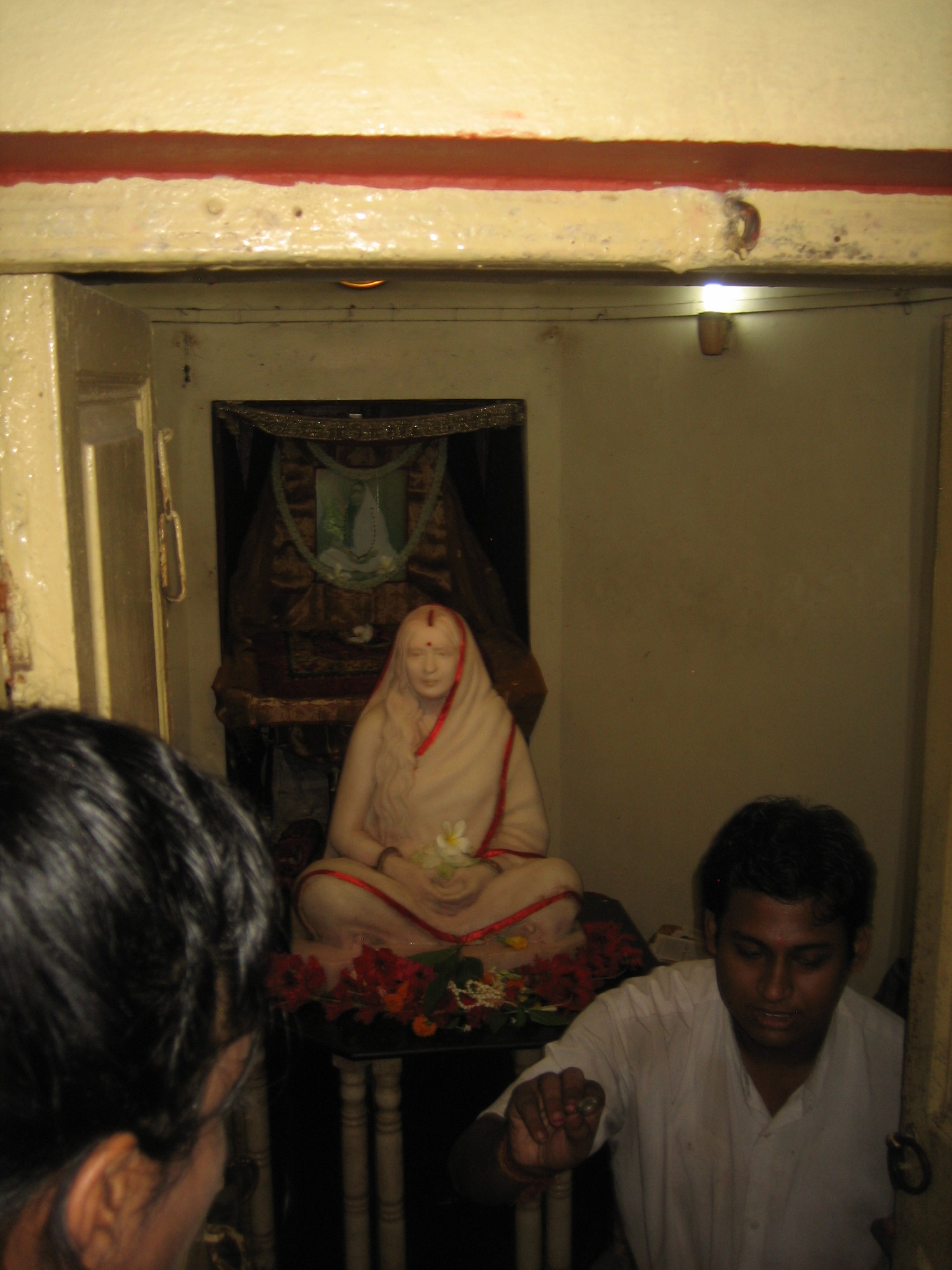
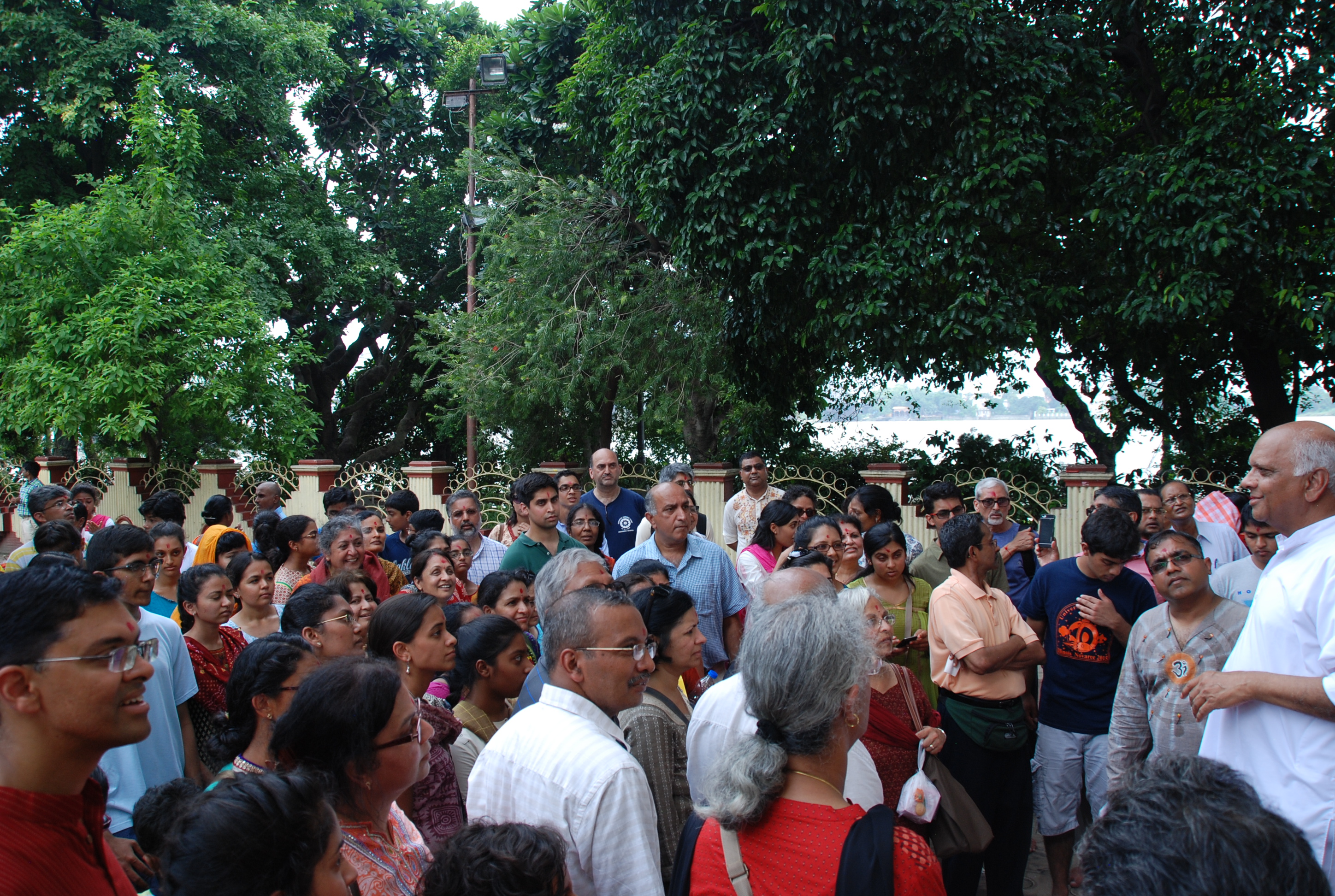
Holy Mother lived at the Old Math for some time and also conducted the “Panchatapa” austerity here.  This was also where she a had vision of Sri Ramakrishna standing in the Ganga and Swami Vivekananda pouring the water of Ganga to all over the world.  Another importance of this place is that here Swami Vivekananda composed arati “Khandan Bhava Bandhan” and the hymn “Om Hri Ritam.”  Unfortunately, Holy Mother’s room was closed.  We decided to come later on our trip.  Swami Sarvapriyananda also talked about the Veda Vidyalalya which was next to this place.

Formal Welcome Program:

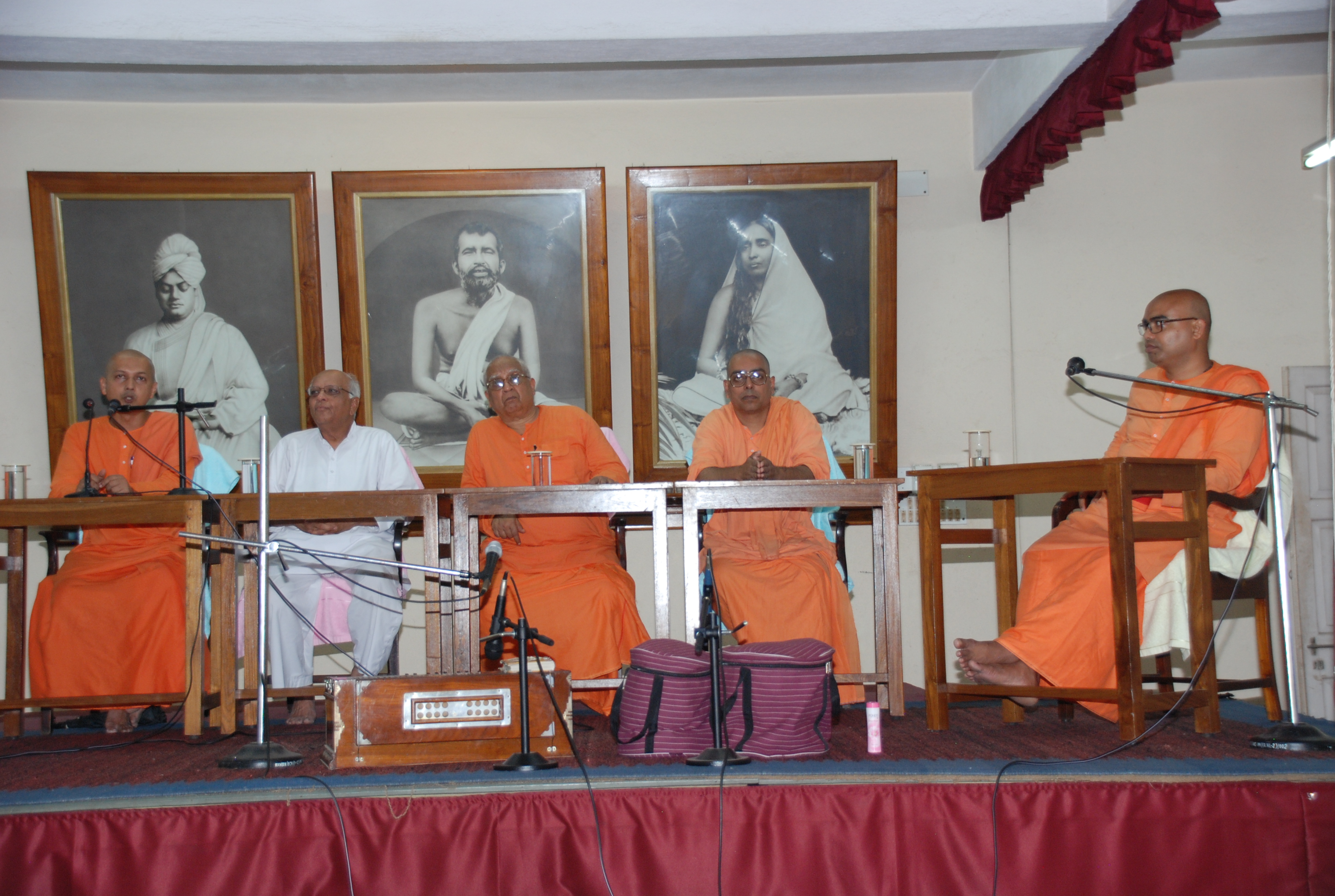
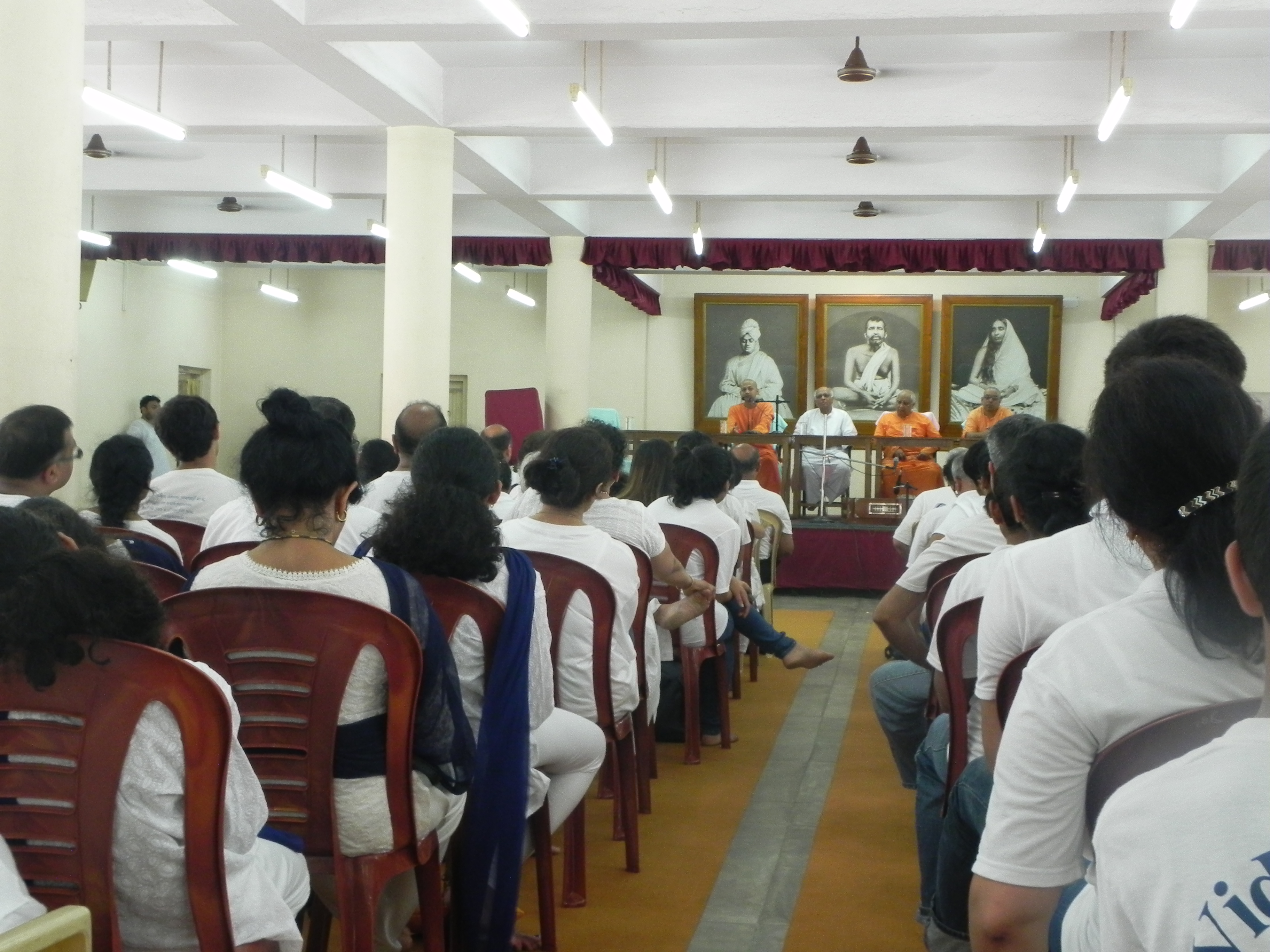
To our great surprise, we found that Revered Swami Girishanandaji had arranged a special “Welcome Program” for us in a cultural hall. When we reached the cultural hall, we saw that a stage had been prepared with a few chairs, a table and microphones.  There was a harmonium and a pair of table on the front of the stage.  In the background, there were large size pictures of Sri Ramakrishna, Holy Mother Sri Saraada Devi and Swami Vivekananda.

DSC_0117DSC_0118

DSC_0120 DSC_0129

DSC_0126 DSC_0128 DSC_0136

DSC_0134 DSC_0133

DSC_0116

DSC_0144 DSC_0147

DSC_0149 DSC_0148

DSCN6633 DSCN6632In the auditorium, over 100 chairs were arranged nicely for our group.  The auditorium was filled by Vidyapith students, teachers and parents.  On the stage were Tapas Maharaj, Swami Devpriyananda, Swami Girishananda, Uncle, and Swami Sarvapriyananda.

Tapas Maharaj was emcee of the program.  He heartily welcomed our Vidyapith family to Belur Math and then conducted the whole program.  To begin the program, one Swami of the Ramakrishna Mission sang a bhajan. Then, revered Swami Girishanandaji welcomed us all. He told about his positive experiences and impressions about Vivekananda Vidyapith when he visited the institution during his recent USA tour.

Then, on behalf of all Vidyapith students, teachers and parents who were present, Uncle sincerely thanked all Swamis for extending their hearty welcome to all of us and going out of their way to shower their love. Uncle continued and said, “Today we see the significance of the saying that if we go one step towards God, then God comes 10 steps towards us.  What we have done is to try to follow lives and teachings of Sri Ramakrishna, Holy Mother Sri Sarada Devi, and Swami Vivekananda. And in return we received lots of love and encouragements from all these revered Swamis.”

Following Uncle, Pr. Shuddhatmaprana spoke. She said how she was thrilled to see familiar faces since she had accompanied us on our Gujarat Tour in 2013.  She was excited to meet many new faces as well. Pr. Shuddhatmaprana talked about the great time she had being with our Vivekananda Vidyapith group during the Gujarat Tour.

Following Pr. Shuddhatmaprana, alumni Meera Rajani and Nilesh Shukla spoke about their experiences at Vidyapith and their appreciation for our warm welcome to Belur Math.  Then, Swami Devapriyananda gave his talk and showed his happiness to see Vidyapith’s students, teachers, and parents.

Next, Swami Sarvapriyananda spoke. He said, “You look all very happy because here in Belur Math you are at home.” He said, “Consider Belur math as your home and come and visit it whenever you can.”   He continued, “It is great that in the US you are learning the essence of Indian Culture and practicing them.  We even see that Indian Culture [and philosophy] is manifesting in many American literature and films.”  He referred to the Star Wars and few other resources.  He emphasized the two main essential teachings of Vedanta: the potential divinity of each soul and Oneness of all beings.

Swami Sarvapriyananda expressed his admiration for Vivekananda Vidyapith as well by stating, “Vivekananda Vidyapith is a successful model for a youth program preparing our next generation.”

Dr. Shuvendu Majumdar, a professor at the Vivekananda University expressed his thoughts and joy to see all of Vidyapith’s students.

The students and alumni of Vidyapith were then given the opportunity to offer their prayers. We melodically sang Durgati Nashini for the swamis as Sneha Shah played harmonium and Apurva Shah accompanied on the tabla.

17 – Picture – students singing

Prasad at Belur Math:

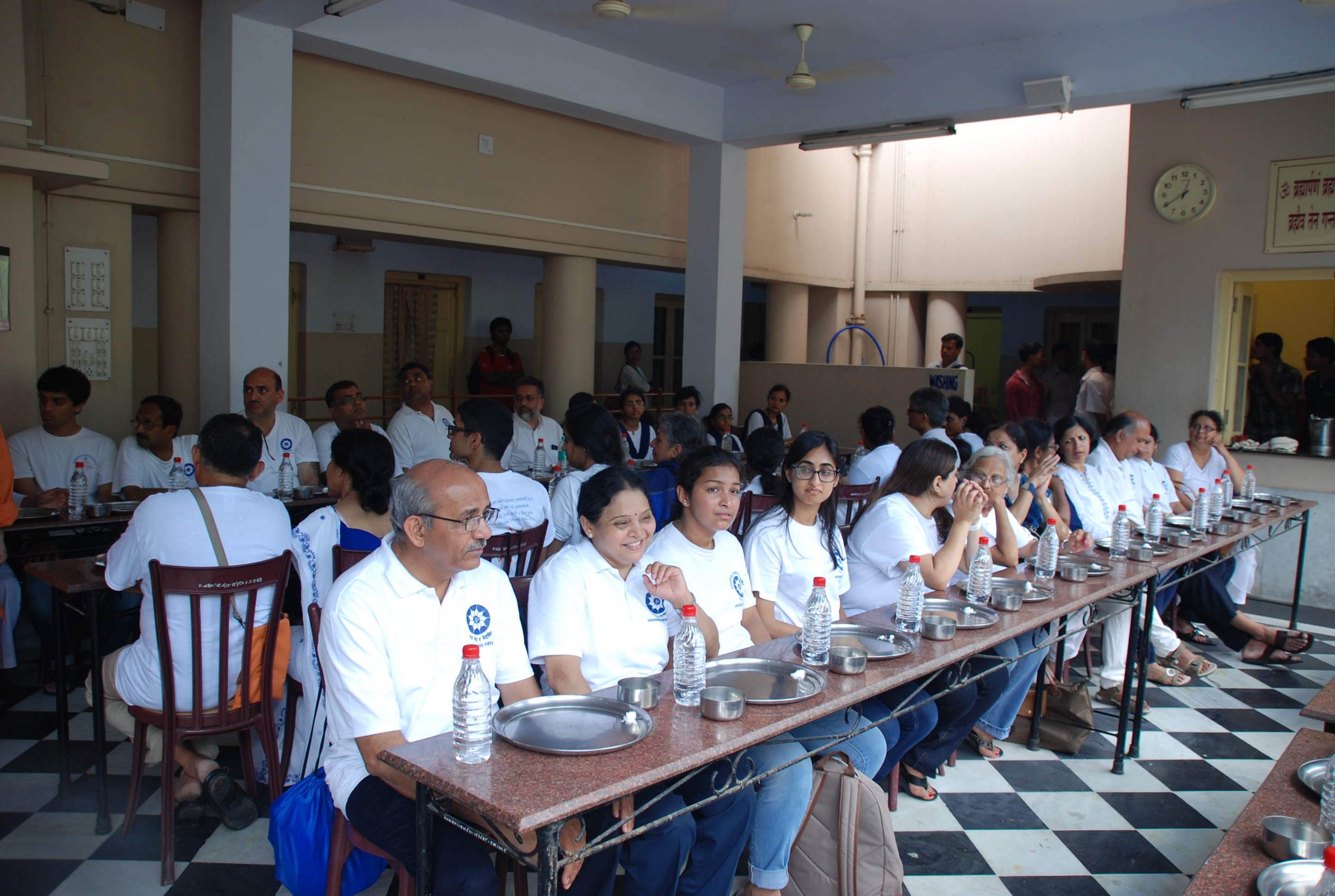
Following the cultural hall, we sat down for lunch.

DSC_0153 DSC_0152

DSC_0158 DSC_0163

DSC_0165 DSC_0161

Swamis reciting “Om Brahmarpanam…..”

Revered Sukumar Maharaj (Bhandari Maharaj) was lovingly taking care of our Prasad.  Revered Tapas Maharaj and Uttam Maharaj were joyfully helping.  We were served a variety of delicious dishes, with several Bengali sabzis, some warm rotis, and daal which was then topped off with ice cream and sweet mangos! We came to know later that sweet mangoes and ice cream were a special treat to all of us and Mr. Prakash Chakraborty had made arrangement for this. With so much love of Swamis the Prasad became more delicious.

(The original report was prepared by Priya Parikh and Bindi Parikh.)

Belur Math Pilgrimage 2015 – Day 0

August 2, 2015

Two years ago, a few students, teachers, and parents attended the International Youth Conference organized by the RKM Vadodara and went on a pilgrimage to the places in Gujarat that were visited by Swami Vivekananda. It was then that a thought crossed our minds about the possibility of organizing a pilgrimage to Belur Math and to the places associated with Sri Ramakrishna, Holy Mother, and Swamiji.

In December of 2014, Uncle, Nalin Uncle, Anandhi Aunty, Mihir Uncle, Shilpa Aunty and Nisha Parikh began exploring this possibility. The initial discussions and research for the Belur Math Pilgrimage had begun and they were in full swing by the time Youth Day celebrations came to an end in January. The organizers met every Sunday to discuss the itinerary along with the hotel and transportation arrangements. There was also a constant flow of emails and phone calls to the different parties in India to coordinate the trip. Yet, during all of this planning, many questions arose – Would people want to travel to India during the hot monsoon season? Would they be comfortable knowing the challenges we may face while traveling at this time? Would students sign up? Much to people’s surprise, these fears were quickly dispelled. As word of the pilgrimage spread, devotees and their families eagerly signed up. The list of pilgrims grew to 91 people:

1 Uncle, 2 Rasendra Adhvaryu, 3 Jyoti Champanerkar, 4 Kabir Champanerkar, 5 Kartik Champanerkar, 6 Priya Dhar, 7 Sunil Dhar, 8 Sunita Dhar, 9 Naiya Gosai, 10 Chandrashekhar Jani, 11 Harsha Jani, 12 Nalin Johri, 13 Anandi Johri, 14 Arundhati Johri, 15 Krishnan Raghavan, 16 Lalitha Raghavan, 17 Rajan Krishnamurthy, 18 Usha Krishnamurthy, 19 Hina Mehta, 20 Sonali Mehta, 21 Arvind Mistry, 22 Rashmita Mistry, 23 Sridhar Nambi, 24 Sumathi Nambi, 25 Veda Nambi, 26 Veena Nambi, 27 Gopesh Pandya, 28 Anupa Pandya, 29 Stotra Pandya, 30 Shashin Parikh, 31 Nayana Parikh, 32 Nisha Parikh, 33 Ronak Parikh, 34 Vrunjal Parikh, 35 Trupti Parikh, 36 Priya Parikh, 37 Bindi Parikh, 38 Fenil Patel, 39 Linsy Patel, 40 Dhir Patel, 41 Keya Patel, 42 Manoj Patel, 43 Khushbu Patel, 44 Khush Patel, 45 Vironika Patel, 46 Ekalavya Patel, 47 Laxmi Pichappan, 48 Kanna Pichappan, 49 Siva Pichappan, 50 Lakshmi Pusuloori, 51 Shailee Pusuloori, 52 Brinda Pusuloori, 53 Sudhir Railkar, 54 Aruna Railkar, 55 Kanchan Railkar, 56 Jyoti Rajani, 57 Meera Rajani, 58 Kirit Rokad, 59 Hina Rokad, 60 Deba Saha, 61 Amita Saha, 62 Debamita Saha, 63 Ghanshyam Senjalia, 64 Varsha Senjalia, 65 Abhishek Senjalia, 66 Avni Senjalia, 67 Apurva Shah, 68 Jyoti Shah, 69 Chintal Shah, 70 Mihir Shah, 71 Shilpa Shah, 72 Nilesh Shukla, 73 Apexa Shukla, 74 Radhika Shukla, 75 Raghav Shukla, 76 Rajan Shukla, 77 Advait Suvarnakar, 78 Aastha Suvarnakar, 79 Aashka Suvarnakar, 80 Latha Tatapudy, 81 Bhavin Trivedi, 82 Kanan Trivedi, 83 Ishani Trivedi, 84 Priya Trivedi, 85 Jaymeen Trivedi, 86 Nixita Trivedi, 87 Neer Trivedi, 88 Anish Trivedi, 89 Kunal Trivedi, 90 Kiran Yagnamurthy, 91 Divya Yagnamurthy

Two meetings with all pilgrims were held at Vidyapith to discuss logistics and further preparations. Spring passed, summer began, and the excitement continued to build. Everyone started to purchase their airline tickets and finalize travel preparations.

Before we knew it, the much-awaited day arrived. On August 2nd, families began arriving in Kolkata from the United States and from different cities in India. Families arriving at the airport were received by Club 7 personnel holding signs that read “Vivekananda Vidyapith.” Throughout the day, Club 7 vehicles shuffled back and forth between the airport and hotel to pick up more pilgrims. As each of us approached the Hyatt Regency, we were amazed by the grand sight and its beautiful property. When we stepped out of our taxis, we saw many familiar faces and could not hold our joy in seeing one another!

HYATT

Those of us who arrived early started the day with a delicious breakfast, which included a variety of dishes from upma, dosa, and pongul to waffles and croissants. For the rest of the day, many of us relaxed at the hotel in attempts to overcome jetlag, while others explored the city. Some families went shopping at the nearby mall and sari markets, while others ventured out for some fresh coconut water and fruits. All throughout, we would run into our fellow Vidyapithers both at the hotel and in the city. We were so far from Wayne, but we still felt the warmth of our Vidyapith family in Kolkata.

At 7 PM, we gathered in the “Topaz and Sapphire” banquet hall for our Welcome Meeting. The space had been specially reserved for our group. The room was buzzing with excitement. Uncle spoke at the podium and welcomed everyone.

UncleAtPodium

Uncle began by reading an email he had received from Swami Sarvadevananda, the Spiritual Head of the Vedanta Society of Southern California, LA, who had graciously sent his humble prayers and blessings for our trip:

“… I was overwhelmed to note that you have organized a pilgrimage trip for 90 Vidyapith associates and shall visit Belur Math, Jayrambati, Kamarpukur and other places connected with Thakur, Ma and Swamiji. It is probably for the first time that such a big number of devotees will be going in a group, from the West, for pilgrimage. May Mother keep everyone in good health and joy–is my prayer…”

-Swami Sarvadevananda

Uncle then moved onto a topic that was on all of our minds. As he had warned earlier in the year, the weather can be quite unpredictable in Kolkata, especially during the monsoon season. In fact, in the days prior to our arrival, a cyclone passed through the region. Many areas were hit with heavy rains and flooding. Many of us had seen a few flooded streets on our way to the hotel. Naturally, some of us were nervous and we were all praying for better weather for the week ahead. Uncle said that we have to surrender to God’s wish and do what we have to do.  He also shared with us Aunty’s thought on this. She said to think of Sri Ramakrishna, Sarada Devi, and Swamiji. They had lived in this weather but nevertheless kept their minds on God. We would perhaps experience firsthand what they had faced. What a great thought! In the same way they didn’t let the spontaneous showers trouble them, we all resolved to keep a positive attitude and were ready to face the rain armed with our ponchos and umbrellas! The rains would not stop our Vidyapith pilgrims from making the most out of their trip!

Uncle moved on to introduce the staff of Club 7, the travel agency that has been assisting us with our tour, and asked the CEO, Aparna Didi, to address the group.

Club7Members

Aparna Didi heartedly welcomed the pilgrims and assured us that Club 7 would do everything to make our pilgrimage a memorable experience. She surprised us with a wonderful booklet they had made which outlined our itinerary and included important contact information.

Club7book

Club 7 gave each one of us a gift bag that consisted of umbrellas and cross-bags. To top it all off, we were given a large bag full of snacks for the week.

Screen Shot 2015-08-10 at 12.18.24 AM

Following this, Uncle explained that in order to make our transportation orderly, seven groups were formed. He announced the names of the group leaders, their responsibilities, and the members of the group. The group leaders were Krishnan Uncle & Lalitha Aunty, Rasendra Uncle & Ronak, Nalin Uncle & Anandhi Aunty, Sudhir Uncle and Aruna Aunty, Rajan Uncle & Usha Aunty, and Ghanshyam Uncle & Varsha Aunty.

Next, Uncle introduced the medical team of doctors: Dr. Anandhi Johri, Dr. Sridhar Nambi, Dr. Apexa Shukla, Dr. Nilesh Shukla. On behalf of the medical team, Dr. Nambi Uncle reviewed guidelines for our health and well being on the trip. We were so lucky to have four doctors on our trip!

Already carrying their large professional cameras around their necks, our enthusiastic photography volunteers, Mihir Uncle, Nalin Uncle, and Rasendra Uncle, waived to everyone. They were going to help us capture candid moments and record most of our trip.

Uncle then went over the agenda for the next day. We were going to visit Belur Math, the RKM Institute of Culture at Golpark, and Yogodhyan. We planned to wear our Vidyapith uniform so that we could take a group picture.

Soon it was time for dinner! There were so many different items. After dinner, all gathered according to their groups and exchanged contact information. We shared our thoughts about the places we were going to visit and reflected on what we were going to see the next day. We were also handed booklets about the Belur Math Pilgrimage Trip. A team of teachers (Nalin Uncle, Anandhi Aunty, Deba Uncle, Rasendra Uncle, Sunil Uncle, Sunita Aunty, Krishnan Uncle, and Lalitha Aunty) prepared researched summaries on each of the places of pilgrimage. Nalin Uncle compiled and organized the information by the day of visit. Nalin Uncle, Anandhi Aunty, and Arundhati printed and bound copies for each family on the trip!
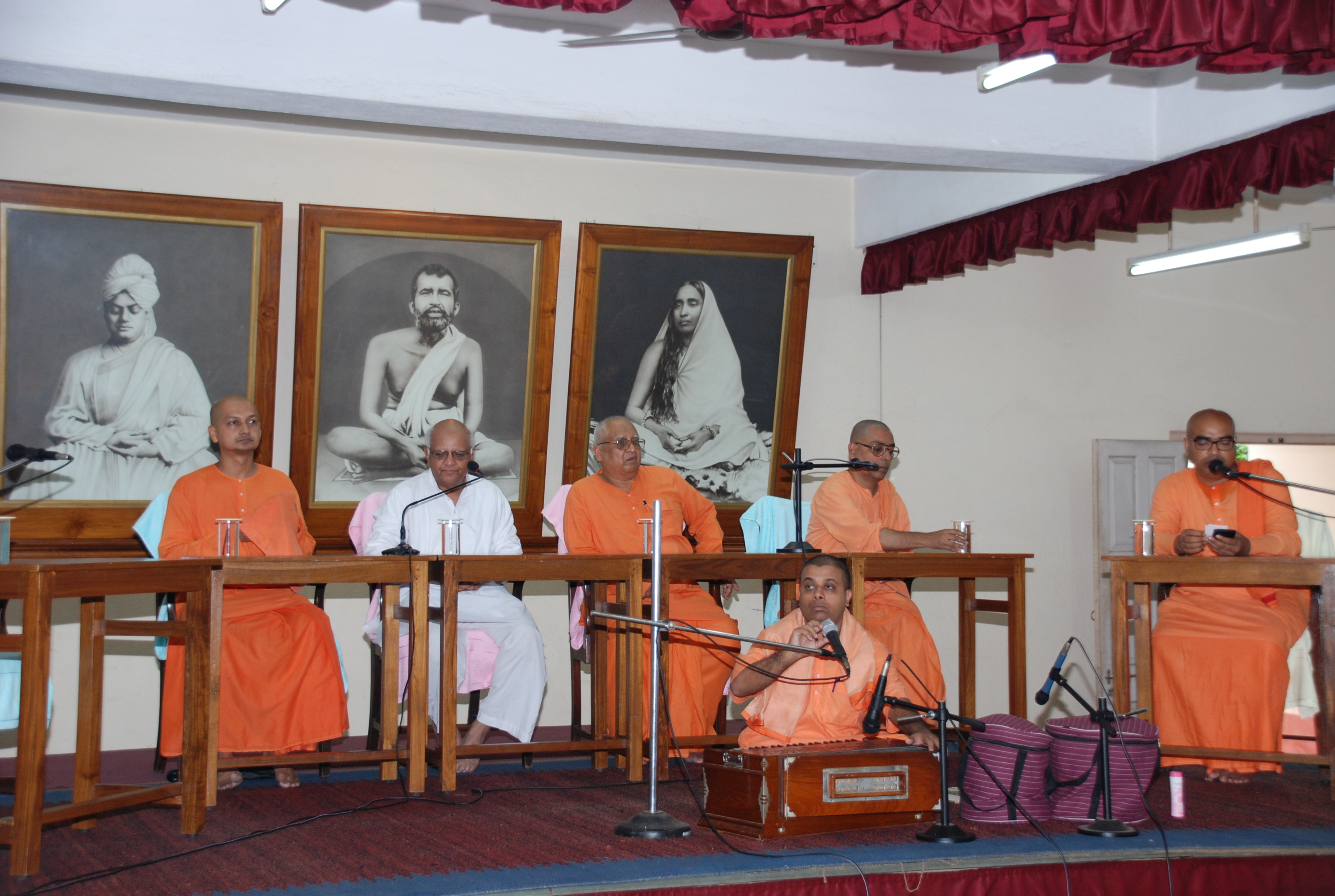
Uncle also showed the Bhajan-Dhoon-Hymns booklet prepared by Trupti Aunty, Jyoti Shah Aunty, Priya Parikh, Bindi Parikh and Chintal Shah.  These booklets would help us with our morning and evening prayers and when we sing during our travel in buses.

books

At the end of the meeting, Uncle let us know that we were asked to sing a couple of dhoon-bhajans at the Belur Math Cultural Hall. Deba Uncle brought out his harmonium and tabla, and some of our Vidyapith students and alumni practiced the Shanti Mantras and a few bhajans.

Screen Shot 2015-08-10 at 12.18.46 AM

Energized about the week ahead, we headed to our rooms for full night of rest. We were going to have an early start the next day as breakfast would begin at 5:45 AM and our buses would leave at 6:45 AM.

(The original report was prepared by alumnus Vrunjal Parikh.)

Laugh and Learn – 4

Justice in Heaven

I heard the following story from Swami Adiswarananda, the Spiritual Head (1973 – 2007) of the Ramakrishna Vivekananda Center in New York.  I have added material needed to set up the background of the story.

Taxi drivers make their living by transporting as many passengers as they can each day.  For them, time is money. While this mindset helps the driver earn money, sometimes it also results in risky driving.

When I saw how taxis run on the streets of New York City, I remembered a description I had read in the Ramayana.  The famous villain Ravana had a plane that was directed through his thoughts alone.  The taxis in New York City are similar. If you are driving behind a taxi in New York, you may not know where the taxi will go.  It always seems to me that the taxi will only go according to the thoughts of the taxi driver.  The taxi driver may go to the right lane or the left, take a right turn or a left, and sometimes even take a complete U-turn.

One such taxi driver died and went to heaven.  St. Peter looked at the driver’s life record and gave him a big mansion to live in while in heaven.

After some time, a religious preacher died and also went to heaven.  St. Peter looked up his record of good deeds and gave him a simple hut to live in.  After moving into his place, the preacher started walking around to see the different parts of heaven.  He soon found that his next-door neighbor had a big mansion.  He thought that whoever lives in this mansion must be a great religious preacher.  However, to his surprise, he found that the mansion was occupied by a taxi driver.

Image for Blog

The preacher was furious and went directly to St. Peter. He told St. Peter that he was really upset.  He was expecting full justice in heaven. Instead, he found total injustice.  St. Peter asked him to explain why he felt mistreated.  The religious preacher said that he had taught the name of God to people for every day of his life.  For this, he had come to heaven.  However, despite this work, the preacher was just given a dingy little place while the taxi driver… a taxi driver… (The preacher’s voice choked out of anger).  After controlling himself, the preacher finally finished his thought and complained that his neighbor was given a big mansion despite only driving taxis in New York City.

St. Peter seemed undisturbed.  He told the preacher that there cannot be any injustice in heaven.  He asked the preacher to calm down and listen to the reason for these rewards.  St. Peter said that he had great respect for the preacher’s work of preaching God to people for his entire life.  However, when he was preaching, people used to sleep.  On the other hand, when this taxi driver was driving his taxi in New York City, the passengers were constantly praying to God! J

Lesson Learned:

Preaching is a difficult job.  Sri Ramakrishna once said that only those who have received God’s command could inspire people to truly love God.  It is not the oratory skill or the knowledge of scriptures that can inspire people to love God.

Many preachers are great orators or well-versed in scriptures but they do not have God’s command. People who witness these preachers often say, “Wow!  This preacher is such a great orator or how this preacher is so knowledgeable!”  But, they forget everything the preacher had said shortly after meeting him/her.  In these cases, the people unfortunately do not develop a true love for God through listening the lectures.

A sincere devotee loves God and lives a God-oriented life.  He/she has no craving to teach people.  If God makes a devotee an instrument to inspire people to love God, then the devotee will accept it as God’s wish. Yet, the devotee always remembers that it is God who is inspiring people.  The devotee never develops an ego or a sense of doer-ship.

Almost all people need a human example to develop love for God.  When we see someone who truly loves God and someone whose thoughts, speech, and actions have Godly-touch, we become inspired to love God.  Through this person, we realize that God is not an abstract idea but rather as real as the core of our existence.

Heaven:  People wish to extend their worldly pleasures after death and want worldly rewards for their good work.  Thus, we find the idea of heaven that has been entertained in most of the religions.  Swami Vivekananda says that the idea of heaven differs by the people.  If people have been living in deserts and like to enjoy having lots of water, they imagine their heaven with rivers, lakes and lots of green land.  People who lived in tropical countries where it rains most of the time imagine heaven as a dry place with occasional rain.

According to the Bhagavad Gita, heaven is like a resort where people go on vacation.  People enjoy their money’s worth of pleasures in a resort and when the money runs out, they have to go back to their work place.  They cannot earn money at the resort.  In this metaphor, the “money” in the heaven is an individual’s good deeds.  People want worldly pleasures for their good deeds after their death.  For this reason, they have enjoyment in heaven and when they run out of the merits of their good deeds, then come back to earth and start all over again.  Heaven and hell go together.  There cannot be heaven without hell.

As I had mentioned in my earlier post, living a life for only body-mind enjoyments is a hellish life filled with lots of suffering. Living a God-fearing moral life and doing some good work is a life lived in heaven. Living a Spirit-oriented or Self-oriented life with no craving for worldly desires is a life lived in divine bliss – a life that is beyond heaven and hell.

(Thanks to Madhavi Jani for the illustration and Ronak Parikh for editing this post.)

Laugh and Learn – 3

Oops!  I am in the wrong train again!

I heard the following story from Swami Adiswarananda, the Spiritual Head (1973 – 2007), Ramakrishna Vivekananda Center, New York.

Story:

A person in New York was frustrated with many problems in his life.  He had problems in his job as well as in his family.  He thought he could not handle them.  To run away from these problems and worries, he turned to drinking.

One Friday, he spent the whole night drinking in a bar.  The next day, he thought he would go to see his friend in Boston.  Since he was not sober enough to drive, he decided to take a train.  He was so used to drinking that while going to the train station he took a couple of shots of vodka.

He had a ticket to Boston.  But the drinks had gone to his head and he could not think straight.  He was embarrassed to ask anyone for the train track and platform.  He got into a train and found out that it was the wrong train.  He got off and sat in another train.  But that was also the wrong train.

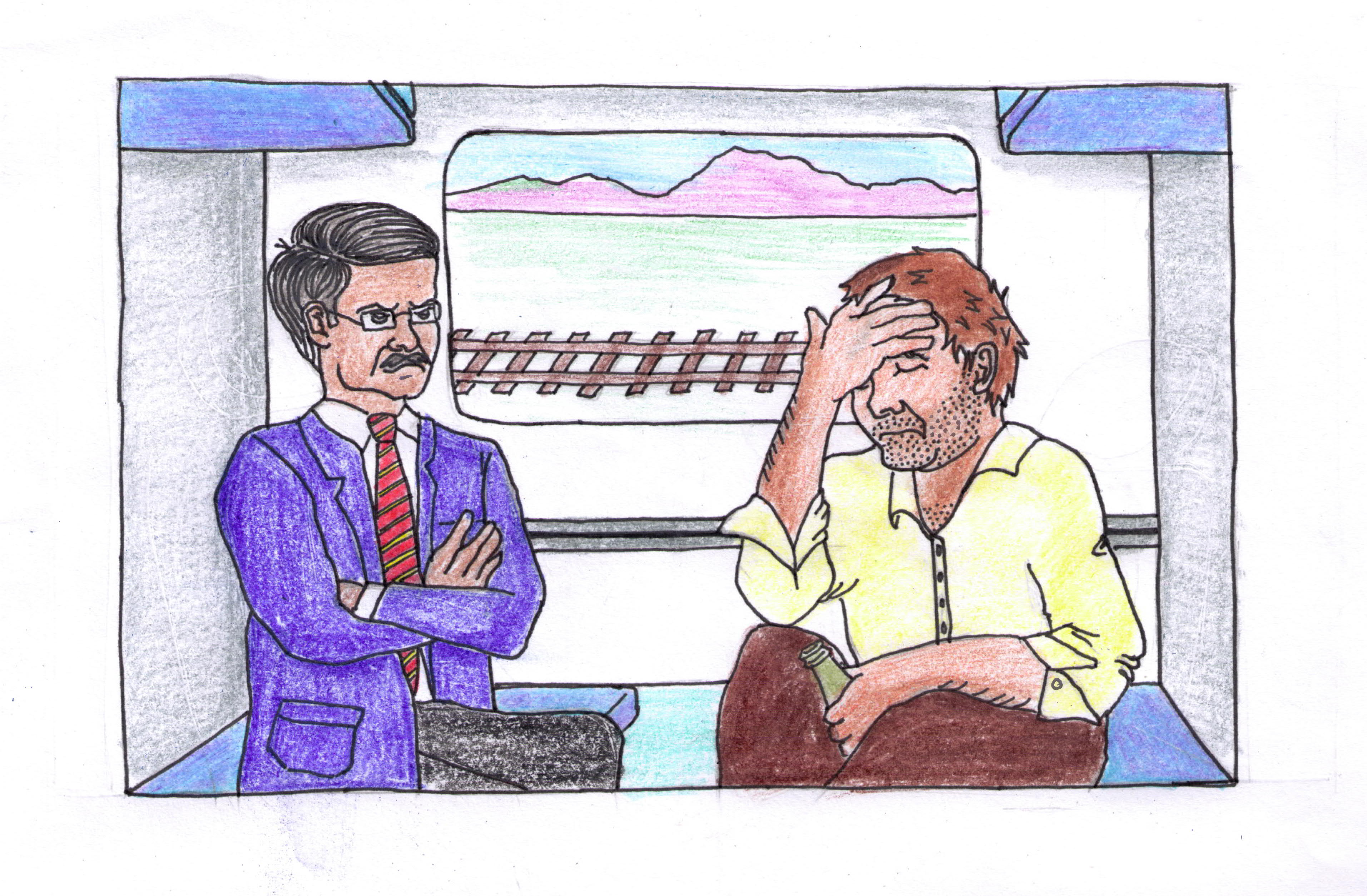
After getting on and off the wrong train five times, finally, someone helped him to get in a train that was going to Boston.  He saw a well-dressed gentleman sitting on a berth.  The gentleman was annoyed by the smell and appearance of the drunkard.  The drunkard sat a little bit away from this gentleman.

By this time, the drunkard was becoming somewhat sober.  To make sure he was in the right train, the drunkard asked this gentleman, “Sir! Where this train is going?”

Wrong Train Illustration-Sneha

The gentleman felt pity for the drunkard.  He looked at the drunkard from head to toe and said, “Do you know with your drinking habit you are heading towards hell?”  The gentleman was a religious preacher.

The drunkard immediately got up and said, “Oops! I am in the wrong train again.” J

Note:  I am not promoting drinking.

Lesson Learned:  I learned never to judge a person by his/her behavior. Never write off a person.  Each person is inherently divine.  Negative and wrong thoughts make a person behave badly.   In anyone’s life, bitter and painful consequences help replace wrong ideas with the right ideas.  Swami Vivekananda said that the role of nature is to make realize each person his/her inner divinity.

We all make mistakes.  Swami Vivekananda said, “If a man with an ideal (of realizing one’s inner divinity) makes a thousand mistakes, I am sure that the man without an ideal makes fifty thousand.” When we realize our mistakes, we have to correct them and try not to repeat the same mistakes again.

How do we know if we have wrong ideas?  Swami Adiswarananda said that if everyone comes in your way, then you are heading in the wrong direction.  We blame other people for our wrong ideas and improper behavior.

Hell and heaven are here on this earth.  If we live a selfish life based only on the pleasures of body and mind, then we will be living in hell.  If we live life with the goal of realizing and manifesting our inner divinity, then we will be living in heaven.  Living a spiritual life or Soul-oriented, unselfish life brings bliss that is beyond heaven.

(Thanks to Sonali Tatapudi for editing and Sneha Shah for illustration .)

Laugh and Learn – 2

Where are we?

I heard the following story from Swami Adiswarananda , the Spiritual Head (1973 – 2007), Ramakrishna Vivekananda Center, New York.

Story:

Two people decided to travel around the world in a hot-air balloon.  They were enjoying their journey, looking at mountains, rivers, fields, cities, villages and various other points of scenery.

In one part of the world, they unexpectedly hit a big storm. Their maps, cell phones, and all other belongings were blown off the balloon.  Their balloon being caught in the heavy wind was tossed all around.  They thought they would definitely die.

By God’s grace, however, the storm passed on without harming them.  As they struggled to bring the balloon under their control, they noticed the beautiful landscape.   Lush green meadows stretching for miles lay beneath them. The greenery was eye-catching and soothing to the mind.  They tried to guess where they were, but having been tossed around in all directions, they had no clue.

Bringing their balloon down, they tried to look for any signs of life, but found none.  Suddenly, their eyes caught something moving.  As they came closer, they found that it was a man walking back and forth.

FullSizeRender (3)

He was dressed nicely, had a white beard and was supporting himself with a cane . One of the travelers asked him, “Sir, can you tell us where we are?”

The person stopped walking.  He looked up at the balloon, and then looked around, engrossed in deep thought for a while.

The traveler in the balloon thought that the man either did not hear him clearly or did not understand English.  The traveler had no choice but to try again.  This time, she asked more loudly, “Sir, can you tell us where we are?”

The person on the ground seemed as though he was coming out of his thoughts.  With emphasis and with full conviction he said, “You are in a balloon.” 🙂

The first traveler told the second traveler, “He must be a philosopher.”

The second traveler asked her, “How do you know that he is a philosopher?”

The first traveler said, “I know for sure that he is a philosopher because (1) What he said is absolutely true, and (2) What he said is also absolutely useless.” 🙂

(This is NOT meant to put down philosophers. So, no philosopher should take this personally.)

Lesson Learned:

From this story, I learned that many times, philosophical discussions are nothing more than intellectual entertainment.  They do not help us to live better lives in any way, nor do they answer any fundamental questions of life, such as:(i) Is there any meaning to life? (ii)  What is my true identity?  Am I just this body and mind, or something more?  (iii) Does this universe have any meaning? (iv) Am I connected with other individuals?  If yes, , then in what way am I connected? (v) What is the goal of my life?

If there exists a philosophy which can answer these questions in a sensible and logical way, and if it can also improve my life, then that philosophy is good.  Also, such a philosophy must be practical.  I should be able to realize the truths presented by the philosophy.

Sri Ramakrishna used to say that “Granthas” (books of philosophy) are “Granthis” (knots).  In other words, mere book-learning without discrimination and non-attachment serves only to increase one’s arrogance and vanity. That means, it multiplies the knots (confusion) in one’s mind.

Sri Ramakrishna said, “The “Para-Vidya” or Highest Learning is that by which God is known” (In other words, highest learning is that through which the Ultimate Truth is realized.) All else, the scriptures, philosophy, logic, grammar etc.- only load and puzzle the mind. They are good only when they lead to the Highest Learning.

(Thanks to Jahnavi Vyas and Sunita Dhar for editing this post and Ishani Trivedi for illustration.)

Laugh and Learn – 1

Future Prospect

The following is a story I heard from Swami Adiswarananda (1973 – 2007), Spiritual Head of Ramakrishna Vivekananda Center, New York.

In India, one circus was traveling from one city to another for its shows.

Circus

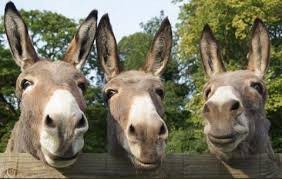
The circus was not making much money, so it adopted a cheaper way of transportation.  It loaded heavy materials, like poles and tents, on the back of donkeys.

Donkeys

To make sure that the donkeys did not run away, logs of wood were tied from their front left foot to their hind right foot.  With the logs of wood, the donkeys could walk slowly but could not run away.

During the shows, the donkeys were free of their load, but the logs of wood always remained tied to their feet.  In the daytime, the donkeys were allowed to walk around to graze.  At night, they came back to the circus for more food and shelter.

One day, one donkey slowly walked far away from the circus and neared a forest.

Two Donkeys

There, he met a wild donkey who was freely running around.  They started a conversation.  The circus donkey said, “At the end of the day, I do not have to worry if I do not get enough food to eat while roaming around because I am sure to get food at the circus.”

The forest donkey said, “It is true that I have slept without food for many nights, but I am happy that my feet are not tied up by a log of wood. I can walk, run, and dance freely without that bondage.  Also, I can wander around wherever I want to go and enjoy the beautiful nature.  If you want to enjoy freedom, you should come with me and we will find a way to remove your log of wood.

After listening to the forest donkey, the circus donkey felt that he should join him, but was hesitant to let go of the opportunities that could arise if he stayed with the circus.

The forest donkey asked, “What is the future prospect that is stopping you from your own freedom?”

The circus donkey said, “It is a long story.  The circus manager has a beautiful young daughter.  She is very good in the swing part of the circus.  One day, she was practicing various swinging tricks and I was observing.  During the practice session, she did not catch the swing and fell on the net.  The manager was furious and said, ‘If you fall one more time, I will marry you to this donkey.’  So you see, I am waiting for the daughter to fall.  Marrying her is my future prospect.” 🙂

The forest donkey quietly left and went deeper into the forest.

Lesson Learned:  Most people dream of achieving something in life.  Many do not get opportunities to work towards their dreams.  However, many do get opportunities to work hard and realize their dreams.  Obstacles do come in their way, but they overcome them with determination and tenacity and are able to fulfill their dreams.

Some people have dreams but wait for miracles to occur, which may help them realize their dreams.  Usually these are false hopes.

We have to be careful not to entertain imaginary future prospects.

 (Thanks to Pallavi Tatapudy and Ishani Trivedi for editing this post).

Being Spiritual Vs. Religious

The original aim of all religions was to develop the spiritual side of human beings.  However, knowingly or unknowingly, many religious groups slowly drifted away from spirituality.  The earth has been covered with bloodshed more so in the name of religion than for any other reason. No religion can claim that it is inculpable of this.  Every religion has a group of people who, instead of encouraging love for all human beings, espouse hatred for the people of other religions.  That is why many thoughtful and sensitive people are distancing themselves away from religion and are happy to be called atheists.  However, they do not realize that along with religion they are often giving up spirituality and thus they miss all life-essential benefits that spirituality can offer.

Keeping this in mind, I reflected upon the differences between being a spiritual person and being a religious person.

1. The Goal:

Spiritual:  The goal of a spiritual person is to realize the Spirit or Soul or Atman that is lying within. The Spirit is what remains after we remove the name and form of a person.  Thus, the Spirit is the same in all people irrespective of a person’s color, country, culture, religion, age, gender and any other external thing that separates them.  This Spirit or Soul is divine.  It is the support of every being on the individual plane and it is the support of the universe as a whole.  It is called the Consciousness or the Ultimate Reality of a being.  It is referred to as the highest truth a human-being can achieve. And it is the peak of the mental evolution of human beings.

Religious: The goal of a religious person is multifarious. Some people want to go to heaven. Some want worldly pleasures and success including wealth, power, position, name and fame. Some want a little peace of mind. Some want to continue the tradition of their parents and grandparents. And some want to avoid the guilt of not being religious.

2. The Practices:

Spiritual:  A spiritual person’s practice is an inner search for the Ultimate Truth.  This search is as scientific in nature as that of a scientist’s for external truth.  Even though this inner search is based on the guidelines of the scriptures and the teachings of Sages and Saints who have realized the Ultimate Reality or Ultimate Truth, a spiritual seeker has full freedom to carve out a path which suits his/her physical and mental capacity and chemistry.  Thus, the spiritual practice is individually customized.  Since spiritual development is an inner journey towards our own divine Self, it is purely individual.

In general, there are four kinds of practices for spiritual development related to the four faculties of a human being: the physical, the emotional, the focusing of the mind (concentration), and the analytical.

The spiritual practice related to the physical faculty is unselfish service to humanity.  In this practice, one puts aside all external differences and personal gain and tries to serve all beings for one’s own spiritual development.  The more one becomes unselfish in thought, speech, and action, the more one advances towards his/her own divine Self.

The spiritual practice related to the emotional faculty focuses on developing love for a divine form of God, an incarnation of God, or a saintly person, and to think of and imbibe His/Her virtues in one’s personal life. One worships a form of God and sings His/Her glories to develop love for God or love for goodness.  A devotee realizes that God is not hiding somewhere outside, but is residing within.  Our true identity, the Divine Self, makes us pray to God and seek God.  Through the worship of various forms of God, people are worshipping that same God that is residing within.  Even though the same God resides in all, people are different because the manifestations of God through them are different.  Shri Ramakrishna says that fire is in every object, but it is more manifested in wood, meaning we can get fire more easily from wood than any other object.  In the same way, God’s presence can be felt more through the thoughts, speech, and actions of good people – our Saints and Sages.

Repeating name of God (Japa), doing regular prayers, worshipping God, reading spiritually uplifting books, serving and learning from devotees of God, and visiting holy places are various ways to develop love for God.  Thus, these spiritual practices are associated with the emotional faculty of human beings.

The spiritual practices related to the faculty of focusing of the mind are measures that enable one to acquire complete control over the body and mind and to develop concentration power.  Moderation in all activities – such as eating, sleeping, working, exercise, entertainment and others–is an important spiritual practice, which helps in focusing the mind.  Trying to live a goal-oriented and self-disciplined life helps us achieve control over our minds.  Worldly cravings distract the mind.  If worldly cravings are more important than spiritual development, when one attempts to focus the mind, the mind will wander about thinking about those very cravings. Practicing virtues eliminate many worldly cravings.

To focus the mind, japa (repeating name of God) and meditation are useful.  Japa easily leads to meditation.  When we meditate, we become one with the object or the person on whom we meditate.  Thus, when we meditate on our true identity, our Divine Soul, we become one with that Divine Soul.

The spiritual practice related to the analytical faculty of a person involves developing a refined, unbiased and objective reasoning.  Through this reasoning, one can find out one’s true identity or the Ultimate Reality, Soul or Atman.  Meditation and self-control help one in realizing one’s true identity.  This realization is then reflected in the thoughts, speech, and actions of a person.

Religious:  Going to a church or temple, or any other religious place, and doing solely ritualistic prayer or worship is the main activity of most religious people.  Religious people do ritualistic worship whenever it is convenient for them.  Some people do it daily, some do it weekly, some do it on monthly basis, and some do it whenever they remember to or have free time.

Swami Adiswarananda used to say that many people go to religious places of worship when they are hatched, matched, and dispatched; when a child is born, when people get married and when they die.

Religious people like to go to a religious place to offer prayers, worship as prescribed by the priest, and eat sacred food given by the priest.  They occasionally read religious books, watch religious videos, and listen to or sing religious songs.  These practices are the means and ends of religious people. It is more of a congregational practice.  Many people go to a religious place to socialize or to eat good food.  Thus, many religious places have become social, economic, and political centers.  Prayer and religious worship seem like excuses to meet and socialize. People worship with the hope that these practices fulfill their worldly desires.  Since genuine spiritual practices are difficult, people take satisfaction in going to holy places and doing some ritualistic worship or prayers.

3. The Progress:

Spiritual:  If a person does spiritual practices properly, then the following can be seen in a person.

(i)  Transformation:  A transformation starts taking place in his/her life for good. Many virtues develop like humility, unselfish love for all, not hating anyone, seeing good things in all, service-oriented nature and others.

(ii) Inner Peace & Strength: A person feels peace within himself / herself.  He/she develops inner strength which helps to face any situation with calmer mind.

One feels joy within.  This joy does not depend on any worldly object or a person.  With this joy, a person’s life becomes truly and genuinely joyful.

(iii) Deeper Understanding: One obtains a deeper understanding of one’s own mind.  This helps in understanding others’ minds and in looking things with a proper, balanced perspective.  With this understanding, one develops better relationships with other people.

A finer intellect (Viveka) develops which makes a person realize that the body and mind are not permanent.  The body and mind constantly change.  A person realizes that one’s true identity is beyond the body and mind, and is rather the Soul or Atman.  This Atman is the support of life.  Because of Atman, the body, mind, and senses of an individual function.  Similarly, as with Atman on an individual level, there is a single support of the whole universe, which is called Brahman. The whole universe came from this Brahman, is nourished by Brahman and is going to dissolve in Brahman.  Through a deeper understanding, one understands that there is no difference in Atman and Brahman.   Brahman residing in an individual person is called the Atman.

(iv) Self-Control:  One attains more control over one’s own mind and senses.  This helps a person avoid unnecessary problems, which he/she could have been trapped into unconsciously.  One develops virtues and obtains control over weaknesses like lust, greed, anger, jealousy, hatred etc.

(v) Awareness:  One lives a life with awareness.  One thinks before uttering any word or getting involved in any action.

One realizes that the goal of life is not moneymaking, producing children, acquiring name and fame, or seeking out sense-pleasures.  One becomes fully convinced that the goal of life is to realize one’s true identity, Atman, whose nature is “Existence-Knowledge-Bliss-Absolute” – the support of all life.  All knowledge and bliss comes from the Atman.  In short, whatever a human being is seeking in the universe (happiness, knowledge, fearlessness, immortality, satisfaction and others), he/she gets all by realizing Atman.

Religious:

A religious person who attends church, does prayer, etc. and is regularly engaging in spiritual practices for spiritual development will obtain all the benefits mentioned above.

However, one who does only religious practices without the goal of spiritual development will only achieve the following:

(i) Momentary Satisfaction: Through the performance of religious practices without spirituality, one attains momentary satisfaction and feels happy that one has followed the family tradition.

Since the motives of religious practices do not include spiritual development, the joy of performing religious practices is short lived.  Many times, after the religious worships, trifle matters remain engraved in the mind of this person. This person focuses more on things like the worldly behavior of the priest, the behavior and interactions of people in the congregation, the taste of the Prasad (the sacred food) etc.

Without trying for spiritual development, religious practices become like a patchwork or bandage treatment.  Since the fundamental problem, “the basic ignorance of life”, is not resolved, life brings many problems like fear and frustration, which ultimately make life miserable. This prevents a longer lasting peace.

(ii) Worldly Benefits: A religious person seeks to develop a social network by meeting other people in religious places and uses this network to accomplish some worldly goals and increase his/her name or fame – whether professionally or socially.  Through these contacts one’s wealth may increase and one may acquire name and fame as a religious person.

(iii) Fanatic Joy:  On an extreme end, a religious person may acquire joy in converting people to one’s faith and sometimes one gets joy in killing people of other faiths.

4. The Outcomes:

Spiritual:  The major outcomes of truly engaging in spiritual practices include the following:

(i)   Divinity: A complete transformation of life for good. A person becomes divine, meaning all of the virtues described in the scriptures (which are needed to have a happy human society) manifest in the person: love for all, humility, free from lust, greed, anger, jealousy, ego and selfishness, forgiving nature, and others.

(ii)  Freedom: A spiritual person becomes free from all bondages.  He/she will not be a slave of anything and will work and live as his/her own master.

(iii) Fulfillment: All human desires become fulfilled and a true sense of fulfillment comes in life.

(iv) Love For All: One develops unselfish love for all, understands that each person is divine as a soul, and is always ready to serve others.

(v)  Inner Peace and Power: One feels an unbroken inner peace which does not depend on any worldly object. Being identified with the soul or Atman, one feels tremendous power within.

(vi) Realization of Truth: One realizes that one’s true identity is divine.  This divinity is Atman.  One realizes that as the ocean water in pots of different shape and colors is the same, the Atman in all is the same.  If a pot breaks, then the water inside merges with the water outside and it becomes one.  Similarly, when the body-mind frame of a being dies, the Atman lying within merges with Brahman outside.  Identifying with the Atman (Spirit) makes one immortal and fearless.

One realizes that just as various ornaments are made from the same element of gold, all “different” beings and things of the universe are made from the same consciousness called Brahman.  In this way, one realizes that he/she is associated with all beings and things of the universe and that they are part of him/her.  As one hand does not harm another hand because both the hands are the parts of the same body, a realized person does not harm another person.  If the left hand is hurt, the right hand will try to ease the pain of the left hand.  Similarly, a realized person is always ready to help any other being considering that they all share common identity.

A realized person lives a fully aware life.  He/she is always aware that the true identity of a being is Existence-Knowledge-Bliss Absolute.  This person’s life is creative and not monotonous.  For such a person, everything in the universe is alive and meaningful.  He/she takes full interest in everything that comes to him/her.  In the presence of a realized person, others feel that their lives are meaningful and as a result their good qualities blossom.  To live in the company of such a person is truly a blessing.  It is like living in the presence of God.

Religious:  If a person doing religious worship develops love for spiritual development, then he/she can obtain the benefits outlined above. Yet if a person does religious worship without spiritual development, he/she will only gain the following major outcomes and will risk facing the dangers described subsequently.

(i) Short-term Satisfaction: A religious person will earn some satisfaction and short-term peace of mind thinking that one has continued one’s family tradition.

(ii) Worldly Gains: A religious person may acquire name and fame, develop a strong social network helpful for worldly purposes, and gain financial benefits.

Dangers: However, along with these limited benefits, there are various dangers of doing religious practices without having spiritual development as a goal.

(i) Being Mechanical:  The mouth may repeat the words of prayers and hymns, but the mind will become occupied with worldly thoughts.  Thus, ritualistic prayers and worship may become mechanical and one may lose interest in them.

(ii) Losing Faith:  If by doing ritualistic worship one’s worldly desires do not get fulfilled, then one may lose faith in God and thus lose the benefit that spirituality can offer.

(iii) Living Double Life: Without a spiritual goal, one’s actions may not match with the words of prayers.  Many times, the actions of a religious person become contradictory to the meanings of the prayers uttered. One may pray to God who is compassionate, but the person may become cruel to his/her fellow beings.

(iv) Frustration and Depression:  Since the fundamental questions of the life – “What is my true identity?”, “What is the meaning of my life?”, “What is the connection between the people of the world and I?” – are not addressed, one will become frustrated and depressed.  A time comes when money, worldly name and fame, or sense pleasures become meaningless and a person will crave for something higher to have a peace of mind.

(v) Becoming Fanatic: On an extreme end, one may become a fanatic.  One may lose the sense of discrimination between what is good and what is bad.  A fanatic believes that his/her religion is the only great religion in the world and all followers of other religions are demonic.  A fanatic believes that converting other people to one’s faith is a great religious activity.  The worst is when a fanatic believes that killing the people of other faiths is a religious activity.  This is the complete opposite of the goal of a religion.

I love my mother.  But, it is ludicrous to ask and force everyone to love my mother as I do.  Each person has a mother who is dear to him/her.  The point is that the forms of the mothers are different, but the “motherhood” is the same.  Thus, God has many forms and people, according to their own family faiths, situations, and tastes, worship the form they feel comfortable with.  Like motherhood, Godhood is the same for all religions. All are worshipping the same God through different forms. However, the fanatics are ignorant of this, causing them to lose their common sense and simple human decency.  Because of this, sensible people get fed-up with religion and are happy to be atheists.

5. Conclusion:

As I had mentioned in the beginning, all religions started for the spiritual development of human beings.  But slowly, many religious groups have drifted away from their goal and have become more or less social, economic, and political groups.  As a result, the religious people, instead of becoming divine, become more worldly, hypocritical, indecent and cruel.

The great religious personalities who have done good for the whole of humanity and not just for a selected group of people were all spiritually oriented.  Spiritual Development is the ultimate goal of human life and until we accept that, we will have to face death, destruction, fear, frustration, depression, and all the negative aspects of life.

(Thanks to Ronak Parikh for editing this blog.)

A Story from Chhandogya Upanishad – IV

The steps to realize the Ultimate Truth: (Chhandogya Upanishad, Chapter 8.7 – 8.12)

Chhandogya Upanishad

Prajapati (The Lord of people) said, “One has to search and realize the Atman. The Atman is pure, free from hunger, thirst, old age, and death. Its desires and vows come true. If one searches the Atman following the scriptures and the guidance of a competent teacher and realizes It, then all his desires are fulfilled and he attains everything.”

The devas and demons heard Prajapati’s declaration. The realization of Atman, they thought, would fulfill all their desires and allow them to attain everything they ever dreamed of. They decided to pursue this quest for the Atman.

Devas asked their king, Indra, and the demons asked their king, Virochana, to go to Prajapati to learn about Atman.

Both Indra and Virochana went to Prajapati’s ashram with offerings in their hands. Jealous of one another, they vowed to themselves, I will learn about Atman first.

Prajapati asked them to stay in the ashram, live an ascetic life, and take the vow of celibacy. They lived there for 32 years.

After 32 years Prajapati asked them, “What is it that you desire? What has motivated you to stay here?” Both said that they had heard the Revered Prajapati’s declaration, “One has to search and realize the Atman. The Atman is pure, free from hunger, thirst, old age, and death. Its desires and vows come true. If one searches the Atman following the scriptures and the guidance of a competent teacher and realizes It, then all his desires are fulfilled and he attains everything.” They too wanted to know and realize the Atman.

Prajapati said, “The Person that is seen in the eyes,-that is Atman. That is the immortal and fearless Brahman.”

Eyes sketch
The Person thst is seen in the eyes

Indra and Virochana asked, “Between these two, one which is perceived in the water and the one which is perceived in the mirror, which one is Atman?” Prajapati said, “The same one, indeed, is perceived in all of these.”

Neer-1
Reflection in mirror


Neer-2
Reflection in water

Prajapati said, “Both of you go and look at yourselves in a pot filled with water.” They both looked at their reflections in the water. Prajapati asked, “What do you see?” Both said, “O Lord! We see Atman from head to toe, along with hair and nails.”

Then, Prajapati asked both of them to wear their best clothes and ornaments. Indra and Virochana did as they were told and returned in their finest clothing and ornaments. Prajapati told them to look at themselves in the water. He then asked, “What do you see?” Both Indra and Virochana said, “O Lord! We see that the reflection is dressed as we are dressed up. Prajapati said, “That is Atman. That is the immortal and fearless Brahman.” Satisfied with that answer, Indra and Virochana left the ashram.

Watching them leave, Prajapati mumbled, “Both of them are leaving without knowing and realizing Atman.  Devas or demons, those who do not truly know Atman will perish.”

Virochana, the king of the demons, was satisfied with what he had learned. He went to the demons and started to teach them that the body is Atman. It is this Atman (body) that has to be worshiped and nurtured. One who takes care of this Atman (body) fulfills all desires and attains everything.”

Therefore, even today people say that a person is of demonic nature if he/she has no faith in something higher than his/her body, and sees no purpose in charity and spiritual development. People of demonic nature adorn even dead bodies with make-up, nice clothing, and ornaments thinking that these things will help the dead person attain everything.

Indra too was on his way to see the Devas. Yet, a thought kept disturbing him. Something was definitely wrong with his understanding of Atman. He started thinking, ‘when a body is adorned with nice clothes and ornaments, its reflection too is adorned with nice clothes and ornaments. Similarly, if a person becomes blind, then its reflection becomes blind; if a person is hurt, then its reflection is hurt, and when a person dies, then its reflection also dies. Something was awry. How could there be anything beneficial in this knowledge of Atman?’

Indra went back to Prajapati with offerings in his hands. Upon seeing Indra, Prajapati asked “O Indra! I saw that you and Virochana were satisfied with the knowledge of Atman and had left. Why did you come back again? What do you want?” Indra replied, “O Lord! I do not see any benefit in my understanding that the reflection of the body, which I see through my eyes, is Atman. If I put on nice clothes and ornaments, my reflection puts on nice clothes and ornaments. If I am clean, my reflection is clean. But, if I become blind, my reflection becomes blind. If I am hurt, my reflection is hurt and if I die, my reflection dies.” Prajapati said, “O Maghavan (Indra)! Yes, it is like that. Live here for another 32 years observing celibacy. After 32 years, I will explain it to you more.”

After 32 years, Prajapati said, “The One who moves about, exalted, in our dreams is Atman. It is the immortal, fearless Brahman.” Indra was satisfied and left.

But, before he reached the Devas, he thought, there is something wrong with his understanding of Atman. If one becomes blind, his dream-self does not become blind; if one gets hurt, his dream-self does not get hurt; and if one dies, perhaps his dream-self does not die. Thus, the limitations and changes of the body do not apply to the dream-self. But, if in one’s dream, someone beats the dream-self, the dream-self feels the pain, if someone treats the dream-self badly, then it gets upset, and if danger approaches the dream-self shows fear. Thus, one’s dream-self cannot be Atman and there is no benefit in this knowledge of Atman.

Indra came back to Prajapati with offerings in his hand. Prajapati asked, “O Indra! You had left satisfied with your understanding. Then, why did you come back? What do you want?”

Indra answered, “O Lord Prajapati! It is true that my dream-self does not get affected by whatever happens to my body. For examples, it does not become blind if my body does, it does not get hurt even if my body gets hurt, and it does not die even if my body dies. But, if someone beats my dream-self, then this dream-self feels pain, if someone treats my dream-self badly, then it gets upset, and if some danger comes to my dream-self, then it shows fear. Thus, I do not see any benefit in knowing that my dream-self is Atman.”

Prajapati said, “O Maghavan! It is like that. Live here for another 32 years observing celibacy. After 32 years, I will explain it to you more.”

After 32 years, Prajapati said, “When a person is in deep sleep, he sees no dreams and is happy – that is Atman. It is the immortal and fearless Brahman.” Indra was satisfied and left.

But, before he reached the Devas, he thought to himself, in deep sleep one is not even aware of his own self and other people. In deep sleep one is not aware that “I am Atman.” What is good about this deep sleep state? It is as good as being a dead person. Indra did not see anything good about this knowledge of Atman.

Indra came back to Prajapati with offerings in his hands. Prajapti asked, “O Indra! Satisfied with your understanding of Atman, you had left. Then, why did you come back? What do you want?”

Indra replied, “O Lord Prajapati! In deep sleep I am not aware that “I am Atman” and I am not aware of all people and things around me. It is like I have died. I do not see anything good in this knowledge.”

Prajapati said, “O Maghavan! It is like that. This time, live here for another 5 years observing celibacy. After 5 years, I will explain it to you more.”

Indra lived with Prajapati for another 5 years observing celibacy. Thus, they say that Indra had lived with Prajapati for 101 years observing celibacy.

After 5 years, Prajapati told Indra, “O Indra! The body is mortal. It dies. But, this mortal body is the abode of the immortal, body-less Atman. As long as one has body-consciousness, one has likes and dislikes. But, likes and dislikes do not touch a person who is aware of the body-less Atman lying within.”

“Wind, cloud, lightning, and thunder are body-less. All these arise from the space and, through the light of the sun, go back to their original forms. Similarly this Atman arises from the body and through the Supreme Knowledge of Itself, goes back to Its original form.

In that state, the Atman moves about–laughing, playing, and rejoicing–without thinking of the body. But, this very Atman remains attached to the body as an animal remains attached to a cart.

The Atman is the cause of seeing and the eyes are Its instruments to see. When one is aware of this fact, that person realizes that the Atman is the “Seer” and the eyes are Its instruments.

– When one is aware that the Atman is the cause of smelling, the “Smeller” is the Atman and the nose is Its instrument.

– When one is aware that the Atman is the cause of speaking, the “Speaker” is the Atman and the mouth is Its instrument.

– When one is aware that the Atman is the cause of listening, the “Listener” is the Atman and the ears are Its instruments.

– One who is aware that the Atman is the cause of thinking, the “Thinker” is the Atman and the mind is Its instrument.  The mind is called the divine eyes of the Atman. The Atman sees all the desires in the world through the divine eye of the mind.

After learning this Truth, the Devas meditated on this Atman. As a result, all their desires were fulfilled and they attained everything.” “Thus,” Prajapati declared, “One who understands the teachings about Atman from the scriptures and from a competent teacher and realizes It fulfills all his desires and attains everything.”

Reflections:

Four States:

This story beautifully describes the four states of a human being: Jagrata (physically awake state), Swapna (dream state), Sushupti (dreamless sleep state) and Turiya (state of awareness of Atman).

Jagrata (physically awake state): Most people remain in the physically awakened state for most of their time. Also, most people think that this is the only real state of a human being. Whatever we perceive in this physically awakened state is real and all other things are imaginary or delusion. Most of us consciously or unconsciously believe that what we perceive through our senses are the only useful things in life. We try to understand the world with what we perceive through our senses. All our physical knowledge lies on these grounds, on sense perception.

We perceive most parts of our bodies through our eyes. We also perceive our bodies through their reflections in the mirror or water or through our photographs. All our joys and sorrows are based on this sense perception.

Indra thought that the physically awaken state was the only reality. But, then he realized that what we perceive through our senses is limited. The body undergoes changes. It is subject to disease, old age, and death. Indra realized that Prajapati wanted him to reflect further; the body was not the Ultimate Reality. Human beings are more than their body. One cannot be really happy by nurturing the body alone and constantly thinking about the pleasures of the body.

Swapna (dream state): Prajapati drew Indra’s attention to another state of a human being– the dream state. When a person is in the dream state, his/her mind creates an entire universe. In this state, the outer world, the world perceived through the senses, disappears. In a dream a person can create the Yankee Stadium filled with thousands of people watching a ball game.   That person can even create themselves in the dream, enjoying the game. For the dreamer it is all real. Many a times, in one’s dreams, a person fulfills all of the unfulfilled desires of his Jagrata (physically awakened) state.

Indra realized that the limitations of the Jagrata state do not follow in the dream state. Even when one is poor in the physically awakened state, he may become rich in his dreams. However, unpleasant things may happen.  A rich person may become poor in his dream.  A hungry tiger may chase the dreamer, in an attempt to devour him. It is good that we do not remain in the dream state all the time and we wake up in the middle of unpleasant dreams.

Indra realized that the dream state was not what he wanted. He wanted all his desires to be fulfilled and wanted to be happy and free from the fear of death. He found that dream state too has sufferings and limitations. So, he came back to know more.

Sushupti (state of deep sleep): When a person is going to sleep, one turns off all the lights of the house, goes to the bedroom, turns the light off in bedroom, keeps a night-lamp on and sleeps on the bed. Similarly, when a person is going to sleep, slowly all the senses are withdrawn and get cut off from the physically awakened state. Then, he enters in the dream state. At one point, all the dreams go away and he falls into deep sleep. Like that night-lamp which remains on in the bedroom, in deep sleep the vital forces keep one alive. The senses have merged into mind and mind has merged into Atman. If a person has good dreamless sleep, he feels very happy. However, as soon as he wakes up, within a fraction of a nano second all of the things connected to the physical-self come rushing back: all work, all the plans and desires, all associations, joys and sorrows, likes and dislikes and more. The person does not find any change or a transformation within oneself, all that has happened is that the body and mind have had a good rest.

Indra realized that this state of dreamless sleep was as good as being lifeless or dead. There is no awareness of the Atman. He did not see anything deeper in this state beyond having achieved physical rest. He recognized that the awareness of Atman could not be this state. Prajapati agreed with him. Prajapati acknowledged that Indra was finally ready to understand the Atman after thoughtfully ruling out the other three states.

Turiya (state of awareness of Atman): Prajapati gave excellent analogies of body-less entities. When we think of Atman as body-less, we have difficulty grasping this concept. But, Prajapati points to the wind, cloud, lightning and thunder which are also body-less. They come from space and disappear into space. Thus, through these analogies, we get a little glimpse of what Prajapati was trying to explain. We can see that something can come from an infinite source; it reveals itself after becoming tangible or graspable by the senses and again it can merge into the infinite. Sound and light are waves. These waves are graspable to humans at certain frequencies, and they can exist beyond our comprehension. The body-less infinite unchangeable Ultimate Reality or Ultimate Power creates bodies and things of the universe that are comprehensible by our human senses, which eventually merge back into that Ultimate Reality or Power. That Ultimate Reality or Power is called Brahman and it is called Atman with reference to an individual.  This body-less Atman is our true identity.  It resides in our finite body.  This Atman is the cause of our capacity to touch, taste, smell, speak, hear, and think. This Atman has created its instruments to perceive the world of senses.

A person can attain this Turiya state where there is only awareness of Atman and it is not a state of dreamless sleep. People have witnessed such states of awareness. It is called a Nirvikalpa Samadhi. One example I know is that of Sri Ramakrishna. He used to be in such a state often. Atheists, critics and medical doctors have examined this state and accepted that physically there was no sign of life, but it was not death or a deep sleep. The face of Sri Ramakrishna was beaming with joy even in the intense painful physical state of throat cancer. He was oblivious of the pain and pleasures of the body.

Swami Vivekananda said that the difference between a person going into dreamless deep sleep and the Nirvikalpa Samadhi is this: a dull minded person remains dull minded after going into deep sleep, but a dull minded becomes a wise person after coming back from Nirvikalpa Samadhi. After attaining this state one experience so much bliss that all the joy of fulfilling all the possible worldly desires becomes an insignificant small fraction of that bliss. After realizing Atman, no desires remain to be fulfilled and one feels that one has attained everything that a human being can attain.

This Turiya state is possible by any person who follows the guidance described by the scriptures and competent teachers. Even if one does not attain Nirvikalpa Samadhi, going towards this state of awareness of Atman brings fulfillment, knowledge, and fills the heart with unselfish love and unlimited bliss.

1_Swami_Vivekananda_1
Swami Vivekananda

Swami Vivekananda says, “There is something behind this world of senses, this world of eternal eating and drinking and talking nonsense, this world of false shadows and selfishness. There is something beyond all books, beyond all creeds, beyond vanities of the world-and that something is the realization of God within yourself.”

(Thanks to Nisha Parikh for editing this post)


A Story from Chhandogya Upanishad – Part III

A Dispute among the Senses and Faculties of a Human Being

Once there was a dispute between all the senses and several faculties of a human being.   Each one, the eyes, the ears, the hands, the legs, the mind and others started to claim, “I am the best.”

The eyes said that if one cannot see, one could not do anything. The ears said that without listening one would face many problems in life; the legs said that without being able to move, one’s life was doomed. 

The question was raised, who could decide which one of these senses was superior to the rest?

They all went to their creator Brahma.  Lord Brahma listened to them and thought about a solution.  He advised that each one of the senses and the faculties of the body, one at a time, go on vacation for a year.  In whose absence the body becomes most crippled, that sense or a faculty is the best among all.

First, speech went on vacation for a year.

Speech sketch
Speech going to vacation

Then, speech came back and asked all the senses and the faculties of the body how they lived their life without talking.

In reply, all the senses and faculties of the body said that they lived life as a mute person lives.  Mute people can see with their eyes, listen with their ears, think with their minds and thus they lived.

After that, the eyes went on vacation for a year.

Eyes sketch
Eyes going on vacation

Then, the eyes came back and asked all the senses and the faculties of the body how they lived their life without the ability to see.

In reply, all the senses and the faculties of the body said that they lived as a blind person lives.  Blind people can speak with their mouths, listen with their ears, think with their minds, and thus they live their life.

Next, the ears went on vacation for a year.

Ear sketch
Ears going on vacation

Then, the ears came back and asked all the senses and the faculties of the body how they lived without the ability to hear.

In reply, all the senses and the faculties of the body said that they lived as a deaf person lives.  Deaf people can speak with their mouths, see with their eyes, think with their minds, and thus they lived their life.

Then, the mind went on vacation for a year.

Mind sketch
Mind going on vacation

The mind came back and asked all the senses and the faculties of the body how they lived without thinking.

In reply, all the senses and the faculties of the body said that they lived as babies live whose minds have not been fully developed.  Babies speak with their mouths, see with their eyes and listen with their ears.

Finally, Prana (the vital forces including breathing) started going on vacation.

As soon as the Prana started leaving the body, all the sense started losing their power.  All felt as if a powerful wild horse was pulling out all the nails that have tied it with ropes.

Then, all the senses went to the Prana and said, “Please do not leave.  You are the best among all of us.”  The eyes, the ears, speech, and the mind said to the Prana that they are all powerful because of the Prana.  That is why, in the scriptures all the senses are referred to as Prana.

– Chhandogya Upanishad: Chapter 5, section 1

(Thanks to Sneha Shah for illustrations and Nisha Parikh for editing the post.)

A story from Chhandogya Upanishad – Part II

It is simply amazing how 5000 years ago, teachers and students of the Upanishads tried to find the answers of fundamental questions of life and the universe through simple available means.  It is more amazing that the answers they had found become more and more relevant with the advancement of science.

The following story from the sixth chapter of the Chhandogya Upanishad is one such example.  Its teachings are profound but have been expressed them in a very simple and appealing way.  This is not an English translation of the chapter.  I tried simply to bring out its essential teachings.

The following books provide the original Sanskrit text of the chapter and its English translation by Swami Nikhilananda respectively.

Chhandogya Upanishad

Chhandogya Upanishad – Sanskrit

DSC04930

A great Rishi named Aruna had a son named Uddalaka who was also known as Aaruni.  Uddalaka was also a great Rishi.  (A rishi is one who has attained the highest knowledge of life a human being can attain.)

Rishi Uddalaka had a son named Swetaketu.  When Swetaketu was twelve years old, his father, Uddalaka, told him that no one in the family had attained the highest knowledge without studying the scriptures.  So, Uddalaka sent Swetaketu to an ashrama where students learned the scriptures.

After twelve years of study, Swetaketu returned home. Uddalaka found him arrogant, having a superiority complex and considering himself a great orator of and an expert on the scriptures.

Uddalaka asked Swetaketu,

“Did you acquire the knowledge by which one can hear what cannot be heard, think what is unthinkable, and know what is unknowable?

Did you acquire the knowledge that would allow you, by knowing a lump of clay, to know all things made out of clay and to know that the differences among things made from clay are only in their names and forms? And that these names and forms are but modifications of speech? Did you acquire the knowledge to understand that the clay is the only truth?

Things made out of Clay
Clay images

Did you acquire the knowledge that would allow you, by knowing a nugget of gold, to know all of things made out of gold and to know that the differences among things made from gold are only in their names and forms? And that these names and forms are but modifications of speech? Did you acquire the knowledge to understand that the gold is the only truth?

Jewlery made out of gold
various ornaments of Gold

Did you acquire the knowledge that would allow you, by knowing a steel nail-clipper, to know all things made out of steel and to know that the differences among things made of steel are only in their names and forms which are but modifications of speech? Did you acquire the knowledge to understand that the steel is the only truth?”

Things made out of Steel
Things made out of steel

Swetaketu answered, “Revered Father! My teacher definitely did not know about this. Otherwise, he would have taught me.  Please teach me.”

Rishi Uddalaka said, “My son! In the beginning of the universe there was only one life force called “Sat” (Brahman).  From Sat, the whole universe came.

A group of people think that there was nothing before the universe.  But, how does ‘something’ come from ‘nothing’?  It is not possible.  Therefore, there was a unique life force called Sat before the universe.

That Sat thought that it should become many and create a universe. Sat therefore created light / fire (Teja).  Light/fire then thought to become many and it created water (Aapa).  We see that when a person feels warm, he/she perspires.  Thus, we can conclude that the light/fire is the source of water.  After water was created, it (Aapa) thought to become many and in turn created food (Anna – this includes everything related to food like land and earth).  We see that when it rains a lot, lots of vegetation grows.  This shows that rain is the source of food.

All beings can be born from one of three things: (i) from eggs, (ii) from species of their kind or (iii) from seeds.

Egg hatching
Andaja – born from egg
kittens
Jivaja – born from species of the same kind
seeds and sprouts
Udbhijja – born from seeds

Light/fire, water and food/earth, decided to enter into these beings in various proportions and thus created a world of names and forms.

In everything that we see, that which is reddish comes from light/fire, that which is white comes from water, and that which has darker colors comes from food/earth.

Sun
The Sun
Moon
The Moon
Lightening
Lightening

One can see these three colors in the sun, moon, and lightening.  These three exist even in fire.  If you separate the fire-part, water-part and the food/earth-part from the fire, then the qualities of fire disappear.  (The same applies to water and food/earth.)

Let us see what roles light/fire, water, and food/earth have in human beings:

There are three parts of food: the gross part, the semi-gross part and the subtle part.  When a person eats food, the gross part of the food comes out as feces (solid waste comes out from human body), the semi-subtle part of the food becomes the meat, and the subtle part of the food makes mind.

Similarly, when a person drinks water, the gross part comes out as urine, the semi-gross part makes the blood, and the subtle part produces the vital forces (prana), including breathing.

When a person eats especially nourishing food (teja), the gross part of it makes the bones, the semi-subtle part of it makes the bone marrow, and the subtle part of it makes the speech.

Thus, the mind is made out of food, vital forces and breath are made out of water, and speech is made out of teja.

How do we see that the subtle parts of food, water, and teja make up the mind, vital forces/breath and speech respectively?

butter rises
Butter from buttermilk

When we churn buttermilk, the subtle part of the butter rises to the surface.  Similarly, the subtle part of food makes the mind, the subtle part of water makes the vital forces/breath, and the subtle part of teja makes the speech.

Swetaketu said, “Father!  Please explain further.”  Uddalaka responded, “My son!  Sure, I will explain further.”

How do we see that the mind is made out of food?

Rishi Uddalaka told Swetaketu, “Do not eat for fifteen days.  You can drink water.  Since you will be drinking water, you will remain alive.  Come to me after fifteen days.”

Swetaketu responded, “Okay father!”

Swetaketu returned to his father after fifteen days.  Uddalaka said, “You had learned the Vedas.  Now recite something from the Vedas.”  Swetaketu answered, “Father!  My mind is not functioning. I cannot recite anything.” Uddalaka said, “Go and eat something.”  Swetaketu had a good meal and came back.  Uddalaka then asked him again to recite from the Vedas.  Swetaketu recited many verses from the Vedas.  Father Uddalaka said, “See Swetaketu, when a blazing fire is put off and only a little fire remains, it cannot cook anything.  But, if we put dry branches of trees into the little fire, we can ignite it into a blazing fire and then cook anything in it. In the beginning, your mind could not function without food, but after you ate food, it functioned very well.  Know that the mind is made out of food, that vital forces/breath are made out of water, and that speech is made out of teja.

How do you feel your true self?

Uddalaka told Swetaketu that when a person is in a dreamless sleep, his awareness of the world associated with his name and form go away.  A little “prana” (vital force/breath) keeps one alive, but one is not aware of all the joys, sorrows, and problems associated with one’s body and mind.  This is an indirect experience of the true self in which the awareness of one’s own external identity disappears.

(When we go to bed, first various thoughts come to our minds, then we enter a dream state, and then finally we come to the state of deep sleep without dreams.  In that state we forget all about our gender, age, color, culture, plans, positions, problems, and everything related to our body and mind.  At that time we are almost one with our true identity “Sat” or Atman.  But, as soon as we wake up, within a fraction of a second, our body-form identity and everything related to it comes rushing back.

To experience our true identity “Sat” or Atman in our awakened state is realization of Truth or God.)

Searching our true identity:

By following the root of ourselves, we can find our true identity.

(i) Prana is the support of the mind:  Our mind needs our body.  Rishi Uddalaka told Swetaketu to imagine a person with an eagle as a pet.  The owner ties a string to the bird and keeps the other end of the string in his/her hand.  The bird will fly all around and then come back to the hands of the owner.  Similarly, our mind will go around, but will eventually come back to the living body.  Thus, the mind needs “prana” to keep the body alive.  Food keeps the body alive.

(ii) Water leads to food:  Uddlaka continued, “Swetaketu!  How does a person get hungry?  When a person eats food, the food mixes with water and becomes digested.  All of the nourishment of the digested food goes in the body and the person becomes hungry again.  Thus, water leads to a need for food.”

(iii) Teja leads to water:  “How does a person become thirsty?  When body heat evaporates the water inside the body, a person becomes thirsty.  Thus, teja/fire leads to a need for water.

(iv) “Sat” (Brahman) leads teja:  Teja/fire came from Sat.  Thus, Sat leads teja/fire.

Search for the root or the cause:

When a person is dying, he/she stops talking.  People first say, “Oh!  He/she is not talking.”  They then find that “he/she is not moving.”  Finally, they find that “his/her body is cold.”  Thus, when a person stops talking, the mind of the person merges into “prana” (vitality).  When, a person stops moving, the “prana” merges into “teja/fire”.  Finally, when the person’s body is cold, his/her teja merges into Sat (Brahman).

Rishi Uddalaka told Swetaketu, “My son!  Search for the cause or root of each one (food, water, and teja) and you will realize your true identity.  The cause of body is food, the cause of food is water, the cause of water is light/fire, and the cause of light/fire is the one life force Sat (Brahman) which created the whole universe and which is the whole universe.

That Sat is subtle and has manifested as the universe.  That is the Truth (behind the universe of names and forms). That is Brahman. That is Atman, and Thou art That (Sat) (Tatvamasi-Tat Tvam Asi). 

Thus, our true identity is divine.  It is the support of our existence.  We call this unique life force (Sat) God and worship It in various forms.  The goal of human existence is to realize our true identity.

Swetaketu said, “Father!  Please explain further.”  Father said, “My son!  Sure, I will explain further.”

Example of bees:

Honey in honeycomb
Bees and Honeycomb


Honey

Rishi Uddalaka said, “O Swetaketu!  Bees collect juices from various flowers and other sources and make honey.  In the honey, one cannot separate the juices by their sources.  Similarly, the individuality of all things of the universe will disappear when they merge with the original unique life force Sat.”

Example of Rivers:

river bringing water to ocean
River meeting ocean

“O Swetaketu!  All rivers empty their water into the ocean.  In the ocean one cannot separate the waters by their source rivers. Similarly, the individuality of all things of the universe will disappear when they merge with the original unique life force Sat.”

That Sat is subtle and has manifested as the universe.  That is the Truth (behind the universe of names and forms). That is Brahman. That is Atman, and Thou art That (Sat) (Tatvamasi-Tat Tvam Asi). 

Now, as in the dreamless sleep, a person momentarily loses his/her external identity of name and form and becomes one with the Sat. After waking up, however, the person immediately returns to his/her name-form identity. Similarly, all beings, because of their worldly desires, come back to their separate name-form identities even after being merged with Sat.

Swetaketu said, “Father!  Please explain further.”  Father said, “My son!  Sure, I will explain further.”

“Sat” or Atman does not die:

A Tree with branches
Living Tree

Rishi Uddalaka said, “Swetaketu!  If you struck a living tree at its roots, it would bleed.  If struck it in the middle, it would bleed.  If you struck it at the top, it would bleed.  Similarly, when the life force is in the body, it spreads everywhere and is all pervading like the sap of the tree.

Dry Tree
Dead Tree

But, if the life force leaves a branch of the tree, then that branch falls off.  If it leaves another branch, that will also fall off.  If it leaves the whole tree, then the whole tree dries up and falls.  Remember, the life force does not die.  When the life force (Atman) leaves a body, then only does the body die.

That Sat is subtle and has manifested as the universe.  That is the Truth (behind the universe of names and forms). That is Brahman. That is Atman, and Thou art That (Sat) (Tatvamasi-Tat Tvam Asi). 

Swetaketu said, “Father!  Please explain further.”  Father said, “My son!  Sure, I will explain further.”

Have faith in the existence of “Sat” (Atman):

A Banyan Tree
Banyan Tree

Rishi Uddalaka asked, “Swetaketu!  Please bring me a fruit from this banyan tree.”

Swetaketu said, “O Father!  Here is a fruit of the banyan tree.”

Rishi Uddalaka said, “Break this fruit.”

Swetaketu said, “I broke it.”

Fruit and seeds of a banyan tree
Seed of Banyan Tree

Rishi Uddalaka said, “What do you see in it?”

Swetaketu said, “I see very small seeds.”

Rishi Uddalaka said, “Break one seed.”

Swetaketu said, “I broke it, father.”

Rishi Uddlaka said, “What do you see inside?”

Swetaketu said, “Father! I don’t see anything inside.”

Rishi Uddalaka said, “You do not see anything inside this seed, but from such a seed this big banyana tree came. The subtle part of the seed has made this huge banyan tree.  My son! Have faith. That Sat is subtle and has manifested as the universe.  That is the Truth (behind the universe of names and forms). That is Brahman. That is Atman, and Thou art That (Sat) (Tatvamasi-Tat Tvam Asi). 

Swetaketu said, “Father!  Please explain further.”  Father said, “My son!  Sure, I will explain further.”

“Sat” (Brahman or Atman) is everywhere in the universe:

DSC04932
Glass of water
Salt
Salt

Rishi Uddalaka asked, “Swetaketu!  Please bring a glass of water and some salt.”

Swetaketu said, “Father! Here is a glass of water and some salt.”

Rishi Uddalaka said, “Put salt into the water and stir.”

Swetaketu said, “I stirred it.”

Rishi Uddalaka said, “Now it is night. Go to bed and in the morning bring this glass to me.”

Swetaketu came in the morning with a glass.

Rishi Uddalaka said, “Please give me the salt which you put it in the glass of water.”

Swetaketu said, “I do not see any salt in the water.”

Rishi Uddalaka said, “Take a spoon and drink water from the top of the mixture.  What do you taste?”

Swetaketu said, “I taste salt.”

Rishi Uddalaka said, “Now take a spoonful of mixture from the middle.  What do you taste?”

Swetaketu said, “I taste salt.”

Rishi Uddalaka said, “Now take a spoonful of mixture from the bottom.  What do you taste?”

Swetaketu said, “I taste salt, father.”

Rishi Uddalaka said, “My son! You do not see salt in the mixture, but you tasted the salt everywhere.  Similarly, “Sat” (Brahman) is always there in the universe.  You cannot see It, but It is there. That Sat is subtle and has manifested as the universe.  That is the Truth (behind the universe of names and forms). That is Brahman. That is Atman, and Thou art That (Sat) (Tatvamasi-Tat Tvam Asi).” 

Swetaketu said, “Father!  Please explain further.”  Father said, “My son!  Sure, I will explain further.”

How does one realize “Sat” or “Brahman”?

Rishi Uddalaka said, “Suppose a thief blindfolds a person, ties his hands, takes him out of the city Gandhar and into the woods and leaves him there.  The blindfolded person will scream, ‘I cannot see.  I am blindfolded!  Please untie my hands and remove my blindfold!’

Suppose a passerby has compassion for this victim.  He frees the person’s hands and removes his blindfold.  The free person says to the passerby ‘I am from the City Gandhar.  Please tell me how to go to the city.’

The passerby points out the direction of Gandhar.  Then, the free person, asking people from village to village, reaches the city of Gandhar. Like the passerby, there are wise people who know “Sat” (Brahman). Through their guidance we can be free from our ignorance. Following their directions, we can realize the “Sat” (Brahman) from which we had come.

The “Sat” that we are seeking is subtle and has manifested as the universe.  That is the Truth (behind the universe of names and forms). That is Brahman. That is Atman, and Thou art That (Sat) (Tatvamasi-Tat Tvam Asi).”  

Swetaketu said, “Father!  Please explain further.”  Father said, “My son!  Sure, I will explain further.”

Who attains freedom?

Rishi Uddalaka said, “Suppose a king’s guards bring a suspect to the king and say, ‘O King! This person has stolen money.’ The king will ask the servants to bring a hot axe, which serves as a lie-detector test.

Steel axe
Axe

The suspect will have to hold the hot axe.  If he is a liar, then he will get burned and die.  If he is not a liar, nothing will happen to him and the king will relieve him immediately.

Thus, a wise person who has realized the “Sat” (Brahman), the Ultimate Reality, will become free from all bondage and sufferings, but an ignorant person will, like the liar, suffer in the universe.

Therefore, realize “Sat” (Brahman), the Ultimate Reality and be free from all bondage and sufferings of the world.

Realize That Sat is subtle and has manifested as the universe.  That is the Truth (behind the universe of names and forms). That is Brahman. That is Atman, and Thou art That (Sat) (Tatvamasi-Tat Tvam Asi).”    

Swetaketu said, “Now, I understand.  Now, I understand.  Thank you father!”

 Om Peace!  Peace be unto us! Peace be unto all beings!

(Thanks to Ronak and Nisha Parikh for editing this post.)

Celebrating Swami Vivekananda’s 152nd Birthday

Monday, January 12, 2015 is Swami Vivekananda’s 152nd birthday.  All over the world, people who have been inspired by Swami Vivekananda will be celebrating his birthday with great joy.

1_Swami_Vivekananda_1

Since 1984, India celebrates every January 12th, Swami Vivekananda’s birthday, as a National Youth Day.  On that day, students in schools and colleges all over India participate in parades, youth conventions, youth-related seminars, presentations of speeches, recitations, essay-writing contests, yoga-asanas, and various athletic events.

Who was Swami Vivekananda?  He was a saint, a prophet, a yogi, an Incarnation of all loving and compassionate Lord Shiva, a great orator, a poet, a writer, a musician, a great teacher, a scholar, a visionary, a thinker, a philosopher, an explorer of Vedanta, a humanitarian, a social reformer, a patriot, a lover of humanity and much more.  His multi-faceted personality is blinding to the human eyes.  He lived only for 39 years, but his positive impact on the society will go on inspiring people for thousands of years.

In 1976, on the occasion of America’s Bicentennial Celebration, the National Portrait Gallery in Washington, D.C. displayed a large portrait of Swami Vivekananda as a part of its exhibition, called “Abroad in America: Visitors to the New Nation: 1776 -1914. ” This exhibition paid tribute to the great personalities who visited America from abroad and made a deep impression on the American mind.  The commemorative volume of the exhibition reads: “The Swami charmed the audiences with his magical oratory, and left an indelible mark on America’s spiritual development.

One can buy the commemorative volume “Abroad in America: Visitors to the New Nation: 1776 -1914” from amazon.com.  The following is the cover page:

Abroad in America
The Cover page of the book

The following link connects to the Facebook page of the Ramakrishna Vivekananda Center in New York, which has posted the cover and a few pages of the commemorative volume along with several photos.

https://www.facebook.com/165218223516894/photos/ms.c.eJxFzcsRgEAIA9COHD5hCf03pi6LHt8kgYwIgxLgsrIrtwHVsHJvW1ZSKxfG~_fbx59n5Oqbt3DiOdozrue~;Cyav7~_tk7n3~;FfR9n76K7LzXuvfBz9~;UG~;MAtmA~-~-.bps.a.755522737819770.1073741941.165218223516894/755522797819764/?type=1&theater

The life and teachings of Swami Vivekananda can be a great source of inspiration for anyone who aspires to achieve something positive in life.

The best way to celebrate Swami Vivekananda is to reflect upon and practice a couple of his teachings.  Let us do just that.

Everyone likes to achieve success in life.  No one likes to fail.  Swami Vivekananda gives a guideline on how to achieve success in life.

Swami Vivekananda says, “Take up one idea.  Make that one idea your life – think of it, dream of it, and live on it.  Let the brain, muscles, nerves, every part of your body, be full of that idea, and just leave other ideas alone.  This is the way to success.”

Of course, the practice of this idea must be helpful and not harmful.  It must be helpful to all beings, not just few.  Let us think how we can apply this teaching in our lives.

First:   We have to find a good idea.  How do we find good ideas?  For this we have to read inspiring books, especially biographies and teachings of people who have done something good to the world.

We have to be in the company of people who are engaged in doing some good to the world.  Company plays an important role.  We learn much more from living examples of good people and being in the company of good people.  We have to fill our minds with good ideas.  And another thing we have to remember is that if we do not fill our minds with good ideas, then our minds will pick up all kinds of harmful or useless ideas.

Second:  We can reflect upon all the good ideas we collected, write about these ideas, and discuss these ideas with people who are interested in doing good things. Most importantly, we have to think of the following few things:

(i)   What exactly do these good ideas mean?

(ii)  Which idea appeals to me most?

(iii)  Why should I practice this idea?

(iv)  How can I practice this idea?

Swami Vivekananda advises us to “dream of that good idea.”  Dream that we have practiced this idea in life and have been successful.

Third – Live the idea.  When we try to practice a good idea in our lives, two things come:

(i) Obstacles and difficulties:  If our good idea is challenging, then we may face more obstacles and more difficulties.  But we should not take them negatively.  Obstacles and difficulties come to test the intensity of our desire to practice the good idea.  They come to measure our sincerity, commitment, and determination to attain success in manifesting the good idea in our lives.  If there are no obstacles or difficulties, then we do not value the good idea.  Obstacles and difficulties also build our mental strength.  In spite of obstacles and difficulties, if we continue to work for the good idea, we can build up our mental strength and confidence in ourselves.

(ii) Failures:  If we read biographies of people who lived inspiring lives and had done some good to the humanity, we find that they all met failures.  Not a single one had an easy ride.  They all had tremendous faith in themselves.  Swami Vivekananda said, “Throughout the history of mankind, if any one motive power has been more potent than others in the lives of great men and women, it is that of faith in themselves.  Born with the consciousness that they were to be great, they became great.

In addition, people who have been doing good work successfully take struggles positively.  We all know that Thomas A. Edison failed 10,000 times to invent the light bulb.  But he said, “I have not failed.  I have just found 10,000 ways that won’t work.”  We should also remember another quote of Thomas A. Edison: “Many of life’s failures are people who did not realize how close they were to success when they gave up.

Thus, if an idea is good and we have checked it for its goodness, thought about it, dreamt about it leaving all other ideas alone, and worked for it, then success will surely come.

Reflections:

(i)  Now, not everyone has to have a new good idea to work towards to make a life successful.  If someone had a good idea and we work towards that same idea with others, we can also be successful.  Some great ideas need a team of people.  Learn how to work as a team for a great idea and working for it will not be a small thing.  It will give us fulfilment.

Rockefeller Center Christmas Tree

People from all over the world come to see the Rockefeller Center Christmas tree.  It is grand.  It has 10,000 light bulbs and thousands of decorations. Each light bulb shining separately cannot create the same grandeur.  Yet, on the other hand, each light bulb is important as each of the other 10,000 light bulbs.  We can be those individuals who shine like light bulbs working as a team for a great cause.

(ii)  If we work unselfishly for a good cause, then we will realize that ultimately a good idea comes from the Almighty Creator who has created this universe and has created our body and mind.  Hence, if we are working for our own good idea or for someone else’s good idea, we will be working for the Creator’s idea.  We then become an instrument working for the Creator.

(iii)  I have never seen a person who even though living alone, cooks delicious dishes every day for him or herself, sits on a dining table alone, and enjoys eating these dishes.  Usually, when a person is alone, he/she finds any food, whether leftovers or junk food, that can fill the stomach.

However, when one cooks for a family he/she loves, one enjoys cooking.  Similarly, along with our family, there is more joy in cooking and feeding guests whom we love most than simply feeding ourselves.  The reason is that our Soul or Atman is connected to everyone.  When we remove the idea of our body and mind, then what remains is Atman.  This Atman is the same in all and we are all connected by that Atman.  So when we cook for ourselves only, there is little joy coming from the fulfillment of the desire of our body and mind.  When we cook and eat with other people, we feel more joy because we are connected with them.  Those who do unselfish service find that when they work for the good of all beings, then infinite joy comes from within, as if the Atman is dancing with joy in seeing that all are happy.

Swami Vivekananda said, “This life is short, the vanities of the world are transient, but they alone live who live for others, the rest are more dead than alive.”  There is very little joy in selfishness. Unselfishness is what brings infinite joy.

I have only taken one of Swami Vivekananda’s teachings in this post.  You can select one that you like, think about it, and live it.

(Thanks to Ronak Parikh for editing this post)

Happy New Year!

Happy New Year!

May the year 2015 brings peace, prosperity, and progress to all of you.

Kalpataru Day:

search
Sri Ramakrishna

To the devotees of Sri Ramakrishna, January 1st is considered to be a Kalpataru Day, meaning a day which fulfills all desires, especially spiritual desires.  Spiritual progress brings inner peace, true happiness, wealth of knowledge, and fulfillment.

On January 1, 1886, Sri Ramakrishna, in the midst of intense pain of throat cancer and physical weakness, came down from his second floor room, walked to the devotees and blessed them.  At that time the desires of all the devotees who were present were fulfilled.  That is why it is called a Kalpataru Day.

Eat mangoes!

People were asking Sri Ramakrishna whether there is life after death or what happens after a person dies or other similar questions.   Sri Ramakrishna used to tell them to eat mangoes and not to bother their heads with the details of how many branches, leaves, or mangoes the mango tree has.

Where are mangoes?  Where is the tree?

Once a famous painter Nanda Basu asked Sri Ramakrishna where the mango tree is and where are the mangoes.  Sri Ramakrishna said that God is infinite, but God is also a Wish-fulfilling Tree, called a Kalpataru Tree.  All our wishes would be fulfill if we go closer to God.  Then, we will find that four fruits called Dharma (Rightousness), Artha (Wealth), Kama (Worldly Desires), and Moksha (Freedom from all Bondages) are lying under the tree.

Worldly minded people ask God for Artha and Kama, Jnani (Those who seek Knowledge) ask God for Dharma and Moksha, while devotees of God ask God for only devotion or love for God.

Devotees enjoy taking name of God, constantly thinking of God, serving devotees of God, and loving unselfishly the children of God.

Shri Rang Avadhoot Maharaj of Nareshwar – Part III

Sri Rang Avadhoot Maharaj of Nareshwar,

Gujarat, India

Part – III (The Last part)

Shri Rang Avadhoot
Shri Rang Avadhoot of Nareshwar

(The information of this post is based upon the biography “Nareshwarana Rang Avadhoot” written in Gujarati by Shri Dhirubhai Joshi.  This book is published by “Shri Avadhoot Sahitya Prakashan Trust, Nareshwar,” August 22, 2011).

Shri Rang Avadhootji was always engaged in spiritual practices.  Once he thought of reading “Datta Purana” 108 times and also to do japa.  He then wanted to celebrate this completion of his reading.  But, he did not have any money and he would never ask anyone for money.   As a celebration he decided to complete Parikrama (meaning walking around the whole Narmada River) in 108 days.

Narmada Parikrama:

Though it is possible to walk around the Narmada River, it is a difficult task.  Thousands of people do this “Parikrama.”  The rule is to start at any place on the bank of the Narmada River, walk around the river and come back to the same place.  Only at Vimaleshwar where Narmada River meets the ocean, one can take a boat and go to the other side of the river.  Many people die doing this “Parikrama.”

Narmada - 2
Narmada River

My paternal grandfather had also tried this “Parikrama”, when I was very young.  I remember that he prepared himself with all the things needed for this Parikrama and took only few things which he could carry himself.  The day he left, we were proud of him, but were also sad and concerned about his health and his life.  After he left, we used to recite “Narmadshtakam” every day in our family evening prayer to remember the Narmada River and to pray for him.  He walked for more than a month (I don’t   remember the exact timing), but his health could not let him finish it and he came back with a heavy heart.

Shri Rang Avadhoot Maharaj started his “Parikrama” from a place called Mortakka.  On an average, he used to walk 25 miles per day, and sometimes he even walked 50 miles in a day.   He walked every day except when he was sick or if a sincere devotee requested him to stay.  In those cases, he would stay for a day or two.  If people offered him food he would eat, otherwise he would melt jaggery (brown sugar) in water and drink it in place of a meal. He had amazing experiences of people’s kindliness and good heartedness.  Many strangers gave him meals and even jaggery when he had used up all his supplies.

Someone asked Shri Avadhootji: “We are doing “Parikrama” to remove our worldly suffering.  You do not have any worldly suffering, then why are you going through these difficulties?”  Shri Rang Avadhootaji said, “I am in search of suffering, but I am not finding any.  In all circumstances, I always feel joy within.”  Shri Avadhootji often said that, if one had any doubt about the existence of God, one should go on a Parikrama of the Narmada River where he/she would have many experiences which would remove all doubts about God’s existence.

Narmada - 1
Narmada River

Shri Rang Avadhootji met a devotee who was singing bhajans with a “tamburo” (a string instrument which gives a scale for singing,) while doing Parikrama.  One night, some robbers confronted them and demanded all the money and the precious things they have.  Everyone gave what they had, but the devotee with the “tamburo” did not give his “tamburo.”  He told the robbers that he needed the “tamburo” to sing bhajans.  But, the robbers snatched his “tamburo” and smashed it on the ground.  The hollow bottom of the “tamburo” broke and several coins fell out of it.   Everyone realized why he did not want to give away his “tamburo,” besides wanting it for singing.  Later when Shri Avadhootji found that the devotee was really missing his “tamburo” to sing bhajans, he requested some kind-hearted person to buy him another “tamburo.”

Shri Rang Avadhootji’s spiritual personality used to attract many people and they felt blessed to provide him food.  Witnessing this, some people tried to accompany him in his walk.  But, Shri Rang Avadhootji liked to walk alone, and think of God.  Hence, he had to find ways to be alone.

Narmada - 3
Narmada River

On his way, notable people at a couple of places, asked him to be the head of their religious institutions, but he denied those requests.  He said that he just wanted to be free from all bondages.  At Vimaleshwar, Shri Rang Avadhootji and some other people were crossing the Narmada River by boat.   All of a sudden, a big storm came and it started rocking the boat.  People thought they were going to die soon.  Some started crying and some were screaming.  Shri Rang Avadhootji sat quietly.  People asked him to pray to the Narmada River for his life.  Shri Avadhootji said, “Look, if I die, I will be dying in the lap of Mother Narmada.  If we survive, then we would have made it to the opposite bank of the river.” The storm subsided and everyone landed safely on the other side of the river.  After that incident, Shri Rang Avadhootji wrote “Vande Narmadam.”   Upon completion of the Parikrama, Shri Avadhootji came back to Nareshwar.   He came to be known as “Nareshwar Nivasi Shri Rang Avadhoot Maharaj.”

Shri Rang Avadhoot Maharaj’s writings:

In a dream, Shri Rang Avadhootji received a command from his Guru Shri Vasudevananda Saraswati, to write about the life of Lord Dattatreya.  Following the command of his Guru, he wrote a book about it.

He also wrote “Shri Guru Lilamruta.” When the first part was published, a critic for a leading Gujarati magazine “Buddhi Prakash”, wrote that “Shri Guru Lilamruta” was going to be well-received by many people.

Shri Avadhootji wrote many hymns and bhajans.  A collection of his bhajans was published in the book “Avadhooti Ananda”.  His book “Rang Hridayam, consists of some of his Sanskrit hymns and poems.   One of his popular books “Datta Nama Smaran,” is a collection of 108 shlokas.  He also wrote “Sangit Gita,” a book containing all the shlokas of the Bhagavad Gita written in Gujarati and in the same meters as the Sanskrit Shlokas.  He wrote a book titled, “Atma Chintan”, exploring the teachings of Vedanta and a book called, “Shri Datta Panchapadi”, consisting of bhajans to be sung at night.  Even now many people sing these bhajans at night.  He wrote about the significance of the pilgrimage place Nareshwar in a book titled “Nareshwara Mahatmya.”

Shri Rang Avadhootji wrote the famous “Datta Bavani” while he was staying at Siddhanath Mahadev Temple in Saija Village near Kalol- Sheratha.  This was written to remove fear of his devotee’s wife.  Even today, “Datta Bavani” (a 52 line hymn) is being sung regularly in many houses, especially on Thursdays.  As I mentioned it in a previous post, this hymn was sung in my family every Thursday during the evening prayers.  My mother knew it by heart and often recited it.

Shri Rang Avadhootji’s letters were published in two volumes.  These letters reveal his various thoughts and his state of mind in Nareshwar.

rangavahoot
Shri Rang Avadhoot Maharaj

Shri Datta Jayanti Celebrations:

Shri Rang Avadhootji mostly observed silence.  When one devotee used to bring or send food on Thursdays and Sundays through another devotee, Shri Avadhootji used to speak to them.  Later on, people found out that Shri Avadhootji spoke on Thursdays and Sundays. Then, more people started coming on Thursdays and Sundays to salute Shri Avadhootji and to ask him their questions.  Since Shri Avadhootji sang glories of Lord Datta, people decided to celebrate Shri Datta Jayanti in his presence. Every year for two days devotees celebrated Shri Datta Jayanti by reciting “Shri Guru Lilamruta,” singing bhajans and dhoons, and offering special worship to Lord Dattatrey.   During the celebration, everything was well organized and people were self-disciplined which kept the dignity of the celebration and of the place.  Within a few years, thousands of people started attending the Datta Jayanti celebration.  Word spread that Shri Rang Avadhoot Maharaj had created an inspiring place of pilgrimage at Nareshwar.  Great Gujarati poet and patriot Shri Jhaverchand Meghani wrote admiringly about the Datta Jayanti celebration at Nareshwar.  Since the number of participants became very large, Shri Rang Avadhootji told them that they should celebrate Shri Datta Jayanti in their own villages and that he would visit the villages in rotation.

Love for his Mother & Rang Jayanti:

Shri Rang Avadhootji’s younger brother Narayana was taking care of their mother in Mumbai.  But, Narayana became very sick.  Shri Avadhootji brought his mother and Narayana to Nareshwar.   Shri Rang Avadhoot Maharaj realized that Narayana was worrying about their mother’s well-being in the event that Narayana died.  Shri Rang Avadhootji told Narayana that he should not be worrying about their mother.  He assured Narayana that in order to take care of their mother if he had to work and earn money he would do it.  With this assurance, Narayana peacefully passed away.  Mother Rukmamba cried profusely at the demise of her son Narayana.  Shri Rang Avadhootji took good care of their mother.    Mother Rukmamba’s grief slowly subsided and she started getting acquainted to Nareshwar.

Every day Shri Rang Avadhootji made sure that his mother was doing well. Whenever he went out of town, he asked his mother’s permission.  If he was away and found that his mother was not feeling well he would return to Nareshwar immediately.  He chose to travel to places close to Nareshwar.  People who came to pay respects to Shri Rang Avadhootji also paid respects to his mother Rukmamba.  They found out from her the exact birthdate of Shri Rang Avadhoot Maharaj.  Then, with the support of Rukmamba, people received permission form Shri Rang Avadhoot Maharaj to celebrate his birthday as “Rang Jayanti.”  Thus, “Rang Jayanti Celebration” started.

Shri Rang Avadhootji’s 60th birthday was celebrated in Nareshwar in the presence of his mother.  About 100,000 people gathered at Nareshwar to celebrate this special birthday.  During Rang Jayanti Celebrations Shri Rang Avadhootji gave lectures at various places.  All these lectures were compiled in a book called “Amar Adesh.”   Mother Rukmamba lived happily at Nareshwar until her last breath.

Shri Rang Avadhootji in Africa:

A devotee had invited Shri Rang Avadhoot Maharaj to visit Africa.  But, Shri Avadhootji wanted to be around his mother, so he could not accept that invitation.  After his mother passed away, when the devotee requested his visit to Africa again, Shri Rang Avadhootji could not deny the invitation.  In Africa, Shri Datta Jayanti was celebrated in his presence and Shri Avadhootji himself led a few bhajans and dhoons.

The Zambia Times reporter was very impressed by Shri Avadhootji’s presence.  He felt as if a Messiah had come to visit Africa.  An African lady who was planning to visit India met Shri Avadhootji and told him that she was scared to visit India. Shri Avadhootji gave her his picture and told her that she need not worry because God would be with her in India.  The lady said that she had not seen God.  Shri Avadhootji replied that he had seen God, so not to worry.  This assured her and she overcame her fear. One British person saw St. Paul in Shri Avadhootji, another British man requested Shri Avadhootji to touch his handkerchief and bless it so that he could take it back home to his family members for them to touch the kerchief and be blessed. Shri Avadhootji kindly fulfilled that request.

Shri Rang Avadhootji enjoyed the Victoria Falls of Africa.  The fall reminded him of the holy river Ganga emerging out of Lord Shiva’s head.  He wrote a Sanskrit hymn describing this experience.

In Africa, Shri Avadhootji gave a lecture to a group of students.  To motivate the students to achieve something in life, Shri Avadhootji told them that if a person in young age did not acquire knowledge, did not earn money as an adult,  and did not do any good work, then what was the purpose of his/her life.  He advised the students to put in a lot of effort in studying and build up a strong academic foundation. Shri Avadhootji then led one of his songs which said, “O Beloved God!  Let a day come when I see you everywhere.”  Students sang after him.  Then, he asked everyone to meditate for a couple of minutes.  It was a very inspiring occasion.

Shri Rang Avadhootji travelled in five states of Africa and then returned to India.  He was pleased with this trip.  The following link has a small video capturing few glimpses of his Africa trip.  Click the link, then click “YouTube”, and then click on “Avadhoot Dekh Lo..”

http://www.rangavadhoot.org/page21/

Final Days:

In July and August 1968, Shri Rang Avadhoot Maharaj first stayed at Kujarav and later at Vallabh Vidyanagar.  There he met Shri Ravishankar Maharj, Rev. Shri Mota, Bhaikaka, Shri H. M. Patel and others.   In Vadodara he delivered a lecture in Sanskrit.  After a few days, someone requested him for the script of his Sanskrit lecture.  He had gotten rid of the script but at the person’s request, he wrote down the whole lecture word for word from his memory. People were amazed by his mental capacity.   He visited several places in Gujarat, and at Kapadvanj he told his devotees that Kapadvanj was his last station.  Indeed it was his last station in Gujarat.

Shri Rang Avadhootji then went to Jaipur where devotees celebrated Rang Jayanti in his presence.  He blessed everyone and encouraged them to do Japa Yoga to experience divine bliss within and to be free from all bondages.  From Jaipur, he went to Haradwar.  Someone asked him when he would return from Haradwar.  Shri Avadhootji replied that anyone who had gone to Haradwar never returned back.  On November 19, 1968 he repeated Om three times and left his body in Haradwar.  On his birthday, November 21, 1968, his body was cremated in Nareshwar.

A Few Teachings and Sayings of Shri Rang Avadhoot Maharaj:

– One of his advertisement-writing is amusing:

“Wanted, Wanted, Wanted”

Who?

Spiritual Teachers

What kind of Teachers?

Those who

– are not just orators, but practice what they teach

–  do not teach by words, but set-up examples from their own life and inspire

– are not eager to advise others, but eager to teach themselves first before teaching

– are not eager to become Gurus, but ready to be disciples of all

– do not steal money of their students, but remove their sufferings

– are not just idealistic, but very pragmatic

– do not remain in dream-land, but are always conscious of everything

What is the salary?

Inner Satisfaction, Eternal Bliss, and Unbroken Inner peace

Where to Apply?

Within your hearts

When to Start Working?

At the very moment you make a firm decision

Where to Join?

Join at the place wherever you are.

How do you know your application was accepted?

When you feel joy within for working.

Whom to send your application?

To your own inner Self – which is Avadhoot.

By “The Friend of the World – Rang Avadhoot”

——————————————————–

Other Teachings:

– “Mata Mataiva Kevalam” – There is nothing like Mother

– “Paraspara Devo Bhava” – May you consider each other as divine.

– “Swayam Ashishah Tu Satkarma” – Good action is blessing itself.

– “Shreyah Prayaso Vishishyate” – Shreya (preferable) is better than Preya (pleasurable)

– “Bhaktir Danbhah Vina Bhavam” – Devotion without love is hypocrisy.

– “Jena Dilama Deenani Daj Nathi Eva Durijananu Ahi Kama Nathi” – We do not need such a bad person here who does not have love and compassion for poor people.

– One Formless is hidden in the infinitely many forms (that we see).

– The World and God do not care for a beggar.

– Share joys and sorrows of your fellow beings.

– Where there is Oneness, there one finds Prosperity, and Joy.

– Dharma (religion or righteousness) is the one which takes us from animal-life to compassion-filled human life.

– Do not criticize any person, society, institution, or a religion.

– Listen good things even though it is little, think more (on what you had heard), let it go through the testing of discrimination (Viveka), and then practice in life.

– Keep God with you in your every action.

– Past has gone from your hands, so do not brood over it.  Future is not in your hands, so don’t dream about it.  Take maximum advantage of the presence and filled your mind with joy.

– People want benefit without working – how can that happen?

– Unpracticed Knowledge is as useless as wealth buried in the ground.

– One who ignores the responsibilities given by God and simply repeats God’s name is an enemy of God.

– Dharma (Righteousness) should be the foundation of the temple of progress of society and Moksha (Freedom from all bondages) should be its roof.

– The foundation of Joy is the repetition of God’s name.

– “Hinena Duyate Iti Hindu” – One who feels pain within by any harmful action is a Hindu.

– Speak less and do more.

– Bring unity in your thoughts, speech, and actions.

– Keep your head cool, and keep your hands and feet warm (meaning be active in doing good work).

– If you want to improve my health, please keep me with youngsters.

—————————————————-

The following link has an MP3 audio of Shri Rang Avadhoot Maharaj’s speeches (in Gujarati) compiled as “Amara Adesh.”  There are four parts.  The last part includes bhajans.

http://www.rangavadhoot.org/page78/index.html

I have selected the following six small pieces from these audios to have a glimpse of Shri Rang Avadhoot Maharaj’s singing, and his powerful and inspiring speeches, his knowledge of scriptures, his choices of words and a natural flow of expression coming from within:

(1)  Speech telling that “I am not a Dharma Pracharak”:

(2)  Talk on Lord Dattatreya:

(3)  Lecture on “God is One”:

(4)  The Upanishad’s Story about “DA, DA, DA” (Daman, Dan, and Daya):

(5)  Shri Avadhootji singing Lord Dattaterys Hymn (I have taken only couple of stanzas):

(6)  Shri Avadhootji’s Reva Hymn sung by artists (I do not know their names):

(Thanks to Jyoti Champanerkar for editing this post.)


Sri Rang Avadhoot Maharaj of Nareshwar – II

Sri Rang Avadhoot Maharaj of Nareshwar,

Gujarat, India

Part – II

(The information of this post is based upon the biography “Nareshwarana Rang Avadhoot” written in Gujarati by Shri Dhirubhai Joshi.  This book is published by “Shri Avadhoot Sahitya Prakashan Trust, Nareshwar,” August 22, 2011).

Sri Rang Avadhoot-2
Sri Rang Avadhoot Maharaj

Teaching and Writing:

After receiving his degree from Gujarat Vidyapith, Pandurang Vitthala Valame (Shri Rang Avadhoot Maharaj) started teaching in a school.  His motto was, “Chhatra Devo Bhava.”  meaning “Consider student as god.”  He put his heart and soul in teaching.  During his teaching time, he wrote two books on Sanskrit Grammar, parts I and II.  He selected excellent quotations and sentences from rich Sanskrit literature as examples to learn the rules of grammar and he also created some values-based phrases.  For example, he wrote, “’Sarve gunah kanchanam ashrayante’ iti murkhah vadanti.  ‘Sarve gunah sheelameva ashrayante’ iti budhah vadanti.”  Meaning, ‘Foolish people say that ‘all values are based on wealth,’ but, the wise people say that ‘all values are based on good character.’   A well-known writer and thinker Shri Kaka Saheb Kalelkar liked these volumes.

Pandurang also collected fourteen inspiring stories from the Upanishads and published a book called “The Stories of Upanishads.”  This book was translated in Hindi and published as, “Fourteen Jewels of Upanishads.”

Once, Shrimati Ansuyaben Sarabhai was looking for a teacher who could teach her Sanskrit, read excellent Sanskrit literature books and explain them to her.  She asked Kaka Saheb Kalelkar for such a teacher and he suggested Pandurang’s name to her.  Shrimati Ansuyaben was very busy with her work and found time only for fifteen days in a month to learn from Pandurang.  However, she paid Pandurang his salary regularly for the whole month.  One day, Pandurang told her that he was not happy to receive full month’s salary since he was not teaching her for the full month.  She hesitantly asked him to translate a couple of books when he did not have any teaching.  Pandurang was very happy.  During this time he translated Tolstoy’s famous booklets “Tolstoy and shikshana” (Tolstoy and Education) and “Tyare karishu shu?“ (Then, what should we do?) in Gujarati.

Pandurang compiled stories from Vishnu Purana into a book  titled “Vishnu Puranani Vato.” He also compiled a book “Prashnottara Gita” (Question-Answer-Gita).  These two books were published later by Avadhoot Sahitya Prakashan, Nareshwar.

Kakasaheb Kalelkar
Kaka Saheb kalelkar

Kaka Saheb Kalelkar had compiled 108 sholkas from Shri Bhartruhari’s Niti Shatakam into a book titled “Sad-Bhodha-Kshataka.” He asked Pandurang to write a commentary of this book in simple Sanskrit which would be good for students.  Pandurang wrote his commentary in a book form titled “Bala-Bodhini.”  Kaka Saheb read it and was very pleased.  Bala-Bodhini was also published later.

Teaching through Trust:

Pandurang fasted on Thursdays.   During his break he used to give one rupee to a student to go to a nearby shop and buy sweets.  Sometimes the student stole one or two coins from the change or ate part of the sweets.  Pandurang showed his trust in the student and accepted the change and the sweets that the student gave him without any inquiry.  After couple of Thursdays, the student felt very bad.   With tears in his eyes he apologized to Pandurang for stealing coins and sweets.  Pandurang said, “I am your teacher.  I knew that the stealing was going on.  But I thought that you were taking your own reward for buying the sweets.  That is why I did not say anything.  It is good that you realized your mistake.”  Pandurang accepted the student’s apology and forgave him.

Teaching through Example:

As part of India’s Freedom Movement, Mahtma Gandhi had asked people to give up the bad habit of drinking alcohol.  Many families’ had been ruined due to uncontrolled drinking.  Pandurang along with a group of volunteers visited people who were addicted to drinking to explain to them the ill effects of drinking and requested them to stop drinking.  There was one lady who was a heavy drinker.  She would not get convinced by anyone.  She said that as people had other habits, she had the habit of drinking.  What was wrong in that one?  Volunteers asked Pandurang to say something to her.  Pandurang told them that he would try to convince her after a few days.  After three-four days Pandurang went with the volunteers to the lady.  He addressed her as “sister” and told her that drinking was not good and that it was ruining her life.  The address “sister” and the words of Pandurang created a magical effect on the lady.  She became emotional and renounced liquor at that very moment.  The volunteers asked Pandurang about how he could manage to have such an effect on her.  Pandurang said that he had the habit of drinking tea.  Within three-four days he tried to give up this habit.  It was hard for him in the beginning, but eventually he succeeded in giving it up.  Pandurang said that only after giving up his own habit he was ready to talk to the lady about her habit.

Inspection of Pandurang’s teaching:

One day, a government inspector came to examine classroom teachings of all teachers.  When the inspector and the Principal of the school went to Pandurang’s classroom, they found that Pandurang was not in the room.  All the students in the class were sincerely doing their work.  When the inspector entered in the class, they all showed great respect for the inspector and the Principal and again started doing their assigned work.  The inspector was amazed to see that students followed the teacher’s instructions and were sincerely studying even in the teacher’s absence.  The inspector asked the principal where the teacher was.  The Principal said that he had gone for his lunch.   They had an agreement in the contract that Pandurang would take his lunch break from 8:00 a.m. to 8:30 a.m.  The inspector finished his observation of Pandurang’s class. When they came out of the class, Pandurang was back.  He invited the inspector to his class for an inspection.  The inspector said that he had already been to the class and was very much impressed by the discipline and sincerity of the students.  He did not have any question about Pandurang’s teaching ability and control on his class.  But, he had a question about why Pandurang had his lunch at 8:00 a.m.  Pandurang laughed and said that people typically ate their lunch around six hours after they woke up.  He  woke up at 2:00 a.m. in the morning and  got hungry by 8:00 a.m.  The inspector laughed and left.

Spiritual Urge:

Since childhood Pandurang did japa of Lord Rama.  He used to get up early and do Yoga Asanas and spiritual practices like pranayama and meditation.  He used to read inspiring books.  In Vadodara, Pandurang regularly met a saintly person Bhagavan.  Every now and then Pandurang looked for a secluded place to intensify his spiritual practices.

When Pandurang’s younger brother Narayana finished his studies, started his job, settled in Mumbai and was ready to take care of his mother, Pandurang went to his mother and said, “Mother!  Since long I had this desire to give up the world, go to a secluded place like a forest and plung into my spiritual practices.”  His mother was shocked.  After her husband had passed away, she wished that her sons would get married and settle down.  Pandurang said that if she forced him to marry, she would be unhappy as he was not interested in living as householder.  Pandurang said that by his marriage if she was looking for a daughter to look after her and ask for her blessings, then she would find that many daughters would come to look after her and seek her blessings if she would let him go for spiritual practices.   Seeing an intense desire for spiritual practices Pandurang’s mother gave her consent and blessings.

Pandurang was anxious about finding a secluded place and plunge into spiritual practices.  He met many saints and asked for their guidance. He went to Saint Shri Keshavanandaji of Saikheda.  Many people used to go to him for instructions.  Usually, the saint observed silence.  Pandurang found out that the saint sometimes spoke to sincere people at midnight.  Pandurang went at midnight to see the saint. He offered  couple of mangoes to the saint.  He saluted the saint and asked for his guidance. Shri Keshavanandaji said that it was not good for Pandurang to stay with him as many people used to come there and Pandurang would not be able to find a quiet time.  He asked Pandurang to go to the bank of Narmada and find a proper place there.  Shri Keshavanandaji was happily eating the offered mangoes and kept telling Pandurang, “Jungleman Maangal” (It is good in a forest.)  Pandurang felt that he had received the saint’s blessings.  Later when Pandurang ate a mango from the same basket of the offered mangoes, he found that the mango was very sour.  Then he realized that the saint was very compassionate and he had to enjoy everything even if the things were not of his taste.

Finally, a well-wisher Shri Haragovinddas Soni suggested Pandurang a place called Deharaa (now Nareshwar) on the bank of Narmada.   Deharaa had a cremation ground which was used by seven villages, a dense forest and was filled with snakes and scorpions.  Pandurang liked the place and in the cold winter of 1925, he settled there.  After three months he had a livable hut there for his stay.

Daily Routine of Spiritual Practices:

Pandurang used to wake up around 3:30 a.m.  He would take a shower with a pot filled with Narmada water which was brought the previous night.  Then, he would do meditation untill dawn.  At that time he would put “khichadi” (a mixture of rice and daal) on a wooden stove to get cooked.  Then, he would go to Narmada River for his bath.  While leaving he would tell the “khichadi” that it better be cooked when he returned, otherwise he would eat it uncooked.  While taking bath in Narmada he would do japa.  Sometimes he would get absorbed in japa so much that he would forget everything around him.  Once when he opened his eyes, he found himself surrounded by three alligators.

Alligator
Alligators

He said that he sprinkled water on them and told them that they had seen him and now they could go.  Somehow the alligators went away and he was saved.  After his meal, he would rest a little bit and then again spend time in meditation and thinking about God.  If someone visited him, he would talk a little to the visitor.  Otherwise, he stayed absorbed in his spiritual practices.

He expressed his state in a song.  It says that in the cool shade of a forest, a Yogi is living happily.  Sometimes he laughs, sometimes he sings, and sometimes he cries.  His day goes with the sun and night with the stars.  He talks to the trees and plays with the birds.  He burns his ego and hatred within and never enjoys lust or greed.  He remains awake day and night and considers the objects of the senses as poison.  He takes names of God with every breath and enjoys peace within.  All of his doubts get destroyed within moments.  When he becomes one with the thinking of God, Moksha falls at his feet.  With the background music of tanpura of “Tat Tvam Asi” (That Thou Art) the “Rang” (joy) of singing glories of God heightens and he attains the Supreme Knowledge.

Harassment by People:

As Pandurang enjoyed bliss of God, many neighboring people became skeptical and suspicious about him.  They started thinking: ‘Why this person lives alone in a forest?, ‘ ‘Is he a secret agent?,’ ‘People come to see him and sometimes he talks in English – maybe he is a freedom fighter and hiding himself’ and many other things.  Some people did not like his calm demeanor.  They would have been happy to see a Sadhu smearing his body with ashes, keeping a trident, burning leaves or woods, and smoking pot.  To disturb his peace, one person killed a peacock and left its dead body near his hut.

Peacock
Peacock

Peacock is the national bird of India and to kill it is a major offence.  The person thought that the police would come and find this major offense and drive Pandurang out from there.  However, guided by a Sadhu, Pandurang met the leaders of the village,  filled in a few appropriate documents and submerged the body of the peacock in the  Narmada river.

Once, few people told a police inspector to visit Pandurang and find out who he was.  They thought if he was a freedom fighter, then the police would arrest him and put him in jail.  Accordingly, a police inspector came and sat among the group of people with whom Pandurang was talking.  Pandurang noticed, but he continued as if he had not seen the police inspector.  After a while, the inspector asked Pandurang if Pandurang knew that he was a police inspector.  Pandurang told him how he could have known that he was a police inspector.  If the inspector had come with few police officers, then he would have known him who he was.  Coming with few ladies, no one could recognize him as a police inspector.  Then, the inspector asked Pandurang whether he knew some tricks.  Pandurang said that he knew tricks which make an arrogant person like the police inspector himself into a humble human being.  The police inspector was stunned by the fearlessness and straight talk of Pandurang.  After some time he quietly left the place.

One night Pandurang was lying down outside his hut.  Two thieves thought that Pandurang may have some money that he was hiding.  They came with “dharia” (a sharp weapon which can kill a person).  One stood at Pandurang’s head and another near his feet.  Pandurang did not panic.  He was calm and did not move or show any fear.  One of them said, “Open the door of the hut.”  Pandurang said while lying down, “The door is open.  Inside, I have wealth of the whole universe.  Take as much as you want.”  The thieves figured that he did not have anything in the hut.  But they were amazed by his fearlessness.  They asked him, “Maharaj!  (Sadhu)  Aren’t you afraid of anything?”  Pandurang said, “Whom to be afraid of?  Dwitiyat vai bhayam bhavati” (which means fear comes when there is another person). “When there is no other person, then whom I should be afraid?    You and myself, we are all Brahman.  There is no difference between you and me.”  One thief said, “What would you do if we kill you?”  Pandurangji said, “Well, one of you hold me and one of you kill me and see what I can do.”  The thieves realized their mistake of coming to a wrong person to rob. They just left him unharmed.

Scorpion bite:

Once, at midnight, when Pandurang was sleeping a wild scorpion suddenly fell on his bed. Before Pandurang realized what it was, the scorpion bit him on his hand.

Scorpion
Scorpion

Pandurang felt as if his whole body was on fire.  He did not know what to do.  In the dark, he went to Narmada River which was flooded at that time.  He put his hand into the water of Narmada.  After a long time, the pain was gone.  Later Pandurang described this incident in a letter and wrote that his mind was filled with great joy and there was no one to share it with.  After this painful situation his inner joy doubled.

Transformation:

With intense spiritual practices Pandurang Vithalla Valame transformed into a saintly person Shri Rang Avadhoot Maharaj.  Many people started to visit him.  In his presence people felt divinity and peace within and were uplifted by his talks.

Shri Rang Avadhoot
Sri Rang Avadhoot Maharaj

In the foreword of “Avadhoota Gita” translated from Sanskrit to English by Swami Ashokananda, published by Sri Ramakrishna Math, Madras, 2009, there is  the following explanation.

Avadhoota means a liberated soul, one who has “passed away from” or “shaken off” all worldly attachments and cares, and has attained a spiritual state equivalent to existence of God.  Though avadhoota naturally implies renunciation, it includes an additional and yet higher state which is neither attachment nor detachment but beyond both.  An avadhoota feels no need of observing any rules, either secular or religious.  He seeks nothing.  He has neither knowledge nor ignorance.  Having realized that he is the infinite Self, he lives in that vivid realization.  To the Hindu mind, Dattatreya is a symbol of this realization.”

People found all these qualities in Sri Rang Avadhoot Maharaj and that is how he was known later on as an Avadhoota.  People also considered him as an incarnation of Dattatreya.

Swami Vivekananda said, “Men like (Dattatreya) the one who wrote this Song (Avadhoota Gita) keep religion alive.  They have actually realized; they care for nothing, feel nothing done to the body, care not for heat, cold, danger, or anything. They seat still, enjoying the bliss of Atman, and though red-hot coals burn the body, they feel them not.”

Lectures on Gita:

During that time, a Sadhu named Niranjan came to a village called Diver (Shinor District) and started spreading wrong ideas about Bhagavad Gita and Hindu religion.  The noble people of the village were worried and wondering about how to stop this wrong propaganda.  They had heard about Shri Rang Avadhoot Maharaj and they decided to talk to him.  They went to Nareshwar and requested him to visit their village and talk to the people.  Shri Rang Avadhoot Maharaj agreed to it.  As soon as the Sadhu heard that Shri Rang Avadhoot Maharaj was coming, he left the village.  Shri Rang Avadhoot Maharaj gave lectures on Bhagavad Gita for one month. He brought out the essential meaning of Bhagavad Gita, and purged all the wrong degrading ideas from the villagers’ minds.

“Be Like Me”:

Shri Rang Avadhootji thus started guiding people.  Once he was in Rajpipala.  Many people came to listen to him.  At that time, the King’s family members also used to come to listen to him.  One day, a beggar came and spreading an empty bag to him and said, “O Avadhootji! I do not have any support.  This bag is my support.  Please ask these rich people to give me something.”  Shri Rang Avadhootji said, “You are lucky that you have the support of your bag.  I do not have even that.  Throw away your bag, and be like me who has no support.  God supports those who have no other support.”

“Why People go to Shri Rang Avadhoot Maharaj?”

People felt divine peace in the presence of Shri Rang Avadhoot Maharaj.  Just by being with him, many people found answers to their questions.  They did not have to ask.  If a person was sincere and had a genuine question, then Shri Rang Avadhoot Maharaj would answer.  If he felt that the person was not sincere then Shri Avadhootji would just sit quietly.  Some people experienced that when they visited Shri Avadhootji to ask couple of questions, to their surprise he was talking to others on the same topic and in conversation answered their questions.

One lawyer thought that many a times Shri Avadhootji did not give lectures and did not even talk, then why people kept going to see him.  The lawyer wondered what they must be getting from seeing him.  He wanted to ask Shri Rang Avadhoot Maharaj himself about it.  He regularly went for a few days, but could not ask.  One day he gathered courage and asked him the  question.  Shri Avadhootaji said, “I found that you were coming for a few days regularly.  Tell me why did you come here?”  The lawyer said that he did not know why he felt an attraction to visit him for few days.  Shri Rang Avadhootji said in English, “That something which you cannot see, know nor explain, but the existence of which you cannot deny, is divinity of God.  Just like you, all these people come here attracted by that divinity.”                                                                                             (to be continued in the next post)

(Thanks to Jyoti Champanerkar for editing this post.)


Sri Rang Avadhoot Maharaj of Nareshwar – I

Sri Rang Avadhoot Maharaj of Nareshwar,

Gujarat, India

Part – I

Shri Rang Avadhoot
Shri Rang Avadhoota Maharaj

                                                  November 21, 1898 – November 19, 1968

My mother passed away on October 6, 2014 (USA date).  I could not see her at the last moment.  However, I was fortunate to spend time with her in August 2014 for couple of days.   After she stopped visiting us in USA because of her health, I used to visit her every year and also I was in touch with her through phone.  Whenever I went to spend some time with her, she used to ask me to sing a bhajan.  She did the same with my brothers and sister.  She would enjoy listening to bhajans and dhoons.  She had a very good voice and we used to enjoy her singing.  One of her favorite hymns was “Dattabavani” written by the great saint Sri Rang Avadhoot Maharaj.   Up to her last days she could recite this hymn from her memory.  My brother used to say that whenever he was singing Dattabavani to her, not only she would join in singing, but she would surpass him in singing.  We feel blessed to be her children and she taught us many values from her life which is difficult to learn in any other way.

images
Going to River Narmada

For one of the ceremonies we had to go to Nareshwar, a place of pilgrimage on the bank of the great river Narmada.  It seemed that couple of days ago or on the previous day the river was high tide and the day we went was low tide.

Narmada River
River Narmada

The ground was wet and was filled with sea-shells and trails of various small species.  We had to go further in to be in the water.  We were amazed to see that the water was very clean.  We could see everything at the bottom of the river.  Being purified with Mother Narmada’s water, we walked to Sri Rang Avadhootji’s Ashram.  It was very clean everywhere.  The entire environment was peaceful.   A group of devotees were singing bhajans.  One of the bhajans was a loving request to Sri Rang Avadhootji to come and help the devotees in their spiritual path.  We joined the singing.  Our sorrowful minds received some peace.  We saluted and decided to walk around the place.  There was a sign ‘DO NOT PUT MONEY.’  We were surprised to see something different.  Then, we went to see the cave where Sri Rang Avadhootji did his spiritual practices.  Everything was inspiring. My brother gave donation in the office located outside and across the temple.

When we were leaving, one of my brothers and I thought of checking out the bookstore.  He wanted the book of bhajans that we just heard and I wanted Shri Rang Avadhoot Maharaj’s biography. We both got our books.  We gave a round figure bill and the person at the book store had to return to us Rs. 2.  He was searching for it.  We said that it was okay if he did not have it and started walking away.  But, he insisted that we must take Rs. 2 from him.  He did not let us go until we took that money.  Again, we were impressed by ‘no money-minded mentality’ which is rare.

Let me tell you my association with Shri Rang Avadhoot Maharaj.  My paternal grandfather was his close disciple and I distinctly remember that on one occasion as a young boy I was sitting very close to Shri Rang Avadhoot Maharaj.  He was sitting in a slightly relaxing chair wearing darker glasses.  His face was beaming with unusual divine light.  I think it was in the town Chhani, near Vadodara and my grandfather was one of the main organizers of the program.  In our home every day we had regular prayers – once in the early morning and once in the evening.  The whole family used to join in the prayer.  On Thursdays we used to recite “Dattabavani” written by Shri Rang Avadhoot Maharaj.

Visiting his ashram at Nareshwar, all my memories associated with Shri Rang Avadhoot Maharaj came to the surface.  While going back to Vadodara in the 15-seater Van I started reading his small biography “Nareshwarana Rang Avadhoot” written in Gujarati by Shri Dhirubhai Joshi.  This book is published by “Shri Avadhoot Sahitya Prakashan Trust, Nareshwar.”  I find the life and teachings of Shri Rang Avadhootji very inspiring.  The biography has been very well written by Shri Dhirubhai Joshi.  The same day I finished reading this biography. I also shared some incidents and thoughts with my brothers and sister.  Since I enjoyed it so much, I decided to share this experience and information briefly with the readers.  This is a first part of a series of posts.

Life and teachings of Shri Rang Avadhoot Maharaj:

Parents:  In Ratnagiri region of Maharashtra there is a village called Devale.  In that village a Brahmin named Shri Jayaram Bhatt was living.  He had four sons.  His third son’s name was Shri Vitthala Pant.  He was spiritually inclined and wanted to renounce everything to realize God.  But, at a young age he was married to a young girl.  Unfortunately that girl passed away.  Shri Vitthala Pant decided to visit the famous place of pilgrimage named Pandharpur at the bank of Chadrabhaga.  He stayed there for few days worshipping and thinking of Lord Vitthala.  One night Lord Vitthala appeared in his dream and told him to go home and marry again because the Lord wanted to be born as his son.  He was in disbelief and ignored that dream.  But, again the same dream came and this time he was told whom he should marry.  Being a simple minded devotee he came home and to his surprise found that such a girl existed.  The girl’s parents were very happy to marry their daughter named Kashi to Shri Vitthala Pant.  Later her name was changed to Rukmini.

Around that time a friend of Shri Jayaram Bhatt named Shri Sakharam Sarapotadar was visiting Devale from a city Godhara of Gujarat.  He had Lord Vitthala’s temple in Godhara and was looking for someone who can be a priest in the temple.  He asked Shri Jayaram Bhatt if his son Shri Vitthala Pant can come and take care of the temple worship.  The father was reluctant, but Shri Vitthala Pant agreed and the newly wed family settled in Godhara, Gujarat.

Shri Vitthala Pant and Shrimati Rukminidevi were very pious.  People were amazed by their spiritually inclined life and their unselfish service to all.

Birth and Childhood:

On November 21, 1898 Shrimati Rukminidevi gave birth to a boy.  They named him Pandurang.  His full name was Pandurang Vitthala Valame.  This boy Pandurang became the great saint Shri Rang Avadhoot Maharaj.  Since childhood Pandurang Valame was unusual.  At that time in Godhara a fatal disease started spreading and many people were dying.  Little Pandurang saw this and asked his father “Does everyone have to die.”  Father said, “Yes.”  The boy continued, “After death what happens?”  The father said, “People are born again.”  Pandurang asked, “Can we avoid this chain of birth and death?”  The father said, “Yes my son.  By repeating the name of Lord Rama one can get out from this cycle.”  This conversation left a deep impression on the mind of Pandurang.  From that day on whenever he found time he would sit in a corner of his house and repeat Lord Rama’s name.

When Pandurang was three years old his baby brother was born.  His name was Narayana.  When Pandurang was five years old a natural calamity came.  An outbreak of plague covered Godhara and surrounding areas.  Pandurang and Narayan’s father Mr. Vitthala Pant became a victim and he could not survive.  For the mother Rukmini to survive in Godhara with two little children away from relatives was a big challenge.  She was shaken up.  But, she kept her composure and with great courage continued to raise children in the best possible way.  Sometimes there were no vegetables in the house to eat, but Pandurang said that, “Mother, do not worry.  We will eat without vegetables. You need not have to ask for them to anyone.”  Thus, children managed with what little they had.

Surrender to Guru:

When the two children grew up a little more, mother Rukmini took them to Devale for their sacred thread ceremony.  After the ceremony they went to a place of pilgrimage called Narasoba Vadi on the bank of river Krishna.  At that time a famous saint Shri Vasudevananda Saraswati was visiting the place.  As soon as the eight year old Pandurang saw him, he ran and fell at his feet.  Shri Vasudevanandaji asked whose boy it was.  Pandurang immediately said, “Yours.”  Thus, little Pandurang found his Guru and surrendered himself to him.  Later on Shri Rang Avadhoot used to say that, “After surrendering my head to my Guru on that day, I have never raised my head with ego.  I became headless (meaning ego-less).’

Courage:

Pandurang was very courageous and filled with inner strength.  Once a bully started threatening Pandurang’s friend Hariprasad.  One day, the bully and his friends decided to beat Hariprasad.  Pandurang asked Hariprasad if he had any weapon at home to fight with them.  He found a wooden sword.  When the bully and his friends came to beat Hariprasad, Pandurang started swinging the wooden sword and with roaring voice said, “Come forward whoever wants to touch Hariprasad!  I will take care of them.”  No one came forward and the friends of the bully were impressed with Pandurang.  The bully had to run away.

Once, a British Principal Mr. Robertson was conducting individual oral exam of students in Pandurang’s school.  Seeing Pandurang with shaven head, ‘tilak’ on his forehead, and simple traditional attire, Mr. Robertson smiled and asked Pandurang why he was wearing funny attire.  Pandurang said that he could answer the question in two ways: one was to give a direct answer and the other was with a counter question.  He asked Mr. Robertson for his preference.  Mr. Robertson thought that the boy is smart.  Continuing smiling he said whichever way he wants.  Pandurang asked him why he was wearing a noose on his neck (meaning a tie).  Mr. Robertson said that it was a symbol of his religion.  It reminded him of the cross.  Pandurang explained that in the same way his shaven head and tilak reminds him of God.  He added that India was a poor country and it was expensive to get a hair-cut.  Mr. Robertson was pleased by Pandurang’s courage, self-pride, and effective articulation of his thoughts.  He gave Pandurang the highest score in the exam.

Once Pandurang was sick and he had to take his college exam.   He was worried that he would fail the exam.  A sadhu told Pandurang that he had checked Pandurang’s horoscope in a book and according to it he was going to fail.  Even though he was very sick, Pandurang collected all his strength and took the exam with the help of a writer.  Pandurang passed the exam.  He went to the sadhu and told him to throw his book away.  The book was wrong in his case.  Sadhu said that because of Kali Yuga (deteriorating time), Pandurang is talking like this.  Pandurang told him he should have forseen Kali Yuga when he referred to his book.

Pandurang was studying in a college in Baroda (now Vadodara).  Once there was a cricket match on the college field.  Hundreds of college students were watching the game.  At that time an Army Officer of the King Sayagirao Gayakvad was walking by and he was swinging his cane.  Some students were hurt and they complained to him.  The Officer was mad to see the students protest.  So, he beat them with his cane.  Afterwards the students and professors had a meeting to discuss what kind of actions they should take against the officer.  They could not decide what to do.  All the students came to Pandurang.  He suggested that all students should go on strike.  Pandurang added that the strike must be “well-behaved strike.”  All students should not attend any classes, do not gather as a crowd and do not destroy anything.  Overnight they circulated a flier of the strike in the city and all the people of the city agreed to take some action against the army officer. Then, they met the Principal of the college.  The Principal said that he was leaving for Bombay (now Mumbai) for a few days and the students should hold on their strike. He assured them that upon his return he would take care of the matter.  Pandurang and all students called off the strike.  After coming back from Mumbai, the Principal wrote a letter.  The army officer gave a written apology and the Principal posted it on the college bulletin board.

As a freedom fighter & meeting with Mahatma Gandhi:

Lokmanya Tilak
LokmanyaTilak

In 1921, Shri Lokmanya Tilak, a great Indian leader and a freedom fighter passed away.  In Jubili Park of Vadodara a rally was held by all the students in honor of Shri Tilak.  Pandurang gave a very powerful speech and offered his reverence to Shri Lokmanya Tilak.  In his letters Pandurang wrote how he grieved over the passing away of Shri Tilak.

B6BP31
Mahatma Gandhi

During that time Mahatma Gandhi started taking the leadership of India to free India from slavery.  He asked all the youngsters to join in this freedom movement.  Pandurang went to one of the meetings of the Congress.  As he presented himself as a students’ representative, Mahatma Gandhi asked him, “Did you bring any documentation?”  Pandurang said, “Is there a coronation ceremony for a lion to be the king of the forest?  If anyone else comes claiming to be a students’ representative from the same region, let me know.”  Mahatma Gandhi was very much impressed by Pandurang’s tremendous self-confidence.  Mahatma Gandhi said that if he had 100 such passionate students like Pandurang, then India would be free in no time.

Pandurang was in the senior year of his undergraduate program.  His mother was waiting for him to get a degree and earn money to ease the financial problems of the family.  Pandurang was aware of this.  But, Pandurang could not resist his inner voice to work for the freedom of his motherland.  One day, he wrote on the college blackboard, “To fight for the freedom of my country I am leaving this college.  Anyone who wants to join me, come along with me.”

Pandurang came to Ahmedabad.  He started writing in newspapers and magazines to raise public consciousness to engage all in the fight for freedom.  He was writing a column named “Bhangno Loto” (A pitcher of Bhang – a mild intoxicated drink people take in Shivaratri) with the pen name “Ganjeri” (An addict).

Once, a famous lawyer Shri Jaykar was going to come as a guest.  Pandurang and other students started thinking what kind of food they should serve him.  Pandurang and a couple of his friends said that they should serve Mr. Jaykar the same simple meal that they all ate regularly.  But, the majority decided that they should serve more exquisite foods.  Pandurang and his two friends did not join in the dinner.  Later on this incident was reported to Mahatma Gandhi.  After the evening prayer Mahatma Gandhi admired the view and action of Pandurang and his two friends.

Once, Pandurang went to Dakor for a pilgrimage.  When he returned Mahatma Gandhi said that Dakor was not a clean place.  It had lots of filth all over.  Pandurang replied, “Bapu (a loving address as a father to Mahatma Gandhi)!  I did not go to Dakor to see the dirt.  I went to salute the deity Shri Ranchhodarayaji (Shri Krishna) and I was very happy to do that.  Next time when I go to Dakor, then I will see how filthy it is.”  Mahatma Gandhi said that it was so true that one sees what one wants to see.

Mahatma Gandhi started a university called Gujarat Vidyapith in 1920.  He enrolled the first 13 students to this university who came to Ahmedabad after quitting their colleges to fight for India’s freedom.  Pandurang was one of the 13 students who were thus enrolled.  In this university Pandurang met the famous Gujarati writer and thinker Kakasaheb Kalelkar.  Kakasaheb had a very high regard for Pandurang.  All 13 students received a degree from Gujarat Vidyapith.  Pandurang received a degree of “Bhasha Visharad” (expert in language).                                                                                       (To be continued in the next post.)

(Thanks to Jyoti Champanerkar for editing this post.)


Four Spiritual Practices and Four Yogas – IV

This is the fourth and the last post of the series “Four Spiritual Practices and Four Yogas.”

graduation-cap

“Congratulations to 2014 Graduates”

The high school graduates are already in colleges and the college graduates are either working or in graduate colleges.  I am sure these spiritual practices will help them and all of the readers.

In the first part, I shared my thoughts on Jnana Yoga and Karma Yoga, in the second part on Raja Yoga, and in the third part on Bhakti Yoga.

In this post, I am going to share my thoughts on the four spiritual practices, which are considered the practices of the four yogas.  These four practices are not mutually exclusive, meaning they do have a few things in common and are interconnected.  For example, it is very difficult to be a Jnana Yogi without devotion, self-control and unselfish service.  Similarly for all of the other three yogas, one cannot be exclusively one kind of a yogi.  Swami Vivekananda wanted his disciples to practice all four yogas to speed up their spiritual paths.  Practicing all four yogas is like driving a car with four cylinders instead of one cylinder, or flying an airplane with four engines and not only one.

The First Spiritual Practice (Jnana Yoga):

DSC04878 (2)

The first spiritual practice consists of Reading, Reflections, and Meditation.

(The numbering first, second, etc. is just for listing purposes.  They do not signify the order of the practices.  Any of the four practices could be the first practice.)

(i)  Read and Reflect:

We have to read the scriptures and the lives and teachings of realized souls, and reflect upon them for the following purposes:

– to realize that the goal of human life is God realization, which is the highest state of knowledge that a human being can attain.

–  to realize that this highest state of knowledge provides everything that a human being is seeking: peace of mind, unlimited bliss, a deeper understanding of life, and fulfilment.

– to learn that even though we have to live in this world and perform our duties, the goal of life is NOT making money, producing children, and running around to do errands to acquire little pleasures.

– to realize that no worldly pleasure or object can give us unlimited happiness in life.  Worldly objects and sense-pleasures are limited and can give us only limited happiness and in return, we pay a very high price and suffer bitter consequences.

-to find out the way to realize God.

– to understand the characteristics of a person who had realized God.

– to learn how saints and sages have struggled hard to realize God.

– to enjoy reading about God and His/Her devotees.

– to realize that there is one life, one consciousness, and one God whom Vedanta refers to as Brahman.  The same Brahman resides in each one of us as a soul called the Atman.  It is divine.  Its nature is Sat-Chit-Ananda (Existence-Knowledge-Bliss absolute).  That is our true identity and to realize It is our goal.

– to intensify our desire to realize the Atman lying within us.

If we read the scriptures and the lives and teachings of saints and sages but cannot fulfill the above purposes, then our reading and reflections become only an intellectual exercise.  There is very little gain.

When we read teachings of saints and sages, we have to remember that everything we read may not be applicable to us at that time or, in some cases, may not be applicable at a later time either.  There are some universal teachings that are applicable to everyone all the time.  But, there are also teachings that were given to specific devotees and are only applicable to similar minded devotees in similar situations.  Sri Ramakrishna taught things according to the needs of the devotees.  Some may look contradictory.  For instance, one of Sri Ramakrishna’s devotees lacked courage and did not stand up for the right cause.  Sri Ramakrishna told him to be courageous, to be bold and stand up for what he believed to be true.  However, when another devotee, who was aggressive in nature, came to Thakur in the exact same situation, Sri Ramakrishna asked him to be humble.

(ii) Meditation:

Along with reading and reflections, we have to meditate on Brahman which is permanent.  The nature of Brahman is “Sat-Chit-Ananda” – Existence-Knowledge-Bliss Absolute.

How do we meditate on the Existence Absolute part of Brahman?  We should realize that the whole universe came from Brahman.  The universe resides in Brahman and is nourished by Brahman.  Ultimately, the whole universe will dissolve in Brahman.  Brahman is the Ultimate Reality.  Everything else is constantly changing and exists only for a short time, even though this short time could be millions of years.  We meditate and realize that Brahman has become everything. A potter makes various utensils from clay.  Everything was, is, and will be clay.  A goldsmith makes various kinds of ornaments like necklaces, rings, earrings, bracelets from gold.  They all look different, but ultimately it is all gold.  Similarly, we meditate and realize that Brahman has become all people and all things around us.  We then desire nothing to possess and hate nothing.

Also, through meditation, we realize that the same Brahman is residing in us as the Soul or the Atman.  A pot filled with ocean water is floating in an ocean.  The water inside the pot is the same water lying outside the pot.  All the qualities of the ocean water exist in the water of the pot.  Similarly, Atman has all the qualities of Brahman.  Meditate on the idea that an individual is like a pot filled with ocean water freely floating in an infinite ocean.  When the pot breaks the water inside merges with the water outside.  The pot is our ego, which separates us from the infinite Brahman.  This is how we meditate on the Existence Absolute part of Brahman.

We meditate on the Knowledge Absolute part of Brahman.  Through meditation, we realize that Brahman had created all the brains of the world, is creating more brains now and will create them in future. The Ultimate Brain is Brahman. Each brain has partial knowledge and is a part of that Ultimate Brain.

We meditate on the Bliss Absolute part of Brahman, and realize that all of the happiness in the world is either a direct,  or reflected, or deformed bliss of Brahman.  Satvik happiness, derived from purifying the mind, doing prayers, meditating, and doing unselfish service to society, is a direct experience of the Bliss of Brahman.  Rajasik happiness, which comes from fulfilling pleasures of the body and mind, is a reflected Bliss of Brahman. And tamasik happiness, which comes from ignorance and harming people, is a deformed Bliss of Brahman.  Rajasik and Tamasik happiness bring more miseries and bondages with them, while Sattvik happiness frees us from miseries and bondages.

All of the happiness of the world combined together is just a small fraction of the Bliss of Brahman.  The Bliss of Brahman which has been realized by many does not depend on any person or any object of the world.  When we realize our true identity, which is our divinity or Atman, then we experience this Bliss of Brahman.  Then and only then do all the miseries of life vanish.

There are various ways to meditate as a part of the Jnana Yoga practice.  We can think that

– an individual self is like a bird flying freely in an infinite sky of consciousness

– an individual soul is a fish swimming freely in an infinite ocean of consciousness

– an individual soul is a point of light in an infinite luminous surrounding that envelops everything

– an individual self is a pot filled with ocean water and is surrounded on all sides by the ocean water (Consciousness of Brahman)

– in the heart there is a lotus, and in the middle of this lotus is an un-flickering steady lamp.  The lamp represents the Self-awareness and un-flickering of the lamp represents our steady mind being merged with Brahman.

– a light spot in our heart (representing the Atman) slowly increases and merges into an infinite, all-pervading illumined space

– the whole universe is covered with divine consciousness or Brahman just as everything around us is covered with water during the monsoon

The bird and the sky, the fish and the ocean, the pot and the ocean, the light spot and the illumined environment are all supports for the beginner to focus the mind. Then they become steps to realize that everything is Brahman including oneself.

The Second Spiritual Practice (Bhakti Yoga):

DSC04833

For Bhakti Yoga, there are three major practices:  Prayer, Japa, and Holy Company.

(1)  Prayer:

One must do prayer at least twice a day – once in the morning and once in the evening.  We should be aware that prayer is more than physical food.  A sincere seeker of God should not miss any day without prayer.  In the initial stage of spiritual development, one should not miss prayer for any day and one should make all efforts to keep a fixed prayer time.  Later on, when love for prayer and God increases, one will naturally follow the regularity of time and prayer.  At that time, if one is helplessly engaged in some other activity, one’s mind will start praying even if one physically misses the regular prayer.

The length of the time for prayer is not important.  The important thing is to be sincere in our prayer.   We have to focus our mind on the prayer and its meaning, and feel the presence of God.  If our prayer is sincere, then God comes and enjoys our prayer.  Suppose in a prayer we may say, “O God!  You are my mother and father. You are my sibling and a friend.  You are my knowledge and wealth.  You are everything for me.”  If we say this, we should feel that God truly is our mother, father, friend and everything.  If we only do this one prayer sincerely, feel its meaning, think about it, and practice it in our lives, then no other prayer is necessary.  As a result of this one prayer, all of our worldly demands, desires, miseries, fear and weaknesses will go away.  Through this one prayer we can have God-realization.

Initially, the mind may wander around, so a variety of prayers is necessary.  But we hope that our mind becomes focused in some part of prayer. As we progress, our mind remains in prayer and one thought of the prayer can lift the mind to God and enjoy His/Her presence.  Prayer is necessary to develop love for God.  Sri Ramakrishna says that when love of God develops, then by listening to God’s name, one has “romanch” (goose-bumps), tears of joy flow naturally from the eyes, and one does not like anything else except name of God.  At that time, one’s life becomes transformed for good.  All of the virtues described in the Bhagavad Gita shlokas 12.13 -12.19 manifest in the devotee. These virtues include loving all, hating none, having humility, being truthful, lacking jealousy, and balancing the mind in all circumstances among others.

To do regular prayer at home, one needs a prayer room or a quiet prayer corner.  That place must be used solely for prayer.  It has to be clean and may have an altar with pictures of the forms of God that one likes.  One can decorate it with flowers, clothes, and other items.  Try to keep the decoration simple. Too much decoration may distract the mind; simple yet artistic decoration may create a pleasant environment.  Lighting a lamp and burning incense create a mood for prayer.

Prayer may include worship, arati, hymns, bhajans, dhoons, doing japa, and reading inspiring biographies and teachings of Holy People who have realized God.  If people cannot sing, then they can listen to arati, hymns, bhajans, and dhoons from audio CDs.  Prayer can be a silent prayer done in one’s mind.  The idea is to forget everything about the world, including one’s body and focusing the mind on God.  If a prayer is done sincerely, many inspiring thoughts may come on the surface of the mind, doubts may be destroyed, the mind becomes serene and peaceful, faith in God and one’s own divinity becomes stronger, the restlessness of the mind starts going away, and one develop inner strength to face any problem in life.

(2)  Japa:

Prayer should lead a devotee into the important spiritual practice of Japa.  Japa is the repetition of God’s name with love. The name of God comes in the form of a Mantra.  These mantras have been evolved over thousands of years and, by repeating them, many have had God-realization.  That is why these mantras are potent.  Repeating them properly with a true love of God will produce great spiritual results.  If one can get a mantra from a God-person who has realized God or has been much advanced in spiritual life, then the mantra has a special power.   If one has not found such a person, then one can select a mantra of the form of God one likes and repeat it with sincerity and love.  God will be happy with this repetition too.

In japa, we can think that God is happily and lovingly sitting in front of us just as our loving father, mother, grandparent, or any spiritual teacher is sitting in front of us.  One can then meditate on God’s feet, hands, chest, ears, eyes, mouth, and whole face while repeating the mantra.  Then, meditate on the lotus feet of the form of God.  One can also think of the life incidents and teachings of the form of God to whom one is praying.  Sometimes it is helpful to read life incidents and teachings of the form of God before doing japa.  For example, one can read from the Ramayana before doing japa of Lord Rama; one can read a portion of the Bhagavatam before doing japa of Lord Krishna; one can read the Shiva Purana or the meaning of the Shiva mahimna hymn before doing japa of Lord Shiva; one can read The Gospel of Sri Ramakrishna before doing japa of Sri Ramakrishna.

DSC04881 (2)

Singing dhoons, bhajans, or hymns also help in focusing our mind in japa. Japa leads one to meditation. While doing japa, when no other thought except the thought of God remains in the mind, then meditation begins.

Sri Krishna says in Bhagavad Gita, “O Partha!  I (God) am easily revealed to the person who is constantly engaged in spiritual practices and is thinking of me with focused mind.”

(3)  Holy Company:  Sri Ramakrishna said that Bhagavat, Bhakta, and Bhagavan are the same, meaning that the scriptures of God, the company of a devotee of God and being with God are all the same.  To develop love for God, holy company is most important.  We need a living example. We need to see and be with a person who truly loves God.  In the world we find people everywhere who love money, name-fame, shopping, food, comforts, and worldly pleasures.  It is rare to find someone who truly loves God and finds that all other worldly are pleasures less important.  Many saints have praised the importance of having holy company.  Sometimes a simple action, expression, or hint coming from a holy person may transform our lives completely for good.  Through this, our doubts can be destroyed and our faith in God becomes stronger.

But how do we know if our company is holy?  A company is holy if in their presence our holy thoughts come to the surface of our mind.  Through sincere prayer, we can prepare our mind to understand the spiritual impact of holy company.  Many times people go to God-people and discuss politics or trifle worldly things that they themselves cherish.  But, this is not the purpose of holy company. Out of love and a desire not to hurt others, holy people may talk a little bit about these things, but they really cherish talks about God and spiritual development more than anything else.

Swami Adiswaranandaji used to say that people make counterfeits because money is valuable, and mimic gold because it is precious.  No one mimics dirt because it is not precious.  Similarly, since holy company is the most valuable thing in the world, a few people may try to mimic holy people. As people have to be careful about counterfeits, people have to also be alert about holy company.  But once we find true holy company, we should think that we are blessed by God.  We have to take advantage of such holy company to develop spiritually.  The Shrimad Bhagavad Gita says that we have to respectfully approach God-people and ask our questions to remove our doubts, to develop love for God, to understand the true nature of God, and to find and remove obstacles of our spiritual path.

The Third Spiritual Practice (Raja Yoga):

Raja Yoga Book of Swami Vivekananda

The two main spiritual practices of Raja Yoga are self-control and the focusing of the mind.

(1)  Self-control by practicing values: 

Most people think Yoga means physical exercises.  However, this is an extremely simplified meaning.  Yoga exercises are good in that they keep our bodies in good shape.  Yet, the only purpose of maintaining our bodies is to prevent them from being an obstacle in realizing our inner divinity – God residing in us.

This is the same purpose for the breathing exercises (Pranayam) of Yoga.  Breathing exercises help the mind to be ready to focus on our inner divinity or Atman.  However, Swami Vivekananda warns us, saying that these breathing exercises have to be done in the direct guidance of an expert and in a measured way.  If the exercises are wrongfully done, then they may damage our brains.  Shri Shankaracharya says that if we do not realize our inner divinity or Atman through the breathing exercises (Pranayam), then we are torturing our nose.

The real self-control comes by practicing values including yama (practice of non-violence, truthfulness, not to steal, practicing celibacy, and simple living) and niyama (practicing purity, contentment, austerity, study of scriptures, and worship of God) of Raja Yoga.  Let us keep it clear in our mind that sincerely practicing values to get control on our senses and mind is real Raja Yoga. In his Raja Yoga book, Swami Vivekananda describes the following values to become a yogi:

“He who hates none, who is the friend of all, who is merciful to all, who has nothing of his own, who is free from egotism, who is even-minded in pain and pleasure, who is forbearing, who is always satisfied, who is ever devoted to yoga, whose self has become controlled, whose will is firm, whose mind and intellect are given unto Me-such a one is My beloved bhakta.

He from whom comes no disturbance, who cannot be disturbed by others, who is free from joy, fear and anxiety-such a one is My beloved.

He who does not depend on anything, who is pure and active, who does not care whether good comes or evil, and never becomes miserable, who has given up all efforts for himself, who is the same in praise or in blame, silent and thoughtful, pleased with what little comes his way, homeless, having the whole world for his home, and steady in his mind-such a one is My beloved bhakta.”  (Translation of Bhagavad Gita, Chapter 12, shlokas 13 –19)

When we see so many values to practice, we become disheartened.  But, in the same chapter, Swami Vivekananda says, “Be not afraid if you are not perfect in all of these (values).  Work and you will succeed.”  If we truly practice any one of the values described above, then all of the other values will come to us.

(ii)  Focusing our mind (Meditation):

The purpose of all the efforts of Raja Yoga practices (including the practicing of values) is to attain control over our self and become fit to focus our mind to attain the highest knowledge – to realize our inner divinity and be free from all bondages.

Every day, we have to sit and try to meditate on our true identity.  Our true identity is Atman, which is eternal.  By discriminating between what is permanent and what is not permanent, we can focus on our Atman.  For example, our body and the mind constantly change.  Because of the unchangeable Atman in the background, we perceive these changes of the body and mind.  We should try to focus our mind on the unchangeable Atman.  We have to try to go beyond our sense of “I”, which is limited to our name and form, our gender, our age, our achievements, our belongings, our desires and attachments, our limitations, our birth, and death.  Our true identity, the Atman, is beyond these limited things.  It is eternal, infinite, formless, Existence-Knowledge-Bliss Absolute.  If we try to focus on this Atman every day, by denying all the false identities, then with other supportive activities we will be able to make progress and we will start feeling our true identity.  What is the test of our progress?  All of the characteristics or values described in the above-mentioned Bhagavad Gita shlokas will start manifesting in our lives and we will feel blessed.  Then, we will find the true meaning of life and life truly becomes worth living.

Focusing our mind is not an easy task.  Arjun, the hero of Mahabharat who could focus his mind in archery on an eye of a bird sitting on a tree, told Sri Krishna in Bhagavad Gita that to focus the restless mind in meditation is as extremely difficult as controlling the powerful wind.  Sri Krishna agreed to Arjun and said, “O Mighty Arjun, yes, the mind is restless and very difficult to control.  But, through constant practice and detachment, it can be controlled.  This Yoga (realizing Brahman) is extremely difficult for one who has no self-control.  But, this Yoga can be attained through proper spiritual practices by one who has self-control.” (Gita 6.33 – 6.36)

 The Fourth Spiritual Practice (Karma Yoga):

DSC04877 (2)

The practice of Karma Yoga is unselfish service.

Who can do unselfish service?

We all have to perform our responsibilities and we are happy when we can do something for others.  All of this constitutes service.  Karma Yoga teaches us how we can make this service a spiritual practice.

Many people like to give lectures and/or guide others without building up their own lives. Similarly many people want to do service without first becoming fit to do service.  Only a person who is “unselfish” or sincerely “trying to be unselfish” can do an unselfish service. “Trying to be unselfish” means to be committed to realizing one’s true identity as the divine Atman. He/she sees the same divinity in all beings and all things in the universe.  Until one realizes this identity or ‘sameness’ in everything, one cannot be truly unselfish. If we are selfish, we might do harm to people whom we are serving.  For example, if I am attached to my children, then I might be ignoring their weaknesses. I may not be able to tell them what is right and what is wrong. And in the name of doing service, I might be indirectly nourishing their harmful activities.

While doing service, somehow desire for name-fame, recognition, worldly-gain of any form creep in, and the service deteriorates into an ugly form of selfish worldly activity.  If one does any work with a selfish motive, then it is okay, but doing selfish worldly activity in the form of service is ugly and counter-productive.  A sincere Karma Yogi has to constantly watch him or her to avoid seeking any selfish motive from his/her service.

How can one be unselfish?    

Practically, in order to be unselfish, one has to be selfish for one’s own spiritual development.  We have to realize that in an absolute sense, we cannot do anything good in the world.  The world is perfect as it is.  Many people have tried to make this world a perfect place, and we see that the world has not become perfect and the fundamental problems remain same. Only the formats of the problems change.  The problems created by jealousy, hatred, greed, and other vices continue to appear in different forms. Should we not try to do good then?  Yes, we must try to do good for others in whatever way we can. But we have to remember that by trying to do good in the world we are doing good to ourselves.  A true Karma Yogi is thankful to God for receiving an opportunity to do something good for others and in this process is able to expand himself/herself from his/her little self.  If we have the spiritual goal to realize our true identity, which is the Self or Atman, then we can think of this doing good as a spiritual practice to go towards our Atman.  We will then measure the success of our service not by the changes we have made in the world, but in terms of how much progress we have made in realizing this true identity and ‘oneness’ (seeing the same Atman in all).  This way, even if the people whom we have served turn against us and blame us, we will not be disturbed. We will be able to remain calm and continue to serve.  Also, if the people whom we have served praise us and shower us with worldly things, we will not be flattered or become tempted, but remain calm, controlled, and continue to serve without any selfish motive.

What makes us selfish?

We know that worldly attractions, prosperity, desire for name and fame, recognition, body-mind pleasures etc. make us selfish.  Yet if we go deeper, we find that “me and mine-ness” and “doer-ship” also make us selfish.  All worldly temptations come from these things.  When we separate ourselves from Brahman, the Ultimate Reality, with the “little ‘I’”, covered with the body and mind, then the “me and mine-ness” and the “doer-ship” begin.

How do we get rid of the “me and mine-ness” and the “doer-ship”?

In order to get rid of these two, we have to start looking at ourselves and the world in their Reality.  We have to recognize that some power or God has created this world, that It is nourishing this world, and that It will dissolve this world.  We have very little control on ourselves and on the world.  In fact, we have no total control on our own bodies.  This limited control may even be a good thing because, with total control, we may harm ourselves.  We have to remember that the world was going on before our birth and will go on after we die.  Compared to the whole infinite universe, we are just tiny little things. Yes, as the Atman—a part of Brahman—we are infinite and have infinite power as Brahman.   But, as our limited selves with just our bodies and minds, we are finite and have very little power.  By realizing that we are the instrument in the hands of Brahman, the Ultimate Reality or Power, we can lose our “me and mine-mess” and “doer-ship.”  Sri Ramakrishna says to take care of all of our responsibilities as caretakers, appointees of God, or as instruments of God.  He gave the example of a baby-sitter who raises children of his/her master as his/her own but knows very well that they do not belong to him/her.  Another practice in ridding ourselves of selfishness is to offer the results of our services to God.

Conclusion:

In brief, it is good to keep in mind the following four spiritual practices in order to attain the Ultimate Spiritual Goal:

(1)  Daily prayer, japa and meditation

(2)  Reading from inspiring books and keeping holy company

(3)  Practicing values and

(4)  Doing unselfish service.

I sincerely wish all the best to all who are striving for spiritual development.  May God help us all.

(My special thanks to Ronak and Nisha Parikh for their help in editing this post.)

Four Spiritual Practices and Four Yogas – III

This is a third post of a series of posts.

graduation-cap
“Congratulations to 2014 Graduates”

I keep the “congratulations to 2014 graduates” as a part of the post because I decided to write these four posts for the graduates.  Of course, others can also enjoy reading and practicing these ideas.

I shared my thoughts on Jnana Yoga and Karma Yoga in the first part and Raja Yoga in the second part of this series.

In this post, I am going to share my thoughts on Bhakti Yoga.  Bhakti Yoga is a path to attain the highest Knowledge or State or God-realization through love.

One can read more about Bhakti Yoga from the following books.

Bhakti Yoga
Bhakti Yoga
Shrimad Bhagavad Gita
Narada Bhakti Sutras
The Four Yogas - Swami Adiswarananda
The Four Yogas – Swami Adiswarananda

Why Bhakti Yoga?

Some people can reason well and can realize that “I am the divine soul and not body and mind.”  They can align their thoughts, speech, and action to this conviction.  These are Jnana Yogis.

Some people can easily become unselfish in one’s thoughts, speech, and actions, and live life serving all without any worldly motive.  These are Karma Yogis.

Some people can control their senses and minds easily and can focus their minds on the inner divinity.  These are Raja Yogis.

But there are many people who have difficulties in reasoning, becoming unselfish, and controlling the senses and the mind, and focusing the mind on an object of meditation.  Such activities are not natural to them.  What is the way for these people?  The ancient teachers found that it is natural for most people to love.  Most of us have experienced love between parents and children, teachers and students, between friends, and between spouses.  The ancient teachers found that for most people it is easier to attain the highest knowledge through loving God.  The Bhagavad Gita says that as long as we have body-consciousness, it is extremely difficult to think of God as formless (12.5).  Thus this love of God comes in the relationship with a form of God .  Swami Vivekananda says that if a fish thinks of God, it will think of a huge mighty fish.  Similarly, when a human being thinks of God, he/she thinks of a super-human being.

How to develop love for a form of God?

Many people have this question: How can one believe an imaginary form as God and love this God?  It is a genuine question.

For an answer to this question, we can look at this from different points of view.  When we read a novel or watch a movie, we know very well that the hero and heroine are imaginary.  But, we get attached to them.  We think they are real and we become happy and sad with them.  For sincere readers, these characters are real to them.  Similarly, Sri Rama and Mother Sita from Ramayana and Shri Krishna from Mahabharata are real to many people.  Not only that these forms are real to them, but by following the virtues of Sri Rama and Sita as exhibited by them in the Ramayana, and the teachings of Shri Krishna described in Srimad Bhagavad Gita and Srimad Bhagavatam, people can improve their lives and become good citizens in the society.  This is exactly the reason why the Shiva Purana, Vishnu Purana, Devi Puarana and other Puranas were written.  In each Purana, life incidents of a form of God or Goddess have been described.  Devotees read them, get attached to them, follow their teachings, and improve their lives spiritually.  If we look deeper, we find that the Ramayana, Mahabharata, and other Puranas have built up the Hindu culture.  The Upanishads and Brahma Sutras provide the essential philosophy of life, but the great epics and the Puranas showed people how to put the essential teachings of the Upanishads and the Brahma Sutras into practical life.

In a way, everything is an imagination.  A picture of our friend or relative in our mind is also imaginary.  Yes, we see them and we talk to them, but we also carry an image of each person in our mind.  If we already live our lives with these imaginary pictures, then what is wrong with having an imaginary picture of God that helps us to improve our life?  However, for the devotees, the form of God is real and not imaginary.  It is as real as the picture of our friend and relative in our mind.

Swami Vivekananda says, “Some imaginations help to break the bondage of the rest. The whole universe is imagination, but one set of imaginations will cure another set…. The highest imagination that can break all the links of the chain is that of Personal God.  ‘Om tat sat’ is the only thing beyond Maya, but God exists eternally.  As long as the Niagara Falls exists, the rainbow will exist; but the water continually flows away. The falls are the universe, and the rainbow is personal God; and both are eternal.”

Some people still may not be convinced to develop an attachment to a form of God.  For many of them, an incarnation of God or a great saintly personality who was actually born, lived in this world like any other person, and in whose presence people felt the presence of God, could be a form of God to love and to help one grow spiritually.  Buddha, Ramanuja, Shankaracharya, Sri Ramakrishna, Holy Mother Sri Sarada Devi, Swami Vivekananda, Sri Arobindo, and Sri Raman Maharshi are but a few such examples.

Is God limited to a form?

We have to remember that a bhakta (devotee) begins with loving a form of God, but does not limit God to this form.  Bhakta has to go beyond the form of God.  He/she ultimately realizes that the Ultimate God is infinite, formless, and omnipresent, and He/She still lies within each one of us as our inner divinity.  It is our divinity which makes us run around to find God.  Swami Vivekananda, in one of his poems, says that he searched for God in temples, mountains, and caves, but he could not find God anywhere.  Ultimately, when he was desperate to see God, he realized that God was present in him the whole time as his inner divinity, and this divinity made him look for God outside.

A great devotee, Hanuman, gave us a deeper understanding about the perception of God.  When Lord Rama asked him, “How do you look at me?”, Hanuman replied, “When I am aware of my body (Deha-buddhya) I see you as my Master and I am your servant. When I am aware of my individual soul (Jiva-buddhya), I see that you are Infinite and I am a part of you. But when I am aware of my inner divinity, which is Atman (Atma-buudhya), then I see there is no difference between You and I.”

Thus, a devotee looks at God in different ways according to his/her state of mind.  Each form of God is true in that mental state.

The Essential points of Bhakti Yoga:

– As a mother is happy to love her child, a devotee is happy and satisfied to love God.   He/she does not want anything from God.  The beginning, middle, or end of Bhakti Yoga is nothing but love for God.  By loving God, a devotee finds complete fulfillment of life.

– As a true mother is ready to sacrifice anything for her child, a devotee is always ready to sacrifice anything for God.

– Love does not have fear.  Where there is fear, there is no love.  A devotee is fearless.  He/she has completely surrendered to the wish of his/her beloved God.  When a devotee goes through a painful situation, he/she holds on to God knowing very well that there is no other alternative.  When a mother punishes her child for wrongdoing, a child holds on the cloth of the mother knowing that there is no alternative.

– A devotee has full faith in God’s words: “Na me bhaktah pranashyati (My devotee never perish.)”  (Gita 9.31)

– When true love for God comes, then all the states of the other three Yogas come naturally to a devotee.  He/she can realize that God is Real and everything else is unreal, he/she can become unselfish, become ready to serve all as God’s children, easily have self-control, and focus the mind completely on his/her beloved God.

– Devotees’ lives become filled with bliss and satisfaction.  A devotee thinks that he/she has attained everything in life that can be achieved and there is nothing left to attain.  No joy or sorrow can throws off a devotee from this blissful state.

– A devotee does not have to reason for God or to prove anything to others.

– A devotee has a positive outlook of life.  Everything is created by his/her beloved God, so he/she accepts all lovingly and hates no one.  A devotee always encourages all to remove weaknesses and he/she helps others manifest their inner divinity.  A devotee’s world is real and not imaginary.

–  A devotee is always active to fulfill the responsibilities given to him/her by his/her beloved God.  When a mountain asked Hanumanji to take some rest, he said, “Rama Kaju kihne binu mohi kahan bishrama (Until I finish Lord Rama’s work, how can I take rest?).”

– A devotee does not want to become one with God.  He/she wants to remain as a devotee so that he/she can enjoy taking name of God and enjoy loving God.  He/she does not want to become sugar, but wants to enjoy sugar.

Practices of Bhakti Yoga:

The following are few practices to develop love for God.

1. Japa: Constantly repeating name of God.

2. Kirtana: Singing glories of God through hymns, bhajans, and dhoons.

3. Puja: Doing worship of God through various means like washing feet of God, offering water for bath, offering sandal paste, flowers, cloth, food, and other things.

4. Reading scriptures: Reading the life and teachings of the form of God that one is worshiping.

5. Lila-smarana: Thinking and remembering the life incidents and/or teachings of the form of God that one is worshiping.

6. Holy Company: Seeking the company of Saints and devotees that increases love for God. The company of people who sincerely love God, have realized God, or are trying to realize God, is extremely important.

7. Prayer: God listens to our sincere prayer. A devotee regularly and constantly prays to God for devotion.

8. Serving Devotees: Sri Ramakrishna used to say, “Bhagavata, Bhakta, and Bhagava are same.” Since a devotee loves God, he/she loves anything associated to God, especially people who love God.  Serving devotees is like serving God.

9. Build up a relationship with God: A devotee has to establish some form of relationship with God. There are various examples of such relationship.   Hanuman had a relationship with God as a servant.  Prahlada had relationship with God as a son.  The cowherd boys had a relationship with Sri Krishna as a friend.  Yashoda, Kaushlya, and King Dasharatha had a relationship with God as His parents. Sri Radha and the Gopis considered Sri Krishna as their beloved.  Sri Ramakrishna had a relationship with Mother Kali as her son. Sri Ramakrishna said that the servant-Master and the child-parent relationships are the best relationships Bhakti Yogis can have with God.  Only when mind becomes completely free from thoughts of lust can one understand the relationship of Sri Radha and the Gopies with Sri Krishna.

10. Combine three attractions: In order to realize God or develop intense love for God, one needs to combine the intensities of three attractions – a greedy person’s for wealth, a lustful person’s for lust, and a mother’s attraction for child.

11. Turn the faces toward God: For a devotee, nothing is bad.  A devotee turns everything towards God.  For example, he/she gets angry for not making spiritual progress, has an intense desire to realize God, and becomes greedy for God-realization.

Two kinds of Bhakti:

There are two kinds of Bhakti (devotion): preliminary Bhakti and matured Bhakti.

Preliminary Bhakti consists of ritualistic worship, going to temples, doing a certain number of japa, doing regular prayers, and practicing values.  The practicing of values includes keeping holy company and avoiding unholy company, controlling passions, keeping external and internal purity, being truthful, having sincerity, giving compassion to all, not hurting anyone through thoughts, speech and actions, not stealing, not indulging in vain thoughts, and not brooding over injuries received from others.   One must acquire inner strength and remain cheerful in taking the name of God, but avoid indulging in excessive worldly pleasures.  People who get overjoyed easily also get depressed easily.  A devotee’s mind must be steady, peaceful, and well balanced.

Preliminary Bhakti is good in the beginning to develop love for God.  But one must advance in the path and acquire mature Bhakti.  In this state, love for God intensifies.  Now, a devotee feels that without God, there is nothing important in the world.  He/she does all the work of the world, but his/her mind constantly thinks of God.  A devotee does not like any other talk except of God.  When a devotee’s mind goes away from God, he/she becomes as restless as a fish out of the water.  By taking the name of God, the voice chokes out of love, the skin gets goose-bumps, tears of love and joy flow, and the mind becomes absorbed in the thoughts of his/her beloved God.  Everything else drops off from the mind except the thought of God.  At this stage, the form of God envelops the whole universe and one sees God everywhere and in everyone.

Thus when Bhakti matures or deepens, the mind becomes absorbed in the thought of God. This is called Bhava.  This Bhava matures into Mahabhava and it matures into Samadhi, the complete absorption of the mind into God.  In this state, one is not aware of space and time.  The body-consciousness goes away completely.  Sri Chaitanya Mahaprabhu and Sri Ramakrishna had this state.  The state of matured devotion and matured knowledge is the same.  There remains only Bliss, Bliss, and Bliss.

Who is a true devotee of God?

In the Bhagavad Gita (12.13-19), a list of characteristics of a most beloved devotee of God has been given by Lord Krishna himself.

It says that a most beloved devotee of God is one who

  1. hates none
  2. is a friend of all
  3. is merciful to all
  4. is unselfish (has gone beyond thinking of “Me” and “Mine”)
  5. is egoless
  6. remains the same in pain and pleasure
  7. is forgiving
  8. is ever-satisfied
  9. is constantly devoted to God
  10. has total self-control
  11. has firm conviction that God is the Truth
  12. has given the mind and intellect to God
  13. does not afflict the world
  14. cannot be afflicted by the world
  15. is free from excessive joy, jealousy, fear, and anxiety
  16. is totally self-dependent (God-dependent)
  17. is pure
  18. is skillful
  19. is unbiased
  20. is free from all anxieties
  21. does not get indulged into any selfish activity
  22. rejoices not (by worldly gain), hates not, grieves not, and desires not
  23. has gone beyond the idea of auspicious and inauspicious
  24. is filled with devotion
  25. is fair with a friend and a foe
  26. remains balanced in honor and insults, heat and cold, and pain and pleasure
  27. is unattached (completely attached to God)
  28. considers praise and blame as equal (to learn)
  29. speaks when needed
  30. accepts everything that comes to him as a “Prasad” (gift) from God
  31. considers whole world as his/her home and
  32. has steady intellect.

These virtues are inter-connected.  If one establishes one virtue, then the other virtues follow.  Sri Ramakrishna says that when a devotee sincerely loves God, then by the grace of God these virtues manifest in the devotee.  At that time, we know that the God-realization is very near for the devotee.

Sant Narsimha Mehta has inter-woven these virtues into his famous bhajan “Vaishnava jana to tene re kahiye..” which was a favorite to Mahatma Gandhi.

Dangers:

A devotee should be aware of the following things.

Devotion is not easy.  There is a big difference between emotion and devotion.  Most of the time, a devotee gets confused between the two.  A temporary uplifting of the mind may be caused by the external environment and it vanishes in the absence of that environment.  A devotee considers this falsely as a genuine inspiration.  One should know that a genuine inspiration must come from one’s own spiritual practices and deeper understanding.  It should not depend on any external thing.  All tears may not be of devotion.  Tears may come due to several reasons.  For example, tears may come due to anger, helplessness, and jealousy, or memory of past sad experiences or unfulfilled desires.

A devotee becomes a victim of fanaticism.  If I like one form of God that does not mean that others also should like it.  I love my mother, but I cannot tell others to love my mother and not theirs.  The Motherhood is important.  The forms of mothers may be different.  Fanaticism has killed more people on earth than for any other reason.  People become blind with fanaticism.  This attitude is not spiritual at all.  It is anti-spiritual.  It is better not to believe in God than to become fanatic in the name of God.  Because of fanaticism, many people hate religion and spirituality or anything related to God.

A devotee doing regular prayer and other ritualistic worships may wrongly believe that he/she has become a true advanced devotee and that he/she has nothing to do anything more for progress.  In this case, one gets stuck at one place in the spiritual path.  Ultimately, such a devotee remains deprived of all spiritual benefits.  This may lead a devotee to quit spiritual practices thinking that the practices are useless.

A devotee loves a form of God and worships God with many ingredients, but remains unaware of the sufferings of fellow human beings.  This is why we see huge temples being built and tons of money being spent in the worship of God while outside those same temples, millions of human beings (the living God) are dying without food and basic necessities.  Devotees may become insensitive to the sufferings of others.  Such attitude is not a genuine devotion.

Kirtan (singing name of God or God’s glories) raises the mind very quickly.  If a devotee has not developed self-control and discrimination, then after the kirtan the mind takes a big fall into the sense-pleasures.  Eventually, instead of progressing in spirituality, a person becomes worldlier.  Kirtan is a great spiritual practice, but it has to be supported by strict self-control and discrimination.  Also, without discrimination, a devotee cannot separate the joy of music and the joy of devotion. Such a devotee gets bored by frequently singing the same dhoons, bhajans, or hymns.  He/she needs newer and newer dhoons, bhajans, or hymns to satisfy his/her musical enjoyment.  Sri Ramakrishna gives the example of a person who was playing tabla in kirtan, but after sometime began playing for money and name-fame.  To prevent this, one should be aware of this fact.  Then, each time one sings any dhoons, bhajans, or hymns one has to focus one’s mind on the meaning of this singing and feel the presence of God. One should always sing to please one’s God and not people.

Knowledge and Devotion: We have to remember that “Knowledge without devotion is dry and devotion without knowledge may become futile sentiments.”  Thus, we always have to think and remember why we are praying to God, who we are praying to, and what should be the outcome of our prayers.

Grace of God: Devotion (true love for God) comes only by grace of God.  We have to sincerely try and pray for this grace.


Four Spiritual Practices and Four Yogas – Part II

This is a second part of a series of posts

graduation-cap

Congratulations to 2014 Graduates!

In the first part, I briefly talked about the philosophies of Jnana Yoga and Karma Yoga before describing simple but effective spiritual practices of the yogas.  In this part, I would like to share with you briefly what I understood the practical major points of Raja Yoga.

One can learn more about Raja Yoga by reading the Bhagavad Gita (especially chapter 6), Swami Vivekananda’s book “Raja Yoga” and Swami Adiswaranandaji’s book “The Four Yogas”.


Raja Yoga Book of Swami Vivekananda
The Four Yogas - Swami Adiswarananda
The Four Yogas – Swami Adiswarananda
Shrimad Bhagavad Gita

Raja Yoga:  Raja Yoga is a path to realize the Ultimate Reality or Brahman or God that is lying within through self-control and focusing the mind.  As sun-rays gathered by a magnifying-glass creates fire, similarly the mind, gathered by self-control and focused on our inner divine Self (Atman), reveals our true identity.  This is God realization.

Raja Yoga logically and scientifically describes the stages of progress from the beginning to the last stage of realizing the Ultimate Reality.  These steps are different states of our mind.  Once we go through all of these stages, we understand all the aspects of our mind.  These are the famous eight steps of Raja Yoga. 

Seven Steps of Raja Yoga & Eighth step of Vedanta:

(1) Yama:  Yama constitutes of five practices to help attain self-control:

(i) Ahimsa (Non-violence):  One should not hurt anyone physically, verbally, and mentally.  Any thought, or word, or an action which harms any person keeps our mind in an agitated or reactionary mood.  With such a mood, a person cannot focus one’s mind completely. We can focus our mind partially on the Self along with harmful thoughts.  But such partial focus cannot help us to attain the highest knowledge.  A person with idea of revenge or harming others cannot be a decent human being, not to talk about a Yogi.  Therefore, 100% focus of our mind is necessary.

(ii) Satya (Truthfulness):  In order to be a Raja Yogi, one has to practice to be truthful in thoughts, speech, and actions.  Hypocrites and dishonest people cannot progress in any Yoga.  Being truthful prepares a ground to begin our journey to realize the highest knowledge.

(iii)  Asteya (Not to Steal):  Respecting the property of other people and not stealing builds up self-control.  These properties of others could be in any form.

(iv)  Brahmacharya (Practicing Celibacy):  Sri Ramakrishna said that lust and greed tie mind of a human being to the lower planes and will not let it think anything higher.  Brahmacharya is to control lustful thoughts, speech, and actions.  There is a short story that encapsulates this point. Someone once had a mongoose as a pet and he had a small ground for it to go around. The ground was surrounded by a wall.  To stop mongoose from running away, the owner tied a brick to its tail with a string.  Each time mongoose tried to climb the wall to go away, the weight of the brick brought it down.  Lust and greed are these weights.

Lust is a natural instinct in all beings to continue the creation of the universe.  But, it is a small part of human life.  Human beings are not born just to produce more human beings and die.  There is much more to life.  People forget this and orient their whole lives around this lust-oriented joy.  Therefore, they miss a lot of uplifting joy of life which the scriptures describe.  The Upanishads say that the sum total of all worldly joys is lesser than one-billionth of the bliss one gets by realizing Atman.

Those who try to fulfill lustful desires are either not aware of or forget the fact that these desires are like fire and attempts to fulfill them are like adding ghee into it.  The more we put ghee into the fire, the more it intensifies.  It is like the Myth of Sisyphus.  Each time one rolls a stone up, it rolls down.  Sri Shankaracharya says that trying to fulfill all worldly desires and simultaneously get the highest knowledge is like trying to cross a river holding a crocodile.

What can be done?  Not all people can live a life of celibacy.  It is true that only 1% of human beings truly renounce everything and fully dedicate their lives for God-realization and service to humanity.  In Bhagavad Gita, Sri Krishna says, “All legitimate desires come from Me (God)” (Gita 7.11).  That is why in the Hindu system there are four parts of life: Brahmacharya, Gruhastha, Vanprastha and Sanyas.  In the younger ages (up to 25 years), students should practice celibacy and devote all their time and energy to acquire moral and spiritual knowledge, learning various skills to make a living in the future and to build their character.  Then, there are two choices.  One path is to renounce everything for God-realization and service to humanity. The second path is to get married, raise a family properly, and get control over lust and greed. And then, after having experienced the world, they can renounce everything for God-realization and service to humanity. This is Vanaprastha and Sanyasa.  Sri Ramakrishna said that after one or two children, the husband and wife should live like brother and sister and should help each other in their spiritual progress.  This is possible if they understand the importance of spiritual practices and the bliss, peace, knowledge, and fulfillment that follow.  This has to be done very carefully without damaging an individual’s mind and his/her relationship with the spouse.

Controlling and focusing the mind on God or Self is not an easy task for it needs tremendous will-power.  This will-power comes from controlling the lustful thoughts and other desires through which our energy runs out.  This is where spiritual practice becomes difficult and we need help from the All Mighty.  We have to sincerely pray and try.  If we are sincere, at right moment help comes from the All Mighty.  Actually, devotees feel that only by God’s grace can we do spiritual practices.

(v)  Aparigraha (Living with minimum belongings and not receiving any gift or favors from others):  Those who have a higher goal of God realization or attaining the highest knowledge need all of the possible time and resources to make progress on achieving this goal.  They cannot waste their time maintaining lots of unnecessary material things.  That is why they select a “simple life,” meaning to live on minimum number of worldly things.  For example, they question to themselves: How many minimum numbers of clothes, shoes, toiletries and other things are needed for me to live?  They will find out what the minimum liabilities they should go into are.  They chose bare necessities over luxury.

Receiving gifts or favors from others creates a sense of guilt to pay back in some form or other. The giver may have some form of expectation that may result in guilt if we cannot fulfill them.  A question comes:  “In house-holders life how can we avoid not receiving gift or favors?”  The answer is, “We should receive gifts or favors only in unavoidable situations.  And whenever we receive any gift or favor, we must try to give back more than what we have received.  This way no guilt will be left and mind remains free.”

(2) Niyama:   Niyama constitutes the following five observances:

(i)  Saucha(External and internal purity):  Cleanliness of the body and mind is very important.  Cleanliness of body is easy to maintain, but cleanliness of mind takes a long time. When mind is clean, only then does the divinity manifest from within.  Thus, cleanliness of mind is the ultimate goal.  A Raja Yogi should have this goal of purification in mind and constantly work for it. As mind gets purified, one advances towards one’s true identity, The Divine Self or Atman. One develops a sense of purity, and consequently impurity will make one uncomfortable.  We have to remember that whatever takes us away from our divine Self is impure.

(ii)  Santosh(Contentment): A student of Raja Yoga develops a sense of contentment. Being in the world, it is natural that we have desires.  We need to fulfill legitimate desires.  But, we have to realize the following facts:  (1) We cannot fully satisfy all the worldly desires.  The more we try to fulfill these desires, the more they grow in intensity.  (2) The fulfillment of worldly desires gives us little pleasure initially, but then we have to pay a high price for our energy, time, and resources. At the end, the consequences make us suffer more than the pleasure.  (3) Worldly desires make us slaves of worldly objects and people.  We cannot think and act independently.  (4)  It is always good to have desires which help us grow spiritually and give us better understanding of our lives.  Thus, we have to keep our legitimate desires minimum, be happy with what we have and what we get, and continue striving for spiritual development.  Scriptures say that “contentment is the greatest wealth one can have.”

(iii)  Tapas(Austerity):  We have to learn to bear the pain that comes when we make efforts for spiritual development.  People suffer so much to attain a worldly thing which eventually gives them very little joy and still they do not complain. Why then should a spiritual seeker complain in bearing a little suffering which will give infinite joy?  If we are forced to remain hungry, it is painful.  But, if we willingly fast, then it is an austerity.

(iv) Swadhyaya (Study of Scriptures): A study of the scriptures is important.  In the beginning, it is good to listen to the experts who had practiced what the scriptures say and had developed spiritually.  Listening to intellectuals who do not practice the essence of scriptures will not help much.  Through the God-realized people, we can learn essence of scriptures and practice them.  This way we avoid spending our time understanding useless and unnecessary things.  We will also avoid misinterpretations of the scriptures.  Furthermore, we have to learn what is applicable to us at this given point.  Many inessential things of the scriptures are necessary to preserve the essential things.  For example, a banana skin is necessary to have banana.  But, we have to remove the skin and eat only the banana.

(v)  Ishwar Pranidhana (Worship of God):  Some form of worship of God is necessary to develop love for God.  Also, for a person with body-consciousness, it is important to think God with a form.  It will be easier to focus on God with form than God without form.

(3) Asana:   We have to master a sitting posture that is comfortable and will help us focus our minds on God.  We have mastered a posture if by sitting in that posture we can forget our body and comfortably think of God for an hour or more. Usually, this posture consists of sitting on the floor with crossed legs.  For a normal healthy person, the mastery of this posture can be developed through regular spiritual practice.  Those who have been advanced in the spiritual path say that sitting crossed-legged while keeping the spinal column, neck and head in straight line, helps focus our minds on God or our spiritual ideal.  The Bhagavad Gita also describes the same posture in the shlokas 6.13.

(4) Pranayama:  Our breathing is connected with our state of mind.  If we are calm, then our breathing is slow, smooth, even from both the nostrils, and has fewer inhale-exhale units per minute.  If our mind is excited, agitated, angry, or scared, then our breathing will be faster, shorter, and will have more units of inhale-exhale per minute.  Also, we do not need to breathe from both of our nostrils all the time.  This depends on our state of mind.  Naturally our mind is calm when night meets day and in the evening when day meets night.  These are the best times to pray, do japa, or meditate.

Raja Yoga also teaches how to do the opposite – to control the mind by controlling breathing.  This has to be done systematically and in the presence of an expert.  Otherwise, one may damage one’s mind.  Along with this breathing exercise (Pranayama), one has to do all the practices described above for self-control.

(5) Pratyahara:   We must get control over the mind’s power of attaching and detaching to our sense-organs.  This can be done with 3 things. (1) One must observe how various thoughts come and how the mind gets attached or detached from the sense-organs and their objects.  Mostly, the mind gets attached to the sense-organs and their objects through desires, causing the mind to wander around.  By observing the mind and having desire to get control over the mind, the desires and thoughts get reduced over a period of time.  (2) One must have the will-power to withdraw the mind from the sense-organs and their useless desires.  Using too much force is not good.  This has to be done cleverly without breaking the mind’s ability to function.  (3) One must explain to his/her mind how useless it is to run after every desire that comes to the mind. By discrimination, from all desires, we have to separate the favorable and legitimate desires and the harmful illegitimate desires.  Then, tell the mind to get rid of the latter desires and focus on the favorable and legitimate desires.

(6) Dharana:  Practice to focus the mind on God or Self (Atman; our True Identity) and keep it focused as long as possible.  The mind has to be focused and must remain steady like the flame of an oil-lamp or the candle in a windless environment.  If we can focus our mind continuously on God or Self for twelve seconds then it is called Dharana.  Imagine, we have to focus continuously for only twelve seconds!  But, the mind’s activities are very fast and can in fact be measured in nanoseconds.  However, yogis can still control and focus their mind on God or Self.  Many people focus their mind unconsciously on the worldly object they love.  We have to use this ability in the spiritual path in order to obtain the unlimited bliss, deeper knowledge of ourselves, unselfish love for all, and fulfillment of life.

(7) Dhyana (Meditation):  When the focus of our mind becomes steady, then we can go into meditation.  Twelve seconds of continuous focus of our mind on God or Self makes one unit of Dharana and twelve such units of Dharana makes one unit of Dhyana or meditation.  When people say that they are meditating, then they are actually NOT meditating.  Because, when one is aware that ‘I am meditating,’ that is a distraction of the mind.  In meditation, there is no awareness of anything except the form of God or Self.  One only becomes aware of the meditation after the actual meditation happened.  Trying to meditate is different than meditation.  In meditation, there is no awareness of body, time and space.

(8) Samadhi:  This is the final stage of consciousness in which the meditator, the object of meditation, and the meditation become one.  Twelve units of meditation lead one into Samadhi.  It is very difficult to attain Samadhi.  However, it is not impossible.  People have witnessed Sri Ramakrishna attaining Samadhi often.  Any thought of God or any uplifting thought would take his mind to either God (Mother Kali) or further into Infinite Atman or Brahman.  Doctors have even checked his physical state during Samadhi and found that all the activities of body have stopped, though his face continued beaming with divine bliss.  In Samadhi, Sri Ramakrishna was oblivious of the space, time, and environment.  Only towards the end of his Samadhi would his mind slowly become aware of space, time, and environment.  Regaining consciousness, his words would become very powerful, filled with inspiration and wisdom.  Being one with the Universal Mother in Samadhi, he used to say, “The Universal Mother speaks through me.”  By a mere look and touch, he transformed many people’s lives for good.  These people (his direct disciples) inspired millions of people all over the world.  Following Sri Ramakrishna’s guidance, they uplifted themselves, removed their sufferings, experienced infinite bliss, and served humanity with their unselfish service.  This is the outcome of Samadhi.  A person experiencing Samadhi can improve lives of millions of people.

Six Centers of Spiritual Consciousness: Raja Yoga also includes six centers of consciousness.      

These centers are in the spinal column and match with the nervous-system of a human being.  According to Raja Yoga, the consciousness of a person moves along three subtle nerve channels called Ida, Pingala, and Sushumna.  If we take a horizontal figure eight (   or the infinity symbol and pile up several of these symbols one on top of the other, that would resemble what prepares the nerve channels of Ida, Pingala, and Sushumna.  The left circle represents Ida, the right circle represents Pingala, and the middle hollow part is Sushumna. This column goes from sacral plexus to the top of the brain.  The different plexuses that have centers in the spinal column do match with the centers of Raja Yoga.  Usually, the messages between brain and other nerve centers travel through Ida and Pingala.  Yet, a Raja Yogi, through control on the senses and mind, develops a faster communication between brain and the senses through Sushumna.  The signals travel through air like wireless communication.  It is amazing that when Swami Vivekananda explained the work of Sushumna, the wireless communication was not even invented.

These six centers of Raja Yoga range from the lowest plane of gross impulses to the highest plane of pure bliss.

(i)  Muladhara (Center symbolized with a four-petal lotus): This is the first state of consciousness.  When mind is at this level, a person thinks only of food, guided by gross subconscious desires.

(ii)  Swadhisthan (symbolized with a six-petal lotus):  At this level of consciousness, a person is constantly swayed by gross impulses, imaginations, and animalistic propensities.

(iii)  Manipur (symbolized with a ten-petal lotus):  This is situated at the naval level of an individual.  At this level, one feels that as clouds obstruct the vision of sun, the clouds of gross urges and impulses are obstructing the Truth.

(iv)  Anahata (symbolized with a twelve-petal lotus):  This is situated at the level of heart.  When consciousness rises at this level, an individual starts getting a glimpse of the Ultimate Truth or God or Self.  Every now and then the clouds of the gross urges go away and one has spiritual vision of God or Self.

(v)  Vishuddha (symbolized with a sixteen-petal lotus): When mind rises to this level of consciousness and stays there most of the time, then all impurities of the mind goes away.

(vi)  Ajna (symbolized with a two-petal lotus):  This center lies between eyebrows. At this level of consciousness, one has clear vision of God or Self.  However, it is as if an extremely clear and thin glass surrounds this God or Self.  This clear glass is the thin ego of a person who wants to enjoy the vision of God or Self.

Vedanta talks about seventh stage of consciousness.

(vii)  Sahastrara (symbolized with a thousand-petal lotus):  It is located at the crown of the head.  When the consciousness rises to this level, an individual becomes one with God or Self.  All the ideas of identification of an individual with body and mind vanish.  An individual’s consciousness merges with the Universal Consciousness.  Now a person feels Oneness with all.  One feels that everything is manifestation of consciousness (Brahman).  One directly sees that consciousness (Brahman) has become everything.  There is no matter.

With above mentioned practices of Raja Yoga, one can raise one’s consciousness from the lowest level to the highest level.

Dangers:

(1)  Usually people think that Yoga refers to just a few physical exercises to live a healthy life and get some mental peace.  This wrong impression prevents them to get something higher.  It is like people seeing few pictures of Himalayas and thinking that they have seen Himalayas.  By just seeing a picture, they cannot get thrilling experience of the grandeur and beauty of Himalayas.

(2)  People look at the requirements to be a Raja Yogi and become afraid that they can never be such a yogi.  The steps of Raja Yoga are so clearly described that people get overwhelmed.  But, with determination and practice, one can become a true Raja Yogi.

(3)  In Raja Yoga, “Laya” is a great obstacle.  When people travel in a car or a train or a plane, they fall in sleep by the rhythm.  Similarly, in Raja Yoga when people try to meditate, most of the time “Laya” comes and people cannot separate this lazy state of mind from the actual meditative state.  People spend years remaining at this stage believing that they have attained meditative state.  A highly meditative state and a state of inertness look alike.  Swami Vivekananda clearly stated the difference between a person in Samadhi and a person in deep sleep.  He said that an ignorant person feels physically good after falling in deep sleep, but remains ignorant.  On the other hand, when an ignorant person goes into Samadhi, he becomes wise.

(Thanks to Ronak Parikh for editing this post.)