Category Archives: Vivekananda

What I learned from Swami Vivekananda’s “Paper on Hinduism”

           Swami Vivekananda’s lectures given at the Chicago World Parliament of Religions from September 11, 1893, to September 27, 1893, made him known to the world. Out of many positive comments, I selected the following three which give us a glimpse of how his lectures were received by eminent people and the leading newspapers.  

            Mr. Merwin-Marie Snell, President of the Scientific Section of the Chicago Parliament of Religions said, “..by far the most important and typical representative of Hinduism was Swami Vivekananda, who in fact was beyond question the most popular and influential man in the Parliament.”

            The New York Herald wrote, “He (Swami Vivekananda) is undoubtedly the greatest figure in the Parliament of Religions.”

            Boston Evening Transcript wrote, “Vivekananda’s address before the Parliament was broad as the heaven above us, embracing the best in all religions, as the ultimate universal religion – charity to all mankind and good works for the love of God, not for fear of punishment or hope of reward. He is a great favorite of the parliament…If he merely crosses the platform he is applauded…”

            Swami Vivekananda gave six lectures at the Chicago Parliament of Religions. It seems that five of these lectures were extempore and the sixth one titled “Paper on Hinduism” was a well-prepared one-hour lecture delivered on September 19, 1893. We can guess that all the speakers were allowed to present a one-hour paper on their religion.

            Anyone who wants to know about Hinduism must read this lecture. Swami Vivekananda explained the basic principles of Hinduism in a very rational and eloquent way. The development of the thoughts is wonderful. When we read this lecture, we can feel his passion, practice, and the divine touch of his own realization of these eternal principles. He also showed that Hinduism is not a religion of an underdeveloped country that is filled with primitive ideas of worship and snake charmers which many western people have conceived. Swami Vivekananda, having the knowledge of science, explained that the principles of Hinduism are scientific and science, with its advancement, is establishing the same truths that the founders of Hinduism had established earlier. Swami Vivekananda also cleared up the wrong conceptions about Hinduism prevailing in the minds of non-Indian people, especially in western minds.

            In this article, I wanted to share the main points that appealed to me while studying this lecture. I hope these points inspire the readers to read Swami Vivekananda’s lecture, “Paper on Hinduism” to get its full impact and along with it enjoy his eloquence, language, analogies, logical explanations, and many more things.

(1) Many sects and religions arose from Hinduism to challenge its fundamental principles, but Hinduism absorbed them all. Hinduism in itself has a place for the high spiritual flights of the Vedanta philosophy and low ideas of idolatry with its multifarious mythology, the agnosticism of the Buddhists and the atheism of Jains, and many more contradictory-looking sects.

(2) Hindus have received their religion through revelation, the Vedas. The Vedas is a collection of the spiritual laws discovered or perceived by the Rishis. Just as the laws, discovered by the scientists that govern the universe, always exist whether they were found or not, similarly spiritual laws always exist which govern the spiritual world. The spiritual laws deal with the moral and spiritual relations between individuals, the purpose of life, and the relation between the creator of the universe and its creation. In the Vedas, we find that many Rishis were women.

(3) The Vedas teach that creation is without beginning or end. The cycle of creation, preservation, and dissolution goes on. The power of Brahman runs these cycles. All the material of one cycle gets recycled in the next one.

Rig Veda (10.190) says, “The sun and the moon, the Lord created like the suns and moons of the previous cycles.”

This agrees with the science.

(4) Each individual is Atman (spirit) and not a combination of material substances.  Creation means combination and combination has a certain future dissolution. Atman is not created and therefore it does not die. The body dies, but not the Atman.

(5) The idea of a creator God is not logical and it does not agree with science. The creator God cannot explain why people are born in different situations; some are born in rich families where all their needs are fulfilled while some are born in poor families where they had to struggle even for their survival, and some are born with excellent health while some are born with physical and/or mental deficiencies. If there is a creator God, then He/she would be considered partial and unjust.

(6) Since Atman does not die, the atman takes many lives. People are born in different situations because of their own Karma (actions) in their previous births. This is logical. No one else has to be blamed for one’s own situation. We are the builder of our destiny.

(7) Swami Vivekananda gave a convincing example to explain the impressions of past lives. He said that he is talking in English which is not his mother tongue.  During the talk, not a single word of his mother tongue Bengali appears in his conscious mind. However, if he wishes to speak Bengali, then all the Bengali words will come out from the deeper level of his mind.  Rishis say that it is possible to go into the deeper level of the consciousness of the mind where one can find all the stored impressions of past lives.  

(8) Atman is immortal. No weapon can destroy it, no fire can burn it, no water can soak it and no wind can wither it.  

Swami Vivekananda said, “Every soul (Atman) is a circle whose circumference is nowhere, but whose center is located in the body, and that death means the change of this center from the body to body.”

(9) In its very essence, Atman is free, unbounded, holy, pure, and perfect. But, somehow or other it finds itself tied down to matter, and thinks of itself as matter. (Note: Here Swamiji did not bring the concept of Maya.)

Hindus are bold and say that they don’t know how the perfect Atman came to think of itself as imperfect.  (Note: Actually, it is senseless for a deluded person to ask ‘how did I get deluded?’ under the delusion.)

(10) Is a human being a helpless and weak entity being tossed around due to the chain of his/her Karmas and their effects?

A Vedic sage said, “Hear, ye children of immortal bliss! Even ye that resides in higher spheres! I have found the Ancient One who is beyond all darkness, all delusion: knowing that Ancient One alone you shall be saved from death over again.”  

Swami Vivekananda said, “’ Children of immortal bliss’ – what a sweet, what a hopeful name! Allow me to call you, brethren, by that sweet name – heirs of immortal bliss – yea, the Hindu refuses to call you sinners.”

Thus, each person is potentially divine. The real identity of each individual is Atman and not the material existence bounded by body and mind.

(11) The Vedas proclaim that a human being is not a dreadful combination of unforgiving laws, not an endless prison of cause and effect, but that at the head of all these laws, in and through every particle of matter and force, stands One (Atman or Brahman) ‘by whose command the wind blows, the fire burns, the cloud rain, and death stalks upon the earth.’  

(12) What is the nature of the Ancient One (Brahman)?

Brahman is everywhere, the pure and formless One, the Almighty and the All-merciful.

The Vedas say, “Thou art the father, Thou art the mother, Thou art our beloved friend. Thou art the source of all strength; give us strength. Thou art He that beareth the burdens of the universe; help me bear the little burden of this life.”  

(13)  How to worship Brahman?

The answer is ‘Through love’.

‘Brahman is to be worshipped as the one beloved, dearer than everything in this and the next life.’

(14) Lord Krishna in the Bhagavad Gita taught that a person ought to live in this world like a lotus leaf, which grows in the water but is never moistened by water; so a person ought to live in the world – his/her heart to God and hands to work. One must live in the world with a detached spirit.

(15) It is good to love God for the hope of reward in this or the next world, but it is better to love God for love’s sake.

There is a prayer: “O Lord! I do not want wealth, children, or learning. If it be Thy will, I shall go from birth to birth, but grant me this, that I may love Thee without the hope of reward – love unselfishly for love’s sake.”  

Queen Draupadi asked her husband, King Yudhishthira, “Why should you suffer so much misery when you are the most virtuous of mankind?”

King Yudhishthira said, “Behold, my queen, the Himalayas, how grand and beautiful they are; I love them. They do not give me anything, but my nature is to love the grand, the beautiful, therefore I love them. Similarly, I love the Lord. He is the source of all beauty, of all sublimity. He is the only object to be loved; my nature is to love Him, and therefore I love. I don’t pray for anything; I don’t ask for anything. Let Him place me wherever He likes. I must love Him for love’s sake. I cannot tread in love.”  

(16) The Vedas teach that the soul (Atman) is divine, only held in the bondage of matter; perfection will be reached when this bond will burst, and the word they use for it is, therefore, Mukti – freedom, freedom from the bonds of imperfection, freedom from death and misery.

This bondage can only fall off through the mercy of God, and this mercy comes on pure. So, purity is the condition of His mercy.

How does that mercy act?

God reveals Himself to the pure heart; the pure and stainless see God, yea, even in this life; then and then only all the crookedness of the heart is made straight. Then all doubts cease.

 Then, the human being is no more a freak of a terrible law of causation.

This is the very center, the very vital conception of Hinduism. The Hindu does not want to live upon words and theories. If there is Atman in him/her which is not the matter, then the Hindu wants to realize it directly. The Hindu knows that this realization can alone destroy all doubts.

So, the best proof a Hindu sage gives about God or Atman is, “I have seen the God; I have realized the Atman.” That is the only condition of perfection. A perfect soul is free from all the bondages.

(17) The Hindu religion does not consist in struggles and attempts to believe a certain doctrine or dogma, but in realizing God (Atman) – not in believing, but in being and becoming.

The whole object of the Hindu system is the constant struggle to become perfect, to become divine, to reach God, and see God, and this reaching God, seeing God, and becoming perfect even as the Father in Heaven is perfect, constitutes the religion of the Hindus.

(18) What becomes of a person who attains perfection?

A perfect soul lives a life of bliss infinite. He/she enjoys infinite and perfect bliss, having obtained the only thing in which a person ought to have pleasure, namely God, and enjoys the bliss with God.

This is the common religion of all the sects of Hinduism.

Perfection is absolute, and the absolute is only one, it cannot be two or three. The absolute has no qualities and it cannot be an individual. Thus, when a person becomes perfect and absolute, he/she becomes one with Brahman. He/she realizes one’s own nature and existence, that is, the existence absolute, knowledge absolute, and bliss absolute (Sat-Chit-Ananda).  

People often think that when one loses the so-called ‘individuality’ made out of body and mind and becomes one with Brahman, then he/she becomes a stock or a stone. 

Swami Vivekananda says, “I tell you it is nothing of the kind. If it is happiness to enjoy the consciousness of this small body, it must be greater happiness to enjoy the consciousness of two bodies, the measure of happiness increasing with the consciousness of an increasing number of bodies, the aim, the ultimate of happiness being reached when it would become a universal consciousness.

“Therefore, to gain this infinite universal individuality, this miserable little prison-individuality must go.

“Then alone can death cease when I am one with life (Sat),

 Then alone can misery cease when I am one with happiness itself (Ananda),

 Then alone all errors cease when I am one with knowledge itself (Chit).

“This is the necessary scientific conclusion. Science has proved to me that physical individuality is a delusion, that really my body is one little continuously changing body in an unbroken ocean of matter; and Advaita (unity) is the necessary conclusion with my other counterpart, Soul (Atman).”

(19) Swami Vivekananda said, “Science is nothing but finding unity. As soon as science would reach perfect unity, it would stop further progress, because it would reach the goal.

“The chemistry could not progress further when it would discover ‘one element’ out of which all others could be made.

“Physics would stop when it would be able to fulfill its services in discovering ‘one energy’ of which all the others are but manifestations.

“The science of religion become perfect when it would discover

the One, who is the one life in a universe of death,

the One, who is the constant basis of an ever-changing world,

the One, who is the only Soul of which all souls are but delusive manifestations.

“Thus, it is through multiplicity and duality, that the ultimate unity is reached. Religion can go no further. This is the goal of all science.

“All science is bound to come to this conclusion in the long run. Manifestation and not creation is the word of science today, and the Hindu is only glad that what he/she has been cherishing in his/her bosom for ages is going to be taught in more forcible language and with further light from the latest conclusions of science.” 

(20) Swami Vivekananda said that so far he had discussed the aspirations of the Vedanta philosophy of Hinduism and now he wants to talk about the worship of the Hindu people.

Swami Vivekananda said, “At the very outset, I may tell you that there is no polytheism in India.”

In every Hindu temple, the worshippers apply all the attributes of God, including omnipresence, to the images. It is not polytheism.

Swami Vivekananda said, “The tree is known by its fruits. When I have seen amongst them that are called idolaters, people, the like of whom, in morality and spirituality, and love, I have never seen anywhere, I stop and ask myself, ‘Can sin beget holiness?’

There are images in all religions. We can no more think about anything without a mental image than we can live without breathing. By the law of association, the material image calls up the mental idea and vice versa. This is why the Hindu uses an external symbol when he/she worships. It helps to keep his/her mind fixed on the Being to whom he/she is praying. The Hindu knows that the image is not God and is not omnipresent.

How can we think about the concept of omnipresence? Most people think of omnipresence as the extended sky or of space and nothing more. We need an image to think of the word ‘omnipresent’.

The Hindus have associated the ideas of holiness, purity, truth, omnipresence, and such other ideas with different images and forms.

The whole religion of the Hindu is centered on realization.  A person is to become divine, by realizing the divine. Idols or temples or books are only the supports, that help in the beginning stages of spirituality, but he/she must progress towards realizing the divine. He/she must not stop anywhere.

A Hindu scripture says, “External worship, material worship is the lowest stage; struggling to rise high, mental prayer is the next stage, but the highest stage is when the Lord has been realized.”  

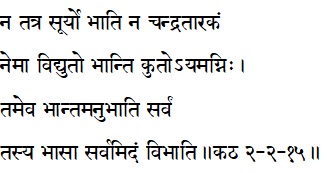
A Hindu who kneels down before an idol tells you, “Him the sun cannot express, nor the moon, nor the stars, the lightning cannot express Him, nor what we speak of as fire; through Him, they shine.”   

A Hindu never condemns anyone who is worshiping an image. He/she recognizes the necessity of worshiping an image in the initial stage of spiritual life.

To Hindus, a person is not traveling from error to truth, but from truth to truth, from lower to higher truth.

(21) A Hindu recognizes that ‘Unity in variety is the plan of nature’.  

The Hindus have discovered that the absolute can only be realized, thought of, or stated through the relative, and the images, crosses, and crescents are simply so many symbols – so many pegs to hang spiritual ideas on. This help is not necessary for all.  Taking help with the images is not compulsory in Hinduism.

To the Hindu, the whole world of religions is only a traveling, a coming up, of different men and women, through various conditions and circumstances, to the same goal. Every religion is only evolving a God out of the material being, and the same God is the inspirer of all of them.

A Hindu thinks that the contradictions are only apparent. They come from the same truth adapting itself to the varying circumstances of different natures.  It is the same light coming through glasses of different colors. These variations are necessary for purposes of adaption. In the heart of everything the same truth reigns.

Lord Krishna has said in the Bhagavad Gita:

“I am in every religion as the thread through a string of pearls.” 

“Wherever thou seest extraordinary holiness and extraordinary power raising and purifying humanity, know thou that I am there.”

Hindus never believe that they are the only spiritual people. They know the fact that in God’s kingdom spiritual-minded people are in every religion and in every country.

Sage Vyasa says in the Vedanta Sutras, “We find perfect men and women even beyond the pale of our caste and creed.”   

(22) At the end Swami Vivekananda expresses his dream of a universal religion that includes all religions and all people and still has space for development. In that religion, there will be no place for persecution or intolerance in its polity. Such a religion will recognize the divinity in every man and woman, and whose whole scope, whose whole force, will be centered on aiding humanity to realize its own true, divine nature.

Swami Vivekananda said that America, through the Chicago Parliament of Religions, was destined to proclaim to the world that the Lord is in every religion.

Celebrating Swami Vivekananda’s 159th Birthday

(The following online lecture is given as a part of the Indian Consulate of New York’s special celebration on January 12, 2022.)

Pujya Swami Sarvapriyanandaji, Honorable acting Indian consul general Dr. Varun Jeph, Shri Vipul Dev ji, Mr. Jay Atta, and friends:

I sincerely thank the Indian Consulate of New York for inviting me to participate in this online panel discussion, celebrating the legacy of Swami Vivekananda.

With salutation to Swami Vivekananda, I will pray for the good of all, a prayer needed most during this pandemic time:

May all be happy, may all be healthy, may good come to all, may no one suffer.

Om peace, peace be unto us, peace be unto all beings.

Swami Vivekananda said that whenever we sit down for our prayer, we have to sit in a straight prayer posture, and the first thing we must do is to send a current of holy thought to all creation in the east, west, north, south, above and below.

He continued, “The more we pray for the good of all, the better we will feel for ourselves. We will find at last, that the easiest way to make ourselves healthy is to see that others are healthy, and the easiest way to make ourselves happy is to see that others are happy.”

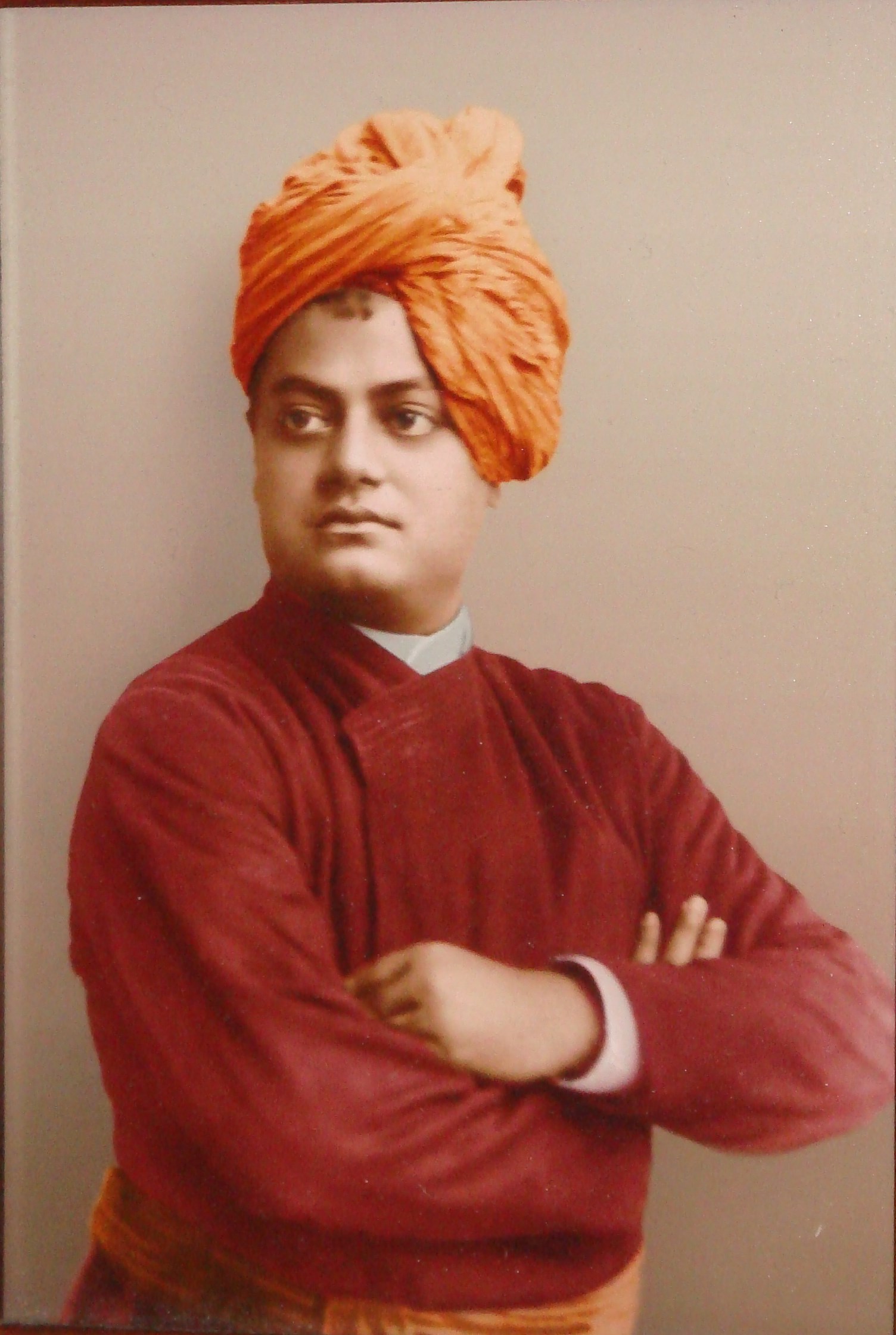
January 12, 2022, is Swami Vivekananda’s 159th birthday. Swami Vivekananda was ever young. He passed away at the age of 39, but within a few years, his life and teachings have made a big positive impact on people all over the world and he had inspired millions of people.

Personally, Swami Vivekananda is my hero, my role model, my guide, and my inspiration.

Who was Swami Vivekananda? He was a prophet, a saint, one of the Saptarshi, a messenger (as he had said, “Buddha had a message for the East, I have a message for the West), a social reformer, a patriot, a visionary, a wonderful teacher, sincere student, a proud disciple, a devotee, a voice without a form, a poet, a musician, a wrestler, and many more.

As Shri Adi Shankaracharya has logically established the principles of Vedanta in his Brahma Sutra commentary, Swami Vivekananda has established these Vedanta principles in the modern scientific language. He showed that the search of the scientists in the external world for the truth and the search of the Rishis in the internal world for the truth is the same and they both are going to meet at the same point.

Swami Vivekananda’s teachings are eternal and universal. They are applicable to all people all over the world.

Today, I will briefly talk about Swami Vivekananda’s teachings on education. His thoughts on education are original, unique, and thought-provoking. I will look into 5 questions:

(1)  What is education?

Swami Vivekananda said, “Education is not the amount of information that is put into your brain and runs riot there, undigested all your life. We must have life-building, man-making, character-building, assimilation of ideas. If you have assimilated five ideas and made them your life and character, you have more education than any person who has got by heart a whole library. If education were identical with information, the libraries would be the greatest sages in the world and encyclopedias the Rishis.”

Unfortunately, growing up in a society where the sign of success is measured in terms of how much money one makes, students hardly appreciate the underlying beauty of any subject and cannot appreciate the wonders of life the education can present.

Also, a school or college degree does not help build our character. It does not teach us how to manage our life’s problems; for example, how to control our emotions, how to face adverse situations in life, how to develop patience, and how to deal with others.

(2) What do we mean by “learning”?

For Swamiji, “learning” is “uncovering”. He said, “Education is the manifestation of the perfection already in man (human being).”

This is a little deeper concept. According to Swamiji, all knowledge is within us. We just have to uncover it.  Swamiji explained by an example. He said that an apple fell. That gave a suggestion to Newton. He then rearranged all his thoughts in his mind and he ‘found’ or ‘discover’ a new link called ‘gravitation’.  

It is amazing to see how Swamiji’s thoughts were echoed by scientists. I will give you one example. My Ph. D. adviser, Prof. Eldon Dyer, was a very well-known mathematician. He used to make fun of ‘the so-called popular religion’. However, one day to my surprise, he told me, “We cannot create new mathematics.  The mathematics is all laid out. We just have to uncover it.”

(3) How do children learn?

Swamiji said: “We cannot teach anyone.” As the way a plant grows by itself, a child educates itself.  For a plant, what we could do is to prepare the soil, give water, remove weeds, and provide enough light. Then, the plant grows by itself. Similarly, to a child, we can just create a learning environment, remove the obstacles, and the child will learn by itself.

In addition, he said, ‘Negative thoughts weaken human beings.’ We should not put down children. Kind words and encouragement help the child to learn.

(4) What should we learn first?

Swami Vivekananda said, “If I had to do my education over again, I would develop the power of concentration and detachment, and then with a perfect instrument I could collect all the facts at will.” He said that as the rays of the sun gathered through a magnifying glass burn a paper when a mind is focused on any subject, it reveals its knowledge.

(5) What should be the outcome of education?

According to Swamiji, through Education, we must develop physical, mental, intellectual, moral, and spiritual strength. We must develop an all-round character.

Swamiji said, ““What I want is muscles of iron and nerves of steel, inside which dwells a mind made out of the same material from which the thunderbolt is made.”

He said that strength is the one thing needed most. Strength is the remedy and medicine for all our problems and miseries.

Swamiji told one youngster, who was physically weak, to go and play soccer to understand Bhagavad Gita better.

Swami Vivekananda’s life and teachings are a huge reservoir of inspiring ideas. I will conclude with very important teaching of Swami Vivekananda regarding the goal of life. He said,

Each soul is potentially divine. The goal is to manifest this divinity within by controlling nature: external and internal. Do this either by work, or worship, or psychic control, or philosophy – by one, or more, or all of these – and be free.”

To realize and manifest this divinity, at Vivekananda Vidyapith, we learn, practice, and teach youngsters the four yogas: Jnana Yoga, Karma Yoga, Bhakti Yoga, and Raja Yoga.  We ask them to do regular prayers, Japa, and meditation; read inspiring books, seek holy company, practice values, and do unselfish service.

Our students know that to achieve this goal we have to work hard and never give up. At the end of our Saturday and Sunday morning prayers, they all enthusiastically say:

Arise! Awake! And stop not till the goal is reached!

I salute to Swami Vivekananda who is the king of the Yogis, resplendent as the sun, the embodiment of Existence-Knowledge-Bliss Absolute, and the remover of the sufferings of mankind.

Thank you.

Note: One may find the video of the program at https://www.facebook.com/indiainnewyork

The title says, “

Celebrating the Legacy of Swami Vivekananda#AzadiKaAmritMahotsav

Celebrating Swami Vivekananda’s 157th Birthday

(The following post is based on a talk I have given at Vivekananda Vidyapith’s Youth Day Celebration, January 4, 2020.)

Dear Students, teachers, parents, helpers, and friends:

We are very happy to celebrate Swami Vivekananda’s birthday as “A Month-Long Youth Day Celebration”.

In India, from 1985, January 12th, Swami Vivekananda’s birthday, is being celebrated as “National Youth Day”. On this day, all over India, the Government and other organizations hold various programs celebrating Swamiji’s birthday. In fact, all over the world people celebrate Swami Vivekananda’s birthday remembering his life and teachings. Swami Vivekananda lived only for 39 years (1863-1902), but his positive impact will continue to inspire people in India and all over the world for years to come.

Who was Swami Vivekananda? He was a Saint, Prophet, Philosopher, Devotee, Karma Yogi, Jnana Yogi, Raja Yogi, Patriot, World Teacher, Musician, Orator, Poet, Visionary, Reformer, and many others. Swami Vivekananda said about himself that he was “A Voice Without A Form”. He was a voice of the infinite which is lying within all of us as our conscience. He was the voice of all the scriptures.

Swami Vivekanand’s main message is: “Each soul is potentially divine. The goal is to manifest this divinity within by controlling nature, external and internal. Do this either by work (Karma Yoga), or worship (Bhakti Yoga), or psychic control (Raja Yoga), or philosophy (Jnana Yoga) – by one, or more, or all of these – and be free. This is the whole of religion. Doctrines, or dogmas, or rituals, or books, or temples, or forms, are but secondary details.”

His lectures given in the USA and UK on the four Yogas, namely Raja Yoga, Karma Yoga, Bhakti Yoga, and Jnana Yogas, give us the essence and practical guidelines based on the teachings of the Upanishads and Bhagavad Gita. Everyone should read these lectures. This is one of his unique contributions to the world.

Swami Vivekananda had realized and manifested the divinity in his thoughts, speech, and actions. Recently, I heard from Swami Sarvapriyananda, Minister and Spiritual Leader of the Vedanta Society of New York, that there are two kinds of realizations of our own divine identity (Atman or Brahman): One described by Shri Shankaracharya – realize that “I am Brahman.” and second described by Swami Vivekananda –  “The manifestation of the inner divinity in our thoughts, speech, and actions.” Swami Vivekananda’s manifestation of the divinity includes Shri Shankaracharya’s realization. In order to manifest the divinity, one has to realize first that “I am Atman” or “My True Nature is Divine.”

Swami Vivekananda has said, “It may be that I shall find it good to get outside my body – to cast it off like a worn-out garment. But I shall not cease to work. I shall inspire people everywhere until the world shall know that it is one with God.” He has inspired millions of people in the past and will continue to inspire people to realize their divinity lying within and manifest it through unselfish service to humanity.

Today, I would like to share the thoughts which come to mind when I sing the bhajan, “Jaya Vireshwara Viveka Bhaskar…” in honor of Swami Vivekananda.

Jaya Vireshwara – victory to Vireshwara.

Swami Vivekananda’s childhood name was “Vireshwara” from which the adorable name “Biley” came. His mother Bhuvaneshwari Devi felt that Lord Vireshwara Shiva gave her a son and therefore she and her husband Vishwanatha Datta named the boy Vireshwara. As a young boy, he was fully energetic and naughty. He used to run around and play lots of mischiefs. Four people needed to catch him and control him. Finally, to calm him down his mother used to pour cold water on his head saying “Shiva, Shiva, Shiva’. He knew the stories of Ramayana and Mahabharata. He loved to meditate. He used to meditate for a while and used to check if he had developed a ‘Jata’ (long matted hair) like Lord Shiva. He had his own gym and a drama company of young boys. He loved to read. Swami Vivekananda’s other childhood’s name was Narendra or Naren. We can learn many things from his childhood.

Viveka Bhashkara – Swami Vivekananda’s “Viveka” was like a blazing sun. Viveka means the power of discrimination between ‘truth’ and ‘untruth’, or ‘right’ and ‘wrong’, or ‘helpful’ and ‘harmful’. He was very sharp and analytical. Sri Ramakrishna said that he was like an open sword. Not a single bad or harmful thought can come closer to him. In Viveka Chudamani, Shri Shankaracharya says that in the spiritual path the first thing needed is “Viveka’.

In Kathopanishad Lord Yama says that in life at every step a person has to make a choice between Shreya (preferable) and Preya (pleasurable). Shreya helps a person to make spiritual progress and leads to the Highest Knowledge, peace, and bliss while Preya fulfills the worldly desires of the body and mind and leads to ignorance, suffering, and restlessness. One who has ‘Viveka’ selects always Shreya while deluded people select Preya.

Jaya Jaya Sri Vivekananda: Victory to Vivekananda – one who enjoys having sharp Viveka.  Before Sri Ramakrishna passed away, he had given symbolic ‘Sanyas’ to the young disciples by giving them ocher cloths.

After Sri Ramakrishna passed away, under the leadership of Narendra, all brother disciples took monastic vows and changed their names to the monastic names. I have heard that Narendra wanted to keep his monastic name as Swami Ramakrishnananda, but he found that his brother disciple Shashi Maharaj wanted to have that name. Narendra told him that his (Shashi Maharaj’s) devotion for Sri Ramakrishna is very deep, so he can keep that name. Then, Narendra kept his monastic name as Swami Vivekananda.

Indu Nibhanann Sundara lochan: Swami Vivekananda as a young man Narendra was very handsome. He had beautiful eyes. Once when he asked Devendranath Tagore (Ravindranath Tagore’s father), “Sir! Have you seen God?” Then, Devendranath said to Narendra that he has the eyes of a Yogi, and he should practice meditation.

Vishwa – Manava Chira Vandya: Swami Vivekananda saw God in all human beings and in everything. He taught all to see Unity in Variety, the One God residing in people with various colors, cultures, and countries. He was a “Universal Man.” He cannot be confined to one country. Those who understand his life and teachings will revere him eternally.

Prema Avirala:  Swami Vivekananda loved all; especially he loved people who were poor, miserable, weak, neglected and crushed by society. As a young child, he used to give away precious things to poor people including his mother’s expensive saris to satisfy their hunger and basic needs. He told his brother disciples that for a while put away all gods and goddesses and serve poor and miserable people seeing God in them.

Usually, spiritual seekers want to attain “Moksha” and be free from the cycle of births and deaths. But, out of his love for humanity, Swami Vivekananda said, “May I be born again and again, and suffer thousands of miseries, so that I may worship the only God that exists, the only God I believe in, the sum total of all souls.”

Kanti Suvimala:  He was pure in mind. The purity was shining from his personality. He was simply majestic.

Adhigata Veda Vedanta:  Swami Vivekananda had studied all the Vedas and Vedanta, has realized the truths of them and he taught these truths to the people in the scientific language of the time. We find that in the Baranagar Math Swami Vivekananda and his brother disciples were studying scriptures. As a wandering monk, when he was traveling all over India, he was eager to meet people who were experts in the scriptures and to discuss with them about various topics. When he came to the USA, he brought with him many scriptural books and later he was requesting people residing in India to send him the books he needed.

Tyaga, Titiksha, Tapasya Ujjvala:  His sacrifice, forbearance, and austerity were unparalleled. His father passed away and his mother and siblings had no money to acquire daily meals. The family was dependent on Narendra. On the other hand, he had the goal of God-realization and service to humanity. He loved his family dearly, but his goal was calling him. Finally, he put a stone on his heart and renounced the world to achieve his goal of ‘God Realization and Service to Humanity’. In the Baranagar Math and during his wandering period he did severe austerity to keep his mind in constant communion with Brahman, the Ultimate Reality. He bore patiently all the hardships and sufferings during this time. Even in the USA he had to go through many hardships to continue his work of explaining the principles of Vedanta and guiding people for their spiritual upliftment. His book on Raja Yoga is considered a standard guideline for the Yoga Practices.

Chitta Nirmal Shanta:  Swami Vivekananda was a perfect person as described in the Bhagavad Gita – he was clam within in the intense activity and when surrounded by a whirlpool of problems.

Karma Bhakti Jnana Trishula Dharana:  Swami Vivekanand was an incarnation of Shiva. His trident was made out of three yogas – Karma, Bhakti and Jnana Yoga. His lectures given on these yogas are an excellent guide to realizing our inner divinity.

Chhedana Jiva Moha Bhandha:  With that trident, he destroys the delusion and bondages of people.

Brahma Parayana Namo Narayana:  He was “Sat-Chit-Sukha Swarupaya” always one with Brahman. Someone asked him how one should sit in meditation. He was showing the posture of sitting and then he was absorbed in deep meditation becoming one with Brahman. There are several noted incidents in which Swami Vivekananda was completely merged with Brahman during his meditation.

When he met Sri Ramakrishna first time, Sri Ramakrishna said to him, “O Lord! I know that you are the ancient sage Nara – the incarnation of Narayana – born on earth to remove the miseries of mankind.”

Dehi, dehi, charanarvinda:  On this day we salute to Swami Vivekananda and pray that we learn from his life and teachings, build up our character, realize that our true identity is divine and serve all unselfishly.

Interfaith Thanksgiving Service- 2018

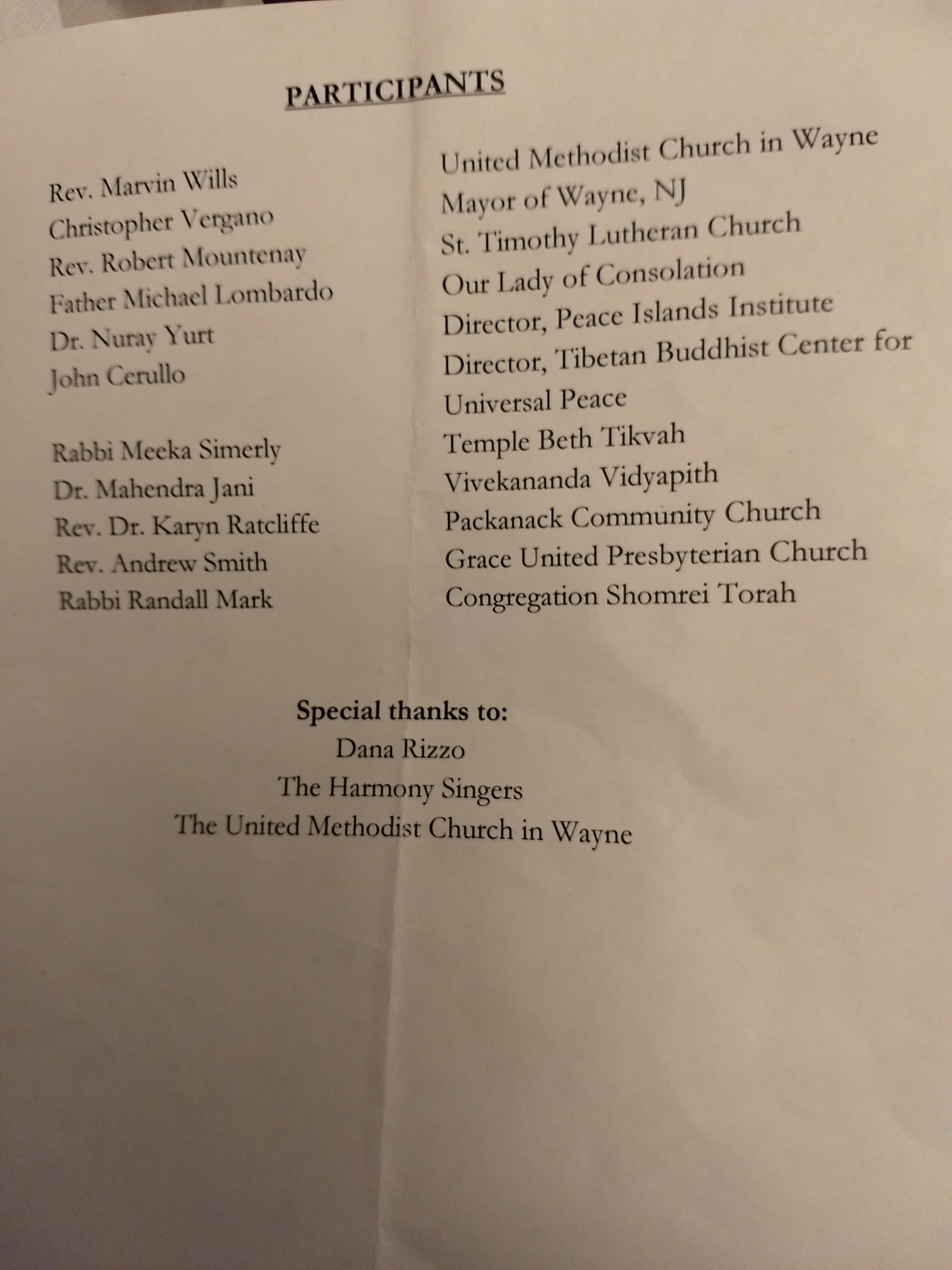
(A wonderful ‘Interfaith Community Thanksgiving Service’ was held on Tuesday, November 20, 2018, at The United Methodist Church in Wayne, 99 Parish Drive, Wayne, New Jersey 07470. Clergies and representative of various faiths participated in the event and offered their prayers and reflections for the occasion. The main message was unity, inclusiveness, community fellowship, and giving. One of the organizer Pastor Andrew Smith later said, “I feel like it was a meaningful service and a beautiful expression of community, and all the feedback I got afterward was very positive.”

I was invited to participate and give my offering as ‘reflections’. I thought to share this talk with you all who could not be there. It was a three minutes talk. I am posting it here with a few minor changes. I hope you like it.)

Dear Friends,

Good evening and Namaste! When we (Hindus) greet each other we say ‘Namaste’ with folded hands. This means that ‘I salute the God residing in you’.

I sincerely thank The Wayne Clergy Fellowship and Pastor Andy Smith for inviting me to participate in this Interfaith Thanksgiving Service. It is my great joy to be here with you all.

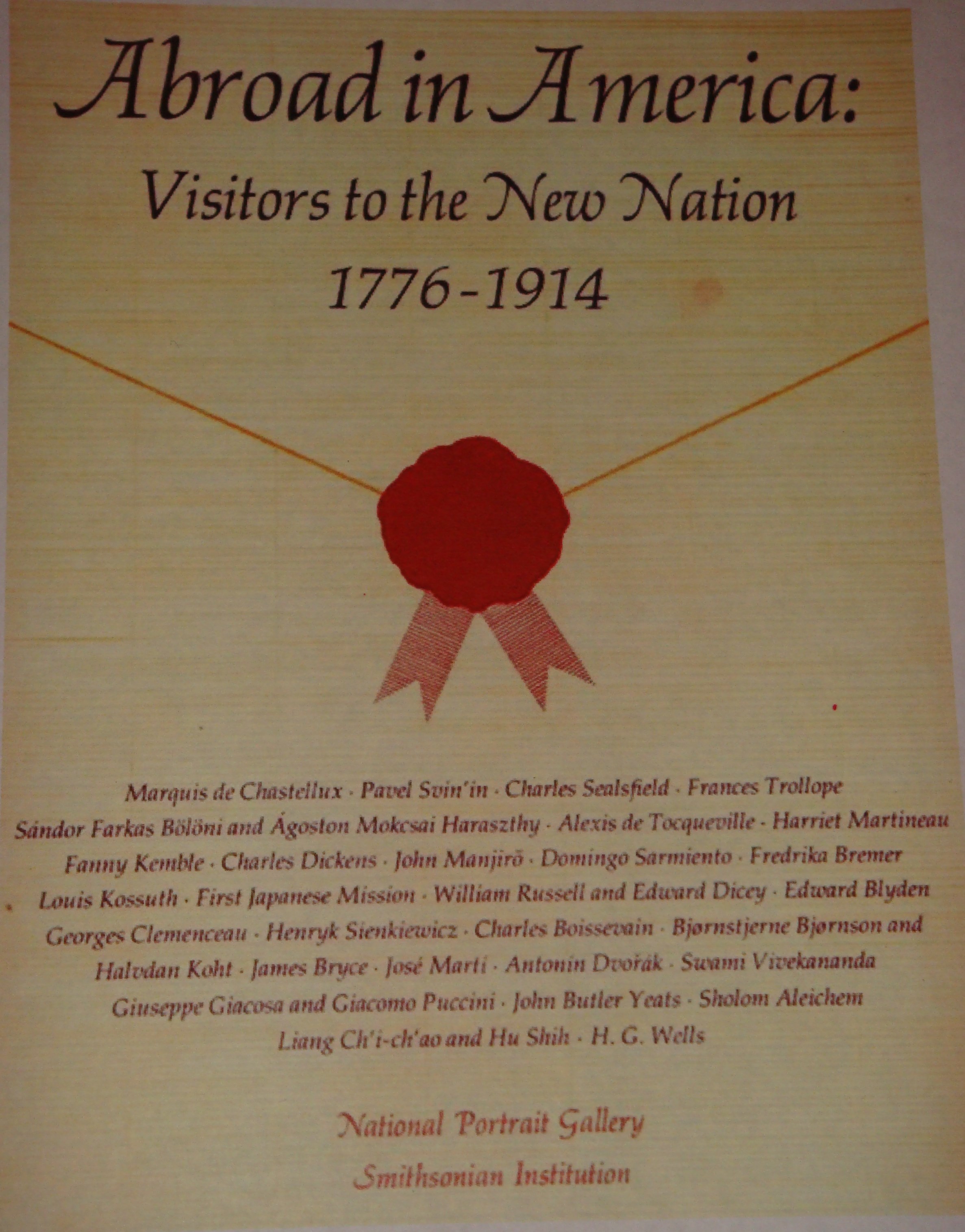
Swami Vivekananda, whose name has been associated with the name of our institution, was a great teacher and a Saint. In 1893, he participated in the Chicago World Parliament of Religions and gave six lectures. These lectures were well received by the American audience and these lectures made him famous all over the world. In our congregations, we say that ‘Columbus discovered America and America discovered Swami Vivekananda’.

In one of his lectures Swami Vivekananda said, “Unity in variety” is nature’s plan in the evolution of the universe, and that only by harmony and brotherhood among religions and by mutual toleration and help can the mission and destiny of humanity be accomplished.”

The nature has created varieties of human beings. With mutual toleration and helping each other, we can achieve harmony and brotherhood among religions which ultimately help us realize the unity that exists behind the varieties.

How should we seek or think about the unity?

In another lecture, Swami Vivekananda said, “Unity in variety is the plan of the universe. We are all human beings, and yet we are all distinct from one another.

– As a part of humanity I am one with you, but as Mr. so and so, I am different from you.

– A man is separate from a woman and a woman is separate from a man, but as human beings they both are same.

– A man is separate from an animal, but as living beings, man, woman, animal, and plant are all one:

– and as existence, we are one with the whole universe. That Universal existence is God, the Ultimate Unity in the universe. In God we are all one.”

 Bhagavad Gita is the essence of Hindu Scriptures. It was Mahatma Gandhi’s constant companion. In the 18th chapter, it describes that superior knowledge is the one which realizes ‘Unity in Variety’.  Variety brings joy in life, but we can enjoy it if we see unity behind all varieties.

We have to see the common life force in all and love all. We observe that:

 The sun shines on all beings without any discrimination.

The rain showers water on all beings equally.

The air provides oxygen to all.

The fire cooks meals for all and

The Mother Earth holds all beings.

We learn from nature and love all beings.

I will conclude with an ancient Hindu prayer which I am reciting every day and millions of

Hindus recite regularly:

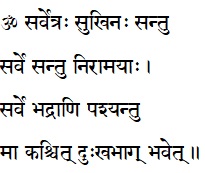
May all be happy,

May all be healthy

May good cones to all

May no one suffers.

Om Peace! Peace be unto us! Peace be unto all living beings!

Thank you.  Have a Happy Thanksgiving!

Celebrating Swami Vivekananda’s 155th Birthday

My Homage to Swami Vivekananda 

(The following blog is based upon my thoughts I shared with Vivekananda Vidyapith’s students, teachers, parents, and helpers during Youth Day Celebration Speech Competitions held on Saturday and Sunday, January 6th and 7th of 2018.)

Swami Vivekananda (1863-1902) lived only for 39 years, but his life and teachings will continue to inspire people as long as a single person on earth searches for the eternal truth. All over the world, we can see the positive and uplifting effect of Swami Vivekananda’s life and teachings helping the humanity for its good. His teachings about strength, the divinity of the soul, oneness of existence, and harmony of religions have been appealing to more and more people. These teachings encourage them to search for their inner divinity and try to manifest it in their thoughts, speech, and actions, especially through their unselfish service to the society. His emphasis on serving the “Living God,” the sum total of all living beings, touches the hearts of even atheists.

We could see a fraction of this positive effect during the Vidyapith’s Youth Day Celebration Speech Competition. The temperature during last Friday, Saturday, and Sunday were in single digit close to zero degrees Fahrenheit and the wind-chill was in negative degrees. But, the Vivdyapith’s students and helpers joyfully loaded and unloaded a truck in the cold with the things needed for the competition. Several other people worked unselfishly for countless hours to make this competition a great success. For all of them, it was a labor of love. Also, almost all the students from grades sixth through twelfth came for the competition and presented their excellent speeches. The students, teachers, and the helpers were inspired by Swami Vivekananda’s life and teachings.

The following are few of my thoughts I shared with the Vidyapith’s students, teachers, and helpers:

“Swami Vivekananda is our beloved teacher, leader, and a role-model. He was a saint, a prophet, a yogi, a great teacher, an orator, a poet, a reformer, a humanitarian, a patriot, a world-leader, a visionary and many more.

He told about himself that, “He is a voice without a body.” His voice was and is the voice of the Vedanta – the Upanishads and the Bhagavad Gita. He also said that “As Buddha had a message for the east, he has a message for the west.”

There are many teachings of Swami Vivekananda which we have to learn and practice in our life. As students, one teaching we have to really learn is his definition of education. He said, “Education is the manifestation of the perfection already in man.” By ‘man’ he meant men and women. This perfection is the perfection of the Atman dwelling in each one of us. We have to realize this perfection and then try to manifest it in our thoughts, speech, and actions.

To me, the simple meaning of perfection is ‘Be happy with what we have and be always ready to improve our performance.’  With this simple rule, we will constantly improve our study, our work, and our performance in every field.

There is another aspect of education. In schools and colleges, we learn about the topics related to the physical and mental world. There, we do not learn about our true identity which is beyond our body and mind. For that, we have to learn to go deeper within ourselves and search for our true identity. Swami Vivekananda says that our true identity is divine. In order to search our true identity (or divinity dwelling within), Bhagavad Gita has described four paths, namely Bhakti Yoga, Jnana Yoga, Karma Yoga and Raja Yoga. We can do every day four simple spiritual practices which cover all these four yogas: (1) Spend few minutes doing prayer, Japa and meditation, (2) read couple of pages from inspiring books and seek holy company which encourages us in our search for our true identity, (3) practice values which help us realize this true identity (for example the values described in the 12th chapter of Bhagavad Gita shlokas 13-19), and (4) do unselfish service. If we do these four practices regularly and properly, then definitely we will go deeper within and realize our true identity which is divine.

Note that the goal of all the Vidyapith’s classes and all activities including this speech competition is to help us to learn about our true identity (the divinity dwelling within) and encourage us to realize it and manifest it in our thoughts, speech, and actions. But, we have to do our homework by practicing the above mentioned four practices. Just as we do homework after taking classes in schools and college and educate ourselves, similarly in this search also we have to do our homework.

What do we get by realizing our inner divinity? We see that each person irrespective of his/her color of skin, religion, culture, country, physical appearance or any external difference is divine. The basic life-force in all beings is the same. Once we realize that then we love all and be ready to help all. We do not hate anyone. We will get control on our lower nature including our anger, jealousy, greed, lust, ego, and other impurities. We become sincere, honest, and humble. This makes us a better person fit to live in the society.

When we realize this inner divinity, then we can understand Swami Vivekananda’s teachings of Vedanta, namely the divinity of the soul, oneness of existence, harmony of religions, and service to the ‘Living God’. With oneness of existence, we realize ‘unity in diversity’.  This is the best way to celebrate Swami Vivekananda’s birthday. May we all get inspired by Swami Vivekananda’s life and teachings and make our life blessed.”

Belur Math Pilgrimage – 2015, Day – 5 Morning at Baranagore Math

August 7, 2015

Going to Baranagore Math

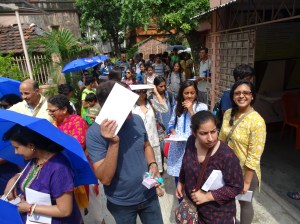
On Friday, all the pilgrims woke up around 5:30 am, got ready and went downstairs for a lovely breakfast at the Gucchi. Breakfast consisted of a vast array of foods from “dosas” to cereals.  Over the breakfast table, everyone was happily talking about the inspiring pilgrimage they had experience thus far.  With the grace of Mother Nature and God, we had nice weather and were able to carry out the pilgrimage without many problems.  After having a good breakfast everyone gathered at the entrance of the Hyatt Hotel, ready to board our buses.  After getting onto buses according to our groups, the buses left around 7am.  Today, we had planned to visit the Baranagore Math and the Cossipore Garden House in the morning, and after lunch we were going to visit Jorasanko.  While coming back from Jorasanko we had planned a bus tour of Kolkata.  Everyone was excited about the scheduled program.

As usual in each bus, after “five Jai’s” everyone did the Morning Prayer including the “Sri Ramakrishna Suprabhatam.”

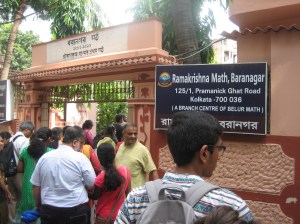
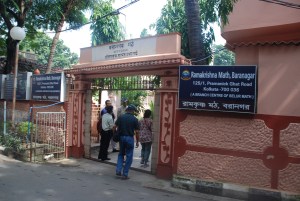
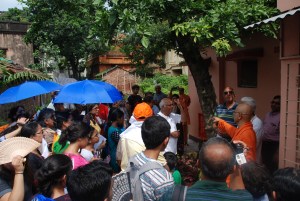
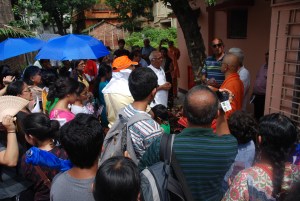
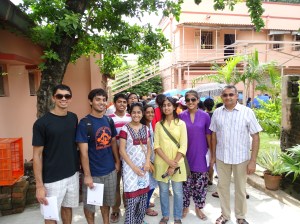
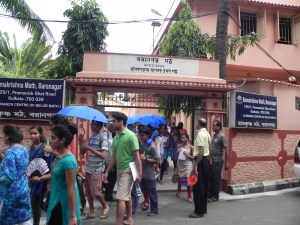
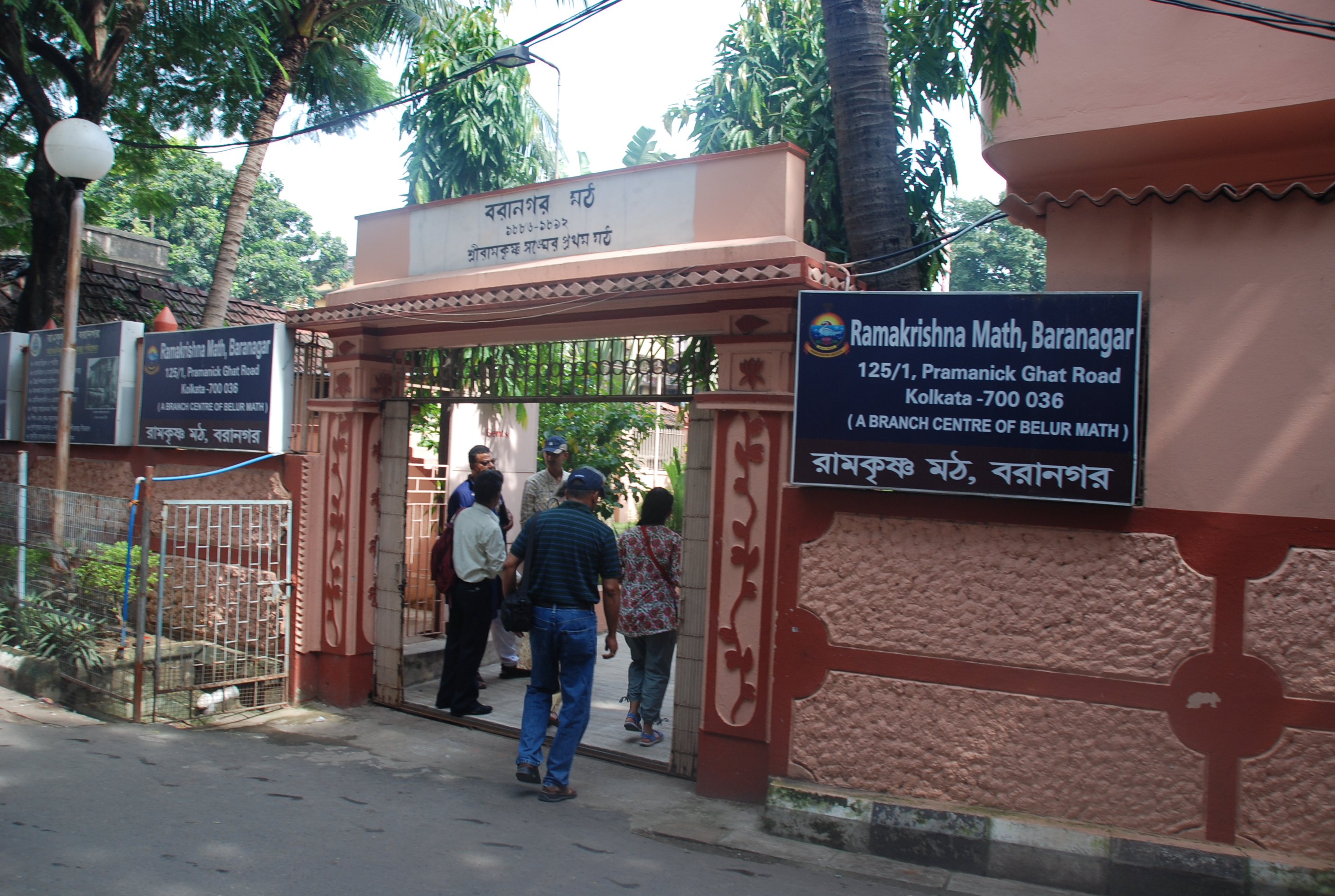
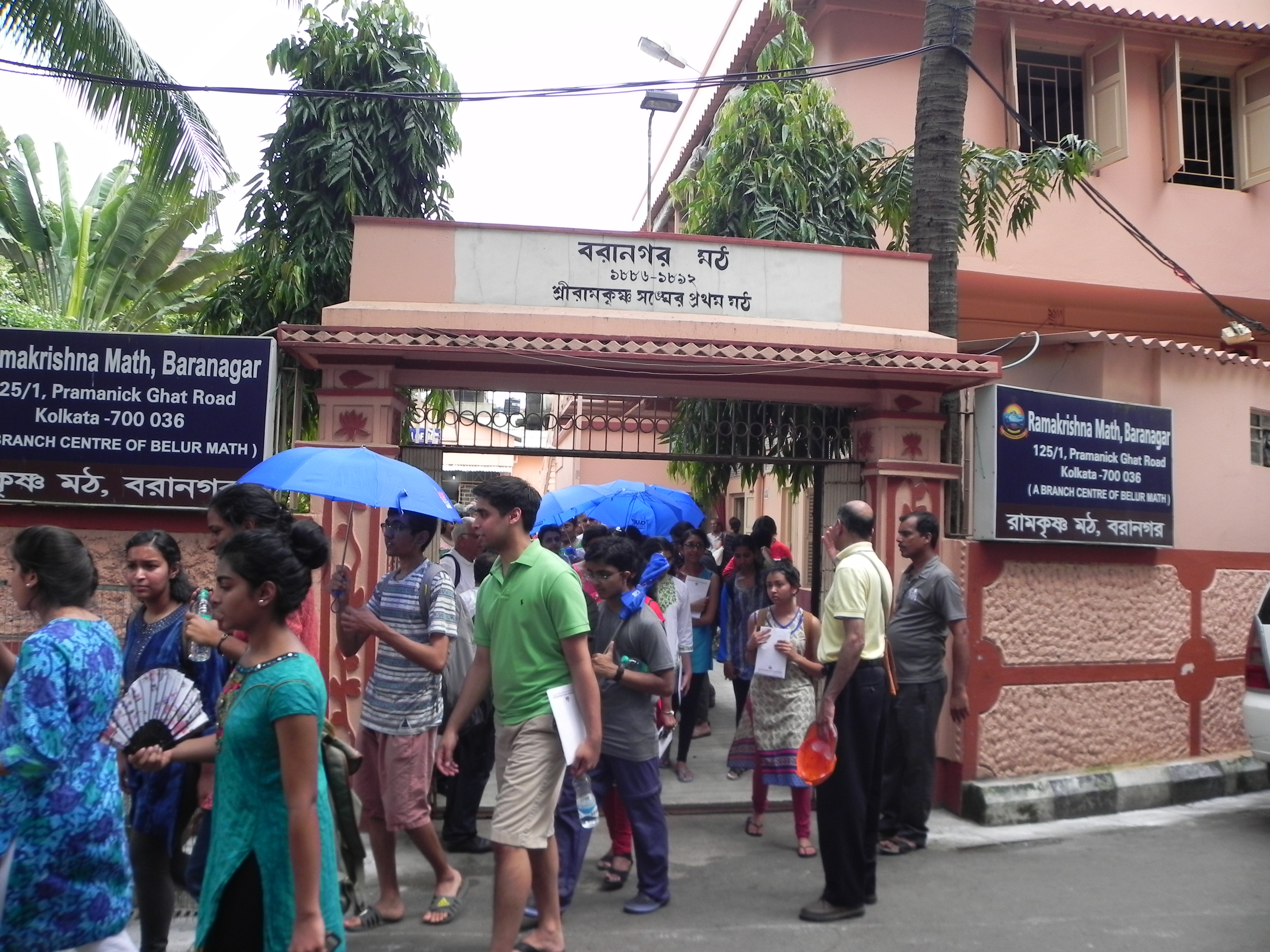
After about an hour, we arrived at the Baranagore Math.  It was a bright morning.

1 on the road 2 going to Math 3 Near te entrance 4 Entrance -2
7 before going up8 Going upstaris - 1

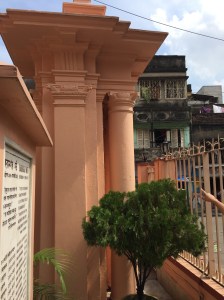
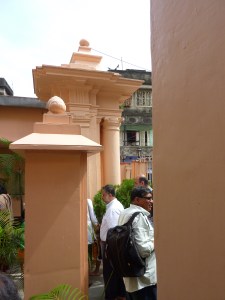
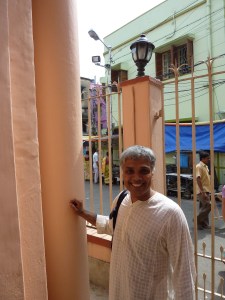
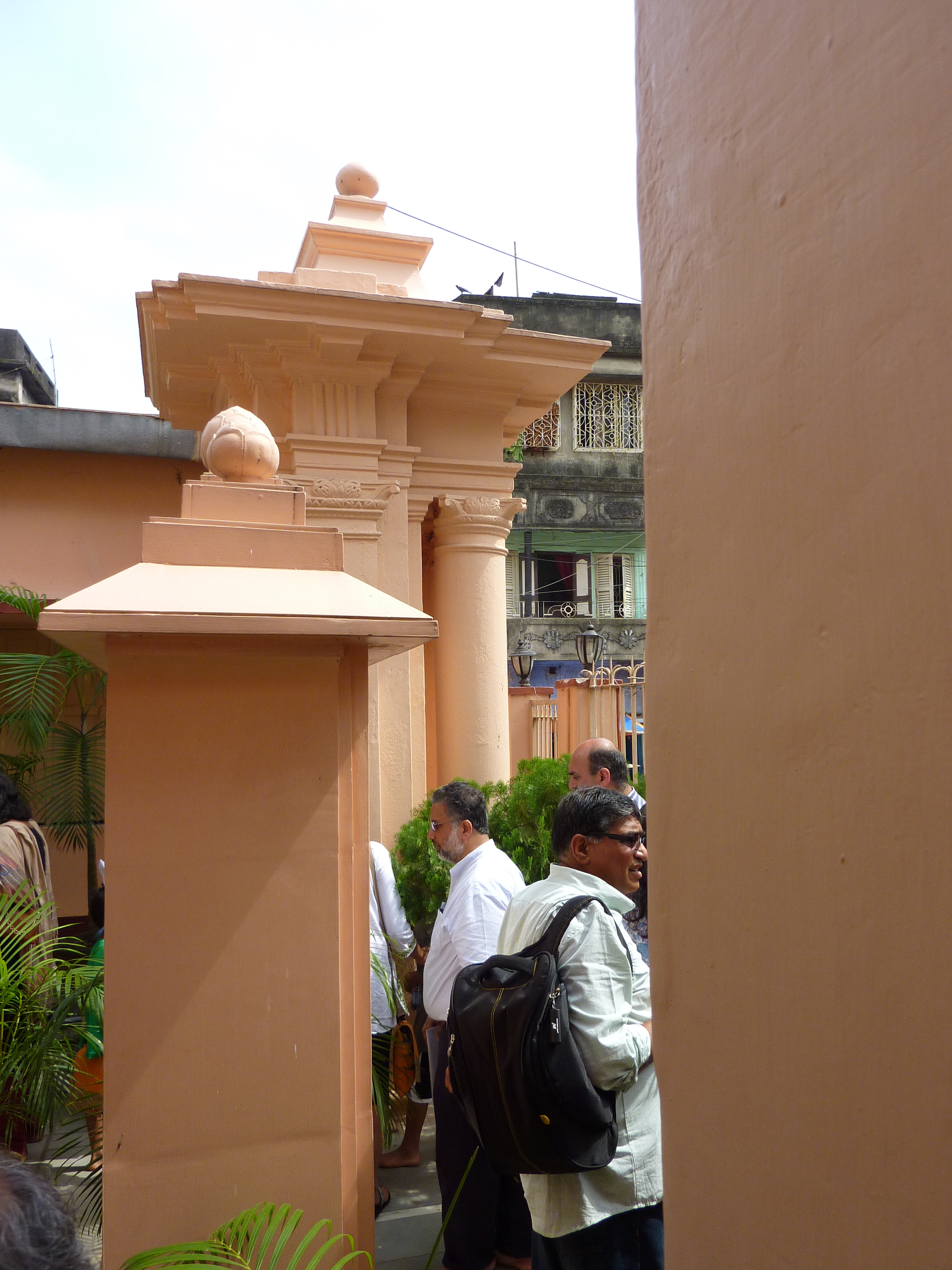
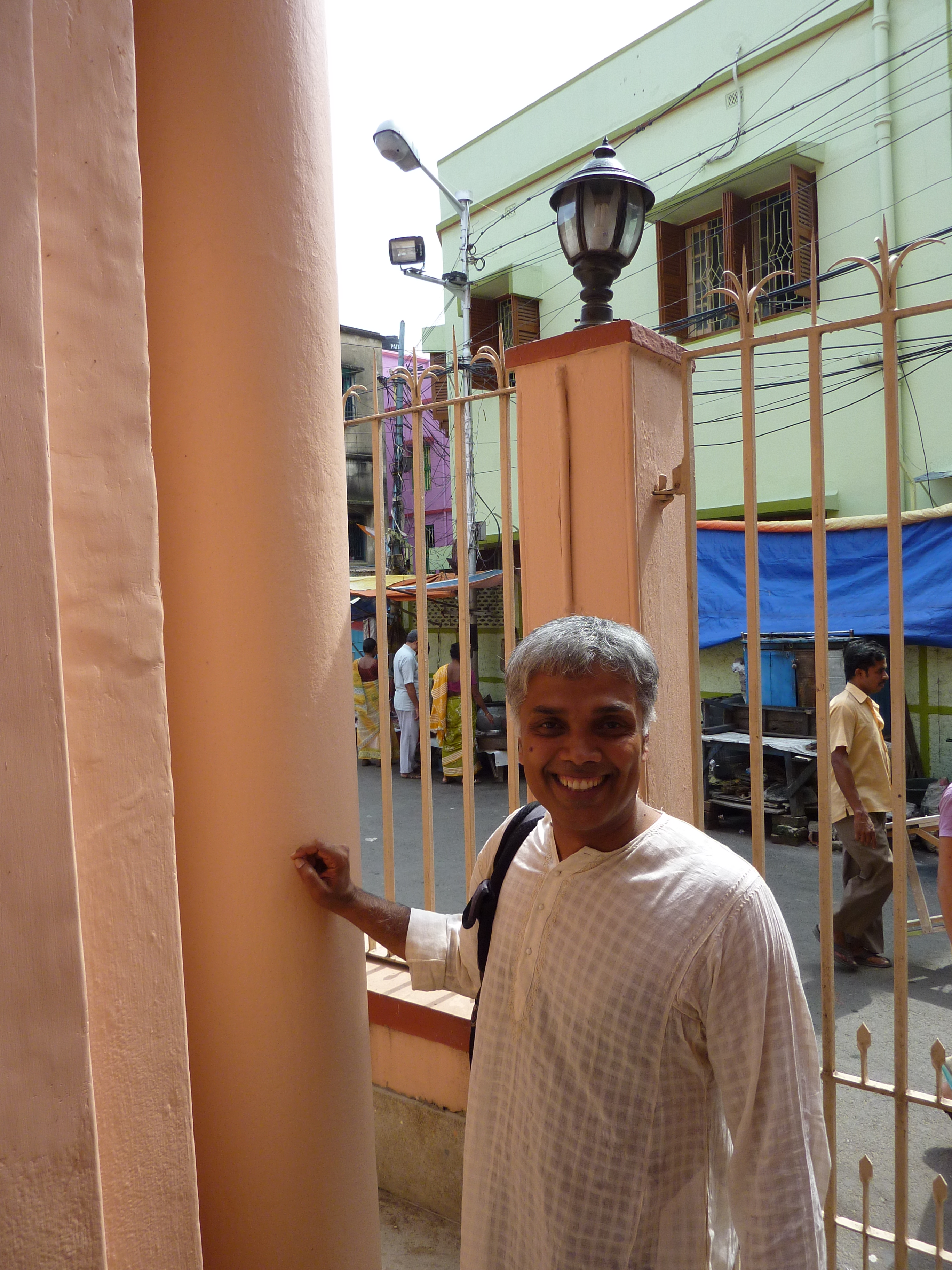
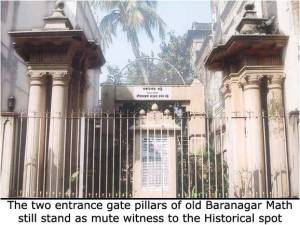
As we entered the Math, we saw two pillars on the two sides of the gate.
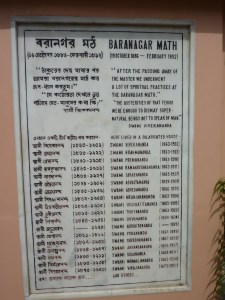
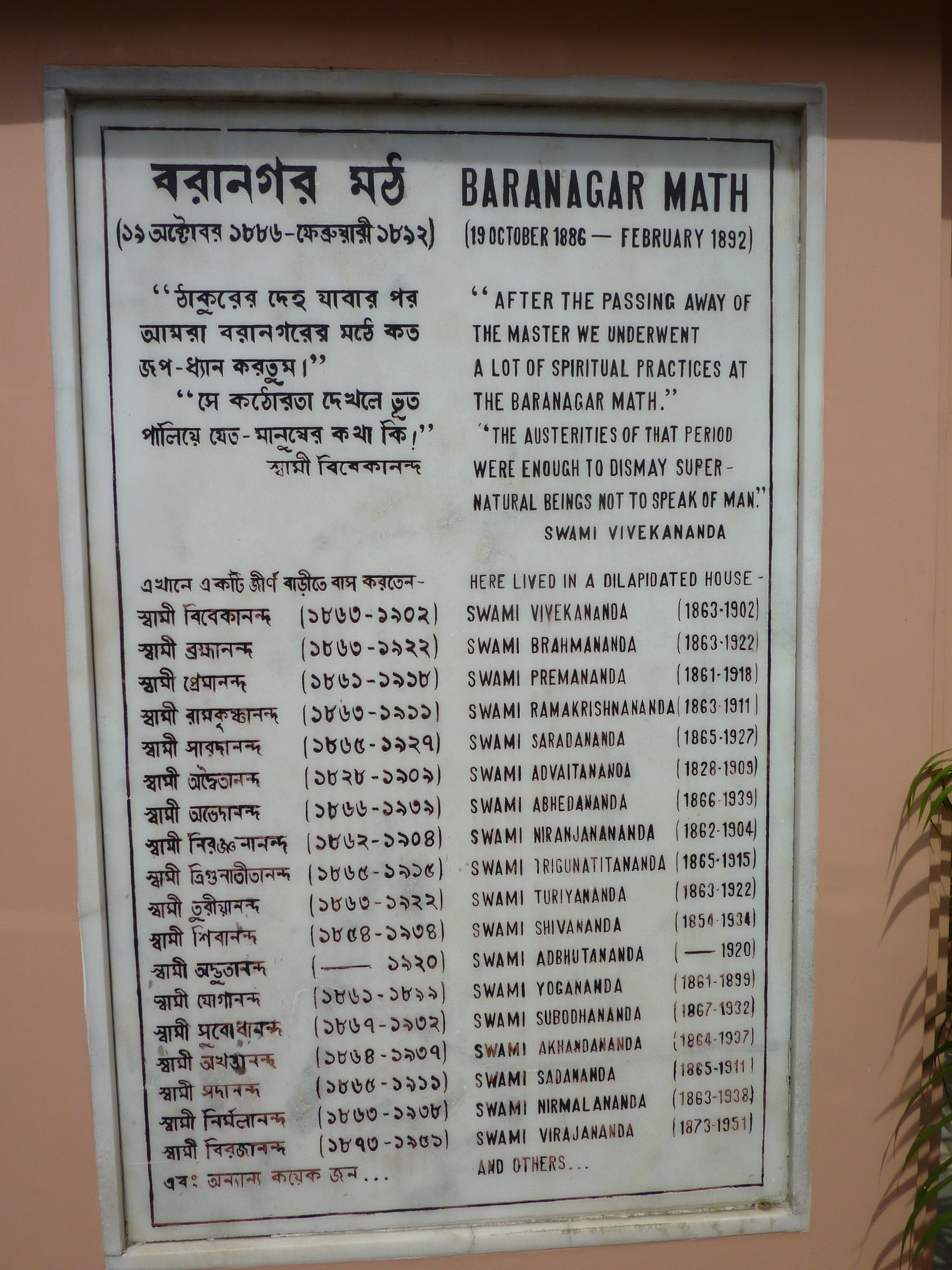
4 ppt 39 1 names of disciples - 2

6 going upstairs Original Pillar

We were told that these were the last of the remaining historic pillars from the old Baranagore Math building. As we entered, we were told to go upstairs to the shrine room to offer our salutations.

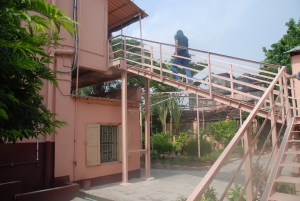
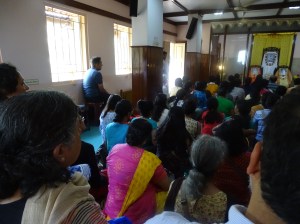
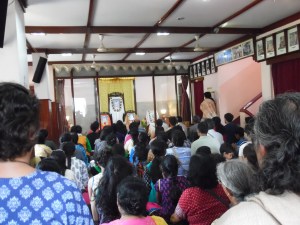
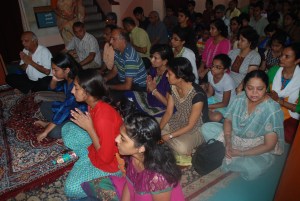
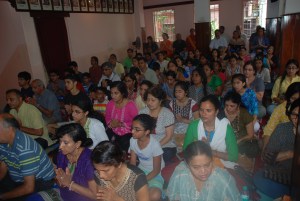
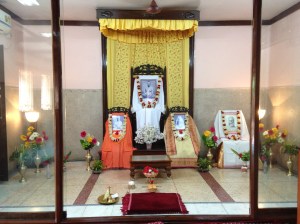
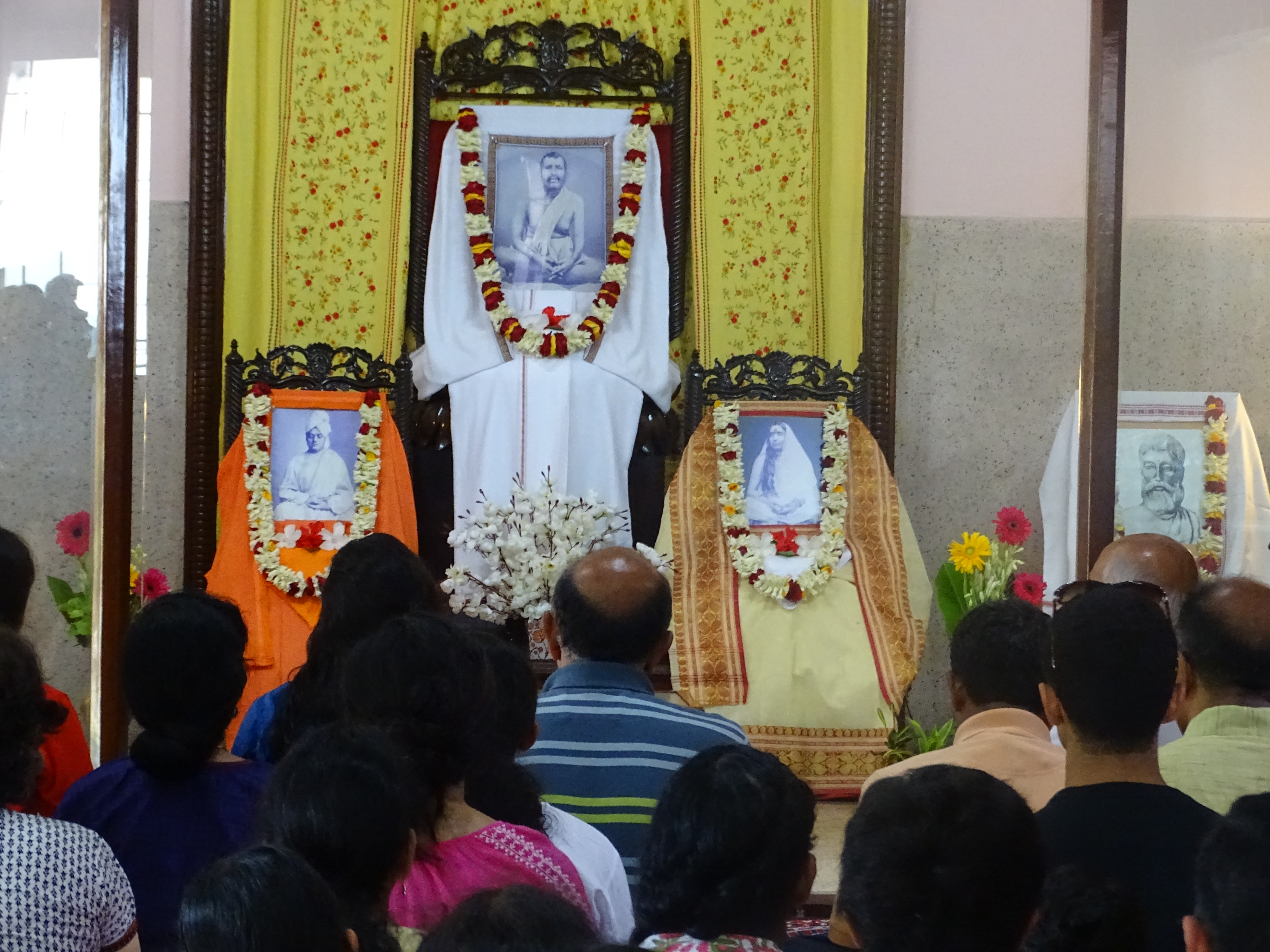
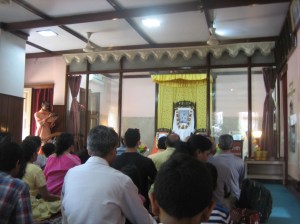
We placed our shoes on a rack, went upstairs, and quietly sat in the prayer hall.
27a 27a1 27a2 27d  28a3 302928a

The environment was very serene. We were thinking of Sri Ramakrishna’s young disciples who had observed intense spiritual practices in this Math. It was this important period that established the foundation of the Ramakrishna Math and Mission. We were very happy to learn that it was Shri Nag Mahashay’s birthday on the day of our visit.  Shri Nag Mahashay was a great household devotee of Sri Ramakrishna. He was a living example of a householder who had absolutely no ego.  He had inspired many people, and all the disciples of Sri Ramakrishna had great reverence for him.

After our salutations, we recited the pranam manras, offering our salutations to Sri Ramakrishna, Holy Mother Sri Sarada Devi and Swami Vivekananda.  Then we sang “Jaya Vireshwara Vivekabhaskar..,” as an offering to Swami Vivekananda.  After singing, we spent a few minutes doing japa.

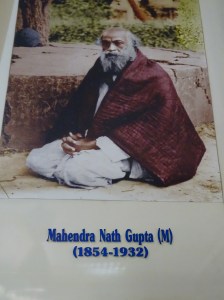
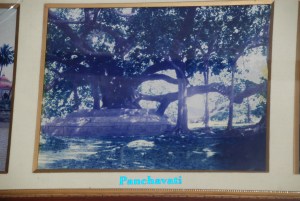
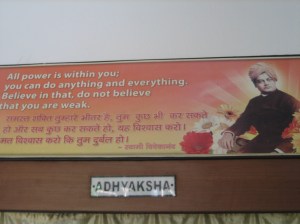
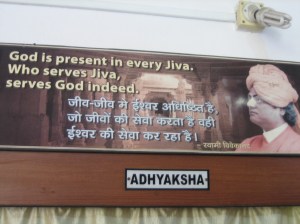
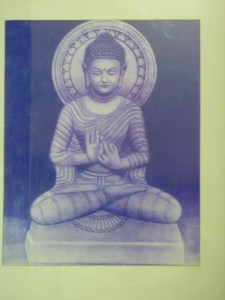
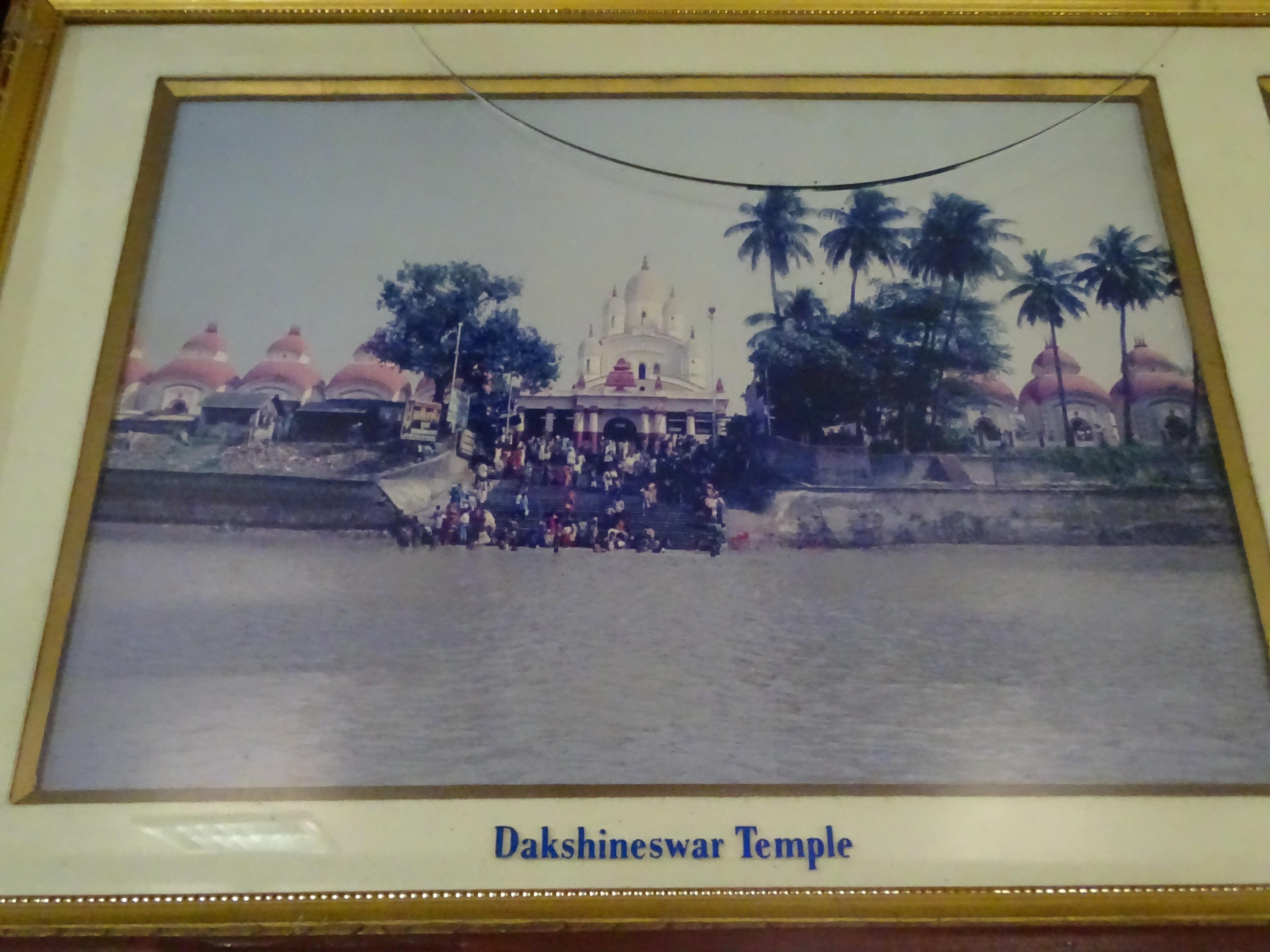
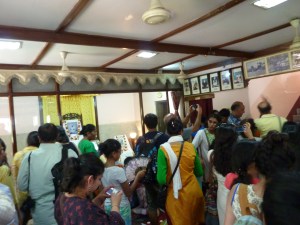
Around the perimeter of the prayer hall, there were photographs of all the original disciples and the original Baranagore Math as well as quotes of Swami Vivekananda .
31 M. Old math- disciples-writing Dakshniswar Temple - 2 Panchvati Quote - 3 Quote - 2 Quote - 1 Buddha

While looking at all the pictures, we thought of the disciples’ days at the Baranagore Monastery. We were given some Prasad. After looking all the pictures, we came downstairs and went into the backyard.
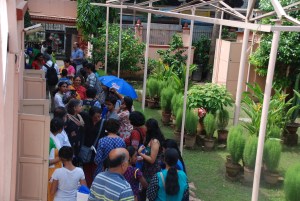
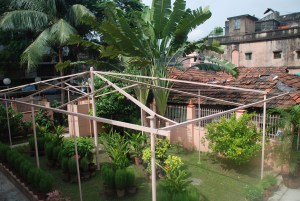
33 36e 36h1 36a 36b 36g 36l2 36h2 36n3 38 39

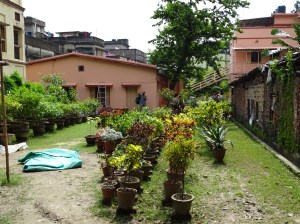
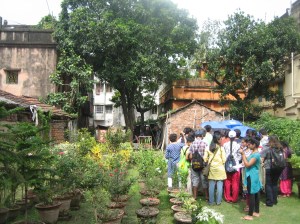
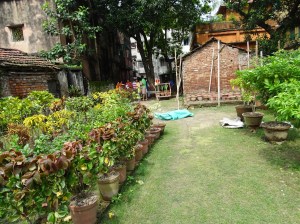
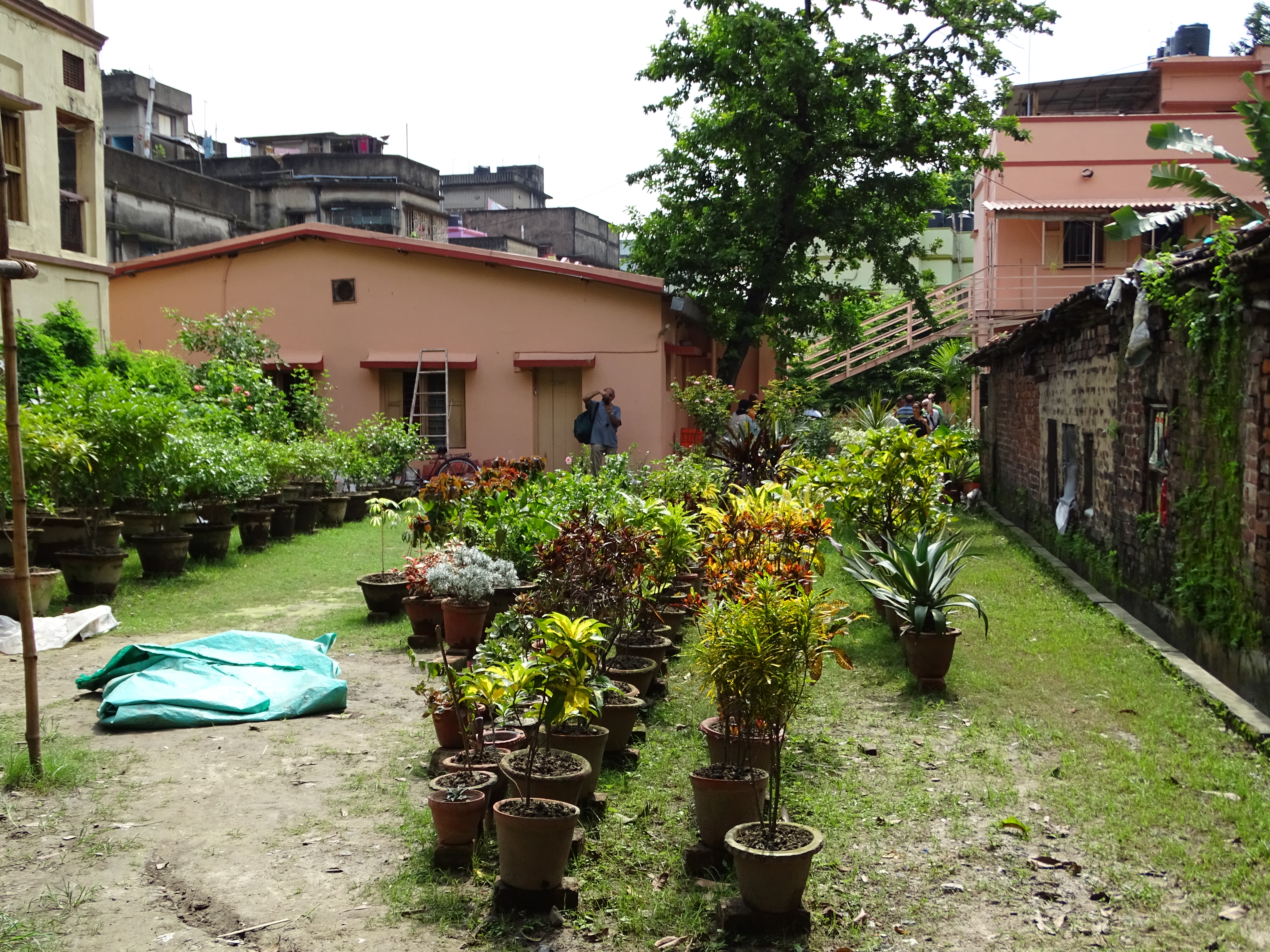
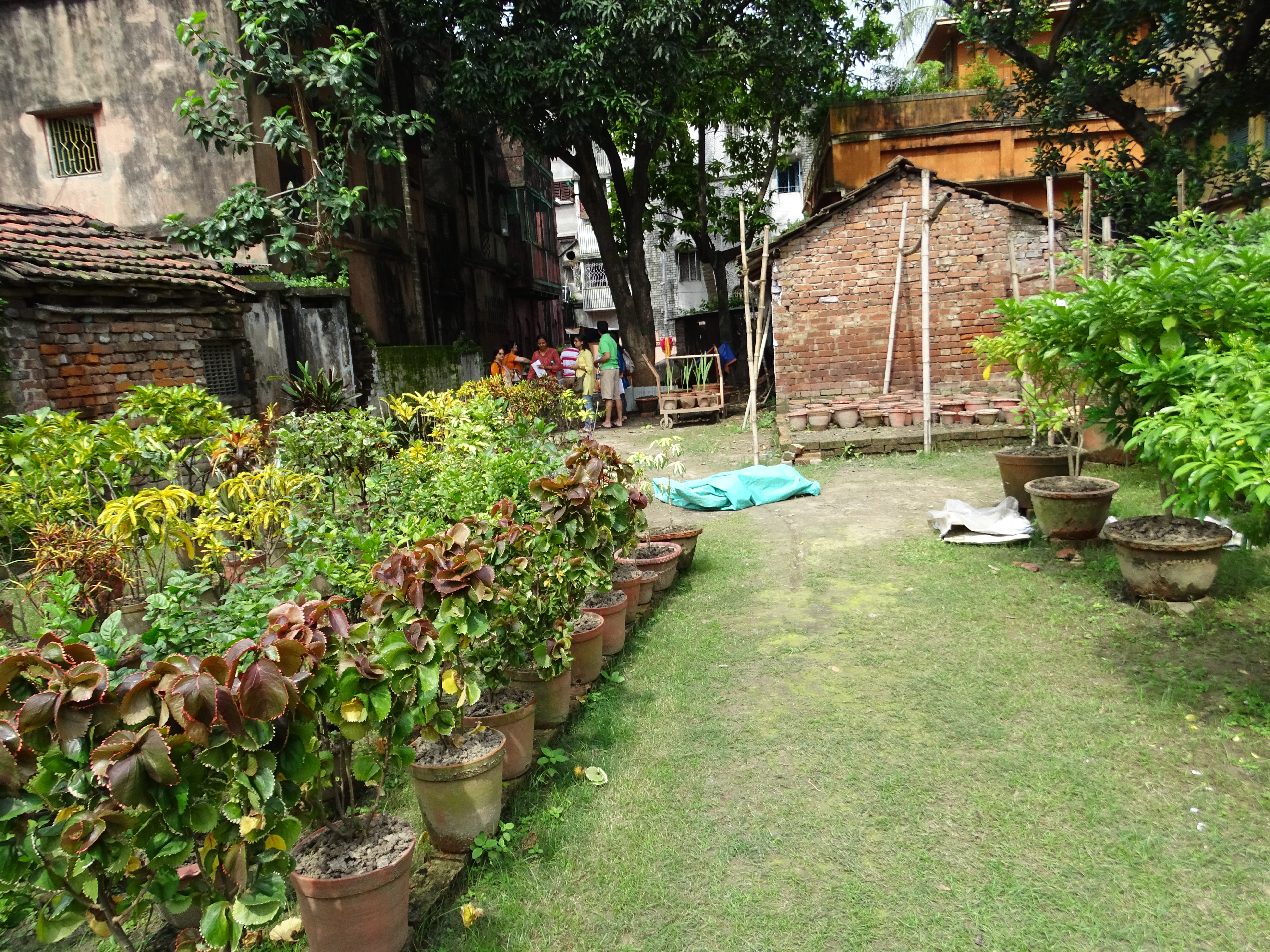
Swami Snehamayananda pointed to the grounds that marked the location of the original Baranagore Math.  We took in the sight of the old grounds, paid our respects, and enjoyed the beautiful garden.  The weather was great and environment was serene and peaceful. It filled our minds and hearts with joy and uplifting power. We were given refreshments arranged by the Swamis of the Math.
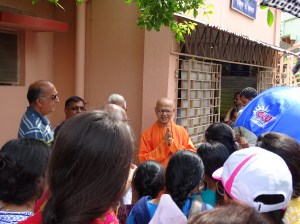
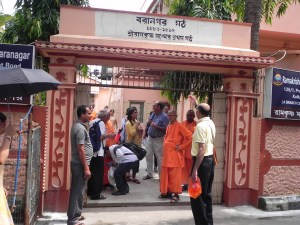
36 18 20 40 3

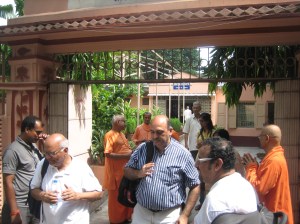
We were greeted by three Swamis, Swami Bamanananda, Secretary Maharaj, Swami Snehamayananda and Swami Devatattowananda, who were very happy to see all of us. As we prepared to leave, they lovingly stood at the gates to see us off. Before boarding our buses, we saluted the Swamis and took their blessings. As we sat on the bus, we remembered the hardships and austerities of the direct disciples of Sri Ramakrishna. Soon we were off to another important place, the Cossipore Garden House, where Sri Ramakrishna spent his last eight months.
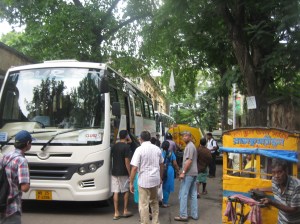
Getting into bus

The following information and incidents show us the real importance of the Baranagore Math. They truly inspire us to better ourselves in our spiritual path.

Baranagore Math:

The Baranagore Math was established in October 1886 and then the Math was moved to the Alambazar Math in February 1892.  The Baranagore Math is a very important place for the Ramakrishna Math and Mission and for its activities.  It was the first headquarter for the monks of the Ramakrishna Order.

Sri Ramakrishna passed away on August 16, 1886 at the Cossipore Garden House.  Several youngsters had given up their homes and studies to serve their Master (Sri Ramakrishna).  Tarak, Latu, and Elder Gopal (Budho Gopal) had renounced their homes and family-life.  After Sri Ramakrishna passed away, most of the youngsters had to go home because the lease of the Cossipore Garden house was ending in August.  Narendra was worried about the spiritual future of all the youngsters, including him.  Sri Ramakrishna had told him to take care of his young disciples and to make sure that their spiritual urge to realize God and to serve humanity continued.

One evening, early in September 1886, while Surendra Mitra was meditating in front of his shrine, he had a vision of Sri Ramakrishna who told him, “What are you doing here?  My boys are roaming about without a place to live.  Attend to that before anything else.”  Immediately, Surendra rushed to Narendra’s house and asked him and other young disciples to rent a house.  Surendra said that he would pay the rent of the house.

Surendranath Mitra

Narendra and the other disciples rented a house in Baranagore at eleven rupees per month.  This was the first Ramakrishna monastery.  Tarak, Kali, Shashi, and Elder Gopal lived in the Baranagore Math.  Narendra used to come in the evening, and other disciples visited whenever they could.

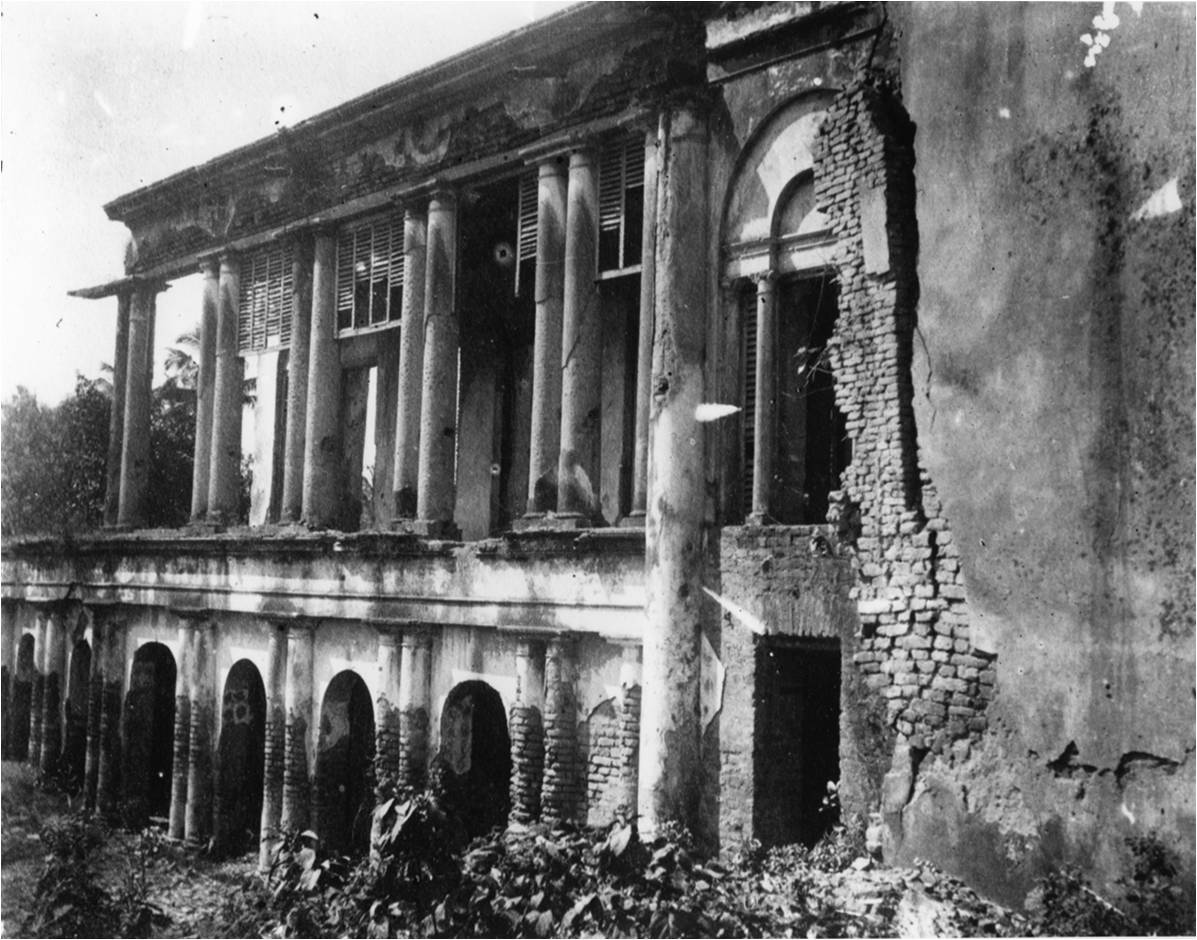
The Baranagore Monastery was an abandoned, dilapidated two-story building, infested with snakes and said to be haunted by ghosts.  The rooms on the ground floor were dark, damp, and unfit for habitation, so they were used as kitchen and for storage.  Shashi was once bitten by a snake in one of those dark rooms.
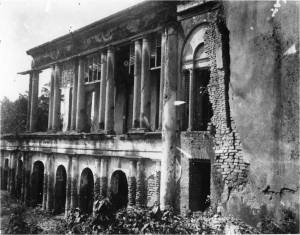
Old math

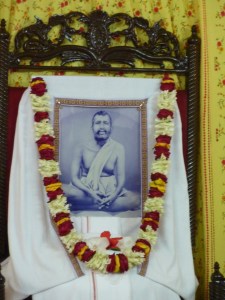
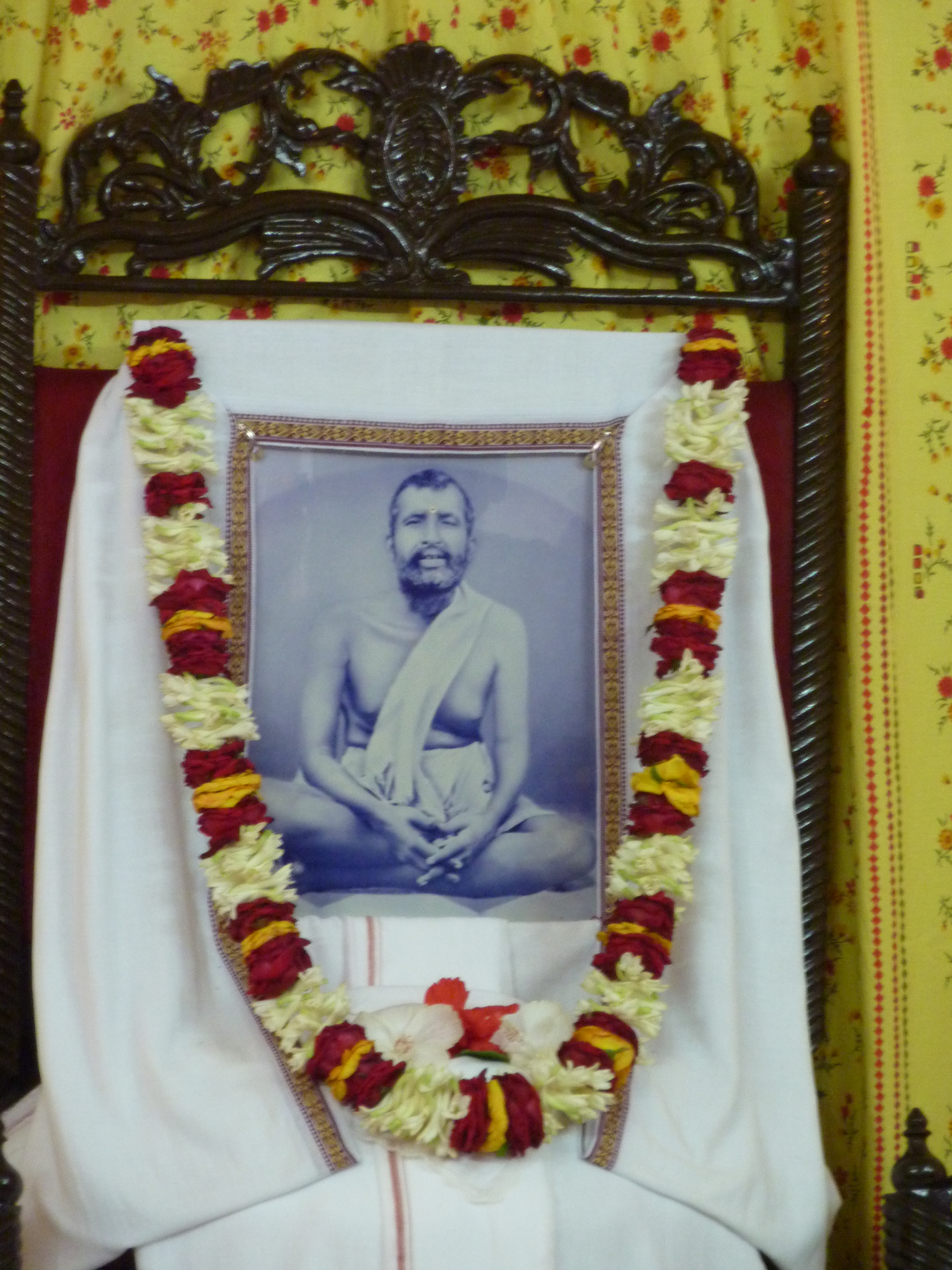
The monks set up a shrine in an upstairs room. The relics of the Master were brought from Balaram’s house, and a picture of Sri Ramakrishna was placed on the altar.  The articles that the Master had used at Cossipore were also preserved in the shrine room.  Shashi kept the memory of the Master ablaze in the Monastery with his wholehearted dedication and devout service to the Master.  His scrupulous precision and regularity of service made everybody feel the living presence of the Master.

Narendra devoted himself–heart and soul–to the training of the young brother disciples. He spent the daytime at home, supervising a lawsuit that was pending in court and looked after other family affairs.  Since his father had passed away, he was responsible for taking care of his mother and siblings.  During evenings and nights, he was always with his brother disciples at the monastery, encouraging them to practice spiritual disciplines.  His presence at the monastery was a source of unfailing delight and inspiration to all.

The following incident played an important role in shaping the future of the young disciples.

Antapur Incident:

Baburam’s mother, Matangini Devi, invited–through her eldest son Tulsiram–all the youngsters to her house in Antpur towards the end of December.  Narendra and the other youngsters decided to go to Antpur.  From Howrah nine youngsters, namely, Narendra, Baburam, Sarat, Shashi, Tarak, Kali, Niranjan, Gangadhar and Saradacharan, boarded a train going to Tarkeshwar.  They had a tanpura and tabla with them.  In the train they sang “Shiva Shankar Bum Bum Bhola” and other songs. They got off the train at the Haripal station and with horse carriages travelled eight miles to Antpur.  Matangini Devi was extremely happy to receive them and made all arrangements for their stay and meals.

In the quiet and green natural surroundings, they all spent their time singing bhajans, doing prayer, japa, and meditation, discussing the teachings of Sri Ramakrishna, and remembering his infinite love.

One day, all the youngsters were discussing spirituality until late in the evening under the open bright starlit sky.  Upon Narendra’s suggestion, they lit a “dhoony” (a friendly fire) which Sadhus (renounced people) light before meditation.  Around the fire, they meditated for a while.  At that time, Narendra was inspired to talk about the life of Jesus Christ and about his penances and sacrifices.  His moving speech was filled with the fire of renunciation; it touched everyone’s hearts.  He then talked about the sacrifices made by St. Paul and other disciples of Jesus Christ. Narendra concluded his speech saying that they had learned so much from their Master. Following the Master’s teachings, they must renounce the world for God realization and the service to humanity.  Narendra’s speech infused everoyone’s spirit with burning renunciation. They all touched the fire and took a solemn vow to renounce the world for the goal of “God-realization and service to humanity.”  As they took their vow in front of the fire, their faces glowed even brighter.  When their minds came down to a normal plane, they were astonished to realize that it was “Christmas eve”.

Later recalling the incident Swami Shivananda said, “It was at Antpur that our resolve to become a group grew more intense.”

If we look into the lives of great personalities, we find that they have built the foundation for their lives’ goals from a young age.  These youngsters also prepared themselves for the great, positive, historical, and everlasting impact they had left in the world. In 1886 Narendra’s age was 23, Kali was 20, Sarat and Sarada Prasanna were 21, Gangadhar was 22, Shashi was 23, Niranjan was 24, Baburam was 25 and Tarak was 32.

After spending a week in Antpur, all the brother disciples came back to Kolkata.  In 1887 Rakhal and Elder Gopal went to Antpur with Narendra.  In January 1887 at the Baranagore Math, these eleven people (10 youngsters and Elder Gopal) took “Sanyas” (renouncing the world for God-realization and service to humanity) by performing the “Viraja Homa.”

Monastic Names of Sri Ramakrishna’s Disciples:

With the “Viraja Homa” completed, all of the disciples of Sri Ramakrishna renounced everything and took monastic names.  Narendra took the name Swami Vividishananda.  During his pilgrimages to different places in India, he assumed the name Swami Satchidananda. It was before going to America, that he assumed the name Swami Vivekananda, upon the request of Raja Ajit Singh of Khetri.

The other disciples took the following names:

Rakhal….Swami Brahmananda                                   Hari……Swami Turiyananda

Jogin……Swami Yogananda                                         Sarat…..Swami Saradananda

Niranjan…..Swami Niranjanananda                            Shashi….Swami Ramakrishnananda

Latu……Swami Adbhutananda                                    Kali…….Swami Abhedananda

Baburam…..Swami Premananda                                Gangadhar….Swami Akhandananda

Tarak……Swami Shivananda                                       Elder Gopal….Swami Advaitananda

Sarada Prasanna…Swami Trigunatitananda              Subodh……Swami Subodhananda

Life at Baranagore Math:

The young brother disciples lived an intense austere life at the Baranagore math.  They spent day and night in japa, meditation, worship, studying scriptures, and devotional music.  They used to forget to eat their meals.  At such times, Shashi, who had constituted himself as their caretaker, literally dragged them to the dining room.  Often, there was no food at all in the monastery.  At that time without complaining, they would simply spend their time in prayer and meditation.  They lived for months on boiled rice, salt, and bitter herbs.  Sometimes they had only rice and no salt at all.  But, no one cared about these inconveniences.  At night, they slept on straw mats spread on the hard floor.

Narendra studied with them. They would study world history and various philosophical systems.  They had a library that contained about a hundred books.  They discussed and compared the philosophies of Aristotle, Plato, Kant, Hegel, Shankaracharya, Ramanujacharya, Madhavacharya, Chaitanya, Nimbark, Buddha and many.  They also studied the Upanishads, Bhagavad Gita, and the four yogas. They could reconcile many apparent contradictions in light of Sri Ramakrishna’s life and teachings.  The dryness of the discussions was removed by devotional music.  There were many light moments, sometimes indulging in innocent laughter.  Among all these activities, Narendra kept reminding them that their goal was to have complete control of their lower nature and God realization.

Some of the household disciples of Sri Ramakrishna did not approve of the austerities of the young men.  One of them teasingly asked whether they had realized God by renouncing their homes.  At that Narendra said sharply, “What do you mean?  Suppose we have not realized God; must then we go back to the life of senses and deprave our higher nature?”

Swami Vivekananda’s reminiscences of Baranagore Monastery:

“After the passing away of Sri Ramakrishna, we underwent a lot of religious practices at the Baranagore Math. We used to get up at 3:00 a.m. and after washing our faces etc. we would sit in the shrine and become absorbed in japa and meditation.  What a strong spirit of dispassion we had in those days! We had no thought of even as to whether the world exists or not…There were days when the japa and meditation continued from morning till four and five in the afternoon.  Ramakrishnananda waited and waited with our meals ready, till at last he would come and snatch us from our meditation by sheer force….There were days when the monastery was without a grain of food.  If some rice was collected by begging, there was no salt to take it with! On some days there would be only rice and salt, but nobody cared for it in the least.  We were then being carried away by a tidal wave of spiritual practices.  Oh, we had those wonderful days!”

Description of Baranagore Math in “The Gospel of Sri Ramakrishna” by M:

“The members of the (Baranagar) Math called themselves the ‘danas’ or ‘daityas,’ which means the ‘ghosts’ and the ‘demons,’ the companions of Shiva.  They took these names because their indifference to worldly pleasures and relationships….Narendra and other members of the Math often spent their evenings on the roof.  There they devoted a great deal of their time to discussions of the teachings of Sri Ramakrishna, Shankaracharya, Ramanuja, and Jesus Christ, and of Hindu Philosophy, European Philosophy, the Vedas, the Puranas, and the Tantras.”

(I believe M. visited the monastery mainly in the evenings.)

Interesting Incidents at Baranagore Math:

(1) Swami Advaitananda (Elder Gopal Maharaj):

At the Baranagore Math, Swami Advaitananda helped his brother monks with household work and played the tabla when Swami Vivekananda sang.

Sometimes the young monks would tease him or make him subject of practical jokes.  Most of the disciples slept in one large room as they did not have many rooms.  One night when Advaitananda went to the bathroom, Akhanadananda replaced his pillow with a brick.  When Advaitananda returned, he discovered his brick-pillow.  He smiled and said to Akhanadananda: “Ganga (Akhanadananda), I know you have done this mischief.  Brother, I shall use your precious gift tonight as my pillow.”  Akhandananda was touched by these words.  He immediately threw away the brick and brought back his pillow.  With an apology, Akhandananda said, “Brother, you are a real monk – free from anger and ego.”

(2) Swami Abhedananda (Kali ‘Tapasvi’ Maharaj):

The southernmost room of the second floor was used for meditation and study.  Kali secluded himself in this room for most of the day and that is why this room was known as ‘Kali Tapasvi’s Room.’  ‘Tapasvi’ means one who performs severe austerities. He was an ascetic by nature.  He ate vegetarian food, did not wear shoes, and shunned the company of people.  He spent his time in meditation, studying scriptures and composing hymns on Sri Ramakrishna and Holy Mother.

He composed the famous hymn of Holy Mother, namely “Prakrutim Paramambhayam Varadam…” One day Kali visited Holy Mother at her residence at Nilambar Babu’s house in Belur and read this hymn to Holy Mother.  After listening this hymn, Holy Mother blessed him saying, “May, Saraswati, the goddess of knowledge, reside on your tongue.”

When someone in the Baranagore Monastery complained that Kali was not taking any responsibility for the household work, Vivekananda said, “Let one of the brothers be a scholar and I will do the dishes myself.”

One day, Mahendranath Datta, one of Vivekananda’s brothers, was shocked when he saw Kali lying like a dead person in the sun on the dusty floor of the veranda.  Jogin told him with a smile, “He is not dead.  The rascal meditates that way.”  The young disciples used to tease and make fun of each other.  Ramakrishna gave a taste of true spirituality to these young disciples and made their spiritual practices filled with joy.  Poverty and hardship could not dampen their spirit.

The brother disciples had deep love for each other.  One night, Kali was shivering with cold and could not sleep; none of them had warm clothing or sufficient blankets.  They were sleeping on the floor of a large room under a single mosquito net.  When Kali told Narendra about his suffering, Narendra got up at 2:00 a.m. and made hot tea for his brother.  He told Kali, “Enjoy this hot cup of tea and get rid of the cold.”  He also teased Kali saying, “This hot cup of tea seems to me more concrete than your blessed theory of Advaita, don’t you think so?”

Kali was well versed in both Eastern and Western philosophies and enjoyed discussions with Narendra.

(3) Swami Adbhutananda (Latu Maharaj):

Latu Maharaj’s story is one of the miracles stories of Sri Ramakrishna.  Latu was a servant of Ramachandra Datta.  Sri Ramakrishna saw him when Latu came for some work.  Sri Ramakrishna liked him and asked Ramachandra to keep him at Dakshineswar.  Ramachandra agreed to it.  Sri Ramakrishna made Latu a saint out of a servant.  That is why Swami Vivekananda suggested the name Swami Adbhutananda for him.  “Adbhuta” means wonder of wonders.

When Latu Maharaj came to the Baranagore Monastery some disciples had already taken monastic vows.  Narendra Asked Latu Maharaj to do the same.  Latu Maharj agreed immediately.  During the “Sanyas ceremony” Latu Maharaj offered his own unconventional simple prayers instead of Sanskrit mantras. After he became Sanyasi, he stayed at the Baranagore Monastery for a year and a half.  In later years he told many stories about the early days at the monastery.

Love of brother disciples:

Latu Maharaj said, “Shashi’s performance of the vesper service was something worth seeing. Everyone could palpably feel the Master’s presence….In those days we loved each other so dearly that if perchance someone got angry with someone else, that anger did not last long. Very often our topic of conversation would be the Master’s transcendent love. If one person said, “He used to love me most,” another would contradict him and say, “No, he loved me most.” One day during such a discussion I told them: ‘The Master did not leave any property behind and still your squabbling seems unending.  The Lord alone knows whether you would have gone to court if he had left any property.’ There was outburst laughter at my remark.”

Why study scriptures?

Latu Maharaj said, “I noticed that everyone at the (Baranagore) Math was studying hard.  One day I asked Brother Sharat (Swami Saradananda): ‘Why do you read so many books? All of you are finished with school, yet you study so hard! Are you to appear for an examination?’ Sharat replied, ‘Brother, without serious study how are we to understand the subtle matters of religion?’ I rejoined that the Master had talked so much about these subtle matters, and I had never seen him reading books.  Sharat said: ‘His case was completely different. He himself said that the Divine Mother used to provide him with heaps of knowledge. Have we reached that stage, or can we hope to reach it? We have to read in order to acquire such knowledge.’

I (Latu Maharaj) did not leave the matter there, but replied, ‘The Master said that we get one conception of the truth through studying books and quite another by spiritual experience.’ Then Sharat said: ‘But didn’t he say that those who would be teachers will have to study the scriptures as well?’ Then I realized that men understand differently according to their mental constitutions and that the Master taught each one according to his own nature. From then on I kept quiet.”

Swami Ramakrishnananda on Latu Maharaj at Baranagore:

“We often had to call Latu back to normal consciousness and virtually force him to take food. There were many days when we called him again and again but no response, so we would place his food in his room and leave. The rest of the day passed. When we went to call him for supper, we would find the noon meal still there where it was placed, untouched and stale. We found Latu lying down in same straight posture as before, completely covered with a thick cotton chadar. We had to resort to many tricks just to force a little food down his throat.”

Swami Saradananda on Latu Maharaj at Baranagore:

Swami Saradananda jokingly said, “You see, at night that rascal Leto (Latu) dos not sleep at all. During the first part of the night he pretends to be asleep and even snores; but he keeps his rosary with him, and when the others are asleep he sits up and starts counting his beads (doing japa). One night I heard the ticking of beads and thought a mouse might have come in the room. When I gave a rap the sound stopped. A little later the ticks began again. This went on for a while, and I began to suspect that it might not be a mouse. The next night I stayed awake and was very watchful. The moment I heard the first tick, I struck a match and found Leto sitting up, counting his beads. Then I laughed: ‘Ah, you mean to surpass us all! While we are sleeping you are counting your beads!’”

Swami Turiyananda on Latu Maharaj at Baranagore:

Swami Turiyananda said, “Many of the brother monks were leaving the monastery at Baranagore to practice austerity. I too felt an urge to meet holy men in other places of India. As I was thinking this over, a voice said from within me, ‘Where will you find such a sadhu as he (meaning latu)?’ Startled, I turned my gaze and saw Latu Maharaj lying down covered with a thick cloth, deep in meditation….The very same moment Latu Maharaj spoke out: ‘Where will you go? It is better to engage yourself in tapasya (austerity) here.’ That time I stayed at the monastery.”

(4) Swami Turiyananda (Hari Maharaj):

At the Baranagore math, after taking the monastic vows Swami Vivekananda read and explain to his brother disciples two chapters from the Brihadaranyaka Upanishad, namely Antaryami Brahman 3.7 and Maitreyi Brahman 4.5.  In these chapters renunciation and the greatest truths of Vedanta are discussed.  They all plunged into achieving the highest goal of human life, realizing the Supreme.

After joining the monastery Swami Turiyananda passed through a dry spell. He described it later on: “When I was young and living in the Baranagore math, once I had a very despondent mood. I could not meditate. I was then pacing back and forth on the roof. Then suddenly there was a rift in the cloud, and out came the full moon in all its majesty. All darknesswas dispelled, and the whole landscape was flooded with light. As soon as I saw that I thought: ‘See, the moon was there all the time but I could not see it. So the Atman is also ever present, shining in its own glory, but I did not see it. The cloud of ignorance stood between the Atman and me.  My intellect overshadowed my mind. And at once I felt strong again, my doubts were all gone.’”

In 1889 Swami Turiyananda left the Baranagore Math and went to Rishikesh and in summer of 1890 he went to Gangotri with Swami Saradananda.

(5) Swami Saradananda (Sharat maharaj):

After Sri Ramakrishna’s passing away on August 16, 1886, Sharat returned to his home.  Sharat’s parents were happy to have him back, but his mind was not at peace.  He could not concentrate his mind in his studies.  Every now and then the blissful form of his Master would appear to him and he would cry.

When the Baranagore Monastery was established, Sharat started visiting it whenever he got a chance.  Sometimes he stayed overnight at the monastery.  Sharat’s father was alarmed that he would quit his studies and would go to the monastery, so he locked Sharat in a room.  Sharat was waiting for the right moment.  One day his brother Prakash unlocked the room and Sharat quietly walked out of the house and went to the monastery and stayed there.  Later when Sharat’s parents found that their son was determined to dedicate his life to realize God and service to humanity, they went to the monastery and gave their blessings to him.

After the “Viraja Homa,” Swami Vivekananda gave the name Swami Saradananda to Sharat. At the Baranagore Math, Sharat Maharaj became absorbed in spiritual discipline. Sometimes Vivekananda and Saradananda would go to the Cossipore cremation ground where the Master’s body was cremated and spend the whole night in japam and meditation.  Sometimes, they used to go to Dakshineswar and meditate at the Panchavati Grove.  On April 9, 1887 Vivekananda said to M.: “The Master has given me charge of Sharat. He is now yearning for God. His kundalini has been awakened.”

At the monastery, Saradananda used to help with the household duties like cleaning the rooms, washing dishes, and so on.  Saradananda learned from Vivekananda how to sing and play tabla.  He had a sweet melodious voice, which from a distance could be mistaken to be a female voice. One night, while Saradananda was singing, some neighbors thought that a woman was singing.  To find out what was going on, they scaled the wall and entered the monastery.  After finding out that Swami Saradananda was singing they were ashamed of themselves and sincerely apologized to the monks. His singing and recitations of Chandi were very inspiring.

After Sri Ramakrishna’s birthday celebration, Saradananda went on a pilgrimage to Puri with Swami Premananda and Swami Abhedananda.  When he returned to the monastery his body was emaciated but his face was a glow with devotion.  He became more indrawn.

(6) Swami Premananda (Baburam maharaj):

Baburam’s mother had invited all young brother disciples to her house in Antpur. After the “Viraja Homa,” Swami Vivekananda gave the name Swami Premananda to Baburam Maharaj. Swami Vivekananda said that according to Sri Ramakrishna, a part of Srimati Radha had incarnated in Baburam since he was very pure and filled with unselfish love.

At the Baranagore Math, Premananda used to help with the household work as well as the Master’s worship.  One day he fell from a tree while picking flowers for the master’s worship. He fractured his right wrist.

Later Premananda told a touching episode. He said, “After the passing away of Sri Ramakrishna Swami Vivekananda used to cry secretly at night remembering him. He used to cry so much that his pillow would get fully wet and I would put it in the sun in the morning to dry.”

During his stay at the monastery Premananda went on several pilgrimages with his brother disciples.

(7) Swami Brahmananda (Rakhal Maharaj):

After the “Viraja Homa,” Swami Vivekananda gave the name Swami Brahmananda to Rakhal Maharaj. Shortly after this, Rakhal Maharaj’s father went to the monastery to persuade him to return home. But, he calmly and firmly said to his father: “Why do you take so much trouble to come to me? I am quite happy here. Now bless me that I may forget you and you may forget me.”

At the Baranagore Math, Brahmananda became so absorbed in japa and meditation the he almost forgot the world.

In the Gospel of Sri Ramakrishna M. recorded his conversation with Rakhal Maharaj in the Baranagore Monastery:

Rakhal (earnestly): “M., let us practice spiritual discipline. We have renounced home for good. When someone says, ‘you have not realized God by renouncing home; then why this fuss?’ Narendra gives a good retort. He says, ‘Because we could not attain Rama, must we live with Shyama and beget children?’ Ah! Every now and then Narendra says nice things.”

M.: “What you say is right. I see that you too have become restless for God.”

Rakhal: “M., how can I describe the state of my mind? Today, at noontime I felt great yearning for the Narmada (a holy river in Central India).

During his stay at the Baranagore Math, Brahmananda went on pilgrimages of places like Puri, Kamarpukur, Jayrambati, Varanasi, and Omkarnath situated on the bank of Narmada.

(8) Swami Shivananda (Tarak Maharaj):

Tarak Maharaj was one of the three youngesters who started staying in the Baranagore Monastery from the first day. After the “Viraja Homa,” looking at his Shiva-like nature, Swami Vivekananda gave the name Swami Shivananda to Tarak Maharaj.

Swami Shivananda remarked during their stay at the Baranagore Monastery: “We had so much deep love for each other (among the brother disciples) that we were ready to sacrifice our lives for each other.”

Swami Shivananda lived at Baranagore for about two and a half years, developing his own spiritual life and helping to consolidate the new monastery. He nursed monks who fell ill, and did household work, such as cutting vegetables for cooking, carrying water from the Ganga, sweeping and dusting the rooms, and even cleaning the toilets.

(9) Swami Trigunatitananda (Sarada Prasanna Maharaj):

When the Baranagore Math started, Sarada Prasanna started visiting his brother disciples at the Math. His parents strongly did not approve of these visits.  When Narendra and other brother disciples decided to go to Antpur, he secretly sent a message of this trip to Sarada Prasanna.  Sarada immediately left home and joined the group.

One day in Antpur, Sarada went to take bath in a pond. He did not know how to swim. Suddenly he slipped from a step and fell in deep water. Immediately Niranjan dove into the water and rescued him.

When they returned to the Baranagore Math, Sarada went with the brother disciples instead of going home.  Sarada’s elder brother Binay secretly arranged a sacrificial ceremony to try to change the mind of Sarada.  Twelve brahmins performed the ceremony for one month and twelve days. Binay had spent four thousand rupees for the ceremony. After the ceremony the brahmins said that it was not possible for them to change the mind of Sarada as his desire was very intense to realize God. Then, Binay went to the Baranagore Monatery and asked the brother disciples to send Sarada home, but the brother disciples refused to do that.  They said let Sarada himself decide what he wants to do. Sarada became disgusted with all these attempts and he stopped visiting home completely.

With the “Viraja Homa,” Sarada took the monastic vows and Swami Vivekananda gave him the name Swami Trigunatitananda.  Swami Vivekananda used to tease him saying that his name was too long, so he would call him “Tirgunatita.”

One day, Swami Vivekananda asked Saradananda to visit Navadwip, the birthplace of Sri Chaitanya, on foot.  Saradananda immediately prepared to walk sixty miles to Navadwip without any money. Swamis Shivananda and Trigunatitananda found out about it and they went along with him.

An amusing incident happened. Trigunatita’s eating habits were unusual! Once he had stomach ache. Swami Brahmananda sent him to Dr. Bepin Ghosh, a cousin of Swami Premananda, for a treatment. The doctor was a devotee and knew Trigunatita very well.  He wanted to serve him before proceeding for the examination. He asked Trigunatita, “Please tell me what you would like to eat?” Swami said, “Rasagoollas,” (an Indian sweet – cheese balls soaked in syrup). Dr. Ghosh offered him two rupees’ worth of “Rasagollas,” more than two dozen.  Trigunatita ate them all. Then, Dr, Ghosh asked, “Please tell me your trouble for which you had come to me?” Trigunatita replied, “I have a stomach problem.” Dr. Ghosh was shocked and asked, “My goodness! Why then did you eat these rasagollas?” Swami said that he offered him with love, so he ate them. The doctor than gave a medicine.  Swami Trigunatitananda had tremendous self-control.  He could eat an enormous amount of food and he could also fast for few days at a stretch.

During his spiritual practices at the Baranagore Math, Trigunatita had a great desire to perform some tantric rituals at midnight on the cremation grounds. He knew Vivekananda would not give him permission to do this. One night, when all brother disciples slept, he prepared to leave for the cremation ground. To his utter astonishment, he heard Swami Vivekananda, “Where are you going?” Trigunatita stood speechless. Vivekananda said, “Sri Ramakrishna appeared to me and told me where you are going. You should not go there.  Sri Ramakrishna had given us everything and it is sufficient to keep our minds on him.” This was the end of his desire to do any tantric ritual.

Another amusing and touchy incident happened. Trigunatita decided to repeat his mantra 24/7. His goal was, “God-realization or starve to death.” Swami Shivananda was concerned about him.  He persuaded him to come out from his room.  Trigunatita did come out, but he refused to eat as his repetition of mantras would stop. Shivananda found a way out. Shivananda touched him and repeated the mantras on his behalf while Trigunatita hurridly ate some food.

Trigunatota’s father was trying to bring him back home.  Trigunatita refused and he went to Puri on a pilgrimage.

In the Gospel of Sri Ramakrishna, M. mentioned the state of Trigunatita’s mind when he was at the Baranagore Math.  On May 7, 1887 he wrote: “Narendra was in charge of the members of the monastery. Sarada Prasanna had been practicing austere sadhana for the past few days. Once, Narendra had told him his desire to fast to death for the realization of God. During Narendra’s absence in Kolkata, Prasanna had left the monastery for an unknown destination.

Narendra (to M.): “You see what a lot of trouble I am in! Here, too, I am involved in a world of Maya. Who knows where this boy had gone?”

Prasanna had left a letter for Narendra. He had written: “I am going to Vrindavan on foot. It is very risky for me to live here. Here my mind is undergoing a change….The Master once told me, ‘Your people at home are apt to do anything; never trust them.’”

(10) Swami Ramakrishnananda (Shashi Maharaj):

After Sri Ramakrishna passed away, Shashi reluctantly went home.  But as soon as Narendra and other disciples rented the Baranagore Math with the help of Surendranath Mitra, Shashi joined his brother disciples.

Shashi Maharaj’s Service to Sri Ramakrishna:

From 1886 to 1897 Shashi kept a constant vigil over the Master’s relics, seldom visiting any holy place or leaving the monastery overnight. Because he came from an orthodox Brahmin family, he performed the Master’s worship as one serves a living human being. He would get up at 4:00 a.m., and after washing would enter the shrine to rouse the Master from his bed. He would then offer a twig for a toothbrush and water to rinse the mouth. Next he would offer some sweets made from coconut and a glass of water for breakfast. He never allowed his brother disciples to help him. Afterwards he would pick flowers, sweep the shrine, wash the worship vessels, and make the necessary preparations for the worship. He would then go to the nearby market to buy groceries. Shashi always bought the best product for the Master; although he did not have much money, he had a rich heart. After returning from the market he would help the cook cut vegetables, and then he would go to bathe in the Ganga and bring holy water for worship. Afterwards he would perform rituals and offer cooked food to the Master.

In the evening, he would conduct the vesper service, waving a light, fanning the Master, and singing with the disciples the vesper song of Vishwanath in Varanasi:

Jai Shiva Omkara, Bhaj Shiva Omkara,

Brahma Vishnu Sadashiva

Hara Hara Hara Mahadev!

Swami Virajananda’s (Swami Vivekananda’s disciple) reminiscences of arati:

“Oh, how wonderful was the ararti of Shashi Maharaj! It was really a sight for the gods. Enveloped within the dhooni of the incense and drowned in the music of drums and cymbals, he would wave a chamar (fanning to Sri Ramakrishna) towards the end of the arati. Intoxicated with God-consciousness he would repeat, “Jai Gurudev! Jai Gurudev!”, in a crescendo of divine abandon and would dance from one side of the hall to the other rhythmically pacing the floor. What a unique feeling of ecstatic love would course through the hearts of men witnessing it can better be imagined than described….The spectators would watch from the adjoining room and join him, all repeating in chorus, “Jai Gurudev! Jai Gurudev!”

After the Viraja Homa, Swami Vivekananda, knowing Shashi’s love for Sri Ramakrisha, gave him the name “Swami Ramakrishnananda.”.

Shashi Maharaj’s efforts to support the monastery:

To meet the expenses of the Baranagore Monastery, Shashi Maharaj worked as a teacher at the Baranagore High School for two hours daily after lunch, foregoing his rest. He continued this for three months to support the monastery.

Ramakrishnananda’s love:

One day four monks went out for alms, but unfortunately did not receive any food. The monastery store was empty. Ramakrishnananda was anxious and disturbed with the thought that the Master would have to starve that day. Giving up the desire for food, the brother disciples became absorbed in devotional singing. Ramakrishnananda then quietly went to the house of a friendly neighbor and said to him, “Brother dear, today nothing has been obtained from begging. Could you give me a handful of rice, some potatoes, and a little ghee?” Although other members of his family were not sympathetic, he gave a half a pound of rice, some potatoes, and little ghee. Ramakrishnananda gladly cooked that food and offered it to the Master.  Then, he mixed it together and made small balls, which he carried to the hall and put one ball in the mouth of each brother disciple.  That small amount of sanctified food appeased their hunger, and they were touched by Ramakrishnananda’s love and concern.

A heated exchange:

Swami Adbhutananda reminisced: “Once there was a heated exchange of words between brother disciples in connection with the shrine. It began when a household devotee said, “You fellows do nothing but act as priests to the photograph of the Master, burning incense and waving lights before it, just as orthodox priests do before the stone image of Goddess Shitala.”

This remark upset Brother Shashi very much and he said sharply: “The money of such a householder should not be touched with a barge pole! It is cursed.”

Brother Loren (Vivekananda) used to be amused when he saw Shashi angry. He told him, “All right, then go and beg food for your Master.” “Very well,” responded Shashi, “and I will not touch a bit of your money either! I will beg food in order to feed my Master.” Loren said with a smile, “And I suppose you will offer him luchis that you get by begging?” Undaunted Shashi replied, “Yes, I will offer him luchis; and moreover, I will serve those offered luchis to you to gulp down afterwards.”

Then Loren pretended to get angry: “No, by no means will I allow luchis to be offered to him while we have nothing to eat! Such a Master should be thrown out. If you won’t do it, I am going to throw him out myself!” Saying this, he sprang up and started towards the shrine. Shashi said something in English and ran after him.

When I saw what was happening, I tried to intercede. I told Loren, “Brother, why are you opposed to Shashi’s desire to serve luchis to the Master? Let him go his own way and you yours.” Loren returned, “Keep quiet, you fool.” A harsh retort was about to come out of my mouth, when Brother Loren laughed in such a way that Shashi too began to laugh. A few minutes later, we all were sitting together making arrangements for the Master’s worship.”

Shashi Maharaj’s sincerity in serving Sri Ramakrishna:

Swami Adbhutananda told this incident. “One day Brother Shashi asked an elderly Swami Satchidananda to put a fresh twig stripped of leaves and bark, in the shrine early in the morning to be offered to the Master for use as a toothbrush. The elderly swami did not know that one end of the twig was to be gently beaten to soften the fibers and make them like a brush….During the breakfast Shashi saw this, and he rushed to the elderly swami and scolded him saying, “You rogue, you have caused the Master’s gum bleed today. I will teach you a good lesson.” I cried out to the elderly swami, “Don’t just stand here looking at Shashi. Run away!” He fled and the situation calmed down immediately. Shashi got another twig, prepared it properly and threw away the old one.”

(11) Swami Niranjanananda (Niranjan Maharaj):

Niranjan took monastic vows after the “Viraja Homa” at the Baranagore Monastery.  Swami Vivekananda gave him the name “Swami Niranjanananda.” he continued his spiritual discipline and austerities at the monastery.

Swami Niranjanananda helped performed the worship service and other household responsibilities.  He thought that the altar for the Master must be better. He had heard about an elderly expert carpenter in Kolkata. He contacted him and have him made a beautiful altar for the shrine.  With the help of the devotees Niranjan Maharaj collected a bed and proper utensils for the Master and a Japanese gong for vespers. He planted a bel tree on the spot where the master’s body was cremated on the bank of Ganga and made a marble altar around the tree.

Holy Mother’s recollection:

Holy Mother recalled: “What an austere life they led at the Baranagore Monastery! Niranjan and others often starved themselves. They spent all their time in japa and meditation. One day they resolved among themselves: “Well, we have renounced everything in the name of Sri Ramakrishna. Let us see if he will supply us with food if we simply depend on him. Neither will we tell anyone about our wants, nor will we go out for alms.” Saying so, they covered themselves with their chadars (shawls) and sat down for meditation. The whole day passed. It was late at night. They heard someone knocking at the door. Naren left the seat and asked one of his brother monks: “Please open the door and see who is there. First, check if he has anything in his hand.” What a miracle! When the door opened, they found a man had come from Laha Babu’s Krishna Temple near the Ganga with various delicacies in his hand. They were overjoyed and became convinced of the protecting hand of Sri Ramakrishna. They then offered that food to the Master and partook of the Prasad. Such things happened many a times.”

(12) Swami Subodhananda (Subodh Maharaj):

Subodh Maharaj was the youngest disciple among the brother disciples.  When Sri Ramakrishna passed away he was just 19 years old.  He felt emptiness within without his Master.  When Holy Mother moved to Balaram Babu’s house from the Cossipore Garden house, Subodh Maharaj visited her almost every day.  He also visited Kamarpukur and Jayrambati when Holy Mother was there. He was not finding peace within.  So, one day he just walked away from home on a pilgrimage.

Later he himself described his experiences: “For the sake of my mental peace I left home. I began my journey heading towards the western part of India on foot without carrying any money with me. If anyone wanted to talk to me on the way, I would talk only of God. As a result, no worldly thought enter my mind. Sometimes I stayed at night under a tree or in a meadow or on the bank of a river. At noon I ate whatever I got by begging from door to door like the mendicants. I had no extra clothing or shoes or umbrella. In the rain my clothes would get wet and they would eventually dry from my body heat.”  Thus, he reached to Varanasi, visited Lord Vishwanath and Mother Annupurna’s temple and received their blessings. There, his relatives found where he was and brought him back to home.

He could not live at home. He joined the Baranagore Monastery. After performing “Viraja Homa,” Subodh took final monastic vows and became known as Swami Subodhananda.  As he was the youngest among the disciples, he was known as “Khoka Maharaj.” “Khoka” means the youngest.

About his days in Baranagore Math, Swami Subodhananda said, “Swami Vivekananda and others were engaged in deep meditation and japa. I used to wash the dishes, sweep the floor, and do all sorts of household work.”

Along with severe austerities these boys used to play tricks on each other and had fun. When everyone was asleep, Latu Maharaj used to get up and do japa under a mosquito curtain. With the intent to do some mischief, one night, Subodhananda put a wet cloth on the mosquito net.  Latu Maharaj woke up to do japa and found that water was dripping on him. Since the house was considered to be haunted, Latu Maharaj was frightened. When he found out about the mischief, he complained to Saradananda that Khoka was frightening him.

(13) Swami Yogananda (Jogin Maharaj):

After Sri Ramakrishna passed away, Jogin Maharaj went for pilgrimage with Holy Mother and her devotees. They went to Deoghar, Varanasi, Ayodhya, and Vrindavan.  One day in Vrindavan, Holy Mother had a vision of Sri Ramakrishna in which he told her to initiate Jogin with a certain mantra. Holy Mother thought it was a hallucination. But, the vision repeated.  Holy Mother asked Sri Ramakrishna how she could initiate Jogin; out of shyness she was not talking to any men including Jogin. Sri Ramakrishna said that she should initiate him in presence of Yogin-Ma. Shortly after Holy Mother initiated Jogin and he became the first initiated disciple of Holy Mother.

After the pilgrimage, Jogin went to Baranagore Math. He took his monastic vows there and became Swami Yogananda. His family members requested him to return home.  Yet, Jogin Maharaj was determined to live a life of renunciation to realize God and do service to humanity.  His father-in-law, Madhusudan Roy, was a pious man. He understood the mental state of his son-in-law. He accepted it as God’s command. He built a ghat on the bank of Ganga and adjacent to it a Kali temple. Madhusudan Roy spent last part of his life worshipping the Divine Mother.  His daughter helped him in his worship and she spent the rest of her life in meditation and performing austerities.

At the Baranagore Math, Yogananda was not much interested in studying scriptures. He loved to be in solitude, and would practice japa and meditation for several hours. Sometimes he would leave the monastery and practice austerities on the bank of the Ganga. Due to his intense fasting, his body became lean, but his eyes were bright and luminous.

A funny incident happened. As sadhus go for alms, one day Yogananda went out for alms. He arrived at a thatched cottage in Alambazar. A poor woman was sweeping the house. Seeing the young monk begging for food, she angrily said: “Get away from this place! You are a young man, why don’t you work and make money? You come in disguise of a monk at daytime to check the houses and will return at night to steal.” Saying this she hit her broomstick on the ground. Yogananda suppressed his laughter; but when he returned to the monastery, he mimicked the woman and took the whole incident lightly.  His acting was so good that the brother disciples rolled on the floor with laughter. Yogananda had a good sense of humor.

Few devotees visit to Baranagore Math:

Gopaler- Ma occasionally visited the Baranagor monastery. At their request she would cook a couple of dishes and offer them to the Master.

One day Swami Niranjanananda told Girish Chandra Ghosh, “The Master made you a monk. There is no need for you to stay at home.”

Girish took this advice as an order from the Master. He left home barefoot, wearing only a single cloth, and went to the Baranagore Monastery. However, the brother disciples sent him home because they knew that Girishbabu would not be able to bear the austerities of a monk’s life.

  1. regularly visited the Baranagor Monastery and supported the monastic disciples in every possible way. He used to join them in practicing spiritual disciplines, and he was never tired of speaking of their spiritual fervor to others. To him the monks were the full time lovers of God, while the householders were part-time because of their worldly obligations.

Balarambabu visited Baranagore Monastery regularly. One day he noticed that the monks were eating only rice and spinach. After returning home he told his wife that he would have only rice and spinach for his meal. When she found out the reason for this she immediately sent food and other articles to the monastery. Afterwards Balarambabu started giving one rupee per day for the food offering to the Master.

Akshay Kumar Sen was inspired by Swami Vivekananda to be a poet. He started writing Bengali verses in 1887. After he finished the early life of Sri Ramakrishna, he read it to Swami Vivekananda at the Baranagore Monastery.  Swami Vivekananda was deeply moved by this writing. This book was published in four parts between 1894 and 1901.

The following is the future restoration plan for the Baranagore Math.
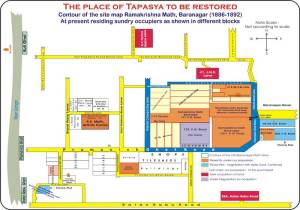
Restoration plan for Baranagar Math showing marks for two original pillars (Thanks to Arundhathi Johri and Kanna Pichappan for writing the original report and Deba Uncle for providing the necessary information needed to write this post.)

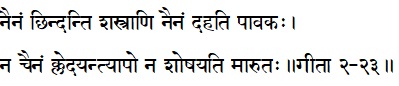
 

Celebrating Swami Vivekananda’s 152nd Birthday

Monday, January 12, 2015 is Swami Vivekananda’s 152nd birthday.  All over the world, people who have been inspired by Swami Vivekananda will be celebrating his birthday with great joy.

1_Swami_Vivekananda_1

Since 1984, India celebrates every January 12th, Swami Vivekananda’s birthday, as a National Youth Day.  On that day, students in schools and colleges all over India participate in parades, youth conventions, youth-related seminars, presentations of speeches, recitations, essay-writing contests, yoga-asanas, and various athletic events.

Who was Swami Vivekananda?  He was a saint, a prophet, a yogi, an Incarnation of all loving and compassionate Lord Shiva, a great orator, a poet, a writer, a musician, a great teacher, a scholar, a visionary, a thinker, a philosopher, an explorer of Vedanta, a humanitarian, a social reformer, a patriot, a lover of humanity and much more.  His multi-faceted personality is blinding to the human eyes.  He lived only for 39 years, but his positive impact on the society will go on inspiring people for thousands of years.

In 1976, on the occasion of America’s Bicentennial Celebration, the National Portrait Gallery in Washington, D.C. displayed a large portrait of Swami Vivekananda as a part of its exhibition, called “Abroad in America: Visitors to the New Nation: 1776 -1914. ” This exhibition paid tribute to the great personalities who visited America from abroad and made a deep impression on the American mind.  The commemorative volume of the exhibition reads: “The Swami charmed the audiences with his magical oratory, and left an indelible mark on America’s spiritual development.

One can buy the commemorative volume “Abroad in America: Visitors to the New Nation: 1776 -1914” from amazon.com.  The following is the cover page:

Abroad in America
The Cover page of the book

The following link connects to the Facebook page of the Ramakrishna Vivekananda Center in New York, which has posted the cover and a few pages of the commemorative volume along with several photos.

https://www.facebook.com/165218223516894/photos/ms.c.eJxFzcsRgEAIA9COHD5hCf03pi6LHt8kgYwIgxLgsrIrtwHVsHJvW1ZSKxfG~_fbx59n5Oqbt3DiOdozrue~;Cyav7~_tk7n3~;FfR9n76K7LzXuvfBz9~;UG~;MAtmA~-~-.bps.a.755522737819770.1073741941.165218223516894/755522797819764/?type=1&theater

The life and teachings of Swami Vivekananda can be a great source of inspiration for anyone who aspires to achieve something positive in life.

The best way to celebrate Swami Vivekananda is to reflect upon and practice a couple of his teachings.  Let us do just that.

Everyone likes to achieve success in life.  No one likes to fail.  Swami Vivekananda gives a guideline on how to achieve success in life.

Swami Vivekananda says, “Take up one idea.  Make that one idea your life – think of it, dream of it, and live on it.  Let the brain, muscles, nerves, every part of your body, be full of that idea, and just leave other ideas alone.  This is the way to success.”

Of course, the practice of this idea must be helpful and not harmful.  It must be helpful to all beings, not just few.  Let us think how we can apply this teaching in our lives.

First:   We have to find a good idea.  How do we find good ideas?  For this we have to read inspiring books, especially biographies and teachings of people who have done something good to the world.

We have to be in the company of people who are engaged in doing some good to the world.  Company plays an important role.  We learn much more from living examples of good people and being in the company of good people.  We have to fill our minds with good ideas.  And another thing we have to remember is that if we do not fill our minds with good ideas, then our minds will pick up all kinds of harmful or useless ideas.

Second:  We can reflect upon all the good ideas we collected, write about these ideas, and discuss these ideas with people who are interested in doing good things. Most importantly, we have to think of the following few things:

(i)   What exactly do these good ideas mean?

(ii)  Which idea appeals to me most?

(iii)  Why should I practice this idea?

(iv)  How can I practice this idea?

Swami Vivekananda advises us to “dream of that good idea.”  Dream that we have practiced this idea in life and have been successful.

Third – Live the idea.  When we try to practice a good idea in our lives, two things come:

(i) Obstacles and difficulties:  If our good idea is challenging, then we may face more obstacles and more difficulties.  But we should not take them negatively.  Obstacles and difficulties come to test the intensity of our desire to practice the good idea.  They come to measure our sincerity, commitment, and determination to attain success in manifesting the good idea in our lives.  If there are no obstacles or difficulties, then we do not value the good idea.  Obstacles and difficulties also build our mental strength.  In spite of obstacles and difficulties, if we continue to work for the good idea, we can build up our mental strength and confidence in ourselves.

(ii) Failures:  If we read biographies of people who lived inspiring lives and had done some good to the humanity, we find that they all met failures.  Not a single one had an easy ride.  They all had tremendous faith in themselves.  Swami Vivekananda said, “Throughout the history of mankind, if any one motive power has been more potent than others in the lives of great men and women, it is that of faith in themselves.  Born with the consciousness that they were to be great, they became great.

In addition, people who have been doing good work successfully take struggles positively.  We all know that Thomas A. Edison failed 10,000 times to invent the light bulb.  But he said, “I have not failed.  I have just found 10,000 ways that won’t work.”  We should also remember another quote of Thomas A. Edison: “Many of life’s failures are people who did not realize how close they were to success when they gave up.

Thus, if an idea is good and we have checked it for its goodness, thought about it, dreamt about it leaving all other ideas alone, and worked for it, then success will surely come.

Reflections:

(i)  Now, not everyone has to have a new good idea to work towards to make a life successful.  If someone had a good idea and we work towards that same idea with others, we can also be successful.  Some great ideas need a team of people.  Learn how to work as a team for a great idea and working for it will not be a small thing.  It will give us fulfilment.

Rockefeller Center Christmas Tree

People from all over the world come to see the Rockefeller Center Christmas tree.  It is grand.  It has 10,000 light bulbs and thousands of decorations. Each light bulb shining separately cannot create the same grandeur.  Yet, on the other hand, each light bulb is important as each of the other 10,000 light bulbs.  We can be those individuals who shine like light bulbs working as a team for a great cause.

(ii)  If we work unselfishly for a good cause, then we will realize that ultimately a good idea comes from the Almighty Creator who has created this universe and has created our body and mind.  Hence, if we are working for our own good idea or for someone else’s good idea, we will be working for the Creator’s idea.  We then become an instrument working for the Creator.

(iii)  I have never seen a person who even though living alone, cooks delicious dishes every day for him or herself, sits on a dining table alone, and enjoys eating these dishes.  Usually, when a person is alone, he/she finds any food, whether leftovers or junk food, that can fill the stomach.

However, when one cooks for a family he/she loves, one enjoys cooking.  Similarly, along with our family, there is more joy in cooking and feeding guests whom we love most than simply feeding ourselves.  The reason is that our Soul or Atman is connected to everyone.  When we remove the idea of our body and mind, then what remains is Atman.  This Atman is the same in all and we are all connected by that Atman.  So when we cook for ourselves only, there is little joy coming from the fulfillment of the desire of our body and mind.  When we cook and eat with other people, we feel more joy because we are connected with them.  Those who do unselfish service find that when they work for the good of all beings, then infinite joy comes from within, as if the Atman is dancing with joy in seeing that all are happy.

Swami Vivekananda said, “This life is short, the vanities of the world are transient, but they alone live who live for others, the rest are more dead than alive.”  There is very little joy in selfishness. Unselfishness is what brings infinite joy.

I have only taken one of Swami Vivekananda’s teachings in this post.  You can select one that you like, think about it, and live it.

(Thanks to Ronak Parikh for editing this post)

Happy 151st Birthday of Swami Vivekananda!

Swami Vivekananda was born on January 12, 1863.  His 150th Birth Anniversary was celebrated for last two to three years all over the world by his devotees and admirers.

Image
Swami Vivekananda (January 12, 1863-July 4, 1902)

As time passes, people forget people.  Generations after generations simply fade away in time. But, for personalities like Swami Vivekananda, as time passes, more and more people understand the importance of their lives, teachings and/or their contributions.

According to the Hindu calendar, Sunday, February 3, 2013 was Swami Vivekananda’s actual 150th Birthday.  I was fortunate to be invited by Revered Swami Yuktatmananda, Spiritual Head of Ramakrishna Vivekananda Center, 17 East, 94th St., New York, as one of the four speakers to share my thoughts.  My topic was “The Essential Spiritual Message of Swami Vivekananda.”

FlierFeb3Y2013
Flier of February 3, 2013 Program

Revered Swami Yuktatmananda was kind enough to give me the audio of my speech delivered at the Ramakrishna Vivekananda Center.

Simply enjoy it by clicking on the following arrow:

If you cannot get all the words, then please read the following lecture prepared from the audio with some minor changes.

The Essential Spiritual Message of Swami Vivekananda

(Lecture given at Ramakrishna Vivekananda Center, New York, on February 3, 2013, on the occasion of 150th Birthday Celebration of Swami Vivekananda)

Mahendra Jani

Revered Swami Yuktatmanandaji, honorable speakers and friends:

I sincerely thank Swami Yuktatmanandaji for giving me an opportunity to share my thoughts on this special occasion, celebrating Swami Vivekananda’s 150th Birth Anniversary. This is a very special occasion as it is on the exact birthday of Swami Vivekananda according to the Hindu calendar.  My topic is, “The Essential Spiritual Message of Swami Vivekananda.”

After listening to and learning from revered Swami Adiswaranandaji for many years, listening to Swami Yuktatmanandaji and others, and also reflecting upon Swami Vviekananda’s teachings, I am fully convinced that the essential spiritual message of Swami Vivekananda is this:

“Each soul is potentially divine.  The goal is to manifest that divinity within by controlling nature: external and internal.   Do this either by work, or worship, or psychic control, or philosophy-by one, or more, or all of these-and be free.  This is the whole of religion.  Doctrines, or dogmas, or rituals, or books, or temples, or forms are but secondary details.”

Why Divinity and what is divinity? We all want to be happy, but various disturbances and miseries come and make us unhappy.  We say, Om Shanti! Shanti! Shanti!  Om Peace! Peace! Peace! Three times because there are three kinds of disturbances:  from the environment, from people, and from our own minds. We have no control over the natural disasters like tsunamis, earthquakes, and storms like Sandy.  But the question is what can we do about the internal disturbances?

If we examine life more closely, what do we find? We find more misery than happiness. Babies are born crying.  Toddlers cry for food and discomfort.  Teens are unhappy because they cannot do what they want to do and cannot get what they want.  Adults are worried about finding good jobs and life partners.  Then, there are the three rings: engagement ring, wedding ring and suffering.  Adulthood passes in carrying the heavy workload of their job and household.  It follows by old age, disease, and death.

Suppose everything is fine – one has a good job, a good spouse, and a good family. But, then the mind changes and they are not good anymore. A person’s mind gets bored or unhappy with what he or she has.  One day the job and the boss look great, and another day you hate both of them.  The husband, who was sweet like honey before marriage, now becomes a bitter pill to swallow.   Someone once said, one day the wife looked as though moon-faced (Chandramukhi), another day as though sun-faced (Suryamukhi), and another day as though volcano-faced. Same people, but the mind changed. Or one can say, “As the mind changes, people change.  The house which was once a heaven on earth, now looks like a prison. We suffer because we are helpless.  We are slaves of our past actions.  We cannot get out of their consequences.  There are physical limitations.  No one asked me before my birth where I wanted to be born, what would be the color of my skin and eyes. I want to be in New York, in Los Angeles and in Delhi at the same time.  But, I can’t. I want to enjoy food, but doctors say, “No.  It is not good for you.”  I know someone who was dieting because of health problems.  After ten days of fasting, he was passing by a bakery and smelled a cheese cake.  He controlled himself, went a few steps further.  All of a sudden, he turned back, went into the bakery, bought the cheese cake and ate the whole right there.  We make resolutions, but we cannot keep them.  People say that it is good to make resolutions on January 1st, so we have the joy of breaking them in February.  Shankaracharya says that a fish gets caught because of craving for food, an elephant because of its desire to enjoy touch, a moth by the beauty of fire, deer by sound, and a bee by smell.  Human beings are slaves of all five senses, and we suffer.

Next is the fundamental question of life, ‘What is the purpose of life?’  Is there any purpose? If a near and dear one dies, then we think, “Is that all?  The life is gone? He or she was there a while go, and now is no more.  One day I will be gone and it is all over.” Buddha had all the pleasures of the world, but similar thoughts came to his mind and he could not enjoy the palaces, the parties and the flashy desires. Someone may say, “Uncle, you are looking at the negative side of life.  You are looking at half empty glass.  Look at the positive side of life; see that the glass is half full.”  But, aren’t the “half empty” and “half full” both partial views of life? Isn’t it wise to look at the whole glass? Is it not good to have a realistic view of life? Swami Vivekananda said that we do not have the clear picture of the universe because it is based upon little experience, poor reasoning and our weaknesses.

What is the way out? Some people say, ‘Don’t think too much. Occupy your mind with something: art, science, sports, and parties. Some say, keep changing: change your hair–if you have any, change your house, job, friends, spouse, country etc. Some say that this is what the world is.  Learn to live with it.  Get used to it. Think positive and keep hope alive. But these are mere patch-works. These are not solutions. Running away from the problem or pretending that the problem does not exist is not going to solve the problem. We have to face the problem. Swami Vivekananda said, “Face the brute.” He learned this lesson from a sadhu when he was being chased by monkeys. Rishis, Sages and saints faced the fundamental problems of life.  Swami Vivekananda said that only by facing the forces of nature and not giving in, human beings have manifested their power.

So, what is the way out? After seeing old age, disease and death, Buddha saw a mendicant.  He was serene and filled with happiness. Upon enquiry he found out that this mendicant had realized something that brought all this peace and bliss. Buddha set out to find that something. He set out in search of that Truth or God which removes all sorrows and brings true happiness. Swami Vivekananda wanted that happiness and answers to these fundamental questions of life. He also wanted to know the truth. He wanted to know God. That is why he was asking all people, “Sir, Have you seen God?” No one said, “Yes.” Finally, he met Sri Ramakrishna who said, “Yes my son! I have seen God and I see God more clearly than I see you.”  Swami Vivekananda found in that voice, the echo of the Truth that he was searching and he followed him. What Swami Vivekananda learned from Sri Ramakrishna about God and what he himself realized later, he beautifully described in his poem “Quest for God.” He wrote:

O’ver hill and dale and mountain range,
In temple, church, and mosque,
In Vedas, Bible, Al Koran
I had searched for Thee in vain.

(He searched God everywhere.)

……………

Years then passed in bitter cry,
Each moment seemed an age,
Till one day, midst my cries and groans
Some one seemed calling me.

A gentle soft and soothing voice
That said ‘my son’ ‘my son’,
That seemed to thrill in unison
With all the chords of my soul.

…………….

A flash illumined all my soul;
The heart of my heart opened wide.
O joy, O bliss, what do I find!
My love, My love (God), you are here
And you are here, my love (God), my all!

………………….

            Swami Vivekananda found that the God he was searching for everywhere resided within. God is the divinity lying within that makes us look for God outside. That is why he said, “Each person is potentially divine and the goal of our life is to realize this divinity and manifest it in our thoughts, speech, and actions.”

How do we realize this divinity? Swamiji said, “Realize this divinity by controlling nature: external and internal.” We can control the external nature partially by science, social reform, and proper actions.  But how do you control the internal nature? Note that the external behavior is a reflection of our inner mind-set.   So, most important is to control our internal nature. Swamiji said control your internal nature by either work, or worship, or psychic control, or philosophy.

These are four Yogas of the Bhagavad Gita: Karma Yoga, Bhakti Yoga, Raja Yoga, and Jnana Yoga.  The series of lectures given by Swami Vivekananda on these four Yogas in this New York City around 1894-1895 are one of the greatest contributions of his to humanity. He said both Monks and householders can realize this divinity within.  Offer the results of actions to God, meaning perform all actions unselfishly, not for name, fame, or other ulterior benefit.  Think that everything belongs to God, the Creator, and we are just care-takers. By doing work this spirit, our actions will purify our minds and our divine nature will manifest from within. He said that we must have intense passion to realize God. Sri Ramakrishna said that we have to combine the intensities of three kinds of love: the love that mother has for her child, a greedy person has for money, and a passionate person has for one’s spouse – combine the intensity of all these three kinds of love for God and then one can realize God. When one realizes God, one’s mind will be filled with bliss and love.  With that love of God, even miseries of life seem blessings of God in disguise.  Swami Vivekananda said that learn to control senses by mind and mind by intellect. Then, focus the mind on God or the inner divinity. Study scriptures.  Learn the essence of the teachings of the scriptures from holy people. Reflect upon them. Practice them. and realize that the support of our body and mind is the Soul, our divine self.  Body and mind changes, but the blissful soul is eternal.  Realize that this constantly changing world cannot give us the eternal bliss and peace.  Only through realizing our inner divinity we acquire true happiness and become free from all bondages. These Four Yogas cover all our four faculties: intellect, mind, heart and hands.  All four yogas are necessary.

Finally, Swami Vivekananda said that see God everywhere; see God in all; respect all and love all. Ultimately we have to realize that God has become everything.  He asked us to worship the living God — the God that walks through all feet, who works through all hands, sees through all eyes, speaks through all mouths, and listens through all ears. He encouraged us to worship this living God by serving humanity unselfishly.

Swami Vivekananda had a robust physic.  But, in serving humanity, he had worn out his body and passed away at the age of 39.  He practiced what he preached and left a glorious example for all of us to follow. Million salutations to Swami Vivekananda and salutation to you all! Thank you.

(My sincere thanks to Nisha Parikh for her help in editing this article.)

IYC – Bulletin 1

DSC03604
Going to Baroda with the list of Vidyapith delegates participating in IYC

DSC03605
The first batch arrived to finalize preparations for the trip

DSC03615
IYC posters on the streets of Baroda

DSC03620
With Rev. Swami Nikhileshwarananda at RKMVM in Vadodara

Swami Vivekananda in Gujarat

                  Swami Nikhileshwarananda has written an excellent research article “Swami Vivekananda in Gujarat.”  One who is interested in Swami Vivekananda and/or Gujarat should read this article.  The article brings out various aspects of Swami Vivekananda and makes him more humane.  It also tells us how Swami Vivekananda directly and Sri Ramakrishna indirectly attracted few powerful personalities of Gujarat and played an important role in their lives.  We can see how Swami Vivekananda built loving relationship with all of them.

Here I will tell you a few important points from this article that gives an overview of “Swami Vivekananda in Gujarat.”

  • During his ‘wandering monk’ period, July 1890 through May 1893, Swami Vivekananda spent maximum duration of time in Gujarat, from November 1891 through April 26, 1892.
  • During this time,
    • Swami Vivekananda strongly felt that he has a mission of his life.
    • He perceived bright future of India
    • He realized that India is one Huge Temple, as it were with chapels and sanctuaries everywhere. He saw the glory of Mahabharat.
    • He received inspiration for going to West to preach Sanatana Dharma
    • Pandit Shankar Pandurang told Swamiji, “I am afraid you cannot do much in this country. Few will appreciate you here. You ought to go to the West. Surely you can throw a great light on Western culture by preaching the Sanatana Dharma”. Here, probably Swamiji heard for the first about the religious convention that was to be held sometime in the following year at Chicago.
    • He had a wonderful experience of a mirage. In his lecture delivered in New York entitled ‘The Real and the Apparent Man’ Swamiji gave a description of the phenomenon and drew a very important moral from it.
    • He met some of the most prominent princes, Diwans, scholars and eminent personalities of his time. Such as:
      • Thakore Saheb of Limbdi Shri Yashwantsinhji
      • Maharaja of Bhavanagar Shri Takhtsinhji
      • Maharaja of Bhuj Shri Khengarji (III)
      • Maharaja of Porbandar Shri Vikamatji
      • Maharaja Gaekwad Shri Sayaji Rao
      • Shri Haridas Viharidas Desai, Diwan of Junagadh
      • Pandit Shankar Pandurang, Administrator of Porbandar
      • Shri Motichand Lalchand, Diwan of Kutch
      • Shri Manilal Jashbhai, Diwan of Baroda
      • Shri Mansukhram Tripathi & Shri Manibhai N. Dwivedi, the great Gujarati Scholars
      • Shri Lalshankar Umiashankar Trivedi, sub-judge and great philanthropist

All of them became great friends and admirers of Swamiji and some of them became even his disciples.

Ahmedabad

One day when a sub-judge of Ahmedabad was coming out of Ahmedabad Railway Station, he saw a sturdy and stout sannyasi sitting under a pipal tree, who had a look of greatness around him. He went to the monk and talked with him and became so much impressed that he atonce requested him to be his guest. Both got into the waiting tonga and soon arrived at the house of the host – Shri Lalshankar Umiashankar Trivedi – residing at 36 Amritlal’s Pole in Khadia the heart of the city of Ahmedabad.

Soon Shri Lalshankar realized that his guest was an unusual person with a good knowledge of almost everything in the world. The unknown monk was of course, none other, than Swami Vivekananda. Although the house was spacious, it lacked the required tranquility for meditation and reading, so Shri Lalshankar took Swamiji to another house he had in Ellisbridge behind the townhall. The house became a beehive of activity with many people flocking to hear and meet Swamiji, who lectured on several topics including high philosophy.

He stayed in Ahmedabad for 11 days.

Wadhwan

He saw Sati Ranakdevi’s temple.

Limbdi

He had a terrible experience with some evil sadhus, but Swamiji cleverly escaped with the help of a young village boy and the Majaraj of Limbdi.

Swamiji stayed in the beautiful palace of Limbdi for many days and held discussion in Durbar hall of the palace with the maharaja, Thakore Saheb, Shri Yashwantshinji (1859-1907).  He was a brilliant, learned king who had visited England and America. President Cleveland warmly greeted the Maharaja at the White House in Washington DC. Thakore Saheb described in detail what he had learnt from his visits to England and America and requested Swamiji to go to these countries for preaching Sanatana Dharma. Thakore Saheb of Limbdi was the first among the Maharajas to inspire Swamiji to go to the West for preaching work.

A fire in 1906, consumed a major portion of the beautiful Limbdi palace, left untouched the Darbar Hall where Swamiji had stayed. Sixty five years later Shri Chhatrasalji, the present Thakore Saheb of Limbdi, donated the palace to a public body named “Shri Ramakrishna Prarthana Mandir”. And now this trust has handed over the palace alongwith other properties to Ramakrishna Mission.

The Impact of Swami Vivekananda’s Visit to Gujarat

After returning from the West Swamiji sent two of his Gurubhais, Swami Turiyananda and Swami Saradananda to Gujarat to preach and to collect funds. Both of them spent about 3 months in Gujarat (From 22 February to 18 April 1899).

Junagadh & Girnar

Swamiji saw many ancient monuments and ruins – an old fortress called Uparkot, an old Rajput palace, two ancient wells, Khapra Khodia caves dating back to the Buddhist period, perhaps used as monasteries, ‘Ashoka Shilalekh’ in which the edicts of Emperor Ashoka and of the other emperors are inscribed and many other places of historical importance.

Girnar is group of about ten hills, highest of which is Gorakhnath (about 3600 ft.) has been a place of pilgrimage sacred to Buddhists, Jains and Hindus alike before the days of Ashoka (272-231 B.C.). For Swamjji, it must have been of special interest because here Pavahari Baba was initiated into the mysteries of yoga. 26 He sought out a cave and practised meditation for a few days during which Diwan Saheb took all possible care of him.

For a few days Swamiji stayed with Shri Chhaganlal Harilal Pandya (1859-1936), a great scholar and Manager of Diwanji Saheb, who became his staunch admirer. About Swamiji’s stay in his house he gave a delightful account – how he charmed everybody by his personality, vast scholarship, songs and discourses and not the least by his proficiency in the art of cuisine, specially by the ‘excellent rasagollas’ he prepared. In his talks Swamiji spoke of Jesus Christ as also of Shri Ramakrishna.

Swamiji visited Junagadh many times. During one of the trips he had also stayed with Shri Mansukhram Tripathi, the well-known writer and scholar of Gujarat, a man of high character, who preferred higher values of life. We get confirmation about Swamiji’s stay with Shri Mansukhram Tripathi from the account given by Swami Abhedananda in his auto-biography.

“On arrival at Junagadh, I came to hear from people that a Bengali sannyasi with high English education was staying for some days at the house of Mansukhram Suryaram Tripathi, a Gujarati brahmin, who was the Private Secretary of the local Nawab.. Elated with joy I reached the house of Mansukhram and immediately found that my conjecture was true. Narendranath brightened up with joy to see me unexpectedly.. Fortunately when I arrived there Narendranath was discussing some topic of non-dualistic Vedanta with Mr. Tripathi.. I gladly stayed in his house for three or four days in the company of Narendranath and then I got ready to start for Dwarka.”

During his very first visit to Junagadh Swamiji had become a guest of Shri Haridas Viharidas Desai, the Diwan of Junagadh (whom Swamiji used to address as Diwanji Saheb). Diwanji Saheb was so much charmed with the company of Swamiji that every evening with all the State officials he used to meet Swamiji and converse with him until late at night. Swamiji in turn loved and respected him as a son does his father, the difference in their age being 22 years. He wrote from Khetri in May 1893, “Believe me that I love you and respect you like a father and that my gratitude towards you and your family is surely unbounded…”

There are 13 inspiring and important letters of Swamiji addressed to Diwanji Saheb.”A friend in need is a friend indeed”. Like a true friend Swamiji helped Diwanji Saheb to overcome his problems, whenever needed. Once when Diwaniji Saben was in distress, Swamiji wrote an inspiring and powerful letter to him, “Often and often we see that the very best of men even are troubled and visited with tribulations in this world…”

Similarly, when Swamiji was in trouble, while some vested interests in America raised all sorts of scandalous charges against his character and conduct, Diwanji Sabeb, as soon as he came to know about it, wrote on 26.6.1894 to Mr. G. W. Hale in staunch defence of his beloved Swamiji. Swamiji wrote back to him, “your kind note to G.W. Hale has been very gratifying as I owed them that much.”

Diwanji Saheb’s administration of more than a decade in Junagadh was marked by the most important reforms in every department of the State.

Kutch

After spending a few days in Junagadh, Swamiji proceeded towards Kutch with a letter of introduction from Diwanji Saheb to his bosom friend Motichand Lalchand, Diwanji of Bhuj. Bhuj was the capital of Kutch. The Maharaja of Kutch, Khengarji Bahadur, only three years younger than Swamiji, soon formed a very close friendship with him. He was deeply impressed by Swamiji’s magnetic personality and was astonished at his vast knowledge: “Swamiji, as after reading may books the head becomes dazed, even so after hearing your discourses my brain becomes dizzy. How will you utilize this talent? You will never rest until you have done wonderful things!”

Swamji afterwards went to Mandavi.

Swamiji’s journey was not always pleasant or safe. When Swamiji was at Bhuj, his brother – disciple Swami Akhandananda warned him of the dangers of jealous state officers. Some state officers had even poisoned a Bengali sannyasin years ago when this sannyasin had tried to introduce reforms to improve the state.

Somnath

Several times the temple of Somnath was destroyed and several times rebuilt. Swamiji paused by this great ruin and pondered over the greatness that had been India’s in the past. He realized that in India religious life forms the center, the keynote of the whole music of national life. Later (in 1897) he was to address his countrymen, “Some of these old temples of Southern India and those like Somnath of Gujarat will teach you volumes of wisdom, will give you a keener insight into the history of the race than any amount of books.”
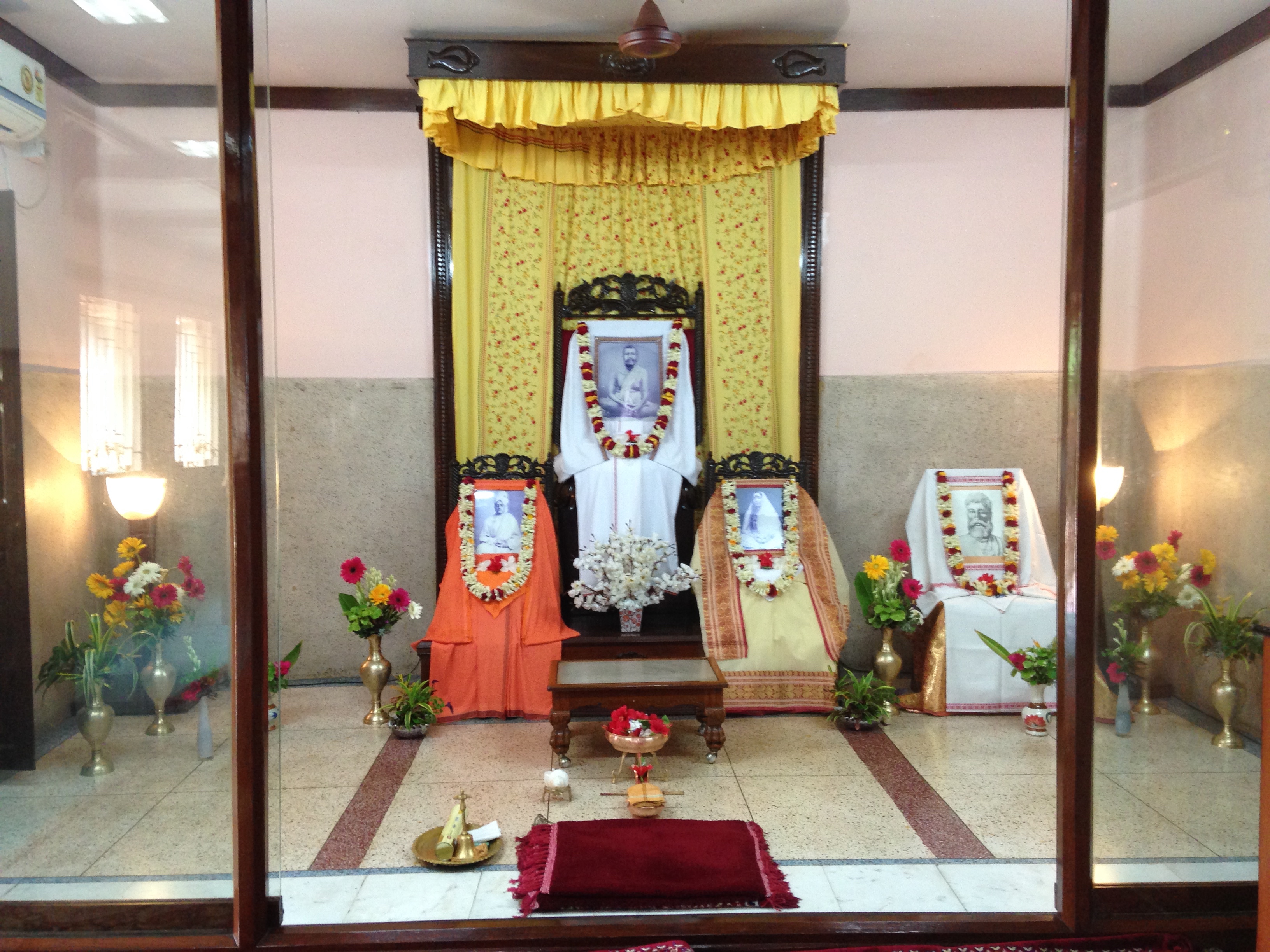
Dwarka

After a brief stay in Porbandar reached Dwaraka, holy with innumerable memories and legends of Shri Krishna. But of its glories nothing remains at present. Now the ocean roars in tumult over the place where once the powerful Yadava lived and where once stood a great capital of which Shri Krishna was the reigning prince.

He sat on the shore and yearned ardently to fathom the contents of the future. Then rising as from a dream he went to Sharada Math (a monastery founded by Adi Shankaracharya) where he was assigned a room. There in the silence of his cell, he saw a great light – the resplendent future of India.

From Dwaraka Swamiji went to Bet Dwaraka (Island Dwarka) Mandvi etc.

An interesting chase

Akhandananda heard at Ahmedabad that Swamiji had gone to Wadhwan. At Wadhawan he heard that he had gone to Junagadh; at Junagadh he learnt that Swamiji had left for Dwaraka via Porbandar; at Dwaraka that he had left for Bet Dwaraka; at Bet Dwaraka that at the invitation of the Maharaja of Kutch he had gone to Mandavi; at Mandavi that accompanied by a party of body guards he had gone to Narayan Sarovar, which was eighty miles away.

Swami Akhandananda was warned at Mandavi that the road to Narayan Sarovar was infested with dacoits. But heedless of danger he sped on. On the way he was beaten and robbed by dacoits. At Narayan Sarovar he learnt that the journey to the place, which might have cost him his life, had been fruitless for he was told that Swamiji had left for Mandavi via Ashapura. The road lay through desert wastes and was also infested with dacoits and it meant a journey for a hundred miles, yet he heroically marched on in spite of having fallen sick.

Swamiji was also astonished and no less glad to meet his beloved brother disciple but when he heard the story of his chasing him, he got worried that his brother – disciple would not leave him alone as he had come all the way at the risk of his life. He told Swami Akhandananda, “Look I have become a spoiled man, you leave me.” Swami Akhandananda replied, “what would it matter to me even if you had lost your character ? I love you, and that is not in any way affected by your good or bad character. But I do not wish to be in your way. I had a longing to see you, and now I am satisfied. Now you can go alone.” Swamiji was happy to hear this and next day left for Bhuj, which Swami Akhandananda reached a day later. Both of them then went back to Mandavi and halted for a fortnight. There Swamiji made many friends. From there Swamiji went to Porbandar. Swami Akhandananda joined him at Porbandar after about a week and after spending a few days at Porbandar he went to Jamnagar via Jetpur, Gondal, Rajkot and thus spent about a year in Kathiawad.

Porbandar

One evening while Swamiji was pacing on the roof of the palace of the Maharaja of Porbandar.  He suddenly saw his brother disciple Swami Trigunatitananda coming towards the palace with a group of sadhus. Swamiji was thrilled to see him.

In Porbandar, Swamiji came into contact with Pandit Shankar Pandurang (1840-1894) of Konkan. He was a Sanskrit scholar of eminence. After his return from England in 1874, he was appointed as Oriental Translator in Bombay Government as he was proficient in nine languages.

Swamiji visited Porbandar twice. According to Swami Shivananda, it was the large beautiful library of Panditji that had attracted Swamiji. During his earlier visit to Porbandar, Panditiji had requested him to stay as long as he liked at his place and utilize the library. Thus, Swamiji stayed for about four months.

During his long stay at Porbandar Swamiji became very intimate with Panditji and his family. He used to ride with Panditji on horseback to have a look at the distant villages. Being an artist of the cuisine he taught the wife of Panditji, Ushadevi, various delicious preparations. Two sons of Panditji – Madhav and Vaman played with him, learnt swimming from him and became great friends of Swamiji. Three daughters Tara, Kshama and Bhadra who were at first shy, received greater affection and blessings of Swamiji.

When Swamiji was at Porbandar, Pandit Shankar Pandurang was editing Sayanacharya’s commentary on the ‘Atharva Veda’. Struck with Swamiji’s scholarship, he often asked his help to explain some of the more abstruse passages which Swamiji did with his usual lucidity. Both kept at the work constantly, Swamiji becoming more and more engrossed in it as his perception of the greatness of Vedic thought grew still keener. Swamiji also finished reading of Panini’s ‘Mahabhasya’ at Porbandar. Swamiji told Swami Akhandananda that in the whole of India he had not seen Pandurang’s equal in Vedic learning. 37 Swamiji also learnt French at the instance of Panditiji who said, “It will be of great use to you Swamiji”. He wrote a letter in French to his brother – disciples at Alambazar and gave them a great surprise.

Pandit Shankar Pandurang told Swamiji,

I am afraid you cannot do much in this country. Few will appreciate you here. You ought to go to the West. Surely you can throw a great light on Western culture by preaching the Sanatana Dharma”.

Here, probably Swamiji heard for the first about the religious convention that was to be held sometime in the following year at Chicago.

Humour at Porbandar

Acharya Revashankar Anupram Dave who was a centenarian, used to go to Bhojeswar Bungalow to meet Swamiji with his friend Madhav, while he was himself 18 years of age. Giving his memories of those days he said that one day the students of Sanskrit school were brought to Swamiji who talked to them mostly in Hindi, but at times Bengali and Sanskrit words used to creep in. One of the students Govindaji replied to Swamiji, “I went to Varanasi and have studied the ‘Sama-veda’. I have learnt six Mantras (Shastras ?)” Then Swamiji asked, “Why did you not study further?” Govindaji replied, “I happened to have Karela so I had to come back.” On hearing the word ‘Karela’, Swamiji had a hearty laugh. ‘Karela’ means bitter gourd, but the boy had meant that he had an attack of cholera.

Palitana

From Porbandar Swamiji came to Junagadh and then started for Palitana – a city of temples many of which date back to the eleventh century.  High up on Shatrunjaya mountain sacred to the Jains, is a temple dedicated to Hanuman and a shrine dedicated to Hengar, a Muslim saint. Swamiji climbed to the top of the mountain to enjoy the view that is magnificent.

At Palitana Swamiji drew the attention of people because of his mastery of singing and playing on instruments.

Nadiad

From Palitana Swamiji started for Baroda. On his way he met his friends Shri Haridas Viharidas Desai, Shri Chhaganlal Pandya and Shri Manasukhram Tripathi. He also met Shri Manilal Nabhubhai Dwivedi, the well-known Gujarati writer. Dwivediji’s life (1858-1898) was spent in writing many books in Gujarati, English and Sanskrit including ‘Immitation of Shankara’, ‘Rajayoga’, ‘Siddhanta Sar’, ‘Bhagavad Gita’ etc. He could not go to Chicago Parliament of Religions but his paper was read out there. Dwivediji was one of the pioneers in spreading Advaita Vedanta in Gujarat. Hence Swamiji must have enjoyed his company at Nadiad by holding discussions on Vedanta.

Baroda

From Nadiad, Swamiji came finally to Baroda before leaving Gujarat, with a letter of introduction from Diwanji Saheb addressed to his intimate friend Shri Manibhai J. Diwan of Baroda, who was a man of piety and noble character. Shri Manibhai J. had received the title of Diwan Bahadur from the Government of India along with a medal and gift of Rs. 75,000 while he was the Diwan of Kutch. In Kutch he introduced great and beneficial reform in all departments – collection of revenue, education, sanitation etc.

At Baroda Diwan Shri Manibhai worked hard and there was spectacular progress in the field of education. Swamiji spent sometime with him in discussing about the education system of the State. Swamiji wrote from Baroda on 26th April, 1892 to Diwanji Saheb of Junagadh “I had not the least difficulty in reaching your house from the station of Nadiad. And your brothers, they are what they should be, your brothers. May the Lord shower his choicest blessings on your family. I have never found such a glorious one in all my travels. Your friend Mr. Manibhai has provided every comfort for me but as to his company, I have only seen him twice, once for a minute, the other time for 10 minutes at the most when he talked about the system of education here. Of course, I have seen the library and the pictures by Ravi Varma and that is about all seeable here. So I am going off this evening to Bombay.”

Curiously enough, there is no mention in the above letter about Swamiji’s meeting with Maharaja Sayajirao Gaekwad. Swamiji had told Prince Martand Varma at Trivandrum that “of all the ruling princes he had met, he had been most impressed with the capacity, patriotism, energy and foresight of H.H. the Gaekwad of Baroda.” 40 Swamiji was also perhaps impressed with the Maharani of Gaekwad because he wrote on 17.2.1901 to Miss Macleod from Belur Math “I hope you will go to Baroda and see Maharani” However, the State records reveal that Maharaja was not in Baroda at the time of Swamiji. He had gone to place called Lonavali (Lonavala ?) In all probability Swamiji met him while he was in Mahabaleshwar or Poona. After his return from the West, Swamiji wanted to visit Baroda and meet the Maharaja but it did not materialize.

Most likely, on 26th April, 1892 Swamiji left Gujarat and proceeded to Bombay and thus ended his historical tour of Gujarat.

For the full article see: http://www.rkmvadodara.com/svinguj.htm

International Youth Conference at Vadodara, Gujarat, India

Ramakrishna Mission Vivekananda Memorial at Vadodara is holding an International Youth Convention on August 10th and 11th, 2013 as a part of its celebration of Swami Vivekananda’s 150th Birth Anniversary.  For more information check the link:    http://www.rkmvadodara.com/

I am joining with Vivekananda Vidyapith’s 27 Youth Delegates, 30 Vidyapith’s teachers and parents and 9 children to participate in this convention.  Also, 54 of these participants are going to visit places in Saurashtra which are associated with Swami Vivekananda and Mahatma Gandhi.

For more news about this convention keep checking this blog.

Recognition of Service

Vivekananda Vidyapith Honored by the Passaic County Board of Chosen Freeholders, New Jersey, USA

As a part of Passaic County’s celebration of Asian Pacific American History month, Vivekananda Vidyapith was one of two honorees chosen for outstanding contributions made to the U.S. and the community. Sponsored by the Passaic County Board of Chosen Freeholders (“PCBCF”), the event was held on Tuesday, May 28, 2013, 5:30 p.m. to 6:30 p.m. at the Administration Office in Paterson, New Jersey.

Mr. John W. Bartlett, a Wayne Freeholder, applauded Vidyapith for its dedication to teaching Indian philosophy and great human values to students, and the positive influence it has had on the community at large. Then, Mr. Pasquale “Pat” Lepore, the former Mayor of West Paterson (now Woodland Park) read the proclamation and publicly recognized Vidyapith’s contribution. Thereby, Mr. Bartlett congratulated Dr. Mahendra Jani and Dr. Vandana Jani, co-founders and pioneers of Vivekananda Vidyapith, by presenting them with a beautifully framed plaque and wishing them continued success.

The following are few pictures of the event

GivingTalk
Talk on Swami Vivekananda

ProclamationMay28Y2013
Proclamation