Shiva Mahimna Stotra
Shloka 15

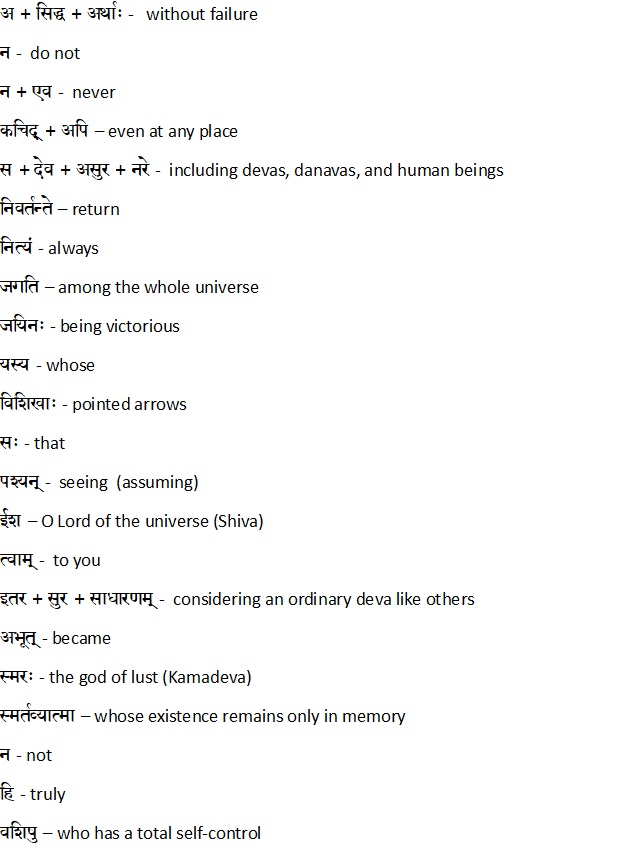

Meaning: O Lord of the Universe (Shiva)! Kamadeva, the god of lust, whose pointed arrows never return with failures in the whole universe which includes Devas, Danavas, and human beings, became just a memory because he considered you as an ordinary Deva like others. Truly, it is not beneficial to disrespect a person who has total self-control.
Reflections: In this shloka, Shri Pushpadanta refers to a story from the scriptures. Let us look into this story.
The Story in the Scriptures:
Whenever anyone does intense austerity, Indra, the king of the gods or Devas, always worries that this person may take away his throne and his kingdom. So, he finds various ways to disrupt his/her austerity. For him, one of the sure ways is to send Kamadeva, the god of lust, to deviate the minds of the person. Most of the time he is successful.
Indra has a reason to do this because the Daityas or Danavas being the eternal enemies of the Devas had performed the austerity in the past and were successful in driving out Indra and the Devas from their kingdom and had harassed them.
According to the Puranas, Kashyapa was the grandson of Brahma. He married the daughters of Daksha. One of them was Diti. One group of sons of Diti and Kashyapa were known as Daityas or Danavas and they were always in fight with the Devas.
One of the Kashyapa and Diti’s sons, Vajranga, didn’t want to fight with the Devas and wanted to live a spiritual peaceful life. He was living such a Sattvika life. He got married to Varangi. They had a son named Taraka. Varangi wanted their son Taraka to be the strongest person in the world, to take away the kingdom of Indra and the Devas, and to harass them. Taraka did lots of severe austerities and pleased Lord Brahma. When Brahma said that he was pleased and that Taraka could ask for any boon, Taraka asked that he be the strongest person in the world, and that he could not be killed by anyone except the son of Lord Shiva. Taraka knew that Lord Shiva was always merged in Samadhi, and he was not going to have a son.
With the power of that boon, he conquered all three worlds, snatched away the kingdom of Indra and the Devas, and started harassing them. No one could defeat him and definitely no one can kill him. With this success and power, his demonic qualities dominated his mind and forced him to do harmful things. He then became known as Tarakasura, the Demonic Taraka. Harassed Devas went to Brahma and asked him to find a way to stop Tarakasura’s tortures. Brahma said that he was helpless. He has given a boon to Tarakasura and only Lord Shiva’s son can kill him. Devas told him that Lord Shiva mostly remains in Samadhi and He is not interested in marrying. Brahma told Indra and other Devas to go to Kamadeva, the god of lust, and ask him to bring Lord Shiva’s mind to the world and make him think of getting married. Indra called Kamadeva and asked him to do the same.
Kamadeva went with pride to do his job. He was very confident about his powerful arrows which have never returned without success. He went with his friend Spring where Lord Shiva was meditating. Both of them created a very lustful environment around Lord Shiva. Finding that nothing is bringing Lord Shiva’s mind down, Kamadeva finally shoots his powerful arrows at Lord Shiva. That broke Lord Shiva’s meditation. He opened his eyes, and felt the lustful environment, but immediately realized that this was the work of Kamadeva. He opened his third eye of Knowledge. From that came a fire of discrimination and it burnt Kamadeva.
Reflections continue: Shri Pushpadanta is referring to this story of the scriptures in this shloka and describes the state of Lord Shiva’s mind and His power. Afterwards, Kamadeva’s wife Rati, Indra, Devas, Brahma, and Vishnu came to Lord Shiva and requested him to help out humanity by getting married. They said that Parvati, the daughter of Himalaya, was performing austerities to marry him.
Lord Shiva said to them that he had burnt Kamadeva to set up an example to the Devas and spiritual seekers not to yield to the lust. He said that lust and anger are the doors to hell. They don’t let the mind rise beyond the body and mind and they drag it to the lowest level which is filled with vices. If they want to make spiritual progress and attain the highest blissful state ‘Samadhi’, they have to control lust and anger.
We find this thought in the Bhagavad Gita. When Arjuna asked, “Under what compulsion does a person commit sin?” Then Shri Krishna replied,

“Know that the lust and anger, created by Rajas, are our enemies. They are all-devouring and are the cause of all sin.” Bhagavad Gita (3.37)
Lord Shiva said that he is blissful within and sees no need to get married, but to help out humanity and was pleased by the devotees’ prayers, he will marry Parvati. Later, their son Kartikeya killed Tarakasura and brought peace to the world.
Lord Shiva also set up an example as a householder. He didn’t keep many belongings and remained in a meditative state when He was alone, and when He was with Mother Parvati, they both enjoyed spiritual discourses.
Less than one percent of humanity renounces the world to realize God and to serve all. Most of the ninety-nine percent of people remain in the world. Among them, those who like to realize God, have to struggle hard. Sri Ramakrishna said that householders also can realize God, but it is hard for them. Day and night they are surrounded by an environment that is filled with lust and greed. Every now and then, they have to go into solitude, away from this environment, and think about what is permanent and what is not permanent. By reflection, they should realize that God or Brahman is the Ultimate Reality, and this world is for a few days. After one or two children, husband and wife should help each other in their spiritual path and live like brother and sister. Householders should earn money honestly and live a simple life. They have to develop detachment and offer all the results to God. The path of detachment has been described in the Bhagavad Gita. Sri Ramakrishna said that ‘Holy Company’ also helps to withdraw minds from worldly thoughts and focus on God.
Another lesson we learn from this shloka is ‘not to disrespect any person, in particular, one who has total self-control’. Saints and spiritual seekers practice having total self-control. One sign of sainthood is to have total self-control. By being disrespectful to the Saints, we actually harm ourselves. Nothing happens to the Saints. Kamadeva considered Lord Shiva as an ordinary person and with his pride he was disrespectful to Him by shooting arrows at Him. As a result, he was burnt to death. Shri Pushpadanta uses proper poetic phrases saying that Kamadeva, whose other name is ‘Smara” (one who exists in memory) became ‘Smartavyatma’ and became a subject of memory.
 mahendrajani
Beautiful stories packed with moral lessons for life throughout the hymn. It gives a glimpse of how deep Pushpdant’s knowledge must be!
You nicely connected to Bhagavad Gita and Thakur’s teachings. This reminded me of Ch. 16 where Sri Krishna beautifully explains Divine and Demonic qualities, especially how demonic people think and behave.
One most important lesson in this I found is every person is born with his or her sanskara, parents can help to bring them out, blossom but can lead in wrong direction as well if not careful.
Loved the poetic connection of Smara and Smaratvyatma. Which again highlight proficiency of the poet.
Thanks again to do this pains taking project. I am sure you are enjoying it.
Thank you Mallika for reading these posts and taking time out to write your detailed comments. I really like it.
One more thought just came to mind. Lord Shiv is always ready to help humanity. Previous shloka he is helping by drinking poison to save the universe and here he accepts to get married to help though he is not interested in life of a house holder.
Lord Shiva’s form is serene and auspicious. He is always ready to help.
Very nice , I like both two lesson given in this shlok 15. Deep Understanding Required for this type of knowledge sharing . Thanks
I am very happy to know that you liked these two lessons of shloka 15. Thanks for sharing your thoughts. Soon I will be posting the next shloka.