The Universe cannot completely hide Brahman
Shloka 32
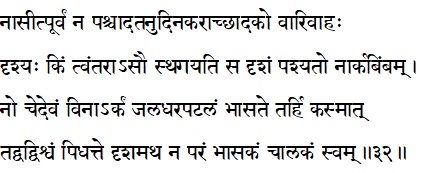
Meaning:
The cloud that covers the huge sun did not exist at one point and will not exist after some time. But, on a cloudy day, it covers the sun. Does the cloud really cover the sun? The answer is ‘No’. If the cloud really covers the sun, then we cannot see the cloud itself and anything else. The cloud apparently covers the sun partially from the sight of a few spectators. Similarly, this universe did not exist at some time and will not exist after some time, but due to Maya, it will not let people see the Brahman who is its illuminator and the controller.
Reflections:
It is fascinating that the cloud which is created by the sun covers the sun itself temporarily and partially.
Maya is the power of Brahman.
Sri Ramakrishna used to cover his face with a cloth and ask his disciples ‘Do you see me now?’ All will say, ‘no’. Then, he would take away the cloth and ask again, ‘Do you see me now?’ They will say, ‘yes’. Sri Ramakrishna thus taught his disciples that we don’t see Brahman when it is covered by Maya. When Maya goes away, we realize that ‘Everything is Brahman and the names and forms were illusory.’
The truth is that Brahman is the Ultimate Reality and by Its own power (Maya) It appears as the universe with names and forms.
How do we know that?
We do not see Brahman. We see only names and forms. How do we know that Brahman exists? One answer is that ‘we cannot deny the existence of something that we cannot see’. Sri Ramakrishna said that in the daytime we do not see the stars. In that case, we cannot say that stars do not exist because we don’t see them. Many things exist that we do not see or perceive. For example, there are many TV waves, Radio-waves, and other waves floating around us that we cannot perceive through our senses. If we get a TV or a radio and tune in with the proper frequencies, then we can perceive what they are transmitting. There are many small germs like viruses and others floating around us, whom we do not perceive, but they do exist and they make us sick.
Similarly, behind our body and mind, there is a Reality (our True Identity or Existence) that we cannot perceive through our senses, but the Seers (Rishis) realize It through reflection and contemplation. The Vedanta Seers call It by the name ‘Atman’. This Atman is appearing as our body and mind like a wave in the ocean. The water of the wave is not different from the water of the ocean. The body and mind keep changing, but Atman remains the same as a witness consciousness. In the background of the unchanging Atman, we can perceive all the changes of the body and mind.
What is in the micro is the same in the macro. The way the Atman is the Ultimate Reality behind our body and mind, Brahman is the Ultimate Reality behind this universe. Brahman is like an ocean of Consciousness and all the names and forms of the universe are like waves of this ocean that rise and fall and merge into the ocean again. Rishis say that Atman and Brahman are the same. With reference to an individual, we call Brahman as Atman.
What covers the Atman?
Whatever attaches our mind to our body covers the Atman. Sri Ramakrishna said that lust and greed are the two main forces that tie our mind to the body. There are also other worldly desires and attachments that tie our mind with the body.
We allow this bondage with our bodies because we think that it is the only way we get happiness by fulfilling our worldly desires. Little that we know that (i) all the happiness in the world is the reflection of the Bliss of the Atman, and (ii) this so-called short-term happiness brings miseries and the delusion which causes all our troubles.
What are the ways to realize the Atman?
The four yogas (Jnana Yoga, Karma Yoga, Bhakti Yoga, and Raja Yoga) are the paths to realizing the Atman.
(i) Jnana Yoga: First, we listen and learn about the nature of the Atman from the scriptures and from the people who have realized It or have been sincerely practicing to realize It. Second, we reflect upon what we have heard and learned about Atman. Through proper reasoning, we convince ourselves fully that our true identity is Atman which is unchanging and everything else including our body and mind is constantly changing and is temporary. Third, with the proper understanding, we realize or experience that our true identity is Atman. When we realize the Atman, all the characteristics of a ‘Jiven Mukta’ (Free Soul), which have been described in the scriptures, naturally manifest through our thoughts, speech, and actions.
(ii) Karma Yoga: We purify our mind by performing all our responsibilities in a detached way as prescribed in the Bhagavad Gita. Such a mind experiences that the three Gunas, Sattva, Rajas, and Tamas, are performing all the actions through our body and mind, and the Atman (our True Self) is only a witness consciousness. Thus, by going beyond the three Gunas, we realize the Atman.
Performing all the actions as an offering to God makes us unselfish and free from all worldly desires. Thus, we become only aware of the presence of God which is a symbol of the infinite Brahman. In the process, when our ego diminishes completely, then we realize that the Atman and Brahman are one. Performing unselfish activities or services also expands our ‘little ego’ to a much larger ego enveloping the whole universe. Thus, we develop an awareness of Brahman.
(iii) Bhakti Yoga: We love a form of God who is a symbol of Brahman and offer our worship. We sing the glories of God and offer the results of all our actions to God. With our unselfish love for God, we feel the constant presence of God in our minds and around us. We feel that God has become everything and God is the doer of everything. Finally, out of love, our mind merges with God and we realize that God and Brahman are the same.
(iv) Raja Yoga: We learn how to control our mind and the senses with various disciplines. Then, we learn how to focus our mind on the Atman residing within and we realize It and experience Its presence all the time.
What are the benefits of knowing Atman or Brahman?
(1) Meaningful life: Our life becomes meaningful as it finds a purpose to realize our true identity. Otherwise, just having one body, one mind, and one life seems purposeless.
(2) When we realize that our true identity is Atman, which is immortal, unchanging, and Its nature is Existence-Knowledge- Bliss Absolute, we have the following benefits:
(i) Fearlessness: We become fearless. The fear of all fears is the fear of death. Since we are Atman, we are immortal. This atman can take many bodies and minds.
(ii) Hope: Knowing that the existing life is not the only one we have, there is hope for everyone to improve. At any stage of life, if we recognize that we had made a mistake, we can turn around and correct the mistake and go on the right path of God-realization. We must remember that God-realization is the same as the realization of the Atman. We try to attain God-realization in this life, but if we cannot attain it, then there is always the next life to move on to.
(iii) Infinite Power and Knowledge: When we know that our true identity is Atman, we acquire infinite power compared to the power of the limited body and mind. All saints and sages have done great work for the good of humanity due to this inner power. Also, we acquire an unbelievably deeper understanding of people’s minds, situations, and the universe. This is how those who have realized Atman help remove the sufferings of people and guide them to the right path.
(iv) Love for all: Knowing that One Brahman is manifesting through all the names and forms, we connect ourselves with everyone in the universe. This brings a love for all disregarding outer differences. However, we have to use our common sense. Sri Ramakrishna says that all are manifestations of God, but we have to use our common sense and not embrace a tiger. But, we cherish no hatred for the tiger or anyone in the universe. We remember that Brahman is manifesting through the mindset of a person. If the mindset changes, then Brahman will manifest in Its full glory.
(iv) Peace, Bliss, and Fulfilment: Bahman is the embodiment of divine bliss. Realizing that our true nature is blissful, we attain inner peace and bliss. Also, a sense of complete fulfillment comes.
In the Bhagavad Gita (6.21 & 22), Shri Krishna says, “By realizing Atman, one experiences the boundless joy which is beyond the comprehension of the senses. It can be grasped only through pure and subtle intellect. Once established in the realization of the Atman, one never deviates from this state of Reality. One finds that there is nothing higher remains to be achieved in life and one does not deviate from this state even in the heaviest sorrows.”
Describing the state of a person who has realized the Atman, Shri Krishna says in the Bhagavad Gita (2.70), “Just like the waters of rivers enter into an ocean and get absorbed in it without disturbing the ocean which is filled with water to its brim, similarly all the desires that enter in the mind of the realized person get absorb in it without creating any ripple in it.” Briefly, it means that the mind of the realized person remains calm under all circumstances.
The Ultimate Truth:
When we realize the Ultimate Truth, then we see that Brahman, with Its own power Maya, creates this universe, preserves it, and dissolves it into Itself. It is like a movie starts on a screen; it develops its story and then disappears in the screen. Similarly, just like the screen, Brahman is the only Reality. The names, forms, and various situations are created in Brahman by Its own power, called Maya.
 mahendrajani
Namaste Uncle!! Thank you for writing this blog post!! It’s super helpful!! The explanations of how we can practice the four yogas, and the benefits of knowing Atman/Brahman, are clear and inspiring!
Dear Kanna: Thank you for your comments. I am very happy that you read the post and found it very helpful. The shloka has a wonderful message.
It is truly amazing article. One question- how do you stay motivated, without any excitement? For example..one knows that, they are going to Niagara Falls. It gets excitement, which converts into physiological changes. Any guidance is helpful
Dear Nayanbhai: You asked a very thoughtful and subtle question. Briefly, I can say this: Motivation is related to a higher goal in life. Motivation comes when we understand the purpose and the importance of our goal. When we work hard to achieve our goal and we see some success then excitement comes. For example if people had worked hard to send a spacecraft on the moon and it goes near the moon or lands on the moon then excitement comes. If at the last minute the project fails, then excitement may turn into depression. But, if there is a motivation and determination for the project, then one corrects one’s mistakes and tries again. In general, excitement is connected with the pleasures of the senses or the fulfilment of the desires. It is okay if excitement comes, but it should not throw us overboard. We have to understand that this excitement is for a temporary pleasure and it is short lived or it may bring misery to us. I hope this partly answers your question. Thank you for asking.