“Shatashloki” of Shri Shankaracharya – XIII (Shlokas – 17 and 18)
Renunciation of attachment and desires
The following shloka is for the person who wants to dedicate one’s life completely for God-realization (Self-realization) and service to humanity. First, one has to sever all external attachments with family and friends; second, one has to live with minimum without demanding much from the society; and third, one has to give up complete attachment with one’s body and mind and focus on God or one’s own divine Self.

Meaning: Just as a snake discards one’s skin and moves away, the aspirant seeking God alone in life should leave home and free oneself from the attachment to family and possessions. Just as a traveler resorts to the shade of the trees for a short rest and proceeds on the road, the aspirant may remain in the body and try to maintain it with minimum necessities. Such an aspirant may eat fruits fallen from the trees or receives necessary food from the society to satisfy one’s hunger. In order to realize Self (God), the aspirant should focus his/her mind on Self (God) and completely give up identification with one’s body and mind.
Comments: Clearly, this shloka is for those who have an intense desire to realize God and are ready to do anything to achieve that goal. We see that such a group of people is about 1% of the human population. It is amazing that in the midst of the world which offers various kinds of sense-pleasures, there are people who do not want any of this pleasure and they want to realize God. The following teaching of the Bhagavad Gita explains these rare phenomena.
At the end of the sixth chapter of the Bhagavad Gita (6.37-39), Arjuna asks Shri Krishna, ‘what happens to a Yogi who is endowed with faith, but did not realize Self (God) before death? Would that Yogi be perished like a riven cloud?’ Shri Krishna said that such a Yogi does not get destroyed in this life or the next life. No bad thing happens to the person who had done any spiritual practices. After death, such a Yogi takes birth in a pure and prosperous family or the family of yogis rich in wisdom. There, the Yogi gets opportunity to connect with his/her spiritual knowledge acquired in the previous birth and continue to strive to realize the Self (God).’
What happens to the other 99% of the population? Vedanta says that each individual is ultimately going to realize one’s own true divine identity, called the Self (God). The purpose of the world is to make each individual attain that goal; only thing is that 99% of the people have to reach that goal going through detours. These detours could be shorter or longer. 99% of the people have to satisfy their worldly desires before they realize that ‘the goal of human life is to realize this Self and not to go on running after the worldly pleasures’. The worldly pleasures promise infinite happiness, but they only provide limited happiness along with lots of miseries and worries. Even the satisfaction of a worldly desire increases lots of greed to acquire more and makes life miserable.
Can a householder realize Self (God)? Sri Ramakrishna says that a householder can certainly realize God. But, every now and then, the householder has to go in solitude and reflect upon what is Real and what is Unreal. He/she has to realize that Self (Brahman or God) is only Real and everything else is unreal or temporary. Sri Ramakrishna told that King Janaka had realized Brahman, but he did lots of intense spiritual practices before. A householder also has to do lots of spiritual practices and perform one’s responsibilities in a detached manner prescribed by the Bhagavad Gita.
A Sadhu, one who has renounced everything to realize God, gives up everything externally and mentally. A householder has to renounce everything mentally. Sri Ramakrishna says that ignorance is ‘Me and Mine’ and “I am a doer’. One has to think that ‘everything belongs to God’; God has created everything, God preserves, and God dissolves. Even our body is not ours. We do not have total control on our body. We cannot control our heart, digestive system, and many other body’s functions. Thank God that we do not have control on it, otherwise we will mess it up. Similarly, we do not have control on our family members, friends, the world, and the circumstances. Things happen by some higher power, which we call God. We are just the instruments in the hands of God. A householder can mentally change this attitude from ‘Me and Mine’ to ‘Thee and Thine’ and realizing that ‘God is the ultimate doer of everything’, and work as a God’s instrument. This is householder’s renunciation.
Many people enjoy taking name of God, singing dhoons, bhajans, and hymns and listening to the spiritual discourses, but when the word ‘renunciation’ comes, they get turned off. They love their worldly pleasures and do not see anything wrong in enjoying them. They think why we cannot do both: enjoy the worldly pleasures and sing God’s name or listen to spiritual discourses? They are only touching the ocean of the spirituality and may be occasionally swimming on the bank a little bit. When they realize that the worldly pleasures cannot give them what they were looking for, namely the Infinite Bliss, the Ultimate Knowledge, and Fearlessness (especially the Victory over the fear of Death), they go deeper into the spiritual practices leaving the world aside.
We have to remember how many sacrifices a person makes to achieve any worldly achievement. To acquire money, or power, or position, or a title, one gives up comforts, food, sleep, family-friend-time, and many worldly pleasures. Then, to achieve the highest thing a human being can achieve, namely, the realization of God, it is not surprising that we need to take our mind off from all the distractions of the world and fully focus it on the Self.
The positive attitude of Vedanta:
Without knowing the complete message of Vedanta, people get turned off by the word ‘renunciation’. Renunciation is giving up the wrong or faulty ideas and replaces them with the right ideas or the ‘ultimate Truth’. Sri Ramakrishna gave an excellent example. A person wants to go to the terrace of a building by climbing up on a staircase. He/she goes on the first step and asks, ‘Is this the terrace?’ and then denies it knowing that ‘it is not the terrace’. Thus, he/she denies all the steps and reaches to the terrace. After reaching the terrace, the person realizes that the steps are made out of the same material that the terrace is made of. Meaning, a person initially denies that my body, mind, vital forces, intellect, joy, family, friends and the world is Brahman (Atman or Self), and then by realizing the Self (Atman or Brahman), finds that everything is Brahman. Endowed with the limited physical characteristics (Upadhis), Brahman appears as material like body, mind and other things, but ultimately everything is Brahman. This is the highest knowledge.
Desire, anger, and greed:
The following shloka describes how the three major enemies of a person, namely, the worldly desire, anger, and greed, arise in the mind.
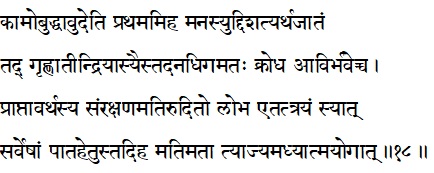
Meaning: At first, desire for sense objects arises in the mind of human beings. Then, the mind craves and makes efforts to acquire these sense objects. After acquiring the sense objects the mind enjoys them through senses. When the mind cannot acquire these objects, then anger rises. For the acquired sense objects, the mind wants to protect them. Thus, greed arises in the mind. These three (desire, anger, and greed) are the cause of human being’s spiritual downfall. A wise person should focus one’s mind on the Self and the ways to realize It and stay away from the chain of desire, anger, and greed.
Comments:
It is very natural that the mind seeks joy in the worldly objects. Since these worldly objects satisfy the cravings of the senses, the senses drag the mind outside in the world. According to the Vedanta, this is the play of the Maya, the power of Brahman.
Why senses run outside?
In the following shloka of the Kathopanishad, Lord Yama explains this play of the Maya:
Kathopanishad (2.1.1):

Meaning: The self-existent Supreme Lord delude the senses (destroy their super-power) by creating them with the outgoing tendencies. Therefore, a human being looks only outside and not the inner Self. A wise person, seeking the Immortality and Bliss, turn his/her senses introvert to realize one’s own inner Self.
Hide-and-seek game:
Sri Ramakrishna talks about a children’s play, called hide-and-seek. In that game a grandma sits on a chair in the middle of an open area of a house. One child, called a leader, begins the game by facing his/her face towards a wall covering sides of his/her eyes with palms and counts 10. During this time, all other children hide in the various corners of the house. After counting 10, the leader tries to find another child and touch the child to make him/her ‘out (caught)’. If the child, who was found out, runs faster than the leader and touches the grandma, then he/she will be considered ‘saved’ and ‘not out’ (not caught). The one who gets ‘out’ becomes the next leader and the game goes on. The fun of the game is (1) to find places to hide, and (2) if found out by the leader, then to run around and somehow touch the grandma before getting caught.
Sri Ramakrishna used to say that in the beginning of the game if all go and touch the grandma, then the fun part of the chasing and screaming of the children of the game will be missed. The grandma enjoys the running around of the children and their joyful noises when they run. Thus, the world is a play of Maya. Touching the grandma is getting liberated. Maya does not want all get liberated, so the worldly game goes on.
Usual complain:
By listening to this hide-and-seek game and the play of the Maya, usually a thought comes to the mind, ‘well, it might be fun for the Maya, but we suffer in the world and the Maya is having a good time at our cost.’
The Vedanta’s answer is that ‘Everything is Brahman. Out of ignorance a person separates oneself from the Brahman, creates a small self with body and mind (called ego) and enjoys as well as suffers.’ After much spiritual practices, by Brahman’s (God’s) grace, one realizes this Ultimate Reality, and goes beyond the pairs of opposites like pleasure and pain. Many don’t like this answer of the Vedanta. But, when we go deeper and reflect upon the Ultimate Reality, we understand the significance of the real answer. All other answers do not stand the reasoning.
Now, as long as we have ‘ego’ and we consider ourselves as different from Brahman (Existence-Knowledge-Bliss Absolute), we have to do spiritual practices and follow the guidelines provided by the scriptures in order to realize the Ultimate Reality (or Truth).
Many wise people have realized that all other worldly answers and efforts are like “Band-Aids” and do not solve the real problem.
A few teachings of Bhagavad Gita:
This Shatashloki’s shloka directly reflects the teachings of the Bhagavad Gita. The following shloka of the Bhagavad Gita tells us how harmful desire, anger, and greed are.
Gita (16.21)

Meaning: Desire (especially lust), anger, and greed are the three doors to hell (the lowest state of consciousness in the relative world). These three destroy the self. Therefore, a person should get rid of them from one’s mind.
It is NOT easy to get rid of desire, anger, and greed. First, we have to understand how harmful they are. When a person finds out that there is a poisonous snake in the house, then that person will be eager to get rid of this snake as soon as possible. Legitimate desires are okay. But, illegitimate and harmful desires which bring ruin to a person and make a person slave have to be renounced. Second, we have to regularly do spiritual practices. By spiritual practice, we understand what is going on in our mind and we can separate good and helpful desires from the bad and harmful desires. Third, we have to have ‘holy company’; company of people who have renounced these three things or even trying to renounce them. Holy company also includes inspiring books, and audio-video lectures. Fourth, we have to avoid the company of those who encourage us for worldly desires, anger, and greed. If we cannot avoid such people, we have to be careful not to have their influence on our mind.
A person with steady intellect:
At the end of the chapter-2 of the Bhagavad Gita, Arjuna asked Shri Krishna, ‘What are the characteristics of a person with steady intellect who has merged in the Samadhi (meaning has attained the Highest Knowledge)’. The very first characteristic presented by Shri Krishna is most appropriate here.
Gita (2.55)

Meaning: O Partha (Arjuna)! When a person casts off all the desires of the mind and is fully satisfied by dwelling on the Self alone, then that person is called ‘a person with steady intellect’.
Can we get rid of all desires?
The answer is ‘NO’. As long as a person is alive, he/she will have a desire to maintain the body by providing it food and other necessities. Then, why Shri Krishna said that the person has cast-off all the desires? I will just share my thoughts on this.
We see from the lives of all the people who had attained the highest knowledge that at one point in their lives, each one of them had only one intense desire left, namely, to attain the highest knowledge. They had lost interest in all other desires including the desire to keep the body alive. During the spiritual practices, at one point Sri Ramakrishna’s mind was filled with only one desire, ‘I want to realize God’. The mind was not available to think even for the food. A sadhu used to put food in his mouth and with a stick used to push it inside. That is how he survived during his intense spiritual practices. Such lives show the validity of Shri Krishna’s words that a person has casts off all the desires.
As long as we have many other desires, we cannot realize God. Sri Ramakrishna used to say that in order to pass a thread through an eye of a needle, all the fibers of the thread should be combined and make it one-pointed. Even if a small fiber is sticking out, the thread cannot go through the eye of a needle. When the desire to realize God becomes intense, the other desires fade out. Even when one enjoys doing spiritual practices regularly, the harmful and useless desires slowly drop off because they become hindrance. When such desires drop off, one feels peace within.
Sri Ramakrishna gave another example of a child. As long as a child is busy playing with toys, the mother takes care of the housework. If a child gets bored with one toy and screams “Maa”, the mother knows from the scream that the child is still interested in playing with more toys. Finally, when the child really gets bored playing with the toys and there is only one desire left, namely, ‘I want my mother’, then the real scream comes. The mother knows this scream and she comes running to the child.
After God-realization, God keeps desires in the minds of the Saints and Sages to maintain their bodies in order to guide humanity in the spiritual path and enjoy taking name of God.
The following shlokas, Bhagavad Gita (2.62-63), tell us how desire, anger, and greed bring our destruction.

Meaning: When a person dwells on the worldly objects, he/she feels an attraction for them. This attachment gives rise desire to acquire these objects. When one does not acquire them, then that breeds anger.
From anger comes delusion (lack of clarity in the mind); from delusion, the failure of memory (of all good things one had heard), the ruin of discrimination (between what is right and what is wrong); and from the ruin of discrimination the destruction of the person.
I will conclude with another two shlokas of the Bhagavad Gita (2.67-68) which tell us why we should control our senses.
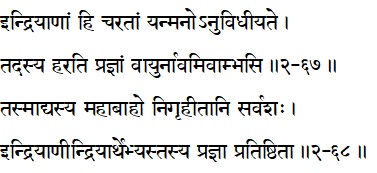
Meaning: For even one of the roving senses, if the mind yields to it, carries away discrimination as a gale carries away a ship on the waters.
Therefore, O mighty Arjuna, his wisdom is steady whose senses are completely restrained from their objects.
 mahendrajani
Appreciate your Shatashloki vyakhyan. Hope you complete all the 101.
A better idea may be to post on YouTube . Depends on you sir.
Thanks.
Thank you for your encouraging comments. I am very happy to know that you liked Shatashloki. Most of the Vedanta ideas are in these shlokas with amazing analogies. We can see the brilliance of Shri Shankaracharya. He had brought out the deeper concepts and thoughts of the Vedanta in a poetic form. I am more encouraged to complete all the shlokas. YouTube is usually good for music and video lectures. Thanks for your suggestion.