“Shatashloki” of Shri Shankaracharya – XI (Shlokas – 12 & 13)
How the seekers of God live in the world?
According to the Vedanta Philosophy, the goal of a spiritual seeker (or an aspirant for liberation) can be expressed in various ways. The following is a list of a few of these expressions:
(1) To attain the highest knowledge.
(2) To realize that one’s true identity is Atman,
(3) To realize God and to experience that God has become everything.
(4) To realize that ‘Brahman is the Ultimate Reality and Brahman is appearing as the universe’. For such a person three things become one; the knower, the object of knowledge, and the knowledge.
(5) To attain the state of ‘Sthita-prajna’, a person having steady intellect all the time.
(6) To attain a state of ‘Gunatita’, a state beyond the three Gunas, sattva, rajas, and tamas.
(7) To break all the bondages and be completely free.
(8) To attain a state of complete self-abnegation, meaning one constantly realize that everything belongs to God and I am an instrument of God.
A seeker of God always wants to know how one should live in the world while pursuing to achieve one’s spiritual goal. Shri Shankaracharya in the following two shlokas of Shatashloki gives a very clear guideline on how a spiritual seeker practicing Jnana Yoga (the Path of Knowledge) lives in the world.
Shloka – 12:
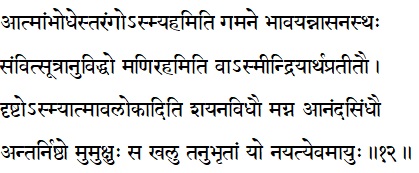
Meaning: An aspirant of liberation who has been established in the Atman (one’s true identity) residing within lives in the world in the following way:
(1) While engaged in the activities, looks upon oneself as a wave in the ocean of Brahman (Pure Consciousness),
(2) While sitting, thinks of oneself as a jewel strung on the thread of Brahman,
(3) While experiencing sense objects, sees all the objects as Brahman, and
(4) While sleeping, thinks of oneself immersed in the ocean of the bliss of Brahman.
Comments: While living in the world, an aspirant of liberation wants to keep his/her mind connected with Brahman (or God). This shloka gives us a very clear picture of how we can connect ourselves with Brahman in all our various states.
(1) When we are engaged in activities, we can think that we are the waves of the ocean of Brahman (Pure Consciousness). We are part of Brahman. The ocean is always active. The whole universe is active including the sun, the moon, the planets, the stars, the earth, and all beings. We can think that we are performing our responsibilities given to us by Brahman (God) and we can perform them only through the power of Brahman.
(2) When we are not active but awake, we can think that we are connected with all as the jewels of a necklace connected by a thread. This thread is the Atman or Brahman.
This reminds the message of the Bhagavad Gita (shloka 7.7): “O Dhananjaya (Arjuna), there is nothing higher than Me (Brahman). All are strung on Me as a row of gems on a thread.”
The Ultimate Knowledge is the Knowledge of Oneness. If we remove our names and forms we are all one. We are Pure Consciousness. The names and forms separate us from each other. Once we know the oneness behind all of us, all the negative things like fear, jealousy, hatred, greed, and others go away and our lives get filled with love and compassion for all.
(3) While enjoying the sense-objects, we can think that ‘everything is Brahman’.
Shri Krishna in the Bhagavad Gita (7.11) says, “I am the strength of the strong, free from longing and attachment. O Bharatarshabha (the Lord of the Bharatas – Arjuna), I am the desire in all beings that is not contrary to dharma.”
While fulfilling the legitimate desires, if we do not want to get bounded, then we have to be detached. A spiritual seeker has to develop a skill to enjoy legitimate desires without becoming a slave of the objects. For example, wise people say that ‘it is okay to drink tea or coffee, but make sure the tea or coffee does not drink you’. This means that we do not become slaves to the objects of the world. Everything we have to do in moderation and we have to have total control over ourselves. Therefore, in the above shloka, Shri Krishna used the words free from longing and attachment. To attain this state we have to learn to be detached and it is possible when we have total control over our mind and the senses. One way to be detached is to offer the results of all our actions to God. Through spiritual practices, holy company, reflections, and the grace of God, we acquire inner strength which helps us get such control and learn how to be detached.
(4) I have heard from Swami Adiswarananda that ‘a spiritual seeker who sincerely does spiritual practices and does not do anything wrong gets a good night’s sleep’. He/she has nothing to worry about. His/her conscience is very clear. In addition to this state of mind, if the spiritual seeker thinks while going to bed that ‘he/she is going to get immersed into the bliss of Brahman’, then that will be the best way to sleep and connect oneself with Brahman. Dreamless deep sleep gives us an idea of the blissful state of Samadhi, the highest state that a spiritual seeker can attain. In the dreamless deep sleep, our ego remains in a subtle form. This ego comes back as soon as we are out of deep sleep and then we become our formal self. But, in the Samadhi, one’s ego gets completely effaced and the person becomes free from all bondages and sufferings, and one experiences infinite bliss. Such a person’s ego remains like a line drawn on water.
Thus, in our daily activities, we can remain connected with our ultimate goal, Brahman.
The following shloka describes more ways to look at the world.
Shloka – 13:

Meaning:
A person who has acquired the highest knowledge (Jnana) and had direct experience of the highest truth (Vijnana) realizes the following: (1) The whole universe which is made out of names and forms is a fraction of Brahman, (2) Because of the indwelling Self (Atman), all beings of the universe move around as living beings and experience the objects of the world, and (3) Just like the sun, the Self is neither a performer of any action nor the enjoyer of it. Such a person lives in the world keeping his/her mind always focused on the Supreme Self (Atman/Brahman).
Comments:
Sri Ramakrishna explains Jnana and Vijnana by giving simple examples. He says that just knowing the milk and seeing it is Jnana, but drinking the milk and gets nourished by it is Vijnana. One who has known about God and has seen God is a Jnani and one who has an intimate relationship with God and converses with God is a Vijnani. Thus, the Vijnani remains constantly aware of the presence of God or Brahman and knows how to live in the world with that awareness.
Brahman is appearing as the universe, but because of the names and forms, we see things differently.
Because of the power of Brahman, residing in the beings as Self (Atman), all beings get power to move around and perform all their functions. Also, the consciousness of the Self illumines the intellect and through that, all living beings experience the objects of the universe.
The sun shines and in its light people can see things and perform all their actions. But, the sun is not the performer of any action. Also, the sun is not affected by the results of the good or bad actions of the people. Similarly, the indwelling Self is a witness consciousness. In and through Its light of consciousness people experience the objects of the universe and perform all kinds of actions. The Self is not the performer of any action and so It is not affected by the result of any action. A person who performs the actions experiences the results of his/her actions. This person is the ‘ego’ (Jiva) made out of the body-mind complex which separates itself from the Self. That Jiva enjoys or suffers the consequences of its actions. When the ‘ego’ vanishes, the ‘Jiva” becomes one with the ‘Self’.
Shri Ramakrishna used to say often that ‘I am an instrument and the Mother of the Universe is its operator.’ He also said that several fruits when ripped their seeds get separated inside from the fruits. If you shake the fruits, then you can hear the sound of the separated seeds. Thus, when a person realizes that his/her true identity is the indwelling Self (Atman), and not the body-mind complex, then he/she mentally separate the inner Self from the body and mind. Such a person realizes that in the light of the Atman the body and mind are functioning, but the Atman is doing nothing. The following shlokas of the Bhagavad Gita express this truth very explicitly:
Bhagavad Gita (5.8-9): “The Yogi, the knower of Truth, clearly realizes that in seeing, hearing, touching, smelling, tasting, walking, breathing, sleeping, speaking, emitting, seizing, and opening and closing eyes, he/she is doing nothing; only the senses are busy with their objects.”
In the fourteenth chapter of the Bhagavad Gita, Shri Krishna says that according to the dominance of the three Gunas, namely, Sattva, Rajas, and Tamas, the body and the mind of a person perform all actions. A person who has gone beyond the three Gunas knows very well that the “Gunas are acting through the body and mind”. By knowing this he/she remains as a witness consciousness without being disturbed by the Gunas’ activities.
This shloka gives a clear picture of how a Jnani and Vijnani live in the world keeping one’s mind connected with the Supreme Brahman. A spiritual seeker should try to live in the same way.
 mahendrajani
Dear Uncle,
Enjoyed reading Shastshloki verses 12 &13. There are a few points that one can look at from an angle different from the explanation (though the explanation is very lucid and clear)
In verse 12 thinking that we are waves on the ocean will not do much except delude us. Thinking limits an individual and confines him to structure and content. Thinking does not lead one to realization except one goes round and round.Any thinking is mind based and will lead either to attachment or repulsion both of which is bondage.
The awareness that I (we) are the atman formless, pure, stainless and ever free will lead us to realizing that everything in life is momentary, temporary and doing so there will be neither bondage hence no need for liberation.
There is no need to seek liberation when the realization dawns that we are always free. In awareness there is nothing to control. Trying to control the mind all that we succeed in doing is suppressing not transcending. In awareness there is “no mind” and actions arise based on situation(s). The action (if required) will be not be ego based but more appropriate of what is required at that moment.
Awareness is Brahman hence connection is not needed. We only connect or try to connect when there is duality in absence of duality where is the need to connect?
Dear Krishnan: I am glad to know that you enjoyed reading the post. Thank you for taking the time to write your comments.
These shlokas are for “Mumukshu (the spiritual seekers)” who are trying to realize Brahman. They are in a state of duality.
In that state, it is good to think that as the waves of the ocean look different from the ocean, but in reality, are not different from it,
similarly, the spiritual seekers with names and forms look different from Brahman, but in reality, they are not different from It. But, they
have to attain that state.
Sri Ramakrishna used to say that as long as we have body-consciousness, it is not good to say that “I am Brahman”. It will do harm to us.
Once we realize Brahman and become one with It in Samadhi, then our “I” will not remain. At that time, there is no bondage and no need for liberation.