“Shatashloki” of Shrimad Shankaracharya –IX (Shloka – 10)
Only Atman is likable for all the time
Shloka – 10
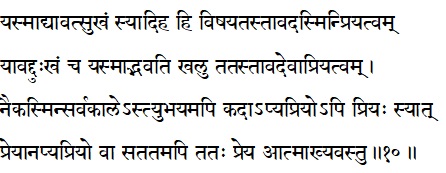
Translation: In this world, one likes an object (or a person) as long as it gives happiness. On the other hand, one dislikes the same object when it gives pain. No object is likable or dislikable for all the time. Sometimes a likable object becomes unlikable and an unlikable object becomes likable. But, Atman is the only one that is likable all the time.
Comments:
Love, happiness, and selfishness: This shloka states simple facts that in this universe love and happiness are inter-related and are in direct proportion. If an object gives more happiness, then it becomes more lovable in proportion to happiness. On the other hand, pain and dislikes are inter-related and are in direct proportion. If an object gives more pain, then one dislikes it in direct proportion to the intensity of the pain.
This fact has two levels. On the general level, it applies more to the selfish people. They love themselves and they love who gives them happiness. They love people as long as their selfish interest is fulfilled and dislike them when their selfish interest is hindered. We may get surprised whether the same person loved us a few days ago and how that love disappeared. But, this is the way of the world. Let us look at the deeper side of love, likes, and dislikes.
The Parents’ Love: Does this above mention fact apply to the parents’ love for their children, and especially, mothers’ love for her children? Out of love, going through so much sacrifices and suffering, parents raise their children. Children out of their ignorance and lack of maturity give pain to the parents, but the parents continue to love them. It seems that this fact does not apply to them. But, if we reflect upon this, then we find that parents also derive joy within to do something for their children even though children give them pain. I have seen, little children kicking their mothers, but mothers continue to feed them. However, the parents’ love is limited to their children, and so it is considered as an attachment. But, this love is better than selfish people’s love. Sri Ramakrishna said that God puts love in the hearts of the parents, so their children can grow.
A sincere and dedicated teacher may not be likable to a lazy student who wants success without any efforts. But, a student who wants to learn and make progress in his/her field will not mind the teacher’s strict attitude, demand for progress, criticism, or even scolding. The student understands that it is for his/her progress the teacher is taking the trouble. Parents also play such a role as strict teachers to raise their children properly. In these cases, even though there are pain and suffering, but students or children love their teachers and parents. Besides parents, school, and college teachers, there are many kinds of teachers in society helping their students, or players, or assistants, and others.
The genuine spiritual teachers, besides various guidance and training, work on the ego of their disciples. They want to remove the false ego of their disciples and develop humility in them to become worthy of spiritual knowledge. It is painful, but sincere disciples undergo this training and still keep the love for their teachers.
Holy people: Then, there are a much deeper side of love, likes, and dislikes. There are people on earth who see God in all and love all. They are ready to serve all as worship to the God residing in them. Their love is unconditional and they do not expect anything from anyone. Offering service to all as the worship of God is their greatest happiness. Serving all is not easy. There is a saying that the mouth bites the very hand which feeds it. Many times people enjoy being served and simultaneously criticize who served them. But, the holy people continue to serve all irrespective of the people’s behavior that they serve.
There is a famous example of a holy person who was taking a bath in a river. He saw a scorpion was drowning in the river. He put his hand under the scorpion and tried to lift it up above the water. As soon as his hand touched the scorpion, it bit his hand. The holy person could not hold the scorpion in his hand. The scorpion started drowning again. The holy person tried to help it again and the scorpion bit his hand again. The holy person was again extending his hand to save the scorpion. Someone on the shore who was watching this whole scene shouted to the holy man saying why he is trying to save the scorpion who continues to bit him. The holy man said that the scorpion is not giving up its nature to bite, then why should he give up his nature to help? This is a very high state of love. But, there are holy people on earth who love all and serve all without thinking of any return or about their own life.
A difference between a holy person and a selfish person is evident. If we have done ninety-nine bad things and one good thing to a holy person, then the holy person will remember one good thing and forgets all the ninety-nine bad things. On the other hand, if we have done ninety-nine good things and one bad thing to a selfish person, then that person will remember only that one bad thing and forgets all the ninety-nine good things.
The nature of mind: This shloka brings out another important point that no object is likable or unlikable all the time. The likable may at some time become unlikable and an unlikable at some time becomes likable.
We have heard from Swami Chinmayananda one of his life experiences. He was observing silence during his meals. In one house a host served him Karela (the bitter gourd), which are very good hygienically but are bitter. He thought that let him eat that first and then enjoy the other items that were served. He finished the Karela first. The host thought that Swami likes Karela. The host mother served him more Karela. This time, Swami Chinmayananda kept the Karela up to the end and somehow swallowed them up and drank water. The next day, Swamiji was going for a bhiksha to another house. Now, this new host called the previous host and asked what items the Swami likes to eat. This host said that Swamiji loves Karela. Swami Chinmayananda felt bad to tell people that he does not like Karela but eats them because people were serving him with love. Then, Swamiji said that after eating Karela from eight to ten houses, he started liking them. Thus, unlikable things may become likable.
The mind is amazing and it is very difficult to understand its nature. The mind craves for something and if we make efforts to acquire that object, then in the middle or at the end it loses its interest in the object. Many times even it starts liking something else. One of the difficult spiritual practices is to control the mind. Most people unknowingly become slaves of their minds. They think that they are free to select what they want, but actually, out of mind’s slavery, they are forced to select a particular thing. We find that in most cases love and hatred depend on the mind’s moods and the mental states.
Swami Brahmananda said that controlling the mind is like controlling a naughty restless child. Spiritually advanced people have control over their minds. Their minds will do what they want them to do.
Also, when situations change, then our needs also change. For example, warm clothes give warmth in the winter, but they make us feel uncomfortable in the summer. Things which are good in one surrounding or at one stage, may not be good in other surrounding or at another stage. The toys which entertain children will not entertain them when they become youngsters. Similarly, the things which youngsters like, they may not like them when they become adults.
Love for Atman: This shloka is actually connected with the previous shloka – 9. We learned in that shloka that because Atman is residing in all, we like all.
Those spiritual seekers, who sincerely do spiritual practices to realize Atman (God or Brahman), find that the more they advance in their path, their love for Atman or God increases more. As we have seen that in the case of the worldly love, a likable thing may become unlikable, and an unlikable may become likable. But, in the spiritual path, God, or Atman becomes more and more likable. Finally, a spiritual seeker realizes that Atman or God or Brahman has become everything. That is why they love all and ready to serve all.
Therefore, this shloka says that seek only Atman. The worldly things lose their luster when we see them as matter, but, if we realize that everything in the universe is covered by God or Brahman, then we love all and serve all.
 mahendrajani
Perfect , Every time when i land to this mahendrajani’s post , give me some deeper knowlege of myself,Thank you so much for your efforts.
Dear Raval Keyur: Thank you for your comments. These comments exhibit your deeper understanding of the topics presented in this blog. You have touched the central message of the blog – “Think, Practice, Realize, and serve”. The word ‘Realize’ indicates the realization of our true Self. If these posts help people realizing their true divine identity, then I considered they have served their purpose. I am writing these posts to help me realize my Self. I am very happy that through this blog I can connect myself with like-minded people like you. Thank you again.