Shiva Mahimna Stotra
Shloka 30
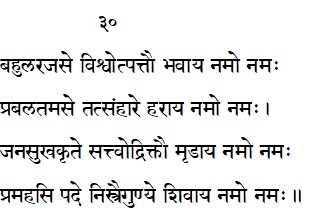

Meaning: I salute again and again your form of Brahma filled with the abundance of rajas to create the universe, your form of Rudra filled with the abundance of tamas to dissolve the universe, and your form of Vishnu filled with the abundance of sattva to preserve the universe for the happiness of people. I salute again and again to self-luminous Shiva, your serene and peaceful form, who is beyond the three gunas and the final goal of all, which is liberation.
Reflections: According to the Vedanta, Brahman is the Ultimate Reality of the universe. The Power of Brahman is called Maya, Prakriti, Avidya, or Shakti. Technically there are differences between them, but in general, they are fundamentally the same.
Sri Ramakrishna, again and again, said that Brahman and Shakti are the same. When inactive, we refer to It as Brahman, and when It is engaged in the creation, preservation, and dissolution of the universe, we refer to It as Shakti. The same power appears in the form of Brahma (the creator), Vishnu (the preserver), and Mahesha (the dissolver).
Sri Ramakrishna said that as fire is unmanifested in the wood, Shakti is unmanifested in the Brahman. He also said that as fire and its burning power, milk and its whiteness, a snake and its wriggling movement, and a jewel and its luster are inseparable, so are Brahman and Shakti.
This Shakti or Prakriti is made of three gunas, namely sattva, rajas, and tamas. When the three gunas are balanced, then Prakriti merges into Brahman and remains unmanifest. The imbalance of the three gunas makes the universe function.
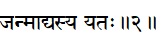
These thoughts have been clearly mentioned in the scriptures. The Brahma Sutra (1.1.2) says that ‘Brahman is the only cause of creation, preservation, and dissolution of the universe’.
Actually, Brahman is Omnipotent, Omniscient, Infinite, and devoid of any qualities. However, It appears as the universe because of Its delusive power Maya.
In Viveka Chudamani, Sri Shankaracharya calls the power of Brahman as Avidya or Maya.

“Avidya or Maya is the power of the Lord. It is Unmanifested when It is inactive. It is beginningless, supreme, and made up of three gunas; sattva, rajas, and tamas. Wise people realize Its existence by Its effects. It brings forth this whole universe.” Viveka Chudamani – 108
In Shri Durga Saptashati (11.11) Rishi says, “O Narayani (All-Pervading Mother)! You are the power to create, preserve, and dissolve the universe. You are the support of the three gunas (sattva, raja, and tamas) and you have all the virtues. I salute you.”

In the Bhagavad Gita, Shri Krishna mentions that Brahman is the cause of the creation, preservation, and dissolution of the universe and Its power is Prakriti.

Shri Krishna said, “My inferior Prakriti consists of eight things: Earth, water, fire, air, space, mind, intellect, and ego.
“O Arjuna! With My superior Prakriti, the Indwelling Spirit, the universe is sustained.
“Know that these two Prakritis of mine are the cause of all beings. I am the origin of the entire universe and also its dissolution.” (Bhagavad Gita 7.4-6)
In the following shloka, Shri Krishna mentions the cyclical nature of the universe; it appears, sustains, dissolves, and appears again and the cycle goes on.

Shri Krishna said, “O Arjuna! At the end (time of dissolution) of the cycle of the universe, all beings enter into My Prakriti and at the beginning of a cycle I generate them again.” (Bhagavad Gita 9.7)
Because of Rajas, people have a desire for progeny, and we have creation. Because of Sattva, parents have love in their hearts, and children are being nourished. Because of Tamas, there is the dissolution of the universe in order to recycle the universe.
The same thing applies to the whole universe. That is why, Pushpadanta wrote in this shloka that with the abundance of Rajas, the power of Shiva as Brahman, creates the universe. He called this power or form of Shiva “Bhava”, and “Bhavaya” means ‘to Bhava’. The Sanskrit root of this word is “Bhu” which means ‘to be born’. He said, ‘I salute to Bhavaya’.
With the abundance of Sattva, the power of Brahman sustains the universe. This power or form is called “Mrida” or “Mruda”, and “Mridaya” means ‘to Mrida’. The Sanskrit root of the word is “Mrida” or “Mruda” and its meaning is ‘one which gives joy’. Out of joy, the power of Brahman preserves the universe. That is why Pushpadanta says, ‘I salute to Mridaya’.
With the abundance of Tamas, the power of Brahman dissolves the universe to create the universe again. This power or form is called, “Haraya”. The Sanskrit root of the word is “Hara”, one who takes away everything. Pushpadanta says that ‘I salute to Haraya’. Devotees say “Om Namah Parvatipataye Hara, Hara, Mahadeva Hara”. Meaning, “O Lord Shiva, the husband of Parvati, please take away all our problems, sufferings, and ignorance.”
Brahman is beyond the three gunas. When all three gunas are balanced, then the Prakriti merges into Brahman, and so does the universe. Only Self-luminous Brahman remains. In the fourteenth chapter of the Bhagavad Gita, Shri Krishna says that when one goes beyond the three gunas, one merges with the Lord. This is the ultimate goal of all beings. We have to make spiritual efforts to control tamas by rajas, rajas by sattva, and then go beyond the three gunas knowing that ‘I am Atman. I am the witness consciousness, and I am beyond the three gunas.’ Pushpadanta calls this form as “Shiva”, and “Shivaya” means ‘to Shiva’. The meaning of Shiva is ‘one who is auspicious. Pushpadanta says, ‘I salute to Shiva who is auspicious and beyond the three gunas’.
We have to see Shiva or Brahman in everything. Also, we have to learn about three gunas and how to go beyond the three gunas from the Bhagavad Gita, especially from chapters 14th, 17th, and 18th.
 mahendrajani