Shivaratri is going to be celebrated on Thursday, February 27, 2014 all over the world, especially all over India, by millions of people.
Lord Shiva reminds us of serenity, a blissful state, and a focused mind which mostly remains merged with the Infinite Brahman, total self-control, a heart that is filled with love and compassion and which is always thinking for good of all.
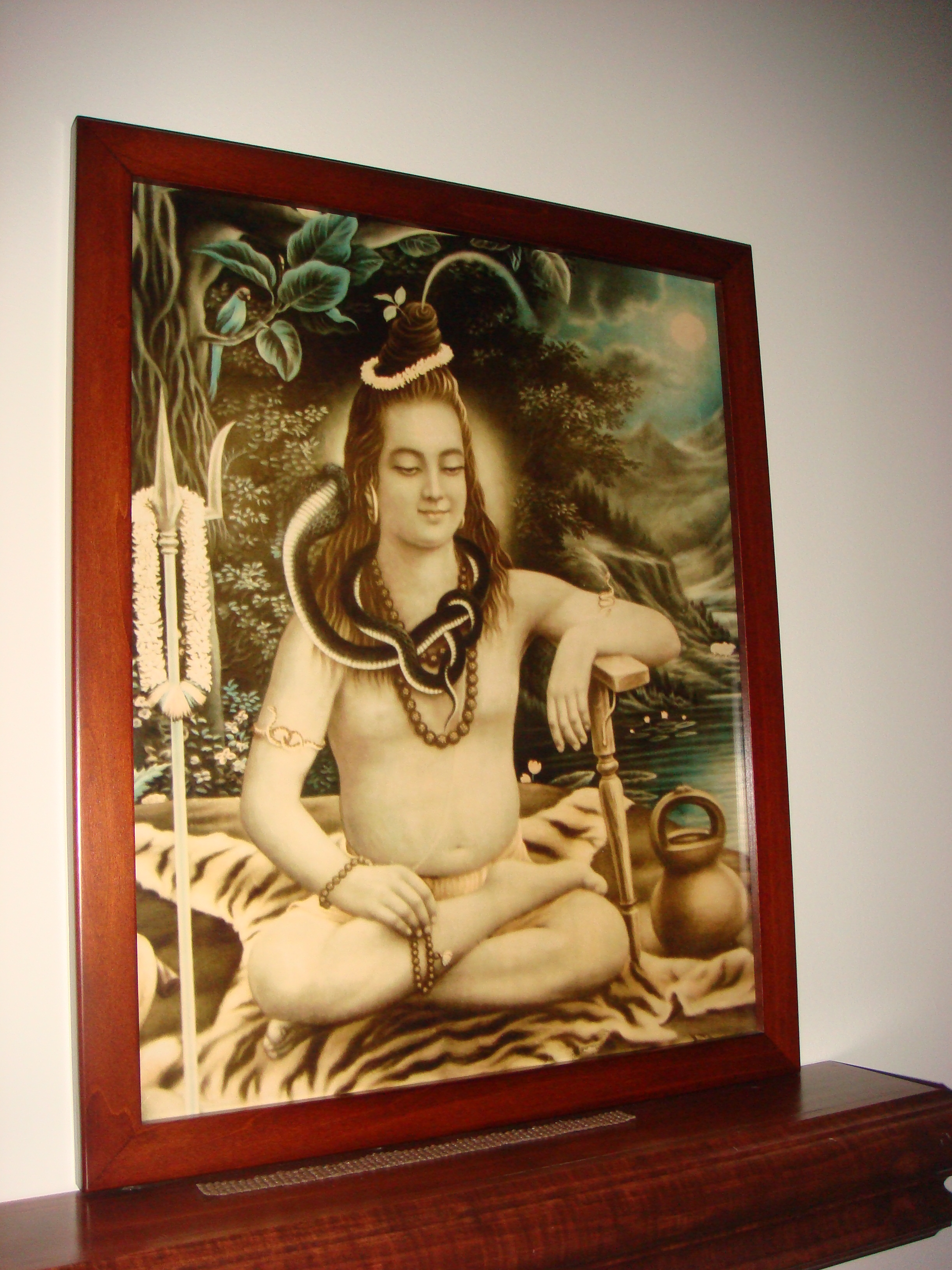
The Ultimate Reality or The Life Force which supports the universe and each individual is called Brahman. The highest knowledge is to realize that the Brahman has become everything. The apparent universe came out of Brahman, it is nourished by Brahman and it dissolves into Brahman. When we see Brahman as a creator, we call It Brahma (the Creator). When we see Brahman as someone who nourishes the universe, we call It Vishnu. When we see Brahman as someone who dissolves everything, then we call It Shiva.
There are numerous hymns, bhajans, and dhoons of Shiva which devotees love to sing. These hymns, bajans and dhoon remind us the glories of Shiva and uplift our mind to the higher state of consciousness. One of these hymns is “Shiva Mahimna”. There are several stories in this hymn which elaborate Shiva’s virtues. One can learn easily through stories. One of the stories goes as follows SM – 10 (Shiva Mahimna, shloka 10):
Once there was a dispute between Brahma and Vishnu (even though they both were the forms of Brahman!). The dispute was to decide ‘who is greater; Brahma or Vishnu’. Brahma said he is greater because he creates and Vishu said he is greater because he preserves. Brahma’s argument was that if he does not create then Vishnu cannot preserve while Vishnu argued that if he does not preserve then creation is futile. They could not reconcile. I am sure their followers were more involved in this dispute and almost ready to fight a big war. At that time a pillar of fire appeared before them. Brahma and Vishnu both looked at the pillar and were surprised. They could not see any end to it. Vishnu asked Brahma, “Did you create this pillar?” Brahma said, “No.” Brahma asked Vishnu, “Did you nourish or sustain this pillar?” Vishnu said that he didn’t. They both decided to find out more about the pillar, especially to find its support or an end. Brahma went up and Vishnu went down. They went as far as they could go, but could not find its end or beginning. It was an infinite pillar. Both were shocked to see something beyond the creation. Brahma and Vishnu were humbled. The Shiva aspect of Brahman taught them that the time is infinite and many universes were created, being nourished, and had been dissolved into time and this phenomenon continues. Brahma and Vishnu then praised the Shiva aspect of Brahman. The Shivalinga which is worshipped in Shiva temple is a symbol of that infinite pillar of fire. I learned from this story that whenever we think of the infinite, our little ego, pride, achievements look very timid and many times silly. Thinking of the infinite makes us humble and sane.
There are twelve famous Shiva temples in which these glorious Shivalingas are worshipped. They are called “Dwadash Jyotirlingas.” I have visited Rameshwaram, Somanath, and Nageshwara. In all the temples witnessing deep love and devotion of many devotees of Shiva, my mind was filled with divine mood. In the hearts of the devotees we feel the presence of Shiva. These devotees were from all over India and abroad.
The following is a link in which one can see the places of these famous Shiva temples. There are more than 12 famous Shiva temples. For a devotee it is good to go and visit these temples and feel the presence of Lord Shiva in the hearts of all.
http://www.mapsofindia.com/maps/india/jyotirlinga.htm
The following is a link of 12 famous Shiva temples and their Jyotirlingas which are worshipped every day.
http://www.dwadashjyotirlinga.com/
Swami Vivekananda quoted Shiva Mahimna Shloka-7 in his famous speech of September 11, 1893 given at the World Parliament of Religions held at the Chicago World Fair. While talking about the harmony of religions and acceptance of all religions as true, he said, “I will quote to you, brethren, a few lines from a hymn which I remember to have repeated from my earliest boyhood, which is every day repeated by millions of human beings: “As the different streams having their sources in different paths which men take through different tendencies, various though they appear, crooked or straight, all lead to Thee.”
Sri Ramakrishna loved Shiva Mahimna Hymn. Once he was reciting its shloka-32 which says, “O Lord Shiva! If ink is made by dissolving a blue mountain into an ocean, a pen is made by a branch of the divine tree, and the Goddess of Knowledge (Saraswati) writes your glories on the earth (using as a paper) for ever even then she cannot completely describe your glories.” Thus, thinking of the infinite glories of Shiva, Sri Ramakrishna was overwhelmed with emotions. He embraced the Shivalingam with both the hands and kept repeating with tears of love in his eyes, “O Shiva! Your glories cannot be described even by the Goddess of Knowledge.”
We know that everyday tons of research papers are being published. Each paper solves couple of problems but then most of them make us aware of more open problems. If we put all our knowledge in a circle and consider the area outside the circle as ignorance, then as our circle of knowledge grows the circumference of the circle which is the awareness of ignorance also grows.

Sri Ramakrishna told his disciples again and again that lust and greed are two forces which drag down people from their path of righteousness and spiritual development. So, sincere spiritual seekers have to watch out for these two forces.
We see that Shiva’s living is very simple. Even though by his little blessing one acquires riches, his means of living are very few (SM – 8).
Shiva’s self-control regarding lust has been beautifully described in SM – 15. It says that the arrows of the god of lust never come back without hitting the target. They are always victorious. Meaning lust drags down the minds of demons, humans, and angles from their righteousness and spiritual path. That god of lust shot his arrow of lustful thought to Shiva. Lord Shiva opened his eye of knowledge and not only the arrow but the god of lust himself was burnt to ashes. The story goes that after this the wife of the god of lust came to Shiva and explained that it was not her husband’s fault. He was asked by all the Devas to do this. She asked for forgiveness. Shiva out of compassion told that your husband will be immortal and he will reside in the minds of all.
Shri Krishna says in Bhagavad Gita, “Renounce lust, greed, and anger because these are three doors to hell. They destroy all the good things of a person.” (Gita 16.21).
Lord Shiva showed us that lust is a thought and it can be destroyed by a thought of knowledge, the awareness of our divine Self. Our true identity Atman does not have any gender.
Let us also remember Swami Vivekananda’s thoughts on worship of Shiva. Swami Vivekananda says, “This is the gist of all worship–to be pure and to do good to others. He who sees Shiva in the poor, in the weak, and in the diseased, really worships Shiva; and if he sees Shiva only in the image, his worship is but preliminary. He who has served and helped one poor man seeing Shiva in him, without thinking of his caste, or creed, or race, or anything, with him Shiva is more pleased than with the man who sees Him only in temples.” Swami Vivekananda wanted his disciples to see Shiva in each individual and serve him/her unselfishly.
In order to be pure and to see Shiva in all, we have to do spiritual practice and learn self-control from Shiva.
 mahendrajani