Shloka 28
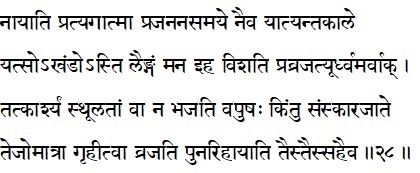
Meaning: Atman does not come from someplace at birth and it does not go anywhere at death. Atman is infinite and omnipresent. It is the subtle body that enters the body when the child is conceived and leaves it at the time of death.
The subtle body is not affected by the characteristics of the gross body such as leanness or heaviness and others. At the time of death, the subtle body leaves the existing body along with the Sanskaras, the Prana, and the subtle senses and enters into a new body at the time of its birth.
Reflection:
In the Bhagavad Gita (2.27), Lord Krishna says that ‘Whatever is born is going to die and whatever dies is going to be reborn.’
This is a general statement of fact. However, thinking about the transmigration of souls, the following categories came to my mind:
(1) Incarnations: God incarnates with His/Her/Its power as a human being to guide people in the spiritual path through His/Her life example and teachings. Incarnations also protect and encourage the righteous people and curb the power of the unrighteous. They take births at their own will.
(2) Liberated Souls (Jivan-Muktas): Those who have realized Atman do not born again.
(3) Yogis who did not realize Atman: Shri Krishna says in the Bhagavad Gita that among thousands of people who are engaged in spiritual practices, a few make real good progress. And, among those who make such progress, someone realizes the Atman.
Those spiritual seekers, who struggle in their life to realize Atman but do not succeed, take births in the families which help them to continue their struggle from where they had left. In the Bhagavad Gita, Shri Krishna describes this very clearly:
Gita (6.41-45): Shri Krishna said, “The soul of a yogi, who has not realized Atman in his/her life, after death, goes to the worlds of righteous (heavens). Having lived there for many years, either the soul of the yogi takes birth in a family which is pure and prosperous or takes birth in a family of yogis who are knowledgeable. Truly, a birth in such families is very difficult to get.
“In these families, the newly born yogi easily connects with the knowledge he/she had acquired and the progress he/she had made in the previous life and strives further to realize Atman.
“Because of the yoga practices in the previous life, this yogi naturally gets attracted to realize Atman. Even a curious person for the knowledge of yoga surpasses mere performances of the Vedic rites. But, a diligent yogi, with the help of all the yoga practices done in the previous lives, becomes pure and attains the Supreme Goal, the realization of the Atman.”
(4) People who do not do spiritual practices: The attractions of worldly objects are so powerful that most people are not interested in spiritual practices. They think that the goal of life is to get maximum enjoyment from worldly objects. Very little do they know that the joy from worldly objects is temporary and it brings lots of suffering. Also, people have to pay a high price for a little joy. Actually, this trap to attract people toward worldly objects and then make them suffer is a plan of Mahamaya to wake them up and make them understand the importance of spiritual practices. Mahamaya deludes people to bring them to the Atman.
People who do not do spiritual practices have lots of worldly desires to fulfill. One life is not enough to fulfill millions of desires. So, after death, Mahamaya sends them first to heaven or hell according to their deeds to enjoy or suffer respectively, and then gives them various kinds of lives on earth to fulfill their desires.
Gita (9.7-8): Shri Krishna said, “O Arjuna! At the end of a cycle all beings enter into My Prakriti (Mahamaya), and at the beginning of a cycle, I generate them again.
“Through My Prakriti, I create all beings again and again. They are helpless because of their own past actions.”
What is it that leaves the body at the time of death?
The Upanishads teach that the Atman or Brahman is omnipresent. According to the Vedanta, the whole universe is projected on Brahman by Maya (the power of Brahman).

Ishopanishad says, “Whatever is in the universe is covered by the Lord.

Chhandogya Upanishad says, “Everything is verily Brahman.”
This means that Brahman is appearing as the universe.
In the Bhagavad Gita (12.3), Shri Krishna describes Brahman who is devoid of names and forms as ‘Imperishable, Ineffable, Un-manifest, Omnipresent, Incomprehensible, Immutable, and Unchanging’.
Thus Atman or Brahman is Omnipresent and without a second. It does not come from somewhere at the time of the birth of a body and does not go anywhere after its death.
The Shatashloki Shloka – 28 says that it is the subtle body of a being that goes from one body to another body. We find Shri Krishna talks about this in the Bhagavad Gita in the following shlokas:
Gita (15.7 & 8): Shri Krishna says, “In the world of living beings, the individual soul (Jivatma) is an eternal portion of Mine. Abide in Prakriti (Maya or My Power), it draws to itself the five senses and the mind.
“When Jivatma leaves a body, it carries with it these five senses and the mind to another body just as the wind carries fragrance from one place to another.”
Gita (15.10 & 11): Shri Krishna says, “The deluded people do not perceive the Jivatma residing in the body, enjoying the objects of the world, and uniting with the three Gunas or leaving a body. Those who have an eye of wisdom really perceive it.
“The yogis, established in the Yoga, who strives to realize the Atman, behold It dwelling within themselves. But those who are undisciplined and have not purified their minds do not perceive It even though they strive.”
The question is: What is the Subtle Body?
Shri Shankaracharya talks about Sthula Sharira (Gross Body) and Sukshma Sharira (Subtle Body) in the “Viveka Chudamani”.
Sthula Sharira (the gross body) is made out of the gross forms of the five elements, namely, space, air, fire, water, and earth. It consists of skin, flesh, blood, arteries and veins, fat, marrow and bones, and human waste.
Sukshma Sharira (subtle body): It is made out of the following eight things. All are in their subtle forms.
(i) Five Karmendriyas (the organs of actions): They are speech, hands, legs, organ of excretion, and organ of regeneration. Through these, an individual performs actions.
(ii) Five Jnanendriyas (the organs of perceptions): These are ears, skin, eyes, nose, and tongue. With the help of these senses, an individual perceives the universe.
(iii) Five Pranas (the vital forces): Prana (helps in breathing, drinking, and eating), Apana (helps in evacuating the waste from the body), Vyana (helps in blood circulation), Udana (helps in sneezing, crying, vomiting, and an individual soul to leave the body), and Samana (helps in digestion and balancing the pressures)
(iv) Five Elements: Space, air, fire, water, and earth.
(v) Antahkarana: It is broadly the mind of a person. It has been divided into four parts according to its functions, namely Mana, Buddhi, Chitta, and Ahankara. Through Mana or the mind, one perceives the universe with the help of the senses, thinks, desires, and experiences pain and pleasures. Buddhi or the intellect is the analytical part of the mind which classifies the information that the mind gathers. It is also determinist in nature. It sets up goals of life and separates rights and wrongs. Chitta is the reservoir of all the impressions of the person’s thoughts, speech, and actions. Ahankara is the ego, the subtle, and the gross.
(vi) Avidya or the fundamental ignorance of one’s true identity.
(vii) Desires and
(viii) The impressions of the actions.
The Karan Sharira (causal body) is included in the subtle body. It is the cause or the seed of the subtle and the gross body. It has no other function than being the seed of these bodies. Its form is ‘nirvikalpa rupam’, an undifferentiated form. The ‘Karana sharira’ is formed because of ‘Avidya’, ignorance of the true identity of the existence of a being, which is Atman. The ignorance makes a being think that it is separate from the Atman. We can say that it is the subtle ego or the basis of the manifested ego. It is destroyed only when ignorance is destroyed in the state of Samadhi. In the Samadhi there is only the awareness of Pure Consciousness, inside and outside. A person in Samadhi is not aware of his/her body, mind, place, and time. We find the records of such a state of Samadhi in the life of Sri Ramakrishna.
Brahma Sutras (3.1.1 & 3) also talk about the subtle body going out from a body at the time of death to form another body.

Meaning: “From the question and answer in the Shruti (Upanishads, Brahma Sutras, and Bhagavad Gita) it is known that the soul (Jiva) goes out of the body enveloped with subtle parts of the elements with a view to obtain a fresh body.
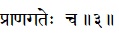
Meaning: Because of the going out of the Pranas (the vital force) and the sense organs with the soul, the elements also accompany the soul.
What do we learn from this?
Samkaras are important. Every thought we think, every word we speak, and every action we perform leaves a mark on our minds. The sum total of all these impressions builds up our character and it inspires us to think, speak, and act accordingly.
Swami Vivekananda explains it in Raja Yoga. He says, “…Each action is like the pulsations quivering over the surface of the lake. The vibration dies out, and what is left?, the Samskaras, the impressions…..
“…The Samskaras are left by these vibrations passing out of our mind, each one of them leaving its result. Our character is the sum – total of these marks, and according as some particular wave prevails one takes that tone. If good prevails, one becomes good; if wickedness, one becomes wicked; if joyfulness, one becomes happy. The only remedy for bad habits is counter habits; all the bad habits that have left their impressions are to be controlled by good habits…
“… Character is repeated habits, and repeated habits alone can reform character.”
Thus, we can build or change our character by thinking, speaking, and acting accordingly. These impressions will decide our next birth. If we want to be free from our ignorance and our slavery of senses, then we have to do spiritual practices.
Shri Krishna in the Bhagavad Gita (8.5-7) says, “There is no doubt that anyone who leaves his/her body thinking only of Me (God) becomes one with Me.
“O Arjuna! Whatever object or a being a person thinks of at the time of death, the person becomes that object or the being in the next life because the person was deeply cherishing that object or a being.
“Therefore, at all times, think of Me and fight this war. There is no doubt that if your mind and intellect both are constantly absorbed in Me, then you will become one with Me.”
Shloka 29
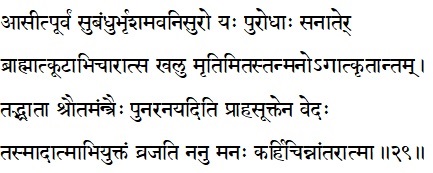
Meaning: Many years ago, king Sanati had a priest called Subandhu. He was a Brahmin by the caste. Other brahmins, out of jealousy, played some dirty tricks and killed Subandhu. His subtle body with his mind went to the Lord Yama, the Lord of Death.
Later on, Subandhu’s brother recited some Vedic mantras and brought Subandu’s subtle body back on earth and made Subandhu alive. This story has been narrated in a sukta of Rigveda.
This shows that it is the subtle body that leaves the body at the time of death and transmigrates and not the Atman.
Reflection:
This is an example from the Rig Veda. It shows the acceptance of the Vedas that at the time of death the subtle body leaves the body.
All over the world people think that the greatest miracle on earth is to make a dead person alive. There are many people interested to communicate with their departed family members.
We have heard from the Saints that those who seek knowledge of Atman should not entertain the thoughts of making the dead alive and communicating with the departed souls. Such thoughts and actions distract the mind and take one away from the goal of life which is the realization of one’s true Self or Atman.
Shloka 30

Meaning: Atman is one without a second and omnipresent. Because it is all-pervading, it does not move at all. However, Atman is reflected in the mind and the mind is constantly running around, so it looks as if the Atman is running around. It is like the water of the ocean goes up and down with the waves created by the wind and when the wind dies down the water goes back to its calm state.
It is amazing that the way water is inside and outside of the waves, Atman is inside and outside of the mind as a reflection, but the eyes and the other senses don’t know it. When the mind becomes calm, then one realizes that the nature of the Atman is motionless and calm.
Reflection:
For the Atman to move, it needs a space where the Atman is not present. Since Atman is omnipresent, it does not move.
The question is: Then, what moves? This shloka gives an excellent analogy to explain the phenomena of the movement.
The Ultimate Reality is Sat-Chit-Ananda Brahman. It is devoid of names, forms, and any action. To get an idea, Brahman is considered like an ocean without any waves. Ignorance produces a wave that thinks that it has a separate existence. We can think of this wave as ‘Jivatma’, an individual soul. Now, the wave gets associated with the wind and it goes up and down. We can think of the wind as the desires and different moods of the mind. When all the desires and with that all the moods of the mind die, the wave subsides completely and what remains is the calm ocean.
Another analogy is the reflection of the sun in a pot. The body is a pot and the water inside it is the mind. The reflection of the sun in the pot is Jivatma. When the water in the pot moves or the pot itself moves, then one feels that the sun is moving. But, actually, it is the reflection in the pot’s water that is moving. The pot, the water, and the reflection are the product of ignorance of reality. The Vedanta says that the Atman or pure consciousness illumines the intellect and through that, the senses and the sense objects get illumined. The senses do not see that the intellect has been illumined by the Atman. They feel that intellect is pure consciousness and it has its own light. When the mind or the ego which is the fundamental cause of the mind merges with the Atman, then the reflection merges with the original sun. At that time only the Atman or the pure consciousness remains. This is the state of Samadhi or the realization of the Atman. The individuals and the world are created so that each individual attains this state. If we make conscious efforts for this realization, then we enjoy the journey.
 mahendrajani