The Nature of the World

Meaning: Before the creation, the world was not absolutely non-existent like the flowers in the sky. Nor did it exist as an entity different from Brahman. It was different from both, meaning, the world was neither non-existent nor existent.
Before creation, the world as we now experience did not exist. The Virat (total gross body) which is the cause of the elements beginning with space too did not exist. But, it subsequently appeared like silver appearing on the nacre.
Can the world which was neither non-existent nor existent covers Brahman? Absolutely the world cannot cover Brahman, just as the mirage created by an illusion on the earth cannot cover the earth.
Reflections:
One of the very puzzling questions is: ‘Did the world exist before the creation?’
Several related questions arise with this question: (i) Did this world start at some time? (ii) Did the world come out from nothing? (iii) Was there anything that existed before this world? If it did, what was it? (iv) Did the world come out of something? (v) Which forces created this world? (vi) Is there a creator of this world? Is that creator a superhuman being or not a human being? (vii) If the world would be created again, would it be the same world or different?
Three Popular Theories:
There are three popular theories that exist about the beginning of the universe:
(1) From the religious point of view: God created this universe.
(2) From the non-believer’s point of view: This universe came out from nothing.
(3) From the scientific point of view: The big bang theory looks more convincing.
Religious View:
To accept the religious point of view, one needs faith that ‘There is God.’ and ‘God has created the universe.’ In this case, one should not ask questions like, ‘From where God got the material to create the universe and what kind of tools He/She used?’, ‘Is God a man or a woman or a non-human being?’, ‘Where does God reside?’, ‘Why did God create a universe in which many people suffer?’
Skeptic’s View:
On the other hand, the non-believer’s point of view, namely, ‘This universe came out of nothing.’ does not make sense. Something cannot come out of nothing.
Some people think that at the beginning of the creation, there was only matter, and then at some point, the consciousness started. The question comes: How insentient matter becomes sentient?
Big Bang Theory:
The scientists believe in the Big Bang Theory:
The record shows that the big bang theory was first proposed by Alexander Friedman, a Russian mathematician in 1922 and expanded upon in 1927 by Georges-Henri Lemaitre. He was a Belgian physicist, who was also a Roman Catholic priest. He theorized that the universe began from a single primordial atom. In the first 10^-43 seconds of its existence, the universe was very compact, less than a million billion billionths the size of a single atom.
Scientists such as Edwin Hubble have made detailed observations and measurements that support and develop this theory.
For the big bang theory, a question always comes: “What came before the big bang?”
A physicist Glenn Starkman at the Case Western Reserve University suggests a textbook answer for this. According to him, “The question, “What came before the big bang?”, is meaningless, just as it’s meaningless to ask what’s south of the South Pole.”
In the big bang theory, people say that the time itself began with the big bang. Therefore, there was nothing ‘before’ the big bang. Starkman knows that hardly anyone finds that answer satisfying.
In trying to describe a ‘creation process’ through scientific language we encounter a serious challenge: if every effect results from a cause, we can follow the chain of causation backward in time until we arrive at the First Cause. But what caused this cause? Aristotle thought of some divine entity to solve this conundrum, called the Unmoved Mover, the one that can cause without having been caused. It looks very convenient, but it is not scientifically satisfying.
Quantum Nothingness:
Then, there is a theory of scientists and philosophers who think that the universe came out from ‘a special nothing’. They say that the Universe emerged spontaneously from a random quantum fluctuation in some sort of primordial quantum vacuum, the scientific equivalent of “nothing“. However, this quantum vacuum is a very loaded nothing: it assumes the whole machinery of quantum field theory, the modern description of how elementary particles of matter interact with one another.
In the quantum realm, even the lowest energy state, the “vacuum,” is not empty. Even if the energy of a quantum system is zero, it is never really zero due to the inherent quantum fluctuations about this state. A zero-energy quantum state is as impossible as a perfectly still lake, with absolutely no disturbances on its surface. This quantum jitteriness amounts to fluctuations in the value of the energy; if one of these fluctuations is unstable it may grow big, like a soap bubble that blows itself up. The energy remains zero on average because of a clever interplay between the positive energy of matter and the negative energy of attractive gravity. This is the result that physicists like Stephen Hawking, Lawrence Krauss, Mikio Kaku, and others speak of when they state that the “universe came out of quantum nothingness,” or something to that extent.
Other Views:
Some physicists now think that the time didn’t begin with the Big Bang, but somehow emerged when the universe reached a certain level of complexity.
Others theorize that the universe runs in cycles, in a possibly endless series of expansions and contractions. If this “cyclic” model is right, the Big Bang wasn’t the beginning, but just a transition from an earlier era. Another possibility is that our universe is just one of countless “bubble universes” that pop up repeatedly in a “multiverse.”
The Vedanta View:
It is interesting to reflect upon the Vedanta view of the universe and its beginning which the Shata Shloki shloka 23 presents.
This shloka says that before the creation, we cannot say that ‘the universe did not exit’ and we cannot say that ‘the universe did exist’.
According to Vedanta, there is only one Ultimate Reality called Brahman. Its nature is Pure Consciousness or Existence-Knowledge-Bliss Absolute. These are not the qualities of Brahman. They describe the nature of Brahman. They give us an idea of Brahman. Brahman is Knowledge Itself, Existence Itself, and Bliss Itself. Qualities come and go, but the nature remains same all the time. Brahman is the Ultimate Reality, but when It is seen through the prism of space, time, and causation, then it appears as the universe as we know or experience.
Because Brahman appears as the universe, the universe actually did not exist. On the other hand, we cannot say, it didn’t exist because we perceive it. According to Vedanta, the power of Brahman, called Maya, creates these apparent contradictions. Maya is difficult to describe.
Swami Vivekananda provides more insight into this concept of Maya in his lecture delivered in London.
He said, “What, then, does the statement that the world exists mean? It really means that the world has no existence. What, again, does the statement that ‘the world has no existence’ mean? It means that it has no absolute existence: it exists only in relation to my mind, to your mind, and to the mind of everyone else.
We see this world with the five senses, but if we had another sense, we would see in it something more. If we had yet another sense, it would appear as something still different.
It has, therefore, no real existence; it has no unchangeable, immovable, infinite existence.
Nor can it be said to have non-existence, since it exists and we have to work in and through it.”
Swami Vivekananda says that our whole life is a mixture of this contradiction of existence and non-existence. He points out several contradictions in our life:
(1) A human being feels that he/she can know everything, but he/she finds that there is an adamantine wall that is difficult to pass through. A human being’s mind has limitations and difficult to go beyond this mind.
(2) There is a general tendency to be selfish, but in the inner recess of our hearts, we know that unselfishness is good.
(3) At a young age a person is very optimistic, but as the person grows old, he/she becomes pessimistic.
(4) Every minute people are dying, but the people who are alive think that they are immortal.
(5) Our desires cannot be fulfilled by the enjoyments. As fire increases more when we pour ghee into it, our desires also increase more by the enjoyments.
(6) Because of the attachment people suffer, but they continue to remain attached.
(7) In society, if one evil is removed, several other evils show up.
(8) The knowledge of happiness brings the knowledge of unhappiness.
(9) As happiness grows in society, then miseries also grow simultaneously.
(10) As good increases in the world, then evil also increases.
(11) All the obstacles remind us of our limitations, but inside we have a feeling that we are not limited.
(12) There is nothing in this universe that is completely good or completely bad. Each thing is a mixture of good and bad.
(13) As knowledge increases, our awareness of ignorance also increases.
According to Swami Vivekananda, the Maya is not a theory for the explanation of the world. It is simply a statement of facts as they exist. It tells us that the very basis of our being is a contradiction.
Swami Vivekananda says that in ancient Vedic literature, the word Maya was used in the sense of delusion. Then, Maya was used as magic. There is a text, “Indra through his Maya assumes various forms. Later on, Maya was used as a mist that covers reality. A question was asked: “Why we cannot know the secret of the universe?” The answer was given, “Because we talk in vain, and because we are satisfied with things of the senses, and because we are running after desires, therefore we cover the Reality, as it were, with a mist.”
Swami Vivekananda said, “The Maya of Vedanta, in its final form, is neither idealism, nor realism, nor is it a theory. It is a simple statement of fact – what we are and what we see around us.”
Other Forms of Maya:
Maya is also called Prakriti, or Shakti, or the Power of Brahman. This universe is Maya. Shwetaswatara Upanishad states it clearly.

Shwetaswatara Upanishad (4.10): “Know, then, that Prakriti is Maya, and that the Supreme God (Brahman) is the Lord of Maya. The whole universe is pervaded by the Prakriti (the power of Brahman) through the cause and effect.”
Prakriti (Maya) is made out of three gunas; sattva, rajas, and tamas. The universe is going on because of the imbalance of these three Gunas. When the three Gunas are in perfect balance, then the universe gets dissolved. Brahman is beyond the three Gunas. Dominated by the imbalance of the three Gunas within and without, a person limits oneself to one’s limited body-mind existence and becomes active to fulfill one’s desires. Thus, one could not see the Reality that Brahman is appearing as this universe. Shri Krishna asserts this fact in the Bhagavad Gita.
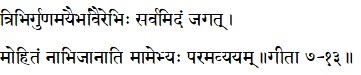
Shri Krishna says, “Deluded by these threefold Gunas constituting Nature, this whole world fails to recognize Me (Brahman), who am above the Gunas and immutable.” (Bhagavad Gita 7.13)
When a person goes beyond the three Gunas, then one realizes the Ultimate Reality (Brahman) within and without. But, it is very difficult. Shri Krishna says that the delusion is very powerful.

Shri Krishna says, “Verily, this divine Maya of Mine, consisting of the Gunas, is hard to overcome. But, those who take refuge in Me alone, shall cross over this Maya.” (Bhagavad Gita 7.14))
Maya and the Cyclical View of the Universe:
According to Vedanta, the universe runs in cycles. The cycle of creation, preservation, and dissolution of the universe goes on eternally. In the Bhagavad Gita, Shri Krishna clearly states this principle.

Shri Krishna said, “At the end of the cycle, all beings, O son of Kunti, enter into My Prakriti, and at the beginning of a cycle I generate them again.” (Bhagavad Gita 9.7)
Thus, Shri Krishna (identifying Himself with Brahman) says that by the power of Brahman, at the beginning of each cycle, the universe is created. Then, it is preserved, and at the end of the cycle, it is dissolved. The creation is seeing Brahman through the prism of space, time, and causation.
The Teaching of Shata Shloki shloka 23:
According to the Upanishads (Vedanta), there is only one existence, namely Brahman. It is also considered as Pure Consciousness or the Ultimate Reality. Aittareya Upanishad says Brahman alone existed before the creation of the universe:
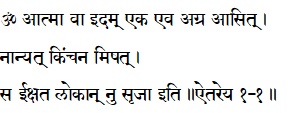
“At the beginning (all) this verily was Atman only, one and without a second. There was nothing else that winked. The Atman thought: “Let Me now create the worlds.” (Aitareya Upanishad 1.1)
The Brahman, with its power, called Maya or Prakriti, created the universe with names and forms. But, we have to remember that it is due to the Maya, Brahman started manifesting as the universe as we see silver on the nacre. The other two Vedanta examples regarding this delusion are seeing a snake in a rope and seeing water (mirage) on the road.
Due to Maya, individuals think that they have separate limited existence from Brahman confined with their bodies and minds. Then, they think that worldly objects are for their sense pleasures and to acquire these pleasures is their goal of life. In the process of acquiring sense-pleasures, obstacles, competitions, the lack of fulfillment, frustration, suffering, and many other things come. Individuals forget that their true identity is Brahman; Existence-Knowledge-Bliss Absolute. Craving to fulfill sense-pleasures, they become slaves of their senses and become blindfolded. A few great souls reflect upon their true identity and the true nature of the universe. With meditation and proper spiritual practices these great souls realize that their true identity is Atman, the universe is nothing but Brahman, and Atman and Brahman are identical. These liberated souls are called the realized beings or ‘Jivanmukatas’. Their sufferings go away along with their delusion and they experience infinite bliss within. In their presence, the minds of sincere seekers of Truth get uplifted and they get a glimpse of the Ultimate Reality or Brahman.
The shloka 23 of the Shatashloki says that as the mirage cannot cover the whole earth, the delusion that ‘I have a separate existence from Brahman’, cannot cover the individual’s mind forever. Those people, who have realized that Brahman (Pure Consciousness) is the only Ultimate Reality, live in the world remaining completely detached. They see their lives and the universe like movies projected on a screen. Movies consist of all the dramas of life filled with joy, sorrow, fear, anxiety, adventure, success, failure, frustration, helplessness, elation, depression, and many other things. But, the screen is not affected by all these movies. Those realized beings live balanced sane life and guide other people to attain that state.
Science has proved many Vedanta views through its progress and will prove many other views as it advances further. The Vedanta search is internal and the Science’s search is external. Swami Vivekananda says that both the searches will ultimately meet at the same point, the Ultimate Truth.
 mahendrajani