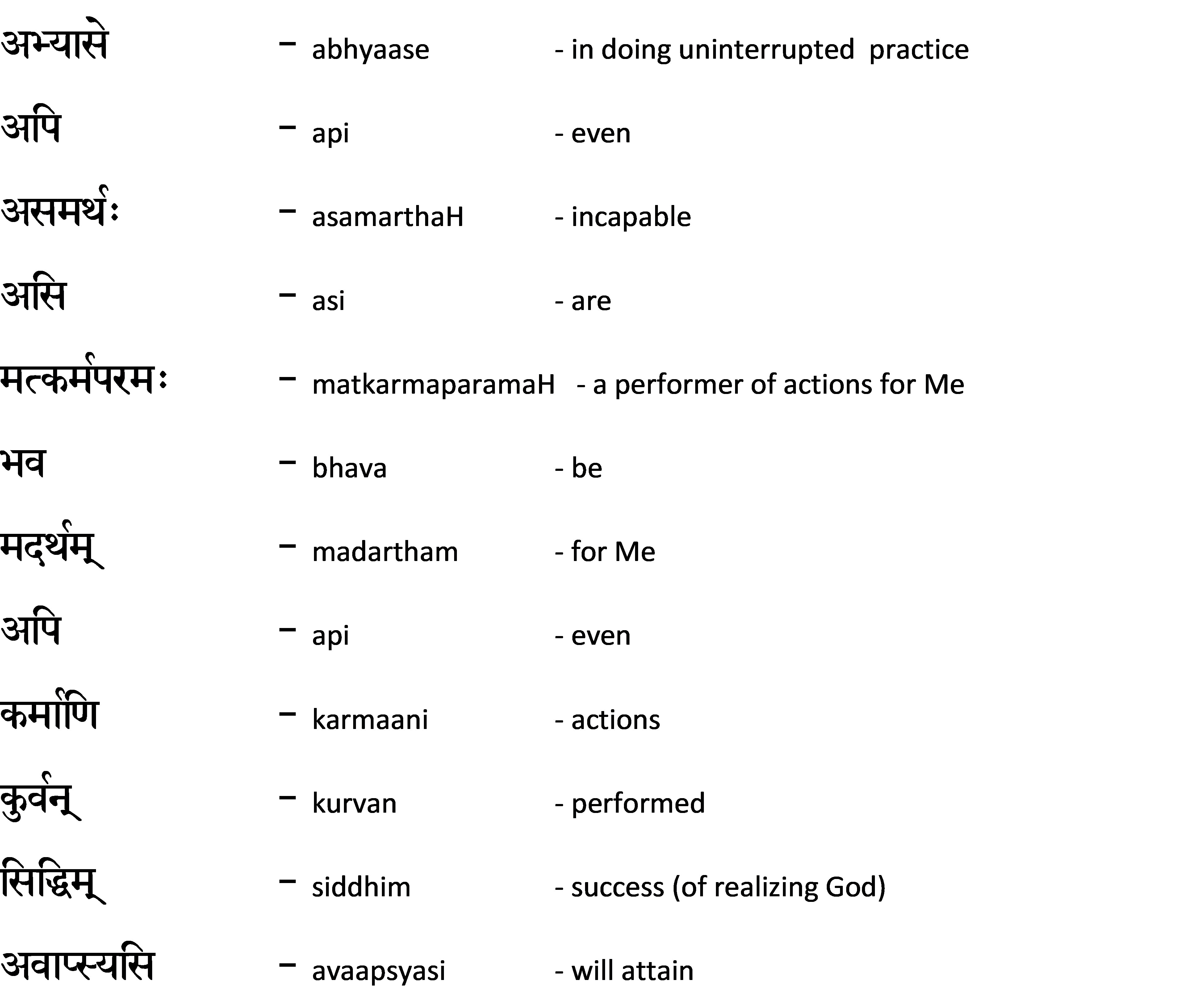
10. If you are incapable of practicing Abhyasa Yoga (Yoga of constant practice), then perform actions for Me. Even by performing actions for Me, you will attain perfection (the realization of God).
“Abhyasa Yoga” is excellent for those who have some control over their minds. But, in reality, not all can control their restless minds, which constantly run towards worldly objects and bring them back to God. Even those who can practice “Abhyasa Yoga” for some time may grow tired of fighting the resistance of their minds. What to do in that case? For those people, Shri Krishna suggests another alternative of ‘performing work for God’.
In the Vedanta spiritual practices, no one is left out. There is a way for everyone to attain the Highest Knowledge, no matter what weaknesses one has. Everyone has some kind of strength. Vedanta encourages all and shows them a way to use their strength to attain the Highest Knowledge. There are ‘work-oriented’ people. They enjoy doing work for some purpose. If they sit down for japa or meditation, their minds start thinking of various works. For such people, Shri Krishna offers this alternative: to do work for God.
Performing work for God includes worship of God; mentally washing the feet of God, offering sandal paste, flowers, incense, lamp, food, and other things. It also includes singing the glories of God, practicing spiritual disciplines like japa and meditation, studying scriptures, practicing values, performing some form of austerities, giving in charity, doing unselfish service, and others.
Performing work for God also includes fulfilling our responsibilities, which are work given by God. Performing work for God is also a way to worship God. Just as father and mother do all the work to raise their children, devotees can do work for God. As parents develop love for children by taking care of their responsibilities, devotees can develop love for God by working for God. We can think that ‘I am a servant of God,’ or ‘I am a son or a daughter of God,’ or, ‘I am a representative of God’, and all my responsibilities in the world are given to me by God by giving me a birth in that environment, which is created due to space, time, and situations. When we sincerely and lovingly perform these responsibilities without any worldly expectations, then this work becomes a worship of God. Through this worship of work, we can attain the perfection, or God-realization, or the Highest Knowledge described in the Vedanta scriptures.
In the Mahabharata, there are stories of a devoted wife who was serving her sick husband, and a butcher who was sincerely taking care of his inherited unpleasant business, both of whom attained the Highest Knowledge that the all-renounced yogi was seeking through meditation. Swami Vivekananda told this story in one of his Karma Yoga lectures, named ‘What is Duty?’ When we perform our responsibilities as doing God’s work, we constantly think of God during our work and feel an inner strength. With such practice, we easily develop concentration of our mind and love for God, which helps us attain God-realization.
But what if one cannot even do this? Is there any hope for such people? Let us listen to Shri Krishna.
9. If you cannot focus your mind steadily on Me, then O Dhananjaya, desire to attain to Me through the Abhyasa Yoga (Yoga of constant practice).
In the previous shloka, Shri Krishna asked Arjuna to focus his mind and intellect on Him (God or Atman). People who try to focus their minds on God know very well how difficult that task is. In the Gita chapter six (shlokas 33 and 34), Arjuna had already expressed his concerns about the difficulty in focusing his mind. He had said, “O Madhusudan! Because of the restlessness of the mind, I don’t see I can attain and established in the Yoga of Equanimity. O Krishna! The mind is restless, turbulent, powerful, and unyielding. To control this mind is as difficult as controlling the wind.”
Arjuna, a mighty warrior who can defeat any powerful enemy on the battlefield through his archery, admits that he has difficulty controlling his mind. Also, remember when Dronacharya was testing all the Pandavas and Kauravas on the required concentration in archery; Arjuna was the only one who passed the test by saying, “he sees only the bird’s eye.” This shows that one can have a full concentration on worldly matters, but it is a different situation when we need to focus our minds on God.
As we had discussed before, the mind is a reservoir of “samskaras,” the impressions of past thoughts, speech, and actions. Based upon these “samskaras,” it has desires and plans to be happy, which in reality create obstacles in the spiritual path. Mind is not going to think of God until it realizes that most of its plans for happiness are futile and will bring untold sufferings and miseries, along with little short-lived happiness. Through our pure intellect’s ability to analyze and reason, we have to convince our mind that God Realization is the only worthy goal of life in order to attain what we are trying to attain in the world, and for that, we have to focus our mind on God.
Reminding the mind of the futility of the cravings and fulfillments of worldly desires, we have to withdraw the mind again and again from all worldly objects and focus it on God. This is Abhyasa Yoga, which Shri Krishna asks us to practice. When we realize that our life will be futile without God Realization, then intense longing develops, and our mind easily gets focused on God.
Also, whenever the mind runs away from God and starts thinking about other things, we should not join with it. We should not identify ourselves with our minds, but step aside as an intellect and observe its activities. Many times, when the mind finds that it is being observed, it gets embarrassed and stops running around. Mind goes where its treasure is. Tracking down our mind we find what worldly desires and objects we cherish. Once we know these desires and objects, then we can work on our mind through intellect to reduce the unnecessary desires and convince it to stop running after them.
As we read in the great epic Ramayana, when Rishis were performing Yajnas (special worship of God), the demons used to come and throw filthy and disgusting things to create problems and interrupt the worship. Similarly, the deluded mind creates disturbances when one tries to focus it on God. Here, the obstacles are our own distracting thoughts. We have to follow the great Rishi Vishwamitra’s example to stop the obstructions and disturbances. He asked Sri Rama and Lakshmana (two great archers) to guard his worship. Similarly, Shri Krishna is advising us to keep two great archers, namely Abhyasayoga (constant practice) and Vairagya (renunciation of distracting thoughts, speech, and actions), ready to support our spiritual efforts. These two can definitely remove all our obstacles in focusing our minds on God.
Shri Krishna’s solution shows great understanding of the human mind and tells us proven techniques to control the mind, an impossible job for many. Abhyasa Yoga is a path of repeated efforts of focusing the mind on God. As tiny drops constantly falling on a stone make a hole in the stone, similarly, bringing the mind again and again to God tames our mind by developing a habit. We find that children learn a new thing by repeating it several times. In kindergarten, all children look alike. But, after several years of study and practice, some become medical doctors, some engineers, some teachers, some athletes, some artists, and other professionals. Similarly, by proper guidance and repetition of God’s name, the mind develops love for God, and it can be focused on God. In order to make spiritual progress, Sri Ramakrishna repeatedly mentioned the following spiritual practices: repeating God’s name and glories, holy company, regular prayers, going into solitude, and sincerely praying to develop love for God.
When our desire to attain God becomes intense, then we make sincere efforts. Then, we are ready to renounce whatever obstacles come in our way, and our minds get more focused. We have to use various methods to teach the mind how to develop love for God, as loving parents raise their children and try to teach them good habits. We should not exert too much force and break the mind either. Mind is a delicate thing, and we have to handle it as carefully as we handle a beautiful, delicate flower vase. Through our minds only, we are going to realize God. Mind is a powerful thing. When it focuses on God, we acquire the highest knowledge and experience the infinite bliss.
In Mundaka Upanishad (2.2.4), Rishi says, “Om is the bow; the mind is the arrow; the Brahman (God) is its target. Hit the target with a focused mind and become one with Brahman as the arrow-head merges into its target.”
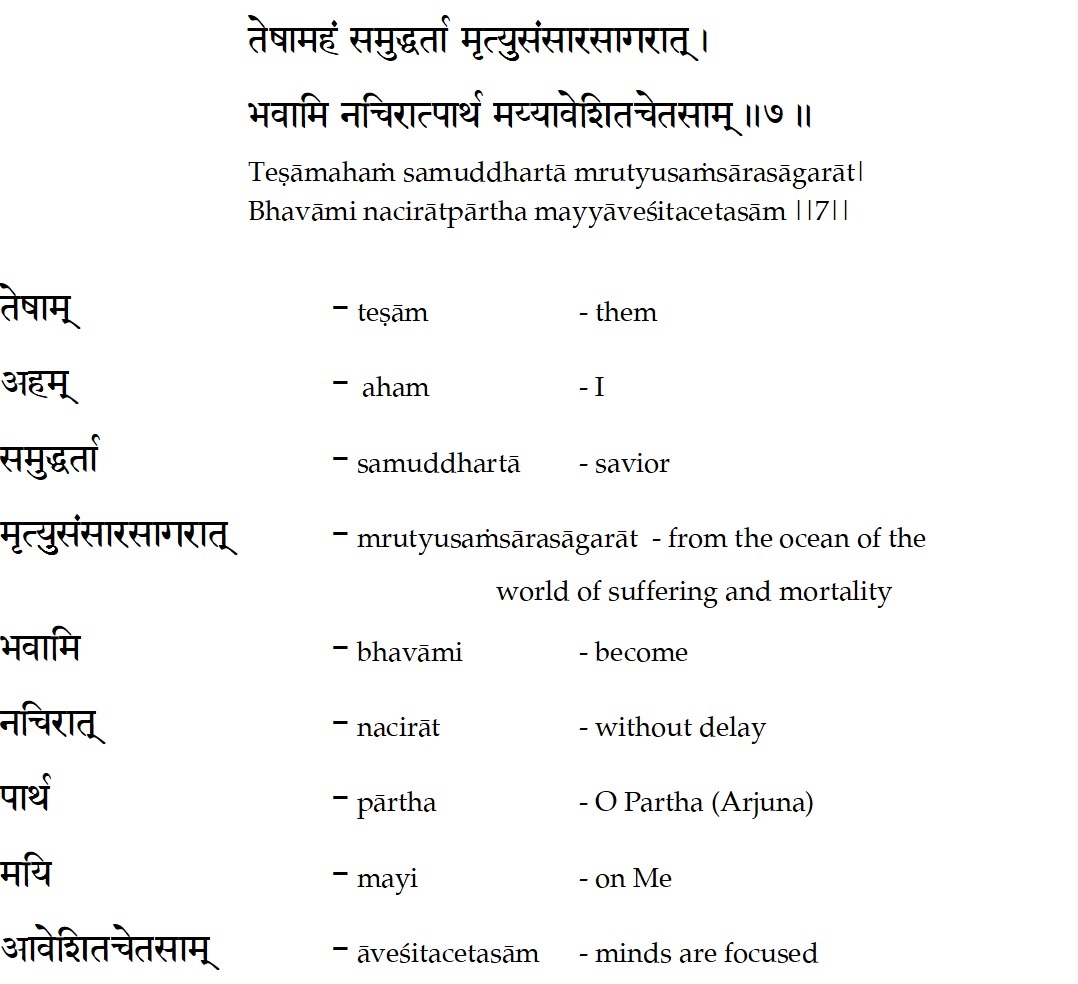
6-7 But those who worship Me, renouncing all their actions in Me, considering Me as their supreme goal, and meditate on Me with single-minded concentration, to them, whose minds are thus absorbed in Me, O Partha, without any delay, I become their Savior and save them from the ocean of worldly sufferings and mortality.
Reflections:
For most people, the Path of Devotion (Bhakti Yoga) is a relatively easy path for spiritual development. Shrimad Bhagavatam (11.10.8), a renowned spiritual scripture for Bhakti Yoga, teaches us the following “Even though a person who is not established in renunciation, is not detached from the world, but by listening to My (God’s) glories by chance develops love for Me (God), then the Path of Devotion (Bhakti Yoga) brings successful spiritual results in the life of that person.” Love for God brings positive changes in a person’s life. It fills the heart and mind of the devotee with sublime joy and makes human life meaningful and worth living. The presence of true devotees inspires people to be good and do good.
In these shlokas, Shri Krishna clearly mentions four spiritual practices or the requirements for the devotees to attain liberation or freedom from all bondages through the path of devotion. Narasimha Mehta, a great Gujarati Saint and poet, has written that the devotees of God do not seek liberation, but instead, they ask God to give them a human birth, again and again as devotees, so that they can enjoy loving God and singing God’s glories. However, to the devotees who are established in the following four spiritual practices, Shri Krishna promised that He would immediately lift them out of the ocean of suffering and mortality.
(1) Consider God as the supreme goal:Among all these requirements, the first is to make a resolve that God-realization is the goal of life. God-realization means realizing one’s own “True Divine Identity”. Until this resolve is made, one cannot begin a spiritual journey.
To be a devotee, one must be convinced that worldly pursuits and achievements are incapable of providing what one is seeking: knowledge that brings meaning to life, removal of sufferings or developing strength to bear these suffering with a clam mind, bliss or everlasting happiness, love for all, removal of all fear, including fear of death, and fulfilment. On the other hand, we find many examples of devotees who have attained all the above things through spiritual practices, love for God, and God’s grace. As this conviction strengthens, a devotee becomes increasingly focused on realizing God and engages in spiritual practices earnestly.
(2) Renouncing all actions to God: Once God-realization has been established as the goal of life, a devotee should try to integrate all activities to help achieve that goal. Renouncing all actions to God means performing all actions with the intention of realizing God.
A few blessed souls realize intently that God-realization is the only goal of life, and they renounce everything to achieve that goal. All other people live in the world, and they have to learn how to work that help them to realize God. This is the Karma Yoga Shri Krishna taught to Arjuna and all of us.
For that, first, we have to determine our responsibilities or duties. Our collective responsibilities are referred to as ‘Our Dharma.’ According to one’s position in life, each person has responsibilities to fulfill for the family, society, and the world. A devotee considers these responsibilities as given by God. For example, a student has to study, build up a moral and spiritual foundation, take care of his/her parents and siblings, and try to help people in society. An adult has to earn money, take care of the family, and fulfill his/her social responsibilities. If we do not meet these responsibilities, they create direct or indirect obstructions to focusing our minds on God. On the other hand, if we consider fulfilling these responsibilities as God’s work, sincerely perform our best, and offer them to God, then they become our spiritual practices and help us advance in our spiritual path. Performing our responsibilities in this manner, we feel God’s presence in all our work..
We must be careful to limit our required responsibilities to the minimum and not increase them to fulfill our worldly desires. Otherwise, we may not have time for our spiritual practices, such as regular prayer, studying scriptures, having Holy Company, doing japa and meditation, and unselfish service. All our spiritual practices must be for the development of love for God and ultimately for God-realization.
After the completion of each work, we have to offer the result to God. This way, each work develops our love for God, and the result will not disturb our minds. If a good result comes, we thank God for providing the opportunity and ability to do good work. If failure or an unpleasant result occurs, we must consider how to improve our future performance. If we have done our best and failure comes, we tell God, ‘This is the best I can do. Please let me know my weaknesses and help me in the future.’ A devotee will not perform any action for worldly gain, including name and fame. All worldly gain creates disturbances in the mind and takes us away from God. Shri Krishna reminds Arjuna of the path of Karma Yoga, which he taught him in the Gita, chapters 2-5.
In the Bhagavad Gita (9.27-28), Shri Krishna says, “Whatever act you perform, whatever you eat, whatever you sacrifice (perform yajna), whatever you give in charity, whatever austerity you perform, offer all of these to Me. Those who have thus offered everything to Me become free from the bondages of the good or bad results of their actions, and they realize Me.” Thus, offering all the results to God helps us attain God and freedom from all bondages.
Sri Ramakrishna says we do not have to renounce anything. We have to turn the face of everything towards God. He said it in Bengali, “mod phiriye dao”. Desire to realize God, get angry when we do not make spiritual progress, be jealous of those who have realized God, have an ego that ‘I am a servant of God or I am a devotee of God, and I must not do wrong things, etc.
When we perform all our activities as an offering to God, we renounce our little ego and become God’s instruments. Just as a person who represents a country acquires tremendous power, a devotee surrendering to God acquires infinite power within.
(3) Meditate and worship God with single-minded concentration or devotion: Yoga means to connect our mind with God. “Through Ananya Yoga” means having single-minded devotion and determination to realize God. When God-realization is established as the sole goal of life, a devotee develops single-minded devotion. Where there is single-minded devotion, there is single-minded concentration, which leads to ‘Dhyana’ (meditation). Such concentration brings the realization of God.
Sri Ramakrishna says that a thread cannot go through the eye of a needle even if a single fiber of the thread is sticking out. All the fibers of the thread at the end must become one pointed; only then does it go through the eye of a needle. Similarly, only a focused mind can penetrate all the layers of ourselves, namely the body, the subtle forces, the mind, the intellect, and the ego, and realize God residing within us.
In the spiritual path, ‘Upasana,’ or worship, is a dynamic practice. Devotees are constantly trying to lift their minds from the body-mind level to God. Worldly desires bring the mind down from the spirit to the body-mind level. A person who has cravings for worldly desires must go through the cycles of joys and sorrows and is not yet ready to advance on the spiritual path. This means that the person has not yet fully understood that this world cannot give him/her a longer-lasting peace and fulfillment of life. The great Rishi Narada says in the Bhakti Sutra (1.10),
“Anyashrayanam tyaga ananyata,’ giving up all false hopes and completely surrender to God is ‘Ananyata,’ one-pointedness.
We must have one goal in mind – to realize God in this life. Even in worldly pursuits, success often comes when one works with a focused mind for a sustained period. On the spiritual path, where we strive for the highest knowledge, bliss, and immortality, we cannot achieve success with an unfocused mind filled with multiple goals.
(4) Keep the mind absorbed in God: A sincere devotee constantly thinks of God by repeating God’s name, singing God’s glories, reading, listening to, and conversing about God, worshiping God, meditating on God, or doing God’s work. For spiritual progress, we must try to keep our minds absorbed in God in various ways. When one develops love for God, this practice of absorption becomes natural.
Holy Mother Sri Sarada Devi tells us that constant remembering of God leads to spiritual awakening. She said, “As you smell the fragrance of a flower while handling it or the smell of sandalwood while rubbing it against a stone, so you obtain spiritual awakening by constantly thinking of God.”
The practice of japa helps us absorb our minds in God. Sri Ramakrishna said, “Suppose there is a piece of timber sunk in the water of the Ganga and fastened with a chain to the bank. You proceed link by link, holding onto the chain, and dive into the water, following the chain. Finally, you are able to reach the timber. In the same way, by repeating God’s name, you become absorbed in Him and finally realize Him.”
In the Bhagavad Gita (9.34), Shri Krishna says, “Focus your mind on Me, be devoted to Me, worship Me, offer your salutations to Me. Having thus disciplined yourself, and regarding Me as the Supreme Goal, you will come to Me.”
Mind takes the form on which it meditates. Swami Chinmayananda said, “When an integrated mind-intellect equipment, with constant practice, gains the capacity to engage it entirely on God, to the exclusion of all agitations and undivine thoughts, then it takes the form of God”.
Amritabindu Upanishad (1.2) says,
“Mind is the cause of bondage and liberation. Mind attached to the objects of the world is the bondage. Mind detached from the objects of the world is the liberation.” The mind makes us slaves, and the same mind makes us free. Actually, the bondage and liberation are in the mind. The Atman (our True Identity) is ever free. It was never bound.
Shri Krishna, the immediate Savior:
Shri Krishna said that Jnana Yogis come to Me, while I lift the devotees, who fulfill the four requirements mentioned above, from the ocean of the “Samsara”, the ocean of delusion, sufferings, and mortality. Devotees who completely surrender to God are sure that their beloved God will take care of them. The word “Samsara” refers to something that is constantly changing and deceives people. It is also filled with small moments of happiness and immense suffering. Shri Krishna does not want His devotees to suffer anymore.
Here, liberation does not mean going to heaven. Going to heaven is like going to a place for vacation. As long as one has money, one enjoys a place of vacation. After the vacation period is over, people come back to their original workplace. Similarly, people enjoy heaven as long as their merits last and then come back to the earth to start all over again. Shri Krishna says (Gita 9.21), “Having enjoyed the vast heavenly world, they come back to the world of the mortals (the Earth) when their merit is exhausted. Thus, abiding by the injunctions of the three Vedas and desiring desires, they are subject to death and rebirth.” Shri Krishna’s lifting up of devotees means that they then live with God. They then attain the highest knowledge. Their impurities and ignorance of the mind have been removed, and the God within them shines through their lives.
In summary, the path of Jnana Yoga is for those who have control over their body, mind, and intellect and can focus their minds on the Atman within, who is the Witness Consciousness. For most people who are attached to their body, mind, and intellect, and have difficulty thinking of Atman as their true Self, the path of Devotion is better. Seekers of both paths ultimately realize Brahman. They ultimately attain the highest knowledge, immortality, and everlasting bliss.
If there are pleasant days, then there are unpleasant days.
If some days we are happy, then some days we are sad.
If some days, we are successful, then some days we face failures.
If some days we receive honor, then some days we feel insulted.
If some days we are healthy, then some days we get sick.
If we like something, then we dislike something else.
If there are rich people, then there are poor people.
If there are good people, then there are bad people.
If there are good administrators, then there are bad administrators.
If we are happy with life, then we face the fear of death.
This life is such that we cannot avoid the pairs of opposites. If we accept one, then we have to accept the other. We cannot have one without the other.
Our spiritual teachers show us the way out of this life filled with pairs of opposites. They say that the problem of pairs of opposites is in our minds.
I separate myself from my true identity, Atman, which is Pure Consciousness or Sat-Chit-Ananda (Existence-Knowledge-Bliss Absolute), and consider myself a person who consists of body and mind. Then, I create my likes and dislikes according to the constitution of my mind, which is made by my ignorance and past impressions. This starts the whole drama, which is filled with pairs of opposites.
To go back to my true identity, I have to do three spiritual practices. (i) I have to listen to the teachings of the scriptures from the Holy People, which describe the nature of the Atman and ways to realize it. (ii) I have to reflect on these teachings to understand them properly, and (iii) I have to meditate on Atman until I realize that my true identity is Atman.
Thus, I can go beyond my little imaginary self, which consists of my body and mind, and go beyond the pairs of opposites. In that state, I realize all these opposites are in my mind. When the mind enjoys happiness, I will be very well aware that the same mind will make me suffer. I will not complain to God about my sorrows.
It is strange that we complain to God about our suffering, but not for giving us happiness. We complain about insults but not about the honor we have received. We complain about death, but not about giving us life. This is because of our fundamental ignorance about our true nature, Atman.
People say it is hard to realize Atman. Then, we have to live in this world of opposites, sometimes happy and sometimes sad. It is usually for a bit of time happy, and more time sad. The choice is ours.
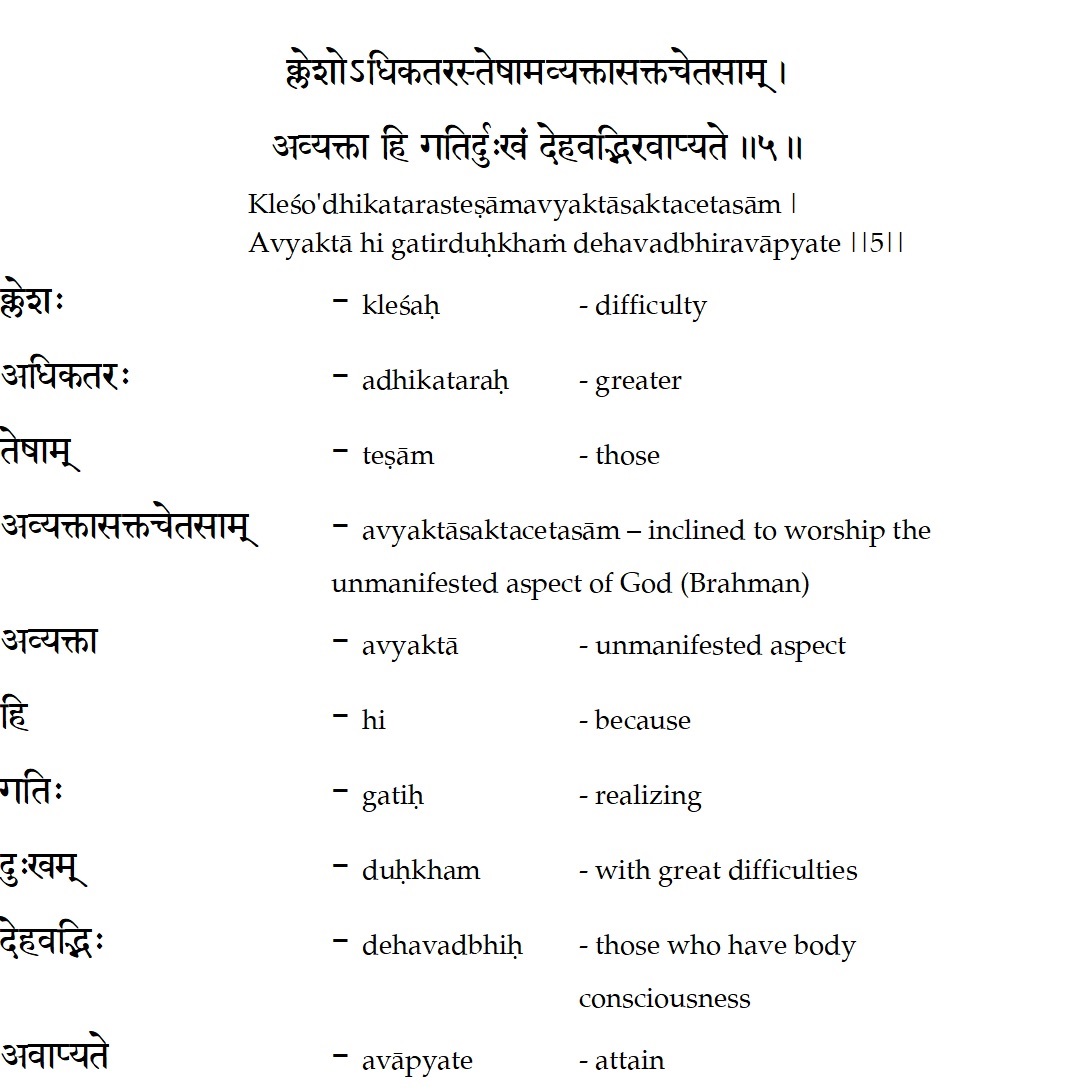
5 However, the path of devotees inclined towards worshipping the Unmanifest God is more difficult. Those who are conscious of their bodies have greater difficulties realizing the Unmanifest God (Brahman).
Reflections:
The Path of Knowledge (Jnana Yoga):
In the previous shloka, Shri Krishna described infinite Brahman with eight epithets and three characteristics of a Jnana Yogi. The path of Jnana Yoga is direct. One has to think that one’s true identity is the Self or the Atman. The body, mind, and intellect are ignorantly projected on the Atman. This Atman and the Infinite form of God, Brahman, are the same. Along with the eight epithets, Brahman is considered Sat-Chit-Ananda, Existence-Knowledge-Bliss Absolute. It is also described as Truth-Knowledge-Infinite. With these convictions about Atman and Brahman, one has to reflect and meditate on the Atman and realize that ‘I am Atman.’ After realizing one’s true nature as Atman, one lives in the world with the awareness that Brahman has become everything.
However, Shri Krishna says that those who wish to follow this path of worshipping the formless God face more difficulties than those who follow Bhakti yoga, the path of devotion in which they worship God with form. He further says that making progress in the Path of Knowledge is almost impossible for those who have body consciousness. Why is that? Let us reflect on the major difficulties of the followers of Jnana Yoga.
Difficulties in the Path of Knowledge:
(1) Comprehension: It is very difficult to focus the mind on God, who does not have any name, form, or quality. This God is Infinite, Unmanifested, Incomprehensive, and Omnipresent. Whatever we think of, it becomes limited and finite. Our highest idea of the infinite is the sky. But it is manifested and comprehensible. Mind cannot be focused on ‘nothing.’
(2) Self-control: Since the mind has nothing tangible to focus on, it is difficult to control it. On the other hand, the senses run after worldly objects for pleasure, and the uncontrolled restless mind naturally joins the senses and runs after the worldly objects. This makes it difficult to make any spiritual progress.
(3) Discrimination and Dispassion: In the Jnana Yoga, ‘Viveka’ and ‘Vairagya’ are two important practices. ‘Viveka’ is an ability to separate ‘what is Brahman’ and ‘what is not Brahman,’ meaning ‘what is permanent’ and ‘what is not permanent.’ Whatever is perishable is not Brahman. Thus, seekers of the formless God reject everything in the world, saying ‘not this,’ ‘not this.’ Many times, for such seekers, nothing remains after the discrimination. This makes it harder to progress in this path.
‘Vairagya’ is the capacity of the mind to renounce what is not Brahman. In the initial stages of this path, having no concrete idea of Brahman, seekers have difficulty renouncing the world, especially those attached to their bodies. For most people, the attachment to the body and cravings for worldly desires do not go away easily.
(4) Will-power and self-efforts: In this path, one needs tremendous willpower to control the restless and turbulent mind and the senses. Not many people have such willpower. They need an outside help. Seekers of this path need undaunted faith in the words of the scriptures and spiritual teachers. They have to hold on to the belief in the existence of Brahman. Such seekers are like baby monkeys who hold on to their mothers when mothers jump from one branch of a tree to another. If they lose their grips, they fall.
By meditating on the Formless, Infinite, Omnipresent Brahman, a Jnana Yogi must inspire himself/herself to continue on the Path of Knowledge. Compared to Bhakti Yoga, a Jnana Yogi has fewer supportive practices to draw inspiration and motivation.
A Jnana Yogi has to purify one’s mind through self-effort. A mind can fool itself and make compromises. Without purification of the mind, one cannot advance in the spiritual path. Therefore, a Jnana Yogi must take the help of a competent teacher.
(5) False ego: A Jnana Yogi who thinks that ‘I am Brahman’ develops a false ego, a major obstacle in this path. Generally, a person cannot even comprehend that one’s true identity is not one’s body, mind, and intellect, but it is their substratum. The difficulty is that our identities are deeply rooted in our bodies, minds, and intellect.
Only in the highest state of Samadhi (the Nirvikalpa Samadhi) does a person completely merge with the Atman, losing almost total body consciousness. Rare people attain such a stage. People witnessed Sri Ramakrishna going into this stage. In that state, he used to lose the awareness of his body, the place, and the time. When his mind was rising to that state, he used to keep a desire, like ‘I want to drink water’ or ‘I want to eat something.’ Through that desire, he said that his mind used to return to the body-consciousness. This shows how hard it is for most people to attain that state.
If a person has body consciousness and still says, “I am Atman or Brahman,” then great harm comes to the person. Such a person not only falls from the spiritual path, but many times, he/she becomes unethical and immoral, deludes oneself and others, and drags down other people to live a low-level life.
(6) Illusory reality: The Jnana Yoga says, ‘ Brahman is the only Reality, and the universe is a delusion.’ It is very difficult for a person with body consciousness to say that his/her body and the universe are an illusion. Sri Ramakrishna’s Advaita teacher, Sri Totapuri, was established in Jnana Yoga. One day, he developed a stomach pain. He told himself many times that ‘He is not a body. He is Atman, which has no pain or pleasure.’ But the pain continued. He was disgusted with himself and wanted to drown himself in the Ganga. Finally, he accepted that as long as there is body consciousness, he must accept the illusory universe as ‘true.’
The advantages of the Path of Devotion (Bhakti Yoga):
The title of this chapter is Bhakti Yoga. Shri Krishna wanted to point out that it is hard for most people to go beyond their body consciousness, and therefore, Jnana Yoga will be more difficult for them. Hence, for most people, Bhakti Yoga is a relatively easier path. Let us reflect on the major advantages of Bhakri Yoga.
(1) God as a human being: It is natural for a human being to think of God as a human being. As long as a person has a body, God also has a body. In his book ‘Bhakti Yoga,’ Swami Vivekananda says, “Talk as you may, try as you may, you cannot think of God except as a man (human being). You may deliver great intellectual discourses on God and all things under the sun, become great rationalists, and prove to your satisfaction that all these accounts of the Avataras (Incarnations) of God as men are nonsense. But let us come for a moment to practical common sense. What is there behind this kind of remarkable intellect? Zero, nothing, simply so much froth….By our present constitution, we are limited and bound to see God as a man. If, for instance, the buffaloes want to worship God, they will, in keeping with their own nature, see Him as a huge buffalo; if the fish want to worship God, they will have to form an idea of Him as a big fish; and men have to think of Him as a man. And these various conceptions are not due to a morbidly active imagination. Man, buffalo, and fish all may be supposed to represent so many different vessels, so to speak. All these vessels go to the sea of God to get filled with water, each according to its own shape and capacity. In the man, the water takes the shape of a man; in the buffalo, the shape of a buffalo; and in the fish, the shape of a fish. Each of these vessels has the same water of the Sea of God. When men see Him, they see Him as a man, and the animals, if they have any conception of God at all, must see Him as an animal, each according to his own ideal. So, we cannot help seeing God as a man; therefore, we are bound to worship Him as a man. There is no other way.”
Therefore, it is easy for a human being to think of God as a human being. That is why Hinduism provides various forms of God. The devotees choose the forms they like, and it becomes easy for them to focus their minds on them. The Infinite God appears to the devotee in the form of the God he/she worships.
(2) Control of the mind and the senses: In the Path of Devotion (Bhakti Yoga), it is easy to focus the mind on the form of God, which one likes. Also, worshiping God with form helps control one’s senses. The senses find something divine to focus on rather than worldly objects. For example, the eyes want to see God’s form, the mouth wants to sing God’s name and glory, the ears want to listen to God’s name and glories, the hands want to worship God by offering flowers, incense, naivedya, etc., and legs want to visit the places of pilgrimage or Holy People.
(3) Eradication of ego: By thinking of God as Father, Mother, or Master and oneself as God’s child or a servant, one easily eradicates one’s ego. A human relationship with God makes it easy for a devotee to surrender to God completely.
A devotee thinks, ‘ God is everything, and I am nothing.’ ‘Everything belongs to God. Nothing belongs to me.’ Thus, ‘Me and Mine’ turns into ‘Thee and Thins.’
Thinking that ‘I am an instrument in the hands of God,’ a devotee gets rid of ‘doer-ship.’
(4) Incarnations of God: For beginners on the spiritual path, it is easy to get an idea of God through the Incarnations of God. An Incarnation of God exhibits all the qualities of God in human life through his/her words and actions. Shri Krishna says (Gita 4.7-8), “O Bharat (Arjuna)! Whenever there is the decline of righteousness and a rise of unrighteousness, I incarnate Myself. I am born in every age for the protection of the good people, the destruction of the wicked, and the establishment of righteousness.” Humanity needs a human being to guide and show the path of righteousness. Seeing a person who day and night thinks of God and lives a God-centered life inspires us to follow his/her example and mold our lives accordingly. The lives of Incarnations provide concrete examples or role models to which devotees can connect and follow.
The scriptures describe the characteristics of people who have realized God. For example, the Bhagavad Gita describes the characteristics of people with steady intellects, beloved devotees of God, people who have gone beyond the three gunas, and others. The lives of Incarnations provide living examples of these characteristics. It is difficult to believe these states are attainable without seeing such living examples. By imitating them, the devotees develop devotion to God. Also, it is easy to focus one’s mind on the life incidents of the Incarnations. Their lives provide high ethical standards for the devotees, which helps them make spiritual progress.
(5) Grace and Assurance: When a devotee sincerely struggles to make spiritual progress, God showers His/Her grace on the devotee, removes his/her obstacles, and smooths the progress. Saints say that when a devotee goes one step towards God, God moves ten steps towards the devotee. From the Absolute Vedanta point of view, the help comes from within, but the devotee thinks it came from God. However, the devotee’s love for God becomes more intense when he/she feels God showered His/Her grace on him/her.
In the Bhagavad Gita (9.22), Shri Krishna says, “Those who worship Me without thinking of anything else, and are ever devoted to Me, I provide them what they lack and preserve what they have.” With this assurance, a devotee becomes free from any worry. A devotee is sure that the way a father or mother takes care of his/her child, God takes care of me. If a child makes a mistake, the mother worries for the child’s welfare more than punishing the child. A devotee (the worshiper of God with form) is like a kitten whom the mother holds and moves around. There is less danger of falling. Because of the devotee’s love for God, God removes the impurities of the devotee out of compassion.
A devotee is sure that God will provide what he/she needs. Sri Ramakrishna used to say that the Universal Mother can even give me the knowledge of Brahman if she will.
Problems with the Bhakti Yoga:
Most people find the Path of Devotion (Bhakti Yoga) relatively easy. However, people are of various kinds. Some people have analytical minds. They like to reason and accept answers that convince their intellect. They ask questions regarding God with form: ‘Who is God? Is God a man or woman? Where does God live? If God is compassionate, why is there so much misery in the world? Does God favor some and punish other people? How can a God with form be infinite or eternal? Were Rama, Sita, Krishna, Radha, Shiva, and Parvati born in the past, or are they just people’s imaginations? People make pictures or statues of gods and goddesses from their imaginations. The different parts of India have different kinds of pictures or statues of Rama, Sita, Krishna, Radha, Shiva, Parvati, and others. Thus, many questions come to the minds of people who like to reason. Analytic-minded people need convincing answers before they accept God with form.
Also, people get turned off from the Bhakti Yoga for several reasons. The following are a few examples of followers of Bhakti Yoga, who turn off rational-minded people. (i) People wear external spiritual marks and make a big show, but their characters don’t match the characteristics of the devotees described in the scriptures. (ii) People become fanatics about the forms of God they worship and try to convince other people that their forms of God are superior, and all must accept them as superior. Fanatics even kill people in the name of religion. (3) People mix up emotions and devotion. They lose their ability to separate what is right and what is wrong. They even lose rational thinking and common sense. For example, in one place, from early morning, a saint’s devotees were celebrating his 90th birthday with extended worship of the saint’s photo. It was 1:00 p.m., and the worship was still going on. The saint was hungry and wanted to eat. The devotees said they would give him food after the picture’s concluding worship, ‘arati.’ (iv) People with temporary sentiments have no lifelong commitment to realizing God. They feel that a temporary emotion is devotion. (v) God loves all, but priests of some temples discriminate and prohibit certain people from entering the temples.
The Path of Devotion mixed with Knowledge:
Sri Ramakrishna encouraged devotees to have devotion mixed with Knowledge of Atman. When devotees develop such devotion, they do not become fanatics. They know that they are worshipping the Absolute Formless God in the form of their ‘Ishta Deva,’ their chosen ideal. Different forms of God are representing the same Brahman, the Formless God. Therefore, there is no need to quarrel comparing various forms of God trying to prove ‘my God is superior.’ A devotee knows very well that it is easy to start focusing one’s mind on God with form. That is why one selects a form of God one likes to worship and starts his/her spiritual practices. As the devotee advances in the spiritual path, his/her body consciousness becomes less and less, and he/she becomes qualified to realize the formless God. Also, when a devotee develops devotion with the Knowledge of Brahman, he/she can understand and follow Bhakti Yoga properly and does not deviate from the path by wrong interpretations.
Sri Ramakrishna showed from his life how to combine devotion with the Knowledge of Brahman. Sri Ramakrishna first realized God as Mother Kali, and then he experienced the Omnipresent, Infinite, and Formless God. Sri Ramakrishna described this experience in his own words: “Tota Puri (Advaita Vedanta teacher) taught me to detach my mind from all objects and plunge it into the heart of Atman. But, despite all my efforts, I could not cross the realm of name and form and lead my spirit to the Unconditional state. I had no difficulty in detaching my mind from all objects, with the one exception of the too-familiar form of the radiant Mother (Kali), the essence of pure knowledge, who appeared before me as a living reality. She barred the way to the beyond. I tried on several occasions to concentrate on the precepts of the Advaita Vedanta, but each time, the form of the Mother intervened. I said to Tota Puri in despair: ‘It is no good. I shall never succeed in lifting my spirit to the “unconditioned” state and find myself face to face with the Atman.’ He replied severely: ‘What! You say you cannot? You must!’ Looking around him, he found a piece of glass. He took it and stuck the point between my eyes. I began to meditate with all my might, and as soon as the glorious form of the Divine Mother appeared, I used my discrimination as a sword, and I clove Her in two. The last barrier fell, and my spirit immediately precipitated beyond the plane of the ‘conditioned’; I lost myself in Samadhi.”
After merging with the Brahman, the Formless aspect of God, Sri Ramakrishna again engaged himself in singing the glories of Mother Kali. He showed that as long as there is body consciousness, one should think of God with form. The experience of Formless God is possible only in Samadhi.
Sri Ramakrishna provided a nice analogy to combine these two views. He said that when we climb a staircase to reach the roof, at each step, we say, ‘This step is not the roof.’ When we reach the roof, we find that all the steps are made of the same material by which the roof is made. Similarly, initially, we deny everything in the universe as not Brahman, saying, ‘Neti, Neti – Not this, not this.’ After realizing Brahman, we see that Brahman has become everything in the universe. In particular, Brahman is manifesting through all the forms of God.
Different States of Mind:
Swami Vivekananda says that all the various philosophies of God are not contradictory. They represent various states of human minds. Hanumanji and Sant Kabir have expressed it in simple language.
Once, Lord Rama asked his devotee Hanumanji, “How do you look at Me?” Hanumanji replied, “O Rama, when I have body consciousness, I see that ‘Thou art the Master and I am your servant.’ When I am aware of my soul, then I see that ‘Thou art the Whole, and I am your part.’ But, when I am aware that ‘I am Pure Consciousness (Atman),’ I see that “Thou art I and I am Thou.’ This is my firm conviction.
Saint Kabir also showed us how to combine God’s two aspects: formless and endowed with form. He said, “The formless Absolute is my Father and God with form is my Mother.” We love both, and both are needed.
A question:
A question comes to mind: Shri Krishna said (Gita 12.4) that a Jnana Yogi comes to Me and becomes one with God. Then, what happens to those who think of God with form? We find the answer in the following shlokas.





 mahendrajani