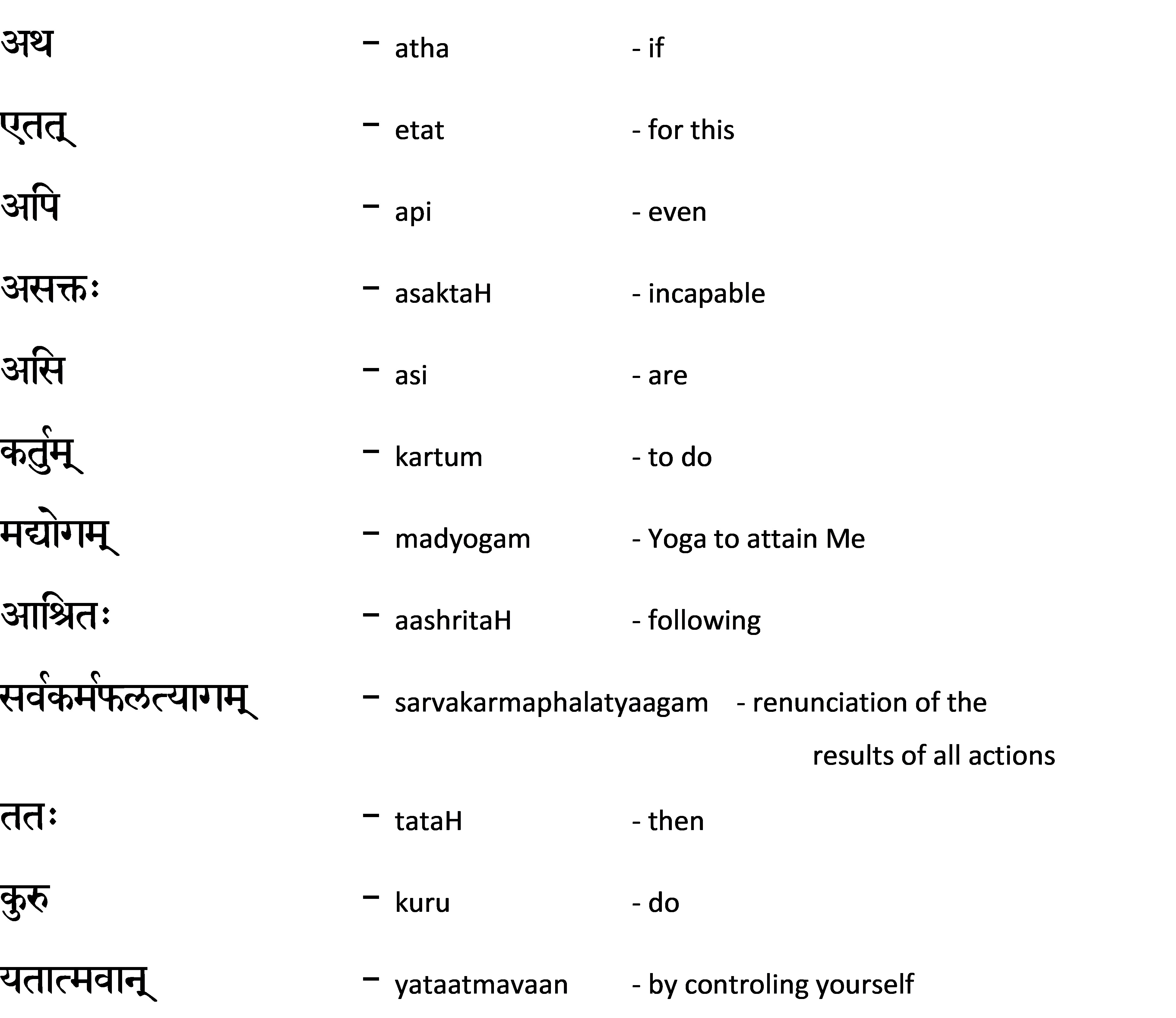
11. If you are incapable of performing even this (performing actions for Me), then be self-controlled, and taking refuge in Me, renounce the results of all your actions to Me.
In the Gospel of Sri Ramakrishna, he said that, just as a mother cooks various dishes according to children’s digestive capacities and tastes, several paths have evolved for the spiritual development of people to suit their capacities and mental constitutions. There cannot be a single path for everyone on Earth. Along the same lines, a spiritual teacher prescribes various paths to his/her students according to their capacity and mental chemistry. Shri Krishna, a great teacher, describes all possible ways for spiritual development in the Bhagavad Gita.
Shri Krishna tells Arjuna that if he cannot perform actions for God, then just offer the results of all his actions to God. Shri Krishna had described Karma Yoga, the Path of Actions, to attain the Highest Knowledge in the previous chapters. He has said (Gita 2.47), “You have a right to perform an action, not in the fruit of an action, do not get attached to the result of action – do not be inactive.”Here, Shri Krishna tells Arjuna the final step of Karma Yoga. We perform actions to enjoy their results. Our attachment to the results of the actions being performed brings joy or sorrow, depending on the favorable or unfavorable outcomes. The results of these actions leave deep impressions on our minds. Since we crave favorable outcomes, we constantly worry about the outcomes of our actions rather than focusing on the actions themselves. All these cravings and worries create constant disturbances and distractions in our minds.
Shri Krishna, knowing all the intricacies of human minds, suggests a simple but very effective path. Even though this path begins with a simple act of mentally offering the results of all our actions to God, if properly performed, it culminates in self-upliftment or self-transformation for the good. This path makes a person divine from the level of being a slave of the senses. How does it work? I think of the following steps:
(1) Remembering God: Initially, when we offer the results of our actions, we remember God.
(2) Awareness of the results of actions: Later, at the time of offering, we become aware of the results being good or bad, depending on whether we are going closer to God residing within or going away from God.
(3) Selection of actions: Because of this awareness, we start asking ourselves questions about what kind of actions we should perform or not perform. We examine whether the results of these actions are appropriate to offer to God.
(4) Improvement of our performance: Since we will not constantly think about the results of our actions, we will do our best in the performance of our actions. This way, we improve the quality of their results.
(5) Transformation: With all the above practices, a big transformation comes in us. We learn how to select appropriate actions, to perform them in the best spirit, and to offer their results to God. Our awareness of God increases throughout our lives, and it reflects in our thoughts, speech, and actions.
(6) Purification of our minds: Finally, the attachment to the results of the actions also goes away. This process purifies our mind and makes it ready to focus it on God. We realize that “God has created me, has given me an opportunity, capacity, and favorable conditions to do this work.” Thus, before, during, and after performing a work, what remains is the awareness of the presence of God. All the worldly consequences and attachments to the work and its results vanish, and we feel peace within.
A question comes: Is it not an idealistic imagination? Is this possible in real life? Has anyone ever tried this method and obtained a successful result? The answer is ‘yes.’ There are several examples. I will state one such example from the book, “They lived with God”, by Swami Chetanananda. This example makes us believe that this path is practical and not an imaginary hypothesis.
Girish Chandra Ghosh, a famous playwright of Kolkata, was a disciple of Sri Ramakrishna. One day, he asked Sri Ramakrishna for spiritual instructions. Sri Ramakrishna said, “Do just what you are doing now. Hold on to God with one hand and to the world with the other hand. Think of God at least in the morning and evening.” This sounded simple to Girish, but then he recalled that his life was so irregular that it would be hard for him to remember God at those stated hours, so he kept quiet. Sri Ramakrishna read his mind and said, “Well, if you cannot do that, then remember God before you eat and before you sleep.” But now Girish was reluctant to make any promises to Sri Ramakrishna. He knew that, with his instinctive resistance to self-discipline and rules, he might not be able to keep even this simple observance. Then Sri Ramakrishna went into an ecstatic mood and said to him, “So you are unwilling to agree even to this. All right. Give me your power of attorney. Henceforth, I will take full responsibility for you. You won’t have to do anything at all.” Giving power of attorney means that the consequences of all Girish’s actions will be borne by Sri Ramakrishna. After this, the life of Girish Chandra Gosh was transformed to such an extent that he found himself completely surrendered to God. He felt that he was an instrument in God’s hands. In the later part of his life, he would say, “Look at me. I am not even free to breathe.” Thus, surrendering the results of all our actions brings self-surrender and a constant awareness of God.
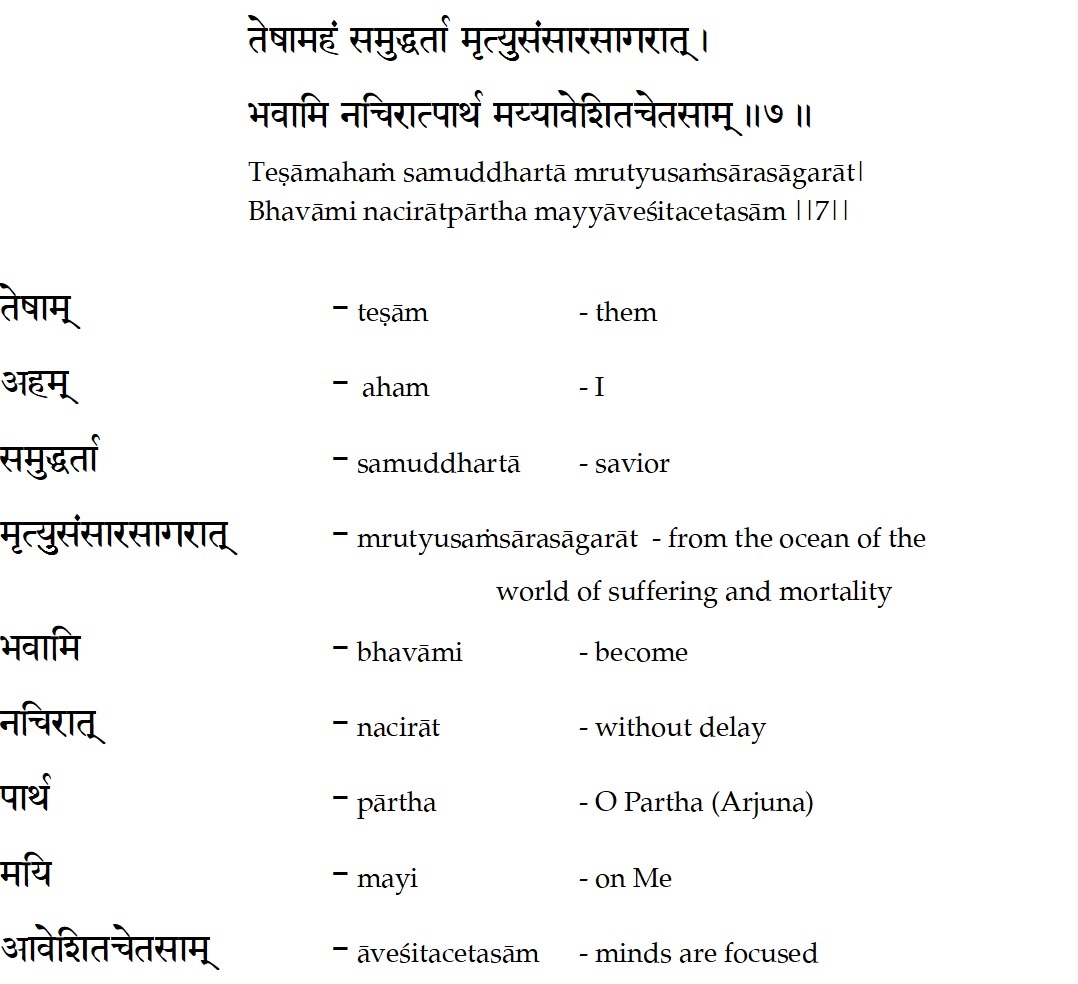
6-7 But those who worship Me, renouncing all their actions in Me, considering Me as their supreme goal, and meditate on Me with single-minded concentration, to them, whose minds are thus absorbed in Me, O Partha, without any delay, I become their Savior and save them from the ocean of worldly sufferings and mortality.
Reflections:
For most people, the Path of Devotion (Bhakti Yoga) is a relatively easy path for spiritual development. Shrimad Bhagavatam (11.10.8), a renowned spiritual scripture for Bhakti Yoga, teaches us the following “Even though a person who is not established in renunciation, is not detached from the world, but by listening to My (God’s) glories by chance develops love for Me (God), then the Path of Devotion (Bhakti Yoga) brings successful spiritual results in the life of that person.” Love for God brings positive changes in a person’s life. It fills the heart and mind of the devotee with sublime joy and makes human life meaningful and worth living. The presence of true devotees inspires people to be good and do good.
In these shlokas, Shri Krishna clearly mentions four spiritual practices or the requirements for the devotees to attain liberation or freedom from all bondages through the path of devotion. Narasimha Mehta, a great Gujarati Saint and poet, has written that the devotees of God do not seek liberation, but instead, they ask God to give them a human birth, again and again as devotees, so that they can enjoy loving God and singing God’s glories. However, to the devotees who are established in the following four spiritual practices, Shri Krishna promised that He would immediately lift them out of the ocean of suffering and mortality.
(1) Consider God as the supreme goal:Among all these requirements, the first is to make a resolve that God-realization is the goal of life. God-realization means realizing one’s own “True Divine Identity”. Until this resolve is made, one cannot begin a spiritual journey.
To be a devotee, one must be convinced that worldly pursuits and achievements are incapable of providing what one is seeking: knowledge that brings meaning to life, removal of sufferings or developing strength to bear these suffering with a clam mind, bliss or everlasting happiness, love for all, removal of all fear, including fear of death, and fulfilment. On the other hand, we find many examples of devotees who have attained all the above things through spiritual practices, love for God, and God’s grace. As this conviction strengthens, a devotee becomes increasingly focused on realizing God and engages in spiritual practices earnestly.
(2) Renouncing all actions to God: Once God-realization has been established as the goal of life, a devotee should try to integrate all activities to help achieve that goal. Renouncing all actions to God means performing all actions with the intention of realizing God.
A few blessed souls realize intently that God-realization is the only goal of life, and they renounce everything to achieve that goal. All other people live in the world, and they have to learn how to work that help them to realize God. This is the Karma Yoga Shri Krishna taught to Arjuna and all of us.
For that, first, we have to determine our responsibilities or duties. Our collective responsibilities are referred to as ‘Our Dharma.’ According to one’s position in life, each person has responsibilities to fulfill for the family, society, and the world. A devotee considers these responsibilities as given by God. For example, a student has to study, build up a moral and spiritual foundation, take care of his/her parents and siblings, and try to help people in society. An adult has to earn money, take care of the family, and fulfill his/her social responsibilities. If we do not meet these responsibilities, they create direct or indirect obstructions to focusing our minds on God. On the other hand, if we consider fulfilling these responsibilities as God’s work, sincerely perform our best, and offer them to God, then they become our spiritual practices and help us advance in our spiritual path. Performing our responsibilities in this manner, we feel God’s presence in all our work..
We must be careful to limit our required responsibilities to the minimum and not increase them to fulfill our worldly desires. Otherwise, we may not have time for our spiritual practices, such as regular prayer, studying scriptures, having Holy Company, doing japa and meditation, and unselfish service. All our spiritual practices must be for the development of love for God and ultimately for God-realization.
After the completion of each work, we have to offer the result to God. This way, each work develops our love for God, and the result will not disturb our minds. If a good result comes, we thank God for providing the opportunity and ability to do good work. If failure or an unpleasant result occurs, we must consider how to improve our future performance. If we have done our best and failure comes, we tell God, ‘This is the best I can do. Please let me know my weaknesses and help me in the future.’ A devotee will not perform any action for worldly gain, including name and fame. All worldly gain creates disturbances in the mind and takes us away from God. Shri Krishna reminds Arjuna of the path of Karma Yoga, which he taught him in the Gita, chapters 2-5.
In the Bhagavad Gita (9.27-28), Shri Krishna says, “Whatever act you perform, whatever you eat, whatever you sacrifice (perform yajna), whatever you give in charity, whatever austerity you perform, offer all of these to Me. Those who have thus offered everything to Me become free from the bondages of the good or bad results of their actions, and they realize Me.” Thus, offering all the results to God helps us attain God and freedom from all bondages.
Sri Ramakrishna says we do not have to renounce anything. We have to turn the face of everything towards God. He said it in Bengali, “mod phiriye dao”. Desire to realize God, get angry when we do not make spiritual progress, be jealous of those who have realized God, have an ego that ‘I am a servant of God or I am a devotee of God, and I must not do wrong things, etc.
When we perform all our activities as an offering to God, we renounce our little ego and become God’s instruments. Just as a person who represents a country acquires tremendous power, a devotee surrendering to God acquires infinite power within.
(3) Meditate and worship God with single-minded concentration or devotion: Yoga means to connect our mind with God. “Through Ananya Yoga” means having single-minded devotion and determination to realize God. When God-realization is established as the sole goal of life, a devotee develops single-minded devotion. Where there is single-minded devotion, there is single-minded concentration, which leads to ‘Dhyana’ (meditation). Such concentration brings the realization of God.
Sri Ramakrishna says that a thread cannot go through the eye of a needle even if a single fiber of the thread is sticking out. All the fibers of the thread at the end must become one pointed; only then does it go through the eye of a needle. Similarly, only a focused mind can penetrate all the layers of ourselves, namely the body, the subtle forces, the mind, the intellect, and the ego, and realize God residing within us.
In the spiritual path, ‘Upasana,’ or worship, is a dynamic practice. Devotees are constantly trying to lift their minds from the body-mind level to God. Worldly desires bring the mind down from the spirit to the body-mind level. A person who has cravings for worldly desires must go through the cycles of joys and sorrows and is not yet ready to advance on the spiritual path. This means that the person has not yet fully understood that this world cannot give him/her a longer-lasting peace and fulfillment of life. The great Rishi Narada says in the Bhakti Sutra (1.10),
“Anyashrayanam tyaga ananyata,’ giving up all false hopes and completely surrender to God is ‘Ananyata,’ one-pointedness.
We must have one goal in mind – to realize God in this life. Even in worldly pursuits, success often comes when one works with a focused mind for a sustained period. On the spiritual path, where we strive for the highest knowledge, bliss, and immortality, we cannot achieve success with an unfocused mind filled with multiple goals.
(4) Keep the mind absorbed in God: A sincere devotee constantly thinks of God by repeating God’s name, singing God’s glories, reading, listening to, and conversing about God, worshiping God, meditating on God, or doing God’s work. For spiritual progress, we must try to keep our minds absorbed in God in various ways. When one develops love for God, this practice of absorption becomes natural.
Holy Mother Sri Sarada Devi tells us that constant remembering of God leads to spiritual awakening. She said, “As you smell the fragrance of a flower while handling it or the smell of sandalwood while rubbing it against a stone, so you obtain spiritual awakening by constantly thinking of God.”
The practice of japa helps us absorb our minds in God. Sri Ramakrishna said, “Suppose there is a piece of timber sunk in the water of the Ganga and fastened with a chain to the bank. You proceed link by link, holding onto the chain, and dive into the water, following the chain. Finally, you are able to reach the timber. In the same way, by repeating God’s name, you become absorbed in Him and finally realize Him.”
In the Bhagavad Gita (9.34), Shri Krishna says, “Focus your mind on Me, be devoted to Me, worship Me, offer your salutations to Me. Having thus disciplined yourself, and regarding Me as the Supreme Goal, you will come to Me.”
Mind takes the form on which it meditates. Swami Chinmayananda said, “When an integrated mind-intellect equipment, with constant practice, gains the capacity to engage it entirely on God, to the exclusion of all agitations and undivine thoughts, then it takes the form of God”.
Amritabindu Upanishad (1.2) says,
“Mind is the cause of bondage and liberation. Mind attached to the objects of the world is the bondage. Mind detached from the objects of the world is the liberation.” The mind makes us slaves, and the same mind makes us free. Actually, the bondage and liberation are in the mind. The Atman (our True Identity) is ever free. It was never bound.
Shri Krishna, the immediate Savior:
Shri Krishna said that Jnana Yogis come to Me, while I lift the devotees, who fulfill the four requirements mentioned above, from the ocean of the “Samsara”, the ocean of delusion, sufferings, and mortality. Devotees who completely surrender to God are sure that their beloved God will take care of them. The word “Samsara” refers to something that is constantly changing and deceives people. It is also filled with small moments of happiness and immense suffering. Shri Krishna does not want His devotees to suffer anymore.
Here, liberation does not mean going to heaven. Going to heaven is like going to a place for vacation. As long as one has money, one enjoys a place of vacation. After the vacation period is over, people come back to their original workplace. Similarly, people enjoy heaven as long as their merits last and then come back to the earth to start all over again. Shri Krishna says (Gita 9.21), “Having enjoyed the vast heavenly world, they come back to the world of the mortals (the Earth) when their merit is exhausted. Thus, abiding by the injunctions of the three Vedas and desiring desires, they are subject to death and rebirth.” Shri Krishna’s lifting up of devotees means that they then live with God. They then attain the highest knowledge. Their impurities and ignorance of the mind have been removed, and the God within them shines through their lives.
In summary, the path of Jnana Yoga is for those who have control over their body, mind, and intellect and can focus their minds on the Atman within, who is the Witness Consciousness. For most people who are attached to their body, mind, and intellect, and have difficulty thinking of Atman as their true Self, the path of Devotion is better. Seekers of both paths ultimately realize Brahman. They ultimately attain the highest knowledge, immortality, and everlasting bliss.
Let us reflect upon what Shri Krishna says about the devotees who worship the Infinite, Formless God.
3 -4 “However, those who worship the Imperishable, the Indefinable, the Unmanifested, the Omnipresent, the Incomprehensible, the Unchangeable, the Immovable, and the Eternal, having controlled their senses, being even-minded everywhere, engaged in unselfish service to all, definitely reach Me only.”
In the first shloka of this chapter, Arjuna mentioned only two epithets of the Formless God (Brahman), namely, the Imperishable and the Unmanifested. In the third shloka, Shri Krishna mentioned eight epithets of Brahman, namely (1) the Imperishable, (2) the Indefinable, (3) the Unmanifested, (4) the Omnipresent, (5) the Incomprehensible, (6) the Unchangeable, (7) the Immovable, and (8) the Eternal. These epithets have been mentioned in the Upanishads.
Shri Krishna says that those who worship the Formless God (Brahman) with these epithets and who are endowed with the three characteristics, namely, (1) having total control over the senses, (2) being even-minded everywhere in all circumstances, and (3) constantly engaged in unselfish service to all, also reach the same highest state as the worshippers of God with form do.
Shri Krishna is a great teacher. He describes various aspects of Infinite Formless God clearly and states all the characteristics needed to attain It. Let us reflect upon the eight epithets and the three characteristics.
The eight epithets are interconnected. If we accept one, we have to accept all. They give us an idea of Brahman, the Formless God, from various points of view. Words cannot describe Brahman, but through words, we try to get an idea of Brahman. Keeping this limitation in mind, let us try to understand these epithets.
(1) The Imperishable (Aksharam): Rishis, the Knowers of Brahman, realized that whatever has a name, a form, and characteristics or qualities is made of five elements, namely, Space, Wind, Fire, Water, and Earth. Whatever has been composed of elements will decompose in time and will perish. Even the five elements came from Brahman or Pure Consciousness, and one day, they will merge into It. Thus, whatever has names, forms, and qualities are perishable.
We have to understand what perishable means. Perishable means going back to its origin, its Ultimate Reality. Swami Vivekananda said in his paper on Hinduism, “…chemistry could not progress further when it would discover one element out of which all others could be made. Physics would stop when it is able to fulfill its services in discovering one energy of which all the others are but manifestations, and the science of religion becomes perfect when it discovers Him (Brahman), who is the one life in a universe of death, Him, who is the constant basis of an ever-changing world, One who is the only Soul of which all souls are but delusive manifestations.”
Thus, the Rishis realized that there is only One Ultimate Reality called Brahman, which is the cause of the creation, preservation, and dissolution of the universe. They realized further that Brahman alone appears as the universe. Out of ignorance, a human being sees Brahman as entities confined to names, forms, and qualities, including oneself.
The title of the eighth chapter of the Bhagavad Gita is ‘Akshara Brahma Yoga,’ ‘The Path to the Imperishable Brahman.’ At the beginning of the chapter, Arjuna asks, “What is Brahman?” Shri Krishna replies, “Brahman is the Imperishable, the Supreme.’ Thus, the Vedanta scriptures declare that Brahman is Imperishable, the Ultimate Realiity.
Brahman is Imperishable because It is devoid of names, forms, and qualities. Since It is the Ultimate Reality, It does not decompose any further. Examples have been given to understand the relationship between Brahman and the universe. (1) Golden ornaments like rings, necklaces, and earrings have names, forms, and qualities, and they look different from each other, but in reality, they are nothing but gold. When the ornaments are melted in the fire, what remains is nothing but gold. Here, the gold is the Ultimate Reality for the ornaments. (2) A kid makes objects and people from the moisturized sand on the ocean bank. After some time, he/she destroys all the forms, and what remains is the sand. Here, the sand is the Ultimate Reality for all the sand objects. (3) A movie is projected on a screen. Various characters and situations appear on the screen. People are born, they live, and they die. But, all the time, the screen remains the same. It was the screen that appeared as characters and situations, but all the time, the screen was without names, forms, and qualities that we saw in the movie. The screen was the substratum. Similarly, due to ignorance of the Ultimate Reality, we see the universe in Brahman with all the objects and beings. The universe is created, sustained, and dissolved in Brahman. (4) Consider the Brahman or Pure Consciousness to be an ocean. In the ocean, various waves appear, remain there, and then dissolve into the ocean. The waves have names, forms, and qualities, and they look different than the ocean. But in reality, all the waves are nothing but the ocean water. Similarly, Pure Consciousness appears as objects and people, but ultimately, they are not different from Pure Consciousness. Also, Pure Consciousness or Brahman is always there. It is Imperishable.
(2) The Indefinable (Anirdeshyam): The meaning of Anirdeshyam is also something we cannot point out. If we point out a thing means, we can define it. We can define a thing with a name, form, and qualities. Since Brahman is devoid of name, form, and qualities, It is indefinable.
Sri Ramakrishna said that Brahman has not become ‘Jhutha.’ If we touch food with our mouth, then it is considered as ‘Jhutha’ or polluted. He said that Brahman cannot be described by our mouth, so It is never polluted or limited. Whatever we describe becomes limited by those words. Brahman is beyond all our descriptions. Brahman manifests as the whole universe and is beyond. Brahman is Unmanifested. Therefore, It cannot be defined.
Sri Ramakrishna quoted one incident from the scriptures. A father sent his two sons to Ashrama to learn Vedanta. After learning for some time, they came home. Father asked the older son, ‘What is Braman?’ The son started describing Brahman with various epithets. The father didn’t say anything. He then turned to the younger son and asked the same question. The younger son kept his head down and didn’t say anything. From his gestures, it was clear that he could not describe Brahman. The father said, “Well, you have understood somewhat what Brahman is.”
(3) The Unmanifested (Avyaktam): Whatever is manifested has a name, form, and quality. Whatever has a name, form, and quality will perish. Brahman is Imperishable. Hence, it is not manifested.
A question comes. What is the purpose of talking about something that is not manifested? For pure Advaitist, this universe is a dream and has no real existence. Everything is Brahman, but by ignorance or delusion created by Maya, the power of Brahman, we see the universe. In the dream, there is nothing there, but we create a huge baseball field, thousands of people, and a game or various situations of joys and sorrows. When we wake up, we find nothing else but ourselves. Knowledgeable people say that, in reality, there is only Brahman, but because of our desires, ignorance, or delusion, we see a variety of things with names, forms, and qualities. Knowledgeable people say that when we get rid of our ignorance or delusion, then, just like the dream world, this world also disappears, and we see only one Reality, Brahman. Then, we understand that whatever is manifested is perishable, and Brahman is not manifested.
Shri Shankaracharya gives examples to illustrate how, due to delusion, we see things differently. He said that there is a rope lying on the floor, but in the semi-darkness, we see it as a snake and get scared. When we bring light, then we see the reality. Another example is a mirage. On a hot summer day, we see water on the ground. But, if we go closer, we find no water at all. Thus, through ignorance or delusion, we see names, forms, and qualities, but the ultimate reality is Brahman or Pure Consciousness. Thus, manifest is the universe, and Brahman remains unmanifested.
There are saints and sages like Sri Ramakrishna who say that the universe is not a dream. Sri Ramakrishna said that he accepts everything, Brahman, Its Power Shaki (or Maya), Ishwara (the creator, preserver, and dissolver), Universe, and Jiva (individuals), as true. As long as we have body consciousness, we are aware of Shakti, Ishwara, Universe, and Jiva. Only in the state of Samadhi does the universe not exist when an individual completely merges with Brahman and has no separate existence. He said that if we accept that only Brahman exists and nothing else, the total weight is not counted. Sri Ramakrishna gave an example. Bel fruit has an outer skin, an inner fruit substance that people eat, and its seed. If people say that when we buy the bel fruits, the seller must weigh only the eatable inner substance, then the seller would not agree. The seller will say that the bell fruit consists of all three things, and he/she must weigh the complete bel fruit. Thus, Brahman is the manifested universe and the Unmanifested.
What we see in the universe is the tip of an iceberg. The manifested universe is just a fraction of what is un-manifested. How many kinds of human beings, animals, insects, fish, plants, and stars have been born, are being born, and will be born in the future? If the Un-manifested Brahman is finite in nature, it creates only a finite number of varieties. Time is infinite, and in this time, infinitely many varieties of species have been born in the past, being born in the present, and will be born in the future. Even though this manifested universe looks infinite, Brahman is all of this and beyond. Ishopanishad says Brahman is infinite, and this universe is infinite. Infinite (universe) came from the infinite (Brahman) and infinite remains.’ From this point of view, a part of Brahman is manifested and most of it is unmanifested.
(4) The Omnipresent (Sarvatragama): Brahman is all-pervading. If Brahman is not somewhere, it has a limit and a shape. Whatever has a shape perishes. Therefore, Brahman is everywhere. Ishopanishad says that everything in the universe is covered by the Lord (Brahman).
It is hard for people to think that God is in both the harmless and the harmful plants, and animals, and in good and bad people. Initially, we try to see God in good plants, animals, and people. Later, when we advance in the spiritual path, we understand God is also in the bad people. Bad people cover God with their bad acts. When the cover of bad thoughts, speech, and actions is removed, God shines through them. Harmful plants and animals also have their purpose in the universe, many of which we may not understand.
(5) The Incomprehensible (Achintyam): Socrates has taught us that the sign of knowledge or wisdom is to know the fact, ‘how little we know.’ This is the reason why wise people are humble. They are aware that the finite human mind cannot know the infinite. After all these years of human research, how little we know! A research paper solves one problem and raises several new problems. Think of a circle. Think that inside the circle is all the knowledge that human beings have collected so far, and outside the circle is the world of the unknown. As the circle of knowledge gets bigger, its circumference, which is touching the world of the unknown, also gets bigger. As our knowledge of the world increases, so does our awareness of our ignorance.
Let us look at the sky. Where is its end? With a powerful telescope, we see galaxies, planets, and stars being created and destroyed trillions of light-years afar. We talk about events that took place several light-years ago, and these are only finitely many events! We go to aquariums and are amazed by the varieties of species, all different in shapes and colors. These are just a few species we have gathered during our finite time. Similarly, in any field, starting from our body and mind to the galaxies, we find that there is an infinite amount of information lying there. Sri Ramakrishna said that a one-gallon container cannot hold ten gallons of milk. Our finite mind cannot comprehend the infinite. Also, we can comprehend things that have names and forms. Such things we can grasp through our senses. Brahman is beyond names and forms. It is a support of all names and forms. Thus, Brahman is Incomprehensible. But, our finite minds can feel the infinite or develop an intuition about the infinite. Spiritual practices are to develop that feel of the infinite and mold our lives based on that experience. Great teachers of humanity have felt that infinite.
Sri Ramakrishna expresses this idea effectively. He said, “Men often think they have understood Brahman fully. Once, an ant went to a hill of sugar. One grain filled its stomach. Taking another grain in its mouth, it started homeward. On its way, it thought, ‘Next time, I shall carry home the whole hill.’ That is the way shallow minds think. They do not know that Brahman is beyond one’s words and thoughts. However great a man may be, how much can he know of Brahman? Sukadeva and sages like him may have been big ants, but even they could carry, at the most, eight or ten grains of sugar!…. Once, a salt doll went to measure the depth of the ocean. It wanted to tell others how deep the water was. But this it could never do, for no sooner had it got into the water than it melted. Now, who was there to speak about the depth?” Anything that we perceive through our senses is finite, and thus, it cannot perceive or describe the infinite.
(6) The Unchangeable (Kutastham): The Sanskrit word “Kuta” has many meanings. In this reference, it means ‘unchangeable.’ Some people use the English word ‘immutable’ to translate it. The known analogy for this word is an anvil. An anvil is a heavy steel or iron block with a flat top, concave sides, and typically a pointed end on which metal can be hammered and shaped. A blacksmith makes various kinds of iron tools or objects by hammering the iron pieces on an anvil. At the end of the day, after all the tools or objects of various shapes are made, the anvil remains unchanged. That is why Brahman has been referred to as ‘Kutastha.’ Brahman is the substratum on which we see various objects with different names, forms, and qualities.
We can also consider ‘Kutastha’ as a television screen. So many people, objects, and situations of various kinds appear on the television screen, but the screen remains unchanged. Similarly, Brahman, due to Its power Maya, appears as various people, objects, and situations with names, forms, and qualities, but It remains unchanged.
Change needs a duality: one that is changing and another that is observing. These two could be the same person looking objectively at oneself as a separate being. Also, change happens in time. A baby is born, and after a few months or years, the baby looks different. People who see this change remember when the baby was born and how it looked. Compared to that moment, now, after a few months or years, people see the change. Babies cannot see the change in themselves unless they look at their old photos and compare them with their present look in a mirror. Thus, to perceive a change, one needs awareness, which is there all the time and is not changing. We perceive changes in the backdrop of Atman or Brahman, an eternal and unchanging awareness, which we call a witness consciousness. If Brahman or Awareness keeps changing, we cannot perceive a change. Time, space, and qualities are projected on Brahman. The reality is that Brahman is beyond time, space, and qualities. The Awareness due to the presence of Brahman and an illusory ego that limits itself to a body-mind frame sees all the changes.
(7) The Immovable (Achalam): Brahman is immovable. To move a thing, one needs room to move. Since Brahman is Omnipresent, there is no room for Brahman to move. Also, things move in space and time. Brahman is the support of time and space and is beyond both. Thus, It is immovable.
(8) The Eternal (Dhruvam): Brahman is Imperishable. Therefore, It is eternal. Brahman is like a pole star. All directions are meaningful because the pole star remains at the same place. Brahman is the cause of the creation, preservation, and dissolution of the universe, so it has to be eternal. All the epithets of Brahman are interconnected. If we accept one, we have to accept all.
Notes: Swami Ramsukhdasji says in “Srimad Bhagavadgita – Sadhaka-Sanjivani” that negative epithets of Brahman, like Imperishable, Indefinable, Unmanifested, Incomprehensible, Immovable, are negative adjectives of Brahman. They show that Braman is different from the universe. On the other hand, the positive epithets, such as omnipresent, eternal, blissful, truth, and consciousness, show Brahman’s independent existence.
Swami Ramsukhdasji also points out that in the Bhagavad Gita, Shri Krishna describes the epithets of Atman, which are the same as the epithets of Brahman. For example, in Bhagavad Gita Chapter Two, shlokas 24 and 25 say, along with other things, the Self (Atman) is Eternal, All-Pervading, Unchanging, Immovable, Unmanifest, and Incomprehensible. This shows that Atman and Brahman are the same.
Three Characteristics: Shri Krishna described three characteristics needed to realize God, especially the Formless God. They are also needed to realize God with form. These characteristics are the signs of the realized people and also the practices of the seekers of a formless God. Let us reflect on these characteristics so that we can practice and develop them in our lives.
(i) Total Control of senses: One sign of a person with God-realization is having total control of one’s senses and mind. For a spiritual seeker, trying to get total control of one’s senses and mind is absolutely necessary. Kathopanishad (2.1.1) says, “The Lord has destroyed the senses by making them extrovert. Therefore, people see outside of themselves and do not see their Self inside. A rare individual with discrimination, desiring immortality, turns one’s eyes inside, and he/she realizes the Atman within.” Most people think that all the joy of life is in the objects of the world. They feel that their desires will be satisfied by worldly objects, and this satisfaction will ultimately make them very happy and help them attain contentment. That is why people run around the world to acquire worldly objects to be happy. As a person’s brain develops and acquires more experiences of the world, one finds that this joy is not in worldly objects. This joy is projected from our mind in the object. When situations change, and with it, mental outlook changes, the same object that was giving joy can give intense pain.
Mature people realize that worldly desires cannot be completely fulfilled. Knowledgeable people say that when we add ghee to a plank of burning wood, then it increases the fire. Pouring more ghee does not put off the fire. Similarly, the more we try to fulfill worldly desires, the cravings to fulfill them become more intense. For example, lust and greed are never satisfied. When we try to fulfill them, initially, we feel some joy, but then, as the cravings become more intense, we forget the joy and feel intense pain for not being able to satisfy them. Also, the efforts to satisfy worldly desires make us slaves of worldly objects. Wise people say, ‘It is good to drink tea, but tea should not drink us.’ We are happy when we live like a master and not like a slave.
A spiritual seeker should have total control of the senses and the mind to realize God. If we do not have control of our senses and minds, how can we focus them on God? Swami Ramsukhdasji says that those who like to realize the Formless God need absolute control of the senses and the mind. Devotees who worship God with form can focus their senses and minds on the form of God, but the worshippers of formless God initially have nothing to focus on.
The senses will be controlled if we control our worldly desires. Sri Ramakrishna expresses the need to control our desires very effectively. He says, “In our part of the country, I have seen peasants bringing water into their paddy fields. The fields have low ridges on all sides to prevent the water from leaking out, but these are made of mud and often have holes here and there. The peasants work themselves to death to bring the water, which, however, leaks out through the holes. Desires are the holes. You practice japa and austerities, no doubt, but they all leak out through the holes of your desires. If there are no desires, the mind naturally looks up toward God.” We pray and meditate on the Atman or Self within and make some spiritual progress. But, if our daily activities are not integrated with the goal of Self-realization, our spiritual progress gets nullified, and we go nowhere.
Senses are very powerful and very difficult to get under control. What to do? Kathopanishad (1.3.3 & 4) says, “Know the Atman (Self) as the master of the chariot, the body as the chariot, the intellect as the charioteer, and the mind as the reins. The people with discrimination call the senses as the horses, the objects of the senses as the roads, and the Self associated with body, mind, and senses as the enjoyer of the ride.” A person whose senses are not under control will have a rough ride in life, and the one whose senses are under control will have a smooth ride. We also learn from these mantras that we have to control our senses by our minds, control our minds by intellect, and control our intellect by our Self or Soul. Initially, we do not have any experience of our Self. Hence, we have to develop our intellect through the study of scriptures and holy company – a company of teachers who have realized the Atman or are committed to realizing It through sincere spiritual practices. We have to reflect upon the teachings of scriptures and develop Viveka, a sense of discrimination that tells us clearly which thoughts and activities will take us towards the Atman and which will take us away from It. With this intellect, we can control our minds, and we can control our senses by our minds. With the sense of discrimination, we make proper choices that help us realize the Atman and avoid things that diverge us from this realization. If we realize that our house is on fire, then we simply run away from the house to save ourselves. In this case, our intellect and mind are convinced that fire will kill us. Similarly, in the spiritual path, once we develop a sense of discrimination and convince the mind about what is favorable and what is not favorable, then through the mind and intellect, we can control our senses.
Which practices help us to control our senses? In the book “Raja Yoga,” Swami Vivekananda states that the Raja Yoga is divided into eight steps. The first step is “Yama,” which consists of non-violence, truthfulness, non-stealing, continence, and non-receiving of gifts. The second step is “Niyama,” which consists of cleanliness, contentment, austerity, the study of scriptures, and self-surrender to God. These two steps build the foundation for the eight steps to realize Atman. The practice of these two steps brings control to our minds and senses. As we make progress in getting control over our minds and senses, we become fit to focus our minds on the Atman.
Practical Hints:
(a) To control lust, greed, jealousy, anger, or hatred is more difficult. For beginners, it is advised to start with making a daily schedule for spiritual practices, like prayer, japa, meditation, and reading inspiring books. Then, people have to be diligent to maintain this regular schedule. Minds will bring all kinds of excuses to break the schedule, but they should try their best to keep the schedule. This way, people get some control over their minds. Then, it is advised to keep weekly, monthly, and yearly spiritual schedules for special spiritual practices, holy company, and unselfish service.
When we start getting control over our minds, then we can work on removing the weaknesses of the mind and strengthening the positive sides of our minds.
(b) To control our minds, we have to know our minds. Start observing our minds and know their strengths and weaknesses. We get some control over our minds by just knowing our weaknesses. Then we have to work on them cleverly. The difficult part is that we have to control our minds by our minds. Keeping a diary to observe the mind is also helpful. Sincere prayers and an intense desire to control the mind and the senses are most helpful.
(ii) Even-minded in all situations: Suppose a person controls one’s senses and mind. Does this necessarily mean that one is progressing towards one’s Atman? It may not be the case. Many people with worldly goals have control over themselves. That is why Shri Krishna gave three characteristics together. All three characteristics are very important to realize one’s Self or Atman. When one realizes one’s Atman, then one finds that the same Atman resides in all beings and that the Atman does not depend on gender, age, color, creed, religion, or any external differences. Thus, a spiritual seeker of Jnana Yoga, the path of knowledge, realizes Oneness.
The more one advances towards one’s Atman, the more one identifies oneself with others. The pain and pleasures of others become his/her pain and pleasures. Also, this Oneness is not limited to one’s relatives or friends, but it envelops all beings. There is a story that a thief entered a holy man’s hut and stole a couple of pots. The holy man woke up. The thief started running. The holy man saw that the thief was running away with his pots, but he also realized that the thief did not have warm clothes to protect himself in the cold winter. The holy man ran after the thief with a blanket, shouting, ‘Hey fellow! Please stop and take this blanket. You need it badly!’ Such unselfish love is possible only when one realizes Oneness with all beings. Even when a child makes a mistake, the child’s welfare becomes more important for the mother than the punishment for the mistake. A person who has realized Atman will feel that all beings are not different from him/herself.
In the Bhagavad Gita (5.18), Shri Krishna says, “Knowledgeable people see the same Atman in all – whether it be a Brahmin endowed with learning and humility, or a cow, or an elephant, or a dog, or an outcaste.” Of course, dealings with wise people and cows will be different, but a person who has realized the Formless God sees the same Atman in all beings.
Another aspect of being even-minded everywhere is achieving a state of calmness in all circumstances, like pain or pleasure, success or failure, honor or insults, and others. This is achieved when one remains absorbed in Atman under all circumstances, is devoid of all worldly desires, has no expectations from the world, and is ever satisfied being one with Atman.
Practical Hints: First, we try to see and experience the Atman within us through meditation. As we experience the Atman within, we can see Atman in others.
The universe and life constantly bring us opposite situations, like joys and sorrows, successes and failures, honors and insults, etc. Through spiritual practices, we can develop a mind that balances our reactions to these situations and remains calm.
The reactions of the mind are just thoughts. One kind of thought creates disturbances in our mind, while another creates calmness and peace within. Suppose suffering comes, then we can go on complaining and screaming about it and get disturbed thinking, ‘Why me?’ This way, we add more pain to our miseries. On the other hand, devotees, after making all the efforts to remove the cause of suffering, think that God is the controller of everything and that God has sent this suffering either to learn something from it or to exhaust my past karma or something beneficial may come out from this, which I don’t know. Such a thought helps us to go through the suffering with a calm mind. We have to suffer anyway, then why not suffer calmly and strengthen our faith in God? We can apply the same kind of thinking in all unfavorable situations.
(iii) Engaged in selfless service to all: Realization of Oneness naturally leads to selfless service to all beings. A mother feels oneness with her child. As a consequence, she is always ready to serve her child. When a seeker of Truth or a Jnana Yogi realizes that all beings are not different from him/her, then he/she is always ready to serve all beings. Such a service has no worldly motive like material gain or name or fame. Just as the left hand of a person is ready to help the right hand when it is injured, such a realized Jnani is ready to serve all beings, considering them as part of him/herself.
Practical Hints: We can start seeing Atman or Brahman in our family members and friends and render services without any selfish motive, thinking that ‘I am serving God.’ Then, we can expand our circle to all beings. It is also good to get engaged in selfless service projects as offering our worship to the Living God.
Worship of the people who try to realize the formless God:
We know the worship of those who try to realize God with form. They decorate God, offer flowers, incense, lamps, and food, sing God’s glories, do japa, and meditate. What kind of worship of those who try to realize the formless God?
The Jnana Yogis, who try to realize the formless God through the practice of analysis and meditation, make efforts to experience that (i) Brahman alone is real, and all else is unreal, meaning impermanent, (ii) one’s own true identity is Atman, which is Sat-Chit-Ananda (Existence- Knowledge-Bliss Absolute), and (iii) Atman is Brahman. This practice and selfless service to all seeing the same Atman in them are the worship of the Jnana Yogis. In the end, they merge in Brahman.
They also reach Me:
In the second shloka of this chapter, Shri Krishna said that those who worship God with form, whose minds are fixed on Him, are ever steadfast, and endowed with supreme faith are better Yogis. In this shloka, He said that the Jnana Yogis described above, who worship the formless God, also attain Him. In the Bhagavad Gita (7.18), Shri Krishna says that the Jnanis are My very Self. Mundaka Upanishad (3.2.9) says, ‘One who knows Brahman becomes one with Brahman.’ Thus, the Jnana Yogis who worship the formless God also reach the same God realized by the worshippers of God with form. There is nothing higher or lower among the great souls who have realized God either way.
Then, why did Shri Krishna first say that those who worship God with form are better yogis? The answer is in the next shloka.
Chapter twelve discusses a few major aspects of Bhakti Yoga, the Path of Devotion. A devotee, the follower of this path, usually has several questions, the answers of which help him/her to have a clear understanding of the path and its practices.
In this chapter, we find that Lord Krishna Himself clearly answers the following questions: (i) Who is a better Yogi, one who worships God with form or one who worships God without form? (ii) How to realize God? (iii) What do we do if we cannot focus our mind on God? and (iv) Who is a true devotee of God?
It will be helpful to all devotees to reflect upon the answers given in this chapter and practice them wholeheartedly to develop a love for God and ultimately have a direct vision of God. At the end of the chapter, Shri Krishna himself says that a devotee who considers God as the supreme goal, endowed with faith and devotion, and follows the guidelines prescribed here is His (God’s) most beloved.
1. Arjuna asked, “Those devotees who, ever steadfast, thus worship You (God with form) and also those who worship the Imperishable, the Unmanifested – which of them are well-versed in Yoga?”
Why did Arjuna ask this question?
To understand the reason for Arjuna’s question, we have to quickly go over the essential parts of Bhagavad Gita’s chapters, tenth and eleventh.
In chapter ten of the Bhagavad Gita, Arjuna asked Shri Krishna, “How can I realize You by constantly meditating on You? What are Your forms I should meditate on? Please tell me elaborately about Your Yogic Divine Powers and Your special manifestations. The more I listen to You, the more my desire to listen to You increases.
Then, Shri Krishna mentioned many of His forms, like Atman in the hearts of all, the Sun among the luminous objects, the Mind among the senses, the Om among all the words, the Japa among all the yajnas, the Himalaya among the immovable things and many others. In the end, He said there is no limit to His Divine manifestations. They are infinite. In short, He said, wherever you see glorious or mighty things, know they are a fraction of His Power; even the whole universe is supported by a fraction of His Power.
This partial description created Arjuna’s desire to actually see Lord Krishna’s Universal Form. In the eleventh chapter of the Bhagavad Gita, Lord Krishna showed him His Universal Form out of love for Arjuna. Arjuna enjoyed seeing the beautiful part of the Universal Form but was scared by Its horrible part. Arjuna then requested Shri Krishna to show him His loving and compassionate human form. Again, out of love, Lord Krishna showed His human form to Arjuna, making him feel more at peace.
Thus, Arjuna saw the Universal Form, which gives an idea of an Unmanifested Infinite God and the loving human form of the manifested God. After seeing these two forms, it is natural that he asked Shri Krishna which form a devotee or himself should meditate upon. He asked it differently. He asked, “Who is well-versed in Yoga, one who worships God with form or one who worships God without form?”
Those religions that believe only in God without Form do not need to consider this question. However, in Hinduism, devotees are allowed to worship God without form and with form. For these devotees, this is a fundamental question. In this chapter, Lord Krishna clearly answers this question with a logical explanation.
What does ‘thus’ (evam) mean here?
Arjuna asked, “…. devotees who, ever steadfast, thus worship You…”. What does he mean by ‘thus’?
Arjuna refers to what Shri Krishna told at the end of chapter eleven. Shri Krishna said one cannot see any forms, the Universal or the human, by studying scriptures, austerities, charity, or any other means. He said that only through love for Him (God) alone can one know, see, or essentially understand Him. He further said, “One who does My work and looks on Me as the Supreme Goal, who is devoted to Me, who is without attachment and hatred for any creature – he/she comes to Me.”
Back to the Arjuna’s question:
In Hinduism, most of the seekers of God or Truth can be divided into two categories: those who worship God in human form through idols, statues, and pictures, whom we call the followers of the Path of Devotion (Bhakti Yoga), and those who worship the Infinite God devoid of names, forms, and epithets, whom we refer to as the followers of the Path of Knowledge (Jnana Yoga). In particular, the students of Vedanta come across such question: scriptures like Upanishads extol the Infinite, Formless Brahman as the only one worthy of realization, while the devotional scriptures based upon the same Upanishads emphasize the worship of various forms of God or Incarnations of God. It puzzles the novice on the spiritual path. Which one of the above two is better?
Those who are inclined to the Infinite aspect of God think that people who worship God in the statues and pictures are ignorant and inferior. They asked whether a wave could represent the entire ocean. On the other hand, those who worship God in human form think that people who worship the Infinite form of God are either thinking about the void or some non-tangible abstract concept and live in an imaginary world. Such people lack sensitivity and cannot relate their God to the world. They say that the ocean does not exist without waves. Arjuna wanted to find an answer to his question from the Lord to decide which aspect of God he should worship.
Each sincere seeker of God must settle this question before starting spiritual practices. Thus, Arjuna’s question is extremely important and appropriate. Let us see what Sri Krishna’s answer is.






 mahendrajani