Gita Chapter 12
Shloka 11

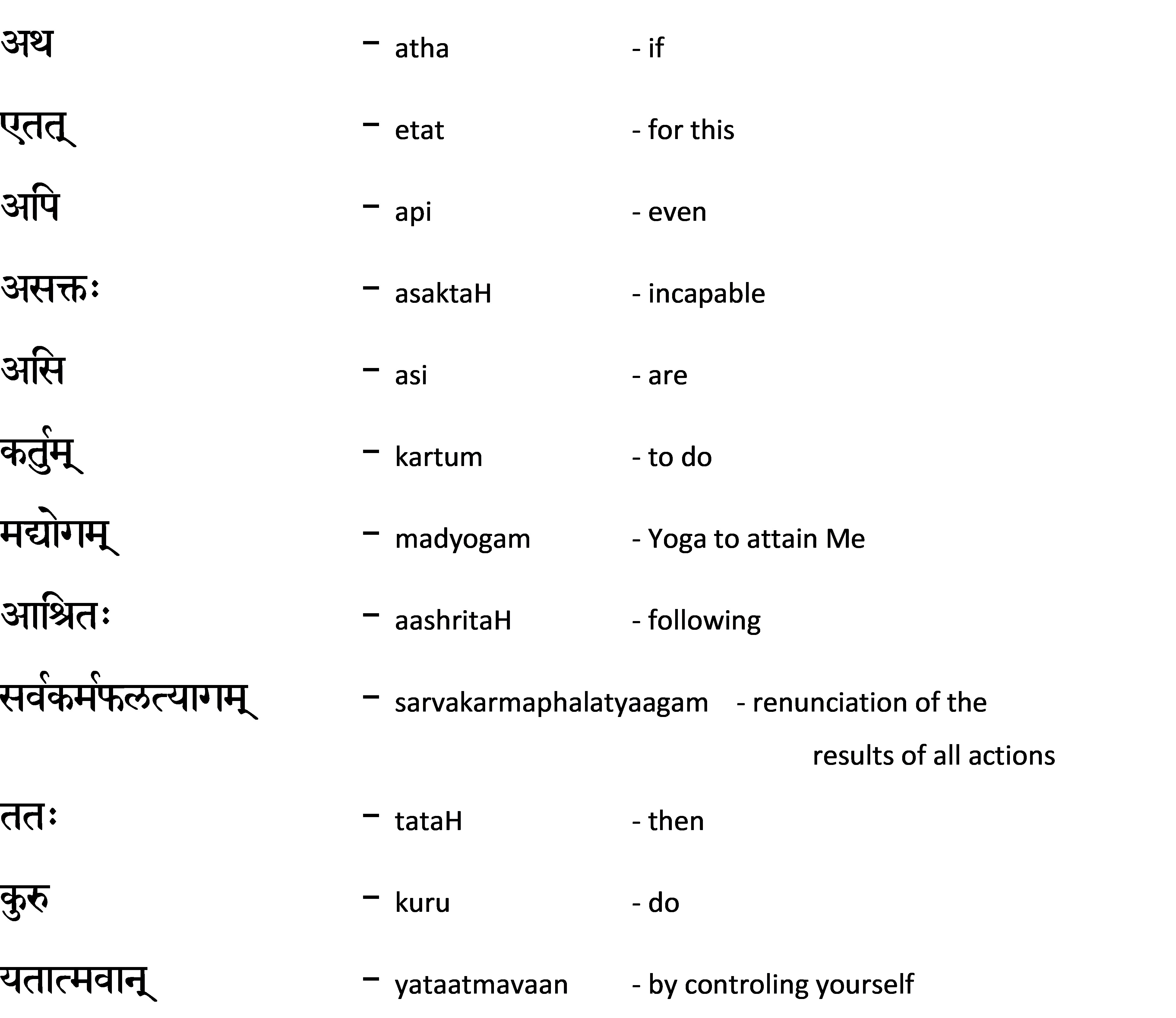
11. If you are incapable of performing even this (performing actions for Me), then be self-controlled, and taking refuge in Me, renounce the results of all your actions to Me.
In the Gospel of Sri Ramakrishna, he said that, just as a mother cooks various dishes according to children’s digestive capacities and tastes, several paths have evolved for the spiritual development of people to suit their capacities and mental constitutions. There cannot be a single path for everyone on Earth. Along the same lines, a spiritual teacher prescribes various paths to his/her students according to their capacity and mental chemistry. Shri Krishna, a great teacher, describes all possible ways for spiritual development in the Bhagavad Gita.
Shri Krishna tells Arjuna that if he cannot perform actions for God, then just offer the results of all his actions to God. Shri Krishna had described Karma Yoga, the Path of Actions, to attain the Highest Knowledge in the previous chapters. He has said (Gita 2.47), “You have a right to perform an action, not in the fruit of an action, do not get attached to the result of action – do not be inactive.”Here, Shri Krishna tells Arjuna the final step of Karma Yoga. We perform actions to enjoy their results. Our attachment to the results of the actions being performed brings joy or sorrow, depending on the favorable or unfavorable outcomes. The results of these actions leave deep impressions on our minds. Since we crave favorable outcomes, we constantly worry about the outcomes of our actions rather than focusing on the actions themselves. All these cravings and worries create constant disturbances and distractions in our minds.
Shri Krishna, knowing all the intricacies of human minds, suggests a simple but very effective path. Even though this path begins with a simple act of mentally offering the results of all our actions to God, if properly performed, it culminates in self-upliftment or self-transformation for the good. This path makes a person divine from the level of being a slave of the senses. How does it work? I think of the following steps:
(1) Remembering God: Initially, when we offer the results of our actions, we remember God.
(2) Awareness of the results of actions: Later, at the time of offering, we become aware of the results being good or bad, depending on whether we are going closer to God residing within or going away from God.
(3) Selection of actions: Because of this awareness, we start asking ourselves questions about what kind of actions we should perform or not perform. We examine whether the results of these actions are appropriate to offer to God.
(4) Improvement of our performance: Since we will not constantly think about the results of our actions, we will do our best in the performance of our actions. This way, we improve the quality of their results.
(5) Transformation: With all the above practices, a big transformation comes in us. We learn how to select appropriate actions, to perform them in the best spirit, and to offer their results to God. Our awareness of God increases throughout our lives, and it reflects in our thoughts, speech, and actions.
(6) Purification of our minds: Finally, the attachment to the results of the actions also goes away. This process purifies our mind and makes it ready to focus it on God. We realize that “God has created me, has given me an opportunity, capacity, and favorable conditions to do this work.” Thus, before, during, and after performing a work, what remains is the awareness of the presence of God. All the worldly consequences and attachments to the work and its results vanish, and we feel peace within.
A question comes: Is it not an idealistic imagination? Is this possible in real life? Has anyone ever tried this method and obtained a successful result? The answer is ‘yes.’ There are several examples. I will state one such example from the book, “They lived with God”, by Swami Chetanananda. This example makes us believe that this path is practical and not an imaginary hypothesis.
Girish Chandra Ghosh, a famous playwright of Kolkata, was a disciple of Sri Ramakrishna. One day, he asked Sri Ramakrishna for spiritual instructions. Sri Ramakrishna said, “Do just what you are doing now. Hold on to God with one hand and to the world with the other hand. Think of God at least in the morning and evening.” This sounded simple to Girish, but then he recalled that his life was so irregular that it would be hard for him to remember God at those stated hours, so he kept quiet. Sri Ramakrishna read his mind and said, “Well, if you cannot do that, then remember God before you eat and before you sleep.” But now Girish was reluctant to make any promises to Sri Ramakrishna. He knew that, with his instinctive resistance to self-discipline and rules, he might not be able to keep even this simple observance. Then Sri Ramakrishna went into an ecstatic mood and said to him, “So you are unwilling to agree even to this. All right. Give me your power of attorney. Henceforth, I will take full responsibility for you. You won’t have to do anything at all.” Giving power of attorney means that the consequences of all Girish’s actions will be borne by Sri Ramakrishna. After this, the life of Girish Chandra Gosh was transformed to such an extent that he found himself completely surrendered to God. He felt that he was an instrument in God’s hands. In the later part of his life, he would say, “Look at me. I am not even free to breathe.” Thus, surrendering the results of all our actions brings self-surrender and a constant awareness of God.
 mahendrajani