Category Archives: Vedanta

Shatashloki – XIII (Shlokas – 17 and 18)

“Shatashloki” of Shri Shankaracharya – XIII (Shlokas – 17 and 18)

Renunciation of attachment and desires 

The following shloka is for the person who wants to dedicate one’s life completely for God-realization (Self-realization) and service to humanity. First, one has to sever all external attachments with family and friends; second, one has to live with minimum without demanding much from the society; and third, one has to give up complete attachment with one’s body and mind and focus on God or one’s own divine Self.     

Meaning: Just as a snake discards one’s skin and moves away, the aspirant seeking God alone in life should leave home and free oneself from the attachment to family and possessions. Just as a traveler resorts to the shade of the trees for a short rest and proceeds on the road, the aspirant may remain in the body and try to maintain it with minimum necessities. Such an aspirant may eat fruits fallen from the trees or receives necessary food from the society to satisfy one’s hunger. In order to realize Self (God), the aspirant should focus his/her mind on Self (God) and completely give up identification with one’s body and mind.      

Comments: Clearly, this shloka is for those who have an intense desire to realize God and are ready to do anything to achieve that goal. We see that such a group of people is about 1% of the human population. It is amazing that in the midst of the world which offers various kinds of sense-pleasures, there are people who do not want any of this pleasure and they want to realize God. The following teaching of the Bhagavad Gita explains these rare phenomena.  

At the end of the sixth chapter of the Bhagavad Gita (6.37-39), Arjuna asks Shri Krishna, ‘what happens to a Yogi who is endowed with faith, but did not realize Self (God) before death? Would that Yogi be perished like a riven cloud?’ Shri Krishna said that such a Yogi does not get destroyed in this life or the next life. No bad thing happens to the person who had done any spiritual practices. After death, such a Yogi takes birth in a pure and prosperous family or the family of yogis rich in wisdom. There, the Yogi gets opportunity to connect with his/her spiritual knowledge acquired in the previous birth and continue to strive to realize the Self (God).’

What happens to the other 99% of the population? Vedanta says that each individual is ultimately going to realize one’s own true divine identity, called the Self (God). The purpose of the world is to make each individual attain that goal; only thing is that 99% of the people have to reach that goal going through detours. These detours could be shorter or longer. 99% of the people have to satisfy their worldly desires before they realize that ‘the goal of human life is to realize this Self and not to go on running after the worldly pleasures’. The worldly pleasures promise infinite happiness, but they only provide limited happiness along with lots of miseries and worries. Even the satisfaction of a worldly desire increases lots of greed to acquire more and makes life miserable.

Can a householder realize Self (God)? Sri Ramakrishna says that a householder can certainly realize God. But, every now and then, the householder has to go in solitude and reflect upon what is Real and what is Unreal. He/she has to realize that Self (Brahman or God) is only Real and everything else is unreal or temporary. Sri Ramakrishna told that King Janaka had realized Brahman, but he did lots of intense spiritual practices before. A householder also has to do lots of spiritual practices and perform one’s responsibilities in a detached manner prescribed by the Bhagavad Gita.

A Sadhu, one who has renounced everything to realize God, gives up everything externally and mentally. A householder has to renounce everything mentally. Sri Ramakrishna says that ignorance is ‘Me and Mine’ and “I am a doer’. One has to think that ‘everything belongs to God’; God has created everything, God preserves, and God dissolves. Even our body is not ours. We do not have total control on our body. We cannot control our heart, digestive system, and many other body’s functions. Thank God that we do not have control on it, otherwise we will mess it up. Similarly, we do not have control on our family members, friends, the world, and the circumstances. Things happen by some higher power, which we call God. We are just the instruments in the hands of God. A householder can mentally change this attitude from ‘Me and Mine’ to ‘Thee and Thine’ and realizing that ‘God is the ultimate doer of everything’, and work as a God’s instrument. This is householder’s renunciation.  

Many people enjoy taking name of God, singing dhoons, bhajans, and hymns and listening to the spiritual discourses, but when the word ‘renunciation’ comes, they get turned off. They love their worldly pleasures and do not see anything wrong in enjoying them. They think why we cannot do both: enjoy the worldly pleasures and sing God’s name or listen to spiritual discourses? They are only touching the ocean of the spirituality and may be occasionally swimming on the bank a little bit. When they realize that the worldly pleasures cannot give them what they were looking for, namely the Infinite Bliss, the Ultimate Knowledge, and Fearlessness (especially the Victory over the fear of Death), they go deeper into the spiritual practices leaving the world aside.

We have to remember how many sacrifices a person makes to achieve any worldly achievement. To acquire money, or power, or position, or a title, one gives up comforts, food, sleep, family-friend-time, and many worldly pleasures. Then, to achieve the highest thing a human being can achieve, namely, the realization of God, it is not surprising that we need to take our mind off from all the distractions of the world and fully focus it on the Self.

The positive attitude of Vedanta:

Without knowing the complete message of Vedanta, people get turned off by the word ‘renunciation’. Renunciation is giving up the wrong or faulty ideas and replaces them with the right ideas or the ‘ultimate Truth’. Sri Ramakrishna gave an excellent example. A person wants to go to the terrace of a building by climbing up on a staircase. He/she goes on the first step and asks, ‘Is this the terrace?’ and then denies it knowing that ‘it is not the terrace’. Thus, he/she denies all the steps and reaches to the terrace. After reaching the terrace, the person realizes that the steps are made out of the same material that the terrace is made of. Meaning, a person initially denies that my body, mind, vital forces, intellect, joy, family, friends and the world is Brahman (Atman or Self), and then by realizing the Self (Atman or Brahman), finds that everything is Brahman. Endowed with the limited physical characteristics (Upadhis), Brahman appears as material like body, mind and other things, but ultimately everything is Brahman. This is the highest knowledge. 

Desire, anger, and greed:

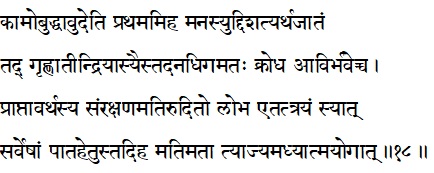
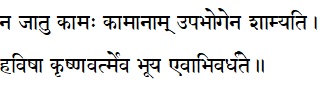
The following shloka describes how the three major enemies of a person, namely, the worldly desire, anger, and greed, arise in the mind.

Meaning: At first, desire for sense objects arises in the mind of human beings. Then, the mind craves and makes efforts to acquire these sense objects. After acquiring the sense objects the mind enjoys them through senses. When the mind cannot acquire these objects, then anger rises. For the acquired sense objects, the mind wants to protect them. Thus, greed arises in the mind. These three (desire, anger, and greed) are the cause of human being’s spiritual downfall. A wise person should focus one’s mind on the Self and the ways to realize It and stay away from the chain of desire, anger, and greed.    

Comments:

It is very natural that the mind seeks joy in the worldly objects. Since these worldly objects satisfy the cravings of the senses, the senses drag the mind outside in the world. According to the Vedanta, this is the play of the Maya, the power of Brahman.

Why senses run outside?

In the following shloka of the Kathopanishad, Lord Yama explains this play of the Maya:

Kathopanishad (2.1.1):

Meaning: The self-existent Supreme Lord delude the senses (destroy their super-power) by creating them with the outgoing tendencies. Therefore, a human being looks only outside and not the inner Self. A wise person, seeking the Immortality and Bliss, turn his/her senses introvert to realize one’s own inner Self.   

Hide-and-seek game:

Sri Ramakrishna talks about a children’s play, called hide-and-seek. In that game a grandma sits on a chair in the middle of an open area of a house. One child, called a leader, begins the game by facing his/her face towards a wall covering sides of his/her eyes with palms and counts 10. During this time, all other children hide in the various corners of the house. After counting 10, the leader tries to find another child and touch the child to make him/her ‘out (caught)’. If the child, who was found out, runs faster than the leader and touches the grandma, then he/she will be considered ‘saved’ and ‘not out’ (not caught). The one who gets ‘out’ becomes the next leader and the game goes on. The fun of the game is (1) to find places to hide, and (2) if found out by the leader, then to run around and somehow touch the grandma before getting caught.

Sri Ramakrishna used to say that in the beginning of the game if all go and touch the grandma, then the fun part of the chasing and screaming of the children of the game will be missed. The grandma enjoys the running around of the children and their joyful noises when they run. Thus, the world is a play of Maya. Touching the grandma is getting liberated. Maya does not want all get liberated, so the worldly game goes on.  

Usual complain:

By listening to this hide-and-seek game and the play of the Maya, usually a thought comes to the mind, ‘well, it might be fun for the Maya, but we suffer in the world and the Maya is having a good time at our cost.’ 

The Vedanta’s answer is that ‘Everything is Brahman. Out of ignorance a person separates oneself from the Brahman, creates a small self with body and mind (called ego) and enjoys as well as suffers.’ After much spiritual practices, by Brahman’s (God’s) grace, one realizes this Ultimate Reality, and goes beyond the pairs of opposites like pleasure and pain. Many don’t like this answer of the Vedanta. But, when we go deeper and reflect upon the Ultimate Reality, we understand the significance of the real answer. All other answers do not stand the reasoning.          

Now, as long as we have ‘ego’ and we consider ourselves as different from Brahman (Existence-Knowledge-Bliss Absolute), we have to do spiritual practices and follow the guidelines provided by the scriptures in order to realize the Ultimate Reality (or Truth).

Many wise people have realized that all other worldly answers and efforts are like “Band-Aids” and do not solve the real problem.

A few teachings of Bhagavad Gita:

This Shatashloki’s shloka directly reflects the teachings of the Bhagavad Gita. The following shloka of the Bhagavad Gita tells us how harmful desire, anger, and greed are. 

Gita (16.21)  

Meaning: Desire (especially lust), anger, and greed are the three doors to hell (the lowest state of consciousness in the relative world). These three destroy the self. Therefore, a person should get rid of them from one’s mind. 

It is NOT easy to get rid of desire, anger, and greed. First, we have to understand how harmful they are. When a person finds out that there is a poisonous snake in the house, then that person will be eager to get rid of this snake as soon as possible. Legitimate desires are okay. But, illegitimate and harmful desires which bring ruin to a person and make a person slave have to be renounced. Second, we have to regularly do spiritual practices. By spiritual practice, we understand what is going on in our mind and we can separate good and helpful desires from the bad and harmful desires. Third, we have to have ‘holy company’; company of people who have renounced these three things or even trying to renounce them. Holy company also includes inspiring books, and audio-video lectures. Fourth, we have to avoid the company of those who encourage us for worldly desires, anger, and greed. If we cannot avoid such people, we have to be careful not to have their influence on our mind.        

A person with steady intellect:

At the end of the chapter-2 of the Bhagavad Gita, Arjuna asked Shri Krishna, ‘What are the characteristics of a person with steady intellect who has merged in the Samadhi (meaning has attained the Highest Knowledge)’. The very first characteristic presented by Shri Krishna is most appropriate here. 

Gita (2.55)  

Meaning: O Partha (Arjuna)! When a person casts off all the desires of the mind and is fully satisfied by dwelling on the Self alone, then that person is called ‘a person with steady intellect’. 

Can we get rid of all desires?

The answer is ‘NO’. As long as a person is alive, he/she will have a desire to maintain the body by providing it food and other necessities. Then, why Shri Krishna said that the person has cast-off all the desires? I will just share my thoughts on this.

We see from the lives of all the people who had attained the highest knowledge that at one point in their lives, each one of them had only one intense desire left, namely, to attain the highest knowledge. They had lost interest in all other desires including the desire to keep the body alive. During the spiritual practices, at one point Sri Ramakrishna’s mind was filled with only one desire, ‘I want to realize God’. The mind was not available to think even for the food. A sadhu used to put food in his mouth and with a stick used to push it inside. That is how he survived during his intense spiritual practices. Such lives show the validity of Shri Krishna’s words that a person has casts off all the desires.

As long as we have many other desires, we cannot realize God. Sri Ramakrishna used to say that in order to pass a thread through an eye of a needle, all the fibers of the thread should be combined and make it one-pointed. Even if a small fiber is sticking out, the thread cannot go through the eye of a needle. When the desire to realize God becomes intense, the other desires fade out. Even when one enjoys doing spiritual practices regularly, the harmful and useless desires slowly drop off because they become hindrance. When such desires drop off, one feels peace within.    

Sri Ramakrishna gave another example of a child. As long as a child is busy playing with toys, the mother takes care of the housework. If a child gets bored with one toy and screams “Maa”, the mother knows from the scream that the child is still interested in playing with more toys. Finally, when the child really gets bored playing with the toys and there is only one desire left, namely, ‘I want my mother’, then the real scream comes. The mother knows this scream and she comes running to the child.

After God-realization, God keeps desires in the minds of the Saints and Sages to maintain their bodies in order to guide humanity in the spiritual path and enjoy taking name of God.            

The following shlokas, Bhagavad Gita (2.62-63), tell us how desire, anger, and greed bring our destruction.

Meaning: When a person dwells on the worldly objects, he/she feels an attraction for them. This attachment gives rise desire to acquire these objects. When one does not acquire them, then that breeds anger.

From anger comes delusion (lack of clarity in the mind); from delusion, the failure of memory (of all good things one had heard), the ruin of discrimination (between what is right and what is wrong); and from the ruin of discrimination the destruction of the person.     

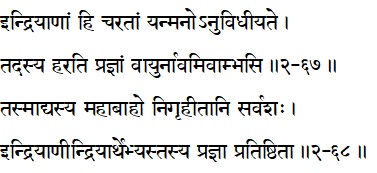
I will conclude with another two shlokas of the Bhagavad Gita (2.67-68) which tell us why we should control our senses. 

Meaning: For even one of the roving senses, if the mind yields to it, carries away discrimination as a gale carries away a ship on the waters.

Therefore, O mighty Arjuna, his wisdom is steady whose senses are completely restrained from their objects.  

Shatashloki XI (shlokas 12 and 13)

“Shatashloki” of Shri Shankaracharya – XI (Shlokas – 12 & 13)

How the seekers of God live in the world?

According to the Vedanta Philosophy, the goal of a spiritual seeker (or an aspirant for liberation) can be expressed in various ways. The following is a list of a few of these expressions:

(1) To attain the highest knowledge.

(2) To realize that one’s true identity is Atman,

(3) To realize God and to experience that God has become everything.

(4) To realize that ‘Brahman is the Ultimate Reality and Brahman is appearing as the universe’. For such a person three things become one; the knower, the object of knowledge, and the knowledge.

(5) To attain the state of ‘Sthita-prajna’, a person having steady intellect all the time.

(6) To attain a state of ‘Gunatita’, a state beyond the three Gunas, sattva, rajas, and tamas.

(7) To break all the bondages and be completely free.

(8) To attain a state of complete self-abnegation, meaning one constantly realize that everything belongs to God and I am an instrument of God.

A seeker of God always wants to know how one should live in the world while pursuing to achieve one’s spiritual goal. Shri Shankaracharya in the following two shlokas of Shatashloki gives a very clear guideline on how a spiritual seeker practicing Jnana Yoga (the Path of Knowledge) lives in the world.

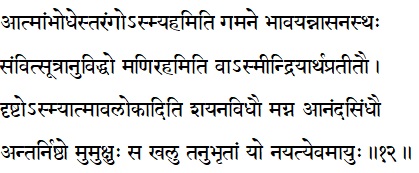
Shloka – 12:

Meaning: An aspirant of liberation who has been established in the Atman (one’s true identity) residing within lives in the world in the following way:

(1) While engaged in the activities, looks upon oneself as a wave in the ocean of Brahman (Pure Consciousness),

(2) While sitting, thinks of oneself as a jewel strung on the thread of Brahman,

(3) While experiencing sense objects, sees all the objects as Brahman, and

(4) While sleeping, thinks of oneself immersed in the ocean of the bliss of Brahman.   

Comments: While living in the world, an aspirant of liberation wants to keep his/her mind connected with Brahman (or God).  This shloka gives us a very clear picture of how we can connect ourselves with Brahman in all our various states.

(1) When we are engaged in activities, we can think that we are the waves of the ocean of Brahman (Pure Consciousness). We are part of Brahman. The ocean is always active. The whole universe is active including the sun, the moon, the planets, the stars, the earth, and all beings. We can think that we are performing our responsibilities given to us by Brahman (God) and we can perform them only through the power of Brahman.

(2) When we are not active but awake, we can think that we are connected with all as the jewels of a necklace connected by a thread. This thread is the Atman or Brahman.

This reminds the message of the Bhagavad Gita (shloka 7.7): “O Dhananjaya (Arjuna), there is nothing higher than Me (Brahman). All are strung on Me as a row of gems on a thread.”

The Ultimate Knowledge is the Knowledge of Oneness. If we remove our names and forms we are all one. We are Pure Consciousness. The names and forms separate us from each other. Once we know the oneness behind all of us, all the negative things like fear, jealousy, hatred, greed, and others go away and our lives get filled with love and compassion for all.

(3) While enjoying the sense-objects, we can think that ‘everything is Brahman’.

Shri Krishna in the Bhagavad Gita (7.11) says, “I am the strength of the strong, free from longing and attachment.  O Bharatarshabha (the Lord of the Bharatas – Arjuna), I am the desire in all beings that is not contrary to dharma.”

While fulfilling the legitimate desires, if we do not want to get bounded, then we have to be detached. A spiritual seeker has to develop a skill to enjoy legitimate desires without becoming a slave of the objects. For example, wise people say that ‘it is okay to drink tea or coffee, but make sure the tea or coffee does not drink you’. This means that we do not become slaves to the objects of the world. Everything we have to do in moderation and we have to have total control over ourselves. Therefore, in the above shloka, Shri Krishna used the words free from longing and attachment. To attain this state we have to learn to be detached and it is possible when we have total control over our mind and the senses. One way to be detached is to offer the results of all our actions to God. Through spiritual practices, holy company, reflections, and the grace of God, we acquire inner strength which helps us get such control and learn how to be detached.

(4) I have heard from Swami Adiswarananda that ‘a spiritual seeker who sincerely does spiritual practices and does not do anything wrong gets a good night’s sleep’. He/she has nothing to worry about. His/her conscience is very clear. In addition to this state of mind, if the spiritual seeker thinks while going to bed that ‘he/she is going to get immersed into the bliss of Brahman’, then that will be the best way to sleep and connect oneself with Brahman. Dreamless deep sleep gives us an idea of the blissful state of Samadhi, the highest state that a spiritual seeker can attain. In the dreamless deep sleep, our ego remains in a subtle form. This ego comes back as soon as we are out of deep sleep and then we become our formal self. But, in the Samadhi, one’s ego gets completely effaced and the person becomes free from all bondages and sufferings, and one experiences infinite bliss. Such a person’s ego remains like a line drawn on water.

Thus, in our daily activities, we can remain connected with our ultimate goal, Brahman.

The following shloka describes more ways to look at the world.

Shloka – 13:

Meaning:

A person who has acquired the highest knowledge (Jnana) and had direct experience of the highest truth (Vijnana) realizes the following: (1) The whole universe which is made out of names and forms is a fraction of Brahman, (2) Because of the indwelling Self (Atman), all beings of the universe move around as living beings and experience the objects of the world, and (3) Just like the sun, the Self is neither a performer of any action nor the enjoyer of it. Such a person lives in the world keeping his/her mind always focused on the Supreme Self (Atman/Brahman).

Comments:

Sri Ramakrishna explains Jnana and Vijnana by giving simple examples. He says that just knowing the milk and seeing it is Jnana, but drinking the milk and gets nourished by it is Vijnana. One who has known about God and has seen God is a Jnani and one who has an intimate relationship with God and converses with God is a Vijnani. Thus, the Vijnani remains constantly aware of the presence of God or Brahman and knows how to live in the world with that awareness.

Brahman is appearing as the universe, but because of the names and forms, we see things differently.

Because of the power of Brahman, residing in the beings as Self (Atman), all beings get power to move around and perform all their functions. Also, the consciousness of the Self illumines the intellect and through that, all living beings experience the objects of the universe.

The sun shines and in its light people can see things and perform all their actions. But, the sun is not the performer of any action. Also, the sun is not affected by the results of the good or bad actions of the people. Similarly, the indwelling Self is a witness consciousness. In and through Its light of consciousness people experience the objects of the universe and perform all kinds of actions. The Self is not the performer of any action and so It is not affected by the result of any action. A person who performs the actions experiences the results of his/her actions. This person is the ‘ego’ (Jiva) made out of the body-mind complex which separates itself from the Self. That Jiva enjoys or suffers the consequences of its actions. When the ‘ego’ vanishes, the ‘Jiva” becomes one with the ‘Self’.

Shri Ramakrishna used to say often that ‘I am an instrument and the Mother of the Universe is its operator.’ He also said that several fruits when ripped their seeds get separated inside from the fruits. If you shake the fruits, then you can hear the sound of the separated seeds. Thus, when a person realizes that his/her true identity is the indwelling Self (Atman), and not the body-mind complex, then he/she mentally separate the inner Self from the body and mind. Such a person realizes that in the light of the Atman the body and mind are functioning, but the Atman is doing nothing. The following shlokas of the Bhagavad Gita express this truth very explicitly:

Bhagavad Gita (5.8-9): “The Yogi, the knower of Truth, clearly realizes that in seeing, hearing, touching, smelling, tasting, walking, breathing, sleeping, speaking, emitting, seizing, and opening and closing eyes, he/she is doing nothing; only the senses are busy with their objects.”   

In the fourteenth chapter of the Bhagavad Gita, Shri Krishna says that according to the dominance of the three Gunas, namely, Sattva, Rajas, and Tamas, the body and the mind of a person perform all actions. A person who has gone beyond the three Gunas knows very well that the “Gunas are acting through the body and mind”. By knowing this he/she remains as a witness consciousness without being disturbed by the Gunas’ activities.

This shloka gives a clear picture of how a Jnani and Vijnani live in the world keeping one’s mind connected with the Supreme Brahman. A spiritual seeker should try to live in the same way.

Shatashloki X (shloka – 11)

“Shatashloki” of Shri Shankaracharya – X (Shloka – 11)

Wise people desire to realize Brahman only.

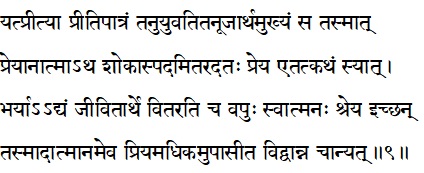
Meaning:  In this world, there are two kinds of ‘Shreya’ (preferable) things and two kinds of ‘Preya’ (pleasurable) things:

(i) ‘Kamya Shreya’ (short-term, lower-desire-oriented preferable things) and

‘Kamya Preya’ (short-term, lower-desire-oriented pleasurable things), and

(ii) ‘Atyantika Shreya’ (long-term, higher-desire-oriented preferable things) and

‘Atyantika Preya’ (long-term, higher-desire-oriented pleasurable things).

Among these, both ‘Kamya Shreya’ (desires to attain heaven and others) and ‘Kamya Preya’ (desires for sense pleasures) are the cause of suffering. Even though both of these lose their charm after some time, ignorant people continue to desire them.

‘Atyantika Shreya’ (things which are always good for us) and ‘Atyantika Preya’ (things which are always likable) aim for the realization of Brahman (the Ultimate Reality) which is the source of infinite bliss. Therefore, wise people desire the realization of Brahman. This has been mentioned in the Kathopanishad, which is divided into six sections.

 Comments: The story of Kathopanishad is very well-known. Once, Rishi Vajashravasa wanted to perform a ‘yajna’ in which he had to give away everything that he possessed in order to get the highest benefit.  At that time, a person’s wealth was measured on the number of cows he/she owned. Rishi Vajashravasa had a young son named Nachiketa. Vajashravasa, out of love for his son and thinking about his livelihood, kept the healthy cows hidden and wanted to give away all the weak cows. Nachiketa found out what his father was doing and thought that this act would not bring good to him. Nachiketa thought that if his father gives him away to someone, then he would not have to worry about his livelihood.

Nachiketa asked his father to whom he would be given. His father ignored this question. But when Nachiketa asked him two-three times, then his father, out of anger, told him that he would give him to Yama, the Lord of death.

Nachiketa sat in meditation and went to Yama. He found that Yama was not at home. His wife asked Nachiketa to come inside the home and wait for Yama. But Nachiketa waited outside the house for three days and three nights without any food or drink. When Yama came home and found out, he sought to appease Nachiketa by offering him three boons. Nachiketa agreed to it.

For his first boon, Nachiketa asked that when Yama would release him and sent him back to his home, his father would forgive him and would receive him with love. This boon was granted.

For his second boon, Nachiketa asked for Yama to teach him the yajna which would take him to heaven. Yama taught him the yajna and was he pleased to find that Nachiketa was a very fast learner. Yama said that now onwards this yajna would be known as ‘Nachiketa Yajna’.

For his third boon, Nachiketa asked Yama the following question: One group of people on Earth says that there is life after death and another group of people says that there is no life after death — which is the truth? Yama told Nachiketa that this was a very difficult thing to comprehend and therefore he should ask another boon instead. But Nachiketa was determined to know, ‘whether there is a life after death’. Yama instead offered Nachiketa a long and healthy life, as much wealth as he wanted, horses, chariots, musicians, dancers, and all the possible worldly pleasures as an alternative to answering his question. Nachiketa rejected all of Yama’s offers, saying that all these things give happiness only for a few days and they were of no use. Nachiketa said that he had found a great teacher like Yama who possessed this knowledge about life after death and therefore he did not want anything else.

Yama was pleased by Nachiketa’s intense desire to get the highest knowledge and his clear understanding of the futility of the worldly pleasures. Yama said that anyone else would have been drowned in the river of temptations he had offered, but Nachiketa had discarded all of them in order to seek the highest knowledge.

Now, what Yama told Nachiketa is stated in the Shatashloki shloka -11.

Kathopanishad (1.2.2) says, “Both, the preferable and the pleasurable things, come to a human being. Wise people thoughtfully analyze them, separate them, and select the preferable over the pleasurable. On the other hand, the dull-minded, for the immediate gratification of their sense-pleasures, select the pleasurable over the preferable.”

There is a general tendency of the human mind to go for immediate pleasures and to find a short-cut for success and enjoyment compared to a path that gives longer-lasting joy and uplifts the mind to a higher purpose but requires hard work, struggle, and a long time commitment. Kathopanishad describes the reason why this is the case.

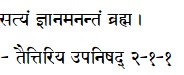
Kathopanishad (2.1.1) says, “The Creator has deluded the senses by making them extrovert. Therefore, a human being seeks pleasures outside and never looks within. But a wise person, who is seeking infinite bliss and immortality, turns his/her senses within and realizes the inner Self.”

Someone asked, Swami Nikhileswarananda, the head of the Ramakrishna Ashram, Rajkot, India,  a question: “How much spiritual practice should I do?” The Swami asked him a counter-question: “How much bliss do you want?”

Here is a series of Q&A I had with my Vidyapith students:

Q:  “Why are you studying hard?”

A: “For good grades.”

Q: “Why do you want good grades?”

A: “So we can go to a good college.”

Q: “Why do you want to go to a good college?”

A: “So we can find a good job.”

Q: “Why do you want a good job?”

A: “So we can make lots of money.”

Q: “Why do you want lots of money?”

A: “So we can have an enjoyable family life.”

Q: “Why do you want an enjoyable family life?”

Students smiled at this and to end the conversation said, “Just to enjoy, to have fun.”

This is a general trend in society:  if we make lots of money, then we can have an enjoyable family life and be happy. There is some truth in this and I am not against this trend. But there are other higher goals in life which can give us a longer-lasting and deeper joy and satisfaction than sense-pleasures bought with money. There is greater joy in going deeper into music, dance, studying and writing, doing research in various fields, doing spiritual practices, and performing unselfish service to the community and others.

Among all of these, over the period of thousands of years, wise people have found that doing spiritual practices to realize one’s true divine identity (which Vedanta calls the Self or Atman) seeing that same Atman in all, and doing unselfish service to all gives us an abundance of bliss, satisfaction, and fulfillment of all our desires. The proof of the pudding is in the eating. The only way to find this out is to try it. We may study well, have a good job, make money and perform our family responsibilities, but along with it we have to spend time on our personal spiritual development and do some unselfish service to humanity. There are a few people who have understood that Self-realization and unselfish service to humanity is the highest goal of life and that gives us everything we are looking for in our human life. Such people give up everything else and devote their entire life to realize this goal. There are also others who have understood this highest goal, but they are living family lives. They perform their family responsibilities as an offering to God and try to achieve this highest goal by giving it the highest priority in life.  This shloka talks about this highest goal.  Let us work hard to achieve this goal and make our life a blessing.

(Thanks to Sonali Tatapudy and Rushil Desai for their help in editing this post.)

Shatashloki – IX (Shloka 10)

“Shatashloki” of Shrimad Shankaracharya –IX (Shloka – 10)

Only Atman is likable for all the time

Shloka – 10

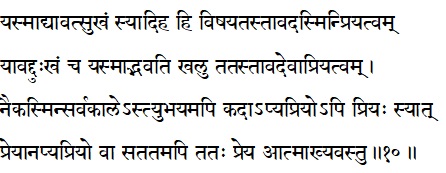
Translation: In this world, one likes an object (or a person) as long as it gives happiness.  On the other hand, one dislikes the same object when it gives pain.  No object is likable or dislikable for all the time. Sometimes a likable object becomes unlikable and an unlikable object becomes likable. But, Atman is the only one that is likable all the time.

Comments:

Love, happiness, and selfishness:  This shloka states simple facts that in this universe love and happiness are inter-related and are in direct proportion.  If an object gives more happiness, then it becomes more lovable in proportion to happiness.  On the other hand, pain and dislikes are inter-related and are in direct proportion. If an object gives more pain, then one dislikes it in direct proportion to the intensity of the pain.

This fact has two levels. On the general level, it applies more to the selfish people. They love themselves and they love who gives them happiness. They love people as long as their selfish interest is fulfilled and dislike them when their selfish interest is hindered. We may get surprised whether the same person loved us a few days ago and how that love disappeared. But, this is the way of the world. Let us look at the deeper side of love, likes, and dislikes.

The Parents’ Love: Does this above mention fact apply to the parents’ love for their children, and especially, mothers’ love for her children? Out of love, going through so much sacrifices and suffering, parents raise their children. Children out of their ignorance and lack of maturity give pain to the parents, but the parents continue to love them. It seems that this fact does not apply to them. But, if we reflect upon this, then we find that parents also derive joy within to do something for their children even though children give them pain. I have seen, little children kicking their mothers, but mothers continue to feed them. However, the parents’ love is limited to their children, and so it is considered as an attachment. But, this love is better than selfish people’s love. Sri Ramakrishna said that God puts love in the hearts of the parents, so their children can grow.

A sincere and dedicated teacher may not be likable to a lazy student who wants success without any efforts. But, a student who wants to learn and make progress in his/her field will not mind the teacher’s strict attitude, demand for progress, criticism, or even scolding. The student understands that it is for his/her progress the teacher is taking the trouble. Parents also play such a role as strict teachers to raise their children properly. In these cases, even though there are pain and suffering, but students or children love their teachers and parents. Besides parents, school, and college teachers, there are many kinds of teachers in society helping their students, or players, or assistants, and others.

The genuine spiritual teachers, besides various guidance and training, work on the ego of their disciples. They want to remove the false ego of their disciples and develop humility in them to become worthy of spiritual knowledge. It is painful, but sincere disciples undergo this training and still keep the love for their teachers.

Holy people:  Then, there are a much deeper side of love, likes, and dislikes. There are people on earth who see God in all and love all. They are ready to serve all as worship to the God residing in them. Their love is unconditional and they do not expect anything from anyone. Offering service to all as the worship of God is their greatest happiness. Serving all is not easy. There is a saying that the mouth bites the very hand which feeds it. Many times people enjoy being served and simultaneously criticize who served them. But, the holy people continue to serve all irrespective of the people’s behavior that they serve.

There is a famous example of a holy person who was taking a bath in a river. He saw a scorpion was drowning in the river.  He put his hand under the scorpion and tried to lift it up above the water.  As soon as his hand touched the scorpion, it bit his hand. The holy person could not hold the scorpion in his hand. The scorpion started drowning again. The holy person tried to help it again and the scorpion bit his hand again.  The holy person was again extending his hand to save the scorpion. Someone on the shore who was watching this whole scene shouted to the holy man saying why he is trying to save the scorpion who continues to bit him. The holy man said that the scorpion is not giving up its nature to bite, then why should he give up his nature to help? This is a very high state of love. But, there are holy people on earth who love all and serve all without thinking of any return or about their own life.

A difference between a holy person and a selfish person is evident. If we have done ninety-nine bad things and one good thing to a holy person, then the holy person will remember one good thing and forgets all the ninety-nine bad things. On the other hand, if we have done ninety-nine good things and one bad thing to a selfish person, then that person will remember only that one bad thing and forgets all the ninety-nine good things.

The nature of mind: This shloka brings out another important point that no object is likable or unlikable all the time. The likable may at some time become unlikable and an unlikable at some time becomes likable.

We have heard from Swami Chinmayananda one of his life experiences. He was observing silence during his meals. In one house a host served him Karela (the bitter gourd), which are very good hygienically but are bitter. He thought that let him eat that first and then enjoy the other items that were served. He finished the Karela first. The host thought that Swami likes Karela. The host mother served him more Karela. This time, Swami Chinmayananda kept the Karela up to the end and somehow swallowed them up and drank water. The next day, Swamiji was going for a bhiksha to another house. Now, this new host called the previous host and asked what items the Swami likes to eat. This host said that Swamiji loves Karela. Swami Chinmayananda felt bad to tell people that he does not like Karela but eats them because people were serving him with love. Then, Swamiji said that after eating Karela from eight to ten houses, he started liking them. Thus, unlikable things may become likable.

The mind is amazing and it is very difficult to understand its nature. The mind craves for something and if we make efforts to acquire that object, then in the middle or at the end it loses its interest in the object. Many times even it starts liking something else. One of the difficult spiritual practices is to control the mind. Most people unknowingly become slaves of their minds. They think that they are free to select what they want, but actually, out of mind’s slavery, they are forced to select a particular thing. We find that in most cases love and hatred depend on the mind’s moods and the mental states.

Swami Brahmananda said that controlling the mind is like controlling a naughty restless child. Spiritually advanced people have control over their minds. Their minds will do what they want them to do.

Also, when situations change, then our needs also change. For example, warm clothes give warmth in the winter, but they make us feel uncomfortable in the summer. Things which are good in one surrounding or at one stage, may not be good in other surrounding or at another stage. The toys which entertain children will not entertain them when they become youngsters. Similarly, the things which youngsters like, they may not like them when they become adults.

Love for Atman:  This shloka is actually connected with the previous shloka – 9. We learned in that shloka that because Atman is residing in all, we like all.

Those spiritual seekers, who sincerely do spiritual practices to realize Atman (God or Brahman), find that the more they advance in their path, their love for Atman or God increases more. As we have seen that in the case of the worldly love, a likable thing may become unlikable, and an unlikable may become likable. But, in the spiritual path, God, or Atman becomes more and more likable. Finally, a spiritual seeker realizes that Atman or God or Brahman has become everything. That is why they love all and ready to serve all.

Therefore, this shloka says that seek only Atman. The worldly things lose their luster when we see them as matter, but, if we realize that everything in the universe is covered by God or Brahman, then we love all and serve all.

Kaivalyashtakam

Kaivalyashtakam

Kaivalyashtakam is one of my favorite hymns.  Many saint-poets of India did not attach their names with their poems or hymns. This is one such hymn. The saint-poets think that God inspired them to write poems or hymns, or these poems or hymns revealed to them from within, therefore they are not the authors. It is a great example of selflessness.

Gita Press, Gorakhpur has done a great service to humanity by publishing Hindu scriptures with excellent printing and binding. Also, the prices of these scriptures are most reasonable. The Kaivalyashtakam is hymn # 72 in the collection of hymns, called “Stotra Ratnavali”, published by the Gita Press, Gorakhpur.

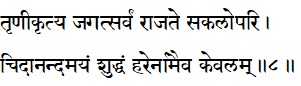
Kaivalyashtakam is a hymn with simple Sanskrit words, but it is very poetic and it expresses the fundamental principles of spirituality. The refrain in this hymn is “Harer Naamaiva Kevalam”, which means that ‘repeating the name of Hari (God) is the only important thing for spiritual life.’

Sri Ramakrishna learned Vedanta philosophy from a great spiritual teacher Totapuri. Following the Vedantic meditation under the guidance of Totapuri, Sri Ramakrishna attained the Nirvikalpa Samadhi within a couple of days. Nirvikalpa Samadhi is the highest state in spirituality. In this Samadhi one’s mind completely merges with the Ultimate Reality, called Brahman. In that state, one remains in a continuous blissful state and that person has no consciousness of his/her body and mind and space and time.  Totapuri was amazed to find that what took forty years of spiritual practices for him, that Nirvikalpa Samadhi, Sri Ramakrishna attained in a few days.

However, next day, Totapuri was amused to see that Sri Ramakrishna was chanting Mother Kali’s name and clapping his hands. He was thinking why Sri Ramakrishna is behaving like a beginner in the spiritual path after attaining the Nirvikalpa Samadhi.  Totapuri wanted to express this thought to Sri Ramakrishna, so he said to him in a light tone, “What? Are you making chapatis (Indian bread made by hands)?” Sri Ramakrishna said, “I am taking the name of God.”  Totapuri believed in God without form and he did not find it necessary to go to the temple, or take the name of God with a form, or worship such God and perform any rituals for his spiritual progress. We know that later he had a severe stomach ache. He sat in meditation and started thinking, “I am not the body, I am not the mind, I am Atman, I am Consciousness, I do not have any pain.” But, his meditation on the formless Brahman could not lift up his mind beyond his stomach pain. Out of frustration, he decided to drown himself in the river Ganga. At that time, he had a vision of the Universal Mother who showed him that She is the power of Brahman and everything happens according to Her wish. His heart was filled with devotion. He understood the significance of chanting the name of the Mother. Thus, Sri Ramakrishna and Totapuri taught us the significance of chanting God’s name. Saints who have realized God say that chanting God’s name is enough to attain everything in the spiritual path.

Sri Ramakrishna also said that when a person sings musical notes ‘Sa, Re, Ga, Ma, Pa, Dha, Ni, and upper Sa”, then one cannot stay on the upper Sa note for a long time. After some time one has to come down to the lower notes. Similarly, one cannot remain in the Nirvikalpa Samadhi for a long time. After some time, one has to come down to the body-mind level. Now, when we are aware of our body, our name, and form, then God also has a name and a form.  At that level chanting of God’s name is the most effective way to focus our mind on God.

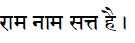
Name and form are inseparable. This way  ‘Nama’ (God’s name) and  ‘Nami’ (the form of God represented by that name) are inseparable. If we chant ‘Rama’ then the form of Lord Rama comes to our mind and if we think of the form of Lord Rama, then the name ‘Rama’ comes to our mind. In India people chant  ‘Rama Nama Satta hai’, meaning the name of Rama is the Ultimate Truth. Since Rama as God is the Ultimate Truth, the name of Rama is also the Ultimate Truth. This is also the meaning of “Harer Nmaiva Kevalam’.

Now, let us look at the meaning of the eight stanzas of the Kaivalyashtakam and develop a love for chanting God’s name. The word    ‘Ashtakam’ means a collection of eight stanzas. Many hymns have been composed with eight stanzas and we find the word ‘Ashtakam’ attached to the title of the hymn.

Stanza – 1:

Meaning:
God’s name is the sweetest among all the sweet things,
God’s name is most auspicious among all auspicious things,
God’s name is most purifying among all purifiers,
Chanting God’s (Lord Hari’s) name is most important in the spiritual life.

Comments:

In life, all sweet things lose their sweetness at some point. Change of the situations or change in the things themselves or change of the mind-set makes the worldly things lose their sweetness. Only chanting God’s name with proper understanding makes it sweeter and sweeter every day.

Chanting God’s name brings all the good in our life. It brings us peace of mind, gives us the inner strength to go through the sufferings of life, and brings inner satisfaction.

Chanting God’s name develops a love for God and this love for God destroys lust, greed, anger, jealousy, and other impurities from our mind.

Chanting God’s name gives us everything that spirituality offers.

Stanza – 2:

Meaning:

Everything from Brahma, the creator of the universe, to the blade of grass is covered by Maya.

Chanting God’s name is the Ultimate Truth, that is the Ultimate Truth, and again I repeat, that is the Ultimate Truth.

Chanting God’s (Lord Hari’s) name is most important in the spiritual life.

Comments:

Whatever we perceive through our senses have a beginning and an end. They are constantly changing. Worldly things look different than they actually are. We get trapped by their external glories. These temporary things cannot give us permanent happiness. If we consider the worldly things or worldly situations as permanent, then we suffer when these things change or we lose them. If we understand that the worldly things and situations are impermanent and they may change at any moment or vanish, we prepare ourselves to accept the change, and then we can live in the world with sanity.

Our body and mind constantly change, but our Atman under whose background we perceive these changes is permanent. It is the support of our bodies and mind. Similarly, in the world, all things are constantly changing, but the support of the world, Brahman, is not changing. It remains the same and in the background of Brahman, we perceive the changes in the world. Our true nature is that Atman which is the same as Brahman. That is the only truth.

We can directly realize this Atman or Brahman by focusing our mind within ourselves in meditation. But, it is very difficult for most people. The other way is to focus our minds on the forms of God, or the forms of incarnations of God, or the forms of the realized beings. Since the name and form are inseparable, by chanting God’s names, or incarnations’ names, or realized beings’ names, we become one with them and through them, we realize our true divine identity. Thus, chanting God’s names lead us to the highest goal of spirituality.

Stanza – 3:

Meaning:

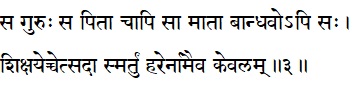
One who teaches us to chant God’s name, he/she is our spiritual teacher, our father, our mother, and our sibling.

Chanting God’s (Lord Hari’s) name is most important in the spiritual life.

Comments:

Father, Mother, spiritual teacher, and siblings think for our good. They wish that we are in good health; we study well, have an excellent job, earn lots of money, have a happy family life, and acquire name, fame, power, and the highest position in the world. No doubt, these are good wishes. But, all these things give us temporary happiness. Since the worldly happiness and miseries go together, we cannot have happiness without miseries. This stanza says that among them those who teach us to chant God’s names are the best well-wishers. Because, chanting God’s name will give us eternal happiness, satisfaction, and everything that we are actually looking for in the world.

Stanza – 4:

Meaning:

There is no guarantee which one will be our last breath.
Therefore, chant God’s name from childhood.

Chanting God’s (Lord Hari’s) name is most important in the spiritual life.

Comments:

Life is unpredictable and very short. Time flies very fast. So, we have to start chanting God’s name from childhood, if we really want to enjoy the precious fruits of our spiritual efforts. If we have missed it in our childhood, then we have to start chanting God’s name as soon as we have realized its importance. People think that when we finish our worldly duties and retire, at that time, we will take the name of God. But, it does not work that way. As Swami Brahmananda has said that it is like on a hot summer day, a person is waiting on the shore for the waves to stop, so that he/she can jump in the ocean to cool down. Waves will not stop. We have to jump in. Also, whatever our interests are at present, the same interests will continue when we retire. We cannot all of a sudden develop spiritual interest when we retire.

Stanza – 5:

Meaning:

God always resides where the devotees chant God’s name with devotion.

Chanting God’s (Lord Hari’s) name is most important in the spiritual life.

Comments:

Sri Ramakrishna said that a devotee’s heart is God’s dwelling place. This stanza simply tells us where we can find God. We can truly feel God’s presence where sincere devotees chant God’s name. God, residing in the hearts of such devotees, manifests even outside in that environment. When we truly love God, we can feel the spiritual vibrations in such an environment.

Stanza – 6:

Meaning:

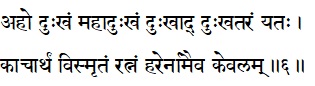
Oh! It is painful, it is terrible, and it is most painful when we give up chanting God’s name for short-lived worldly pleasures.  It is like giving up a jewel, in order to get a mere piece of glass.

Chanting God’s (Lord Hari’s) name is most important in the spiritual life.

Comments:

Chanting God’s name gives us inner peace and strength of mind. It also keeps our minds clear about what we think, speak, and act. Thus, we can live a sane life with awareness. Our life will be a blessing to ourselves and to others also. A person finds a big difference between a life lived on the spiritual background compared to a life lived to fulfill worldly desires without any spiritual background. One is like living in a nice, cool, comfortable place and the other is like living in a hot scorching sunny place having no shelter. A life lived only to fulfill worldly desires is more filled with problems, anxieties, dissatisfaction, sorrows, and frustration than joy and satisfaction. When people get used to the sufferings of life, they think that it is the only way to live. It is true that only fortunate people develop a love for God and love to chant God’s name.

Stanza – 7:

Meaning:

O my ears! Always listen to God’s name.

O my tongue! Always repeat God’s name and sing God’s glories.

Chanting God’s (Lord Hari’s) name is most important in the spiritual life.

Comments:

We have to occupy all our senses and mind to think of God. This can be done in various ways. This stanza indicates that let our ears listen to God’s names, tongue sings God’s glories, hands clap giving rhythm to our singing, eyes visualize God’s form, and legs take us to the holy places or to our prayer-room or to a quiet place where we can sing God’s glories. We can offer all our work to God and make them as worship to God. We can offer our whole life to God by doing God’s work.

Stanza – 8:

Meaning:

God’s name gloriously dwells above all in the world as ever pure Sat-Chit-Ananda (Existence, Knowledge, and Bliss Absolute) making the joy of the whole world as mere straw.

Chanting God’s (Lord Hari’s) name is most important in the spiritual life.

Comments:

Upanishad says that the joy of the whole world is a very small fraction of the bliss of God-realization.  Even by going a little bit closer to God, we can feel a big positive change in our life. It is like on a hot summer day if we got closer to an ocean we feel the cool breeze and experience joy.

Sri Ramakrishna says, “’ Distaste in taking the name of God!’ Because of the ignorance and impurities of the mind if distaste develops in taking God’s name, then there is no chance for us to save ourselves from the miseries of the world. On the other hand, if in our life we develop a little bit of taste in taking God’s name, then there is a great hope to save ourselves from the miseries of life. So, develop taste in taking God’s name. Repeat God’s name regularly. Repeat the name of Durga, Krishna, Hari, or any name of God which you like. By repeating God’s name, ‘Anuraga’, (intense love for God) develops day by day. Then one experiences bliss and becomes fearless. This intense love for God definitely will remove the ignorance and impurities of the mind and definitely one receives God’s grace.”

Let us sing this hymn, reflect on its meaning, mold our life accordingly, and enjoy the unlimited eternal bliss in our life.

I thank Jyoti and Chintal Shah for singing Kaivalyashtakam hymn and a dhoon for this post. Listen to it, sing it, think about its meaning, and experience spiritual joy.


Shatashloki VIII (shloka- 9)

“Shatashloki” of Shri Shankaracharya – VIII (Shloka – 9)

Make all efforts to realize the Atman residing within

Shloka – 9:  Because of which a person loves one’s own body, spouse, children, and wealth, that Atman is the most lovable thing. All things other than the Atman are the cause of suffering. Therefore, all things other than the Atman are not pleasurable. One who is seeking the highest good of oneself is ready to sacrifice one’s own life, family, relatives, and all other things. Therefore a wise person should make all the efforts to realize the Atman only and nothing else.

Comments:

There is a well-known message in Brihadaranyaks Upanishad. Rishi Yajnavalkya was going to retire from the family life and was going to spend his time as a Sanyasi (all renounced person who is fully focusing his mind on the Ultimate Reality – Brahman). He wanted to divide his wealth between his two wives, Maitreyi and Katyayani. This way he was also asking his wives for their permissions to let him renounce everything and focus his mind on the Ultimate Reality. Without their permission, he cannot renounce his responsibilities as a householder.

Brihadaranyaka (2.4.1-5): Sage Yajnavalkya said, “My dear Mitreyi! I am going to renounce this (householder’s) life. Let me make a final settlement between you and Katyayani.”

Thereupon, Maitreyi said, “O Venerable One! If indeed the whole earth, full of wealth, belonged to me, would I be immortal through that?” Yajnavalkya replied, “No. Your life would be just like that of people who have plenty. There is no hope of immortality through wealth.”

Maitreyi said, “Then, what should I do with that which would not make me immortal? Please tell me of that alone which you know to be the only means of attaining immortality.”

Yajnavalkya replied, “My dear, you have been my beloved so far and now you are talking which is most dear to me. Come, sit down, I will explain to you what makes one immortal. As I explain that to you, you reflect upon it and meditate on it.”

Then, Yajnavalkya said, “Verily, not for the sake of the husband, my dear, is the husband loved, but he is loved for the sake of the Self (Atman or Brahman).

Verily, not for the sake of the wife, my dear, is the wife loved, but she is loved for the sake of the Self.

Verily, not for the sake of the sons (children), my dear, are the sons (children) loved, but they are loved for the sake of the Self.

Verily, not for the sake of the wealth, my dear is wealth loved, but it is loved for the sake of the Self…

Verily, not for the sake of the All, my dear, is the All loved, but it is loved for the sake of the Self.

“Verily, my dear Maitreyi, it is the Self that should be realized – should be heard of, reflected on, and meditated upon. By the realization of the Self, my dear – through hearing, reflection, and meditation – all this is known.”

The ninth shloka of the Shatashloki clearly expresses sage Yajnavalkya’s teachings. When Atman leaves the body of a spouse, or a child, or a friend, then the body starts deteriorating and it has to be cremated as soon as possible. This makes it obvious that people loved the Atman residing within the person and not the body of the person.

Wealth has some value as long as we are alive. Wealth is material; it is a metal or a paper. A little reflection makes us aware that the value of wealth is limited. Wealth cannot buy love or mental peace. If wealth is not properly used, then it becomes a cause of suffering. Material possession also causes suffering. When we bought our first car, I had to park it on a busy street in a city. From our bedroom window, I could see our car. At night, a couple of times, whenever I heard some weird noise like car abruptly stopping with a squeaking break’s noise, or a person hitting a car while parking, I woke up to see whether it is our car. After waking up for a couple of times, I thought to myself, ‘Did I buy this car for comfort and pleasure or for a worry?’ Then, I laughed at myself and slept well.

There is a rule of the universe that except the bliss of realizing the Atman, anything that gives us material joy becomes the cause of suffering as well. Many times the material joy is little than the sufferings that follow. Saint Tulsidas said that we suffer when we meet people who do harmful things and we suffer when good people leave us. Joy and sorrow come together. We cannot have one without the other.

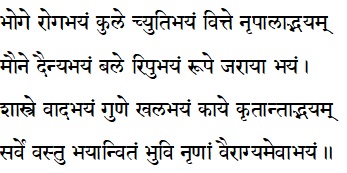
Fear and worry are connected. We worry because we have some kind of fear in the back of our minds.  Saint Bhartruhari tells us in his Vairagya Shataka (shloka 34) that fear is attached to everything in this universe:

“If we go to enjoy something, then we have a fear of disease,

If we take pride in our heredity, then we have a fear of falling from its status,

If we have wealth, then we have a fear that the king might take it away (right now the IRS),

If we keep silence, then there is a fear that we are considered weak,

If we are physically strong, then we have a fear of an enemy,

If we have beauty, then we have a fear of old age,

If we take pride in our expertise, then we have a fear of someone knowing more than us,

If we take pride in our virtues, then we have a fear of a fault-finder pointing to our vice,

If we have body consciousness, then we have a fear of death,

In short, all things in this universe filled with fear except the renunciation. The renunciation only can make a person fearless.

The fear of all fears is the fear of death. In the conversation of the Rishi Yajnavalkya and Maitreyi we learned that realizing Atman makes us immortal, meaning it removes all our fear of death. Upanishads say that there is no other way to go beyond the fear of death except realizing our Atman. When we realize that our true identity is Atman which is eternal, that it was never born and so it will not die, then we can overcome the fear of death. We understand that what dies is the physical existence consists of our body and mind which we mistook as our true existence.

What is the way? According to Saint Bhartruhari, renunciation makes us fearless. What do we renounce? We have to renounce our false association with our body and mind. Simultaneously, we have to realize that our true identity is Atman or Brahman, and the goal of human life is to realize this Atman. By realizing Atman all our desires get fulfilled, all our doubts about life get destroyed, all our fear vanishes, and our life gets fulfillment.

In a collection of Sri Ramakrishna’s Bengali teachings, I read, “If we can see our true Self (Atman) in our self, then everything is accomplished. To see this we have to do spiritual practices. To be able to do these spiritual practices we have a body. To create a golden image, one needs a clay-mold. Similarly, we have the mold of the mortal body to realize the immortal Atman.”

Many people who have understood the importance of achieving this goal of life have renounced everything and had plunged into making efforts to realize the Atman. However, these people are one percent of the human population. For the other ninety-nine percent of the people, Sri Ramakrishna said that they have to renounce mentally. We can live in the world and perform all our responsibilities, but every day we have to sit in a quiet place and reflect upon ‘What is permanent and what is impermanent’. We have to think that our true identity is Atman or Brahman, the Ultimate Reality. We have to understand that the Power of Brahman which we call God or Shakri (Mother) or Mahamaya had created this universe; He/She preserves it and dissolves it. After doing our spiritual practices sincerely and regularly for a while, when we go deeper within, then we realize that in reality, God has become everything. The Ultimate Reality Brahman is appearing as various things of the universe with various names and forms.

Most people find it difficult to think that ‘I am Atman’. Our ‘ego’, meaning our body-mind-consciousness is so deep that it will not let us separate from it and let us think “I am Atman’. Sri Ramakrishna said that since the ego does not go away easily; let the rascal ego remains as a ‘devotee ego’ or ‘a servant ego’.  He calls it a ‘ripe or mature ego’. A person with this ripe ego thinks that everything belongs to God; nothing is mine, not even my own body and mind. God gave me responsibilities to fulfill and I must perform my responsibilities as an offering to God or as a worship of God. If we start with this attitude, then slowly we will understand that God is the Ultimate Reality, Brahman. The Brahman is within me as Atman and because of its power my body and mind function. Then, comes a time when we can realize that Brahman is appearing a universe with its various names and forms. This shloka says that we must make all efforts to attain to this state.


Shatashloki – VII (Shloka 8)

“Shatashloki” of Shri Shankaracharya – VII (Shloka – 8)

The Teachings of the Upanishads

Shloka – 8

Translation:

To appease a child who is crying for a long time, his/her mother gives the child various fruits like grapes, or dates, or a mango, or a banana to eat. Similarly, the Upanishads have prescribed various methods to bring peace and to acquire proper knowledge to the disturbed mind of a deluded person whose delusion has been piled up due to the ignorance of innumerable past lives.

Comments:

A Mother consoling her crying child:

This picture of a mother and child is universal. The food items may vary. I wonder how many children will be appeased by fruits! This mother must be of a Sattvika nature who gives Sattvika food to her child. Usually, the candies and the cookies appease most of the children. However, the picture of a crying baby and mother’s various attempts to appease her child is universal and eternal. It is an appropriate picture which follows by Shri Shankaracharya’s message.

Shri Shankaracharya considers the Upanishads as the Mother of all people and the Upanishads through their teachings trying to appease the crying people. The people are crying like babies due to their problems of life and many problems are self-created. Shri Shankaracharya says that the fundamental cause of all human problems is the ignorance of the Reality. A person by ignorance thinks that ‘I am such and such a person and I am this body and mind.’ With that ignorance, all the problems begin.

The cause of crying:

Children cry when they don’t get what they want, or they are hungry, or something is hurting them, or they are tired or sick. Adults think that the children are ignorant and they cry because they have a lack of understanding. But, adults also cry. They cry mainly when they are sick, or they lose their near and dear ones, or they lose their jobs or money, or their desires do not get fulfilled or they feel helpless. I am sure the wise people who love all and have compassion for all feel the pain of the crying adults, but they know that these adults are crying because of their ignorance and lack of true knowledge.

In human life, there is little joy and lots of suffering. Birth, old age, sickness, and death are painful. Dejection, any kind of loss, and not getting what we want is painful. On top of this natural calamities come. Many people were happy with their normal life. But the coronavirus came and disturbed the happiness of people all over the world. Everywhere people are filled with the fear of death and uncertainty of life. In the hospitals, people are separated from their families and are suffering alone and many of them are dying alone. Maybe after a few months or a few years, the coronavirus situation gets under control and we may go back to the ‘revised normal’ living. But after that, the whole package of our previous joys and sorrows, desires and disappointments, future plans and their obstacles, and many other things will come back and they will occupy our mind.  Sri Ramakrishna says that “If you throw a brick-bat into a pond covered with moss, you get a glimpse of the water.  But a few moments later the moss comes dancing back and covers the water.” Similarly, in painful times we come face to face with Reality of life, but then the Mahamaya, the deluding power of Brahman, covers our minds with many unfulfilled desires and we forget the Reality.

Even without any natural calamity, we are not always happy. Our desires have no end. When our desires are not fulfilled we are unhappy. Even when our one desire gets fulfilled, other desires occupy our mind and will not let us enjoy the happiness we had acquired. Many times, we work day and night sacrificing all our comforts and pleasures to acquire one worldly object. But when we get that desired object, our mind loses interest in that object. Thus, the problem is not in worldly objects, but it is in our minds.

The real urge to acquire spiritual knowledge:

Only when we realize that the worldly objects cannot give us longer-lasting happiness, then we look for something higher than the worldly objects to acquire longer-lasting happiness. Lord Buddha saw this longer-lasting happiness or serenity on the face of a mendicant who had no worldly possession. Shri Ramakrishna said that as long as the child is busy playing toys, the mother gets all the work done in the house like cooking and other choirs. When the child gets tired of playing with the toys and really needs his/her mother, then the child screams for the mother.  At that time the mother puts away the pots and pans and comes to the child running. Similarly, when we realize that the worldly objects like toys cannot give us the longer-lasting happiness, then the real hunger for the higher knowledge comes. Until then we have to go through the waves of joys and sorrows in life where the waves of sorrows are higher and deeper than the waves of happiness. We appreciate and understand the value of the Upanishad’s teachings when that real cry comes from within.

Would crying help?

From the human and the practical point of view crying helps to vent out our pain lying within. If people don’t cry and keep the pain inside, then they develop psychological problems that are harmful.

However, just venting out our pain by crying and then get back again into the same routine of life which keeps us in the vicious cycle of suffering and crying, does not help to remove the main cause of our suffering. People think that crying to God may help fulfill our worldly desires.  Swami Vivekananda says that such crying increases our superstitions.

Swami Vivekananda:  “You know in your inmost heart that many of your limited ideas, this humbling of yourself and praying and weeping to imaginary beings are superstitions. Tell me one case where these prayers have been answered. All the answers that came were from your own hearts.

You know there are no ghosts, but sooner are you in the dark than you feel a little creepy sensation. That is so because in our childhood we have had all these fearful ideas put into our heads. But do not teach these things to others through fear of society and public opinion, through fear of incurring the hatred of friends, or for fear of losing cherished superstitions. Be master of all these,

What is there to be taught more in religion than the oneness of the universe and faith in one’s self?”

In the following passage, Swami Vivekananda says that the ultimate help is going to come from within. There is no use of crying.

Swami Vivekananda: “It is a tremendous error to feel helpless. Do not seek help from anyone. We are our own help. If we cannot help ourselves, there is none to help us. …”Thou thyself art thy only friend, thou thyself art thy only enemy. There is no other enemy but this self of mine, no other friend by myself” (Bhagavad Gita 6.5). This is the last and greatest lesson, and Oh, what a time it takes to learn it! We seem to get hold of it, and the next moment the old wave comes. The backbone breaks. We weaken and again grasp for that superstition and help. Just think of that huge mass of misery, and all caused by this false idea of going to seek for help!”

The cause of our suffering is ignorance:

The Upanishads say that the cause of our sufferings is the ignorance of our true identity which is called ‘Atman’. We think that we are just our body and mind, but through reflections, meditations, and proper spiritual practices Rishis and many saints realized that behind our body and mind there is something eternal and non-changing substratum called ‘Atman’ which is our true nature.  By nurturing the ignorance of our true nature we suffer again and again.

Swami Vivekananda says, “The main cause of all bondage is ignorance. Man is not wicked by his own nature–not at all. His nature is pure, perfectly holy. Each man is divine. Each man that you see is a God by his very nature. This nature is covered by ignorance, and it is ignorance that binds us down. Ignorance is the cause of all misery. Ignorance is the cause of all wickedness, and knowledge will make the world good.”

Swami Vivekananda says, “A caterpillar spins a little cocoon around itself out of the substance of its own body and at last, finds it imprisoned. It may cry and weep and howl there; nobody will come to its rescue until it becomes wise and then comes out, as a beautiful butterfly. So (it is) with these our bondages. We are going around and around ourselves through countless ages. And now we feel miserable and cry and lament over our bondage. But crying and weeping will be of no avail. We must set ourselves to cutting these bondages.”

What to do then? Swami Vivekananda talks about it in the following passage:

Swami Vivekananda says, “If the room is dark, do you go about beating your chest and crying, “It is dark, dark, dark!” No, the only way to get the light is to strike a light, and then the darkness goes. The only way to realize the light above you is to strike the spiritual light within you, and the darkness of sin and impurity will flee away. Think of your higher self, not of your lower.”

This higher self is within us.

Swami Vivekananda says, “The Vedanta proves that the truth for which we have been searching all this time is present, and was all the time with us. In our ignorance, we thought we had lost it, and went about the world crying and weeping, struggling to find the truth, while all along it was dwelling in our own hearts. There alone can we find it.”

The teachings of the Upanishads:

Swami Vivekananda brought out two major teachings of the Upanishads: ‘Oneness’ and ‘Faith in one’s Inner Self’.

The ‘Oneness’ is the ‘Oneness of Existence’. The Upanishads teach that there is only one Reality, one Existence behind the varieties of people, animals, trees, plants, stars, sun, moon, planets, and all the objects of the universe. The same Brahman appears out of our ignorance as a variety of things. It is like waves in the ocean of consciousness. Various waves arise in the ocean. They look different, but they all are nothing but the ocean water. They appear in the ocean and again merge in the ocean.

The following passage gives us some idea about the Brahman:

Swami Vivekananda says, “The Purusha (Brahman) does not love, it is love itself. It does not exist, it is existence itself. The Soul does not know, It is knowledge itself. It is a mistake to say the Soul loves, exists, or knows. Love, existence, and knowledge are not the qualities of the Purusha, but its essence. When they get reflected upon something, you may call them the qualities of that something. They are not the qualities but the essence of the Purusha, the great Atman, the Infinite Being, without birth or death, established in its own glory. It appears to have become so degenerate that if you approach to tell it, “You are not a pig,” it begins to squeal and bite.”

The same Brahman reflects in each individual as an Atman. Sri Ramakrishna says that imagine the body is like a plate and the mind is like water in the plate and in that water there is a reflection of the sun, which is Atman. This Atman is our true identity. It is divine. It is never born and does not die. Its nature is Existence-Knowledge-Bless Absolute. By realizing It all our fear of death goes away, our mind gets filled with bliss, and we get endowed with tremendous inner strength. This is the second thing we can learn from the Upanishads, ‘the faith in our true identity – Atman.’ By realizing Atman, we can remove the cause of all our sufferings.

Sri Ramakrishna’s teachings of crying:

Sri Ramakrishna says that people shed a jug of tears for their relatives, money, and many worldly things, but who cries to realize God. If people sincerely cry for three days to realize God, then they have a vision of God.

This crying is not for the worldly rewards and for worldly gain. This crying comes when we understand the futility of trying to get longer-lasting happiness from the finite worldly objects. Sri Ramakrishna used to say that often one has to go into solitude and reflect upon the ultimate truth, ‘Brahman alone is real (permanent) and everything else is unreal (impermanent)’.  By realizing the eternal and omnipresent Brahman, we feel infinite bliss within and we can go through the joys and sorrows of life keeping our mind always focused on the Brahman. Then, we may cry due to human suffering, but we will not get deluded. We always remember that this world is impermanent and we have to move on.

The Upanishad’s teachings will make us strong and fearless and will give us the fulfillment of life. The four yogas (Jnana Yoga, Bhakti Yoga, Raja Yoga, and Karma Yoga), developed from the Upanishads and the Bhagavad Gita, are also helpful to remove our sufferings of life.

Note: Today is Lord Buddha’s Birthday. His goal of life was to remove the sufferings of life and bring bliss within. May we make sincere efforts to remove the sufferings of our life and bring peace and bliss within.


Brahma Sutras (Lesson – 3: Sutra – 2)

Brahma Sutras – Sutra 2

(Study based on Shri Shankaracharya’s commentary)

Topic – 2: Definition of Brahman (sutra-2)

Sutra-2:

Meaning: From Brahman came the creation, preservation, and the dissolution of the universe.

Comments:

Only nothing comes out of nothing:

This sutra says that the universe did not come out from nothing. Only nothing comes out of nothing.

The Big Bang Theory is the prevailing cosmological description of the development of the Universe. Under this theory, space and time emerged together 13.8 billion years ago and the energy and matter initially present has become less dense as the Universe expanded.

The most widely accepted theory of planetary formation, known as the nebular hypothesis, maintains that, 4.6 billion years ago, the Solar System formed from the gravitational collapse of a giant molecular cloud which was light-years across. Several stars, including the Sun, formed within the collapsing cloud. The gas that formed the Solar System was slightly more massive than the Sun itself. Most of the mass collected in the center, forming the Sun; the rest of the mass flattened into a protoplanetary disc, out of which the planets and other bodies in the Solar System formed.

However, something was there to expand. According to the Rishis, who reflected upon the fundamental questions of life like: (1) What is my true identity? (2) What is the purpose of my life? (3) How this universe came into existence? (4) What is the reality behind this constantly changing universe? (5) Who is preserving this universe? (6) What is the ultimate end of this universe? (7) What is my relationship with the universe? (5) What is my relation to all other beings? and found their answers through their scientific search within. They found with their inner search and reflections that there is only one Ultimate Reality which they call it ‘Brahman’ and the same Ultimate Reality appears as the universe. This conclusion matches the scientific conclusion mentioned above.

In the previous sutra, it has been said that when one has a proper background, then an intense desire comes to inquire into the nature of Brahman.  It was also established that the knowledge of Brahman makes one free from all bondages, destroys all doubts regarding one’s own existence and the universe, brings fearlessness, peace of mind, and fulfillment of life.

Now, in order to know or realize Brahman, one should know ‘What is Brahman?’ and “What are the characteristics of Brahman?”

Doubts and arguments for impossibility to acquire the knowledge of Brahman: Some people say that “Brahman has no characteristics by which It can be defined, and in the absence of definition It cannot be known, and consequently there cannot be any liberation or freedom from all bondages.

Answer: This sutra and its commentary give the answer to this question. It is not easy to describe Brahman, but sincere attempts are made to give as much idea of Brahman as possible. A mother points out a finger to the moon and tells her child, “Look at the moon.” The hand and the pointed finger are not the moon. They just point towards the moon. The child has to see the moon. Thus, Brahma Sutras and all the scriptures just point out to the Brahman. People have to follow the directions given by the scriptures and do appropriate spiritual practices to realize the Brahman. Those who have followed properly, they had realized the Brahman and their experiences match with the experiences of the Rishis who have realized It. Sri Ramakrishna, Holy Mother Sri Sarada Devi, Swami Vivekananda, and many other saints are examples of people who have realized the Brahman.

There are two major definitions of Brahman.

Tatastha Lakshana:

This sutra gives a definition of Brahman: “That which is the cause of the universe is Brahman – where the imagined “cause of the world” is indicative of Brahman.

This is called the ‘Tatastha Lakshnana’, meaning that characteristic of a thing which is distinct from its nature and yet serves to make it known.

In the definition given by this sutra, the origin, sustenance, and dissolution are characteristics of the universe and as such are in no way related to Brahman which is eternal and changeless; yet these indicate Brahman, ; which is imagined to be the cause of the universe. Actually, Maya, the power of Brahman, creates an illusion due to which the Brahman appears as the universe separate from Brahman. It is just like an imagined snake indicates the existence of a rope. One says ‘that which is imagined as a snake is the rope.’

Swaroopa Lakshana:

The scriptures give another definition of Brahman.

Taittiriay Upanishad (2.1.1):

“Truth, Knowledge, Infinity is Brahman.”

This is called the Swaroopa Lakshana, that which defines Brahman in Its true essence.  These words, though they have different meanings in ordinary parlance, yet refer to the one indivisible Brahman. It is like the same man is refer to by the words father, son, brother, husband etc. depending on the relationship with the other individuals.

In the universe grasped by the senses, knowledge comes by various means, like direct perception by the senses, reasoning, inference, and others. But, we have to note that this sutra does not arrive at the fact that ‘The Brahman is the first cause of the universe’ by reasoning, or inference or any other means.

Brahman cannot be so established independently of the scriptures (Shruti).

Cause – effect reasoning: Each effect has a cause. The existence of the universe is an effect and it must have a cause. But, we cannot logically establish with certainty what exactly the nature of that cause is. Since Brahman is not an object of the senses, we cannot say that the Brahman alone is the cause of the universe and nothing else. The relation between the cause and the effect can be established when both the objects are perceived.

Inference and Reasoning: Inference and other means may give only strong suggestions of Brahman’s being the First Cause of the universe. But, a thing established by mere inference, however well thought out, is explained otherwise by greater intellects.  A sound heard from a floor upstairs can be inferred through reasoning, but we cannot say with certainty that it is the only reason for the sound.

The reasoning is also endless according to the intellectual capacity of people and therefore cannot go far in asserting the Truth.

It is a direct experience that carries the weight. Therefore all the scriptures are authoritative in asserting the Truth because they are the records of the direct experience of the masterminds (Rishis) who have come face to face with the Ultimate Reality. This experience can be checked up to a point through reasoning, but the reasoning should be based on the scriptures. Reasoning not based on the scriptures does not lead us anywhere. Therefore the scriptures having the records of the direct experience of the Truth of the Rishis are called ‘Aptavakya’.

Thus, the prime object of this sutra is not to establish Brahman through inference, but to discuss scriptural passages which declare that ‘Brahman is the First Cause of the universe.

Taittiriya Upanishad (3.1):

“Bhrigu, the son of Varuna, approached his father Varuna and said, ‘Venerable Sir, teach me about Brahman.’ Varuna told him, ‘…That from which these beings are born, by which they live after birth and into which they enter (at the time of dissolution) – try to know That. That is Brahman.”

The sutra asks us to collect the Vedanta texts for the full comprehension of Brahman.  Once, the scriptures have declared Brahman to be the First Cause, we have to reason to understand these Vedanta Texts and not to reason to contradict them. We must reason to find out the Truth lying behind these Vedanta texts.

Vedanta Practices:

Vedanta prescribed the following three kinds of practices in order to realize Brahman:

(1) Shravana: We have to listen to or read the scriptures (Shrutis). Listening to scriptures from a person who has realized Brahman or whose goal is to realize Brahman and who is sincerely making efforts to achieve that goal is better than reading the scriptures ourselves. These people tell us the essence of the scriptures and save our time to find this essence. We can then read the scriptures to better understand the essence we had heard.

(2) Manana: After listening to and reading the essence of the scriptures, we have to reflect upon them. Sri Ramakrishna always emphasized to sit in the solitude and reflect on the essence of the scriptures which is, ‘Brahman alone is real and everything else is unreal, meaning impermanent’. We have to reflect upon the reasoning and the elaboration provided to us establishing the Ultimate Truth of the scriptures by the Sages who have realized Brahman.

(3) Nididhyasana: We have to meditate on the nature of the Brahman in order to realize It ourselves. If we have done Shravan and Manana practices properly, then our meditation becomes deeper and focused on the Brahman. We have to continue our meditation practices until we realize the Brahman.

Intuition: Meditation leads us to intuition. By intuition is meant that kind of mental modification (Vritti) of the mind (Chitta) which destroys the ignorance. The main ignorance is to think that ‘I am this body and mind’, ‘I am not Brahman’, and ‘This universe is different from Brahman’. When the ignorance is destroyed by this mental modification in the form of Brahman (called Brahmakara Vritti), then Brahman, which is self-luminous, reveals Itself within.

The difference between ordinary perception and realization of Brahman:

In ordinary perception, first, our senses bring an external object to our mind, then our mind  (Chitta) takes the form of that object, and the consciousness reflected through intellect in this modification of the mind manifests the object. Thus, our ignorance about the object will vanish.

In the case of the realization of Brahman, the mental modification in the form of Brahman (Brahmakara Vritti) destroys the ignorance mentioned above, and the Brahman, being self-luminous, and Pure Consciousness reveals Itself within.

Since the destruction of the ignorance is most important, the scriptures mostly talk about Brahman negatively, saying ‘Neti Neti” (Not this, not this), means ‘body is not Brahman, the mind is not Brahman, intellect is not Brahman, what we perceive through our senses is not Brahman.’

However, Sri Ramakrishna gave an excellent example regarding this. He said that if we are going to the terrace of a house, we climb each step and ask, ‘Is this the terrace?’ and the answer is ‘No’, until we come to the terrace. Thus, we deny all the steps as not being the terrace. But, after reaching the terrace we find that the steps are made out of the same material as the terrace is made out of. This means that after negating everything, when we realize Brahman, then we find that everything is Brahman. There is nothing in this universe that is not Brahman. Only out of ignorance we perceive everything as different from Brahman.

The difference between ‘an inquiry into Brahman’ and ‘a non-Brahman religious inquiry’:

In a non-Brahman religious inquiry, a person usually wants to achieve a worldly thing or wants to go to heaven for enjoyment. In that case, one has to have faith in the scriptures, perform the required rituals, and then wait for the result. In this case, only faith is required to acquire the predicted result. Also, note that one has to wait for the result.

In the inquiry into Brahman, we do not have to wait for the result. As soon as the ignorance vanishes, the Brahman reveals from within. Note that the Brahman has already existed before. We have to make efforts to destroy our ignorance, and not to reveal Brahman. In this process of realization of Brahman, faith, reasoning, and other methods are available to destroy our ignorance.

Brahman also has been described as “Sat-Chit-Ananda”, Existence, Knowledge, Bliss Absolute, and as “Shuddha, Buddha, Nitya Mukta”, Pure, All Knowledge, and Ever Free from all the bondages.

We will know more about Brahman by studying the remaining Brahma Sutras.


Brahma Sutras (Lesson – 2: Sutra – 1)

Brahma Sutras – Sutra 1 

(According to Shri Shankaracharya)

The Advantage of Studying the Brahma Sutras:

By studying the Brahma Sutras, we learn the following:

(1) The Nature of Brahman (the Ultimate Reality or Truth, the One Existence). It can be thought of as Pure Consciousness.

(2) We learn the characteristics of Brahman which have been realized by the Knowers of Truth, called the Rishis.

(3) We find the seeds of the “Vedanta Philosophy” which have been fully developed later on by the great teachers. Especially, we can be familiar with the background of Swami Vivekananda’s lectures on the Vedanta.

(4) We learn some of the important passages from the Upanishads. In particular, we learn the true meaning of those passages of the Upanishads which are unclear or ambiguous.

(5) By knowing correctly the nature of Brahman we can get rid of our spiritual and religious superstitions which could be the obstacles in our spiritual development.

Now, let us start to learn about the Brahma Sutras. It is said that people at least should learn the meanings of the first four Brahma Sutras.

The 555 Brahma Sutras are divided into four chapters. Each chapter has four sections and each section has several topics.

Chapter -1:  “What is Brahman?”

 Topic – 1: The inquiry into Brahman and its pre-requisites (sutra-1)

Sutra-1: 

Meaning: Now, therefore, the inquiry into the real nature of Brahman.

Comments:  Now, means after being prepared to inquire about the Brahman.

How do we prepare ourselves?

To prepare ourselves for the inquiry into Brahman, the following four practices have been mentioned by Shri Shankaracharya in the Viveka-Chudamani:

(1) Viveka – Awareness of what is permanent and what is not permanent. (The word discrimination has other connotations, so I would not use it.) Logically, emotionally, and through experiences we have to come to an understanding that anything that has a beginning and an end is impermanent. Thus, our body, mind, and all the objects of the world which we perceive by our senses are impermanent. The One Reality or One Existence, called Brahman, lies behind all the impermanent things. It is the only permanent reality. It is our true identity and the goal of life is to realize it.

(2) Vairagya – Giving up the cravings for the impermanent.

Shri Ramakrishna said that a child is busy playing with toys. During that time the mother takes care of the cooking and other choirs of the house. But, when the child gets bored by the toys and gets hungry, then the child screams for the mother. At that time, the mother puts away the pots and pans and runs to the child.

Vairagya is like ‘getting bored’ by all the temporary joys of the senses and realizing that the worldly objects cannot give us permanent happiness, satisfaction, and fulfillment of life. When this understanding comes, then naturally one gets withdrawn from the worldly objects and seeks the realization of Brahman which gives infinite bliss and the fulfillment of life.

(3) Shama-Dama-Shada Samppati: The following six practices are important to have:

(i) Shama:  Withdrawing the mind from all the sense objects, meaning giving up all the thoughts related to the sense objects and focusing on Brahman, is called Shama. We need to acquire the control of our mind by constant practice of japa and meditation.

(ii) Dama: In order to have control of the mind, we need control of the senses which is called Dama. We have to practice both the Shama and Dama together. They are inter-connected. The control of the senses can be acquired by practicing austerity. For example, have a daily spiritual schedule to do spiritual practices and strictly follow it for several years, at least twelve years. Then, controlling the senses by various austerities, like fasting, controlling what we watch, listens to, eat, and other sense-related activities. Practicing truthfulness (Satya), non-violence (Ahimsa), celibacy (Brahmacharya), not to be greedy, or envy or jealous (Asteya) and have a simple living (Aparigraha) are also important practices.

(iii) Uparati: Giving up all worldly dependency and being dependent only on the Self (Atman or Brahman) is important. From the devotional point of view, it is surrendering to God. We have to practice to withdraw our minds from the world and focus on Brahman.

(iv) Titiksha: Bear the worldly suffering without any complaint or worry is essential. We have to think that God is the doer of everything. As good-time cones, bad-time also comes. We just have to go through all the situations of life keeping our mind focused only on the goal of life – Self-realization.

(v) Shraddha: Having faith in the words of the scriptures and in the teachings and guidance of Saints, Sages, and our spiritual teachers is a must. In the world, we have faith in the news-media, doctors, plumbers, electricians, accountants, lawyers, airplane-pilots, and others. Many of them are selfish, but we have faith in them and follow their instructions. Then, why cannot we have faith in the words of the scriptures and the Saints who are unselfish and are telling us for our good? Our ego is the main obstacle in having this faith. In the spiritual path, we think we are wiser than the scriptures and the Saints. It is hard for many of us to accept that even though we may be very advanced and knowledgeable in the worldly fields, we are just KG students in the spiritual path.

(vi) Samadhan: Fixing the mind and the intellect on Brahman with a firm conviction that realizing Brahman is the goal of human life and my life’s mission will be fulfilled if I realize It.

4) Mumukshutva – means to have an intense desire to realize Brahman. We can study scriptures and acquire the intellectual grasp of the teachings of the scriptures and Saints, but if we have not developed an intense desire to realize Brahman, then it is of no use. Restlessness and passion have to be developed naturally to realize Brahman. At the end of the day, seeing the sun-set Shri Ramakrishna was rolling on the ground crying profusely saying ‘O Mother! One more day is gone and I have not realized Thee. Would my life go in vain without your vision?”

To realize God or Brahman, Shri Ramakrishna says that one has to combine the intensity of the three attractions: the greedy person’s attraction for wealth, a loving husband’s or wife’s attraction for his/her spouse, and the mother’s attraction for her child.

Note: When we read all the pre-requisites needed even to inquire about the nature of Brahman, we get dishearten and think that we will not be fit for such knowledge in this life. We should not be disheartened because of these pre-requisites.

I think these pre-requisites tell us that God-realization is not possible just by doing casual spiritual practices, performing a few religious rituals, reading a few books, listening to a few spiritual discourses, and occasionally chanting the name of God. God-realization or realization of Brahman is the highest state a human being can attain. It needs a life-time commitment, an intense desire and a readiness to make all possible efforts to achieve this goal.

Actually, the pre-requisites give us a guide-line to achieve this goal. We have to follow this guide-line. It is not the case that we have to fulfill all the pre-requisites first and then inquire into the nature of Brahman. Simultaneously we have to prepare ourselves with proper spiritual practices and inquire into the nature of Brahman. As we make progress in fulfilling the pre-requisites, we also make progress in understanding the nature of Brahman. After some spiritual practices if a question comes to our mind ‘why am I not realizing Brahman?’, then we have to look at the pre-requisites and we will know the reason.

Benefits of realization of Brahman: If we truly understand the importance of the realization of Brahman, then our desire to attain it becomes more intense. Swami Vivekananda says that a genuine thief who is looking for wealth finds that in the next room there is precious jewelry hidden, he/she will make all the efforts to acquire that jewelry.

The benefits of realizing Brahman are unlimited and hard to write down on a piece of paper. But, I will write down a few benefits which I think important to me:

(1) A human being is looking for three things in life: (i) the Ultimate Knowledge which solve all the fundamental questions of life, (ii) Infinite Bliss which does not depend on any worldly object, and (iii) Immortality, becoming fearless by conquering the fear of death and thus all fears of life. The realization of Brahman gives all these three which we cannot attain by any knowledge of the world.

(2)  Removes all the sorrows of life

(3) Brings peace, satisfaction, and fulfillment of life

(4) It makes us feel connected with all. Thus, we develop unselfish love for all. What we give to the world that we receive from the world. Thus, by giving unselfish love to all, our life gets filled with unselfish love. Even we can transform the hatred into love.

(5) All our doubts, confusion, and superstitions will vanish.

Therefore, the inquiry into the nature of Brahman:

People, who have understood the benefits of realizing Brahman plunge into the spiritual practices to realize It. We do not have to wait to enjoy the above-mentioned benefits until we realize Brahman. Shri Ramakrishna says that on a hot summer day when we go towards an ocean, we feel the cool breeze of the water, enjoy listening to the sounds of the waves and the chirping of the birds and other things. Thus, even during the journey to realize Brahman we enjoy all the benefits. Let us just start the journey. We will never regret it.

Let us learn the nature of Brahman and then realize that our true identity is Atman, the support of our body and mind and it is not different from Brahman (Existence-Knowledge-Bliss Absolute).

Brahma Sutras (Lesson – 1: Introduction)

Brahma Sutras 

(This is a part of my notebook that I had prepared during the study of the Brahma Sutras in our Monday classes. We followed the commentary by Shri Adi Shankaracharya. The following two books were used as the references:

  1. “Brahma Sutras, According to Shri Shakara”, Swami Vireswarananda, Advaita Ashrama Publication Department, Kolkata, India, 10th Impression, November 2008
  2. “Brahma Sutras”, Sri Swami Sivananda, The Divine Life Society Publication, Shivanandanagar, India, 6th edition, 2016)

Prasthanatrayi:

The Vedanta Philosophy is based on the principles or the truths taught in the Prashathantrayi.

The word “Prasthana” in Sanskrit has various meanings, for examples – Advent, cause, course, departure, dispatching, dying, inferior kind of drama, journey, march, method, moving, place of origin, proceeding, procession, religious mendicancy, sect, sending, away, setting out, starting-point, system, walking, and way to attain.

The main meaning of “prasthana” is “proceeding”. We can say that “prasthana” means “proceeding towards one’s liberation”.

The word “Trayi” in Sanskrit means a collection of three.

Thus, “Prasthanatrayi” means “three sources of books for liberation”: (1) The Upanishads, (2) The Brahma Sutras, and (3) The Bhagavad Gita.

(1) The Upanishads, known as Upadesha prasthana (injunctive texts), and the Śruti prasthāna (the starting point or axiom of revelation), especially the Principals of the Upanishads. There are more than 108 Upanishads. Among them, the following eleven Upanishads are considered as major ones: Isha, Katha, Kena, Prashna, Mundaka, Mandukya, Aittareya, Taittiriya, Swetaswatar, Chhandogya, and Brihadaranyaka.

(2) The Brahma Sutras, known as Nyaya prasthana or Yukti prasthana (logical text or axiom of logic). The Brahma Sūtras (also known as the Vedānta Sūtras, Bhikshu Sutras or Shariraka Sutras), systematize the doctrines taught in the Upanishads and the Bhagavad Gītā. As mentioned above, Brahma Sutras are also known as Bhikshu Sutras or Shariraka Sutras.  Bhikshu refers to Sanyasins. Thus, there were sutras for the Sanyasins. Shariraka refers to the Atman living in the body. Thus, Shariraka Sutras means the Sutras for the Atman.

(3) The Bhagavad Gita, known as Sadhana prasthana (practical text), and the Smriti prasthāna (the starting point or axiom of remembered tradition) The Bhagavad Gītā is a part of the great epic Mahabhārata.

The meaning of the word “sutra”:

The word “sutra” in Sanskrit means ‘a meaningful condensed sentence written by a qualified person in the field’. It also has other meanings such as a thread, knitting, a symbol, an indication etc.

The great teacher Madhvacharya in his commentary on the “Brahmasutras” quotes the meaning of the word “Sutra” from “Padma Purana” as follows (with the sandhis separated:

“The learned people in “the science of the sutra” say that the “sutra” means a sentence which has the following characteristics: (1) concise, (2) unambiguous, (3) gives the essence of an aspect of a topic or the topic itself, (4) it enlightens from all the possible aspects of the topic, (5) devoid of repetition and (6) faultless.

The author and the time of Brahma Sutras:

It seems that there were Bhikshu Sutras which were known among the Sanyasins. Then, Rishi Badarayana, starting with the Bhikshu Sutras, systematized and summarized the teachings of the Upanishads into the Brahma Sutras.

The Bhagavad Gita was written before the birth of Buddha. The Brahma Sutras were written before the Bhagavad Gita because there is a reference of Brahma Sutras in Bhagavad Gita (13.4):

It says, “This (teaching or the truth) has been sung by the Rishis in various ways and through various hymns and has been established logically and convincingly in the words of the Brahma Sutras.”

This indicates that the time of the Brahma Sutras is before 400 B.C..

Now, surprisingly, there are references of the Bhagavad Gita in the Brahma Sutras (for example 2.3.45 and 4.2.21). This shows that Rishi Vyasa, the writer of the Mahabharata and thus of the Bhagavad Gita, may have re-written these sutras. Hence, Rishi Vyasa’s name is also associated with the Brahma Sutras.

The Number of Brahma Sutras: There are four chapters in Brahma Sutras and each chapter has four sections. There is a total of 555 sutras. The following are the names of the chapters of the Brahma Sutras and the number of sutras in each chapter:

Chapter I: What is Brahman? (“Samanvaya Adhyaya” which has four Sections; 31+32+43+28) 134 SUTRAS

Chapter II: Review of competing theories (“Avirodha Adhyaya” which four Sections; 37+45+53+22) 157 SUTRAS

Chapter III: The means to spiritual knowledge (“Sadhana Adhyaya” which has four Sections; 27+41+66+52) 186 SUTRAS

Chapter IV: The benefit of spiritual knowledge (“Phala Adhyaya” which has four Sections; 19+21+16+22) 78 SUTRAS

Total sutras are 134 + 157 + 186 + 78 = 555

The Well-known Commentators on the Brahma Sutras:

  • There are many commentators who explained the meanings of the Brahma Sutras. Among them, there are five famous commentators, namely, (1) Shri Shankaracharya, (2) Shri Ramanujacharya, (3) Shri Nimbarkacharya, (4) Shri Madhvacharya, and (5) Shri Vallabhacharya, who have established five different schools of thoughts which currently exist and have many followers. These are all called the Schools of the Vedanta Philosophy.
  • It is amazing to see that all these five Acharyas (Teachers) accept the teachings of the Vedas. They all believe that the goal of human life is to realize the Ultimate Reality, Brahman. They differ in their interpretations of the Brahman, an individual soul, the relationship of an individual soul with the Brahman, the idea of the world and the relationship between the world and the Brahman. They all interpret the Brahma Sutras in a way that justifies their own philosophies about the reality. Many times, the same sutra has been interpreted in different ways.

Note: There are two main reasons why there are different interpretations of the same sutra: (1) The sutras are concise and brief, so there is room for interpretations and (2) Brahma Sutras do not establish any philosophy. They just state the truths of the Upanishads and the Bhagavad Gita.

  • The Five Schools:

(1) Shri Shankaracharya (788-820 AD):  The exponent of Monism. (Advaita Vada).

  • Brahman is attribute-less, immutable, and pure intelligence
  • Iswara is a product of Maya – the highest reading of the Nirguna Brahman by the individualized soul.
  • The world is a Virata or apparent transformation through Maya of the Nirguna Brahman but not in reality.
  • The Jiva, in reality, is all-pervading and identical with Brahman, though as individualized by its Upadhi (adjunct), the internal organ, it regards itself as an atomic, as an agent, and as a part of the Lord.
  • The knowers of the Nirguna Brahman attain Brahman directly and have not to go by “the path of the gods”.
  • But, the knowers of the Saguna Brahman go by “the path of gods” to Brahmaloka from where they do not return. They attain Brahman at the end of the cycle.
  • Knowledge is the only means of Liberation.

(2) Shri Ramanujacharya (11th-12th century AD): The exponent of Qualified Monism (Vishitha Adviata Vada).

  • Brahman is a Personal God with attributes. It is endowed with auspicious qualities. Intelligence is its chief attribute. It contains within Itself whatever exists.
  • World and individual souls are essential real constituents of Brahman’s nature.
  • Matter (Achit) and soul (Chit) form the body of the Lord.
  • The universe is not unreal or illusory but is a true manifestation or Parinama of Brahman. Just as milk transformed into curd, so also Brahman has transformed as this universe.
  • Lord Narayana is the Inner Ruler (Antaryamin).
  • The individual soul is really individual. It will remain a personality for ever.
  • The soul remains in Vaikuntha forever in the state of bliss and enjoys the divine Aisvarya of Lord Narayana.
  • Bhakti is the chief means of final emancipation.

(3) Shri Nimbakacharya (11th Century): The exponent of the Theory of Difference and Non-Difference (Bhedabheda Vada OR Dvaitadvaita OR Dvaita-Advaita-Vada).

  • Brahman is both Saguna and Nirguna.
  • Brahman is both the efficient and the material cause of the world.
  • The universe is not unreal or illusory but is a true manifestation or Parinama of Brahman (Similar to Sri Ramanuja).
  • This world is identical with and at the same time different from Brahman just as the wave or bubble is the same and at the same time different from water.
  • The individual souls are the parts of the Supreme Self. They are controlled by the Supreme Being.
  • The final salvation lies in realizing the true nature of one’s own soul.
  • Bhakti is the means for liberation.
  • The individuality of the finite self is not dissolved even in the state of the final emancipation.

(4) Shri Madhvacharya (13th century AD): The exponent of Dualism (Dvaita Vada).

(5) Shri Vallabhacharya (1479-1531): The exponent of Pure Monism (Suddha-Advaita Vada).

There is one more major school formed by Shri Chaitnya Mahaprabhu (1486-1534):

(Achintya-Bheda-Abheda Vada)

Note: These schools look contradictory, but actually they are not contradictory. They are created to suit the mental states of various kinds of people. Even the same person at different times lives in different states of mind and he/she feels comfortable to accept the reality described in one of the schools at that time.

Shri Ramakrishna said that “Jato Mat, tato Path’ (As many opinions, those many paths). Sri Ramakrishna said that a mother cooks verities of dishes to suit the stomachs and the tastes of her children.

Hanumanji’s State of Mind: The following shloka tells how the mind of a devotee remains on different states at different times.

Once Lord Rama asked his devotee and a servant Shri Hanumanji how he looks at him. Shri Hanumanji gave an excellent answer which tells about the minds of all devotees of God. He said the following:

Shri Hanumanji said, “O Lord Rama! When I am aware of my body, then I feel that you are my master and I am your servant. When I am aware of my soul lying behind my body and mind, then I feel that you are infinite consciousness and I am a part of you. When I am aware that I am Pure Consciousness, then I do not see any difference between you and me. This is my firm conviction.”

Thus, all thoughtful interpretations of the Brahma Sutras are useful at the various states of human minds to understand the Reality.

Realization of Brahman: According to the Vedanta Philosophy, the goal of human life is to realize Brahman. It means to realize that each individual’s true identity is divine. It is called Atman, which is the same as Brahman. The nature of Atman or Brahman is Sat-Chit-Ananda (Existence-Knowledge-Bliss Absolute). The following are the three major benefits of realization of Brahman:

(1) Attaining Moksha (Liberation from all bondages and not to be born again and get bounded.)

(2) Atyantika Dukha Nivrutti (Cessation of all the sufferings of the world) and

(3) Paramananda Prapti (Experiencing infinite bliss within which does not depend on any external object and attaining complete fulfillment of life)

Shatashloki – VI (Shloka 7)

“Shatashloki” of Shri Shankaracharya – VI (Shloka – 7)
The Witness Consciousness

Shloka – 7

Translation:

A man who earns his livelihood by entertaining people and scaring small children by painting his body like a tiger and wearing a tiger’s mask does not attack or eat animals or human beings like a tiger.  A man who dresses up as a woman for a performance in a drama does not think that he is a woman and does not seek a husband. Similarly, when one realizes that one’s true nature is Atman and is separate from the body and mind, that person considers oneself as a witness consciousness residing in the body and is not affected by the actions of the body and mind.

 Comments:

In the Bhagavad Gita, Shri Krishna says (9.8-9), “With My Power (Prakriti), I (Brahman) create all beings again and again whose destiny has been framed by their past actions. But, being the witness consciousness, I (Brahman) am unattached to their actions and do not get affected by their actions.”

According to the Vedanta philosophy, Brahman (Pure Consciousness) is the support of the existence of the universe and Atman (the individual Pure Consciousness) is the support of the existence of an individual.

Note:  ‘The State of Witness Consciousness’, ‘Lack of Doer-ship’ and ‘Being Unattached’ are inter-connected.

Let us try to understand the ‘State of Witness Consciousness’.

State of Witness Consciousness: Pure Consciousness is infinite. It is never born and it does not die. An individual Pure Consciousness gets tied to the body-mind form. This body-mind form has a beginning (birth) and an end (death).

Question: How can the infinite and all-powerful Pure Consciousness get tied to the body-mind, which is made out of matter?

Answer: Shri Krishna explains in the fourteenth chapter of Bhagavad Gita that the Pure Consciousness (Atman) is tied to the body-mind by three gunas: sattva, rajas, and tamas. Sattva is pure and luminous and it ties Atman to the body-mind by spiritual knowledge and pure bliss. The nature of Rajas is passion and attachment. It creates desires for worldly pleasures and ties Atman to the body-mind in actions. Tamas is created by ignorance and it creates delusion which ties Atman to the body-mind by laziness, inadvertence, and sleep.

The fact is that our true identity is Pure Consciousness. Due to ignorance, each one of us assumes that ‘I am nothing but my body and mind.’ This ignorance is deeply engrained in our mind. It creates desires that ‘I will be happy if I sleep, or work to attain something, or do spiritual practice.’ Thus, the mind remains in the Tamasika, Rajasika, or Sattvika states accordingly. After some time (this time could consist of thousands of lives) going through lots of suffering and life-experiences, we start understanding that the sattvika state gives us longer-lasting happiness and a better understanding of our lives. As we establish ourselves in the sattvika state, we find that ‘Our true identity is something higher than our body and mind.’

Shri Krishna says in the Bhagavad Gita (14.19-20), “When a person realizes that he/she is beyond the three gunas, is a witness consciousness, and only the three gunas are the cause of all actions, then he/she attains My (the Supreme) state. Then, he/she goes beyond the three gunas. Thus, he/she becomes free from the cycles of birth-death-birth and all the suffering of the body-mind and attains Immortality and the highest bliss.”

Note: When one realizes that ‘as Witness Consciousness I am different from the body-mind form’, then one attains the ‘State of Non-doer-ship.’ In that state, one feels that the body-mind functions according to the rules of its nature. This is exactly ‘The State of Detachment;’ being aware of one’s Atman, one is detached from the body-mind form.

Question: If the Pure Consciousness is different than the body-mind and the body-mind does not have its own consciousness, then how can the body-mind function?

Answer: According to the Vedanta Philosophy, the body-mind has borrowed consciousness. An example is given to understand this borrowed consciousness. Let us put potatoes into a pot filled with water and put that pot on the stove. Turn on the stove. After some time the water boils and the potatoes start jumping. The potatoes do not have their own energy to jump. But, it is the energy of the fire comes through the boiled water to the potatoes that make them jump. Thus, Pure Consciousness illumines the intellect, which illumines the mind, and then through the borrowed consciousness of the mind, the senses function.

That is why Shri Krishna says in Bhagavad Gita (3.42-43), “The senses are superior to the body and the objects of the senses, the mind is superior to the senses, the intellect is superior to the mind, and the Atman (Pure Consciousness) is superior to the intellect. By knowing this, with the power of Pure Consciousness, control the intellect, mind, and senses, and destroy the enemy, called the ‘cravings’ which brings all suffering and delusion.”

Question: A natural question comes: ‘How can one comprehend the Atman (Pure Consciousness) residing within as a witness consciousness?’

Answers:

First, we have to understand that Brahman (Pure Consciousness) is infinite and beyond the comprehension of our finite mind. Therefore, all our expressions to describe Brahman will fall short.  However, analogies and examples give us some idea of Brahman. After acquiring some idea, sincere seekers, through meditation, experience the presence of Brahman within as the witness consciousness.

I will cite a few of these examples:

(1) Electricity: We know that electricity is flowing in the wires which are hidden in our house walls. We see only the outlets. Now, in these outlets, we can plug-in lamps, heaters, fans, air conditioners, cookers, food processors, phone and computer chargers, vacuum cleaners and other equipment. Each equipment has its own function and two different pieces of equipment may have two contradictory functions, but the electricity powering each of them is the same. Electricity does not directly provide heat or cold nor does it do the cooking; the equipment does the work. Similarly, in the presence of the Atman, the body and the mind function. Thus, we can think that electricity is like the witness consciousness.

(2)  Light:  Shri Ramakrishna said that in the light one may be reading holy scriptures while another may be preparing false documents to commit a crime, but the light is unaffected by these acts. Here, the light is witness consciousness.

(3) Sun: Kathopanishad (2.2.11) says, “The sun helps all the eyes to see, but is not affected by the blemishes of the eyes. Similarly, Atman who dwells in all beings is the cause of all the awareness, but it is not affected by the suffering of all beings.” The sun is an example of witness consciousness.

(4) The reflection of the Moon: It has been mentioned in the scriptures that the reflection of the full moon in the water of a lake, a river, or an ocean appears to move up and down with the waves, but the moon itself is not moving. This indicates that, like the reflection of the moon, the thinking power of the intellect is the borrowed power of the Atman.

(5) Lotus Leaf in the Water: In the Bhagavad Gita (5.10) Shri Krishna says, “One who offers the results of all actions to Brahman and works without any attachment does not get affected by the ill results of the actions, just as the lotus-leaf is not affected by the water.”  The lotus grows in the water and its leaves remain in the water for a long time but do not get affected by it and remain green. Thus, the lotus-leaf is a good example of a state of witness consciousness.

(6) Fire and Knife: Saints and sages give simple examples of fire and a knife to explain the witness consciousness. Fire can be used to cook food and it can also burn a person, but it is not the fault of the fire. Similarly, knives are used to cut vegetables and fruits to eat, but can also cut one’s finger. It is not the fault of the knife.

(7) Movie Screen:  This is a very concrete example to get an idea of witness consciousness. We see various kinds of movies on a movie screen like tragedy, comedy, horror or an educational movie. We laugh or cry or learn, but the movie screen remains unattached by all these movies and the moods they create.

(8) A Babysitter:  Shri Ramakrishna gave a wonderful example of a babysitter from our day-to-day life to explain the deeper and difficult concept of working with full mind and heart while still remaining unattached. He said that a babysitter takes care of the children whose family she is hired by.  She calls them ‘My Dear Gopal’ or ‘My Dear Hari or Dhara’ and shows her love as if they are her children. But, in her mind, she is very clear that these children belong to the owner of the house and they are actually not hers. Similarly, we have to work with all, love all, take care of all the people who depend on us, but we have to remember that they are created and nourished by God and their lives are controlled by God and we have no control over them. This is a sign of Ultimate Knowledge. A person, who experiences him/herself as the witness consciousness, sees that his/her body-mind does all the work and as Atman (Pure Consciousness) he/she is unattached to these actions.

(9) Living in Hotels:  A wandering monk was passing by a king’s palace. He somehow got inside the palace, occupied a corner and lay down to take some rest. Security guards came and told him that this is a king’s palace and he has to leave. The sadhu said that it is a Dharamshala, meaning a place where wandering pilgrims can stay for a while and take rest. The security guards tried to explain to the sadhu that it is not a Dharamshala, but rather a king’s palace. But the sadhu did not budge. As the sadhu was a man of God, the security guards did not want to hurt him or force him to leave. They were confused. One of them informed the king about the situation. The king was amused and wanted to talk to the sadhu. The sadhu asked the king, “O Dear King! For how long have you been living here?” The king replied, “For the last 35 years.” The sadhu asked, “Who lived here before then?” The king said, “My Father lived here.” The sadhu asked, “Who lived here before your father?” The king said, “There was another king who built this palace and lived here.” The sadhu said, “O King! See this palace is like a Dharamshala or a hotel where people come, live for a while and then leave. You also will live for a while and leave this palace. Your 35 years is like a day compared to the infinite time.  Similarly, our body is also like a hotel-room which we have rented for a while and as Atman, we have to leave this place after some time.” The king knew that this sadhu was a realized person and had come to teach him a life lesson. The king honored the sadhu and made him his guest for a couple of days. Then, the sadhu continued his pilgrimage.

Wrong interpretation of the witness consciousness state:  People can twist or misinterpret the highest truths and mislead themselves and other people. The state of witness consciousness uplifts a person and brings out the best in him/her. But, its misinterpretation can degrade a person and bring harm to the person and others.

We should know that only a person with total self-control, pure in mind, having no ego or selfishness can attain the state of witness consciousness. A person with an impure mind or with a selfish motive may think that he/she has attained the state of witness consciousness and is not affected by whatever his/her body-mind does. A person may do wrong or evil things and may think that he/she has nothing to do with the act. This is dangerous. Such a person is called a hypocrite. But, it is certain that if one does a wrong or evil act, then one has to suffer its painful consequences. A person attaining the state of witness consciousness is so well established in morality and ethics that his/her body-mind cannot do any unethical or harmful thing. If such a person had done anything wrong unwillingly, then he/she will immediately accept his/her mistake and would not mind the painful consequences.

Two more excellent examples:  In addition to the examples mentioned above describing the state of witness consciousness, the Shatashloki’s shloka-7 gives two more excellent examples:

(1) A person who earns one’s livelihood by wearing a tiger mask and painting oneself like a tiger knows very well that he/she is different from the tiger. He/she does all the acting of a tiger to amuse people or scare children, but he/she will not eat animals and people like the tiger does. Thus, we perform our various roles in life, but we can realize that our true identity is pure consciousness.

(2) The second example is similar. A man who dresses up like a woman to perform a female role knows very well that he is not a woman. Here it has been shown that gender is also an external thing. Pure consciousness has no gender.

What are the advantages of attaining the state of witness consciousness?

If we practice and realize the state of the witness consciousness, then we see the following advantages in our lives:

(1) Finding better solutions:  We see our body-mind objectively. Whenever we look at each problem objectively, we can understand the problem and see a solution.  In that state, we can see the causes of our problems in life. Once we realize these causes, either we solve the problems or we get inner strength to bear the problems. Thus, our quality of life improves.

(2) Live with serenity:  We attain the state of serenity. We can keep our mind balanced in joy or sorrow, honor or insult, success or failure, love or hate, and many such pairs of opposites. We acquire a total control on our body and mind.

(3) Views of people and situations change:  When we are attached to our body and mind, we think of everything from the selfish point of view. We try to use people and situations to give happiness to our own body and mind. We forget that each individual is free, has his/her own life, and is not born to make us happy. When we see that people or objects of the world are obstacles to our happiness, then we get angry. With the practice of witness consciousness, we try to give more than we receive because we see that other people are not different from us. Seeing that all people are basically nothing but pure consciousness, we develop a bond of unselfish love with all and we express that love through our thoughts, speech, and actions. What we give, that we get. When we express unselfish love to all, we receive unselfish love in return. In that state even if we don’t receive unselfish love in return, it does not bother us at all since our happiness does not depend on any external thing. Many times children get angry towards their loving parents, but the parents just smile and continue performing their responsibilities towards them.

(4) Fearlessness: The cause of all fear is the fear of death. When we realize that we are pure consciousness separate from our body and mind, the fear of death goes away. Pure consciousness is not born, and so it does not die. The body and mind were born, so they die. We see that they are just temporary instruments to express pure consciousness. The Upanishads say that there is no other way to overcome the fear of death.

(5) Monitoring our progress:  When we understand the mechanisms of our body and mind objectively, then we can monitor them in a better way. We can guide our body and mind to take ourselves towards the highest state – the realization that ‘I am Atman and my nature is Existence-Knowledge-Bliss Absolute.

(7) Not to add bondages:  The body-mind has been formed to perform certain actions based on our past Karma.  There is a chain of action-results-action based on the chain of cause-effect-cause. We can cut this chain by not adding any unnecessary desire and thus not performing unnecessary action.

(8) Becoming a good performer of our responsibilities: When we know exactly what our responsibilities are, and we can watch the performance of our body and mind objectively, then we become an excellent performer. We all came here to play our roles. If we understand that role, then we can perform better.

Remember the famous lines of William Shakespeare: “All the world’s a stage, and all the men and women merely players: they have their exits and their entrances; and one man in his time plays many parts…” (From ‘As You Like It’, Act II, Scene VII).

As an excellent actor/actress, when one becomes attached and detached as needed from his/her performance in the world, then his/her every action becomes a piece of perfection. Echoing this thought, there is a hymn which says, “O Krishna! Your every action including walking, talking, friendship, playing flute, dancing, and dealings with others is filled with love and is sweetness.”

The state of witness consciousness and doer-ship:  As we discussed before, when a person realizes that he/she is nothing but pure consciousness, is different from his/her body-mind, and that his current actions result from the three gunas, which result from past actions, then he/she feels that he/she is not the doer of all actions. Sri Ramakrishna used to sing a song, “O Mother (the Power of Brahman)! Everything is happening according to your wish. Actually, you are doing everything, but people think that I am doing everything.” This is also the ultimate surrender to the will of God. With complete surrender to the will of God comes perfection in our performance, and we experience inner peace and bliss.

(Thanks to Sonali Tatapudy and Rushil Desai for editing this post.)


Shatashloki – V (Shloka 6)

“Shatashloki” of Shri Shankaracharya – V (Shloka – 6)
We create our own destiny

Shloka – 6

Translation (Shloka – 6):

A silkworm, thinking that it is very wise, creates a cocoon around itself and lives in it until its death and tries to fulfill its desires. Similarly, each individual creates one’s physical body and mind based on the actions performed in his/her previous life and lives on earth to fulfill his/her desires.

(The silkworms and their cocoons. The image is from dreamtime.com)

Comments:

We are born and we spend our lives making plans for what we want to do and performing various activities. In the midst of all this planning and activity, a few people take a pause and ask questions like: (1) Who decided that I should be a man or a woman? (2) Who decided how my face and body should look like? (3) Who selected my parents? (4) Who selected my family environment?

What are the answers? We can think of the following four answers:

(1) These are silly or useless questions for we can never find their answers.

(2) It is all a result of probability and chances.  If the chromosomes X and Y combine, then a boy is born and if chromosomes X and X combine, then a girl is born.

(3) Parents’ genes decided.

(4) Nature decides everything.

(5) God is the creator and God decides everything that happens.

The answer #1 seems mostly agnostic, partly pessimistic, and shows a lack of enthusiasm to seek answers.

The answer #2 is a sophisticated way to get out from finding an answer. Since everything in nature is working precisely, how can we think that things happen randomly? We can admit that we do not understand many phenomenon of nature. But, in the past, we did not know many things like how rain comes, how lightening happens, how eclipses happen, etc.  Humans had assumed these to be an act of some mysterious power. But, now science has explained many such natural phenomena. With regards to answer #2, we can further inquire, ‘who makes the chromosomes?’ and ‘who combines them?’.

Answer #3 is partially true as long as our physical structure is concerned. Our nose, and eyes, and chin etc. may look like someone in our family. But, parents did not decide their children’s gender. A family can have all boys, or all girls, or boys and girls both. Further, if we go to the inner nature of mind, then we find that siblings have different personalities even among twins or triplets. Parents themselves are surprised when their children reveal various mental tendencies. Thus, parents do not decide things about their children’s mental make-up. They can provide some external environment for their children to help them grow in a certain way, but it is not in their hands to decide how the children will grow.

Answers #4 and #5 are almost the same, only the names are different. People who do not like to say the word ‘God’ may choose the word ‘Nature’. However, it seems that God has ears to hear, but the Nature does not have ears. Nature is like a big giant elephant walking on the road and the beings are like ants and insects who helplessly get crushed under its feet. Even if the smaller beings say something, it is of no avail. On the other hand, we feel that God is some Being who can listen to us. Let us then for the time being consider answer #5.

Most of us feel that God listens to our complaints more than our prayers. Therefore, people complain to God more often than they pray to God. People complain, ‘O God! Why did you make me a woman or a man?’, or ‘Why didn’t you created me as a handsome man or a beautiful woman?’,  or ‘Why did you give me a birth in a poor family?’ or ‘Why do I have to struggle so much for my achievements while some others get them easily?’ etc.

We can bring more pressure on God for His/Her favoritism when we find that (1) One child is born in an affluent and totally secure environment while another child is born in a poor family in a neighborhood where gun-shots often go on like fire-works and where one considers oneself lucky if one survives for one more day. (2) One child has a healthy body while another one has many physical problems from childhood. (3) One person has an abundance of wealth and can do whatever one wants while another has to worry everyday how to bring some food on the table. (4) One child is excellent in studies, art, music, sports etc. from the childhood while another one is struggling to learn basic things in the schools. (5) One child has many virtues and follows a disciplined life while another one has destructive tendencies and does not feel bad doing unethical things.

We ask, if God has created all, then why are there differences? Why is God partial to a few and cruel to others? Do we have answers of these questions? Because of these differences, many people do not like to think of God. They do not see any purpose in praying to God.

In the ancient time Rishis thought about this and they found a logical answer to these questions. They found that in this universe there is a chain of cause and effect. Every action has a result and the result becomes the cause of another action, which in turn call an effect. If I drop a glass-cup on a hard floor, it breaks. If I walk on these pieces of glass, then I will cut my feet and bleed. If I do not take care of the bleeding, I will suffer severe physical problems. Originally, I might have dropped the glass-cup for some reason. Similarly, there is a long chain of cause-effect for everything that happens in the universe. The problem is that most of the time we see the effects and not the causes. Thus, our current situations are the effects of our past actions. We do not have to blame God for our situations. This is the Theory of Karma.

I have to make one point very clear here. If someone is suffering, we cannot come out and say that ‘you are suffering because of your past karmas’. That is very cruel. It is a sign of an ignorance and lack of sensitivity on our part. At that time, we have to try to help the person who is suffering. If we cannot help, then at least we wish and pray that the person’s sufferings be removed or the person gains strength to go through the sufferings. The Theory of Karma should be applied to ourselves. We have to take full responsibility of our current situation. If we want to change our current situation in the future, then we should properly start working on it now.

Based on the Rishis’ realization, Vedanta teaches the theory of rebirth based on the Theory of Karma. The Bhagavad Gita (8.6) tells that, “According to the person’s strongest desire at the time of death, the person is reborn to fulfill that desire.” Suppose a young man or woman believes that sleeping for most of the time (say 12 or more hours a day) is the best state to acquire happiness in life. These days, it is hard for a human being to sleep for 12 hours or more per day. One’s studies, job, daily choirs, and family and/or society will force the person to wake up. For the person desiring 12 hours of sleep, this causes unhappiness. To such a person, the compassionate Mother Nature gives him or her body of a crocodile in their next life. When this person’s sleeping desire is fulfilled and he or she thinks that ‘I had enough with sleep, now I want to run around like a rabbit,’ then the gracious Mother Nature will make the person a rabbit. Thus, it goes on. Thus, we are responsible for our current situations in our life. We are the result of our past desires. Mother Nature or God had given this life to fulfill a few of those desires.

On the other hand, if a person wants to attain the highest knowledge of the Ultimate Reality, and has engaged in lots of spiritual practices for this purpose, but dies without attaining it, then the Bhagavad Gita (6.40-6.43) says, “The life of such a person does not become ruined. No bad things happen to a person who has engaged in spiritual practice. After enjoying the results of his/her good actions (spiritual practices), the person takes birth in a pure and prosperous family. Or he/she will be born in a family of yogis rich in wisdom. Such a birth is difficult to gain in this world. There, he/she remembers all his/her past spiritual practices and continues to strive further to attain the highest knowledge.”

As a being goes in a cycle of birth and death, the whole universe moves in a cycle of creation-preservation-dissolution. In Bhagavad Gita (9.7-9.8), Shri Krishna says that He, as Brahman, the Ultimate Existence, by His Power creates the universe in the beginning of a cycle, (nourishes the universe), and at the end of the cycle dissolves it into Brahman. Thus, all the beings are born again and again.

The Theory of Karma, the Theory of Rebirth, and the Cyclical Theory of the Existence of the Universe seem logical and answer most of the questions we have raised earlier. They are also consistent with a principal central to Vedanta philosophy, that there is only one existence. Vedanta calls it ‘Brahman’. One can also call it ‘Pure Consciousness’. According to Vedanta, the Universe is nothing but only one existence Brahman (Pure Consciousness) appearing as various objects and beings of the universe. Brahman is eternal.

According to Vedanta philosophy, a human being is a part of the universe, and therefore he/she is nothing but the Pure Consciousness or Brahman. And like Brahman, he/she too is eternal. However, when he/she thinks that ‘I am an individual that has a separate existence from Brahman having a certain body and mind’, then he/she goes through the cycle of birth and death. Vedanta philosophy says that this thought leads to all the following problems:

(1) An individual thinks that he/she is not happy and will be happy only if his/her desires are fulfilled.

(2) A person creates a small world around him/her and thinks that he/she is responsible for that small little world. However, when some undesirable thing happens against all his/her efforts or a near and dear one dies, then the person feels helpless and becomes frustrated.

(3) An individual thinks that he/she is limited and the whole universe is against him/her.

(4) A person is constantly threatened by the fear of death, his/her non-existence.

Shri Shankaracharya says in Shaktashloki Shloka 6 that this thought (which he calls a basic ignorance) is like the cocoon of the silkworm that has been created around oneself. An individual can break this cocoon with the firm conviction that ‘I am nothing but Brahman, the Pure Consciousness. My body-mind existence has been created by me, separating myself from the eternal Brahman.’  But, it is sad that due to our ignorance we passionately love our body and mind and the world we have created around them. As a consequence, we suffer and go through the cycle of birth and death.

Vedanta emphasizes that the realization, ‘I am not different from Brahman’ removes all our sufferings, bondages, and fear. We feel connected with everything in the universe, especially with all beings. From this connectedness springs love for all in our heart. Such love gives us fulfillment. Vedanta describes various paths to break this cocoon and be free, in particular the Four Yogas described in the Bhagavad Gita.

Many other great teachers and saints have described various ways to break this cocoon and be free from our sufferings, bondages, and fear.

(Thanks to Nisha Parikh for editing this post.)


The last word on listening to spiritual discourses

The last word on listening to spiritual discourses

Thinking about the Bhagavad Gita, the following shloka came to my mind:

After the dialogue between Shri Krishna and Arjuna, which is contained in most of the 694 shlokas of the Bhagavad Gita, Arjuna told Sri Krishna, “O Krishna! My delusion is gone. Through Your grace, I have regained my memory (of my true identity, Atman). All my doubts have been destroyed. My mind is clear and I have a firm conviction about my responsibility. I will follow your command.” (Gita 18.73)
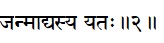
These are the last words of Arjuna in the Bhagavad Gita. The dialogue between Sri Krishna and Arjuna ends with these words. Sri Krishna answered the many questions of Arjuna and explained to him that the goal of life is to realize his true divine identity as the Atman, and how he can face the unpleasant and sorrowful situation that was forced on him by his cousins. Shri Krishna showed Arjuna how each of his responsibilities can be turned into spiritual practice, which can help to realize the Atman. The remaining 5 shlokas are the thoughts and expressions of Sanjaya.

Through this shloka, Arjuna shows us what should be the final outcome after listening to a spiritual discourse or having a spiritual dialogue. Each word of this shloka is important.

Let us review the meaning of each word of the shloka and reflect upon it.

My delusion is gone.

What is the delusion here? The greatest delusion of life is to think that we are nothing but our body and mind. We forget that our true identity is Atman, which is birthless and deathless. It is infinite, omnipresent and omnipotent. Limiting our self to the body and mind is the cause of all suffering and all delusion in life. We block the Reality of life and therefore, we suffer. Thus, after listening to spiritual discourses, this delusion must go.

 – I have regained my memory.

Deep within each of us there is awareness that ‘My true identity is divine. It is infinite and not limited by my body and mind.’ The Upanishads and Bhagavad Gita refer to this identity as the Atman (or Brahman in the context of the universe) and its nature is Sat-Chit-Ananda (Existence-Knowledge-Bliss Absolute).

‘Existence Absolute’ means ‘I am the Pure Consciousness from which the whole universe came (including my body and mind), which is nourished by It, into which the universe ultimately dissolves.

‘Knowledge Absolute’ means that the Self-Luminous Pure Consciousness illumines my intellect because of which I can think and perceive the universe.

‘Bliss Absolute’ means all my joy, inner (experienced, but not caused by the senses) and outer (which arises from the contact of my senses with worldly objects), is due to the presence of this Pure Consciousness (my true identity).

Arjuna says that he has regained this fundamental memory, that he is nothing but the Atman.

– O Krishna! Through your grace I have attained all these.

When the fundamental delusion is removed, the knowledge or the awareness of our true identity as Atman is revealed from within. This knowledge does not come from outside. However, we need help from the outside to remove our fundamental delusion. The idea that ‘I am nothing but this body and mind’ has been deeply ingrained in every fiber of our being; therefore, for most of us, it is difficult to remove this idea by our own efforts. Arjuna found that Shri Krishna’s teachings helped him remove this delusion and he is recognizing this help.

– I am firm.

This means that ‘I am clear in my mind. My intellect is steady. I know what I am supposed to do’. At the end of the second chapter of the Bhagavad Gita, Shri Krishna describes the characteristics of a person with steady intellect. The Sanskrit word for such a person is ‘Sthitaprajna.’ Arjuna is stating that his intellect is steady now.

– All my doubts are gone.

After listening to spiritual discourses, having spiritual dialogues, and doing spiritual practices accordingly, we have to come to a stage when all our doubts are removed. First, intellectual doubts have to be removed and then after realization of Atman, all our doubts are resolved. Suppose the Sun is covered by the clouds and we cannot see it.  Then, doubts come to our mind about whether or not the Sun exists. But, when the clouds are removed and we see the Sun directly, we feel its warmth, and in the sunlight we see everything clearly, then all our doubts about the existence of the Sun go away. At that time, we do not need any further proof of whether the Sun exists. In fact, we realize that the clouds were perceived only because of the presence of the Sun.

After listening to Shri Krishna’s teachings and having visions of both forms of Shri Krishna, the human and the Infinite, all of Arjuna’s doubts were gone.

– I will follow your command.

These words show that Arjuna was not interested in intellectual knowledge. He had to face a sorrowful situation and he was confused about the right thing to do. He needed a clear-cut answer and a clear-cut way to perform his responsibility. He stated his thoughts in the first chapter and the beginning of the second chapter. Based on these thoughts he initially decided not to fight. But deep down in his heart, he had a feeling that he was not thinking right. He had tremendous faith in Shri Krishna. That is why he said that ‘I surrender to you. Please tell me what is good for me.’

Shri Krishna first rebuked Arjuna for becoming a victim of his cowardliness. He said to Arjuna that this kind of behavior does not fit him. Then, Shri Krishna told Arjuna the essence of the Upanishads, explained to him that the goal of life is to realize Atman, and described the four Yogas (the four paths to attain this goal). Shri Krishna told him that by properly performing one’s own responsibilities one can realize one’s true identity as the Atman.

Arjuna did not swallow whatever had been said without understanding. Whenever he had questions, he did not hesitate to ask them to Shri Krishna. A couple of times it seemed that he was being blunt. Once he said, “O Krishna! You say that knowledge of the Atman is superior to actions. Then, why are you trying to encourage me to perform these horrible actions? You are confusing me with contradictory thoughts. Please tell me one thing which is good for me.” Another place he said, “O Krishna! You praise renunciation of actions, and then you talk about performing actions unselfishly. Please tell me which one is better.” When Shri Krishna said that he had taught this Karma Yoga to Vivasvata, Arjuna pointed out to him that he (Shri Krishna) had been born now and Vivasvata was born long ago, so how should he (Arjuna) believe that Shri Krishna had taught this Yoga to Vivasvata.

Shri Krishna was a great teacher. In his presence Arjuna did not have any fear to ask any question he had. After explaining in various ways why Arjuna should perform his responsibility, at the end, Shri Krishna gave Arjuna the freedom to do what he thought was right.

Arjuna was a great disciple. He reasoned to understand what Shri Krishna wanted to tell him. He reflected upon Shri Krishna’s teachings. With Shri Krishna’s grace he was able to realize the Ultimate Reality (Brahman) and finally with a clear mind, free from all doubts, and a firm conviction, he said, “I will follow your Command.” He was ready to implement what he had learned.

After realization of one’s true identity (Atman), all the desires of the realized person are fulfilled. Then he/she has nothing remaining to attain to be happy or any desire to accomplish anything further. But, many realized persons continue to work for the good of humanity. They set up ideal examples of saints and/or householders for people to follow and thus they inspire people to realize their true identity.

Sri Ramakrishna encouraged Narendra (Swami Vivekananda) to be such a person. It is good to remember the famous incident in Narendra’s life. Narendra asked Sri Ramakrishna to give him a boon to remain merged in Samadhi for three to four consecutive days with a few interruptions now and then for a bite of food. Sri Ramakrishna said, “You are a fool. There is a state higher than that. It is you who sings: ‘O Lord! Thou art all that exists.’” On another occasion, in response to a similar request from Narendra, Sri Ramakrishna said, “Shame on you! You are asking for such an insignificant thing. I thought that you would be like a big banyan tree, and that thousands of people would rest in your shade.” Thus scolded, Narendra shed profuse tears. He realized the greatness of Sri Ramakrishna’s heart. Thus, Sri Ramakrishna encouraged Narendra and all disciples to serve all beings, seeing God in them before and after the realization of God (Atman).

Sri Rama’s devotee Hanumanji had also set an example. He jumped over the ocean to cross it to find Mother Sitaji. A Mainak mountain asked Hanumanji to take some rest and then go forward. But, Hanumanji just touched the mountain recognizing the mountain’s love for him and said, “Until I finish Sri Rama’s work, how can I take any rest?”

Thus, many realized beings continue to serve humanity unselfishly.

Conclusion:  Arjuna’s words are the last word on listening to spiritual discourses and dialogue. He showed us that when we listen to spiritual discourses: (1) we should make sure that we learn about the goal of our life – realizing God or our true identity as the Atman (the Ultimate Reality). (2) We have to reflect upon the spiritual discourses and respectfully ask questions in order to understand the teachings presented to us. (3) Following the teachings, ultimately our fundamental delusion should go away. (4) We have to realize Atman. (5) We respectfully and with humility recognize the valuable contribution of our spiritual teachers. (6) We have to acquire a state of having a ‘steady intellect’. (7) All our doubts must go away, and (8) We perform our responsibility unselfishly and serve humanity.

(Thanks to Rushil Desai and Sonali Tatapudi for editing this post.)

Shatashloki –IV (Shloka 4 and 5)

“Shatashloki” of Shrimad Shankaracharya –IV (Shloka – 4 & 5)
The goal of life

Shloka – 4 & 5

Essential Meaning of Shloka 4 & 5:

Through experiences in the world, we find that the Atman is Sat-Chit-Ananda (Existence-Knowledge-Bliss Absolute). Because of the Atman, the body and mind function. This is the Truth, but deluded people always think that the perishable body is one’s real self. In reality, the body is made out of bones, muscles, bone marrow, flesh, blood, membrane, and skin and inside it is filled with filth like excreta, urine, and mucus.

Further, deluded people think that their bodies, spouses, children, friends, servants, pets and possessions are the sole source of their happiness; they spend their valuable time to protect and nourish them. They never think that it is because of the Atman that they have their lives and they continue to function. Such people never reflect on the Atman that resides within, the Atman that controls life and is immortal and blissful.

Comments:

Sat-Chit-Ananda

If we are aware and reflect on our day-to-day activities, we find that as a motor runs an engine, there is some power that keeps us alive and allows our mind and body to function. When we think of this power, we begin to understand the idea of the ‘Sat” (Existence Absolute) part of the Atman lying within.

In our dreams, even though our eyes are closed and our body is not moving, we can still see and do things! Who illumines the world we see in our dreams? As we think about this, we can begin to understand the ‘Chit’ (Knowledge Absolute) part of the Atman. In reality, the Atman illumines our intellect and because of this illumined intellect we see (when we are awake and when we are dreaming) and know things of the world.

When we come out of deep sleep, we sometimes experience joy. Where does this joy come from? We did not eat anything, we did not do anything and yet we experience joy. This experience gives us an idea of the ‘Ananda’ (Bliss Absolute) part of Atman.

The Goal of life:

A thoughtful person questions the goal of life: “Is the goal to earn a college degree or any diploma? Is it money-making? Is it acquiring name, fame, power and position? Is it just producing children? Why am I running around like a chicken without head from morning to night doing the same routine day after day?” When we do not have clear picture of our ultimate goal, then we sometimes lose interest in what we are doing.

Many great thinkers and saints have thought about this question. Sri Ramakrishna, in following the thought process of the great rishis and saints and through his own reflections, said that the goal of human life is God-realization. Swami Vivekananda makes this even more explicit. Swamiji said that the goal of human life is to realize the potential divinity lying within ourselves (the Atman) and to manifest this divinity in our thoughts, speech, and actions. Many great personalities and saints have shown through their lives that all our activities can be integrated around this goal and we can live a normal life free from all fear, and one that is filled with satisfaction, infinite happiness, a deeper understanding of our life and of the world, and unselfish love for all.

Generally, in order to be happy, we often try to acquire many things and run after the pleasures of the body and mind. But a great saint, Bhatruhari says, in Shloka 34 of “Vairagya Shatakam,” that we face fear in every worldly thing we try to cherish.

When one tries to enjoy worldly things, there is a fear of disease.

When one has acquired a higher position, then there is a fear of losing that position.

When one has acquired wealth, one has a fear of the king (government taxes).

When a person keeps silence, then there is a fear of being considered as a weak person.

When one has developed physical strength, one has a fear of an enemy.

When one has acquired beauty, then there is a fear of old age.

When one has acquired knowledge of scriptures, then there is a fear of a challenge.

When one practices virtues, then one has a fear of wicked people finding faults in one’s character

When one is attached to one’s body, then there is a fear of death.

Thus, every worldly thing has a fear attached to it.

Detachment is the only way to attain a state of fearlessness. Here, detachment means to understand that all worldly things are impermanent and then to make efforts to realize the permanent Atman

People and Worldly Things:

Consciously or unconsciously we make the mistake of thinking that our relatives, other people, animals, plants and worldly objects are made for our pleasure. With this attitude, our expectations grow beyond the limit and when people or things do not satisfy our expectations, we either become sad or angry.

We have to remember that our relatives and worldly objects have their own purpose for existence. We have to perform our own responsibilities, help others as much as we can, and refrain from keeping any expectations. This is the way to happiness.

Another mistake we make is that we are attracted to people because of their external appearances and/or roles. In Brihadaranyaka Upanishad (II.4.5) we find the following:

Rishi Yajnavalkya tells his wife,

“Verily, not for the sake of the husband, my dear, is the husband loved, but he is loved for the sake of the Self (Atman).”

“Verily, not for the sake of the wife, my dear, is the wife loved, but she is loved for the sake of the Self (Atman).”

…..

“Verily, not for the sake of the beings, my dear, are the beings loved, but they are loved for the sake of the Self (Atman).”

“Verily, not for the sake of the All, my dear, is the All loved, but it is loved for the sake of the Self (Atman).”

Thus, the Upanishad teaches us that all people and things look attractive because of the existence of the Atman lying within. When that Atman is gone, people and things lose their luster. When our loved one dies, we become sad. But, we know that the person has gone and the body was just an instrument and it will deteriorate.

In Shatashloki Shloka 4, Shri Shankaracharya asks us to think about this, and ask ‘what the body is made out of and what is in the body?’ He says that the body is made out of bones, muscles, bone marrow, flesh, blood, membrane, and skin and it is filled with filth like excreta, urine, and mucus.

Lust brings the mind down to the body-level which is impermanent and remaining on the body-level causes many problems. God has created lust to populate the earth, but to live a lustful life is not the goal of human life. In the “Shrimad Bhagavatam,” there is a story of King Yayati. He was cursed to lose his youth for his improper lustful behavior. After begging for the pardon, Yavati was allowed to switch his old age with the youth of a young person. He asked his sons to switch their youth with his old age. The youngest son agreed to the switch. After a few years, King Yayati realized that his lustful desires would be impossible to fulfill no matter how many years he tries. He switched back his youth with his son’s old age. He shared the following truth about this experience:

“Lustful desires cannot be fulfilled by trying to fulfill them. The more we try to fulfill lustful desires, the more they increase in their intensity just as a fire blazes more when we pour ghee into it.” Shrimad Bhagavatam 9.19.14

Thus, focusing the mind on the higher goal of life and striving to attain this goal gives us natural control of our lower desires. Sri Ramakrishna explains this using a simple analogy: if we have tasted a delicious mango, then we do not like the lower kind of cheap mangoes anymore.

 God-realization:

Sri Ramakrishna said that the goal of life is to realize God. To householders, he said that after having one or two children, the husband and wife should focus their minds on this main goal of God-realization and help one another other in the attainment of this goal.

Shri Shankaracharya in the “Viveka Chudamani” says that by it is by God’s grace that one attains the following three things: (1) a human life, (2) desire to realize God, and (3) proper guidance of a proper teacher.

Human life is rare to get and we should not waste the precious time in our lives by running after impermanent things of the world. These things cannot give us permanent satisfaction, a deeper understanding of our life and the world, inner peace, immortality, fearlessness, infinite bliss and unselfish love for all. The only realization of God (our true divine Self – Atman) can give us all of these wonderful things. Hence, we have to perform our worldly responsibilities as an offering to God and strive to achieve the goal of God-realization. For this, we have to learn the ways to realize God from the scriptures, holy people and saints, and practice them.

(Thanks to Nisha Parikh for editing this post.)


Shatashloki – III (Shloka 3)

“Shatashloki” of Shrimad Shankaracharya – III (Shloka – 3)
The Outline of Spiritual Journey

Shloka – 3

Translation of Shloka – 3

When we examine the questions, ‘What is Truth?” and “What is Untruth?, we begin to understand the difference between “Atman” and “Anatman (not Atman).” After this process, we start understanding the nature of Brahman by “Having direct experience” and “through reasoning’, the two methods described in the scriptures. Later on we realize the truth; First as “I am Brahman” and then as “Everything is Brahman”.  The first realization, “I am Brahman,” comes with reference to the body and the second realization, “Everything is Brahman,” comes from the experience that Atman resides in all and in everything.

Comments:

In this shloka, an outline of the entire spiritual journey of realizing the Ultimate Truth of ourselves and of the universe has been given.

The First Step – Analyze and Reflect

Sri Ramakrishna said that along with our daily prayers we have to go often into a solitary place and think about what is permanent and what is not permanent. Truth is permanent and untruth is not permanent. We can first find out what is not permanent. The body and mind are not permanent. They are born and they die. The world is not permanent. It has a beginning and therefore it has an end. Whatever we perceive through our senses has a beginning and has an end. But, behind our body and mind and behind this universe, there seems to be a permanent entity in reference to which we perceive all changes. One has to realize that the goal of life is to know what is permanent in us and behind the universe. Conviction in this goal is the first step in the spiritual path. Without this conviction, we actually have not yet started our spiritual journey, and all our spiritual practices, rituals, and ceremonies just become the preparation for this journey.

The Second Step – Spiritual Practices

With the firm resolve to attain the above-mentioned goal, we must start doing all our spiritual practices. For the people who follow Jnana Yoga (the Path of Knowledge), the spiritual practices will include: studying or listening to the scriptures from knowledgeable people and reflecting upon their teachings, using reasoning and analysis to understand the real difference between permanent and impermanent, discarding the impermanent and making efforts to realize what is permanent. In this shloka, the path of knowledge has been indicated. One can also practice Bhakti Yoga (the Path of Devotion), Karma Yoga (the Path of Unselfish Service), and Raja Yoga (the Path of Self-control and Meditation).

By practicing one or more Yogas simultaneously, we must realize Brahman, the Ultimate Reality, the permanent support of our existence and of the universe.

The First Realization:

According to this shloka, through spiritual practices, the first realization that comes is that behind this body and mind there is an “Atman” which is permanent. Its nature is Sat-Chit-Ananda, (Existence-Knowledge-Bliss Absolute). It is the support of our existence. It illumines our intellect, and through our intellect, we become aware of our Self and the universe. It is the source of all our happiness.

As a part of our spiritual journey, we realize that there are five layers which cover this Atman: (1) Annamaya Kosha – a layer of the physical body which is nourished by food and grows by food. It is made of bones, flesh, blood, and other such things. (2) Pranamaya Kosha – a layer of vital forces which help us to function. (3) Manomaya Kosha – a layer of our desires, imaginations, and emotions.  (4) Vijnanamaya Kosha – a layer of the subtle part of the mind which reasons and analyzes. (5) Anandamaya Kosha – a layer of sattvika joy (the joy of doing the right things). When we go beyond these five layers, then we realize that our ‘true identity’ is not our body and mind, but pure consciousness which we call “Atman’. This Atman was not born and does not die. The birth of a person is the birth of his/her body and mind. We realize that the nature of Atman, as described before, is Sat-Chit-Anand. This realization is related to our body and mind. We realize that if we remove our name and form, then what remains is Atman.

The Second Realization: After continuing spiritual practices, we realize that the Atman in me and Atman in another person are not different. When we remove name and form of each being, then what remains is Atman, the Pure Consciousness. Further, if we remove name and form of anything in the universe, then what remains is only Pure Consciousness. We also realize that the whole universe came from Pure Consciousness. It is Pure Consciousness which appears as varieties of things because of name and form. Ultimately the universe merges into Pure Consciousness. We call this Pure Consciousness, “Brahman”.

We also realize that the Pure Consciousness behind oneself and the Pure Consciousness behind the whole universe are same. We can think of the pot analogy to understand this. Various pots are lying in an ocean. Each pot has ocean water inside. All the characteristics of the water inside the pots and the water outside the pots are same. When a pot breaks, the water inside the pot merges with the ocean water. Another analogy is that of the reflections of the sun in pots filled with water. The sun represents Brahman and its reflection represents Atman. When the pot breaks, then the reflection merges with the sun itself.

Sri Ramakrishna has explained these stages of understanding for God-realization with simple examples. He said that there are those who have heard about milk, those who have seen milk, those who have touched milk and those who have drunk the milk and got nourished by it. Thus, there are people who have just heard about God. Then, there are people who have felt the presence of God within. Further, there are people who have an intimate relationship with God, meaning they see God in everything and feel that they are always living with God. Their minds are filled with bliss. Their words become scriptures. They show humanity that one can keep one’s mind on God and live in this world, leading a normal life. Their minds remain calm in the pairs of opposites like joy and sorrow, success and failure, favorable and unfavorable situations, honor and insult, dealings with friends and foes, etc. They inspire people to realize God or Atman or Brahman and attain their God-consciousness state.

Sri Ramakrishna realized God within with his eyes closed and then without with his eyes open. He saw that God has become everything. He encouraged his disciples to realize God within and then to see God in all, and to serve all as a worship to God.

(Thanks to Nisha Parikh for editing this post.)

The Basics of Vedanta – Part II

The Basics of Vedanta
The Search for the Self
Lesson – 2

Teacher:  Can you please summarize what we learned in lesson one?

Student:  I learned lots of things. Let me try to recall the main points.

As colors are made out of primary colors, all music is made out of seven notes, all sounds are combined in the sound of OM, and all positive integers are made out of 1 (0 is the absence of 1). Rishis, the scientists of the inner truth, searched for ‘something’ from which all people and the objects of the world are made out of. Through inner search, logic, and direct realization of the Ultimate Truth, they found that everything in the universe is made out of “Pure Consciousness” which they call “Brahman”.

As golden ornaments, though different in names and forms are made out of gold, clay images are made out of clay, and all different waves of an ocean are nothing but water, all various beings and objects of the world are made out of “Pure Consciousness”  or Brahman. Rishis, sages, saints, as well as other people, have realized this Ultimate Truth. Anyone who follows this well-researched path described by these Rishis, Sages, and Saints can realize this Ultimate Truth. When we realize this Truth, we become connected with all beings and objects of the world as one entity.

Teacher:  Do you recall anything else about what we discussed?

Student:  Yes, I remember more. You have said that all the spiritual laws (findings related to the Ultimate Truth) were compiled into “Vedas.” The Rishis did not claim that they had created these laws. But they said they had realized these truths.

Oh, I also have something more to say.

Teacher:  Please go ahead.

Student:  The philosophical parts of the Vedas (related to the existence and functions of our life and the universe) were compiled into Upanishads. Sage Badarayana had composed 555 sutras or formulas to systematize the revelations and the realizations of the Rishis on a rational basis. The book that consists of these sutras is called the “Brahma Sutras”. And the practical expressions and applications of these truths have been written in the form of a dialogue between Shri Krishna and Arjuna in The Bhagavad Gita, a part of the great epic Mahabharata.  We can also learn these truths from the lives and teachings of the realized souls.

Teacher:  Anything else?

Student:  Yes. “Pure Consciousness” or Brahman cannot be described in words as words are incapable of expressing infinity. But, the closest description of the nature of Brahman has been expressed through the word Sat-Chit-Ananda (Existence, Knowledge, and Bliss Absolute). Brahman is the support of our Existence, the basis of our awareness (which gives us knowledge), and the source of our happiness.

Teacher:  Excellent. In the spiritual path, it is always good to go back and remember what we have learned and reflect upon it. The more we do that, the more we understand these fundamental thoughts of Vedanta. The books of the Vedanta Philosophy are not like the kinds of novels that we read once and know their stories and then need not read again. We must realize the Ultimate Truth by repetitively reading, reflecting, and practicing these thoughts as described in the Vedanta books.

Student:  Does that mean that the spiritual knowledge is not an intellectual knowledge?

Teacher:  Exactly. You understand the point.

Remember one more thing I had said in the last lesson. I mentioned that Shri Shankaracharya wrote commentaries on the Upanishads, Brahma Sutras, and the Bhagavad Gita. Then, based upon the truths described in these books and his own direct experiences, he taught his disciples “Advaita Philosophy.” Later, based on the life and teachings of Sri Ramakrishna and Holy Mother Sri Sarada Devi, as well as his own studies and revelations, Swami Vivekananda expounded upon these truths through his lectures and writings. This is what most people consider to be the foundation of the Vedanta Philosophy that we know today. We can also find many other books in the literature based on the experiences and teachings of Saints and Sages which are also helpful to learn about the Vedanta Philosophy.

Student:  Thank you for reminding me of that point. I have a question: Besides Sat-Chit-Ananda are there any other names or expressions that are used to describe Brahman?

Teacher:  Good question. In the Bhagavad Gita, Upanishads, and Brahma Sutras, various words and expressions are used to provide the reader with some understanding of Pure Consciousness or Brahman.

You know that the Bhagavad Gita is considered to be the essence of all Upanishads.  I will cite a few of them from the Bhagavad Gita.

In Chapters two and twelve of the Bhagavad Gita, Pure Consciousness or Brahman has been described as follows:

Student: It seems that several of these expressions can be interpreted as having a negative connotation, like birth-less, does not perish, does not move, cannot be burnt, cut, or drowned, or Indefinable.

Teacher: You are right. Initially, one tries to understand “what is not Brahman.” It is called the process of elimination. In Sanskrit it is called “Neti, Neti” – not this, not this. For example, whatever perishes is not Brahman. Thus, the body and mind cannot be Brahman. Whatever is subject to change is not Brahman. We look around and find that everything is changing. We do not perceive anything that is permanent. Ultimately we find that whatever we perceive through our senses is not Brahman.

Student:  But, through this process, we will then eliminate everything in the universe and ultimately nothing will remain that can be called Brahman!

Teacher (with a smile): That is not the case. At the end of the elimination, the One who inspired the search definitely remains.

See, in a process of searching three things are needed: (1) The subject: the person who searches, (2) the object: the objective or goal of the search and (3) the process: the act itself of searching.  In this case, the Pure Consciousness is guiding the mind of a person (subject) to the search for Itself. Then, how can it find Itself? Here, the subject is looking for itself as an object!

Suppose a king named Bhimsing forgot that he is the king Bhimsing.

Now, suppose he begins to ask everyone “Are you king Bhimsing?” Everyone will definitely say ‘no, he or she is not’.  Ultimately, when the king realizes that ‘he himself is king Bhimsing,’ then his search ends, and he is happy with himself. Thus, by eliminating everything that is not Brahman, we ultimately realize our true identity which is Pure Consciousness and the search ends. Then, the subject, the object, and the process of the search all become one.

Student: Is it then true that whatever has been denied is not Brahman?

Teacher: Good question. In this case, there are three steps: (1st) One denies that everything that is grasped by the senses is Brahman, (2nd) One realizes the “Pure Consciousness” or Brahman by becoming one with It, and (3rd) After realizing Brahman, one finds that everything that has been denied was also Brahman, but one was not aware of it.

For example, when we are so aware of various names and forms of people with their different personalities, we forget that there is one life force behind them all. When we become aware of the same life force, the outer differences start melting away.

It is the same with the golden ornaments. When we are aware of the gold, then the names and shapes of the ornaments fade away, and we realize that everything is gold. It is same with clay images.

Sri Ramakrishna explained this in a very simple way. He said that in a house there is a staircase which takes one to the terrace. We climb on the first step and ask, ‘Is this the terrace?’ The answer is ‘no’. Then, we go on the second step and ask, “Is this the terrace?’ The answer is ‘no’. Thus, denying all the steps we finally reach to the terrace. Then, we find out that the terrace is made out of the same material that the steps have been made out of. Similarly, in the beginning, we negate that which does not appear to be Pure Consciousness. After negating everything, when we do finally realize Pure Consciousness, then we understand that everything actually is Pure Consciousness. The only difference is that before this realization, we saw all these things as various, separate objects.

Student: This is great. The names and forms of people divide us all. In order to realize the life force behind every being, we have to go beyond their names and forms. Once we realize the common life force behind everything, we start seeing all things connected by a common thread.

Teacher:  Excellent. That is the goal of the spiritual search for the Ultimate Truth or Ultimate Reality, also known as Pure Consciousness or Brahman.

Let us go back to the words I cited from Bhagavad Gita which refer to Brahman. They are all inter-connected. One that is imperishable should be birth-less because anything that has a beginning must also have an end, and therefore, it cannot be imperishable.

The imperishable should be infinite and omnipresent, or all-pervading.  That which is omnipresent is unique. Thus, there can be no two Brahmans.  Infinite cannot manifest because whatever manifests is, by definition, finite. Thus, the infinite is un-manifested. It is also unchangeable and immovable.

Student:   I have a question. If Brahman or Pure Consciousness moves through all beings, then how can It be immovable?

Teacher:  I admire your thinking and your question. Let me tell you an incident from my life. Once I was traveling in a New York Subway. It was a rush hour. The subway car was packed with people. I was standing in the middle of the car surrounded by people. The train makes turns on its way and the riders get thrown around. I was holding a strap which was a short distance away. I had to stretch my hand out to hold onto it, and so my hand was hitting the faces of several people. One passenger told me to let the strap go. I said, “If I let go, I will fall.” The passenger smiled and asked me, “Where are you going to fall?”  I then understood the situation. In order to fall, I needed a room. But I had no room to move, so, how could I fall? This analogy taught me about Brahman being immovable. In order for Brahman to move, it needs some space where Brahman does not exist. But, Brahman is everywhere. Therefore, It has no room to move, and as such, Brahman is immovable as a whole.

Student: That was a good explanation of how Brahman is immovable. A similar question comes to my mind about how to understand Brahman being un-changeable even though all things in the universe are changing.

Teacher:  Changes are relative. I told you in lesson one, if you have several photographs taken from your childhood up until now at various stages of your life, they will surely all look different. But you feel that you are the same person in all of those pictures. Who is ‘you’? Your body and mind keep changing, but, the one ‘you’ who see all changes is not changing. There is something behind your body and mind which does not change. Relative to that unchanging personality, you perceive all changes.

The same thing holds true for movement. I move my hand and you see the movement of my hand because behind my hand something is not moving. Imagine that I am standing in an elevator of a 500 story building. The elevator is at 500th floor and it is going down to the 1st floor. Now, suppose the machinery of the elevator breaks and the elevator car falls with gravitational force. During that time, if I hold a pencil in my hand and let it go in the air, the pencil will not fall on the ground until the elevator hits the ground. The pencil floats in the air because the pencil in the air and floor of the elevator are going down with the same speed. Thus, we do not see the pencil moving because the elevator and the pencil are moving together at the same speed. If the background against which the pencil fell remained steady, then we would see the pencil moving.

Student:  It is amazing to know that several hundred years ago when the Bhagavad Gita was written, all these appropriate words were selected to describe Brahman. The Rishis and Lord Vyas must have been very thoughtful and deeply research-minded.

Teacher: The Rishis were research-minded and also very poetic in their expressions. A Rishi told a story in the Kena Upanishad in order to express that Brahman or Pure Consciousness cannot be destroyed by any weapon, fire, water, or wind.

Once, the gods and demons had a war. The gods won the war and they were boasting about their powers. Among the gods, there was the fire-god, the wind-god, and Indra, the king of all gods. At that time, Brahman appeared in a celestial form called a Yaksha and presented a straw to the fire-god to burn it. The fire-god tried with all his might, but he could not burn the straw. Similarly, when the piece of straw was presented to the wind-god, he could not move the straw. The fire-god and the wind-god were embarrassed by their defeat. They asked Indra to go and find out who that Yaksha was. When Indra went to find out, the celestial being disappeared and he saw a divine goddess Uma in its place. When Indra inquired about the celestial being, Uma told him that it was Brahman, who came in that form to inform people that because of the power of Brahman, the gods had won the war. The gods were just the instruments of Brahman.

Student: That is a very interesting story. I am amazed to hear that it was told several thousand years ago. It really highlights the message that Brahman is indestructible, and cannot be burnt by a fire or blown away by the wind.

I think I am finally getting an idea about Pure Consciousness or Brahman.  You have explained to me that Brahman is infinite and our finite mind cannot comprehend it. But I cannot help but wonder: ‘Why can Brahman not be known? Within the last several thousand years, we have learned so much and advance so far, so one day we will be able to know Brahman. Is that true?’

Teacher: Is there a limit to knowledge? The sky is the limit for learning.

For example, look at the bottom chart.

The area inside the circle represents all the knowledge that exists between all human beings on the earth. The area outside the circle represents our ignorance.  Suppose the radius of the circle is 2 units. Then, the circumference will be C = 2 x (Pi) x (2) = 4 (Pi).

Suppose after some time, through research and learning, we acquire more knowledge. Then the area of the circle of knowledge increases. Now suppose this new circle has a radius of 3 units. Then, its circumference will be C = 2 x (Pi) x (3) = 6 (Pi).

 Do you agree that 6 (Pi) is bigger than 4 (Pi)? What do you see? As our knowledge increases, the circumference of the circle of knowledge also increases.  This is actually the awareness of our ignorance. Thus, the more we know, the more we are aware of our ignorance.

Student: This is wonderful. I never thought it that way. I figured we just know more and more every day so that one day we will know everything that we are supposed to know. But, it is not true.

Teacher: You know that tons of research papers are being published every day. If you look at a few scientific research papers more closely, you will find that they solve one problem, but create more questions or inquiries. It is good. It shows that the awareness of our ignorance is increasing with our increase in knowledge.

Student: I remember that the wise man Socrates said a similar thing. If someone claimed that he/she had some knowledge about any subject, then Socrates would start asking questions of that person until a point came when the person was forced to admit that he/she did not know the subject. I think Socrates’ intention was not to insult that person but to help him/her realize that there is a limit to one’s knowledge.

I also remember another thing about Socrates. He once said that some respectable person had been going around saying to others “Socrates is the wisest person around.”Socrates began to wonder why a respectable person would say such a thing. Socrates knew that many people knew more about many subjects than he did. But, upon pondering this more deeply, he realized that many people claimed that they knew more than they actually knew, while he himself was actually aware of what he knew and what he did not know.

From this, we can conclude that the sign of a wise person is that he/she is fully aware of what he/she knows and does not know.

Teacher: That is a very nice connection you made.

Student: But, I find it depressing to know that we are limited in our abilities such that we cannot know everything. It makes me feel helpless.

Teacher: Let me tell you a few important things the Upanishads teaches us about knowledge

The first point is from the Chhandogya Upanishad (7.1.1 – 3).

A great sage Narada went to another Sage and Teacher named Sanatkumar and told him, “I came to learn from you. Please guide me.”

Sanatkumar asked Narada, “Please tell me what you already know. After knowing it, I will have a better idea what I have to tell you.”

Narada said, “I know all the four Vedas, the Puranas, Grammar, Mathematics, Economics, Logic, Ethics, the Science of Archery, Astronomy, the Performing Arts, and much more. I know all these things, but I have not overcome my dissatisfaction and sorrows. I think to myself, ‘I am only Mantra-Vit (the Knower of the Mantras) and not Atma-Vit (the Knower of Atman).’ That is why I am not fully satisfied and happy within. I have heard that an Atma-Vit person has obtained complete satisfaction and experiences bliss within. So, please guide me in obtaining the Knowledge of Atman.”

So the Great Sage and Teacher, Sanatkumar, taught Narada the Knowledge of Atman.

There is another similar but more important teaching we find in the Mudaka Upanishad (1.1.3-5) about knowledge.

Once, Sage Shaunaka, who was the head of a large university, went to another great Sage, Angira, and respectfully asked him, “O Respectable Sage, what is it by knowing which everything is known?”

Sage Angira said, “The Knowers of Brahman say that there are two kinds of knowledge: The Inferior Knowledge (Apara Vidya) and The Superior Knowledge (Para Vidya).  The Inferior Knowledge (Apara Vidya) includes, but is not limited to the knowledge of all four Vedas, Chanting, Rituals, Grammar, Poetry, the Planets and Stars, and others. The Superior Knowledge (Para Vidya) is the one by which the Imperishable Brahman is realized.”

Student: Wow! So, both the Upanishads say the same thing! I keep wondering again, and again, how, several thousand years ago, these great Rishis thought to attain the highest knowledge that a human being ought to attain?

Teacher: Yes, it is amazing. More importantly, these thoughts and the truths these Sages realized are not bound by time and space. As the laws of science are true in all countries, for all people and for all the time, these truths of the Upanishads, the Bhagavad Gita, and the Brahma Sutras are true for all people everywhere and for all of the time.

The Rishis tell us that the knowledge of worldly objects or materials is limited. The knowledge of “I,” the One who is inquiring, Pure Consciousness (Brahman), is most important. When we realize Brahman, our true divine identity, then we find that our life and the world become meaningful, and all our fundamental questions of life are answered. We acquire a clear understanding of ourselves and our relationship to others, attain fearlessness and fulfillment in life, and experience infinite bliss within. This does not depend on any object in the world.

Student: After knowing this, I wonder who would not want to try to realize one’s true divine identity. Thank you for sharing these wonderful eternal truths with me.

 Teacher: My pleasure.

(Thanks to Sheela Krishnan and Ben Baker for editing this post.)

Shatashloki – II (Shloka 2)

“Shatashloki” of Shrimad Shankaracharya – II (Shloka – 2)
The Glories of a Sadguru and His/Her Disciples

Shloka – 2

Translation of Shloka – 2

As the sandalwood tree fills the neighboring trees with its fragrance and makes them ‘cooling trees’ which remove people’s tiredness and the burning sensation of the sun, the compassionate disciples of a Sadguru who have realized God (Brahman) remove the three kinds of suffering and impurity of the people around them.

Comments:

We learned in shloka-1 that a Sadguru makes his/her disciple a “Sadguru” just like him/her. But the impact of the Sadguru’s teachings goes further. The disciples of the Sadguru with their compassionate hearts remove the suffering of the people around them.

Sri Ramakrishna emphasized repeatedly that “Holy Company” is very important for spiritual progress, especially to develop the love for God. He gave an example of a dyer who had a pool filled with a magical liquid. If anyone came and asked, “Please make this white cloth into a red colored cloth,” the dyer would dip that cloth into the pool and it would come out as a red cloth. In the same way, he colored people’s white clothes with blue, yellow, orange, and other colors just by dipping them into the same pool. One person observed this and said, “I want to be colored with your color.” The analogy applies to Sri Ramakrishna himself. If Krishna’s devotee came to him, he would fill the heart of that devotee with the devotion of Krishna with his talks and singing. The same was the case with the devotees of Kali, Durga, Shiva, Rama, or any other god or even any other religion. Sri Ramakrishna was suggesting that an observant devotee may ask him about how to become like him.

A company is contagious. Swami Vivekananda said that if you cherish good thoughts and try to build a good character, you will attract people with good thoughts and good character. These people, in turn, help you to develop more good thoughts and to strengthen your good character. The same is true for bad character. If we cherish harmful ideas and knowingly or unknowingly try to be a wicked person, we attract people with harmful thoughts and wicked character. They help us to become a truly wicked person. There is a proverb that ‘A person is known by the company he/she keeps.” There are exceptions to this. Out of compassion and love, Lord Shiva kept ghosts and goblins around him for their upliftment. We cannot judge Lord Shiva by his company.

Sri Ramakrishna said that when a plant is small, it has to be hedged around otherwise animals will eat it. But, when the small plant becomes a big tree, then you can tie an elephant to the tree and nothing happens to the tree. Thus, when a person’s strong character is built, then he/she will not be affected by his/her company. People with strong character make a positive influence on the people around them. Still, wise people say that “Sadhu Savadhan”, meaning a wise person should always be alert to not being influenced by wicked people.

The trees covered by the fragrance of the sandalwood means that in the presence of holy company, people’s holy thoughts rise to the surface. With holy thoughts, people’s minds get cleansed and become pure. Also, holy thoughts guide people to do the right thing, avoid problems in life, and attain peace within.

Swami Vivekananda said that each person is potentially divine. When we go towards our divinity, we feel peace within. We will feel the joy of doing the right thing. On the other hand, when we go away from our divinity, our minds are filled with demonic thoughts. Having these demonic thoughts, we speak accordingly and perform demonic actions. Such things will fill our minds with impurities and develop inner conflicts between our divine selves and these demonic thoughts, speech, and actions. This state of mind will always be filled with agitation, frustration, depression, and dissatisfaction. Such a mind will be far away from peace. It suffers from all kinds of mental problems. Thus, the holy company is extremely important to help us raise our holy thoughts to the mental surface which eventually help us to realize our divinity and enjoy purity, peace, and bliss within.

It will not be inappropriate to look at the list of divine and the demonic qualities Shri Krishna had described in the sixteenth chapter of the Bhagavad Gita. By knowing these qualities, we focus our minds to develop divine qualities and stay away from the demonic qualities in order to attain purity, peace, and bliss.

Divine Qualities:

(1) fearlessness, (2) purity of mind, (3) being established in the True Knowledge of the Self and an ability to focus the mind on the Self, (4) charity, (5) control on one’s senses, (6) sacrifice or unselfish service (7) study of the scriptures and the habit of reflecting upon their teachings in order to practice them, (8) austerities – bearing the pain due to spiritual practices (9) being simple minded (lack of crookedness), (10) not to hurt anyone through thought, speech and action, (11) being truthful, (12) devoid of anger, (13) renunciation – ability to renounce what comes in the way of spiritual development (14) peaceful nature, (15) not to think or talk ill of others, (16) compassion towards all beings, (17) not being greedy, (18) having a gentle nature (not being rude), (19) modesty; feeling shame in doing unrighteous things, (20) not restless (21) possessing an aura of divinity (22) forgiveness, (23) ability to hold onto spiritual practices until realization of one’s divinity, (24) purity – external and internal, (25) having no animosity towards anyone and (26) not craving for special honor or respect.

Demonic Qualities:

(1) Pretension, (2) Arrogance, (3) Being egoistic, (4) Lack of control over anger, (5) Rudeness, (6) Ignorance, (7) Being confused between “what should be done,” and “what should not be done,” (8) Lacking purity (9) Being unrighteous (10) Being untruthful

(11)  Thinking that the world is devoid of truth, has no moral basis, is without God, and is the creation of a combination of the male and female element with no other cause except the fulfillment of lust. Having such views, these lost souls, with little understanding and fierce actions, rise as the enemies of the world for its destruction.

(12) Being filled with hypocrisy, pride, and arrogance, and giving themselves up to insatiable desires, they hold false views through delusion and act with impure resolve.

(13) Living with infinite worries which last till their deaths, and thinking that ‘acquiring pleasures of the body and mind is the only goal of life,’ they crave for sense-pleasures.

(14) Being slaves of thousands of hopes of worldly desires and filled with lust and anger, they are busy collecting money for sense pleasures through unethical means.

(15) Thinking that “Today I have gained one thing and later on I will fulfill another longing. I have collected this much money, and in the future, I will collect more. I have killed this enemy and I will kill more in the future.  I am the Lord of the Universe.  I enjoy the world.  I am endowed with all the cleverness. I am powerful and I am happy.  I am rich and I am from a ‘high family.’  There is no one equal to me.  I give in charity, perform religious rituals, and I will enjoy the world.”  Thus, being deluded by ignorance, caught in the net of ‘attachment’, with messed-up minds, and craving for sense pleasures they fall into a hell, meaning that they live very low-level human lives.

(16)  Considering them as great, drunken by the wealth and worldly respect these arrogant people perform religious rituals whimsically for their worldly pleasures.  They do not properly follow scriptural injunctions.

(17) With minds filled with ego, the pride of their physical strength, arrogance, worldly desires, anger, and jealousy they torture Me (the Self) which lies in themselves and others.

We have one more important thing to know. Sri Ramakrishna had said that the wind from the Malaya Mountain fills all the trees with the fragrance of the sandalwood except a few trees like the cotton trees, the banyan trees, the ashwattha trees.

This means that holy company does not inspire all people. In order to get inspired by the holy company, one needs a proper state of mind. Those who are egoistic, arrogant, deeply engrossed in worldly pleasures and think that there is nothing higher to attain than sense-pleasures, name-fame, honor, power, and position do not get inspired by the holy company. There were many people who had seen Sri Ramakrishna at the Dakshineswar Kali Temple, but they did not understand his spiritual depth, let alone feeling inspired by him. Several of them even thought that Sri Ramakrishna was a “pagol” (insane) person. So, we have to do spiritual practices in order to recognize and get inspired by the holy company. Swami Adiswarananda, the Spiritual Head of the Ramakrishna Vivekananda Center of New York, used to say that people go to a holy person for the holy company, but then they talk about politics and other mundane things. The holy people out of love and compassion talk to such people about non-spiritual things, but then they miss the advantage of the holy company. We should go to the holy company in order to learn about spirituality and how to make progress in our spiritual path. We can learn valuable lessons from their experiences and teachings which inspire us to realize our true divine identity.

Note: The cotton trees, the banyan trees, and the ashwattha trees are very special and have significant importance. In this example, we have to take just a partial meaning and not to condemn these trees.

(Thanks to Rushil Desai and Sonali Tatapudy for editing this post.)


Shatashloki – I (Shloka 1)

“Shatashloki” of Shrimad Shankaracharya – I (Shloka -1)
The Glories of a Sadguru

“Shatashloki” means a collection of one hundred shlokas. However, Shrimad Shankaracharya added one more shloka at the end to salute the Lord and made it a bouquet of one hundred and one shlokas. The first two shlokas describe the glories of “Sadguru” and his/her disciples. The remaining ninety-eight shlokas bring out the essence of Vedanta in beautiful Sanskrit poetry using the meter of “Stragdhara.” Thus, “Shatashloki” shows Shrimad Shankaracharya’s direct knowledge of the Ultimate Reality, his knowledge of the Vedas, Upanishads, Brahma Sutras and Bhagavad Gita, his excellent command of the Sanskrit language, and his poetic genius.

All one hundred and one shlokas of the “Shatashloki” have been written in the Sanskrit poetic meter “Stragdhara.”  Each line consists of 21 letters which are divided in 7-7-7 letters while singing in the traditional way.  The other rules of the letters are very complicated. One can see the genius of Shrimad Shankaracharya by observing how he could express the deeper ideas of Vedanta in such an appealing and lucid way through this complicated meter.  In this collection, one finds various examples explaining Vedantic philosophy in a very effective way. Such examples are difficult to find in other books.

“Shatashloki” is a must read book for a student of Vedanta who wants to realize the Ultimate Reality. Many ideas of Vedanta become clearer by learning the various examples described in the book. One also gets practical hints and a clear picture of a person who realized the Ultimate Reality, called Brahman.

I personally enjoyed reading “Shatashloki” and studying with many devotees in our Monday classes. The main purpose of this translation is to bring out the central messages of the shlokas of the “Shatashloki” in English rather than trying to give a word-to-word translation. I hope that this translation and a few comments made after each shloka will be spiritually helpful to the reader.

Shloka – 1:

Translation:

Shloka – 1.  In the whole world, one cannot find an analogy to describe the positive impact of a Sadguru on the life of his/her disciple. Even an analogy between a “Parasmani” (Philosopher’s stone) and the Sadguru falls short. A “Parasmani” makes a piece of iron into gold by its touch, but it cannot make it into a “Parasmani.” On the other hand, when a disciple accepts a Sadguru as his/her guide and follows his/her guidance sincerely, then the Sadguru makes the disciple just like him/her. That is why there is no good analogy to describe the Sadguru. The Sadguru is simply great and is beyond the description.

Comments:

Guru means one who removes ignorance. But, now the word Guru has been used freely for a teacher or an expert in a field.

Bhagavad Gita (17.23) says that “Om,” “Tat,” and “Sat” are three epithets of the Ultimate Reality (Brahman). Whenever there is anything which is noble, or good, or respectful, it has been described in Sanskrit by a word which starts with “Sat.” Here are a few examples:  Sat-bhava (Sadbhava – good motive), Sat-jana (Sajjana – a good or a noble person), Sat-marga (Sanmarga- a good or right path), Sat-sang (good company), Sat-Guru (Sadguru – a noble Guru).

Actually, a Sadguru is one who guides his/her disciple to the spiritual path and leads him/her to God-realization. The meaning of God-realization is to realize one’s true divine identity as “Atman,” which is the same as realizing the Ultimate Reality, called Brahman.

It is true that if one sincerely wishes to realize God, has an intense desire, and makes efforts to realize God, then God, from within, guides the person to the right path. If he/she needs help, then God provides all the guidance needed through a Sadguru.

In the Srimad Bhagavatam, it is described that a wise man named Avadhuta had twenty-four teachers. He learned from nature and from people. A foolish person has nothing to learn even from a wise person, but a wise person learns even from a foolish person. Swami Adiswarananda used to say that we need experts and their guidance in all the fields of life, but still many people think that they do not need any guide on the spiritual path.

Some people think, ‘Let me wait until I find a Sadguru. I will do all spiritual practices after I find a Sadguru.’ But this does not work. The fact is that until we do spiritual practices, we cannot recognize a Sadguru. Many people saw Sri Ramakrishna and lived around him, but they did not understand his greatness. Many even thought that he was a crazy person.

I used to tell the students in my math classes: “If you have tried to do your homework and struggle to solve a problem at home, then the next day in the class you will be able to understand the hints I give you and you will be able to solve the problem by yourselves.” Similarly, when we do spiritual practices and do not see how to make further progress, then we recognize and understand the importance of a Sadguru’s hints. Otherwise, the teachings of a Sadguru go over our heads.

Thus, we have to start our spiritual practices based upon whatever we know. Even a sincere prayer to God is enough to start with. All the help comes when we really need it. We have to make ourselves worthy to receive guidance from a Sadguru.

In the series of lectures on Bhakti Yoga, Swami Vivekananda gave two lectures: (1) The Need of a Guru and (2) Qualifications of the Aspirant and the Teacher. Swami Vivekananda said that a disciple should have a pure mind, a real thirst for knowledge, and perseverance.

Sri Ramakrishna said that even if a sincere devotee is unintentionally going down the wrong path, God will send a guide to put him back on the right path. For example, if a traveler sat in the wrong bus, then someone would tell him/her, ‘My dear fellow, this is the wrong bus, and that one is the right bus for you.’   One who does nothing does not need any guidance.

Three kinds of Teachers

The Gospel of Sri Ramakrishna describes three kinds of Gurus or teachers; inferior, mediocre, and superior. The inferior teacher gives spiritual instructions and then leaves the disciples alone. The mediocre teacher, after giving spiritual instructions, explains the importance of spiritual progress and uses many tactics to convince the disciple to follow the instructions and do spiritual practices. The superior teacher also gives instructions and explains their importance, but when he/she finds out that the disciple is not following any instruction, he/she uses loving force to make the disciple do some practices. It is like a mother who, finding that her sick child is not taking any medicine, uses force to make the child take the medicine.

However, there are also three kinds of disciples: superior, mediocre, and inferior. The superior disciple immediately follows his/her Sadguru’s instruction whenever received. He/she does not have to be reminded of these instructions. For the superior disciple, the inferior Sadguru will suffice. Similarly, for the mediocre disciple who needs explanations, reminders, and goading, the mediocre Sadguru will be helpful. For the inferior disciple who ignores explanation, reminders, and goading, the superior Sadguru, who uses loving force to help the disciple, will be best.

Shrimad Shankaracharya says in the Viveka Chudamani that by God’s grace only one gets three things: a human birth, an intense desire to realize God, and the guidance of a Sadguru.

In Shatashloki, Shrimad Shankaracharya says that the positive impact of a Sadguru in the life of a disciple is “Aloukik”: divine, superb, out of this world, and indescribable by anything in the world.

Really, when by the guidance of a Sadguru, a disciple finds that

(1) his/her life has been completely transformed for good,

(2) he/she has found that a human life is meaningful,

(3) his/her delusion and ignorance have vanished and now everything looks clear and meaningful in the light of the knowledge of the Atman,

(4) he/she realizes that his/her true identity is divine,

(5) he/she feels inner peace and bliss which does not depend on any person or object of the world,

(6) he/she finds the inner strength to go through favorable and unfavorable life situations with a calm mind,

(7) he/she finds fulfillment in life, and

(8) he/she finds that each being is potentially divine and is not different than him/her,

then that disciple realizes that the impact of his/her Sadguru cannot be described by anything in the world.

(Thanks to Sonali Tatapudy for editing this post.)


The Basics of Vedanta – Part I

The Basics of Vedanta
The Search for the Self
Lesson – 1

Teacher:  Write down as many colors you can think of in two minutes and tell me their names.

Student (after two minutes): There are hundreds of colors. But, in two minutes I wrote down the following colors which came to my mind: Red, Green, Purple, Chocolate, Amber, Blue, Apricot, Beige, Black, Pink, Brown, Burgundy, Peach, Yellow, White, Violet, Gold, Orange, Crimson, Lilac, and Maroon.

Teacher:  Excellent. You wrote names of many colors. Now, I have a Yellow color and if I mix it with Blue color, then what happens?

Student:   It will be green.

Teacher:  What if I mix Red and Yellow?

Student:   It will be an Orange color.  Are you talking about the primary and secondary colors? I have learned that in one model Red, Yellow, and Blue are primary colors and Green, Orange, and Purple are secondary colors which are made from the combination of the primary colors. There are also tertiary colors which are made from the primary and secondary colors.

Teacher:  Very good. Now, who told you that Red, Yellow, and Blue are the primary colors and all other colors are made from these colors?

Student (after some thinking):   I guess, my school teacher.

Teacher:  Who told that teacher?

Student:   I guess, her teacher.

Teacher:  Now, let me sing a couple of bhajans and dhoons.

(After singing a couple of bhajans and dhoons, the teacher continued)

Teacher:  What are all these made from?

Student:   I think they are made from tunes.

Teacher:  What are the tunes made from?

Student:  Musical notes.

Teacher:  How many musical notes are there?

Student:   There are seven main notes: Sa, Re, Ga, Ma, Pa, Dha, and Ni in Indian Music and in Western Music, they are Do, Re, Mi, Fa, So, La, and Ti.

Teacher:  You are right. All music made from these seven notes. Do you know what all the sounds made from?

Student:  There are so many kinds of sounds. How can we find a sound from which all sounds are made?

Teacher:  Try to remember if you have learned about this in some class.

Student:  Oh yes, I remembered Swami Vivekananda talked about the sound of Om in his lecture on “The Mantra: Om”.

Teacher:  I am glad you remembered this. Swami Vivekananda said that the Lord first becomes conditioned as the Sphota (or Word) and then evolves Himself as the yet more concrete sensible universe. This Sphota has one word as its only possible symbol, and this Word is  Om.

Swami Vivekananda further said that these three Sanskrit letters –  – pronounced in combination as Om, may well be the generalized symbol of all possible sounds.

The letter covers all the sounds that originate and starts at the navel level and goes up to the end of the mouth, the letter covers all the sounds that start at the beginning of the mouth up to the lips, and the letter covers all the sounds that end with closing the lips.

(The teacher pauses.)

Okay! Now, let me write a positive integer 47,589,013,726. I don’t want you to read that number. But, I want you to tell me what this integer is made from?

Student:  Yes, it is made from the integers 1, 2, 3, 4, 5, 6, 7, 8, 9, and 0.  I can say that every positive integer is made from these 10 integers.

Teacher:  Let us go further. What these 10 integers (1, 2, 3, 4, 5, 6, 7, 8, 9, and 0) made from?

Student:  I did not understand the question. These are 10 integers and all positive integers are made from these integers.

Teacher:  How the number 2 is made?

Student:  Yes, it is 1 plus 1.  Now, I know that integers 1 through 9, each one is made from 1. But, what can we say about 0?

Teacher:  Excellent answer and the question. One can think that 0 as the absence of 1. Thus, all positive integers are made from 1.

Now, suppose someone asks you, “Who are you?” What would you say?

Student:  I will tell my name, my birthdate, my grade, my residence, the name of my parents and family members, my achievements, my dreams, my thoughts and many other things of myself.

Teacher:  Suppose you can write all this information down on papers, like writing down your resume, would that resume capture all of you?

Student:  I guess not.

Teacher:  Why not?

Student:  Because I am more than whatever I write down about myself.

Teacher:  Suppose I ask this question “Who are you?” to Jack, Jane, Vrinda, and Yogesh, and many others and suppose they all write something about themselves, would you be able to find any common thing or things among them?

Student:  Maybe they have similar interests or maybe they have nothing in common among themselves.

Teacher:  What are all these people made of?

Student:  I guess the body and mind.

Teacher:  Well, their bodies and minds will be different. Even twins and triplets have differences among themselves. Is there anything common among them?

Student:   I think ‘life’ is common among them.

Teacher:  Very good. Now, you see, the way human beings searched and found that (1) all colors are made from three primary colors, (2) all music is made from seven notes, and (3) all positive integers are made from 1, the same way “Rishis” who were scientists of the inner world of our mind searched for the true identity of human beings and found out through their reflections, introspections, and meditation that all beings have one common thing and it is consciousness. They called this “Pure Consciousness” or “Brahman” compare to the individual consciousness that we commonly refer to. They realized that all beings, animals, fish, trees, vegetation, and even all matter is made of this Pure Consciousness or Brahman. Many Sages, Saints, and great teachers directly experienced or vision that the same Pure Consciousness is being expressed through various forms.

Student:  But, when I close my eyes and think of myself, I feel that I am my body and my mind. I do not see anything beyond!

Teacher:  You are right. Most people think that they are nothing but their body and mind. But, think for a while.

If your parents have taken your photos from the time you were born till now and if I lined them up chronologically, what will you find? You look different at various stages of life. Ten or twenty years from now you will look different than you are now. Our body is constantly changing. Our body cells are changing. But, we feel that we are the same people! If you were just the body, then you are not the same person. But, why do you feel that you are the same person?

Now, let us talk about our mind. Our interests are changing. You might not be playing with your toys that you enjoyed playing with when you were a child. Youngsters have different kinds of toys to entertain themselves and so do the grownups.  Thus, our interest and thoughts, our likes and dislikes and our views of many things change, but amazingly we feel that we are the same!

Rishis with their introspection and logical and scientific inquiry realized that we are not our body and mind. We are something beyond our body and mind which does not change and having it in the background we see all the changes of our body and mind. This true identity is the same in all beings which they called it “Pure Consciousness” or “Brahman”.

Student:  Wow! I have never thought it that way. How do we know that these Rishis found this out?

Teacher:  Good question. As I told you, these Rishis were the scientists and they realized that the common thing behind all beings and things is “Pure Consciousness” or Brahman. They even realized that “Pure Consciousness” or Brahman has become everything. After their realization, they taught these truths to their students and later these truths were collected into books called the Vedas. These Rishis did not claim that they found the truths, but they said that they realized or directly experienced these truths and therefore no Rishi claimed to be the founder of the truth or the author of the book.

Do you know how many Vedas are there?

Student:  Yes, I have learned their names. They are Rig Veda, Yajur Veda, Sama Veda, and Atharva Veda.

Teacher:  Good that you remembered their names. Now, know more about them. It is good to know how Swami Vivekananda talked about these Vedas to the American audience on September 19, 1893, in his lecture “Hinduism” as one of the famous Chicago Lectures delivered at the World Parliament of Religions.

Swami Vivekananda said, “They (the Vedas) mean the accumulated treasure of spiritual laws discovered by different persons in different times. Just as the law of gravitation existed before its discovery and would exist if all humanity forgot it, so it is with the laws that govern the spiritual world. The moral, ethical, and spiritual relations between soul and soul and between individual spirits and the Father of all spirits were there before their discovery and would remain even if we forgot them.

The discoverers of these laws are called Rishis, and we honor them as perfected beings. I am glad to tell this audience that some of the very greatest of them were women.”

Here spirit means the “Pure Consciousness” or Brahman and the spiritual means everything related to the “Pure Consciousness” or Brahman.

Student:  Please tell me more about Brahman or Pure Consciousness.

Teacher:  As I told you before, Rishis, Sages, and Saints realized that Brahman or Pure Consciousness alone appears as the whole universe. The following analogies can give you some idea of that expression.

Imagine an ocean. In the ocean there are various kinds of waves arise and merge back into the ocean. All these waves are nothing but the water of the ocean. Similarly, the Brahman or Pure Consciousness is appearing as various things of the universe; the sun, the moon, the planets, the stars, the earth, and all beings and the matter on the earth.

On a beach of an ocean, kids make various things from the sand. They look different and one can give them different names, but they are nothing but the sand.


Let us see another analogy.  Several ornaments are made from gold like a necklace, ring, earrings, bracelet, and others. All the ornaments look different and have different names, but they are nothing but the gold. The gold appears as different ornaments.

From clay, one can make the sun, the moon, the planets, the stars, the earth, people, animals, houses, mountains, the whole universe, but it is all clay. Children make many things out of Play-Doh. These things look different and we can give them different names, but it is all Play-Doh!

Have you seen a wax museum? It has varieties of people, but it is all wax. Similarly, One Brahman is appearing as varieties of objects and beings of the universe.

Student:  Wow! What an experience! Whoever had such an experience feels that the whole universe is “One”.  With that experience, one feels that he/she is related to all. More correctly, one can feel that “everything in the universe is the extension of Myself”. Such a person feels connected with everyone. If I find out that a boy or a girl whom I meet is a son or a daughter of my beloved Uncle or Aunty, then I feel great joy meeting him or she and I feel a loving bondage between two of us.  With that experience, no one remains a stranger in the universe.

Can I have that experience?  Is it true that such experience is exclusively for Rishis, or Sages, or Saints and not for all people?

Teacher:  Rishis, Sages, and Saints who had experienced this fact tell us that anyone who follows a proper guideline that they had followed can have that experience. It is not exclusively for selected people.  In science books, it has been described that a certain way hydrogen and oxygen are combined then it produces water. If anyone anywhere in the world follows this method, then he/she can produce water. Similarly, if one follows proper guidelines, then one can have that experience. There are people living now who have such an experience. They do not advertise about their experience. Such people are humble. Only people who had such experience or those who are sincerely trying to have that experience can know them.

Sri Ramakrishna had an intense desire to realize this truth through the worship of Mother Kali. He spent days and moths worshipping Mother Kali, singing Her glories, meditating, and crying like a child who was separated from his mother in order to have Her vision. One day he even thought that his life is useless without this vision. Then, he realized this truth.

In Sri Ramakrishna’s biography, we can find such vision described in his own words: “…suddenly the blessed Mother revealed Herself. The buildings with their different parts, the temple, and everything else vanished from my sight, leaving no trace whatsoever, and in their stead, I saw a limitless, infinite, effulgent Ocean of Consciousness. As far as the eye could see, the shining billows were madly rushing at me from all sides with a terrific noise, to swallow me up!… What was happening in the outside world I did not know; but within me, there was a steady flow of undiluted bliss, altogether new…”

Later, on many occasions in the state of Samadhi (the same experience – Being One with Brahman) he realized that Pure Consciousness has become the whole universe. He guided his young disciple Narendra (later known as Swami Vivekananda) to have this experience and encouraged him to serve all beings seeing God (Pure Consciousness) in them.

Sri Ramakrishna’s experiences matched with what has been described in the Vedas.

Student:  Should I then study all the Vedas in order to have such an experience?

Teacher:  You can study the Vedas if you have time. But, know that each Veda consists of four parts (1) the Samhitas (consists of hymns), (2) the Brahmanas (deal with rituals), (3) the Aranyakas (theologies) and (4) the Upanishads (philosophies). The Upanishads deal with the fundamental questions of life, like “is there life after death?”, “By whose power, everything is working?”, “What is the most important knowledge?”, “What is the goal of life?”, “What is the Ultimate Reality?”, “What is the nature of an individual?”, “What is the nature of the universe?”, and others.

The culmination of the truths of the Vedas or we can say the essence of the Vedas is called “The Vedanta Philosophy”. Shri Shankaracharya wrote commentaries on the following books (called Prashtanatraya) and out of the truths of these books he systematically developed “Advaita Philosophy” which became the foundation of “The Vedanta Philosophy”.

(1) The Upanishads: In the Upanishads, we find the Vedic thought and quest for the Ultimate Reality reaches its culmination and is known as the Vedanta. Shri Shankaracharya wrote commentaries on the following ten Upanishads: Isha, Katha, Kena, Mundaka, Mandukya, Prashna, Brihadaranyaka, Chhandogya, Aitareya, and Taittiriya.  Some also include Svetasvatara Upanishad as the eleventh important Upanishad.

(2) Brahma Sutras: This book consists of 555 sutras or formulas. It systematized on a rational basis the various spiritual revelations and realizations of the Rishis that are recorded in the Upanishads and strings them together into a coherent philosophy of Brahman, the Ultimate Reality.

(3) The Bhagavad Gita: This book consists of 700 shlokas. It is a part of the great epic Mahabharata written by Shri Vyasa. It gives the practical expression to the Vedanta Philosophy by showing the paths to the realization of the Ultimate Reality. It also brings our everyday life into harmony with the truths of the Vedanta Philosophy.

Student:  Then, I must study the Bhagavad Gita, the Upanishads, and the Brahma Sutras.

Teacher:  Yes, you may study in that order. There are also several Saints and Sages who have realized the Ultimate Reality, and we can learn many things from studying their lives and teachings too.

I want to share my personal experience with you that the lives and teachings of Sri Ramakrishna, Holy Mother Sri Sarada Devi, and Swami Vivekananda helped me to understand the truths of the Vedanta Philosophy and made the philosophy more practical. From their lives, we can learn how to apply the truths of the Vedanta Philosophy in our day-to-day life and realize the Ultimate Reality. The Gospel of Sri Ramakrishna, the teachings of Holy Mother, and Swami Vivekananda’s lectures help us understand the Vedanta Philosophy in the language of this time.

Student:  I love reading biographies. I will definitely read the lives and teachings of Sri Ramakrishna, Holy Mother Sri Sarada Devi, and Swami Vivekananda.

Teacher:  It will be good for you.

Student:  You told me that Brahman is the common ground of all beings and matter in the universe and that Brahman has become everything. Is there one word which can tell me about the nature of Brahman, the Pure Consciousness, or the Ultimate Reality?

Teacher:  It is very difficult to describe Brahman.

Sri Ramakrishna said that everything in this universe has become “Jutha”, meaning half-eaten by the mouth, but Brahman has not become “Jutha”. What he meant that we can describe limited things through our mouth, but infinite Brahman cannot be described by our mouth.

Sri Ramakrishna again said that one cannot put ten gallons of milk in a one-gallon container.  Whatever our mind grasps is limited. Our finite mind cannot comprehend something infinite. We can realize Brahman and become one with it, but that time we are not separate from Brahman. In order to comprehend an object, we have to be different from the object.

Knowing this difficulty in describing Brahman, the Rishis gave a hint to grasp a sense of Brahman. They said that Brahman is Sat-Chit-Ananda, the Existence Absolute, the Awareness (Knowledge) Absolute and the Bliss Absolute. We can say that Brahman is the support of our existence, the basis of our awareness which gives us knowledge, and the source of all our happiness.

Student:  Thank you for your guidance.

Teacher:  Now, reflect upon what you had learned today. We will continue to learn further about the Vedanta Philosophy and make our life meaningful and blissful.

(Thanks to Sheela Krishnan for editing this post.)