“Shatashloki” of Shri Shankaracharya – VIII (Shloka – 9)
Make all efforts to realize the Atman residing within
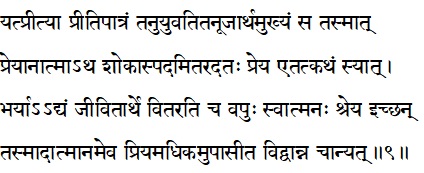
Shloka – 9: Because of which a person loves one’s own body, spouse, children, and wealth, that Atman is the most lovable thing. All things other than the Atman are the cause of suffering. Therefore, all things other than the Atman are not pleasurable. One who is seeking the highest good of oneself is ready to sacrifice one’s own life, family, relatives, and all other things. Therefore a wise person should make all the efforts to realize the Atman only and nothing else.
Comments:
There is a well-known message in Brihadaranyaks Upanishad. Rishi Yajnavalkya was going to retire from the family life and was going to spend his time as a Sanyasi (all renounced person who is fully focusing his mind on the Ultimate Reality – Brahman). He wanted to divide his wealth between his two wives, Maitreyi and Katyayani. This way he was also asking his wives for their permissions to let him renounce everything and focus his mind on the Ultimate Reality. Without their permission, he cannot renounce his responsibilities as a householder.
Brihadaranyaka (2.4.1-5): Sage Yajnavalkya said, “My dear Mitreyi! I am going to renounce this (householder’s) life. Let me make a final settlement between you and Katyayani.”
Thereupon, Maitreyi said, “O Venerable One! If indeed the whole earth, full of wealth, belonged to me, would I be immortal through that?” Yajnavalkya replied, “No. Your life would be just like that of people who have plenty. There is no hope of immortality through wealth.”
Maitreyi said, “Then, what should I do with that which would not make me immortal? Please tell me of that alone which you know to be the only means of attaining immortality.”
Yajnavalkya replied, “My dear, you have been my beloved so far and now you are talking which is most dear to me. Come, sit down, I will explain to you what makes one immortal. As I explain that to you, you reflect upon it and meditate on it.”
Then, Yajnavalkya said, “Verily, not for the sake of the husband, my dear, is the husband loved, but he is loved for the sake of the Self (Atman or Brahman).
Verily, not for the sake of the wife, my dear, is the wife loved, but she is loved for the sake of the Self.
Verily, not for the sake of the sons (children), my dear, are the sons (children) loved, but they are loved for the sake of the Self.
Verily, not for the sake of the wealth, my dear is wealth loved, but it is loved for the sake of the Self…
Verily, not for the sake of the All, my dear, is the All loved, but it is loved for the sake of the Self.
“Verily, my dear Maitreyi, it is the Self that should be realized – should be heard of, reflected on, and meditated upon. By the realization of the Self, my dear – through hearing, reflection, and meditation – all this is known.”
The ninth shloka of the Shatashloki clearly expresses sage Yajnavalkya’s teachings. When Atman leaves the body of a spouse, or a child, or a friend, then the body starts deteriorating and it has to be cremated as soon as possible. This makes it obvious that people loved the Atman residing within the person and not the body of the person.
Wealth has some value as long as we are alive. Wealth is material; it is a metal or a paper. A little reflection makes us aware that the value of wealth is limited. Wealth cannot buy love or mental peace. If wealth is not properly used, then it becomes a cause of suffering. Material possession also causes suffering. When we bought our first car, I had to park it on a busy street in a city. From our bedroom window, I could see our car. At night, a couple of times, whenever I heard some weird noise like car abruptly stopping with a squeaking break’s noise, or a person hitting a car while parking, I woke up to see whether it is our car. After waking up for a couple of times, I thought to myself, ‘Did I buy this car for comfort and pleasure or for a worry?’ Then, I laughed at myself and slept well.
There is a rule of the universe that except the bliss of realizing the Atman, anything that gives us material joy becomes the cause of suffering as well. Many times the material joy is little than the sufferings that follow. Saint Tulsidas said that we suffer when we meet people who do harmful things and we suffer when good people leave us. Joy and sorrow come together. We cannot have one without the other.
Fear and worry are connected. We worry because we have some kind of fear in the back of our minds. Saint Bhartruhari tells us in his Vairagya Shataka (shloka 34) that fear is attached to everything in this universe:
“If we go to enjoy something, then we have a fear of disease,
If we take pride in our heredity, then we have a fear of falling from its status,
If we have wealth, then we have a fear that the king might take it away (right now the IRS),
If we keep silence, then there is a fear that we are considered weak,
If we are physically strong, then we have a fear of an enemy,
If we have beauty, then we have a fear of old age,
If we take pride in our expertise, then we have a fear of someone knowing more than us,
If we take pride in our virtues, then we have a fear of a fault-finder pointing to our vice,
If we have body consciousness, then we have a fear of death,
In short, all things in this universe filled with fear except the renunciation. The renunciation only can make a person fearless.
The fear of all fears is the fear of death. In the conversation of the Rishi Yajnavalkya and Maitreyi we learned that realizing Atman makes us immortal, meaning it removes all our fear of death. Upanishads say that there is no other way to go beyond the fear of death except realizing our Atman. When we realize that our true identity is Atman which is eternal, that it was never born and so it will not die, then we can overcome the fear of death. We understand that what dies is the physical existence consists of our body and mind which we mistook as our true existence.
What is the way? According to Saint Bhartruhari, renunciation makes us fearless. What do we renounce? We have to renounce our false association with our body and mind. Simultaneously, we have to realize that our true identity is Atman or Brahman, and the goal of human life is to realize this Atman. By realizing Atman all our desires get fulfilled, all our doubts about life get destroyed, all our fear vanishes, and our life gets fulfillment.
In a collection of Sri Ramakrishna’s Bengali teachings, I read, “If we can see our true Self (Atman) in our self, then everything is accomplished. To see this we have to do spiritual practices. To be able to do these spiritual practices we have a body. To create a golden image, one needs a clay-mold. Similarly, we have the mold of the mortal body to realize the immortal Atman.”
Many people who have understood the importance of achieving this goal of life have renounced everything and had plunged into making efforts to realize the Atman. However, these people are one percent of the human population. For the other ninety-nine percent of the people, Sri Ramakrishna said that they have to renounce mentally. We can live in the world and perform all our responsibilities, but every day we have to sit in a quiet place and reflect upon ‘What is permanent and what is impermanent’. We have to think that our true identity is Atman or Brahman, the Ultimate Reality. We have to understand that the Power of Brahman which we call God or Shakri (Mother) or Mahamaya had created this universe; He/She preserves it and dissolves it. After doing our spiritual practices sincerely and regularly for a while, when we go deeper within, then we realize that in reality, God has become everything. The Ultimate Reality Brahman is appearing as various things of the universe with various names and forms.
Most people find it difficult to think that ‘I am Atman’. Our ‘ego’, meaning our body-mind-consciousness is so deep that it will not let us separate from it and let us think “I am Atman’. Sri Ramakrishna said that since the ego does not go away easily; let the rascal ego remains as a ‘devotee ego’ or ‘a servant ego’. He calls it a ‘ripe or mature ego’. A person with this ripe ego thinks that everything belongs to God; nothing is mine, not even my own body and mind. God gave me responsibilities to fulfill and I must perform my responsibilities as an offering to God or as a worship of God. If we start with this attitude, then slowly we will understand that God is the Ultimate Reality, Brahman. The Brahman is within me as Atman and because of its power my body and mind function. Then, comes a time when we can realize that Brahman is appearing a universe with its various names and forms. This shloka says that we must make all efforts to attain to this state.
“Shatashloki” of Shri Shankaracharya – VII (Shloka – 8)
The Teachings of the Upanishads
Shloka – 8
Translation:
To appease a child who is crying for a long time, his/her mother gives the child various fruits like grapes, or dates, or a mango, or a banana to eat. Similarly, the Upanishads have prescribed various methods to bring peace and to acquire proper knowledge to the disturbed mind of a deluded person whose delusion has been piled up due to the ignorance of innumerable past lives.
Comments:
A Mother consoling her crying child:
This picture of a mother and child is universal. The food items may vary. I wonder how many children will be appeased by fruits! This mother must be of a Sattvika nature who gives Sattvika food to her child. Usually, the candies and the cookies appease most of the children. However, the picture of a crying baby and mother’s various attempts to appease her child is universal and eternal. It is an appropriate picture which follows by Shri Shankaracharya’s message.
Shri Shankaracharya considers the Upanishads as the Mother of all people and the Upanishads through their teachings trying to appease the crying people. The people are crying like babies due to their problems of life and many problems are self-created. Shri Shankaracharya says that the fundamental cause of all human problems is the ignorance of the Reality. A person by ignorance thinks that ‘I am such and such a person and I am this body and mind.’ With that ignorance, all the problems begin.
The cause of crying:
Children cry when they don’t get what they want, or they are hungry, or something is hurting them, or they are tired or sick. Adults think that the children are ignorant and they cry because they have a lack of understanding. But, adults also cry. They cry mainly when they are sick, or they lose their near and dear ones, or they lose their jobs or money, or their desires do not get fulfilled or they feel helpless. I am sure the wise people who love all and have compassion for all feel the pain of the crying adults, but they know that these adults are crying because of their ignorance and lack of true knowledge.
In human life, there is little joy and lots of suffering. Birth, old age, sickness, and death are painful. Dejection, any kind of loss, and not getting what we want is painful. On top of this natural calamities come. Many people were happy with their normal life. But the coronavirus came and disturbed the happiness of people all over the world. Everywhere people are filled with the fear of death and uncertainty of life. In the hospitals, people are separated from their families and are suffering alone and many of them are dying alone. Maybe after a few months or a few years, the coronavirus situation gets under control and we may go back to the ‘revised normal’ living. But after that, the whole package of our previous joys and sorrows, desires and disappointments, future plans and their obstacles, and many other things will come back and they will occupy our mind. Sri Ramakrishna says that “If you throw a brick-bat into a pond covered with moss, you get a glimpse of the water. But a few moments later the moss comes dancing back and covers the water.” Similarly, in painful times we come face to face with Reality of life, but then the Mahamaya, the deluding power of Brahman, covers our minds with many unfulfilled desires and we forget the Reality.
Even without any natural calamity, we are not always happy. Our desires have no end. When our desires are not fulfilled we are unhappy. Even when our one desire gets fulfilled, other desires occupy our mind and will not let us enjoy the happiness we had acquired. Many times, we work day and night sacrificing all our comforts and pleasures to acquire one worldly object. But when we get that desired object, our mind loses interest in that object. Thus, the problem is not in worldly objects, but it is in our minds.
The real urge to acquire spiritual knowledge:
Only when we realize that the worldly objects cannot give us longer-lasting happiness, then we look for something higher than the worldly objects to acquire longer-lasting happiness. Lord Buddha saw this longer-lasting happiness or serenity on the face of a mendicant who had no worldly possession. Shri Ramakrishna said that as long as the child is busy playing toys, the mother gets all the work done in the house like cooking and other choirs. When the child gets tired of playing with the toys and really needs his/her mother, then the child screams for the mother. At that time the mother puts away the pots and pans and comes to the child running. Similarly, when we realize that the worldly objects like toys cannot give us the longer-lasting happiness, then the real hunger for the higher knowledge comes. Until then we have to go through the waves of joys and sorrows in life where the waves of sorrows are higher and deeper than the waves of happiness. We appreciate and understand the value of the Upanishad’s teachings when that real cry comes from within.
Would crying help?
From the human and the practical point of view crying helps to vent out our pain lying within. If people don’t cry and keep the pain inside, then they develop psychological problems that are harmful.
However, just venting out our pain by crying and then get back again into the same routine of life which keeps us in the vicious cycle of suffering and crying, does not help to remove the main cause of our suffering. People think that crying to God may help fulfill our worldly desires. Swami Vivekananda says that such crying increases our superstitions.
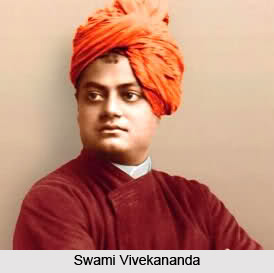
Swami Vivekananda: “You know in your inmost heart that many of your limited ideas, this humbling of yourself and praying and weeping to imaginary beings are superstitions. Tell me one case where these prayers have been answered. All the answers that came were from your own hearts.
You know there are no ghosts, but sooner are you in the dark than you feel a little creepy sensation. That is so because in our childhood we have had all these fearful ideas put into our heads. But do not teach these things to others through fear of society and public opinion, through fear of incurring the hatred of friends, or for fear of losing cherished superstitions. Be master of all these,
What is there to be taught more in religion than the oneness of the universe and faith in one’s self?”
In the following passage, Swami Vivekananda says that the ultimate help is going to come from within. There is no use of crying.
Swami Vivekananda: “It is a tremendous error to feel helpless. Do not seek help from anyone. We are our own help. If we cannot help ourselves, there is none to help us. …”Thou thyself art thy only friend, thou thyself art thy only enemy. There is no other enemy but this self of mine, no other friend by myself” (Bhagavad Gita 6.5). This is the last and greatest lesson, and Oh, what a time it takes to learn it! We seem to get hold of it, and the next moment the old wave comes. The backbone breaks. We weaken and again grasp for that superstition and help. Just think of that huge mass of misery, and all caused by this false idea of going to seek for help!”
The cause of our suffering is ignorance:
The Upanishads say that the cause of our sufferings is the ignorance of our true identity which is called ‘Atman’. We think that we are just our body and mind, but through reflections, meditations, and proper spiritual practices Rishis and many saints realized that behind our body and mind there is something eternal and non-changing substratum called ‘Atman’ which is our true nature. By nurturing the ignorance of our true nature we suffer again and again.
Swami Vivekananda says, “The main cause of all bondage is ignorance. Man is not wicked by his own nature–not at all. His nature is pure, perfectly holy. Each man is divine. Each man that you see is a God by his very nature. This nature is covered by ignorance, and it is ignorance that binds us down. Ignorance is the cause of all misery. Ignorance is the cause of all wickedness, and knowledge will make the world good.”
Swami Vivekananda says, “A caterpillar spins a little cocoon around itself out of the substance of its own body and at last, finds it imprisoned. It may cry and weep and howl there; nobody will come to its rescue until it becomes wise and then comes out, as a beautiful butterfly. So (it is) with these our bondages. We are going around and around ourselves through countless ages. And now we feel miserable and cry and lament over our bondage. But crying and weeping will be of no avail. We must set ourselves to cutting these bondages.”
What to do then? Swami Vivekananda talks about it in the following passage:
Swami Vivekananda says, “If the room is dark, do you go about beating your chest and crying, “It is dark, dark, dark!” No, the only way to get the light is to strike a light, and then the darkness goes. The only way to realize the light above you is to strike the spiritual light within you, and the darkness of sin and impurity will flee away. Think of your higher self, not of your lower.”
This higher self is within us.
Swami Vivekananda says, “The Vedanta proves that the truth for which we have been searching all this time is present, and was all the time with us. In our ignorance, we thought we had lost it, and went about the world crying and weeping, struggling to find the truth, while all along it was dwelling in our own hearts. There alone can we find it.”
The teachings of the Upanishads:
Swami Vivekananda brought out two major teachings of the Upanishads: ‘Oneness’ and ‘Faith in one’s Inner Self’.
The ‘Oneness’ is the ‘Oneness of Existence’. The Upanishads teach that there is only one Reality, one Existence behind the varieties of people, animals, trees, plants, stars, sun, moon, planets, and all the objects of the universe. The same Brahman appears out of our ignorance as a variety of things. It is like waves in the ocean of consciousness. Various waves arise in the ocean. They look different, but they all are nothing but the ocean water. They appear in the ocean and again merge in the ocean.
The following passage gives us some idea about the Brahman:
Swami Vivekananda says, “The Purusha (Brahman) does not love, it is love itself. It does not exist, it is existence itself. The Soul does not know, It is knowledge itself. It is a mistake to say the Soul loves, exists, or knows. Love, existence, and knowledge are not the qualities of the Purusha, but its essence. When they get reflected upon something, you may call them the qualities of that something. They are not the qualities but the essence of the Purusha, the great Atman, the Infinite Being, without birth or death, established in its own glory. It appears to have become so degenerate that if you approach to tell it, “You are not a pig,” it begins to squeal and bite.”
The same Brahman reflects in each individual as an Atman. Sri Ramakrishna says that imagine the body is like a plate and the mind is like water in the plate and in that water there is a reflection of the sun, which is Atman. This Atman is our true identity. It is divine. It is never born and does not die. Its nature is Existence-Knowledge-Bless Absolute. By realizing It all our fear of death goes away, our mind gets filled with bliss, and we get endowed with tremendous inner strength. This is the second thing we can learn from the Upanishads, ‘the faith in our true identity – Atman.’ By realizing Atman, we can remove the cause of all our sufferings.
Sri Ramakrishna’s teachings of crying:
Sri Ramakrishna says that people shed a jug of tears for their relatives, money, and many worldly things, but who cries to realize God. If people sincerely cry for three days to realize God, then they have a vision of God.
This crying is not for the worldly rewards and for worldly gain. This crying comes when we understand the futility of trying to get longer-lasting happiness from the finite worldly objects. Sri Ramakrishna used to say that often one has to go into solitude and reflect upon the ultimate truth, ‘Brahman alone is real (permanent) and everything else is unreal (impermanent)’. By realizing the eternal and omnipresent Brahman, we feel infinite bliss within and we can go through the joys and sorrows of life keeping our mind always focused on the Brahman. Then, we may cry due to human suffering, but we will not get deluded. We always remember that this world is impermanent and we have to move on.
The Upanishad’s teachings will make us strong and fearless and will give us the fulfillment of life. The four yogas (Jnana Yoga, Bhakti Yoga, Raja Yoga, and Karma Yoga), developed from the Upanishads and the Bhagavad Gita, are also helpful to remove our sufferings of life.
Note: Today is Lord Buddha’s Birthday. His goal of life was to remove the sufferings of life and bring bliss within. May we make sincere efforts to remove the sufferings of our life and bring peace and bliss within.
The steps to realize the Ultimate Truth: (Chhandogya Upanishad, Chapter 8.7 – 8.12)
Chhandogya Upanishad
Prajapati (The Lord of people) said, “One has to search and realize the Atman. The Atman is pure, free from hunger, thirst, old age, and death. Its desires and vows come true. If one searches the Atman following the scriptures and the guidance of a competent teacher and realizes It, then all his desires are fulfilled and he attains everything.”
The devas and demons heard Prajapati’s declaration. The realization of Atman, they thought, would fulfill all their desires and allow them to attain everything they ever dreamed of. They decided to pursue this quest for the Atman.
Devas asked their king, Indra, and the demons asked their king, Virochana, to go to Prajapati to learn about Atman.
Both Indra and Virochana went to Prajapati’s ashram with offerings in their hands. Jealous of one another, they vowed to themselves, I will learn about Atman first.
Prajapati asked them to stay in the ashram, live an ascetic life, and take the vow of celibacy. They lived there for 32 years.
After 32 years Prajapati asked them, “What is it that you desire? What has motivated you to stay here?” Both said that they had heard the Revered Prajapati’s declaration, “One has to search and realize the Atman. The Atman is pure, free from hunger, thirst, old age, and death. Its desires and vows come true. If one searches the Atman following the scriptures and the guidance of a competent teacher and realizes It, then all his desires are fulfilled and he attains everything.” They too wanted to know and realize the Atman.
Prajapati said, “The Person that is seen in the eyes,-that is Atman. That is the immortal and fearless Brahman.”
The Person thst is seen in the eyes
Indra and Virochana asked, “Between these two, one which is perceived in the water and the one which is perceived in the mirror, which one is Atman?” Prajapati said, “The same one, indeed, is perceived in all of these.”
Reflection in mirror
Reflection in water
Prajapati said, “Both of you go and look at yourselves in a pot filled with water.” They both looked at their reflections in the water. Prajapati asked, “What do you see?” Both said, “O Lord! We see Atman from head to toe, along with hair and nails.”
Then, Prajapati asked both of them to wear their best clothes and ornaments. Indra and Virochana did as they were told and returned in their finest clothing and ornaments. Prajapati told them to look at themselves in the water. He then asked, “What do you see?” Both Indra and Virochana said, “O Lord! We see that the reflection is dressed as we are dressed up. Prajapati said, “That is Atman. That is the immortal and fearless Brahman.” Satisfied with that answer, Indra and Virochana left the ashram.
Watching them leave, Prajapati mumbled, “Both of them are leaving without knowing and realizing Atman. Devas or demons, those who do not truly know Atman will perish.”
Virochana, the king of the demons, was satisfied with what he had learned. He went to the demons and started to teach them that the body is Atman. It is this Atman (body) that has to be worshiped and nurtured. One who takes care of this Atman (body) fulfills all desires and attains everything.”
Therefore, even today people say that a person is of demonic nature if he/she has no faith in something higher than his/her body, and sees no purpose in charity and spiritual development. People of demonic nature adorn even dead bodies with make-up, nice clothing, and ornaments thinking that these things will help the dead person attain everything.
Indra too was on his way to see the Devas. Yet, a thought kept disturbing him. Something was definitely wrong with his understanding of Atman. He started thinking, ‘when a body is adorned with nice clothes and ornaments, its reflection too is adorned with nice clothes and ornaments. Similarly, if a person becomes blind, then its reflection becomes blind; if a person is hurt, then its reflection is hurt, and when a person dies, then its reflection also dies. Something was awry. How could there be anything beneficial in this knowledge of Atman?’
Indra went back to Prajapati with offerings in his hands. Upon seeing Indra, Prajapati asked “O Indra! I saw that you and Virochana were satisfied with the knowledge of Atman and had left. Why did you come back again? What do you want?” Indra replied, “O Lord! I do not see any benefit in my understanding that the reflection of the body, which I see through my eyes, is Atman. If I put on nice clothes and ornaments, my reflection puts on nice clothes and ornaments. If I am clean, my reflection is clean. But, if I become blind, my reflection becomes blind. If I am hurt, my reflection is hurt and if I die, my reflection dies.” Prajapati said, “O Maghavan (Indra)! Yes, it is like that. Live here for another 32 years observing celibacy. After 32 years, I will explain it to you more.”
After 32 years, Prajapati said, “TheOne who moves about, exalted, in our dreams is Atman. It is the immortal, fearless Brahman.” Indra was satisfied and left.
But, before he reached the Devas, he thought, there is something wrong with his understanding of Atman. If one becomes blind, his dream-self does not become blind; if one gets hurt, his dream-self does not get hurt; and if one dies, perhaps his dream-self does not die. Thus, the limitations and changes of the body do not apply to the dream-self. But, if in one’s dream, someone beats the dream-self, the dream-self feels the pain, if someone treats the dream-self badly, then it gets upset, and if danger approaches the dream-self shows fear. Thus, one’s dream-self cannot be Atman and there is no benefit in this knowledge of Atman.
Indra came back to Prajapati with offerings in his hand. Prajapati asked, “O Indra! You had left satisfied with your understanding. Then, why did you come back? What do you want?”
Indra answered, “O Lord Prajapati! It is true that my dream-self does not get affected by whatever happens to my body. For examples, it does not become blind if my body does, it does not get hurt even if my body gets hurt, and it does not die even if my body dies. But, if someone beats my dream-self, then this dream-self feels pain, if someone treats my dream-self badly, then it gets upset, and if some danger comes to my dream-self, then it shows fear. Thus, I do not see any benefit in knowing that my dream-self is Atman.”
Prajapati said, “O Maghavan! It is like that. Live here for another 32 years observing celibacy. After 32 years, I will explain it to you more.”
After 32 years, Prajapati said, “When a person is in deep sleep, he sees no dreams and is happy – that is Atman. It is the immortal and fearless Brahman.” Indra was satisfied and left.
But, before he reached the Devas, he thought to himself, in deep sleep one is not even aware of his own self and other people. In deep sleep one is not aware that “I am Atman.” What is good about this deep sleep state? It is as good as being a dead person. Indra did not see anything good about this knowledge of Atman.
Indra came back to Prajapati with offerings in his hands. Prajapti asked, “O Indra! Satisfied with your understanding of Atman, you had left. Then, why did you come back? What do you want?”
Indra replied, “O Lord Prajapati! In deep sleep I am not aware that “I am Atman” and I am not aware of all people and things around me. It is like I have died. I do not see anything good in this knowledge.”
Prajapati said, “O Maghavan! It is like that. This time, live here for another 5 years observing celibacy. After 5 years, I will explain it to you more.”
Indra lived with Prajapati for another 5 years observing celibacy. Thus, they say that Indra had lived with Prajapati for 101 years observing celibacy.
After 5 years, Prajapati told Indra, “O Indra! The body is mortal. It dies. But, this mortal body is the abode of the immortal, body-less Atman. As long as one has body-consciousness, one has likes and dislikes. But, likes and dislikes do not touch a person who is aware of the body-less Atman lying within.”
“Wind, cloud, lightning, and thunder are body-less. All these arise from the space and, through the light of the sun, go back to their original forms. Similarly this Atman arises from the body and through the Supreme Knowledge of Itself, goes back to Its original form.
In that state, the Atman moves about–laughing, playing, and rejoicing–without thinking of the body. But, this very Atman remains attached to the body as an animal remains attached to a cart.
The Atman is the cause of seeing and the eyes are Its instruments to see. When one is aware of this fact, that person realizes that the Atman is the “Seer” and the eyes are Its instruments.
– When one is aware that the Atman is the cause of smelling, the “Smeller” is the Atman and the nose is Its instrument.
– When one is aware that the Atman is the cause of speaking, the “Speaker” is the Atman and the mouth is Its instrument.
– When one is aware that the Atman is the cause of listening, the “Listener” is the Atman and the ears are Its instruments.
– One who is aware that the Atman is the cause of thinking, the “Thinker” is the Atman and the mind is Its instrument. The mind is called the divine eyes of the Atman. The Atman sees all the desires in the world through the divine eye of the mind.
After learning this Truth, the Devas meditated on this Atman. As a result, all their desires were fulfilled and they attained everything.” “Thus,” Prajapati declared, “One who understands the teachings about Atman from the scriptures and from a competent teacher and realizes It fulfills all his desires and attains everything.”
Reflections:
Four States:
This story beautifully describes the four states of a human being: Jagrata (physically awake state), Swapna (dream state), Sushupti (dreamless sleep state) and Turiya (state of awareness of Atman).
Jagrata (physically awake state): Most people remain in the physically awakened state for most of their time. Also, most people think that this is the only real state of a human being. Whatever we perceive in this physically awakened state is real and all other things are imaginary or delusion. Most of us consciously or unconsciously believe that what we perceive through our senses are the only useful things in life. We try to understand the world with what we perceive through our senses. All our physical knowledge lies on these grounds, on sense perception.
We perceive most parts of our bodies through our eyes. We also perceive our bodies through their reflections in the mirror or water or through our photographs. All our joys and sorrows are based on this sense perception.
Indra thought that the physically awaken state was the only reality. But, then he realized that what we perceive through our senses is limited. The body undergoes changes. It is subject to disease, old age, and death. Indra realized that Prajapati wanted him to reflect further; the body was not the Ultimate Reality. Human beings are more than their body. One cannot be really happy by nurturing the body alone and constantly thinking about the pleasures of the body.
Swapna (dream state): Prajapati drew Indra’s attention to another state of a human being– the dream state. When a person is in the dream state, his/her mind creates an entire universe. In this state, the outer world, the world perceived through the senses, disappears. In a dream a person can create the Yankee Stadium filled with thousands of people watching a ball game. That person can even create themselves in the dream, enjoying the game. For the dreamer it is all real. Many a times, in one’s dreams, a person fulfills all of the unfulfilled desires of his Jagrata (physically awakened) state.
Indra realized that the limitations of the Jagrata state do not follow in the dream state. Even when one is poor in the physically awakened state, he may become rich in his dreams. However, unpleasant things may happen. A rich person may become poor in his dream. A hungry tiger may chase the dreamer, in an attempt to devour him. It is good that we do not remain in the dream state all the time and we wake up in the middle of unpleasant dreams.
Indra realized that the dream state was not what he wanted. He wanted all his desires to be fulfilled and wanted to be happy and free from the fear of death. He found that dream state too has sufferings and limitations. So, he came back to know more.
Sushupti (state of deep sleep): When a person is going to sleep, one turns off all the lights of the house, goes to the bedroom, turns the light off in bedroom, keeps a night-lamp on and sleeps on the bed. Similarly, when a person is going to sleep, slowly all the senses are withdrawn and get cut off from the physically awakened state. Then, he enters in the dream state. At one point, all the dreams go away and he falls into deep sleep. Like that night-lamp which remains on in the bedroom, in deep sleep the vital forces keep one alive. The senses have merged into mind and mind has merged into Atman. If a person has good dreamless sleep, he feels very happy. However, as soon as he wakes up, within a fraction of a nano second all of the things connected to the physical-self come rushing back: all work, all the plans and desires, all associations, joys and sorrows, likes and dislikes and more. The person does not find any change or a transformation within oneself, all that has happened is that the body and mind have had a good rest.
Indra realized that this state of dreamless sleep was as good as being lifeless or dead. There is no awareness of the Atman. He did not see anything deeper in this state beyond having achieved physical rest. He recognized that the awareness of Atman could not be this state. Prajapati agreed with him. Prajapati acknowledged that Indra was finally ready to understand the Atman after thoughtfully ruling out the other three states.
Turiya (state of awareness of Atman): Prajapati gave excellent analogies of body-less entities. When we think of Atman as body-less, we have difficulty grasping this concept. But, Prajapati points to the wind, cloud, lightning and thunder which are also body-less. They come from space and disappear into space. Thus, through these analogies, we get a little glimpse of what Prajapati was trying to explain. We can see that something can come from an infinite source; it reveals itself after becoming tangible or graspable by the senses and again it can merge into the infinite. Sound and light are waves. These waves are graspable to humans at certain frequencies, and they can exist beyond our comprehension. The body-less infinite unchangeable Ultimate Reality or Ultimate Power creates bodies and things of the universe that are comprehensible by our human senses, which eventually merge back into that Ultimate Reality or Power. That Ultimate Reality or Power is called Brahman and it is called Atman with reference to an individual. This body-less Atman is our true identity. It resides in our finite body. This Atman is the cause of our capacity to touch, taste, smell, speak, hear, and think. This Atman has created its instruments to perceive the world of senses.
A person can attain this Turiya state where there is only awareness of Atman and it is not a state of dreamless sleep. People have witnessed such states of awareness. It is called a Nirvikalpa Samadhi. One example I know is that of Sri Ramakrishna. He used to be in such a state often. Atheists, critics and medical doctors have examined this state and accepted that physically there was no sign of life, but it was not death or a deep sleep. The face of Sri Ramakrishna was beaming with joy even in the intense painful physical state of throat cancer. He was oblivious of the pain and pleasures of the body.
Swami Vivekananda said that the difference between a person going into dreamless deep sleep and the Nirvikalpa Samadhi is this: a dull minded person remains dull minded after going into deep sleep, but a dull minded becomes a wise person after coming back from Nirvikalpa Samadhi. After attaining this state one experience so much bliss that all the joy of fulfilling all the possible worldly desires becomes an insignificant small fraction of that bliss. After realizing Atman, no desires remain to be fulfilled and one feels that one has attained everything that a human being can attain.
This Turiya state is possible by any person who follows the guidance described by the scriptures and competent teachers. Even if one does not attain Nirvikalpa Samadhi, going towards this state of awareness of Atman brings fulfillment, knowledge, and fills the heart with unselfish love and unlimited bliss.
Swami Vivekananda
Swami Vivekananda says, “There is something behind this world of senses, this world of eternal eating and drinking and talking nonsense, this world of false shadows and selfishness. There is something beyond all books, beyond all creeds, beyond vanities of the world-and that something is the realization of God within yourself.”
A Dispute among the Senses and Faculties of a Human Being
Once there was a dispute between all the senses and several faculties of a human being. Each one, the eyes, the ears, the hands, the legs, the mind and others started to claim, “I am the best.”
The eyes said that if one cannot see, one could not do anything. The ears said that without listening one would face many problems in life; the legs said that without being able to move, one’s life was doomed.
The question was raised, who could decide which one of these senses was superior to the rest?
They all went to their creator Brahma. Lord Brahma listened to them and thought about a solution. He advised that each one of the senses and the faculties of the body, one at a time, go on vacation for a year. In whose absence the body becomes most crippled, that sense or a faculty is the best among all.
First, speech went on vacation for a year.
Speech going to vacation
Then, speech came back and asked all the senses and the faculties of the body how they lived their life without talking.
In reply, all the senses and faculties of the body said that they lived life as a mute person lives. Mute people can see with their eyes, listen with their ears, think with their minds and thus they lived.
After that, the eyes went on vacation for a year.
Eyes going on vacation
Then, the eyes came back and asked all the senses and the faculties of the body how they lived their life without the ability to see.
In reply, all the senses and the faculties of the body said that they lived as a blind person lives. Blind people can speak with their mouths, listen with their ears, think with their minds, and thus they live their life.
Next, the ears went on vacation for a year.
Ears going on vacation
Then, the ears came back and asked all the senses and the faculties of the body how they lived without the ability to hear.
In reply, all the senses and the faculties of the body said that they lived as a deaf person lives. Deaf people can speak with their mouths, see with their eyes, think with their minds, and thus they lived their life.
Then, the mind went on vacation for a year.
Mind going on vacation
The mind came back and asked all the senses and the faculties of the body how they lived without thinking.
In reply, all the senses and the faculties of the body said that they lived as babies live whose minds have not been fully developed. Babies speak with their mouths, see with their eyes and listen with their ears.
Finally, Prana (the vital forces including breathing) started going on vacation.
As soon as the Prana started leaving the body, all the sense started losing their power. All felt as if a powerful wild horse was pulling out all the nails that have tied it with ropes.
Then, all the senses went to the Prana and said, “Please do not leave. You are the best among all of us.” The eyes, the ears, speech, and the mind said to the Prana that they are all powerful because of the Prana. That is why, in the scriptures all the senses are referred to as Prana.
– Chhandogya Upanishad: Chapter 5, section 1
(Thanks to Sneha Shah for illustrations and Nisha Parikh for editing the post.)
It is simply amazing how 5000 years ago, teachers and students of the Upanishads tried to find the answers of fundamental questions of life and the universe through simple available means. It is more amazing that the answers they had found become more and more relevant with the advancement of science.
The following story from the sixth chapter of the Chhandogya Upanishad is one such example. Its teachings are profound but have been expressed them in a very simple and appealing way. This is not an English translation of the chapter. I tried simply to bring out its essential teachings.
The following books provide the original Sanskrit text of the chapter and its English translation by Swami Nikhilananda respectively.
Chhandogya Upanishad – Sanskrit
A great Rishi named Aruna had a son named Uddalaka who was also known as Aaruni. Uddalaka was also a great Rishi. (A rishi is one who has attained the highest knowledge of life a human being can attain.)
Rishi Uddalaka had a son named Swetaketu. When Swetaketu was twelve years old, his father, Uddalaka, told him that no one in the family had attained the highest knowledge without studying the scriptures. So, Uddalaka sent Swetaketu to an ashrama where students learned the scriptures.
After twelve years of study, Swetaketu returned home. Uddalaka found him arrogant, having a superiority complex and considering himself a great orator of and an expert on the scriptures.
Uddalaka asked Swetaketu,
“Did you acquire the knowledge by which one can hear what cannot be heard, think what is unthinkable, and know what is unknowable?
Did you acquire the knowledge that would allow you, by knowing a lump of clay, to know all things made out of clay and to know that the differences among things made from clay are only in their names and forms? And that these names and forms are but modifications of speech? Did you acquire the knowledge to understand that the clay is the only truth?
Clay images
Did you acquire the knowledge that would allow you, by knowing a nugget of gold, to know all of things made out of gold and to know that the differences among things made from gold are only in their names and forms? And that these names and forms are but modifications of speech? Did you acquire the knowledge to understand that the gold is the only truth?
various ornaments of Gold
Did you acquire the knowledge that would allow you, by knowing a steel nail-clipper, to know all things made out of steel and to know that the differences among things made of steel are only in their names and forms which are but modifications of speech? Did you acquire the knowledge to understand that the steel is the only truth?”
Things made out of steel
Swetaketu answered, “Revered Father! My teacher definitely did not know about this. Otherwise, he would have taught me. Please teach me.”
Rishi Uddalaka said, “My son! In the beginning of the universe there was only one life force called “Sat” (Brahman). From Sat, the whole universe came.
A group of people think that there was nothing before the universe. But, how does ‘something’ come from ‘nothing’? It is not possible. Therefore, there was a unique life force called Sat before the universe.
That Sat thought that it should become many and create a universe. Sat therefore created light / fire (Teja). Light/fire then thought to become many and it created water (Aapa). We see that when a person feels warm, he/she perspires. Thus, we can conclude that the light/fire is the source of water. After water was created, it (Aapa) thought to become many and in turn created food (Anna – this includes everything related to food like land and earth). We see that when it rains a lot, lots of vegetation grows. This shows that rain is the source of food.
All beings can be born from one of three things: (i) from eggs, (ii) from species of their kind or (iii) from seeds.
Andaja – born from eggJivaja – born from species of the same kindUdbhijja – born from seeds
Light/fire, water and food/earth, decided to enter into these beings in various proportions and thus created a world of names and forms.
In everything that we see, that which is reddish comes from light/fire, that which is white comes from water, and that which has darker colors comes from food/earth.
The SunThe MoonLightening
One can see these three colors in the sun, moon, and lightening. These three exist even in fire. If you separate the fire-part, water-part and the food/earth-part from the fire, then the qualities of fire disappear. (The same applies to water and food/earth.)
Let us see what roles light/fire, water, and food/earth have in human beings:
There are three parts of food: the gross part, the semi-gross part and the subtle part. When a person eats food, the gross part of the food comes out as feces (solid waste comes out from human body), the semi-subtle part of the food becomes the meat, and the subtle part of the food makes mind.
Similarly, when a person drinks water, the gross part comes out as urine, the semi-gross part makes the blood, and the subtle part produces the vital forces (prana), including breathing.
When a person eats especially nourishing food (teja), the gross part of it makes the bones, the semi-subtle part of it makes the bone marrow, and the subtle part of it makes the speech.
Thus, the mind is made out of food, vital forces and breath are made out of water, and speech is made out of teja.
How do we see that the subtle parts of food, water, and teja make up the mind, vital forces/breath and speech respectively?
Butter from buttermilk
When we churn buttermilk, the subtle part of the butter rises to the surface. Similarly, the subtle part of food makes the mind, the subtle part of water makes the vital forces/breath, and the subtle part of teja makes the speech.
Swetaketu said, “Father! Please explain further.” Uddalaka responded, “My son! Sure, I will explain further.”
How do we see that the mind is made out of food?
Rishi Uddalaka told Swetaketu, “Do not eat for fifteen days. You can drink water. Since you will be drinking water, you will remain alive. Come to me after fifteen days.”
Swetaketu responded, “Okay father!”
Swetaketu returned to his father after fifteen days. Uddalaka said, “You had learned the Vedas. Now recite something from the Vedas.” Swetaketu answered, “Father! My mind is not functioning. I cannot recite anything.” Uddalaka said, “Go and eat something.” Swetaketu had a good meal and came back. Uddalaka then asked him again to recite from the Vedas. Swetaketu recited many verses from the Vedas. Father Uddalaka said, “See Swetaketu, when a blazing fire is put off and only a little fire remains, it cannot cook anything. But, if we put dry branches of trees into the little fire, we can ignite it into a blazing fire and then cook anything in it. In the beginning, your mind could not function without food, but after you ate food, it functioned very well. Know that the mind is made out of food, that vital forces/breath are made out of water, and that speech is made out of teja.
How do you feel your true self?
Uddalaka told Swetaketu that when a person is in a dreamless sleep, his awareness of the world associated with his name and form go away. A little “prana” (vital force/breath) keeps one alive, but one is not aware of all the joys, sorrows, and problems associated with one’s body and mind. This is an indirect experience of the true self in which the awareness of one’s own external identity disappears.
(When we go to bed, first various thoughts come to our minds, then we enter a dream state, and then finally we come to the state of deep sleep without dreams. In that state we forget all about our gender, age, color, culture, plans, positions, problems, and everything related to our body and mind. At that time we are almost one with our true identity “Sat” or Atman. But, as soon as we wake up, within a fraction of a second, our body-form identity and everything related to it comes rushing back.
To experience our true identity “Sat” or Atman in our awakened state is realization of Truth or God.)
Searching our true identity:
By following the root of ourselves, we can find our true identity.
(i) Prana is the support of the mind: Our mind needs our body. Rishi Uddalaka told Swetaketu to imagine a person with an eagle as a pet. The owner ties a string to the bird and keeps the other end of the string in his/her hand. The bird will fly all around and then come back to the hands of the owner. Similarly, our mind will go around, but will eventually come back to the living body. Thus, the mind needs “prana” to keep the body alive. Food keeps the body alive.
(ii) Water leads to food: Uddlaka continued, “Swetaketu! How does a person get hungry? When a person eats food, the food mixes with water and becomes digested. All of the nourishment of the digested food goes in the body and the person becomes hungry again. Thus, water leads to a need for food.”
(iii) Teja leads to water: “How does a person become thirsty? When body heat evaporates the water inside the body, a person becomes thirsty. Thus, teja/fire leads to a need for water.
(iv) “Sat” (Brahman) leads teja: Teja/fire came from Sat. Thus, Sat leads teja/fire.
Search for the root or the cause:
When a person is dying, he/she stops talking. People first say, “Oh! He/she is not talking.” They then find that “he/she is not moving.” Finally, they find that “his/her body is cold.” Thus, when a person stops talking, the mind of the person merges into “prana” (vitality). When, a person stops moving, the “prana” merges into “teja/fire”. Finally, when the person’s body is cold, his/her teja merges into Sat (Brahman).
Rishi Uddalaka told Swetaketu, “My son! Search for the cause or root of each one (food, water, and teja) and you will realize your true identity. The cause of body is food, the cause of food is water, the cause of water is light/fire, and the cause of light/fire is the one life force Sat (Brahman) which created the whole universe and which is the whole universe.
That Sat is subtle and has manifested as the universe. That is the Truth (behind the universe of names and forms). That is Brahman. That is Atman, and Thou art That (Sat) (Tatvamasi-Tat Tvam Asi).
Thus, our true identity is divine. It is the support of our existence. We call this unique life force (Sat) God and worship It in various forms. The goal of human existence is to realize our true identity.
Swetaketu said, “Father! Please explain further.” Father said, “My son! Sure, I will explain further.”
Example of bees:
Bees and Honeycomb
Honey
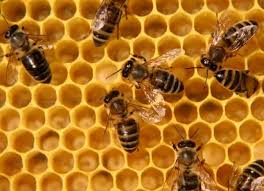
Rishi Uddalaka said, “O Swetaketu! Bees collect juices from various flowers and other sources and make honey. In the honey, one cannot separate the juices by their sources. Similarly, the individuality of all things of the universe will disappear when they merge with the original unique life force Sat.”
Example of Rivers:
River meeting ocean
“O Swetaketu! All rivers empty their water into the ocean. In the ocean one cannot separate the waters by their source rivers. Similarly, the individuality of all things of the universe will disappear when they merge with the original unique life force Sat.”
That Sat is subtle and has manifested as the universe. That is the Truth (behind the universe of names and forms). That is Brahman. That is Atman, and Thou art That (Sat) (Tatvamasi-Tat Tvam Asi).
Now, as in the dreamless sleep, a person momentarily loses his/her external identity of name and form and becomes one with the Sat. After waking up, however, the person immediately returns to his/her name-form identity. Similarly, all beings, because of their worldly desires, come back to their separate name-form identities even after being merged with Sat.
Swetaketu said, “Father! Please explain further.” Father said, “My son! Sure, I will explain further.”
“Sat” or Atman does not die:
Living Tree
Rishi Uddalaka said, “Swetaketu! If you struck a living tree at its roots, it would bleed. If struck it in the middle, it would bleed. If you struck it at the top, it would bleed. Similarly, when the life force is in the body, it spreads everywhere and is all pervading like the sap of the tree.
Dead Tree
But, if the life force leaves a branch of the tree, then that branch falls off. If it leaves another branch, that will also fall off. If it leaves the whole tree, then the whole tree dries up and falls. Remember, the life force does not die. When the life force (Atman) leaves a body, then only does the body die.
That Sat is subtle and has manifested as the universe. That is the Truth (behind the universe of names and forms). That is Brahman. That is Atman, and Thou art That (Sat) (Tatvamasi-Tat Tvam Asi).
Swetaketu said, “Father! Please explain further.” Father said, “My son! Sure, I will explain further.”
Have faith in the existence of “Sat” (Atman):
Banyan Tree
Rishi Uddalaka asked, “Swetaketu! Please bring me a fruit from this banyan tree.”
Swetaketu said, “O Father! Here is a fruit of the banyan tree.”
Rishi Uddalaka said, “Break this fruit.”
Swetaketu said, “I broke it.”
Seed of Banyan Tree
Rishi Uddalaka said, “What do you see in it?”
Swetaketu said, “I see very small seeds.”
Rishi Uddalaka said, “Break one seed.”
Swetaketu said, “I broke it, father.”
Rishi Uddlaka said, “What do you see inside?”
Swetaketu said, “Father! I don’t see anything inside.”
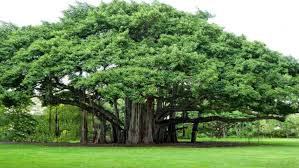
Rishi Uddalaka said, “You do not see anything inside this seed, but from such a seed this big banyana tree came. The subtle part of the seed has made this huge banyan tree. My son! Have faith.That Sat is subtle and has manifested as the universe. That is the Truth (behind the universe of names and forms). That is Brahman. That is Atman, and Thou art That (Sat) (Tatvamasi-Tat Tvam Asi).
Swetaketu said, “Father! Please explain further.” Father said, “My son! Sure, I will explain further.”
“Sat” (Brahman or Atman) is everywhere in the universe:
Glass of waterSalt
Rishi Uddalaka asked, “Swetaketu! Please bring a glass of water and some salt.”
Swetaketu said, “Father! Here is a glass of water and some salt.”
Rishi Uddalaka said, “Put salt into the water and stir.”
Swetaketu said, “I stirred it.”
Rishi Uddalaka said, “Now it is night. Go to bed and in the morning bring this glass to me.”
Swetaketu came in the morning with a glass.
Rishi Uddalaka said, “Please give me the salt which you put it in the glass of water.”
Swetaketu said, “I do not see any salt in the water.”
Rishi Uddalaka said, “Take a spoon and drink water from the top of the mixture. What do you taste?”
Swetaketu said, “I taste salt.”
Rishi Uddalaka said, “Now take a spoonful of mixture from the middle. What do you taste?”
Swetaketu said, “I taste salt.”
Rishi Uddalaka said, “Now take a spoonful of mixture from the bottom. What do you taste?”
Swetaketu said, “I taste salt, father.”
Rishi Uddalaka said, “My son! You do not see salt in the mixture, but you tasted the salt everywhere. Similarly, “Sat” (Brahman) is always there in the universe. You cannot see It, but It is there. That Sat is subtle and has manifested as the universe. That is the Truth (behind the universe of names and forms). That is Brahman. That is Atman, and Thou art That (Sat) (Tatvamasi-Tat Tvam Asi).”
Swetaketu said, “Father! Please explain further.” Father said, “My son! Sure, I will explain further.”
How does one realize “Sat” or “Brahman”?
Rishi Uddalaka said, “Suppose a thief blindfolds a person, ties his hands, takes him out of the city Gandhar and into the woods and leaves him there. The blindfolded person will scream, ‘I cannot see. I am blindfolded! Please untie my hands and remove my blindfold!’
Suppose a passerby has compassion for this victim. He frees the person’s hands and removes his blindfold. The free person says to the passerby ‘I am from the City Gandhar. Please tell me how to go to the city.’
The passerby points out the direction of Gandhar. Then, the free person, asking people from village to village, reaches the city of Gandhar. Like the passerby, there are wise people who know “Sat” (Brahman). Through their guidance we can be free from our ignorance. Following their directions, we can realize the “Sat” (Brahman) from which we had come.
The “Sat” that we are seeking is subtle and has manifested as the universe. That is the Truth (behind the universe of names and forms). That is Brahman. That is Atman, and Thou art That (Sat) (Tatvamasi-Tat Tvam Asi).”
Swetaketu said, “Father! Please explain further.” Father said, “My son! Sure, I will explain further.”
Who attains freedom?
Rishi Uddalaka said, “Suppose a king’s guards bring a suspect to the king and say, ‘O King! This person has stolen money.’ The king will ask the servants to bring a hot axe, which serves as a lie-detector test.
Axe
The suspect will have to hold the hot axe. If he is a liar, then he will get burned and die. If he is not a liar, nothing will happen to him and the king will relieve him immediately.
Thus, a wise person who has realized the “Sat” (Brahman), the Ultimate Reality, will become free from all bondage and sufferings, but an ignorant person will, like the liar, suffer in the universe.
Therefore, realize “Sat” (Brahman), the Ultimate Reality and be free from all bondage and sufferings of the world.
Realize That Sat is subtle and has manifested as the universe. That is the Truth (behind the universe of names and forms). That is Brahman. That is Atman, and Thou art That (Sat) (Tatvamasi-Tat Tvam Asi).”
Swetaketu said, “Now, I understand. Now, I understand. Thank you father!”
Om Peace! Peace be unto us! Peace be unto all beings!
(Thanks to Ronak and Nisha Parikh for editing this post.)
The following are two stories from the Chhandogya Upanishad.
Story – 1:
Prajapati (the Creator) had children called Devas and Asuras. For some reason they started fighting (as siblings do).
(The Sanskrit word “Deva” comes from the root “Div” meaning illumined or say divine. Asuras are usually referred to as Demons in English. But, if we keep the Sanskrit word Asura, then it means “not Deva.”
Devas can be understood as the force that leads us to our inner divine nature which brings knowledge, fearlessness, inner peace and bliss. On the other hand, Asuras can be understood as the force which leads us towards senses and sense-pleasures, which brings temporary happiness, but eventually brings suffering, ignorance, restlessness, and fear. These two forces constantly fight in us.)
Devas wanted to defeat Asuras. They thought to hold on to “Udgitha,” that which cannot be destroyed or damaged or polluted.
(“Udgitha” is Om which is the symbol of Brahman, the Ultimate Reality. It is referred to as Atman with respect to an individual.)
(But, where is Udgitha?). Devas first decided to meditate on Udgitha as the breath which we take through our nostrils. But, Asuras attacked the breathing with evil and the nostrils started breathing both good and bad smells. Devas gave up meditating on breathing.
Then, Devas meditated on Udgitha as speech. Asuras attacked speech with evil. The speech got polluted and the mouth started speaking both truth and untruth. Devas gave up meditating on speech.
Then, Devas meditated on Udgitha as eyes. Asuras attacked eyes with evil. The eyes got polluted and they started seeing both good and bad things. Devas gave up meditating on the eyes.
Then, Devas meditated on Udgitha as the ears. Asuras attacked ears with evil. The ears got polluted and the ears started listening to both useful and worthless things. Devas gave up meditating on the ears.
Then, Devas meditated on Udgitha as the mind. Asuras attacked the mind with evil. The mind got polluted and it started making both helpful and harmful resolves. Devas gave up meditating on the mind.
Then, Devas meditated on Udgitha as the Mukhya Prana (the fundamental life force). Asuras attacked Mukhya Prana. But, as a clay-ball breaks to several pieces when thrown to a solid unbreakable rock, Asuras were destroyed to pieces.
(Mukhya Prana is our true identity called Atman. Its nature is divine. Nothing can damage that divinity. When person realizes one’s divine nature, then one sees divinity in all. One realizes that each one is basically divine and the bad things are just outside covers. When these covers are gone, the inner divinity manifests through all.)
As a clay-ball shatters to several pieces when thrown to an unbreakable stone, similarly a person shatters to pieces who try to do harm to an individual who had realized the Udgitha as Atman, the support of our being. (Meaning, the realized one has become the immortal Atman.)
Om
Story – 2
Once, the Devas were scared by death. They entered into three-fold knowledge (knowledge of three Vedas – Rig, Yajur, and Sama) and covered themselves with the hymns. That is why hymns are called ‘chhandas.’
(This means that the Devas thought to do ritualistic worships of performing yajnas reciting hymns to save themselves from death.)
As a fisherman finds fish in the water, death saw the Devas engaged in ritualistic worships described in the three Vedas Rig, Yajur, and Sama.
The Devas also found out that death had seen them. They then left the ritualistic worships of the Vedas and entered into Om. (Devas realized that ritualistic worships cannot make them free from the fear of death.)
When a person masters Rig Veda he loudly utters Om. He does same when he masters Sama Veda and Yajur Veda. Om is immortal and fearless. The Devas entering into Om became immortal and fearless.
One, who knows this, sings the glories of Om and enters into the immortal and fearless Om, becomes immortal and fearless as the Devas became immortal and fearless.
* * *
Notes: There are more than 108 Upanishads. Among them eleven Upanishads are considered major ones as Shri Shankaracharya had written commentaries on them.
These eleven Upanishads are Ishopanishad, Kathopanishad, Kenopanishad, Prashnopanishad, Mundakopanishad, Mandukya Upanishad, Aitareya Upanishad, Taittiriya Upanishad, Shvetashvatar Upanishad, Chhandogya Upanishad, and Brihadaranyaka Upanishad.
The teachings of Upanishads, the Brahma Sutras, and the Bhagavad Gita constitute Vedanta, the essence or the culmination of the teachings of the Vedas. Vedanta provides a complete guideline to any spiritual seeker or a seeker of the Ultimate Reality or Truth.
Reflections:
Fisherman’s Net: Sri Ramakrishna says that a fisherman throws the net in the water. Some fish are very smart that they remain much deeper and away from the shore. Fisherman cannot reach them. Couple of fish struggle to get out of the net and they succeed. Looking at them the fisherman says, ‘Ah! Those fish are gone.’ Few fish struggle to get out of the net, but they cannot succeed. While most of the fish take the net in the mouth, go deeper into the mud and think they are fine. But, the fish which were caught in the net, they panic when the fisherman start pulling the net. They cannot do anything at that time. The fisherman is death. Those fish who are free represent people who had conquered the fear of death by realizing their True Identity, their Divine Self or Atman. They had attained immortality in their Self and they enjoy the unlimited Bliss.
Freedom: Swami Vivekananda’s one of the messages was to be free from all bondages. He wants us all to be free from our weaknesses. He wanted us to be free from our slavery of senses, dependence on matter and people, fear, and finally ignorance. Realizing our true divine identity makes us free from all bondages.
Two ways: The fisherman’s net is also considered as the net of ignorance of Mahamaya. The great Bengali drama-writer Girish Chandra Ghosh has said that ‘Mahamaya cannot catch two people – Narendra (Swami Vivekananda) and Nag Mahashay. Each time Mahamaya threw net, Narendra became so huge that the net was always falls short. In the case of Nag Mahashay, each time Mahamaya threw net, he became so small that he could get out of the net. ‘ What he meant that not to get caught in the net of ignorance either one should make one’s ‘ego’ so huge by becoming one with the universe or one should become so small by becoming most humble person. Only a free person understands the joy of freedom.
More than 2700 years ago, a student asked his/her teacher the following important questions:
– By whose inspiration (or power) my mind thinks many things?
– By whose power my vital forces (including breathing) function?
– By whose power I can speak? and
– By whose power my eyes can see and my ears can hear?
The teacher gave the following answer:
“It is the Ear of the ears, Mind of the minds, Speech of the speeches, Vital Force of all vital forces, and the Eye of the eyes. By knowing It wise people become immortal.
Eyes cannot see It, speech cannot describe It, and mind cannot comprehend It fully.
I don’t know how to teach about It. No one showed me how to teach about It.
Wise people have told us that It is different from what we know and above the unknown.
We call It as Brahman.
Brahman is the One, whom
– speech cannot describe, but because of whom we can speak,
– mind cannot comprehend It, but because of whom mind can comprehend,
– eyes cannot see It, but because of whom eyes can see,
– ears cannot listen to It, but because of whom ears can listen and
– vital forces cannot move It around, but because of whom vital forces function.
Whom people worship is only a symbol of Brahman.
Now the teacher talks about “knowing Brahman.”
– If you think that you have known Brahman fully, then definitely you have understood very little about Brahman.
– If you think that ‘Brahman is a part in me and in all others,’ then you have to rethink about Brahman.
– I cannot say that “I have known Brahman fully” and I cannot say that “I do not know Brahman at all” because I know Brahman. Among us, those who have known Brahman know why I say, “I don’t know Brahman and I know Brahman.”
– In the case of Brahman, one who realizes that “I cannot know Brahman fully” knows It and one who thinks that “I have understood Brahman fully” does not know It.
– Brahman is known when It is realized in every state of mind. One who realizes Brahman attains immortality. Through Brahman one gets mental strength to know Brahman and through that knowledge one attains immortality.
– If you know Brahman in this life, then your life becomes meaningful and blessed. If you do not know Brahman, then you face Brahman in Its terrible form such as obstacles, suffering, frustration, helplessness, stress, old age, disease, and death.
– Wise people see that Brahman has become everything and with that knowledge they acquire infinite inner power to face all the challenges of life including death and become immortal.
Teacher tells a story to enhance his teachings about Brahman:
Once demons (human weaknesses) and devas (angles or stronger people among humans) had a fight and the devas won the battle. They were all proud of themselves and boasting about their strength. They probably had a party to celebrate their victory.
At that time, a stranger appeared at a distance. No one could recognize the stranger. They probably were suspicious and worried. All asked the fire god to go and find out who the stranger was.
The fire god ran to the stranger. The stranger asked, “Who are you? The fire god was surprised to find out that the stranger did not know him. He said, “I am Agni! (The fire god) and I am also known in the world as “Jataveda.”
The stranger asked, “What is your power?” The fire god said, “I can burn everything on this earth.”
The stranger threw a little piece of straw and asked the fire god to burn it. The fire god tried with all its power, but could not burn the piece of straw. He was embarrassed. He looked down and with a heavy heart returned to the devas and said, “I could not find out who that stranger was.”
All the devas then asked the wind god to find out who the stranger was. The wind god ran to the stranger. The stranger asked, “Who are you? The wind god was surprised to find out that the stranger did not know him. He said, “I am Vayu! (The wind god) and I am also known in the world as “Matarishwa.”
The stranger asked, “What is your power?” The wind god said, “I can blow everything that exist on this earth.”
The stranger threw a little piece of straw and asked the wind god to blow it. The wind god tried with all its power, but could not blow the piece of straw. He was embarrassed. He looked down and with a heavy heart returned to the devas and said, “I could not find out who that stranger was.”
(One can relate to the sholkas of Kathopanishad and Bhagavd Gita: Fire cannot burn Atman (individual soul), wind cannot blow it up, water cannot drown it, and weapons cannot destroy it.)
All the devas asked their leader Indra to find out who the stranger was. As Indra approached the stranger, the stranger disappeared. Then, Indra saw in the sky the Goddess of the Universe, Mother Uma with all her glories. Indra asked, “Mother! Who was the stranger?” Mother Uma said, “It was Brahman by whose power you have become victorious.”
Thus, Indra understood that everything is happening because of the power of Brahman.
Since the fire god, the wind god and Indra were in close proximity of Brahman, they attained more respect than other gods. Among these three Indra is considered superior because he understood that It was Brahman.
Concluding remarks and a peace chant:
The realization of Brahman happens like a flash of a lightening or within a blink of an eye.
When our mind starts understanding Brahman, then it gets attracted to It and makes a resolve to realize It.
Brahman is a great attractor. It is blissful. One who realizes Brahman becomes blissful and all beings adore such a person.
After listening to these teachings, a student requested the teacher, “Please tell us what Upanishad is.” The teacher said, “This is what Upanishad is. It is the knowledge of Brahman. What I said is this profound knowledge of Brahman.”
The knowledge of Brahman is supported by three pillars: austerity (joyfully bearing all the suffering and facing the difficulties that come to realize Brahman), control of the senses and mind, and performing one’s responsibilities as an offering to Brahman.
Brahman is the abode of the Truth (the Ultimate Reality). One who realizes Brahman attains the highest state in this life.
Peace chant of Kenopanishad:
Om! May my speech, vital forces, eyes, ears, and all senses get fully nourished (so, I become fit to realize Brahman)! May I do not deny Brahman which has been described in the Upanishad! May Brahman does not deny me! May my relationship with Brahman remains unbroken! I am committed to realize Brahman. May I acquire all the virtues which have been described in the Upanishads (which are needed to realize Brahman)!


















 mahendrajani