Celebrating 533rd Birthday of Shri Chaitanya Mahaprabhu

On Thursday, March 21, 2019, all over the world, the devotees of Shri Chaitanya Mahaprabhu (1486 – 1534) celebrated his 533rd birthday. He was a scholar, a poet, and a great teacher. He had learned all the scriptures and was well-versed in the six systems of philosophy, especially in the ‘Nyaya Shashtra’, generally known as the field of logic.
But, at one point he realized that all this book learning could not give him inner peace, satisfaction, and the fulfillment of the heart. He realized that for most people during his time, the path of devotion could uplift people towards spirituality and was most appropriate for focusing one’s mind on God. It was because of his love for God that he could embrace all with love and serve all unselfishly–irrespective of their cast, learning, and economic status. He taught his disciples to be moral, humble, to forbear, to chant the name of God, and to serve all beings.
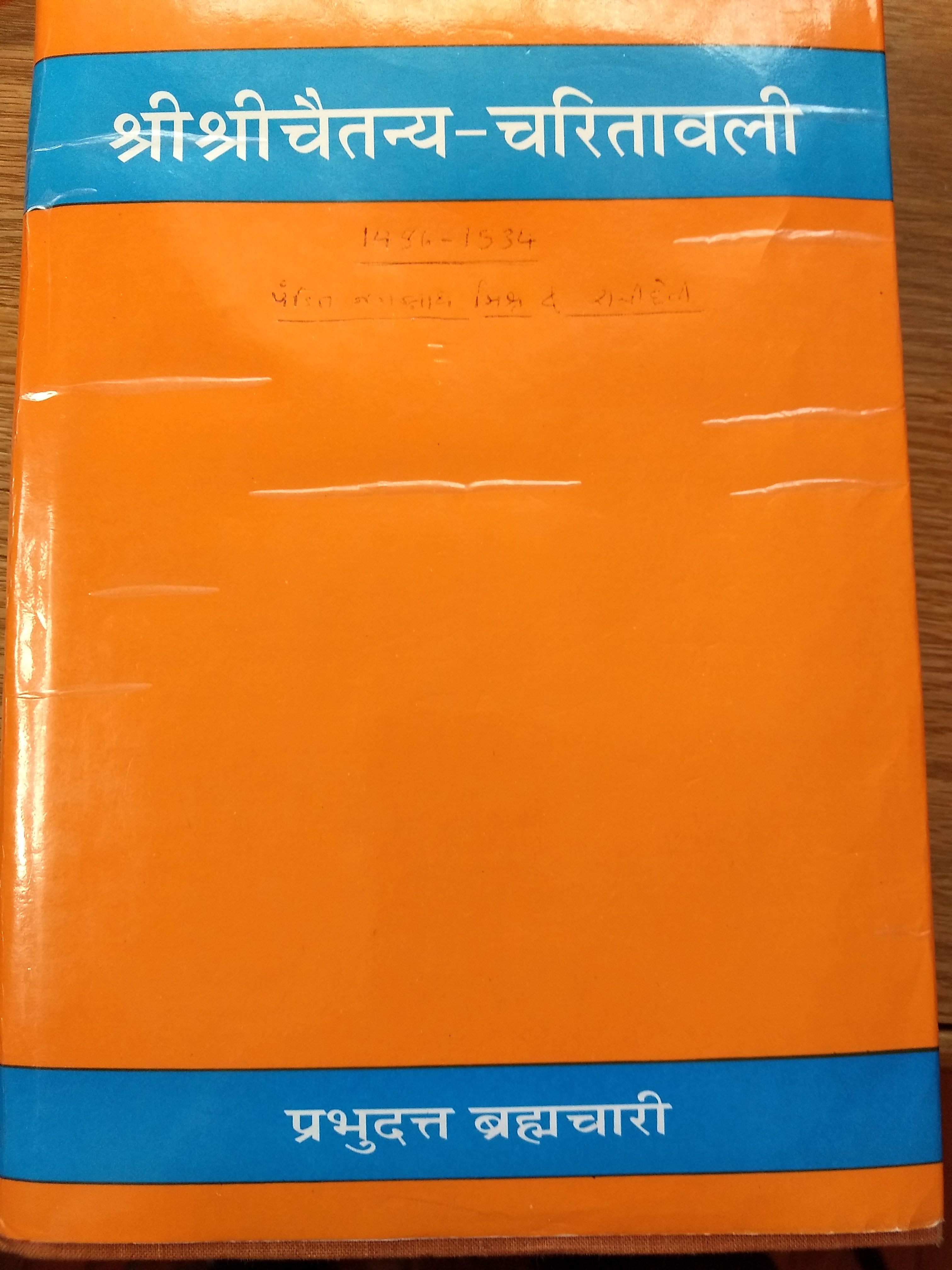
On this occasion, I would like to remember the meeting of the famous Pundit Sarvabhauma and Shri Chaitanya Mahaprabhu. The following write-up is based on the book “Shri Shri Chaitanya Charitavali” written by Shri Prabhudatt Brahmachari.
Shri Chaitanya Mahaprabhu and Pundit Sarvabhauma Bhattacharya:
Pundit Vasudev Sarvabhauma Bhattacharya was a famous scholar who had mastered all the scriptures. The king of Oddisa, King Prataparudra, had appointed him to run his school in the city Puri, near the famous temple of Lord Jagannatha. The pundit met Shri Chaitanya Mahaprabhu when the latter had come to the Jagannatha temple for the first time for darshana. He was attracted by the divinity manifesting through Shri Chaitanya Mahaprabhu’s face. Saurvabhauma went closer to him to know more about Shri Chaitanya. Upon seeing Lord Jagannatha for the first time, Shri Chaitanya Mahaprabhu became overcome with devotion and fell unconscious. People rushed to help him. The pundit too rushed to help the fallen sanyasi and asked people to carry Shri Chaitanya to his house. Pundit Sarvabhauma, his wife and his son respectfully served Shri Chaitanya Mahaprabhu as a sanyasi. Finally, upon hearing a couple of close devotees chanting the name of God, Shri Chaitanya Mahaprabhu regained consciousness.
When Pundit Sarvabhauma found out that Shri Chaitanya Mahaprabhu was from his hometown and that he knew the pundit’s father and relatives very closely, his love for Shri Chaitanya grew deeper. He started showing more respect for Shri Chaitanya Mahaprabhu. Since the pundit was older than Shri Chaitanya Mahaprabhu, he claimed that Shri Chaitanya was like his son and sought to guide him: “Do not go to the Lord Jagannatha temple alone. Also, a Sanyasi has to keep his mind occupied with spiritual practices. If you want, you can come to my school and listen to the study of the Vedanta Sutras.” Shri Chaitanya Mahaprabhu agreed. Pundit Sarvabhauma made arrangements for Shri Chaitanya Mahaprabhu and his close devotees to stay in Puri near his own house.
The next day, Shri Chaitanya Mahaprabhu went to Pundit Sarvabhauma’s school where the pundit himself was reading Shri Shankaracharya’s commentary on the Vedanta Sutras, called Shariraka Mimansa Bhashya. Shri Chaitanya sat there and started listening to the Sutras and their interpretations. Pundit Sarvabhauma was enjoying reading the commentary, providing various supportive shlokas and interpretations. For seven days Shri Chaitanya Mahaprabhu quietly listened.
After the seventh day, Pundit Sarvabhauma questioned Shri Chaitanya, “You have been listening to the reading and the interpretations for seven days, and yet you haven’t said a word about whether you liked it or not.” Shri Chaitanya Mahaprabhu humbly replied saying that he was asked to listen to the Vedanta Sutras, so he was simply listening. Pundit Sarvabhaum smiled and said, “I have not asked you to listen to the Sutras like a statue. If you have any questions, you should have asked them. And if you have liked something, then please share it.” Shri Chaitanya Mahaprabhu replied, “How can I understand such a deep subject, and how can I dare raise doubts in front of such a scholarly person like you?” Pundit Sarvabhauma said, “Please don’t be shy. Say what you have on your mind.”
Shri Chaitanya Mahaprabhu said, with a little hesitance, “I can understand the simple meaning of Bhagavan Vyas’s Vedanta Sutras, but the commentaries create some problems. It seems to me that in many places the respectable commentators try to twist the meaning of the words to bring out the meaning they want. Sometimes they force meaning in the Sutras which is not there.”
All the students around them were startled by this statement.
Pundit Sarvabhauma countered, “What are you talking about? Shruti’s main goal is to establish that the goal of life is to realize the Nirguna Nirakar Brahman (Formless Brahman devoid of any gunas). Shariraka Mimansa Bhashya exactly establishes the One Brahman (which is without the second) and is devoid of name and form.”
Shri Chaitanya Mahaprabhu replied, “I have nothing against the description of the Nirguna Nirakar Brahman.” Then, giving a few examples SCM said, “Shruti talks about both: Saguna and Nirguna Brahman, Sakara and Nirakara Brahman, Brahman with and without form and Brahman with and without characteristics. But, commentators only emphasize the Nirguna Nirakar Brahman and ignore the Saguna Sakara Brahman. I do not like these one-sided interpretations. Both forms of Brahman are important. The interpretations to establish Nirguna Nirakar Brahman may be appealing to people who are head-oriented, those who are more logic-oriented and who enjoy being analytical. But, they do not appeal to those who are heart-oriented, who enjoy loving God and for whom feelings are more important than logic. ”
Pundit Sarvabhauma said, “The commentators do not create their own meanings. They try to bring out the meaning which Bhagavan Vyasa was trying to express.”
Sri Chaitanya Mahaprabhu said, “Bhagavan Shankaracharya, Ramanujacharya, and Madhvacharya have interpreted the same Sutras differently. Each one has his own interpretation. They all are great teachers and are respectable. But, each one established his own philosophy from the same sutras. Now, how can we consider one interpretation correct over another? Each teacher interpreted the sutras according to the philosophy he wanted to establish.
Shri Chaitnaya Mahaprabhu continued, “Lord Vyasa wrote six scriptures, eighteen puranas, and the fifth Veda called the Mahabharata. Even after writing all these scriptures, he was not happy and had no peace of mind. He felt he did not do enough to help humanity. It was this feeling that propelled him to write the Shrimad Bhagavatam, which finally brought him the peace of mind he was seeking. Lord Vyasa writes in the Shrimad Bhagavatam (10.14.32), “Really the cowherd boys who lived in the Vrajadhama were very fortunate because their friend (Shri Krishna) was Blissful, Supreme Ideal, and the Eternal Brahman.” Can Lord Vyasa who wrote this ever insists that only the formless Brahman is real and all forms of God are imaginary and false?
Pundit Sarvabhauma sat quietly for a while and then finally responded, “Oh! Then Sri Shankaracharya’s all the reasoning and teachings are incorrect because in all his commentaries he had established the formless Brahman and said that the world with names and forms appears due to the ignorance and is not real. He asked everyone to realize that his/her true identity is nothing but Brahman.”
Shri Chaitanya Mahaprabhu said, “The intellect is given by God. By establishing Advaita Vedanta Sri Shankaracharya had showed the highest state that can be reached through logical reasoning and reflection. But, let us look closely at Shri Shankaracharya’s heart. The very Shri Shankaracharya who said that the highest state is ‘I am Brahman,’ has also written the following shloka while sitting on the banks of the Ganga, his eyes filled with tears of love for God: “O God! In reality there may not be any difference between you and me. Nevertheless, My Lord, ‘I am yours’ but ‘You are not mine’. Even though there is no difference between the ocean and its wave, we can only say that ‘a wave belongs to the ocean’. We never say that, ‘the ocean belongs to its wave’.
Then, Shri Chaitanya Mahaprabhu quoted another shloka from the Shrimad Bhagavatam (1.7.10), “ Those who have studied all the scriptures, from whose hearts the attachment and ego have been destroyed, and who silently enjoy the bliss of the Atman within, they also enjoy loving God for love’s sake. They do not want anything from God. They are naturally drawn to the virtues and form of God. Wise people, therefore, cannot help but love God.”
Pundit Sarvabhauma found an opportunity to show his knowledge of the scriptures. He gave nine different meanings of that shloka. Sri Chaitanya Mahaprabhu praised Pundit’s erudite interpretations and told him that there are more than nine interpretations of the shloka. The pundit could not believe it. Shri Chaitanya Mahaprabhu gave another additional nine interpretations of the shloka! With that, Pundit Sarvabhauma’s ego was completely crushed. He found that his knowledge and understanding of the scriptures were limited. He felt that he is in front of an Incarnation of God and he should seek Shri Chaitanya’s blessings and guidance. Pundit Sarvabhauma fell at the feet of Shri Chaitanya Mahaprabhu and said, “O Lord! Please forgive me. I am deeply engrossed in this world of delusion. O Govinda! O Damodara! O Madhava! I surrender to you. Please lift me up from this ocean of Samsara, the world of pairs of opposites.”
Then, Pundit Sarvabhauma asked the following three important questions to Sri Chaitnya Mahaprabhu. The answers to these questions are beneficial to all of us:
Pundit Sarvabhauma’s Three Questions:
Question 1:
Pundit Sarvabhauma: “O Lord What is the best way to develop one-pointed devotion for the lotus feet of God?”
Shri Chaitanya Mahaprabhu: “One cannot give the same medicine and the same dosage to all patients who have the same disease. An expert doctor figures out the type of medicine and the dosage that suits each patient. The same principle applies to meals. There are three benefits of meals: (1) nourishment of the body (2) satisfaction to the mind and (3) removal of the hunger. But, for the nourishment of the body and removal hunger, the same food is not given to everyone. It is good that a person eats what suits him or her. In the scriptures, various paths have been described to realize God, but in the present time, there is no better and easier path than repeating God’s name.
Question 2:
Pundit Sarvabhauma: “O Lord! What is the way to repeat God’s name?”
Shri Chaitanya Mahaprabhu: “There is no particular way to repeat God’s name. Whenever you have time, wherever you are, and whatever situation you are in, just repeat God’s name. Repeat God’s name in a fixed number, meditate on the form of God which you like, sing God’s glories through hymns, bhajans, and dhoons, and listen, reflect and discuss God’s life incidents and virtues with devotees. The point is to keep the body, mind, and the senses engaged in the thoughts of God.
Question 3:
Pundit Sarvabhauma Bhattacharya: “O Lord! How should we meditate on God?”
Shri Chaitanya Mahaprabhu: “First, make sure that your senses and your mind do not run around aimlessly in the world. While working in the world, keep the form of God in your mind and the name of God on your lips. Whenever your mind goes away from the form of God, look up and remember the loving form of God.
After the conversation, Pundit Sarvabhauma went home accompanied by Pundits Jagadananda and Damodara. He then prepared a few dishes to offer to Shri Chaitanya Mahaprabhu and sent them with the pundits along with two following shlokas that he, himself, had composed:
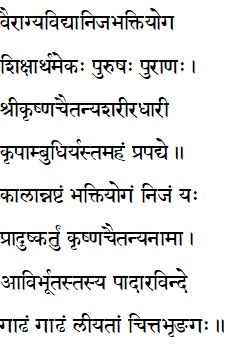
“I take refuge at the feet of the One, who is full of compassion, the ancient Purusha, who incarnated with the name of Shri Krishna Chaitanya to teach knowledge, renunciation and the path of devotion to all beings.
As a bee enjoys sipping honey of a flower and remains around the flower, may my mind deeply enjoy remaining immersed at the holy feet of Shri Krishna Chaitanya who has incarnated on earth to re-establish the path of devotion which was lost in time.”
Reflections: In the Bhagavad Gita, Shri Krishna described four Yogas as four paths to realize God or to realize the Ultimate Reality. These four Yogas are Raja Yoga (the path of self-control and focusing the mind), Jnana Yoga (the path of reasoning and reflections), Bhakti Yoga (the path of devotion to God), and Karma Yoga (the path of unselfish actions). According to one’s mental chemistry, one has to follow one or more Yogas and combine them proportionally. Swami Vivekananda Wanted his disciples to practice all the four Yogas in which one can engage one’s head, heart, and hands to attain the goal.
(Thanks to Nisha Parikh for editing this post.)

 mahendrajani