Category Archives: Shiva

Shiva Mahimna Stotra – Shloka 29

Shiva Mahimna Stotra

Shloka 29

Meaning: O Lord who loves to live in the forests (enjoys solitude)! Salutation to thee who is very near and is very far. O destroyer of the god of lust! Salutation to thee who is very subtle and huge. O Lord with three eyes! Salutation to thee who is the oldest and the youngest. Salutation to thee who has become all and salutation to the one who has been addressed indirectly or directly in the form of all.

Reflections: Pushpadanta tells in different ways that Lord Shiva is not limited to His form.  He is infinite Brahman.

Pushpadanta has a mastery over the words and an absolute command of the Sanskrit poetic meters. His thinking is very logical, and his heart is filled with love for Lord Shiva.  This shloka reflects all these talents. He is giving us a convincing visual picture of how Lord Shiva is everything in this universe.  

Pushpadanta says, “I salute to Shiva who is very near to us and is very far.” Lord Shiva is very near to us. As Atman or inner consciousness, Lord Shiva is our true identity. He is the support of our existence. Just as gold is the reality behind any golden ornament, or clay is the reality behind any clay toy, Lord Shiva as Atman is the ultimate reality of our existence. Due to ignorance of our divine nature, we assume that we are finite and made out of body and mind. Thus, Lord Shiva is closer than our body-mind existence.

On the other hand, Lord Shiva is omnipresent and is everywhere in the universe and is beyond the universe. Lord Shiva resides everywhere in the universe which we can perceive through our most powerful telescope and is beyond those boundaries. There is another way to look at the statement ‘Lord Shiva is far’. Because Lord Shiva is so close to us, we don’t realize Him, and we look for Him outside further and further away. Many times, we miss the values of the people and things which are close to us. We take them for granted. Thus, Lord Shiva is far. This way, Brahman covers the span of the mind. Far and near depends on the state of the mind. 

Pushpadanta says, “I salute Lord Shiva who is most subtle and is also huge.” Scientists have shown us that there is tremendous power in an atom. This is the power of Brahman. Also, Brahman is bigger than the universe. Brahman is beyond the boundaries of our telescopes. Pushpadanta is giving us a visual idea of what Brahman is.  This way Brahman covers all of the space and beyond the space.

Pushpadanta says, “I salute Lord Shiva who is the oldest and who is also the youngest.” Brahman is the ultimate cause of the creation, preservation, and dissolution of the universe. Thus, Brahman is beyond the creation of the universe and hence is the most ancient one. On the other hand, Brahman is something that is just born. This way, Brahman covers all the time and beyond the time.

Finally, Pushpadanta says, “I salute Brahman who has become everything.” The highest realization of God is to feel the presence of God inside us and outside us in everything.

In the beginning, it is difficult to see God in something that looks bad, cruel, horrible, impure, unrighteous, etc. That is why, in the beginning, we have to see God in something that is good, unselfish, pure, loving, peaceful, holy, righteous, etc. When we get spiritually mature, then we will realize that God is manifesting through everything. God is manifesting directly through goodness, unselfishness, purity, kindness, righteousness, holiness, etc., and indirectly through bad acts, selfishness, impurity, cruelty, unrighteousness, etc. It is like pristine Ganga water coming out from the Himalayas is Ganga water and the polluted dirty water of Ganga is also Ganga water. When the dirty Ganga water is purified, it will not be different from the pristine Ganga water.

Pushpadanta is telling us that there is only God which is manifesting through everything and there is only one Power of God which is working through all. Pushpadanta calls this God Lord Shiva and salutes Him.

In this shloka, Pushpadanta gave us four names of Lord Shiva:

 Priyadava means Shiva who loves quiet forests. Shiva loves meditation. Hence, He enjoys solitude. He is teaching us to seek solitude. Sri Ramakrishna emphasized going into solitude often and sincerely praying to God for knowledge and devotion. Along with prayer, we have to think about what is permanent in this universe and what is impermanent. Sri Ramakrishna said that God or Brahman is only permanent and everything else is impermanent. Let us learn from Shiva to get absorbed in the meditation focusing our mind on Brahman. Once we learn how to keep our mind focused on Atman or Brahman in solitude, we can do it in the midst of a city street filled with activities and noises.

Smarahara means Shiva who has destroyed the god of lust.  Bhagavad Gita says that lust, anger, and greed are the three doors to hell, meaning the low life. Sri Ramakrishna emphasized getting rid of ‘lust and greed’. Anger follows lust and greed. God created lust for progeny, to continue Its creation. But, beyond that lust brings the mind down to the body and cannot let it think something higher. Lust makes people slaves, and they suffer immensely. Sri Ramakrishna said that after one or two children, the husband and wife should focus their minds on the ultimate goal of life, God-realization, and help each other to attain this goal. This will bring inner peace, bliss, fulfillment, awareness of God in all, love for all, fearlessness, and freedom from all bondages. Lord Shiva taught us to burn lust so that it cannot deviate our mind from our ultimate goal. It is not easy to control lust and one should not boast about controlling it. There are examples of people in the scriptures who thought they had controlled lust and then became victims of it.  We have to pray to God for strength to control lust and keep our minds in the spiritual consciousness.  We read in the scriptures that usually Lord Shiva meditates, but when He is not meditating, He and Mother Parvati spend time in spiritual conversations.   

Trinayana means Shiva with three eyes, having the third eye of Knowledge. With spiritual development one develops a divine intuition. This makes the seeker see the hidden Reality which others cannot see. This intuition also leads the seeker to pure thoughts, speech, and actions which help realize God. With the third eye of Knowledge of Brahman, Lord Shiva burnt the god of lust. It is also called an inner vision of Ultimate Reality.

Sarvasmai means Shiva who is manifesting through all the forms. Tat means ‘that’ which is incomprehensible, and idam means ‘this’ which is comprehensible. Both these are nothing but Lord Shiva (Brahman).  Pushpadanta says ‘I salute to this Shiva who has become everything’.    

This shloka tells us that Lord Shiva is no one else but Brahman, and how we can see Him in everything.
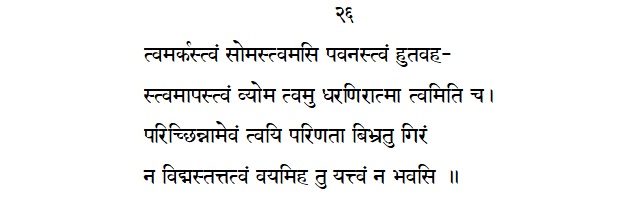
Shiva Mahimna Stotra – Shloka 26

Shiva Mahimna Stotra

Shloka 26

Meaning: Intellectually developed people make you limited by saying that ‘You are sun, moon, wind, fire, water, sky, earth, and soul’. But, in this universe, we do not know anything which is not You.

Reflections:  Hindus know that God is only one, called Brahman, and Brahman is infinite, formless, and free from all qualities. Since it is difficult to meditate on the formless Brahman initially, seekers of God are encouraged to meditate on various forms of Brahman (God) endowed with qualities according to one’s liking. There is total freedom in selecting the forms and qualities of God. That is why the Hindu religion has reached mythology. However, all the seekers of God are reminded again and again that these forms are limited, and they are just the representations of the infinite Brahman. This will prevent them to be fanatics about the particular forms of God. Pushpadanta, in this shloka, addresses this point in a very poetic way.

There are several lists of gods and goddesses available in Hinduism. One of the lists talks about eight manifestations of Brahman, namely, five elements (space, wind, fire, water, and earth), two illumined objects (sun, and moon, which are considered as the eyes of Brahman), and Atman (the inner consciousness). In Bhagavad Gita, Shri Krishna says that wherever one sees special power manifesting through a person or an object, one should know that it is the ‘Power of Lord Krishna’, meaning the power of Brahman. One can meditate first on that manifestation and then develop a way to meditate on the infinite, formless, and qualityless Brahman.        

In this shloka, Pushpadanta poetically says that Lord Shiva as Brahman is not only the eight manifestations, but there is nothing in the universe that is not Brahman. Brahman is what we perceive in the universe and is beyond what we perceive. Actually, one who is searching for Brahman is not different from Brahman. Out of ignorance one separates oneself from Brahman and then looks for Brahman.  

No one can describe Brahman. Whatever we describe becomes limited. Brahman is infinite and unlimited. Sri Ramakrishna says that everything in the universe has become ‘jhutha’ except Brahman. Whatever touches our mouth is considered ‘jhutha’. We think that we can describe all the objects and beings in the universe because they are limited. But Brahman is even beyond our comprehension because our mind is limited. Again, Sri Ramakrishna says that one cannot put ten gallons of milk in a one-gallon container.  

The truth that ‘Brahman has become everything’ has been mentioned all over in the Hindu scriptures. The following are a couple of examples:

Ishopanishad, line 1 of mantra 1, says:

“ALL THIS – whatever exists in this changing universe – should be covered by the Lord.”

Lord Shri Krishna, identifying himself with Brahman, says the following in the Bhagavad Gita:

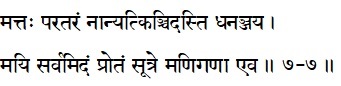
“O Arjuna! There exists nothing whatever higher than I am. All is strung on Me (Brahman) as a row of gems on a thread.” (Gita 7.7).

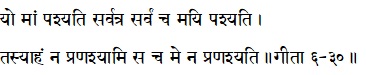
“One who sees Me (Brahman) everywhere and sees everything in Me, to that person I am never lost, nor he/she is ever lost to Me.” (Gita 6.30).

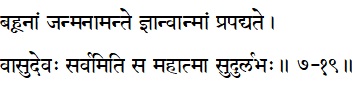
 “At the end of many births, the person of wisdom, realizing that ‘Vasudeva (Brahman) is all’, worships Me (Brahman). Rare indeed to find such a great soul.” (Gita 7.19).

Shiva Mahimna Stotra – Shloka 12

Shiva Mahimna Stotra

Shloka 12

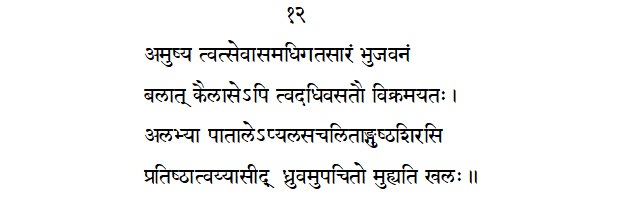
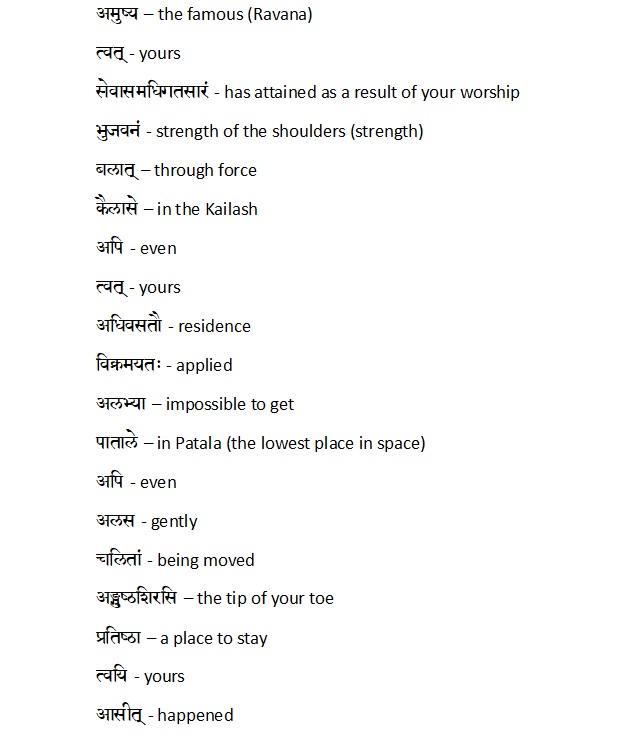
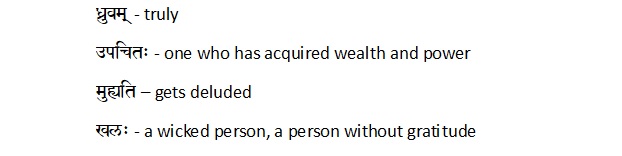
Meaning:  The famous Ravana acquired great strength by worshipping Lord Shiva. But, with that strength, he started to shake your abode, Kailash. However, when you gently pressed the tip of your toe (on Ravana’s head), Ravana could not find a place even in Patala, the lowest plane in the universe. Truly, a wicked person loses a sense of right and wrong when he/she acquires wealth and power.

Reflections: Ravana worshipped Lord Shiva and acquired great strength and wealth. But he forgot that all his glories came from Lord Shiva. At one point he wanted to apply the same strength against Lord Shiva and started shaking Kailash, Lord Shiva’s abode. Lord Shiva gently pressed the tip of his toe and with that force, Ravana went down and down in space and became a laughable person. Pushpadanta writes that a wicked person really gets deluded by wealth and strength, and loses the sense of right and wrong. Wicked people have no sense of gratitude, and they learn their lessons the hard way.  

Question: We know that when one realizes God, one gets liberated. Ravana performed severe austerities and realized Lord Shiva, but why then did he bring his own destruction?  

This is my understanding:

Answer:  God is called a “Kalpataru”, the wish-fulfilling tree. Ravana had a desire to conquer the world and acquire all the wealth of the world. With that desire in mind, he intensely performed austerity, much more than any ordinary person can perform. God must fulfill his desire. But that desire led him to destructive ideas which brought destruction of himself, his followers, and his kingdom. 

The theory of Karma says that if we have a desire, then we will act accordingly, and we must go through the consequences of our actions. However, if we have a desire for knowledge of the Ultimate Reality and love for God, then this desire will liberate us from all other worldly desires, and make us free from all our bondages.  

People whose minds are filled with tamas and rajas have desires to harm people or to acquire worldly gain. Many of them pray to God to fulfill their desires. The power which creates, preserves, and dissolves the universe gives strength to these people to fulfill their desires, but then they must suffer the consequences of their actions.  Therefore, if we do not want to suffer anymore, and want to be liberated from all our bondages and experience infinite bliss within, then we must pray to God for Knowledge and Devotion.

One more lesson we learn from this shloka is to recognize all the help we have received and to be thankful to all who have helped us.  Parents help us to grow, teachers help us to learn, and many people and objects of the world help us in various ways to survive, work, and for our achievements. We must recognize this help, be thankful to all, and do our best to return this favor in some way. Even if we live a decent life grounded by morality and spirituality, then all who have helped us will be happy for the sacrifices they have made for us.

The ego is the main obstacle to recognizing other people’s help. It wants to boast thinking that ‘I have done everything by myself’. Developing a sense of gratitude does not make us smaller, but it makes us humble, and it adds up to our self-dignity and awareness of reality.   

Shiva Mahimna Stotra – Shloka 10

Shiva Mahimna Stotra

Shloka 10

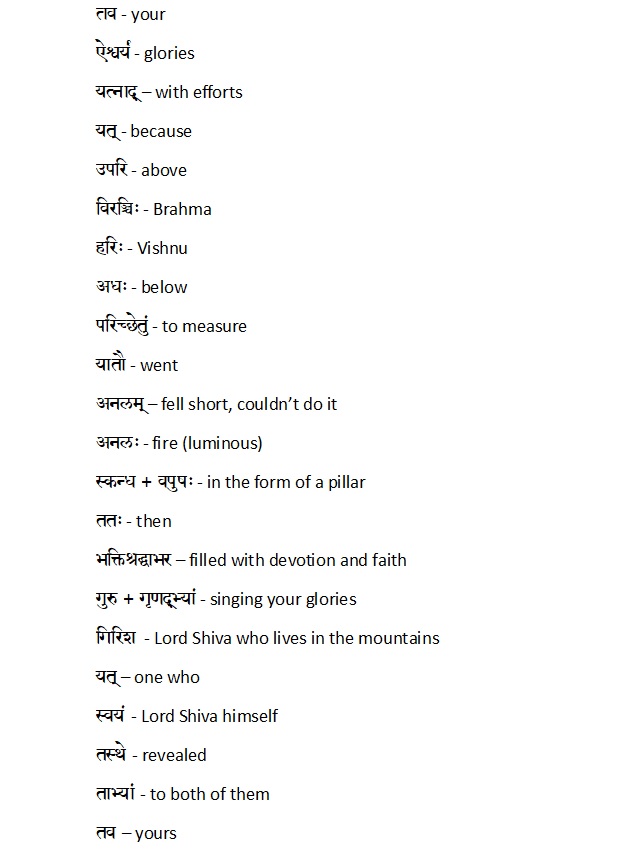
Meaning: O Girisha (Shiva)! To measure your glories which appeared as a luminous pillar, Brahma went above, and Vishnu went below. Thus, they made lots of effort. But they could not measure your glories. Then, being filled with devotion and faith, when they sang your glories, you revealed yourself to them. A prayer filled with devotion and faith definitely leads to the realization of the Lord.

Reflections:  This shloka tells us that no one can fully comprehend Brahman, the absolute aspect of God, even the divine forms Brahma, and Vishnu.

The story goes that a dispute arose between Brahma and Vishnu about ‘who is greater’. Each one claimed that he was greater. Brahma said that he is greater because he creates the universe and Vishnu said that he is greater because he preserves the universe and Brahma has been born from his navel. The dispute could not be resolved, and it became intense. Out of anger, each one threw a weapon at the other. Lord Shiva stopped both the weapons and thus stopped great destruction, and He appeared as the infinite luminous pillar.

Brahma had not created that pillar and Vishnu had not seen it before. Both were amazed by its luminosity and infinite nature. Both planned to check out the source of the pillar. Brahma went above and Vishnu went below. But they could not find its end and its source. They felt ashamed of their boasting. They found something higher than them. Finally, both forgot about their fight, their hearts got filled with faith and devotion, and with folded hands, they asked this divine force to reveal itself.  At that time, Brahman appeared in the form of Shiva and told that Brahman is the Ultimate Reality of the universe and It appears as Brahma, Vishnu, and Shiva.   

We can learn from this that we boast about our worldly achievements and think that we are great. But, when we think of the infinite power and glories of God manifesting in the universe, then we look very timid. For example, when we see Himalayas, or an ocean, or Grand Canyon, or think of the infinite sky filled with planets, stars, and galaxies, or the infinite time, then we realize that we are nothing more than an ant or a very tiny creature walking on earth having a big ego which has a very little value.

Here is a practical way to reduce our ego, pain, problems, and quarrels in our life. Suppose I am sitting in a chair in my study room and a camera is showing only me. I occupy the whole picture. Then, the camera moves further away and shows me sitting in the whole room. Then, it keeps moving away showing me in my house, in the whole block, in the city, in the country, on the earth, and so on. Then, the camera goes out into space where the whole earth becomes like a green pea and then may become a small dot. In this infinite space, what is my existence? It is ridiculous that we walked around with a big worldly ego having achieved something which looks trivial in infinite time. In this perspective, our existence, our pain, problems, and quarrels in our life become insignificant, and we realize that we had mentally magnified them more than their actual reality. Thus, we get a proper understanding and inner strength to go through the adversities of life.  

Now, let us look at it from the Vedantic point of view. A being with body and mind is an extremely limited person, but as an Atman, each individual is not different than Brahman. When we realize our true divine Self, Atman, then we become infinite by being one with the whole universe.          

This shloka also teaches us that if we sincerely pray to God with faith and devotion, then God reveals Its nature.   

Shiva Mahimna Stotra – Shloka 7

Shiva Mahimna Stotra

Shloka 7

Note: Last week, in a summer camp, I taught ‘Introduction of Shiva Mahimna Stotra’ to 8th and 9th-grade students along with a few high school seniors and alumni. I had five periods, and each was forty-five minutes long. For the introduction, I selected nine shlokas out of the forty-three shlokas of the Shiva Mahimna Stotra, namely, 1, 7, 10, 12, 26, 29, 30, 32, and 43. Therefore, I have decided to talk about these shlokas first and then fill in the other shlokas later. In the last blog, I covered the ‘Introduction’, ‘Pranam Mantra’, and ‘Shloka 1’ of the Shiva Mahimna Stotra. Here is the Shloka 7 of the stotra.

Meaning: Three Vedas, Sankhya, Yoga, Shaivite sect, Vaishnava’s sect, and others have described several paths to realize God. People say that ‘this path or that path is the best or more helpful’. But, as the ocean is the one destination of all the rivers’ water, all these various religious paths, created to match various likings of the people, straight or difficult they appear, they all lead to You (One God).

Reflections:  There is only one God and people worship It with various names and forms. Sri Ramakrishna says that mothers cook dishes according to the digestive capacity and the liking of the children. Similarly, God has created all these religious paths to suit the needs of the people. It is futile to try to prove that one path is better than the other. I love my mother, but I cannot tell my neighbor that ‘my mother is the best and he/she should love only my mother’. My neighbor will say that he/she loves his/her mother and thinks that she is great. In essence, mothers are different, but the ‘motherhood’ is the same. 

Rig Veda says, “Ekam Sat Vipra Bahuda Vadanti”, Truth is one, sages call It by various names. Sri Ramakrishna says that follow the path you like to realize God, but do not think that your path is the only right path, and all other paths are wrong. If we sincerely follow our path, we can realize God. Even if our path has some mistakes, if we are sincere and open-minded, then God will correct all our mistakes and guide us in the right direction. Only politicians and religious fanatics who are interested in power and other worldly benefits guide people into religious fights and differences. They are not really interested in realizing God. We hope people understand this truth that God is one and all paths lead to the same God. This way we can avoid hatred created in the name of religion.

As I had mentioned in the last blog, Swami Vivekananda, in his famous speech given on September 11, 1893, at the Chicago World Parliament of Religions, quoted this shloka saying:

“I will quote to you, brethren, a few lines from a hymn which I remember to have repeated from my earliest boyhood, which is every day repeated by millions of human beings: ‘As the different streams having their sources in different places all mingle their water in the sea, so, O Lord, the different paths which men take through different tendencies, various though they appear, crooked or straight, all lead to Thee’.”

Shiva Mahimna Stotra – Shloka 1

Shiva Mahimna Stotra

            Shiva Mahimna Stotra is a hymn filled with Lord Shiva’s glories and enlightening thoughts which help us understand the Ultimate Reality and build our character. It was written by Shri Pushpadanta. He was an angel and a devotee of Lord Shiva. He was well-versed in singing and literature.

            There is a story telling us why Shri Pushpadanta wrote this hymn. Being an angel, he could remain invisible to human beings and fly around the world freely. His greatest joy was to offer beautiful flowers to Lord Shiva every day. Once when he was flying over the garden of King Chitraratha, he observed that there were very special and beautiful flowers growing there that he had not seen. He thought of offering these flowers to Lord Shiva. But the garden was protected by high security. He thought that he could be invisible, and he could fly, so he had nothing to worry about stealing the flowers. He invisibly entered the garden, quietly collected the flowers he liked, and offered them to Lord Shiva. This continued for a few days.

The king was also offering flowers to Lord Shiva. But he found that he was not getting the special flowers that he loved to offer. Upon inquiry, he found from the guards that someone was stealing these flowers lately and they were unable to find the thief. The king observed that there was no flow in the security. He was convinced that this was the job of an angel. He had an idea.  He asked the guards to collect respectfully the flowers and the bilva leaves already offered to Lord Shiva in his temple and spread them around those flower plants from which the thief was stealing regularly. The guards did exactly what the king had told them to do and that night they remained awake hiding behind the bushes.  Angel Pushpadanta came invisibly and started stealing the flowers. But he found that he was losing his power to remain invisible and now all can see who he was. The guards caught him and told him that he lost his power because he insulted Lord Shiva by stepping on and going over the offered flowers and bilva leaves to Lord Shiva. Pushpadanta’s heart was filled with pain knowing that he had insulted his beloved Lord Shiva and he was engaged in wrongdoing. In order to please Lord Shiva and regain His love, he started composing a hymn.  With this hymn, Shri Pushpadanta became immortal and one of the most beloved devotees of Lord Shiva.  Over a period of hundreds of years, by reciting this hymn, millions of devotees had a vision of Lord Shiva and their souls have been uplifted. 

In his famous speech given on September 11, 1893, at the Chicago World Parliament of Religions, Swami Vivekananda said the following1:

“I will quote to you, brethren, a few lines from a hymn which I remember to have repeated from my earliest boyhood, which is every day repeated by millions of human beings: ‘As the different streams having their sources in different places all mingle their water in the sea, so, O Lord, the different paths which men take through different tendencies, various though they appear, crooked or straight, all lead to Thee.’” This is the seventh shloka of Shiva Mahimna Stotra.

The following incident from the life of Sri Ramakrishna2 gives us a clear picture of how people had a vision of Lord Shiva by repeating the Shiva Mahimna Stotra.

 “One day, the Master (Sri Ramakrishna) entered one of the Shiva temples of Dakshineswar and began to recite the Shiva Mahimna, a hymn in praise of the Deity. He was beside himself in ecstasy as he recited the following verse: “O Lord! Imagine if the ink is prepared by dissolving a blue mountain into an ocean, the biggest branch of the celestial tree becomes the pen to write, and the earth the writing paper, and if by taking all these things, Saraswati, the goddess of Learning, writes your glories forever, even then she cannot describe your glories.”

“While the Master was reciting the above verse, he intensely felt the glory of Shiva in his heart, and he lost himself. He forgot the hymn, the Sanskrit language of the hymn, the order of the verses, and so on, and repeatedly cried aloud, “O Lord, how can I express Your infinite glory?” Tears poured down his cheeks, chest, and clothes, finally dampening the floor.”

Let us sincerely study this great hymn, Shiva Mahimna, and uplift ourselves spiritually and asked Lord Shiva to give us His vision to bless our life and be free from all bondages. With this vision our life will be meaningful, we will attain great fulfillment, and we will experience infinite bliss which cannot be obtained by any worldly object, person, or pleasure.  

[1: Chicago Address by Swami Vivekananda, Advaita Ashrama, Kolkata, fifth edition, 2015, page 20.

2: Sri Ramakrishna and His Divine Play by Swami Saradananda, translated by Swami Chetanananda, page 487.]

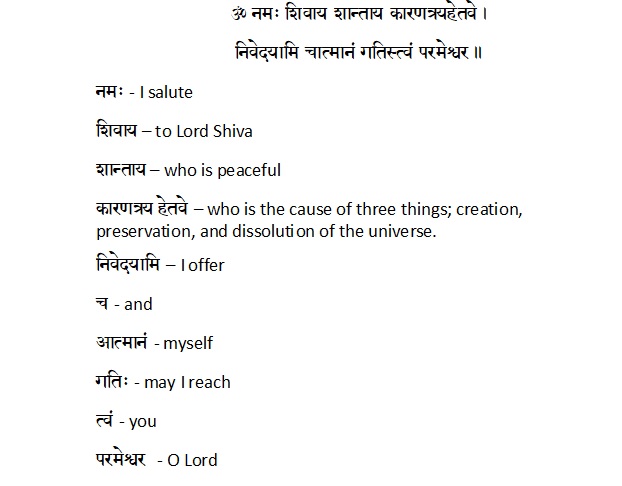
First, we will salute Lord Shiva with the following shloka:

Meaning: I salute Lord Shiva who is peaceful, auspicious, and the cause of the creation, preservation, and dissolution of the universe. O Lord Shiva! I surrender myself to you. May I realize you.

Reflections:  Lord Shiva’s form is serene, peaceful, and auspicious. By meditating on this form, we also acquire the same qualities. Lord Shiva, as Brahman, the Ultimate Reality, is the cause of the creation, preservation, and dissolution of the universe. There is no other cause for these activities. This Brahman is our true identity which we refer to it as Atman.

For our spiritual development, we have to surrender our ego which is formed by our body and mind, and the fundamental ignorance of our true nature. We pray to God to realize that our true nature is not different from God. 

Meaning: This is Shiva Mahimna Stotra composed by Shri Pushpadanta.

(Meaning of Shloka – 1): “O Shiva, the remover of all sufferings, I am ignorant of your infinite glories. If my hymn is improper, then even the hymns sung by Brahma and other knowledgeable people are also improper because no one has completely fathomed your glories. If the hymn sung by each one according to one’s limited intellect is permissible, then my effort to compose this hymn is not an exception.”

Reflections: No one can describe God’s infinite glories. Take, for example, our eyes. Go deeper to understand how the eyes function. The eyes take pictures that are registered inside us as upside-down images. Then the senses encode all the pictures into messages and then send them to the brain. The brain then puts them together as the things look outside and sends messages to the body to react according to the mind’s feelings. Cameras came from studying how the eyes function. Science has studied some parts of the functions of the eyes, but if we ask the experts, they will say that after some point they don’t know many things about the eyes.

The greatest mystery is how life appears in the mother’s womb. Every day several research papers are published. Each one solves a few problems but raises many other questions. As our knowledge grows, so does our awareness of our ignorance. Thus, God’s glories are infinite and our finite minds cannot fathom them.

If we pray to God sincerely, then God listens to our prayer. God will ignore all our imperfections in our language and expressions.