Category Archives: Shatashloki

Shatashloki – V (Shloka 6)

“Shatashloki” of Shri Shankaracharya – V (Shloka – 6)
We create our own destiny

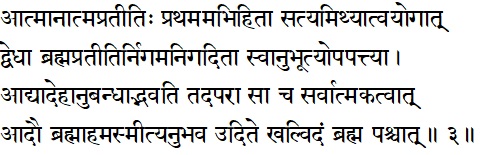
Shloka – 6

Translation (Shloka – 6):

A silkworm, thinking that it is very wise, creates a cocoon around itself and lives in it until its death and tries to fulfill its desires. Similarly, each individual creates one’s physical body and mind based on the actions performed in his/her previous life and lives on earth to fulfill his/her desires.

(The silkworms and their cocoons. The image is from dreamtime.com)

Comments:

We are born and we spend our lives making plans for what we want to do and performing various activities. In the midst of all this planning and activity, a few people take a pause and ask questions like: (1) Who decided that I should be a man or a woman? (2) Who decided how my face and body should look like? (3) Who selected my parents? (4) Who selected my family environment?

What are the answers? We can think of the following four answers:

(1) These are silly or useless questions for we can never find their answers.

(2) It is all a result of probability and chances.  If the chromosomes X and Y combine, then a boy is born and if chromosomes X and X combine, then a girl is born.

(3) Parents’ genes decided.

(4) Nature decides everything.

(5) God is the creator and God decides everything that happens.

The answer #1 seems mostly agnostic, partly pessimistic, and shows a lack of enthusiasm to seek answers.

The answer #2 is a sophisticated way to get out from finding an answer. Since everything in nature is working precisely, how can we think that things happen randomly? We can admit that we do not understand many phenomenon of nature. But, in the past, we did not know many things like how rain comes, how lightening happens, how eclipses happen, etc.  Humans had assumed these to be an act of some mysterious power. But, now science has explained many such natural phenomena. With regards to answer #2, we can further inquire, ‘who makes the chromosomes?’ and ‘who combines them?’.

Answer #3 is partially true as long as our physical structure is concerned. Our nose, and eyes, and chin etc. may look like someone in our family. But, parents did not decide their children’s gender. A family can have all boys, or all girls, or boys and girls both. Further, if we go to the inner nature of mind, then we find that siblings have different personalities even among twins or triplets. Parents themselves are surprised when their children reveal various mental tendencies. Thus, parents do not decide things about their children’s mental make-up. They can provide some external environment for their children to help them grow in a certain way, but it is not in their hands to decide how the children will grow.

Answers #4 and #5 are almost the same, only the names are different. People who do not like to say the word ‘God’ may choose the word ‘Nature’. However, it seems that God has ears to hear, but the Nature does not have ears. Nature is like a big giant elephant walking on the road and the beings are like ants and insects who helplessly get crushed under its feet. Even if the smaller beings say something, it is of no avail. On the other hand, we feel that God is some Being who can listen to us. Let us then for the time being consider answer #5.

Most of us feel that God listens to our complaints more than our prayers. Therefore, people complain to God more often than they pray to God. People complain, ‘O God! Why did you make me a woman or a man?’, or ‘Why didn’t you created me as a handsome man or a beautiful woman?’,  or ‘Why did you give me a birth in a poor family?’ or ‘Why do I have to struggle so much for my achievements while some others get them easily?’ etc.

We can bring more pressure on God for His/Her favoritism when we find that (1) One child is born in an affluent and totally secure environment while another child is born in a poor family in a neighborhood where gun-shots often go on like fire-works and where one considers oneself lucky if one survives for one more day. (2) One child has a healthy body while another one has many physical problems from childhood. (3) One person has an abundance of wealth and can do whatever one wants while another has to worry everyday how to bring some food on the table. (4) One child is excellent in studies, art, music, sports etc. from the childhood while another one is struggling to learn basic things in the schools. (5) One child has many virtues and follows a disciplined life while another one has destructive tendencies and does not feel bad doing unethical things.

We ask, if God has created all, then why are there differences? Why is God partial to a few and cruel to others? Do we have answers of these questions? Because of these differences, many people do not like to think of God. They do not see any purpose in praying to God.

In the ancient time Rishis thought about this and they found a logical answer to these questions. They found that in this universe there is a chain of cause and effect. Every action has a result and the result becomes the cause of another action, which in turn call an effect. If I drop a glass-cup on a hard floor, it breaks. If I walk on these pieces of glass, then I will cut my feet and bleed. If I do not take care of the bleeding, I will suffer severe physical problems. Originally, I might have dropped the glass-cup for some reason. Similarly, there is a long chain of cause-effect for everything that happens in the universe. The problem is that most of the time we see the effects and not the causes. Thus, our current situations are the effects of our past actions. We do not have to blame God for our situations. This is the Theory of Karma.

I have to make one point very clear here. If someone is suffering, we cannot come out and say that ‘you are suffering because of your past karmas’. That is very cruel. It is a sign of an ignorance and lack of sensitivity on our part. At that time, we have to try to help the person who is suffering. If we cannot help, then at least we wish and pray that the person’s sufferings be removed or the person gains strength to go through the sufferings. The Theory of Karma should be applied to ourselves. We have to take full responsibility of our current situation. If we want to change our current situation in the future, then we should properly start working on it now.

Based on the Rishis’ realization, Vedanta teaches the theory of rebirth based on the Theory of Karma. The Bhagavad Gita (8.6) tells that, “According to the person’s strongest desire at the time of death, the person is reborn to fulfill that desire.” Suppose a young man or woman believes that sleeping for most of the time (say 12 or more hours a day) is the best state to acquire happiness in life. These days, it is hard for a human being to sleep for 12 hours or more per day. One’s studies, job, daily choirs, and family and/or society will force the person to wake up. For the person desiring 12 hours of sleep, this causes unhappiness. To such a person, the compassionate Mother Nature gives him or her body of a crocodile in their next life. When this person’s sleeping desire is fulfilled and he or she thinks that ‘I had enough with sleep, now I want to run around like a rabbit,’ then the gracious Mother Nature will make the person a rabbit. Thus, it goes on. Thus, we are responsible for our current situations in our life. We are the result of our past desires. Mother Nature or God had given this life to fulfill a few of those desires.

On the other hand, if a person wants to attain the highest knowledge of the Ultimate Reality, and has engaged in lots of spiritual practices for this purpose, but dies without attaining it, then the Bhagavad Gita (6.40-6.43) says, “The life of such a person does not become ruined. No bad things happen to a person who has engaged in spiritual practice. After enjoying the results of his/her good actions (spiritual practices), the person takes birth in a pure and prosperous family. Or he/she will be born in a family of yogis rich in wisdom. Such a birth is difficult to gain in this world. There, he/she remembers all his/her past spiritual practices and continues to strive further to attain the highest knowledge.”

As a being goes in a cycle of birth and death, the whole universe moves in a cycle of creation-preservation-dissolution. In Bhagavad Gita (9.7-9.8), Shri Krishna says that He, as Brahman, the Ultimate Existence, by His Power creates the universe in the beginning of a cycle, (nourishes the universe), and at the end of the cycle dissolves it into Brahman. Thus, all the beings are born again and again.

The Theory of Karma, the Theory of Rebirth, and the Cyclical Theory of the Existence of the Universe seem logical and answer most of the questions we have raised earlier. They are also consistent with a principal central to Vedanta philosophy, that there is only one existence. Vedanta calls it ‘Brahman’. One can also call it ‘Pure Consciousness’. According to Vedanta, the Universe is nothing but only one existence Brahman (Pure Consciousness) appearing as various objects and beings of the universe. Brahman is eternal.

According to Vedanta philosophy, a human being is a part of the universe, and therefore he/she is nothing but the Pure Consciousness or Brahman. And like Brahman, he/she too is eternal. However, when he/she thinks that ‘I am an individual that has a separate existence from Brahman having a certain body and mind’, then he/she goes through the cycle of birth and death. Vedanta philosophy says that this thought leads to all the following problems:

(1) An individual thinks that he/she is not happy and will be happy only if his/her desires are fulfilled.

(2) A person creates a small world around him/her and thinks that he/she is responsible for that small little world. However, when some undesirable thing happens against all his/her efforts or a near and dear one dies, then the person feels helpless and becomes frustrated.

(3) An individual thinks that he/she is limited and the whole universe is against him/her.

(4) A person is constantly threatened by the fear of death, his/her non-existence.

Shri Shankaracharya says in Shaktashloki Shloka 6 that this thought (which he calls a basic ignorance) is like the cocoon of the silkworm that has been created around oneself. An individual can break this cocoon with the firm conviction that ‘I am nothing but Brahman, the Pure Consciousness. My body-mind existence has been created by me, separating myself from the eternal Brahman.’  But, it is sad that due to our ignorance we passionately love our body and mind and the world we have created around them. As a consequence, we suffer and go through the cycle of birth and death.

Vedanta emphasizes that the realization, ‘I am not different from Brahman’ removes all our sufferings, bondages, and fear. We feel connected with everything in the universe, especially with all beings. From this connectedness springs love for all in our heart. Such love gives us fulfillment. Vedanta describes various paths to break this cocoon and be free, in particular the Four Yogas described in the Bhagavad Gita.

Many other great teachers and saints have described various ways to break this cocoon and be free from our sufferings, bondages, and fear.

(Thanks to Nisha Parikh for editing this post.)
 

Shatashloki –IV (Shloka 4 and 5)

“Shatashloki” of Shrimad Shankaracharya –IV (Shloka – 4 & 5)
The goal of life

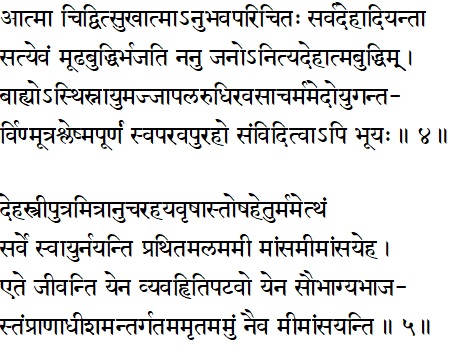
Shloka – 4 & 5

Essential Meaning of Shloka 4 & 5:

Through experiences in the world, we find that the Atman is Sat-Chit-Ananda (Existence-Knowledge-Bliss Absolute). Because of the Atman, the body and mind function. This is the Truth, but deluded people always think that the perishable body is one’s real self. In reality, the body is made out of bones, muscles, bone marrow, flesh, blood, membrane, and skin and inside it is filled with filth like excreta, urine, and mucus.

Further, deluded people think that their bodies, spouses, children, friends, servants, pets and possessions are the sole source of their happiness; they spend their valuable time to protect and nourish them. They never think that it is because of the Atman that they have their lives and they continue to function. Such people never reflect on the Atman that resides within, the Atman that controls life and is immortal and blissful.

Comments:

Sat-Chit-Ananda

If we are aware and reflect on our day-to-day activities, we find that as a motor runs an engine, there is some power that keeps us alive and allows our mind and body to function. When we think of this power, we begin to understand the idea of the ‘Sat” (Existence Absolute) part of the Atman lying within.

In our dreams, even though our eyes are closed and our body is not moving, we can still see and do things! Who illumines the world we see in our dreams? As we think about this, we can begin to understand the ‘Chit’ (Knowledge Absolute) part of the Atman. In reality, the Atman illumines our intellect and because of this illumined intellect we see (when we are awake and when we are dreaming) and know things of the world.

When we come out of deep sleep, we sometimes experience joy. Where does this joy come from? We did not eat anything, we did not do anything and yet we experience joy. This experience gives us an idea of the ‘Ananda’ (Bliss Absolute) part of Atman.

The Goal of life:

A thoughtful person questions the goal of life: “Is the goal to earn a college degree or any diploma? Is it money-making? Is it acquiring name, fame, power and position? Is it just producing children? Why am I running around like a chicken without head from morning to night doing the same routine day after day?” When we do not have clear picture of our ultimate goal, then we sometimes lose interest in what we are doing.

Many great thinkers and saints have thought about this question. Sri Ramakrishna, in following the thought process of the great rishis and saints and through his own reflections, said that the goal of human life is God-realization. Swami Vivekananda makes this even more explicit. Swamiji said that the goal of human life is to realize the potential divinity lying within ourselves (the Atman) and to manifest this divinity in our thoughts, speech, and actions. Many great personalities and saints have shown through their lives that all our activities can be integrated around this goal and we can live a normal life free from all fear, and one that is filled with satisfaction, infinite happiness, a deeper understanding of our life and of the world, and unselfish love for all.

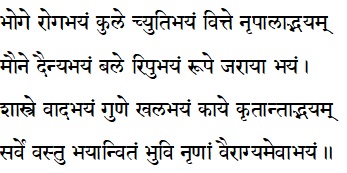
Generally, in order to be happy, we often try to acquire many things and run after the pleasures of the body and mind. But a great saint, Bhatruhari says, in Shloka 34 of “Vairagya Shatakam,” that we face fear in every worldly thing we try to cherish.

When one tries to enjoy worldly things, there is a fear of disease.

When one has acquired a higher position, then there is a fear of losing that position.

When one has acquired wealth, one has a fear of the king (government taxes).

When a person keeps silence, then there is a fear of being considered as a weak person.

When one has developed physical strength, one has a fear of an enemy.

When one has acquired beauty, then there is a fear of old age.

When one has acquired knowledge of scriptures, then there is a fear of a challenge.

When one practices virtues, then one has a fear of wicked people finding faults in one’s character

When one is attached to one’s body, then there is a fear of death.

Thus, every worldly thing has a fear attached to it.

Detachment is the only way to attain a state of fearlessness. Here, detachment means to understand that all worldly things are impermanent and then to make efforts to realize the permanent Atman

People and Worldly Things:

Consciously or unconsciously we make the mistake of thinking that our relatives, other people, animals, plants and worldly objects are made for our pleasure. With this attitude, our expectations grow beyond the limit and when people or things do not satisfy our expectations, we either become sad or angry.

We have to remember that our relatives and worldly objects have their own purpose for existence. We have to perform our own responsibilities, help others as much as we can, and refrain from keeping any expectations. This is the way to happiness.

Another mistake we make is that we are attracted to people because of their external appearances and/or roles. In Brihadaranyaka Upanishad (II.4.5) we find the following:

Rishi Yajnavalkya tells his wife,

“Verily, not for the sake of the husband, my dear, is the husband loved, but he is loved for the sake of the Self (Atman).”

“Verily, not for the sake of the wife, my dear, is the wife loved, but she is loved for the sake of the Self (Atman).”

…..

“Verily, not for the sake of the beings, my dear, are the beings loved, but they are loved for the sake of the Self (Atman).”

“Verily, not for the sake of the All, my dear, is the All loved, but it is loved for the sake of the Self (Atman).”

Thus, the Upanishad teaches us that all people and things look attractive because of the existence of the Atman lying within. When that Atman is gone, people and things lose their luster. When our loved one dies, we become sad. But, we know that the person has gone and the body was just an instrument and it will deteriorate.

In Shatashloki Shloka 4, Shri Shankaracharya asks us to think about this, and ask ‘what the body is made out of and what is in the body?’ He says that the body is made out of bones, muscles, bone marrow, flesh, blood, membrane, and skin and it is filled with filth like excreta, urine, and mucus.

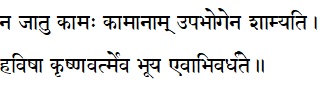
Lust brings the mind down to the body-level which is impermanent and remaining on the body-level causes many problems. God has created lust to populate the earth, but to live a lustful life is not the goal of human life. In the “Shrimad Bhagavatam,” there is a story of King Yayati. He was cursed to lose his youth for his improper lustful behavior. After begging for the pardon, Yavati was allowed to switch his old age with the youth of a young person. He asked his sons to switch their youth with his old age. The youngest son agreed to the switch. After a few years, King Yayati realized that his lustful desires would be impossible to fulfill no matter how many years he tries. He switched back his youth with his son’s old age. He shared the following truth about this experience:

“Lustful desires cannot be fulfilled by trying to fulfill them. The more we try to fulfill lustful desires, the more they increase in their intensity just as a fire blazes more when we pour ghee into it.” Shrimad Bhagavatam 9.19.14

Thus, focusing the mind on the higher goal of life and striving to attain this goal gives us natural control of our lower desires. Sri Ramakrishna explains this using a simple analogy: if we have tasted a delicious mango, then we do not like the lower kind of cheap mangoes anymore.

 God-realization:

Sri Ramakrishna said that the goal of life is to realize God. To householders, he said that after having one or two children, the husband and wife should focus their minds on this main goal of God-realization and help one another other in the attainment of this goal.

Shri Shankaracharya in the “Viveka Chudamani” says that by it is by God’s grace that one attains the following three things: (1) a human life, (2) desire to realize God, and (3) proper guidance of a proper teacher.

Human life is rare to get and we should not waste the precious time in our lives by running after impermanent things of the world. These things cannot give us permanent satisfaction, a deeper understanding of our life and the world, inner peace, immortality, fearlessness, infinite bliss and unselfish love for all. The only realization of God (our true divine Self – Atman) can give us all of these wonderful things. Hence, we have to perform our worldly responsibilities as an offering to God and strive to achieve the goal of God-realization. For this, we have to learn the ways to realize God from the scriptures, holy people and saints, and practice them.

(Thanks to Nisha Parikh for editing this post.)


Shatashloki – III (Shloka 3)

“Shatashloki” of Shrimad Shankaracharya – III (Shloka – 3)
The Outline of Spiritual Journey

Shloka – 3

Translation of Shloka – 3

When we examine the questions, ‘What is Truth?” and “What is Untruth?, we begin to understand the difference between “Atman” and “Anatman (not Atman).” After this process, we start understanding the nature of Brahman by “Having direct experience” and “through reasoning’, the two methods described in the scriptures. Later on we realize the truth; First as “I am Brahman” and then as “Everything is Brahman”.  The first realization, “I am Brahman,” comes with reference to the body and the second realization, “Everything is Brahman,” comes from the experience that Atman resides in all and in everything.

Comments:

In this shloka, an outline of the entire spiritual journey of realizing the Ultimate Truth of ourselves and of the universe has been given.

The First Step – Analyze and Reflect

Sri Ramakrishna said that along with our daily prayers we have to go often into a solitary place and think about what is permanent and what is not permanent. Truth is permanent and untruth is not permanent. We can first find out what is not permanent. The body and mind are not permanent. They are born and they die. The world is not permanent. It has a beginning and therefore it has an end. Whatever we perceive through our senses has a beginning and has an end. But, behind our body and mind and behind this universe, there seems to be a permanent entity in reference to which we perceive all changes. One has to realize that the goal of life is to know what is permanent in us and behind the universe. Conviction in this goal is the first step in the spiritual path. Without this conviction, we actually have not yet started our spiritual journey, and all our spiritual practices, rituals, and ceremonies just become the preparation for this journey.

The Second Step – Spiritual Practices

With the firm resolve to attain the above-mentioned goal, we must start doing all our spiritual practices. For the people who follow Jnana Yoga (the Path of Knowledge), the spiritual practices will include: studying or listening to the scriptures from knowledgeable people and reflecting upon their teachings, using reasoning and analysis to understand the real difference between permanent and impermanent, discarding the impermanent and making efforts to realize what is permanent. In this shloka, the path of knowledge has been indicated. One can also practice Bhakti Yoga (the Path of Devotion), Karma Yoga (the Path of Unselfish Service), and Raja Yoga (the Path of Self-control and Meditation).

By practicing one or more Yogas simultaneously, we must realize Brahman, the Ultimate Reality, the permanent support of our existence and of the universe.

The First Realization:

According to this shloka, through spiritual practices, the first realization that comes is that behind this body and mind there is an “Atman” which is permanent. Its nature is Sat-Chit-Ananda, (Existence-Knowledge-Bliss Absolute). It is the support of our existence. It illumines our intellect, and through our intellect, we become aware of our Self and the universe. It is the source of all our happiness.

As a part of our spiritual journey, we realize that there are five layers which cover this Atman: (1) Annamaya Kosha – a layer of the physical body which is nourished by food and grows by food. It is made of bones, flesh, blood, and other such things. (2) Pranamaya Kosha – a layer of vital forces which help us to function. (3) Manomaya Kosha – a layer of our desires, imaginations, and emotions.  (4) Vijnanamaya Kosha – a layer of the subtle part of the mind which reasons and analyzes. (5) Anandamaya Kosha – a layer of sattvika joy (the joy of doing the right things). When we go beyond these five layers, then we realize that our ‘true identity’ is not our body and mind, but pure consciousness which we call “Atman’. This Atman was not born and does not die. The birth of a person is the birth of his/her body and mind. We realize that the nature of Atman, as described before, is Sat-Chit-Anand. This realization is related to our body and mind. We realize that if we remove our name and form, then what remains is Atman.

The Second Realization: After continuing spiritual practices, we realize that the Atman in me and Atman in another person are not different. When we remove name and form of each being, then what remains is Atman, the Pure Consciousness. Further, if we remove name and form of anything in the universe, then what remains is only Pure Consciousness. We also realize that the whole universe came from Pure Consciousness. It is Pure Consciousness which appears as varieties of things because of name and form. Ultimately the universe merges into Pure Consciousness. We call this Pure Consciousness, “Brahman”.

We also realize that the Pure Consciousness behind oneself and the Pure Consciousness behind the whole universe are same. We can think of the pot analogy to understand this. Various pots are lying in an ocean. Each pot has ocean water inside. All the characteristics of the water inside the pots and the water outside the pots are same. When a pot breaks, the water inside the pot merges with the ocean water. Another analogy is that of the reflections of the sun in pots filled with water. The sun represents Brahman and its reflection represents Atman. When the pot breaks, then the reflection merges with the sun itself.

Sri Ramakrishna has explained these stages of understanding for God-realization with simple examples. He said that there are those who have heard about milk, those who have seen milk, those who have touched milk and those who have drunk the milk and got nourished by it. Thus, there are people who have just heard about God. Then, there are people who have felt the presence of God within. Further, there are people who have an intimate relationship with God, meaning they see God in everything and feel that they are always living with God. Their minds are filled with bliss. Their words become scriptures. They show humanity that one can keep one’s mind on God and live in this world, leading a normal life. Their minds remain calm in the pairs of opposites like joy and sorrow, success and failure, favorable and unfavorable situations, honor and insult, dealings with friends and foes, etc. They inspire people to realize God or Atman or Brahman and attain their God-consciousness state.

Sri Ramakrishna realized God within with his eyes closed and then without with his eyes open. He saw that God has become everything. He encouraged his disciples to realize God within and then to see God in all, and to serve all as a worship to God.

(Thanks to Nisha Parikh for editing this post.)
Shatashloki – II (Shloka 2)

“Shatashloki” of Shrimad Shankaracharya – II (Shloka – 2)
The Glories of a Sadguru and His/Her Disciples

Shloka – 2

Translation of Shloka – 2

As the sandalwood tree fills the neighboring trees with its fragrance and makes them ‘cooling trees’ which remove people’s tiredness and the burning sensation of the sun, the compassionate disciples of a Sadguru who have realized God (Brahman) remove the three kinds of suffering and impurity of the people around them.

Comments:

We learned in shloka-1 that a Sadguru makes his/her disciple a “Sadguru” just like him/her. But the impact of the Sadguru’s teachings goes further. The disciples of the Sadguru with their compassionate hearts remove the suffering of the people around them.

Sri Ramakrishna emphasized repeatedly that “Holy Company” is very important for spiritual progress, especially to develop the love for God. He gave an example of a dyer who had a pool filled with a magical liquid. If anyone came and asked, “Please make this white cloth into a red colored cloth,” the dyer would dip that cloth into the pool and it would come out as a red cloth. In the same way, he colored people’s white clothes with blue, yellow, orange, and other colors just by dipping them into the same pool. One person observed this and said, “I want to be colored with your color.” The analogy applies to Sri Ramakrishna himself. If Krishna’s devotee came to him, he would fill the heart of that devotee with the devotion of Krishna with his talks and singing. The same was the case with the devotees of Kali, Durga, Shiva, Rama, or any other god or even any other religion. Sri Ramakrishna was suggesting that an observant devotee may ask him about how to become like him.

A company is contagious. Swami Vivekananda said that if you cherish good thoughts and try to build a good character, you will attract people with good thoughts and good character. These people, in turn, help you to develop more good thoughts and to strengthen your good character. The same is true for bad character. If we cherish harmful ideas and knowingly or unknowingly try to be a wicked person, we attract people with harmful thoughts and wicked character. They help us to become a truly wicked person. There is a proverb that ‘A person is known by the company he/she keeps.” There are exceptions to this. Out of compassion and love, Lord Shiva kept ghosts and goblins around him for their upliftment. We cannot judge Lord Shiva by his company.

Sri Ramakrishna said that when a plant is small, it has to be hedged around otherwise animals will eat it. But, when the small plant becomes a big tree, then you can tie an elephant to the tree and nothing happens to the tree. Thus, when a person’s strong character is built, then he/she will not be affected by his/her company. People with strong character make a positive influence on the people around them. Still, wise people say that “Sadhu Savadhan”, meaning a wise person should always be alert to not being influenced by wicked people.

The trees covered by the fragrance of the sandalwood means that in the presence of holy company, people’s holy thoughts rise to the surface. With holy thoughts, people’s minds get cleansed and become pure. Also, holy thoughts guide people to do the right thing, avoid problems in life, and attain peace within.

Swami Vivekananda said that each person is potentially divine. When we go towards our divinity, we feel peace within. We will feel the joy of doing the right thing. On the other hand, when we go away from our divinity, our minds are filled with demonic thoughts. Having these demonic thoughts, we speak accordingly and perform demonic actions. Such things will fill our minds with impurities and develop inner conflicts between our divine selves and these demonic thoughts, speech, and actions. This state of mind will always be filled with agitation, frustration, depression, and dissatisfaction. Such a mind will be far away from peace. It suffers from all kinds of mental problems. Thus, the holy company is extremely important to help us raise our holy thoughts to the mental surface which eventually help us to realize our divinity and enjoy purity, peace, and bliss within.

It will not be inappropriate to look at the list of divine and the demonic qualities Shri Krishna had described in the sixteenth chapter of the Bhagavad Gita. By knowing these qualities, we focus our minds to develop divine qualities and stay away from the demonic qualities in order to attain purity, peace, and bliss.

Divine Qualities:

(1) fearlessness, (2) purity of mind, (3) being established in the True Knowledge of the Self and an ability to focus the mind on the Self, (4) charity, (5) control on one’s senses, (6) sacrifice or unselfish service (7) study of the scriptures and the habit of reflecting upon their teachings in order to practice them, (8) austerities – bearing the pain due to spiritual practices (9) being simple minded (lack of crookedness), (10) not to hurt anyone through thought, speech and action, (11) being truthful, (12) devoid of anger, (13) renunciation – ability to renounce what comes in the way of spiritual development (14) peaceful nature, (15) not to think or talk ill of others, (16) compassion towards all beings, (17) not being greedy, (18) having a gentle nature (not being rude), (19) modesty; feeling shame in doing unrighteous things, (20) not restless (21) possessing an aura of divinity (22) forgiveness, (23) ability to hold onto spiritual practices until realization of one’s divinity, (24) purity – external and internal, (25) having no animosity towards anyone and (26) not craving for special honor or respect.

Demonic Qualities:

(1) Pretension, (2) Arrogance, (3) Being egoistic, (4) Lack of control over anger, (5) Rudeness, (6) Ignorance, (7) Being confused between “what should be done,” and “what should not be done,” (8) Lacking purity (9) Being unrighteous (10) Being untruthful

(11)  Thinking that the world is devoid of truth, has no moral basis, is without God, and is the creation of a combination of the male and female element with no other cause except the fulfillment of lust. Having such views, these lost souls, with little understanding and fierce actions, rise as the enemies of the world for its destruction.

(12) Being filled with hypocrisy, pride, and arrogance, and giving themselves up to insatiable desires, they hold false views through delusion and act with impure resolve.

(13) Living with infinite worries which last till their deaths, and thinking that ‘acquiring pleasures of the body and mind is the only goal of life,’ they crave for sense-pleasures.

(14) Being slaves of thousands of hopes of worldly desires and filled with lust and anger, they are busy collecting money for sense pleasures through unethical means.

(15) Thinking that “Today I have gained one thing and later on I will fulfill another longing. I have collected this much money, and in the future, I will collect more. I have killed this enemy and I will kill more in the future.  I am the Lord of the Universe.  I enjoy the world.  I am endowed with all the cleverness. I am powerful and I am happy.  I am rich and I am from a ‘high family.’  There is no one equal to me.  I give in charity, perform religious rituals, and I will enjoy the world.”  Thus, being deluded by ignorance, caught in the net of ‘attachment’, with messed-up minds, and craving for sense pleasures they fall into a hell, meaning that they live very low-level human lives.

(16)  Considering them as great, drunken by the wealth and worldly respect these arrogant people perform religious rituals whimsically for their worldly pleasures.  They do not properly follow scriptural injunctions.

(17) With minds filled with ego, the pride of their physical strength, arrogance, worldly desires, anger, and jealousy they torture Me (the Self) which lies in themselves and others.

We have one more important thing to know. Sri Ramakrishna had said that the wind from the Malaya Mountain fills all the trees with the fragrance of the sandalwood except a few trees like the cotton trees, the banyan trees, the ashwattha trees.

This means that holy company does not inspire all people. In order to get inspired by the holy company, one needs a proper state of mind. Those who are egoistic, arrogant, deeply engrossed in worldly pleasures and think that there is nothing higher to attain than sense-pleasures, name-fame, honor, power, and position do not get inspired by the holy company. There were many people who had seen Sri Ramakrishna at the Dakshineswar Kali Temple, but they did not understand his spiritual depth, let alone feeling inspired by him. Several of them even thought that Sri Ramakrishna was a “pagol” (insane) person. So, we have to do spiritual practices in order to recognize and get inspired by the holy company. Swami Adiswarananda, the Spiritual Head of the Ramakrishna Vivekananda Center of New York, used to say that people go to a holy person for the holy company, but then they talk about politics and other mundane things. The holy people out of love and compassion talk to such people about non-spiritual things, but then they miss the advantage of the holy company. We should go to the holy company in order to learn about spirituality and how to make progress in our spiritual path. We can learn valuable lessons from their experiences and teachings which inspire us to realize our true divine identity.

Note: The cotton trees, the banyan trees, and the ashwattha trees are very special and have significant importance. In this example, we have to take just a partial meaning and not to condemn these trees.

(Thanks to Rushil Desai and Sonali Tatapudy for editing this post.)


Shatashloki – I (Shloka 1)

“Shatashloki” of Shrimad Shankaracharya – I (Shloka -1)
The Glories of a Sadguru

“Shatashloki” means a collection of one hundred shlokas. However, Shrimad Shankaracharya added one more shloka at the end to salute the Lord and made it a bouquet of one hundred and one shlokas. The first two shlokas describe the glories of “Sadguru” and his/her disciples. The remaining ninety-eight shlokas bring out the essence of Vedanta in beautiful Sanskrit poetry using the meter of “Stragdhara.” Thus, “Shatashloki” shows Shrimad Shankaracharya’s direct knowledge of the Ultimate Reality, his knowledge of the Vedas, Upanishads, Brahma Sutras and Bhagavad Gita, his excellent command of the Sanskrit language, and his poetic genius.

All one hundred and one shlokas of the “Shatashloki” have been written in the Sanskrit poetic meter “Stragdhara.”  Each line consists of 21 letters which are divided in 7-7-7 letters while singing in the traditional way.  The other rules of the letters are very complicated. One can see the genius of Shrimad Shankaracharya by observing how he could express the deeper ideas of Vedanta in such an appealing and lucid way through this complicated meter.  In this collection, one finds various examples explaining Vedantic philosophy in a very effective way. Such examples are difficult to find in other books.

“Shatashloki” is a must read book for a student of Vedanta who wants to realize the Ultimate Reality. Many ideas of Vedanta become clearer by learning the various examples described in the book. One also gets practical hints and a clear picture of a person who realized the Ultimate Reality, called Brahman.

I personally enjoyed reading “Shatashloki” and studying with many devotees in our Monday classes. The main purpose of this translation is to bring out the central messages of the shlokas of the “Shatashloki” in English rather than trying to give a word-to-word translation. I hope that this translation and a few comments made after each shloka will be spiritually helpful to the reader.

Shloka – 1:

Translation:

Shloka – 1.  In the whole world, one cannot find an analogy to describe the positive impact of a Sadguru on the life of his/her disciple. Even an analogy between a “Parasmani” (Philosopher’s stone) and the Sadguru falls short. A “Parasmani” makes a piece of iron into gold by its touch, but it cannot make it into a “Parasmani.” On the other hand, when a disciple accepts a Sadguru as his/her guide and follows his/her guidance sincerely, then the Sadguru makes the disciple just like him/her. That is why there is no good analogy to describe the Sadguru. The Sadguru is simply great and is beyond the description.

Comments:

Guru means one who removes ignorance. But, now the word Guru has been used freely for a teacher or an expert in a field.

Bhagavad Gita (17.23) says that “Om,” “Tat,” and “Sat” are three epithets of the Ultimate Reality (Brahman). Whenever there is anything which is noble, or good, or respectful, it has been described in Sanskrit by a word which starts with “Sat.” Here are a few examples:  Sat-bhava (Sadbhava – good motive), Sat-jana (Sajjana – a good or a noble person), Sat-marga (Sanmarga- a good or right path), Sat-sang (good company), Sat-Guru (Sadguru – a noble Guru).

Actually, a Sadguru is one who guides his/her disciple to the spiritual path and leads him/her to God-realization. The meaning of God-realization is to realize one’s true divine identity as “Atman,” which is the same as realizing the Ultimate Reality, called Brahman.

It is true that if one sincerely wishes to realize God, has an intense desire, and makes efforts to realize God, then God, from within, guides the person to the right path. If he/she needs help, then God provides all the guidance needed through a Sadguru.

In the Srimad Bhagavatam, it is described that a wise man named Avadhuta had twenty-four teachers. He learned from nature and from people. A foolish person has nothing to learn even from a wise person, but a wise person learns even from a foolish person. Swami Adiswarananda used to say that we need experts and their guidance in all the fields of life, but still many people think that they do not need any guide on the spiritual path.

Some people think, ‘Let me wait until I find a Sadguru. I will do all spiritual practices after I find a Sadguru.’ But this does not work. The fact is that until we do spiritual practices, we cannot recognize a Sadguru. Many people saw Sri Ramakrishna and lived around him, but they did not understand his greatness. Many even thought that he was a crazy person.

I used to tell the students in my math classes: “If you have tried to do your homework and struggle to solve a problem at home, then the next day in the class you will be able to understand the hints I give you and you will be able to solve the problem by yourselves.” Similarly, when we do spiritual practices and do not see how to make further progress, then we recognize and understand the importance of a Sadguru’s hints. Otherwise, the teachings of a Sadguru go over our heads.

Thus, we have to start our spiritual practices based upon whatever we know. Even a sincere prayer to God is enough to start with. All the help comes when we really need it. We have to make ourselves worthy to receive guidance from a Sadguru.

In the series of lectures on Bhakti Yoga, Swami Vivekananda gave two lectures: (1) The Need of a Guru and (2) Qualifications of the Aspirant and the Teacher. Swami Vivekananda said that a disciple should have a pure mind, a real thirst for knowledge, and perseverance.

Sri Ramakrishna said that even if a sincere devotee is unintentionally going down the wrong path, God will send a guide to put him back on the right path. For example, if a traveler sat in the wrong bus, then someone would tell him/her, ‘My dear fellow, this is the wrong bus, and that one is the right bus for you.’   One who does nothing does not need any guidance.

Three kinds of Teachers

The Gospel of Sri Ramakrishna describes three kinds of Gurus or teachers; inferior, mediocre, and superior. The inferior teacher gives spiritual instructions and then leaves the disciples alone. The mediocre teacher, after giving spiritual instructions, explains the importance of spiritual progress and uses many tactics to convince the disciple to follow the instructions and do spiritual practices. The superior teacher also gives instructions and explains their importance, but when he/she finds out that the disciple is not following any instruction, he/she uses loving force to make the disciple do some practices. It is like a mother who, finding that her sick child is not taking any medicine, uses force to make the child take the medicine.

However, there are also three kinds of disciples: superior, mediocre, and inferior. The superior disciple immediately follows his/her Sadguru’s instruction whenever received. He/she does not have to be reminded of these instructions. For the superior disciple, the inferior Sadguru will suffice. Similarly, for the mediocre disciple who needs explanations, reminders, and goading, the mediocre Sadguru will be helpful. For the inferior disciple who ignores explanation, reminders, and goading, the superior Sadguru, who uses loving force to help the disciple, will be best.

Shrimad Shankaracharya says in the Viveka Chudamani that by God’s grace only one gets three things: a human birth, an intense desire to realize God, and the guidance of a Sadguru.

In Shatashloki, Shrimad Shankaracharya says that the positive impact of a Sadguru in the life of a disciple is “Aloukik”: divine, superb, out of this world, and indescribable by anything in the world.

Really, when by the guidance of a Sadguru, a disciple finds that

(1) his/her life has been completely transformed for good,

(2) he/she has found that a human life is meaningful,

(3) his/her delusion and ignorance have vanished and now everything looks clear and meaningful in the light of the knowledge of the Atman,

(4) he/she realizes that his/her true identity is divine,

(5) he/she feels inner peace and bliss which does not depend on any person or object of the world,

(6) he/she finds the inner strength to go through favorable and unfavorable life situations with a calm mind,

(7) he/she finds fulfillment in life, and

(8) he/she finds that each being is potentially divine and is not different than him/her,

then that disciple realizes that the impact of his/her Sadguru cannot be described by anything in the world.

(Thanks to Sonali Tatapudy for editing this post.)