Category Archives: Shatashloki

Shatashloki – XXIV (Shlokas – 33 and 34)

The nature of the world

Shloka 33
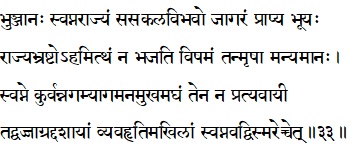
Meaning: A person who is enjoying a kingdom in the dream does not get upset after waking up and does not cry saying,  ‘Oh! I have been dethroned and I have lost my kingdom.’ Also, a person who had committed an immoral act in the dream including an illicit relationship does not feel guilty after waking up. Similarly, a person who had realized that his/her true identity is Atman (Pure Consciousness) which is the Witness Consciousness, remains unattached to the joys and sorrows of one’s body and mind. Remaining merged into Pure Consciousness, he/she does not do anything wrong and realizes that the joys and sorrows of the waking state are not different from those of the dream state.

Reflection:

The central message of the examples:

By giving examples, this shloka tries to describe the state of the mind of a realized person or a free soul (Jivanmukta). Examples can be looked at from various angles. Whenever examples are given, we have to be careful not to misinterpret them and take the wrong meanings. Rather, we must make efforts to understand the essential message lying behind the examples. 

First, we have to be clear about one thing: this shloka is NOT teaching that a realized person can do anything immoral in the waking state and does not feel guilty about it. A realized person gets established first in ‘sattva’ and then goes beyond the three gunas. A sattvika person is pure, follows the moral commands of the scriptures, has total self-control, and does not let his/her mind go down to do anything immoral or unethical, or harmful thing. Sri Ramakrishna said that a realized person is like an expert dancer who never makes a false step or an expert tabla player who never goes out of rhythm. 

A spiritual seeker who has not yet realized Atman may make mistakes because of past habits and lack of self-control. But, such a seeker accepts one’s mistakes, asks God for forgiveness, and makes all efforts not to repeat these mistakes.  Such a seeker knows very well that until he/she is established in sattva or purity and has total self-control he/she is not going to realize Atman.

The combination of the divine and the human:

A realized person understands that everything is in the mind. There are no joys and sorrows in worldly objects. According to one’s attachment and hatred, one projects joys and sorrows in the objects and situations of the world.

We also find that the realized beings have love and feel like other human beings. We don’t have authentic details of most realized people’s lives. From Ramayana, we know how Sri Rama cried for Sitaji and missed her. Thanks to the disciples of Sri Ramakrishna, Holy Mother Sri Sarada Devi, and Swami Vivekananda for keeping authentic information about their lives. From that, we know how the realized people’s minds on the one hand remained absorbed in God-consciousness, and on the other hand, they live a normal human life. Sri Ramakrishna cried when his nephew Akshay passed away at a young age. In the ecstasy, Sri Ramakrishna found that death is nothing more than going from one state to another, but in the normal plane, he missed him. Holy other cried profusely when Sri Ramakrishna passed away. Swami Vivekananda had cried for his brother disciple. Thus, we know that the realized beings do not see any difference between the reality of the waking state and the reality of the dream state, but still, they are sensitive about the joys and sorrows of the world just like normal human beings.

Realized person and his/her actions:

The scriptures say that the Jivanmukta’s (or the realized person’s) all actions get destroyed.

For example, Shri Krishna in the Bhagavad Gita (4.37) says,

“As the blazing fire burns all the woods to ashes, the fire of Knowledge destroys all the actions of the knowledgeable person.”

Brahma Sutras says the same thing based on the scriptures. 

“The scriptures have declared that on the attainment of Brahman, all the sins of the past life get destroyed and the future sins do not cling to the person.”

Shri Ramakrishna said that if there is the slightest worldly desire or ego, one cannot realize Brahman. When there is no ego, there is no doer-ship of any action, and no desire to attain any worldly thing. The Pure Atman or Brahman works through the body and mind of a realized person.  A realized person’s all desires have been fulfilled and have attained the highest state that one can attain in one’s life. Such a person works only to maintain one’s body and to serve humanity.  He/she continues to work in society to set up an example and for the purpose of guiding others.   

In the Bhagavad Gita (3.22 and 23), Shri Krishna says,

“O Partha! I have no duty in the world. There is nothing in the three worlds that I have not gained and nothing that I have to gain. Yet, I continue to work.  People are following my example. If I don’t work constantly and carefully, I will be misguiding them.”

Shloka 34
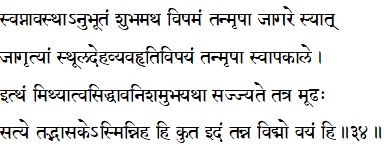
Meaning: All that is experienced in the dream, either good or bad, is false when a person wakes up. On the other hand, whatever has been done by the gross body of a person in the waking state does not help the person in his/her dream state.  Thus, the experiences and actions we perform in the waking state are false or useless in the dream state and vice versa. This shows that the Atman, the Witness Consciousness, which illumines everything in the waking as well as in the dream state, is the only Reality.  It is amazing that ignorant people do not understand this fact and cling to the objects of the world thinking them as real.    

Reflection:

The dream and waking states:

First, we note that the dream state and the waking state are disconnected.

It is very clear that the money we have earned in the dream cannot pay the bills of the waking state. On the other hand, no amount of money lying in the bank can help us if we dream that we are penniless beggars.

If we are sick in the dream, then we have to call a dream ambulance by dialing 911 on a dream phone. On the other hand, if we are sick in the waking state, then a dream doctor will not be helpful. We need a waking state doctor.

The question is: “Which state is real: the dream state or the waking state?” 

Is the dream state real?

It is very easy to understand that the dream state is not real because of the following reasons:

(i) When we wake up all the things of the dream vanish.

(ii) Nothing of the dream state is helpful to us in the waking state.

(iii) There is no connection and continuity in the dream states. The two dream states are totally unrelated and the second dream does not start where the first dream ended.

(iv) We hardly see the same people of one dream in the next dream. Suppose we see them in the next dream, their responses are not aligned with theirs of the previous dream. For example, in the waking state, if a friend borrows a book from me today and says, ‘I will return it to you tomorrow’, then on the next day the same friend returns the book to me. Such a thing does not happen in the dream state.   

Is the waking state real?

Now, the question is: “Why the waking state is not real?” It is a little difficult to understand this.

First, let us think about ‘What we mean by ‘Real’?’   

(i) Real does not change. The thing that is not real undergoes changes. For example: if we buy a gold-plated ornament thinking that it is a golden one, then after some time when the coating of the gold fades out or wears out, then the real metal shines forth.

(ii) Real is always present. Past becomes a dream and the future is an imagination.

(iii) Real destroys all the doubts.

(iv) Real is not a combination of things. A thing made of two substances will be destroyed when these two substances separate from each other. Real is just one entity that is eternal and unchanging.

We will examine these four points for the waking state.

(i) Is our waking state changeless?  The answer is ‘no’. First, everything around us keeps constantly changing. Our bodies and mind are constantly changing. The world is constantly changing. This is the nature of the universe. For a young person, childhood looks like a dream, and for an elderly person, the youth state looks like a dream. For the new generation, the older generation looks like a dream. Thus, nothing is permanent in the waking state.

Second, what we perceive through our senses is not real either. We perceive that the sky is blue, but we go up in space and realize that it has no color. Similarly, ocean water looks blue or green, but when we take the water in our hands, we find that it has no color. We all know that the mirage is not real water, but we perceive it as real.

The wise people say that what we perceive through our minds is also not real.  We project joys and sorrows or various qualities in the objects and people of the world and then we perceive the same as real. Sri Ramakrishna said that a camel chews thorny bushes, blood comes out of its mouth and the camel thinks that the juice is from the bushes. Therefore, when our perception of our mind changes, the joys and sorrows, and the qualities in the objects and the people of the world also changes.  This shows that nothing is permanent in the world. People die and they disappear. The objects of the world get destroyed and they no longer exist.

(ii, iii, and iv): We will think about these three points together. The Rishis or the realized souls told us through the Upanishads and the Bhagavad Gita that there is only One Existence or One Reality, called Ataman or Brahman, which is permanent behind all the changes of the body and mind and the universe. Brahman is the only Reality, and It appears as various names and forms filled with qualities. There are various golden ornaments having different shapes, names, and forms, but gold is the only Reality behind all of them. Thus, everywhere Brahman was in the past, Brahman is at present, and Brahman will be in the future. Realized souls experience that Brahman is the only Reality that ever exists and there is nothing else.

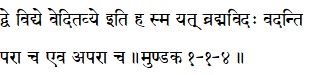
Mundakopanishad (2.2.8) says, “When Brahman, which is both high and low, is realized, then the bondages of the hearts get destroyed, all doubts are resolved, and all actions cease to bear fruits.”

Thus, we must wake up from the waking state. When we spiritually rise within, we recognize and experience Brahman as the Ultimate Reality behind this ever-changing world consisting of names, forms, and qualities. Finally, when the ignorance of being a separate entity from Brahman gets destroyed, one gets merged into Brahman. That is the stage of Samadhi that Sri Ramakrishna experienced often and has been witnessed by many. Rishis and many saints had the same experience. At that time, one realizes that the waking state was also a dream state of a different kind.

The Shloka 34 of the Shatashloki says, ‘It is amazing that ignorant people do not understand this fact and cling to the objects of the world thinking them as real.’ Kathopanishad explains why that is the case. It says:

Kathopanishad (1.3.12): “The Self hidden in all beings does not shine forth, but It is seen by people endowed with keen introspection and they see It through their one-pointed and subtle intellect.”

To develop this one-pointed subtle intellect one needs to do spiritual practices and receive the grace of Brahman. It is difficult, but not impossible. May we all realize Brahman and make our life blessed.
Shatashloki – XXIII (Shloka – 32)

The Universe cannot completely hide Brahman

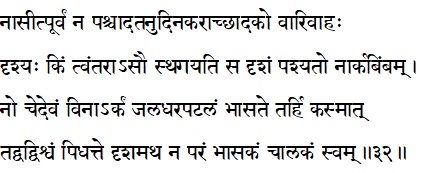
Shloka 32

Meaning:

The cloud that covers the huge sun did not exist at one point and will not exist after some time. But, on a cloudy day, it covers the sun. Does the cloud really cover the sun?  The answer is ‘No’. If the cloud really covers the sun, then we cannot see the cloud itself and anything else. The cloud apparently covers the sun partially from the sight of a few spectators. Similarly, this universe did not exist at some time and will not exist after some time, but due to Maya, it will not let people see the Brahman who is its illuminator and the controller.

Reflections:

It is fascinating that the cloud which is created by the sun covers the sun itself temporarily and partially.

Maya is the power of Brahman. 

Sri Ramakrishna used to cover his face with a cloth and ask his disciples ‘Do you see me now?’ All will say, ‘no’. Then, he would take away the cloth and ask again, ‘Do you see me now?’ They will say, ‘yes’. Sri Ramakrishna thus taught his disciples that we don’t see Brahman when it is covered by Maya.  When Maya goes away, we realize that ‘Everything is Brahman and the names and forms were illusory.’   

The truth is that Brahman is the Ultimate Reality and by Its own power (Maya) It appears as the universe with names and forms.

How do we know that?

We do not see Brahman. We see only names and forms. How do we know that Brahman exists? One answer is that ‘we cannot deny the existence of something that we cannot see’. Sri Ramakrishna said that in the daytime we do not see the stars.  In that case, we cannot say that stars do not exist because we don’t see them. Many things exist that we do not see or perceive. For example, there are many TV waves, Radio-waves, and other waves floating around us that we cannot perceive through our senses. If we get a TV or a radio and tune in with the proper frequencies, then we can perceive what they are transmitting. There are many small germs like viruses and others floating around us, whom we do not perceive, but they do exist and they make us sick.  

Similarly, behind our body and mind, there is a Reality (our True Identity or Existence) that we cannot perceive through our senses, but the Seers (Rishis) realize It through reflection and contemplation. The Vedanta Seers call It by the name ‘Atman’. This Atman is appearing as our body and mind like a wave in the ocean. The water of the wave is not different from the water of the ocean. The body and mind keep changing, but Atman remains the same as a witness consciousness. In the background of the unchanging Atman, we can perceive all the changes of the body and mind.

What is in the micro is the same in the macro. The way the Atman is the Ultimate Reality behind our body and mind, Brahman is the Ultimate Reality behind this universe. Brahman is like an ocean of Consciousness and all the names and forms of the universe are like waves of this ocean that rise and fall and merge into the ocean again.  Rishis say that Atman and Brahman are the same. With reference to an individual, we call Brahman as Atman.

What covers the Atman?

Whatever attaches our mind to our body covers the Atman. Sri Ramakrishna said that lust and greed are the two main forces that tie our mind to the body. There are also other worldly desires and attachments that tie our mind with the body.

We allow this bondage with our bodies because we think that it is the only way we get happiness by fulfilling our worldly desires. Little that we know that (i) all the happiness in the world is the reflection of the Bliss of the Atman, and (ii) this so-called short-term happiness brings miseries and the delusion which causes all our troubles.

What are the ways to realize the Atman?

The four yogas (Jnana Yoga, Karma Yoga, Bhakti Yoga, and Raja Yoga) are the paths to realizing the Atman.

(i) Jnana Yoga: First, we listen and learn about the nature of the Atman from the scriptures and from the people who have realized It or have been sincerely practicing to realize It. Second, we reflect upon what we have heard and learned about Atman. Through proper reasoning, we convince ourselves fully that our true identity is Atman which is unchanging and everything else including our body and mind is constantly changing and is temporary. Third, with the proper understanding, we realize or experience that our true identity is Atman. When we realize the Atman, all the characteristics of a ‘Jiven Mukta’ (Free Soul), which have been described in the scriptures, naturally manifest through our thoughts, speech, and actions.

(ii) Karma Yoga:  We purify our mind by performing all our responsibilities in a detached way as prescribed in the Bhagavad Gita. Such a mind experiences that the three Gunas, Sattva, Rajas, and Tamas, are performing all the actions through our body and mind, and the Atman (our True Self) is only a witness consciousness. Thus, by going beyond the three Gunas, we realize the Atman.

Performing all the actions as an offering to God makes us unselfish and free from all worldly desires.  Thus, we become only aware of the presence of God which is a symbol of the infinite Brahman. In the process, when our ego diminishes completely, then we realize that the Atman and Brahman are one. Performing unselfish activities or services also expands our ‘little ego’ to a much larger ego enveloping the whole universe. Thus, we develop an awareness of Brahman.

(iii) Bhakti Yoga:  We love a form of God who is a symbol of Brahman and offer our worship. We sing the glories of God and offer the results of all our actions to God. With our unselfish love for God, we feel the constant presence of God in our minds and around us. We feel that God has become everything and God is the doer of everything. Finally, out of love, our mind merges with God and we realize that God and Brahman are the same.  

(iv) Raja Yoga:  We learn how to control our mind and the senses with various disciplines. Then, we learn how to focus our mind on the Atman residing within and we realize It and experience Its presence all the time.   

What are the benefits of knowing Atman or Brahman?

(1) Meaningful life: Our life becomes meaningful as it finds a purpose to realize our true identity. Otherwise, just having one body, one mind, and one life seems purposeless.

(2) When we realize that our true identity is Atman, which is immortal, unchanging, and Its nature is Existence-Knowledge- Bliss Absolute, we have the following benefits:

(i) Fearlessness: We become fearless. The fear of all fears is the fear of death. Since we are Atman, we are immortal.  This atman can take many bodies and minds.

(ii) Hope: Knowing that the existing life is not the only one we have, there is hope for everyone to improve. At any stage of life, if we recognize that we had made a mistake, we can turn around and correct the mistake and go on the right path of God-realization.   We must remember that God-realization is the same as the realization of the Atman. We try to attain God-realization in this life, but if we cannot attain it, then there is always the next life to move on to.

(iii) Infinite Power and Knowledge:  When we know that our true identity is Atman, we acquire infinite power compared to the power of the limited body and mind. All saints and sages have done great work for the good of humanity due to this inner power. Also, we acquire an unbelievably deeper understanding of people’s minds, situations, and the universe. This is how those who have realized Atman help remove the sufferings of people and guide them to the right path.

(iv) Love for all: Knowing that One Brahman is manifesting through all the names and forms, we connect ourselves with everyone in the universe. This brings a love for all disregarding outer differences. However, we have to use our common sense. Sri Ramakrishna says that all are manifestations of God, but we have to use our common sense and not embrace a tiger. But, we cherish no hatred for the tiger or anyone in the universe. We remember that Brahman is manifesting through the mindset of a person. If the mindset changes, then Brahman will manifest in Its full glory.

(iv) Peace, Bliss, and Fulfilment:  Bahman is the embodiment of divine bliss. Realizing that our true nature is blissful, we attain inner peace and bliss. Also, a sense of complete fulfillment comes.

In the Bhagavad Gita (6.21 & 22), Shri Krishna says, “By realizing Atman, one experiences the boundless joy which is beyond the comprehension of the senses. It can be grasped only through pure and subtle intellect. Once established in the realization of the Atman, one never deviates from this state of Reality. One finds that there is nothing higher remains to be achieved in life and one does not deviate from this state even in the heaviest sorrows.”

Describing the state of a person who has realized the Atman, Shri Krishna says in the Bhagavad Gita (2.70), “Just like the waters of rivers enter into an ocean and get absorbed in it without disturbing the ocean which is filled with water to its brim, similarly all the desires that enter in the mind of the realized person get absorb in it without creating any ripple in it.” Briefly, it means that the mind of the realized person remains calm under all circumstances.  

The Ultimate Truth:

When we realize the Ultimate Truth, then we see that Brahman, with Its own power Maya, creates this universe, preserves it, and dissolves it into Itself. It is like a movie starts on a screen; it develops its story and then disappears in the screen. Similarly, just like the screen, Brahman is the only Reality.  The names, forms, and various situations are created in Brahman by Its own power, called Maya.  

Shatashloki – XXII (Shloka – 31)

A picture of a worldly person

Meaning: A person initially was alone. Later on, he desired that ‘I must have a wife, children, wealth, and things which will make me happy.’. Then, he works to acquire and preserve these things. For this, he goes through lots of suffering, and every day he works to the last drop of his energy. At that time he believes that there is nothing better to acquire in life other than what he is engaged in. If he does not get any of his desired objects, then he thinks that his life is incomplete, and if he loses one of these worldly objects, then he thinks that his life was useless. At that time, he lives as if he is dead. He loses all enthusiasm in life and plunges into despondency.    

Reflection:

People think that marriage will bring all the happiness in the world and it will solve all their life’s problems. Married people know that it is not true. After the end of the romantic period of the marriage, the reality of adjustments between the two personalities begins. Then, the married person starts the struggles for raising children, making more money, and acquiring higher positions, power, name, and fame. This shloka says that the person works unto the last drop of his/her energy. The joy gets less and less and the miseries grow more and more.  

In the scriptures, there is a picture of a worldly man seeking a little joy in the midst of terrors and sufferings. A man was walking in a forest. He heard a roar of a tiger and he started running in the opposite direction. In that direction, he saw a mad elephant running toward him. He tried to run away from both.  While running with fear he fell into a well that was covered by the branches of a tree. He was going to fall headlong into the well, but a branch stopped him and he started hanging upside down. He saw that due to the commotion snakes living in the walls of the well came out and started swimming in the water. Because of his fall, he had smashed a honeycomb and the bees of the comb started flying all around him. He realized that a single branch was holding him from falling into the well. At that time, he heard the noise of rats. He looked up and saw that a white and a black rat were cutting the branch which was holding him. In this situation, he felt that something fell on his cheek near his mouth. He realized that it was the honey dripping from the honeycomb. He opened his mouth and after much struggle, he successfully got a drop of honey on his tongue. He was happy with the drop of the honey. Is this a happy ending to a horrible story?

The roars of uncertainties, disease, and death are constantly haunting a person. Blinded by millions of desires and greed he falls into a well of commitments that he may or may not be able to get out of. The failures, like the snakes, are waiting to get him. Hundreds of worries circle in his mind like bees. Like the white and the black rats, the passing of the days and nights are cutting his string of life. In this situation, the man is trying to get some pleasure from this world and if he gets a little joy like a honey drop in his mouth he feels that the struggles and fears are worth it.

 It is an extreme picture painted to make us aware of our life’s situations. After much suffering to get a little joy in the world, we become insensitive towards our sufferings. We feel that it is the only way to live in the world.        

Lord Buddha, even though he had all the worldly pleasures around him as a prince Siddhartha, realized that worldly life is filled with suffering. That is why his first noble truth was, “There is suffering”.

First, we have to understand that the pairs of opposites always come together like the heat and cold, pleasures and pain, success and failures, honor and insult, elation and depression. Thus, worldly pleasures are always followed by suffering. We cannot get one without the other. Overall, in the world, our sufferings are more in percentage than our pleasures. 

People who do not have much experience of life think that this is a pessimistic view of life and the world. They think that life and the world are pleasurable. On the other hand, those who are burnt by the world think that life and the world are most miserable. Wise people have a balanced view.

Swami Sarvapriyananda has said: (i) the pessimists say that there is only a dark tunnel; (ii) the optimists say that there is a light at the end of this dark tunnel, and (iii) the wise people say that there is a dark tunnel, there is a light after this dark tunnel, and after the light, there is another dark tunnel.

Life is filled with pairs of opposites. By knowing this, we don’t keep swinging between the two extremes and get exhausted, but we can remain balanced and continue performing our responsibilities. The practices prescribed by Karma Yoga can help us to live a sane life in the world. The lessons of detachment, offering the results of all our activities to God, and the practice of unselfishness help us get control of our minds and eventually they purify our minds.

Second, we have to learn and realize the fundamentals of Vedanta taught by the Upanishads.

Upanishad says that joy is within us, but by ignorance, we think that it is in a worldly object or a person.

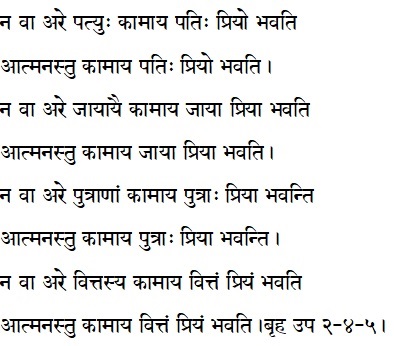
In the Brihadaranyaka Upanishad (2.4.5; Part I), Rishi Yajnavalkya says,

“Verily, not for the sake of the husband, the husband is loved, but he is loved for the sake of the Self.

“Verily, not for the sake of the wife, the wife is loved, but she is loved for the sake of the Self.

“Verily, not for the sake of the sons, the sons are loved, but they are loved for the sake of the Self.

“Verily, not for the sake of the wealth, the wealth is loved, but it is loved for the sake of the Self.

A person gets attracted to his/her spouse because of physical beauty or talents or virtues or something external. But, if we reflect upon this attraction, we find that the main attraction is due to the Atman residing behind the spouse’s body and mind. When a spouse dies, then immediately the husband or the wife makes arrangements for the dead person’s funeral services. This shows that the spouse did not love the body and the mind, but loved something which made the body-mind alive.  

If we understand and realize this fact, then our love will be on much stronger ground. Then, the old age, disease, or the external changes of the spouse don’t affect our love. Our performance of our responsibilities becomes worship of Atman or God residing in the spouse and not unpleasant slavery for the ‘so-called love’, which is actually an attachment to the body and mind.    

Rishi Yajnavalkya continues and tells his wife Maitreyi that anything that we love in the world is due to the Atman or the Ultimate Reality lying behind this phenomenal world. Therefore, we must hear about the Atman from the scriptures or the Holy People, reflect upon it, meditate on it, and ultimately realize it.

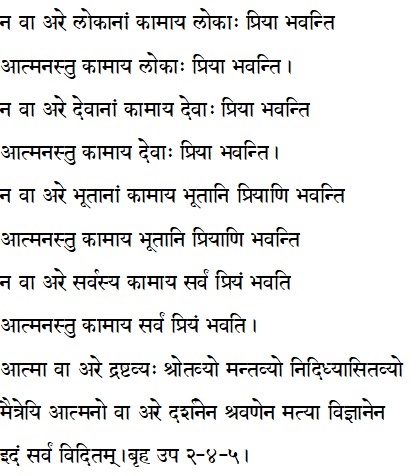
In the Brihadaranyaka Upanishad (2.4.5; Part II), Rishi Yajnavalkya continues,

“Verily, not for the sake of the worlds, the worlds are loved, but they are loved for the sake of the Self.

“Verily, not for the sake of the gods, the gods are loved, but they are loved for the sake of the Self.

“Verily, not for the sake of the beings, the beings are loved, but they are loved for the sake of the Self.

“Verily, not for the sake of the All, the All is loved, but it is loved for the sake of the Self.

“My dear Maitreyi, it is the Self that should be realized – should be heard of, reflected on, and meditated upon.

“By the realization of the Self through hearing, reflection, and meditation all this is known.”

Atman’s nature is Existence-Knowledge-Bliss Absolute. It is Existence Itself, Knowledge Itself, and Bliss Itself. When we experience joy or bliss from the objects or the people of the world, it is the reflection of the Bliss of the Atman. When we truly realize this, then the external loss or gain does not throw us off from our inner peace. If we lose an object of the world or a person, we may feel its pain, but we will not feel that ‘we are dead’ and ‘the whole world is falling apart’. We realize that the universe is nothing but Atman or Brahman and it is appearing in various names and forms.  The way the different kinds of waves rise and subside in the ocean, the objects and people of the world come to existence and then merge in the ocean of Atman, or Brahman, or Pure Consciousness. We also realize that we have no control over anything including our own body and mind.

When we realize that Atman or Brahman is the Ultimate Reality and It is the only eternal substance and everything else is temporary, meaning, it has a beginning and end, then we can handle all the situations with sanity.  Because things are temporary, we do not become careless or irresponsible. On the other hand, we take care of things and people with full attention and love.

Swami Taygananda said in his lecture that we buy a bunch of roses. We know that they are not going to last forever, but we put them nicely in a vase, water them, and put in preservatives to prolong their lives and enjoy their beauty. Also, when the roses die, we don’t feel that we have died. Similarly, knowing that everything in the universe is temporary except Brahman, we sincerely love all and make all efforts for their welfare.    

Shatashloki – XXI (Shlokas – 28, 29, and 30)

Shloka 28

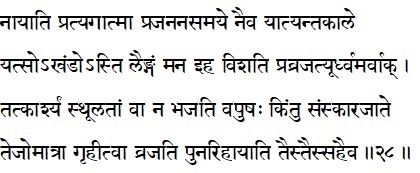
Meaning: Atman does not come from someplace at birth and it does not go anywhere at death. Atman is infinite and omnipresent. It is the subtle body that enters the body when the child is conceived and leaves it at the time of death.

The subtle body is not affected by the characteristics of the gross body such as leanness or heaviness and others. At the time of death, the subtle body leaves the existing body along with the Sanskaras, the Prana, and the subtle senses and enters into a new body at the time of its birth.

Reflection:

In the Bhagavad Gita (2.27), Lord Krishna says that ‘Whatever is born is going to die and whatever dies is going to be reborn.’

This is a general statement of fact. However, thinking about the transmigration of souls, the following categories came to my mind:

(1) Incarnations: God incarnates with His/Her/Its power as a human being to guide people in the spiritual path through His/Her life example and teachings. Incarnations also protect and encourage the righteous people and curb the power of the unrighteous. They take births at their own will.   

(2) Liberated Souls (Jivan-Muktas): Those who have realized Atman do not born again.

(3) Yogis who did not realize Atman: Shri Krishna says in the Bhagavad Gita that among thousands of people who are engaged in spiritual practices, a few make real good progress. And, among those who make such progress, someone realizes the Atman.

Those spiritual seekers, who struggle in their life to realize Atman but do not succeed, take births in the families which help them to continue their struggle from where they had left. In the Bhagavad Gita, Shri Krishna describes this very clearly:

Gita (6.41-45): Shri Krishna said, “The soul of a yogi, who has not realized Atman in his/her life, after death, goes to the worlds of righteous (heavens). Having lived there for many years, either the soul of the yogi takes birth in a family which is pure and prosperous or takes birth in a family of yogis who are knowledgeable.  Truly, a birth in such families is very difficult to get.

“In these families, the newly born yogi easily connects with the knowledge he/she had acquired and the progress he/she had made in the previous life and strives further to realize Atman.

“Because of the yoga practices in the previous life, this yogi naturally gets attracted to realize Atman. Even a curious person for the knowledge of yoga surpasses mere performances of the Vedic rites. But, a diligent yogi, with the help of all the yoga practices done in the previous lives, becomes pure and attains the Supreme Goal, the realization of the Atman.”    

(4) People who do not do spiritual practices: The attractions of worldly objects are so powerful that most people are not interested in spiritual practices. They think that the goal of life is to get maximum enjoyment from worldly objects. Very little do they know that the joy from worldly objects is temporary and it brings lots of suffering. Also, people have to pay a high price for a little joy. Actually, this trap to attract people toward worldly objects and then make them suffer is a plan of Mahamaya to wake them up and make them understand the importance of spiritual practices. Mahamaya deludes people to bring them to the Atman.    

People who do not do spiritual practices have lots of worldly desires to fulfill. One life is not enough to fulfill millions of desires.  So, after death, Mahamaya sends them first to heaven or hell according to their deeds to enjoy or suffer respectively, and then gives them various kinds of lives on earth to fulfill their desires.  

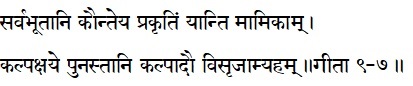
Gita (9.7-8): Shri Krishna said, “O Arjuna! At the end of a cycle all beings enter into My Prakriti (Mahamaya), and at the beginning of a cycle, I generate them again.

“Through My Prakriti, I create all beings again and again. They are helpless because of their own past actions.”

What is it that leaves the body at the time of death?

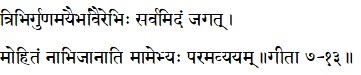
The Upanishads teach that the Atman or Brahman is omnipresent. According to the Vedanta, the whole universe is projected on Brahman by Maya (the power of Brahman). 

Ishopanishad says, “Whatever is in the universe is covered by the Lord.

Chhandogya Upanishad says, “Everything is verily Brahman.” 

This means that Brahman is appearing as the universe.

In the Bhagavad Gita (12.3), Shri Krishna describes Brahman who is devoid of names and forms as ‘Imperishable, Ineffable, Un-manifest, Omnipresent, Incomprehensible, Immutable, and Unchanging’.

Thus Atman or Brahman is Omnipresent and without a second.  It does not come from somewhere at the time of the birth of a body and does not go anywhere after its death.

The Shatashloki Shloka – 28 says that it is the subtle body of a being that goes from one body to another body. We find Shri Krishna talks about this in the Bhagavad Gita in the following shlokas:

Gita (15.7 & 8): Shri Krishna says, “In the world of living beings, the individual soul (Jivatma) is an eternal portion of Mine. Abide in Prakriti (Maya or My Power), it draws to itself the five senses and the mind.

“When Jivatma leaves a body, it carries with it these five senses and the mind to another body just as the wind carries fragrance from one place to another.”

Gita (15.10 & 11): Shri Krishna says, “The deluded people do not perceive the Jivatma residing in the body, enjoying the objects of the world, and uniting with the three Gunas or leaving a body. Those who have an eye of wisdom really perceive it.

“The yogis, established in the Yoga, who strives to realize the Atman, behold It dwelling within themselves.  But those who are undisciplined and have not purified their minds do not perceive It even though they strive.”

The question is: What is the Subtle Body?

Shri Shankaracharya talks about Sthula Sharira (Gross Body) and Sukshma Sharira (Subtle Body) in the “Viveka Chudamani”.

Sthula Sharira (the gross body) is made out of the gross forms of the five elements, namely, space, air, fire, water, and earth. It consists of skin, flesh, blood, arteries and veins, fat, marrow and bones, and human waste.

Sukshma Sharira (subtle body):  It is made out of the following eight things. All are in their subtle forms.

(i) Five Karmendriyas (the organs of actions): They are speech, hands, legs, organ of excretion, and organ of regeneration. Through these, an individual performs actions.

(ii) Five Jnanendriyas (the organs of perceptions): These are ears, skin, eyes, nose, and tongue. With the help of these senses, an individual perceives the universe.

(iii) Five Pranas (the vital forces): Prana (helps in breathing, drinking, and eating), Apana (helps in evacuating the waste from the body), Vyana (helps in blood circulation), Udana (helps in sneezing, crying, vomiting, and an individual soul to leave the body), and Samana (helps in digestion and balancing the pressures)

(iv) Five Elements: Space, air, fire, water, and earth.

(v) Antahkarana: It is broadly the mind of a person. It has been divided into four parts according to its functions, namely Mana, Buddhi, Chitta, and Ahankara. Through Mana or the mind, one perceives the universe with the help of the senses, thinks, desires, and experiences pain and pleasures. Buddhi or the intellect is the analytical part of the mind which classifies the information that the mind gathers. It is also determinist in nature. It sets up goals of life and separates rights and wrongs. Chitta is the reservoir of all the impressions of the person’s thoughts, speech, and actions. Ahankara is the ego, the subtle, and the gross. 

(vi) Avidya or the fundamental ignorance of one’s true identity.

(vii) Desires and

(viii) The impressions of the actions.

The Karan Sharira (causal body) is included in the subtle body. It is the cause or the seed of the subtle and the gross body. It has no other function than being the seed of these bodies. Its form is ‘nirvikalpa rupam’, an undifferentiated form. The ‘Karana sharira’ is formed because of ‘Avidya’, ignorance of the true identity of the existence of a being, which is Atman. The ignorance makes a being think that it is separate from the Atman.  We can say that it is the subtle ego or the basis of the manifested ego. It is destroyed only when ignorance is destroyed in the state of Samadhi. In the Samadhi there is only the awareness of Pure Consciousness, inside and outside. A person in Samadhi is not aware of his/her body, mind, place, and time. We find the records of such a state of Samadhi in the life of Sri Ramakrishna. 

Brahma Sutras (3.1.1 & 3) also talk about the subtle body going out from a body at the time of death to form another body.

Meaning: “From the question and answer in the Shruti (Upanishads, Brahma Sutras, and Bhagavad Gita) it is known that the soul (Jiva) goes out of the body enveloped with subtle parts of the elements with a view to obtain a fresh body.

Meaning:  Because of the going out of the Pranas (the vital force) and the sense organs with the soul, the elements also accompany the soul.

What do we learn from this?

Samkaras are important. Every thought we think, every word we speak, and every action we perform leaves a mark on our minds. The sum total of all these impressions builds up our character and it inspires us to think, speak, and act accordingly.

Swami Vivekananda explains it in Raja Yoga. He says, “…Each action is like the pulsations quivering over the surface of the lake. The vibration dies out, and what is left?, the Samskaras, the impressions…..

“…The Samskaras are left by these vibrations passing out of our mind, each one of them leaving its result. Our character is the sum – total of these marks, and according as some particular wave prevails one takes that tone. If good prevails, one becomes good; if wickedness, one becomes wicked; if joyfulness, one becomes happy. The only remedy for bad habits is counter habits; all the bad habits that have left their impressions are to be controlled by good habits…

“… Character is repeated habits, and repeated habits alone can reform character.”

Thus, we can build or change our character by thinking, speaking, and acting accordingly. These impressions will decide our next birth. If we want to be free from our ignorance and our slavery of senses, then we have to do spiritual practices.

Shri Krishna in the Bhagavad Gita (8.5-7) says, “There is no doubt that anyone who leaves his/her body thinking only of Me (God) becomes one with Me.

“O Arjuna! Whatever object or a being a person thinks of at the time of death, the person becomes that object or the being in the next life because the person was deeply cherishing that object or a being. 

“Therefore, at all times, think of Me and fight this war. There is no doubt that if your mind and intellect both are constantly absorbed in Me, then you will become one with Me.”

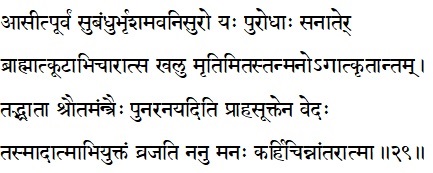
Shloka 29

Meaning:  Many years ago, king Sanati had a priest called Subandhu. He was a Brahmin by the caste. Other brahmins, out of jealousy, played some dirty tricks and killed Subandhu. His subtle body with his mind went to the Lord Yama, the Lord of Death.

Later on, Subandhu’s brother recited some Vedic mantras and brought Subandu’s subtle body back on earth and made Subandhu alive. This story has been narrated in a sukta of Rigveda.

This shows that it is the subtle body that leaves the body at the time of death and transmigrates and not the Atman.

Reflection: 

This is an example from the Rig Veda. It shows the acceptance of the Vedas that at the time of death the subtle body leaves the body.  

All over the world people think that the greatest miracle on earth is to make a dead person alive.  There are many people interested to communicate with their departed family members.

We have heard from the Saints that those who seek knowledge of Atman should not entertain the thoughts of making the dead alive and communicating with the departed souls. Such thoughts and actions distract the mind and take one away from the goal of life which is the realization of one’s true Self or Atman.

Shloka 30

Meaning:  Atman is one without a second and omnipresent. Because it is all-pervading, it does not move at all. However, Atman is reflected in the mind and the mind is constantly running around, so it looks as if the Atman is running around. It is like the water of the ocean goes up and down with the waves created by the wind and when the wind dies down the water goes back to its calm state.

It is amazing that the way water is inside and outside of the waves, Atman is inside and outside of the mind as a reflection, but the eyes and the other senses don’t know it.  When the mind becomes calm, then one realizes that the nature of the Atman is motionless and calm.

Reflection:  

For the Atman to move, it needs a space where the Atman is not present. Since Atman is omnipresent, it does not move.

The question is: Then, what moves? This shloka gives an excellent analogy to explain the phenomena of the movement. 

The Ultimate Reality is Sat-Chit-Ananda Brahman. It is devoid of names, forms, and any action. To get an idea, Brahman is considered like an ocean without any waves. Ignorance produces a wave that thinks that it has a separate existence. We can think of this wave as ‘Jivatma’, an individual soul. Now, the wave gets associated with the wind and it goes up and down. We can think of the wind as the desires and different moods of the mind. When all the desires and with that all the moods of the mind die, the wave subsides completely and what remains is the calm ocean.     

Another analogy is the reflection of the sun in a pot. The body is a pot and the water inside it is the mind. The reflection of the sun in the pot is Jivatma. When the water in the pot moves or the pot itself moves, then one feels that the sun is moving. But, actually, it is the reflection in the pot’s water that is moving. The pot, the water, and the reflection are the product of ignorance of reality. The Vedanta says that the Atman or pure consciousness illumines the intellect and through that, the senses and the sense objects get illumined. The senses do not see that the intellect has been illumined by the Atman. They feel that intellect is pure consciousness and it has its own light. When the mind or the ego which is the fundamental cause of the mind merges with the Atman, then the reflection merges with the original sun. At that time only the Atman or the pure consciousness remains. This is the state of Samadhi or the realization of the Atman. The individuals and the world are created so that each individual attains this state. If we make conscious efforts for this realization, then we enjoy the journey.   

Shatashloki – XX (Shlokas – 26 & 27)

Shatashloki – 26

Maya and the World

Meaning:  Maya (Brahman’s Power) has four special characteristics: (1) It is ever youthful and ever new just like a young woman every day looks new by wearing new dresses and adorning herself with new ornaments, (2) It is very clever and can do impossible looking things possible, (3) Initially it looks very sweet and tempting, and (4) It covers the knowledge of Brahman established by the Shruti (Vedas).

In this Maya, Jiva (an individual soul) and Ishwara (the Lord) both dwell like two birds on a tree; Jiva experiences the sweet and bitter fruits of the tree, while Ishwara remains unattached as a witness consciousness.

Reflection:   

(I) Maya is ever new:

The word Maya has been used to represent various things: (i) magic, (ii) delusion, (iii) Avidya (ignorance), (iv) space, time, and causation, (v) Ishwara who creates, preserves, and dissolve the universe, (vi) the universe, (vii) the Nature, (viii) Shakti (the power of Brahman), (ix) Prakriti (made out of three Gunas), (x) a statement of fact, (xi) pairs of opposites like joy and sorrow, birth and death, success and failure, (xii) power which covers Brahman and projects names, forms, and attributes, and others. Thus, we can see that Maya does not have any gender.  However, thinking of Shakti, one imagines a picture of a goddess.

The 26th and 27th shlokas are connected with the Vedas. In the Rig Veda (8.6.16.3) Maya has been described as a girl having the above-mentioned four qualities. But, we should go beyond the gender-biased. Men also may have these four qualities. The true identity of men and women is Atman (pure consciousness). As pure consciousness, the Atman has no gender.        

The first quality of Maya is that it is always new. We see that everything in the universe is constantly changing; for example, the sky, the weather, the trees, our bodies, our moods, our situations in life, and other things. Nothing in the universe with names and forms is permanent. We just start enjoying our favorable situations in life and all of a sudden a cloud of miseries comes. With the joy of success, failures start haunting us.  We become aware of our good health and feel the joy of human life, simultaneously or within a short time, the fear of disease and death starts threatening us. Maya would not let us have a good time for a long time. Every now and then it throws a curve ball and our joy turns into miseries. If nothing bad happens, then we get bored with what we have. The opposite also happens; in the midst of dark clouds of miseries and failures, all of a sudden a hope of success comes like a ray of sunshine. A positive twist helps us keep going with our life.

(II)  Maya makes the impossible possible:

Shri Shankaracharya, in his ‘Maya Panchakam’, describes how Maya makes impossible things possible. The following are examples of this fact.

(1) My true reality is Atman, which is pure consciousness, one without a second, eternal, unlimited, and devoid of names and forms. Atman and Brahman are identical. But, Maya superimposes on Brahman, the distinctions in the form of Jiva (Individual soul), Jagata (universe), and Ishwara (the Lord).

(2) Maya tempts all people with lust and greed. Being tempted by lust and greed, even people who have learned Vedas and the Upanishads behave no better than animals.

(3) Jiva’s true identity is Atman, which is pure consciousness, blissful, eternal, and one without a second. But, under the influence of Maya, Jiva identifies itself with its body and mind which are made out of five elements, and as a result whirl around in the ocean of ‘trans migratory’ existence.

(4) Jiva’s nature as Atman is Existence-Knowledge-Bliss Absolute and is devoid of all attributes. But, coming under the influence of Maya, Jiva develops a false ego, gets attached to its spouse, children, and property, and acquires attributes like color, caste, creed, gender, and other characteristics.

(5) Brahman is one without a second, undivided, and is nameless, formless, and attribute-less. But, Maya makes even learned people deluded and make them think that Brahma, Vishnu, Shiva, and other gods and goddesses are all different from each other.

(III) Maya initially looks very sweet and tempting:

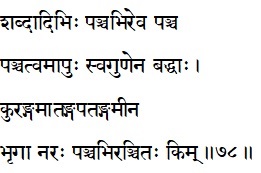
In Viveka Chudamani (shloka 78 of Gita Press Gorakhpur),

Shri Shankaracharya describes how animals first get tempted by Maya and then get trapped afterward. Initially, everything looks sweet and filled with enjoyment, but then it brings pain and destruction.

(i) A hunter charms dear with music and then kills it.

(ii) A hunter keeps a female elephant in a big hole. The male elephant goes to rub its body with the female elephant and gets caught by the hunter.

(iii) A moth gets attracted by the light and ends up dying in it.

(iv) A fish enjoys the bait, but then gets caught by the fisherman.

(v) A bee enjoys the fragrance and honey of a lotus, but in the evening it dies being trapped when the lotus closes its petals.

Shri Shankaracharya says that each animal gets trapped because of having one strong sense. How then a human being could be saved who has five strong senses. Maya creates false pictures of the sense objects and arises temptations in the mind to enjoy these objects. Initially, these sense objects look sweet and charming, but then the human beings find their real nature, get frustrated, and suffer the consequences.

(IV) Maya covers knowledge of Brahman:

As we saw in the Maya Panchkam, Maya covers the Atman (the true eternal divine identity of an individual) and creates an ego who thinks that its identity is limited to its body and mind. Then, this ego that is known as ‘Me or I’ creates a division between ‘Mine’ and ‘Not-Mine’. That is the cause of all the problems in our life.  

In the universe, everything is Brahman. But, Maya covers this awareness and projects objects and individuals with names and forms with various characteristics. These are like the characters and situations of a movie projected on a screen. Brahman, like a screen, remains unattached to what has been projected on It.      

The Analogy of Two Birds:

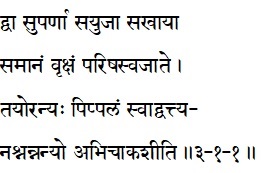
When Brahman with Its power Maya creates, preserves, and dissolves the universe, we refer to It as Ishwara, the Lord of the universe. Ishwara and an individual soul (Jiva) are both in the realm of Maya. We find a wonderful analogy of an individual soul (Jivatma) and Atman (Paramatma) in Mundakopanishad (3.1.1), Rig Veda (1.164.20), and Atharva Veda (9.14.20).  Atman and Brahman are the same.

Mundakopanishad (3.1.1): “Two birds, which always stay together and are friends of each other, stay on the same tree. One of them eats the fruits of the tree, but the other one sits there with a detached look without eating anything.”

The tree is our body and mind. The two birds are an individual soul (Jivatma) and Atman (Paramatma).  Individual soul eats the fruits of its actions, while Atman remains unattached as a witness consciousness without any action.

The last line of the Shatashloki (26) refers to this mantra and the following Shatashloki (27) talks more about these two birds.

Shatashloki – 27

Jivatma and Paramatma

Meaning:  Among these two birds, one bird that represents Ishwara (the Lord) always remains unattached. The Jiva (the individual soul) remaining in the ocean of ignorance forgets its own true nature, which is Brahman, and it sees the world of multifarious names and forms as real even though they are mere appearances and have no reality apart from Brahman.

But, when the Jiva, through its intellect, withdraws its mind from the external world and focuses it on the Self (Atman), then it realizes its true nature as Atman (or Brahman). At that time, Maya leaves the Jiva and the Jiva also leaves Maya.

The saints know that Atman and Brahman are one and the same and without a second. However, to teach and guide the students, they describe It in various forms.   

Reflection: The true nature of each individual is Pure Consciousness (Atman). But, by the association with Maya (Ignorance), it forgets its true nature and thinks that it is separate from Atman having body and mind. This develops a sense of ‘Me and Mine’ and unfulfillment which leads an individual to make efforts to be happy. All actions have either pleasurable or painful or mixed results which Jivatma has to experience. The results become the cause of more desires and more actions. Thus, the Jivatma continues taking different births to fulfill these desires.

At some point, Jivatma gets tired of running after the false or temporary pleasures of the body and mind. It develops an intense desire to know its true nature which is Atman, Existence-Knowledge-Bliss Absolute (Sat-Chit-Ananda). This is when Jivatma starts doing spiritual practices and focuses its mind on Atman residing within. When it realizes its true nature Atman, Maya leaves Jivatma and Jivatma also becomes free from Maya. At that time, Jivatma merges in Atman or Paramatman. This is the story of Jivatma. If we really understand this story, then we start doing spiritual practices to realize our true divine nature and attain fulfillment.    

Sri Ramakrishna used to say that there are two kinds of Maya; Avidya Maya and Vidya Maya. Avidya Maya takes a person away from Atman, while Vidya Maya takes a person towards Atman. When we become aware that Avidya Maya is working on us, then Avidya Maya becomes ashamed and leaves us temporarily. Sri Ramakrishna gave an example that one person wearing a mask of the tiger was scaring children. The children were crying and trying to run away out of fear. Meanwhile, one child recognized that ‘this is my uncle’ and told the person that ‘you are my uncle’. Immediately the uncle took out his tiger mask, laughed, and went away.

Whenever our mind is going away from Atman, during a pleasurable or painful time, we have to fold our hands and request Avidya Maya to leave us. Then, we have to take the help of Vidya Maya to do our spiritual practices, make spiritual progress, and realize Atman. If we don’t do this, then Avidya Maya will teach us through miseries and force us to understand the importance of realizing Atman.   

Shatashloki – XIX (Shloka – 25)

Shatashloki – XIX (Shloka – 25)

Maya and the World

Meaning:  Before the creation (at the end of the dissolution of the universe of the previous cycle) only Maya (the Power of Brahman) existed as deep darkness of ‘Ignorance’ (Avidya).  As water is hidden in the milk, the universe was hidden in the Maya.  

Then, the will of the Creator was prompted by the unfulfilled desires of all the individual souls produced by their actions in the previous cycles to create a new cycle of the universe. Because of that will, this universe consists of names and forms that have been created by Maya in conformity with the past karmas of the individual souls. 

Reflection: 

Three things have been described here: (i) Dissolution of the universe, (ii) Creation of a new cycle, and (iii) The cause of the births of individual souls.

Let us reflect on each of these three parts.

(i) The dissolution of the universe:

According to Vedanta, the process of creation, preservation, and dissolution of the universe is not linear, but it is cyclical. This shloka of Shatashloki mentions that at the end of a cycle, the universe merges into Maya or Prakriti, which is the power of Brahman, the Ultimate Reality. As water is hidden in the milk, the universe hides in Maya. Brahman and its power Maya are inseparable.

Sri Ramakrishna having direct experiences of Samadhi in which a person becomes one with the Ultimate Reality (Brahman) explains the nature of Brahman and Maya as follows:

Sri Ramakrishna says, “The Jnanis, who adhere to the non-dualistic philosophy of Vedanta, say that the acts of creation, preservation, and destruction, the universe itself and all its living beings, are the manifestations of Shakti, the Divine Power (Maya or Prakriti).  If you reason it out, you will realize that all these are as illusory as a dream. Brahman alone is the Reality and all else is unreal. Even this very Shakti is unsubstantial, like a dream.

“But, though you reason all your life, unless you are established in Samadhi, you cannot go beyond the jurisdiction of Shakti, Even when you say, ‘I am meditating’, or ‘I am contemplating’, still you are moving in the realm of Shakti, within Its power.

“Thus Brahman and Shakti are identical. If you accept the one, you must accept the other. It is like fire and its power to burn. If you see the fire, you must recognize its power to burn also. You cannot think of fire without its power to burn, nor can you think of the power to burn without fire. You cannot conceive of the sun’s ray without the sun, nor can you conceive of the sun without its rays….

“Thus, one cannot think of Brahman without Shakti, or Shakti without Brahman. One cannot think of the Absolute without the Relative, or of the Relative without the Absolute.”

During the period of dissolution, the universe is hidden in the Maya (which is inseparable from Brahman) and not completely dissolved. Those individual souls who have realized Brahman had no desires left and therefore they do not born again. But, such souls are few in number. Most of the individual souls had lots of desires left to enjoy the world and therefore this shloka says that they prompt Brahman to create a new cycle.  

(ii)  The creation of a new cycle:

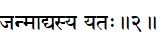
Brahma Sutras logically establishes that Brahman is the cause of the universe.

Brahma Sutra (1.1.2) says:

“Brahman is the cause of the creation, preservation, and dissolution of the universe.”

Aittareya Upanishad (1.1.1) describes how the new cycle comes into existence.

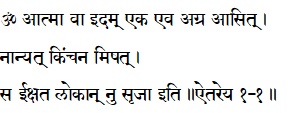
Aitareya Upanishad (1.1.1) says:

“At the beginning (all) this was verily Atman (Brahman) only, one and without a second. There was nothing else that winked. The Atman thought, “Let me now create the worlds.”

Sri Ramakrishna said that when Brahman is engaged in the activity of creation, preservation, and dissolution of the universe, we refer to It as Shakti. Thus, Shakti thought to create a new cycle.

At this point, it is interesting to read a portion of Swami Vivekananda’s thoughts presented in his lecture “The Real and the Apparent Man”, delivered in New York on February 16, 1896. Explaining the origin of the universe he said the following:

“….Every manifestation of energy, therefore, according to the Hindus, is prana. Every manifestation of the matter is akasha.

“When this cycle (of the universe) ends, all that we call solid will melt away into the next finer or the liquid form, that will melt away into finer and more uniform heat vibrations, and all will melt back into the original akasha.  And what we now call attraction, repulsion, and motion will slowly resolve into the original prana.  Then this prana, it is said, will sleep for a period, again to emerge and throw out all these forms; and when this period ends, then the whole thing will subside again…. At one time it remains potential, and in the next period, it becomes active….

“Yet this analysis is only partial….. We have not yet found that one thing knowing which everything else is known. We have resolved the whole universe into two components, what are called matter and energy, or what the ancient philosophers of India called akasha and prana. The next step is to resolve akasha and prana into their origin.  Both can be resolved into a still higher entity called the mind. It is out of mind, mahat, the universally existing thought-power, that these two have been produced. Thought is a finer manifestation than either akasha or prana.  It is thought that splits itself into these two. The universal thought existed in the beginning, and that manifested, changed, and evolved itself into these two: akasha and prana.  By the combination of these two, the whole universe has been produced.”  – Swami Vivekananda

The Aitareya Upanishad (1.1.1) says, “The Atman (or Brahman) thought, “Let me now create the worlds.”   Thus, this thought created the whole universe. We know that everything happens first in the mind and then it manifests itself in action. For example, at first, a thought or an idea of a chair comes into the mind of a human being, and then the physical chair comes into existence.

We find a similar expression in the Chhandogya Upanishad (6.2.3). It says,

 “Brahman thought: ‘May I be many. May I grow forth.”

Shri Krishna, identifying Himself with Brahman, reiterates in the Bhagavad Gita, the message of the Brahma Sutras that Brahman is the cause of the universe.

Shri Krishna in the Bhagavad Gita (9.7) says,

“O Arjuna! At the end of the cycle, all beings enter into My (Brahman’s) Prakriti (Maya), and at the beginning of a cycle I create them again.”

(iii) The cause of the births of individual souls:

We know that the physical configuration comes from parents, grandparents, and even great-grandparents. But, Swami Vivekananda (in his ‘Paper on Hinduism’) says, “There are other tendencies peculiar to a soul caused by its past actions. And a soul with certain tendencies would by the law of affinity take birth in a body which is the fittest instrument for the display of that tendency. This is in accord with science, for science wants to explain everything by habit, and habit is got through repetitions. So repetitions are necessary to explain the natural habits of a newborn soul. And since they were not obtained in this present life, they must have come down from past lives.”

Thus, the theory of reincarnation is the best logical explanation of the discrepancies in the births of children: some are born in a perfectly favorable environment and others are born in families or surroundings with miserable environments.  The theory of reincarnation goes hand in hand with the law of karmas. We are in the present state because of our past karmas and if we want to change our future then we have to perform appropriate karmas in the present.   

This is what the Lord Yama (the god of Death) explains in the Kathopanishad. He says that in the new cycle, the individual souls take birth in different categories according to their strong unfulfilled worldly desires.

Kathopanishad (2.2.7):

Lord Yama says, “According to their karmas and their desires created by what they had learned in their lives, the individual souls (jivas) born in the different categories, such as human beings, or animals, birds, and various species, or trees and plants, or inert things like stones.”

The past karmas are the cause and the present state is their effect. The law of karmas is the chain of cause and effect.  Swami Vivekananda explains very effectively this fact in the following quote.

Swami Vivekananda writes, “The Divine Mother (Maya or Prakriti) is the power of all causation. She energizes every cause unmistakably to produce the effect. Her will is the only law, and as She cannot make a mistake, nature’s laws–Her will–can never be changed. She is the life of the law of karma or causation. She is the fructifier of every action. Under Her guidance, we are manufacturing our lives through our deeds or karma.”

The truths of the Vedanta Philosophy are eternal and not limited to a certain group of people. They are helpful to all people at all times and at any place in the world. Realizing these truths and manifesting them in our lives bring fulfillment, inner peace, and eternal bliss.      

Shatashloki – XVIII (Shloka – 24)

The Nature of the individual soul and the world

Meaning:  There is no day or night in the sun. The day and night happens because the sun is being seen or not seen due to the rotation of the earth. Sun is always there in the sky. The illusion of day and night is created because we look through our eyes.  Similarly, since Atman is Brahman and it is one without a second, it is never bound and therefore it does not need liberation. Jiva’s (an individual being’s) true nature is Atman which is ever free. But, due to ignorance it thinks that it is limited by its body and mind. Because of this ignorance the cycle of births and deaths has been attributed to the Jiva.

Before the creation, Brahman only existed without any adjuncts like Prana, senses, and others. Through Maya, Brahman appeared as the Creator (Ishwara) of the universe. Actually, nothing exists except Brahman. When, through Maya, the Brahman is covered, Jiva appears as a separate identity consisting with body and mind.

Reflection:  This shloka gives an excellent example that convinces us the principle of the absolute non-dualism.  It says that there is no day and night in the sun. We talk about sunset and sunrise, but in reality the sun is always there in the sky. It never rises nor does it set. If there is sunset, then the question of sunrise arises. Similarly, the Atman (the true reality of an individual) has never been bounded, so there is no question of its being free. It is always free from all bondages.

 As the rotation of the earth creates a delusion of sunset and sunrise, the Maya (the power of Brahman) creates a delusion that Atman is bounded by the body and mind and therefore it goes through the cycles of births and deaths.

Swami Adiswarananda used to say that according to Acharya Gaudapada you are all free.  You were never bounded. So, you don’t need any sermon or teachings. Go home and enjoy your freedom. But you will say, ‘No Swamiji! I am not free. I have many problems.’ If that is the case, then you need spiritual practices to be free or to realize that ‘you were free’.

The problem is that through Maya an ego is created in an individual who separates itself from the eternal Atman and makes one feel that ‘I am a person with limited body and mind. I have millions of desires and I have to make lots of efforts to make myself happy.’ 

Maya is ignorance. It covers the true nature of an individual (Atman) and projects that it is a soul with limited body and mind.  

Sri Ramakrishna said that ego created by the ignorance is like a stick that divides the undivided water. If we take away the stick, then there will be only undivided water. This means that when our ego is gone, then we experience our true identity, which is Pure Consciousness. This is the state of Samadhi. We suffer because of our ego. We are bound because of our ego. 

Sri Ramakrishna said that it is very hard to get rid of the ego. At one moment we think we had got rid of our ego, and then in another moment it pops up again. Sri Ramakrishna said that ‘unripe ego’ is harmful. Having that ego one takes pride in one’s body, mind, wealth, power, position, popularity and other such things. It takes us away from the Atman. One who has a ‘ripe ego’ thinks that ‘I am a devotee of God’, ‘My goal is to realize God’, ‘I cannot do anything unethical’, ‘I cannot harm anyone’ etc. “Ripe ego’ is not harmful. It takes us towards our true Self (Atman).

The ignorance reveals through two mental characteristics: (1) ‘Me and mine’; I am this person with body and mind and all these things belong to me. And (2) ‘I am the doer’; I have achieved many things and I will continue to achieve many more. I perform all the good work etc.

When the ignorance goes away, then Knowledge of Atman reveals from within. At that time one realizes that (1) Everything belongs to God including my body and mind, or more correctly, everything is God (Brahman) and (2) God is the doer of everything and my body-mind is an instrument.

The realization of the Ultimate Knowledge has been mentioned in the Upanishads.

Ishopanishad (Shloka 1) says,

“Realize that whatever exists in the universe is nothing but the Lord.”

Chhandogya Upanishad (3.14.1) says,

“All this is verily Brahman.”

To realize the Ultimate Truth that Brahman has become everything, the Upanishads talks about three spiritual practices; (1) Shravana: to listen or learn the Truth from the scriptures and Holy People who have realized It, (2) Manana: reflect upon the Truth, reason to understand It, and get convinced about it, and (3) Nidhdhyasana: meditate on the Truth and realize It.

The intellectual conviction of the Truth is not enough. We have to actually realize the Truth that ‘Brahman is appearing as the universe including all individuals and objects’. Also, this realization should reflect in our thoughts, speech, and actions as blessings to ourselves and to all around us.

Chhandogya Upanishad (3.14.1) actually says how to meditate on this Ultimate Truth:

“All this is verily Brahman. From Brahman the universe comes forth, in It the universe merges, and in It the universe manifest. Therefore, one has to meditate on the Brahman as described above with a calm mind (meaning being free from the attachment and the aversion).”

The goal of human life is to realize this Ultimate Truth.

Shatashloki – XVII (Shloka – 23)

The Nature of the World

Meaning: Before the creation, the world was not absolutely non-existent like the flowers in the sky. Nor did it exist as an entity different from Brahman. It was different from both, meaning, the world was neither non-existent nor existent.

Before creation, the world as we now experience did not exist. The Virat (total gross body) which is the cause of the elements beginning with space too did not exist. But, it subsequently appeared like silver appearing on the nacre.

Can the world which was neither non-existent nor existent covers Brahman? Absolutely the world cannot cover Brahman, just as the mirage created by an illusion on the earth cannot cover the earth.     

Reflections: 

One of the very puzzling questions is: ‘Did the world exist before the creation?’ 

Several related questions arise with this question: (i) Did this world start at some time? (ii) Did the world come out from nothing? (iii) Was there anything that existed before this world? If it did, what was it? (iv) Did the world come out of something? (v) Which forces created this world? (vi) Is there a creator of this world? Is that creator a superhuman being or not a human being? (vii) If the world would be created again, would it be the same world or different?

Three Popular Theories:

There are three popular theories that exist about the beginning of the universe:

(1) From the religious point of view: God created this universe.

(2) From the non-believer’s point of view: This universe came out from nothing.

(3) From the scientific point of view: The big bang theory looks more convincing.

Religious View:

To accept the religious point of view, one needs faith that ‘There is God.’ and ‘God has created the universe.’ In this case, one should not ask questions like, ‘From where God got the material to create the universe and what kind of tools He/She used?’, ‘Is God a man or a woman or a non-human being?’, ‘Where does God reside?’, ‘Why did God create a universe in which many people suffer?’

Skeptic’s View:

On the other hand, the non-believer’s point of view, namely, ‘This universe came out of nothing.’ does not make sense. Something cannot come out of nothing.

Some people think that at the beginning of the creation, there was only matter, and then at some point, the consciousness started. The question comes: How insentient matter becomes sentient?

Big Bang Theory:

The scientists believe in the Big Bang Theory:

The record shows that the big bang theory was first proposed by Alexander Friedman, a Russian mathematician in 1922 and expanded upon in 1927 by Georges-Henri Lemaitre. He was a Belgian physicist, who was also a Roman Catholic priest. He theorized that the universe began from a single primordial atom. In the first 10^-43 seconds of its existence, the universe was very compact, less than a million billion billionths the size of a single atom.

Scientists such as Edwin Hubble have made detailed observations and measurements that support and develop this theory.

For the big bang theory, a question always comes: “What came before the big bang?”

A physicist Glenn Starkman at the Case Western Reserve University suggests a textbook answer for this. According to him, “The question, “What came before the big bang?”, is meaningless, just as it’s meaningless to ask what’s south of the South Pole.”

In the big bang theory, people say that the time itself began with the big bang. Therefore, there was nothing ‘before’ the big bang. Starkman knows that hardly anyone finds that answer satisfying.

In trying to describe a ‘creation process’ through scientific language we encounter a serious challenge: if every effect results from a cause, we can follow the chain of causation backward in time until we arrive at the First Cause. But what caused this cause? Aristotle thought of some divine entity to solve this conundrum, called the Unmoved Mover, the one that can cause without having been caused. It looks very convenient, but it is not scientifically satisfying.

Quantum Nothingness:

Then, there is a theory of scientists and philosophers who think that the universe came out from ‘a special nothing’.  They say that the Universe emerged spontaneously from a random quantum fluctuation in some sort of primordial quantum vacuum, the scientific equivalent of “nothing“. However, this quantum vacuum is a very loaded nothing: it assumes the whole machinery of quantum field theory, the modern description of how elementary particles of matter interact with one another.

In the quantum realm, even the lowest energy state, the “vacuum,” is not empty. Even if the energy of a quantum system is zero, it is never really zero due to the inherent quantum fluctuations about this state. A zero-energy quantum state is as impossible as a perfectly still lake, with absolutely no disturbances on its surface. This quantum jitteriness amounts to fluctuations in the value of the energy; if one of these fluctuations is unstable it may grow big, like a soap bubble that blows itself up. The energy remains zero on average because of a clever interplay between the positive energy of matter and the negative energy of attractive gravity. This is the result that physicists like Stephen Hawking, Lawrence Krauss, Mikio Kaku, and others speak of when they state that the “universe came out of quantum nothingness,” or something to that extent.

Other Views:

Some physicists now think that the time didn’t begin with the Big Bang, but somehow emerged when the universe reached a certain level of complexity.

Others theorize that the universe runs in cycles, in a possibly endless series of expansions and contractions. If this “cyclic” model is right, the Big Bang wasn’t the beginning, but just a transition from an earlier era. Another possibility is that our universe is just one of countless “bubble universes” that pop up repeatedly in a “multiverse.”

The Vedanta View:

It is interesting to reflect upon the Vedanta view of the universe and its beginning which the Shata Shloki shloka 23 presents.

This shloka says that before the creation, we cannot say that ‘the universe did not exit’ and we cannot say that ‘the universe did exist’.  

According to Vedanta, there is only one Ultimate Reality called Brahman. Its nature is Pure Consciousness or Existence-Knowledge-Bliss Absolute. These are not the qualities of Brahman. They describe the nature of Brahman.  They give us an idea of Brahman. Brahman is Knowledge Itself, Existence Itself, and Bliss Itself. Qualities come and go, but the nature remains same all the time. Brahman is the Ultimate Reality, but when It is seen through the prism of space, time, and causation, then it appears as the universe as we know or experience.

Because Brahman appears as the universe, the universe actually did not exist. On the other hand, we cannot say, it didn’t exist because we perceive it. According to Vedanta, the power of Brahman, called Maya, creates these apparent contradictions.  Maya is difficult to describe.

Swami Vivekananda provides more insight into this concept of Maya in his lecture delivered in London.  

He said, “What, then, does the statement that the world exists mean? It really means that the world has no existence. What, again, does the statement that ‘the world has no existence’ mean? It means that it has no absolute existence: it exists only in relation to my mind, to your mind, and to the mind of everyone else.

We see this world with the five senses, but if we had another sense, we would see in it something more. If we had yet another sense, it would appear as something still different.

It has, therefore, no real existence; it has no unchangeable, immovable, infinite existence.

Nor can it be said to have non-existence, since it exists and we have to work in and through it.”

Swami Vivekananda says that our whole life is a mixture of this contradiction of existence and non-existence.  He points out several contradictions in our life:

(1) A human being feels that he/she can know everything, but he/she finds that there is an adamantine wall that is difficult to pass through. A human being’s mind has limitations and difficult to go beyond this mind.

(2) There is a general tendency to be selfish, but in the inner recess of our hearts, we know that unselfishness is good.

(3) At a young age a person is very optimistic, but as the person grows old, he/she becomes pessimistic.

(4) Every minute people are dying, but the people who are alive think that they are immortal.

(5) Our desires cannot be fulfilled by the enjoyments. As fire increases more when we pour ghee into it, our desires also increase more by the enjoyments.

(6) Because of the attachment people suffer, but they continue to remain attached.

(7) In society, if one evil is removed, several other evils show up.

(8) The knowledge of happiness brings the knowledge of unhappiness.

(9) As happiness grows in society, then miseries also grow simultaneously.

(10) As good increases in the world, then evil also increases.

(11) All the obstacles remind us of our limitations, but inside we have a feeling that we are not limited.

(12) There is nothing in this universe that is completely good or completely bad. Each thing is a mixture of good and bad.

(13) As knowledge increases, our awareness of ignorance also increases.

According to Swami Vivekananda, the Maya is not a theory for the explanation of the world. It is simply a statement of facts as they exist. It tells us that the very basis of our being is a contradiction.

Swami Vivekananda says that in ancient Vedic literature, the word Maya was used in the sense of delusion. Then, Maya was used as magic. There is a text, “Indra through his Maya assumes various forms. Later on, Maya was used as a mist that covers reality.  A question was asked: “Why we cannot know the secret of the universe?” The answer was given, “Because we talk in vain, and because we are satisfied with things of the senses, and because we are running after desires, therefore we cover the Reality, as it were, with a mist.”

Swami Vivekananda said, “The Maya of Vedanta, in its final form, is neither idealism, nor realism, nor is it a theory. It is a simple statement of fact – what we are and what we see around us.” 

Other Forms of Maya:

Maya is also called Prakriti, or Shakti, or the Power of Brahman.  This universe is Maya. Shwetaswatara Upanishad states it clearly.

Shwetaswatara Upanishad (4.10): “Know, then, that Prakriti is Maya, and that the Supreme God (Brahman) is the Lord of Maya. The whole universe is pervaded by the Prakriti (the power of Brahman) through the cause and effect.” 

Prakriti (Maya) is made out of three gunas; sattva, rajas, and tamas. The universe is going on because of the imbalance of these three Gunas. When the three Gunas are in perfect balance, then the universe gets dissolved. Brahman is beyond the three Gunas. Dominated by the imbalance of the three Gunas within and without, a person limits oneself to one’s limited body-mind existence and becomes active to fulfill one’s desires.  Thus, one could not see the Reality that Brahman is appearing as this universe. Shri Krishna asserts this fact in the Bhagavad Gita.

Shri Krishna says, “Deluded by these threefold Gunas constituting Nature, this whole world fails to recognize Me (Brahman), who am above the Gunas and immutable.” (Bhagavad Gita 7.13)

When a person goes beyond the three Gunas, then one realizes the Ultimate Reality (Brahman) within and without. But, it is very difficult.  Shri Krishna says that the delusion is very powerful.

Shri Krishna says, “Verily, this divine Maya of Mine, consisting of the Gunas, is hard to overcome. But, those who take refuge in Me alone, shall cross over this Maya.” (Bhagavad Gita 7.14))

Maya and the Cyclical View of the Universe:

According to Vedanta, the universe runs in cycles. The cycle of creation, preservation, and dissolution of the universe goes on eternally.  In the Bhagavad Gita, Shri Krishna clearly states this principle.    

Shri Krishna said, “At the end of the cycle, all beings, O son of Kunti, enter into My Prakriti, and at the beginning of a cycle I generate them again.” (Bhagavad Gita 9.7)

Thus, Shri Krishna (identifying Himself with Brahman) says that by the power of Brahman, at the beginning of each cycle, the universe is created. Then, it is preserved, and at the end of the cycle, it is dissolved. The creation is seeing Brahman through the prism of space, time, and causation.

The Teaching of Shata Shloki shloka 23:

According to the Upanishads (Vedanta), there is only one existence, namely Brahman. It is also considered as Pure Consciousness or the Ultimate Reality.  Aittareya Upanishad says Brahman alone existed before the creation of the universe:

“At the beginning (all) this verily was Atman only, one and without a second. There was nothing else that winked. The Atman thought: “Let Me now create the worlds.” (Aitareya Upanishad 1.1)

The Brahman, with its power, called Maya or Prakriti, created the universe with names and forms. But, we have to remember that it is due to the Maya, Brahman started manifesting as the universe as we see silver on the nacre. The other two Vedanta examples regarding this delusion are seeing a snake in a rope and seeing water (mirage) on the road. 

Due to Maya, individuals think that they have separate limited existence from Brahman confined with their bodies and minds. Then, they think that worldly objects are for their sense pleasures and to acquire these pleasures is their goal of life. In the process of acquiring sense-pleasures, obstacles, competitions, the lack of fulfillment, frustration, suffering, and many other things come. Individuals forget that their true identity is Brahman; Existence-Knowledge-Bliss Absolute.  Craving to fulfill sense-pleasures, they become slaves of their senses and become blindfolded.  A few great souls reflect upon their true identity and the true nature of the universe. With meditation and proper spiritual practices these great souls realize that their true identity is Atman, the universe is nothing but Brahman, and Atman and Brahman are identical.  These liberated souls are called the realized beings or ‘Jivanmukatas’. Their sufferings go away along with their delusion and they experience infinite bliss within. In their presence, the minds of sincere seekers of Truth get uplifted and they get a glimpse of the Ultimate Reality or Brahman.      

The shloka 23 of the Shatashloki says that as the mirage cannot cover the whole earth, the delusion that ‘I have a separate existence from Brahman’, cannot cover the individual’s mind forever. Those people, who have realized that Brahman (Pure Consciousness) is the only Ultimate Reality, live in the world remaining completely detached. They see their lives and the universe like movies projected on a screen. Movies consist of all the dramas of life filled with joy, sorrow, fear, anxiety, adventure, success, failure, frustration, helplessness, elation, depression, and many other things. But, the screen is not affected by all these movies. Those realized beings live balanced sane life and guide other people to attain that state.

Science has proved many Vedanta views through its progress and will prove many other views as it advances further. The Vedanta search is internal and the Science’s search is external. Swami Vivekananda says that both the searches will ultimately meet at the same point, the Ultimate Truth.

Shatashloki – XVI (Shloka – 22)

Because of ignorance, we see the world

Meaning:   The Vedas say that there is a universal rule applicable to all, from the creator Brahma to an individual: ‘Because of ignorance we see the world and when we realize Atman (or Brahman), the world disappears’. Because of illusion we see silver in the nacre, but when we know ‘it is nacre’, the silver merges into the nacre. Actually, there was no silver at all.  Similarly, in the state of ignorance, Brahman merges in the world, and after the realization of Brahman, the world merges in Brahman.

Reflections: 

From the beginning of our human awareness, there is a search to find the units out of which all the things are made. Simple examples are: (1) 0 and 1 form the set of the whole numbers, (2) all the colors are made out of three primary colors; red, yellow, and blue, (3) all the music came out from the major seven notes; Sa, Re, Ga, Ma, Pa, Dha and Ni in Indian Music and do–re–mi–fa–sol–la–si in the Western Music.

In ancient times, in India, the seekers of Truth called the Rishis, searched for something from which the whole universe came. Swami Vivekananda, in his paper on Hinduism, which he presented in the Chicago World Parliament of Religions on September 19, 1893, expressed this thought eloquently.

Swami Vivekananda said, “Science is nothing but the finding of unity. As soon as science would reach perfect unity, it would stop further progress, because it would reach the goal. Thus chemistry could not progress further when it would discover one element out of which all others could be made. Physics would stop when it would be able to fulfill its services in discovering one energy of which all the others are but manifestations, and the science of religion become perfect when it would discover Him (Brahman) who is the one life in a universe of death, Him who is the constant basis of an ever-changing world, One who is the only Soul of which all souls are but delusive manifestations. Thus is it, through multiplicity and duality, that the ultimate unity is reached. Religion can go no farther. This is the goal of all science.”

In the Mudakopanishad (1.1.3-6), “Shaunaka, the great householder, approached Rishi Angirasa with reverence and humility and asked:

“Revered Sir, what is it by knowing which all this becomes known?”

Angirasa said to Shaunaka:

“Knowers of the Brahman tell us that two kinds of knowledge must be known. They are Higher Knowledge and the lower knowledge.”

“Of these two, the lower knowledge is the knowledge of Rig-Veda, the Yajur-Veda, the Sama-Veda, the Atharva-Veda, Siksha (phonetics), Kalpa (rituals), Vyakarana (grammar), Nirukta (etymology). Chhanda (meter), and Jyotish (astronomy); and the Higher Knowledge is the one by which the imperishable Brahman is attained.”

What is Brahman? Rishi Angirasa describes it briefly; in the first line negatively and in the second line positively:

“By means of the Higher Knowledge, the wise behold everywhere Brahman, which otherwise cannot be seen or seized, which has no root or attributes, no eyes or ears, no hands or feet; which is eternal and omnipresent, all-pervading and extremely subtle; which is imperishable and the source of all beings.”

Thus, through introspections and analysis, the Rishis of the Upanishads had realized that ‘there is only one Ultimate Reality’, which they referred to as Brahman. They realized that from Brahman the whole universe came, it sustains in Brahman, and it dissolves in Brahman. Actually, Brahman, the Ultimate Reality, appears as the universe. Just as formless water of ocean appears as waves with form, the formless and quality-less Brahman appears with various forms of the universe. If we remove names and forms of all the objects of the universe, what remains is ‘pure consciousness,’ which is Brahman.      

This pure consciousness is our true nature.  A person is not his/her body and mind having consciousness within, but a person is infinite formless consciousness which thinks that ‘I have a body and mind’. Body and mind are matter and they cannot produce consciousness. On the other hand, consciousness can produce many bodies and minds.

This wrong thinking that ‘I am my body and mind having consciousness within’ limits our true identity and becomes the cause of all our problems and miseries. When we realize that my true identity is ‘pure consciousness’ (Atman) and it can create many bodies and minds to experience the universe, then we become free from all our bondages, we become a witness consciousness and go through the joys and sorrows of life as is we are watching movies or actors and actresses performing their roles in a drama.  

What happens in the micro-levels happens in the macro-level. As an individual, my true identity is ‘infinite formless pure consciousness’ (Atman) in and through I perceive my body and mind, similarly, this universe is nothing but ‘One Pure Consciousness’, called Brahman, but we perceive it made out of various objects with names, forms, and qualities.   

Note that Atman and Brahman are the same. When we refer to Brahman, the ‘Pure Consciousness’ with respect to an individual, we call it ‘Atman’. Suppose a pot has ocean water inside and is floating in the ocean. There is no difference between the water inside the pot and water outside the pot. Here, the water inside the pot is like Atman and the water outside the pot is like Brahman. Thus, Atman and Brahman are the same. Upanishad says, “That Thou Art” (Tatvamasi).  

In the Bhagavad Gita (6.30), Shri Krishna says that one who has realized Brahman will never get deluded. He identifies Himself with Brahman and says:

“One who sees Me everywhere and sees everything in Me, to that person I am never lost, nor this person ever lost to Me.”

Upanishads also tell us that there is only one Ultimate Reality.

Chhandogya Upanishad (6.2.1):

“In the beginning, my dear, this (universe) was Being (Sat) alone, one only without a second.”

‘In the beginning’ means prior to the manifestation of names and forms. Before the creation, all that existed was Pure Being (Brahman). After the creation also the universe is Pure Being; but it is differentiated by names and forms.  

Chhandogya Upanishad (3.14.1):

“All this is Brahman.”

Ishopanishad (Mantra 1):

“Whatever exists in this universe is covered by the Lord (Brahman)”.

A question may come: ‘If everything in this universe is Brahman, why don’t I see it?’ Because we perceive this universe through our limited senses and minds and think that that is the real universe. Those who think further, reflect upon their perceptions, and analyze them, they find that there is only one unchanging ‘Ultimate Reality’ which appears as objects which are constantly changing their names and forms having various qualities. The perceptions through our senses and minds create delusions.

This shatashloki shloka-22 tells us this fact. There are several delusions we experience created by our sensory and mental perceptions. Here are a few examples: (1) in the dim light a curly rope appears as a snake, (2) in a desert, the hot sun creates mirage (a delusion of water), (3) some times, while driving or rowing a boat, we feel moon or its reflection is moving with us, (4) in the sunlight from a distance nacre appears like silver.

When we look more closely, we find that the snake is a rope, water is sand, the moon is not moving with us, but it has its own movement, and silver is a nacre.

Coming and going are also relative. People who are waiting at the Ahmedabad railway station say that ‘a train is coming’ and the passengers in the train say that ‘Ahmedabad station is coming’. The same thing happens at the airport.  People waiting at Newark airport say that ‘the plane came’ while the passengers inside the plane say that ‘Newark airport came’.    

Those people, who go through proper spiritual disciplines and reflections on Reality, realize the Ultimate Reality (Brahman) and they live a sane human life. They go through joys and sorrows of life, but remain undisturbed and calm within. They constantly experience the Bliss of Brahman within knowing that they are ‘Pure Consciousness’, or ‘Sat-Chit-Ananda’, meaning, Existence-Knowledge-Bliss Absolute.

Those, who think that the world they perceive through their senses and minds is real and they are nothing more than their bodies and minds, sail through their lives being tossed up and down by the joys and sorrows of life, having little worldly joy followed by lots of suffering and live a life filled with greed, anger, jealousy, hatred, fear, false sense of accomplishments, frustration with unfulfilled desires and lack of proper understanding of themselves and others.

One thing we should know is that the realization of Brahman happens in Samadhi. It happens when in meditation the mind of an individual completely merges with Brahman (Pure Consciousness) and one loses body-consciousness. When such a person’s mind comes down from the Samadhi and becomes aware of the body and mind, one perceives the world with the senses as all others do. But, the impact of the experience lingers in the mind of the realized being and most of the mind remains filled with inexplicable Bliss and the awareness of Reality. The words and acts of such realized people guide others towards this realization. They help remove people’s ignorance about Reality and with it all the sufferings of life. 

Swami Vivekananda has said that one cannot perceive the world of names and forms and Brahman at the same time. If we are aware of Brahman, we are not aware of objects of the world with names and forms, and when we are aware of the world of names and forms we are not aware of Brahman. The shatashloki shloka-22 says it clearly that at the time of realization the world merges into Brahman, and at the time of delusion, Brahman merges into the world.

Let us realize that what appears as silver is in reality nacre, the world we grasp through our senses and minds is not the Ultimate Reality. The Ultimate Reality is Brahman, Pure Consciousness. Our true identity is ‘Pure Consciousness’ in and through which we perceive our mind and body and the world of plurality due to delusion.

Shatashloki – XV (Shlokas – 20 & 21)

“Shatashloki” of Shri Shankaracharya – XV (Shlokas – 20 & 21)

Offering food to gods, guests, and needy people

Meaning: When one eats food after offering to gods, goddesses, and guests, then the food becomes nectar for the person.  Otherwise the food becomes useless for the person’s spiritual development.  The scriptures say that if a person cooks food only for himself/herself, then that food becomes like death to the person.

One who eats food without offering to gods, goddesses, guests, and the needy people is considered an embodiment of sin in this world. A person who eats food without offering the food as an oblation to the Pranas as prescribed in the scriptures is a dead person, meaning is not spiritually alive.

Meaning:  A person, who gives food to the poor people visiting his/her house, is considered ‘Bhoja’ (the Giver) in the universe. Such a person receives abundance of food for the sacrifices and does not have an enemy. But, one who does not give food to the starving friend or to people who is constantly serving him/her is not one’s own friend (meaning he/she is one’s own enemy).  Even the food, like an enemy, wishes to leave such a selfish person.  

Reflections: 

The importance of food:

There is a well-known mantra of Taittiriya Upanishad (2.1.3) which says,

“Verily, from that Atman (Brahman) was born akasha (space);

from akasha, air was born;

from air, fire was born;

from fire, water was born;

from water, earth was born;

from earth, herbs and vegetation was born;

from herbs and vegetation, food was born; and

from food, human beings were born.”

Thus, the whole creation comes down to the food which is useful to create and nourish human beings.

Further, Taittiriya Upanishad (2.1.4) says, “Verily, from food are produced all creatures – whatsoever dwell on earth. Furthermore, by food alone they live, and in the end, they do return to food; for food alone is the eldest (first born) of all beings, and therefore it is called the panacea for all.”

Why bless the food by prayers and offering to God?

Chhandogya Upanishad (6.6.5) says, “Thus, my dear, the mind consists of food, the prana consists of water, and the speech consists of fire.”

Food nourishes our body and mind. If we don’t eat for a few days, our mind cannot function properly. Moreover, the food affects our thoughts. If we eat food prepared and/or offered by a person with a good character, our mind nourishes good thoughts. But, if we eat food prepared and/or offered by people with bad character then our mind cherishes bad thoughts.

There are people who could feel the subtle vibrations emanating from other people. They feel that a person with a good character spreads positive and spiritually uplifting vibrations and a person with a bad character spreads negative and spiritually harmful vibrations around. Holy company means in whose presence all our holy thoughts come on the surface of our mind.  

Sri Ramakrishna used to feel such vibrations and he would not be able to touch a glass of water or a food-plate which is brought by a person with a bad character. Once, in the presence of Narendra (Swami Vivekananda) a religious-looking person brought a glass of water to Sri Ramakrishna which he could not touch it. Narendra was shocked and had a doubt about the validity of Sri Ramakrishna’s action. Narendra afterwards inquired about the character of that person by talking to other people and found that he was not of a good character.  

Sri Ramakrishna was eating food at Balaram Basu’s house without any reservation. He himself said that, ‘At Balaram’s house there is a worship of Lord Jagannatha and therefore the food is pure’. He also told Balaram to feed young devotees like Narendra, Rakhal, Latu and others because they were embodiment of Lord Narayana and by feeding them lots of good will come to him. The following mantra of the Chhandogya Upanishad tells us why the pure food is important.  

Chhandogya Upanishad (7.26.2) says, “When the food is pure, the mind becomes pure. When the mind is pure, the memory becomes firm. When the memory is firm, all the ties are loosened.” Meaning the awareness of Atman within becomes firm and all the bonds created by the ignorance with the body, mind, and the world become lose and one becomes free.

While eating in the restaurants and other people’s houses, we don’t know who had cooked the food, who had brought the food and what kind of vibrations the food has been carrying. Therefore, it is important to offer the food to God and purify it before eating. Thus, we remove the negative vibrations and create positive ones. Many religions have this food offering ritual before eating. In many Hindu houses the first plate of cooked food has to be offered to the deities in the shrine room before eating. This is they called a ‘naivedya’.

Warning: We should be aware that one has to be very much advanced in the spiritual path in order to feel the positive or negative vibrations emanating from other people. Those who feel it will never condemn people. Thus, we should not start judging people. Therefore, it is best to bless the food by prayers and then eat it. The knowledge and awareness of Brahman destroys all kind of negative vibrations.   

At many places people recite the fifteenth chapter or the following shloka of the Bhagavad Gita before eating:

Gita (4.24): “To the enlightened person, Brahman is the offering and Brahman is the oblation, and it is Brahman who offers the oblation in the fire of Brahman. Brahman alone is attained by the person who thus sees Brahman in action.”

Here eating food is considered as an offering to God residing in the body. The Ultimate Truth is that there is only one Existence (Consciousness, or Brahman according to the Vedanta) which expresses Itself through various names and forms. Repeating this shloka before eating reminds us that we have to realize this Ultimate Truth. Thus, each time we eat, thinking about Brahman becomes an important spiritual practice.

Also, God is considered as the fire in the stomach which digests all kinds of food.

In the Bhagavad Gita (15.14): Shri Krishna said, “As the fire Vaishwanar, I (the Lord), enter into the bodies of all living beings, and mingling with the upward and downward breaths (Pranans) digest the four kinds of food.”

Thus, blessing the food that we eat is very important. That is why in many religions there are prayers to recite before eating.

The following are a few more prayers for blessing food:

Children’s Prayer:

God is great, God is good.
Let us thank him for our food.
By his hands, we are fed.
Let us thank him for our bread.

A Few more Christian Prayers:

“Without Thy sunshine and Thy rain
We could not have the golden grain;
Without Thy love we’d not be fed;
We thank Thee for our daily bread. Amen.”

“Bless, O Lord, this food to our use and us to thy service, and keep us ever mindful of the needs of others. Amen.”

“Our Dear Heavenly Father, we thank Thee for this food. Feed our souls on the bread of life and help us to do our part in kind words and loving deeds. We ask in Jesus’s name.”

“Heavenly Father, bless this food and bless our friends and family who’ve come to dine with us today.”

“God, many hands made this meal possible. Farmers grew it. Truckers drove it. Grocers sold it. We prepared it. Bless all those hands, and help us always remember our dependence on you. Amen.”

Humorous Prayers:

“Good food, good sweets, good Lord, let’s eat.”

“Lord, bless this bunch as they munch their lunch.”

Why offering to Prana?

Prana is the energy by which all our senses function and we are alive. By offering food to the Prana we become aware of the its important function. There is a story in the Brihadaranyaka Upanishad (6.1.7-13).

There was a dispute among the sense-organs. Each one thought that it is superior to all other organs. They could not come to a conclusion. Then, they all went to Prajapati (the Creator) and asked him, “Which one amongst us is the most superior?”

The Prajapati said that each sense-organ can leave the body and go on a vacation for a year. In that process you will find the answer.

Then, one by one, the organ of speech, the eyes, the ears, the mind, and the organ of generation went on vacation for a year. But, the body continued to live without that sense-organ. Finally, the vital breath (Prana) was about to depart, it uprooted all the sense-organs from their respective places just as a great, noble horse of the Sindhu country tears up the pegs to which his feet are tried. All the sense-organs said to the Prana, “Venerable Sir, please do not leave the body. We shall not be able to live without you.”

This story tells that the vital force (Prana or the energy) is very important in our life. We take it for granted the energy which keeps us alive and which is the fundamental cause of our activities. To make us aware of the importance of the vital force (the Prana), the Hindu scriptures instruct us to offer the food to the Pranas before eating. Those who know the scriptures offer food to the five pranas by saying, (i) Om Pranaya Swaha, (ii) Om Apanaya Swaha, (iii) Om Vyanaya Swaha, (iv) Om Udanaya Swaha, (v) Om Samanaya Swaha and (vi) Om Brahmane Swaha.

(i) Prana takes care of the breathing through the nose and the mouth and also maintains the pressures of the eyes and ears. (ii) Apana takes cares of the lower parts of the body and helps to push out things from the organs of generation and evacuation including the baby from the mother’s womb. (iii) Vyana works in the several thousands of arteries to circulate the blood. (iv) Udana helps the soul to exit the body. (v) Samana distributes properly the nourishing essence of the food digested in the stomach to all the sense-organs.  

Offering food to the needy people and the guests:

By thinking about ‘Me’, ‘Me’, and ‘Me” for twenty-four hours, we make our self very limited and confined to a small frame of body and mind. The goal of spirituality is to expand our little self to the whole universe and see all beings in our Atman and our Atman in all beings. A very simple and tangential spiritual practice is to offer food to the needy people, to the people who are dependent on us, who are around us and are hungry. More we share, more we expand from selfishness to unselfishness. The Bhagavad Gita condemns in strong words the attitude of enjoying things without thinking of others or sharing with others.   

Bhagavad Gita (3.12) says that a person is verily a thief who enjoys what has been given by gods and goddesses without offering anything in return.

Bhagavad Gita (3.13): Shri Krishna said, “Good people, who eat the remnant of the sacrifice, are freed from all sins; but wicked people, who cook food only for themselves, verily eat sin.”

One of the important teachings of these Shatashloki shlokas is to be unselfish and to give. To reflect upon Swami Vivekananda’s teachings on unselfishness is very helpful for our spiritual development.

Swami Vivekananda says:

“Unselfishness is God.”

“Are you unselfish? This is the question. If you are, you will be perfect without reading a single religious book, without going into a single church or temple.”

“The life is short, the vanities of the world are transient, but they alone live who live for others, the rest are more dead than alive.”

Simple Practices:

Thinking about the teachings of the shlokas 20 and 21 of the Shatashloki, I remember a simple practice that Vandana Aunty had taught to the Vivekananda Vidyapith students. She said that whenever we go to buy groceries, we must buy a can or a box of non-perishable food for the needy and hungry people and then we have to donate them in the nearby soup kitchen. We can also regularly give in charity and support soup kitchens or other institutions who feed hungry people.

I will conclude with another important teaching of Swami Vivekananda:

Swami Vivekananda says, “There is no higher virtue than charity. The lowest person is one whose hand draws in, in receiving; and the highest person is one whose hand goes out in giving. The hand was made to give always. Give the last bit of bread you have even if you are starving. You will be free in a moment if you starve yourself to death by giving to another. Immediately you will be perfect, you will become God.”

Shatashloki – XIV (Shloka – 19)

“Shatashloki” of Shri Shankaracharya – XIV (Shloka – 19)


Four causes of freedom and four causes of bondage

Meaning:

The following are four practices to attain freedom from all bondages:

(i) Charity:  Money or things given to a deserving person or an institution as an offering to God, without having any selfish motive. In a broader sense, it includes any form of unselfish service rendered to people or institutions.

(ii) Forgiveness:  Forgiving a person without keeping any anger or hatred for that person in the mind. It also includes continuing to perform our responsibilities without getting agitated with people or situations, and keeping our mind calm and serene. We perform our responsibilities as an offering to God.

(iii) Faith:  Having a firm faith that the words of the scriptures and my Guru are true and helpful in my spiritual path. To have a firm faith in the existence of God, or the Ultimate Reality, or the supreme power which creates, preserves, and dissolves this universe.

(iv) To follow the Path of Truth:  Making efforts to understand and realize that there is only One Truth, or One Reality, or One Existence in the universe.  In the Vedanta, that reality is called Brahman (Sat-Chit-Ananda; Existence-Knowledge-Bliss Absolute).  With reference to an individual, we call it Atman. Atman and Brahman are same. It also includes speaking the truth and practice to maintain our thoughts, speech, and actions in unison.

The opposites of the above four are the causes of bondage. Because we have to overcome them to realize Brahman (the Ultimate Reality), they are called ‘a Setu’ or a bridge. The following are these four opposites:

(i) Greed: Wanting more and more worldly possessions and pleasures, and not being satisfied with what we have.

(ii) Anger:  Getting angry when we don’t get what we want and do get what we hate. It includes not forgiving people who had made mistakes. Hating people who we think are the obstacles in our path of fulfilling our worldly desires. The thought of vengeance is another form of anger.    

(iii) Having lack of faith and cherishing doubts:  Doubting or being skeptical about the words of the scriptures and the spiritual teachers including our Guru without much thinking is a big obstacle in the spiritual path.

(iv) To follow the path of lies or falsehood:  A path of falsehood is to disregard the Ultimate Reality that our true identity is Atman, and to live with the idea that ‘I am only body and mind’. A person with this ideology remains engaged in acquiring short-lived pleasures of body and mind. Such ideology leads a person to a stage when he/she will not have any shame to lie or cheat for selfish reasons.

If a person avoids the above mentioned four causes of bondage and practice the first four – charity, forgiveness, faith, and following the path of Truth – attains heaven, and immortality. Also, having realized the effulgent Ultimate Reality (Brahman), he/she becomes free from all the bondages of the world.

Reflections: 

(1) Charity Vs Greed: While talking about renunciation, Shri Krishna told Arjuna in the Bhagavad Gita (18.5), “One should not renounce Yajna(offering), Dana (charity – giving money, knowledge, or any kind of help to others without any selfish motive), and Tapa(austerity – spiritual practices and self-control). But one should perform them because they purify the wise people.” When mind becomes pure, one can realize one’s true divine identity (Atman).

In the Bhagavad Gita (17.20-22) three kinds of charity (Dana) have been mentioned; sattvika (superior), rajasika (mediocre), and tamasika (inferior).

When charity is performed (1) with the spirit that ‘I must give’, (2) without expecting any worldly return, and (3) done at the right time, right place, and to a worthy person, then it is held to be of the sattvika (superior) nature.

When charity is performed (1) expecting some worldly return, (2) to fulfil one’s selfish motive, and (3) done with reluctance or grudge, then it is considered to be of rajasika (mediocre) nature.

When charity is performed (1) without respect or with disdain, (2) done at an improper place, and time, and (3) for an unworthy person and cause, then it is of the tamasika (inferior) nature.

Definitely, we must perform sattvika charity.

On the other hand, greed makes us selfish. It limits our vision to our little limited self. Also, greed cannot be satisfied. It is like fire. If we try to feed the fire, it increases more. Greed makes our life more miserable.  

The gist of all our spiritual practices is to go from selfishness to unselfishness, from the ‘little-self’ bounded by the body-mind to the true Absolute Self (Atman) which is eternal, and free from all bondages.

(ii) Forgiveness Vs Anger and hatred:

There is a saying that ‘To err is human, but to forgive is divine’. Forgiveness comes out of love for all and from a deeper understanding of life. An egotistic and selfish person hardly forgives.

Mahatma Gandhi said, “The weak never forgive. Forgiveness is the attribute of the strong.”

A compassionate and thoughtful person thinks that ‘I make mistakes; similarly other people also can make mistakes. Why should I get upset when other people make mistakes?’

Anger and hatred are our thoughts. If we change our thoughts, then our anger or hatred can go away. For example, if someone comes and criticizes us or tells harsh words, then our usual reaction is to criticize that person by telling all his/her wrong-doing or to tell him/her harsher words. Then, we feel good by our retaliation.   We usually react and do not act.

From the following famous story related to Lord Buddha, we can learn a great lesson about how love and understanding can overcome anger and hatred.

Once, a young man came to Lord Buddha with anger and hatred. He then criticized and ridiculed Buddha in an inappropriate language. Buddha listened to him quietly with his usual serene face.  After the young man had finished, Buddha asked him, “Suppose you bought a gift to give it to a person and the person does not take it, with whom the gift remains?” The young man was puzzled by the calmness of Buddha and his question. Anyway, he replied, “Of course it remains with me.” Buddha said, “Look my son! You bought this gift of anger, hatred, insults, and falsehood. I am not accepting it. Hence, all these remain with you. This way you are hurting yourself.”    

The young man understood the greatness of Lord Buddha. He learned a valuable lesson that day. He bowed down to Buddha.

Lord Buddha also teaches us how to act and not to react. I was thinking about this topic and ‘AAA – practice’ came to my mind.

Absorb:  The first ‘A’ stands for ‘to Absorb the situation’. Buddha absorbed the situation. He understood the motive of the young man.

Analyze: The second ‘A’ stands for ‘to Analyze the situation’.  Buddha must have thought about the best way to handle this situation.

Act: The third ‘A’ stands for ‘to Act properly’. By asking a question and making the young man realize the situation, Buddha acted properly. The result was the transformation of the young man. We all have goodness within us. Ignorance and impure thoughts cover our goodness. As soon as ignorance and impurity go away, our goodness shines from within.

I am sure we can find tons of such examples in the lives of great personalities, especially in the life of Saints.

Anger, hatred, and vengeance are like terminal cancers. They destroy the person who cherishes them in the mind. Also, we must remember that when we hate someone, we are giving a special place to that person in our mind. When we forgive someone, the matter is over, and our mind will be free from the person and the situation. The goal of a spiritual seeker is to realize that God has become everything.

Regarding mistakes, the difference between an egotistic person and a wise person is the following:

An egotistic person sees once own mountain-like mistake as a muster-seed like mistake, and other people’s muster-seed like mistake as a mountain-like mistake. While the wise person sees the opposite.

(iii) Faith Vs Doubt:

Shri Shankaracharya in his “Viveka Chudamani” book (25 or 26 shloka depending on the book-version) describes ‘faith’ as follows:

“’Accepting the words of the scriptures and one’s spiritual teacher (Guru) as ‘true’’ is called ‘faith’ by the wise people by which one can realize the Ultimate Reality (Atman or Brahman).”

We have faith in the words of plumbers, electricians, doctors, air-pilots, and others, but our mind creates doubts in the words of the saints and scriptures.  

The words of the scriptures are the collections of the words of the seers of God. The words of the saints also are based on their direct experience of God and they agree with the words of the scriptures. In many cases, the words of the saints explain the words of the scriptures in our contemporary language. Saints and seers of God are unselfish. We have to do spiritual practices according to our Guru’s (spiritual teacher’s) guidance. If we don’t have a Guru or any other guide, then initially, we can sincerely practice the way we understand the scriptures and pray to God for the guidance. If we are sincere, we will get the proper spiritual guidance. Sri Ramakrishna says that if we are sitting in a wrong bus, someone will tell us that ‘My friend, you are sitting in a wrong bus.’ Then, they guide us to a right bus.

All saints tell us the importance of faith.

Sri Ramakrishna said that from time to time we should live in the company of holy people and go into solitude to meditate on God. Furthermore, we should practice discrimination (thinking about what is good and bad for me) and pray to God, “Please give me faith and devotion”. He said that, “Once a person has faith, he has achieved everything. There is nothing greater than faith”.

In a lighter tone Sri Ramakrishna said that Lord Rama has to build a bridge to cross the ocean, but Shri Hanuman, having faith in the name of ‘Lord Rama’, jumped over the ocean. He didn’t need a bridge.

Doubts can destroy a person. Genuine questions to understand the spiritual instructions in order to make spiritual progress are most welcomed by all saints. When a person does not want to do spiritual practices and wants to continue to fulfill his/her worldly cravings, then he/she   creates purposeless doubts to find excuses. 

In the Bhagavad Gita, at the end of the Chapter 4, we find a very clear message about the faith and doubts.

First we look at the shlokas (4.39) regarding the importance of faith.

Meaning of Gita (4.39): Shri Krishna said, “A person who is full of faith, has intense desire to realize Brahman and has a complete control on one’s senses attains the Highest Knowledge. Having attained the Highest Knowledge, this person immediately attains the Supreme Peace.”

Attaining the Highest Knowledge is realizing Atman or Brahman. The Highest Knowledge destroys all our bondages and makes us free.  Note that the faith has been mentioned here first.

Now, let us see how Shri Krishna gave clear instructions to Arjuna about the doubts.

Meaning of Gita (4.40):   Shri Krishna said, “One who is ignorant, without faith, and always doubting ruins oneself.  For a doubting person, there is no happiness in this world or the world beyond.”    

A fate of a doubting person has been very clearly mentioned here. We have to destroy our doubts by proper knowledge. Also, by performing our responsibilities properly, we can destroy our bondages. 

Meaning of Gita (4.41): Shri Krishna said, “O Dhananjaya (Arjuna)! Actions do not bind a person (1) who has offered the results of all actions to the Lord, (2) who has destroyed all the doubts by the knowledge of the Self, and (3) who has total self-control.”             

Selfish actions or the actions performed for the worldly pleasures bind a person. One has to suffer the consequences of one’s own actions. Bhagavad Gita is teaching us how to perform our actions as a practice of Karma Yoga to attain the Highest Knowledge which makes us free from all the consequences.

The following is the final command of Shri Krishna to Arjuna regarding the doubts.

Meaning of Gita (4.42): Shri Krishna said, “Therefore with the sword of Knowledge destroy your doubt about the Self, the doubt that is born out of ignorance and resides in your heart. Then, arise O Bharata (Arjuna) and devote yourself to the Karma Yoga.”                         

(iv) Truth Vs Falsehood:

Sri Ramakrishna says that in this time and age if one follows the truth then one can realize God.

In the “Shiksha Vally” of Taittiriya Upanishad the spiritual teacher gives the final commands to the graduating students who had completed their study of the Vedas. The very first command is “Satyam Vada”, meaning ‘speak the truth’. Further, he emphasized again by saying “Satyaanna Pramaditavyam”, meaning ‘don’t deviate from the truth’.

Thus, speaking the truth and not deviating from the truth is most important in our life. Also, we have to be sensitive when we speak the truth. We have to be polite, respectful, and try not to hurt people in speaking the truth. It doesn’t mean that we have to lie to please people. If we have love for all people then we will find a way to present the truth without hurting people.

There is a ‘subhashita’ which says that wise people’s thoughts, speech, and actions are in alignment. They speak what they think and do what they say. We call it honesty and sincerity. We find honesty and sincerity in the life of all saintly people. Sri Ramakrishna was very keen about following any promise he had made to himself or to others. Truthfulness is very important in the spiritual path. A hypocrite cannot make any spiritual progress.

Mahatma Gandhi gave a title ‘Satyana Prayogo’ to his autobiography in Gujarati, and it is translated in English as “The Story of My Experiments with Truth”. The following quote reveals his deep introspection on the truth and God.

Mahatma Gandhi said, “The word Satya (Truth) is derived from Sat, which means ‘being’. Nothing is or exists in reality except Truth. That is why Sat or Truth is perhaps the most important name of God. In fact it is more correct to say that Truth is God, than to say that God is Truth.”   

It seems that Mahatma Gandhi was referring to the following definition of the Ultimate Reality (Brahman) given in the Taittiriya Upanishad.

Meaning:  Brahman is ‘Satyam’ (Reality or Existence), ‘Jnanam’ (Knowledge or Consciousness) and ‘Anantam’ (Infinite).

Satyam:  ‘Sat’ stands for Truth. Existence or Reality is the Ultimate Truth. Anything that changes is not the truth. Thus, the Ultimate Reality or the Existence which is unchangeable is addressed by the Upanishads as Brahman. An example is given that in all the golden ornaments like ring, necklace, and earrings etc. the gold is real. The gold is appearing as the ring, or necklace, or an earring.         

Jyanam:  Brahman is Knowledge itself. It is Awareness or the Consciousness. This shows that Brahman is not matter. As in the light of the sun we can see things and perform our actions but the sun is unaffected by our thoughts and actions, similarly, due to Brahman, as the Witness Consciousness, we are aware of everything. 

Anatam: Brahman is Infinite. There are no limitations on Brahman.

Thus, Brahman is an Infinite Existence and Awareness or Consciousness which appears as varieties of the things in the universe.

Actually, Brahman is beyond the comprehension of the mind and the senses. Brahman is indescribable. Whatever words describe becomes limited. Tons of books have been written and tons of lectures have been given on Brahman. These are mere attempts to give an idea of Brahman. Brahman has to be experienced directly. Rishis and great saints have experienced Brahman.

There is another important mantra of the Mundakopanishad regarding the Truth.

Meaning:  Truth alone prevails, not falsehood. By truth the path is laid out, the Way of the Gods, on which the seers, having satisfied all their desires, proceed to the Highest Abode of the True.

The shloka-19 of the Shatashloki says that realizing Brahman as Truth we can remove all our bondages. If we don’t accept this Truth and follow the idea that we are just body and mind, then we add more bondage on ourselves and live like a slave of the senses. Falsehood is not accepting the Truth that there is only One Existence, or One Reality.

Note that the first two practices are simple in nature like giving in charity, and forgiving. Then, the next two practices, namely faith and following the Truth are subtle and deeper. Following these, we make progress from our ‘little self’ to our absolute true ‘Self’. As a result, we get rid of all our bondages, become free, and enjoy the Infinite Bliss and attain the fulfilment in life.      

In order to avoid the miseries and the bondage of life, we must avoid the opposites of the above four.

Shatashloki – XIII (Shlokas – 17 and 18)

“Shatashloki” of Shri Shankaracharya – XIII (Shlokas – 17 and 18)

Renunciation of attachment and desires 

The following shloka is for the person who wants to dedicate one’s life completely for God-realization (Self-realization) and service to humanity. First, one has to sever all external attachments with family and friends; second, one has to live with minimum without demanding much from the society; and third, one has to give up complete attachment with one’s body and mind and focus on God or one’s own divine Self.     

Meaning: Just as a snake discards one’s skin and moves away, the aspirant seeking God alone in life should leave home and free oneself from the attachment to family and possessions. Just as a traveler resorts to the shade of the trees for a short rest and proceeds on the road, the aspirant may remain in the body and try to maintain it with minimum necessities. Such an aspirant may eat fruits fallen from the trees or receives necessary food from the society to satisfy one’s hunger. In order to realize Self (God), the aspirant should focus his/her mind on Self (God) and completely give up identification with one’s body and mind.      

Comments: Clearly, this shloka is for those who have an intense desire to realize God and are ready to do anything to achieve that goal. We see that such a group of people is about 1% of the human population. It is amazing that in the midst of the world which offers various kinds of sense-pleasures, there are people who do not want any of this pleasure and they want to realize God. The following teaching of the Bhagavad Gita explains these rare phenomena.  

At the end of the sixth chapter of the Bhagavad Gita (6.37-39), Arjuna asks Shri Krishna, ‘what happens to a Yogi who is endowed with faith, but did not realize Self (God) before death? Would that Yogi be perished like a riven cloud?’ Shri Krishna said that such a Yogi does not get destroyed in this life or the next life. No bad thing happens to the person who had done any spiritual practices. After death, such a Yogi takes birth in a pure and prosperous family or the family of yogis rich in wisdom. There, the Yogi gets opportunity to connect with his/her spiritual knowledge acquired in the previous birth and continue to strive to realize the Self (God).’

What happens to the other 99% of the population? Vedanta says that each individual is ultimately going to realize one’s own true divine identity, called the Self (God). The purpose of the world is to make each individual attain that goal; only thing is that 99% of the people have to reach that goal going through detours. These detours could be shorter or longer. 99% of the people have to satisfy their worldly desires before they realize that ‘the goal of human life is to realize this Self and not to go on running after the worldly pleasures’. The worldly pleasures promise infinite happiness, but they only provide limited happiness along with lots of miseries and worries. Even the satisfaction of a worldly desire increases lots of greed to acquire more and makes life miserable.

Can a householder realize Self (God)? Sri Ramakrishna says that a householder can certainly realize God. But, every now and then, the householder has to go in solitude and reflect upon what is Real and what is Unreal. He/she has to realize that Self (Brahman or God) is only Real and everything else is unreal or temporary. Sri Ramakrishna told that King Janaka had realized Brahman, but he did lots of intense spiritual practices before. A householder also has to do lots of spiritual practices and perform one’s responsibilities in a detached manner prescribed by the Bhagavad Gita.

A Sadhu, one who has renounced everything to realize God, gives up everything externally and mentally. A householder has to renounce everything mentally. Sri Ramakrishna says that ignorance is ‘Me and Mine’ and “I am a doer’. One has to think that ‘everything belongs to God’; God has created everything, God preserves, and God dissolves. Even our body is not ours. We do not have total control on our body. We cannot control our heart, digestive system, and many other body’s functions. Thank God that we do not have control on it, otherwise we will mess it up. Similarly, we do not have control on our family members, friends, the world, and the circumstances. Things happen by some higher power, which we call God. We are just the instruments in the hands of God. A householder can mentally change this attitude from ‘Me and Mine’ to ‘Thee and Thine’ and realizing that ‘God is the ultimate doer of everything’, and work as a God’s instrument. This is householder’s renunciation.  

Many people enjoy taking name of God, singing dhoons, bhajans, and hymns and listening to the spiritual discourses, but when the word ‘renunciation’ comes, they get turned off. They love their worldly pleasures and do not see anything wrong in enjoying them. They think why we cannot do both: enjoy the worldly pleasures and sing God’s name or listen to spiritual discourses? They are only touching the ocean of the spirituality and may be occasionally swimming on the bank a little bit. When they realize that the worldly pleasures cannot give them what they were looking for, namely the Infinite Bliss, the Ultimate Knowledge, and Fearlessness (especially the Victory over the fear of Death), they go deeper into the spiritual practices leaving the world aside.

We have to remember how many sacrifices a person makes to achieve any worldly achievement. To acquire money, or power, or position, or a title, one gives up comforts, food, sleep, family-friend-time, and many worldly pleasures. Then, to achieve the highest thing a human being can achieve, namely, the realization of God, it is not surprising that we need to take our mind off from all the distractions of the world and fully focus it on the Self.

The positive attitude of Vedanta:

Without knowing the complete message of Vedanta, people get turned off by the word ‘renunciation’. Renunciation is giving up the wrong or faulty ideas and replaces them with the right ideas or the ‘ultimate Truth’. Sri Ramakrishna gave an excellent example. A person wants to go to the terrace of a building by climbing up on a staircase. He/she goes on the first step and asks, ‘Is this the terrace?’ and then denies it knowing that ‘it is not the terrace’. Thus, he/she denies all the steps and reaches to the terrace. After reaching the terrace, the person realizes that the steps are made out of the same material that the terrace is made of. Meaning, a person initially denies that my body, mind, vital forces, intellect, joy, family, friends and the world is Brahman (Atman or Self), and then by realizing the Self (Atman or Brahman), finds that everything is Brahman. Endowed with the limited physical characteristics (Upadhis), Brahman appears as material like body, mind and other things, but ultimately everything is Brahman. This is the highest knowledge. 

Desire, anger, and greed:

The following shloka describes how the three major enemies of a person, namely, the worldly desire, anger, and greed, arise in the mind.

Meaning: At first, desire for sense objects arises in the mind of human beings. Then, the mind craves and makes efforts to acquire these sense objects. After acquiring the sense objects the mind enjoys them through senses. When the mind cannot acquire these objects, then anger rises. For the acquired sense objects, the mind wants to protect them. Thus, greed arises in the mind. These three (desire, anger, and greed) are the cause of human being’s spiritual downfall. A wise person should focus one’s mind on the Self and the ways to realize It and stay away from the chain of desire, anger, and greed.    

Comments:

It is very natural that the mind seeks joy in the worldly objects. Since these worldly objects satisfy the cravings of the senses, the senses drag the mind outside in the world. According to the Vedanta, this is the play of the Maya, the power of Brahman.

Why senses run outside?

In the following shloka of the Kathopanishad, Lord Yama explains this play of the Maya:

Kathopanishad (2.1.1):

Meaning: The self-existent Supreme Lord delude the senses (destroy their super-power) by creating them with the outgoing tendencies. Therefore, a human being looks only outside and not the inner Self. A wise person, seeking the Immortality and Bliss, turn his/her senses introvert to realize one’s own inner Self.   

Hide-and-seek game:

Sri Ramakrishna talks about a children’s play, called hide-and-seek. In that game a grandma sits on a chair in the middle of an open area of a house. One child, called a leader, begins the game by facing his/her face towards a wall covering sides of his/her eyes with palms and counts 10. During this time, all other children hide in the various corners of the house. After counting 10, the leader tries to find another child and touch the child to make him/her ‘out (caught)’. If the child, who was found out, runs faster than the leader and touches the grandma, then he/she will be considered ‘saved’ and ‘not out’ (not caught). The one who gets ‘out’ becomes the next leader and the game goes on. The fun of the game is (1) to find places to hide, and (2) if found out by the leader, then to run around and somehow touch the grandma before getting caught.

Sri Ramakrishna used to say that in the beginning of the game if all go and touch the grandma, then the fun part of the chasing and screaming of the children of the game will be missed. The grandma enjoys the running around of the children and their joyful noises when they run. Thus, the world is a play of Maya. Touching the grandma is getting liberated. Maya does not want all get liberated, so the worldly game goes on.  

Usual complain:

By listening to this hide-and-seek game and the play of the Maya, usually a thought comes to the mind, ‘well, it might be fun for the Maya, but we suffer in the world and the Maya is having a good time at our cost.’ 

The Vedanta’s answer is that ‘Everything is Brahman. Out of ignorance a person separates oneself from the Brahman, creates a small self with body and mind (called ego) and enjoys as well as suffers.’ After much spiritual practices, by Brahman’s (God’s) grace, one realizes this Ultimate Reality, and goes beyond the pairs of opposites like pleasure and pain. Many don’t like this answer of the Vedanta. But, when we go deeper and reflect upon the Ultimate Reality, we understand the significance of the real answer. All other answers do not stand the reasoning.          

Now, as long as we have ‘ego’ and we consider ourselves as different from Brahman (Existence-Knowledge-Bliss Absolute), we have to do spiritual practices and follow the guidelines provided by the scriptures in order to realize the Ultimate Reality (or Truth).

Many wise people have realized that all other worldly answers and efforts are like “Band-Aids” and do not solve the real problem.

A few teachings of Bhagavad Gita:

This Shatashloki’s shloka directly reflects the teachings of the Bhagavad Gita. The following shloka of the Bhagavad Gita tells us how harmful desire, anger, and greed are. 

Gita (16.21)  

Meaning: Desire (especially lust), anger, and greed are the three doors to hell (the lowest state of consciousness in the relative world). These three destroy the self. Therefore, a person should get rid of them from one’s mind. 

It is NOT easy to get rid of desire, anger, and greed. First, we have to understand how harmful they are. When a person finds out that there is a poisonous snake in the house, then that person will be eager to get rid of this snake as soon as possible. Legitimate desires are okay. But, illegitimate and harmful desires which bring ruin to a person and make a person slave have to be renounced. Second, we have to regularly do spiritual practices. By spiritual practice, we understand what is going on in our mind and we can separate good and helpful desires from the bad and harmful desires. Third, we have to have ‘holy company’; company of people who have renounced these three things or even trying to renounce them. Holy company also includes inspiring books, and audio-video lectures. Fourth, we have to avoid the company of those who encourage us for worldly desires, anger, and greed. If we cannot avoid such people, we have to be careful not to have their influence on our mind.        

A person with steady intellect:

At the end of the chapter-2 of the Bhagavad Gita, Arjuna asked Shri Krishna, ‘What are the characteristics of a person with steady intellect who has merged in the Samadhi (meaning has attained the Highest Knowledge)’. The very first characteristic presented by Shri Krishna is most appropriate here. 

Gita (2.55)  

Meaning: O Partha (Arjuna)! When a person casts off all the desires of the mind and is fully satisfied by dwelling on the Self alone, then that person is called ‘a person with steady intellect’. 

Can we get rid of all desires?

The answer is ‘NO’. As long as a person is alive, he/she will have a desire to maintain the body by providing it food and other necessities. Then, why Shri Krishna said that the person has cast-off all the desires? I will just share my thoughts on this.

We see from the lives of all the people who had attained the highest knowledge that at one point in their lives, each one of them had only one intense desire left, namely, to attain the highest knowledge. They had lost interest in all other desires including the desire to keep the body alive. During the spiritual practices, at one point Sri Ramakrishna’s mind was filled with only one desire, ‘I want to realize God’. The mind was not available to think even for the food. A sadhu used to put food in his mouth and with a stick used to push it inside. That is how he survived during his intense spiritual practices. Such lives show the validity of Shri Krishna’s words that a person has casts off all the desires.

As long as we have many other desires, we cannot realize God. Sri Ramakrishna used to say that in order to pass a thread through an eye of a needle, all the fibers of the thread should be combined and make it one-pointed. Even if a small fiber is sticking out, the thread cannot go through the eye of a needle. When the desire to realize God becomes intense, the other desires fade out. Even when one enjoys doing spiritual practices regularly, the harmful and useless desires slowly drop off because they become hindrance. When such desires drop off, one feels peace within.    

Sri Ramakrishna gave another example of a child. As long as a child is busy playing with toys, the mother takes care of the housework. If a child gets bored with one toy and screams “Maa”, the mother knows from the scream that the child is still interested in playing with more toys. Finally, when the child really gets bored playing with the toys and there is only one desire left, namely, ‘I want my mother’, then the real scream comes. The mother knows this scream and she comes running to the child.

After God-realization, God keeps desires in the minds of the Saints and Sages to maintain their bodies in order to guide humanity in the spiritual path and enjoy taking name of God.            

The following shlokas, Bhagavad Gita (2.62-63), tell us how desire, anger, and greed bring our destruction.

Meaning: When a person dwells on the worldly objects, he/she feels an attraction for them. This attachment gives rise desire to acquire these objects. When one does not acquire them, then that breeds anger.

From anger comes delusion (lack of clarity in the mind); from delusion, the failure of memory (of all good things one had heard), the ruin of discrimination (between what is right and what is wrong); and from the ruin of discrimination the destruction of the person.     

I will conclude with another two shlokas of the Bhagavad Gita (2.67-68) which tell us why we should control our senses. 

Meaning: For even one of the roving senses, if the mind yields to it, carries away discrimination as a gale carries away a ship on the waters.

Therefore, O mighty Arjuna, his wisdom is steady whose senses are completely restrained from their objects.  

Shatashloki XII (Shlokas – 14 – 16)

“Shatashloki” of Shri Shankaracharya – XII (Shlokas – 14 – 16)

Attachment and Renunciation

‘Viveka’ and ‘Vairagya’

In order to realize our true divine identity (Atman or God), we need two things, namely, Viveka and Vairagya. Viveka is the power to separate between what is permanent and what is not permanent. Viveka helps us to establish in our mind that only Brahman (or Atman or God) is permanent and all other things which have names and forms are impermanent, i.e. all other things have a beginning and an end.

Why ‘Vairagya’?

Once we are convinced that only Brahman is permanent, then we have to focus our mind on Brahman (or Atman lying within) in order to realize it. However, we are so much attached to our body and mind and all things related to them that it is hard for us to focus our mind on Brahman.  That is why we need Vairagya or dispassion to withdraw our mind from the impermanent things, mainly our body and the worldly desires. Our mind has so many worldly desires that it is hard for us to withdraw it from the world and focus on the Atman or the Brahman. Our worldly desires create an attachment to our body and all related things.

Sri Ramakrishna used to give an example of a mongoose. A mongoose had a hole on a wall to live there. Whenever it wanted to rest, it will go in the hole and take rest. Someone found an opportunity and tied a brick to the mongoose’s tail with a string. With the weight of the brick, the mongoose fell down from the hole. Afterwards, whenever it tried to go to its hole to take a rest it falls off from its hole because of the weight of the brick. With this example, Sri Ramakrishna said that the mind of a worldly person is like the mongoose. The mind wants to focus on God or Atman, but due to the ‘Vishaya Chinta’, meaning the thoughts of the worldly desires, the mind comes down to the body and the world. The worldly desires are like the brick tied to the mind.  

Sri Ramakrishna gave another simple but revealing example. He said that as long as a child is busy with playing toys, the mother takes care of the house choirs. If the child gets bored with one toy, then he/she will give a cry ‘Maa’. But, the mother knows that this is not a real cry. The mother continues doing her work. Soon, the child gets busy with another toy. Finally, when the child gets bored with all the toys and wants only his/her mother, then the child cries from the bottom of his/her heart. The mother knows this real cry. At that time, she puts away all her work, comes to the child and takes the child in her lap.  Similarly, when we are tired with all the worldly objects and search for God (or Atman), then we can realize God.   

Thus, dispassion towards worldly pleasures is needed to focus our mind on Atman which is beyond the body and mind. Bhagavad Gita (16.21) says that lust, greed, and anger take us to the life of hell. Therefore, we have to get control over them and let them not dominate our life. Sri Ramakrishna mainly talks about ‘lust and greed’ to be the cause of all our problems. Note that anger follows lust and greed.

When dispassion or ‘Vairagya’ comes?

Dispassion comes when we understand that the worldly pleasures

(i) cannot give us the infinite bliss that we are looking for

(ii) have long term consequences and we have to pay a very high price to acquire athem, 

(iv) make us slave of their objects, and

(iv) drag our mind down to the body-level and cannot let us focus on the Atman.

How to develop dispassion?

Sri Ramakrishna said that in order to develop such detachment, every now and then we have to go into solitude and reflect upon what is real and what is unreal. We have to establish in our mind that only Brahman or Atman or God is real and all else is temporary.

Along with this, we have to seek holy company which encourages us to acquire love for God and develop dispassion towards illusory pleasures which give us little joy and lots of suffering. We also have to do spiritual practices to uplift our mind from the impermanent things and focus on God.  

‘Vairagya’ is not negative

It looks that in order to make spiritual progress we have to give up the ‘fun’ of our life. Apparently, it looks that way, but really, it is not true. We are so attached with the little pleasures of body and mind that we do not want to give them up for higher pleasures even though we suffer so much. When we realize how much we are suffering unnecessarily for little pleasure, then we do not mind to give them up and strive for the higher pleasures or what we call infinite bliss. When a house is on fire and we run away to save our lives, we won’t say that we have renounced the house.

A Sadhu (one who has renounced everything to realize God) told a householder, “Look, your renunciation is greater than mine. I have renounced little pleasures in order to acquire infinite bliss, but you have renounced infinite bliss for little pleasures.”

Should we then renounce everything?

The immediate question comes: should we then renounce the world and become a ‘Sanyasi’ or a ‘Sanyasini’? Those, who have intense desire to realize the Atman or God, have total self-control, and are ready to dedicate their lives for the realization of the Atman (or God) and unselfish service to humanity, renounce everything for that cause. But, such people are one percent of the total population. The other ninety-nine percent of people have to carve out their path to God-realization while living in the world. We do not have to physically renounce the world. Those who live householders’ life have to mentally renounce everything. In general, we have to change our outlook of ourselves and of the world.  

The spirit of detachment:

Bhagavad Gita teaches us how to live in the world with the spirit of ‘detachment’ (Anasakti).  We can live in the world, but the world should not be in our mind. It is like sailing a boat in the river without having the river water in the boat.

We have to develop two main things in our mind, speech, and actions:

(i) Nothing belongs to me, not even my body. I do not have total control on my body. Everything belongs to God, who is the creator, the preserver, and the dissolver of the universe.

(ii) God is the doer of everything and I am an instrument in the hands of God.

From the devotional point of view, this ‘Anasakti’ or detachment is ‘a complete self-surrender to God’ (Sharanagati). Devotee asks God for the guidance and follows sincerely their inner calls. Such devotees cannot do anything improper, unethical, or harmful.  If unconsciously one thinks to do an unethical or a harmful thing, he/she feels from within that it is not proper.

The above mentioned attitudes are easy to say, but very difficult to develop. For that, first we have to learn from the spiritual teachers the proper meaning of the ‘Anasakti’ and ‘the complete self-surrender’ of the Bhagavad Gita. Then, we have to learn the ways to practice them, and finally, we have to continue these practices until we reach our goal.   

Benefits: 

There are tons of benefits in developing ‘Anasakti’ and ‘complete self-surrender’. In order to know these benefits we have to study three things from the Bhagavad Gita: (i) the characteristics of a person with steady intellect (chapter 2, shlokas 55-72), (ii) the characteristics of a devotee (chapter 12, shlokas 13 – 19), and (iii) the characteristics of a person who is beyond the three gunas (chapter 14, shlokas 22 – 27). We will find that there are many common characteristics. A person with these characteristics finds inner peace, fulfilment of life, attains all the benefits a life offers, and lives a spiritually healthy sane life. Such a person is a blessing to himself/herself and to the society.  

From all these characteristics, if I have to select a couple of them, then I would say:

(1) Keeping the mind calm in the midst of pairs of opposites that life brings; for example,

(i) Not to get elated, lose head and do wrong things while enjoying the legitimate desires and   on the other hand not to get depressed or frustrated during the sorrowful time. Learn to keep the mind calm during the sorrowful time, bare the pain and realize the deeper lessons such time brings.

(ii) In success not to become arrogant or egotistic, but giving credits to all who deserves, especially the grace of God. On the other hand, in the failure not to lose faith in oneself, accept the responsibilities, not to blame others, not to brood over the failures, but learn from the mistakes and move forward.

(iii) In honor, remain humble and give honors to others who deserve.  In insults, not to become angry and not to hate one who insults, but remain calm and learn if the insult teaching us anything.  If there is nothing to learn from the insults, then think that the person out of ignorance is behaving in certain way and bless the person.

(2)  Acquire fearlessness: Such a person has conquered the fear of death which is the cause of all fears. Being focused on the immortal inner Self, one feels that he/she is immortal as the Self. The bodies come and go and that has nothing to do with the Self.

(3) Loves all and hates none: Such a person realizes that the inner Self (Atman) is the same in all the people. Knowing this, one loves all and ready to serve all. This feeling of Oneness brings inner fulfillment and fearlessness.

(4) Infinite Bliss within: All the desires of such a person get fulfilled and had no desire left. This brings inner satisfaction. Such a person enjoys every moment that God presents and truly lives in the world as a master and not as a slave. Remaining focused on the inner Self, whose nature is infinite bliss, he/she experiences the infinite bliss within all the time. Wise people say that the sum total of all the worldly pleasures looks like a fraction of this bliss. Also, this bliss has no consequences compared to every worldly happiness is followed by misery. 

By knowing even a few benefits, I wonder, why one would not get encouraged to follow the spiritual path to acquire such a state!       

Three shlokas of Shatashloki on ‘Vairagya’:

In the Shatashloki of Shri Sankarachary, we find the following three shlokas about the dispassion which leads to renunciation. They cover various aspects of dispassion and renunciation. A sincere spiritual seeker can learn many things from these shlokas.

Two kind of “Vairagya”

Meaning: There are two kinds of renunciations: (i) “Nairvedya” and (ii) “Jyana Garbha”.

(i) Nairvedya:  This is a type of renunciation develops after one experiences lots of pain caused by his/her own desires and selfish expectations from his/her friends and family members and the unsatisfied greed for his/her worldly possessions. 

(ii) Jyana Garbha:  This is a type of renunciation which develops after listening to the spiritual discourses which tells that the goal of life is the realization of one’s true divine identity. After being convinced with this goal one develops intense desire to realize this inner divinity. At that time, one’s mind gets withdrawn from all the worldly pleasures as one does not want to look at the vomited objects.

People who have total control on their mind and have developed the “Jyana Garbha” renunciation, they first renounce the world and then they also renounce their attachment to their body and mind.

Comments:

If the ‘Vairagya’, dispassion towards the worldly pleasures, does not develop an intense desire to realize God or Atman, then it indicates that there is a serious mental or physical problem with that person. In that case one has to consult appropriate medical doctors. Swami Adiswarananda used to say that if someone has lost interest in the world and has no desire to make any spiritual progress, then that person may have a bad lever or any other physical or mental problem, like depression, or a zero bank balance, meaning serious financial problem.

One kind of temporary “Vairagya” is called a ‘Markat Vairagya’ (Monkey Renunciation) or a “Smashana Vairagya” (Cemetery Renunciation). This happens when one has bad experiences from the world, has painful family problems, or when one’s a beloved person dies. Temporarily one finds that the world is not pleasant and nice and a whole life can be snatched away from a person in a single moment. Usually, this kind of renunciation does not last long. As soon as the person gets involved in other worldly activities, this renunciation goes away. Such renunciation is not reliable.

The real renunciation comes when one realizes that seeking infinite bliss from the finite worldly objects is an illusion and the real bliss comes from realizing our Atman, our true divine identity.

In that state the worldly objects look like the vomited objects. Also, the real renunciation is the detachment of the soul from the body and the mind. Realizing that one’s true identity is Atman, one detaches oneself from the body-mind material identity – that is the true renunciation. In that state one lives in the spiritual plane and uses the body and mind as an instrument.

The causes of suffering:

Meaning:  In the three worlds (Earth, Heaven, and Hell), all living beings struggle to acquire happiness. No one struggles to acquire suffering.

Suffering is caused by two things, ‘Me’ and ‘Mine’.  (i) ‘Me’ is the thought that ‘My body-mind is my true identity.’, and (ii) ‘Mine’ means getting attached with the people and objects related to this body-mind.

People know the above mentioned two causes of the suffering. Still, out of delusion they think that ‘My body is my soul’ and experience untold miseries due to the disease of the body and the loss of spouses, children, relatives, or wealth. No one feels any pain when one’s enemy dies.   

Comments: As it was mentioned earlier, ‘Me and Mine’ and the ‘Doer-ship’ (I do everything) are the causes of ignorance and all suffering. A devotee replaces ‘Me and Mine’ by ‘Thee and Thine’. Such a devotee thinks that ‘everything belongs to God’; ‘nothing belongs to me – not even my body’. Also, a devotee thinks that ‘God is the doer of everything and I am just an instrument of God’. To truly realize these truths, we have to do lots of spiritual practices. When there is no attachment we do not have any suffering, like the death of an enemy or a total stranger.   

Detachment leads to peace of mind:

Meaning:  When a traveler is going towards his/her home and on the way stays overnight at a hotel, he/she does not develop attachment to the hotel room and will not feel any pain while leaving it in the morning. Similarly, if a person does not have any attachment to his/her body, then he/she will not be elated or disturbed by the joys and sorrows of the body.

One who has understood that as the clouds come and go in the sky, everything in this universe is transient and subject to change, and whatever is going to happen will happen, such a person, like the sky, lives the life accepting whatever the life brings and remains undisturbed.  

Comments: When we can detach our Atman from our body and mind, then we can live like the sky mentioned in the shloka.

Atman is eternal and it can take many bodies. Thus, each body is just like a hotel room occupied for a time being.

Once a wandering monk somehow got into a king’s palace and started living in a corner of the palace. After sometime, the guards found him and told him that this is a king’s palace and he cannot live there. The monk laughed and said that ‘this is not a king’s palace, but is a hotel.’ Out of respect for the monk, the guards did not use the force, but tried to convince him to leave.  But, the monk was stubborn and keeps repeating that ‘this is not a palace, but a hotel room’. The king came to know about this and out of amusement went to the monk and presented himself. The following is the dialogue took place between the monk and the king:

The monk: “O King, since how long have been living here?”

The king: “For the last 40 years.”

The monk: “Who lived before you?”

The king: “My father lived here.”

The monk: “Who lived here before your father?”

The king: “There was another king.”

The monk: “Who lived here before that king?”

The king: “There was another king who lived here and he had built this palace.”

The monk: “You see what I am talking about. Nobody lived here permanently. Everyone lived here for a while and left. This is just like a hotel.

The king saluted the monk, thanked him for his words of wisdom and made an arrangement for his stay.

Thus, our body is a temporary place for our Atman to stay and do Its work. When time comes we have to live this body. While staying in the body, we enjoy when favorable things happen and we have to go through the sufferings of the body without complain thinking that we have to pay the property tax for living in the body. A person who has realized Atman lives with an attitude ‘seek not, avoid not’.

Shatashloki XI (shlokas 12 and 13)

“Shatashloki” of Shri Shankaracharya – XI (Shlokas – 12 & 13)

How the seekers of God live in the world?

According to the Vedanta Philosophy, the goal of a spiritual seeker (or an aspirant for liberation) can be expressed in various ways. The following is a list of a few of these expressions:

(1) To attain the highest knowledge.

(2) To realize that one’s true identity is Atman,

(3) To realize God and to experience that God has become everything.

(4) To realize that ‘Brahman is the Ultimate Reality and Brahman is appearing as the universe’. For such a person three things become one; the knower, the object of knowledge, and the knowledge.

(5) To attain the state of ‘Sthita-prajna’, a person having steady intellect all the time.

(6) To attain a state of ‘Gunatita’, a state beyond the three Gunas, sattva, rajas, and tamas.

(7) To break all the bondages and be completely free.

(8) To attain a state of complete self-abnegation, meaning one constantly realize that everything belongs to God and I am an instrument of God.

A seeker of God always wants to know how one should live in the world while pursuing to achieve one’s spiritual goal. Shri Shankaracharya in the following two shlokas of Shatashloki gives a very clear guideline on how a spiritual seeker practicing Jnana Yoga (the Path of Knowledge) lives in the world.

Shloka – 12:

Meaning: An aspirant of liberation who has been established in the Atman (one’s true identity) residing within lives in the world in the following way:

(1) While engaged in the activities, looks upon oneself as a wave in the ocean of Brahman (Pure Consciousness),

(2) While sitting, thinks of oneself as a jewel strung on the thread of Brahman,

(3) While experiencing sense objects, sees all the objects as Brahman, and

(4) While sleeping, thinks of oneself immersed in the ocean of the bliss of Brahman.   

Comments: While living in the world, an aspirant of liberation wants to keep his/her mind connected with Brahman (or God).  This shloka gives us a very clear picture of how we can connect ourselves with Brahman in all our various states.

(1) When we are engaged in activities, we can think that we are the waves of the ocean of Brahman (Pure Consciousness). We are part of Brahman. The ocean is always active. The whole universe is active including the sun, the moon, the planets, the stars, the earth, and all beings. We can think that we are performing our responsibilities given to us by Brahman (God) and we can perform them only through the power of Brahman.

(2) When we are not active but awake, we can think that we are connected with all as the jewels of a necklace connected by a thread. This thread is the Atman or Brahman.

This reminds the message of the Bhagavad Gita (shloka 7.7): “O Dhananjaya (Arjuna), there is nothing higher than Me (Brahman). All are strung on Me as a row of gems on a thread.”

The Ultimate Knowledge is the Knowledge of Oneness. If we remove our names and forms we are all one. We are Pure Consciousness. The names and forms separate us from each other. Once we know the oneness behind all of us, all the negative things like fear, jealousy, hatred, greed, and others go away and our lives get filled with love and compassion for all.

(3) While enjoying the sense-objects, we can think that ‘everything is Brahman’.

Shri Krishna in the Bhagavad Gita (7.11) says, “I am the strength of the strong, free from longing and attachment.  O Bharatarshabha (the Lord of the Bharatas – Arjuna), I am the desire in all beings that is not contrary to dharma.”

While fulfilling the legitimate desires, if we do not want to get bounded, then we have to be detached. A spiritual seeker has to develop a skill to enjoy legitimate desires without becoming a slave of the objects. For example, wise people say that ‘it is okay to drink tea or coffee, but make sure the tea or coffee does not drink you’. This means that we do not become slaves to the objects of the world. Everything we have to do in moderation and we have to have total control over ourselves. Therefore, in the above shloka, Shri Krishna used the words free from longing and attachment. To attain this state we have to learn to be detached and it is possible when we have total control over our mind and the senses. One way to be detached is to offer the results of all our actions to God. Through spiritual practices, holy company, reflections, and the grace of God, we acquire inner strength which helps us get such control and learn how to be detached.

(4) I have heard from Swami Adiswarananda that ‘a spiritual seeker who sincerely does spiritual practices and does not do anything wrong gets a good night’s sleep’. He/she has nothing to worry about. His/her conscience is very clear. In addition to this state of mind, if the spiritual seeker thinks while going to bed that ‘he/she is going to get immersed into the bliss of Brahman’, then that will be the best way to sleep and connect oneself with Brahman. Dreamless deep sleep gives us an idea of the blissful state of Samadhi, the highest state that a spiritual seeker can attain. In the dreamless deep sleep, our ego remains in a subtle form. This ego comes back as soon as we are out of deep sleep and then we become our formal self. But, in the Samadhi, one’s ego gets completely effaced and the person becomes free from all bondages and sufferings, and one experiences infinite bliss. Such a person’s ego remains like a line drawn on water.

Thus, in our daily activities, we can remain connected with our ultimate goal, Brahman.

The following shloka describes more ways to look at the world.

Shloka – 13:

Meaning:

A person who has acquired the highest knowledge (Jnana) and had direct experience of the highest truth (Vijnana) realizes the following: (1) The whole universe which is made out of names and forms is a fraction of Brahman, (2) Because of the indwelling Self (Atman), all beings of the universe move around as living beings and experience the objects of the world, and (3) Just like the sun, the Self is neither a performer of any action nor the enjoyer of it. Such a person lives in the world keeping his/her mind always focused on the Supreme Self (Atman/Brahman).

Comments:

Sri Ramakrishna explains Jnana and Vijnana by giving simple examples. He says that just knowing the milk and seeing it is Jnana, but drinking the milk and gets nourished by it is Vijnana. One who has known about God and has seen God is a Jnani and one who has an intimate relationship with God and converses with God is a Vijnani. Thus, the Vijnani remains constantly aware of the presence of God or Brahman and knows how to live in the world with that awareness.

Brahman is appearing as the universe, but because of the names and forms, we see things differently.

Because of the power of Brahman, residing in the beings as Self (Atman), all beings get power to move around and perform all their functions. Also, the consciousness of the Self illumines the intellect and through that, all living beings experience the objects of the universe.

The sun shines and in its light people can see things and perform all their actions. But, the sun is not the performer of any action. Also, the sun is not affected by the results of the good or bad actions of the people. Similarly, the indwelling Self is a witness consciousness. In and through Its light of consciousness people experience the objects of the universe and perform all kinds of actions. The Self is not the performer of any action and so It is not affected by the result of any action. A person who performs the actions experiences the results of his/her actions. This person is the ‘ego’ (Jiva) made out of the body-mind complex which separates itself from the Self. That Jiva enjoys or suffers the consequences of its actions. When the ‘ego’ vanishes, the ‘Jiva” becomes one with the ‘Self’.

Shri Ramakrishna used to say often that ‘I am an instrument and the Mother of the Universe is its operator.’ He also said that several fruits when ripped their seeds get separated inside from the fruits. If you shake the fruits, then you can hear the sound of the separated seeds. Thus, when a person realizes that his/her true identity is the indwelling Self (Atman), and not the body-mind complex, then he/she mentally separate the inner Self from the body and mind. Such a person realizes that in the light of the Atman the body and mind are functioning, but the Atman is doing nothing. The following shlokas of the Bhagavad Gita express this truth very explicitly:

Bhagavad Gita (5.8-9): “The Yogi, the knower of Truth, clearly realizes that in seeing, hearing, touching, smelling, tasting, walking, breathing, sleeping, speaking, emitting, seizing, and opening and closing eyes, he/she is doing nothing; only the senses are busy with their objects.”   

In the fourteenth chapter of the Bhagavad Gita, Shri Krishna says that according to the dominance of the three Gunas, namely, Sattva, Rajas, and Tamas, the body and the mind of a person perform all actions. A person who has gone beyond the three Gunas knows very well that the “Gunas are acting through the body and mind”. By knowing this he/she remains as a witness consciousness without being disturbed by the Gunas’ activities.

This shloka gives a clear picture of how a Jnani and Vijnani live in the world keeping one’s mind connected with the Supreme Brahman. A spiritual seeker should try to live in the same way.

Shatashloki X (shloka – 11)

“Shatashloki” of Shri Shankaracharya – X (Shloka – 11)

Wise people desire to realize Brahman only.

Meaning:  In this world, there are two kinds of ‘Shreya’ (preferable) things and two kinds of ‘Preya’ (pleasurable) things:

(i) ‘Kamya Shreya’ (short-term, lower-desire-oriented preferable things) and

‘Kamya Preya’ (short-term, lower-desire-oriented pleasurable things), and

(ii) ‘Atyantika Shreya’ (long-term, higher-desire-oriented preferable things) and

‘Atyantika Preya’ (long-term, higher-desire-oriented pleasurable things).

Among these, both ‘Kamya Shreya’ (desires to attain heaven and others) and ‘Kamya Preya’ (desires for sense pleasures) are the cause of suffering. Even though both of these lose their charm after some time, ignorant people continue to desire them.

‘Atyantika Shreya’ (things which are always good for us) and ‘Atyantika Preya’ (things which are always likable) aim for the realization of Brahman (the Ultimate Reality) which is the source of infinite bliss. Therefore, wise people desire the realization of Brahman. This has been mentioned in the Kathopanishad, which is divided into six sections.

 Comments: The story of Kathopanishad is very well-known. Once, Rishi Vajashravasa wanted to perform a ‘yajna’ in which he had to give away everything that he possessed in order to get the highest benefit.  At that time, a person’s wealth was measured on the number of cows he/she owned. Rishi Vajashravasa had a young son named Nachiketa. Vajashravasa, out of love for his son and thinking about his livelihood, kept the healthy cows hidden and wanted to give away all the weak cows. Nachiketa found out what his father was doing and thought that this act would not bring good to him. Nachiketa thought that if his father gives him away to someone, then he would not have to worry about his livelihood.

Nachiketa asked his father to whom he would be given. His father ignored this question. But when Nachiketa asked him two-three times, then his father, out of anger, told him that he would give him to Yama, the Lord of death.

Nachiketa sat in meditation and went to Yama. He found that Yama was not at home. His wife asked Nachiketa to come inside the home and wait for Yama. But Nachiketa waited outside the house for three days and three nights without any food or drink. When Yama came home and found out, he sought to appease Nachiketa by offering him three boons. Nachiketa agreed to it.

For his first boon, Nachiketa asked that when Yama would release him and sent him back to his home, his father would forgive him and would receive him with love. This boon was granted.

For his second boon, Nachiketa asked for Yama to teach him the yajna which would take him to heaven. Yama taught him the yajna and was he pleased to find that Nachiketa was a very fast learner. Yama said that now onwards this yajna would be known as ‘Nachiketa Yajna’.

For his third boon, Nachiketa asked Yama the following question: One group of people on Earth says that there is life after death and another group of people says that there is no life after death — which is the truth? Yama told Nachiketa that this was a very difficult thing to comprehend and therefore he should ask another boon instead. But Nachiketa was determined to know, ‘whether there is a life after death’. Yama instead offered Nachiketa a long and healthy life, as much wealth as he wanted, horses, chariots, musicians, dancers, and all the possible worldly pleasures as an alternative to answering his question. Nachiketa rejected all of Yama’s offers, saying that all these things give happiness only for a few days and they were of no use. Nachiketa said that he had found a great teacher like Yama who possessed this knowledge about life after death and therefore he did not want anything else.

Yama was pleased by Nachiketa’s intense desire to get the highest knowledge and his clear understanding of the futility of the worldly pleasures. Yama said that anyone else would have been drowned in the river of temptations he had offered, but Nachiketa had discarded all of them in order to seek the highest knowledge.

Now, what Yama told Nachiketa is stated in the Shatashloki shloka -11.

Kathopanishad (1.2.2) says, “Both, the preferable and the pleasurable things, come to a human being. Wise people thoughtfully analyze them, separate them, and select the preferable over the pleasurable. On the other hand, the dull-minded, for the immediate gratification of their sense-pleasures, select the pleasurable over the preferable.”

There is a general tendency of the human mind to go for immediate pleasures and to find a short-cut for success and enjoyment compared to a path that gives longer-lasting joy and uplifts the mind to a higher purpose but requires hard work, struggle, and a long time commitment. Kathopanishad describes the reason why this is the case.

Kathopanishad (2.1.1) says, “The Creator has deluded the senses by making them extrovert. Therefore, a human being seeks pleasures outside and never looks within. But a wise person, who is seeking infinite bliss and immortality, turns his/her senses within and realizes the inner Self.”

Someone asked, Swami Nikhileswarananda, the head of the Ramakrishna Ashram, Rajkot, India,  a question: “How much spiritual practice should I do?” The Swami asked him a counter-question: “How much bliss do you want?”

Here is a series of Q&A I had with my Vidyapith students:

Q:  “Why are you studying hard?”

A: “For good grades.”

Q: “Why do you want good grades?”

A: “So we can go to a good college.”

Q: “Why do you want to go to a good college?”

A: “So we can find a good job.”

Q: “Why do you want a good job?”

A: “So we can make lots of money.”

Q: “Why do you want lots of money?”

A: “So we can have an enjoyable family life.”

Q: “Why do you want an enjoyable family life?”

Students smiled at this and to end the conversation said, “Just to enjoy, to have fun.”

This is a general trend in society:  if we make lots of money, then we can have an enjoyable family life and be happy. There is some truth in this and I am not against this trend. But there are other higher goals in life which can give us a longer-lasting and deeper joy and satisfaction than sense-pleasures bought with money. There is greater joy in going deeper into music, dance, studying and writing, doing research in various fields, doing spiritual practices, and performing unselfish service to the community and others.

Among all of these, over the period of thousands of years, wise people have found that doing spiritual practices to realize one’s true divine identity (which Vedanta calls the Self or Atman) seeing that same Atman in all, and doing unselfish service to all gives us an abundance of bliss, satisfaction, and fulfillment of all our desires. The proof of the pudding is in the eating. The only way to find this out is to try it. We may study well, have a good job, make money and perform our family responsibilities, but along with it we have to spend time on our personal spiritual development and do some unselfish service to humanity. There are a few people who have understood that Self-realization and unselfish service to humanity is the highest goal of life and that gives us everything we are looking for in our human life. Such people give up everything else and devote their entire life to realize this goal. There are also others who have understood this highest goal, but they are living family lives. They perform their family responsibilities as an offering to God and try to achieve this highest goal by giving it the highest priority in life.  This shloka talks about this highest goal.  Let us work hard to achieve this goal and make our life a blessing.

(Thanks to Sonali Tatapudy and Rushil Desai for their help in editing this post.)

Shatashloki – IX (Shloka 10)

“Shatashloki” of Shrimad Shankaracharya –IX (Shloka – 10)

Only Atman is likable for all the time

Shloka – 10

Translation: In this world, one likes an object (or a person) as long as it gives happiness.  On the other hand, one dislikes the same object when it gives pain.  No object is likable or dislikable for all the time. Sometimes a likable object becomes unlikable and an unlikable object becomes likable. But, Atman is the only one that is likable all the time.

Comments:

Love, happiness, and selfishness:  This shloka states simple facts that in this universe love and happiness are inter-related and are in direct proportion.  If an object gives more happiness, then it becomes more lovable in proportion to happiness.  On the other hand, pain and dislikes are inter-related and are in direct proportion. If an object gives more pain, then one dislikes it in direct proportion to the intensity of the pain.

This fact has two levels. On the general level, it applies more to the selfish people. They love themselves and they love who gives them happiness. They love people as long as their selfish interest is fulfilled and dislike them when their selfish interest is hindered. We may get surprised whether the same person loved us a few days ago and how that love disappeared. But, this is the way of the world. Let us look at the deeper side of love, likes, and dislikes.

The Parents’ Love: Does this above mention fact apply to the parents’ love for their children, and especially, mothers’ love for her children? Out of love, going through so much sacrifices and suffering, parents raise their children. Children out of their ignorance and lack of maturity give pain to the parents, but the parents continue to love them. It seems that this fact does not apply to them. But, if we reflect upon this, then we find that parents also derive joy within to do something for their children even though children give them pain. I have seen, little children kicking their mothers, but mothers continue to feed them. However, the parents’ love is limited to their children, and so it is considered as an attachment. But, this love is better than selfish people’s love. Sri Ramakrishna said that God puts love in the hearts of the parents, so their children can grow.

A sincere and dedicated teacher may not be likable to a lazy student who wants success without any efforts. But, a student who wants to learn and make progress in his/her field will not mind the teacher’s strict attitude, demand for progress, criticism, or even scolding. The student understands that it is for his/her progress the teacher is taking the trouble. Parents also play such a role as strict teachers to raise their children properly. In these cases, even though there are pain and suffering, but students or children love their teachers and parents. Besides parents, school, and college teachers, there are many kinds of teachers in society helping their students, or players, or assistants, and others.

The genuine spiritual teachers, besides various guidance and training, work on the ego of their disciples. They want to remove the false ego of their disciples and develop humility in them to become worthy of spiritual knowledge. It is painful, but sincere disciples undergo this training and still keep the love for their teachers.

Holy people:  Then, there are a much deeper side of love, likes, and dislikes. There are people on earth who see God in all and love all. They are ready to serve all as worship to the God residing in them. Their love is unconditional and they do not expect anything from anyone. Offering service to all as the worship of God is their greatest happiness. Serving all is not easy. There is a saying that the mouth bites the very hand which feeds it. Many times people enjoy being served and simultaneously criticize who served them. But, the holy people continue to serve all irrespective of the people’s behavior that they serve.

There is a famous example of a holy person who was taking a bath in a river. He saw a scorpion was drowning in the river.  He put his hand under the scorpion and tried to lift it up above the water.  As soon as his hand touched the scorpion, it bit his hand. The holy person could not hold the scorpion in his hand. The scorpion started drowning again. The holy person tried to help it again and the scorpion bit his hand again.  The holy person was again extending his hand to save the scorpion. Someone on the shore who was watching this whole scene shouted to the holy man saying why he is trying to save the scorpion who continues to bit him. The holy man said that the scorpion is not giving up its nature to bite, then why should he give up his nature to help? This is a very high state of love. But, there are holy people on earth who love all and serve all without thinking of any return or about their own life.

A difference between a holy person and a selfish person is evident. If we have done ninety-nine bad things and one good thing to a holy person, then the holy person will remember one good thing and forgets all the ninety-nine bad things. On the other hand, if we have done ninety-nine good things and one bad thing to a selfish person, then that person will remember only that one bad thing and forgets all the ninety-nine good things.

The nature of mind: This shloka brings out another important point that no object is likable or unlikable all the time. The likable may at some time become unlikable and an unlikable at some time becomes likable.

We have heard from Swami Chinmayananda one of his life experiences. He was observing silence during his meals. In one house a host served him Karela (the bitter gourd), which are very good hygienically but are bitter. He thought that let him eat that first and then enjoy the other items that were served. He finished the Karela first. The host thought that Swami likes Karela. The host mother served him more Karela. This time, Swami Chinmayananda kept the Karela up to the end and somehow swallowed them up and drank water. The next day, Swamiji was going for a bhiksha to another house. Now, this new host called the previous host and asked what items the Swami likes to eat. This host said that Swamiji loves Karela. Swami Chinmayananda felt bad to tell people that he does not like Karela but eats them because people were serving him with love. Then, Swamiji said that after eating Karela from eight to ten houses, he started liking them. Thus, unlikable things may become likable.

The mind is amazing and it is very difficult to understand its nature. The mind craves for something and if we make efforts to acquire that object, then in the middle or at the end it loses its interest in the object. Many times even it starts liking something else. One of the difficult spiritual practices is to control the mind. Most people unknowingly become slaves of their minds. They think that they are free to select what they want, but actually, out of mind’s slavery, they are forced to select a particular thing. We find that in most cases love and hatred depend on the mind’s moods and the mental states.

Swami Brahmananda said that controlling the mind is like controlling a naughty restless child. Spiritually advanced people have control over their minds. Their minds will do what they want them to do.

Also, when situations change, then our needs also change. For example, warm clothes give warmth in the winter, but they make us feel uncomfortable in the summer. Things which are good in one surrounding or at one stage, may not be good in other surrounding or at another stage. The toys which entertain children will not entertain them when they become youngsters. Similarly, the things which youngsters like, they may not like them when they become adults.

Love for Atman:  This shloka is actually connected with the previous shloka – 9. We learned in that shloka that because Atman is residing in all, we like all.

Those spiritual seekers, who sincerely do spiritual practices to realize Atman (God or Brahman), find that the more they advance in their path, their love for Atman or God increases more. As we have seen that in the case of the worldly love, a likable thing may become unlikable, and an unlikable may become likable. But, in the spiritual path, God, or Atman becomes more and more likable. Finally, a spiritual seeker realizes that Atman or God or Brahman has become everything. That is why they love all and ready to serve all.

Therefore, this shloka says that seek only Atman. The worldly things lose their luster when we see them as matter, but, if we realize that everything in the universe is covered by God or Brahman, then we love all and serve all.

Shatashloki VIII (shloka- 9)

“Shatashloki” of Shri Shankaracharya – VIII (Shloka – 9)

Make all efforts to realize the Atman residing within

Shloka – 9:  Because of which a person loves one’s own body, spouse, children, and wealth, that Atman is the most lovable thing. All things other than the Atman are the cause of suffering. Therefore, all things other than the Atman are not pleasurable. One who is seeking the highest good of oneself is ready to sacrifice one’s own life, family, relatives, and all other things. Therefore a wise person should make all the efforts to realize the Atman only and nothing else.

Comments:

There is a well-known message in Brihadaranyaks Upanishad. Rishi Yajnavalkya was going to retire from the family life and was going to spend his time as a Sanyasi (all renounced person who is fully focusing his mind on the Ultimate Reality – Brahman). He wanted to divide his wealth between his two wives, Maitreyi and Katyayani. This way he was also asking his wives for their permissions to let him renounce everything and focus his mind on the Ultimate Reality. Without their permission, he cannot renounce his responsibilities as a householder.

Brihadaranyaka (2.4.1-5): Sage Yajnavalkya said, “My dear Mitreyi! I am going to renounce this (householder’s) life. Let me make a final settlement between you and Katyayani.”

Thereupon, Maitreyi said, “O Venerable One! If indeed the whole earth, full of wealth, belonged to me, would I be immortal through that?” Yajnavalkya replied, “No. Your life would be just like that of people who have plenty. There is no hope of immortality through wealth.”

Maitreyi said, “Then, what should I do with that which would not make me immortal? Please tell me of that alone which you know to be the only means of attaining immortality.”

Yajnavalkya replied, “My dear, you have been my beloved so far and now you are talking which is most dear to me. Come, sit down, I will explain to you what makes one immortal. As I explain that to you, you reflect upon it and meditate on it.”

Then, Yajnavalkya said, “Verily, not for the sake of the husband, my dear, is the husband loved, but he is loved for the sake of the Self (Atman or Brahman).

Verily, not for the sake of the wife, my dear, is the wife loved, but she is loved for the sake of the Self.

Verily, not for the sake of the sons (children), my dear, are the sons (children) loved, but they are loved for the sake of the Self.

Verily, not for the sake of the wealth, my dear is wealth loved, but it is loved for the sake of the Self…

Verily, not for the sake of the All, my dear, is the All loved, but it is loved for the sake of the Self.

“Verily, my dear Maitreyi, it is the Self that should be realized – should be heard of, reflected on, and meditated upon. By the realization of the Self, my dear – through hearing, reflection, and meditation – all this is known.”

The ninth shloka of the Shatashloki clearly expresses sage Yajnavalkya’s teachings. When Atman leaves the body of a spouse, or a child, or a friend, then the body starts deteriorating and it has to be cremated as soon as possible. This makes it obvious that people loved the Atman residing within the person and not the body of the person.

Wealth has some value as long as we are alive. Wealth is material; it is a metal or a paper. A little reflection makes us aware that the value of wealth is limited. Wealth cannot buy love or mental peace. If wealth is not properly used, then it becomes a cause of suffering. Material possession also causes suffering. When we bought our first car, I had to park it on a busy street in a city. From our bedroom window, I could see our car. At night, a couple of times, whenever I heard some weird noise like car abruptly stopping with a squeaking break’s noise, or a person hitting a car while parking, I woke up to see whether it is our car. After waking up for a couple of times, I thought to myself, ‘Did I buy this car for comfort and pleasure or for a worry?’ Then, I laughed at myself and slept well.

There is a rule of the universe that except the bliss of realizing the Atman, anything that gives us material joy becomes the cause of suffering as well. Many times the material joy is little than the sufferings that follow. Saint Tulsidas said that we suffer when we meet people who do harmful things and we suffer when good people leave us. Joy and sorrow come together. We cannot have one without the other.

Fear and worry are connected. We worry because we have some kind of fear in the back of our minds.  Saint Bhartruhari tells us in his Vairagya Shataka (shloka 34) that fear is attached to everything in this universe:

“If we go to enjoy something, then we have a fear of disease,

If we take pride in our heredity, then we have a fear of falling from its status,

If we have wealth, then we have a fear that the king might take it away (right now the IRS),

If we keep silence, then there is a fear that we are considered weak,

If we are physically strong, then we have a fear of an enemy,

If we have beauty, then we have a fear of old age,

If we take pride in our expertise, then we have a fear of someone knowing more than us,

If we take pride in our virtues, then we have a fear of a fault-finder pointing to our vice,

If we have body consciousness, then we have a fear of death,

In short, all things in this universe filled with fear except the renunciation. The renunciation only can make a person fearless.

The fear of all fears is the fear of death. In the conversation of the Rishi Yajnavalkya and Maitreyi we learned that realizing Atman makes us immortal, meaning it removes all our fear of death. Upanishads say that there is no other way to go beyond the fear of death except realizing our Atman. When we realize that our true identity is Atman which is eternal, that it was never born and so it will not die, then we can overcome the fear of death. We understand that what dies is the physical existence consists of our body and mind which we mistook as our true existence.

What is the way? According to Saint Bhartruhari, renunciation makes us fearless. What do we renounce? We have to renounce our false association with our body and mind. Simultaneously, we have to realize that our true identity is Atman or Brahman, and the goal of human life is to realize this Atman. By realizing Atman all our desires get fulfilled, all our doubts about life get destroyed, all our fear vanishes, and our life gets fulfillment.

In a collection of Sri Ramakrishna’s Bengali teachings, I read, “If we can see our true Self (Atman) in our self, then everything is accomplished. To see this we have to do spiritual practices. To be able to do these spiritual practices we have a body. To create a golden image, one needs a clay-mold. Similarly, we have the mold of the mortal body to realize the immortal Atman.”

Many people who have understood the importance of achieving this goal of life have renounced everything and had plunged into making efforts to realize the Atman. However, these people are one percent of the human population. For the other ninety-nine percent of the people, Sri Ramakrishna said that they have to renounce mentally. We can live in the world and perform all our responsibilities, but every day we have to sit in a quiet place and reflect upon ‘What is permanent and what is impermanent’. We have to think that our true identity is Atman or Brahman, the Ultimate Reality. We have to understand that the Power of Brahman which we call God or Shakri (Mother) or Mahamaya had created this universe; He/She preserves it and dissolves it. After doing our spiritual practices sincerely and regularly for a while, when we go deeper within, then we realize that in reality, God has become everything. The Ultimate Reality Brahman is appearing as various things of the universe with various names and forms.

Most people find it difficult to think that ‘I am Atman’. Our ‘ego’, meaning our body-mind-consciousness is so deep that it will not let us separate from it and let us think “I am Atman’. Sri Ramakrishna said that since the ego does not go away easily; let the rascal ego remains as a ‘devotee ego’ or ‘a servant ego’.  He calls it a ‘ripe or mature ego’. A person with this ripe ego thinks that everything belongs to God; nothing is mine, not even my own body and mind. God gave me responsibilities to fulfill and I must perform my responsibilities as an offering to God or as a worship of God. If we start with this attitude, then slowly we will understand that God is the Ultimate Reality, Brahman. The Brahman is within me as Atman and because of its power my body and mind function. Then, comes a time when we can realize that Brahman is appearing a universe with its various names and forms. This shloka says that we must make all efforts to attain to this state.


Shatashloki – VII (Shloka 8)

“Shatashloki” of Shri Shankaracharya – VII (Shloka – 8)

The Teachings of the Upanishads

Shloka – 8

Translation:

To appease a child who is crying for a long time, his/her mother gives the child various fruits like grapes, or dates, or a mango, or a banana to eat. Similarly, the Upanishads have prescribed various methods to bring peace and to acquire proper knowledge to the disturbed mind of a deluded person whose delusion has been piled up due to the ignorance of innumerable past lives.

Comments:

A Mother consoling her crying child:

This picture of a mother and child is universal. The food items may vary. I wonder how many children will be appeased by fruits! This mother must be of a Sattvika nature who gives Sattvika food to her child. Usually, the candies and the cookies appease most of the children. However, the picture of a crying baby and mother’s various attempts to appease her child is universal and eternal. It is an appropriate picture which follows by Shri Shankaracharya’s message.

Shri Shankaracharya considers the Upanishads as the Mother of all people and the Upanishads through their teachings trying to appease the crying people. The people are crying like babies due to their problems of life and many problems are self-created. Shri Shankaracharya says that the fundamental cause of all human problems is the ignorance of the Reality. A person by ignorance thinks that ‘I am such and such a person and I am this body and mind.’ With that ignorance, all the problems begin.

The cause of crying:

Children cry when they don’t get what they want, or they are hungry, or something is hurting them, or they are tired or sick. Adults think that the children are ignorant and they cry because they have a lack of understanding. But, adults also cry. They cry mainly when they are sick, or they lose their near and dear ones, or they lose their jobs or money, or their desires do not get fulfilled or they feel helpless. I am sure the wise people who love all and have compassion for all feel the pain of the crying adults, but they know that these adults are crying because of their ignorance and lack of true knowledge.

In human life, there is little joy and lots of suffering. Birth, old age, sickness, and death are painful. Dejection, any kind of loss, and not getting what we want is painful. On top of this natural calamities come. Many people were happy with their normal life. But the coronavirus came and disturbed the happiness of people all over the world. Everywhere people are filled with the fear of death and uncertainty of life. In the hospitals, people are separated from their families and are suffering alone and many of them are dying alone. Maybe after a few months or a few years, the coronavirus situation gets under control and we may go back to the ‘revised normal’ living. But after that, the whole package of our previous joys and sorrows, desires and disappointments, future plans and their obstacles, and many other things will come back and they will occupy our mind.  Sri Ramakrishna says that “If you throw a brick-bat into a pond covered with moss, you get a glimpse of the water.  But a few moments later the moss comes dancing back and covers the water.” Similarly, in painful times we come face to face with Reality of life, but then the Mahamaya, the deluding power of Brahman, covers our minds with many unfulfilled desires and we forget the Reality.

Even without any natural calamity, we are not always happy. Our desires have no end. When our desires are not fulfilled we are unhappy. Even when our one desire gets fulfilled, other desires occupy our mind and will not let us enjoy the happiness we had acquired. Many times, we work day and night sacrificing all our comforts and pleasures to acquire one worldly object. But when we get that desired object, our mind loses interest in that object. Thus, the problem is not in worldly objects, but it is in our minds.

The real urge to acquire spiritual knowledge:

Only when we realize that the worldly objects cannot give us longer-lasting happiness, then we look for something higher than the worldly objects to acquire longer-lasting happiness. Lord Buddha saw this longer-lasting happiness or serenity on the face of a mendicant who had no worldly possession. Shri Ramakrishna said that as long as the child is busy playing toys, the mother gets all the work done in the house like cooking and other choirs. When the child gets tired of playing with the toys and really needs his/her mother, then the child screams for the mother.  At that time the mother puts away the pots and pans and comes to the child running. Similarly, when we realize that the worldly objects like toys cannot give us the longer-lasting happiness, then the real hunger for the higher knowledge comes. Until then we have to go through the waves of joys and sorrows in life where the waves of sorrows are higher and deeper than the waves of happiness. We appreciate and understand the value of the Upanishad’s teachings when that real cry comes from within.

Would crying help?

From the human and the practical point of view crying helps to vent out our pain lying within. If people don’t cry and keep the pain inside, then they develop psychological problems that are harmful.

However, just venting out our pain by crying and then get back again into the same routine of life which keeps us in the vicious cycle of suffering and crying, does not help to remove the main cause of our suffering. People think that crying to God may help fulfill our worldly desires.  Swami Vivekananda says that such crying increases our superstitions.

Swami Vivekananda:  “You know in your inmost heart that many of your limited ideas, this humbling of yourself and praying and weeping to imaginary beings are superstitions. Tell me one case where these prayers have been answered. All the answers that came were from your own hearts.

You know there are no ghosts, but sooner are you in the dark than you feel a little creepy sensation. That is so because in our childhood we have had all these fearful ideas put into our heads. But do not teach these things to others through fear of society and public opinion, through fear of incurring the hatred of friends, or for fear of losing cherished superstitions. Be master of all these,

What is there to be taught more in religion than the oneness of the universe and faith in one’s self?”

In the following passage, Swami Vivekananda says that the ultimate help is going to come from within. There is no use of crying.

Swami Vivekananda: “It is a tremendous error to feel helpless. Do not seek help from anyone. We are our own help. If we cannot help ourselves, there is none to help us. …”Thou thyself art thy only friend, thou thyself art thy only enemy. There is no other enemy but this self of mine, no other friend by myself” (Bhagavad Gita 6.5). This is the last and greatest lesson, and Oh, what a time it takes to learn it! We seem to get hold of it, and the next moment the old wave comes. The backbone breaks. We weaken and again grasp for that superstition and help. Just think of that huge mass of misery, and all caused by this false idea of going to seek for help!”

The cause of our suffering is ignorance:

The Upanishads say that the cause of our sufferings is the ignorance of our true identity which is called ‘Atman’. We think that we are just our body and mind, but through reflections, meditations, and proper spiritual practices Rishis and many saints realized that behind our body and mind there is something eternal and non-changing substratum called ‘Atman’ which is our true nature.  By nurturing the ignorance of our true nature we suffer again and again.

Swami Vivekananda says, “The main cause of all bondage is ignorance. Man is not wicked by his own nature–not at all. His nature is pure, perfectly holy. Each man is divine. Each man that you see is a God by his very nature. This nature is covered by ignorance, and it is ignorance that binds us down. Ignorance is the cause of all misery. Ignorance is the cause of all wickedness, and knowledge will make the world good.”

Swami Vivekananda says, “A caterpillar spins a little cocoon around itself out of the substance of its own body and at last, finds it imprisoned. It may cry and weep and howl there; nobody will come to its rescue until it becomes wise and then comes out, as a beautiful butterfly. So (it is) with these our bondages. We are going around and around ourselves through countless ages. And now we feel miserable and cry and lament over our bondage. But crying and weeping will be of no avail. We must set ourselves to cutting these bondages.”

What to do then? Swami Vivekananda talks about it in the following passage:

Swami Vivekananda says, “If the room is dark, do you go about beating your chest and crying, “It is dark, dark, dark!” No, the only way to get the light is to strike a light, and then the darkness goes. The only way to realize the light above you is to strike the spiritual light within you, and the darkness of sin and impurity will flee away. Think of your higher self, not of your lower.”

This higher self is within us.

Swami Vivekananda says, “The Vedanta proves that the truth for which we have been searching all this time is present, and was all the time with us. In our ignorance, we thought we had lost it, and went about the world crying and weeping, struggling to find the truth, while all along it was dwelling in our own hearts. There alone can we find it.”

The teachings of the Upanishads:

Swami Vivekananda brought out two major teachings of the Upanishads: ‘Oneness’ and ‘Faith in one’s Inner Self’.

The ‘Oneness’ is the ‘Oneness of Existence’. The Upanishads teach that there is only one Reality, one Existence behind the varieties of people, animals, trees, plants, stars, sun, moon, planets, and all the objects of the universe. The same Brahman appears out of our ignorance as a variety of things. It is like waves in the ocean of consciousness. Various waves arise in the ocean. They look different, but they all are nothing but the ocean water. They appear in the ocean and again merge in the ocean.

The following passage gives us some idea about the Brahman:

Swami Vivekananda says, “The Purusha (Brahman) does not love, it is love itself. It does not exist, it is existence itself. The Soul does not know, It is knowledge itself. It is a mistake to say the Soul loves, exists, or knows. Love, existence, and knowledge are not the qualities of the Purusha, but its essence. When they get reflected upon something, you may call them the qualities of that something. They are not the qualities but the essence of the Purusha, the great Atman, the Infinite Being, without birth or death, established in its own glory. It appears to have become so degenerate that if you approach to tell it, “You are not a pig,” it begins to squeal and bite.”

The same Brahman reflects in each individual as an Atman. Sri Ramakrishna says that imagine the body is like a plate and the mind is like water in the plate and in that water there is a reflection of the sun, which is Atman. This Atman is our true identity. It is divine. It is never born and does not die. Its nature is Existence-Knowledge-Bless Absolute. By realizing It all our fear of death goes away, our mind gets filled with bliss, and we get endowed with tremendous inner strength. This is the second thing we can learn from the Upanishads, ‘the faith in our true identity – Atman.’ By realizing Atman, we can remove the cause of all our sufferings.

Sri Ramakrishna’s teachings of crying:

Sri Ramakrishna says that people shed a jug of tears for their relatives, money, and many worldly things, but who cries to realize God. If people sincerely cry for three days to realize God, then they have a vision of God.

This crying is not for the worldly rewards and for worldly gain. This crying comes when we understand the futility of trying to get longer-lasting happiness from the finite worldly objects. Sri Ramakrishna used to say that often one has to go into solitude and reflect upon the ultimate truth, ‘Brahman alone is real (permanent) and everything else is unreal (impermanent)’.  By realizing the eternal and omnipresent Brahman, we feel infinite bliss within and we can go through the joys and sorrows of life keeping our mind always focused on the Brahman. Then, we may cry due to human suffering, but we will not get deluded. We always remember that this world is impermanent and we have to move on.

The Upanishad’s teachings will make us strong and fearless and will give us the fulfillment of life. The four yogas (Jnana Yoga, Bhakti Yoga, Raja Yoga, and Karma Yoga), developed from the Upanishads and the Bhagavad Gita, are also helpful to remove our sufferings of life.

Note: Today is Lord Buddha’s Birthday. His goal of life was to remove the sufferings of life and bring bliss within. May we make sincere efforts to remove the sufferings of our life and bring peace and bliss within.


Shatashloki – VI (Shloka 7)

“Shatashloki” of Shri Shankaracharya – VI (Shloka – 7)
The Witness Consciousness

Shloka – 7

Translation:

A man who earns his livelihood by entertaining people and scaring small children by painting his body like a tiger and wearing a tiger’s mask does not attack or eat animals or human beings like a tiger.  A man who dresses up as a woman for a performance in a drama does not think that he is a woman and does not seek a husband. Similarly, when one realizes that one’s true nature is Atman and is separate from the body and mind, that person considers oneself as a witness consciousness residing in the body and is not affected by the actions of the body and mind.

 Comments:

In the Bhagavad Gita, Shri Krishna says (9.8-9), “With My Power (Prakriti), I (Brahman) create all beings again and again whose destiny has been framed by their past actions. But, being the witness consciousness, I (Brahman) am unattached to their actions and do not get affected by their actions.”

According to the Vedanta philosophy, Brahman (Pure Consciousness) is the support of the existence of the universe and Atman (the individual Pure Consciousness) is the support of the existence of an individual.

Note:  ‘The State of Witness Consciousness’, ‘Lack of Doer-ship’ and ‘Being Unattached’ are inter-connected.

Let us try to understand the ‘State of Witness Consciousness’.

State of Witness Consciousness: Pure Consciousness is infinite. It is never born and it does not die. An individual Pure Consciousness gets tied to the body-mind form. This body-mind form has a beginning (birth) and an end (death).

Question: How can the infinite and all-powerful Pure Consciousness get tied to the body-mind, which is made out of matter?

Answer: Shri Krishna explains in the fourteenth chapter of Bhagavad Gita that the Pure Consciousness (Atman) is tied to the body-mind by three gunas: sattva, rajas, and tamas. Sattva is pure and luminous and it ties Atman to the body-mind by spiritual knowledge and pure bliss. The nature of Rajas is passion and attachment. It creates desires for worldly pleasures and ties Atman to the body-mind in actions. Tamas is created by ignorance and it creates delusion which ties Atman to the body-mind by laziness, inadvertence, and sleep.

The fact is that our true identity is Pure Consciousness. Due to ignorance, each one of us assumes that ‘I am nothing but my body and mind.’ This ignorance is deeply engrained in our mind. It creates desires that ‘I will be happy if I sleep, or work to attain something, or do spiritual practice.’ Thus, the mind remains in the Tamasika, Rajasika, or Sattvika states accordingly. After some time (this time could consist of thousands of lives) going through lots of suffering and life-experiences, we start understanding that the sattvika state gives us longer-lasting happiness and a better understanding of our lives. As we establish ourselves in the sattvika state, we find that ‘Our true identity is something higher than our body and mind.’

Shri Krishna says in the Bhagavad Gita (14.19-20), “When a person realizes that he/she is beyond the three gunas, is a witness consciousness, and only the three gunas are the cause of all actions, then he/she attains My (the Supreme) state. Then, he/she goes beyond the three gunas. Thus, he/she becomes free from the cycles of birth-death-birth and all the suffering of the body-mind and attains Immortality and the highest bliss.”

Note: When one realizes that ‘as Witness Consciousness I am different from the body-mind form’, then one attains the ‘State of Non-doer-ship.’ In that state, one feels that the body-mind functions according to the rules of its nature. This is exactly ‘The State of Detachment;’ being aware of one’s Atman, one is detached from the body-mind form.

Question: If the Pure Consciousness is different than the body-mind and the body-mind does not have its own consciousness, then how can the body-mind function?

Answer: According to the Vedanta Philosophy, the body-mind has borrowed consciousness. An example is given to understand this borrowed consciousness. Let us put potatoes into a pot filled with water and put that pot on the stove. Turn on the stove. After some time the water boils and the potatoes start jumping. The potatoes do not have their own energy to jump. But, it is the energy of the fire comes through the boiled water to the potatoes that make them jump. Thus, Pure Consciousness illumines the intellect, which illumines the mind, and then through the borrowed consciousness of the mind, the senses function.

That is why Shri Krishna says in Bhagavad Gita (3.42-43), “The senses are superior to the body and the objects of the senses, the mind is superior to the senses, the intellect is superior to the mind, and the Atman (Pure Consciousness) is superior to the intellect. By knowing this, with the power of Pure Consciousness, control the intellect, mind, and senses, and destroy the enemy, called the ‘cravings’ which brings all suffering and delusion.”

Question: A natural question comes: ‘How can one comprehend the Atman (Pure Consciousness) residing within as a witness consciousness?’

Answers:

First, we have to understand that Brahman (Pure Consciousness) is infinite and beyond the comprehension of our finite mind. Therefore, all our expressions to describe Brahman will fall short.  However, analogies and examples give us some idea of Brahman. After acquiring some idea, sincere seekers, through meditation, experience the presence of Brahman within as the witness consciousness.

I will cite a few of these examples:

(1) Electricity: We know that electricity is flowing in the wires which are hidden in our house walls. We see only the outlets. Now, in these outlets, we can plug-in lamps, heaters, fans, air conditioners, cookers, food processors, phone and computer chargers, vacuum cleaners and other equipment. Each equipment has its own function and two different pieces of equipment may have two contradictory functions, but the electricity powering each of them is the same. Electricity does not directly provide heat or cold nor does it do the cooking; the equipment does the work. Similarly, in the presence of the Atman, the body and the mind function. Thus, we can think that electricity is like the witness consciousness.

(2)  Light:  Shri Ramakrishna said that in the light one may be reading holy scriptures while another may be preparing false documents to commit a crime, but the light is unaffected by these acts. Here, the light is witness consciousness.

(3) Sun: Kathopanishad (2.2.11) says, “The sun helps all the eyes to see, but is not affected by the blemishes of the eyes. Similarly, Atman who dwells in all beings is the cause of all the awareness, but it is not affected by the suffering of all beings.” The sun is an example of witness consciousness.

(4) The reflection of the Moon: It has been mentioned in the scriptures that the reflection of the full moon in the water of a lake, a river, or an ocean appears to move up and down with the waves, but the moon itself is not moving. This indicates that, like the reflection of the moon, the thinking power of the intellect is the borrowed power of the Atman.

(5) Lotus Leaf in the Water: In the Bhagavad Gita (5.10) Shri Krishna says, “One who offers the results of all actions to Brahman and works without any attachment does not get affected by the ill results of the actions, just as the lotus-leaf is not affected by the water.”  The lotus grows in the water and its leaves remain in the water for a long time but do not get affected by it and remain green. Thus, the lotus-leaf is a good example of a state of witness consciousness.

(6) Fire and Knife: Saints and sages give simple examples of fire and a knife to explain the witness consciousness. Fire can be used to cook food and it can also burn a person, but it is not the fault of the fire. Similarly, knives are used to cut vegetables and fruits to eat, but can also cut one’s finger. It is not the fault of the knife.

(7) Movie Screen:  This is a very concrete example to get an idea of witness consciousness. We see various kinds of movies on a movie screen like tragedy, comedy, horror or an educational movie. We laugh or cry or learn, but the movie screen remains unattached by all these movies and the moods they create.

(8) A Babysitter:  Shri Ramakrishna gave a wonderful example of a babysitter from our day-to-day life to explain the deeper and difficult concept of working with full mind and heart while still remaining unattached. He said that a babysitter takes care of the children whose family she is hired by.  She calls them ‘My Dear Gopal’ or ‘My Dear Hari or Dhara’ and shows her love as if they are her children. But, in her mind, she is very clear that these children belong to the owner of the house and they are actually not hers. Similarly, we have to work with all, love all, take care of all the people who depend on us, but we have to remember that they are created and nourished by God and their lives are controlled by God and we have no control over them. This is a sign of Ultimate Knowledge. A person, who experiences him/herself as the witness consciousness, sees that his/her body-mind does all the work and as Atman (Pure Consciousness) he/she is unattached to these actions.

(9) Living in Hotels:  A wandering monk was passing by a king’s palace. He somehow got inside the palace, occupied a corner and lay down to take some rest. Security guards came and told him that this is a king’s palace and he has to leave. The sadhu said that it is a Dharamshala, meaning a place where wandering pilgrims can stay for a while and take rest. The security guards tried to explain to the sadhu that it is not a Dharamshala, but rather a king’s palace. But the sadhu did not budge. As the sadhu was a man of God, the security guards did not want to hurt him or force him to leave. They were confused. One of them informed the king about the situation. The king was amused and wanted to talk to the sadhu. The sadhu asked the king, “O Dear King! For how long have you been living here?” The king replied, “For the last 35 years.” The sadhu asked, “Who lived here before then?” The king said, “My Father lived here.” The sadhu asked, “Who lived here before your father?” The king said, “There was another king who built this palace and lived here.” The sadhu said, “O King! See this palace is like a Dharamshala or a hotel where people come, live for a while and then leave. You also will live for a while and leave this palace. Your 35 years is like a day compared to the infinite time.  Similarly, our body is also like a hotel-room which we have rented for a while and as Atman, we have to leave this place after some time.” The king knew that this sadhu was a realized person and had come to teach him a life lesson. The king honored the sadhu and made him his guest for a couple of days. Then, the sadhu continued his pilgrimage.

Wrong interpretation of the witness consciousness state:  People can twist or misinterpret the highest truths and mislead themselves and other people. The state of witness consciousness uplifts a person and brings out the best in him/her. But, its misinterpretation can degrade a person and bring harm to the person and others.

We should know that only a person with total self-control, pure in mind, having no ego or selfishness can attain the state of witness consciousness. A person with an impure mind or with a selfish motive may think that he/she has attained the state of witness consciousness and is not affected by whatever his/her body-mind does. A person may do wrong or evil things and may think that he/she has nothing to do with the act. This is dangerous. Such a person is called a hypocrite. But, it is certain that if one does a wrong or evil act, then one has to suffer its painful consequences. A person attaining the state of witness consciousness is so well established in morality and ethics that his/her body-mind cannot do any unethical or harmful thing. If such a person had done anything wrong unwillingly, then he/she will immediately accept his/her mistake and would not mind the painful consequences.

Two more excellent examples:  In addition to the examples mentioned above describing the state of witness consciousness, the Shatashloki’s shloka-7 gives two more excellent examples:

(1) A person who earns one’s livelihood by wearing a tiger mask and painting oneself like a tiger knows very well that he/she is different from the tiger. He/she does all the acting of a tiger to amuse people or scare children, but he/she will not eat animals and people like the tiger does. Thus, we perform our various roles in life, but we can realize that our true identity is pure consciousness.

(2) The second example is similar. A man who dresses up like a woman to perform a female role knows very well that he is not a woman. Here it has been shown that gender is also an external thing. Pure consciousness has no gender.

What are the advantages of attaining the state of witness consciousness?

If we practice and realize the state of the witness consciousness, then we see the following advantages in our lives:

(1) Finding better solutions:  We see our body-mind objectively. Whenever we look at each problem objectively, we can understand the problem and see a solution.  In that state, we can see the causes of our problems in life. Once we realize these causes, either we solve the problems or we get inner strength to bear the problems. Thus, our quality of life improves.

(2) Live with serenity:  We attain the state of serenity. We can keep our mind balanced in joy or sorrow, honor or insult, success or failure, love or hate, and many such pairs of opposites. We acquire a total control on our body and mind.

(3) Views of people and situations change:  When we are attached to our body and mind, we think of everything from the selfish point of view. We try to use people and situations to give happiness to our own body and mind. We forget that each individual is free, has his/her own life, and is not born to make us happy. When we see that people or objects of the world are obstacles to our happiness, then we get angry. With the practice of witness consciousness, we try to give more than we receive because we see that other people are not different from us. Seeing that all people are basically nothing but pure consciousness, we develop a bond of unselfish love with all and we express that love through our thoughts, speech, and actions. What we give, that we get. When we express unselfish love to all, we receive unselfish love in return. In that state even if we don’t receive unselfish love in return, it does not bother us at all since our happiness does not depend on any external thing. Many times children get angry towards their loving parents, but the parents just smile and continue performing their responsibilities towards them.

(4) Fearlessness: The cause of all fear is the fear of death. When we realize that we are pure consciousness separate from our body and mind, the fear of death goes away. Pure consciousness is not born, and so it does not die. The body and mind were born, so they die. We see that they are just temporary instruments to express pure consciousness. The Upanishads say that there is no other way to overcome the fear of death.

(5) Monitoring our progress:  When we understand the mechanisms of our body and mind objectively, then we can monitor them in a better way. We can guide our body and mind to take ourselves towards the highest state – the realization that ‘I am Atman and my nature is Existence-Knowledge-Bliss Absolute.

(7) Not to add bondages:  The body-mind has been formed to perform certain actions based on our past Karma.  There is a chain of action-results-action based on the chain of cause-effect-cause. We can cut this chain by not adding any unnecessary desire and thus not performing unnecessary action.

(8) Becoming a good performer of our responsibilities: When we know exactly what our responsibilities are, and we can watch the performance of our body and mind objectively, then we become an excellent performer. We all came here to play our roles. If we understand that role, then we can perform better.

Remember the famous lines of William Shakespeare: “All the world’s a stage, and all the men and women merely players: they have their exits and their entrances; and one man in his time plays many parts…” (From ‘As You Like It’, Act II, Scene VII).

As an excellent actor/actress, when one becomes attached and detached as needed from his/her performance in the world, then his/her every action becomes a piece of perfection. Echoing this thought, there is a hymn which says, “O Krishna! Your every action including walking, talking, friendship, playing flute, dancing, and dealings with others is filled with love and is sweetness.”

The state of witness consciousness and doer-ship:  As we discussed before, when a person realizes that he/she is nothing but pure consciousness, is different from his/her body-mind, and that his current actions result from the three gunas, which result from past actions, then he/she feels that he/she is not the doer of all actions. Sri Ramakrishna used to sing a song, “O Mother (the Power of Brahman)! Everything is happening according to your wish. Actually, you are doing everything, but people think that I am doing everything.” This is also the ultimate surrender to the will of God. With complete surrender to the will of God comes perfection in our performance, and we experience inner peace and bliss.

(Thanks to Sonali Tatapudy and Rushil Desai for editing this post.)