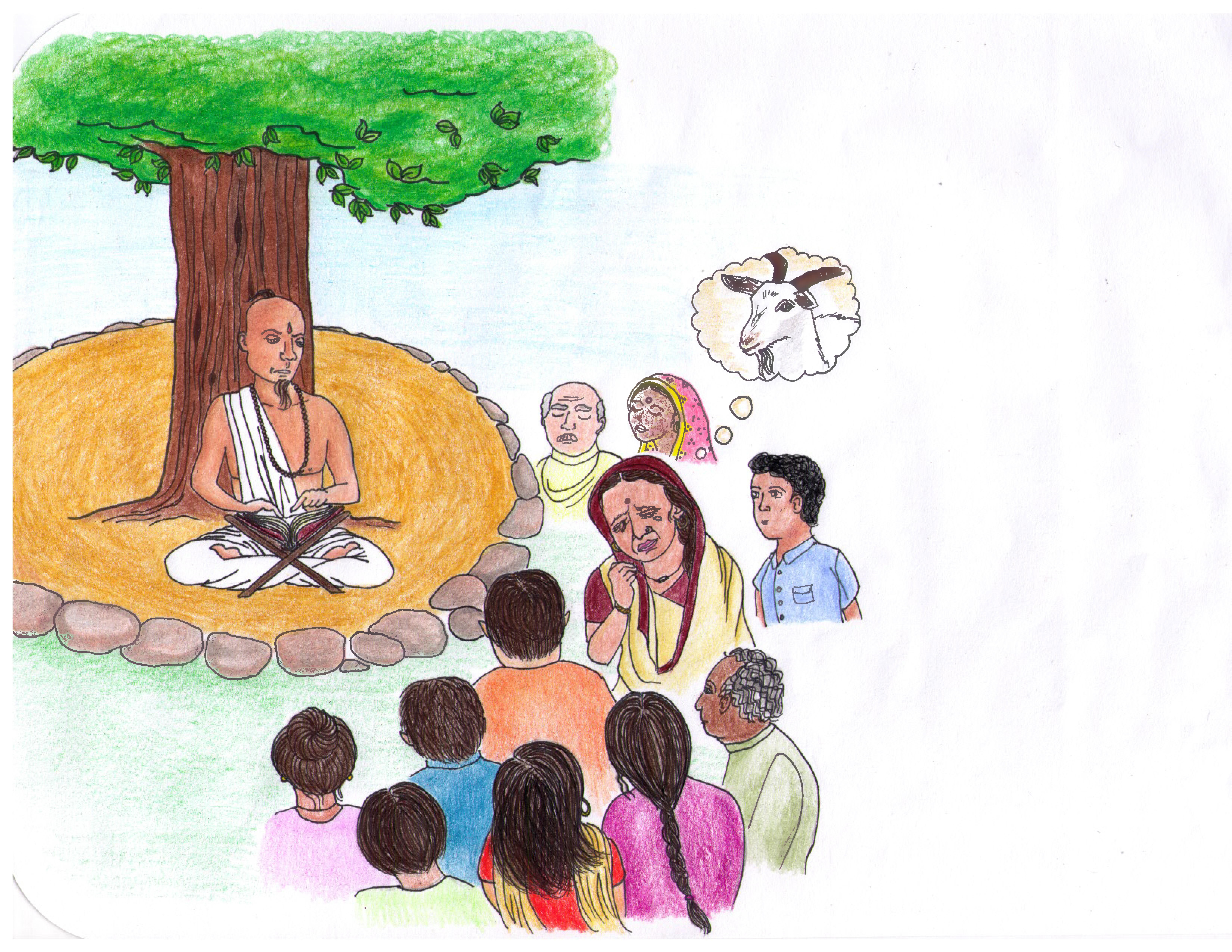
(The following blog is based upon my thoughts I shared with Vivekananda Vidyapith’s students, teachers, parents, and helpers during Youth Day Celebration Speech Competitions held on Saturday and Sunday, January 6th and 7th of 2018.)
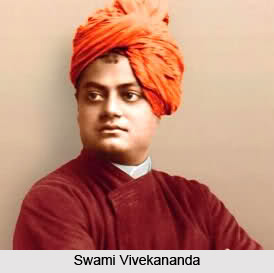
Swami Vivekananda (1863-1902) lived only for 39 years, but his life and teachings will continue to inspire people as long as a single person on earth searches for the eternal truth. All over the world, we can see the positive and uplifting effect of Swami Vivekananda’s life and teachings helping the humanity for its good. His teachings about strength, the divinity of the soul, oneness of existence, and harmony of religions have been appealing to more and more people. These teachings encourage them to search for their inner divinity and try to manifest it in their thoughts, speech, and actions, especially through their unselfish service to the society. His emphasis on serving the “Living God,” the sum total of all living beings, touches the hearts of even atheists.
We could see a fraction of this positive effect during the Vidyapith’s Youth Day Celebration Speech Competition. The temperature during last Friday, Saturday, and Sunday were in single digit close to zero degrees Fahrenheit and the wind-chill was in negative degrees. But, the Vivdyapith’s students and helpers joyfully loaded and unloaded a truck in the cold with the things needed for the competition. Several other people worked unselfishly for countless hours to make this competition a great success. For all of them, it was a labor of love. Also, almost all the students from grades sixth through twelfth came for the competition and presented their excellent speeches. The students, teachers, and the helpers were inspired by Swami Vivekananda’s life and teachings.
The following are few of my thoughts I shared with the Vidyapith’s students, teachers, and helpers:
“Swami Vivekananda is our beloved teacher, leader, and a role-model. He was a saint, a prophet, a yogi, a great teacher, an orator, a poet, a reformer, a humanitarian, a patriot, a world-leader, a visionary and many more.
He told about himself that, “He is a voice without a body.” His voice was and is the voice of the Vedanta – the Upanishads and the Bhagavad Gita. He also said that “As Buddha had a message for the east, he has a message for the west.”
There are many teachings of Swami Vivekananda which we have to learn and practice in our life. As students, one teaching we have to really learn is his definition of education. He said, “Education is the manifestation of the perfection already in man.” By ‘man’ he meant men and women. This perfection is the perfection of the Atman dwelling in each one of us. We have to realize this perfection and then try to manifest it in our thoughts, speech, and actions.
To me, the simple meaning of perfection is ‘Be happy with what we have and be always ready to improve our performance.’ With this simple rule, we will constantly improve our study, our work, and our performance in every field.
There is another aspect of education. In schools and colleges, we learn about the topics related to the physical and mental world. There, we do not learn about our true identity which is beyond our body and mind. For that, we have to learn to go deeper within ourselves and search for our true identity. Swami Vivekananda says that our true identity is divine. In order to search our true identity (or divinity dwelling within), Bhagavad Gita has described four paths, namely Bhakti Yoga, Jnana Yoga, Karma Yoga and Raja Yoga. We can do every day four simple spiritual practices which cover all these four yogas: (1) Spend few minutes doing prayer, Japa and meditation, (2) read couple of pages from inspiring books and seek holy company which encourages us in our search for our true identity, (3) practice values which help us realize this true identity (for example the values described in the 12th chapter of Bhagavad Gita shlokas 13-19), and (4) do unselfish service. If we do these four practices regularly and properly, then definitely we will go deeper within and realize our true identity which is divine.
Note that the goal of all the Vidyapith’s classes and all activities including this speech competition is to help us to learn about our true identity (the divinity dwelling within) and encourage us to realize it and manifest it in our thoughts, speech, and actions. But, we have to do our homework by practicing the above mentioned four practices. Just as we do homework after taking classes in schools and college and educate ourselves, similarly in this search also we have to do our homework.
What do we get by realizing our inner divinity? We see that each person irrespective of his/her color of skin, religion, culture, country, physical appearance or any external difference is divine. The basic life-force in all beings is the same. Once we realize that then we love all and be ready to help all. We do not hate anyone. We will get control on our lower nature including our anger, jealousy, greed, lust, ego, and other impurities. We become sincere, honest, and humble. This makes us a better person fit to live in the society.
When we realize this inner divinity, then we can understand Swami Vivekananda’s teachings of Vedanta, namely the divinity of the soul, oneness of existence, harmony of religions, and service to the ‘Living God’. With oneness of existence, we realize ‘unity in diversity’. This is the best way to celebrate Swami Vivekananda’s birthday. May we all get inspired by Swami Vivekananda’s life and teachings and make our life blessed.”
Shri Krishna Said, “O Arjuna! Because you are eager to listen to my words, I will tell you more profound thoughts which will be beneficial to you.
The devas and great sages do not know My Origin because I (as Brahman) am their ultimate cause.
One who knows Me in essence as Birthless, Beginningless, and the Lord of the Universe, becomes free from all sin (bondage).
From Me alone arise the following attributes and various states of mind in all beings: (1) intelligence (2) knowledge (3) ability not to get deluded (4) forgiveness (5) truth (6) control of the senses (7) control of the mind (8) joy and sorrow (9) birth and death (10) fear and fearlessness (11) non-violence (12) equanimity (13) contentment (14) austerity (15) charity, and (16) fame and infamy.
From My resolve, seven great Rishis and four Manus of ancient time were born, endowed with My Power. All beings are their progeny.
There is no doubt that one who knows in essence “My Divine Manifestations” and “My Yogic Power” will be firmly established in unwavering devotion.
Wise people truly understand that “I (Brahman) am the cause of the creation of the Universe and by Me alone the whole world functions.” That is why they worship Me with the fullness of their hearts.
Having filled their minds with My thoughts, surrendering their life unto Me, they talk among themselves about My glories and enlighten each other. Thus, they take delight and satisfaction in talking about Me.
I give Buddhi Yoga (a path of discrimination and renunciation) to those who are ever devoted to Me and who worship Me with love. Through this Buddhi Yoga, they realize Me.
Out of compassion, I, the one who resides in their hearts, remove the darkness of their ignorance by the light of a lamp of knowledge.”
Arjuna Said, “O Krishna! You are the Supreme Brahman, Supreme abode, and the Purest of the pure. All Rishis call You as the Supreme Self, Eternal, the Self-Effulgent, God of gods, the Birth-less, and the Omnipresent. The Devarshi Narada, Rishis Asit and Deval, and Maharshi Vyasa also have proclaimed You the same. You also said the same unto me.
Whatever You told me, I believe it to be true. Neither devas nor danavas know Your divine nature.
O the Creator and the Lord of all being, God of all gods, and the Supreme Purusha! Only You know Your own Divine Nature. Only You can fully describe Your Divine Manifestations whereby You pervade all the worlds and abide in them.
O Yogeshwar (Krishna)! How should I think of You to realize You? What are the various aspects or objects through which I can meditate on You? Please tell me in detail about Your Yogic Power and Divine Manifestations. My desire never gets fulfilled to listen to Your nectar-like words.”
Shri Krishna said, “My Divine Manifestations are infinite. So, I will tell you only a few of My major manifestations.
(1) I am the Atman dwelling in the hearts of all beings. I am the beginning, the middle and the end of all beings.
(2) I am Vishnu among Adityas.
(3) I am the Sun among the bright objects
(4) I am Marichi among the wind-gods
(5) I am the Moon among the Nakshatras.
(6) I am the Sama Veda among the Vedas.
(7) I am Vasava (Indra) among the Devas.
(8) I am the Mind among all the senses.
(9) I am the Consciousness among the beings.
(10) I am Shankar among the Rudras.
(11) I am Kuber among the Yakshas and Rakshashas.
(12) I am Agni among the eight Vasus.
(13) I am Sumeru among the mountains.
(14) I am Bruhaspati among the priests.
(15) I am Skanda among all the army generals.
(16) I am the Ocean among all the reservoirs.
(17) I am Bhrugu among all the great Rishis.
(18) I am the monosyllable Om among all the words.
(19) I am Japa Yajna among all the Yajnas.
(20) I am Himalaya among all the immovable objects.
(21) I am the Ashwatha tree among all the trees.
(22) I am Narada among all the Devarshis.
(23) I am Chitraratha among all the Gandharvas.
(24) I am Kapil Muni among all the Siddhas.
(25) I am the horse Uchchaishravasa among all horses. Uchchaishravasa was born with the nectar during the churning of the ocean.
(26) I am Gajendra among all elephants.
(27) I am the King among all human beings.
(28) I am the Vajra among all the weapons.
(29) I am the cow Kamadhuk among all the cows.
(30) I am Kandarpa, the Lord of Lust, which is the cause of progeny.
(31) I am Vasuki among all snakes.
(32) I am Shesh Naga among the Nagas (half-human and half-cobras).
(33) I am Varuna among the creatures dwelling in the water.
(34) I am Aryama among the Pitrus.
(35) I am Lord Yama among the controllers.
(36) I am Prahlada among the demons.
(37) I am the Time among the measures.
(38) I am the Lion among the animals.
(39) I am Garuda among the birds.
(40) I am the Wind among the purifiers.
(41) I am Lord Rama among the warriors.
(42) I am the Shark among the fishes.
(43) I am Ganga among the rivers.
(44) I am the beginning, the middle and the end of the universe.
(45) I am the Knowledge of the Self among all the branches of knowledge.
(46) I am the decision-making discussion among all the discussions.
(47) I am the Sanskrit Letter “A” among all the letters.
(48) I am the Sanskrit Sandhi “Dwanda” among all the Sanskrit Sandhis.
(49) I am the Infinite Time.
(50) I am the Nourisher of all and My faces are in all directions.
(51) I am all-seizing Death.
(52) I am the cause of everyone’s birth (another interpretation-I am the cause of prosperity).
(53) I am the seven known virtues, namely Fame, Prosperity, Speech, Memory, Intelligence, Tenacity, and Forgiveness. (These are Sanskrit female-gender virtues.)
(54) I am the Brihat-Saman among the Saman hymns.
(55) I am Gayatri among the meters.
(56) I am Margashirsha among the months.
(57) I am the FlowerySpring among the seasons.
(58) I am the Gambling of the cheats.
(59) I am the Vigor of vigorous people.
(60) I am the Victory of victorious people.
(61) I am the Effort of active people.
(62) I am the Goodness in good people.
(63) I am Vasudeva among the Yadavas.
(64) I am Arjuna among the Pandavas.
(65) I am Vyasa among the sages.
(66) I am Ushana among the seers.
(67) I am the rod of those who chastise.
(68) I am Statesmanship among the people who wish to win.
(69) I am the Silence among secrets.
(70) I am the Knowledge among the knowers.
(71) I am the seed of all beings. No moving or un-moving being can exist without Me.
My Divine Manifestations are infinite. I just told you a few of them.
Know that whatever is glorious, or prosperous, or powerful, it is the manifestation of a fraction of My Divine Manifestation.
What more can I tell you – with a fraction of My Divine Power, I support this whole universe.
Thus, in the Bhagavad Gita— the essence of the Upanishads, the science of Brahman, the scripture of Yoga, and the dialogue between Shri Krishna and Arjuna— ends the Tenth Chapter, entitled “The Path of Divine Manifestations.”
Om Tat Sat.
(Thanks to Sonali Tatapudy for editing this post.)
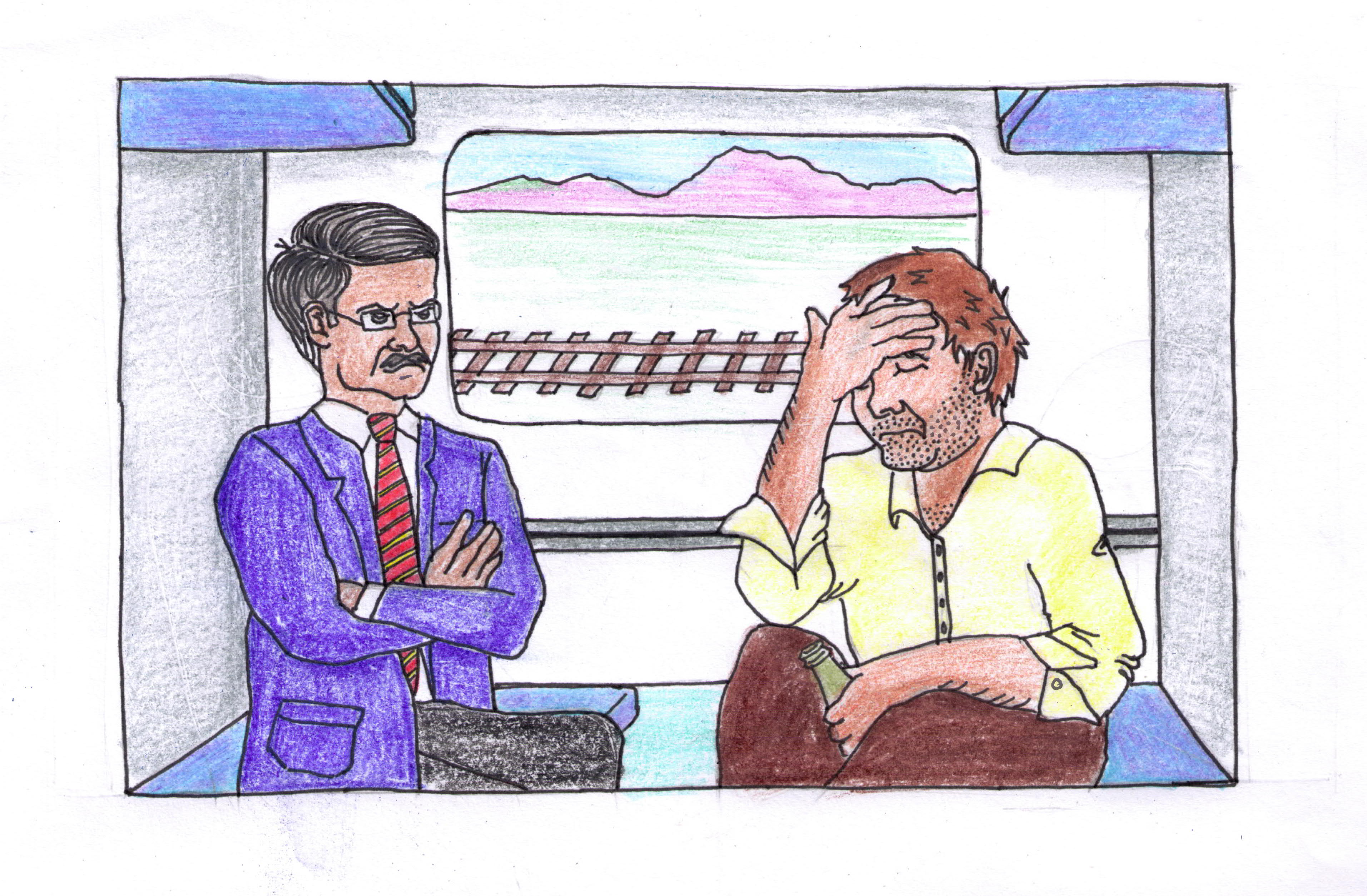
The following post is based on a story I had heard from Swami Adiswarananda, the Spiritual Leader of the Ramakrishna Vivekananda Center in New York from 1973 to 2007.
In cities like New York, all ideas fly. If anyone has some new idea to sell, there are customers to buy that idea.
On the bank of the Hudson River where fishing is allowed, a person put up a sign:
New Way of Fishing!
For $100 only, learn a faster way of fishing.
No need to spend money on rods and baits!
John was walking around the bank of the Hudson River. He saw a few people fishing. He thought that he should have brought his fishing rod. Then, he could have spent time fishing. He walked a little distance and saw this sign advertising a new way of fishing. He smiled and thought to himself, “Wow! My thought has power. I thought of fishing, I do not have any fishing rods, and here is a man telling me how to fish without a fishing rod. Let me learn something new and have a good time.”
John approached the man and asked him, “How can one fish without a fishing rod?” The man said, “In New York, everything has a cost. Give me $100 and I will show you how to fish without a fishing rod.” John was thinking whether he should spend $100 or not. He thought $100 is too much to learn this new way of fishing.
He walked away from the man. But, he was thinking, “Everything in New York is expensive. Compared to all other prices, $100 for a new idea is cheap. Maybe I will learn this new way and show off to my friends. Perhaps I can teach this trick to a few others and either get my money back or maybe earn more. It is good that I withdrew a couple of hundred dollars from the ATM a few hours ago.”
John came back to the guy. He gave him a $100 bill and asked him to teach him the new way of fishing.
The guy said, “See, you have to buy a powerful mirror like this.” He showed him the mirror. Then, he continued, “Reflect the rays of the sun from the mirror to the group of fish or an individual fish. The fish will be blinded by the rays of the sun and will stop moving. At that time, you can go and catch the fish. See, it is so easy. You do not need a rod or bait.”
John was puzzled. He was not sure whether he was learning a new way of fishing or if he was being tricked. He gathered courage and asked him, “How many fish have you caught so far with this new method?”
The guy said, “You are the fifth one!” 🙂 🙂 🙂
———————————————————————
Reflections:
Beware of the people who are trying to teach us short cuts or new ways to avoid the necessary work involved in achieving something important. There may be a few genuine cases in which short-cuts or new ways may help us. But, most of the time these are gimmicks.
Surely, we have to keep learning new ways. But, we should not get cheated by greedy or shrewd people who take advantage of the simple-minded. There is no substitute for hard work. I really like Thomas A. Edison’s famous quote, “Genius is 1% inspiration, 99% perspiration.” He also said, “Our greatest weakness lies in giving up. The most certain way to success is always to try just one more time.”
There are no shortcuts in the spiritual path. We have to follow the paths which have been described by the Saints and Sages who have realized the highest Truth. Swami Adiswarananda said that no one mimics the dirt (meaning creates fake dirt), but many people create fake gold because gold is expensive. Thus, there are many people who have tried and are still trying to create shortcuts or new ways to realize the highest Truth since spirituality is the most important part of our lives. But, almost all of them try to drag spirituality either to sense pleasures or to social entertainment or to develop schemes to make money or to earn position and power. Genuine spiritual teachers will ask us to go through the unavoidable hardships (austerities) of spiritual practices and will never compromise the ultimate Truth.
Shri Krishna in the Bhagavad Gita said, “Help thyself by thyself. You are your greatest friend and you are your enemy. One who has attained self-control is one’s own friend and one who lacks self-control is one’s own enemy.” (Bhagavad Gita 6.5 and 6.6)
Shri Krishna emphasizes on self-efforts and says, “With firm determination, lift up the mind systematically and steadily from the body-mind and its related world with the help of the intellect, and focus it on the Atman (one’s true identity). Then, do not think of anything else.” (Bhagavad Gita 6.25). He further said, “If the restless and unsteady mind runs towards the body-mind and the objects of the world, then bring it back from these objects and again focus it on to the Atman.” (Bhagavad Gita 6.26).
Thus, there is no short-cut in spiritual path. We can take help from outside, but ultimately we have to do the required spiritual practice to uplift our self from the lesser truth to the higher truth.
(Thanks to Pallavi Tatapudy for editing this post and Viraj Khetani for the illustration.)
Chapter 9: The Path of Sovereign Wisdom and Sovereign Mystery
Shri Krishna said, “O Arjuna! You do not carp, so I will tell you this profound knowledge with its practical aspect of realization, by knowing which, you will be free of all the sorrows of life.
This is sovereign knowledge, sovereign mystery, and the supreme purifier. It is righteous, eternal, gives tangible results, and is easy to practice.
People who do not have faith in these teachings do not attain Me (Brahman) and they go through the cycle of birth and death in this world.
The whole world is pervaded by My un-manifested form (Brahman). All beings are in Me, but I am not in them.
(Note: The whole world is projected on Brahman. In particular, all beings are projections of names and forms on Brahman.)
Actually, all beings do not dwell in Me (meaning they are just the projections of names and forms). However, behold My Divine Power (Maya) that I am the Creator (cause) and the Nourisher (support) of all beings, yet I do not dwell in them.
As the mighty wind—created from the sky, which moves everywhere within the sky, and still remains in the sky—all beings dwell in Me.
O Arjuna! At the end of a Kalpa (a period of 4.32 billion years), all beings merge into My Divine Power (Prakruti), and at the beginning of the next Kalpa, I create them with My Divine Power.
With My Divine Power I create all beings again and again. They are helpless because of their worldly desires and past actions.
Since I am the Witness Consciousness and unattached to their actions, their actions do not bind Me.
With My consent, My Divine Power creates the whole universe of living and non-living and makes it move around.
When I take human form, deluded people do not recognize Me as the Lord of the Universe and they disregard Me. Being that their intellect is covered by delusion, they remain engaged in useless hopes, actions, and knowledge. Thus, they remain possessed by demonic qualities.
On the other hand, the great souls, filled with divine qualities, know that I am Imperishable and the cause of the whole universe, and they constantly think of Me with focused mind.
(Note: For the demonic and divine qualities, read Chapter 16 of The Bhagavad Gita.)
These great souls remain firm in their vows to realize Me. They constantly sing My names and glories, make efforts to realize Me, remember Me, salute Me, and thus, worship Me with great devotion.
The followers of “Jnana Yoga”, worship Me as being one with them as Brahman. Some worship Me as being distinct from them, and others worship My Virata Form (Me as the whole universe) in various ways.
If you think of this whole universe as a “Yajna”, then know that I am the Vedi (in which fire of the Yajna is invoked), I am the fire in it, I am the mantras recited, I am the ingredients offered in the fire, and I am the whole worship of the Yajna.
Also, know that I am the father, the mother, the grandsire, and the sustainer of the universe. I am the one that has to be known. I am the Purifier, the Omkar (one syllable Brahman), and I am three Vedas, namely the Rig Veda, the Sama Veda, and the Yajur Veda.
I am the nourisher, the goal of life, the Lord of the Universe, the Witness Consciousness, the abode, the refuge, and the true friend. I am the cause of creation and the dissolution of the universe, and I am its support. Know that I am the imperishable seed of the universe.
I shine through the sun, create clouds, and bring rain. I am the nectar (immortality) and I am death. I am the being and the non-being.
Those who are devoid of sins and who wish to attain heaven by worshipping Me, through the performance of the “Yajnas” described in the three Vedas, attain heaven by their own merits. In heaven they enjoy various worldly pleasures until their merits are exhausted. Then, they come back to the earth and start their lives all over again. Thus, people who perform rituals described in the Vedas to fulfill their worldly desires go back and forth between earth and heaven. (They do not get the benefits of spiritual life.)
On the other hand, to those devotees who are ever devoted to Me, thinking of Me only and worship Me without any selfish reasons, I provide them what they lack in their spiritual practices and preserve what they have attained. (Thus, God helps these devotees attain their goal of God Realization.)
Those devotees who worship other gods (for worldly pleasures) also worship Me (Brahman), but they do this unknowingly and improperly.
I (as Brahman) am the Recipient and the Lord of all the worships and sacrifices of the devotees. But, not knowing Me, in essence, they fall from their spiritual path and become slaves of their senses.
Those who worship gods (limited forms of Brahman) go to the gods. Those who worship their ancestors go to their ancestors. Those who worship spirits go to the spirits. Those who worship Me (Brahman) come to Me.
If a devotee, out of love, offers Me a leaf, flower, fruit, water, or any simple thing, I accept such an offering made by the pure in heart.
O Arjuna! Offer to me any action you perform (Karma), anything you intake (Food), anything you offer in your spiritual practice (Yajna), anything you give in charity (Dana), and whatever austerity (Tapa) you perform.
(Note: In Chapter 17 of The Bhagavad Gita, Shri Krishna describes three kinds of food, Yajna, Dana, and Tapa, and in Chapter 18, he describes three kinds of actions and performers.)
By offering everything to Me, you follow “Sanyasa Yoga” (The Yoga of Renunciation) and, thus, become free from the bondage of all the results of your actions, whether they are pleasant or unpleasant. Then, being free from all bondages, you will come to Me (become one with Brahman).
I am the same towards all beings. I do not favor anyone and do not deny anyone. But, those who worship Me with love, they are in Me and I am in them.
Even a great sinner worships Me with one-pointed devotion (with repentance of sins and with a vow not to commit any sin again) must be regarded as a righteous person who has made the right resolve. Such a person (with devotion and the right resolve) soon becomes a righteous person and attains eternal peace within. O Kaunteya! Know that My devotee never perishes.
Taking refuge in Me, even women, Vaishyas, Shudras, and sinners attain the Supreme State.
(Note: This was the bold statement of Shri Krishna at the time when women, Vaishyas, Shudras were looked down upon compared to men, Brahmins and Kshatriyas.)
Definitely, when Brahmins or Kshatriyas, being free of sins, worship Me, they attain the Supreme State. Therefore, having attained this temporary human life filled with sufferings, worship Me with great devotion.
Focus your mind on Me, be devoted to Me, worship Me, offer everything to Me, and surrender to Me. Thus, keeping Me as the goal of your life and making efforts to realize Me, you will definitely attain Me (the Supreme State).
Thus, in the Bhagavad Gita— the essence of the Upanishads, the science of Brahman, the scripture of Yoga, and the dialogue between Shri Krishna and Arjuna— ends the Ninth Chapter, entitled “The Path of Sovereign Wisdom and Sovereign Mystery.”
The following post is based on a story I had heard from Swami Adiswarananda, the Spiritual Leader of the Ramakrishna Vivekananda Center in New York from 1973 to 2007.
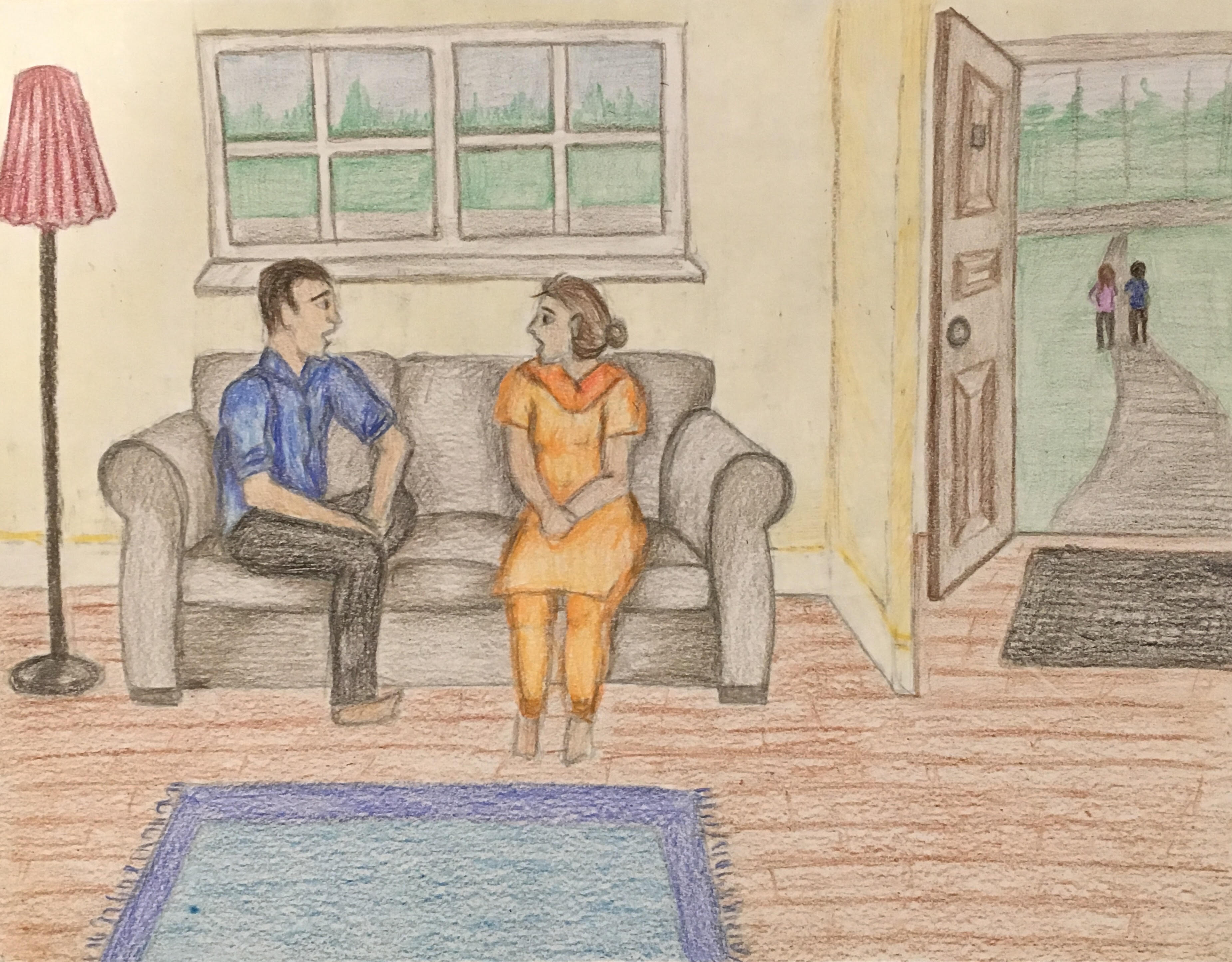
In most cultures, when a young girl finds a boy to marry, she introduces the boy to her parents and waits for their comments and/or consents. If the consents come immediately at the first meeting, then the girl is very happy. Sometimes, the consent of her parents comes after some time, during which the parents happily or unhappily have to change their traditional mindset about their son-in-law to make their daughter happy. Many times, parents do not agree to their daughter marrying the boy she likes and the daughter has to leave her parents’ house and marry the boy. In some such cases, the conflict brings tragic consequences.
A young girl, Riya, fell in love with a boy named Chirag in college. During their four years of undergraduate study, they grew closer. Both of them graduated from college. Riya graduated with a 4.0 GPA and Chirag barely made it to the required 2.5 GPA. Riya immediately got a job while Chirag had difficulty finding a job. A year passed. Riya and Chirag continued to meet each other often and were thinking to get married in proper time. After the completion of the second year of her job, Riya decided to introduce her boyfriend, Chirag, to her parents as she was sincerely thinking of marrying him. Riya told Chirag, “My parents are spiritually inclined. Be careful when you talk to them”.
One day, finding that her parents were in a good mood, Riya explained that she had to tell them something. Her parents immediately understood and asked, “Who is he?” Then, Riya told her parents how she met Chirag in college, how they became close to each other, and that she thinks that it is the proper time for them to meet him. Her parents were happy to meet Chirag. A day was set for Chirag to come to their house.
The day of the meeting came. Since morning, Riya was nervous, thinking of various possibilities that could happen during the meeting and how each possibility would affect her future life. She focused her mind on doing chores to kill time. The meeting time came. Riya and her parents were ready half an hour before the time Chirag was to arrive. He was 10 minutes late. For Riya, one minute was like an hour. Chirag was nervous. Riya introduced Chirag to her parents and vice a versa. After initial greetings, Riya offered some snacks and soft drinks to all. After some time, Riya’s mother suggested that her husband talk to Chirag personally in another room.
Riya’s father and Chirag went to a room. Chirag was even more nervous, but the father made him feel comfortable. After half an hour of talking, they both came out. Chirag had to go somewhere, and Riya decided to go with him.
After Riya and Chirag left, Riya’s mother said that Chirag looked handsome and it seemed that Riya and Chirag liked each other. Then, she asked her husband how the meeting was and what he thought of Chirag. Riya’s father smiled and said, “Chirag thinks that ‘I am God.’” Her mother asked, “Why does he think that way?” Riya’s father said that she should listen to Chirag’s answers to his questions:
Q: “Do you have a job?”
Chirag, “No, but, by God’s will, I will find a job.”
Q: “Do you have a place to live?”
Chirag, “No, not at present. I am living with my friend, but, by God’s will, I will find a place to live.”
Q: “Do you have a car?”
Chirag, “No, but I am sure God will provide me a car.”
Q: “Do you have a bank account?”
Chirag, “No, but when, by God’s will, I will get some money, I will open an account.”
Q: “What are your future plans?”
Chirag, “I don’t have any future plans, but whatever God suggest to me, I will do it.”
Riya’s father told his wife, “Do you see? He thinks that I am God and will provide all these things to him!” 🙂 🙂 🙂
Note: Poor Chirag tried to please Riya’s spiritually-inclined parents by bringing God into every sentence. Let Riya’s parents decide whatever they want to do in this situation. The readers too can make their own decision as to what they would do in a similar situation. I am not interested in judging anyone or suggesting to anyone what they should do. I am only interested to reflect upon the following important topics which came to my mind from the story:
——————————————————–
Self-surrender:
In almost all religions, it is mentioned that one has to surrender to God. Even Buddha, who was considered a non-believer, taught his disciples, “Buddham Sharanam Gachhami…” This means, “Surrender to Buddha, Dharma, and Sangha.”
Thus, self-surrender is considered a most important and necessary step for spiritual progress. Many people shirk at the idea of self-surrender on the spiritual path, yet there is no hesitation to surrender to plumbers, electricians, mechanics, doctors, or even to the pilots of aircrafts. Of course, in all fields, people have been cheated when they surrendered. But, there is no other way. If we doubt everything, we cannot live in the world. We need to have faith. We must check the qualifications of people, make educated choices, and have trust in the people who take care of the things related to our lives and sometimes of our lives themselves. After making the choice, we can keep our eyes open during the process and make the necessary adjustments.
We follow this process easily for worldly matters. However, in religion, people tend to blindly surrender without ever questioning anything. Thus, ills come out from such so-called religious teachers. I think people separate religion and spirituality based on whether people question keeping their minds open or not. In religion, people blindly follow their religious leaders and never question a single thing. Meanwhile, in spirituality, people follow the fundamental and important parts of religion and are not afraid of asking questions about anything they do not understand or agree with. They question because they want to understand exactly what teachers or the scriptures say so that they can make spiritual progress. Also, they do not want to do something harmful or inappropriate in the name of religion.
Self-surrender and self-efforts:
Still, on the spiritual path, misunderstandings happen. In the name of self-surrender, people surrender their efforts, but not the little self. Many times, after starting spiritual practices, people become lazy and less productive in their daily lives. Actually, spiritual practices should give us more strength to perform our responsibilities and make our lives more productive and meaningful.
To me, self-surrender to God means: (1) surrendering our ego to God (becoming humble and developing gratitude), (2) making God our goal (trying to practice all the virtues of God), and (3) performing all responsibilities as an offering to God (with full hearts and focused minds to acquire knowledge and devotion). Self-surrender helps us make self-efforts.
Grace:
In the Bhagavad Gita, Sri Krishna said that the success of every action depends on five factors: (1) a field of actions, (2) tools to perform the actions, (3) knowledge to perform, (4) actual performance, and (5) divine grace. We have control of the first four parts of every action, but we cannot guarantee their success. A natural calamity, a health problem, or a problem from society may affect the results of our actions. That is why we seek the grace of God – to take care of the fifth factor. But, we must take care of the first four factors in order to seek the divine grace. Without fulfilling the four factors, seeking divine grace is meaningless.
Also, if we do not make self-efforts, then we cannot recognize the divine grace and its importance. Saints and sages say that the grace of God is always there. If we make efforts to fulfill the above-mentioned first four factors in any field (including spirituality), then we will see the divine grace and will understand the importance of the grace. God’s grace may come in the form of failure which may be for our own good in the long run.
(Thanks to Pallavi Tatapudy for editing this post and Viraj Khetani for providing the illustration.)
The following post is based on a story I had heard from Swami Adiswarananda, the Spiritual Leader of the Ramakrishna Vivekananda Center in New York from 1973 to 2007.
Martha was working in a company for many years. She found that in the last seven years, many senior employees were laid-off and the management was hiring young people who did not complain and worked more for less money. She had lost few of her friends.
Recently, a young lady named Jane was hired in the company. Martha thought that she might make a good friend. Martha talked to her about the company’s policy and people and the ways to survive in the company. Jane also started feeling comfortable in Martha’s company. Soon, they developed trust in each other and started exchanging their personal life.
Martha found one strange thing in Jane’s behavior. She found that Jane often takes out her cell phone from her purse, looks at a photo of someone for a while, mumbles something, and then puts the cell phone back into her purse.
Initially, Martha ignored that behavior. But, as their friendship became closer, one day Martha took the courage to ask Jane during their lunch: “Hi Jane! If you don’t mind, can I ask you one question?”
Jane said, “What is it?” Martha asked, “Often you take out your cell phone from your purse, and look a photo for a while and then you put your cell phone back into your purse. I wonder whose photo it is that you look at so often.” Jane smiled and said, “Oh! It is my husband’s photo.” Martha said, “I have never seen a wife loving her husband so much that she often needs to look at her husband’s photo. Wow! I must tell your husband about it.”
Jane was silent for a few seconds. Then, she smiled and said, “It is none of this. See, in this company, it is very difficult to work with people who are mean. There are many such people, especially the boss, who is the most difficult to work with. When I get too depressed and frustrated, I take out my husband’s photo and tell myself ‘What more trouble could I have than marrying this guy.’ After that every trouble looks very small and bearable to me and thus my life goes on.”
———————————————————————————————————————-
Lessons I learned:
Swami Rama Tirtha’s Story:
I have heard this story of Swami Rama Tirtha. This is a story from the time when Swami Rama Tirtha was a student. One day his mathematics teacher came to the class and drew a line on a blackboard. Then, he asked all the students to make that line smaller without touching the line. All the students were puzzled and could not find a solution. At that time, young Rama Tirtha got up from his chair, took a chalk in hand, and drew a longer line under the line drawn by the teacher. The teacher was extremely pleased and the students were thrilled.
Problems of Life:
Problems of life are relative. A person is not happy with his/her salary and complains about not having enough money to buy a better car, live in a bigger house or go to an expensive resort for a vacation. But, when he/she thinks about the people in the world who do not have a job, or enough food to eat, not to even mention having a car or a house, then he/she realizes that his/her problems are smaller.
This works on the other way around too. A person is happy with what he/she has such as their house, car, job, salary etc. But, sometimes seeing other people’s big houses, or expensive cars, or high salaries, makes the same person sad and not happy with what he/she has.
A Practical Suggestion:
If we are not happy with our material possessions, or physical comforts, or family problems, then we should think of those who have less possessions and comforts than us and who have more major problems in life to face than we do. Then, we should pray for them and wish the best for them. This way, our problems will become lesser in size and more bearable.
On the other hand, when we are happy with our knowledge or spiritual progress, we should think of the people who have acquired more knowledge than us and who have further advanced their spiritual life than us. This way, our efforts for acquiring knowledge will increase and our urge for spiritual progress will be more intense.
A Story of Shiva Mahimna: There is a story described in shloka 10 of the famous hymn Shiva Mahimna. This story actually describes the glory of Lord Shiva, but we can also learn an important lesson from it. This is my version of the story:
Once there was a dispute between Brahma, the creator of the universe and Vishnu, the preserver of the universe. Each one claimed that he is superior to the other. Brahma said that if he does not create anything, then Vishnu does not have a job of preserving. Vishnu claimed that if he does not preserve the universe, then the universe would have died as soon as it was created, thus rendering the creation is useless. While they were arguing with each other, an infinite fire-pole appeared out of nowhere and filled everything with blinding light. Vishnu asked Brahma whether he had created this pole and Brahma said, “No.” Brahma asked Vishnu whether he had preserved this pole from outside his universe and Vishnu said, “No”. Both were baffled. They decided to check out the ends of the pole to find something about its origin. Brahma went towards the sky to find its end and Vishnu went down for the same. After a long time, they both were exhausted and returned without finding its end. Then, they prayed to the pole to reveal its identity to them. At that time, from the fire-pole Lord Shiva came smiling and said that the Ultimate Reality Brahman is infinite. Infinitely many universes arise from Brahman and merge into Brahman. Each universe has its creator and its preserver. There is no need to boast about their finite work.
I learned a lesson that when we think of the infinite time span, the infinite universe that we live in, then our existence looks like a one little tiny spot and our span, of say, 100 years, is like a Nano- second or Mili-second. Now, what is the significance of our problems, how big they may be, in this short life whose existence is a very small dot in the infinite universe? This is not a pessimist outlook, but rather, a realistic one. In the background of the vision of the infinity of space and time, many of our problems in life become less threatening and we can gather our inner strength and face these problems as vigorously as we can. Even if we die fighting these problems, we do not worry, because in that infinite background even death is totally insignificant.
Progression of Wisdom:
Swami Adiswarananda mentioned three stages of wisdom as we make progress in acquiring wisdom.
First Stage of Realization: (1) There is a problem.
When people are ignorant, they think that life is all good. They think that the goal of life is to get as much joy as possible from the body, mind, people, and the objects of the universe. Then, the reality of life starts revealing itself and the first sign of wisdom comes when we realize that “Life is not all good. There are unavoidable problems in life. We have to pay a high price for each pleasure of our life.”
Second Stage of Realization: (2) The cause of the problem is in me.
We find the problems in life, but then we blame the whole world for these problems. When we introspect more, we find that we have a significant role in creating these problems. The causes of many problems lie in me. If I remove the cause of a problem by transforming my life for good, then the problem either disappears or becomes less painful.
Third Stage of Realization: (3) I am the problem:
When we advance further in our reflections of life and the teachings of the scriptures and saints, we find that our ego “I” causes all the problems. As I separate myself with my name and form (body and mind) from my true identity “Atman”, I make myself limited and more cut off from the reality of life. This is the cause of all my problems. With this wisdom we try to search within our true identity. When we realize our true identity as Atman, whose nature is “Sat-Chit-Ananda” (Existence, Knowledge, Bliss Absolute), then we acquire infinite strength to face these little problems of life. We face these problems with a peaceful mind, and remain content in the opposite situations like joys and sorrows, honor and insult, praise and blame.
(Thanks to Abhishek Senjalia for editing this post and Sneha Shah for the illustration.)
The following post is based on a story I had heard from Swami Adiswarananda, the Spiritual Leader of the Ramakrishna Vivekananda Center in New York from 1973 to 2007.
A Buddhist Monk came to New York as a visitor. He was excited to teach Buddhism to New Yorkers. Whomsoever he met, he started talking to them about the Buddhist philosophy and its applicability.
Walking around in New York, he was hungry. He saw a vendor selling bagels. There was a line of five to six people waiting to buy bagels. He waited also at the end of the line and started talking to the guy in front of him about the teachings of Buddha. He told the guy that a transformation in life has to come just like that which happened in the life of Buddha. The guy was getting a little annoyed, but he did not want to be rude. He continued listening to the Buddhist until his turn came to buy the bagel.
When the guy left, the Buddhist started talking about Buddhism to the vendor who was selling the bagels. The vendor cut off the conversation and asked, “What kind of bagel do you want and what do you want on it?” The Buddhist started telling the vendor that he was not a narrow minded person and he respected all religions. He learns and gathers good thoughts from all. Again, the vendor ignored this sidetrack of conversation and asked, “What kind of bagel do you want and what do you want on it?”
The Buddhist gave a $20 bill to the vendor and told him, “I don’t want to be a narrow minded person. So, give me an ‘everything bagel’ and put everything on it.”
The vendor gave him an ‘everything bagel with butter, cream cheese and mustard’ on it. Then he went to take care of the other customers. The Buddhist waited for a while and soon realized that the vendor was taking care of the other customers one by one.
The Buddhist finally asked him, “What about my change?”
The vendor continued to prepare a bagel for the next customer and said, “Change comes from within!” 🙂
What I learned:
Not to talk about spirituality to everyone:
After giving him the profound message of Practical Vedanta, the essence of the Upanishads, and the science of four yogas, Shri Krishna at the end of Bhagavad Gita told Arjuna, “Do not tell this teaching to anyone who is (1) not austere, (2) without devotion, (3) not interested in listening to this message, and (4) he who speaks ill of Me.” (Gita 18.67)
Shri Krishna is teaching us not to talk about spirituality or God to the above mentioned people. It is futile to talk to them. A beginner in the path of spirituality may lose faith by talking to such people. Their negative influence may wipe out the developing beginner’s faith.
Sri Ramakrishna said that occasionally out of two friends, while one was enjoying listening to his talks about God and spiritual practices, the other friend would became restless after a while. The other friend would whisper into the ears of his friend and ask, “How long are you going to be here?” The interested friend would get annoyed of this distraction. Then, Sri Ramakrishan used to tell the restless friend to go out and visit the temple and the garden.
The great Sanskrit Poet Kalidas prayed to God that he would accept any punishment for his ill-performed actions, but not a punishment where he would have to recite poetry in front of people who are not interested in poetry. He actually said it three times: “Maa likha, maa likha, maa likha.” “Please do not write, please do not write, and please do not write in my destity.”
The same is with talking about spirituality and God to the people who are not interested.
On the other hand, Shri Krishna said, “One who is endowed with supreme love for Me (God or Brahman) shares this profound teachings (of Bhagavad Gita) to My devotees will definitely without any doubt becomes one with Me.” (Gita 18.68)
Sharing uplifting and positive thoughts is good, but it should be only with the people who understand and appreciate them.
Swami Vivekananda’s Thoughts on Changing the World:
The following are Swami Vivekananda’s thoughts on the world and the idea of changing it. These thoughts reflect deep insights of the world and our responsibilities to the world. We can learn great lessons from these thoughts.
“This world is like a dog’s curly tail, and people have been striving to straighten it out for hundreds of years; but when they let it go, it curls up again. How could it be otherwise? When we know that this world is like a dog’s curly tail and will never be straightening, we shall not become fanatic (to change it).”
“There is God in this universe. It is not true that this universe is drifting and stands in need of help from you and me. God is ever present therein; He is undying and eternally active and infinitely watchful. When the whole universe sleeps He sleeps not; He is working incessantly; all the changes in the world are caused by Him.”
“We have to bear in mind that we are all debtors to the world and that the world does not owe us anything. It is a great privilege for all of us to be allowed to do anything for the world. In helping the world we really help ourselves.”
“The world is a grand moral gymnasium wherein we all have to take exercises so that we become stronger and stronger spiritually.”
Swami Vivekananda’s Thoughts on the Characteristics of a Reformer:
“If you want to be a true reformer, you must possess three things:
(1) The first is to feel. Do you really feel for your brothers? Do you really feel that there is so much misery in the world, so much ignorance and superstition? Do you really feel that all men are your brothers? Does this idea permeate your whole being? Does it run in your blood? Does it tingle in your veins? Does it course through every nerve and filament of your body? Are you full of that idea of sympathy? If you are, that is only the first step.
(2) Next, you must ask yourself if you have found any remedy. The old ideas may be all superstitions, but in and around these masses of superstition are nuggets of truth. Have you discovered means by which to keep that truth alone, without any of the dross? If you have done that, that is only the second step; one thing more is necessary.
(3) What is your motive? Are you sure that you are not actuated by greed for gold, by thirst for fame or power? Are you really sure that you can stand up for your ideals and work on, even if the whole world wants to crush you down? Are you sure that you know what you want and will perform your duty, and your duty alone, even if your life is at stake? Are you sure that you will persevere so long as life endures, so long as one pulsation is left in the heart?
Then you are a real reformer, you are a teacher, a master, a blessing to mankind.”
Mahatma Gandhi’s Thoughts on Change:
Henri Edberg is a writer who lives on the east coast of Sweden. He is passionate about happiness and personal development. He writes about it in his “The Positive Blog.” He has written an article “Gandhi’s 10 Rules for Changing the World.” He wrote on the following 10 quotations of Mahatma Gandhi (Henry Edberg gave the titles):
(1) Change yourself:
“You must be the change you want to see in the world.”
(2) You are in control:
“Nobody can hurt me without my permission.”
(3) Forgive and let it go:
“The weak can never forgive. Forgiveness is the attribute of the strong.”
“The eye for an eye ends up making the whole world blind.”
(4) Without actions you aren’t going anywhere:
“An ounce of practice is worth more than tons of preaching.”
(5) Take care of this moment:
“I do not want to foresee the future. I am concerned with taking care of the present. God has given me no control over the moment following.”
(6) Everyone is human:
“I claim to be a simple individual liable to err like any other fellow mortal. I own, however, that I have humility enough to confess and retrack my steps.”
“It is unwise to be too sure of one’s own wisdom. It is healthy to be reminded that the strongest might weaken and the wisest might err.”
(7) Persist:
“First they ignore you, then they laugh at you, then they fight you, then you win.”
(8) See the good in people and help them:
“I look only to good qualities of men. Not being faultless myself, I won’t presume to probe into the faults of others.”
“Man becomes great exactly in the degree in which he works for the welfare of his fellow-men.”
“I suppose leadership at one time meant muscles; but today it means getting along with people.”
(9) Be congruent, be authentic, be your true self:
“Happiness is when what you think, what you say, and what you do are in harmony.”
(10) Continue to grow and evolve:
“Constant development is the law of life, and a man who always tries to maintain his dogmas in order to appear consistent drives himself into a false position.”
(Thanks to Abhishek Senjalia for editing the post and Viraj Khetani for the illustration.)
The following post is based on a story I had heard from Swami Adiswarananda, the Spiritual Leader of the Ramakrishna Vivekananda Center in New York from 1973 to 2007.
A devotee wanted money from God. So, he started praying to God. After a few years of sincere and intense spiritual austerities, God thought to reveal Himself to him.
One day the devotee profusely cried for God. Seeing the devotee’s agony, God granted the devotee a vision of Him. The devotee was overjoyed with this vision.
Then, God asked him, “What do you want?”
The devotee said, “I just want one cent from you.”
God said, “Why just one cent?”
The devotee replied, “God’s one cent is like millions of dollars.”
God wanted to uplift this devotee from his limited wants and make him aware of the higher importance of God-vision, so God said, “Wait a minute!”
———————————————————————————————————————-
Reflections:
Time and Space are Relative:
Moving clocks are slower than stationary ones. Distances (the space is in-between two points) and the durations are observer-dependent. Do you believe this? Einstein’s Theory of General Relativity proves it.
Let us not go into deeper science and think in terms of common experiences. Four to eight lower-middle class people living and adjusting in one bedroom apartment of big cities like New York, Mumbai, London and others feel that they have enough space. When a family of four moves to a 3-4 bedroom house with one acre land initially feels that they have enough space. But, when they filled up the house with furniture and needed or not-needed things, then the same house looks small.
We all know that time is relative. When we are waiting for people whom we love, then one minute feels like one hour. But, when we are having fun, then one hour passes like one minute.
Time in Bhagavad Gita:
Shri Krishna says, “Those people who know that the day of Brahma (the Creator) is thousand eons long and the night of Brahma is thousand eons long, know the day and night. At the approach of the day of Brahma, all manifested objects come forth from the un-manifested (Brahman, or Consciousness, or Energy) and at the approach of the night of Brahma, all the manifested objects merge into the un-manifested.” (8.17-18)
Evolution and Involution:
When we wake up our universe begins. As soon as we wake up all the thoughts of our activities and all of our relationships with people come to the surface of our mind. It stays with us for the whole day. When night comes and we go into deep sleep, all our thoughts and relationships go deeper into our minds in very subtle (encrypted) form.
It is the same with the whole universe. The Bhagavad Gita, as a part of Vedanta, says that the whole universe emerges from one thing called Brahman (in scientific terms we can call this Consciousness or Energy), which is called an evolution. It is similar to how a tree comes out from a seed. Then, after some time (which may be billions of years) everything merges back into Brahman (Consciousness or Energy). Science also talks about black holes. These black holes give us an idea of the process of involution, or the merging of manifested objects into un-manifested. It is like the whole tree merging into a tiny seed.
Time is Maya:
Vedanta says that there is only One Ultimate Existence, called Brahman. From the Brahman the whole universe came. Thus, everything in the universe is nothing but Brahman. But, we do not see it. We see the separate existence of individuals and objects. Vedanta says that these differences have been created by space, time, name and form.
If a wave of an ocean thinks that it has its own separate existence and that the ocean does not exist, that would be ludicrous. If a gold ornament, like a necklace, thinks that it is different from the gold and that gold does not exist, that would be ludicrous. If a clay figure of a man or a woman or an elephant thinks that it is separate from the clay and that clay does not exist, that would be ludicrous. Similarly, if a human individual thinks he/she is different from Brahman, and Brahman does not exist, that is ludicrous. But, we all think that we have separate individual existence, and we have nothing common and we live in delusion. As a result, based upon our selfish motives, we love some, hate some, and go up and down in joys and sorrows.
What deludes us? Vedanta tells us that it is Maya, the power of Brahman, which deludes us. This Maya is space, time, name and form. Brahman is Maya-pati, the Lord of Maya, meaning is beyond Maya. Thus, Brahman is beyond space, time, name and form.
Story of Krishna and Narada:
Swami Vivekananda told a story from mythology in his lecture “Maya and Freedom,” delivered in London, October 22, 1896.
Narada asked Shri Krishna, “O Lord! Show me your Maya.” Shri Krishna said that he had to come with him in a trip to forests. Both walked and walked into deep forests. The sun was scorching. Shri Krishna said, “O Narada! I am thirsty. Can you please look around and see if there is any water nearby. I have no energy to walk.” Narada said, “Yes my Lord! I will look for water and bring it to you.”
At a little distance, Narada found a small village. He stopped at a house, knocked at the door and loudly asked if there was anyone in the home. A beautiful young girl opened the door. Narada was overwhelmed by her beauty and started conversing with her. He asked her name, about her parents, and asked if she is married. The girl also showed interest in Narada and she called her parents. The parents were very happy to see Narada and they accepted his proposal to marry their daughter to him. Narada and the girl got married. They had two children. The girl’s parents died and Narada inherited their home and property. Thus, twelve years passed.
Then a big storm came. Due to high wind and several days of heavy rain all over, one night, the nearby river rose until it overflowed and flooded the whole village. The current of the river was very strong. Houses fell, men and animals were swept away and drowned and everything was floating in the rush of the stream. Narada’s house fell. He had to escape. He held his wife with one hand, a child in his other hand and put one child on his shoulders. He was trying to swim to survive. But, the strong current took away the child from his hand. When he was trying to save that child, the other child flipped over and was swept away. When he tried to save that child, he lost his grip on his wife’s hand and she too was torn away by the current. After being dragged by the current of the river for a distance, he was thrown onto land. Narada wept and wailed in bitter lamentation.
Then, he heard a gentle voice, “O Narada! Where is the water? You have gone away for half an hour to get water.” Narada exclaimed, “Half an hour! Twelve years passed through my mind in half an hour!”
After telling this story, Swami Vivekananda said, “And this is Maya!”
If we are not careful, then years pass like hours without gaining any accomplishment or knowledge which could bring true satisfaction in life.
So, we should think, reflect, do spiritual practice and serve humanity (the Living God) unselfishly.
Maya created by Human Beings:
Brahman creates Maya, but human beings also create Maya. It is Maya of money and greed. Because of greed our life becomes a money-making machine, and it will not leave any time to enjoy the money acquired. We have to make sure that we enjoy money and money does not enjoy us.
Knowledge and Devotion:
God is our father and mother. We should have faith that if we sincerely pray to God and perform our responsibilities, then God will take care of us. We have to pray to God for knowledge and devotion which will fulfill all our desires.
(Thanks to Sonali Tatapudy for editing this post and Viraj Khetani for the illustration.)
Meditation and the Transformation of the Character
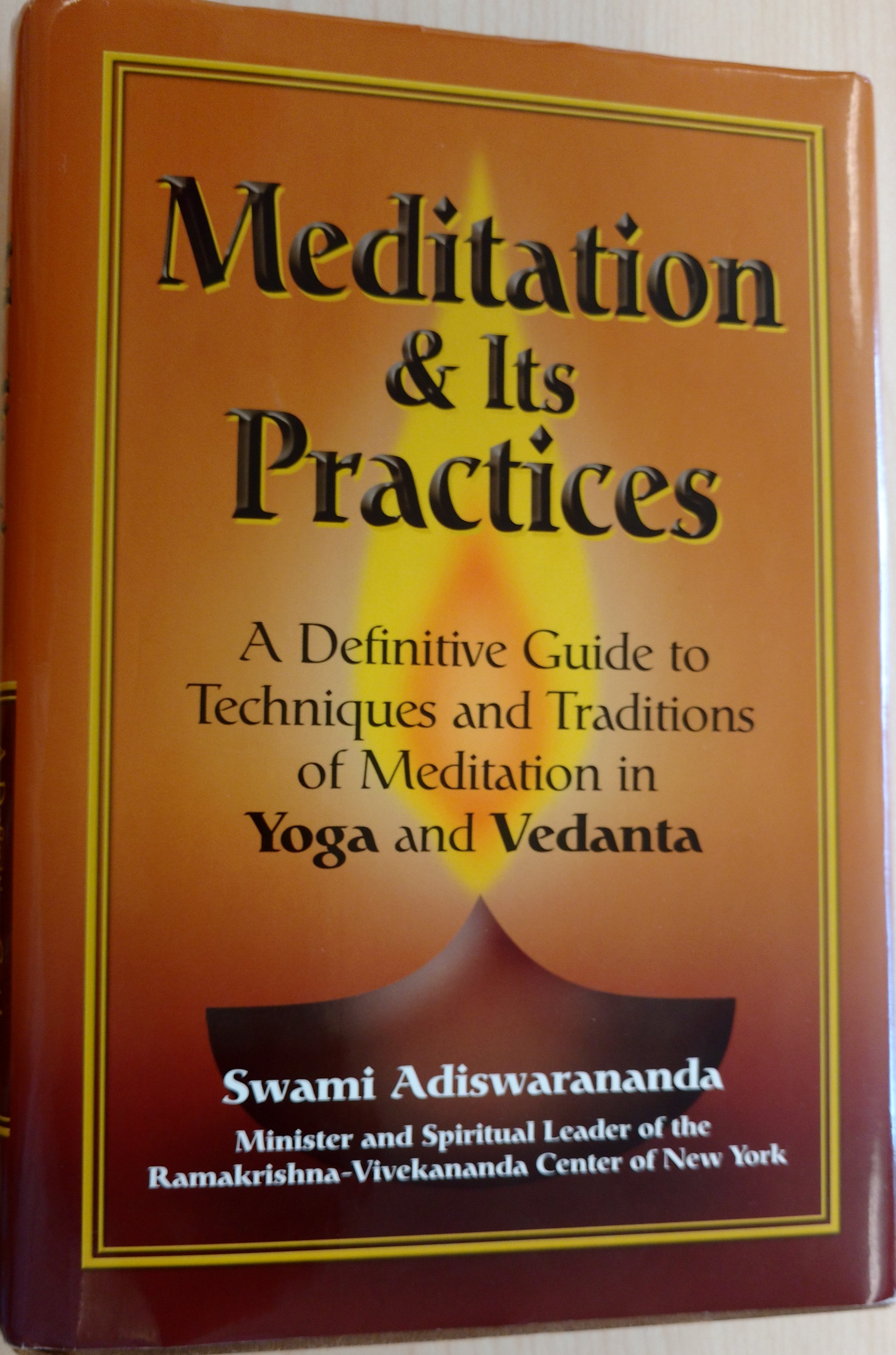
Swami Adiswarananda, Minister and Spiritual Leader of the Ramakrishna Vivekananda Center, New York (1973 – 2007), had written several books related to Vedanta. His books are like mathematics and physics books. Every word and sentence of his books is thoughtfully selected, and one can see logical development of his ideas.
Currently, I enjoy reading his book, “Meditation and Its Practices.” It is a definitive guide to techniques and traditions of meditation in Yoga and Vedanta.
In this book, meditation has been looked at from several points of view, and it contains innumerable quotations from several standard books of meditation, Vedanta, and Yoga.
Personally, on many occasions, I was fortunate to see Swami Adiswarananda absorbed in meditation and felt uplifted by the spiritual environment created by these absorptions. Several times, I have heard him give talks after deep meditation, and I could feel that his words were coming from his direct communion with the Self, filled with convincing power and destroying all doubts.
The quoted paragraphs are excerpts from his book “Meditation and Its Practices.” I found these paragraphs to be very helpful for me to understand meditation and thoughts related to it. The titles and in-between thoughts are mine.
The importance of Meditation:
“Meditation is a subject of universal interest. It is practiced by spiritual seekers of all traditions, in some form or another, for serenity, peace, and blessedness.
The Vedic seers tell us that the causes of suffering are five, and they are:
(1) Ignorance that makes us out of touch with Ultimate Reality
(2) Ego that creates the world of dreams and desires
(3) Attachments to things and beings of that dream world
(4) Aversion toward things and beings we do not like and
(5) Clinging to life and not moving forward.
The only way to overcome the maladies of life is to establish contact with the Ultimate Reality, and the only way to make contact with It is through meditation.
Meditation liberates us from the bondage of the mind and body, and lifts us up into the vast expanse of the Infinite Self.
Meditation awakens the dormant powers of the mind.”
The Steps Leading to Meditation:
“The step leading to meditation is uninterrupted spiritual concentration of the mind on the Self. Such concentration does not develop by itself. It has to be practiced consciously and regularly, and requires overcoming the drags of perverted habits, attachments, and desires. For this reason, meditation is a twofold practice. It is focusing the mind on the ideal, while at the same time, practicing self-control.”
Meditation and Integrated Personality
“An average person’s spiritual goal and spiritual efforts are not well integrated because his thinking, feeling, willing, and acting do not support but instead oppose each other. Most often, his spiritual goal is subordinated to his material and worldly goals.
In his efforts, he does not follow moderation but swings from indulgence to asceticism, pessimism to optimism. Integration of personality is the alignment of all one’s thoughts, words, deeds, and aspirations to spiritual aspiration.
An integrated life, according to Yoga and Vedanta, is a grand symphony of many reflexes, impulses, desires, emotions, thoughts, and purposes. As the millions of cells of the human body must be well harmonized to produce a balanced physique, so must the multiple centers of our personality also be well integrated to make the symphony a reality. The more we get a glimpse of our real Self in meditation, the more we are able to achieve this harmony.”
What is Integrated Personality?
“Meditation enables us to discover the rhythm of integrated living, which is marked by withdrawal from and response to the everyday world. Mere withdrawal without response is meaningless, while mere response without withdrawal is disastrous.
The more active we are, the more we are required to be meditative. The more the musical instruments in an orchestra are played, the more they need tuning. Meditation is to the mind what sleep is to the body. Meditation is the inbreathing of life, while activity represents its outbreathing. Meditation, like a gyroscope, helps the aspirant maintain his poise and balance amid the turbulence of life. Sincerely pursued, meditation becomes the aspirant’s second nature and follows him like his shadow in every action and thought, enabling him to function as two voices singing in counterpoint.”
Meditation is more than the Concentration of the Mind:
“In the philosophies of Yoga and Vedanta, meditation is a mental process by which the meditator becomes one with the object of meditation.
Communion with our true Self, according to the Mahabharata, is the most efficacious form of meditation, comparable to bathing in a sacred river: ‘the river of Atman is filled with the water of self-control; truth is its current, righteous conduct its banks and compassion its waves…. Bathe in its sacred water; ordinary water does not purify the inmost soul.’ Meditation is thus the greatest purifier of the mind.”
Meditation is a constant awareness of our true identity (Atman) or the Ultimate Reality (Brahman). If one is a devotee and worships a chosen form of God (Ishta), then the constant remembrance of this form leads to meditation. Thus, japa, lovingly repeating God’s name or a mantra related to the beloved form of God, leads to an absorption into that form. This is meditation for a devotee. Finally, when this beloved form of God merges with the Ultimate Reality (Brahman), the devotee attains the highest communion with Brahman.
Swami Adiswarananda says, “Through meditation, our individual self, communes with the cosmic Self, as represented by our Chosen Ideal. These moments of communion lift us out of all egocentric involvements and infuse us with a quantum of inner serenity that heals the wounds of our mind, filling it with new strength to face the challenges of life. This inner serenity brings in its wake a stabilizing effect on our everyday life and makes it more efficient, creative, and purposeful. Our daily contact and communion with the external world of countless diversities temporarily overwhelms our knowledge of the unity of existence. As a result, our perception of diversities becomes exaggerated and heightened, and we lose the distinction between the Reality that is permanent and eternal and the realities that are impermanent or relatively permanent. Proficiency in meditation restores our true vision of reality.”
Being Calm and Serene is not Enough:
Only remaining calm or serene does not mean anything. We have to see what is the goal of the person who is calm and serene.
Swami Chetanananda told a story from the Ramayana. When Mother Sita was kidnapped, Lord Rama was crying profusely. At this time, he saw a crane standing calmly with complete serenity in a lake. Lord Rama told his brother Lakshmana, “See how this crane is calm and serene, while I am crying because of the separation of Sita.” At that time, a fish jumped up from the water of the lake and told Rama, “O Lord Rama! This crane has killed my wife and my children and now is meditating to kill me. It looks serene, but not with good intention!”
Meditation brings Transformation of Character:
Vedanta does not like any ambiguity, and it is not only a theory. Vedanta is very practical. The goal of Vedanta— “Self-Realization” or “Communion with the Ultimate Reality” — is not imaginary. The Bhagavad Gita and other Vedantic books clearly state the tangible characteristics of a person who has achieved Communion with the Ultimate Reality. One who practices Vedanta and makes sincere efforts to achieve its goal becomes a decent human being. Such a person’s thoughts, speech, and actions become blessings to society. Actually, society continues to survive due to the presence and inspirations of such people. Without them, people do not see a reason to become unselfish and do any amount of harm to fellow beings, even if destructive, to fulfill their selfishness.
The Bhagavad Gita describes the sets of characteristics of “A Person with Steady Intellect (Gita 2.55-72), “My Beloved Devotee” (Gita 12.13-19), and “A Person Who Has Gone beyond the Three Gunas” (Gita 14.22-27) separately. These characteristics help us know how a person practicing Vedanta becomes a decent human being and a blessing to society.
Meditation is a very personal thing. It is hard to find out whether a person is making progress in his/her meditation or has become stagnant, or if the person is becoming duller and more inactive than before. Many times during meditation, sleep or inertia takes over the meditator’s mind without him/her being aware of it. Experts in meditation say that if we want to measure the progress of the mind of a person who is practicing meditation, we must observe how that person does work in day-to-day life, how that person behaves with other people in various situations, and how the person expresses his/her thoughts in speech. In the following list, Swami Adiswarananda clearly expresses the characteristics of a person who is making progress in meditation and/or has attained the goal of meditation – Communion with the Ultimate Reality. It is an excellent guideline to measure progress in our meditation.
“The sure sign of an individual’s inner integration is his behavioral transformation.
(1) Such a person is always sincere, honest, and straightforward in thought, word, and action. Because he is honest with himself, he is honest with others. His honest intentions are always reflected in his conduct and behavior.
(2) Truthful in all circumstances, he not only desists from lying in any form but does not exaggerate, misrepresent, manipulate, or distort facts to suit his own convenience and self-interest.
(3) Free from all sense of guilt, he enjoys peace of mind.
(4) What he really is and what he appears to be are always the same, and so he is never secretive.
(5) He never broods over the past nor dreams about the future. He acts in the living present; being of clean conscience, he does not procrastinate or vacillate in his decisions or actions.
(6) Positive in his outlook, he is always ready to learn and grow in wisdom.
(7) He accepts the trials and tribulations of life as they come and does not blame anyone or anything for them. Grounded in self-awareness, he is neither aggressive nor defensive in dealing with others.
(8) He is spontaneous, efficient, and creative.
(9) Moderation is his motto, discrimination is his guideline, and Self-Knowledge is his goal.”
This is an age of consultation and counseling. We seek consulations and couseling for college applications, job search, marriage, divorce, raising children, financial growth, stress, sickness, anxieties, problems related to pats, gracefully aging and dying, and many other things. Many times we learn valuable lessons from funny stories.
The following incident was described in one of Swami Adiswarananda’s discourses.
There was a teacher who was looking for ways to make more money because he was not making enough by just teaching. He wished he would have been a businessman or in the corporate world, but he was not trained for it.
One day, he read an advertisement in a major newspaper of New York about a consulting firm that was offering its services to advise people on how to make more money with nominal fees. He was very happy and was waiting for the day that the consultations would begin.
On that day, he got up early, got dressed up, and reached the consulting firm on Park Avenue in New York. He was early, so he walked up and down on Park Avenue and started imagining himself as a rich man with a condo in Midtown Manhattan. He looked at his watch and saw that it was 9:05 a.m.
He rushed to the consulting firm’s service door. To his surprise, he was the only one there. He expected that there was going to be a big crowd waiting to get in.
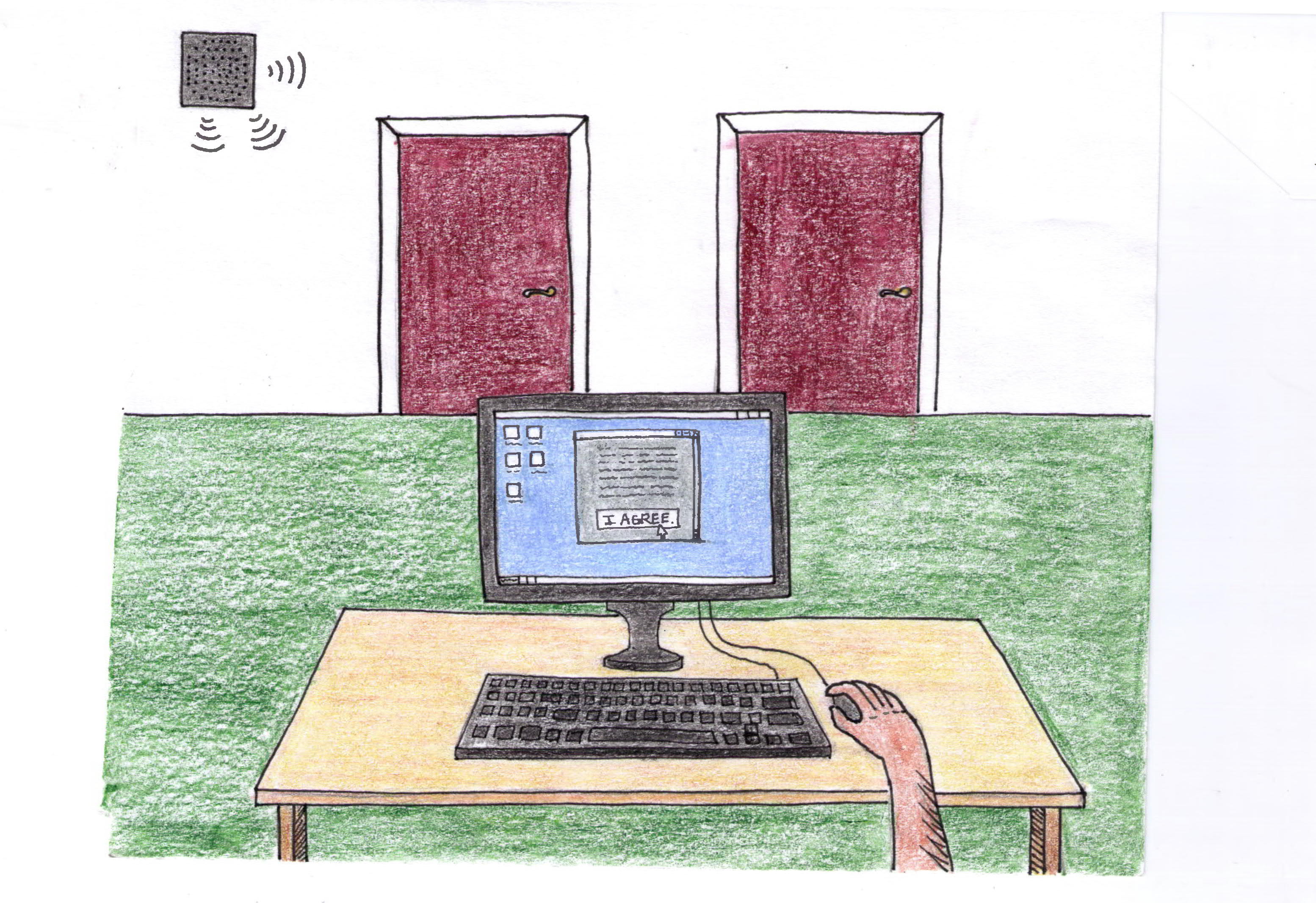
With little hesitance, he went inside. Another surprise! There was no secretary to receive him. There was not a single person there. He looked around. Then, he heard a voice: “Please register on the computer.” He went to the computer and filled out the registration form. The nominal fee was $100. He paid $100 through his credit card and, as all people do, he clicked “I Accept” without looking at the terms and conditions.
Then, the computer said, “Proceed to the door on your right.” He thought this must be a big sophisticated company.
He proceeded through the door and again, to his surprise, he found no one was there. He looked up and saw two signs.
The signs read: “If you are earning $500,000 or more, enter through the right door, or if you are earning less than $500,000, enter through the left door.”
He mumbled, “I wish I was making $500,000 or more! I am here to make that kind of money.” He entered through the left door.
Again, there was no one there, except two doors and two signs.
He read the signs: “If you are earning between $250,000 and $500,000, then enter through the right door, or if you are making $250,000 or less, then enter through the left door.”
He was annoyed by this in-humane treatment and humiliation created by the divisions of people by their salaries. Well, he was here to make more money, so he proceeded through the left door. Now, there was a greater surprise waiting for him.
As soon as he walked through a semi-dark passage, he found himself again on the Park Avenue Street!
Lesson Learned:
Consultation and counseling are good as long as they help us solve our problem. However, many times we unnecessarily run to seek help from outside. I know someone who takes a handful of aspirins from his big bottle at the slightest headache. Many times we run to take a heavy dose of medicine to cure our minor bodily discomforts. The body has a mechanism to cure itself, but we do not have the patience to let it do so.
Shri Krishna in the Shrimad Bhagavad Gita says, “Rise yourself to a higher level of Consciousness by yourself. Do not lower yourself. You are your greatest friend and you are your greatest enemy.” (6.5)
Shri Krishna explains further: “When one has self-control, then one is one’s own friend. When one has no self-control, then one becomes one’s own enemy.” (6.6)
What a wonderful message! Self-control and contentment are great virtues. They bring us success, joy, and satisfaction. In many situations, with patience, self-control, and satisfaction, we can avoid running around for external help. By helping ourselves, we build self-confidence and with that we will start finding solutions from within.
(Thanks to Radha Dhar for editing this post and Sneha Shah for providing illustrations.)
The following post is based on a story I heard from Swami Adiswarananda, the Spiritual Minister of the Ramakrishna Vivekananda Center in New York from 1973 to 2007. This story is not funny, but it has an excellent message.
Let us go back in the past when in India walking was the only way of transportation. People had to go from one village or town to another on foot, and most of the time, they had to go through forests.
At that time, the environment was not disturbed and one could breathe fresh air, but they had to go through the dangers of being killed by animals and sometimes by the highway men. When someone walked through the forests, the relatives of the person would not know for many days whether their family member was killed or reached the destination. If someone survived out of a group of people who were attacked, then only would their family receive the news about the killing.
This is how one group of people found out that in one particular forest there was a crazy giant. If anyone passed by the forest, he would stop the person and ask a question. If the person did not give a satisfactory answer, then he would kill the person. So, people avoided that forest.
One day a wandering monk came to a town near that forest. In the past, in India, wandering monks devoted their mind on God. They would not live at a place for more than three days. Wherever they went, they would guide people to take the name of God and live a decent human life. They helped people solve their personal problems and would try to remove their miseries. In return, people would take care of their basic needs like food and shelter. This monk helped many people of the town and he was ready to move on. When people found out that the monk was planning to go through the forest where the crazy giant lived, they all requested him not to go through that forest as the giant had killed many people. The monk said that he was completely dependent on God and was ready to take on the challenge of the crazy giant. The monk told people not to worry about him. He started walking on the road going through the forest. All people said “goodbye” to him with a heavy heart. They all prayed for him.
The fearless monk was walking through the thick forest. The track was less travelled. So, he had a hard time finding the track, which would hopefully lead him to the next town. Various kinds of birds were chirping. Everything was green and beautiful. He was enjoying the beauty of the nature. He heard some wild animals. As the monk was completely dependent on God, he continued his journey without any fear, repeating God’s name.
After some time, the road broadened and on the sides of the road, he saw a few bodies of people who were killed savagely. The monk remembered the story told by the people of a crazy guy living in this forest and killing people.
The monk continued and thought “Whatever is God’s wish is what will happen.” Within a few minutes he saw a huge, terrible-looking guy standing in the middle of the road laughing.
As the monk went closer to him, the crazy guy said, “Ah! After a long time I found a victim.” And then he again laughed loudly. Anyone else would have died by this laughter, but the monk was fearless. The monk asked him why he was killing innocent people. The crazy guy said, “Well! I want an answer to my question. If a person cannot answer my question, he or she has to die. Your fate is not different from them.”
Again, he laughed for a long time. The monk asked, “What is your question?” The crazy guy said, “The question is very simple. Here are three skulls of three people. Can you tell me which skull is of a wise person? If you cannot give me a satisfactory answer, then you will die.”
The monk was calm. He smiled and went to the three skulls. He took a small pebble and put into the ear-hole of one of the skulls and then he shook it. The pebble came out from the other ear-hole. Then, he took the second skull and did the same thing. The pebble came out from the mouth-hole. The crazy man sat on his knees and start watching the whole thing. Finally, the monk put the pebble in the third skull’s ear-hole and shook it. The pebble did not come out! The monk smiled and handed the third skull in the hands of the crazy guy and said, “This is the wise man’s skull.” The crazy guy said that he should explain why this was the wise man’s skull.
The monk said that the first man heard a good thing from his one ear, but it all went out from the other. The good things did not retain in the head. The second man heard good things, but these good things came out from his mouth. After listening, he gave lectures to others and did not practice them himself. But, the third person whatever good things he heard, he practiced them and assimilated them into his life.
The crazy guy bowed down to the monk. He got up, laughed again and with a great speed ran away. The monk had a sigh of relief and he continued his journey.
Lesson Learned:
I am sure you must have guessed the message after the monk examined the three skulls.
In our scriptures, the following three spiritual practices have been described for a seeker of the Highest Knowledge:
(1) Shravana: The word means to listen to scriptures from a realized person or a person who is committed to realize the Atman (our True Divine Identity lying within) and who is sincerely making all attempts for the realization. This person must have understood the essence of the scriptures. Listening to scriptures from such a person is far better than reading the scriptures by ourselves because by listening we easily get the essence of the scriptures. Shri Shankaracharya says that the scriptures are like deep forests and people easily get lost in them. It means that there are various teachings in the scriptures, many of which look contradictory and many may not be applicable to our situations. Thus, listening to scriptures is a very important spiritual practice for a sincere seeker of Truth.
(2) Manana: This word means reflecting upon what we had listened to and had read from the scriptures. The real thing to hear from the scriptures is about our True Divine Identity lying within ourselves. This is also described as Atman in Vedanta philosophy. This Atman is eternal. That is why It is without birth and death. It does not change. Shrimad Bhagavad Gita says that weapons cannot cut the Atman, fire cannot burn It, wind cannot blow It away, and water cannot drown It. This Atman is the support of our existence and because of It our body and mind function. Its nature is Sat-Chit-Ananda (Existence-Knowledge-Bliss absolute). When we go closer to It through reflections and meditation, we feel the divine bliss within, acquire the knowledge of our True identity, and become fearless by realizing Its eternal nature. By realizing Atman, we know our minds (and thereby, all other minds) in and out. We become free from all bondages which tie us with our little selves, consisting our body and mind. We have to reflect upon the nature of Atman and also reflect upon our imaginary identity of body and mind. The body and mind are constantly changing. They have a beginning and an end. The constantly changing body and mind cannot be our True Identity.
Atman is a part of Brahman, which is the Ultimate Reality of the universe. There is only one Existence which Vedanta describes as Brahman. From Brahman the universe has come. Brahman nourishes the universe and the universe dissolves in Brahman. Also, what is in the universe is in an atom, just as a whole tree lies within a seed. Thus, Atman is nothing but Brahman.
(3) Nididhyasana: This means we have to make efforts to realize this Atman within. The realization of Atman is not an intellectual knowledge. We have to feel within that our true nature or identity is the Atman and our body-mind are like clothes that the Atman is wearing. Once we realize Atman, we find that it is the same Atman residing in all beings, animals, and all the things of the universe. With this awareness of unity, we love all and hate none. We always are ready to serve all with unselfish love, without expecting anything in return. We feel that the purpose of our life is fulfilled and all our doubts go away from our mind. Once we attain the Highest Knowledge, we feel that all the basic questions of life have found their answers. Sages and saints are great because they have attained this knowledge.
Thus, the message of the story is to listen to scriptures, reflect upon the essence of the scriptures, practice the essence of the scriptures, and realize our True Identity (Atman).
(Thanks to Radha Dhar for editing and Pamela C. Beniwal for providing an illustration.)
(The following post is based on a story I heard from Swami Adiswarananda, the Spiritual Minister of the Ramakrishna Vivekananda Center in New York from 1973 to 2007.)
Long before the radio and television were invented, the main principles of the Hindu culture were communicated throughout India by the holy people. They would wander around telling the stories of the great epics, Ramayana and Mahabharata, and expound on scriptures like Bhagavatam and other puranas. Shrimad Bhagavatam is a great book filled with stories of holy people and the life of Shri Krishna, which help develop love for God.
In one village of India, one holy man was expounding on Shrimad Bhagavatam. Usually, this is a seven-day program. Every day the holy man reads and explains a few pages of Shrimad Bhagavatam. Village people come and listen to these stories and, at the end, give money or food to the holy man.
One day, the holy man found that one woman was continuously crying while listening to the discourse. The holy man thought that his explanation was really touching the heart of a devotee. His heart was very much impressed by the devotion of the woman. The holy man was greatly encouraged and he went much deeper into the explanation of the book.
After the discourse, he went to the woman and asked her which part of the book touched her heart. The woman wiping her tears said, “It was not about the book that I was crying. I had a goat. It was such an adorable goat and I loved it dearly. That goat passed away today. I am sorry to say that when you were talking, your goatee constantly reminded me of my goat!”
———————————————————————–
Reflections:
Lesson for the expounders: Never be over-impressed by the listeners’ reactions or responses. It is hard to find out what is going on in the minds of the listeners.
Sri Ramakrishna’s teachings to expounders are very clear and appropriate.
He said, “There is no harm in teaching others if the preacher has a commission from the Lord…When the lamp is lighted, the moths come in swarms. They don’t have to be invited. In the same way, the preacher who has a commission from God need not invite people to hear him. He doesn’t have to announce the time of his lectures. He possesses such irresistible attraction that people come to him of their own accord.” (from the Gospel of Sri Ramakrishna).
Lesson for the Listeners: When we are listening to discourses, we have to put aside all our unrelated thoughts and focus on the essence of the discourse; then only can we learn something from it.
(Thanks to Radha Dhar for editing and Sneha Shah for providing an illustration.)
The following post is based on a story I heard from Swami Adiswarananda, the Spiritual Leader of the Ramakrishna Vivekananda Center in New York from 1973 to 2007.
In the U.S., we see monkeys only in zoos. Many cannot imagine a group of monkeys wandering around in cities or villages, from place to place, mainly in search of food, and maybe in order to maintain or develop their “jumping” skills. They climb up on a tree and swing from branch to branch or jump around on the terraces of buildings a few stories high. In India, we see many such groups of monkeys.
Photo – 1
This is the story of one such group of monkeys in search of food. In India, the weather is mostly sunny, so the windows remain open most of the time. In order to stop monkeys from entering into houses through the windows, houses have iron window grilles built in. Those people who cannot afford such windows have uninvited monkey guests in the house. I have known a few people who were shockingly surprised to see monkeys in their house. If the windows are without grilles, monkeys simply go to the kitchen, grab food, and jump out of the house. If windows have grilles and any food is near the window grilles, monkeys extend their hands inside and grab it.
A group of monkeys is made out of a family or a few families. One such group of monkeys was jumping on the terraces of houses looking for food. Among them was a small monkey who was learning all the monkey tricks and ways to get food. He was jumping around and all of a sudden he saw an apple lying inside a grilled window. It was a big, red apple. Any mouth becomes watery by seeing this apple. The little monkey jumped to the window, extended its hand inside the grille, and grabbed the apple.
Sketch – 1
The monkey was delighted to grab the apple. But, as soon as it tried to bring its hand out with the apple, it found that its hand is not coming out of the grille. The apple was much bigger than the space between the grilles. It tried grabbing the apple in different ways, but its hand could not come out with the apple. It seemed that there was no one in the house. The small monkey started screaming for help. The other monkeys came running to help this little one. They saw the problem and they all started thinking about how to solve it.
One monkey said, “Let us find some sharp object. Then slowly we will cut the grille.” That monkey found a sharp object and started cutting the grille. One monkey said, “Let us try to pull out the whole window. Then the little monkey will have to walk around its whole life with a window on its hand.” That monkey tried to pull out the whole window. One monkey said, “Let us pray to God. I am sure God will find a solution.” It started praying to God. One monkey said, “Try to think that your hand is not caught by the grille.” Among all the commotion, one elderly monkey came and told the little monkey, “Just let go of the apple and pull out your hand.”
Lesson learned: Many times we unnecessarily suffer because we have some desire to fulfill. If the desire is useless or unneeded, then it is better to give it up. With that act of giving something up, we may not lose anything. In fact, our mind will be free from hundreds of worries and struggles.
Sri Ramakrishna gave an example of this. A bird picked up a fish and wanted to eat it. The bird sat on a branch of a tree to eat the fish.
Photo – 2
But, several crows saw that the bird had a fish. They all followed the bird with piercing cawing. The bird tried to run away from the craws and tried to sit on various trees and places. But, all the crows followed it and started poking it with their beaks. Finally, the fish fell from the bird’s mouth. All of the crows followed the fish and left the bird alone. The bird then peacefully sat on a tree. Thus, worries and struggles follow a desire.
The question might arise that, knowing this fact, should we give up all desires? It is true that each desire brings worries and problems. But, as long as we have a body, we will have desires; like desire to live and survive. So, what we should do?
Well, desires are of various kinds. The Shrimad Bhagavad Gita says, “I am the desire in all beings that is not contrary to dharma (7.11).” That means God, the Creator of the Universe, has created righteous desires in all beings. The desires which uplift us from the physical level to the spiritual level, destroy our bondages, and are not harmful to anyone are okay to fulfill. But, our mind runs around and fills itself up with hundreds of other desires, which make us slaves to our senses and are harmful to us and/or others. Such desires should be shunned. These useless and harmful desires bring us many worries and frustrations. Buddha said that the cause of suffering is desires. In life, we get tired by carrying a baggage of extra desires. If we want peace of mind, then we have to reduce the desires to a minimum—the desires which free us from all bondages.
Deeper Meaning of the Story:
Imagine an ocean filled with millions of waves. The Ultimate Reality (Brahman or Consciousness) is like an ocean. Each wave is an individual being or an object. All beings and objects appear as waves (as names and forms) for a little time and then merge into the ocean of The Ultimate Reality. When each wave thinks of itself as a separate entity, then it has conflicts with all other waves and has fears of disappearing as a wave. Similarly, if we think ourselves with our names and forms as separate entities from the Ultimate Reality, then all the problems start. We think that the whole world is against us, that nature is against us, trying to crush us down, and we have a constant fear of death. When we give up our separate identity, then all the problems and fears go away. At that time, keeping in mind ourselves as the Spirit (or Atman, a part of the Ultimate Reality), we just act, like actors/actresses of a play, in the world as separate entities with names and forms.
Notes: (i) The photo -1 is from the Bangalore Gallery , India (ii) Photo – 2 is from dreamtime.com and (iii) the sketch -1 is made by Sneha Shah.
(Thanks to Radha Dhar for editing and Sneha Shah for providing an illustration.)
I heard the following story from Swami Adiswarananda, the Spiritual Head (1973 – 2007) of the Ramakrishna Vivekananda Center in New York. I have added material needed to set up the background of the story.
Taxi drivers make their living by transporting as many passengers as they can each day. For them, time is money. While this mindset helps the driver earn money, sometimes it also results in risky driving.
When I saw how taxis run on the streets of New York City, I remembered a description I had read in the Ramayana. The famous villain Ravana had a plane that was directed through his thoughts alone. The taxis in New York City are similar. If you are driving behind a taxi in New York, you may not know where the taxi will go. It always seems to me that the taxi will only go according to the thoughts of the taxi driver. The taxi driver may go to the right lane or the left, take a right turn or a left, and sometimes even take a complete U-turn.
One such taxi driver died and went to heaven. St. Peter looked at the driver’s life record and gave him a big mansion to live in while in heaven.
After some time, a religious preacher died and also went to heaven. St. Peter looked up his record of good deeds and gave him a simple hut to live in. After moving into his place, the preacher started walking around to see the different parts of heaven. He soon found that his next-door neighbor had a big mansion. He thought that whoever lives in this mansion must be a great religious preacher. However, to his surprise, he found that the mansion was occupied by a taxi driver.
The preacher was furious and went directly to St. Peter. He told St. Peter that he was really upset. He was expecting full justice in heaven. Instead, he found total injustice. St. Peter asked him to explain why he felt mistreated. The religious preacher said that he had taught the name of God to people for every day of his life. For this, he had come to heaven. However, despite this work, the preacher was just given a dingy little place while the taxi driver… a taxi driver… (The preacher’s voice choked out of anger). After controlling himself, the preacher finally finished his thought and complained that his neighbor was given a big mansion despite only driving taxis in New York City.
St. Peter seemed undisturbed. He told the preacher that there cannot be any injustice in heaven. He asked the preacher to calm down and listen to the reason for these rewards. St. Peter said that he had great respect for the preacher’s work of preaching God to people for his entire life. However, when he was preaching, people used to sleep. On the other hand, when this taxi driver was driving his taxi in New York City, the passengers were constantly praying to God! J
Lesson Learned:
Preaching is a difficult job. Sri Ramakrishna once said that only those who have received God’s command could inspire people to truly love God. It is not the oratory skill or the knowledge of scriptures that can inspire people to love God.
Many preachers are great orators or well-versed in scriptures but they do not have God’s command. People who witness these preachers often say, “Wow! This preacher is such a great orator or how this preacher is so knowledgeable!” But, they forget everything the preacher had said shortly after meeting him/her. In these cases, the people unfortunately do not develop a true love for God through listening the lectures.
A sincere devotee loves God and lives a God-oriented life. He/she has no craving to teach people. If God makes a devotee an instrument to inspire people to love God, then the devotee will accept it as God’s wish. Yet, the devotee always remembers that it is God who is inspiring people. The devotee never develops an ego or a sense of doer-ship.
Almost all people need a human example to develop love for God. When we see someone who truly loves God and someone whose thoughts, speech, and actions have Godly-touch, we become inspired to love God. Through this person, we realize that God is not an abstract idea but rather as real as the core of our existence.
Heaven: People wish to extend their worldly pleasures after death and want worldly rewards for their good work. Thus, we find the idea of heaven that has been entertained in most of the religions. Swami Vivekananda says that the idea of heaven differs by the people. If people have been living in deserts and like to enjoy having lots of water, they imagine their heaven with rivers, lakes and lots of green land. People who lived in tropical countries where it rains most of the time imagine heaven as a dry place with occasional rain.
According to the Bhagavad Gita, heaven is like a resort where people go on vacation. People enjoy their money’s worth of pleasures in a resort and when the money runs out, they have to go back to their work place. They cannot earn money at the resort. In this metaphor, the “money” in the heaven is an individual’s good deeds. People want worldly pleasures for their good deeds after their death. For this reason, they have enjoyment in heaven and when they run out of the merits of their good deeds, then come back to earth and start all over again. Heaven and hell go together. There cannot be heaven without hell.
As I had mentioned in my earlier post, living a life for only body-mind enjoyments is a hellish life filled with lots of suffering. Living a God-fearing moral life and doing some good work is a life lived in heaven. Living a Spirit-oriented or Self-oriented life with no craving for worldly desires is a life lived in divine bliss – a life that is beyond heaven and hell.
(Thanks to Madhavi Jani for the illustration and Ronak Parikh for editing this post.)
I heard the following story from Swami Adiswarananda, the Spiritual Head (1973 – 2007), Ramakrishna Vivekananda Center, New York.
Story:
A person in New York was frustrated with many problems in his life. He had problems in his job as well as in his family. He thought he could not handle them. To run away from these problems and worries, he turned to drinking.
One Friday, he spent the whole night drinking in a bar. The next day, he thought he would go to see his friend in Boston. Since he was not sober enough to drive, he decided to take a train. He was so used to drinking that while going to the train station he took a couple of shots of vodka.
He had a ticket to Boston. But the drinks had gone to his head and he could not think straight. He was embarrassed to ask anyone for the train track and platform. He got into a train and found out that it was the wrong train. He got off and sat in another train. But that was also the wrong train.
After getting on and off the wrong train five times, finally, someone helped him to get in a train that was going to Boston. He saw a well-dressed gentleman sitting on a berth. The gentleman was annoyed by the smell and appearance of the drunkard. The drunkard sat a little bit away from this gentleman.
By this time, the drunkard was becoming somewhat sober. To make sure he was in the right train, the drunkard asked this gentleman, “Sir! Where this train is going?”
The gentleman felt pity for the drunkard. He looked at the drunkard from head to toe and said, “Do you know with your drinking habit you are heading towards hell?” The gentleman was a religious preacher.
The drunkard immediately got up and said, “Oops! I am in the wrong train again.” J
Note: I am not promoting drinking.
Lesson Learned: I learned never to judge a person by his/her behavior. Never write off a person. Each person is inherently divine. Negative and wrong thoughts make a person behave badly. In anyone’s life, bitter and painful consequences help replace wrong ideas with the right ideas. Swami Vivekananda said that the role of nature is to make realize each person his/her inner divinity.
We all make mistakes. Swami Vivekananda said, “If a man with an ideal (of realizing one’s inner divinity) makes a thousand mistakes, I am sure that the man without an ideal makes fifty thousand.” When we realize our mistakes, we have to correct them and try not to repeat the same mistakes again.
How do we know if we have wrong ideas? Swami Adiswarananda said that if everyone comes in your way, then you are heading in the wrong direction. We blame other people for our wrong ideas and improper behavior.
Hell and heaven are here on this earth. If we live a selfish life based only on the pleasures of body and mind, then we will be living in hell. If we live life with the goal of realizing and manifesting our inner divinity, then we will be living in heaven. Living a spiritual life or Soul-oriented, unselfish life brings bliss that is beyond heaven.
(Thanks to Sonali Tatapudi for editing and Sneha Shah for illustration .)
I heard the following story from Swami Adiswarananda , the Spiritual Head (1973 – 2007), Ramakrishna Vivekananda Center, New York.
Story:
Two people decided to travel around the world in a hot-air balloon. They were enjoying their journey, looking at mountains, rivers, fields, cities, villages and various other points of scenery.
In one part of the world, they unexpectedly hit a big storm. Their maps, cell phones, and all other belongings were blown off the balloon. Their balloon being caught in the heavy wind was tossed all around. They thought they would definitely die.
By God’s grace, however, the storm passed on without harming them. As they struggled to bring the balloon under their control, they noticed the beautiful landscape. Lush green meadows stretching for miles lay beneath them. The greenery was eye-catching and soothing to the mind. They tried to guess where they were, but having been tossed around in all directions, they had no clue.
Bringing their balloon down, they tried to look for any signs of life, but found none. Suddenly, their eyes caught something moving. As they came closer, they found that it was a man walking back and forth.
He was dressed nicely, had a white beard and was supporting himself with a cane . One of the travelers asked him, “Sir, can you tell us where we are?”
The person stopped walking. He looked up at the balloon, and then looked around, engrossed in deep thought for a while.
The traveler in the balloon thought that the man either did not hear him clearly or did not understand English. The traveler had no choice but to try again. This time, she asked more loudly, “Sir, can you tell us where we are?”
The person on the ground seemed as though he was coming out of his thoughts. With emphasis and with full conviction he said, “You are in a balloon.” 🙂
The first traveler told the second traveler, “He must be a philosopher.”
The second traveler asked her, “How do you know that he is a philosopher?”
The first traveler said, “I know for sure that he is a philosopher because (1) What he said is absolutely true, and (2) What he said is also absolutely useless.” 🙂
(This is NOT meant to put down philosophers. So, no philosopher should take this personally.)
Lesson Learned:
From this story, I learned that many times, philosophical discussions are nothing more than intellectual entertainment. They do not help us to live better lives in any way, nor do they answer any fundamental questions of life, such as:(i) Is there any meaning to life? (ii) What is my true identity? Am I just this body and mind, or something more? (iii) Does this universe have any meaning? (iv) Am I connected with other individuals? If yes, , then in what way am I connected? (v) What is the goal of my life?
If there exists a philosophy which can answer these questions in a sensible and logical way, and if it can also improve my life, then that philosophy is good. Also, such a philosophy must be practical. I should be able to realize the truths presented by the philosophy.
Sri Ramakrishna used to say that “Granthas” (books of philosophy) are “Granthis” (knots). In other words, mere book-learning without discrimination and non-attachment serves only to increase one’s arrogance and vanity. That means, it multiplies the knots (confusion) in one’s mind.
Sri Ramakrishna said, “The “Para-Vidya” or Highest Learning is that by which God is known” (In other words, highest learning is that through which the Ultimate Truth is realized.) All else, the scriptures, philosophy, logic, grammar etc.- only load and puzzle the mind. They are good only when they lead to the Highest Learning.
(Thanks to Jahnavi Vyas and Sunita Dhar for editing this post and Ishani Trivedi for illustration.)
The following is a story I heard from Swami Adiswarananda (1973 – 2007), Spiritual Head of Ramakrishna Vivekananda Center, New York.
In India, one circus was traveling from one city to another for its shows.
The circus was not making much money, so it adopted a cheaper way of transportation. It loaded heavy materials, like poles and tents, on the back of donkeys.
To make sure that the donkeys did not run away, logs of wood were tied from their front left foot to their hind right foot. With the logs of wood, the donkeys could walk slowly but could not run away.
During the shows, the donkeys were free of their load, but the logs of wood always remained tied to their feet. In the daytime, the donkeys were allowed to walk around to graze. At night, they came back to the circus for more food and shelter.
One day, one donkey slowly walked far away from the circus and neared a forest.
There, he met a wild donkey who was freely running around. They started a conversation. The circus donkey said, “At the end of the day, I do not have to worry if I do not get enough food to eat while roaming around because I am sure to get food at the circus.”
The forest donkey said, “It is true that I have slept without food for many nights, but I am happy that my feet are not tied up by a log of wood. I can walk, run, and dance freely without that bondage. Also, I can wander around wherever I want to go and enjoy the beautiful nature. If you want to enjoy freedom, you should come with me and we will find a way to remove your log of wood.
After listening to the forest donkey, the circus donkey felt that he should join him, but was hesitant to let go of the opportunities that could arise if he stayed with the circus.
The forest donkey asked, “What is the future prospect that is stopping you from your own freedom?”
The circus donkey said, “It is a long story. The circus manager has a beautiful young daughter. She is very good in the swing part of the circus. One day, she was practicing various swinging tricks and I was observing. During the practice session, she did not catch the swing and fell on the net. The manager was furious and said, ‘If you fall one more time, I will marry you to this donkey.’ So you see, I am waiting for the daughter to fall. Marrying her is my future prospect.” 🙂
The forest donkey quietly left and went deeper into the forest.
Lesson Learned: Most people dream of achieving something in life. Many do not get opportunities to work towards their dreams. However, many do get opportunities to work hard and realize their dreams. Obstacles do come in their way, but they overcome them with determination and tenacity and are able to fulfill their dreams.
Some people have dreams but wait for miracles to occur, which may help them realize their dreams. Usually these are false hopes.
We have to be careful not to entertain imaginary future prospects.
(Thanks to Pallavi Tatapudy and Ishani Trivedi for editing this post).
The steps to realize the Ultimate Truth: (Chhandogya Upanishad, Chapter 8.7 – 8.12)
Chhandogya Upanishad
Prajapati (The Lord of people) said, “One has to search and realize the Atman. The Atman is pure, free from hunger, thirst, old age, and death. Its desires and vows come true. If one searches the Atman following the scriptures and the guidance of a competent teacher and realizes It, then all his desires are fulfilled and he attains everything.”
The devas and demons heard Prajapati’s declaration. The realization of Atman, they thought, would fulfill all their desires and allow them to attain everything they ever dreamed of. They decided to pursue this quest for the Atman.
Devas asked their king, Indra, and the demons asked their king, Virochana, to go to Prajapati to learn about Atman.
Both Indra and Virochana went to Prajapati’s ashram with offerings in their hands. Jealous of one another, they vowed to themselves, I will learn about Atman first.
Prajapati asked them to stay in the ashram, live an ascetic life, and take the vow of celibacy. They lived there for 32 years.
After 32 years Prajapati asked them, “What is it that you desire? What has motivated you to stay here?” Both said that they had heard the Revered Prajapati’s declaration, “One has to search and realize the Atman. The Atman is pure, free from hunger, thirst, old age, and death. Its desires and vows come true. If one searches the Atman following the scriptures and the guidance of a competent teacher and realizes It, then all his desires are fulfilled and he attains everything.” They too wanted to know and realize the Atman.
Prajapati said, “The Person that is seen in the eyes,-that is Atman. That is the immortal and fearless Brahman.”
The Person thst is seen in the eyes
Indra and Virochana asked, “Between these two, one which is perceived in the water and the one which is perceived in the mirror, which one is Atman?” Prajapati said, “The same one, indeed, is perceived in all of these.”
Reflection in mirror
Reflection in water
Prajapati said, “Both of you go and look at yourselves in a pot filled with water.” They both looked at their reflections in the water. Prajapati asked, “What do you see?” Both said, “O Lord! We see Atman from head to toe, along with hair and nails.”
Then, Prajapati asked both of them to wear their best clothes and ornaments. Indra and Virochana did as they were told and returned in their finest clothing and ornaments. Prajapati told them to look at themselves in the water. He then asked, “What do you see?” Both Indra and Virochana said, “O Lord! We see that the reflection is dressed as we are dressed up. Prajapati said, “That is Atman. That is the immortal and fearless Brahman.” Satisfied with that answer, Indra and Virochana left the ashram.
Watching them leave, Prajapati mumbled, “Both of them are leaving without knowing and realizing Atman. Devas or demons, those who do not truly know Atman will perish.”
Virochana, the king of the demons, was satisfied with what he had learned. He went to the demons and started to teach them that the body is Atman. It is this Atman (body) that has to be worshiped and nurtured. One who takes care of this Atman (body) fulfills all desires and attains everything.”
Therefore, even today people say that a person is of demonic nature if he/she has no faith in something higher than his/her body, and sees no purpose in charity and spiritual development. People of demonic nature adorn even dead bodies with make-up, nice clothing, and ornaments thinking that these things will help the dead person attain everything.
Indra too was on his way to see the Devas. Yet, a thought kept disturbing him. Something was definitely wrong with his understanding of Atman. He started thinking, ‘when a body is adorned with nice clothes and ornaments, its reflection too is adorned with nice clothes and ornaments. Similarly, if a person becomes blind, then its reflection becomes blind; if a person is hurt, then its reflection is hurt, and when a person dies, then its reflection also dies. Something was awry. How could there be anything beneficial in this knowledge of Atman?’
Indra went back to Prajapati with offerings in his hands. Upon seeing Indra, Prajapati asked “O Indra! I saw that you and Virochana were satisfied with the knowledge of Atman and had left. Why did you come back again? What do you want?” Indra replied, “O Lord! I do not see any benefit in my understanding that the reflection of the body, which I see through my eyes, is Atman. If I put on nice clothes and ornaments, my reflection puts on nice clothes and ornaments. If I am clean, my reflection is clean. But, if I become blind, my reflection becomes blind. If I am hurt, my reflection is hurt and if I die, my reflection dies.” Prajapati said, “O Maghavan (Indra)! Yes, it is like that. Live here for another 32 years observing celibacy. After 32 years, I will explain it to you more.”
After 32 years, Prajapati said, “TheOne who moves about, exalted, in our dreams is Atman. It is the immortal, fearless Brahman.” Indra was satisfied and left.
But, before he reached the Devas, he thought, there is something wrong with his understanding of Atman. If one becomes blind, his dream-self does not become blind; if one gets hurt, his dream-self does not get hurt; and if one dies, perhaps his dream-self does not die. Thus, the limitations and changes of the body do not apply to the dream-self. But, if in one’s dream, someone beats the dream-self, the dream-self feels the pain, if someone treats the dream-self badly, then it gets upset, and if danger approaches the dream-self shows fear. Thus, one’s dream-self cannot be Atman and there is no benefit in this knowledge of Atman.
Indra came back to Prajapati with offerings in his hand. Prajapati asked, “O Indra! You had left satisfied with your understanding. Then, why did you come back? What do you want?”
Indra answered, “O Lord Prajapati! It is true that my dream-self does not get affected by whatever happens to my body. For examples, it does not become blind if my body does, it does not get hurt even if my body gets hurt, and it does not die even if my body dies. But, if someone beats my dream-self, then this dream-self feels pain, if someone treats my dream-self badly, then it gets upset, and if some danger comes to my dream-self, then it shows fear. Thus, I do not see any benefit in knowing that my dream-self is Atman.”
Prajapati said, “O Maghavan! It is like that. Live here for another 32 years observing celibacy. After 32 years, I will explain it to you more.”
After 32 years, Prajapati said, “When a person is in deep sleep, he sees no dreams and is happy – that is Atman. It is the immortal and fearless Brahman.” Indra was satisfied and left.
But, before he reached the Devas, he thought to himself, in deep sleep one is not even aware of his own self and other people. In deep sleep one is not aware that “I am Atman.” What is good about this deep sleep state? It is as good as being a dead person. Indra did not see anything good about this knowledge of Atman.
Indra came back to Prajapati with offerings in his hands. Prajapti asked, “O Indra! Satisfied with your understanding of Atman, you had left. Then, why did you come back? What do you want?”
Indra replied, “O Lord Prajapati! In deep sleep I am not aware that “I am Atman” and I am not aware of all people and things around me. It is like I have died. I do not see anything good in this knowledge.”
Prajapati said, “O Maghavan! It is like that. This time, live here for another 5 years observing celibacy. After 5 years, I will explain it to you more.”
Indra lived with Prajapati for another 5 years observing celibacy. Thus, they say that Indra had lived with Prajapati for 101 years observing celibacy.
After 5 years, Prajapati told Indra, “O Indra! The body is mortal. It dies. But, this mortal body is the abode of the immortal, body-less Atman. As long as one has body-consciousness, one has likes and dislikes. But, likes and dislikes do not touch a person who is aware of the body-less Atman lying within.”
“Wind, cloud, lightning, and thunder are body-less. All these arise from the space and, through the light of the sun, go back to their original forms. Similarly this Atman arises from the body and through the Supreme Knowledge of Itself, goes back to Its original form.
In that state, the Atman moves about–laughing, playing, and rejoicing–without thinking of the body. But, this very Atman remains attached to the body as an animal remains attached to a cart.
The Atman is the cause of seeing and the eyes are Its instruments to see. When one is aware of this fact, that person realizes that the Atman is the “Seer” and the eyes are Its instruments.
– When one is aware that the Atman is the cause of smelling, the “Smeller” is the Atman and the nose is Its instrument.
– When one is aware that the Atman is the cause of speaking, the “Speaker” is the Atman and the mouth is Its instrument.
– When one is aware that the Atman is the cause of listening, the “Listener” is the Atman and the ears are Its instruments.
– One who is aware that the Atman is the cause of thinking, the “Thinker” is the Atman and the mind is Its instrument. The mind is called the divine eyes of the Atman. The Atman sees all the desires in the world through the divine eye of the mind.
After learning this Truth, the Devas meditated on this Atman. As a result, all their desires were fulfilled and they attained everything.” “Thus,” Prajapati declared, “One who understands the teachings about Atman from the scriptures and from a competent teacher and realizes It fulfills all his desires and attains everything.”
Reflections:
Four States:
This story beautifully describes the four states of a human being: Jagrata (physically awake state), Swapna (dream state), Sushupti (dreamless sleep state) and Turiya (state of awareness of Atman).
Jagrata (physically awake state): Most people remain in the physically awakened state for most of their time. Also, most people think that this is the only real state of a human being. Whatever we perceive in this physically awakened state is real and all other things are imaginary or delusion. Most of us consciously or unconsciously believe that what we perceive through our senses are the only useful things in life. We try to understand the world with what we perceive through our senses. All our physical knowledge lies on these grounds, on sense perception.
We perceive most parts of our bodies through our eyes. We also perceive our bodies through their reflections in the mirror or water or through our photographs. All our joys and sorrows are based on this sense perception.
Indra thought that the physically awaken state was the only reality. But, then he realized that what we perceive through our senses is limited. The body undergoes changes. It is subject to disease, old age, and death. Indra realized that Prajapati wanted him to reflect further; the body was not the Ultimate Reality. Human beings are more than their body. One cannot be really happy by nurturing the body alone and constantly thinking about the pleasures of the body.
Swapna (dream state): Prajapati drew Indra’s attention to another state of a human being– the dream state. When a person is in the dream state, his/her mind creates an entire universe. In this state, the outer world, the world perceived through the senses, disappears. In a dream a person can create the Yankee Stadium filled with thousands of people watching a ball game. That person can even create themselves in the dream, enjoying the game. For the dreamer it is all real. Many a times, in one’s dreams, a person fulfills all of the unfulfilled desires of his Jagrata (physically awakened) state.
Indra realized that the limitations of the Jagrata state do not follow in the dream state. Even when one is poor in the physically awakened state, he may become rich in his dreams. However, unpleasant things may happen. A rich person may become poor in his dream. A hungry tiger may chase the dreamer, in an attempt to devour him. It is good that we do not remain in the dream state all the time and we wake up in the middle of unpleasant dreams.
Indra realized that the dream state was not what he wanted. He wanted all his desires to be fulfilled and wanted to be happy and free from the fear of death. He found that dream state too has sufferings and limitations. So, he came back to know more.
Sushupti (state of deep sleep): When a person is going to sleep, one turns off all the lights of the house, goes to the bedroom, turns the light off in bedroom, keeps a night-lamp on and sleeps on the bed. Similarly, when a person is going to sleep, slowly all the senses are withdrawn and get cut off from the physically awakened state. Then, he enters in the dream state. At one point, all the dreams go away and he falls into deep sleep. Like that night-lamp which remains on in the bedroom, in deep sleep the vital forces keep one alive. The senses have merged into mind and mind has merged into Atman. If a person has good dreamless sleep, he feels very happy. However, as soon as he wakes up, within a fraction of a nano second all of the things connected to the physical-self come rushing back: all work, all the plans and desires, all associations, joys and sorrows, likes and dislikes and more. The person does not find any change or a transformation within oneself, all that has happened is that the body and mind have had a good rest.
Indra realized that this state of dreamless sleep was as good as being lifeless or dead. There is no awareness of the Atman. He did not see anything deeper in this state beyond having achieved physical rest. He recognized that the awareness of Atman could not be this state. Prajapati agreed with him. Prajapati acknowledged that Indra was finally ready to understand the Atman after thoughtfully ruling out the other three states.
Turiya (state of awareness of Atman): Prajapati gave excellent analogies of body-less entities. When we think of Atman as body-less, we have difficulty grasping this concept. But, Prajapati points to the wind, cloud, lightning and thunder which are also body-less. They come from space and disappear into space. Thus, through these analogies, we get a little glimpse of what Prajapati was trying to explain. We can see that something can come from an infinite source; it reveals itself after becoming tangible or graspable by the senses and again it can merge into the infinite. Sound and light are waves. These waves are graspable to humans at certain frequencies, and they can exist beyond our comprehension. The body-less infinite unchangeable Ultimate Reality or Ultimate Power creates bodies and things of the universe that are comprehensible by our human senses, which eventually merge back into that Ultimate Reality or Power. That Ultimate Reality or Power is called Brahman and it is called Atman with reference to an individual. This body-less Atman is our true identity. It resides in our finite body. This Atman is the cause of our capacity to touch, taste, smell, speak, hear, and think. This Atman has created its instruments to perceive the world of senses.
A person can attain this Turiya state where there is only awareness of Atman and it is not a state of dreamless sleep. People have witnessed such states of awareness. It is called a Nirvikalpa Samadhi. One example I know is that of Sri Ramakrishna. He used to be in such a state often. Atheists, critics and medical doctors have examined this state and accepted that physically there was no sign of life, but it was not death or a deep sleep. The face of Sri Ramakrishna was beaming with joy even in the intense painful physical state of throat cancer. He was oblivious of the pain and pleasures of the body.
Swami Vivekananda said that the difference between a person going into dreamless deep sleep and the Nirvikalpa Samadhi is this: a dull minded person remains dull minded after going into deep sleep, but a dull minded becomes a wise person after coming back from Nirvikalpa Samadhi. After attaining this state one experience so much bliss that all the joy of fulfilling all the possible worldly desires becomes an insignificant small fraction of that bliss. After realizing Atman, no desires remain to be fulfilled and one feels that one has attained everything that a human being can attain.
This Turiya state is possible by any person who follows the guidance described by the scriptures and competent teachers. Even if one does not attain Nirvikalpa Samadhi, going towards this state of awareness of Atman brings fulfillment, knowledge, and fills the heart with unselfish love and unlimited bliss.
Swami Vivekananda
Swami Vivekananda says, “There is something behind this world of senses, this world of eternal eating and drinking and talking nonsense, this world of false shadows and selfishness. There is something beyond all books, beyond all creeds, beyond vanities of the world-and that something is the realization of God within yourself.”
A Dispute among the Senses and Faculties of a Human Being
Once there was a dispute between all the senses and several faculties of a human being. Each one, the eyes, the ears, the hands, the legs, the mind and others started to claim, “I am the best.”
The eyes said that if one cannot see, one could not do anything. The ears said that without listening one would face many problems in life; the legs said that without being able to move, one’s life was doomed.
The question was raised, who could decide which one of these senses was superior to the rest?
They all went to their creator Brahma. Lord Brahma listened to them and thought about a solution. He advised that each one of the senses and the faculties of the body, one at a time, go on vacation for a year. In whose absence the body becomes most crippled, that sense or a faculty is the best among all.
First, speech went on vacation for a year.
Speech going to vacation
Then, speech came back and asked all the senses and the faculties of the body how they lived their life without talking.
In reply, all the senses and faculties of the body said that they lived life as a mute person lives. Mute people can see with their eyes, listen with their ears, think with their minds and thus they lived.
After that, the eyes went on vacation for a year.
Eyes going on vacation
Then, the eyes came back and asked all the senses and the faculties of the body how they lived their life without the ability to see.
In reply, all the senses and the faculties of the body said that they lived as a blind person lives. Blind people can speak with their mouths, listen with their ears, think with their minds, and thus they live their life.
Next, the ears went on vacation for a year.
Ears going on vacation
Then, the ears came back and asked all the senses and the faculties of the body how they lived without the ability to hear.
In reply, all the senses and the faculties of the body said that they lived as a deaf person lives. Deaf people can speak with their mouths, see with their eyes, think with their minds, and thus they lived their life.
Then, the mind went on vacation for a year.
Mind going on vacation
The mind came back and asked all the senses and the faculties of the body how they lived without thinking.
In reply, all the senses and the faculties of the body said that they lived as babies live whose minds have not been fully developed. Babies speak with their mouths, see with their eyes and listen with their ears.
Finally, Prana (the vital forces including breathing) started going on vacation.
As soon as the Prana started leaving the body, all the sense started losing their power. All felt as if a powerful wild horse was pulling out all the nails that have tied it with ropes.
Then, all the senses went to the Prana and said, “Please do not leave. You are the best among all of us.” The eyes, the ears, speech, and the mind said to the Prana that they are all powerful because of the Prana. That is why, in the scriptures all the senses are referred to as Prana.
– Chhandogya Upanishad: Chapter 5, section 1
(Thanks to Sneha Shah for illustrations and Nisha Parikh for editing the post.)