Category Archives: Philosophy

Shatashloki – VII (Shloka 8)

“Shatashloki” of Shri Shankaracharya – VII (Shloka – 8)

The Teachings of the Upanishads

Shloka – 8

Translation:

To appease a child who is crying for a long time, his/her mother gives the child various fruits like grapes, or dates, or a mango, or a banana to eat. Similarly, the Upanishads have prescribed various methods to bring peace and to acquire proper knowledge to the disturbed mind of a deluded person whose delusion has been piled up due to the ignorance of innumerable past lives.

Comments:

A Mother consoling her crying child:

This picture of a mother and child is universal. The food items may vary. I wonder how many children will be appeased by fruits! This mother must be of a Sattvika nature who gives Sattvika food to her child. Usually, the candies and the cookies appease most of the children. However, the picture of a crying baby and mother’s various attempts to appease her child is universal and eternal. It is an appropriate picture which follows by Shri Shankaracharya’s message.

Shri Shankaracharya considers the Upanishads as the Mother of all people and the Upanishads through their teachings trying to appease the crying people. The people are crying like babies due to their problems of life and many problems are self-created. Shri Shankaracharya says that the fundamental cause of all human problems is the ignorance of the Reality. A person by ignorance thinks that ‘I am such and such a person and I am this body and mind.’ With that ignorance, all the problems begin.

The cause of crying:

Children cry when they don’t get what they want, or they are hungry, or something is hurting them, or they are tired or sick. Adults think that the children are ignorant and they cry because they have a lack of understanding. But, adults also cry. They cry mainly when they are sick, or they lose their near and dear ones, or they lose their jobs or money, or their desires do not get fulfilled or they feel helpless. I am sure the wise people who love all and have compassion for all feel the pain of the crying adults, but they know that these adults are crying because of their ignorance and lack of true knowledge.

In human life, there is little joy and lots of suffering. Birth, old age, sickness, and death are painful. Dejection, any kind of loss, and not getting what we want is painful. On top of this natural calamities come. Many people were happy with their normal life. But the coronavirus came and disturbed the happiness of people all over the world. Everywhere people are filled with the fear of death and uncertainty of life. In the hospitals, people are separated from their families and are suffering alone and many of them are dying alone. Maybe after a few months or a few years, the coronavirus situation gets under control and we may go back to the ‘revised normal’ living. But after that, the whole package of our previous joys and sorrows, desires and disappointments, future plans and their obstacles, and many other things will come back and they will occupy our mind.  Sri Ramakrishna says that “If you throw a brick-bat into a pond covered with moss, you get a glimpse of the water.  But a few moments later the moss comes dancing back and covers the water.” Similarly, in painful times we come face to face with Reality of life, but then the Mahamaya, the deluding power of Brahman, covers our minds with many unfulfilled desires and we forget the Reality.

Even without any natural calamity, we are not always happy. Our desires have no end. When our desires are not fulfilled we are unhappy. Even when our one desire gets fulfilled, other desires occupy our mind and will not let us enjoy the happiness we had acquired. Many times, we work day and night sacrificing all our comforts and pleasures to acquire one worldly object. But when we get that desired object, our mind loses interest in that object. Thus, the problem is not in worldly objects, but it is in our minds.

The real urge to acquire spiritual knowledge:

Only when we realize that the worldly objects cannot give us longer-lasting happiness, then we look for something higher than the worldly objects to acquire longer-lasting happiness. Lord Buddha saw this longer-lasting happiness or serenity on the face of a mendicant who had no worldly possession. Shri Ramakrishna said that as long as the child is busy playing toys, the mother gets all the work done in the house like cooking and other choirs. When the child gets tired of playing with the toys and really needs his/her mother, then the child screams for the mother.  At that time the mother puts away the pots and pans and comes to the child running. Similarly, when we realize that the worldly objects like toys cannot give us the longer-lasting happiness, then the real hunger for the higher knowledge comes. Until then we have to go through the waves of joys and sorrows in life where the waves of sorrows are higher and deeper than the waves of happiness. We appreciate and understand the value of the Upanishad’s teachings when that real cry comes from within.

Would crying help?

From the human and the practical point of view crying helps to vent out our pain lying within. If people don’t cry and keep the pain inside, then they develop psychological problems that are harmful.

However, just venting out our pain by crying and then get back again into the same routine of life which keeps us in the vicious cycle of suffering and crying, does not help to remove the main cause of our suffering. People think that crying to God may help fulfill our worldly desires.  Swami Vivekananda says that such crying increases our superstitions.

Swami Vivekananda:  “You know in your inmost heart that many of your limited ideas, this humbling of yourself and praying and weeping to imaginary beings are superstitions. Tell me one case where these prayers have been answered. All the answers that came were from your own hearts.

You know there are no ghosts, but sooner are you in the dark than you feel a little creepy sensation. That is so because in our childhood we have had all these fearful ideas put into our heads. But do not teach these things to others through fear of society and public opinion, through fear of incurring the hatred of friends, or for fear of losing cherished superstitions. Be master of all these,

What is there to be taught more in religion than the oneness of the universe and faith in one’s self?”

In the following passage, Swami Vivekananda says that the ultimate help is going to come from within. There is no use of crying.

Swami Vivekananda: “It is a tremendous error to feel helpless. Do not seek help from anyone. We are our own help. If we cannot help ourselves, there is none to help us. …”Thou thyself art thy only friend, thou thyself art thy only enemy. There is no other enemy but this self of mine, no other friend by myself” (Bhagavad Gita 6.5). This is the last and greatest lesson, and Oh, what a time it takes to learn it! We seem to get hold of it, and the next moment the old wave comes. The backbone breaks. We weaken and again grasp for that superstition and help. Just think of that huge mass of misery, and all caused by this false idea of going to seek for help!”

The cause of our suffering is ignorance:

The Upanishads say that the cause of our sufferings is the ignorance of our true identity which is called ‘Atman’. We think that we are just our body and mind, but through reflections, meditations, and proper spiritual practices Rishis and many saints realized that behind our body and mind there is something eternal and non-changing substratum called ‘Atman’ which is our true nature.  By nurturing the ignorance of our true nature we suffer again and again.

Swami Vivekananda says, “The main cause of all bondage is ignorance. Man is not wicked by his own nature–not at all. His nature is pure, perfectly holy. Each man is divine. Each man that you see is a God by his very nature. This nature is covered by ignorance, and it is ignorance that binds us down. Ignorance is the cause of all misery. Ignorance is the cause of all wickedness, and knowledge will make the world good.”

Swami Vivekananda says, “A caterpillar spins a little cocoon around itself out of the substance of its own body and at last, finds it imprisoned. It may cry and weep and howl there; nobody will come to its rescue until it becomes wise and then comes out, as a beautiful butterfly. So (it is) with these our bondages. We are going around and around ourselves through countless ages. And now we feel miserable and cry and lament over our bondage. But crying and weeping will be of no avail. We must set ourselves to cutting these bondages.”

What to do then? Swami Vivekananda talks about it in the following passage:

Swami Vivekananda says, “If the room is dark, do you go about beating your chest and crying, “It is dark, dark, dark!” No, the only way to get the light is to strike a light, and then the darkness goes. The only way to realize the light above you is to strike the spiritual light within you, and the darkness of sin and impurity will flee away. Think of your higher self, not of your lower.”

This higher self is within us.

Swami Vivekananda says, “The Vedanta proves that the truth for which we have been searching all this time is present, and was all the time with us. In our ignorance, we thought we had lost it, and went about the world crying and weeping, struggling to find the truth, while all along it was dwelling in our own hearts. There alone can we find it.”

The teachings of the Upanishads:

Swami Vivekananda brought out two major teachings of the Upanishads: ‘Oneness’ and ‘Faith in one’s Inner Self’.

The ‘Oneness’ is the ‘Oneness of Existence’. The Upanishads teach that there is only one Reality, one Existence behind the varieties of people, animals, trees, plants, stars, sun, moon, planets, and all the objects of the universe. The same Brahman appears out of our ignorance as a variety of things. It is like waves in the ocean of consciousness. Various waves arise in the ocean. They look different, but they all are nothing but the ocean water. They appear in the ocean and again merge in the ocean.

The following passage gives us some idea about the Brahman:

Swami Vivekananda says, “The Purusha (Brahman) does not love, it is love itself. It does not exist, it is existence itself. The Soul does not know, It is knowledge itself. It is a mistake to say the Soul loves, exists, or knows. Love, existence, and knowledge are not the qualities of the Purusha, but its essence. When they get reflected upon something, you may call them the qualities of that something. They are not the qualities but the essence of the Purusha, the great Atman, the Infinite Being, without birth or death, established in its own glory. It appears to have become so degenerate that if you approach to tell it, “You are not a pig,” it begins to squeal and bite.”

The same Brahman reflects in each individual as an Atman. Sri Ramakrishna says that imagine the body is like a plate and the mind is like water in the plate and in that water there is a reflection of the sun, which is Atman. This Atman is our true identity. It is divine. It is never born and does not die. Its nature is Existence-Knowledge-Bless Absolute. By realizing It all our fear of death goes away, our mind gets filled with bliss, and we get endowed with tremendous inner strength. This is the second thing we can learn from the Upanishads, ‘the faith in our true identity – Atman.’ By realizing Atman, we can remove the cause of all our sufferings.

Sri Ramakrishna’s teachings of crying:

Sri Ramakrishna says that people shed a jug of tears for their relatives, money, and many worldly things, but who cries to realize God. If people sincerely cry for three days to realize God, then they have a vision of God.

This crying is not for the worldly rewards and for worldly gain. This crying comes when we understand the futility of trying to get longer-lasting happiness from the finite worldly objects. Sri Ramakrishna used to say that often one has to go into solitude and reflect upon the ultimate truth, ‘Brahman alone is real (permanent) and everything else is unreal (impermanent)’.  By realizing the eternal and omnipresent Brahman, we feel infinite bliss within and we can go through the joys and sorrows of life keeping our mind always focused on the Brahman. Then, we may cry due to human suffering, but we will not get deluded. We always remember that this world is impermanent and we have to move on.

The Upanishad’s teachings will make us strong and fearless and will give us the fulfillment of life. The four yogas (Jnana Yoga, Bhakti Yoga, Raja Yoga, and Karma Yoga), developed from the Upanishads and the Bhagavad Gita, are also helpful to remove our sufferings of life.

Note: Today is Lord Buddha’s Birthday. His goal of life was to remove the sufferings of life and bring bliss within. May we make sincere efforts to remove the sufferings of our life and bring peace and bliss within.


Brahma Sutras (Lesson – 3: Sutra – 2)

Brahma Sutras – Sutra 2

(Study based on Shri Shankaracharya’s commentary)

Topic – 2: Definition of Brahman (sutra-2)

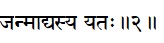
Sutra-2:

Meaning: From Brahman came the creation, preservation, and the dissolution of the universe.

Comments:

Only nothing comes out of nothing:

This sutra says that the universe did not come out from nothing. Only nothing comes out of nothing.

The Big Bang Theory is the prevailing cosmological description of the development of the Universe. Under this theory, space and time emerged together 13.8 billion years ago and the energy and matter initially present has become less dense as the Universe expanded.

The most widely accepted theory of planetary formation, known as the nebular hypothesis, maintains that, 4.6 billion years ago, the Solar System formed from the gravitational collapse of a giant molecular cloud which was light-years across. Several stars, including the Sun, formed within the collapsing cloud. The gas that formed the Solar System was slightly more massive than the Sun itself. Most of the mass collected in the center, forming the Sun; the rest of the mass flattened into a protoplanetary disc, out of which the planets and other bodies in the Solar System formed.

However, something was there to expand. According to the Rishis, who reflected upon the fundamental questions of life like: (1) What is my true identity? (2) What is the purpose of my life? (3) How this universe came into existence? (4) What is the reality behind this constantly changing universe? (5) Who is preserving this universe? (6) What is the ultimate end of this universe? (7) What is my relationship with the universe? (5) What is my relation to all other beings? and found their answers through their scientific search within. They found with their inner search and reflections that there is only one Ultimate Reality which they call it ‘Brahman’ and the same Ultimate Reality appears as the universe. This conclusion matches the scientific conclusion mentioned above.

In the previous sutra, it has been said that when one has a proper background, then an intense desire comes to inquire into the nature of Brahman.  It was also established that the knowledge of Brahman makes one free from all bondages, destroys all doubts regarding one’s own existence and the universe, brings fearlessness, peace of mind, and fulfillment of life.

Now, in order to know or realize Brahman, one should know ‘What is Brahman?’ and “What are the characteristics of Brahman?”

Doubts and arguments for impossibility to acquire the knowledge of Brahman: Some people say that “Brahman has no characteristics by which It can be defined, and in the absence of definition It cannot be known, and consequently there cannot be any liberation or freedom from all bondages.

Answer: This sutra and its commentary give the answer to this question. It is not easy to describe Brahman, but sincere attempts are made to give as much idea of Brahman as possible. A mother points out a finger to the moon and tells her child, “Look at the moon.” The hand and the pointed finger are not the moon. They just point towards the moon. The child has to see the moon. Thus, Brahma Sutras and all the scriptures just point out to the Brahman. People have to follow the directions given by the scriptures and do appropriate spiritual practices to realize the Brahman. Those who have followed properly, they had realized the Brahman and their experiences match with the experiences of the Rishis who have realized It. Sri Ramakrishna, Holy Mother Sri Sarada Devi, Swami Vivekananda, and many other saints are examples of people who have realized the Brahman.

There are two major definitions of Brahman.

Tatastha Lakshana:

This sutra gives a definition of Brahman: “That which is the cause of the universe is Brahman – where the imagined “cause of the world” is indicative of Brahman.

This is called the ‘Tatastha Lakshnana’, meaning that characteristic of a thing which is distinct from its nature and yet serves to make it known.

In the definition given by this sutra, the origin, sustenance, and dissolution are characteristics of the universe and as such are in no way related to Brahman which is eternal and changeless; yet these indicate Brahman, ; which is imagined to be the cause of the universe. Actually, Maya, the power of Brahman, creates an illusion due to which the Brahman appears as the universe separate from Brahman. It is just like an imagined snake indicates the existence of a rope. One says ‘that which is imagined as a snake is the rope.’

Swaroopa Lakshana:

The scriptures give another definition of Brahman.

Taittiriay Upanishad (2.1.1):

“Truth, Knowledge, Infinity is Brahman.”

This is called the Swaroopa Lakshana, that which defines Brahman in Its true essence.  These words, though they have different meanings in ordinary parlance, yet refer to the one indivisible Brahman. It is like the same man is refer to by the words father, son, brother, husband etc. depending on the relationship with the other individuals.

In the universe grasped by the senses, knowledge comes by various means, like direct perception by the senses, reasoning, inference, and others. But, we have to note that this sutra does not arrive at the fact that ‘The Brahman is the first cause of the universe’ by reasoning, or inference or any other means.

Brahman cannot be so established independently of the scriptures (Shruti).

Cause – effect reasoning: Each effect has a cause. The existence of the universe is an effect and it must have a cause. But, we cannot logically establish with certainty what exactly the nature of that cause is. Since Brahman is not an object of the senses, we cannot say that the Brahman alone is the cause of the universe and nothing else. The relation between the cause and the effect can be established when both the objects are perceived.

Inference and Reasoning: Inference and other means may give only strong suggestions of Brahman’s being the First Cause of the universe. But, a thing established by mere inference, however well thought out, is explained otherwise by greater intellects.  A sound heard from a floor upstairs can be inferred through reasoning, but we cannot say with certainty that it is the only reason for the sound.

The reasoning is also endless according to the intellectual capacity of people and therefore cannot go far in asserting the Truth.

It is a direct experience that carries the weight. Therefore all the scriptures are authoritative in asserting the Truth because they are the records of the direct experience of the masterminds (Rishis) who have come face to face with the Ultimate Reality. This experience can be checked up to a point through reasoning, but the reasoning should be based on the scriptures. Reasoning not based on the scriptures does not lead us anywhere. Therefore the scriptures having the records of the direct experience of the Truth of the Rishis are called ‘Aptavakya’.

Thus, the prime object of this sutra is not to establish Brahman through inference, but to discuss scriptural passages which declare that ‘Brahman is the First Cause of the universe.

Taittiriya Upanishad (3.1):

“Bhrigu, the son of Varuna, approached his father Varuna and said, ‘Venerable Sir, teach me about Brahman.’ Varuna told him, ‘…That from which these beings are born, by which they live after birth and into which they enter (at the time of dissolution) – try to know That. That is Brahman.”

The sutra asks us to collect the Vedanta texts for the full comprehension of Brahman.  Once, the scriptures have declared Brahman to be the First Cause, we have to reason to understand these Vedanta Texts and not to reason to contradict them. We must reason to find out the Truth lying behind these Vedanta texts.

Vedanta Practices:

Vedanta prescribed the following three kinds of practices in order to realize Brahman:

(1) Shravana: We have to listen to or read the scriptures (Shrutis). Listening to scriptures from a person who has realized Brahman or whose goal is to realize Brahman and who is sincerely making efforts to achieve that goal is better than reading the scriptures ourselves. These people tell us the essence of the scriptures and save our time to find this essence. We can then read the scriptures to better understand the essence we had heard.

(2) Manana: After listening to and reading the essence of the scriptures, we have to reflect upon them. Sri Ramakrishna always emphasized to sit in the solitude and reflect on the essence of the scriptures which is, ‘Brahman alone is real and everything else is unreal, meaning impermanent’. We have to reflect upon the reasoning and the elaboration provided to us establishing the Ultimate Truth of the scriptures by the Sages who have realized Brahman.

(3) Nididhyasana: We have to meditate on the nature of the Brahman in order to realize It ourselves. If we have done Shravan and Manana practices properly, then our meditation becomes deeper and focused on the Brahman. We have to continue our meditation practices until we realize the Brahman.

Intuition: Meditation leads us to intuition. By intuition is meant that kind of mental modification (Vritti) of the mind (Chitta) which destroys the ignorance. The main ignorance is to think that ‘I am this body and mind’, ‘I am not Brahman’, and ‘This universe is different from Brahman’. When the ignorance is destroyed by this mental modification in the form of Brahman (called Brahmakara Vritti), then Brahman, which is self-luminous, reveals Itself within.

The difference between ordinary perception and realization of Brahman:

In ordinary perception, first, our senses bring an external object to our mind, then our mind  (Chitta) takes the form of that object, and the consciousness reflected through intellect in this modification of the mind manifests the object. Thus, our ignorance about the object will vanish.

In the case of the realization of Brahman, the mental modification in the form of Brahman (Brahmakara Vritti) destroys the ignorance mentioned above, and the Brahman, being self-luminous, and Pure Consciousness reveals Itself within.

Since the destruction of the ignorance is most important, the scriptures mostly talk about Brahman negatively, saying ‘Neti Neti” (Not this, not this), means ‘body is not Brahman, the mind is not Brahman, intellect is not Brahman, what we perceive through our senses is not Brahman.’

However, Sri Ramakrishna gave an excellent example regarding this. He said that if we are going to the terrace of a house, we climb each step and ask, ‘Is this the terrace?’ and the answer is ‘No’, until we come to the terrace. Thus, we deny all the steps as not being the terrace. But, after reaching the terrace we find that the steps are made out of the same material as the terrace is made out of. This means that after negating everything, when we realize Brahman, then we find that everything is Brahman. There is nothing in this universe that is not Brahman. Only out of ignorance we perceive everything as different from Brahman.

The difference between ‘an inquiry into Brahman’ and ‘a non-Brahman religious inquiry’:

In a non-Brahman religious inquiry, a person usually wants to achieve a worldly thing or wants to go to heaven for enjoyment. In that case, one has to have faith in the scriptures, perform the required rituals, and then wait for the result. In this case, only faith is required to acquire the predicted result. Also, note that one has to wait for the result.

In the inquiry into Brahman, we do not have to wait for the result. As soon as the ignorance vanishes, the Brahman reveals from within. Note that the Brahman has already existed before. We have to make efforts to destroy our ignorance, and not to reveal Brahman. In this process of realization of Brahman, faith, reasoning, and other methods are available to destroy our ignorance.

Brahman also has been described as “Sat-Chit-Ananda”, Existence, Knowledge, Bliss Absolute, and as “Shuddha, Buddha, Nitya Mukta”, Pure, All Knowledge, and Ever Free from all the bondages.

We will know more about Brahman by studying the remaining Brahma Sutras.


Brahma Sutras (Lesson – 2: Sutra – 1)

Brahma Sutras – Sutra 1 

(According to Shri Shankaracharya)

The Advantage of Studying the Brahma Sutras:

By studying the Brahma Sutras, we learn the following:

(1) The Nature of Brahman (the Ultimate Reality or Truth, the One Existence). It can be thought of as Pure Consciousness.

(2) We learn the characteristics of Brahman which have been realized by the Knowers of Truth, called the Rishis.

(3) We find the seeds of the “Vedanta Philosophy” which have been fully developed later on by the great teachers. Especially, we can be familiar with the background of Swami Vivekananda’s lectures on the Vedanta.

(4) We learn some of the important passages from the Upanishads. In particular, we learn the true meaning of those passages of the Upanishads which are unclear or ambiguous.

(5) By knowing correctly the nature of Brahman we can get rid of our spiritual and religious superstitions which could be the obstacles in our spiritual development.

Now, let us start to learn about the Brahma Sutras. It is said that people at least should learn the meanings of the first four Brahma Sutras.

The 555 Brahma Sutras are divided into four chapters. Each chapter has four sections and each section has several topics.

Chapter -1:  “What is Brahman?”

 Topic – 1: The inquiry into Brahman and its pre-requisites (sutra-1)

Sutra-1: 

Meaning: Now, therefore, the inquiry into the real nature of Brahman.

Comments:  Now, means after being prepared to inquire about the Brahman.

How do we prepare ourselves?

To prepare ourselves for the inquiry into Brahman, the following four practices have been mentioned by Shri Shankaracharya in the Viveka-Chudamani:

(1) Viveka – Awareness of what is permanent and what is not permanent. (The word discrimination has other connotations, so I would not use it.) Logically, emotionally, and through experiences we have to come to an understanding that anything that has a beginning and an end is impermanent. Thus, our body, mind, and all the objects of the world which we perceive by our senses are impermanent. The One Reality or One Existence, called Brahman, lies behind all the impermanent things. It is the only permanent reality. It is our true identity and the goal of life is to realize it.

(2) Vairagya – Giving up the cravings for the impermanent.

Shri Ramakrishna said that a child is busy playing with toys. During that time the mother takes care of the cooking and other choirs of the house. But, when the child gets bored by the toys and gets hungry, then the child screams for the mother. At that time, the mother puts away the pots and pans and runs to the child.

Vairagya is like ‘getting bored’ by all the temporary joys of the senses and realizing that the worldly objects cannot give us permanent happiness, satisfaction, and fulfillment of life. When this understanding comes, then naturally one gets withdrawn from the worldly objects and seeks the realization of Brahman which gives infinite bliss and the fulfillment of life.

(3) Shama-Dama-Shada Samppati: The following six practices are important to have:

(i) Shama:  Withdrawing the mind from all the sense objects, meaning giving up all the thoughts related to the sense objects and focusing on Brahman, is called Shama. We need to acquire the control of our mind by constant practice of japa and meditation.

(ii) Dama: In order to have control of the mind, we need control of the senses which is called Dama. We have to practice both the Shama and Dama together. They are inter-connected. The control of the senses can be acquired by practicing austerity. For example, have a daily spiritual schedule to do spiritual practices and strictly follow it for several years, at least twelve years. Then, controlling the senses by various austerities, like fasting, controlling what we watch, listens to, eat, and other sense-related activities. Practicing truthfulness (Satya), non-violence (Ahimsa), celibacy (Brahmacharya), not to be greedy, or envy or jealous (Asteya) and have a simple living (Aparigraha) are also important practices.

(iii) Uparati: Giving up all worldly dependency and being dependent only on the Self (Atman or Brahman) is important. From the devotional point of view, it is surrendering to God. We have to practice to withdraw our minds from the world and focus on Brahman.

(iv) Titiksha: Bear the worldly suffering without any complaint or worry is essential. We have to think that God is the doer of everything. As good-time cones, bad-time also comes. We just have to go through all the situations of life keeping our mind focused only on the goal of life – Self-realization.

(v) Shraddha: Having faith in the words of the scriptures and in the teachings and guidance of Saints, Sages, and our spiritual teachers is a must. In the world, we have faith in the news-media, doctors, plumbers, electricians, accountants, lawyers, airplane-pilots, and others. Many of them are selfish, but we have faith in them and follow their instructions. Then, why cannot we have faith in the words of the scriptures and the Saints who are unselfish and are telling us for our good? Our ego is the main obstacle in having this faith. In the spiritual path, we think we are wiser than the scriptures and the Saints. It is hard for many of us to accept that even though we may be very advanced and knowledgeable in the worldly fields, we are just KG students in the spiritual path.

(vi) Samadhan: Fixing the mind and the intellect on Brahman with a firm conviction that realizing Brahman is the goal of human life and my life’s mission will be fulfilled if I realize It.

4) Mumukshutva – means to have an intense desire to realize Brahman. We can study scriptures and acquire the intellectual grasp of the teachings of the scriptures and Saints, but if we have not developed an intense desire to realize Brahman, then it is of no use. Restlessness and passion have to be developed naturally to realize Brahman. At the end of the day, seeing the sun-set Shri Ramakrishna was rolling on the ground crying profusely saying ‘O Mother! One more day is gone and I have not realized Thee. Would my life go in vain without your vision?”

To realize God or Brahman, Shri Ramakrishna says that one has to combine the intensity of the three attractions: the greedy person’s attraction for wealth, a loving husband’s or wife’s attraction for his/her spouse, and the mother’s attraction for her child.

Note: When we read all the pre-requisites needed even to inquire about the nature of Brahman, we get dishearten and think that we will not be fit for such knowledge in this life. We should not be disheartened because of these pre-requisites.

I think these pre-requisites tell us that God-realization is not possible just by doing casual spiritual practices, performing a few religious rituals, reading a few books, listening to a few spiritual discourses, and occasionally chanting the name of God. God-realization or realization of Brahman is the highest state a human being can attain. It needs a life-time commitment, an intense desire and a readiness to make all possible efforts to achieve this goal.

Actually, the pre-requisites give us a guide-line to achieve this goal. We have to follow this guide-line. It is not the case that we have to fulfill all the pre-requisites first and then inquire into the nature of Brahman. Simultaneously we have to prepare ourselves with proper spiritual practices and inquire into the nature of Brahman. As we make progress in fulfilling the pre-requisites, we also make progress in understanding the nature of Brahman. After some spiritual practices if a question comes to our mind ‘why am I not realizing Brahman?’, then we have to look at the pre-requisites and we will know the reason.

Benefits of realization of Brahman: If we truly understand the importance of the realization of Brahman, then our desire to attain it becomes more intense. Swami Vivekananda says that a genuine thief who is looking for wealth finds that in the next room there is precious jewelry hidden, he/she will make all the efforts to acquire that jewelry.

The benefits of realizing Brahman are unlimited and hard to write down on a piece of paper. But, I will write down a few benefits which I think important to me:

(1) A human being is looking for three things in life: (i) the Ultimate Knowledge which solve all the fundamental questions of life, (ii) Infinite Bliss which does not depend on any worldly object, and (iii) Immortality, becoming fearless by conquering the fear of death and thus all fears of life. The realization of Brahman gives all these three which we cannot attain by any knowledge of the world.

(2)  Removes all the sorrows of life

(3) Brings peace, satisfaction, and fulfillment of life

(4) It makes us feel connected with all. Thus, we develop unselfish love for all. What we give to the world that we receive from the world. Thus, by giving unselfish love to all, our life gets filled with unselfish love. Even we can transform the hatred into love.

(5) All our doubts, confusion, and superstitions will vanish.

Therefore, the inquiry into the nature of Brahman:

People, who have understood the benefits of realizing Brahman plunge into the spiritual practices to realize It. We do not have to wait to enjoy the above-mentioned benefits until we realize Brahman. Shri Ramakrishna says that on a hot summer day when we go towards an ocean, we feel the cool breeze of the water, enjoy listening to the sounds of the waves and the chirping of the birds and other things. Thus, even during the journey to realize Brahman we enjoy all the benefits. Let us just start the journey. We will never regret it.

Let us learn the nature of Brahman and then realize that our true identity is Atman, the support of our body and mind and it is not different from Brahman (Existence-Knowledge-Bliss Absolute).

Brahma Sutras (Lesson – 1: Introduction)

Brahma Sutras 

(This is a part of my notebook that I had prepared during the study of the Brahma Sutras in our Monday classes. We followed the commentary by Shri Adi Shankaracharya. The following two books were used as the references:

  1. “Brahma Sutras, According to Shri Shakara”, Swami Vireswarananda, Advaita Ashrama Publication Department, Kolkata, India, 10th Impression, November 2008
  2. “Brahma Sutras”, Sri Swami Sivananda, The Divine Life Society Publication, Shivanandanagar, India, 6th edition, 2016)

Prasthanatrayi:

The Vedanta Philosophy is based on the principles or the truths taught in the Prashathantrayi.

The word “Prasthana” in Sanskrit has various meanings, for examples – Advent, cause, course, departure, dispatching, dying, inferior kind of drama, journey, march, method, moving, place of origin, proceeding, procession, religious mendicancy, sect, sending, away, setting out, starting-point, system, walking, and way to attain.

The main meaning of “prasthana” is “proceeding”. We can say that “prasthana” means “proceeding towards one’s liberation”.

The word “Trayi” in Sanskrit means a collection of three.

Thus, “Prasthanatrayi” means “three sources of books for liberation”: (1) The Upanishads, (2) The Brahma Sutras, and (3) The Bhagavad Gita.

(1) The Upanishads, known as Upadesha prasthana (injunctive texts), and the Śruti prasthāna (the starting point or axiom of revelation), especially the Principals of the Upanishads. There are more than 108 Upanishads. Among them, the following eleven Upanishads are considered as major ones: Isha, Katha, Kena, Prashna, Mundaka, Mandukya, Aittareya, Taittiriya, Swetaswatar, Chhandogya, and Brihadaranyaka.

(2) The Brahma Sutras, known as Nyaya prasthana or Yukti prasthana (logical text or axiom of logic). The Brahma Sūtras (also known as the Vedānta Sūtras, Bhikshu Sutras or Shariraka Sutras), systematize the doctrines taught in the Upanishads and the Bhagavad Gītā. As mentioned above, Brahma Sutras are also known as Bhikshu Sutras or Shariraka Sutras.  Bhikshu refers to Sanyasins. Thus, there were sutras for the Sanyasins. Shariraka refers to the Atman living in the body. Thus, Shariraka Sutras means the Sutras for the Atman.

(3) The Bhagavad Gita, known as Sadhana prasthana (practical text), and the Smriti prasthāna (the starting point or axiom of remembered tradition) The Bhagavad Gītā is a part of the great epic Mahabhārata.

The meaning of the word “sutra”:

The word “sutra” in Sanskrit means ‘a meaningful condensed sentence written by a qualified person in the field’. It also has other meanings such as a thread, knitting, a symbol, an indication etc.

The great teacher Madhvacharya in his commentary on the “Brahmasutras” quotes the meaning of the word “Sutra” from “Padma Purana” as follows (with the sandhis separated:

“The learned people in “the science of the sutra” say that the “sutra” means a sentence which has the following characteristics: (1) concise, (2) unambiguous, (3) gives the essence of an aspect of a topic or the topic itself, (4) it enlightens from all the possible aspects of the topic, (5) devoid of repetition and (6) faultless.

The author and the time of Brahma Sutras:

It seems that there were Bhikshu Sutras which were known among the Sanyasins. Then, Rishi Badarayana, starting with the Bhikshu Sutras, systematized and summarized the teachings of the Upanishads into the Brahma Sutras.

The Bhagavad Gita was written before the birth of Buddha. The Brahma Sutras were written before the Bhagavad Gita because there is a reference of Brahma Sutras in Bhagavad Gita (13.4):

It says, “This (teaching or the truth) has been sung by the Rishis in various ways and through various hymns and has been established logically and convincingly in the words of the Brahma Sutras.”

This indicates that the time of the Brahma Sutras is before 400 B.C..

Now, surprisingly, there are references of the Bhagavad Gita in the Brahma Sutras (for example 2.3.45 and 4.2.21). This shows that Rishi Vyasa, the writer of the Mahabharata and thus of the Bhagavad Gita, may have re-written these sutras. Hence, Rishi Vyasa’s name is also associated with the Brahma Sutras.

The Number of Brahma Sutras: There are four chapters in Brahma Sutras and each chapter has four sections. There is a total of 555 sutras. The following are the names of the chapters of the Brahma Sutras and the number of sutras in each chapter:

Chapter I: What is Brahman? (“Samanvaya Adhyaya” which has four Sections; 31+32+43+28) 134 SUTRAS

Chapter II: Review of competing theories (“Avirodha Adhyaya” which four Sections; 37+45+53+22) 157 SUTRAS

Chapter III: The means to spiritual knowledge (“Sadhana Adhyaya” which has four Sections; 27+41+66+52) 186 SUTRAS

Chapter IV: The benefit of spiritual knowledge (“Phala Adhyaya” which has four Sections; 19+21+16+22) 78 SUTRAS

Total sutras are 134 + 157 + 186 + 78 = 555

The Well-known Commentators on the Brahma Sutras:

  • There are many commentators who explained the meanings of the Brahma Sutras. Among them, there are five famous commentators, namely, (1) Shri Shankaracharya, (2) Shri Ramanujacharya, (3) Shri Nimbarkacharya, (4) Shri Madhvacharya, and (5) Shri Vallabhacharya, who have established five different schools of thoughts which currently exist and have many followers. These are all called the Schools of the Vedanta Philosophy.
  • It is amazing to see that all these five Acharyas (Teachers) accept the teachings of the Vedas. They all believe that the goal of human life is to realize the Ultimate Reality, Brahman. They differ in their interpretations of the Brahman, an individual soul, the relationship of an individual soul with the Brahman, the idea of the world and the relationship between the world and the Brahman. They all interpret the Brahma Sutras in a way that justifies their own philosophies about the reality. Many times, the same sutra has been interpreted in different ways.

Note: There are two main reasons why there are different interpretations of the same sutra: (1) The sutras are concise and brief, so there is room for interpretations and (2) Brahma Sutras do not establish any philosophy. They just state the truths of the Upanishads and the Bhagavad Gita.

  • The Five Schools:

(1) Shri Shankaracharya (788-820 AD):  The exponent of Monism. (Advaita Vada).

  • Brahman is attribute-less, immutable, and pure intelligence
  • Iswara is a product of Maya – the highest reading of the Nirguna Brahman by the individualized soul.
  • The world is a Virata or apparent transformation through Maya of the Nirguna Brahman but not in reality.
  • The Jiva, in reality, is all-pervading and identical with Brahman, though as individualized by its Upadhi (adjunct), the internal organ, it regards itself as an atomic, as an agent, and as a part of the Lord.
  • The knowers of the Nirguna Brahman attain Brahman directly and have not to go by “the path of the gods”.
  • But, the knowers of the Saguna Brahman go by “the path of gods” to Brahmaloka from where they do not return. They attain Brahman at the end of the cycle.
  • Knowledge is the only means of Liberation.

(2) Shri Ramanujacharya (11th-12th century AD): The exponent of Qualified Monism (Vishitha Adviata Vada).

  • Brahman is a Personal God with attributes. It is endowed with auspicious qualities. Intelligence is its chief attribute. It contains within Itself whatever exists.
  • World and individual souls are essential real constituents of Brahman’s nature.
  • Matter (Achit) and soul (Chit) form the body of the Lord.
  • The universe is not unreal or illusory but is a true manifestation or Parinama of Brahman. Just as milk transformed into curd, so also Brahman has transformed as this universe.
  • Lord Narayana is the Inner Ruler (Antaryamin).
  • The individual soul is really individual. It will remain a personality for ever.
  • The soul remains in Vaikuntha forever in the state of bliss and enjoys the divine Aisvarya of Lord Narayana.
  • Bhakti is the chief means of final emancipation.

(3) Shri Nimbakacharya (11th Century): The exponent of the Theory of Difference and Non-Difference (Bhedabheda Vada OR Dvaitadvaita OR Dvaita-Advaita-Vada).

  • Brahman is both Saguna and Nirguna.
  • Brahman is both the efficient and the material cause of the world.
  • The universe is not unreal or illusory but is a true manifestation or Parinama of Brahman (Similar to Sri Ramanuja).
  • This world is identical with and at the same time different from Brahman just as the wave or bubble is the same and at the same time different from water.
  • The individual souls are the parts of the Supreme Self. They are controlled by the Supreme Being.
  • The final salvation lies in realizing the true nature of one’s own soul.
  • Bhakti is the means for liberation.
  • The individuality of the finite self is not dissolved even in the state of the final emancipation.

(4) Shri Madhvacharya (13th century AD): The exponent of Dualism (Dvaita Vada).

(5) Shri Vallabhacharya (1479-1531): The exponent of Pure Monism (Suddha-Advaita Vada).

There is one more major school formed by Shri Chaitnya Mahaprabhu (1486-1534):

(Achintya-Bheda-Abheda Vada)

Note: These schools look contradictory, but actually they are not contradictory. They are created to suit the mental states of various kinds of people. Even the same person at different times lives in different states of mind and he/she feels comfortable to accept the reality described in one of the schools at that time.

Shri Ramakrishna said that “Jato Mat, tato Path’ (As many opinions, those many paths). Sri Ramakrishna said that a mother cooks verities of dishes to suit the stomachs and the tastes of her children.

Hanumanji’s State of Mind: The following shloka tells how the mind of a devotee remains on different states at different times.

Once Lord Rama asked his devotee and a servant Shri Hanumanji how he looks at him. Shri Hanumanji gave an excellent answer which tells about the minds of all devotees of God. He said the following:

Shri Hanumanji said, “O Lord Rama! When I am aware of my body, then I feel that you are my master and I am your servant. When I am aware of my soul lying behind my body and mind, then I feel that you are infinite consciousness and I am a part of you. When I am aware that I am Pure Consciousness, then I do not see any difference between you and me. This is my firm conviction.”

Thus, all thoughtful interpretations of the Brahma Sutras are useful at the various states of human minds to understand the Reality.

Realization of Brahman: According to the Vedanta Philosophy, the goal of human life is to realize Brahman. It means to realize that each individual’s true identity is divine. It is called Atman, which is the same as Brahman. The nature of Atman or Brahman is Sat-Chit-Ananda (Existence-Knowledge-Bliss Absolute). The following are the three major benefits of realization of Brahman:

(1) Attaining Moksha (Liberation from all bondages and not to be born again and get bounded.)

(2) Atyantika Dukha Nivrutti (Cessation of all the sufferings of the world) and

(3) Paramananda Prapti (Experiencing infinite bliss within which does not depend on any external object and attaining complete fulfillment of life)

Shatashloki – VI (Shloka 7)

“Shatashloki” of Shri Shankaracharya – VI (Shloka – 7)
The Witness Consciousness

Shloka – 7

Translation:

A man who earns his livelihood by entertaining people and scaring small children by painting his body like a tiger and wearing a tiger’s mask does not attack or eat animals or human beings like a tiger.  A man who dresses up as a woman for a performance in a drama does not think that he is a woman and does not seek a husband. Similarly, when one realizes that one’s true nature is Atman and is separate from the body and mind, that person considers oneself as a witness consciousness residing in the body and is not affected by the actions of the body and mind.

 Comments:

In the Bhagavad Gita, Shri Krishna says (9.8-9), “With My Power (Prakriti), I (Brahman) create all beings again and again whose destiny has been framed by their past actions. But, being the witness consciousness, I (Brahman) am unattached to their actions and do not get affected by their actions.”

According to the Vedanta philosophy, Brahman (Pure Consciousness) is the support of the existence of the universe and Atman (the individual Pure Consciousness) is the support of the existence of an individual.

Note:  ‘The State of Witness Consciousness’, ‘Lack of Doer-ship’ and ‘Being Unattached’ are inter-connected.

Let us try to understand the ‘State of Witness Consciousness’.

State of Witness Consciousness: Pure Consciousness is infinite. It is never born and it does not die. An individual Pure Consciousness gets tied to the body-mind form. This body-mind form has a beginning (birth) and an end (death).

Question: How can the infinite and all-powerful Pure Consciousness get tied to the body-mind, which is made out of matter?

Answer: Shri Krishna explains in the fourteenth chapter of Bhagavad Gita that the Pure Consciousness (Atman) is tied to the body-mind by three gunas: sattva, rajas, and tamas. Sattva is pure and luminous and it ties Atman to the body-mind by spiritual knowledge and pure bliss. The nature of Rajas is passion and attachment. It creates desires for worldly pleasures and ties Atman to the body-mind in actions. Tamas is created by ignorance and it creates delusion which ties Atman to the body-mind by laziness, inadvertence, and sleep.

The fact is that our true identity is Pure Consciousness. Due to ignorance, each one of us assumes that ‘I am nothing but my body and mind.’ This ignorance is deeply engrained in our mind. It creates desires that ‘I will be happy if I sleep, or work to attain something, or do spiritual practice.’ Thus, the mind remains in the Tamasika, Rajasika, or Sattvika states accordingly. After some time (this time could consist of thousands of lives) going through lots of suffering and life-experiences, we start understanding that the sattvika state gives us longer-lasting happiness and a better understanding of our lives. As we establish ourselves in the sattvika state, we find that ‘Our true identity is something higher than our body and mind.’

Shri Krishna says in the Bhagavad Gita (14.19-20), “When a person realizes that he/she is beyond the three gunas, is a witness consciousness, and only the three gunas are the cause of all actions, then he/she attains My (the Supreme) state. Then, he/she goes beyond the three gunas. Thus, he/she becomes free from the cycles of birth-death-birth and all the suffering of the body-mind and attains Immortality and the highest bliss.”

Note: When one realizes that ‘as Witness Consciousness I am different from the body-mind form’, then one attains the ‘State of Non-doer-ship.’ In that state, one feels that the body-mind functions according to the rules of its nature. This is exactly ‘The State of Detachment;’ being aware of one’s Atman, one is detached from the body-mind form.

Question: If the Pure Consciousness is different than the body-mind and the body-mind does not have its own consciousness, then how can the body-mind function?

Answer: According to the Vedanta Philosophy, the body-mind has borrowed consciousness. An example is given to understand this borrowed consciousness. Let us put potatoes into a pot filled with water and put that pot on the stove. Turn on the stove. After some time the water boils and the potatoes start jumping. The potatoes do not have their own energy to jump. But, it is the energy of the fire comes through the boiled water to the potatoes that make them jump. Thus, Pure Consciousness illumines the intellect, which illumines the mind, and then through the borrowed consciousness of the mind, the senses function.

That is why Shri Krishna says in Bhagavad Gita (3.42-43), “The senses are superior to the body and the objects of the senses, the mind is superior to the senses, the intellect is superior to the mind, and the Atman (Pure Consciousness) is superior to the intellect. By knowing this, with the power of Pure Consciousness, control the intellect, mind, and senses, and destroy the enemy, called the ‘cravings’ which brings all suffering and delusion.”

Question: A natural question comes: ‘How can one comprehend the Atman (Pure Consciousness) residing within as a witness consciousness?’

Answers:

First, we have to understand that Brahman (Pure Consciousness) is infinite and beyond the comprehension of our finite mind. Therefore, all our expressions to describe Brahman will fall short.  However, analogies and examples give us some idea of Brahman. After acquiring some idea, sincere seekers, through meditation, experience the presence of Brahman within as the witness consciousness.

I will cite a few of these examples:

(1) Electricity: We know that electricity is flowing in the wires which are hidden in our house walls. We see only the outlets. Now, in these outlets, we can plug-in lamps, heaters, fans, air conditioners, cookers, food processors, phone and computer chargers, vacuum cleaners and other equipment. Each equipment has its own function and two different pieces of equipment may have two contradictory functions, but the electricity powering each of them is the same. Electricity does not directly provide heat or cold nor does it do the cooking; the equipment does the work. Similarly, in the presence of the Atman, the body and the mind function. Thus, we can think that electricity is like the witness consciousness.

(2)  Light:  Shri Ramakrishna said that in the light one may be reading holy scriptures while another may be preparing false documents to commit a crime, but the light is unaffected by these acts. Here, the light is witness consciousness.

(3) Sun: Kathopanishad (2.2.11) says, “The sun helps all the eyes to see, but is not affected by the blemishes of the eyes. Similarly, Atman who dwells in all beings is the cause of all the awareness, but it is not affected by the suffering of all beings.” The sun is an example of witness consciousness.

(4) The reflection of the Moon: It has been mentioned in the scriptures that the reflection of the full moon in the water of a lake, a river, or an ocean appears to move up and down with the waves, but the moon itself is not moving. This indicates that, like the reflection of the moon, the thinking power of the intellect is the borrowed power of the Atman.

(5) Lotus Leaf in the Water: In the Bhagavad Gita (5.10) Shri Krishna says, “One who offers the results of all actions to Brahman and works without any attachment does not get affected by the ill results of the actions, just as the lotus-leaf is not affected by the water.”  The lotus grows in the water and its leaves remain in the water for a long time but do not get affected by it and remain green. Thus, the lotus-leaf is a good example of a state of witness consciousness.

(6) Fire and Knife: Saints and sages give simple examples of fire and a knife to explain the witness consciousness. Fire can be used to cook food and it can also burn a person, but it is not the fault of the fire. Similarly, knives are used to cut vegetables and fruits to eat, but can also cut one’s finger. It is not the fault of the knife.

(7) Movie Screen:  This is a very concrete example to get an idea of witness consciousness. We see various kinds of movies on a movie screen like tragedy, comedy, horror or an educational movie. We laugh or cry or learn, but the movie screen remains unattached by all these movies and the moods they create.

(8) A Babysitter:  Shri Ramakrishna gave a wonderful example of a babysitter from our day-to-day life to explain the deeper and difficult concept of working with full mind and heart while still remaining unattached. He said that a babysitter takes care of the children whose family she is hired by.  She calls them ‘My Dear Gopal’ or ‘My Dear Hari or Dhara’ and shows her love as if they are her children. But, in her mind, she is very clear that these children belong to the owner of the house and they are actually not hers. Similarly, we have to work with all, love all, take care of all the people who depend on us, but we have to remember that they are created and nourished by God and their lives are controlled by God and we have no control over them. This is a sign of Ultimate Knowledge. A person, who experiences him/herself as the witness consciousness, sees that his/her body-mind does all the work and as Atman (Pure Consciousness) he/she is unattached to these actions.

(9) Living in Hotels:  A wandering monk was passing by a king’s palace. He somehow got inside the palace, occupied a corner and lay down to take some rest. Security guards came and told him that this is a king’s palace and he has to leave. The sadhu said that it is a Dharamshala, meaning a place where wandering pilgrims can stay for a while and take rest. The security guards tried to explain to the sadhu that it is not a Dharamshala, but rather a king’s palace. But the sadhu did not budge. As the sadhu was a man of God, the security guards did not want to hurt him or force him to leave. They were confused. One of them informed the king about the situation. The king was amused and wanted to talk to the sadhu. The sadhu asked the king, “O Dear King! For how long have you been living here?” The king replied, “For the last 35 years.” The sadhu asked, “Who lived here before then?” The king said, “My Father lived here.” The sadhu asked, “Who lived here before your father?” The king said, “There was another king who built this palace and lived here.” The sadhu said, “O King! See this palace is like a Dharamshala or a hotel where people come, live for a while and then leave. You also will live for a while and leave this palace. Your 35 years is like a day compared to the infinite time.  Similarly, our body is also like a hotel-room which we have rented for a while and as Atman, we have to leave this place after some time.” The king knew that this sadhu was a realized person and had come to teach him a life lesson. The king honored the sadhu and made him his guest for a couple of days. Then, the sadhu continued his pilgrimage.

Wrong interpretation of the witness consciousness state:  People can twist or misinterpret the highest truths and mislead themselves and other people. The state of witness consciousness uplifts a person and brings out the best in him/her. But, its misinterpretation can degrade a person and bring harm to the person and others.

We should know that only a person with total self-control, pure in mind, having no ego or selfishness can attain the state of witness consciousness. A person with an impure mind or with a selfish motive may think that he/she has attained the state of witness consciousness and is not affected by whatever his/her body-mind does. A person may do wrong or evil things and may think that he/she has nothing to do with the act. This is dangerous. Such a person is called a hypocrite. But, it is certain that if one does a wrong or evil act, then one has to suffer its painful consequences. A person attaining the state of witness consciousness is so well established in morality and ethics that his/her body-mind cannot do any unethical or harmful thing. If such a person had done anything wrong unwillingly, then he/she will immediately accept his/her mistake and would not mind the painful consequences.

Two more excellent examples:  In addition to the examples mentioned above describing the state of witness consciousness, the Shatashloki’s shloka-7 gives two more excellent examples:

(1) A person who earns one’s livelihood by wearing a tiger mask and painting oneself like a tiger knows very well that he/she is different from the tiger. He/she does all the acting of a tiger to amuse people or scare children, but he/she will not eat animals and people like the tiger does. Thus, we perform our various roles in life, but we can realize that our true identity is pure consciousness.

(2) The second example is similar. A man who dresses up like a woman to perform a female role knows very well that he is not a woman. Here it has been shown that gender is also an external thing. Pure consciousness has no gender.

What are the advantages of attaining the state of witness consciousness?

If we practice and realize the state of the witness consciousness, then we see the following advantages in our lives:

(1) Finding better solutions:  We see our body-mind objectively. Whenever we look at each problem objectively, we can understand the problem and see a solution.  In that state, we can see the causes of our problems in life. Once we realize these causes, either we solve the problems or we get inner strength to bear the problems. Thus, our quality of life improves.

(2) Live with serenity:  We attain the state of serenity. We can keep our mind balanced in joy or sorrow, honor or insult, success or failure, love or hate, and many such pairs of opposites. We acquire a total control on our body and mind.

(3) Views of people and situations change:  When we are attached to our body and mind, we think of everything from the selfish point of view. We try to use people and situations to give happiness to our own body and mind. We forget that each individual is free, has his/her own life, and is not born to make us happy. When we see that people or objects of the world are obstacles to our happiness, then we get angry. With the practice of witness consciousness, we try to give more than we receive because we see that other people are not different from us. Seeing that all people are basically nothing but pure consciousness, we develop a bond of unselfish love with all and we express that love through our thoughts, speech, and actions. What we give, that we get. When we express unselfish love to all, we receive unselfish love in return. In that state even if we don’t receive unselfish love in return, it does not bother us at all since our happiness does not depend on any external thing. Many times children get angry towards their loving parents, but the parents just smile and continue performing their responsibilities towards them.

(4) Fearlessness: The cause of all fear is the fear of death. When we realize that we are pure consciousness separate from our body and mind, the fear of death goes away. Pure consciousness is not born, and so it does not die. The body and mind were born, so they die. We see that they are just temporary instruments to express pure consciousness. The Upanishads say that there is no other way to overcome the fear of death.

(5) Monitoring our progress:  When we understand the mechanisms of our body and mind objectively, then we can monitor them in a better way. We can guide our body and mind to take ourselves towards the highest state – the realization that ‘I am Atman and my nature is Existence-Knowledge-Bliss Absolute.

(7) Not to add bondages:  The body-mind has been formed to perform certain actions based on our past Karma.  There is a chain of action-results-action based on the chain of cause-effect-cause. We can cut this chain by not adding any unnecessary desire and thus not performing unnecessary action.

(8) Becoming a good performer of our responsibilities: When we know exactly what our responsibilities are, and we can watch the performance of our body and mind objectively, then we become an excellent performer. We all came here to play our roles. If we understand that role, then we can perform better.

Remember the famous lines of William Shakespeare: “All the world’s a stage, and all the men and women merely players: they have their exits and their entrances; and one man in his time plays many parts…” (From ‘As You Like It’, Act II, Scene VII).

As an excellent actor/actress, when one becomes attached and detached as needed from his/her performance in the world, then his/her every action becomes a piece of perfection. Echoing this thought, there is a hymn which says, “O Krishna! Your every action including walking, talking, friendship, playing flute, dancing, and dealings with others is filled with love and is sweetness.”

The state of witness consciousness and doer-ship:  As we discussed before, when a person realizes that he/she is nothing but pure consciousness, is different from his/her body-mind, and that his current actions result from the three gunas, which result from past actions, then he/she feels that he/she is not the doer of all actions. Sri Ramakrishna used to sing a song, “O Mother (the Power of Brahman)! Everything is happening according to your wish. Actually, you are doing everything, but people think that I am doing everything.” This is also the ultimate surrender to the will of God. With complete surrender to the will of God comes perfection in our performance, and we experience inner peace and bliss.

(Thanks to Sonali Tatapudy and Rushil Desai for editing this post.)


Shatashloki – V (Shloka 6)

“Shatashloki” of Shri Shankaracharya – V (Shloka – 6)
We create our own destiny

Shloka – 6

Translation (Shloka – 6):

A silkworm, thinking that it is very wise, creates a cocoon around itself and lives in it until its death and tries to fulfill its desires. Similarly, each individual creates one’s physical body and mind based on the actions performed in his/her previous life and lives on earth to fulfill his/her desires.

(The silkworms and their cocoons. The image is from dreamtime.com)

Comments:

We are born and we spend our lives making plans for what we want to do and performing various activities. In the midst of all this planning and activity, a few people take a pause and ask questions like: (1) Who decided that I should be a man or a woman? (2) Who decided how my face and body should look like? (3) Who selected my parents? (4) Who selected my family environment?

What are the answers? We can think of the following four answers:

(1) These are silly or useless questions for we can never find their answers.

(2) It is all a result of probability and chances.  If the chromosomes X and Y combine, then a boy is born and if chromosomes X and X combine, then a girl is born.

(3) Parents’ genes decided.

(4) Nature decides everything.

(5) God is the creator and God decides everything that happens.

The answer #1 seems mostly agnostic, partly pessimistic, and shows a lack of enthusiasm to seek answers.

The answer #2 is a sophisticated way to get out from finding an answer. Since everything in nature is working precisely, how can we think that things happen randomly? We can admit that we do not understand many phenomenon of nature. But, in the past, we did not know many things like how rain comes, how lightening happens, how eclipses happen, etc.  Humans had assumed these to be an act of some mysterious power. But, now science has explained many such natural phenomena. With regards to answer #2, we can further inquire, ‘who makes the chromosomes?’ and ‘who combines them?’.

Answer #3 is partially true as long as our physical structure is concerned. Our nose, and eyes, and chin etc. may look like someone in our family. But, parents did not decide their children’s gender. A family can have all boys, or all girls, or boys and girls both. Further, if we go to the inner nature of mind, then we find that siblings have different personalities even among twins or triplets. Parents themselves are surprised when their children reveal various mental tendencies. Thus, parents do not decide things about their children’s mental make-up. They can provide some external environment for their children to help them grow in a certain way, but it is not in their hands to decide how the children will grow.

Answers #4 and #5 are almost the same, only the names are different. People who do not like to say the word ‘God’ may choose the word ‘Nature’. However, it seems that God has ears to hear, but the Nature does not have ears. Nature is like a big giant elephant walking on the road and the beings are like ants and insects who helplessly get crushed under its feet. Even if the smaller beings say something, it is of no avail. On the other hand, we feel that God is some Being who can listen to us. Let us then for the time being consider answer #5.

Most of us feel that God listens to our complaints more than our prayers. Therefore, people complain to God more often than they pray to God. People complain, ‘O God! Why did you make me a woman or a man?’, or ‘Why didn’t you created me as a handsome man or a beautiful woman?’,  or ‘Why did you give me a birth in a poor family?’ or ‘Why do I have to struggle so much for my achievements while some others get them easily?’ etc.

We can bring more pressure on God for His/Her favoritism when we find that (1) One child is born in an affluent and totally secure environment while another child is born in a poor family in a neighborhood where gun-shots often go on like fire-works and where one considers oneself lucky if one survives for one more day. (2) One child has a healthy body while another one has many physical problems from childhood. (3) One person has an abundance of wealth and can do whatever one wants while another has to worry everyday how to bring some food on the table. (4) One child is excellent in studies, art, music, sports etc. from the childhood while another one is struggling to learn basic things in the schools. (5) One child has many virtues and follows a disciplined life while another one has destructive tendencies and does not feel bad doing unethical things.

We ask, if God has created all, then why are there differences? Why is God partial to a few and cruel to others? Do we have answers of these questions? Because of these differences, many people do not like to think of God. They do not see any purpose in praying to God.

In the ancient time Rishis thought about this and they found a logical answer to these questions. They found that in this universe there is a chain of cause and effect. Every action has a result and the result becomes the cause of another action, which in turn call an effect. If I drop a glass-cup on a hard floor, it breaks. If I walk on these pieces of glass, then I will cut my feet and bleed. If I do not take care of the bleeding, I will suffer severe physical problems. Originally, I might have dropped the glass-cup for some reason. Similarly, there is a long chain of cause-effect for everything that happens in the universe. The problem is that most of the time we see the effects and not the causes. Thus, our current situations are the effects of our past actions. We do not have to blame God for our situations. This is the Theory of Karma.

I have to make one point very clear here. If someone is suffering, we cannot come out and say that ‘you are suffering because of your past karmas’. That is very cruel. It is a sign of an ignorance and lack of sensitivity on our part. At that time, we have to try to help the person who is suffering. If we cannot help, then at least we wish and pray that the person’s sufferings be removed or the person gains strength to go through the sufferings. The Theory of Karma should be applied to ourselves. We have to take full responsibility of our current situation. If we want to change our current situation in the future, then we should properly start working on it now.

Based on the Rishis’ realization, Vedanta teaches the theory of rebirth based on the Theory of Karma. The Bhagavad Gita (8.6) tells that, “According to the person’s strongest desire at the time of death, the person is reborn to fulfill that desire.” Suppose a young man or woman believes that sleeping for most of the time (say 12 or more hours a day) is the best state to acquire happiness in life. These days, it is hard for a human being to sleep for 12 hours or more per day. One’s studies, job, daily choirs, and family and/or society will force the person to wake up. For the person desiring 12 hours of sleep, this causes unhappiness. To such a person, the compassionate Mother Nature gives him or her body of a crocodile in their next life. When this person’s sleeping desire is fulfilled and he or she thinks that ‘I had enough with sleep, now I want to run around like a rabbit,’ then the gracious Mother Nature will make the person a rabbit. Thus, it goes on. Thus, we are responsible for our current situations in our life. We are the result of our past desires. Mother Nature or God had given this life to fulfill a few of those desires.

On the other hand, if a person wants to attain the highest knowledge of the Ultimate Reality, and has engaged in lots of spiritual practices for this purpose, but dies without attaining it, then the Bhagavad Gita (6.40-6.43) says, “The life of such a person does not become ruined. No bad things happen to a person who has engaged in spiritual practice. After enjoying the results of his/her good actions (spiritual practices), the person takes birth in a pure and prosperous family. Or he/she will be born in a family of yogis rich in wisdom. Such a birth is difficult to gain in this world. There, he/she remembers all his/her past spiritual practices and continues to strive further to attain the highest knowledge.”

As a being goes in a cycle of birth and death, the whole universe moves in a cycle of creation-preservation-dissolution. In Bhagavad Gita (9.7-9.8), Shri Krishna says that He, as Brahman, the Ultimate Existence, by His Power creates the universe in the beginning of a cycle, (nourishes the universe), and at the end of the cycle dissolves it into Brahman. Thus, all the beings are born again and again.

The Theory of Karma, the Theory of Rebirth, and the Cyclical Theory of the Existence of the Universe seem logical and answer most of the questions we have raised earlier. They are also consistent with a principal central to Vedanta philosophy, that there is only one existence. Vedanta calls it ‘Brahman’. One can also call it ‘Pure Consciousness’. According to Vedanta, the Universe is nothing but only one existence Brahman (Pure Consciousness) appearing as various objects and beings of the universe. Brahman is eternal.

According to Vedanta philosophy, a human being is a part of the universe, and therefore he/she is nothing but the Pure Consciousness or Brahman. And like Brahman, he/she too is eternal. However, when he/she thinks that ‘I am an individual that has a separate existence from Brahman having a certain body and mind’, then he/she goes through the cycle of birth and death. Vedanta philosophy says that this thought leads to all the following problems:

(1) An individual thinks that he/she is not happy and will be happy only if his/her desires are fulfilled.

(2) A person creates a small world around him/her and thinks that he/she is responsible for that small little world. However, when some undesirable thing happens against all his/her efforts or a near and dear one dies, then the person feels helpless and becomes frustrated.

(3) An individual thinks that he/she is limited and the whole universe is against him/her.

(4) A person is constantly threatened by the fear of death, his/her non-existence.

Shri Shankaracharya says in Shaktashloki Shloka 6 that this thought (which he calls a basic ignorance) is like the cocoon of the silkworm that has been created around oneself. An individual can break this cocoon with the firm conviction that ‘I am nothing but Brahman, the Pure Consciousness. My body-mind existence has been created by me, separating myself from the eternal Brahman.’  But, it is sad that due to our ignorance we passionately love our body and mind and the world we have created around them. As a consequence, we suffer and go through the cycle of birth and death.

Vedanta emphasizes that the realization, ‘I am not different from Brahman’ removes all our sufferings, bondages, and fear. We feel connected with everything in the universe, especially with all beings. From this connectedness springs love for all in our heart. Such love gives us fulfillment. Vedanta describes various paths to break this cocoon and be free, in particular the Four Yogas described in the Bhagavad Gita.

Many other great teachers and saints have described various ways to break this cocoon and be free from our sufferings, bondages, and fear.

(Thanks to Nisha Parikh for editing this post.)


Shatashloki –IV (Shloka 4 and 5)

“Shatashloki” of Shrimad Shankaracharya –IV (Shloka – 4 & 5)
The goal of life

Shloka – 4 & 5

Essential Meaning of Shloka 4 & 5:

Through experiences in the world, we find that the Atman is Sat-Chit-Ananda (Existence-Knowledge-Bliss Absolute). Because of the Atman, the body and mind function. This is the Truth, but deluded people always think that the perishable body is one’s real self. In reality, the body is made out of bones, muscles, bone marrow, flesh, blood, membrane, and skin and inside it is filled with filth like excreta, urine, and mucus.

Further, deluded people think that their bodies, spouses, children, friends, servants, pets and possessions are the sole source of their happiness; they spend their valuable time to protect and nourish them. They never think that it is because of the Atman that they have their lives and they continue to function. Such people never reflect on the Atman that resides within, the Atman that controls life and is immortal and blissful.

Comments:

Sat-Chit-Ananda

If we are aware and reflect on our day-to-day activities, we find that as a motor runs an engine, there is some power that keeps us alive and allows our mind and body to function. When we think of this power, we begin to understand the idea of the ‘Sat” (Existence Absolute) part of the Atman lying within.

In our dreams, even though our eyes are closed and our body is not moving, we can still see and do things! Who illumines the world we see in our dreams? As we think about this, we can begin to understand the ‘Chit’ (Knowledge Absolute) part of the Atman. In reality, the Atman illumines our intellect and because of this illumined intellect we see (when we are awake and when we are dreaming) and know things of the world.

When we come out of deep sleep, we sometimes experience joy. Where does this joy come from? We did not eat anything, we did not do anything and yet we experience joy. This experience gives us an idea of the ‘Ananda’ (Bliss Absolute) part of Atman.

The Goal of life:

A thoughtful person questions the goal of life: “Is the goal to earn a college degree or any diploma? Is it money-making? Is it acquiring name, fame, power and position? Is it just producing children? Why am I running around like a chicken without head from morning to night doing the same routine day after day?” When we do not have clear picture of our ultimate goal, then we sometimes lose interest in what we are doing.

Many great thinkers and saints have thought about this question. Sri Ramakrishna, in following the thought process of the great rishis and saints and through his own reflections, said that the goal of human life is God-realization. Swami Vivekananda makes this even more explicit. Swamiji said that the goal of human life is to realize the potential divinity lying within ourselves (the Atman) and to manifest this divinity in our thoughts, speech, and actions. Many great personalities and saints have shown through their lives that all our activities can be integrated around this goal and we can live a normal life free from all fear, and one that is filled with satisfaction, infinite happiness, a deeper understanding of our life and of the world, and unselfish love for all.

Generally, in order to be happy, we often try to acquire many things and run after the pleasures of the body and mind. But a great saint, Bhatruhari says, in Shloka 34 of “Vairagya Shatakam,” that we face fear in every worldly thing we try to cherish.

When one tries to enjoy worldly things, there is a fear of disease.

When one has acquired a higher position, then there is a fear of losing that position.

When one has acquired wealth, one has a fear of the king (government taxes).

When a person keeps silence, then there is a fear of being considered as a weak person.

When one has developed physical strength, one has a fear of an enemy.

When one has acquired beauty, then there is a fear of old age.

When one has acquired knowledge of scriptures, then there is a fear of a challenge.

When one practices virtues, then one has a fear of wicked people finding faults in one’s character

When one is attached to one’s body, then there is a fear of death.

Thus, every worldly thing has a fear attached to it.

Detachment is the only way to attain a state of fearlessness. Here, detachment means to understand that all worldly things are impermanent and then to make efforts to realize the permanent Atman

People and Worldly Things:

Consciously or unconsciously we make the mistake of thinking that our relatives, other people, animals, plants and worldly objects are made for our pleasure. With this attitude, our expectations grow beyond the limit and when people or things do not satisfy our expectations, we either become sad or angry.

We have to remember that our relatives and worldly objects have their own purpose for existence. We have to perform our own responsibilities, help others as much as we can, and refrain from keeping any expectations. This is the way to happiness.

Another mistake we make is that we are attracted to people because of their external appearances and/or roles. In Brihadaranyaka Upanishad (II.4.5) we find the following:

Rishi Yajnavalkya tells his wife,

“Verily, not for the sake of the husband, my dear, is the husband loved, but he is loved for the sake of the Self (Atman).”

“Verily, not for the sake of the wife, my dear, is the wife loved, but she is loved for the sake of the Self (Atman).”

…..

“Verily, not for the sake of the beings, my dear, are the beings loved, but they are loved for the sake of the Self (Atman).”

“Verily, not for the sake of the All, my dear, is the All loved, but it is loved for the sake of the Self (Atman).”

Thus, the Upanishad teaches us that all people and things look attractive because of the existence of the Atman lying within. When that Atman is gone, people and things lose their luster. When our loved one dies, we become sad. But, we know that the person has gone and the body was just an instrument and it will deteriorate.

In Shatashloki Shloka 4, Shri Shankaracharya asks us to think about this, and ask ‘what the body is made out of and what is in the body?’ He says that the body is made out of bones, muscles, bone marrow, flesh, blood, membrane, and skin and it is filled with filth like excreta, urine, and mucus.

Lust brings the mind down to the body-level which is impermanent and remaining on the body-level causes many problems. God has created lust to populate the earth, but to live a lustful life is not the goal of human life. In the “Shrimad Bhagavatam,” there is a story of King Yayati. He was cursed to lose his youth for his improper lustful behavior. After begging for the pardon, Yavati was allowed to switch his old age with the youth of a young person. He asked his sons to switch their youth with his old age. The youngest son agreed to the switch. After a few years, King Yayati realized that his lustful desires would be impossible to fulfill no matter how many years he tries. He switched back his youth with his son’s old age. He shared the following truth about this experience:

“Lustful desires cannot be fulfilled by trying to fulfill them. The more we try to fulfill lustful desires, the more they increase in their intensity just as a fire blazes more when we pour ghee into it.” Shrimad Bhagavatam 9.19.14

Thus, focusing the mind on the higher goal of life and striving to attain this goal gives us natural control of our lower desires. Sri Ramakrishna explains this using a simple analogy: if we have tasted a delicious mango, then we do not like the lower kind of cheap mangoes anymore.

 God-realization:

Sri Ramakrishna said that the goal of life is to realize God. To householders, he said that after having one or two children, the husband and wife should focus their minds on this main goal of God-realization and help one another other in the attainment of this goal.

Shri Shankaracharya in the “Viveka Chudamani” says that by it is by God’s grace that one attains the following three things: (1) a human life, (2) desire to realize God, and (3) proper guidance of a proper teacher.

Human life is rare to get and we should not waste the precious time in our lives by running after impermanent things of the world. These things cannot give us permanent satisfaction, a deeper understanding of our life and the world, inner peace, immortality, fearlessness, infinite bliss and unselfish love for all. The only realization of God (our true divine Self – Atman) can give us all of these wonderful things. Hence, we have to perform our worldly responsibilities as an offering to God and strive to achieve the goal of God-realization. For this, we have to learn the ways to realize God from the scriptures, holy people and saints, and practice them.

(Thanks to Nisha Parikh for editing this post.)


Happy New Year – 2019

Happy New Year – 2019

Today, all over the world people are celebrating the New Year. In New York, the New Year drops in the form of a ball on the Times Square Building. Everywhere people celebrate the starting of a new year in various ways.

From the Vedanta point of view, ‘Space and time are thoughts in the mind. The Self (Atman) is beyond the mind and therefore It is beyond time and space. We divide the infinite time into various parts according to our convenience. Thus, for the pure Vedantist, there is nothing new in the New Year. ’

But, for the devotees, it gives an excuse to celebrate a particular day with worship and spiritual practices. It is a day to reflect upon the past year’s activities and plan for the next year’s activities to make progress in the spiritual path. It is a day to do special prayers and receive blessings of God directly or indirectly through Saints and Holy Souls.

A question comes: Do we have to pray to God for His/Her blessings? Wouldn’t God give His/Her blessings without praying? I thought of the answer as follows. God always showers His/Her blessings to all, but we are not aware of these blessings. When we pray, we are tunning our minds to God and thus realize God’s blessings. Actually, our life itself is a blessing of God. But, because of our ignorance and selfishness, we think that our life is not a blessing, or it is a partly blessing and partly a curse, or a complete curse. Through spiritual practices when our ignorance dissipates, we find that our life is an opportunity to attain the highest knowledge – the realization of our true identity which is divine and it is Sat-Chit-Ananda (Existence-Knowledge-Bliss Absolute). Then, all our fear and limitations of the little-self go away, we understand the meaning of our life and the meaning lying behind the universe, and we experience infinite bliss within which does not depend on any worldly object or a person.

When we pray we are trying to spiritualize our body and mind. On the other hand when we indulge in the pleasures of the body and mind, then we are materializing our spirit. When we materialize our spirit, then we lose the purpose of life.

Swami Vivekananda said, “My ideal can be put into a few words and that is: to preach unto mankind their divinity, and how to make it manifest in every movement of life. The more our bliss is within, the more spiritual we are.  Let us not depend upon the world for pleasure.”

A thought on worship: On the New Year day, many temples, churches and other religious places have special worships of God. Those who believe in God with form offer various things like sandal paste, flowers, incense, lamp, sweets, and food. This is similar to when we receive and honor a holy person at our house or in an institution. Finally, we have to grow and worship the living God residing in all. At that time, we see God in all and when we serve a person we feel as if we are serving God. Then, we will be always living in the presence of God and never feel separated from God. This is really the highest state and it is not easy to realize it. But, we must strive to attain this state.

Swami Vivekananda asked us to worship the living God.  Someone has said, ‘If you cannot see God in the person living next to you, then there is no need to look further for God.’

Happy New Year! We wish that in the coming year, with our spiritual development, we all experience inner peace, bliss, and fulfillment.

Shatashloki – III (Shloka 3)

“Shatashloki” of Shrimad Shankaracharya – III (Shloka – 3)
The Outline of Spiritual Journey

Shloka – 3

Translation of Shloka – 3

When we examine the questions, ‘What is Truth?” and “What is Untruth?, we begin to understand the difference between “Atman” and “Anatman (not Atman).” After this process, we start understanding the nature of Brahman by “Having direct experience” and “through reasoning’, the two methods described in the scriptures. Later on we realize the truth; First as “I am Brahman” and then as “Everything is Brahman”.  The first realization, “I am Brahman,” comes with reference to the body and the second realization, “Everything is Brahman,” comes from the experience that Atman resides in all and in everything.

Comments:

In this shloka, an outline of the entire spiritual journey of realizing the Ultimate Truth of ourselves and of the universe has been given.

The First Step – Analyze and Reflect

Sri Ramakrishna said that along with our daily prayers we have to go often into a solitary place and think about what is permanent and what is not permanent. Truth is permanent and untruth is not permanent. We can first find out what is not permanent. The body and mind are not permanent. They are born and they die. The world is not permanent. It has a beginning and therefore it has an end. Whatever we perceive through our senses has a beginning and has an end. But, behind our body and mind and behind this universe, there seems to be a permanent entity in reference to which we perceive all changes. One has to realize that the goal of life is to know what is permanent in us and behind the universe. Conviction in this goal is the first step in the spiritual path. Without this conviction, we actually have not yet started our spiritual journey, and all our spiritual practices, rituals, and ceremonies just become the preparation for this journey.

The Second Step – Spiritual Practices

With the firm resolve to attain the above-mentioned goal, we must start doing all our spiritual practices. For the people who follow Jnana Yoga (the Path of Knowledge), the spiritual practices will include: studying or listening to the scriptures from knowledgeable people and reflecting upon their teachings, using reasoning and analysis to understand the real difference between permanent and impermanent, discarding the impermanent and making efforts to realize what is permanent. In this shloka, the path of knowledge has been indicated. One can also practice Bhakti Yoga (the Path of Devotion), Karma Yoga (the Path of Unselfish Service), and Raja Yoga (the Path of Self-control and Meditation).

By practicing one or more Yogas simultaneously, we must realize Brahman, the Ultimate Reality, the permanent support of our existence and of the universe.

The First Realization:

According to this shloka, through spiritual practices, the first realization that comes is that behind this body and mind there is an “Atman” which is permanent. Its nature is Sat-Chit-Ananda, (Existence-Knowledge-Bliss Absolute). It is the support of our existence. It illumines our intellect, and through our intellect, we become aware of our Self and the universe. It is the source of all our happiness.

As a part of our spiritual journey, we realize that there are five layers which cover this Atman: (1) Annamaya Kosha – a layer of the physical body which is nourished by food and grows by food. It is made of bones, flesh, blood, and other such things. (2) Pranamaya Kosha – a layer of vital forces which help us to function. (3) Manomaya Kosha – a layer of our desires, imaginations, and emotions.  (4) Vijnanamaya Kosha – a layer of the subtle part of the mind which reasons and analyzes. (5) Anandamaya Kosha – a layer of sattvika joy (the joy of doing the right things). When we go beyond these five layers, then we realize that our ‘true identity’ is not our body and mind, but pure consciousness which we call “Atman’. This Atman was not born and does not die. The birth of a person is the birth of his/her body and mind. We realize that the nature of Atman, as described before, is Sat-Chit-Anand. This realization is related to our body and mind. We realize that if we remove our name and form, then what remains is Atman.

The Second Realization: After continuing spiritual practices, we realize that the Atman in me and Atman in another person are not different. When we remove name and form of each being, then what remains is Atman, the Pure Consciousness. Further, if we remove name and form of anything in the universe, then what remains is only Pure Consciousness. We also realize that the whole universe came from Pure Consciousness. It is Pure Consciousness which appears as varieties of things because of name and form. Ultimately the universe merges into Pure Consciousness. We call this Pure Consciousness, “Brahman”.

We also realize that the Pure Consciousness behind oneself and the Pure Consciousness behind the whole universe are same. We can think of the pot analogy to understand this. Various pots are lying in an ocean. Each pot has ocean water inside. All the characteristics of the water inside the pots and the water outside the pots are same. When a pot breaks, the water inside the pot merges with the ocean water. Another analogy is that of the reflections of the sun in pots filled with water. The sun represents Brahman and its reflection represents Atman. When the pot breaks, then the reflection merges with the sun itself.

Sri Ramakrishna has explained these stages of understanding for God-realization with simple examples. He said that there are those who have heard about milk, those who have seen milk, those who have touched milk and those who have drunk the milk and got nourished by it. Thus, there are people who have just heard about God. Then, there are people who have felt the presence of God within. Further, there are people who have an intimate relationship with God, meaning they see God in everything and feel that they are always living with God. Their minds are filled with bliss. Their words become scriptures. They show humanity that one can keep one’s mind on God and live in this world, leading a normal life. Their minds remain calm in the pairs of opposites like joy and sorrow, success and failure, favorable and unfavorable situations, honor and insult, dealings with friends and foes, etc. They inspire people to realize God or Atman or Brahman and attain their God-consciousness state.

Sri Ramakrishna realized God within with his eyes closed and then without with his eyes open. He saw that God has become everything. He encouraged his disciples to realize God within and then to see God in all, and to serve all as a worship to God.

(Thanks to Nisha Parikh for editing this post.)

The Basics of Vedanta – Part II

The Basics of Vedanta
The Search for the Self
Lesson – 2

Teacher:  Can you please summarize what we learned in lesson one?

Student:  I learned lots of things. Let me try to recall the main points.

As colors are made out of primary colors, all music is made out of seven notes, all sounds are combined in the sound of OM, and all positive integers are made out of 1 (0 is the absence of 1). Rishis, the scientists of the inner truth, searched for ‘something’ from which all people and the objects of the world are made out of. Through inner search, logic, and direct realization of the Ultimate Truth, they found that everything in the universe is made out of “Pure Consciousness” which they call “Brahman”.

As golden ornaments, though different in names and forms are made out of gold, clay images are made out of clay, and all different waves of an ocean are nothing but water, all various beings and objects of the world are made out of “Pure Consciousness”  or Brahman. Rishis, sages, saints, as well as other people, have realized this Ultimate Truth. Anyone who follows this well-researched path described by these Rishis, Sages, and Saints can realize this Ultimate Truth. When we realize this Truth, we become connected with all beings and objects of the world as one entity.

Teacher:  Do you recall anything else about what we discussed?

Student:  Yes, I remember more. You have said that all the spiritual laws (findings related to the Ultimate Truth) were compiled into “Vedas.” The Rishis did not claim that they had created these laws. But they said they had realized these truths.

Oh, I also have something more to say.

Teacher:  Please go ahead.

Student:  The philosophical parts of the Vedas (related to the existence and functions of our life and the universe) were compiled into Upanishads. Sage Badarayana had composed 555 sutras or formulas to systematize the revelations and the realizations of the Rishis on a rational basis. The book that consists of these sutras is called the “Brahma Sutras”. And the practical expressions and applications of these truths have been written in the form of a dialogue between Shri Krishna and Arjuna in The Bhagavad Gita, a part of the great epic Mahabharata.  We can also learn these truths from the lives and teachings of the realized souls.

Teacher:  Anything else?

Student:  Yes. “Pure Consciousness” or Brahman cannot be described in words as words are incapable of expressing infinity. But, the closest description of the nature of Brahman has been expressed through the word Sat-Chit-Ananda (Existence, Knowledge, and Bliss Absolute). Brahman is the support of our Existence, the basis of our awareness (which gives us knowledge), and the source of our happiness.

Teacher:  Excellent. In the spiritual path, it is always good to go back and remember what we have learned and reflect upon it. The more we do that, the more we understand these fundamental thoughts of Vedanta. The books of the Vedanta Philosophy are not like the kinds of novels that we read once and know their stories and then need not read again. We must realize the Ultimate Truth by repetitively reading, reflecting, and practicing these thoughts as described in the Vedanta books.

Student:  Does that mean that the spiritual knowledge is not an intellectual knowledge?

Teacher:  Exactly. You understand the point.

Remember one more thing I had said in the last lesson. I mentioned that Shri Shankaracharya wrote commentaries on the Upanishads, Brahma Sutras, and the Bhagavad Gita. Then, based upon the truths described in these books and his own direct experiences, he taught his disciples “Advaita Philosophy.” Later, based on the life and teachings of Sri Ramakrishna and Holy Mother Sri Sarada Devi, as well as his own studies and revelations, Swami Vivekananda expounded upon these truths through his lectures and writings. This is what most people consider to be the foundation of the Vedanta Philosophy that we know today. We can also find many other books in the literature based on the experiences and teachings of Saints and Sages which are also helpful to learn about the Vedanta Philosophy.

Student:  Thank you for reminding me of that point. I have a question: Besides Sat-Chit-Ananda are there any other names or expressions that are used to describe Brahman?

Teacher:  Good question. In the Bhagavad Gita, Upanishads, and Brahma Sutras, various words and expressions are used to provide the reader with some understanding of Pure Consciousness or Brahman.

You know that the Bhagavad Gita is considered to be the essence of all Upanishads.  I will cite a few of them from the Bhagavad Gita.

In Chapters two and twelve of the Bhagavad Gita, Pure Consciousness or Brahman has been described as follows:

Student: It seems that several of these expressions can be interpreted as having a negative connotation, like birth-less, does not perish, does not move, cannot be burnt, cut, or drowned, or Indefinable.

Teacher: You are right. Initially, one tries to understand “what is not Brahman.” It is called the process of elimination. In Sanskrit it is called “Neti, Neti” – not this, not this. For example, whatever perishes is not Brahman. Thus, the body and mind cannot be Brahman. Whatever is subject to change is not Brahman. We look around and find that everything is changing. We do not perceive anything that is permanent. Ultimately we find that whatever we perceive through our senses is not Brahman.

Student:  But, through this process, we will then eliminate everything in the universe and ultimately nothing will remain that can be called Brahman!

Teacher (with a smile): That is not the case. At the end of the elimination, the One who inspired the search definitely remains.

See, in a process of searching three things are needed: (1) The subject: the person who searches, (2) the object: the objective or goal of the search and (3) the process: the act itself of searching.  In this case, the Pure Consciousness is guiding the mind of a person (subject) to the search for Itself. Then, how can it find Itself? Here, the subject is looking for itself as an object!

Suppose a king named Bhimsing forgot that he is the king Bhimsing.

Now, suppose he begins to ask everyone “Are you king Bhimsing?” Everyone will definitely say ‘no, he or she is not’.  Ultimately, when the king realizes that ‘he himself is king Bhimsing,’ then his search ends, and he is happy with himself. Thus, by eliminating everything that is not Brahman, we ultimately realize our true identity which is Pure Consciousness and the search ends. Then, the subject, the object, and the process of the search all become one.

Student: Is it then true that whatever has been denied is not Brahman?

Teacher: Good question. In this case, there are three steps: (1st) One denies that everything that is grasped by the senses is Brahman, (2nd) One realizes the “Pure Consciousness” or Brahman by becoming one with It, and (3rd) After realizing Brahman, one finds that everything that has been denied was also Brahman, but one was not aware of it.

For example, when we are so aware of various names and forms of people with their different personalities, we forget that there is one life force behind them all. When we become aware of the same life force, the outer differences start melting away.

It is the same with the golden ornaments. When we are aware of the gold, then the names and shapes of the ornaments fade away, and we realize that everything is gold. It is same with clay images.

Sri Ramakrishna explained this in a very simple way. He said that in a house there is a staircase which takes one to the terrace. We climb on the first step and ask, ‘Is this the terrace?’ The answer is ‘no’. Then, we go on the second step and ask, “Is this the terrace?’ The answer is ‘no’. Thus, denying all the steps we finally reach to the terrace. Then, we find out that the terrace is made out of the same material that the steps have been made out of. Similarly, in the beginning, we negate that which does not appear to be Pure Consciousness. After negating everything, when we do finally realize Pure Consciousness, then we understand that everything actually is Pure Consciousness. The only difference is that before this realization, we saw all these things as various, separate objects.

Student: This is great. The names and forms of people divide us all. In order to realize the life force behind every being, we have to go beyond their names and forms. Once we realize the common life force behind everything, we start seeing all things connected by a common thread.

Teacher:  Excellent. That is the goal of the spiritual search for the Ultimate Truth or Ultimate Reality, also known as Pure Consciousness or Brahman.

Let us go back to the words I cited from Bhagavad Gita which refer to Brahman. They are all inter-connected. One that is imperishable should be birth-less because anything that has a beginning must also have an end, and therefore, it cannot be imperishable.

The imperishable should be infinite and omnipresent, or all-pervading.  That which is omnipresent is unique. Thus, there can be no two Brahmans.  Infinite cannot manifest because whatever manifests is, by definition, finite. Thus, the infinite is un-manifested. It is also unchangeable and immovable.

Student:   I have a question. If Brahman or Pure Consciousness moves through all beings, then how can It be immovable?

Teacher:  I admire your thinking and your question. Let me tell you an incident from my life. Once I was traveling in a New York Subway. It was a rush hour. The subway car was packed with people. I was standing in the middle of the car surrounded by people. The train makes turns on its way and the riders get thrown around. I was holding a strap which was a short distance away. I had to stretch my hand out to hold onto it, and so my hand was hitting the faces of several people. One passenger told me to let the strap go. I said, “If I let go, I will fall.” The passenger smiled and asked me, “Where are you going to fall?”  I then understood the situation. In order to fall, I needed a room. But I had no room to move, so, how could I fall? This analogy taught me about Brahman being immovable. In order for Brahman to move, it needs some space where Brahman does not exist. But, Brahman is everywhere. Therefore, It has no room to move, and as such, Brahman is immovable as a whole.

Student: That was a good explanation of how Brahman is immovable. A similar question comes to my mind about how to understand Brahman being un-changeable even though all things in the universe are changing.

Teacher:  Changes are relative. I told you in lesson one, if you have several photographs taken from your childhood up until now at various stages of your life, they will surely all look different. But you feel that you are the same person in all of those pictures. Who is ‘you’? Your body and mind keep changing, but, the one ‘you’ who see all changes is not changing. There is something behind your body and mind which does not change. Relative to that unchanging personality, you perceive all changes.

The same thing holds true for movement. I move my hand and you see the movement of my hand because behind my hand something is not moving. Imagine that I am standing in an elevator of a 500 story building. The elevator is at 500th floor and it is going down to the 1st floor. Now, suppose the machinery of the elevator breaks and the elevator car falls with gravitational force. During that time, if I hold a pencil in my hand and let it go in the air, the pencil will not fall on the ground until the elevator hits the ground. The pencil floats in the air because the pencil in the air and floor of the elevator are going down with the same speed. Thus, we do not see the pencil moving because the elevator and the pencil are moving together at the same speed. If the background against which the pencil fell remained steady, then we would see the pencil moving.

Student:  It is amazing to know that several hundred years ago when the Bhagavad Gita was written, all these appropriate words were selected to describe Brahman. The Rishis and Lord Vyas must have been very thoughtful and deeply research-minded.

Teacher: The Rishis were research-minded and also very poetic in their expressions. A Rishi told a story in the Kena Upanishad in order to express that Brahman or Pure Consciousness cannot be destroyed by any weapon, fire, water, or wind.

Once, the gods and demons had a war. The gods won the war and they were boasting about their powers. Among the gods, there was the fire-god, the wind-god, and Indra, the king of all gods. At that time, Brahman appeared in a celestial form called a Yaksha and presented a straw to the fire-god to burn it. The fire-god tried with all his might, but he could not burn the straw. Similarly, when the piece of straw was presented to the wind-god, he could not move the straw. The fire-god and the wind-god were embarrassed by their defeat. They asked Indra to go and find out who that Yaksha was. When Indra went to find out, the celestial being disappeared and he saw a divine goddess Uma in its place. When Indra inquired about the celestial being, Uma told him that it was Brahman, who came in that form to inform people that because of the power of Brahman, the gods had won the war. The gods were just the instruments of Brahman.

Student: That is a very interesting story. I am amazed to hear that it was told several thousand years ago. It really highlights the message that Brahman is indestructible, and cannot be burnt by a fire or blown away by the wind.

I think I am finally getting an idea about Pure Consciousness or Brahman.  You have explained to me that Brahman is infinite and our finite mind cannot comprehend it. But I cannot help but wonder: ‘Why can Brahman not be known? Within the last several thousand years, we have learned so much and advance so far, so one day we will be able to know Brahman. Is that true?’

Teacher: Is there a limit to knowledge? The sky is the limit for learning.

For example, look at the bottom chart.

The area inside the circle represents all the knowledge that exists between all human beings on the earth. The area outside the circle represents our ignorance.  Suppose the radius of the circle is 2 units. Then, the circumference will be C = 2 x (Pi) x (2) = 4 (Pi).

Suppose after some time, through research and learning, we acquire more knowledge. Then the area of the circle of knowledge increases. Now suppose this new circle has a radius of 3 units. Then, its circumference will be C = 2 x (Pi) x (3) = 6 (Pi).

 Do you agree that 6 (Pi) is bigger than 4 (Pi)? What do you see? As our knowledge increases, the circumference of the circle of knowledge also increases.  This is actually the awareness of our ignorance. Thus, the more we know, the more we are aware of our ignorance.

Student: This is wonderful. I never thought it that way. I figured we just know more and more every day so that one day we will know everything that we are supposed to know. But, it is not true.

Teacher: You know that tons of research papers are being published every day. If you look at a few scientific research papers more closely, you will find that they solve one problem, but create more questions or inquiries. It is good. It shows that the awareness of our ignorance is increasing with our increase in knowledge.

Student: I remember that the wise man Socrates said a similar thing. If someone claimed that he/she had some knowledge about any subject, then Socrates would start asking questions of that person until a point came when the person was forced to admit that he/she did not know the subject. I think Socrates’ intention was not to insult that person but to help him/her realize that there is a limit to one’s knowledge.

I also remember another thing about Socrates. He once said that some respectable person had been going around saying to others “Socrates is the wisest person around.”Socrates began to wonder why a respectable person would say such a thing. Socrates knew that many people knew more about many subjects than he did. But, upon pondering this more deeply, he realized that many people claimed that they knew more than they actually knew, while he himself was actually aware of what he knew and what he did not know.

From this, we can conclude that the sign of a wise person is that he/she is fully aware of what he/she knows and does not know.

Teacher: That is a very nice connection you made.

Student: But, I find it depressing to know that we are limited in our abilities such that we cannot know everything. It makes me feel helpless.

Teacher: Let me tell you a few important things the Upanishads teaches us about knowledge

The first point is from the Chhandogya Upanishad (7.1.1 – 3).

A great sage Narada went to another Sage and Teacher named Sanatkumar and told him, “I came to learn from you. Please guide me.”

Sanatkumar asked Narada, “Please tell me what you already know. After knowing it, I will have a better idea what I have to tell you.”

Narada said, “I know all the four Vedas, the Puranas, Grammar, Mathematics, Economics, Logic, Ethics, the Science of Archery, Astronomy, the Performing Arts, and much more. I know all these things, but I have not overcome my dissatisfaction and sorrows. I think to myself, ‘I am only Mantra-Vit (the Knower of the Mantras) and not Atma-Vit (the Knower of Atman).’ That is why I am not fully satisfied and happy within. I have heard that an Atma-Vit person has obtained complete satisfaction and experiences bliss within. So, please guide me in obtaining the Knowledge of Atman.”

So the Great Sage and Teacher, Sanatkumar, taught Narada the Knowledge of Atman.

There is another similar but more important teaching we find in the Mudaka Upanishad (1.1.3-5) about knowledge.

Once, Sage Shaunaka, who was the head of a large university, went to another great Sage, Angira, and respectfully asked him, “O Respectable Sage, what is it by knowing which everything is known?”

Sage Angira said, “The Knowers of Brahman say that there are two kinds of knowledge: The Inferior Knowledge (Apara Vidya) and The Superior Knowledge (Para Vidya).  The Inferior Knowledge (Apara Vidya) includes, but is not limited to the knowledge of all four Vedas, Chanting, Rituals, Grammar, Poetry, the Planets and Stars, and others. The Superior Knowledge (Para Vidya) is the one by which the Imperishable Brahman is realized.”

Student: Wow! So, both the Upanishads say the same thing! I keep wondering again, and again, how, several thousand years ago, these great Rishis thought to attain the highest knowledge that a human being ought to attain?

Teacher: Yes, it is amazing. More importantly, these thoughts and the truths these Sages realized are not bound by time and space. As the laws of science are true in all countries, for all people and for all the time, these truths of the Upanishads, the Bhagavad Gita, and the Brahma Sutras are true for all people everywhere and for all of the time.

The Rishis tell us that the knowledge of worldly objects or materials is limited. The knowledge of “I,” the One who is inquiring, Pure Consciousness (Brahman), is most important. When we realize Brahman, our true divine identity, then we find that our life and the world become meaningful, and all our fundamental questions of life are answered. We acquire a clear understanding of ourselves and our relationship to others, attain fearlessness and fulfillment in life, and experience infinite bliss within. This does not depend on any object in the world.

Student: After knowing this, I wonder who would not want to try to realize one’s true divine identity. Thank you for sharing these wonderful eternal truths with me.

 Teacher: My pleasure.

(Thanks to Sheela Krishnan and Ben Baker for editing this post.)

Shatashloki – II (Shloka 2)

“Shatashloki” of Shrimad Shankaracharya – II (Shloka – 2)
The Glories of a Sadguru and His/Her Disciples

Shloka – 2

Translation of Shloka – 2

As the sandalwood tree fills the neighboring trees with its fragrance and makes them ‘cooling trees’ which remove people’s tiredness and the burning sensation of the sun, the compassionate disciples of a Sadguru who have realized God (Brahman) remove the three kinds of suffering and impurity of the people around them.

Comments:

We learned in shloka-1 that a Sadguru makes his/her disciple a “Sadguru” just like him/her. But the impact of the Sadguru’s teachings goes further. The disciples of the Sadguru with their compassionate hearts remove the suffering of the people around them.

Sri Ramakrishna emphasized repeatedly that “Holy Company” is very important for spiritual progress, especially to develop the love for God. He gave an example of a dyer who had a pool filled with a magical liquid. If anyone came and asked, “Please make this white cloth into a red colored cloth,” the dyer would dip that cloth into the pool and it would come out as a red cloth. In the same way, he colored people’s white clothes with blue, yellow, orange, and other colors just by dipping them into the same pool. One person observed this and said, “I want to be colored with your color.” The analogy applies to Sri Ramakrishna himself. If Krishna’s devotee came to him, he would fill the heart of that devotee with the devotion of Krishna with his talks and singing. The same was the case with the devotees of Kali, Durga, Shiva, Rama, or any other god or even any other religion. Sri Ramakrishna was suggesting that an observant devotee may ask him about how to become like him.

A company is contagious. Swami Vivekananda said that if you cherish good thoughts and try to build a good character, you will attract people with good thoughts and good character. These people, in turn, help you to develop more good thoughts and to strengthen your good character. The same is true for bad character. If we cherish harmful ideas and knowingly or unknowingly try to be a wicked person, we attract people with harmful thoughts and wicked character. They help us to become a truly wicked person. There is a proverb that ‘A person is known by the company he/she keeps.” There are exceptions to this. Out of compassion and love, Lord Shiva kept ghosts and goblins around him for their upliftment. We cannot judge Lord Shiva by his company.

Sri Ramakrishna said that when a plant is small, it has to be hedged around otherwise animals will eat it. But, when the small plant becomes a big tree, then you can tie an elephant to the tree and nothing happens to the tree. Thus, when a person’s strong character is built, then he/she will not be affected by his/her company. People with strong character make a positive influence on the people around them. Still, wise people say that “Sadhu Savadhan”, meaning a wise person should always be alert to not being influenced by wicked people.

The trees covered by the fragrance of the sandalwood means that in the presence of holy company, people’s holy thoughts rise to the surface. With holy thoughts, people’s minds get cleansed and become pure. Also, holy thoughts guide people to do the right thing, avoid problems in life, and attain peace within.

Swami Vivekananda said that each person is potentially divine. When we go towards our divinity, we feel peace within. We will feel the joy of doing the right thing. On the other hand, when we go away from our divinity, our minds are filled with demonic thoughts. Having these demonic thoughts, we speak accordingly and perform demonic actions. Such things will fill our minds with impurities and develop inner conflicts between our divine selves and these demonic thoughts, speech, and actions. This state of mind will always be filled with agitation, frustration, depression, and dissatisfaction. Such a mind will be far away from peace. It suffers from all kinds of mental problems. Thus, the holy company is extremely important to help us raise our holy thoughts to the mental surface which eventually help us to realize our divinity and enjoy purity, peace, and bliss within.

It will not be inappropriate to look at the list of divine and the demonic qualities Shri Krishna had described in the sixteenth chapter of the Bhagavad Gita. By knowing these qualities, we focus our minds to develop divine qualities and stay away from the demonic qualities in order to attain purity, peace, and bliss.

Divine Qualities:

(1) fearlessness, (2) purity of mind, (3) being established in the True Knowledge of the Self and an ability to focus the mind on the Self, (4) charity, (5) control on one’s senses, (6) sacrifice or unselfish service (7) study of the scriptures and the habit of reflecting upon their teachings in order to practice them, (8) austerities – bearing the pain due to spiritual practices (9) being simple minded (lack of crookedness), (10) not to hurt anyone through thought, speech and action, (11) being truthful, (12) devoid of anger, (13) renunciation – ability to renounce what comes in the way of spiritual development (14) peaceful nature, (15) not to think or talk ill of others, (16) compassion towards all beings, (17) not being greedy, (18) having a gentle nature (not being rude), (19) modesty; feeling shame in doing unrighteous things, (20) not restless (21) possessing an aura of divinity (22) forgiveness, (23) ability to hold onto spiritual practices until realization of one’s divinity, (24) purity – external and internal, (25) having no animosity towards anyone and (26) not craving for special honor or respect.

Demonic Qualities:

(1) Pretension, (2) Arrogance, (3) Being egoistic, (4) Lack of control over anger, (5) Rudeness, (6) Ignorance, (7) Being confused between “what should be done,” and “what should not be done,” (8) Lacking purity (9) Being unrighteous (10) Being untruthful

(11)  Thinking that the world is devoid of truth, has no moral basis, is without God, and is the creation of a combination of the male and female element with no other cause except the fulfillment of lust. Having such views, these lost souls, with little understanding and fierce actions, rise as the enemies of the world for its destruction.

(12) Being filled with hypocrisy, pride, and arrogance, and giving themselves up to insatiable desires, they hold false views through delusion and act with impure resolve.

(13) Living with infinite worries which last till their deaths, and thinking that ‘acquiring pleasures of the body and mind is the only goal of life,’ they crave for sense-pleasures.

(14) Being slaves of thousands of hopes of worldly desires and filled with lust and anger, they are busy collecting money for sense pleasures through unethical means.

(15) Thinking that “Today I have gained one thing and later on I will fulfill another longing. I have collected this much money, and in the future, I will collect more. I have killed this enemy and I will kill more in the future.  I am the Lord of the Universe.  I enjoy the world.  I am endowed with all the cleverness. I am powerful and I am happy.  I am rich and I am from a ‘high family.’  There is no one equal to me.  I give in charity, perform religious rituals, and I will enjoy the world.”  Thus, being deluded by ignorance, caught in the net of ‘attachment’, with messed-up minds, and craving for sense pleasures they fall into a hell, meaning that they live very low-level human lives.

(16)  Considering them as great, drunken by the wealth and worldly respect these arrogant people perform religious rituals whimsically for their worldly pleasures.  They do not properly follow scriptural injunctions.

(17) With minds filled with ego, the pride of their physical strength, arrogance, worldly desires, anger, and jealousy they torture Me (the Self) which lies in themselves and others.

We have one more important thing to know. Sri Ramakrishna had said that the wind from the Malaya Mountain fills all the trees with the fragrance of the sandalwood except a few trees like the cotton trees, the banyan trees, the ashwattha trees.

This means that holy company does not inspire all people. In order to get inspired by the holy company, one needs a proper state of mind. Those who are egoistic, arrogant, deeply engrossed in worldly pleasures and think that there is nothing higher to attain than sense-pleasures, name-fame, honor, power, and position do not get inspired by the holy company. There were many people who had seen Sri Ramakrishna at the Dakshineswar Kali Temple, but they did not understand his spiritual depth, let alone feeling inspired by him. Several of them even thought that Sri Ramakrishna was a “pagol” (insane) person. So, we have to do spiritual practices in order to recognize and get inspired by the holy company. Swami Adiswarananda, the Spiritual Head of the Ramakrishna Vivekananda Center of New York, used to say that people go to a holy person for the holy company, but then they talk about politics and other mundane things. The holy people out of love and compassion talk to such people about non-spiritual things, but then they miss the advantage of the holy company. We should go to the holy company in order to learn about spirituality and how to make progress in our spiritual path. We can learn valuable lessons from their experiences and teachings which inspire us to realize our true divine identity.

Note: The cotton trees, the banyan trees, and the ashwattha trees are very special and have significant importance. In this example, we have to take just a partial meaning and not to condemn these trees.

(Thanks to Rushil Desai and Sonali Tatapudy for editing this post.)


Shatashloki – I (Shloka 1)

“Shatashloki” of Shrimad Shankaracharya – I (Shloka -1)
The Glories of a Sadguru

“Shatashloki” means a collection of one hundred shlokas. However, Shrimad Shankaracharya added one more shloka at the end to salute the Lord and made it a bouquet of one hundred and one shlokas. The first two shlokas describe the glories of “Sadguru” and his/her disciples. The remaining ninety-eight shlokas bring out the essence of Vedanta in beautiful Sanskrit poetry using the meter of “Stragdhara.” Thus, “Shatashloki” shows Shrimad Shankaracharya’s direct knowledge of the Ultimate Reality, his knowledge of the Vedas, Upanishads, Brahma Sutras and Bhagavad Gita, his excellent command of the Sanskrit language, and his poetic genius.

All one hundred and one shlokas of the “Shatashloki” have been written in the Sanskrit poetic meter “Stragdhara.”  Each line consists of 21 letters which are divided in 7-7-7 letters while singing in the traditional way.  The other rules of the letters are very complicated. One can see the genius of Shrimad Shankaracharya by observing how he could express the deeper ideas of Vedanta in such an appealing and lucid way through this complicated meter.  In this collection, one finds various examples explaining Vedantic philosophy in a very effective way. Such examples are difficult to find in other books.

“Shatashloki” is a must read book for a student of Vedanta who wants to realize the Ultimate Reality. Many ideas of Vedanta become clearer by learning the various examples described in the book. One also gets practical hints and a clear picture of a person who realized the Ultimate Reality, called Brahman.

I personally enjoyed reading “Shatashloki” and studying with many devotees in our Monday classes. The main purpose of this translation is to bring out the central messages of the shlokas of the “Shatashloki” in English rather than trying to give a word-to-word translation. I hope that this translation and a few comments made after each shloka will be spiritually helpful to the reader.

Shloka – 1:

Translation:

Shloka – 1.  In the whole world, one cannot find an analogy to describe the positive impact of a Sadguru on the life of his/her disciple. Even an analogy between a “Parasmani” (Philosopher’s stone) and the Sadguru falls short. A “Parasmani” makes a piece of iron into gold by its touch, but it cannot make it into a “Parasmani.” On the other hand, when a disciple accepts a Sadguru as his/her guide and follows his/her guidance sincerely, then the Sadguru makes the disciple just like him/her. That is why there is no good analogy to describe the Sadguru. The Sadguru is simply great and is beyond the description.

Comments:

Guru means one who removes ignorance. But, now the word Guru has been used freely for a teacher or an expert in a field.

Bhagavad Gita (17.23) says that “Om,” “Tat,” and “Sat” are three epithets of the Ultimate Reality (Brahman). Whenever there is anything which is noble, or good, or respectful, it has been described in Sanskrit by a word which starts with “Sat.” Here are a few examples:  Sat-bhava (Sadbhava – good motive), Sat-jana (Sajjana – a good or a noble person), Sat-marga (Sanmarga- a good or right path), Sat-sang (good company), Sat-Guru (Sadguru – a noble Guru).

Actually, a Sadguru is one who guides his/her disciple to the spiritual path and leads him/her to God-realization. The meaning of God-realization is to realize one’s true divine identity as “Atman,” which is the same as realizing the Ultimate Reality, called Brahman.

It is true that if one sincerely wishes to realize God, has an intense desire, and makes efforts to realize God, then God, from within, guides the person to the right path. If he/she needs help, then God provides all the guidance needed through a Sadguru.

In the Srimad Bhagavatam, it is described that a wise man named Avadhuta had twenty-four teachers. He learned from nature and from people. A foolish person has nothing to learn even from a wise person, but a wise person learns even from a foolish person. Swami Adiswarananda used to say that we need experts and their guidance in all the fields of life, but still many people think that they do not need any guide on the spiritual path.

Some people think, ‘Let me wait until I find a Sadguru. I will do all spiritual practices after I find a Sadguru.’ But this does not work. The fact is that until we do spiritual practices, we cannot recognize a Sadguru. Many people saw Sri Ramakrishna and lived around him, but they did not understand his greatness. Many even thought that he was a crazy person.

I used to tell the students in my math classes: “If you have tried to do your homework and struggle to solve a problem at home, then the next day in the class you will be able to understand the hints I give you and you will be able to solve the problem by yourselves.” Similarly, when we do spiritual practices and do not see how to make further progress, then we recognize and understand the importance of a Sadguru’s hints. Otherwise, the teachings of a Sadguru go over our heads.

Thus, we have to start our spiritual practices based upon whatever we know. Even a sincere prayer to God is enough to start with. All the help comes when we really need it. We have to make ourselves worthy to receive guidance from a Sadguru.

In the series of lectures on Bhakti Yoga, Swami Vivekananda gave two lectures: (1) The Need of a Guru and (2) Qualifications of the Aspirant and the Teacher. Swami Vivekananda said that a disciple should have a pure mind, a real thirst for knowledge, and perseverance.

Sri Ramakrishna said that even if a sincere devotee is unintentionally going down the wrong path, God will send a guide to put him back on the right path. For example, if a traveler sat in the wrong bus, then someone would tell him/her, ‘My dear fellow, this is the wrong bus, and that one is the right bus for you.’   One who does nothing does not need any guidance.

Three kinds of Teachers

The Gospel of Sri Ramakrishna describes three kinds of Gurus or teachers; inferior, mediocre, and superior. The inferior teacher gives spiritual instructions and then leaves the disciples alone. The mediocre teacher, after giving spiritual instructions, explains the importance of spiritual progress and uses many tactics to convince the disciple to follow the instructions and do spiritual practices. The superior teacher also gives instructions and explains their importance, but when he/she finds out that the disciple is not following any instruction, he/she uses loving force to make the disciple do some practices. It is like a mother who, finding that her sick child is not taking any medicine, uses force to make the child take the medicine.

However, there are also three kinds of disciples: superior, mediocre, and inferior. The superior disciple immediately follows his/her Sadguru’s instruction whenever received. He/she does not have to be reminded of these instructions. For the superior disciple, the inferior Sadguru will suffice. Similarly, for the mediocre disciple who needs explanations, reminders, and goading, the mediocre Sadguru will be helpful. For the inferior disciple who ignores explanation, reminders, and goading, the superior Sadguru, who uses loving force to help the disciple, will be best.

Shrimad Shankaracharya says in the Viveka Chudamani that by God’s grace only one gets three things: a human birth, an intense desire to realize God, and the guidance of a Sadguru.

In Shatashloki, Shrimad Shankaracharya says that the positive impact of a Sadguru in the life of a disciple is “Aloukik”: divine, superb, out of this world, and indescribable by anything in the world.

Really, when by the guidance of a Sadguru, a disciple finds that

(1) his/her life has been completely transformed for good,

(2) he/she has found that a human life is meaningful,

(3) his/her delusion and ignorance have vanished and now everything looks clear and meaningful in the light of the knowledge of the Atman,

(4) he/she realizes that his/her true identity is divine,

(5) he/she feels inner peace and bliss which does not depend on any person or object of the world,

(6) he/she finds the inner strength to go through favorable and unfavorable life situations with a calm mind,

(7) he/she finds fulfillment in life, and

(8) he/she finds that each being is potentially divine and is not different than him/her,

then that disciple realizes that the impact of his/her Sadguru cannot be described by anything in the world.

(Thanks to Sonali Tatapudy for editing this post.)


The Basics of Vedanta – Part I

The Basics of Vedanta
The Search for the Self
Lesson – 1

Teacher:  Write down as many colors you can think of in two minutes and tell me their names.

Student (after two minutes): There are hundreds of colors. But, in two minutes I wrote down the following colors which came to my mind: Red, Green, Purple, Chocolate, Amber, Blue, Apricot, Beige, Black, Pink, Brown, Burgundy, Peach, Yellow, White, Violet, Gold, Orange, Crimson, Lilac, and Maroon.

Teacher:  Excellent. You wrote names of many colors. Now, I have a Yellow color and if I mix it with Blue color, then what happens?

Student:   It will be green.

Teacher:  What if I mix Red and Yellow?

Student:   It will be an Orange color.  Are you talking about the primary and secondary colors? I have learned that in one model Red, Yellow, and Blue are primary colors and Green, Orange, and Purple are secondary colors which are made from the combination of the primary colors. There are also tertiary colors which are made from the primary and secondary colors.

Teacher:  Very good. Now, who told you that Red, Yellow, and Blue are the primary colors and all other colors are made from these colors?

Student (after some thinking):   I guess, my school teacher.

Teacher:  Who told that teacher?

Student:   I guess, her teacher.

Teacher:  Now, let me sing a couple of bhajans and dhoons.

(After singing a couple of bhajans and dhoons, the teacher continued)

Teacher:  What are all these made from?

Student:   I think they are made from tunes.

Teacher:  What are the tunes made from?

Student:  Musical notes.

Teacher:  How many musical notes are there?

Student:   There are seven main notes: Sa, Re, Ga, Ma, Pa, Dha, and Ni in Indian Music and in Western Music, they are Do, Re, Mi, Fa, So, La, and Ti.

Teacher:  You are right. All music made from these seven notes. Do you know what all the sounds made from?

Student:  There are so many kinds of sounds. How can we find a sound from which all sounds are made?

Teacher:  Try to remember if you have learned about this in some class.

Student:  Oh yes, I remembered Swami Vivekananda talked about the sound of Om in his lecture on “The Mantra: Om”.

Teacher:  I am glad you remembered this. Swami Vivekananda said that the Lord first becomes conditioned as the Sphota (or Word) and then evolves Himself as the yet more concrete sensible universe. This Sphota has one word as its only possible symbol, and this Word is  Om.

Swami Vivekananda further said that these three Sanskrit letters –  – pronounced in combination as Om, may well be the generalized symbol of all possible sounds.

The letter covers all the sounds that originate and starts at the navel level and goes up to the end of the mouth, the letter covers all the sounds that start at the beginning of the mouth up to the lips, and the letter covers all the sounds that end with closing the lips.

(The teacher pauses.)

Okay! Now, let me write a positive integer 47,589,013,726. I don’t want you to read that number. But, I want you to tell me what this integer is made from?

Student:  Yes, it is made from the integers 1, 2, 3, 4, 5, 6, 7, 8, 9, and 0.  I can say that every positive integer is made from these 10 integers.

Teacher:  Let us go further. What these 10 integers (1, 2, 3, 4, 5, 6, 7, 8, 9, and 0) made from?

Student:  I did not understand the question. These are 10 integers and all positive integers are made from these integers.

Teacher:  How the number 2 is made?

Student:  Yes, it is 1 plus 1.  Now, I know that integers 1 through 9, each one is made from 1. But, what can we say about 0?

Teacher:  Excellent answer and the question. One can think that 0 as the absence of 1. Thus, all positive integers are made from 1.

Now, suppose someone asks you, “Who are you?” What would you say?

Student:  I will tell my name, my birthdate, my grade, my residence, the name of my parents and family members, my achievements, my dreams, my thoughts and many other things of myself.

Teacher:  Suppose you can write all this information down on papers, like writing down your resume, would that resume capture all of you?

Student:  I guess not.

Teacher:  Why not?

Student:  Because I am more than whatever I write down about myself.

Teacher:  Suppose I ask this question “Who are you?” to Jack, Jane, Vrinda, and Yogesh, and many others and suppose they all write something about themselves, would you be able to find any common thing or things among them?

Student:  Maybe they have similar interests or maybe they have nothing in common among themselves.

Teacher:  What are all these people made of?

Student:  I guess the body and mind.

Teacher:  Well, their bodies and minds will be different. Even twins and triplets have differences among themselves. Is there anything common among them?

Student:   I think ‘life’ is common among them.

Teacher:  Very good. Now, you see, the way human beings searched and found that (1) all colors are made from three primary colors, (2) all music is made from seven notes, and (3) all positive integers are made from 1, the same way “Rishis” who were scientists of the inner world of our mind searched for the true identity of human beings and found out through their reflections, introspections, and meditation that all beings have one common thing and it is consciousness. They called this “Pure Consciousness” or “Brahman” compare to the individual consciousness that we commonly refer to. They realized that all beings, animals, fish, trees, vegetation, and even all matter is made of this Pure Consciousness or Brahman. Many Sages, Saints, and great teachers directly experienced or vision that the same Pure Consciousness is being expressed through various forms.

Student:  But, when I close my eyes and think of myself, I feel that I am my body and my mind. I do not see anything beyond!

Teacher:  You are right. Most people think that they are nothing but their body and mind. But, think for a while.

If your parents have taken your photos from the time you were born till now and if I lined them up chronologically, what will you find? You look different at various stages of life. Ten or twenty years from now you will look different than you are now. Our body is constantly changing. Our body cells are changing. But, we feel that we are the same people! If you were just the body, then you are not the same person. But, why do you feel that you are the same person?

Now, let us talk about our mind. Our interests are changing. You might not be playing with your toys that you enjoyed playing with when you were a child. Youngsters have different kinds of toys to entertain themselves and so do the grownups.  Thus, our interest and thoughts, our likes and dislikes and our views of many things change, but amazingly we feel that we are the same!

Rishis with their introspection and logical and scientific inquiry realized that we are not our body and mind. We are something beyond our body and mind which does not change and having it in the background we see all the changes of our body and mind. This true identity is the same in all beings which they called it “Pure Consciousness” or “Brahman”.

Student:  Wow! I have never thought it that way. How do we know that these Rishis found this out?

Teacher:  Good question. As I told you, these Rishis were the scientists and they realized that the common thing behind all beings and things is “Pure Consciousness” or Brahman. They even realized that “Pure Consciousness” or Brahman has become everything. After their realization, they taught these truths to their students and later these truths were collected into books called the Vedas. These Rishis did not claim that they found the truths, but they said that they realized or directly experienced these truths and therefore no Rishi claimed to be the founder of the truth or the author of the book.

Do you know how many Vedas are there?

Student:  Yes, I have learned their names. They are Rig Veda, Yajur Veda, Sama Veda, and Atharva Veda.

Teacher:  Good that you remembered their names. Now, know more about them. It is good to know how Swami Vivekananda talked about these Vedas to the American audience on September 19, 1893, in his lecture “Hinduism” as one of the famous Chicago Lectures delivered at the World Parliament of Religions.

Swami Vivekananda said, “They (the Vedas) mean the accumulated treasure of spiritual laws discovered by different persons in different times. Just as the law of gravitation existed before its discovery and would exist if all humanity forgot it, so it is with the laws that govern the spiritual world. The moral, ethical, and spiritual relations between soul and soul and between individual spirits and the Father of all spirits were there before their discovery and would remain even if we forgot them.

The discoverers of these laws are called Rishis, and we honor them as perfected beings. I am glad to tell this audience that some of the very greatest of them were women.”

Here spirit means the “Pure Consciousness” or Brahman and the spiritual means everything related to the “Pure Consciousness” or Brahman.

Student:  Please tell me more about Brahman or Pure Consciousness.

Teacher:  As I told you before, Rishis, Sages, and Saints realized that Brahman or Pure Consciousness alone appears as the whole universe. The following analogies can give you some idea of that expression.

Imagine an ocean. In the ocean there are various kinds of waves arise and merge back into the ocean. All these waves are nothing but the water of the ocean. Similarly, the Brahman or Pure Consciousness is appearing as various things of the universe; the sun, the moon, the planets, the stars, the earth, and all beings and the matter on the earth.

On a beach of an ocean, kids make various things from the sand. They look different and one can give them different names, but they are nothing but the sand.


Let us see another analogy.  Several ornaments are made from gold like a necklace, ring, earrings, bracelet, and others. All the ornaments look different and have different names, but they are nothing but the gold. The gold appears as different ornaments.

From clay, one can make the sun, the moon, the planets, the stars, the earth, people, animals, houses, mountains, the whole universe, but it is all clay. Children make many things out of Play-Doh. These things look different and we can give them different names, but it is all Play-Doh!

Have you seen a wax museum? It has varieties of people, but it is all wax. Similarly, One Brahman is appearing as varieties of objects and beings of the universe.

Student:  Wow! What an experience! Whoever had such an experience feels that the whole universe is “One”.  With that experience, one feels that he/she is related to all. More correctly, one can feel that “everything in the universe is the extension of Myself”. Such a person feels connected with everyone. If I find out that a boy or a girl whom I meet is a son or a daughter of my beloved Uncle or Aunty, then I feel great joy meeting him or she and I feel a loving bondage between two of us.  With that experience, no one remains a stranger in the universe.

Can I have that experience?  Is it true that such experience is exclusively for Rishis, or Sages, or Saints and not for all people?

Teacher:  Rishis, Sages, and Saints who had experienced this fact tell us that anyone who follows a proper guideline that they had followed can have that experience. It is not exclusively for selected people.  In science books, it has been described that a certain way hydrogen and oxygen are combined then it produces water. If anyone anywhere in the world follows this method, then he/she can produce water. Similarly, if one follows proper guidelines, then one can have that experience. There are people living now who have such an experience. They do not advertise about their experience. Such people are humble. Only people who had such experience or those who are sincerely trying to have that experience can know them.

Sri Ramakrishna had an intense desire to realize this truth through the worship of Mother Kali. He spent days and moths worshipping Mother Kali, singing Her glories, meditating, and crying like a child who was separated from his mother in order to have Her vision. One day he even thought that his life is useless without this vision. Then, he realized this truth.

In Sri Ramakrishna’s biography, we can find such vision described in his own words: “…suddenly the blessed Mother revealed Herself. The buildings with their different parts, the temple, and everything else vanished from my sight, leaving no trace whatsoever, and in their stead, I saw a limitless, infinite, effulgent Ocean of Consciousness. As far as the eye could see, the shining billows were madly rushing at me from all sides with a terrific noise, to swallow me up!… What was happening in the outside world I did not know; but within me, there was a steady flow of undiluted bliss, altogether new…”

Later, on many occasions in the state of Samadhi (the same experience – Being One with Brahman) he realized that Pure Consciousness has become the whole universe. He guided his young disciple Narendra (later known as Swami Vivekananda) to have this experience and encouraged him to serve all beings seeing God (Pure Consciousness) in them.

Sri Ramakrishna’s experiences matched with what has been described in the Vedas.

Student:  Should I then study all the Vedas in order to have such an experience?

Teacher:  You can study the Vedas if you have time. But, know that each Veda consists of four parts (1) the Samhitas (consists of hymns), (2) the Brahmanas (deal with rituals), (3) the Aranyakas (theologies) and (4) the Upanishads (philosophies). The Upanishads deal with the fundamental questions of life, like “is there life after death?”, “By whose power, everything is working?”, “What is the most important knowledge?”, “What is the goal of life?”, “What is the Ultimate Reality?”, “What is the nature of an individual?”, “What is the nature of the universe?”, and others.

The culmination of the truths of the Vedas or we can say the essence of the Vedas is called “The Vedanta Philosophy”. Shri Shankaracharya wrote commentaries on the following books (called Prashtanatraya) and out of the truths of these books he systematically developed “Advaita Philosophy” which became the foundation of “The Vedanta Philosophy”.

(1) The Upanishads: In the Upanishads, we find the Vedic thought and quest for the Ultimate Reality reaches its culmination and is known as the Vedanta. Shri Shankaracharya wrote commentaries on the following ten Upanishads: Isha, Katha, Kena, Mundaka, Mandukya, Prashna, Brihadaranyaka, Chhandogya, Aitareya, and Taittiriya.  Some also include Svetasvatara Upanishad as the eleventh important Upanishad.

(2) Brahma Sutras: This book consists of 555 sutras or formulas. It systematized on a rational basis the various spiritual revelations and realizations of the Rishis that are recorded in the Upanishads and strings them together into a coherent philosophy of Brahman, the Ultimate Reality.

(3) The Bhagavad Gita: This book consists of 700 shlokas. It is a part of the great epic Mahabharata written by Shri Vyasa. It gives the practical expression to the Vedanta Philosophy by showing the paths to the realization of the Ultimate Reality. It also brings our everyday life into harmony with the truths of the Vedanta Philosophy.

Student:  Then, I must study the Bhagavad Gita, the Upanishads, and the Brahma Sutras.

Teacher:  Yes, you may study in that order. There are also several Saints and Sages who have realized the Ultimate Reality, and we can learn many things from studying their lives and teachings too.

I want to share my personal experience with you that the lives and teachings of Sri Ramakrishna, Holy Mother Sri Sarada Devi, and Swami Vivekananda helped me to understand the truths of the Vedanta Philosophy and made the philosophy more practical. From their lives, we can learn how to apply the truths of the Vedanta Philosophy in our day-to-day life and realize the Ultimate Reality. The Gospel of Sri Ramakrishna, the teachings of Holy Mother, and Swami Vivekananda’s lectures help us understand the Vedanta Philosophy in the language of this time.

Student:  I love reading biographies. I will definitely read the lives and teachings of Sri Ramakrishna, Holy Mother Sri Sarada Devi, and Swami Vivekananda.

Teacher:  It will be good for you.

Student:  You told me that Brahman is the common ground of all beings and matter in the universe and that Brahman has become everything. Is there one word which can tell me about the nature of Brahman, the Pure Consciousness, or the Ultimate Reality?

Teacher:  It is very difficult to describe Brahman.

Sri Ramakrishna said that everything in this universe has become “Jutha”, meaning half-eaten by the mouth, but Brahman has not become “Jutha”. What he meant that we can describe limited things through our mouth, but infinite Brahman cannot be described by our mouth.

Sri Ramakrishna again said that one cannot put ten gallons of milk in a one-gallon container.  Whatever our mind grasps is limited. Our finite mind cannot comprehend something infinite. We can realize Brahman and become one with it, but that time we are not separate from Brahman. In order to comprehend an object, we have to be different from the object.

Knowing this difficulty in describing Brahman, the Rishis gave a hint to grasp a sense of Brahman. They said that Brahman is Sat-Chit-Ananda, the Existence Absolute, the Awareness (Knowledge) Absolute and the Bliss Absolute. We can say that Brahman is the support of our existence, the basis of our awareness which gives us knowledge, and the source of all our happiness.

Student:  Thank you for your guidance.

Teacher:  Now, reflect upon what you had learned today. We will continue to learn further about the Vedanta Philosophy and make our life meaningful and blissful.

(Thanks to Sheela Krishnan for editing this post.)


The Essence of the Bhagavad Gita Chapter 4:  The Path of Renunciation of Actions – Leading to Knowledge

The Essence of the Bhagavad Gita Chapter 4: 

                               The Path of Renunciation of Actions – Leading to Knowledge                                                                      

Shri Krishna said, “I have told this Karma Yoga to Vivasvata.  This Karma Yoga is applicable at all times.  Vivasvata then told this Yoga to Manu.  Manu told this Yoga to Ikshvaku. Thus, handed down one to the other, this Yoga has been known to the royal sages. But, through a long lapse of time, this Yoga has been lost in the world. (1-2)

Since you are My devotee and friend, I have told you today the same Karma Yoga which is ancient and supremely profound. (3)

Arjuna asked, “Vivasvata was born many years ago and you are born just a few years ago. How can I understand that You have told this Yoga to Vivasvata in the past?” (4)

Shri Krishna said, “O Parantapa (Arjuna – the scorcher of the foes): “You and I have been born many times in the past. You do not know your previous births, but I know of them all. (5)

Though I am birth-less, Imperishable and the Lord of all beings, by My Own Power (Maya), I incarnate on the earth as a human being taking the support of My Prakriti. (6)

Whenever righteousness declines and unrighteousness prevails on earth, then I incarnate Myself as a human being. (7)

In every age, to protect the righteous people, to destroy the unrighteous people, and to establish Dharma (the righteous path), I (Ishvara, the Lord of the Universe) take birth as a human being. (8)

One who knows in true spirit My divine life and actions becomes free from the bondage of birth and death and attains Me after leaving his/her body. (9)

Many people, who are devoid of passion, fear, and anger, love Me intensely, are completely dependent on Me, and, being purified with the knowledge of the Ultimate Reality, have attained My State. (10)

O Arjuna! In whatever form devotee worships Me, I appear to the devotee in that form. All people through their various ways of worship come to Me only. (11)

People seeking worldly benefits worship various gods because they easily get those benefits by performing rituals for them. (12)

I have created four categories of people according to the dominance of gunas in them and their ability to perform actions. Even though I (as Ishvara or the Lord of the Universe) am the creator of these divisions of labor, I, as an Imperishable Brahman, am not the doer of anything. (13)

(Note: In general, people have natural tendencies or gifts to live their life accordingly and based on these tendencies and gifts they have various ways to offer service to society. Some people have natural tendencies to acquire knowledge and teach others, some are good at taking care of the health of people, some are good in doing business, and some have physical and mental tendencies to join army or police force or fire department, while some are good in doing work laid out by others. For a society to run smoothly, all kinds of people are needed and all are equally important in the society. According to the Bhagavad Gita, these tendencies are determined by the three gunas, namely sattva, rajas and tamas.

Brahman has been described as Existence-Knowledge-Bliss Absolute, the ground of all existence, basis of all awareness, and the source of all bliss. Brahman is also considered Pure Consciousness. Brahman by itself is inactive. Brahman and Its Divine Power Maya combined are called Saguna Brahman or Ishvara or God, the Lord of the Universe who creates, sustains and dissolves the universe.)

Action does not defile Me (as Brahman), nor do I long for its fruit. One who knows Me thus does not get bound by his/her action. (14)

(Note: One who realizes one’s true identity as Atman or Brahman feels oneself as a witness consciousness and not as a body and mind. Laws of actions apply to only body and mind which are nothing but matter.)

By knowing this, the seekers of the Ultimate Reality have performed their actions in the past. Therefore, you should also perform your actions like them. (15)

Even the wise people have been confused about ‘what is action’ and ‘what is inaction (action-less-ness)’. Therefore, I am going to tell you the ‘essence of the action’ (Karma Yoga) by knowing which you will be free from the unpleasant consequences of the actions. (16)

The philosophy of Karma Yoga is very deep. You have to know which actions to perform and how to perform them. Then, you have to know the forbidden actions and the state of action-less-ness. (17)

The Highest State of a Karma Yogi:

(Note: A person in a state of action-less-ness has a steady intellect as described in the Bhagavad Gita Chapter 2 (shlokas 55- 72). We call such a person as ‘action-less-ness person’. The mind of an action-less-ness person is serene. Such a person is fully aware of one’s divine identity (Atman). An action-less-ness person remains calm and serene in the midst of all activities. The calmness and serenity of such a person creates an illusion that the person is not doing anything. In the following shlokas Shri Krishna describes the characteristics of a person who has been established in the state of action-less-ness. This person has attained the highest state of Karma Yoga.)

Among all human beings, that person is wise who remains calm and serene (the state of action-less-ness) in the midst of activities and who is active in the state of action-less-ness. Such a person is a real Karma Yogi and he/she is performing all the actions properly. (18)

According to the wise people, a sage is a person whose all actions are free from selfish desires and self-will and the results of all his/her actions have been burnt by the fire of Knowledge of Brahman. (19)

(Note: Such a person performs his/her responsibilities as an offering to Brahman. This means that one performs one’s own responsibilities only for spiritual development which leads to the realization of the Ultimate Reality (also means attaining the Knowledge of Brahman). In this case, we say that the person has renounced the results of his/her actions.)

A person, who has renounced the results of his/her actions, who is not dependent on any person or a worldly object, and who is ever content, remains in the state of action-less-ness even when he/she is performing actions. (20)

A person, who has gained total control over one’s senses and mind, lives with the bare necessities of life, gets rid of unnecessary possessions, and has no false hopes in life, that person even though works through his/her body and mind does not incurs sins (does not get bounded by the unpleasant consequences of his/her actions). (21)

(Note: Such a person is fully aware that his/her true identity is Atman which is witness consciousness and it does not get affected by the actions of the body and mind. Such a person never does an unrighteous thing.)

One who is happy with whatever one gains through honest effort, never becomes jealous of anyone, has gone beyond the pairs of opposites such as joy and sorrow, honor and insults and others, remains calm in success and failures and continues performing one’s responsibilities; such a person never becomes bound by the results of his/her actions. (22)

A person, whose attachment to the worldly objects is gone, who is free from the ideas of ‘Me and Mine’, whose mind is constantly focused on his/her true identity (Atman), who performs one’s responsibilities as an offering to Brahman, the results of that person’s actions melt away without creating any positive or negative effect on his/her mind. (23)

(Note: The following shloka describes the state of mind of one who performs one’s responsibilities as an offering to Brahman like a Yajna.)

Brahman is the ingredients of the offering and Brahman is the offering. Brahman is the person who offers into the fire of Brahman. Thus, one who sees that Brahman alone is in action attains Brahman. (24)

Some yogis offer their oblations to Devas (gods), while others offer their own little self into the fire of Brahman (meaning they get rid of their false identification with the body and mind). (25)

Some yogis offer their senses like eyes, ears and others into the fire of self-discipline (meaning they control their senses), while other yogis offer their sound and other sense-objects into the fire of their senses (meaning they hear only what is good etc.). (26)

Some yogis offer all the activities of their senses and their vital forces into the fire of self-control, kindled by knowledge. (27)

(Note: The above shloka means that these yogis perform their activities with a sense of discrimination in order to acquire the knowledge of Atman or Brahman).

Some perform yajna (offering) of wealth (to give money for charity). Some perform yajna of austerity (to perform austerities to attain knowledge or to acquire some powers). Some perform yajna of Yoga (to achieve control over their senses and mind and focus their minds on Atman). Some yogis, having a disciplined mind and practicing severe vows, perform yajna of study (to study scriptures to obtain knowledge). (28)

Some offer their prana into apana, some offer apana into prana and some restraining their diet stop prana and apana and offer prana into prana (here various kinds of breathing practices have been mentioned through which people try to control their mind). These are various yajnas by which yogis destroy their sins (impurities). (29-30)

O Kurusattama (Arjuna)! Yogis, who enjoy the results of their actions after offering them to Brahman, attain Brahman. But, those who do not offer their actions to Brahman and perform their actions for selfish motives do not get happiness in this world and definitely not in the other world after they die. (31)

(Note: The actions offered to Brahman are for spiritual growth and to realize the Ultimate Reality, Brahman. As the nature of Brahman is Sat-Chit-Ananda, yogis who attain Brahman experience infinite bliss. While, unoffered actions (selfish actions) may bring some happiness, but, such happiness is short-lived and it always follows by unhappiness.)

Thus, there are various kinds of yajnas which have been described in the Vedas. Know that these yajnas are born of action. If you perform your actions as yajnas, then you will be free from the bondage of your actions. (32)

The ‘Yajna of Knowledge’ is superior to the ‘Yajna performed with Material Ingredients’. All actions culminate in the Knowledge of Brahman. (33)

(Note: Ritualistic worship or a yajna performed with ingredients without motive to attain the highest knowledge is not of much importance. The action offered to Brahman with the motive of obtaining Self-Knowledge is the best yajna. Only Knowledge of Brahman can destroy all bondage of our actions. Shri Krishna encourages Arjuna to acquire the Knowledge of Brahman.)

How to acquire Knowledge of Brahman?

Respectfully approach the wise people who have acquired the Knowledge of Brahman, offer them your salutations, serve them, and ask proper questions with humility and sincerity. Then, they will guide you to the path of Knowledge of Brahman. (34)

What happens after acquiring the Knowledge of Brahman?

Once you realize Brahman, you will not get deluded in this world. Through this knowledge, you will see all beings in your Self and then in Me (Brahman). (35)

The glories of Self-Knowledge (Knowledge of Brahman):

(Note: Arjuna has told Shri Krishna that he would incur sin by fighting this war. Shri Krishna tells Arjuna that if he performs his responsibility as a soldier to protect the righteous people as an offering to Brahman, then with the Knowledge of Brahman his sins will be destroyed.)

Even if you are the foremost sinner, with the boat of Knowledge of Brahman, you will cross the ocean of sins. (36)

(Note: Since Arjuna had no motive to kill people and was forced to fight, Shri Krishna says that by performing his responsibility in the proper spirit and with the Knowledge of Brahman, his conscience will be clear after the war.)

O Arjuna! As a blazing fire burns all wood to ashes, the Knowledge of Brahman destroys all the consequences of the actions. (37)

On this earth, there is no purifier like the Knowledge of Brahman. In the course of time, a person who has become perfect through the practices of Karma Yoga attains this Knowledge of Brahman within oneself. (38)

Who attains this knowledge?

A person who is full of faith and zeal and has control over one’s senses and mind attains this Knowledge of Brahman. Having attained this knowledge, he/she soon experiences supreme peace within. (39)

Destroy the doubts:

People who are ignorant, devoid of faith, and enjoy living in doubts bring destruction to themselves. A person who doubts everything will not experience happiness and to him/her neither this world nor another world will be good. (40)

(Note: The following shloka gives the essence of Karma Yoga.)

O Dhanajaya (Arjuna)! One, who has offered all his/her actions to Brahman, has destroyed one’s doubts by the Knowledge of Brahman, and has obtained total self-control will not get bound by his/her actions. (41)

Therefore, with the sword of Knowledge of Brahman, destroy the doubt that has been created by the ignorance in your heart, establish yourself in Karma Yoga and arise to perform your responsibility. (42)

Thus, in the Bhagavad Gita— the essence of the Upanishads, the science of Brahman, the scripture of Yoga, and the dialogue between Shri Krishna and Arjuna— ends the Fourth Chapter, entitled “The Path of Renunciation of Actions – Leading to Knowledge”.

Om Tat Sat.

(Thanks to Sonali Tatapudy and Rushil Desai for editing this post.)


The Essence of the Bhagavad Gita Chapter 3:  The Path of Action (Karma Yoga)

The Essence of the Bhagavad Gita Chapter 3:

The Path of Action (Karma Yoga)

Arjuna asked, “O Janardana (Krishna)! If you think that Knowledge of Brahman is superior to the Path of Action, then why do you engage me in this terrible action of fighting the war? (1)

My intellect gets confused with contradictory thoughts. Please tell one thing which definitely leads me to the Highest Goal. (2)

Shri Krishna said, “O Pure Minded Arjuna! I have described two kinds of paths in this world, namely “The Path of Knowledge” for the people who follow Sankhya Yoga and “The Path of Action” for the people who follow Karma Yoga. (3)

No one can attain ‘action-less-ness”, the highest state of Karma Yoga, by not performing any action. On the other hand, no one can attain the Highest Knowledge by simply renouncing all actions. (4)

Know for certain that even for a second, no person can remain without performing any action. All people are forced to perform actions by the three gunas created by the Prakriti (the Power of Brahman). (5)

A deluded person who forcefully controls his/her senses, but cherishes the sense-pleasures in the mind is called a hypocrite. (6)

But one who controls one’s senses through the mind, and by remaining unattached, engages the senses in the performance of actions, following the path of Karma Yoga, is indeed superior. (7)

Perform your responsibilities assigned by nature and as described in the scriptures. It is better to perform action than to remain inactive.  Even to keep one’s body alive one has to perform action. (8)

(Note: Each person is born in a particular space, time, and surrounding situation. According to these space-time-situations, one has allotted responsibilities.)

People get bound by their actions if they are not performed as an offering to God. Therefore, O Arjuna! Perform your responsibilities in a detached spirit and as an offering to God. (9)

The Creator Prajapati (Brahma) created human beings and the Yajna (sacrifices) in the beginning of the cycle and said, “May you multiply by these sacrifices. May these sacrifices be the ‘Cow of Plenty’ which fulfills your desires.” (10)

(Note: The Sanskrit word “Yajna” literally means a ritualistic worship described in the Vedas. In a broader sense, any action is “Yajna” if it is done as an offering to God or for one’s spiritual development. Such an action is also called ‘a sacrifice.’)

Prajapati continued, “With these ‘Yajnas’ you nourish the gods (the powers which control the environment) and may the gods nourish you. Thus, nourishing each other, you will obtain the Highest Good. The gods nourished by the ‘Yajnas’ will bestow on you the desired enjoyments. A person who enjoys worldly pleasures that were not given by the gods is a thief.” (11-12)

Good people, who eat the remnant of the “Yajnas” become free from their sins; but those wicked people who cook only for themselves without offering it as “Yajna” verily eat sin. (13)

(Note: Eating sins is like living a selfish life.)

From food all creatures are born. Food comes because of rain. From “Yajnas” comes rain. “Yajnas” (sacrifices) come from actions. Actions are prescribed in the Vedas and the Vedas arise from the Imperishable Brahman. Therefore, the all-pervading Brahman always resides in the “Yajnas” (sacrifices). (14-15)
Thus the wheel was set in motion. One who does not follow this, but takes delight in the selfish pleasures and commits sins lives in vain. (16)

But if one rejoices to be one with the Self (Atman), remains fully satisfied with the Self, and is content in the Self alone, such a person does not have any responsibility to perform.  Such a great soul has nothing left to accomplish in this universe for which he/she has to work, nor does he/she lose anything from any action which is not performed. Such a soul has no selfish motive in his/her relationship with others.  (17-18)

(Note: All the actions of such a great soul are unselfish and beneficial to humanity.)

Therefore, remain always detached and perform your responsibilities. By performing one’s responsibilities without any attachment one realizes the Ultimate Reality (Brahman).  (19)

(Note: Performing responsibility with detachment means to perform it as an offering to God (Brahman) or for to perform for one’s own spiritual (inner) development. First one starts as ‘Work and Worship,’ then it becomes ‘Work as Worship’ and ultimately it becomes ‘Work is Worship.’ To understand more about detachment, one has to study and practice Swami Vivekananda’s lectures on Karma Yoga.)

By performing actions alone in the detached spirit, King Janaka and otherwise people have attained the Supreme Knowledge (or Perfection). Further, you should perform your responsibility in this way even to set a good example in society. (20)

Whatever the great people do, people follow them.  Whatever standards they set in the world, others try to attain. (21)

O Arjuna! I have no responsibility in the world. There is nothing in these three worlds that I have not gained and nothing that remains to be gained. But, I continue to work. (22)

If I do not engage Myself continuously in action, then there will be great harm in society because people follow Me in everything. If I do not perform My responsibilities, then all people will do the same and they will be destroyed. They will either do whatever they want or choose not to perform their responsibilities at all and thus they will destroy themselves. Therefore, I would become the cause of their destruction. (23-24)

O Bharata (Arjuna)! The unattached and wise people, wishing the welfare of all, should perform their actions with the same zeal as ignorant people, who are attached to the world, perform their actions. (25)

An enlightened person should not disturb the mind-set of those who are attached to their actions.  But, he/she should perform actions with the proper spirit and help others to do the same. (26)

Actually, all people are forced to work by the three gunas of the Prakriti.  Only a deluded, egoistic person thinks that “I am performing all actions.” (27)

O Mighty Armed Arjuna! One who knows the truth about ‘the gunas and the actions’ and ‘the Atman being as a witness consciousness’ remains unattached to all actions, realizing that the gunas are forcing the senses to perform these actions. (28)

Those who are under the spell of the three gunas, remain attached to the actions which were forced on them by the gunas. A person who has full understanding of the activities of the three gunas should not disturb the minds of those who have little understanding about them. (29)

Keeping your mind focused on the Self (Atman), offer all actions to Me (Brahman). Thus, you will free your mind from worldly desires and selfishness. Then, perform your responsibility as a warrior to fight without being perturbed by grief. (30)

Those who follow this advice of Mine, having faith in Me and without any complaint, will be free from the bondage of their actions. (31)

Those who are skeptical about this teaching and do not follow it, know that these senseless people blinded to all wisdom are heading towards their own destruction. (32)

All people, including the knowledgeable ones, are working under the dictate of Prakriti. It is useless to try to do otherwise. (33)

Attachment and aversion are engraved in the senses towards their sense-objects. You should not be controlled by them. They are the enemies in the path to perfection (the Highest Knowledge). (34)

One’s own unpleasant responsibility, even if ill-performed, is better than the well-performed, pleasant-looking responsibility of another.  It is better to die performing one’s own responsibility. There is a great danger in performing other people’s responsibilities. (35)

Arjuna asked, “O Krishna! Under what compulsion do people unwillingly commit sin as if they are forced by it?” (36)

Shri Krishna said, “Know that desire and anger are all-devouring and they are the cause of all sin. They arise by the rajo-guna and are our enemy in this world. As smoke covers fire, dirt covers a mirror, and an amniotic sac covers the fetus, desire and anger cover knowledge of our true identity. (37-38)

(Note: Sri Ramakrishna said that one has to conquer lust and greed as they cover our true identity.)

O Arjuna! Know that this desire is like a fire which cannot be quenched by any amount of ghee or wood we put into it. The Ultimate Knowledge of a person is covered by his/her worldly desires. A person who is seeking the Supreme Knowledge should consider these worldly desires as an enemy. (39)

(Note: A person’s worldly desires (especially lust and greed) cannot be fulfilled no matter how many ways one tries to fulfill them. The more we try to fulfill our worldly desires, the more they  multiply and intensify like the fire with the ghee or the wood.)

The senses, the mind, and the intellect are the abode of worldly desires and through them they cover the supreme knowledge of a person that he/she is nothing but the Self (Atman). (40)

Therefore, O Arjuna! Control your senses and destroy the worldly desires which cover the supreme knowledge and the wisdom of a person. (41)

The senses are stronger than the worldly objects. The mind is superior to the senses. The intellect (discriminating power) is superior to the mind. The Self (Atman) is superior to the intellect. (42)

O Mighty Armed Arjuna! With your pure intellect realize the supremacy of the Self, and with it control your mind and destroy this worldly desire, the enemy which is most powerful and difficult to conquer. (43)

Thus, in the Bhagavad Gita— the essence of the Upanishads, the science of Brahman, the scripture of Yoga, and the dialogue between Shri Krishna and Arjuna— ends the Third Chapter, entitled “The Path of Action.”

Om Tat Sat.

(Thanks to Sonali Tatapudy and Rushil Desai for editing this post.)


The Essence of the Bhagavad Gita Chapter 2:  The Path of Knowledge (Part II – Shlokas 39 – 72)

The Essence of the Bhagavad Gita Chapter 2: 

The Path of Knowledge (Part II – Shlokas 39 – 72)

Shri Krishna said, “O Partha (Arjuna) whatever I told you so far is from the ‘Knowledge of the Ultimate Reality’ point of view. Now, I will tell you from the Karma Yoga point of view. This will help you to perform your responsibility without being bound by its consequences. (39)

In this path of Karma Yoga (the path of action) no effort is ever lost and there is no ill consequence of any action. Even a small effort made in this path saves a person from the Great Fear (the cycle of birth and death). (40)

O Kurunandan (Arjuna)! In this path, a Karma Yogi possesses single-minded determination and purposefulness. The thoughts of the people who do not follow Karma Yoga and just work for their selfish reasons such as sense pleasures, worldly gain, and heaven are irresolute. Their thoughts go in all directions and never become conclusive. (41)

No resolute and unwavering thought is formed in the minds of those who:

(1) are deeply attached to pleasure and power,

(2) allow their discrimination to be stolen by the flowery words of the unwise,

(3) permit their souls to be ridden with desires,

(4) regard the attainment of heaven as the highest goal,

(5) think that the Vedas (the scriptures) promise rebirths as the reward of their actions and lay down specific rites for the attainment of pleasure and power, and

(6) take great delight in quoting the ritualistic parts of the scriptures which promise enjoyment in heaven as the fruit of sacrifices and worship, and declare that besides these, there is nothing more to attain from the scriptures. (42-44)

O Arjuna! The Vedas deal with the three Gunas; you must go beyond the three Gunas. Remain balanced in the pairs of opposites like joy and sorrow, praise and blame, etc. Establish yourself in Sattva. Do not desire any worldly thing which you do not have and do not try to preserve what you have. Remain steadily focused on your Self (Atman). (45)

When everything is flooded with water from all sides, one does not need a reservoir of water. Similarly, when a person realizes the Ultimate Reality (Brahman), he/she has attained the highest goal described in the Vedas and has no further need of the Vedas. (46)

(Note: Sri Ramakrishna said that if a relative asks you in a letter to bring a couple of things, once you acquire these things, the letter is no longer important.)

You are entitled to perform an action, but you have no control over its result. Let not the result of the action be your motive to work. You should not be inclined to be inactive either. (47)

(Note: A seeker of the highest truth works only for inner spiritual development and wishes to acquire knowledge and devotion by performing any action. He/she is not interested in worldly gain or loss.)

O Dhananjaya (Arjuna): Perform your responsibilities remaining unattached towards their results and keep your mind balanced in success and failure. Performing responsibilities with a balanced mind is called Yoga. (48)

The performance of those who work for worldly results is inferior to those who work for the highest knowledge. Therefore, acquire the attitude to work for the highest knowledge. The people who work for the worldly results are beggars. (49)

(Note: The highest knowledge or the goal of spiritual development is to realize that our true identity is Divine which is called the Self or Atman and that Brahman is the Ultimate Reality underlying the whole universe. Brahman relative to an individual is called Atman. The nature of Atman and Brahman is Sat-Chit-Ananda (Existence-Knowledge-Bliss Absolute).)

A person with a balanced mind goes beyond the ideas of acquiring merits to go to heaven and the worries of sins to go to hell. Therefore, perform your responsibilities to acquire the highest knowledge, keeping your mind balanced. Skillfully performing all responsibilities to acquire the highest knowledge is called Yoga. (50)

Wise people, keeping their mind balanced, perform actions for the highest knowledge and thus renounce worldly results. They then become free from the bondage of the results of their actions. Ultimately, they attain the state which is beyond all evil. (51)

When your intellect gets rid of delusion, then you will be indifferent to the various ideologies you have heard and many yet to be heard. (52)

Your intellect has been confused by various ideologies you have heard. When your intellect is established firmly in the Self (Atman), then you will attain the goal of Yoga (Self-Realization). (53)

Characteristics of a person with steady intellect:

Arjuna asked, “O Keshava (Shri Krishna)! What are the characteristics of a person whose intellect has been steadily established in the Self? How does such a person speak and behave in the world? (54)

Shri Krishna said, “O Arjuna! When a person has cast off all worldly desires from his/her mind and is completely satisfied to remain focused in the Self (Atman) alone, then that person is called a person of steady intellect. (55)

(Note: A person with a steady intellect has been fully convinced that the world cannot give him/her the infinite bliss, love, satisfaction, knowledge, immortality, fearlessness, and freedom which he/she can get from realizing one’s true identity (Atman). That is why such a person gives up all worldly desires.)

When a person does not get disturbed or depressed by the sufferings of the world, does not seek any longer-lasting happiness in the world, and has given up attachment, fear, and anger, such a person is said to be of a steady intellect or steady wisdom. (56)

One who is not attached to anyone and loves all equally, and does not get elated or agitated when good or evil things come, such a person is said to have a steady intellect. (57)

As a turtle withdraws its limbs when it is in danger, if a person completely withdraws one’s senses from worldly objects, then that person is said to have steady wisdom (or steady intellect). (58)

(Note: This means that one may work with one’s senses in the world, but should keep the mind focused on the Atman so that the mind does not get deviated by the sense-experiences.)

Many times people withdraw their senses from their objects, but their taste (desire) for sense-enjoyment does not go away. However, even the taste (desire) of sense-enjoyment drops away from a person who has realized the Highest Truth (Brahman). (59)

(Note: A person who has realized Brahman experiences infinite bliss within and all other sense-pleasures become so insignificant that they do not attract the person, just as the light of the moon becomes insignificant when the sun comes out.)

O Arjuna! The turbulent senses forcefully drag away even the mind of a wise person who is making efforts to realize the Ultimate Reality (Brahman). (60)

Therefore, a wise person should control all senses and focus his/her mind on Me (Brahman). A person attains steady wisdom (intellect) when all his/her senses are under control. (61)

How a person falls:

– By thinking about sense objects, one develops attachment to those objects.

– From attachment arises the desire to attain these objects.

– When obstacles come in the way of fulfilling these desires, then anger comes.

– Anger covers the mind with one thought and deludes a person.

– In the state of delusion, one forgets all the good things one has heard in the past.

– With such a loss of memory, one loses the sense of discrimination that enables him/her to distinguish right from wrong.

– When the power of discrimination is gone, then that person falls from righteousness. (62-63)

On the other hand, a person with self-control, moving among objects with his/her senses under restraint, and free from attachment and hate, attains serenity of mind. (64)

The serenity of the mind removes all sufferings of the world because the intellect of a person with a serene mind is easily focused on the Self (Atman). (65)

A person who does not have control over his/her senses cannot have a steady intellect. A person without a steady intellect cannot have the inclination to realize the Self (Atman). Without realizing the Self there is no peace of mind. How can a person be happy without peace of mind? (66)

Even one of the roving senses, if the mind yields to it, carries away the intellect (the discriminating power) as a storm carries away a boat in the river. (67)

Therefore O Mighty Armed (Arjuna)! A person has steady wisdom when his/her senses are completely restrained from their objects. (68)

In that which is night to all beings, a person with self-control is awake; where all beings are awake, a person with self-control (who is the seeker of the Ultimate Reality) sleeps. (69)

(Note:  This means that whereas most people are enthusiastic and active to acquire sense-pleasures, the seeker of the Ultimate Reality does not have much interest in such endeavors. On the other hand, a seeker of Self-Knowledge is very enthusiastic to make spiritual efforts, though people seeking sense-pleasures do not have much interest in those efforts.)

Those who are seeking sense-pleasures do not attain peace of mind. But, peace is attained by a person in whom all the desires enter and get absorbed without creating any disturbance in the mind just as an ocean being full to its brim with water remains clam and grounded even though many rivers dump their water into it. (70)

A person who lives completely free from worldly desires, without longing, devoid of the sense of “Me and Mine” and is egoless attains peace. (71)

O Arjuna! This is the state of a person who has attained the Self-Knowledge (the knowledge of the Ultimate Reality, Brahman). By attaining this state one never becomes deluded. Being established therein, even in the hour of death, one attains final liberation in Brahman. (72).

Thus, in the Bhagavad Gita— the essence of the Upanishads, the science of Brahman, the scripture of Yoga, and the dialogue between Shri Krishna and Arjuna— ends the Second Chapter, entitled “The Path of Knowledge.”

Om Tat Sat.

(Thanks to Sonali Tatapudy and Rushil Desai for editing this post.)


The Essence of the Bhagavad Gita Chapter 2:  The Path of Knowledge (Part I – Shlokas 1 – 38)

The Essence of the Bhagavad Gita Chapter 2: 

The Path of Knowledge (Part I – Shlokas 1 – 38)

Sanjaya said, “Arjuna was overwhelmed with pity and despondency. His eyes were agitated and filled with tears. Lord Madhusudan (Shri Krishna) told the following things to Arjuna.” (1)

Shri Krishna said, “O Arjuna! How come this delusion has covered your mind at this critical time? Neither this attitude is fitting for a noble person, nor does it give honor to a person, nor does it take one to heaven. (2)

O Partha (Arjuna)! Don’t be a coward! It does not befit you. Remove this low-level weakness from your heart and stand up! You are actually the scorcher of enemies.” (3)

Arjuna said, “O Madhusudan (Shri Krishna)! In war, how can I shoot arrows at the grandsire Bhishma and my teacher Drona? They are worthy of worship. (4)

I think it is better for me to live on alms than to kill these respectable teachers. By killing them, I will only enjoy in this world the wealth and objects of desires filled with their blood. (5)

We do not know which is better for us: to fight or not to fight. We do not know who will win at the end. And we do not wish to live by killing our cousins, the sons of Dhritarashtra, who are in the opposite army. (6)

My mind has been possessed by pity and I am really confused about my duty. Please tell me what is good for me in this situation. I take refuge at your feet. I am your student. Please guide me. (7)

Even if I become a king of a large prosperous kingdom without any enemy or obtain the lordship over the gods in heaven, I do not see a way to overcome the sorrow which burns up my senses.” (8)

Sanjaya said, “O King Dhritarashtra! Having said this, Arjuna, who is the scorcher of enemies, told Shri Krishna that “I will not fight.” and sat quietly. (9)

Then, Shri Krishna, in the middle of two armies, told the grief-stricken Arjuna the following things with a smile.” (10)

(Note: Shri Krishna is a great teacher and a guide. It is interesting to know how in various ways he explains to Arjuna why it is good for him to perform his duty. First, he explains from the philosophical (Atman) point of view. We also can learn from these teachings why we should continue to perform our responsibility in critical situations.)

Shri Krishna said, “You are grieving for the people who should not be grieved for. You talk like a wise person, but the wise do not grieve for the living or those who are not living. (11)

It is not true that these kings, you, or I were not living in the past nor not living in the future.  Wise people are always aware that the soul (Atman) of an individual gets another body after death just as an individual in one’s own body goes through stages like childhood, adulthood and old age. (12-13)

O Son of Kunti (Arjuna)! Because of the contact of the senses with their objects, one feels heat and cold and joy and sorrow. These dualities always come and go. They are temporary. O Bharata (Arjuna)! You have to endure them. (14)

O the Best among the Human Beings (Arjuna)! Knowing this cause of joy and sorrow, a wise person does not get disturbed. Thus, such a wise person, remaining calm in joy and sorrow, is fit to realize the immortality of the soul (Atman). (15)

The wise people who have realized the Ultimate Reality (the Highest Truth) have observed that ‘the unreal does not exist and the Real never perishes.’ (16)

The One (Brahman) which pervades the whole universe is Imperishable. No one can destroy this Imperishable. The bodies of human beings are perishable, but the Atman residing within is imperishable and incomprehensible. Therefore, O Bharata (Arjuna)! You must perform your duty as a soldier to fight. Both types of people, one who thinks that ‘I kill the Atman’ and the one who thinks that ‘The Atman is being killed,’ do not know that the Atman does not kill and does not get killed. (17-18-19)

This Atman was never born and It never dies. It is not that at some point the Atman is born and then It dies. This Atman is birth-less, eternal, and ancient. This Atman does not die when the body dies. (20)

O Partha (Arjuna)! If one knows that the Atman is imperishable, eternal, unborn, and immutable, how then can that person think that he/she slays or is the cause for another to slay? (21)

(Note: One should not misinterpret these teachings as a justification to kill anyone. That kind of interpretation is completely wrong and distorted. Shri Krishna had made all efforts to stop the war, but the Pandavas (and in particular Arjuna) were forced to fight for their survival and they had no other choice left. We always have to keep in mind this situation when we read these teachings. On the other hand, the deeper understanding that the Atman is imperishable may help us in carrying out our responsibility in various situations.)

As we get rid of worn-out clothes and put on new clothes, the Jivatma (the embodied Atman) gets rid of the old body and put on a new body. (22)

The Atman is Imperishable. Weapons cannot destroy the Atman, fire cannot burn It, water cannot drown It and the wind cannot blow It.  (23)

The Atman can neither be destroyed, nor be burnt, nor be drowned, and nor be blown. The Atman is eternal, all-pervading, immovable, unchangeable and ancient. This Atman is said to be Un-manifest, beyond comprehension, and unchangeable. Therefore, knowing Atman the way it has been described, you should not grieve.  (24-25)

(Note: Now in the next two shlokas, Shri Krishna talks from the layman’s point of view and then again goes back to the philosophy of the Ultimate Reality of the Atman.)

O Mighty Armed Arjuna! Even if you think that this Atman is born with the body and dies with it, you should not grieve, because whatever is born dies and whatever dies is born again, and you cannot do anything about it. (26-27)

All beings were un-manifested before their birth and again become un-manifested after death. They manifest only in the middle. In this situation, what is there to grieve about?  (28)

Some look on this Atman as a wonder; some speak of It as a wonder; some hear about It as a wonder; still others, though hearing, do not understand It at all. (29)

O Bharata (Arjuna)! The Atman which dwells in all bodies is Imperishable. Therefore, you should not grieve for any being. (30)

(Note: In the next six shlokas, Shri Krishna tells Arjuna why it is good for him to perform his responsibilities as a trained warrior from the practical point of view.)

You should not waver from your responsibility as a warrior on the battlefield knowing that the war is unpleasant. For a warrior, there is nothing better than to die fighting for a righteous cause. (31)

O Partha (Arjuna)! Only blessed warriors get such unsought war opening a gate to heaven. On the other hand, if you do not fight this righteous war, then you will incur sin by forsaking your responsibility and honor. (32-33)

If you do not fight, then for years people will talk about your infamy. For an honorable person, dishonor is more painful than death. The great warriors will think that you have run away from the battlefield due to fear.  Also those, who have high regard for you as a warrior, will look down upon you. (34-35)

Your enemies and ill-wishers will make degrading comments about your lack of strength and vigor to fight a war.  Nothing will be more painful than to listen to these remarks.  (36)

If you get killed fighting a war for the righteous cause, then you will go to heaven and if you win, then you will enjoy a large kingdom. Therefore, O Son of Kunti (Arjuna)! Arise and resolve to fight. (37)

Consider the pairs of opposites like pain and pleasure, benefit and loss, and victory or defeat as different stages of life. They are not different from the absolute point of view. Be ready to perform your duty as a warrior to fight. By doing this you will not incur any sin. (38)

End of Gita Chapter two Part I.

(Note: In the year of 1973, at my graduate school, City University of New York, I was talking to couple of classmates about India and Indian culture. In that conversation Bhagavad Gita came up as a topic of discussion. I remembered one classmate said, “Oh! Bhagavad Gita! Is that about an archer who did not want to fight a war and God (Krishna) told him to fight the war?” I just smiled and asked the classmate whether he knew about the reason for the war, the circumstances which led to the war, and the efforts made by Krishna to prevent the war? He did not know any of this.

I told him that Shri Krishna went to the opposite party (King Duryodhana’s court) as a peace-making messenger to prevent the war.  Duryoudhana walked out of the court, insulting Krishna. Even though Pandavas deserved half of the kingdom, Duryodhana said that Pandavas would have to fight even for a piece land that fits on the tip of a blade of grass. Shri Krishna went to Duryodhana’s father, who simply said that his son (Duryodhana) did not listen to him. Shri Krishna went to Bhishma and Drona to prevent the war. Bhishma and Drona both knew that this was an unrighteous war, but they had been bound by their obligations. Thus, Shri Krishna made all his efforts to prevent the war, but he failed. He came back with a heavy heart to tell Pandavas that they had no choice left but to go to war. Moreover, I told my classmate how despite the various ways in which Duryodhana and his cousins tried to kill the Pandavas, the Pandavas were able to survive. Duryodhana cheated the Pandavas and took away their kingdom, with the goal to destroy the righteous Pandavas; just see how much they had to suffer in their lives!  Arjuna was the Pandavas’ main hope to survive.

Another important point is that the teachings of Upanishads were given in Ashramas, which were like universities in wooded areas. All the Upanishads’ teachings were related to the fundamental questions of life, like, ‘What is the purpose of life (if there is any)?’, ‘What is my true identity?’, ‘What is my relationship with others?’, ‘What is the nature and the purpose of the universe?’, ‘What is the goal of a human life?’. The Upanishads give answers to all these questions. But, these answers are philosophical answers. How to practice these thoughts in our day-to-day life is very important. That is why Bhagavad Gita is most important. Shri Krishna told Arjuna how to apply the teachings of the Upanishads in the critical time of his life. With Arjuna, we can learn how to apply Bhagavad Gita’s teachings in the critical time of our life. What could be more critical in our life than Arjuna’s situation In the middle of the battle-field where he was forced to fight with his own relatives? Bhagavad Gita teach us very practical ideas such as, ‘How to live in the world keeping our mind balanced?’, ‘How to acquire the highest knowledge and unbroken bliss while living in the world?’, ‘What are the values we can practice in our life?’, ‘How to love all unselfishly?’ and many others.)

(Thanks to Sonali Tatapudy and Rushil Desai for editing this post.)


The Essence of the Bhagavad Gita Chapter 1: The Path of Arjuna’s Grief

The Essence of the Bhagavad Gita Chapter 1: 

The Path of Arjuna’s Grief

Dhritarashtra said, “O Sanjaya! My sons and the sons of Pandu have gathered in the sacred field of Kurukshetra in order to fight a war with each other. What did they do? (1)

Sanjaya said, “The King Duryodhana observed the formation of the Pandavas’ army. Then, he went to his army teacher Drona and said, “O Teacher! Behold the formation of the huge army of the sons of Pandu arrayed by your talented student Dhrishtadyumna, the son of Dhrupada. (2-3)

In this army, there are mighty archers and heroes, in battle equal to Bhima and Arjuna, Yuyudhana, Virata, and Dhrupada. Each one is a Maharathi, one who can single-handedly fight several archers simultaneously; the heroic Dhrishtaketu, Chekitana, and the valiant king of Kashi; Purujit, Kuntibhoja, and Shaibya, all the best of men; the powerful Yudhamanyu, brave Uttamauja, Subhadra’s son Abhimanyu, and the five sons of Draupadi–all Maharathas indeed. (4-6)

O Great Brahmin! Please recognize the main warriors on our side. For your information, I will tell the names of the main leaders of our army. They are you, Bhishma, Karna, the ever-victorious in war Krupacharya, Ashwatthama, Vikarna, and Somadatta’s son Bhurishrava. (7-8)

(Note:  Addressing Drona as a Brahmin on the battlefield is an insult to Drona.)

There are many brave warriors who are ready to die for me. They are well equipped with various weapons and are clever in fighting. (9)

(Note:  See the ego of Duryodhana in saying that “they are ready to die for me.” He also told the truth –that these people were fighting for Duryodhana and not for a just cause.)

We have unlimited power because we are all protected by Bhishma, while the opposite army is limited in power as they are protected by Bhima. Therefore, all the leaders remaining in their own positions in your divisions definitely protect Bhishma alone from all the sides. (10-11)

(Note: Duryodhana could only mention seven names of the leaders of his army. Also, he chose only Bhima’s name from the opposite army, because he was afraid that Bhima could kill him in mace-battle.)

At that time, the oldest of the Kurus and mighty grandsire Bhishma roared like a lion and blew a conch to create joy in the heart of Duryodhana. (12)

(Note: I think Bhishma knew the ultimate outcome of the war and he wanted to finish the whole matter, so he made the first move.)

Then, together the conches blew, war-drums started beating, and other war-instruments like tabors and cow-horns blared forth. The sound of all these things created a terrible, stupendous sound. (13)

Then, Shri Krishna and Arjuna blew their divine conches from their magnificent chariot yoked by white horses. (14)

(Note:  From the Pandavas’ side, Shri Krishna blew the first conch.)

Shri Krishna blew the Panchjanya conch and Arjuna blew the Devadatta conch. Mighty Bhima, who does terrible deeds in the fight, blew the Paundra conch. King Yudhishthira, the son of Kunti, blew the Anantavijaya conch, and Nakula and Sahadeva blew the Sughosha conch and Manipushpaka conch respectively. (15-16)

O King Dhritarashtra! The great archer, the king of Kashi, the great warrior Shikhandi, Dhrishtadyumna, Virata, the unconquered Satyaki, King Dhrupada, five sons of Draupadi, and the mighty-armed Abhimanyu, the son of Subhadra, blew their conches from all the sides of the Pandava army. That terrible sound filled the sky and the earth and pierced the hearts of all the people of Dhritarashtra. (17-19)

Then, by seeing Dhritarashtra’s army ready to start the war, Arjuna lifted up his bow and asked Shri Krishna, “O Achyuta (Shri Krishna)! Please take my chariot in the middle of the two armies. I want to see who are the war-mongers gathered here in the opposite army and decide with whom I am going to fight.  I really want to know all the kings who are supporting the evil-minded Duryodhana and gathered here to fight for him.” (20-23)

(Note: See the spirit of mighty Arjuna.)

Sanjaya said, “O Dhritarashtra! Upon Arjuna’s request, Shri Krishna drove his chariot in the middle of the two armies and stopped it, facing Bhishma, Drona, and other kings. Then Shri Krishna said, “O Partha (Arjuna)! Behold all the Kurus assembled here.” (24-25)

Then, Arjuna saw arrayed in the armies (on both the sides) fathers and grandfathers, teachers, maternal uncles and brothers, sons and grandsons, friends, fathers-in-laws and comrades. Looking at the relatives, Arjuna, the son of Kunti, was overcome with deep pity and said in a sorrowful voice:

Arjuna said, “O Krishna! By seeing my relatives gathered here to fight a war, all my senses are losing their power, my mouth is drying out, my body has tremors and I have goose-bumps all over. My Gandiva bow is slipping from my hand, my skin is burning, I am feeling dizzy, and I cannot stand on my feet. (26-30)

O Keshava (Krishna)! I see bad omens and I do not see any good in killing my relatives in the war. I do not desire victory, the kingdom, or happiness. What is the use of such a kingdom or the enjoyment or even to live after killing my relatives? (31-32)

Our teachers, fathers, grandfathers, uncles, sons, grandsons, fathers-in-law, brothers-in-law, and other relatives, for whose sake we desire kingdom, enjoyments, and happiness, are arrayed here in battle having staked their wealth and lives. (33-34)

O Madhusudan (Krishna)! I would not kill them even though they kill me. I would not kill them even if I were to acquire the three worlds, then what to talk about this little earth? (35)

O Janardana (Shri Krishna)! What joy can we have by killing the sons of Dhritarashtra? We incur only sins by killing these criminals. O Madhava (Shri Krishna)! Therefore, we should not kill our own cousins. By killing our own relatives, how can we be happy? (36-37)

Even though greed has overpowered their minds and they do not see the evil in destroying their own families and incurring sins in being hostile towards friends, should not we, who clearly see the evil in destroying our families, think about refraining from this sin? (38-39)

With the decay of the family, its long-established traditions and religious practices will perish. With that, unrighteousness will prevail in the family. O Krishna! With that unrighteousness, the women of the family will have unrestricted relationships and with that mixed-caste children will be born. The mixed-caste children will destroy the traditions of the families and ultimately lead families to hell. These children will not properly perform the religious rituals for their ancestors and then their ancestors will also go to hell. With these mixed-caste children, the long-time traditions and religious rituals of the family and the caste will be destroyed. O Krishna! We have heard that the people of such family and caste stay in hell for a long time. (40-44)

(Note: Arjuna’s reasoning is based on the traditional beliefs of his time. If there were people other than his relatives on the opposite side of the battlefield, Arjuna would not have any hesitation to fight with them.)

Oh! It is so sad that we are engaged in committing a great sin. Just for the greed of enjoyment of a kingdom, we are eager to kill our own relatives. (45)

I think it would be better if, in the battlefield, the sons of Dhritarashtra, with their weapons, killed me, unarmed and unresisting.” (46)

Sanjaya said, “By saying this, Arjuna, who was filled with grief, casting aside his bow and arrows, sat on the chariot seat.” (47)

Thus, in the Bhagavad Gita— the essence of the Upanishads, the science of Brahman, the scripture of Yoga, and the dialogue between Shri Krishna and Arjuna— ends the First Chapter, entitled “The Path of Arjuna’s Grief.”

Om Tat Sat.

(Thanks to Sonali Tatapudy and Rushil Desai for editing this post.)

The Essence of the Bhagavad Gita Chapter 10:  The Path of Divine Manifestations

The Essence of the Bhagavad Gita Chapter 10:

The Path of Divine Manifestations

Shri Krishna Said, “O Arjuna! Because you are eager to listen to my words, I will tell you more profound thoughts which will be beneficial to you.

The devas and great sages do not know My Origin because I (as Brahman) am their ultimate cause.

One who knows Me in essence as Birthless, Beginningless, and the Lord of the Universe, becomes free from all sin (bondage).

From Me alone arise the following attributes and various states of mind in all beings: (1) intelligence (2) knowledge (3) ability not to get deluded (4) forgiveness (5) truth (6) control of the senses (7) control of the mind (8) joy and sorrow (9) birth and death (10) fear and fearlessness (11) non-violence (12) equanimity (13) contentment (14) austerity (15) charity, and (16) fame and infamy.

From My resolve, seven great Rishis and four Manus of ancient time were born, endowed with My Power. All beings are their progeny.

There is no doubt that one who knows in essence “My Divine Manifestations” and “My Yogic Power” will be firmly established in unwavering devotion.

Wise people truly understand that “I (Brahman) am the cause of the creation of the Universe and by Me alone the whole world functions.” That is why they worship Me with the fullness of their hearts.

Having filled their minds with My thoughts, surrendering their life unto Me, they talk among themselves about My glories and enlighten each other. Thus, they take delight and satisfaction in talking about Me.

I give Buddhi Yoga (a path of discrimination and renunciation) to those who are ever devoted to Me and who worship Me with love. Through this Buddhi Yoga, they realize Me.

Out of compassion, I, the one who resides in their hearts, remove the darkness of their ignorance by the light of a lamp of knowledge.”

Arjuna Said, “O Krishna! You are the Supreme Brahman, Supreme abode, and the Purest of the pure. All Rishis call You as the Supreme Self, Eternal, the Self-Effulgent, God of gods, the Birth-less, and the Omnipresent. The Devarshi Narada, Rishis Asit and Deval, and Maharshi Vyasa also have proclaimed You the same. You also said the same unto me.

Whatever You told me, I believe it to be true. Neither devas nor danavas know Your divine nature.

O the Creator and the Lord of all being, God of all gods, and the Supreme Purusha! Only You know Your own Divine Nature. Only You can fully describe Your Divine Manifestations whereby You pervade all the worlds and abide in them.

O Yogeshwar (Krishna)! How should I think of You to realize You? What are the various aspects or objects through which I can meditate on You? Please tell me in detail about Your Yogic Power and Divine Manifestations. My desire never gets fulfilled to listen to Your nectar-like words.”

Shri Krishna said, “My Divine Manifestations are infinite. So, I will tell you only a few of My major manifestations.

(1) I am the Atman dwelling in the hearts of all beings. I am the beginning, the middle and the end of all beings.

(2) I am Vishnu among Adityas.

(3) I am the Sun among the bright objects

(4) I am Marichi among the wind-gods

(5) I am the Moon among the Nakshatras.

(6) I am the Sama Veda among the Vedas.

(7) I am Vasava (Indra) among the Devas.

(8) I am the Mind among all the senses.

(9) I am the Consciousness among the beings.

(10) I am Shankar among the Rudras.

(11) I am Kuber among the Yakshas and Rakshashas.

(12) I am Agni among the eight Vasus.

(13) I am Sumeru among the mountains.

(14) I am Bruhaspati among the priests.

(15) I am Skanda among all the army generals.

(16) I am the Ocean among all the reservoirs.

(17) I am Bhrugu among all the great Rishis.

(18) I am the monosyllable Om among all the words.

(19) I am Japa Yajna among all the Yajnas.

(20) I am Himalaya among all the immovable objects.

(21) I am the Ashwatha tree among all the trees.

(22) I am Narada among all the Devarshis.

(23) I am Chitraratha among all the Gandharvas.

(24) I am Kapil Muni among all the Siddhas.

(25) I am the horse Uchchaishravasa among all horses. Uchchaishravasa was born with the nectar during the churning of the ocean.

(26) I am Gajendra among all elephants.

(27) I am the King among all human beings.

(28) I am the Vajra among all the weapons.

(29) I am the cow Kamadhuk among all the cows.

(30) I am Kandarpa, the Lord of Lust, which is the cause of progeny.

(31) I am Vasuki among all snakes.

(32) I am Shesh Naga among the Nagas (half-human and half-cobras).

(33) I am Varuna among the creatures dwelling in the water.

(34) I am Aryama among the Pitrus.

(35) I am Lord Yama among the controllers.

(36) I am Prahlada among the demons.

(37) I am the Time among the measures.

(38) I am the Lion among the animals.

(39) I am Garuda among the birds.

(40) I am the Wind among the purifiers.

(41) I am Lord Rama among the warriors.

(42) I am the Shark among the fishes.

(43) I am Ganga among the rivers.

(44) I am the beginning, the middle and the end of the universe.

(45) I am the Knowledge of the Self among all the branches of knowledge.

(46) I am the decision-making discussion among all the discussions.

(47) I am the Sanskrit Letter “A” among all the letters.

(48) I am the Sanskrit Sandhi “Dwanda” among all the Sanskrit Sandhis.

(49) I am the Infinite Time.

(50) I am the Nourisher of all and My faces are in all directions.

(51) I am all-seizing Death.

(52) I am the cause of everyone’s birth (another interpretation-I am the cause of prosperity).

(53) I am the seven known virtues, namely Fame, Prosperity, Speech, Memory, Intelligence, Tenacity, and Forgiveness.  (These are Sanskrit female-gender virtues.)

(54)  I am the Brihat-Saman among the Saman hymns.

(55) I am Gayatri among the meters.

(56) I am Margashirsha among the months.

(57) I am the Flowery Spring among the seasons.

(58) I am the Gambling of the cheats.

(59) I am the Vigor of vigorous people.

(60) I am the Victory of victorious people.

(61) I am the Effort of active people.

(62) I am the Goodness in good people.

(63) I am Vasudeva among the Yadavas.

(64) I am Arjuna among the Pandavas.

(65) I am Vyasa among the sages.

(66) I am Ushana among the seers.

(67) I am the rod of those who chastise.

(68) I am Statesmanship among the people who wish to win.

(69) I am the Silence among secrets.

(70) I am the Knowledge among the knowers.

(71) I am the seed of all beings.  No moving or un-moving being can exist without Me.

My Divine Manifestations are infinite. I just told you a few of them.

Know that whatever is glorious, or prosperous, or powerful, it is the manifestation of a fraction of My Divine Manifestation.

What more can I tell you – with a fraction of My Divine Power, I support this whole universe.

Thus, in the Bhagavad Gita— the essence of the Upanishads, the science of Brahman, the scripture of Yoga, and the dialogue between Shri Krishna and Arjuna— ends the Tenth Chapter, entitled “The Path of Divine Manifestations.”

Om Tat Sat.

(Thanks to Sonali Tatapudy for editing this post.)