Category Archives: Meditation

The Essence of Bhagavad Gita – Chapter 6: The Path of Self-Control

The Essence of the Bhagavad Gita – Chapter 6

The Path of Self-Control

(This chapter is about the Yoga of Self-Control and the Yoga of Meditation.)

Shri Krishna said, “One who performs one’s responsibilities, renouncing their results, is a Sanyasi and a Yogi, and not the one who is inactive and has abandoned religious rituals.

Know that what is called “Sanyas” is nothing else but “Yoga.” One who has not renounced one’s worldly desires cannot be a Yogi.

To establish oneself in the Yoga of Meditation, practice of Karma Yoga is necessary; to remain established in the Yoga of Meditation, self-control and renunciation of worldly desires are required.

When one is not attached to sense-objects and actions and has renounced all thoughts and desires to acquire the pleasures of the body and mind, then one is said to be established in the Yoga of Meditation.

Help yourself to lift up yourself. Never let yourself go down. Our self is our friend as well as our enemy. One who has obtained control over one’s body and mind is one’s own friend and one who has not obtained such control is one’s own enemy.

The qualities of a Yogi established in Yoga are that (1) he/she has conquered one’s mind and senses, (2) he/she has attained serenity within, (3) his/her heart has been filled with the satisfaction of knowledge and realization, (4) he/she remains steadily absorbed in the Supreme Self, (5) he/she acts with a balanced mind in joy and sorrow, heat and cold, honor and insult, and other such opposite circumstances and (6) for such a person, gold is like dirt and stones (meaning his/her mind cannot be deviated because of money).

Also, such a Yogi, who has equal regard for friends and foes; for people related or unrelated; for those who love or hate; for people who are impartial or indifferent; and even for people who are righteous or sinners, is the best among the Yogis.

A Yogi who has attained control over his/her mind and senses, and who is free from all worldly desires and possessions, should go into solitude and constantly focus his/her mind on the Supreme Self.

In solitude, such a Yogi should find a clean place, and prepare a seat that is not too high or too low, and for comfort has layers of kusha grass, dear skin, and a cloth. Then, sitting on that seat, restraining the activities of one’s mind and senses, he/she should practice the Yoga of meditation to purify his/her mind.

Being established in celibacy, free from any fear, and keeping serenity within, the Yogi should sit in the meditation posture – sitting crossed-legged and keeping the spinal column, neck and head in a straight line – and without looking around, he/she should focus the mind on Me, considering Me as the supreme goal of life.

When a Yogi controls his/her mind and thus focuses it on Me (as Atman), then he/she attains the supreme peace within, which is abiding in the Atman. This peace culminates in Nirvana, freedom from all bondage.

One cannot be established in this Yoga of Meditation if he/she eats or sleeps too much or too little. One can be established in this yoga if one lives a moderate life by keeping moderation in one’s eating, sleeping, activities and entertainment. This Yoga of meditation removes all suffering in life.

Being free from all worldly desires and having obtained total control over one’s mind, when the Yogi’s mind steadily remains in the Atman, then the Yogi is said to be established in the Yoga of Meditation. The steadfastness of such a Yogi’s mind in the Atman has been compared to the steadiness of the flame of an oil lamp in a windless environment.

The Yoga of Meditation removes all the sorrows of life and through it,

(1) the Yogi’s mind rests in quietude after being restrained by the practice of concentration,

(2) the Yogi rejoices in his/her own Self (Atman), realizing the Atman within through the purified intellect, and becomes fully satisfied,

(3) one experiences Infinite Bliss, which can only be grasped by the pure intellect and not by the senses

(4) one remains established in the Ultimate Reality and never deviates from it,

(5) one attains a state of supreme gain and feels that there is nothing higher to achieve, and

(6) by being established in that state, not even the heaviest sorrow can throw off the Yogi’s focused state of mind.

This Yoga of Meditation has to be practiced with determination, enthusiasm, perseverance, and an unwavering mind.

Four steps to be established in the Yoga of Meditation:

(1) Renounce all worldly desires which arise from the mind.

(2) Use the mind to control all senses from running towards their sense-objects.

(3) With firm determination, lift up the mind systematically and steadily from the world with the help of the intellect, and focus it on the Atman. Then, do not think of anything else.

(4) If the restless and unsteady mind runs towards the objects of the world, then bring it back from these objects and again focus it on to the Atman.

The Yogi attains the Supreme Bliss when his/her mind has become completely tranquil and pure, from whom all the passions have been quieted down, and whose mind has become one with Atman (Brahman).

Thus, the Yogi with pure and ever focused mind on the Atman, experiences the Supreme Bliss that comes from the direct experience of the Atman (Brahman).

The Vision of the Yogi of the World:

The Yogi who had direct experience of the Atman (Brahman) within sees the divine Atman in all beings and all beings in the One Divine Atman (Brahman).  He/she has highest regards for all beings irrespective of their outer differences.

One who sees all beings in Me (Brahman) and Me (Brahman) in all beings abides in Me all the time. He/she never gets separated from Me and I never get separated from him/her.

The Yogi who is thus established in Oneness worships Me (Brahman) who resides in all beings. Through all his/her actions, he/she always lives in Me.

The Yogi, who sees his/her own divine Atman dwelling within as the same divine Atman of all beings in joy and sorrow, is considered to be the best Yogi.  Such a Yogi sees the joy and sorrow of all beings as his/her own joy and sorrow”

Arjuna’s Comments and Questions:

Arjuna said, “O Krishna! The Yoga you have described is the Yoga of equanimity. But, the mind is very restless, So, I do not see how long this mind can endure the equanimity.

The mind is restless, turbulent, powerful and stubborn. To control this mind is as difficult as controlling a tornado.”

Shri Krishna Said, “O Mighty Armed Arjuna! There is no doubt that the mind is restless and extremely difficult to control. But, through ‘abhyasa’ (constant practice to control the mind) and ‘vairagya’ (detachment) it can be brought under control.

I firmly believe that a person lacking self-control cannot attain this Yoga, while a person with self-control can attain this Yoga by making proper efforts.”

Arjuna Asked, “O Krishna! Suppose a person has faith in this Yoga, but due to his/her lack of self-control deviates from this Yoga and dies without attaining the final state of the Yoga, what happens to that person? Does this deluded person, fallen from both sides and being un-established in the path to realize Brahman, get destroyed like a fragmented cloud?

O Krishna! Please destroy this doubt completely from my mind since it is hard to find a person like you who can completely destroy such a doubt.”

Shri Krishna said, “O Arjuna! One who does spiritual practices to realize Brahman does not perish in this life or in the next life.  A person who does spiritual practices to be good will never come to grief.

After death, a person fallen from the Yoga goes to the world where righteous people go after their deaths. Enjoying the results of his/her good actions in this world for a while, either he/she takes a birth in a pure and prosperous family or in a family of Yogis who are filled with wisdom. It is very difficult to obtain such a birth.

Being born in such family all the past impressions of the spiritual practices done in the previous lives come to the surface of the mind of this fallen Yogi. Then, naturally he/she continues his/her spiritual practices to go further to realize Brahman.

A Yogi who strives diligently becomes free from impurities of the mind, and with the good impressions of the spiritual practices of the previous births, he/she attains the Supreme State of the Yoga (Realization of Brahman or Perfection or the Knowledge of the Ultimate Reality).

Such a Yogi is superior to the people who practice only austerities, or who only study scriptures, or who only perform religious rituals. That is why, O Arjuna, become such a Yogi.

Among these Yogis, I consider that Yogi to be the best who, with his/her inner self merged in Me, worships Me with faith.”

Thus, in the Bhagavad Gita— the essence of the Upanishads, the science of Brahman, the scripture of Yoga, and the dialogue between Shri Krishna and Arjuna— ends the Sixth Chapter, entitled “The Path of Self-Control.”

Om Tat Sat.

(Thanks to Sonali Tatapudy for editing this post.)
Meditation and the Transformation of the Character

Meditation and the Transformation of the Character

            Swami Adiswarananda, Minister and Spiritual Leader of the Ramakrishna Vivekananda Center, New York (1973 – 2007), had written several books related to Vedanta. His books are like mathematics and physics books. Every word and sentence of his books is thoughtfully selected, and one can see logical development of his ideas.

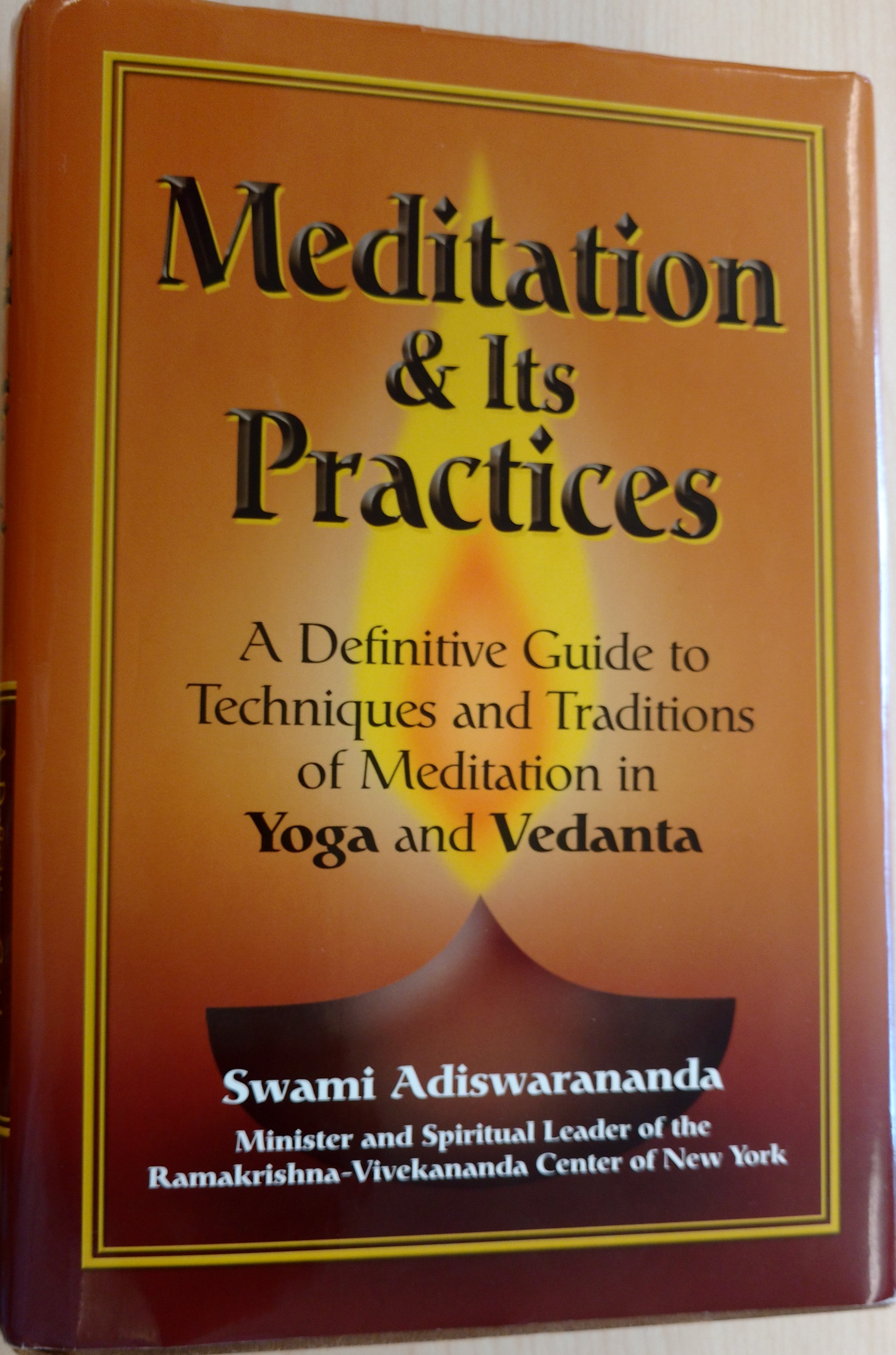
Currently, I enjoy reading his book, “Meditation and Its Practices.” It is a definitive guide to techniques and traditions of meditation in Yoga and Vedanta.

In this book, meditation has been looked at from several points of view, and it contains innumerable quotations from several standard books of meditation, Vedanta, and Yoga.

Personally, on many occasions, I was fortunate to see Swami Adiswarananda absorbed in meditation and felt uplifted by the spiritual environment created by these absorptions. Several times, I have heard him give talks after deep meditation, and I could feel that his words were coming from his direct communion with the Self, filled with convincing power and destroying all doubts.

The quoted paragraphs are excerpts from his book “Meditation and Its Practices.” I found these paragraphs to be very helpful for me to understand meditation and thoughts related to it. The titles and in-between thoughts are mine.

The importance of Meditation:

“Meditation is a subject of universal interest. It is practiced by spiritual seekers of all traditions, in some form or another, for serenity, peace, and blessedness.

The Vedic seers tell us that the causes of suffering are five, and they are:

(1)  Ignorance that makes us out of touch with Ultimate Reality

(2)  Ego that creates the world of dreams and desires

(3)  Attachments to things and beings of that dream world

(4)  Aversion toward things and beings we do not like and

(5)  Clinging to life and not moving forward.

The only way to overcome the maladies of life is to establish contact with the Ultimate Reality, and the only way to make contact with It is through meditation.

Meditation liberates us from the bondage of the mind and body, and lifts us up into the vast expanse of the Infinite Self.

Meditation awakens the dormant powers of the mind.”

The Steps Leading to Meditation:

             “The step leading to meditation is uninterrupted spiritual concentration of the mind on the Self. Such concentration does not develop by itself. It has to be practiced consciously and regularly, and requires overcoming the drags of perverted habits, attachments, and desires. For this reason, meditation is a twofold practice. It is focusing the mind on the ideal, while at the same time, practicing self-control.”

Meditation and Integrated Personality

“An average person’s spiritual goal and spiritual efforts are not well integrated because his thinking, feeling, willing, and acting do not support but instead oppose each other. Most often, his spiritual goal is subordinated to his material and worldly goals.

In his efforts, he does not follow moderation but swings from indulgence to asceticism, pessimism to optimism. Integration of personality is the alignment of all one’s thoughts, words, deeds, and aspirations to spiritual aspiration.

An integrated life, according to Yoga and Vedanta, is a grand symphony of many reflexes, impulses, desires, emotions, thoughts, and purposes. As the millions of cells of the human body must be well harmonized to produce a balanced physique, so must the multiple centers of our personality also be well integrated to make the symphony a reality.  The more we get a glimpse of our real Self in meditation, the more we are able to achieve this harmony.”

What is Integrated Personality?

“Meditation enables us to discover the rhythm of integrated living, which is marked by withdrawal from and response to the everyday world. Mere withdrawal without response is meaningless, while mere response without withdrawal is disastrous.

The more active we are, the more we are required to be meditative. The more the musical instruments in an orchestra are played, the more they need tuning. Meditation is to the mind what sleep is to the body. Meditation is the inbreathing of life, while activity represents its outbreathing. Meditation, like a gyroscope, helps the aspirant maintain his poise and balance amid the turbulence of life. Sincerely pursued, meditation becomes the aspirant’s second nature and follows him like his shadow in every action and thought, enabling him to function as two voices singing in counterpoint.”

 Meditation is more than the Concentration of the Mind:

“In the philosophies of Yoga and Vedanta, meditation is a mental process by which the meditator becomes one with the object of meditation.

Communion with our true Self, according to the Mahabharata, is the most efficacious form of meditation, comparable to bathing in a sacred river: ‘the river of Atman is filled with the water of self-control; truth is its current, righteous conduct its banks and compassion its waves…. Bathe in its sacred water; ordinary water does not purify the inmost soul.’ Meditation is thus the greatest purifier of the mind.”

Meditation is a constant awareness of our true identity (Atman) or the Ultimate Reality (Brahman). If one is a devotee and worships a chosen form of God (Ishta), then the constant remembrance of this form leads to meditation. Thus, japa, lovingly repeating God’s name or a mantra related to the beloved form of God, leads to an absorption into that form. This is meditation for a devotee. Finally, when this beloved form of God merges with the Ultimate Reality (Brahman), the devotee attains the highest communion with Brahman.

Swami Adiswarananda says, “Through meditation, our individual self, communes with the cosmic Self, as represented by our Chosen Ideal. These moments of communion lift us out of all egocentric involvements and infuse us with a quantum of inner serenity that heals the wounds of our mind, filling it with new strength to face the challenges of life. This inner serenity brings in its wake a stabilizing effect on our everyday life and makes it more efficient, creative, and purposeful. Our daily contact and communion with the external world of countless diversities temporarily overwhelms our knowledge of the unity of existence. As a result, our perception of diversities becomes exaggerated and heightened, and we lose the distinction between the Reality that is permanent and eternal and the realities that are impermanent or relatively permanent. Proficiency in meditation restores our true vision of reality.”

Being Calm and Serene is not Enough:

Only remaining calm or serene does not mean anything. We have to see what is the goal of the person who is calm and serene.

Swami Chetanananda told a story from the Ramayana. When Mother Sita was kidnapped, Lord Rama was crying profusely. At this time, he saw a crane standing calmly with complete serenity in a lake.  Lord Rama told his brother Lakshmana, “See how this crane is calm and serene, while I am crying because of the separation of Sita.” At that time, a fish jumped up from the water of the lake and told Rama, “O Lord Rama! This crane has killed my wife and my children and now is meditating to kill me. It looks serene, but not with good intention!”

Meditation brings Transformation of Character:

Vedanta does not like any ambiguity, and it is not only a theory. Vedanta is very practical. The goal of Vedanta— “Self-Realization” or “Communion with the Ultimate Reality” — is not imaginary. The Bhagavad Gita and other Vedantic books clearly state the tangible characteristics of a person who has achieved Communion with the Ultimate Reality.  One who practices Vedanta and makes sincere efforts to achieve its goal becomes a decent human being.  Such a person’s thoughts, speech, and actions become blessings to society. Actually, society continues to survive due to the presence and inspirations of such people. Without them, people do not see a reason  to become unselfish and do any amount of harm to fellow beings, even if destructive, to fulfill their selfishness.

The Bhagavad Gita describes the sets of characteristics of “A Person with Steady Intellect (Gita 2.55-72), “My Beloved Devotee” (Gita 12.13-19), and “A Person Who Has Gone beyond the Three Gunas” (Gita 14.22-27) separately.  These characteristics help us know how a person practicing Vedanta becomes a decent human being and a blessing to society.

Meditation is a very personal thing. It is hard to find out whether a person is making progress in his/her meditation or has become stagnant, or if the person is becoming duller and more inactive than before. Many times during meditation, sleep or inertia takes over the meditator’s mind without him/her being aware of it. Experts in meditation say that if we want to measure the progress of the mind of a person who is practicing meditation, we must  observe how that person does work in day-to-day life, how that person behaves with other people in various situations, and how the person expresses his/her thoughts in speech. In the following list, Swami Adiswarananda clearly expresses the characteristics of a person who is making progress in meditation and/or has attained the goal of meditation – Communion with the Ultimate Reality. It is an excellent guideline to measure progress in our meditation.

“The sure sign of an individual’s inner integration is his behavioral transformation.

(1)        Such a person is always sincere, honest, and straightforward in thought, word, and action. Because he is honest with himself, he is honest with others. His honest intentions are always reflected in his conduct and behavior.

(2)        Truthful in all circumstances, he not only desists from lying in any form but does not exaggerate, misrepresent, manipulate, or distort facts to suit his own convenience and self-interest.

(3)        Free from all sense of guilt, he enjoys peace of mind.

(4)        What he really is and what he appears to be are always the same, and so he is never  secretive.

(5)        He never broods over the past nor dreams about the future. He acts in the living present; being of clean conscience, he does not procrastinate or vacillate in his decisions or actions.

(6)        Positive in his outlook, he is always ready to learn and grow in wisdom.

(7)        He accepts the trials and tribulations of life as they come and does not blame anyone or anything for them. Grounded in self-awareness, he is neither aggressive nor defensive in   dealing with others.

(8)        He is spontaneous, efficient, and creative.

(9)        Moderation is his motto, discrimination is his guideline, and Self-Knowledge is his goal.”

(Thanks to Nishank Mehta for editing this post.)