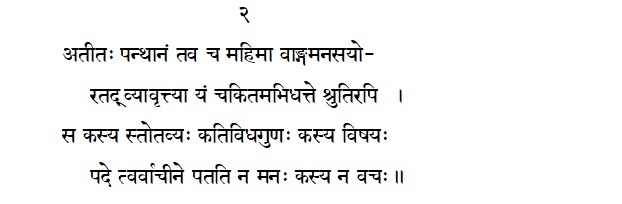
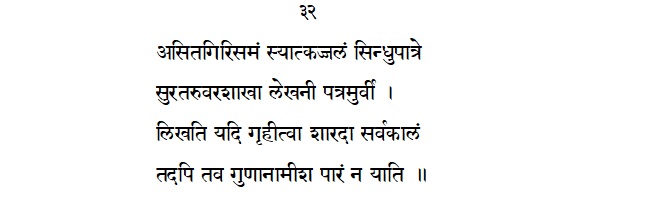
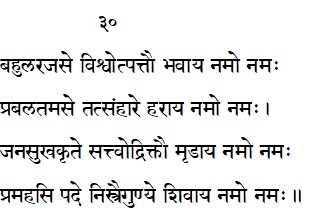
Shiva Mahimna Stotra
Sholka 19
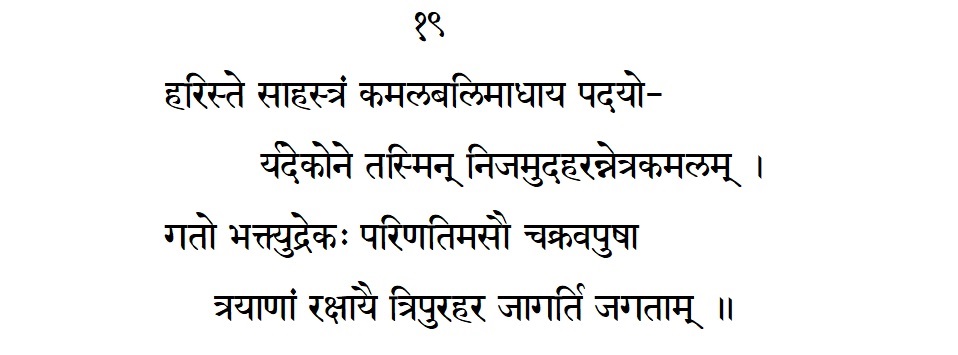

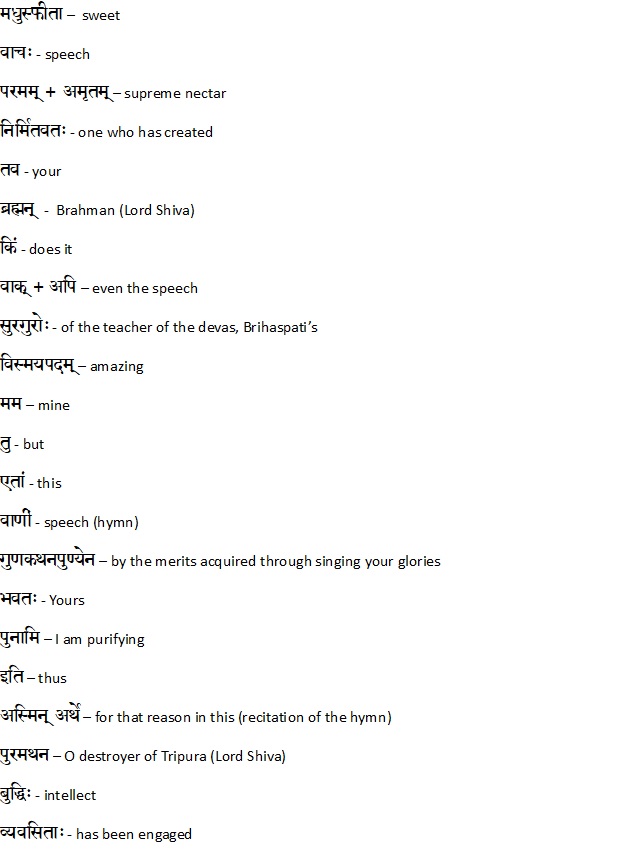
Meaning: O Destroyer of Tripura (Lord Shiva)! Lord Vishnu was worshipping you by offering one thousand lotuses at your feet. He found that one lotus was missing. He then offered one of his lotus eyes to complete the one thousand lotus offering. His intense devotion then turned into a disc (Sudarshana Chakra) that he holds. This disc remains always alert to protect the three worlds.
Reflections:
Various Forms of Brahman:
In Hinduism, God is one, which is called, Brahman. This Brahman appears in many forms according to the devotees’ likings. Shri Krishna says in the twelfth chapter of the Bhagavad Gita (12.5):

“The path is very tough for those whose minds are set on realizing the Unmanifested (Formless God). It is very difficult to realize the Unmanifested for people who have body-consciousness.”
If we think that we have a body, then God also has a body. Realized spiritual teachers say that for most of the devotees, it is easy to begin focusing one’s mind on God with form and then realize that this form is just a representative of the Infinite Brahman. Finally, at one point, these forms dissolve into the Unmanifested Brahman.
Vishnu, Shiva, Brahma, Rama, Krishna, Kali, Durga, and others are various forms that represent the same formless infinite Brahman. No form is higher or lower. There are books for each of these forms describing the glories of that form through stories or hymns. In these books, all other forms of Brahman become subordinate to the form of the books. Thus, in the Shiva Mahimna Stotra, Lord Shiva is the main form of Brahman and all other forms like Vishnu, Brahma, and others worship Lord Shiva. In the books about the form of Lord Vishnu, Lord Shiva worships Lord Vishnu.
Many times, the immature devotees of Lord Shiva and Lord Vishnu don’t understand this point and they fight with each other claiming that their form of God is superior. It is like John tells Jack that his mother is superior, and he should worship his mother. Jack tells John the same thing asking him to worship his mother. Both the mothers are great. As mothers they are different, but the motherhood is the same. Thus, due to the devotees’ likings, the God’s forms are different, but the Godhood (Brahman) is the same.
The story of the offering of one thousand lotuses:
Every day Lord Vishnu offered one thousand lotuses to Lord Shiva along with the thousand names of Lord Shiva. One day, to test the devotion of Lord Vishnu, Lord Shiva invisibly stole one of the thousand lotuses. Lord Vishnu was completely engrossed in the offering. He didn’t notice this act. At the end of the offering, he found that one lotus was short. He was in a dilemma. To get up in the middle of an offering is an insult to Lord Shiva and so is not to offer one thousand lotuses. What to do? Suddenly, He realized that people call Him ‘Pundarikaksha’, meaning ‘lotus-eyed’. Without much thinking further, He plucked his one eye and offered it to Lord Shiva.
Lord Shiva was immediately pleased. He appeared to Lord Vishnu and granted Him his eye and a disc (Sudarshana Chakra) which remains constantly circling in His hand protecting all the three worlds. Shri Pushpadanta says that Lord Vishnu’s devotion turned into this Sudarshana Chakra. This story teaches us that a true devotee out of his/her love for God is ready to sacrifice anything even if it costs his/her life.
Devotee’s Sufferings:
Lord Shiva’s stealing one lotus is symbolic. It shows that God tests devotees through various challenging situations. If the devotees successfully go through these situations, their devotion becomes pure, and it shines like gold that has passed through a fire.
Most beginner devotees have this question: “Why do devotees have to suffer even though they pray to God?” Many prayers say ‘O God! You are the remover of devotees’ suffering.’ Such prayers create a feeling that God removes all the sufferings of the devotees and as a result, devotees do not have to suffer at all. Many devotees lose their faith in God when suffering comes despite their prayers.
When devotees advance in their spiritual path and develop a deeper understanding, they realize that happiness and suffering are part of life. One cannot avoid them. All people must go through joys and sorrows whether they pray to God or not. The devotees’ suffering becomes more striking because people say, ‘Oh! These devotees prayed to God, but they had to suffer so much!’
From the advanced devotees’ point of view, God is the doer of everything. God gives happiness and God gives sorrow. We must accept what God gives us and go through the circumstances holding on to God. During this painful time, we must hold on to God more firmly because there is no other alternative. Only God can give us strength to bear all the sufferings.
There is a story that Rama wanted to take a bath in the ocean. So, he put his arrows on the sand and pushed his bow in the sand to keep it vertical. After his bath when he lifted his bow, he saw it was tainted with blood. He dug into the ground and saw that his bow had pierced the back of a big frog. Rama felt sorry for the frog. He asked the frog why it had not screamed or complained about this. The frog said, “O Rama! If anyone else is giving me pain, then I pray to you. But, when you give me pain, to whom should I pray?”
Another example is of a mother and a child. A child ate dirt. The mother becomes angry and worried that this habit of eating dirt will harm the child in the future. Out of love and anger, she beats the child. The child holds the mother’s sari or cloth and cries. Sometimes the mother also cries while beating.
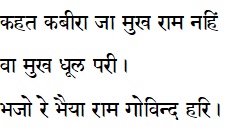
Sincere devotees do not seek suffering, but they know very well that many times in happiness they forget God, while in suffering they remember God more. Saint Kabir said a wonderful thing:
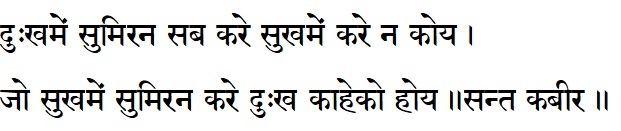
“Everyone prays to God during suffering. No one prays to God when one is happy. If one prays to God when one is happy, then there will not be sorrow anymore.”
Prayers and spiritual practices give us inner bliss which does not depend on any worldly object, and they give us inner strength to go through sufferings.
Devotees feel that through suffering God is testing their faith and devotion. Time passes. Good days pass and so do the bad days. When the devotees go through a painful time holding on to God, their faith and devotion to God deepen and become more mature. Such faith and devotion lead the devotees to realize God.
Even the incarnations of God suffer. Shri Rama, Shri Sitaji, Shri Krishna, Sri Ramakrishna, Holy Mother Sri Sarada Devi, Swami Vivekananda, and others went through many miseries. They showed that when we take a human form, we cannot avoid suffering. It is a part of life.
If we think of ‘suffering’ as a natural situation that arises in our life and ‘pain’ as the impact of the situation that we inflict on our mind, then we can say that ‘suffering is unavoidable, but the pain is optional’. Pain depends on how we take the situation. The pain of the marathon runner, mother giving birth to a child, studying for the test, doing exercises, and in other such cases, people bear it with joy.
Devotees take suffering as ‘prasad’ from God and bear it remembering God. Many times, suffering comes with a greater purpose. Sri Ramakrishna’s throat cancer brought the ‘devotees of the inner circle’ (devotees with strong faith in Sri Ramakrishna) closer to each other, to Sri Ramakrishna, and to God which resulted in the form of Sri Ramakrishna Math and Mission guiding and inspiring millions of people in the path of God-Realization and Unselfish Service to Humanity. In this shloka, Lord Vishnu’s devotion turned into “Sudarshana Chakra” which protects the three worlds.
From the Jnana Yoga (The Path of Knowledge) point of view, ‘Everything is Brahman, Pure Consciousness. Brahman has no happiness or miseries. When out of ignorance (Maya) an individual thinks that he/she is separate from the Brahman and has a body and mind, then that individual (Jiva) becomes happy or sad according to one’s desires being fulfilled or not fulfilled. Happiness and sorrows are like nightmares created by the mind. The only remedy is to wake up and realize that everything is Brahman and the various situations, and the happiness and the miseries are all projected onto Brahman due to Maya.
However, it is very difficult for most of the people to remain always established in Brahman. Therefore, when the mind comes down to the body-mind-consciousness, the attitude of the devotees is very practical and helpful.















































 mahendrajani