Meaning: A person, who recites Shiva Mahimna Stotra once, twice, or thrice every day, becomes free from all sins and gets worshipped in the abode of Lord Shiva.
Reflections: A spiritual seeker tries to keep his/her mind absorbed in spiritual consciousness. Shri Krishna, in the Bhagavad Gita (12.14), says that one who offers his/her mind and intellect to Me, is my most beloved devotee. We have to use our intellect to keep our minds focused on God. The easy way to focus our mind on God is to repeat God’s name or recite God’s glory.
We can learn from Holy Mother Sri Sarada Devi about the importance of repeating God’s name. A disciple wrote to the Holy Mother, ‘I cannot calm my mind and concentrate’ and so on. Holy Mother became agitated at these words and said, “It can be done if one repeats God’s names fifteen or twenty thousand times each day. I have seen it actually happen. Let him do that first and talk afterward if it fails. One must put one’s mind to it.”
Singing God’s glory is also an effective spiritual practice for our spiritual growth. Shiva Mahimna Stotra is filled with Lord Shiva’s glories. Every day, if one recites it once, twice, or thrice, thinking of Lord Shiva, he/she will definitely uplift his/her mind to a higher level of spiritual consciousness. When our mind remains in spiritual consciousness more often, our impurities go away from our minds.
Definitely, we have to recite this hymn with faith, a focused mind, and humility, and we must reflect upon its meaning. By Lord Shiva’s grace, when we develop love for Him, then, our mind goes to the abode of Lord Shiva and ultimately merges into Lord Shiva.
Om Namah Shivaya! May Lord Shiva bless us all.
Note: By the grace of Lord Shiva, with this shloka, I completed my reflections on the Shiva Mahimna Stotra. I posted my reflections on the Shloka 43 earlier. Writing my reflections on this divine hymn was my spiritual practice and a spiritual journey. I offer this collection of reflections at the feet of Lord Shiva.
Thank you all for joining me on this spiritual journey. Om Namah Shivaya!
Meaning: O Maheshwara (the Supreme Lord)! I don’t know your essential form. O Mahadeva (the God of gods)! Whatever is your form, I salute you again and again.
Reflections: As we evolve spiritually, our idea of God also evolves. As Swami Vivekananda expressed through “Namo namo Prabhu vakya-manatita…”, meaning, “I salute to God who is beyond the comprehension of our speech and mind, but, on the other hand, who is the support of our speech and mind.” In the final stage, one realizes that God has become everything. There is nothing in the universe that is not God. However, out of ignorance, we see things and people having different names, forms, characteristics, and their own separate existence.
Only by God’s grace, we can realize God’s true form. People who have realized God become quiet. They know that whatever they say will not describe God completely.
It seems that keeping this in mind, Pushpadanta says ‘I don’t know your essential form. But whatever is your form, I salute you again and again.’
We have to begin with whatever form of God we have in our mind. Then, as we sincerely do our spiritual practices described by the spiritual teachers and the scriptures, we get a better and better understanding of God, and ultimately, by the grace of God, we get the ultimate realization of God.
Meaning: Thus, I have offered this worship in the form of speech at the feet of Lord Shiva. May the ever-auspicious Supreme Lord be gracious to me.
Reflections: ‘Thus’ here means after the completion of the composition of the Shiva Mahimna Stotra. Pushpadanata says that this hymn was his worship of Lord Shiva through the words. He knew that Lord Shiva was ever auspicious, and He would definitely be pleased with this offering.
As we love God, God also loves us. Shri Krishna says in the Bhagavad Gita (9.26):
“If a devotee, out of devotion, offers to me even a simple thing, such as a leaf, a flower, a fruit, or water, I greatly accept it and enjoy it since it is a pious offering of the pure in heart.”
If we recite this Shiva Mahimna with love and devotion as an offering, Lord Shiva will be pleased with us.
Meaning: From the beginning to the end, this (Shiva Mahimna) hymn, composed by a Gandharva (Pushpadanta), is pure, wonderful, pleasing to the mind, and auspicious. It describes the glories of the Lord (Shiva).
Reflections: The poetic beauty of the Shiva Mahiman Stotra and the descriptions of Lord Shiva’s glories attract our minds easily. When we recite this Stotra with devotion and focused mind and reflect upon its meaning, we purify our mind and uplift it spiritually.
Meaning: The Shiva Mahimna Stotra has been composed by Pushpadanta, praised by great Devas and Munis, and sung by the Gandharvas. It is the main cause of attaining heaven and liberation and its effect never fails. One, who recites this hymn with folded hands and with a focused mind, goes closer to Lord Shiva.
Reflections: This is another shloka that glorifies the Shiva Mahimna Stotra and the sure effect of its recitation. Folded hands signify the faith, devotion, and humility of a devotee who recites this hymn. A focused mind is most important during the recitation. When one is reciting this hymn, one should think of its meaning and feel the presence of Lord Shiva to get closer to Him.
Recitations of such hymns are easy and effective means for spiritual development.
Meaning: Pushpadanta, the king of Gandharvas, was a servant of the supreme Lord Shiva who wears the crescent moon on his head. Because of Lord Shiva’s anger, he lost all his power, and he composed this supremely divine hymn, called Shiva Mahimna.
Reflections: This shloka reminds the story of Pushpadanta and the reason why he composed the Shiva Mahimna hymn.
Pushpadanta, the king of the Gandharvas, had the power to be invisible and move around anywhere he desired. Once, he saw a beautiful garden of King Chitraratha having varieties of flowers. He thought to offer these flowers to Lord Shiva. Even though the garden was guarded by the security people, Pushpadanta, with his power, went inside the garden at night and collected flowers of his choice without being noticed. When in the morning the King came to pick up his flowers for his worship of Lord Shiva, he found that the good flowers were already plucked. Upon inquiry, he found from the guards that no one had plucked the flowers, and no one had entered the garden at night. This stealing continued for a couple of days. King Chitraratha was puzzled. Then, he came up with an idea. He knew that anyone who stepped on the bilva leaves and the flowers offered to Lord Shiva would incur sin and must face Lord Shiva’s anger.
He asked guards to spread such leaves and flowers without stepping on them. Pushpadanta unaware of these leaves and flowers stepped on them and immediately lost his power of invisibility. The guards caught him and brought him to the king. As a punishment, the king put him in jail. To please Lord Shiva and to obtain His grace, Pushpadanta composed the Shiva Mahimna Hymn. By Lord Shiva’s grace, he received his power back and was released from jail.
Since the Shiva Mahiman Shlokas 33 – 43 describe the story of the Pushpadanta and the glories of the hymn, it is not clear whether he composed these shlokas or they were added by some other people. Common sense tells us that this shloka might not have been composed by him. However, the shloka is well-composed, and no harm in singing it.
Meaning: Initiation, charity, austerity, pilgrimage, scriptural knowledge, and performance of rituals like homa and others – the benefit of none of these is equal to one-sixteenth of the benefits one gets by reciting the Shiva Mahimna Stotra.
Reflections: This is one of the concluding shlokas that encourage devotees to read, recite, and meditate on the Shiva Mahimna Hymn.
To learn, recite, and meditate on the essence of the hymns are spiritual practices of Bhakti Yoga. Because it is related to the heart, Bhakti Yoga is easier for many devotees compared to the other paths. Recitations or singing hymns help the mind focus on the form and qualities of the god or goddess mentioned in the hymns. By Lord Shiva’s grace, for many days, I had recited Shiva Mahimna Stotra eleven times while offering ‘Abhishekam’ in a quiet secluded Shiva temple of a village Pij, Gujarat, India. I still remember the spiritual environment created by the recitations which brought absorption and peace within. I used to forget the world around me.
Sri Ramakrishna said again and again that we have to develop love for God. If we do it with understanding, then by God’s grace, the recitation of God’s glories through bhajans, dhoons, and hymns helps us develop love for God.
When we develop a love for God, then by God’s grace, we get all the benefits that one gets by practicing all the other three Yogas, performing rituals, giving in charity, going on pilgrimage, or doing any other spiritual practice.
It seems that in the earlier times in India, a hundred percent is compared to the moon shining with all its sixteen phases or ‘kalas’, meaning the moon fully shining with all its glories. Some books say that the fifteen kalas are visible and the 16th is beyond our visibility. The fifteen kalas are related to the fifteen days of the waning and waxing phases of the moon. In some books, we find the names of the sixteen kalas of the moon. They are amritaa, maanadaa, pusha, tusti, pusti, rati, dhriti, sasini (or sasichini), chandrika, kaanti (or kanta), jyotsna, sri, priti, angadaa, purnaa, and purnamritaa. The readers can search on the internet or through any other means to get more information regarding these kalas.
Thinking of the above measurement, Pushpadanta tells us that if the benefit of recitation of the Shiva Mahimna Stotra is one hundred percent which is equal to the moon shining with all its sixteen kalas, then the benefit of any other spiritual practice is not equal to even moon shining with only one kala.
Let us learn Shiva Mahina Stotra, reflect upon its essential meaning, and meditate on Lord Shiva who is nothing but Brahman, the Ultimate Reality.
Meaning: There is no god superior to Mahesha (Lord Shiva). There is no hymn superior to Shiva Mahimna. There is no mantra superior to Aghora (Omkar) Mantra. There is no ‘Tatva’ (Truth, the Ultimate Reality, or Goal) superior to the Spiritual Guru.
Reflections: Most spiritual seekers, in their initial stage, select a form of God as a chosen ideal to focus their minds on and to develop a love for God. This chosen ideal is called an “Ishta deva’. Initially, one must consider this form as the best form of God. By doing this, the seekers develop spiritual roots and make spiritual progress. As the spiritual seekers make progress, they realize that this form is just a representation of the One God, Brahman, and the selection of an ‘Ishta deva’ was only for their spiritual progress and not to put down the other forms of God. Real ‘Ishta Nishtha’ (one-pointed devotion to one’s likable form of God) does not develop fanaticism. Rather, such a devotee understands and appreciates other people’s “Ishta Nishtha’. If I love my mother dearly, I understand and appreciate other people’s love for their mothers.
Swami Adiswarananda, Spiritual Head of New York’s Ramakrishna Vivekananda Center, used to say that ‘Ishta Nishtha’ helps develop spiritual roots. If there are no roots, there will not be any fruits.
Thus, the devotees of Lord Shiva initially should consider Him to be the most superior form of God. Similarly, they must consider the mantra related to Lord Shiva as the best mantra and Lord Shiva’s hymn as the best hymn. Many devotees worship Lord Shiva as Aghora.
Finally, Pushpadana says that there is nothing higher than the spiritual teacher. Proper spiritual guidance is extremely important.
In Viveka Chudamani (3),
Shri Shankaracharya says: “Three things, namely, a human birth, desire to realize God (One’s true divine identity), and spiritual guidance, are very difficult to get and they can only be acquired by God’s grace.”
We can read many scriptural books, but without proper spiritual guidance, we may not be able to grasp the essence of these books. Also, without seeing a real living example we may not know how to practice the essence of the scriptures. Thus, proper spiritual guidance is essential. A genuine spiritual teacher who has a direct experience of God (the Ultimate Spiritual Truth) or one who is sincerely doing proper spiritual practices can wake up our inner spiritual guide. This spiritual guide is our inner conscience which helps us decide what to do and what not to do for our spiritual progress.
Sant Kabir gives the highest honor to Guru, a spiritual teacher.
Sant Kabir says, “Guru and Govinda are standing together. To whom should I salute first? I will salute my Guru first because my Guru has shown me Govinda.”
Pushpadanta, in this shloka, is saying that there is nothing higher than a spiritual teacher. The spiritual teacher takes us to our Ishta deva and in the last stage, our mind along with our Guru merges into the Ishta deva and Ishta deva merges into Brahman.
Meaning: One who recites every day this auspicious hymn of Dhurjati (Lord Shiva with matted hair) with supreme devotion and pure mind, acquires fame, abundance of wealth, and long life, and be blessed with a child in this life, and after death goes to the abode of Lord Shiva and becomes like Shiva.
Reflections: To attract worldly-minded people to the spiritual path and to encourage them to recite hymns, like Shiva Mahimna Stotra, poets add such shlokas which tell them what worldly benefits they get by reciting the hymns. Most worldly-minded people will not think of their spiritual progress until their worldly desires are extinguished either by fulfillment or by bitter experiences. Usually, people want money, a long life, children, and name and fame. Therefore, these benefits are mentioned in this shloka.
After promising worldly pleasures, Pushpadanta reminds the devotees that after their deaths, they achieve their higher goal of life, namely, going to the Shivaloka (the abode of Lord Shiva) and becoming like Shiva.
A sincere devotee wants the Ultimate Knowledge and devotion by reciting Shiva Mahimna Stotra. If people recite his hymn for Knowledge and devotion, then they become like Shiva in this very life and experience real fulfillment and bliss.
Meanng: Lord Chandrasekhara (Shiva) has been worshipped by devas, danavas (demons), and sages, and His glories have been described in the Vedas. He is a God with form and without form. The most virtuous Pushpadanta composed a wonderful hymn for Lord Chandrasekhara in various long Sanskrit poetry meters.
Reflections: Lord Shiva is filled with compassion and love for all. He can be easily pleased. That is why he is also known as ‘Bholanath’, a simple-minded God who can be easily pleased. Because of his love for all, people with different mindsets, like devas, danavas, and sages, worship Lord Shiva.
Three important things have been mentioned in this shloka: (i) Lord Shiva has a crescent moon on his head, (ii) Shiva Mahimna Stotra has been composed in long Chandas, meaning in long Sanskrit Poetic Meters, and (iii) The Shiva is God with form and God without form. Let us look into these things.
(i) Why Lord Shiva is called ‘Indumaule’, ‘Chandramauli’, or ‘Chandrasekhara’?
Chandra (Moon) was married to twenty-seven daughters of Daksha Prajapati. (This is symbolic. There are 27 Nakshatras or Constellations, connected to the Chandra (Moon)).
Over some time, Chandra was more attracted to Rohini, one of the twenty-seven wives. The other twenty-six wives complained to their father Daksha about this unfair treatment. Daksha sat down a couple of times with Chandra and requested him to treat all his wives equally, but Chandra turned a deaf ear to Daksha’s request.
Finally, Daksha got angry and cursed Chandra ‘You will have the tuberculosis disease and you will wane. You will slowly lose your luster and disappear’. Chandra started decreasing and losing his luster. All devas and Rishis were worried because Chandra (Moon) was needed for the juice in the vegetation. Chandra also did not want to die. He went to all the devas and requested them to go to Brahma, the Creator, and find the solution. Brahma told them that Chandra should go to the sacred place called Prabhasa with all the devas, establish a Shivalinga there, offer worship to Lord Shiva, and try to please Lord Shiva with the ‘Japa of the Mrutunjaya Mantra’.
Chandra did everything that Brahma had told him to do and with his severe austerity, he pleased Lord Shiva. When Lord Shiva asked Chandra what he wanted, Chandra said to make him free from the tuberculosis disease. Lord Shiva said that Daksha’s curse would remain, and because of that he would wane for 15 days, but after 15 days he would grow again to his normal form. This is how the waxing and waning of Chandra (moon) started.
Then, the devas and Rishis were very happy and requested Lord Shiva to stay at that place. Lord Shiva blessed all and said that his presence would be felt at that place. This place is nothing but one of the famous Twelve Jyotirlingas (luminous emblems of Lord Shiva), called Somanath Temple in Saurashtra, Gujarat, India. ‘Soma’ means Chandra. Thus, Lord Shiva glorified Chandra.
People say that to glorify Chandra more, Lord Shiva wears Chandra, a crescent moon, on his head. It could be symbolic indicating that Lord Shiva is the controller of the time, and this cycle of birth, growth, and death is eternal. Because of all these events Lord Shiva is known as ‘Indumaule’, ‘Chandramauli’, and ‘Chandrasekhara’.
(ii) Chanda (Sanskrit Poetry Meters) in Shiva Mahimna Stotra:
It has been mentioned that Siva Mahimna Stotra has been composed in long Chandas. The following is the list of these Chandas used in this Stotra.
Shlokas 1 – 29: Shiva Mahimna Stotra’s shlokas 1 through 29 are composed in ‘Shikharini” chanda. It consists of 17 syllables. There is a pause after the 6th syllable. The 2nd – 6th, 12th, 13th, and 17th syllables are long and the others are short. One has to learn about the long and the short syllables.
Shloka 30: This shloka has been composed in ‘Harini’ Chanda. It also contains 17 syllables but has a pause after the 8th syllable. However, in this chanda, the 6th – 10th, 12th, 15th, and 17th syllables are long and the others are short.
Shlokas 31st – 34th, 37th and 38th: These shlokas are composed in ‘Malini’ chanda. It consists of 15 syllables and has a pause after the 8th syllable. The 7th – 9th, 11th, 12th, 14th, and 15th syllables are long, while the others are short.
Shlokas 35th, 36th, and 39th – 42nd: These shlokas are composed in ‘Anushtupa’ chanda. Most of the Bhagavad Gita’s shlokas are in this chanda. It contains 8 syllables in the half line. The full line has 16 syllables. In this Chanda, the 5th syllable is short, the 6th syllable is long, and the 7th syllable is alternately long and short.
Shloka 43: The last shloka has been composed in ‘Vasantatilaka’ or ‘Vasantatilakam’ Chanda. It contains 14 syllables. The pause comes after the 8th syllable. The 1st, 2nd, 4th, 8th, 11th, 13th, and 14th syllables are long and others are short. However, in the 13th and 14th syllables, the poet takes the liberty to keep it long or short.
Thus, we can see that the great poet Pushpadanta has beautifully composed Shiva Mahimna Stotra in these long Chandas with the restrictions of long and short syllables and still it has deeper meanings, is filled with devotion, and has wonderful poetry.
(iii) Lord Shiva is a God with form, and also a God without a form: In most of the hymns of Hindu gods and goddesses, there are indications that these gods and goddesses have form, but they represent the formless God, called Brahman, which is only one. For most of the people, it is difficult to think of God without any form. In the universe we constantly perceive things with forms and qualities, therefore it is easy for most people to think of God with forms having virtues. This shloka reminds us that Shiva Mahimna Stotra praises Lord Shiva with form and without form.
Meaning: O Giver of Boons (Lord Shiva): I cannot imagine that on one hand I have my mind with limited knowledge, strength, and grasping power, and it is filled with five kinds of troubles, and on the other hand there are Your eternal infinite glories which surpass all the boundaries of the virtues. I was bewildered by this contrast. But, being compelled by my devotion to you, I have offered these flowers of shlokas at Your feet.
Reflections: Pushpadanta offered the flowers of the Shiva Mahimna Shlokas at the feet of Lord Shiva.
Three important things about flowers:
The flowers have three important things: honey, fragrance, and beauty.
Those who enjoy the poetic aspects of the hymn, they are appreciating the beauty of the hymn.
Those who go a little deeper into the meaning of the shlokas of the hymn, they are enjoying the beauty and the fragrance.
Those who have gone much deeper into spirituality, enjoy the subtle meanings of these shlokas, and due to their devotion, they experience the presence of the Saguna and the Nirguna aspects of Lord Shiva and get immersed in it. This is like drinking the honey of this hymn. They enjoy the beauty, fragrance, and the honey.
The Contrast:
Shri Pushpadanta, in the initial shlokas of the Shiva Mahimna Stotra, has said that even Brahma cannot describe Lord Shiva’s infinite glories. He said that if each one is describing His glories according to one’s limited perception, his attempt to write this hymn is not an exception. Pushpadanta said that even Brahma’s description of Lord Shiva’s glories cannot amaze Him. Hence, through the composition of Shiva Mahimna Shlokas, he is not trying to please Lord Shiva, but simply trying to purify his speech.
After composing several shlokas of the Shiva Mahimna Stotra, Shri Pushpadanta realizes the contrast between Lord Shiva’s infinite glories and virtues and his own mind with limited capacity and various agitations. Actually, Shri Pushpadanta, by talking about his mind, is talking about the minds of most of the devotees. He points out the five agitations or five causes of suffering described in the Patanjali Yoga Sutras (2.3 – 9).
The Five Kleshas:
Patanjali Yogasutra (2.3) says:
“The five ‘kleshas’ or the causes of suffering are (i) Ignorance, (ii) Ego, (iii) Attachment, (iv) Aversion and, (v) Clinging to life.
(i) Ignorance: Not knowing that an individual’s true identity is Atman (Existene-Knowledge-Bliss Absolute) is ignorance. It is the cause of all our suffering. Actually, it is the only cause of all our suffering. Atman is blissful. Still, we feel miserable because of our ignorance, hallucinations, and delusions.
(ii) Ego: Because of ignorance, one thinks that ‘I am only this body and mind’. This develops an ego, an existence of an individual consisting of only body and mind separate from the Atman. This is a ‘second-level cause’ of our suffering.
(iii) Attachment: The ego brings attachment to the sense-objects which give pleasures to the senses and the deluded mind. The deluded mind thinks that the sense-pleasures alone can give happiness. Hence it craves for the sense-pleasures. These desires become the cause of many sufferings.
(iv) Aversion: Attachment and aversion or hatred go together. The deluded mind likes the objects that give joy and dislikes or hates the ones that don’t give joy or give suffering. Both attachment and aversion cause suffering.
(v) Clinging to life: Out of ignorance, one thinks that ‘I am a person with this body-mind frame. There is nothing like Atman.’ Then, one thinks that only sense-pleasures make me happy and therefore the only goal of my life is to get as many sense-pleasures as possible. This brings clinging to the body, mind, and worldly objects. This clinging to life creates fear of losing body, mind, and worldly objects, which is the fear of death. This fear of death constantly causes pain to the person.
Love overpowers Thinking:
Pushpadanta compares Lord Shiva’s serene and peaceful mind which is mainly absorbed in meditation with his limited mind with five agitations. Thinking about this contrast he feels ashamed about his attempt to compose a hymn to describe the infinite glories of Lord Shiva. Upon reflection, he finds that he is neither trying to describe Lord Shiva’s glories nor trying to please Him. He is just expressing his love for Lord Shiva. His love for Lord Shiva compelled him to write these shlokas to offer at His feet as flowers.
It seems that the next shloka-32 concludes the Shiva Mahimna Stotra stating how difficult it is to describe the infinite glories of Lord Shiva. The remaining shlokas (32 – 43) are either added later or written to glorify this Stotra.
Meaning: O Deva (Lord Shiva)! Bhava, Sharva, Rudra, Pashupati, Ugra, Sahamahana, Bhima, and Ishana are your eight names. Shruti (scriptures) establishes that each of your eight names is noteworthy. You are the most beloved and refuge of all. I salute you with my heart and soul.
Reflections: In this shloka, Pushpadanta refers to the eight names and forms of Lord Shiva which have been mentioned in the Shiva Purana. Each of the eight names represents a special form of Lord Shiva. All the eight forms combined become the manifested form of Lord Shiva which is the whole universe. Let us learn the meaning and the significance of each name and form.
(1) Bhava (Water-Form): This name signifies the creation of the universe. Scientists also say that if there is water in a planet, then there is a possibility of a creation of life. Scriptures mention that the earth came out from the water. The Sanskrit word for the water is ‘Jala’. The ‘ja’ represents the creation of the universe and ‘la’ represents the dissolution of the universe. Thus, the word ‘jala’ tells us that the universe comes from the water and merges in the water. Therefore, the Lord Shiva’s name ‘Bhava’ represents the Water element of the universe.
(2) Sharva (Earth-Form): One who is a refuge of all or an abode of all is Sharva. The Earth holds us all and it is an abode of all of us. It gives us food and thus nourishes us. That is why, the Lord Shiva’s name ‘Sharva’ represents the Earth element of the universe.
(3) Rudra (Fire-Form): Rudra creates terror and punishes the wrong-doers. We find in the Shri Shuklayajurvediya Rudrashtadhyayi (5.1) the following:
“O Rudra! I salute you and your ‘manyu’. I salute to your mighty arms and your arrows.”
The literary meaning of ‘manyu’ is anger. Here the meaning is the punishment to the wrongdoers. The calamities of nature are the arrows of the Rudra. Since anger is like a fire that destroys everything, the Lord Shiva’s name Rudra represents the Fire element of the universe.
(4) Pashupati (Consciousness-Form): The word ‘pashu’ literally means animal. Our senses and the projected characteristics or all the material existence (kshetra) are also referred to as ‘pashu’. All the things which are bounded by ignorance are included in the category of ‘pashu’.
The Sanskrit word for bondage is ‘pasha’. Sri Ramakrishna used to say that ‘Pashabaddha Jiva’ and ‘Pashamukta Shiva’; meaning one who is bounded by ignorance and desires is called ‘jiva’ and one who is free from all the bondages is called ‘Shiva’.
When the Jiva becomes free from all its bondages, then It realizes its own divine nature as ‘Atman’ which is the same as Brahman. Lord Shiva is Brahman or Pure Consciousness. Thus, Lord Shiva is called ‘Pashupati’, the Lord of Pashus, or the Ultimate goal of Pashus.
(5) Ugra (Wind-Form): The word ‘Ugra’ represents the wind-form of Lord Shiva which supports us from inside and outside. It is vibrant and mighty.
(6) Sahamahana or Mahadeva (Moon-Form): ‘Mahana’ means supreme. ‘Sahamahana’ means along with the supreme. Thus, ‘Sahamahana’ reminds Lord Shiva’s another name ‘Mahadeva’, one who dwells with supreme power. The scriptures connect Mahadeva with the mighty mind and the mighty mind with the moon. Thus, ‘Sahamahana’ or ‘Mahadeva’ represents the Moon-Form of Lord Shiva.
(7) Bhima (Space-Form): The word ‘Bhima’ refers to something huge which covers everything. The sky is all pervading. Therefore, ‘Bhima” represents the ‘Space-Form’ of Lord Shiva.
(8) Ishana (Sun-Form): The word ‘Ishana’ stands for something that is luminous. It also means the controller or the supporter of all. It also refers to the intellect through which we get knowledge.
Thus, these eight names and forms of Lord Shiva cover 5 elements, mind, intellect, and Jiva. Each individual consists of these eight forms.
In the Bhagavad Gita, we find similar eight parts of Prakriti.
In Shrimad Bhagavad Gita (7.4), Shir Krishna says, “Earth, water, fire, wind, space, mind, intellect, and ego – these are My Eight-fold Prakriti.”
Shri Pushpadanta says that Lord Shiva, the Manifested Brahman, is most beloved to His devotee and the devotee salutes Him with his/her heart and soul.
Meaning: O Giver of Refuge (Lord Shiva)! Om consists of three letters A, U, and M. As separate letters, Om refers to the three Vedas (Rig, Yajur, and Sama), three states of Consciousness (Jagrata (waking), Svapna (dreaming), and Sushupti (dreamless sleep), three worlds (Bhur, Bhuvah, and Svaha), and the three gods (Brahma, Vishnu, and Mahesh). Thus, as separate letters, Om refers to You as the Saguna Brahman. On the other hand, as combined sound of Om (anahata nada), refers to You as the omnipresent absolute Nirguna Brahman which is represented by the Turiya, the fourth state of Consciousness.
Reflections: In this shloka, Pushpadanta brings out the essential part of the Vedas, namely Om or Pranava. He then mentioned that Lord Shiva is Om, the Saguna, and the Nirguna Brahman.
Shri Krishna in the Bhagavad Gita (7.8) said: “I am Pranava (Om) in all the Vedas.” Upanishads clearly state that Om is the Saguna and the Nirguna Brahman. Om is the first manifestation of the Absolute Brahman, so going backward from the manifested Brahman to the Unmanifested Brahman, Om is the final step before merging with the Absolute Unmanifested Brahman.
Sri Ramakrishna says that as a seeker of God advances in the spiritual path, his/her rituals like sandhya and others merge into the Gayatri Mantra, meaning he/she just recites the Gayatri Mantra. When the seeker advances further, the Gayari merges into Om. Then, the seeker merges with the Brahman.
Many seekers who follow the teachings of the Upanishads, just recite Om to realize Brahman. The following are a few quotations from the major Upanishads regarding Om.
Kathopanishad:
Upon being asked by Nachiketa, when Yama started to impart the knowledge of Brahman to him, this is what he said at first:
Yama said, “I will tell you the one which has been declared by all the Vedas as their goal, which is the aim of all austerities, and by desiring which people lead the life of celibacy. This is Om. (Kathopanishad 1.2.15)
“This syllable Om is indeed Brahman. It is the Supreme. Whosoever knows this Om obtains all that one desires. (Kathopanishad 1.2.16)
“Om is the best support. It is the final support. Whosoever knows this support is adored in the world of Brahma.” (Kathopanishad 1.2.17)
Mundakopanishad:
The essence of the Upanishads is Brahman, and the symbol of Brahman is Om.
Maharshi Angira instructs Shaunaka that by contemplating the meaning of Om and repeating its sound, one realizes that one’s self is the reflection of Brahman. The meditation on the Atman as such is denoted by the placing of the arrow upon the bow. The realization that the reflected consciousness is identical with Pure Consciousness is described as striking the mark. Thus, the beginners are advised to meditate on Brahman through the symbol Om.
Maharshi Angira tells Shaunaka the following:
“Om is the bow; the Atman is the arrow; Brahman is said to be the target. It is to be struck by an undistracted mind. Then the Atman becomes one with Brahman, as the arrow with the target.” (Mundakopanishad 2.2.4)
Om is the cause of Atman becoming one with Brahman. By constant repetition of Om, the mind gets purified, and one realizes that the Atman and Brahman are one.
Mandukya Upanishad:
The very first Mantra of the Mandukya Upanishad says the following:
“Om, the Word, is all this (i.e. the whole universe). A clear explanation of it is as follows: All that is past, present, and future is, indeed, Om. And whatever else there is, beyond the three-fold division of time – that also is truly OM.” (Mnadukya Upanishad, Manra 1).
Prashnopanishad:
“Then, Satyakama, the son of Sibi, asked Pippalada: Sir, if among people someone should here meditate on the syllable Om until death, which world, verily, would that person win hereby?” (Prashnopanishad 5.1)
“Pippalada replied: O Satyakama, the syllable Om is the Supreme Brahman and also the other Brahman (the first manifestation of the Absolute). Therefore, one who knows it, attains the one or the other, with its support.” (Prashnopanishad 5.2)
Shwetashwatar Upanishad:
“The (visible) form of fire, while it lies latent in its source (the firewood), is not perceived; yet there is no destruction of its subtle form. That very fire can be brought out again by means of (persistent) rubbing of the wood, its source. In like manner, Atman, which exists in two states, like fire, can be grasped in this very body by means of Om.” (Shwetashvatara Upanishad 1.13)
“By making the body the lower piece of wood, and Om the upper piece, and through the practice of the friction of meditation, one perceives the luminous Self, hidden like the fire in the wood.” (Shwetashvatara Upanishad 1.14)
Bhagavad Gita:
In the Bhagavad Gita, Shri Krishna mentions the three epithets of Brahman, namely Om, Tat, and Sat.
Shri Krishna said (Bhagavad Gita 17.23 and 24): “”Om Tat Sat” – this has been declared as the three-fold designation of Brahman. At the beginning of the universe, the Brahmins, the Vedas, and the Sacrifices were created by Brahman.”
“Therefore, the followers of the Vedas always utter “Om” when they begin the acts of sacrifice (Yajna), charity (Dana), and austerity (Tapa) enjoined by the scriptures.”
Sri Ramakrishna:
Sri Ramakrishna from his direct experience reveals the significance of Om in his own way.
He says, “The Absolute and the Relative belong to one and the same Reality. What is beyond speech and mind is born in the flesh, assuming various forms and engaging in various activities. From that one Om has sprung ‘Om Shiva’, ‘Om Kali’, and ‘Om Krishna’. Suppose the master of a house has sent out a small boy of the family to invite people to a feast. All look on the boy with great fondness and affection because he is the son or grandson of a prominent man.”
Sri Ramakrishna mentions that Om is the final stage before becoming one with Brahman. He says, “One who has realized God no longer performs religious duties such as the sandhya. In his case, the sandhya merges in the Gayatri. When that happens, it is enough for a person to repeat just the Gayatri mantra. Then the Gayatri merges in Om. After that, one no longer chants even the Gayatri; it is enough then to chant simply Om.
In this quote, he talks about the sound of Om. He says, “The sound Om is Brahman. The Rishis and Sages practiced austerity to realize that Sound-Brahman…’What will you gain’, some sages ask, ‘by merely hearing this sound?’ You hear the roar of the ocean from a distance. By following the roar, you can reach the ocean. As long as there is the roar, there must also be the ocean. By following the trail of Om you attain Brahman, of which the Word is the symbol. That Brahman has been described by the Vedas as the ultimate goal. But such a vision is not possible as long as you are conscious of your ego. A man realizes Brahman only when he feels neither “I” nor ‘you’., neither ‘one’ nor ‘many’.”
In the following quote, Sri Ramakrishna describes his own direct experience. He says, “(To Mahima) You explain Om with reference to A (creation), U (preservation), and M (dissolution) only. But, I give the illustration of the sound of a gong: ‘tom’, t—o—m. It is the merging of the Lila in the Nitya: the gross, the subtle, and the causal merge in the Great Cause; waking, dream, and the deep sleep merge in Turiya. The striking of the gong is like the falling of a heavy weight into a big ocean. Waves begin to rise; the Relative rises from the Absolute; the causal, subtle, and gross bodies appear out of the Great Cause; from Turiya emerge the states of deep sleep, dream, and waking. These waves arising from the Great Ocean merge again in the Great Ocean. From the Absolute to the Relative, and from the Relative to the Absolute…. I have clearly perceived all these things. It has been revealed to me that there exists an Ocean of Consciousness without limit. From It come all things of the relative plane, and in It, they merge again. Millions of Brahmandas rise in that Chidakasha and merge in It again.”
Pushpadanta says that Lord Shiva is Om and thus He is the Saguna as well as the Nirguna Brahman. Om Namah Shivaya.
Meaning: The great yogis who have total self-control, regulate their breaths, make their minds free from all the thought waves, and focus on the inner recess of their hearts, get a direct experience of the Ultimate Truth. With this realization, they feel as if they have taken a dip into a lake of nectar and experience infinite bliss within. As a result of this dip, their hairs stand on end and their eyes get filled with tears of joy. O Lord Shiva! This Ultimate Truth, known in the scriptures, is verily Yourself.
Reflections:
By mentioning ‘Yaminah’, Pushpadanta refers to the eight steps of Raja Yoga. They are (1) Yama, (2) Niyama, (3) Asana, (4) Pranayama, (5) Pratyahara, (6) Dharana, (7) Dhyana, and (8) Samadhi. After having mastery over the first seven steps, the yogi attains the final state of Samadhi in which the yogi experiences the Ultimate Truth.
Swami Vivekananda in his Raja Yoga had elaborately explained all these steps. These are spiritual practices for a yogi. Let us briefly remember what these steps are.
(1) Yama: It means self-control. There are five major controls have been mentioned for us to practice. (i) ‘Ahimsa’ – not to hurt anyone through thoughts, speech, and actions. (ii) ‘Satya’ – being truthful. (iii) ‘Asteya’ – non-stealing. (iv) ‘Brahmacharya’ – practicing celibacy and (v) ‘Aparigraha’ – to live a simple life with minimum means. It also includes not receiving any gift from anyone.
(2) Niyama: Like Yama, this is also for the moral training. It includes five things. (i) ‘Shaucha’ – practicing cleanliness of the body, surroundings, and mind. (ii) ‘Santosha’ – developing contentment. (iii) ‘Tapa’ – austerity. To bear without complaint whatever suffering comes in the practice of Yoga. (iv) ‘Swadhyaya’ – studying scriptures, and (v) ‘Ishwara-Pranidhana’ – self-surrender to God.
(3) Asana: Developing a posture in which one can comfortably sit for a long time to meditate. Bhagavad Gia describes sitting with crossed legs with back, neck, and head aligned in a straight line.
(4) Pranayama: To control the breathing through proper practice so it becomes smooth and slow in pace. Through this one can get control over ‘prana’, the vital forces, and then the mind.
(5) Pratyahara: Controlling the mind. First, observe and then know our mind. The more we know our mind, the better will be our control over it. Let not the mind wander around.
(6) Dharana: Learn how to focus our mind on one thing or at one point. For example, focus the mind on the lotus of the heart, which is filled with effulgent light, or focus the mind on the lotus in the brain as full of light, or focus on the various centers of Sushumna.
(7) Dhyana: Continuously focusing the mind on the Atman residing in the lotus of the heart is dhyana. It leads to the next state Samadhi.
(8) Samadhi: When the focus of the mind on the Atman is uninterrupted like an oil poured from one vessel to the other and is continuous and smooth, then we call it a state of Samadhi. Another analogy for the state of the focused mind on the Atman is the un-flickered flame of a candle in a windless environment. In that state, the mind disappears. There will not be any ‘I Consciousness’. Sri Ramakrishna says that a salt doll went to measure the depth of an ocean. As soon as it went in, it merged completely into the ocean. Thus, the ‘I’ of the person disappears in the Samadhi. After the Samadhi the person becomes enlightened. After this state one experiences infinite bliss within which is not dependent on any object.
Pushpadanta says that yogis realize this Atman in the inner recess of their hearts. Then they take a dip into this Satchidananda Atman. It is like taking a dip into a lake of bliss. As a result, they have goosebumps, and their eyes get filled with tears of joy. Upanishads say that all possible worldly joys combined will be like a drop of the joy that yogis experience by taking a dip into the lake of Sachidananda Atman. To acquire this infinite bliss, we have to practice all the needed steps, dive deep into the inner recess of our hearts, and realize the Atman. Pushpadanta says that this Atman or Brahman is Lord Shiva.
Once Sri Ramakrishna asked Narendra: “Suppose there were a cup of syrup, and you were a fly. Where would you sit to drink the syrup? Narendra said, “I would sit on the edge of the cup and stretch out my neck to drink it.” Sri Ramakrishna asked, “Why? What is the harm of plunging into the middle of the cup and drinking the syrup?” Narendra answered, “Then I should stick in the syrup and die.” Sri Ramakrishna said to him, “My child, that is not the nature of the Nectar of Satchidananda. It is the Nectar of Immortality. People do not die from diving into It. On the contrary, they become immortal.”
Ramakrishna said, “Therefore I say, dive deep. Don’t be afraid. By diving deep into God, one becomes immortal.”
Let us pray to Lord Shiva to help us become capable of diving deep into this inner recess of our heart, into the ocean of Satchidananda, and become one with Him. Om Namah Shivaya.
Meaning: O Destroyer of Kamadeva! Dwelling joyfully in the cremation grounds, being friendly with ghosts and demons, wearing the ashes of burnt dead bodies on yourself and having a garland of human skulls makes you look externally as inauspicious, but O the Giver of Boons! You are supremely auspicious to your devotees who meditate on you.
Reflections: In the previous shloka 23, Pushpadanta gave a pleasant picture of Lord Shiva as Ardhanarishwara, being half Shiva and half Shakti (Parvati). In this shloka he gives totally a different picture of Lord Shiva.
Even after reading Pushpadanta’s comments in the previous shloka If anyone still has a doubt about Lord Shiva’s character by looking at the form of Ardhanarishwara, this shloka definitely destroys that doubt by looking at the Shiva who is completely filled with Vairagya (dispassion) and whose mind is fully withdrawn from the transient world.
Before we reflect on the Lord Shiva’s form described in this shloka, let us try to remember all the forms of Lord Shiva described in the shlokas 1 through 23 of the Shiva Mahimna Stotra. It helps us to meditate on Lord Shiva.
About Lord Shiva’s Various Forms:
(1) In the shloka – 2, Pushpadanta says that You are incomprehensible, but, when You manifest with your divine form, whose mind and speech do not get attracted to You? Meaning, Your form, eventually, attracts everyone’s mind and speech.
(2) In the shloka – 3, Pushpadanta says that You have created nectar-like Vedas. Can the speech of even Brihaspati, the teacher of the Devas, amaze you? Meaning, even Brihaspati’s attempt falls short in describing you.
(3) In the shloka – 7, Pushpadanta says that all religious paths lead to you. Here Lord Shiva has been described as Brahman, the Ultimate Reality.
(4) In the shloka – 8, by making a list of a few items Lord Shiva possess, Pushpadanta gives us a picture of Lord Shiva and His surroundings. Lord Shiva’s slightest graceful look gives abundance of wealth to His devotees, but for himself, He keeps only (i) Nandi (Bull), (ii) a club weapon, (iii) an axe, (iv) tiger-skin cloth, (v) ashes, (vi) snakes, and (vii) a human skull. He remains mostly introvert and in a blissful state. He does not need many things to be happy.
(5) In the shloka – 10, Pushpadanta described the form of Lord Shiva as an infinite luminous pillar of fire that appeared in front of Brahma and Vishnu who were fighting for their superiority.
(6) In the shloka – 14, Pushpadanta gives a picture of Lord Shiva drinking poison to save the world.
(7) In the shloka – 15, Pushpadanta tells us how Lord Shiva burnt Kamadeva, the god of love, to ashes with the fire of His knowledge coming out from His third eye.
(8) In the shloka – 16, we find Lord Shiva was dancing to save the world, but His mighty form created a havoc in the universe. His dancing movements of His mace-like arms were hitting and breaking the planets, His long-matted hairs were breaking the heaven, and His feet movements were shaking the earth.
(9) In the shloka – 17, we have the picture of Lord Shiva as Gangadhara. The mighty Ganga trapped in the Jata (hair) of Lord Shiva and after her prayer, when He moved one of His hairs, then Ganga came out like a little stream. It is like the auspiciousness of Lord Shiva coming out from His head to bless humanity in the form of Ganga.
(10) In the shloka – 18, we have another picture of Lord Shiva who is ready to destroy the demon Tripura. He could have destroyed Tripura with an ease of destroying a blade of grass, but as an act of play, He made the earth as His chariot, sun and moon as its two wheels, Brahma as the charioteer, mountain Meru as His bow, and Vishnu, who holds a discus in hand, as His arrow.
(11) In the shloka – 22, we see Lord Shiva as a hunter. With the swift of a hunter, He shot an arrow to Brahma who was running like a dear.
(12) Lastly, in the sholka – 23, Pushpadanta gave us a pleasant and loving picture of Lord Shiva as ‘Ardhanarishwara’, half Shiva and half Shakti.
After giving the pictures of all these various forms of Lord Shiva, in this shloka – 24, Pushpadanta gives us a picture of Lord Shiva who is filled with Vairagya and who is teaching us the transitoriness of the world.
Cremation Ground: Lord Shiva enjoys meditating in the cremation ground. People’s minds get easily filled with Vairagya (dispassion) in the cremation ground. When a person goes to cremate the body of a near and dear one, he/she starts thinking of the ultimate end of the body in the world. One start thinking of the purpose of life. If after all the running around in life for wealth, worldly pleasures, power, position, and to fulfill various other worldly desires, the body dies and it is going to be cremated, then one sees no purpose of all these efforts.
In the cremation ground, spiritually minded people think that the life is short. We don’t know when the body will fall off. So, it is wiser to focus our minds more on realization of Atman before it falls. Thus, Lord Shiva, by staying in the cremation ground teaches us the urgency to realize Atman and to do service to humanity.
Being friendly with ghosts and demons: Who hang around in the cremation ground? Ghosts and demons. If we want to meditate in the cremation ground, then we must have a friendship with all those who stay there. Because of fear, people hate all the spirits who live in that ground. Lord Shiva is fearless. The fear of all fears is death. One who has conquered death has no fear of anything.
Also, Lord Shiva is compassionate. He embraces all and hates none. He is a friend of all including ghosts and demons. For Lord Shiva, everyone has a part to play in the universe and everyone has a possibility to improve and move on towards the Ultimate Goal, to be one with Brahman.
Wearing the ashes of the dead bodies:
When I came to USA in December 1971, on February 16, 1972, I found several people wearing ashes on their foreheads. In India, I have seen many devotees wearing ashes (vibhuti bhashma) on their foreheads every day. I was surprised to see similar things in USA. Upon inquiry, I found that it was Ash Wednesday. I was happy to see this connection. I told my non-Indian American friend that Lord Shiva wears ashes on his forehead. Lord Shiva reminds all that this body is temporary and when it is cremated after death, it will turn into ashes.
Body is a useful instrument. Sri Ramakrishna says that human body is a mold. When we realize that everything inside the body and the body itself is nothing but Atman (Pure Consciousness), then its job is done. We must keep our body healthy and clean and use it to realize the above-mentioned goal of life. Too much pampering and decorating the body is a wastage of time.
Wearing a garland of human skulls:
A human skull is like the base. Inside the skull and on the skull a human face is made. It has eyes, ears, nose, mouth, and brain. People’s charms of the faces and the developments of brains make them look different, but the skulls are basically same. By wearing a garland of skulls, Lord Shiva shows that all beings externally look different, but they are basically same.
Looking inauspicious, but being auspicious:
Being in the cremation ground surrounded by ghosts and demons, and wearing ashes on the body and a garland of human skulls make Lord Shiva’s look as inauspicious. But Lord Shiva’s name is “Bholanath”, a very simple-minded person. Because He loves all and always thinks about the good of all, He can be easily pleased. His very name “Shiva” means auspicious.
Auspicious means bringing success in our spiritual practices. Lord Shiva mostly is in meditative mood. Thinking of Him inspires us to get absorbed in meditation and become one with Brahman. Thus, Lord Shiva is most auspicious.
Scriptural study and prayers:
Spiritual teachers say that when we study scriptures, we have to think that we are going to live for hundred years, but when we sit for prayer, we have to think that the death may come the very next moment, and we don’t have much time to waste. Thus, we must focus our mind fully in our prayer without wasting any time.
Swami Vivekananda’s thoughts on death:
Swami Vivekananda had expressed very clearly what Lord Shiva is teaching us through his external look presented by Pushpadanta in this shloka.
Shri Surendra Nath Das Gupta wrote the following (from the Complete Works of Swami Vivekananda):
“One day, with some of my young friends belonging to different colleges, I went to the Belur Math to see Swamiji (Swami Vivekananda)….He asked us, “What is the grandest of all the truths in life?..As none put forth any reply, he exclaimed in his inspiring language:
Swamiji said, “Look here – we shall all die! Bear this in mind always, and then spirit within will wake up. Then only, meanness will vanish from you, practicality in work will come, you will get new vigor in mind and body, and those who come in contact with you will also feel that they have really got something uplifting from you.”…
I asked, “But Swamiji, will not the spirit break down at the thought of death and the heart be overpowered by despondency?
Swamiji said, “Quite so. At first, the heart will break down, and despondency and gloomy thoughts will occupy your mind. But persists; let days pass like that – and then? Then you will see that new strength has come into the heart, that the constant thought of death is giving you a new life and is making you more and more thoughtful by bringing every moment before your mind’s eye the truth of the saying, ‘Vanity of vanities, all is vanity!’
Swamiji Continued, “Wait! Let days, months, and years pass, and you will feel that the spirit within is waking up with the strength of a lion, that the little power within has transformed itself into a mighty power! Think of death always, and you will realize the truth of every word I say. What more shall I say in words!””
Happiness and miseries; life and death:
In the Karma Yoga, Swami Vivekananda says, “The only way of getting out of misery is giving up the idea of happiness, because these two are linked to each other. On one side there is happiness, on the other there is misery. On one side there is life, on the other there is death. The only way to get beyond death is to give up the love of life. Life and death are the same thing, looked at from different points. So, the idea of happiness without misery, or life without death, is very good for school-children; but the thinkers sees that it is all a contradictions in terms and gives up both.”
Bhagavad Gita:
Shri Krishna says in the Bhagavad Gita (2.27),
“Anything that is born, its death is certain, and anything that dies, its birth is certain. Therefore, O Arjuna, you should not grieve over a situation that is unavoidable.”
In the next shloka of the Bhagavad Gita (2.28), Shri Krishna says,
“O Bharata! All beings are unmanifest in their beginning, manifest in their middle state, and unmanifest again in their end. Why, then, lament for them?”
Initially, we were one with the Brahman that is Unmanifested, in the middle we take forms as beings, and in the end we again merge in the Brahman. Therefore, we should not lament in losing these forms.
Shri Krishna says that this Atman (Brahman) cannot be destroyed by the weapons, fire cannot burn it, water cannot drown it, and wind cannot blow it. It is eternal and that is our true nature.
We never die:
In Raja Yoga Swami Vivekananda says, “When by analyzing his own mind, man comes face to face, as it were, with something (Atman) which is never destroyed, something which is, by its own nature, eternally pure and perfect, he will no more be miserable, no more unhappy. All misery comes from fear, from unsatisfied desire. Man will find that he never dies, and then he will have no more fear of death. When he knows that he is perfect, he will have no more vain desires, and both these causes being absent, there will be no more misery – there will be perfect bliss, even while living in this body.”
What we learn:
Lord Shiva’s external look described in the shloka 24 of the Shiva Mahimna Stotra seems inauspicious, but it teaches us great lessons and helps us attain the goal of human life, God-realization. Thus, this inauspicious look is in reality auspicious. May Lord Shiva bless us to attain this goal.
Meaning: O Puramathana (Lord Shiva)! Mother Parvati saw that in front of her, Kamadeva, the god of lust, who was holding a bow in his hands, was burnt to ashes within seconds. But, despite this, if she thinks that you are attracted by her beauty because you kept her on your left side, then, O Shiva who has total self-control! O Giver of the boons! women are self-deluded.
Reflections: In the 15th shloka of Shiva Mahimna Stotra, we mentioned that Brahma gave a boon to the demon Tarakasura that he could be killed only by the son of Lord Shiva. For that reason, all the gods sent Kamadeva, the god of lust, to break Lord Shiva’s Samadhi and infuse lust in his mind, so Shiva and Parvati can have a son. But, Lord Shiva, who has total self-control, immediately burnt Kamadeva to ashes with his fire of Knowledge. At that time, Mother Parvati was around Lord Shiva. She witnessed this scene.
In the 21st shloka of the Shiva Mahimna Stotra, we learned that Mother Sati was born as Mother Parvati. She wanted to marry Lord Shiva, so she did lots of austerities to please Lord Shiva. As Lord Shiva remains mostly in Samadhi, it was not easy to please Him. But Mother Parvati’s determination, sincerity, commitment, and severe austerity pleased Lord Shiva. Not only did Lord Shiva agree to marry Mother Parvati, but to express His love for Her, He gave her a place on His left side.
This is symbolic. Lord Shiva is called “Ardhanarishwara”. In the picture of Ardhanarishwara, we find the right half is Lord Shiva and the left half is Mother Parvati. This tells us that Brahman and Its power Shakti or Maya are inseparable. Sri Ramakrishna said that in the inactive state, we call the Ultimate Reality Brahman, and when It is in the active state of creation, preservation, and dissolution of the universe, we call It Shakti or Maya. Mother Parvati is the power of Lord Shiva.
Now, Pushpadanta gives a human touch to Lord Shiva and Mother Parvati by bringing a ‘loving tease’ in their relationship which usually we find between husband and wife. Pushpadanta says that Mother Parvati witnessed Lord Shiva burning Kamadeva, the god of lust, to ashes within a fraction of a second, like burning a blade of grass. Despite this, if Mother Parvati, by looking at the Ardhanarishwara Form of Lord Shiva, thinks that He was infatuated by her beauty, then definitely she is self-deluded.
Through this, Pushpadanta also sends a message to all other people who, by looking at the Ardhanarishwara Form, think that Lord Shiva is infatuated with the beauty of Mother Parvati. Pushpadanta tells them to remember that Lord Shiva has total self-control and He burnt Kamadeva to ashes within a fraction of a second. Only out of love, Lord Shiva gave Mother Parvati a place on His left side.
Many times, we make mistakes and misunderstand the behavior of gods and goddesses or of spiritual teachers by projecting our own human weaknesses into them. Many people thought that Sri Ramakrishna was a crazy man. They used to call him “Pagal Bhattacharya”. Little did they know about the high spiritual state of Sri Ramakrishna. Similarly, people are interested in gossiping about the behavior of spiritual teachers. A sincere devotee and a spiritual seeker should stay away from such gossip. It spoils our minds and we do not get any benefit out of it. On the other hand, we should not be totally blind in following spiritual teachers’ guidance. We have to be alert and try to understand the spiritual guidance and keep our eyes open. Sri Ramakrishna asked his disciples first to watch him day and night to check whether he was practicing what he was preaching, and then follow his guidance. All genuine spiritual teachers say the same things. They are unselfish and guide others on the spiritual path out of love.
Notice that, in this shloka, Pushpadanta addressed Lord Shiva as (1) Puramathana, the destroyer of the Tripura. The three cities represent three gunas; Sattva, Rajas, and Tamas. Lord Shiva destroyed these cities means He is beyond the three gunas. (2) Varada, the giver of the boons. Lord Shiva out of compassion gives boons to the devotees and fulfills their desires. He fulfilled the desire of Mother Parvati to marry her. (3) Yama Nirata, one who enjoys self-control. Lord Shiva has total self-control. With these three names Pushpadanta made it clear that only out of love, Lord Shiva kept Mother Parvati on His left side in the Ardhanarishwara Form.
Let us pray to Lord Shiva to help us acquire total self-control.
Meaning: O Lord Shiva! Lustful Brahma wanted to have a lustful act with his own daughter. Out of fear, the daughter became a hind and ran. Brahma took the body of a stag and ran after her. To punish Brahma for his unethical motive, O Lord, with the swift of a hunter you took a bow in your hand and shot an arrow at Brahma. The fearful Brahma thinking about the pain of being pierced by the arow ran into heaven. But, even today, the arrow is not giving up its chase of Brahma.
Reflections:
This shloka teaches us how Lord Shiva as Brahman protects the righteousness on earth and punishes even Brahma for an unethical motive. This is how ultimately righteousness prevails on earth for the good of humanity to survive. When the earth is filled with only unrighteousness, then it is an indication of the time of dissolution of humanity.
This shloka also teaches us not to underestimate the power of lust.
Shri Krishna says in the Bhagavad Gita (16.21),
“Lust, anger, and greed are three gates to hell which bring destruction of an individual soul. Therefore, these three should be avoided.”
In the Gospel, Shri Ramakrishna told his devotees, again and again, to renounce ‘lust and greed’. These two are great forces that bring the human being’s mind down to the lower level. They do not let the mind rise to a higher level which brings Knowledge, Peace, fulfillment, and Bliss. Initially, lust and greed may bring some pleasure, but they bring tons of miseries. People do all kinds of evil things motivated by lust and greed. Anger follows lust and greed.
That is the reason that in the Hindu scriptures, many stories tell us how great personalities fell from their higher level of consciousness due to lust and greed, especially lust. Whenever a man was performing severe austerities, Indra, the king of gods thought that he was trying to take away his position. So, Indra sent beautiful girls to deviate the mind of the man from spirituality, and most of the time he succeeded.
Let us remember two stories of Devarshi Narada.
(Note: The following two stories have been written to learn the important lesson they teach us. These stories have different versions. For the exact wording of the stories, please go through the Hindu scriptures.)
Narada conquering lust:
Devarshi Narada is a great Rishi and a beloved devotee of Lord Vishnu. Once Narada was meditating. Indra sent lots of distractions including the Kamadeva, the god of lust. But nothing disturbed Narada’s meditation. When Narada conquered the god of lust, he was very happy and proud of himself. He got up from his meditation and immediately went to Lord Shiva to tell him about it. Lord Shiva was very happy listening to Narada about his victory over the lust. Then, Lord Shiva told Narada that this was a very interesting experience, but he should not tell this to Lord Vishnu. However, Narada was so proud of himself that he went to Lord Vishnu and bragged about his victory over the lust. Lord Vishnu admired him and smiled.
To teach Narada and all of us a lesson, Lord Vishnu created a situation. Mother Lakshmiji became a princess of a king. The king announced that his daughter was going to select her husband in a big “Swayamvara” ceremony. Narada was passing by, and he found out about this event. Out of curiosity to see the princess, he went to the king’s palace. The king received him with honor and asked him to see the palm of his daughter and give advice about what kind of husband she should select. Narada, looking at the palm of the princess, mentally fell in love with her, and mentally he decided that he would like to marry this princess. He thought that Lord Vishnu was very handsome and if he got the beauty of his face, then definitely the princess would select him as her husband. He went to Lord Vishnu and told him his wish. Lord Vishnu told Narada that he had conquered the lust a while ago, and how come now he was eager to marry. Narada said, “At this moment this is my decision, and I want the face of Hari. Please grant me that boon.” Lord Vishu said, “So be it.”
Narada was extremely happy and on the day of the “Swayamvara,” he dressed up nicely and stood in the line of princes who wanted to marry the princess. Mother Lakshmiji as princess came with a garland of flowers to select her husband. She went to each one, listened to the candidate, looked at the candidate, and moved on. Narada was sure that he would be selected. When the princess came to Narada, she laughed at him and moved on. Narada was confused and disappointed. He didn’t know why the princess laughed at him. Then, he found that the princess put the garland on the neck of a handsome man and chose him as her husband. After that, both, the princess, and the handsome man, disappeared.
Upon someone’s suggestion, Narada looked at his face in the pool of water and found that he had a ‘monkey face’. Narada was enraged. He felt that he was cheated by Lord Vishnu. He had asked for the handsome face of Hari (Vishnu), instead Lord Vishnu took another meaning of Hari, which means monkey. He ran to Lord Vishnu and found that the princess was none other than Mother Lakshmiji and Lord Vishnu was wearing the garland. Narada’s anger knew no bounds. He cursed Lord Vishnu and Mother Lakshmiji that they both would be born as human beings on earth, both would go through the pain of separation from each other, and monkeys would help them to be united. Lord Vishnu accepted the curse with a smile. He said for the good of the world, we will go through this. Later, Lord Vishnu was born as Sri Rama, and Mother Lakshmiji was born as Mother Sitaji.
Thus, the power of lust deluded even Devarshi Narada who had easy access to Lord Vishnu. What to talk about ordinary people. Therefore, we should never think and boast that ‘we have conquered the lust’.
Narada’s experience of Maya:
Shri Krishna says in the Bhagavad Gita (7.14):
“My divine Maya, made of the three gunas, is very difficult to overcome. Only those who take refuge in Me can cross over this Maya.”
Once Narada asked Shri Krishna, “What is Maya?” Shri Krishna said, “You will find out yourself. Let us go for a walk.” They both walked and walked into a deep forest. Finally, Shri Krishna said that he was very tired and thirsty. He could not walk anymore. He asked Narada to bring some water for him.
Narada walked around and found that there was a small village nearby. He went to the doors of a house and said, “Om Namo Narayanaya”. The doors opened and a beautiful girl greeted him. The girl was so charming that Narada forgot all about the water and got engaged in a conversation with her. He found that the girl was the daughter of the parents who owned the house and was not married. The girl invited him inside the house. Her parents welcomed Narada with lots of love and offered him food and water. In the conversation, the parents mentioned that they are looking for a young man for their daughter to get married. Narada was overjoyed and said that if it was okay with the daughter and the parents, then he would be happy to marry her. They were all happy. Narada and the girl got married. Narada started working to make money. He built a house near a river. Several years passed. Narada and his wife had a couple of children. They were living happily.
One day, the weather changed suddenly. A big storm came and brought torrential rain for several days. Everything was flooded. The river swelled and it started flowing with a strong current. Houses, animals, and people started drowning in the river. Narada’s house was filled with water, and they were dragged into the river by its current. Narada kept his two children in his two arms and his wife was holding him around his neck. Thus, Narada was trying to swim in the forceful river. At one point his wife could not hold him and she was dragged away by the powerful current of the river. Slowly, he started losing his grip on his children. One by one he lost both of his children. Narada was struggling to remain on the top of the water. Finally, he lost his consciousness. When he was awake, he found himself on the bank of the river lying in the sand. He was profusely crying for losing everything. At that time, he heard the voice of Shri Krishna, “Did you get my water?” He was dumbfounded. What did he experience? Was that experience real? How many years passed? He saluted Shri Krishna and said, “Now I know what Maya is.”
Another Story about the Dominance of Lust:
In the shloka 22 of the Shiva Mahimna Stotra, Pushpadanta is referring to a story of how lust deluded even Brahma, the creator of the universe.
It seems to me that after looking at constellations, someone had made this story to show the power of lust.
Brahma is the creator of the universe. He creates things and people from his mind. He created many people, men, and women. But then they should have their children for the creation to continue. The story goes that first, he created 10,000 people. He asked them to do spiritual practices first and then raise families. Narada went to all of them and told them that to remain absorbed in God’s Consciousness is blissful. He told them not to get involved in marriages and raising families. They all renounced and didn’t marry. Brahma was upset.
Brahma then created another set of people. He also created Kamadev, the god of lust, and a beautiful girl, called Sandhya. Brahma gave a boon to Kamadeva that to whom he shot his arrows, their minds would get filled with lust. In an assembly, Kamadeva started shooting his arrows toward all, including his father Brahma. Everyone’s mind was filled with lust. Brahma’s mind also got filled with lust and he looked at his daughter with lustful eyes. Sandhya got afraid and to save herself she became a hind and ran. Brahma under the influence of the lust became a stag and ran after her. Lord Shiva saw this and he was disgusted. He scolded Brahma. Lord Shiva wanted Brahma to come back to his senses and stop chasing Sandhya. So, he, with the swiftness of a hunter, shot an arrow which started chasing Brahma. The fearful Brahma ran to heaven to save himself from this arrow. The arrow is still chasing Brahma even today.
Brahma came back to his senses and got ashamed of himself. He was angry with Kamadeva for polluting his mind and he cursed him that he would be burnt to death by Lord Shiva.
The mental forces of lust and anger are very strong. For most of the people, it takes years of spiritual practices to control them. People easily become victims of these forces. That is why Shri Krishna says in the Bhagavad Gita (5.23):
“A person is a Yogi and acquires happiness who can withstand the force of lust and anger in this life before his/her body falls off.”
In the spiritual path, just controlling lust and anger is not enough. One must develop a love for God, or an intense desire to realize Atman, one’s true divine identity. If one develops intense love for God or an intense desire to realize Atman, one can easily control lust because he/she will not be interested in sensual desires as they drag one away from God or Atman. Similarly, when one intensely seeks God or Atman, one moves towards Oneness in which case one does not want to hurt anyone.
Also, we must remember that we should not dwell much on the lust stories even if they are teaching us some lessons because our mind plays tricks and enjoys thinking of the stories rather than learning lessons. We must read and think of the stories that increase our love for God, intensify our Viveka (sense of discrimination between right and wrong), and renunciation, and encourage us to acquire Knowledge about Atman.
Meaning: Daksha Prajapati was the host of the yajna. He was the lord of all beings and an expert in performing yajnas. The yajna was conducted by the rishis and the devas were attending the yajna. O giver of refuge (Lord Shiva)! Even though You are always eager to give rewards to the yajnas, you destroyed Daksha Prajapati’s yajna. Because one who performs a yajna without any faith definitely brings destruction to the yajna.
Reflections:
Shri Krishna in the Bhagavad Gita (17.28) says,
“Without faith whatever sacrifice or gift is made, whatever austerity is practiced, whatever ceremony is observed, it is all called ‘Asat’ (not beneficial). It will not give any favorable result in this life or the next life.”
Daksha Prajapati’s yajna was not only devoid of faith, but he performed his yajna to insult Lord Shiva. Let us briefly remember the story behind this yajna.
The Story of Daksha Prajapati’s Yajna:
Once, in Prayaga, there was a big gathering of the devas, rishis, and others. Brahma and Shiva were also present there. At that time, Daksha Prajapati entered the hall. All, except Brahma and Shiva, stood up to give an honor to Daksha Prajapati. It seems Lord Shiva must have felt Daksha’s inflated ego and wanted to teach him a lesson.
Considering Brahma as his father, Daksha saluted him. Daksha thought of himself as higher than Lord Shiva. So, he was angry at Shiva for not giving him honor. Daksha abused Lord Shiva in front of all. Lord Shiva remained quiet and peaceful. Daksha’s anger grew more like a fire. He was not satisfied with his abuse. He wanted to do something more.
After some time, Daksha organized a yajna to insult Lord Shiva. He invited all the devas, rishis, and many other people except Lord Shiva. He did not even keep a place for Shiva. On the day of the yajna, Lord Shiva’s wife, Sati, saw everyone going to her father’s yajna. She was surprised to find out that she and Shiva were not invited to the yajna. Sati expressed her desire to go to see this yajna. Lord Shiva knew the reason for not being invited. He told Sati not to go to the yajna. But Sati felt an intense desire to go to the Yajna and see what was going on. She went to the yajna. Forget about receiving her cordially, no one in the yajna, including her father Daksha, even looked at her. She found that there was no seat kept for her husband Lord Shiva. She felt it was a great intentional insult to both. She could not bear it. To stop the yajna, she jumped into the fire of the yajna. The news of Sati’s giving up her life went to Lord Shiva. He sent his disciple Virabhadra to destroy the Yajna. Virabhadra and his army destroyed the whole yajna and killed those who opposed him.
Pushpadanta says that Lord Shiva is usually eager to reward the results of yajnas as it was mentioned in the previous shloka-20 of the Shiva Mahimna, but this yajna he destroyed because it was done for a malicious reason. It was clear that there was no faith in the performance of the yajna. In the end, out of compassion, Lord Shiva gave Daksha his life back. Mother Sati was born as Mother Parvati and married to Lord Shiva.
Reflections continue:
Sri Krishna says in the Bhagavad Gita (17.3);
“The faith of each person is per his/her natural disposition. O Bharata (Arjuna)! A person is made of his/her faith. As is the faith, so is the person.”
In Chapter 17 of the Bhagavad Gita, Shri Krishna describes three kinds of faiths: Sattvika (superior), Rajasika (mediocre), and Tamasika (inferior).
People with superior faith have high regard for the noble virtues. Their ideals are gods or people who exemplify such virtues in their lives. Such people also practice these noble virtues in life. These virtues are beneficial to humanity.
People with mediocre faith have high regard for material glories, like wealth, power, position, worldly skills, external appearances, and others. These people have high regard for gods or people who exhibit material glories.
People with inferior faiths are whimsical. They want inferior kinds of sensations. Such people worship spooky things that are terrifying and imaginaries, like ghosts, evil spirits, and others.
Knowingly or unknowingly, people have faith in many things, but in the spiritual path, they become skeptical. Swami Adiswarananda (Spiritual Head of Ramakrishna Vivekananda Center, New York) used to say that we have faith in the advertisements, carpenters, plumbers, doctors, pilots, and others, but we don’t have faith in the scriptures or spiritual teachers. Strangely, we have faith in the words of selfish-minded people, but not in the words of totally unselfish spiritual teachers.
In the spiritual path, one needs faith in God or Divinity, or Some Power that creates, preserves, and dissolves the universe, or some higher level of state of existence or of consciousness. Vedanta calls It Brahman, Pure Consciousness, or Sat-Chit-Ananda (Existence-Knowledge-Bliss Absolute). Vedanta says that the universe which we grasp by our senses and mind is limited by space, time, and causation. It is projected on the infinite and unlimited Brahman. In other words, Brahman appears as the limited universe due to an illusion created by the power of Brahman. What is in the macro is in the micro. The true nature of an individual is infinite and unlimited Atman (Pure Consciousness) and out of an illusion we think we are individuals limited by our body and mind. Atman is the same as Brahman.
To accept the fact mentally that (i) my true identity is divine Atman, (ii) Brahman is appearing as the universe out of illusion, and (iii) Brahman is Atman, is considered faith in the Vedanta.
Swami Vivekananda says that according to the old religions, a person is an atheist (faithless) who does not believe in God. But, according to the new religion, a person is an atheist who does not believe in himself/herself, meaning who does not believe that his/her true nature is divine, Atman.
We suffer, get filled with fear, limit ourselves, and do all kinds of evil things because we don’t have faith in our true divine identity. This lack of faith creates a ‘false ego’ like that of Daksha and it brings our destruction even though we perform religious rituals.
Shri Krishna says in the Bhagavad Gita (4.39):
“One who is full of faith and zeal and has subdued his senses obtains Knowledge; having obtained Knowledge, he/she soon attains the Supreme Peace.”
To attain fulfillment in our life, we must first develop a genuine faith in our true divine identity through readings of the scriptures, or the teachings of realized spiritual teachers and reflecting upon their meanings. Then, if we follow the guidance of the scriptures and the realized spiritual teachers to do spiritual practices, we will be able to realize the Atman, ‘our true divine identity’ which we believed in. After the direct realization of Atman, the faith and the fact become one. Then, we don’t need to present reasons for having our faith. If we are enjoying sunlight on a cloudless day and someone asks us to prove that the sun exists, then we just smile and say ‘I don’t need to prove it. I am enjoying it.’
One important thing is that we must hold on to the faith we had started with until we get the direct experience. Doubts and questions come to the mind to test our faith. At that time, our own conviction, spiritual teachers’ guidance, and our sincere prayers help us to hold on to that faith.
Sri Ramakrishna told a mythological story which has a great significance. Once a man wanted to cross the ocean. He asked Vibhishana what to do. Vibhishana wrote something on a piece of paper and tied it to the man’s cloth. He told the man that he can now walk on the water and cross the ocean easily. Vibhishana told him not to look at the paper to see what had been written on it. The man started walking on the water. He reached halfway and a curiosity arose in his mind to see what was written on the paper. He could not resist. He untied the knot, took out the paper, and saw it. It was just written ‘Rama’. He thought, ‘What? Just ‘Rama’? He lost his faith and then got drowned.
Thus, in the spiritual path, we must hold on to the faith we had started with until we have a direct experience. Regular spiritual practices and holy company help us nurture this initial faith and help make it stronger.
Meaning: O Lord Shiva! You always remain alert to give the fruits (rewards) of the Yajnas (religious rituals) to the performer as soon as it is completed. How can the completed ritual itself give the fruit (reward) without the worship of the Lord? Therefore, being convinced that You are the giver of the fruits (rewards) of the Yajnas (rituals), people become enthusiastic to perform Yajnas keeping faith in the Vedas.
Reflections: There are two theories about receiving rewards or punishments for our actions. Some people think that every action determines its result. Therefore, there is no need for God to keep a record of all our actions and then give us rewards or punishments. Some people think that if they perform the Yajnas described in the Vedas, then they go to heaven without any additional help from God. These are the views of the atheists.
The devotees of God think differently. Pushpadanta brings out the devotees’ point of view. In this shloka, he asks, ‘How does a material work by itself give a result without any divine intervention or a play of Consciousness?’ Pushpadanta’s answer is, ‘It cannot’. Consciousness which gives strength to a person to perform any ritual, which knows the motive behind the action, gives the appropriate result of the action. Lord Shiva is Pure Consciousness and as ‘Ishwara’ (God or Lord) is the ‘Karma Phala Data’, the giver of the fruits, or results, or rewards of the actions.
A person may think, ‘I eat, so I get strength’. Thus, eating is an action, and getting strength is the result. In this case, why do I need God to get the result of my action? But, the devotee asks, ‘Who gives us strength to eat?’, ‘Who gives us food?’, and ‘Who digests the food?’
Shri Krishna in the Bhagavad Gita` (15.13 & 14) says,
“Entering in the earth, I (God) sustain all beings by My energy, and becoming the sapid moon, I nourish all herbs (which give us food). As the fire Vaishwanara (fire in the stomach), I enter the bodies of all living creatures, and mingling with the vital forces, prana, and apana, I digest all the four kinds of food.”
Thus, devotees think that nothing happens without the help of God.
Many devotees perform rituals to fulfill their worldly desires. In Hinduism God is one, called Brahman, but has many forms according to the likings of the devotees. Devotees worship various forms of God. The fulfillment of their desires, the results of their worship, comes from Brahman through these forms. This thought has been expressed in the following shloka of the Bhagavad Gita.
Shri Krishna says, “A devotee having faith in a form of God worships that form. This form fulfills the devotee’s desires. However, the truth is that I (Brahman) fulfill the devotee’s desires through that form.” (Bhagavad Gita 7.22).
According to Puspadanta, Lord Shiva is the Brahman and He gives the rewards to the devotees through various forms.
Apparent Contradiction:
We just learned that Brahman fulfills the desires of the devotees through the forms of God they worship. The following shloka of the Bhagavad Gita says that God does not connect the result and an action.
Shri Krishna says, “Brahman (Pure Consciousness) does not create the ‘doer-ship’ or ‘the actions’ for the people to perform in the world. Also, It does not connect the fruits (results) with the actions. It is the Prakruti (the power of Brahman) that does all this.” (Bhagavad Gita 5.14)
It looks like there is a contradiction between the two statements. But this contradiction is apparent. Sri Ramakrishna explains that Brahman and Its Power, called Shakti, are inseparable. When Brahman is engaged in Creation, Preservation, and dissolution, we call It Shakti and when It is inactive, we call It Brahman. Thus, Brahman, Pure Consciousness, or Sat-Chit-Ananda (Existence-Knowledge-Bliss Absolute) is not doing anything. It is the Shakti, the Power of Brahman, that does all the work in the universe.
From the duality point of view, in a human being, there is Atman and there is body-mind-existence which consists of all the senses through which a person perceives the universe and performs all the activities. Atman and Brahman are the same. Atman, as Pure Consciousness, is inactive. It does not do anything. But in its presence intellect gets illumined and with that, the mind and the senses perform all the activities. Due to ignorance a ‘Jiva’ is formed which thinks that ‘I am a separate individual with body and mind, and I have desires to enjoy the world’. This Jiva, a reflection of the Atman in the mind goes through experiences of joys and sorrows. When Knowledge comes that the Jiva is a reflection of the Atman and it had created an illusion of having a separate existence, then the Jiva merges with Atman or Brahman. At that time there is no duality.
Shri Krishna says this in the Bhagavad Gita (18.61),
“God dwells in the hearts of all beings. O Arjuna! God’s Maya (Power) causes them to revolve as though mounted on a machine.”
We find in the Bhagavad Gita, sometimes Shri Krishna talks from the Advaita (Nonduality) point of view and sometimes from the Dvaita (duality) point of view. The Advaita point of view is the Ultimate Reality (Paramarthika Satya). It says there is only one Existence, Sat or Brahman. Out of illusion the universe and all beings are projected in the Brahman. Brahman appears as the universe with all beings. The Dvaita point of view is a Relative Reality (Vyavaharika Satya). In that, God exists and the universe with all beings exists. We need both, the Advaita and the Dvaita. The Ultimate Reality removes all our worldly problems and makes us one with Brahman. This destroys all our imaginary bondages and makes us free. It also makes us experience the infinite Bliss within. However, most of the time we are aware of our separate existence with our body and mind. In that state, the Duality philosophy helps us how to think and live in the world with sanity and strive for the Ultimate Reality.
Thus, the contradictions are apparent and not real. The God’s power Shakti, or Prakruti, or Maya explains the world’s existence and its activities in a sensible way.
From this point of view, God or Ishwar or Brahman seen through Its Power Maya, gives the results of our actions. Space, time, and causation exist in the realm of Maya. The causation, the chain of cause and effect, or the chain of action-result-action is infallible. Therefore, people think that every action has its sure effect, and there is no need for God. However, Brahman or Atman is beyond the Maya and therefore It is beyond space, time, and causation. When we become one with Atman or Brahman, we also go beyond all these limitations and laws.
Swami Vivekananda expresses this thought in the ‘Song of the Sannyasin’. He says,
“Who sows must reap,” they say, “and cause must bring
The sure effect: good, good; bad, bad; and none
Escapes the law – but whoso wears a form
Must wear the chain.” Too true; but far beyond
Both name and form is Atman, ever free.
Know thou art That, sannyasin bold! Say,
“Om Tat Sat, Om!”
That is why, in the Bhagavad Gita (7.22), first Shri Krishna said that He, as Brahman, gives rewards to the devotees of their worship through their chosen deities, but immediately afterward in (7.23) He says the following:
Shri Krishna says, “Those who worship various forms of God are not matured and the rewards of their worship are short-lived. Those who worship various forms of God, they attain these forms, while those who worship Me (as Brahman) come to Me.”
Here also we find the duality and non-duality points of view. Those who perform rituals for worldly rewards remain in the world and go through the cycles of joys and sorrows, and the cycles of births and deaths. On the other hand, those who perform actions to realize Brahman attain Brahman and become free from all the bondages. They get liberated and experience the inner unbroken Bliss.


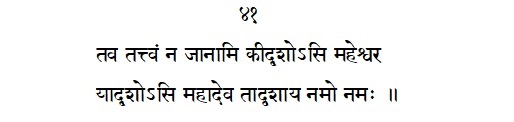
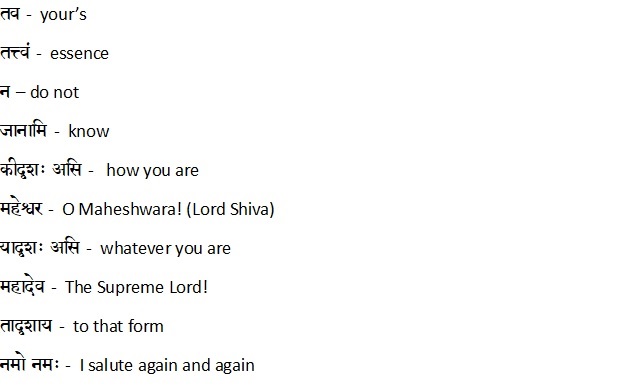


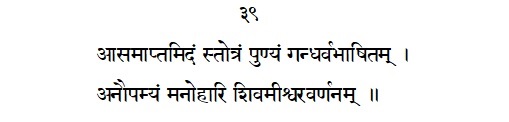


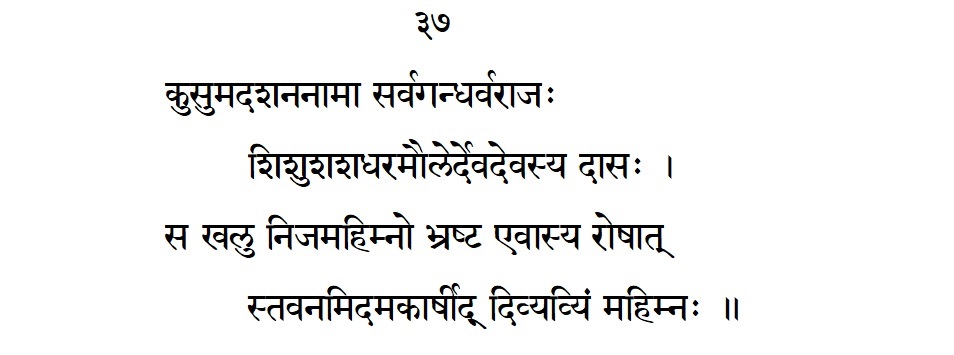


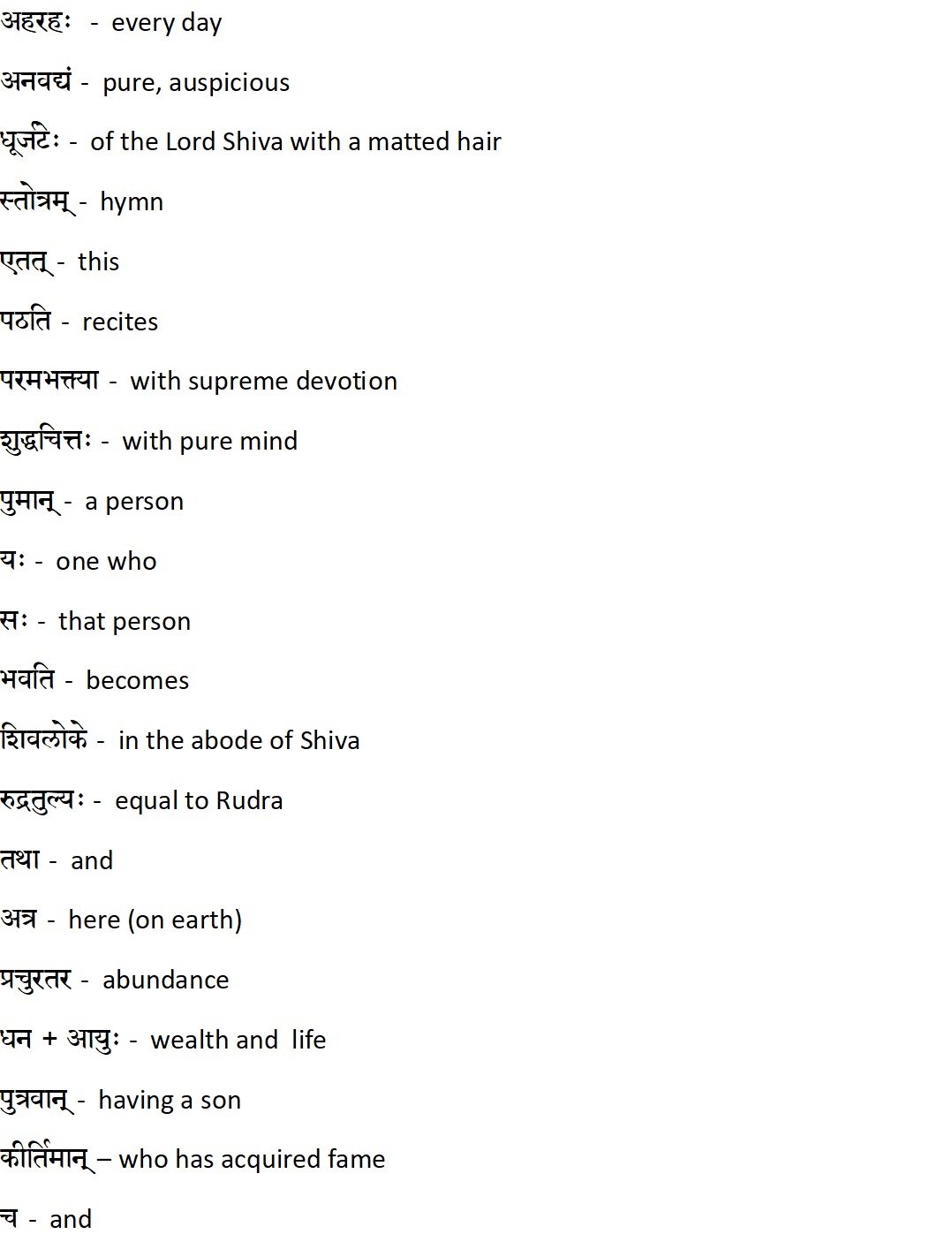


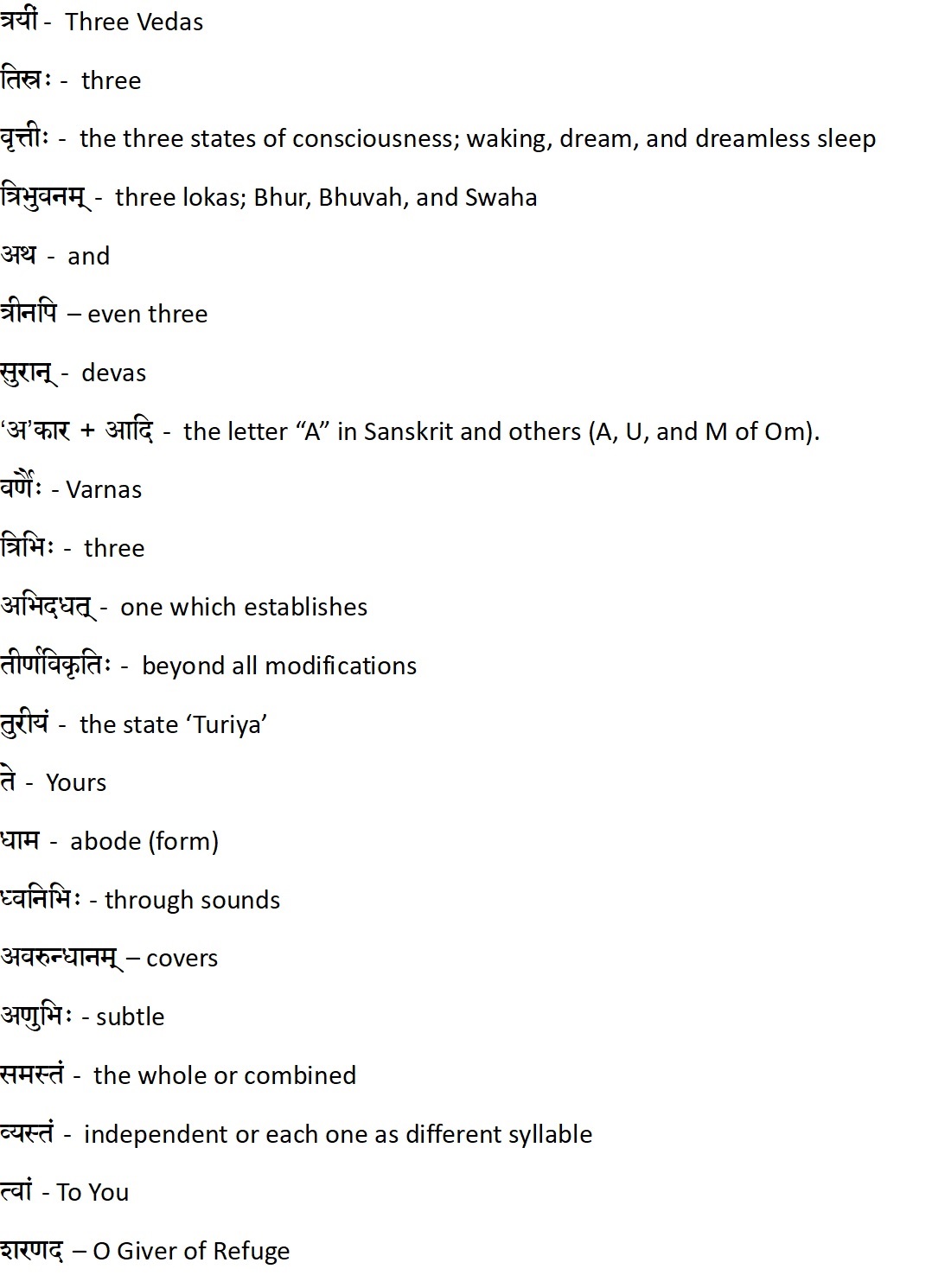


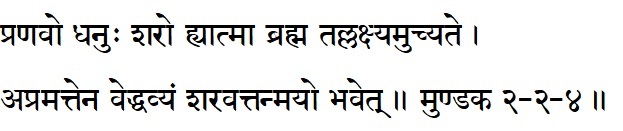


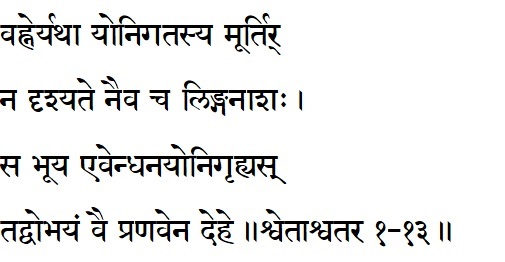


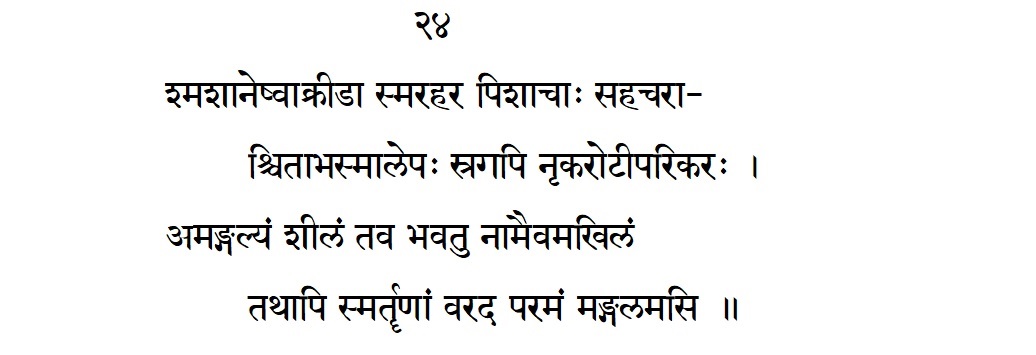


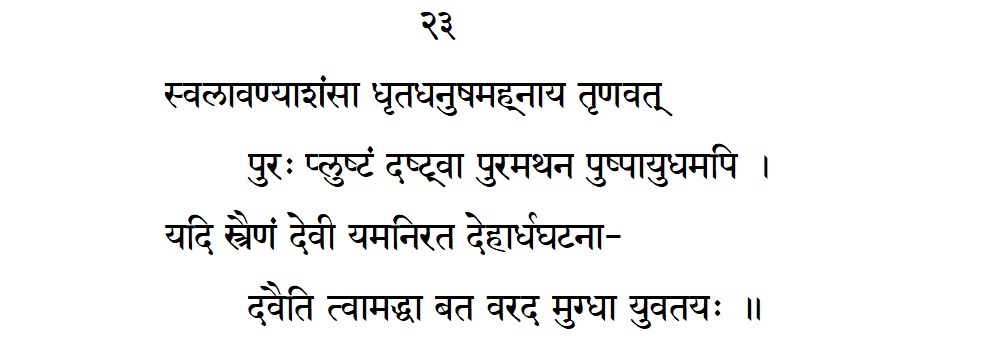
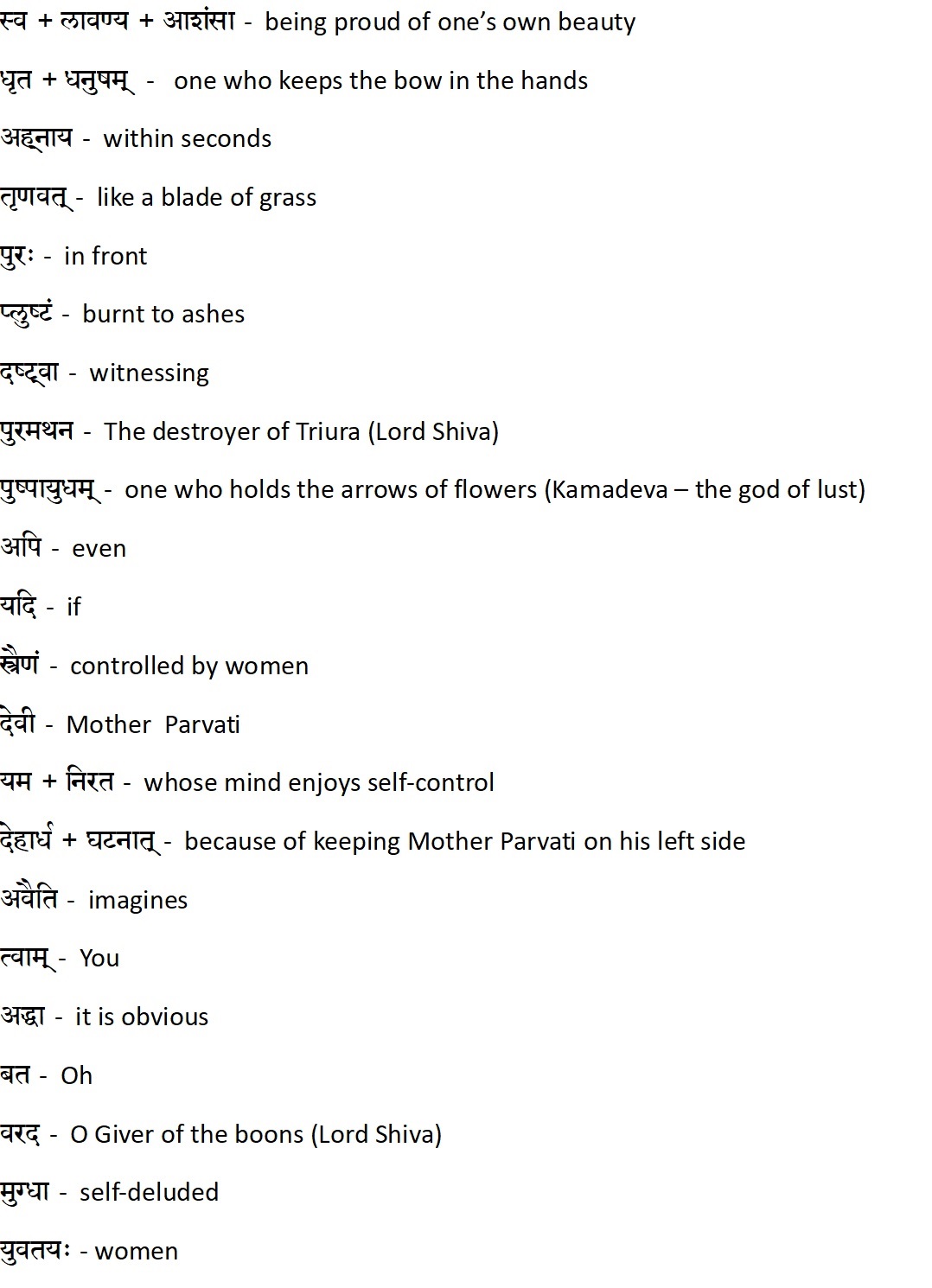

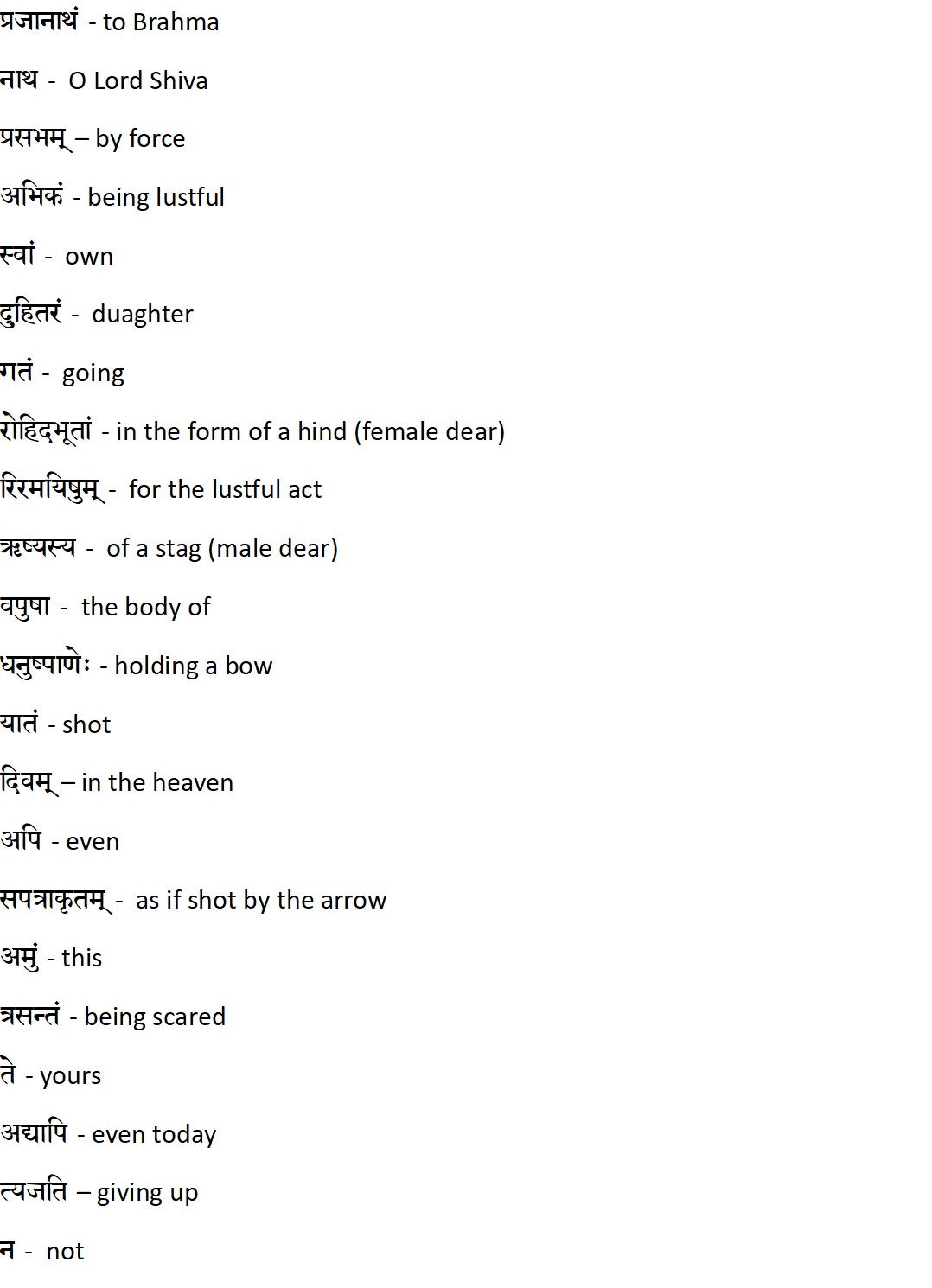


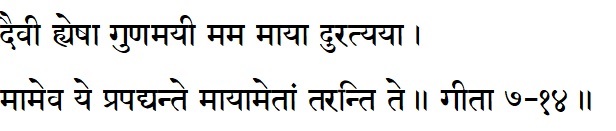

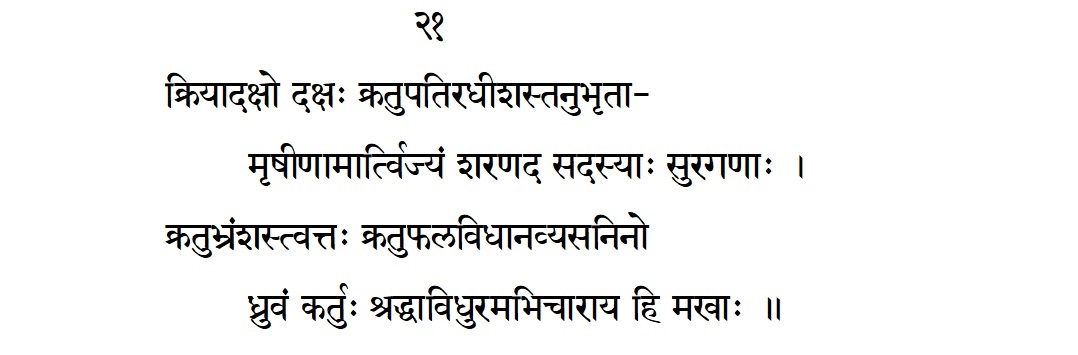









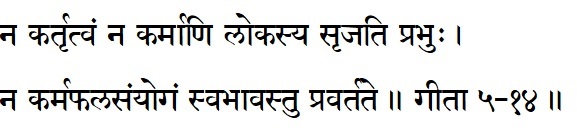


 mahendrajani