Shri Hanuman Chalisa

Last week in a five-day summer camp 10th-grade high school students requested that they want to learn Shri Hanuman Chalisa. I was very happy to teach them because it is the best opportunity for me to learn and think more about Shri Hanuman Chalisa. Since this was one of the four topics of their camp, we only had five online classes. But, to my amazement, they enjoyed learning its text and meaning, and most importantly singing it. A few students learned the whole Hanuman Chalisa and most of them learned 24-28 chaupais out of 40. Almost all the students told me that during these days their minds keep repeating the Hanuman Chalisa. Students enjoyed remembering Sri Hanumanji’s character, vigor, intelligence, love, and devotion and his eagerness to do any work for Lord Rama.
The poet-saint who wrote Shri Hanuman Chalisa
Saint Tulsidas (1532 – 1623) was a Hindu poet-saint who was a great devotee of Lord Rama. He had a vision of Sri Hanumanji, the ideal servant of Lord Rama. Sri Hanumanji helped Saint Tulsidas to have the vision of Lord Rama.
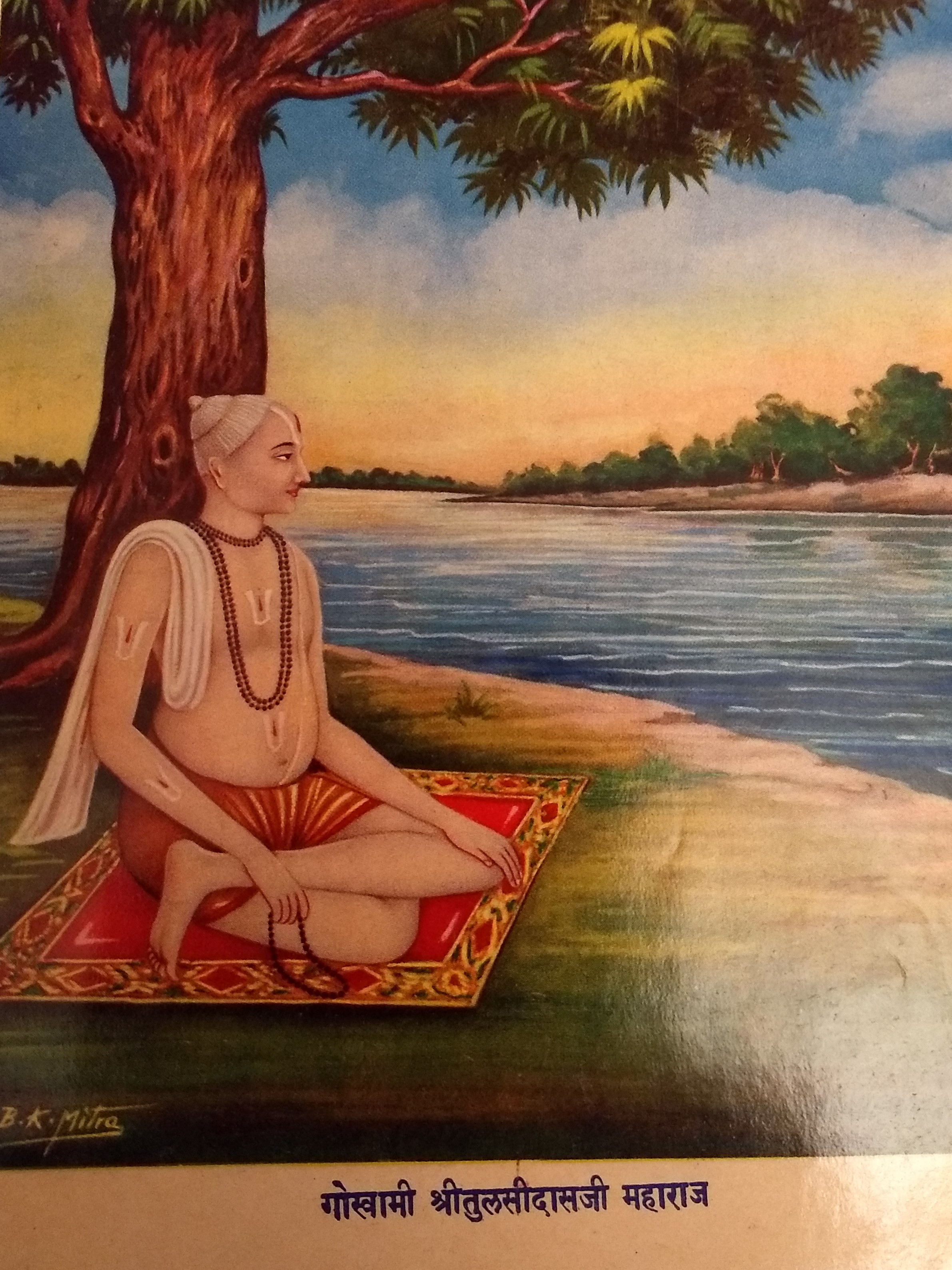
The great epic Ramayana was originally written by Sage Valmiki. Saint Tulsidas wanted the Ramayana to be known by all in Northern India whether they knew Sanskrit or not. He rewrote the Ramayana as “Rama Charita Manasa” in the people’s language Awadhi which is close to Hindi. Today almost all Hindus in North India are familiar with or have heard of The Rama Charita Manas and they have been inspired by the virtues and devotion described in the book. The Rama Charita Manas has seven Kands (sections) in which the Fifth Kand is called the “Sundara Kanda”, meaning it is an excellent, wonderful, and most appealing Kanda. It describes courage, intelligence, humility, and the mighty power of Sri Hanumanji.
Saint Tulsidas wrote separately “The Hanuman Chalisa”, a forty-line hymn describing the glories of Sri Hanumanji. Each line of the hymn is called a “Chaupai”, a verse with two parts which rhyme. Chalisa means forty. Besides the forty lines, the Hanuman Chalisa also consists of two ‘Dohas’, in the beginning, to pray Sri Hanumanji and one Doha at the end asking Sri Hanumanji to reside in the heart of a devotee along with Lord Rama, Mother Sitaji and Lord Rama’s brother Sri Lakshmanji. Doha is a verse with two lines.
The Hanuman Chalisa describes various heroic acts of Sri Hanumanji along with his virtues and his various names. It also mentions the benefits of reciting this hymn. Today, millions of Hindus in India and all over the world are reciting this hymn regularly.
Before we go over the text and the meaning of the Hanuman Chalisa, I wanted to go over the associations of Sri Ramakrishna and Swami Vivekananda with Lord Rama, the Ramayana, and Shri Hanumanji. These are inspiring incidents and thoughts which may help to appreciate the Hanuman Chalisa.
Sri Ramakrishna’s worships of Lord Rama and Hanumanji:
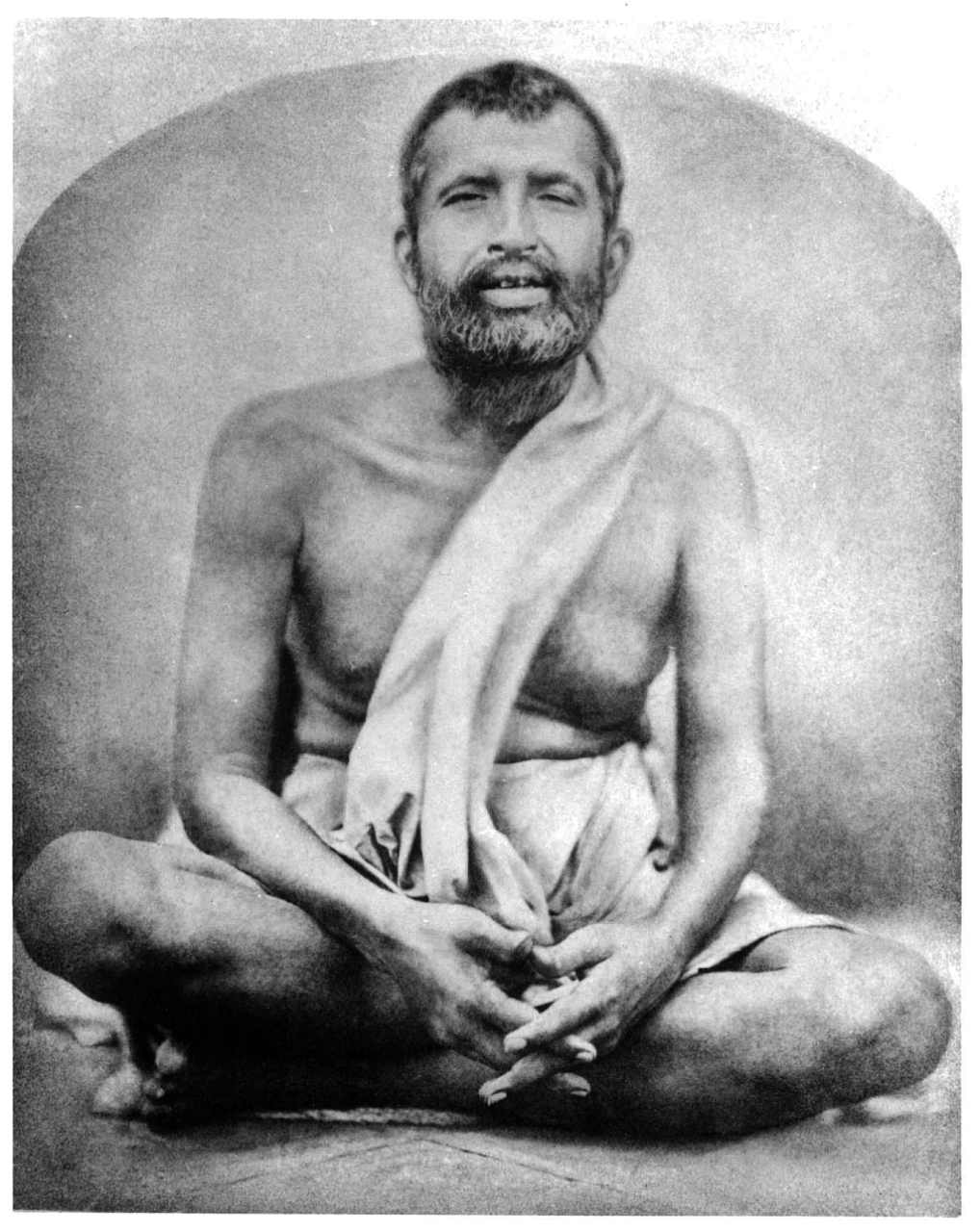
Sri Ramakrishna’s family deity was Lord Rama. It is inspiring to see how Sri Ramakrishna gave his hundred percent mind, intellect, and heart in each of his spiritual practices. His spiritual practices were very natural. He had no inhibition and not the slightest trace of worry about the people’s opinions. The following two descriptions can give us some idea of how he had a vision of Lord Rama and Mother Sitaji and how he became one with Sri Hanumanji.
Worship of Ramalala:
About the year 1864 (when Sri Ramakrishna was about 28 years old) a wandering Vaishnava monk, called Jatadhari (one with matted hair), went to Dakshineswar. He was a devotee of Lord Rama. He had a small metal image of Lord Rama which he was daily worshipping it by giving a bath, feeding it, playing with it, taking it for a walk, and making it sleep. For the monk, it was not an image but a living Lord Rama. The monk was calling it Ramalala, out of love. Sri Ramakrishna loved this Ramalala.
One day, the monk came to Sri Ramakrishna and said that he had a vision of Lord Rama by worshipping the Ramalala and he wanted to give it to him to continue the worship he was doing before he moves on. Sri Ramakrishna was overjoyed. Afterward, Ramalala became a favorite companion of Sri Ramakrishna. Later on, he described to the devotees how the little image would dance gracefully before him, jumps on his back, insist on being taken in his arms, run to the fields in the sun, pluck flowers from the bushes and play pranks like a naughty boy. A few days later Sri Ramakrishna was blessed through Ramalala with a vision of Lord Rama. He realized that the Lord Rama of the Ramayana pervades the whole universe as Spirit and Consciousness; that He is its Creator, Sustainer, and Dissolver. He is the transcendental Brahman, without form, attribute, or name.
Worship of Shri Hanumanji:
Once, during his stage of spiritual practices, Sri Ramakrishna began to worship God by assuming the attitude of a servant towards his master. He imitated the mood of Sri Hanumanji of the Ramayana, the ideal servant of Lord Rama, and the traditional model for his self-effacing form of devotion. When he meditated on Sri Hanumanji, his movements and his way of life began to resemble those of a monkey. His eyes became restless. He lived on fruits and roots. With his cloth tied around his waist, a portion of it hanging in the form of a tail, he jumped from place to place instead of walking. He became one with Sri Hanumanji. After a short while, he was blessed with a vision of Mother Sitaji, the divine consort of Lord Rama, who entered his body and disappeared there with the words, “I bequeath to you my smile.”
Thus, Sri Ramakrishna identified himself with Shri Hanumanji and as Shri Hanumanji had found Mother Sitaji, he had a vision of Mother Sitaji.
(The above mentioned two descriptions are based on the biography written by Swami Nikhilananda in “The Gospel of Sri Ramakrishna”.)
Let us learn more about Sri Hanumanji from Swami Vivekananda.
Swami Vivekananda telling the story of Ramayana:
“When Rama and Lakshmana returned to the cottage and found that Sita was not there, their grief knew no bounds. They could not imagine what had become of her. The two brothers went on, seeking everywhere for Sita, but could find no trace of her. After long searching, they came across a group of “monkeys”, and in the midst of them was Hanuman, the “divine monkey”. Hanuman, the best of monkeys, became the most faithful servant of Rama and helped him in rescuing Sita, as we shall see later on. His devotion to Rama was so great that he is worshipped by the Hindus as the ideal of a true servant of the Lord.”
A great Bhakta (Hanuman) once said when asked what day of the month it was, “God is my eternal date, no other date I care for.”
Swami Vivekananda’s love for Ramayana and Hanuman:

In boyhood, Swami Vivekananda had a great predilection for hearing the chanting of the Ramayana by professional singers. Wherever such chanting would take place in the neighborhood, he would attend it, leaving the sport and all aside. Swamiji related how, while listening to the Ramayana, on some days, he would be so deeply engrossed in it as to forget all about home, and would have no idea that it was late at night, and that he must return home, and so forth. One day during the chant he heard that the monkey – god Hanuman lived in banana orchards. Forthwith he was so much convinced that when the chant was over, he did not go home straight that night, but loitered in a banana orchard close to his house, with the hope of catching sight of Hanuman, till it was very late in the night.
Hanuman (Mahavir) is the great ideal:
A disciple asked Swami Vivekananda: What ideal should we follow now?
Swami Vivekananda: You have now to make the character of Mahavira your ideal. See how at the command of Ramachandra he crossed the ocean. He had no care for life or death! He was a perfect master of his senses and wonderfully sagacious. You have now to build your life on this great ideal of personal service. Through that, all other ideals will gradually manifest in life. Obedience to the Guru without questioning, and strict observance of Brahmacharya — this is the secret of success.
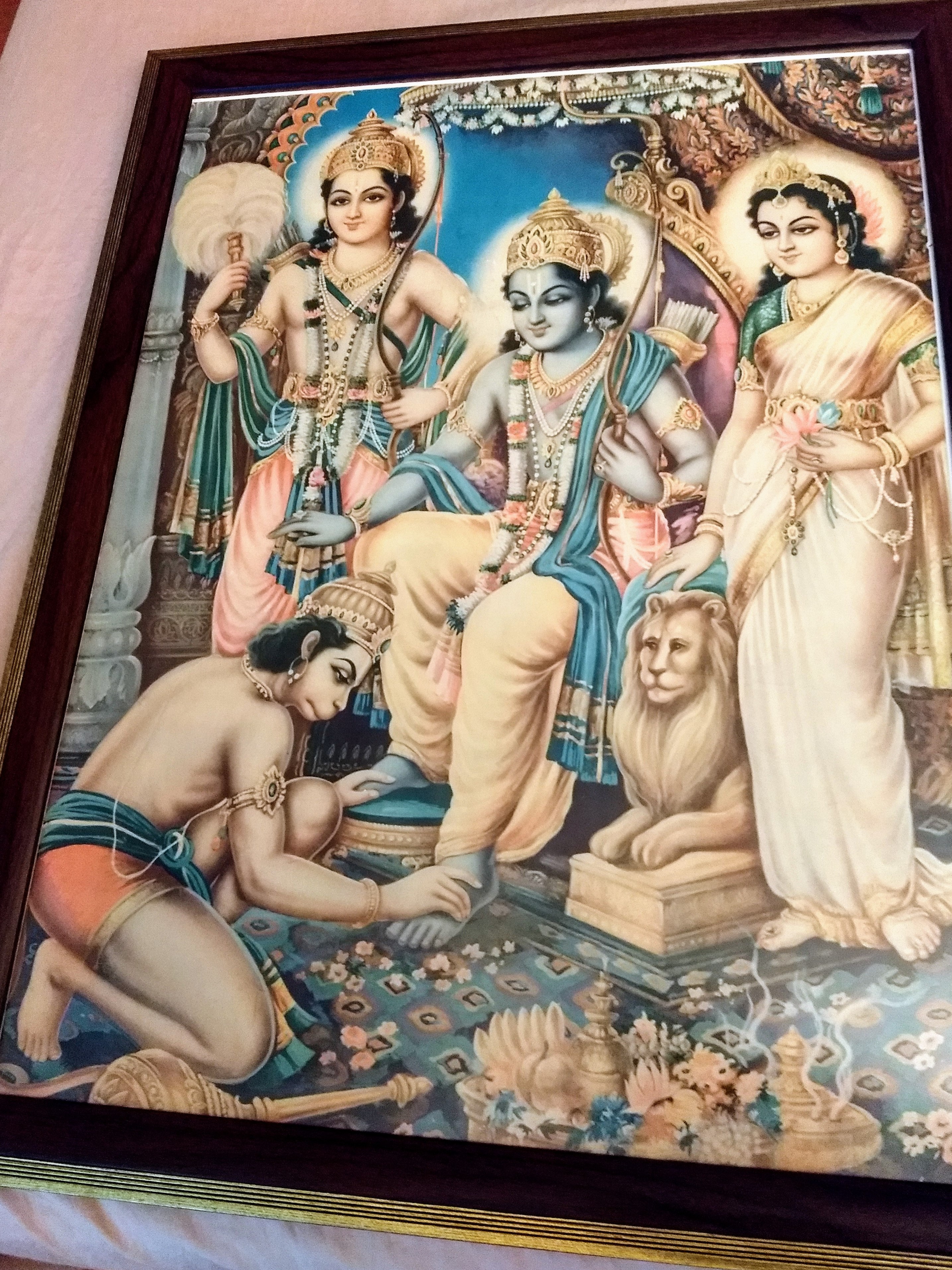
As on the one hand, Hanuman represents the ideal of service, so on the other hand he represents leonine courage, striking the whole world with awe. He has not the least hesitation in sacrificing his life for the good of Rama. A supreme indifference to everything except the service of Rama, even to the attainment of the status of Brahma and Shiva, the great World of gods! Only the carrying out of Shri Rama’s best is the one vow of this life! Such wholehearted devotion is wanted….
The Damaru and horn have to be sounded, drums are to be beaten so as to raise the deep and martial notes, and with “Mahavira, Mahavira” on your lips and shouting “Hara, Hara, Vyom, Vyom”, the quarters are to be reverberated… Through the thunder – roll of the dignified Vedic hymns, life is to be brought back into the country… If you can build your character after such an ideal, then a thousand others will follow. But take care that you do not swerve an inch from the ideal. Never lose heart. In eating, dressing, or lying, in singing or playing, in enjoyment or disease, always manifest the highest moral courage. Then only will you attain the grace of Mahashakti, the Divine Mother.
Hanumanji’s attitude:
“Hanuman, the devotee of Rama, summed up his philosophy in these words: When I identify myself with the body, O Lord, I am Thy creature (servant), eternally separate from Thee. When I identify myself with the soul, I am a spark of that Divine Fire which Thou art. But when I identify myself with the Atman, I and Thou art one.”
Hanuman’s example of Eka(One)-Nishtha which leads to Serva(All)-Nishtha:
Swami Vivekananda: “During his lifetime, Rama came again as Krishna; and Hanuman, being a great Yogi, knew that the same God had come back again as Krishna. He came and served Krishna, but he said to him, “I want to see that Rama-form of yours”. Krishna said, “Is not this form enough? I am this Krishna; I am this Rama. All these forms are mine”. Hanuman said, “I know that, but the Rama-form is for me. The Lord of Jânaki (Lord Rama) and the Lord of Shri (Lord Vishnu) are the same. They are both the incarnations of the Supreme Self. Yet the lotus-eyed Rama is my all in all”. This is Nishtha–knowing that all these different forms of worship are right, yet sticking to one and rejecting the others. We must not worship the others at all; we must not hate or criticize them, but respect them.
This is indeed the most poetical and forcible way in which the theory of Ishta – Nishtha has ever been put. This Eka – Nishtha or devotion to one ideal is absolutely necessary for the beginner in the practice of religious devotion. He must say with Hanuman in the Ramayana, “Though I know that the Lord of Shri and the Lord of Janaki are both manifestations of the same Supreme Being, yet my all in all is the lotus-eyed Rama.” Or, as was said by the sage Tulasidasa, he must say, “Take the sweetness of all, sit with all, take the name of all, say yea, yea, but keep your seat firm.” Then, if the devotional aspirant is sincere, out of this little seed will come a gigantic tree like the Indian banyan, sending out branch after branch and root after root to all sides, till it covers the entire field of religion. Thus will the true devotee realizes that He/She who was his own ideal in life is worshipped in all ideals by all sects, under all names, and through all forms.”
Text, transliteration, and meaning of Shri Hanuman Chalisa:

Shri Hanumaan Chaalisa
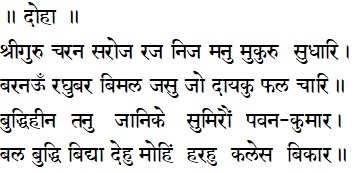
Dohas
Shri Gurucharana saroja raja nija manu mukuru sudhaari
Baranau Raghuvara bimala jasu jo dayaku phala chaari
Buddhihina tanu jaanike sumirau pavankumaar
Bala buddhi vidyaa deho mohi(n) harahu kalesa bikaara.
After cleansing my mind with the holy dust of the lotus feet of my teacher, I engaged myself in describing the untainted pure glory of Sri Ramachandra by knowing which we get all the four fruits of life – Dharma, Artha, Kama, and Moksha.
I am devoid of intelligence. With that awareness, I remember Sri Hanumanji, the son of the wind god, and humbly ask him to give me strength, intelligence, knowledge which destroy all the miseries of my life created by the ignorance.

Chaupai
Jaya Hanumaan gyana guna saagar jaya kapisa tihu(n) loka ujaagara
Raamaduta atulita baladhamaa anjani-putra pavanasuta namaa
Mahabira bikrama Bajarangi kumati nivaara sumatike sangi
Kanchan barana biraaja subsea kaanan kundala kunchita kesaa.
(1) Victory to Sri Hanumanji who is an ocean of knowledge and virtues. O Kapisha! You illumine all the three worlds – Heaven, earth, and hell (the whole universe).
You are the messenger of Sri Rama having immeasurable strength. You are the son of Mother Anjana and named as the son of the wind god.
Having a strong body like the vajra which cannot be destroyed by anything, you are Mahavira, the valiant and brave. You remove the impurity of the intellect and in your presence, we feel the wisdom and our intellect becomes pure.
Your complexion is golden of a yogi. You are adorable with your outfit, curly hair, and earrings.

Haatha bajra au dhvajaa biraajai ka(n)dhe mu(n)ja janeu saajai
Sankara suvana Kesarinandana teja prataapa mahaa jagavandana
Vidyaavaan guni ati chaatura Raama kaaja karibeko aatura
Prabhucharitya sunibeko rasiyaa Raama Lakhana Sitaa mana basiyaa.
(2) You carry in your hand a mace of a lightning bolt and a flag of renunciation and victory of Sri Rama. You are wearing a sacred thread, a symbol of purity and commitment to God-realization. You are a descendant of Lord Shiva and the joy of Shri Kesari. The whole world bows down to you.
You are endowed with the highest knowledge and possess all virtues. You are extremely smart and skillful. You enjoy singing the glories of Sri Rama and all the three, Sri Rama, Sri Lakshmana, and Mother Sitaji, always reside in your heart.
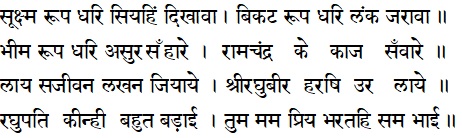
Sukshma rupa dhari siyahi(n) dikhaavaa bikata rupa dhari Lanka jaraavaa
Bhima rupa dhari asura sau(n)haare Raamachandrake kaaja sau(n)vaare
Laaya sajivana Lakhana jiyaaye Shri Raghuvira harashi ura laaye
Raghupati kinhi bahuta badaai tuma mama priya Bharatahi sama bhaai.
(3) By taking a subtle form you found Sitaji and talked to her with humility. On the other hand, you became a giant and burn the whole city Lanka and with the mighty form, you destroyed demons. Thus, you did Sri Rama’s work.
You brought sanjivani to save Sri Lakshmanji’s life. For this act, Sri Rama embraced you with a lot of love and praised you by saying that “You are as dear to me as my own brother Bharat.”
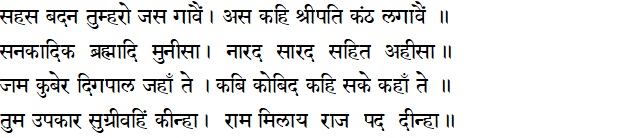
Sahasa badana tumharo jasa gaavai(n) asa kahi Shripati kantha lagaavai
Sanakaadika Brahmaadi munisaa Naarada Saarada sahita Ahisaa
Jama kubera Dikpaala jahaa(n) te kabi kobida kahi sake kahaa(n) te
Tuma upakaaraa Sugrivahi(n) kinhaa Raama milaaya raaja pada dinhaa.
(4) Sri Rama embraces you saying that the Shesh Naga with thousands of mouths praising your glories and so do Sanak, Brahma, Munis, Narada, Saraswati, Ahisa, Yama, Kubera, the gods who protect all directions and others.
Compare to this, how a mere poet can describe your glories adequately? You rendered a great service to Sugriva by introducing Sri Rama to him and making him a king.

Tumharo mantra Bibhishana maanaa Lankeshwara bhaye saba jaga jaanaa
Juga sahasra jojana para bhaanu lilyo taahi madhura phala jaanu
Prabhumudrikaa meli mukha maahi(n) jaladhi laanghi gaye acharaja naahi(n)
Durgama kaaja jagatake jete sugama anugraha tumhare tete.
(5) It is well-known that Vibhishana accepted your counsel and became the king of Lanka.
You flew to swallow the sun which was millions of miles away thinking that it is an apple.
It is no wonder that you put Sri Rama’s ring in your mouth and in one jump crossed the ocean. With your grace, all the impossible-looking works of the world can be made possible.

Raamaduaare tuma rakhavare hota na aagnyaa binu paisaare
Saba sukha lahai tumhaari saranaa tuma rachchhaka kaahu ko daranaa
Aapana teja samhaaro aapai tino(n) loka haa(n)ka te kaa(n)pe
Bhuta pisaacha nikata nahi(n) aavai mahaabira jaba naama sunaavai.
(6) O sentinel of the Lord! No one can enter Sri Rama’s abode without your consent. By your grace, one can enjoy all the happiness of the world and need not have any fear under your protection.
When you roar all the three worlds tremble. Only you can control your own might. When your devotees repeat your name saying ‘O Mahavir!” the evil spirits cannot come near them.
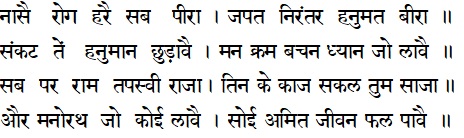
Naasai roga harai saba piraa japata nirantara Hanumata biraa
Sankata te(n) Hanumaana chhudaavai mana krama bachana dhyaana jo laavai
Saba para Raama tapasvi raajaa tinake kaaja sakala tuma saajaa
Aura manoratha jo koi laavai soi amita jivana phala paavai.
(7) O mighty Hanumanji! One who constantly repeats your name can overcome all the diseases and suffering. One who at all the times aligns thoughts, speech, and actions and meditates on Hanumanji becomes free from all the troubles.
The austere king Sri Rama is the ruler of all and you help accomplish all his missions. One who surrenders to you gets all his/her desires fulfilled.

Chaaro(n) juga parataapa tumhaaraa hai parasiddha jagata ujiyaaraa
Saadhu santake tuma rakhavaare asura nikandana Raama dulaare
Ashta siddhi nau nidhike daataa asa bara dina Jaanaki maataa
Raama rasaayana tumhare paasaa sadaa raho Raghupatike daasaa.
(8) Your glory is acclaimed in the four Yugas and your radiance is spread all over the universe. You are a protector of Saints and a destroyer of demons. Sri Rama has great affection for you.
Mother Sitaji granted a boon to you so that you can give anyone the eight Siddhis and the nine Nidhis. You have a great remedy for all problems which is the name of Sri Rama. You are always ready to serve Sri Rama.

Tumhare bhajana Raamako paavai janama janamake dukkha bisaraavai
Anta kaala Raghubara pura jaai jahaa(n) janma Haribhakta kahaai
Aura devataa chitta na dharai Hanumata sei sarva sukha karai
Sankata katai mitai saba piraa jo sumirai Hanumata balabiraa.
(9) By chanting your name one can realize Sri Rama and thus becomes free from the sufferings of many lives. After death, he/she enters the eternal abode of Sri Rama and remains his devotee whenever he/she takes birth on earth.
Other gods may not take care of you, but whoever serves you enjoys all happiness. O Hanumanji! Those, who remember you, the mighty god, become free from all problems and sufferings of life.

Jai jai jai Hanumaana gosaai kripaa karahu Gurudevaki naai
Jo sata baara paatha kara koi chhutahi bandi mahaa sukha hoi
Jo yah padhai Hanumaan chalisaa hoya siddhi saakhi Gaurisaa
Tulsidaasa sadaa Hari cheraa kijai naatha hridaya ma(n)ha deraa.
(10) Victory to Sri Hanumanji. Please be gracious to me as my Supreme Teacher. One who recites this prayer a hundred times becomes liberated from the earthly bondage and enjoys the highest bliss.
One who recites this Hanuman Chalisa attains the highest state and Lord Shiva becomes the witness for that. Tulsidas is the eternal disciple of Lord Hari and prays, ‘O Hanumanji! Please reside in my heart forever’.

Doha
Pavanatanaya sankata harana mangala murati rupa
Raama Lakhana Sitaa sahita hridaya basahu sura bhupa.
O Hanumanji, the son of the wind-god, remover of the problems of life, the embodiment of the blessings, please reside in my heart with Sri Rama, Sri Lakshmana, and Mother Sitaji.

Siyaavara Raamachandraki Jai
Pavanasuta Hanumaanaki Jai
Siyaavara Raamachandraki Jai sharanam.
Victory to Sri Rama, the husband of Mother Sitaji!
Victory to Hanumanji, the son of the wind-god!
Victory to Sri Rama, the husband of Mother Sitaji!
I surrender to you.
Reflections:
Why Shri Hanumanji is a great ideal?
Swami Vivekananda said that Shri Hanumanji is a great ideal for a devotee because of (i) Shri Hanumanji’s one-pointed love for Lord Rama and (ii) Shri Hanumanji was an ideal servant of Lord Rama and he was always ready to do Lord Rama’s work. We should remember that Shri Hanumanji had the highest knowledge of Advaita Vedanta, but he chose to be a devotee and a servant of Lord Rama as long as he has a body-consciousness.
Why do I recite Shri Hanuman Chalisa?
When I recite Shri Hanuman Chalisa,
(1) I join with Saint Tulsidasji in his beginning prayer consists of the two dohas and request Shri Hanumanji to help me (i) purify my mind by surrendering to my spiritual Guru, (ii) remember the untainted glories of Lord Rama, (iii) understand that my intellect is limited and (iv) develop strength, pure intelligence, and acquire spiritual knowledge with which I can remove my fundamental ignorance which creates all the problems of my life. The fundamental ignorance is that I forget my true divine nature and start thinking that I am nothing but my body and mind.
(ii) While reciting Shri Hanuman Chalisa, I try to imagine all the life incidents of Shri Hanumanji which have been described in it.
I enjoy singing the glories of Shri Hanumanji and remember that Shri Hanumanji is a great ideal. Thus, I pray to develop one-pointed love for God and be ready to do God’s work.
(iii) After completing the recitation of Shri Hanuman Chalisa I join again with Saint Tulsidasji in the last doha to pray to Shri Hanumanji to reside in my heart along with Lord Rama, Mother Sitaji and Shri Lakshmanji and manifest their divinity through my thoughts, speech, and actions.
Reciting Shri Hanuman Chalisa for the worldly gain:
Many hymns have a few lines which say that if we recite the hymn then our sufferings will go away and we get worldly benefits.
In this hymn also we find similar lines like “One who remembers Shri Hanumanji, then disease and all the sufferings of the person goes away, ghost and evil spirit don’t come near him/her, and all the desires of the person get fulfilled”.
I think we have to understand these lines in a proper perspective. We have to read and emphasize other lines that bring the deeper meaning of these lines. For example, the same Hanuman Chalisa says that “By chanting your name one can realize Sri Rama and thus becomes free from sufferings of many lives.” This clearly tells us the purpose of reciting the Hanuman Chalisa, namely ‘Realization of God’ which removes all the problems and sufferings of this life and the future lives.
If someone is sick or in trouble, then there is nothing wrong to pray to God for the recovery of the person from his/her illness and being free from the trouble. We love God and we can tell all our troubles to God and pray to God. But, after the prayer, we have to surrender to God’s will. This way we will acquire inner strength and fearlessness which allow us to go through the difficult challenges of life and would be able to bear all the sufferings. There is no other sane way to live our life.
Our prayer is not a business contract like ‘O God! I pray to you and in return, you remove my sickness or trouble.’ God is the creator, preserver, and the dissolver of the universe. There is a divine plan behind this whole universe that we cannot fully understand. In the infinite universe of God, even the whole earth is a tiny little dot, then how can we demand God for our little selfish needs! We cannot tell God what to do. We can only pray to God and then leave everything to God’s will.
Sri Ramakrishna said that he had never asked God for anything except knowledge and devotion. He did not ask Mother Kali for his recovery from his throat cancer. He taught us that we should only pray to God for knowledge and devotion. Swami Vivekananda, as Naren, also did the same thing. He could not pray for his family’s financial crisis to the Divine Mother. He went to pray for it, but instead, he prayed for knowledge and devotion. This is exactly the main purpose of all the hymns – to develop a love for God and realized God. Then all our problems will be solved.
People, who just pray to God to fulfill their worldly desires, may lose faith in God when these desires are not fulfilled. Ultimately they lose all the great benefits of spiritual development.
Let us enjoy reciting the Hanuman Chalisa to develop one-pointed love for God and to become a true servant of God like Shri Hanumanji. May Shri Hanumanji bless us all.
Melodies of Shri Hanuman Chalisa:
Several great artists of India have sung Shri Hanuman Chalisa in various melodies. All these are available on the internet. Several of the melodies are based on the Indian Classical Ragas. There are many melodies based on folk tunes.
A few years ago, singing Shri Hanuman Chalisa, a melody based on the Bhairavi Raga came to my mind. I am so grateful that Shri Ghanashyambhai Senjalia sang for this post the Hanuman Chalisa in Raga Bhairavi. Here is the audio of this recording:
I wanted to add audios of more popular folk tunes. I requested Chintal and Jyoti Shah to sing the Hanuman Chalisa in the folk tune that they are familiar with. I sincerely thank them for this recording which I am presenting here.
There was another popular tune that I had heard from many people. I found that Devika Gadhavi sings in that tune. So, upon my request, Devika sang for this post in short notice. I sincerely thank her for this audio recording which I am attaching here. I hope you enjoy all these recordings.
 mahendrajani