Category Archives: Events

Happy 151st Birthday of Swami Vivekananda!

Swami Vivekananda was born on January 12, 1863.  His 150th Birth Anniversary was celebrated for last two to three years all over the world by his devotees and admirers.
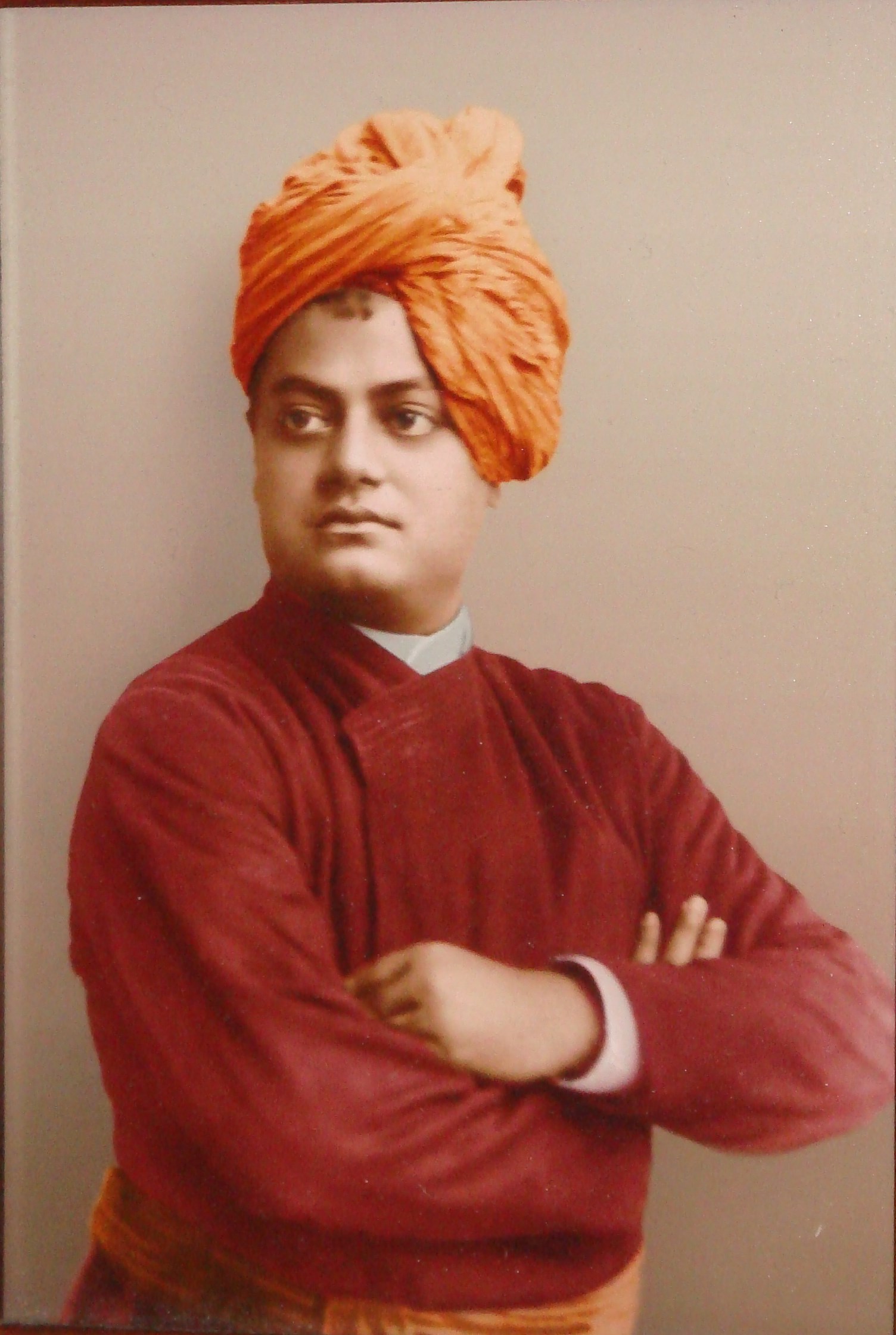
Image
Swami Vivekananda (January 12, 1863-July 4, 1902)

As time passes, people forget people.  Generations after generations simply fade away in time. But, for personalities like Swami Vivekananda, as time passes, more and more people understand the importance of their lives, teachings and/or their contributions.

According to the Hindu calendar, Sunday, February 3, 2013 was Swami Vivekananda’s actual 150th Birthday.  I was fortunate to be invited by Revered Swami Yuktatmananda, Spiritual Head of Ramakrishna Vivekananda Center, 17 East, 94th St., New York, as one of the four speakers to share my thoughts.  My topic was “The Essential Spiritual Message of Swami Vivekananda.”
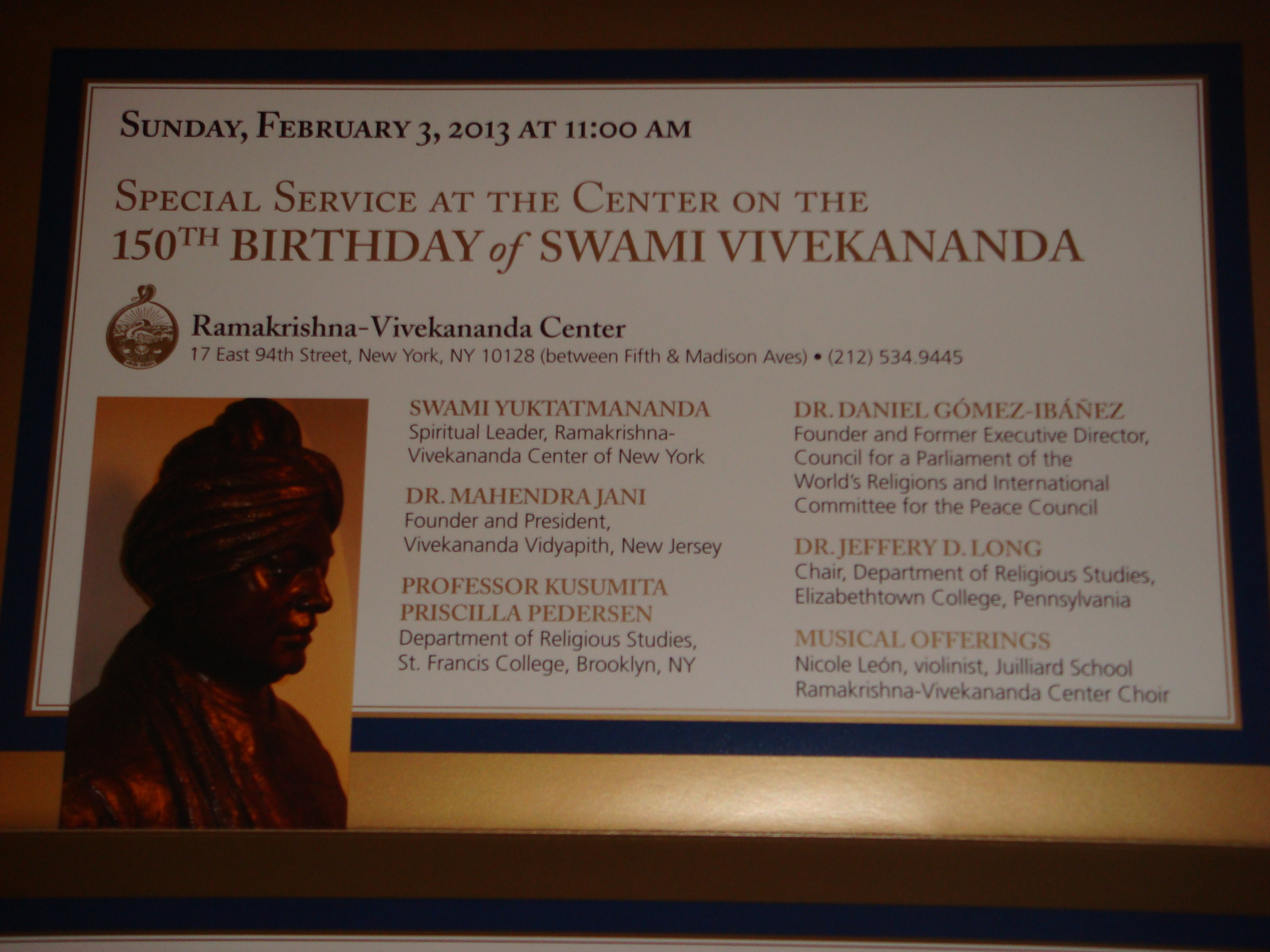
FlierFeb3Y2013
Flier of February 3, 2013 Program

Revered Swami Yuktatmananda was kind enough to give me the audio of my speech delivered at the Ramakrishna Vivekananda Center.

Simply enjoy it by clicking on the following arrow:

If you cannot get all the words, then please read the following lecture prepared from the audio with some minor changes.

The Essential Spiritual Message of Swami Vivekananda

(Lecture given at Ramakrishna Vivekananda Center, New York, on February 3, 2013, on the occasion of 150th Birthday Celebration of Swami Vivekananda)

Mahendra Jani

Revered Swami Yuktatmanandaji, honorable speakers and friends:

I sincerely thank Swami Yuktatmanandaji for giving me an opportunity to share my thoughts on this special occasion, celebrating Swami Vivekananda’s 150th Birth Anniversary. This is a very special occasion as it is on the exact birthday of Swami Vivekananda according to the Hindu calendar.  My topic is, “The Essential Spiritual Message of Swami Vivekananda.”

After listening to and learning from revered Swami Adiswaranandaji for many years, listening to Swami Yuktatmanandaji and others, and also reflecting upon Swami Vviekananda’s teachings, I am fully convinced that the essential spiritual message of Swami Vivekananda is this:

“Each soul is potentially divine.  The goal is to manifest that divinity within by controlling nature: external and internal.   Do this either by work, or worship, or psychic control, or philosophy-by one, or more, or all of these-and be free.  This is the whole of religion.  Doctrines, or dogmas, or rituals, or books, or temples, or forms are but secondary details.”

Why Divinity and what is divinity? We all want to be happy, but various disturbances and miseries come and make us unhappy.  We say, Om Shanti! Shanti! Shanti!  Om Peace! Peace! Peace! Three times because there are three kinds of disturbances:  from the environment, from people, and from our own minds. We have no control over the natural disasters like tsunamis, earthquakes, and storms like Sandy.  But the question is what can we do about the internal disturbances?

If we examine life more closely, what do we find? We find more misery than happiness. Babies are born crying.  Toddlers cry for food and discomfort.  Teens are unhappy because they cannot do what they want to do and cannot get what they want.  Adults are worried about finding good jobs and life partners.  Then, there are the three rings: engagement ring, wedding ring and suffering.  Adulthood passes in carrying the heavy workload of their job and household.  It follows by old age, disease, and death.

Suppose everything is fine – one has a good job, a good spouse, and a good family. But, then the mind changes and they are not good anymore. A person’s mind gets bored or unhappy with what he or she has.  One day the job and the boss look great, and another day you hate both of them.  The husband, who was sweet like honey before marriage, now becomes a bitter pill to swallow.   Someone once said, one day the wife looked as though moon-faced (Chandramukhi), another day as though sun-faced (Suryamukhi), and another day as though volcano-faced. Same people, but the mind changed. Or one can say, “As the mind changes, people change.  The house which was once a heaven on earth, now looks like a prison. We suffer because we are helpless.  We are slaves of our past actions.  We cannot get out of their consequences.  There are physical limitations.  No one asked me before my birth where I wanted to be born, what would be the color of my skin and eyes. I want to be in New York, in Los Angeles and in Delhi at the same time.  But, I can’t. I want to enjoy food, but doctors say, “No.  It is not good for you.”  I know someone who was dieting because of health problems.  After ten days of fasting, he was passing by a bakery and smelled a cheese cake.  He controlled himself, went a few steps further.  All of a sudden, he turned back, went into the bakery, bought the cheese cake and ate the whole right there.  We make resolutions, but we cannot keep them.  People say that it is good to make resolutions on January 1st, so we have the joy of breaking them in February.  Shankaracharya says that a fish gets caught because of craving for food, an elephant because of its desire to enjoy touch, a moth by the beauty of fire, deer by sound, and a bee by smell.  Human beings are slaves of all five senses, and we suffer.

Next is the fundamental question of life, ‘What is the purpose of life?’  Is there any purpose? If a near and dear one dies, then we think, “Is that all?  The life is gone? He or she was there a while go, and now is no more.  One day I will be gone and it is all over.” Buddha had all the pleasures of the world, but similar thoughts came to his mind and he could not enjoy the palaces, the parties and the flashy desires. Someone may say, “Uncle, you are looking at the negative side of life.  You are looking at half empty glass.  Look at the positive side of life; see that the glass is half full.”  But, aren’t the “half empty” and “half full” both partial views of life? Isn’t it wise to look at the whole glass? Is it not good to have a realistic view of life? Swami Vivekananda said that we do not have the clear picture of the universe because it is based upon little experience, poor reasoning and our weaknesses.

What is the way out? Some people say, ‘Don’t think too much. Occupy your mind with something: art, science, sports, and parties. Some say, keep changing: change your hair–if you have any, change your house, job, friends, spouse, country etc. Some say that this is what the world is.  Learn to live with it.  Get used to it. Think positive and keep hope alive. But these are mere patch-works. These are not solutions. Running away from the problem or pretending that the problem does not exist is not going to solve the problem. We have to face the problem. Swami Vivekananda said, “Face the brute.” He learned this lesson from a sadhu when he was being chased by monkeys. Rishis, Sages and saints faced the fundamental problems of life.  Swami Vivekananda said that only by facing the forces of nature and not giving in, human beings have manifested their power.

So, what is the way out? After seeing old age, disease and death, Buddha saw a mendicant.  He was serene and filled with happiness. Upon enquiry he found out that this mendicant had realized something that brought all this peace and bliss. Buddha set out to find that something. He set out in search of that Truth or God which removes all sorrows and brings true happiness. Swami Vivekananda wanted that happiness and answers to these fundamental questions of life. He also wanted to know the truth. He wanted to know God. That is why he was asking all people, “Sir, Have you seen God?” No one said, “Yes.” Finally, he met Sri Ramakrishna who said, “Yes my son! I have seen God and I see God more clearly than I see you.”  Swami Vivekananda found in that voice, the echo of the Truth that he was searching and he followed him. What Swami Vivekananda learned from Sri Ramakrishna about God and what he himself realized later, he beautifully described in his poem “Quest for God.” He wrote:

O’ver hill and dale and mountain range,
In temple, church, and mosque,
In Vedas, Bible, Al Koran
I had searched for Thee in vain.

(He searched God everywhere.)

……………

Years then passed in bitter cry,
Each moment seemed an age,
Till one day, midst my cries and groans
Some one seemed calling me.

A gentle soft and soothing voice
That said ‘my son’ ‘my son’,
That seemed to thrill in unison
With all the chords of my soul.

…………….

A flash illumined all my soul;
The heart of my heart opened wide.
O joy, O bliss, what do I find!
My love, My love (God), you are here
And you are here, my love (God), my all!

………………….

            Swami Vivekananda found that the God he was searching for everywhere resided within. God is the divinity lying within that makes us look for God outside. That is why he said, “Each person is potentially divine and the goal of our life is to realize this divinity and manifest it in our thoughts, speech, and actions.”

How do we realize this divinity? Swamiji said, “Realize this divinity by controlling nature: external and internal.” We can control the external nature partially by science, social reform, and proper actions.  But how do you control the internal nature? Note that the external behavior is a reflection of our inner mind-set.   So, most important is to control our internal nature. Swamiji said control your internal nature by either work, or worship, or psychic control, or philosophy.

These are four Yogas of the Bhagavad Gita: Karma Yoga, Bhakti Yoga, Raja Yoga, and Jnana Yoga.  The series of lectures given by Swami Vivekananda on these four Yogas in this New York City around 1894-1895 are one of the greatest contributions of his to humanity. He said both Monks and householders can realize this divinity within.  Offer the results of actions to God, meaning perform all actions unselfishly, not for name, fame, or other ulterior benefit.  Think that everything belongs to God, the Creator, and we are just care-takers. By doing work this spirit, our actions will purify our minds and our divine nature will manifest from within. He said that we must have intense passion to realize God. Sri Ramakrishna said that we have to combine the intensities of three kinds of love: the love that mother has for her child, a greedy person has for money, and a passionate person has for one’s spouse – combine the intensity of all these three kinds of love for God and then one can realize God. When one realizes God, one’s mind will be filled with bliss and love.  With that love of God, even miseries of life seem blessings of God in disguise.  Swami Vivekananda said that learn to control senses by mind and mind by intellect. Then, focus the mind on God or the inner divinity. Study scriptures.  Learn the essence of the teachings of the scriptures from holy people. Reflect upon them. Practice them. and realize that the support of our body and mind is the Soul, our divine self.  Body and mind changes, but the blissful soul is eternal.  Realize that this constantly changing world cannot give us the eternal bliss and peace.  Only through realizing our inner divinity we acquire true happiness and become free from all bondages. These Four Yogas cover all our four faculties: intellect, mind, heart and hands.  All four yogas are necessary.

Finally, Swami Vivekananda said that see God everywhere; see God in all; respect all and love all. Ultimately we have to realize that God has become everything.  He asked us to worship the living God — the God that walks through all feet, who works through all hands, sees through all eyes, speaks through all mouths, and listens through all ears. He encouraged us to worship this living God by serving humanity unselfishly.

Swami Vivekananda had a robust physic.  But, in serving humanity, he had worn out his body and passed away at the age of 39.  He practiced what he preached and left a glorious example for all of us to follow. Million salutations to Swami Vivekananda and salutation to you all! Thank you.

(My sincere thanks to Nisha Parikh for her help in editing this article.)

Happy 144th Birthday of Mahatma Gandhi

Mahatma Gandhi was born on October 2, 1869.  He was six years younger than Swami Vivekananda.  We see that many of Swami Vivekananda’s teachings were exemplified in Mahatma Gandhi’s life, especially to love poor and the untouchables, and serve them as God, and treat all human beings equally with respect irrespective of their religions and other external differences.

A message of truth
Mahatma Gandhi at Sabarmati Ashram

The famous scientist Albert Einstein said, “Generations to come, it may be, will scarce believe that such a one as this (Mahatma Gandhi), even in flash and blood, walked upon this earth.”

Great personalities on Mahatma Gandhi

The famous writer and thinker Romain Rolland wrote Mahatma Gandhi’s biography in 1924.  At that time Mahatma Gandhi’s launched movement had failed to win its objective.  Mahatma Gandhi was in jail atoning, Christ-like, for the failing of his own countrymen.  Romain Rolland wrote this biography to fully support Mahatma Gandhi.  For him Gandhiji was the dawn of new hope for humanity.  They both met in 1931 and then remained friends till end.

Rolland-and-Gandhi6[1]
Mahatma Gandhi and Romain Rolland
The following is a wonderful word-picture of Mahatma Gandhi written by Ramain Rolland.

“… a small frail man, with a thin face and rather large protruding eyes, his head covered with a little white cap, his body clothed in coarse white cloth, barefooted.  He lives on rice and fruit, and drinks only water.  He sleeps on the floor-sleeps very little, and works incessantly.  His body does not seem to count at all.  There is nothing striking about him-except his whole expression of “infinite patience and infinite love.”

W.W. Pearson, who met him in South Africa, instinctively thought of St. Francis of Assisi.  There is an almost childlike simplicity about him.  His manner is gentle and courteous even when dealing with adversaries, and he is of immaculate sincerity.  He is modest and unassuming, to the point of sometimes seeing almost timid, hesitant, in making assertion.  Yet you feel his indomitable spirit.  He makes no compromises and never tries to hide a mistake. Nor is he afraid to admit having been wrong.

Diplomacy is unknown to him; he shuns oratorical effect or, rather, never thinks about it; and he shrinks unconsciously from great popular demonstrations organized in his honor.  Literally “ill with the multitude that adores him,” he distrusts majorities and fears “mobocracy,” and the unbridled passions of the populace.  He feels at ease only in a minority, and is happiest when, in meditative solitude, he can listen to the “still small voice” within.

This is the man who has stirred three hundred million people to revolt, who has shaken the foundations of the British Empire, and who has introduced into human politics the strongest religious impetus of the last two thousand years.”

 A few quotes of Mahatma Gandhi:

“I am giving you a bit of my experience and that of my companions when I say that he who has experienced the magic of prayer may do without food for days together but not a single moment without prayer.  For without prayer there is no inward peace.” (January 23, 1930)

“I suggest we are thieves in a way.  If I take anything that I do not need for my own immediate use and keep it, I thieve it from somebody else.” (February 19, 1925)

“To me God is Truth and Love; God is ethics and morality; God is fearlessness.  God is the source of Light and Life and yet He is above and beyond all these.  God is conscience.  He is even atheism of the atheist.  For in His boundless love God permits the atheist to live.” (March 5, 1925)

Daridranarayana is one of the millions of names by which humanity knows God, who is unnamable and unfathomable by human understanding and it means God of the poor, God appearing in the hearts of the poor.”  (April 4, 1929)

“I venture to suggest, in all humility, that if India reaches her destiny through truth and non-violence, she will have made no small contribution to the world peace for which all the nations of the earth are thirsting and she would also have, in that case, made some slight return for the help that those nations have been freely giving to her.”  (March 12. 1921)

Note that these three events happened in 1893:

(1)  Swami Vivekananda gave his famous speech in Chicago Parliament of World Religions on September 11, 1893.

(2)  In 1893, Mahatma Gandhi as M.K. Gandhi went to South Africa, where he spent 20 years opposing discriminatory legislation against Indians. As a pioneer of Satyagraha, or resistance through mass non-violent civil disobedience, he became one of the major political and spiritual leaders of his time.

(3)  In February 1893, Sri Aurobindo arrived in India from England.  He started working in Baroda, Gujarat and started taking active interest in the politics of India’s freedom struggle against British rule.

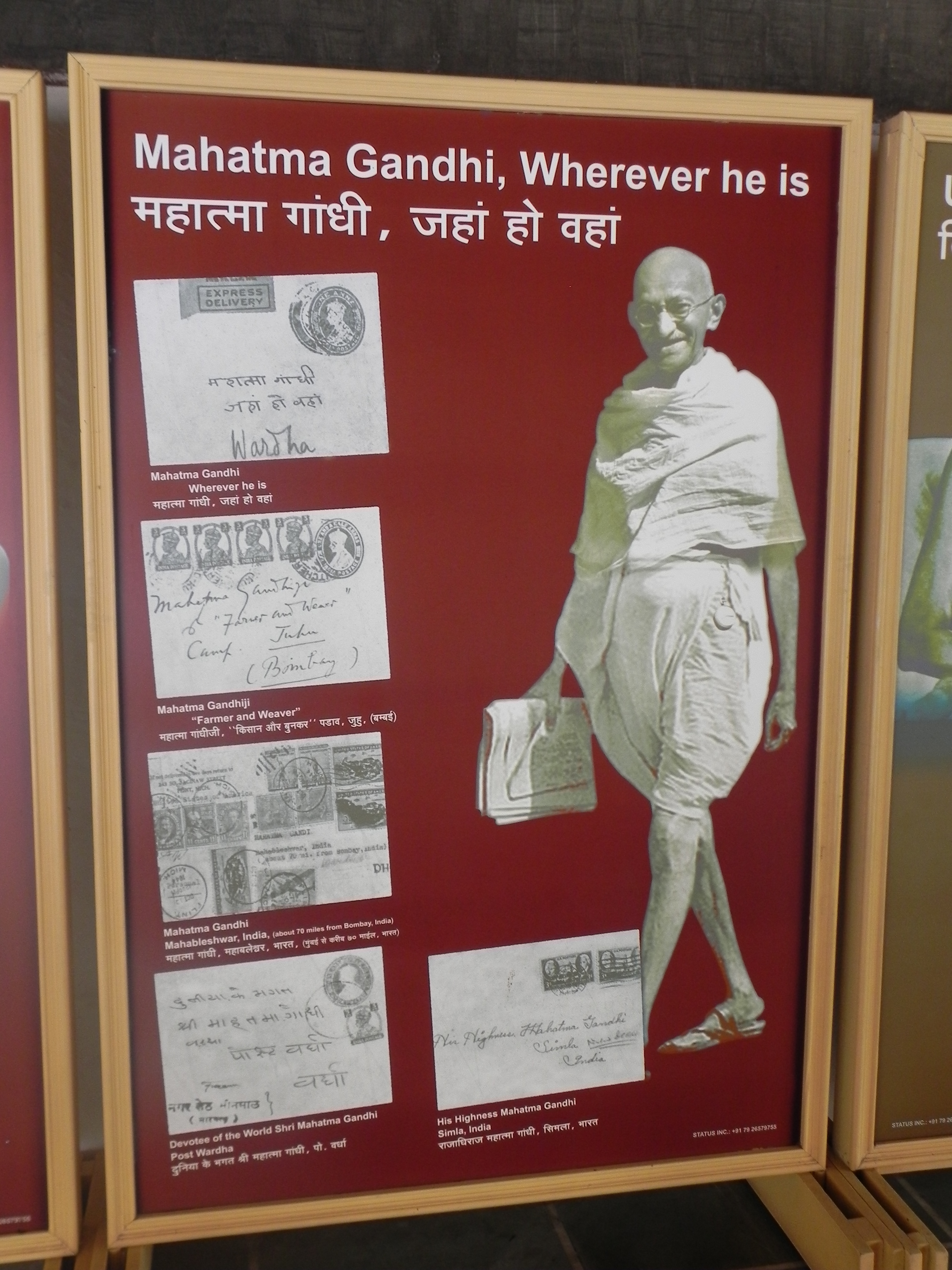
Gandhiji’s mails
Mahatma Gandhi appealed to people all over the world

I can share couple of incidents which were imprinted in my mind.

(1)  It was around December 1982.  Our son was in the middle school.  I went to his school to give him something.  His principal, Mr. Alfred Baumann who was also a mayor of the town, saw me and asked me, “Mr. Jani, would you be able to see me on your way back?”  I said, “Okay.”  I thought there might be something related to our son.  When I was going back, I saw him waiting for me.  He then took me inside his office and asked me to take a seat and he sat on his chair on the other side of the table.  Without any other formalities, he asked me, “Did you see Gandhi movie?”  I was pleasantly surprised.  I said, “Yes, I saw it.”  He asked, “Did you like it?”  I said, “Yes.  I liked it.  Director Attenborough and the actor Ben Kingsley had done a wonderful job.”  Then, Mr. Baumann lean little forward on the table.  His face was filled with loving emotions. He said, “Look, I am a Christian.  After I saw that movie I was thrilled with the thought that a Christ-like person was living on earth when I was a young boy.  In the movie, when a person in South Africa could not burn a passport because he was beaten by a police, I felt like going there and throw the passport in the fire.”  Then we talked about Mahatma Gandhi for a while.  I was amazed by his reverence for Gandhiji.

(2)  This was around early 1970s.  With my friends we went to attend a Sunday morning service conducted by a group which was more Vedanta oriented.  The organizers, though Caucasians, knew Hindu chanting.  After the service, while I was taking some snack which was offered to all, I heard someone was humming a very familiar tune.  I recognized that it was the tune of “Raghupati Raghava Raja Ram.” I turned to my right and found that the Minister (who conducted the service) was joyfully humming this tune.  I asked him, “Do you know what you are humming?”  He calmly said, “Yes, it is ‘Raghupati Raghav Raja Ram’ which was favorit of Mahatma Gandhi.”  I was surprised.  I asked whether he had met Mahatma Gandhi.  He said, “I was not fortunate to meet him.  But, whenever Mahatma Gandhi was fasting for protest or for purification in India, we, a group of young boys, used to fast here in USA to support him.”

(3)  This incident I have heard from Shri Narayanbhai Desai.  He visited Vivekananda Vidyapith and told his reminiscences of Mahatma Gandhi.  He said that he was in Canada and one Canadian (non-Indian) person was driving him.  Road was clear and he was going with the fastest allowed speed.  He was asking Shri Narayanbhai about his association with Mahatma Gandhi.   When Shri Narayanbhai said that he was fortunate to sit on the lap of Mahatma Gandhi, immediately this person turned his car to the shoulder and applied break to stop the car.  It was a jerky stop.  After stopping the car, he turned to Shri Narayanbhai and said, “Can I touch your hands which had touched Mahatma Gandhi?”

These three people were not directly related to Gandhiji, but were deeply impressed by him.

IYC – (The Last) Bulletin 12

International Youth Conference – held by

 Ramakrishna Mission Vivekananda Memorial, Vadodara, Gujarat, India

August 10 & 11, 2013

(I)  Report of Saturday, August 10, 2013 convention:

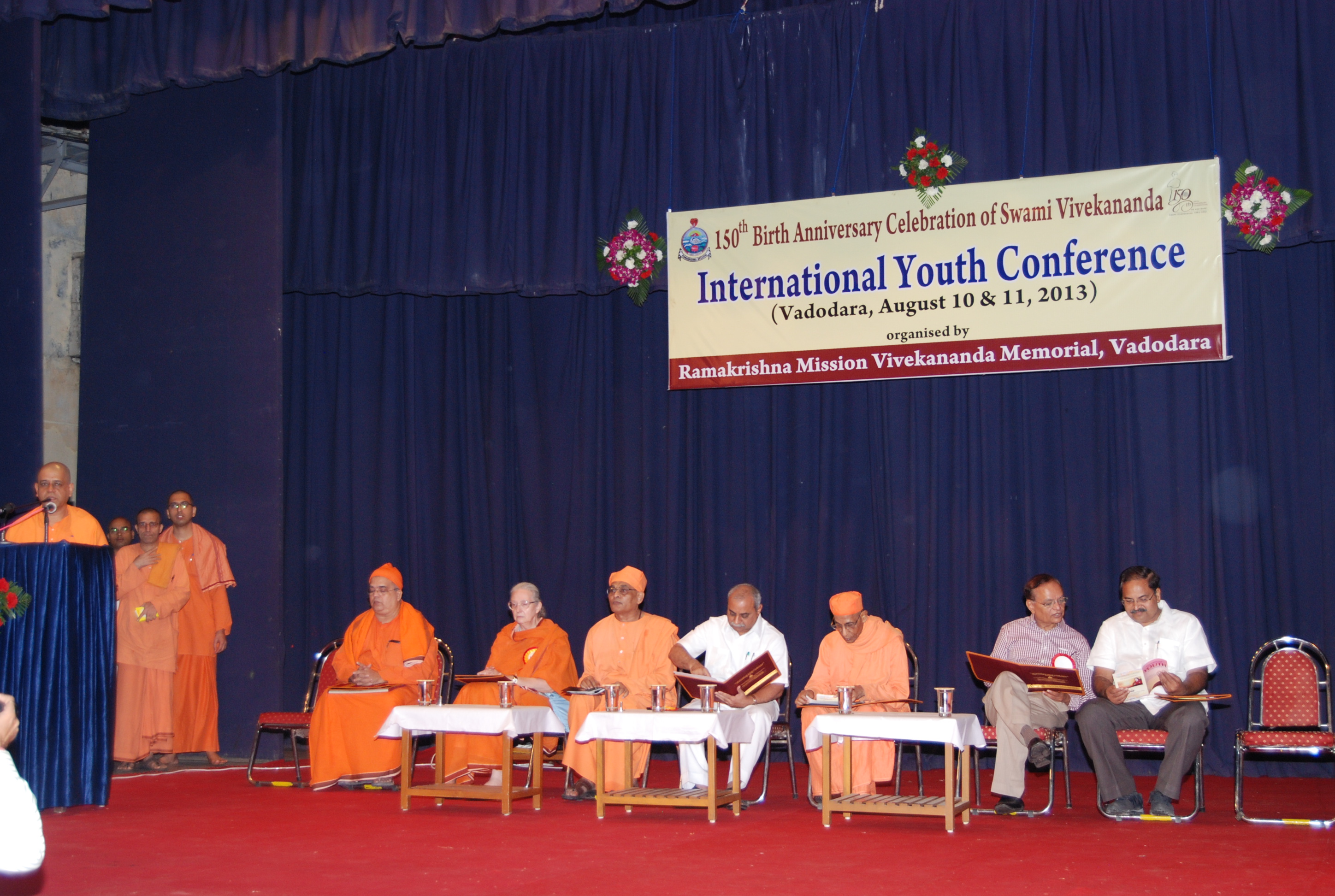
August 10th was the first day of our International Youth Conference here in Baroda. The program began in MS University’s grand CC Mehta Auditorium.

Swami Nikhileswrananda is greeting – Oops! Something fell down
We came early to get good seats
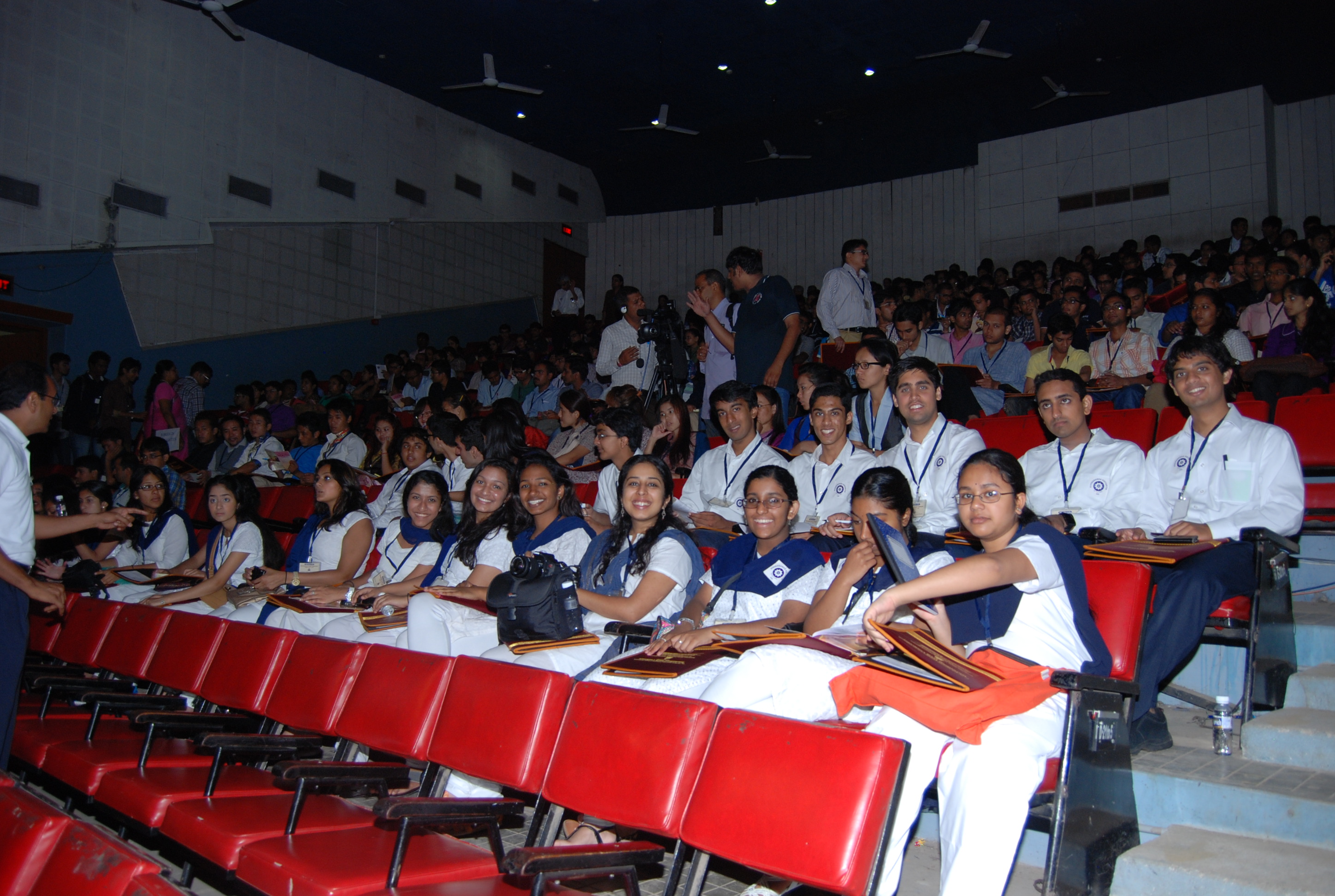
Vidyapith delegates in uniform
Other delegates
Other delegates
Special guests
Vidyapith’s parents & teachers
Vidyapith's parents & teachers admitted as Special guest
Vidyapith’s parents & teachers
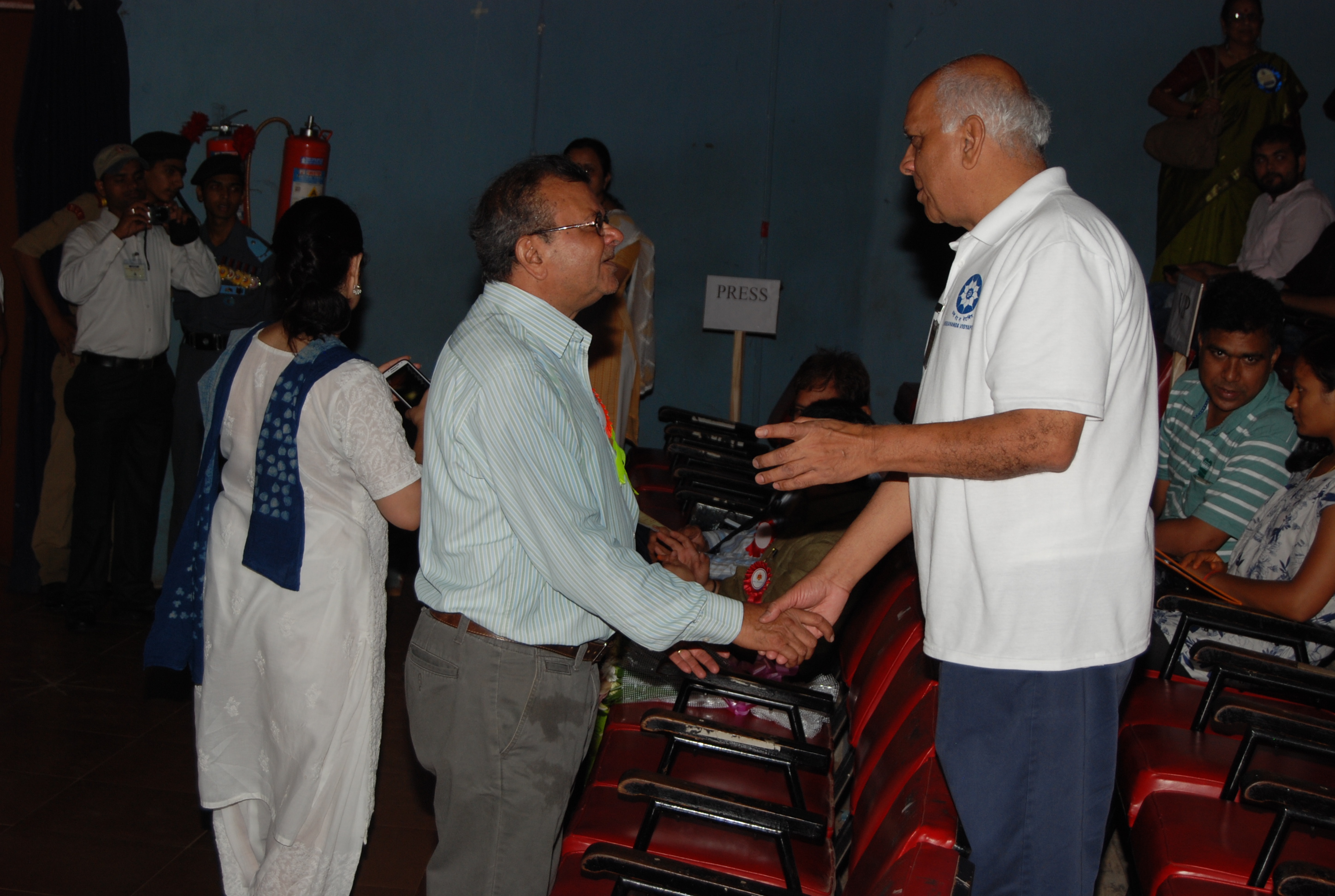
Joy to meet a friend, Mr. Dilip Desai who helped in arranging Mr. Pitroda’s talk

In a packed hall of over 570 people, the conference began with the gathering of chief guests and many swamis including Swami Suhitananda, the General Secretary of the Ramakrishna Math and Ramakrishna Mission in Belur Math.  Swami Atmashraddhananda, Editor of The Vedanta kesari, Chennai, was the Anchor of the program.  

Hall was getting full
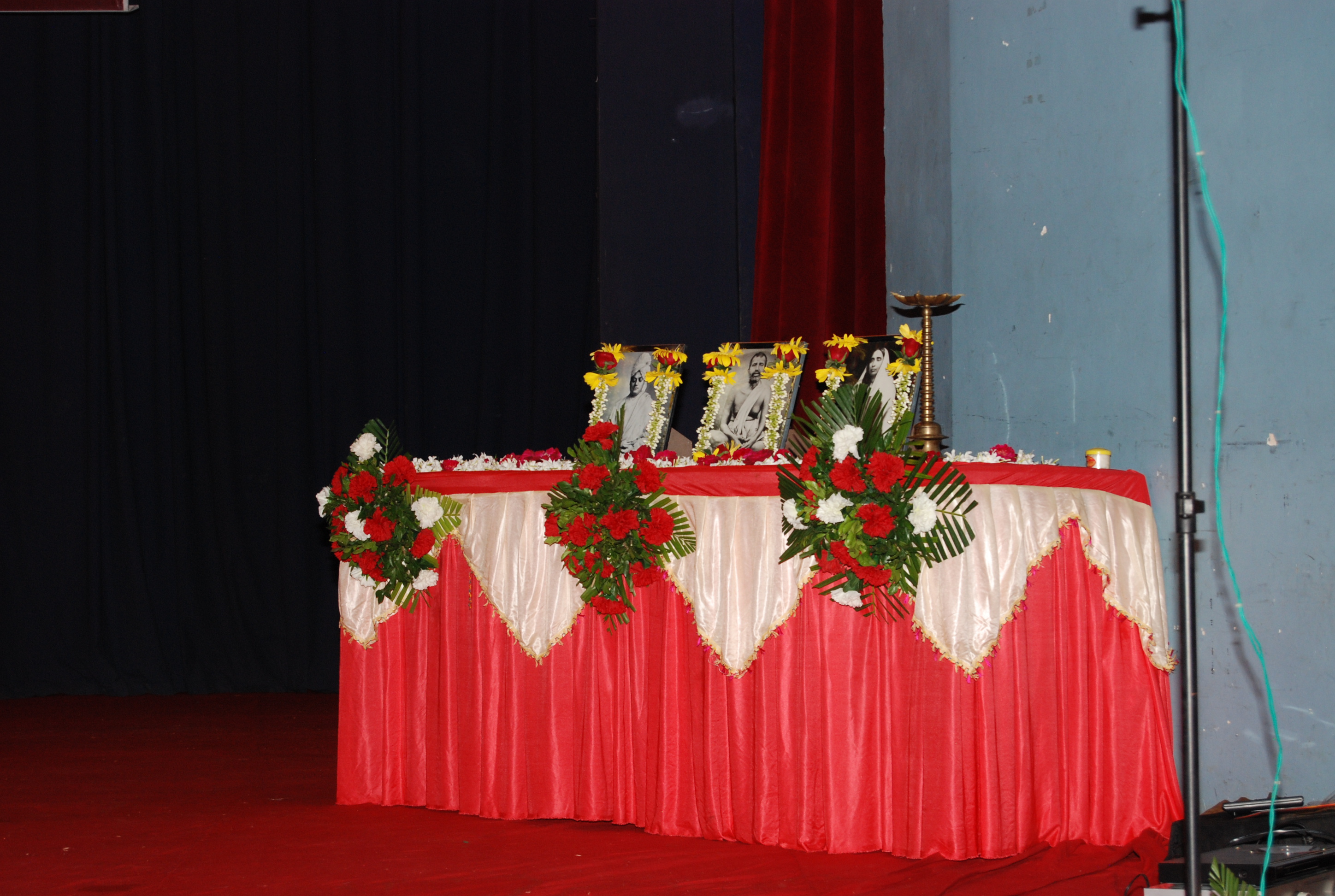
Altar on the stage
Altar on the stage
Anchor of the IYC – Swwami Atmashraddhananda
Anchor of the IYC – Swami Atmashraddhananda -welcoming all

The program started with the recitation of Vedic Chanting recited by Swamis of Ramakrishna Mission.  Shri Nitinbhai Patel, the Finance Minister of Gujarat, was the chief guest of the event.  He inaugurated the program with lighting us a lamp.  He talked about the greatness of Swami Vivekanand and  said that   after 150 years his message is still relevant today and will be relevant after 1000 years.  Then, Swami Suhitanandaji gave his special message on this occasion.

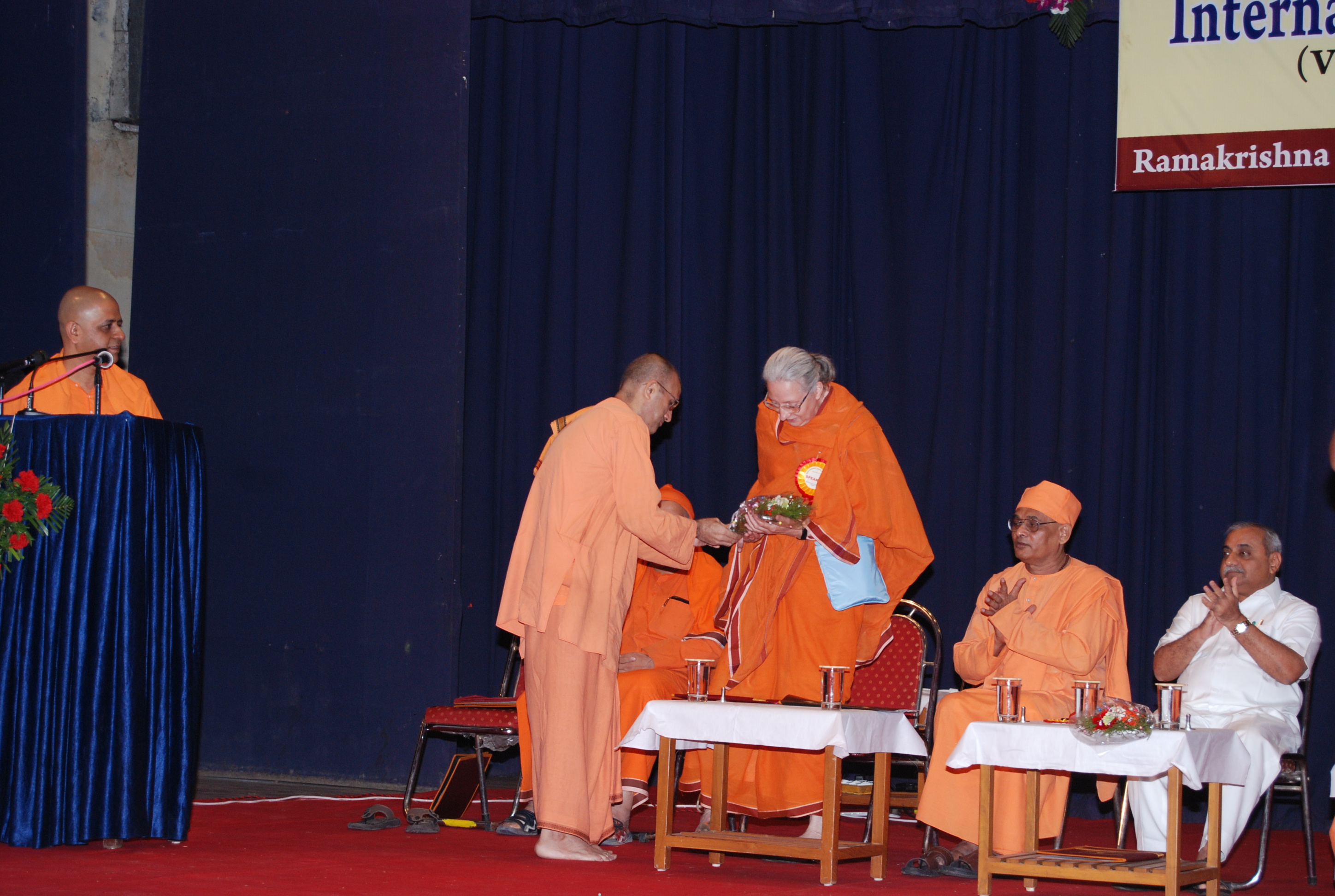
Honoring Pr. Shuddhatmaprana
Swami Nikhileswarananda addressing the audience  -special guests on the stage
Swami Nikhileswarananda addressing the audience -special guests of the session are on the stage

This was followed by a video recorded message of the Director General of UNESCO who discussed the shared values of Swamiji and other global institutions such as UNESCO.

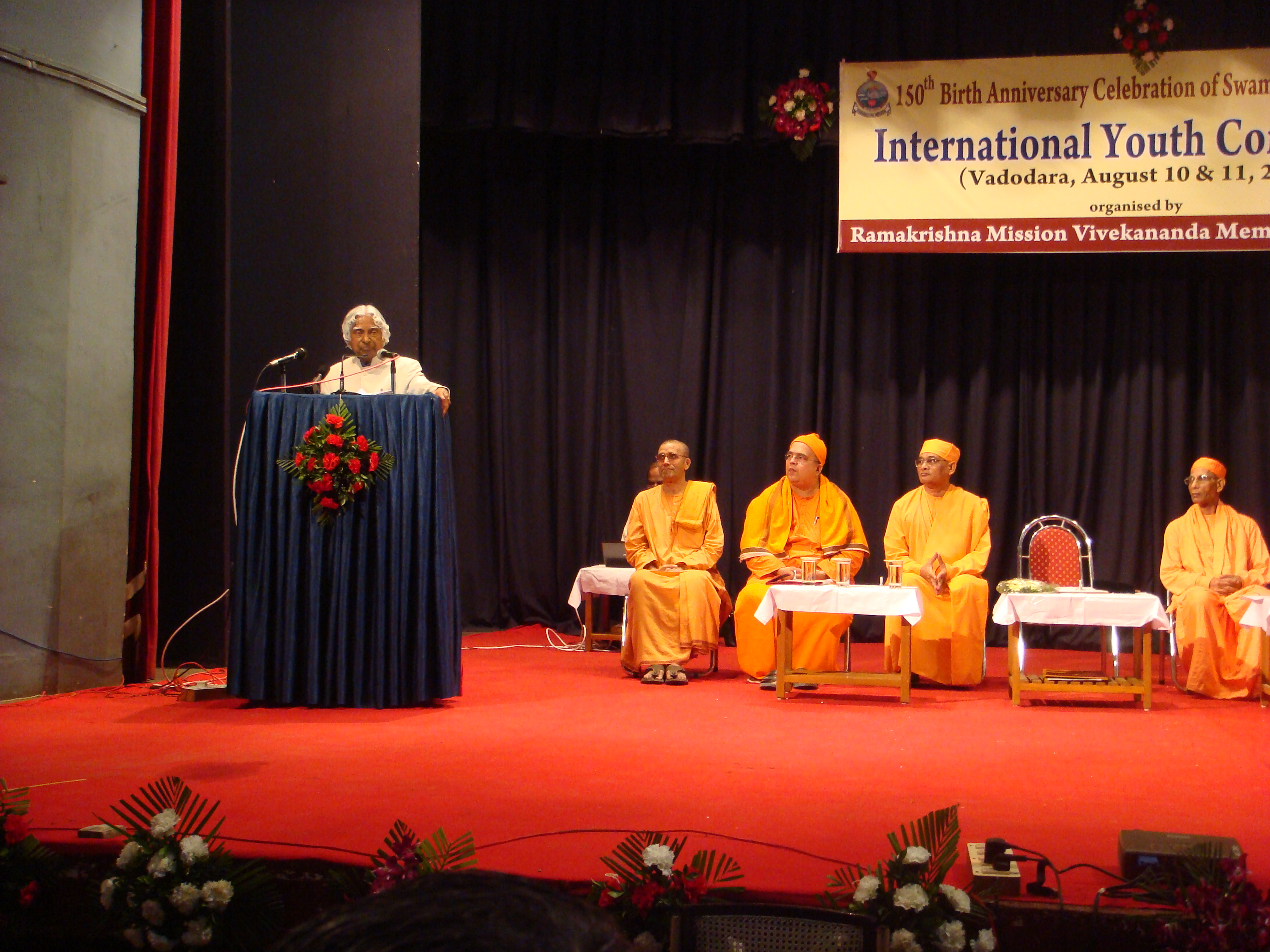
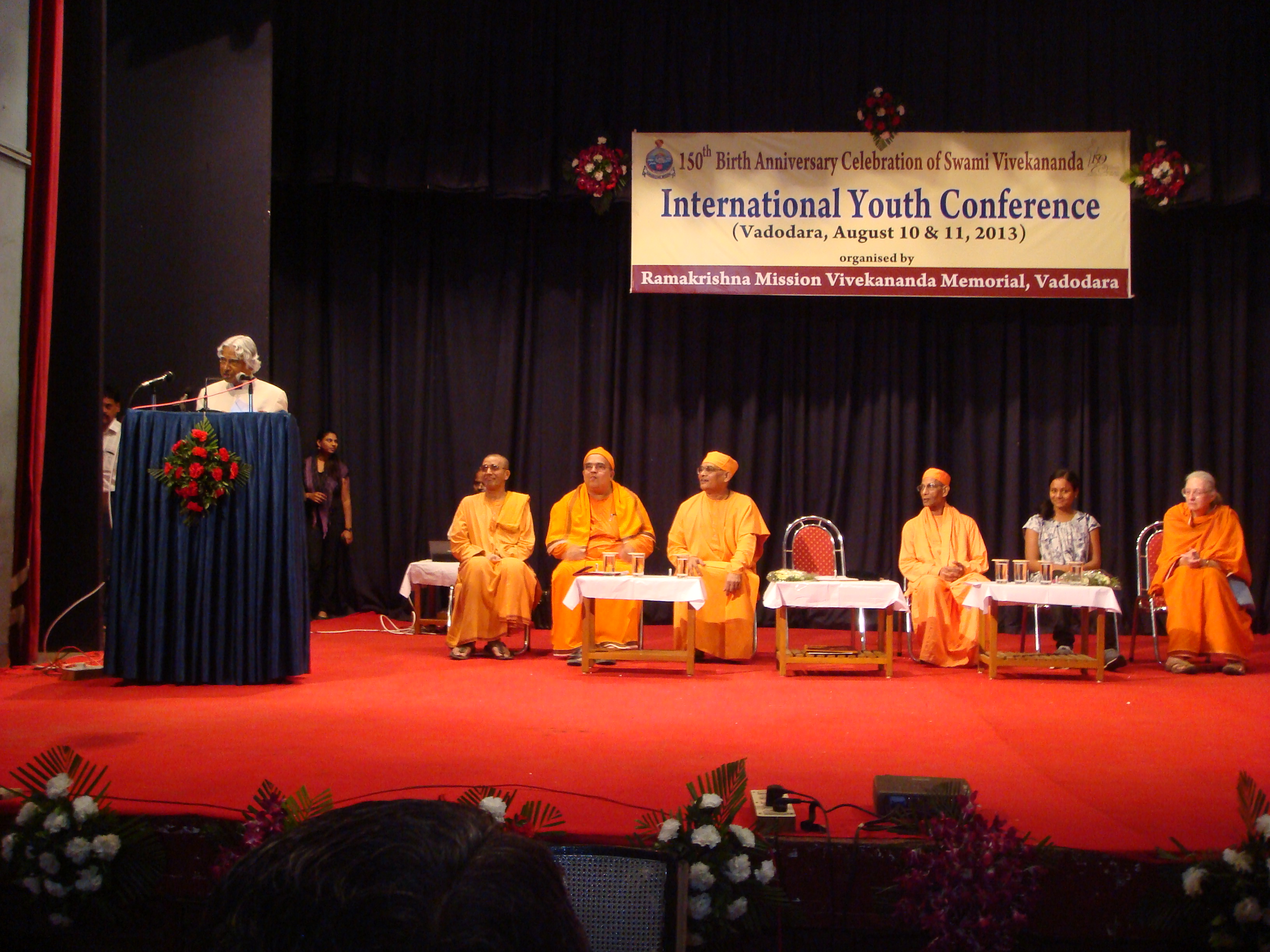
The next event of the day was one of the highlights, a speech by Former President of India Dr. Abdul Kalam.

Dr. Abdul Kalam entering the auditorium

Dr. Kalam’s speech was invigorating and inspiring. He discussed the youth as an influential power source. He mentioned Swamiji’s emphasis on service to man. Dr. Kalam closed his speech by telling the youth how they can be unique and transformative. He mentioned four qualities of uniqueness – a great aim, a constant acquisition of knowledge, hard work, and perseverance. This lecture was followed by a series of questions by the audience.

Anchor Welcoming Dr. Abdul Kalam
Ananat Maharaj addressing the audience
Dr. Abdul Kalam addressing the audience
Auditorium is packed with people
Auditorium was packed with people
Dr. Abdul Kalam was engaging
Big round of applause

Once Dr. Kalam’s session was completed, we headed out for our lunch.

Relaxing time between the sessions

After the break, there was an audio-visual presentation that centered on Swamiji’s life. This was followed by an enthusiastic speech by Shri Bhagyesh Jha, the Secretary of the Department of Youth, Sports, and Cultural Activities in Gujarat. He emphasized Swamiji’s teaching on seeking the good in adversity.

Next was Swami Atmarupananda, a Swamiji who has worked in several California centers and is now in Belur Math reorganizing the Complete Works of Swami Vivekananda. His speech focused on the youth and it’s uniqueness. He said that youth have an idealism and energy that need to be harnessed and that with these qualities we have a great responsibility to serve the world.

Following, was a speech by Pr. Shuddhatmaprana who had joined us in our travels of Gujarat. She focused her story on the parable of the lion who was raised by sheep, and emphasized that we are all like the lion – we have greatness within us and therefore must realize that potential by not being blind followers.

After, was a speech by Ms. Arunima Sinha.  Sinha is a 26 year-old woman who became the first female amputee to climb to the peak of Mt. Everest. Her story of her struggles in losing her leg, rehabilitating, and persevering to achieve her goal was truly inspiring. She mentioned that her drive to succeed came from Swami Nikhileswarananda of Baroda who met with her and introduced her to the work of Swamiji. He even raised funds to get her an extra artificial leg for her expedition. In fact, when Arunima reached the top of Everest, she placed both the Indian flag along with a picture of Swamiji, Thakur, and Holy Mother. Arunima’s speech was received with a standing ovation and much applause.  Then, Dr. Jeetendra Adhia, the Mind Trainer of Ahmedabad gave a lecture demonstration.

Once the speeches of the session were complete, we had a break for teatime.

Vidyapith students & teachers with Arunima Sinha

Teatime was followed by the evening’s cultural programs. The program started with a unique glow in the dark puppet show of Swamiji’s life and then a short drama on Swamiji at the Parliament of Religions.

After this was our cultural program from Vivekananda Vidyapith. Radha Dhar was emcee of the program.

Radha emceed the program, Vidyapith students are ready
Radha emceed the program – Vidyapith students are ready

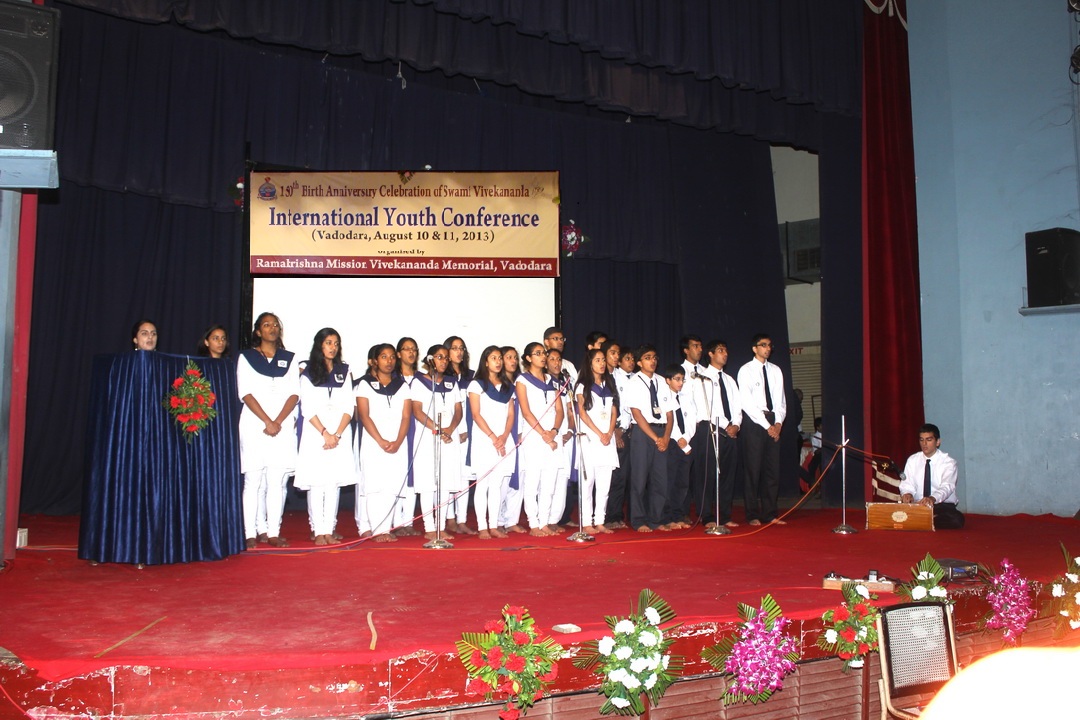
We started with the Shanti Mantra.

Vidyapith students reciting Shanti Mantras
From another angle
From another angle

Following this were several recitations. Radhika Shukla recited Swamiji’s poem, “To an Early Violet.” Neer Trivedi discussed a passage of Swamiji on the harmony of religions – recalling the story of the frog from the sea and the frog from the well. Srujanee Pradhan then spoke on Swamiji’s idea of true education.

Radhika Shukla – “To an early violet”
Neer Trivedi – “Why we disagree?”
Srujanee pradhan – “Education”

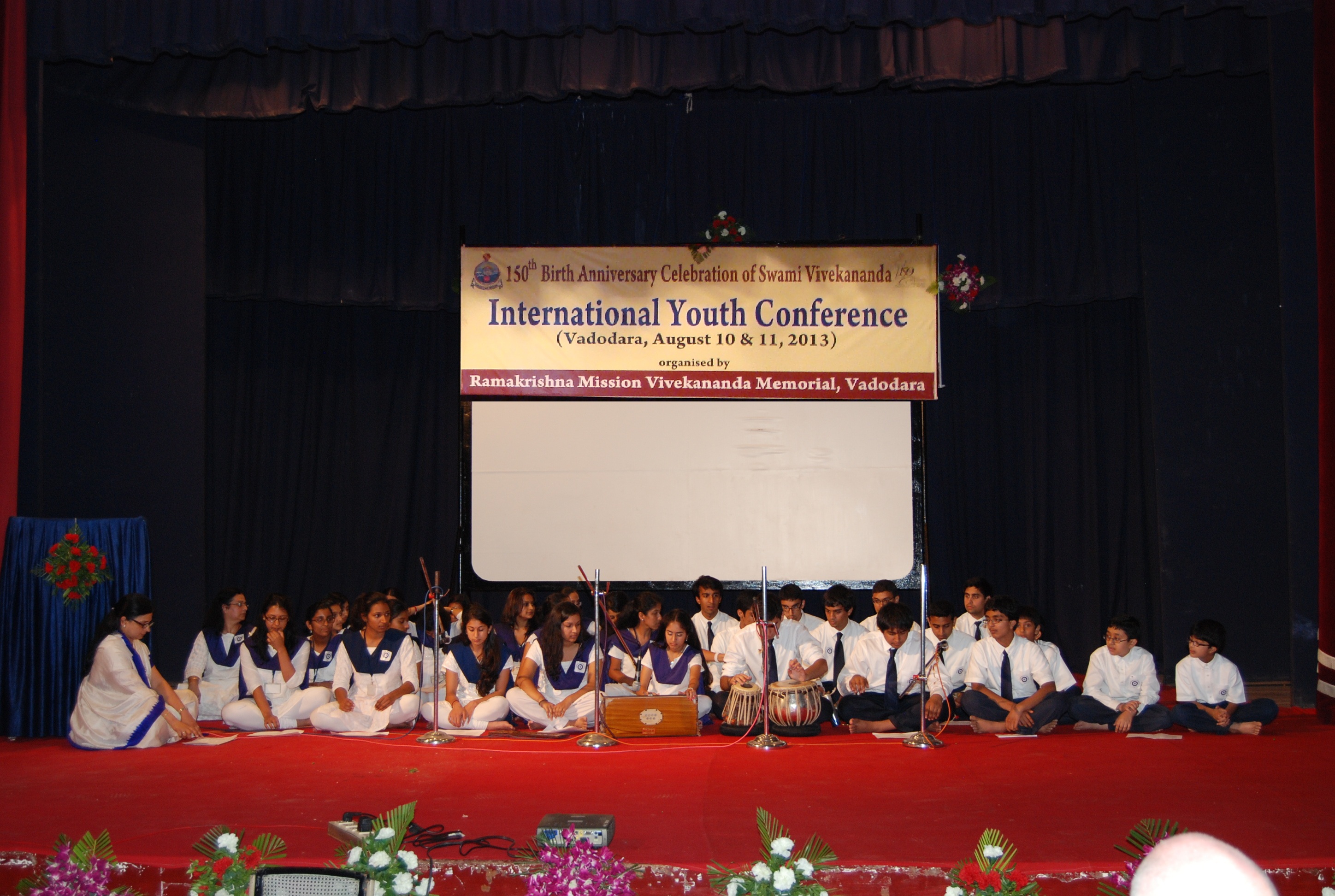
After the recitations, we sang the bhajan “Jaya Vivekananda Sanyasi Veer” and the dhoon “Jaya Vivekananda”.  All of the students sang joyfully and many audience members, including the swamis, even joined in by clapping their hands to the dhoon.

Vivekananda Vidyapith students singing a bhajan & a dhoon

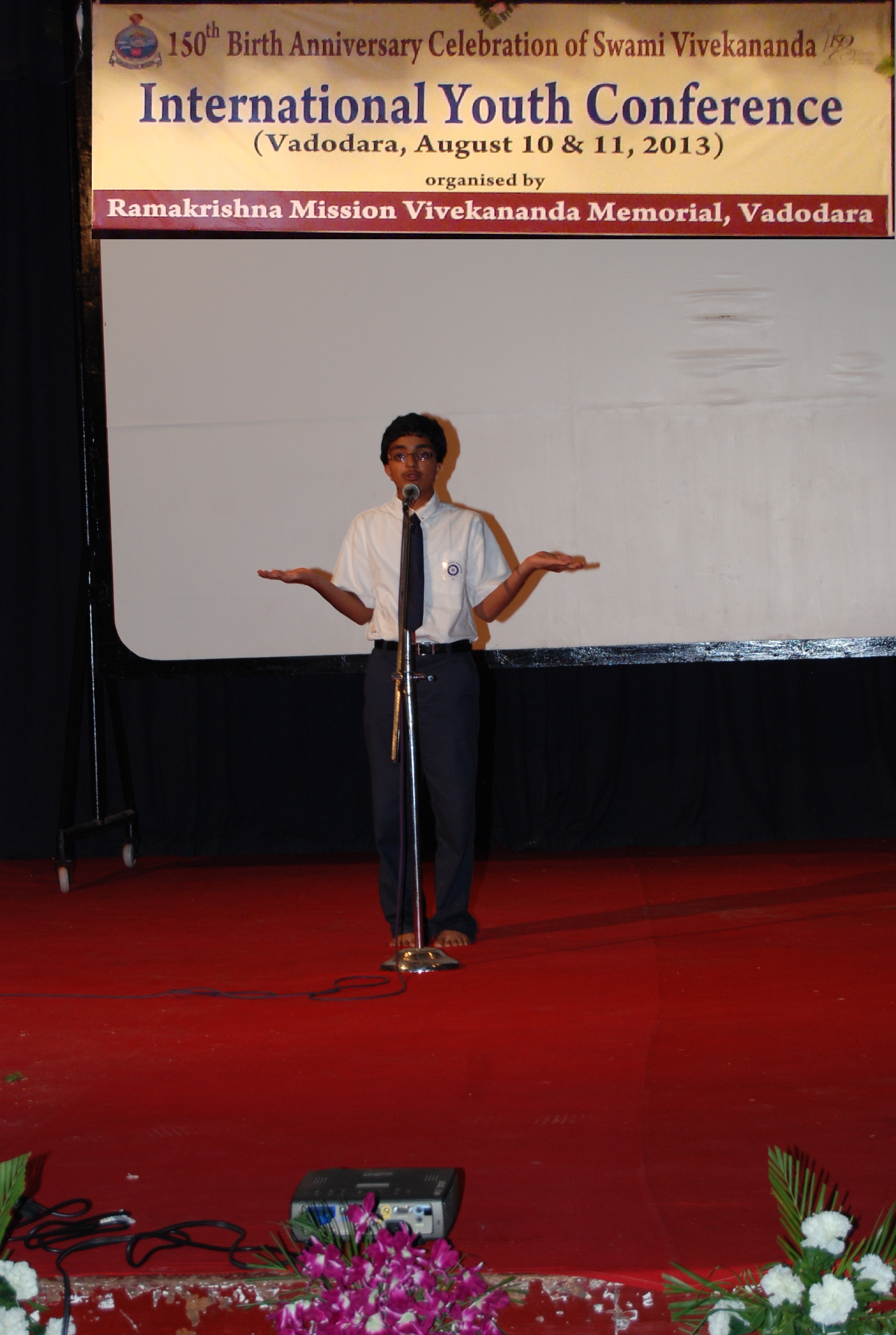
Following the bhajan was another recitation by Rishi, “Failures” by Swami Vivekananda.

Rishi Dhar – “Failures”

Nilesh Shukla then gave a speech on Vidyapith and his reflections on his experiences.

Nilesh Shukla – Presenting his thoughts on Vidyapith

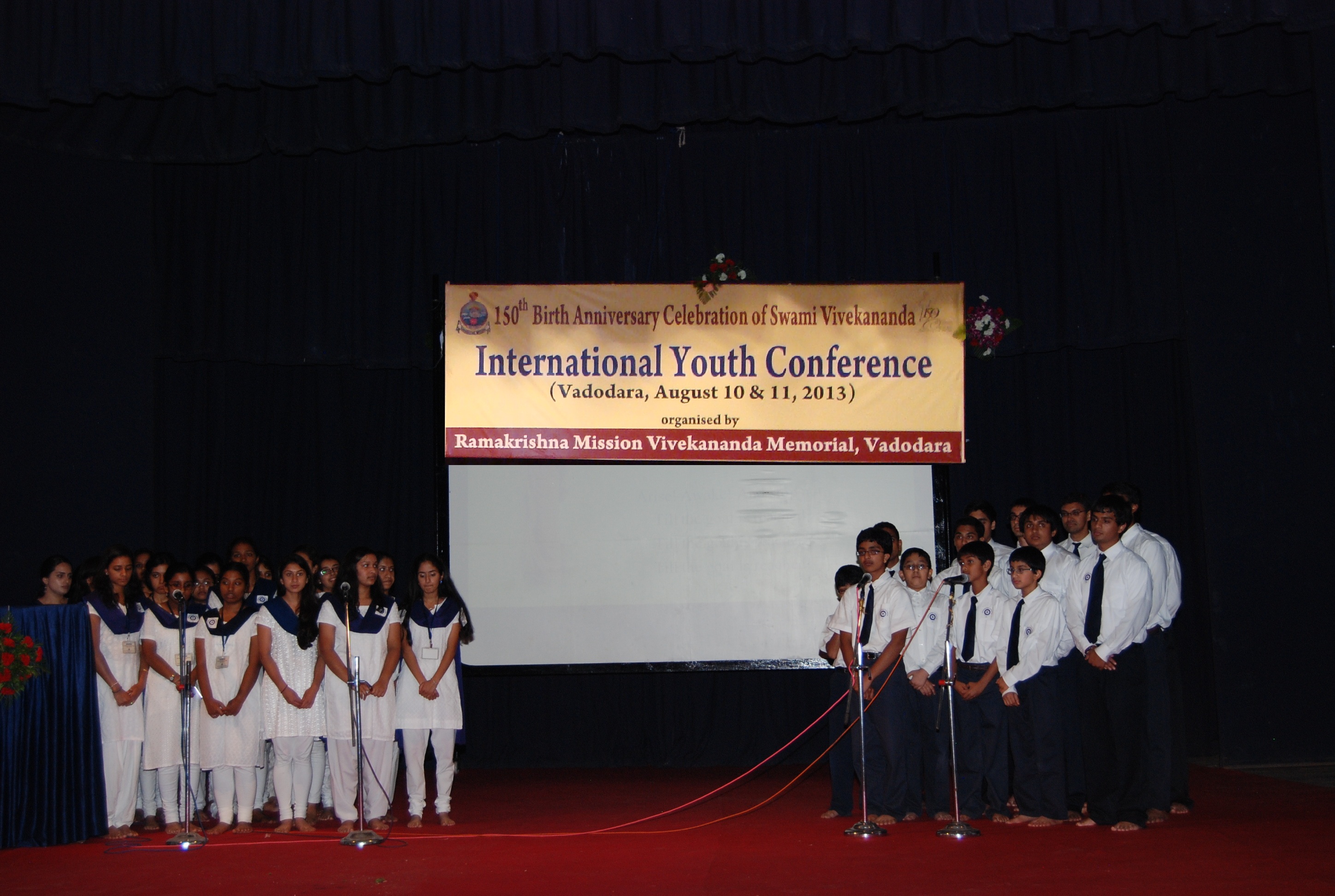
We closed the presentation with the singing of the song “Arise! Awake!….”

Vidyapith students singing “Arise! Awake!...”
Vidyapith students singing “Arise! Awake!…”

All Vidyapith students received gifts from Pr. Shuddhatmaprana.

Pr. Suddhatmaprana giving gifts to Vidyapith students
Pr. Shuddhatmaprana giving gifts to Vidyapith students
Group photo with Pr. Shuddhatmaprana
Group photo with Swami Nikhileswarananda

The participants were:  Ansh Balar, Eesha Bhave, Asthaa Chaturvedi, Dhara Bhuptani, Rishi Dhar, Radha Dhar, Arundhati Johri, Sonali Mehta, Alak Mehta, Nishank Mehta, Bhargavi Nambi, Bindi Parikh, Priya Parikh, Ronak Parikh, Nisha Parikh, Srujanee Pradhan, Kanchan Railkar, Utsav Rana, Aneri Rokad, Nikita Rokad, Chintal Shah, Apurva Shah, Sneha Shah, Smit Shah, Radhika Shukla, Neer Trivedi, Angi Vora, Nilesh Shukla, Trupti Parikh, Jyoti Shah, Siddhant Pradhan, Anish Trivedi, Kunal Trivedi, Shyam Mehta.

The evening program concluded with several items from the Indian youth. Shrimati Vanita Thakkar sang couple of songs based on Swami Vivekananda’s ideas.  There was a cultural dance item along with a poem that was performed.

With Swami of Vadodara and singer Vanita Thakkar

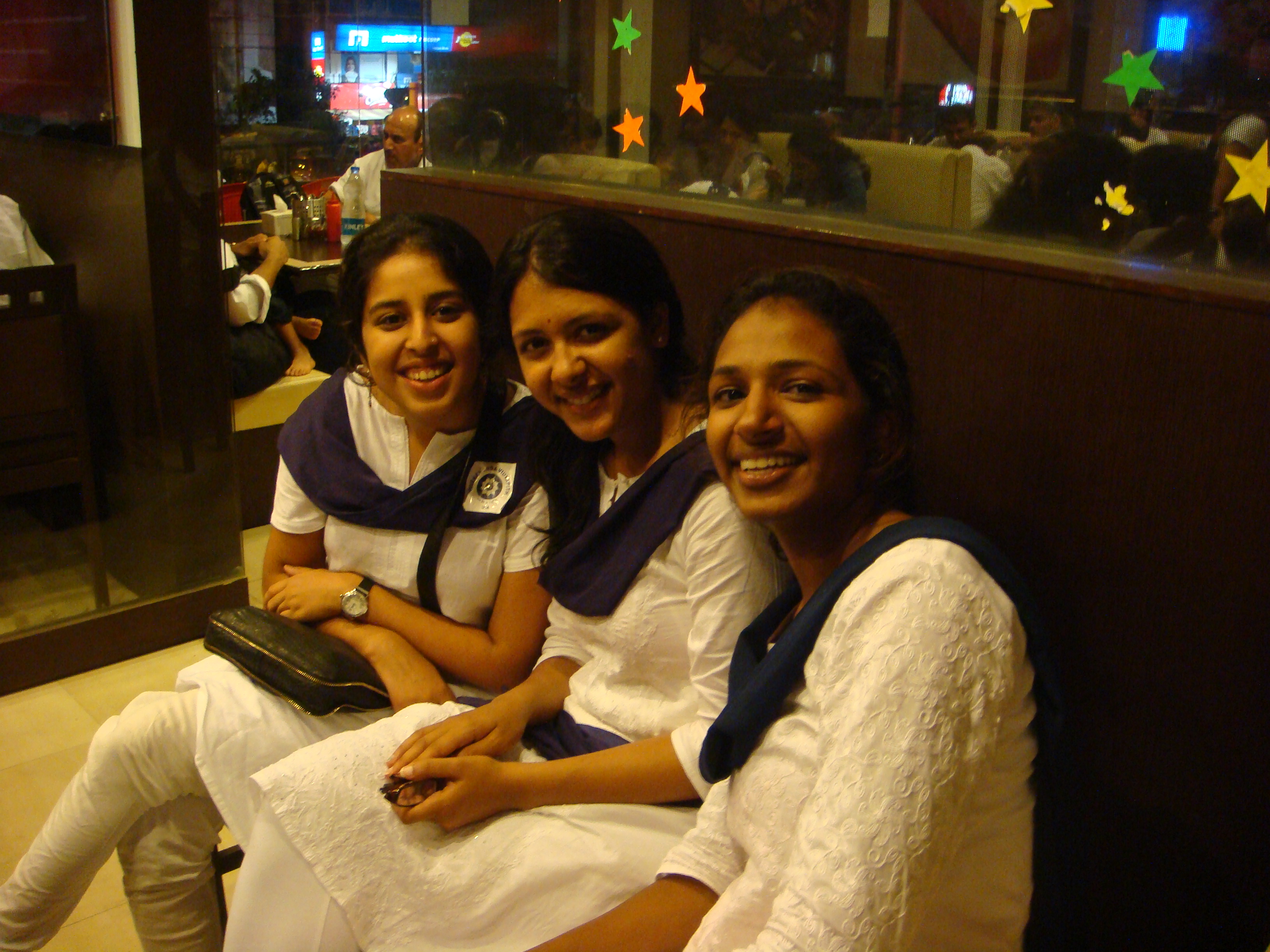
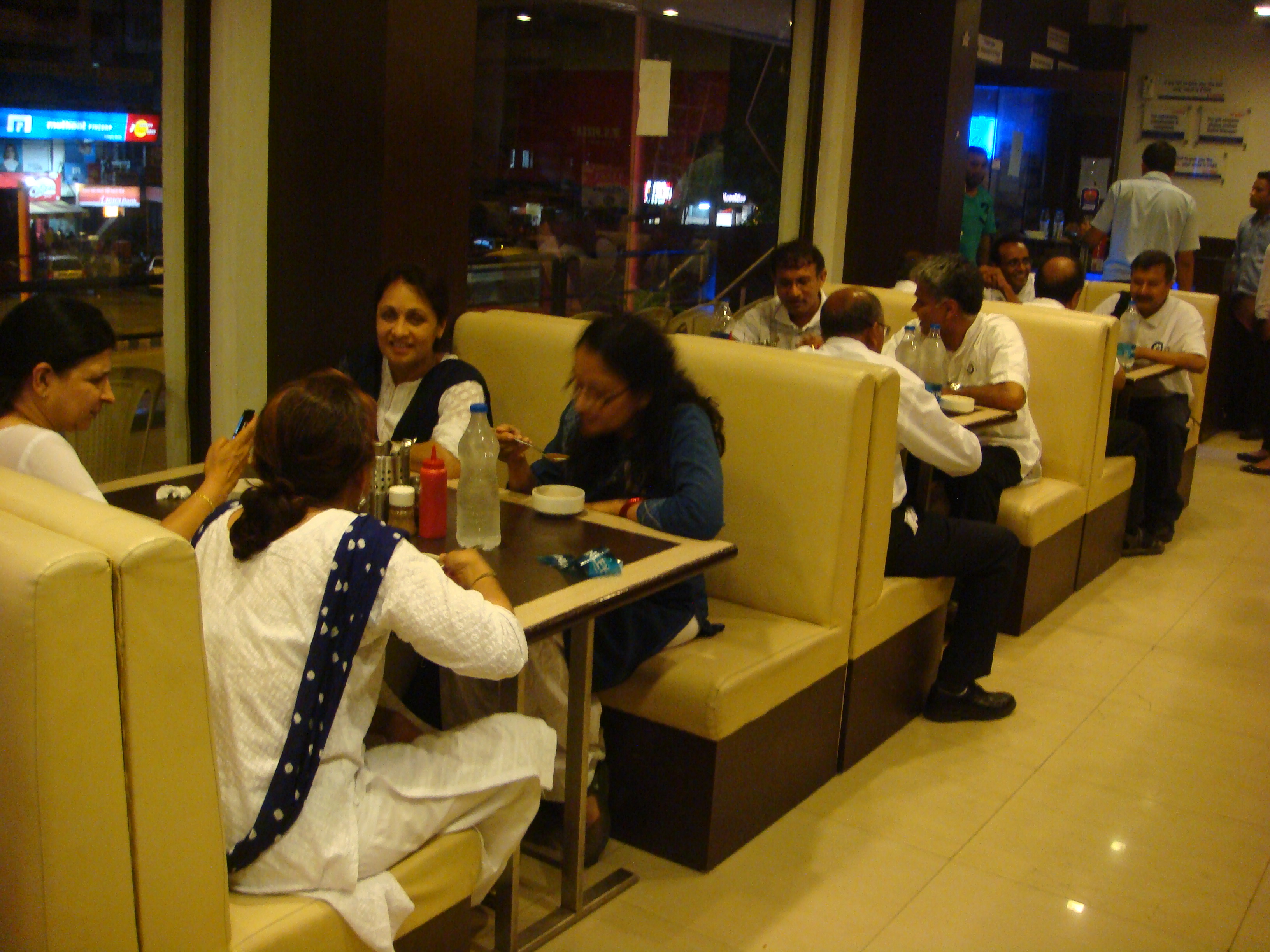
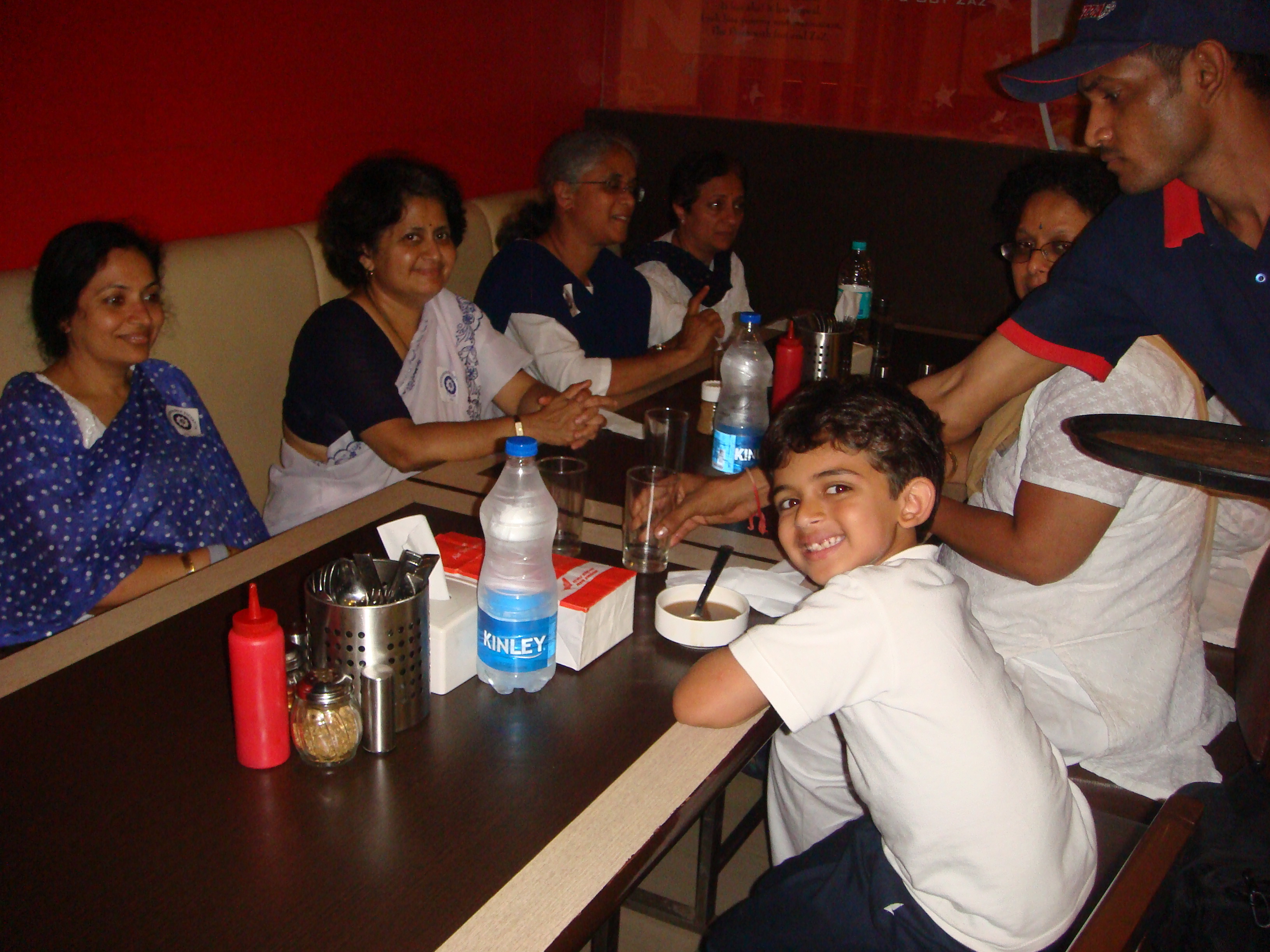
The program was over around 9:00 p.m.  All were hungry.  Nilesh and Apexa had invited all to a Pizza Place.  All were happy about the excellent Vidyapith’s cultural program students had presented today and seeing that it was very well received by the audience.   The Pizza Dinner was most appropriate celebration.  We all went to the Pizza Place and had a great time.  After dinner all went to the Royal Orchid Central hotel and rested well.  There was a great relief in the minds of all.

Let us start with asoup
Let us start with a soup
Waiting for food
Waiting for food
Why do you take a picture - there is nothing on the table
Why do you take a picture – there is nothing on the table
We are having a great time - Look at the picture of Pizza!
We are having a great time – Look at the picture of Pizza!
We can talk whole night!
Hello!
Hello!
We are having so much fun!
Finally food came.
Finally food came.
I am not tired!  I am having a great time.
I am not tired! I am having a great time.

(2)  Report of Sunday, August 11, 2013 convention:

On the 11th we began the second and final day of our conference. The day began with a videoconference with Shri Sam Pitroda, the current chairman of the National Innovation Council, who is heralded as the “father of IT” in India. Pitroda discussed the need for infrastructure development in India, echoing Swamiji’s words that we must address first change ourselves before seeking change in society. He emphasized that the youth needs to become visionary. The youth must seek to create jobs and solutions. They must do so by emphasizing execution rather than simply discussing the problems and blaming others. After his talk, Pitroda answered several questions from youth delegates including four from our very own Vidyapith students.  The following were the questions from Vidyapith’s students to Sam Pitroda:

 Smit Shah’s Question: Many people say that fast-paced technology has caused our minds to atrophy. How do we instead use modern technology to harness our mind’s power and improve our ability to focus?

Smit is ready to ask question
Audience watching Mr. Sam pitroda
Audience listening Mr. Sam pitroda

 Ronak Parikh’s Question: How do we infuse Swamiji’s teachings in our decision-making and management styles at profit-seeking organizations/businesses?

Ronak is asking question

Asthaa Chaturvedi’s Question: “In my experience there’s no substitute for personal human connection. How can we use telecommunications to enhance this human connection rather than dilute it?”

Ashthaa is listening the answer of her question
Ashthaa is listening to the answer of her question

 Eesha Bhave’s Question:  With fast paced changes in technology, how can we use that to empower women in India and in other places?

Eesah is ready to ask question

After the Pitroda session was a speech by Shri G. Narayana, a management trainer who discussed problem solving through various stories from our Hindu mythology.

Following this was an aerodynamic show and tea break. Next was a question/answer session with the Swamijis and Pr. Shuddhatmaprana who were in attendance at the conference.  Several students asked questions.

The following was Kanchan Railkar’s Question to Swami Atmarupananda.   How can we spread Swami Vivekananda’s message to other youth in America if they turn a blind eye to Hinduism? In response to the question Swami Atmarupananda discussed the difference between self-centeredness and self-esteem.  He mentioned that the problem is how we think of ourselves – we must not thinking of “me and them” but “us”.

Then Swami Sarvasthananda discussed how it is difficult to be good and that is where Swami Vivekananda’s emphasis on strength – physical, mental, and spiritual – is necessary.  Swami Nikhileswarananda discussed the concepts of social work and spiritual practice, mentioning that social work is in fact spiritual practice. Pr Shuddhatmaprana spoke on anger, suggesting that we must understand that anger is the “other side of the coin of desire”. She stated that when insulted what is affected is our ego and in the end the use of anger is negligible.

After our insightful session with the Swamis, we had our lunch break.

Following lunch were the youth presentations of the day.  Our own students Ronak Parikh talked about “Youth Power for Social Transformation” and Eesha Bhave talked on “Success Mantras for Youth leadership.”

Ronak is giving his presentation

The following is a summary of Ronak Parikh’s presentation:  ‘Swami Vivekananda has often said that there is significant power and influence in our youth that can lead to social transformation. But what exactly is the nature of this power and how can it be realized? The youth is a period of our lives marked by dynamism – energy, fresh perspective, and perseverance. This dynamism is the power source of transformation. Swami Vivekananda prescribes several steps in making use of this power. As in the scientific method, Swamiji asks us to understand a problem and the roots of that problem before addressing it. Once we have done our research and due diligence, we should completely immerse ourselves in the issue that we are seeking to address.  But Swamiji does not suggest that we directly attempt to address social problems. He explains that we must begin by changing ourselves and we must do so by strengthening 3 qualities: purity, perseverance, and patience. Only with these can we change ourselves and in turn initiate social transformation – whether it be in our global society, in our country, in our neighborhood, or even in our home.

Eesha talked about some of Swamiji’s most important values that youth leaders must abide by, including the ideas of having a dynamic personality, love for all, and being spiritually grounded among others.

There were also sincere and thought-provoking presentations by delegates from South Africa, Bhutan, Russia, Hyderabad, and Vadodara. The excitement and energy during these presentations could be felt in the auditorium itself. The delegates presented on ideas from their personal lives, from teachings of Swamiji, from organizations they have worked with, etc.

The Youth Presentations was followed by Shri Jayant Chakravarty’s talk and presentation who is a popular mind trainer of Kolkata.

Ansh volunteered for an experiment
Ansh volunteered for the program

Next was a speech by Smt. Jayanti Ravi, the Commissioner of Technical Education of Gujarat and a visiting professor at Harvard. She spoke on social enterprising for poverty alleviation through a program she is starting in villages across India.

Audience enjoying the talks

After there were speakers including Dr. Bikas Sanyal, a vice-chairman of UNESCO, and Dr. Balsubramaniam, the founder of the Swami Vivekananda Youth Movement. These were followed by a speech of Major General Dilawar Singh.

The speakers of the Last session
Anant Maharaj is giving mementos and gift to Uncle
Chief Dr. Bikas Sanyal is giving a talk
Chief Guest Dr. Bikas Sanyal is giving a talk

Then, Swami Nikhileswarananda said that he was very happy to see a large group from USA, especially delegates of Vivekananda Vidyapith, USA, (about 60 people) participated in this convention.  He said that actually, when he visited Vivekananda Vidyapith in June 2010 and met the students there, at that time he got this idea of having an ‘International Youth Convention.’  Then, few months ago, he called Mahendrabhai (Uncle) and asked if he can bring students and alumni from the Vidyapith.  Mahendrabhai said ‘yes, he can’ and then all the work for the International Youth convention started.

Uncle is giving a talk

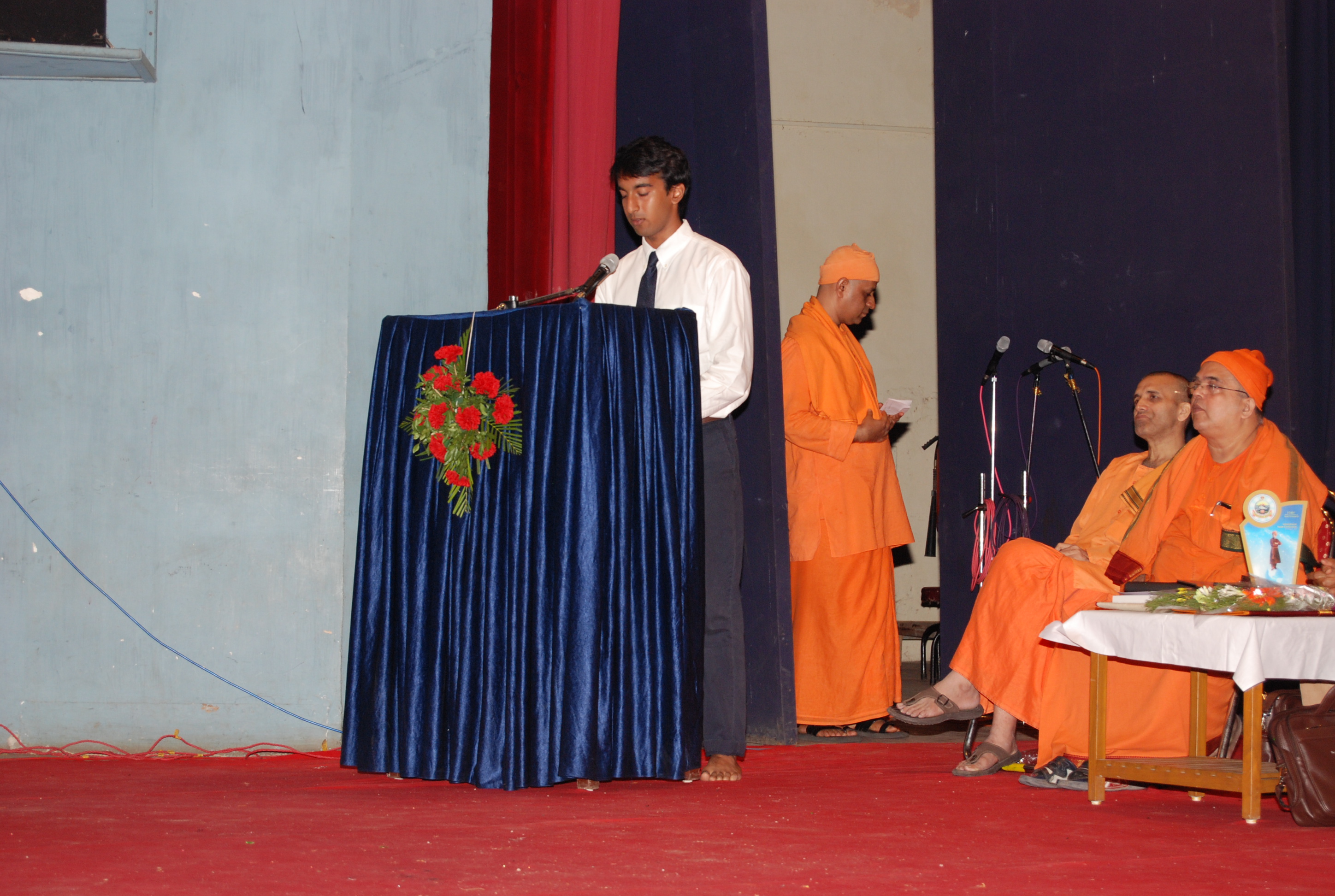
Swami Nikhileswaranandaji asked Dr. Mahendra Jani (Uncle) to share his thoughts on this occasion.  Uncle said that Swami Nikhileswaranandaji gave credit to him, but because of Swami’s tremendous energy and ability such a big convention was possible which hosted several eminent speakers.  Uncle said where else one can find the spirit of Swami Vivekananda other than in the lives and service of Swamis of Ramakrishna Mission?  These Swamis had renounced their lives to follow Swami Vivekananda’s teachings.  Uncle mentioned that when people go far away from India, then they realize the importance of the great Indian culture more.  He said one should not assume that all people who go to USA think about only money and luxury.  There are many Indians residing in USA who carve to know and practice the values taught by Upanishads and Bhagavad Gita.  They want their children to get such character building education based on these values.  All these students of Vivekananda Vidyapith present here are a few examples of this fact.  Uncle then congratulated Swami Nikhileswarananda for successfully holding this International Youth Convention.

 Following Uncle, couple of selected students presented their feedbacks.  One of them was Vidyapith’s Alak Mehta.

A student delegate is giving her feedback
Alak Mehta is giving his feedback

He said, “Namaste. On behalf of the Vivekananda Vidyapith from the United States, I would first like to thank revered Swami Nikhileswaranandaji for organizing this conference, and giving us the opportunity to attend despite the limited space. We are especially grateful to have been able to present a few things to all of you last night as a part of the cultural program.  It has been a tremendous experience to meet and connect with fellow devotees of Swami Vivekananda from all over India and around the world. We are honored to have heard and interacted with such a diverse group of eminent speakers, leaders, and swamis. This conference truly reinforced the universality and practicality of Swamiji’s teachings – Service, Harmony of Religions, Upliftment of the poor, Sacrifice, Perseverance, Oneness, Acceptance, and more. These are important values that all of us can practice and incorporate in our lives. Such is the character-building, value-based mission of Vivekananda Vidyapith. As the Director General of UNESCO pointed out in her recorded message, Swami Vivekananda was a humanist who sought to bring out the potential excellence and divinity in everyone, irrespective of class, race, or nationality. As revered Pravrajika Suddhatmapranaji stated in her speech, we youth need to bring out the lion of divinity lying within us. I sincerely thank everyone at this conference for reminding me that with a strong character, accepting personality, and a purpose, each of us has the power to do great things and transform the world. Thank you.”

The conference closed with energetic remarks by Swami Nikhileswarananda who encouraged the delegates to keep the passion they had gained during the conference alive. He mentioned that like a cell phone, a charge will last only for a temporary time. We need to recharge, and in this case recharge with the reading of Swami Vivekananda’s teachings.

Each of the delegates received a wonderful laptop bag with the logo of the Ramakrishna Mission. The bags were packed with books, calendars and CDs about Swami Vivekananda and his teachings. Swami Nikhileswarananda gifted the Vidyapith students with some of his lectures that they also were able to put in the bags. Vidyapith teachers and parents also received these mementos so they could also remember and listen to Swami Vivekananda’s teachings!

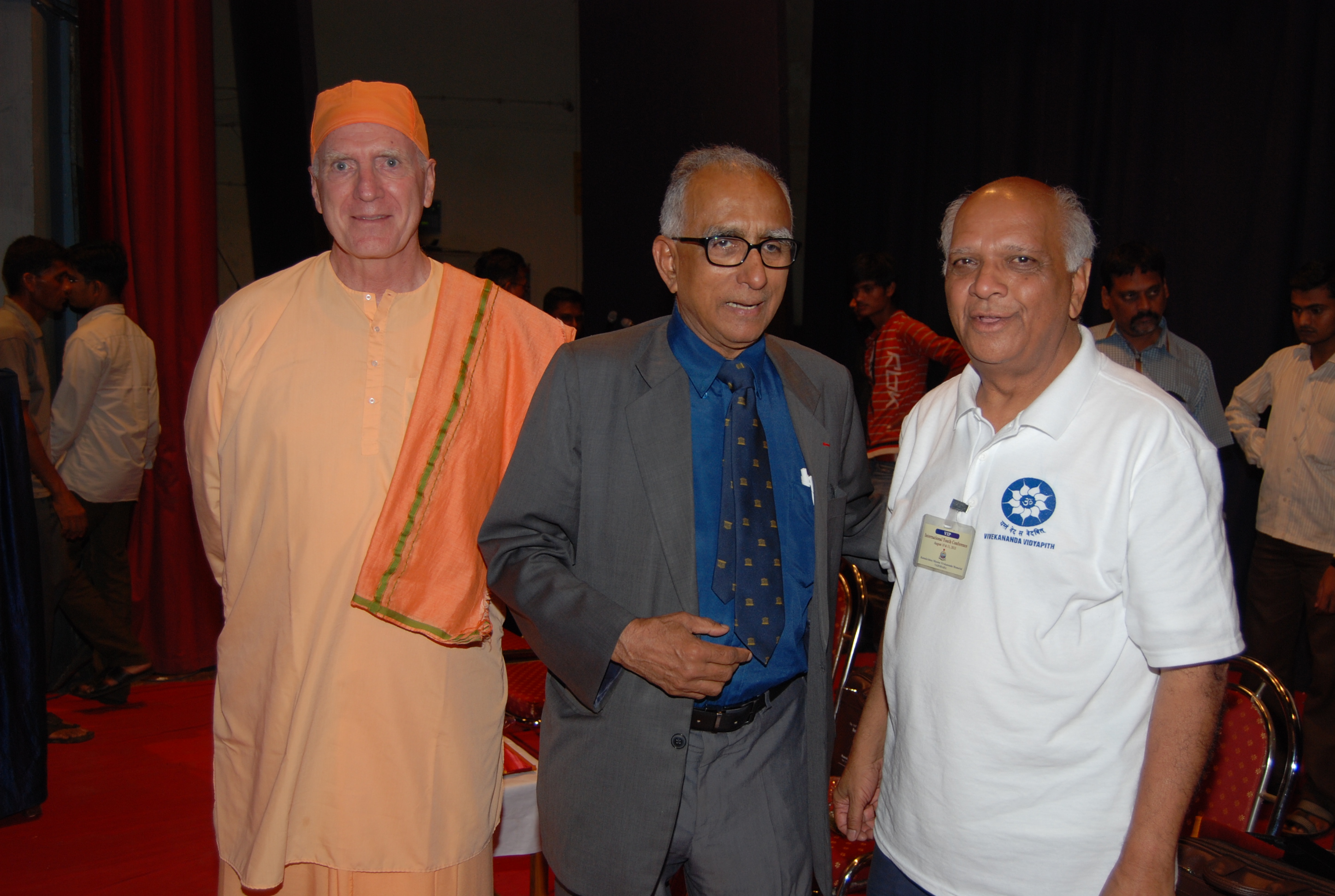
(From L to R):  Swami Atmarupananda, Dr. Bikas Sanyal, and Uncle
(From L to R): Swami Atmarupananda, Dr. Bikas Sanyal, and Uncle
Group photo with Pratima Desai (an admirer of Vidyapith)
A Group photo with Pratima Desai (an admirer of Vidyapith)

The program was over around 6:00 p.m.  Most of the students, teachers, and parents were checking out from the hotel.  Only Nilesha’s family, Prasad’s family and Uncle remained in the Royal Orchid Hotel on August 11th night.  In the morning they were having a breakfast together.  At that time Rajan Shukla (the youngest in the group; 6 years old) asked Uncle with little hesitance and shyness, “Uncle!  When do we have our next trip?”  We had a great laugh.  We were all feeling a great relief that by the grace of God, the trip and the program went very well.  Now, let us relax.  But, Rajan expressed how much he had enjoyed the whole India trip.  Such programs do not happen often.  Just by a divine plan it had happened and we all had a wonderful time thinking of Swami Vivekananda and his impact in the universe.

Thanks to Ronak for writing  the major part of this report, Radha Dhar, Eesha Bhave, and Alak to add the needed material to it, and Nisha Parikh to edit all the bulletins.  This is the last bulletin of the trip and IYC.

IYC – Bulletin 11

August 9, 2013

Lakshmi Vilas Palace – Sankalp (Lunch) – Practice – Surya (Dinner)

          The day of August 9th was filled with pleasant activities.  Before I describe this day’s activities, we have to remember a few people because of whom the Saurashtra trip and the stay in Vadodara went smoothly.

Nimishkaka or Nimishbhai, researched and bargained with all the hotels in the cities we visited. He was in constant communication with hotel owners and managers, and he even visited some of the hotels beforehand to see how they were. After we selected hotels he made all the reservations on our behalf.  Nimishbhai took care of all our transportation logistics and anything we needed.  He would always tell us to let him know if there was any work.  One day, at the last minute we found out that Hotel Royal Orchid Central could not provide us a space for practice. Immediately, Nimishbhai arranged a big hall at a nearby club for our practice.  Then, he was worried about our drinking water.  He, himself, brought a huge package of large water bottles and carried them all the way upstairs.  He was thinking of our needs ahead of time and got them done on time with a smile.  He and his family hosted our lunch at Sankalp.

It is time to remember, Mukundbhai, Maltiben, Virajben and their family members, who hosted us for three days when we were finalizing most of our planning before the trip.  Their support was amazing.  They were ready to help us–whether it was researching restaurants in all the cities we visited or putting together all the individual snack bags, or any other work.  They arranged our trip to the Lakshmi Vilas Palace and also hosted our dinner at Surya.  When our city tour guide canceled at the last minute, Rasheshbhai, Nimishbhai’s brother, gladly agreed to accompany us, guiding the bus driver and pointing out historical city sights.

Nilesh and Apexa hosted a fun dinner at a pizza restaurant in Vadodara, and the Parikh family hosted a dinner in Porbandar. Jaymeenbhai, Nixitaben, Nayanaben, and Truptiben took care of the snacks for our trip.  Our four doctors were constantly helpful, taking care of patients and making sure we were taking good precautions.  All others helped in various ways and were ready to help whenever need arose.  Having spiritual background, there was no ego creating any problem.  Everyone followed the guidelines.  One outsider said that having so many people together for few days and not having a single dispute, that itself is a big achievement.  It was a group of happy people.  They were happy within, so external adjustments did not bother them.

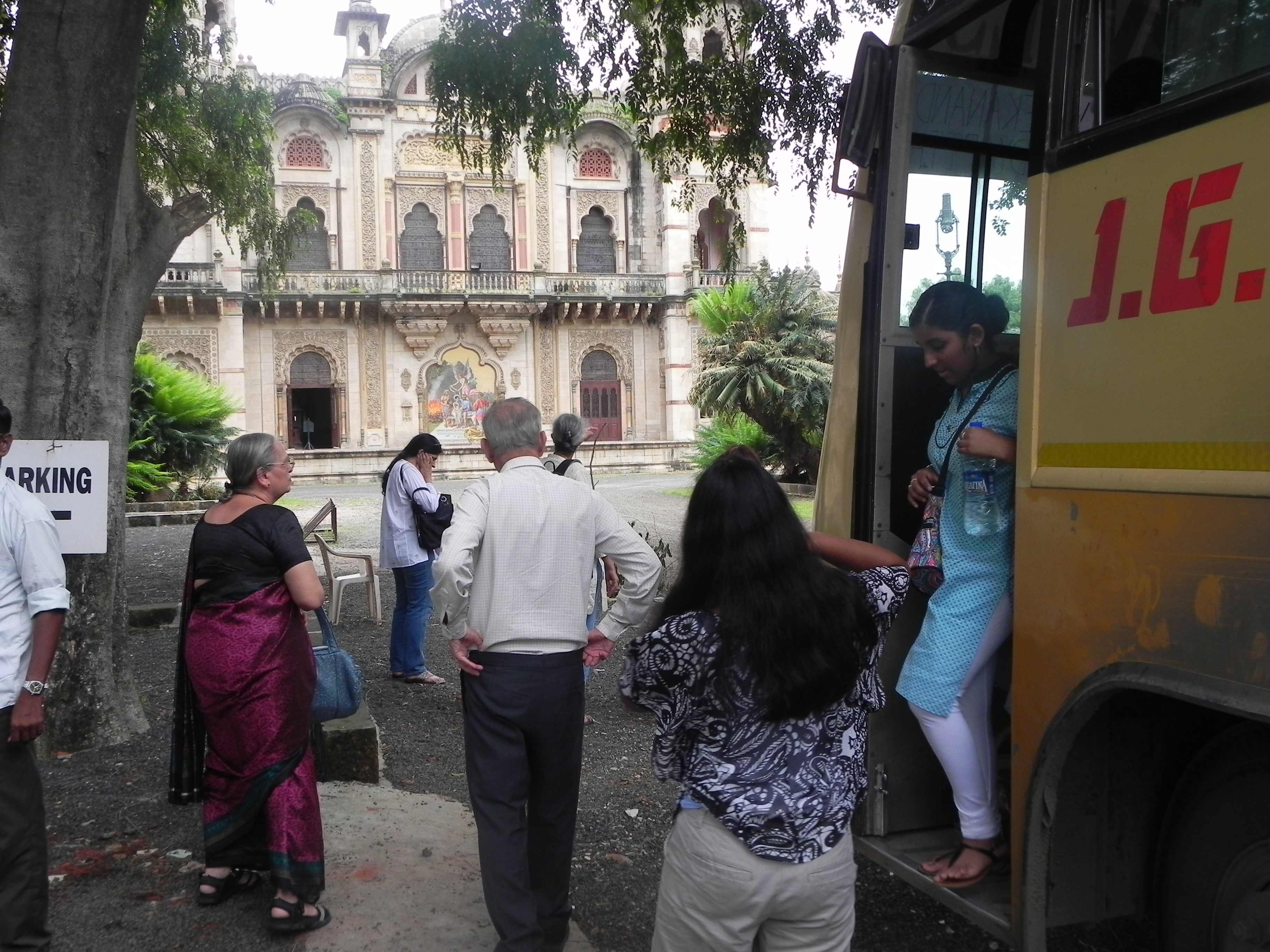
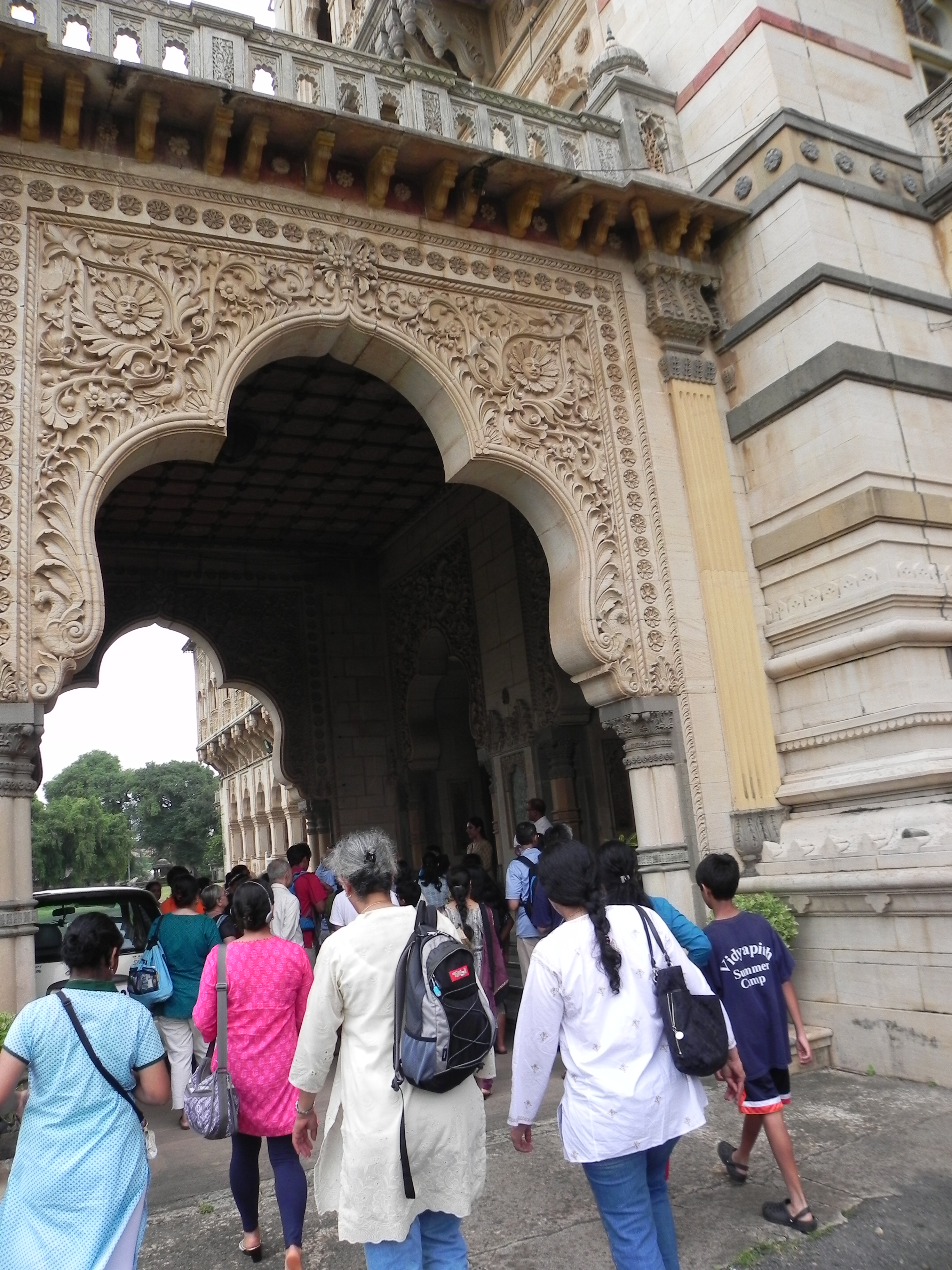
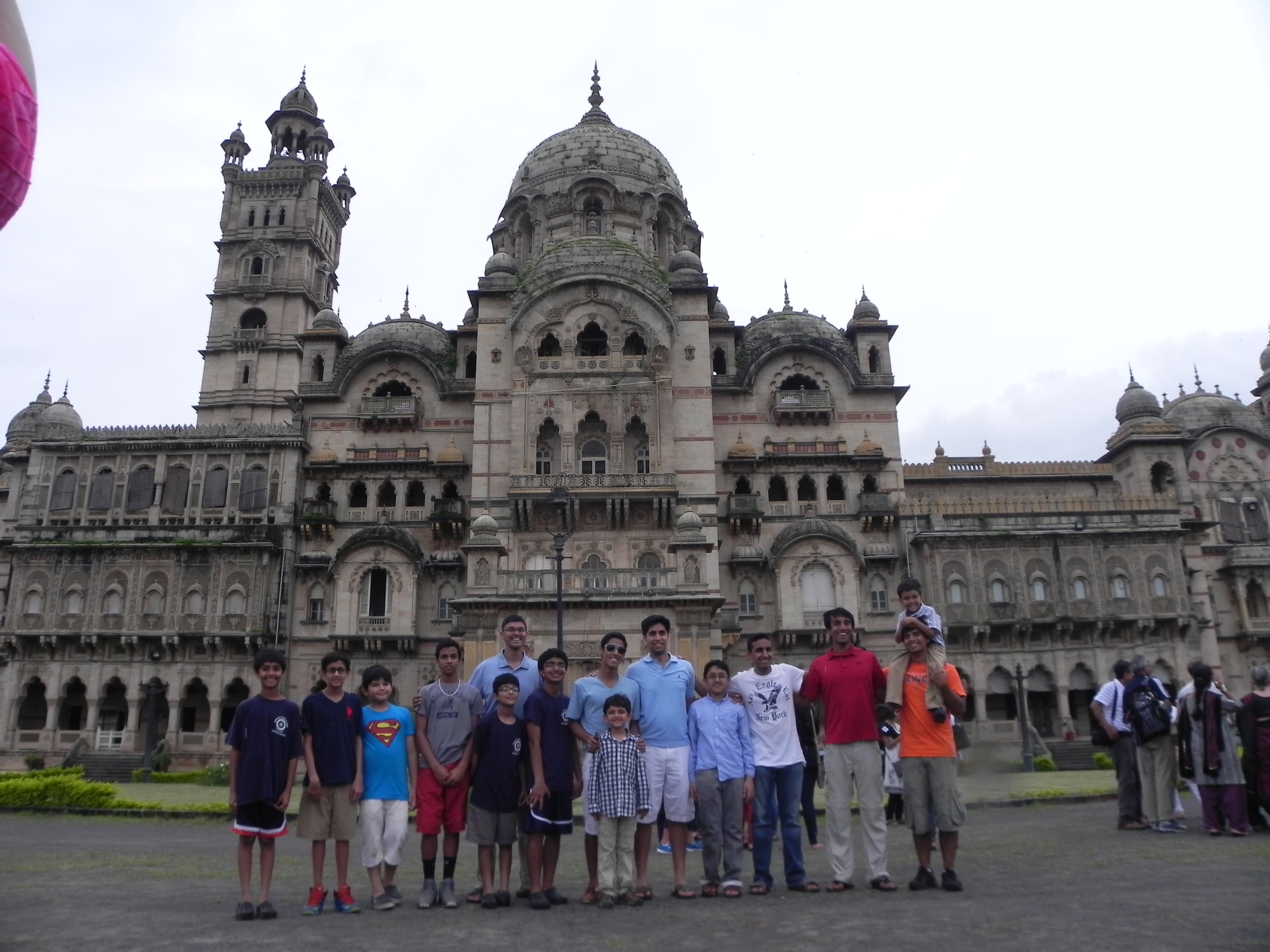
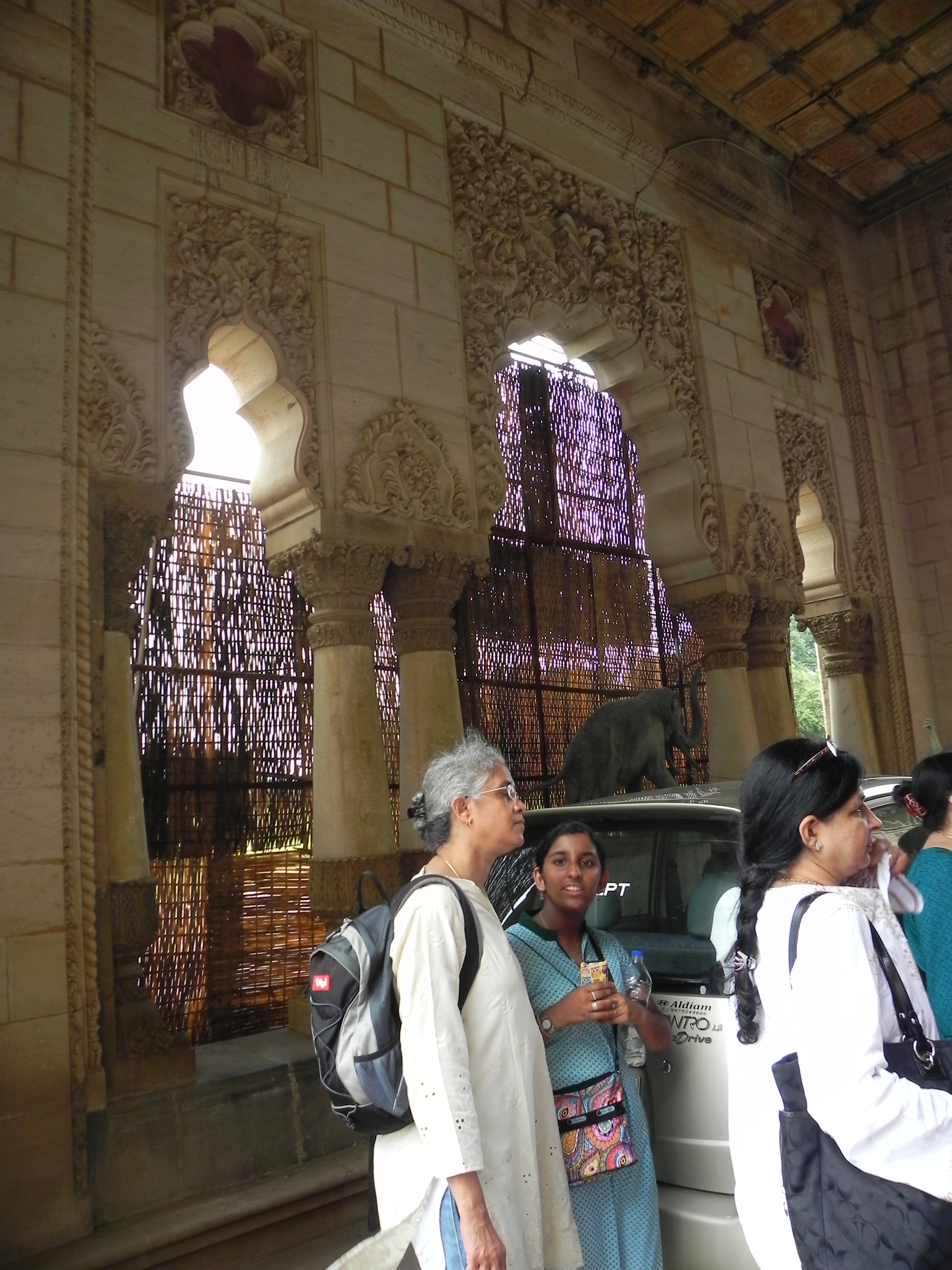
The bus came to the Royal Orchid Central hotel to take us all for an excursion of Vadodara and Lakshmi Vilas Palace. When we got down at the palace, Mukundbhai was waiting to greet us and to make sure we had a good time.  He had paid for our tickets.  It is a huge palace that is worth seeing.  We can see how Sayajirao Gaekwad combined eastern and western art and architecture in the palace.  A guide showed us all possible rooms that we can see.  We also saw Ravi Varma’s paintings. From the literature it seems that Swami Vivekananda had visited the palace and had seen Ravi Varma’s paintings.  He also had praised Maharaja Sayajirao Gaekwas.  Swami Vivekananda had told Prince Martand Varma at Trivandrum that “of all the ruling princes he had met, he had been most impressed with the capacity, patriotism, energy and foresight of H.H. the Gaekwad of Baroda.”  Swamiji was also perhaps impressed with the Maharani of Gaekwad because he wrote on February 17, 1901 to Miss Macleod from Belur Math “I hope you will go to Baroda and see Maharani” Rasheshbhai guided the bus driver, so we could see few major sites of the old city of Vadodara.

Waiting for the bus in the lobby of Royal Orchid Hotel
Going to the Palace
Going to the Palace
In the compound of Lakshmi Vilas Palace
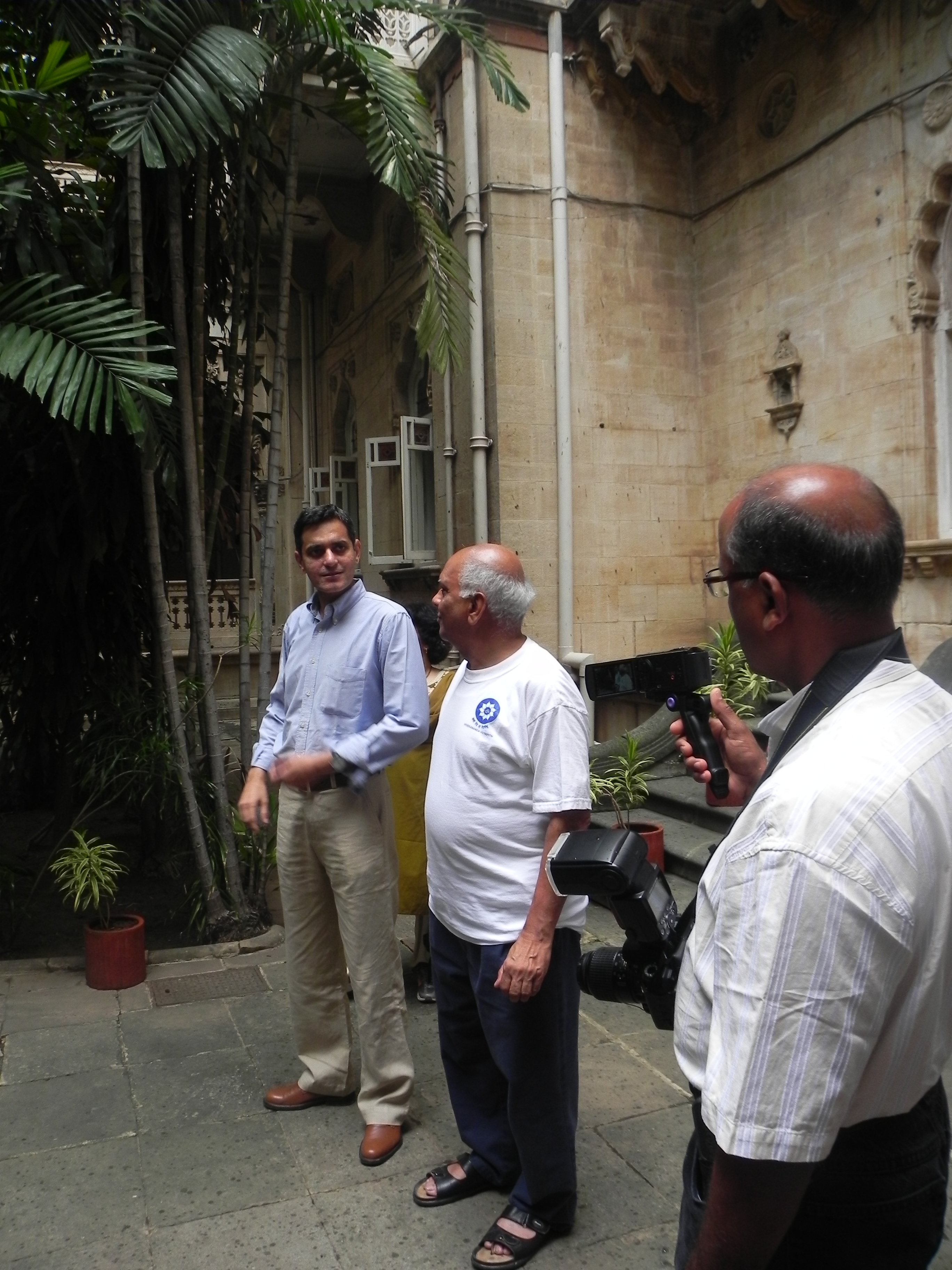
Rasheshbhai is guiding us
Surprise!  Mukundbhai was waiting for us who arranged this trip
Surprise! Mukundbhai was waiting for us who arranged this trip
Entering into a huge gate
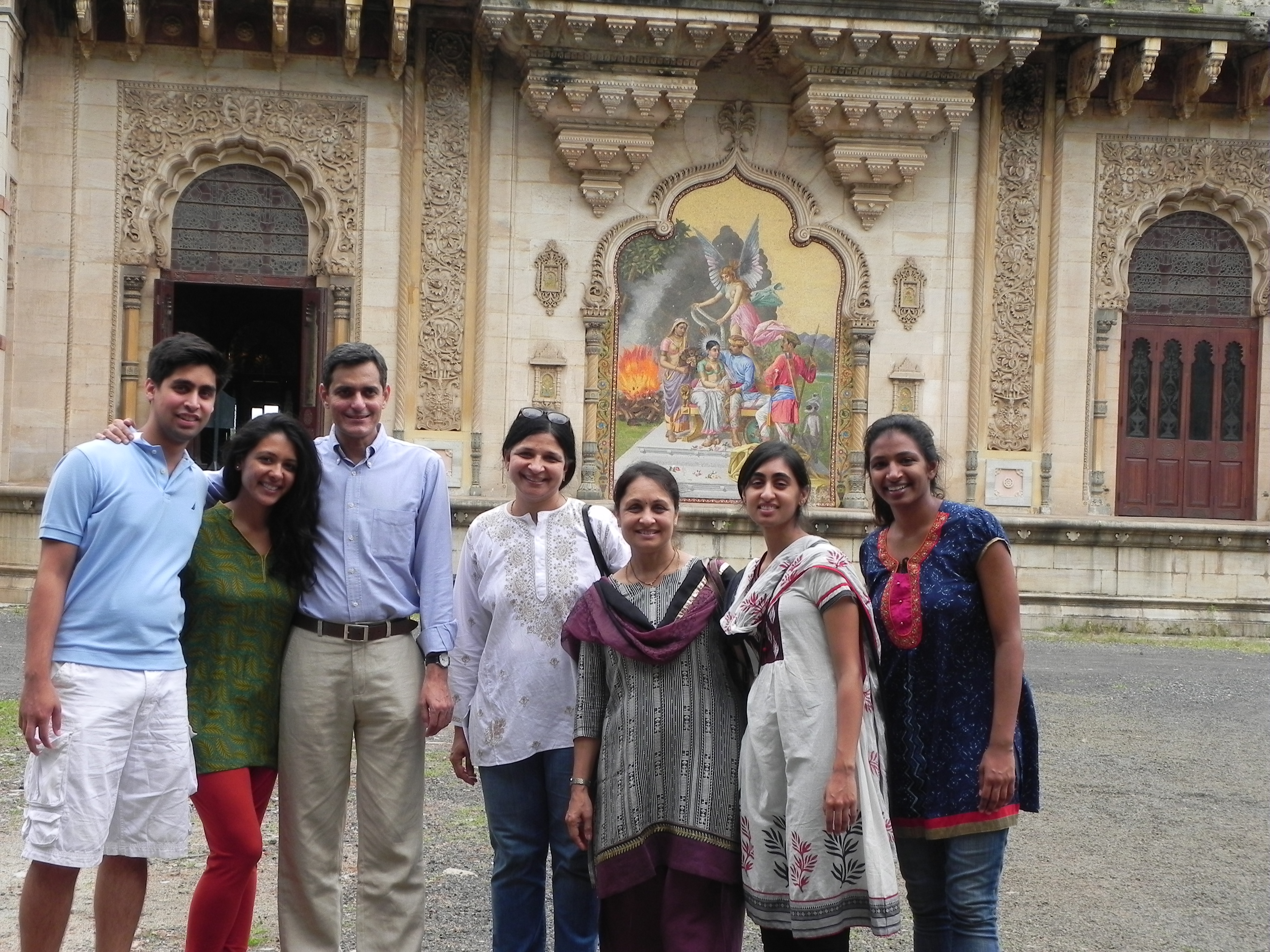
A beautiful painting combining eastern and western art
Closer look
Closer look
The Parikh Family
The Parikh Family
Look at the palace
Look at the palace
The palace has more than 100 rooms
The Vidyapith family in front of the Lakshmi Vilas Palace
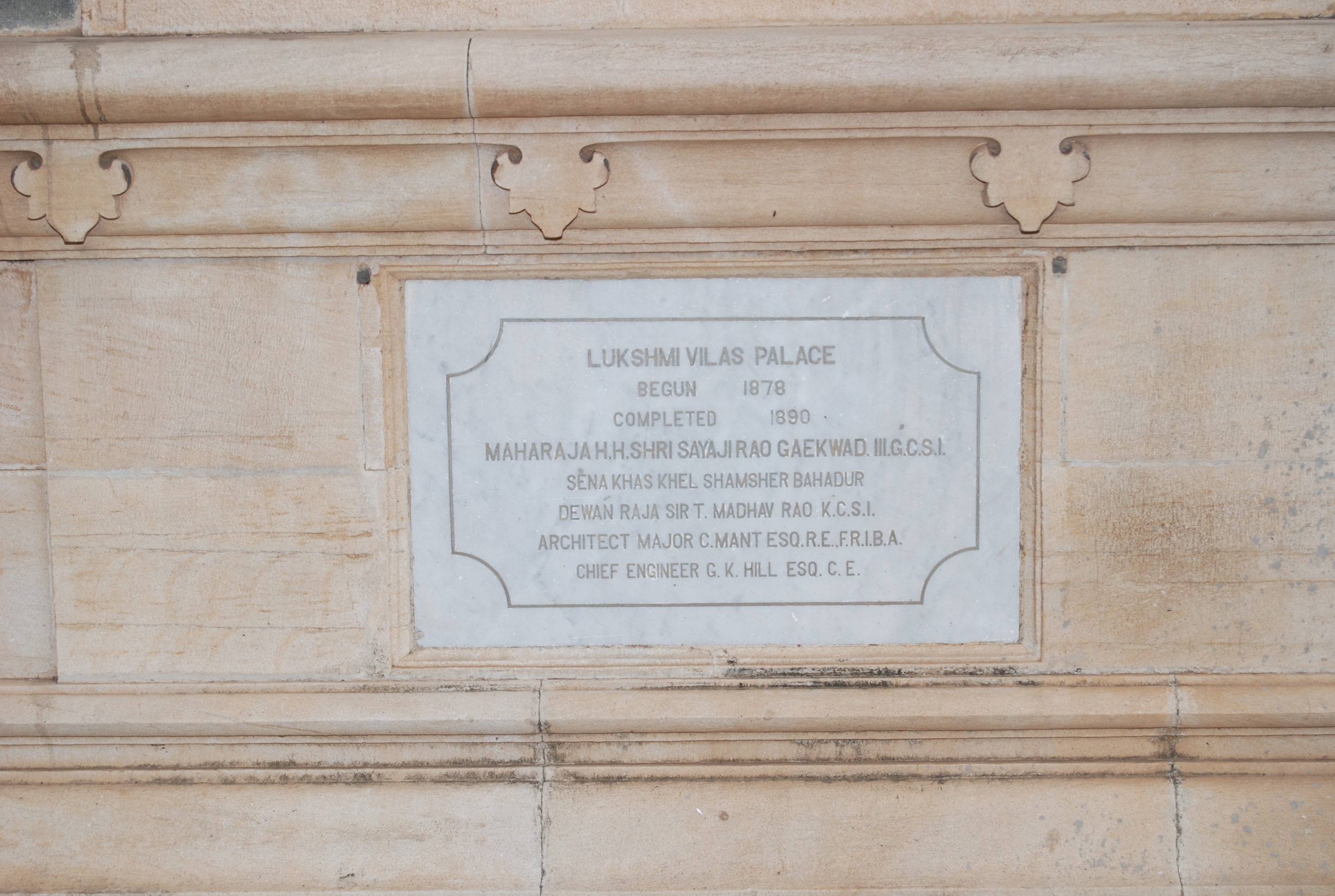
It took 12 years to build the palace(1878-1890);  Swami Vivekananda arrived in Baroda in 1892
It took 12 years to build the palace(1878-1890); Swami Vivekananda arrived in Baroda in 1892
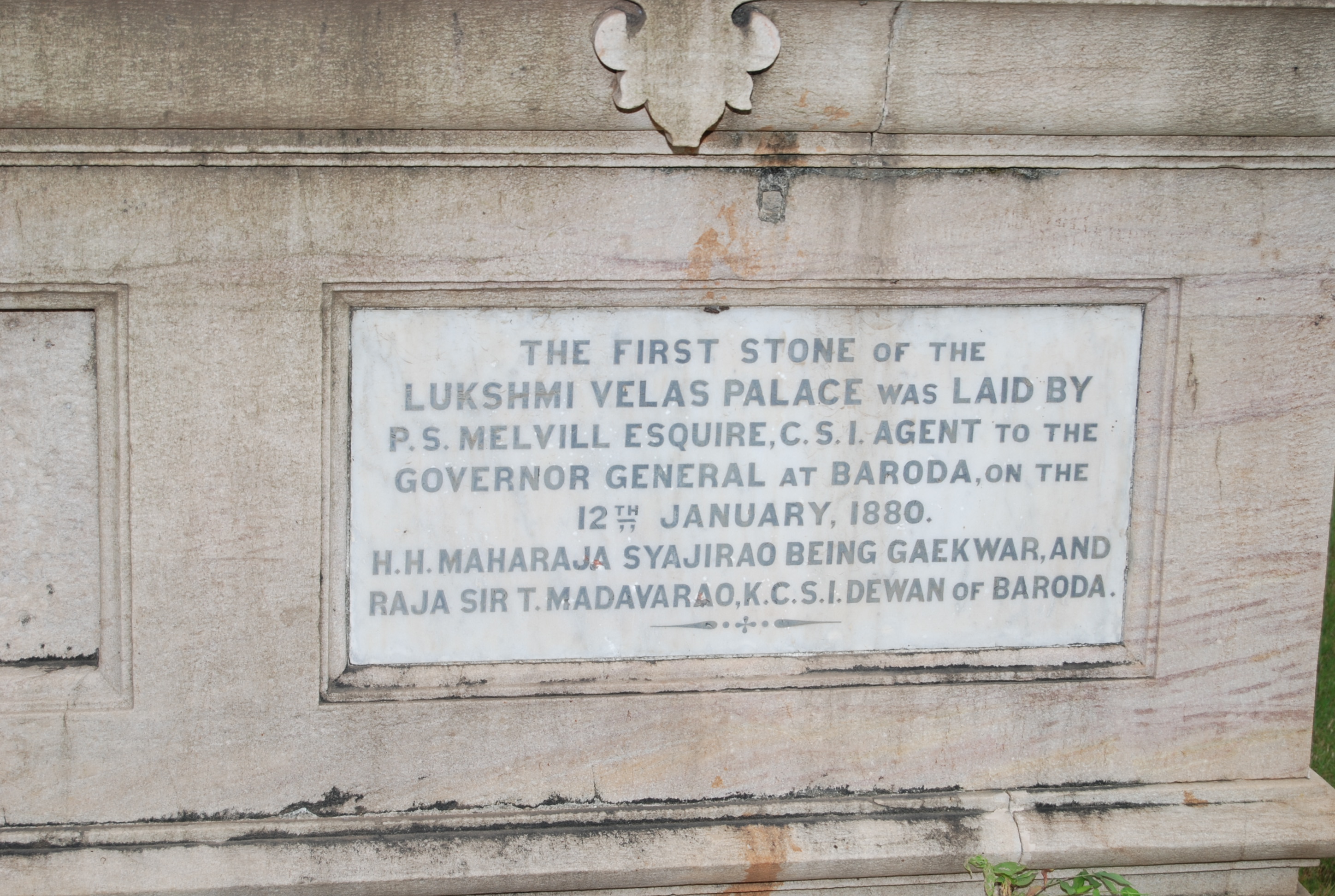
The first stone was laid on Jaunary 12, 1880 (Swami Vivekananda’s birthdate)
The daughters of Vivekananda Vidyapith
The sons of Vivekananda Vidyapith
The Guide who showed us the palace – Camera was not allowed inside
This was the elephant room

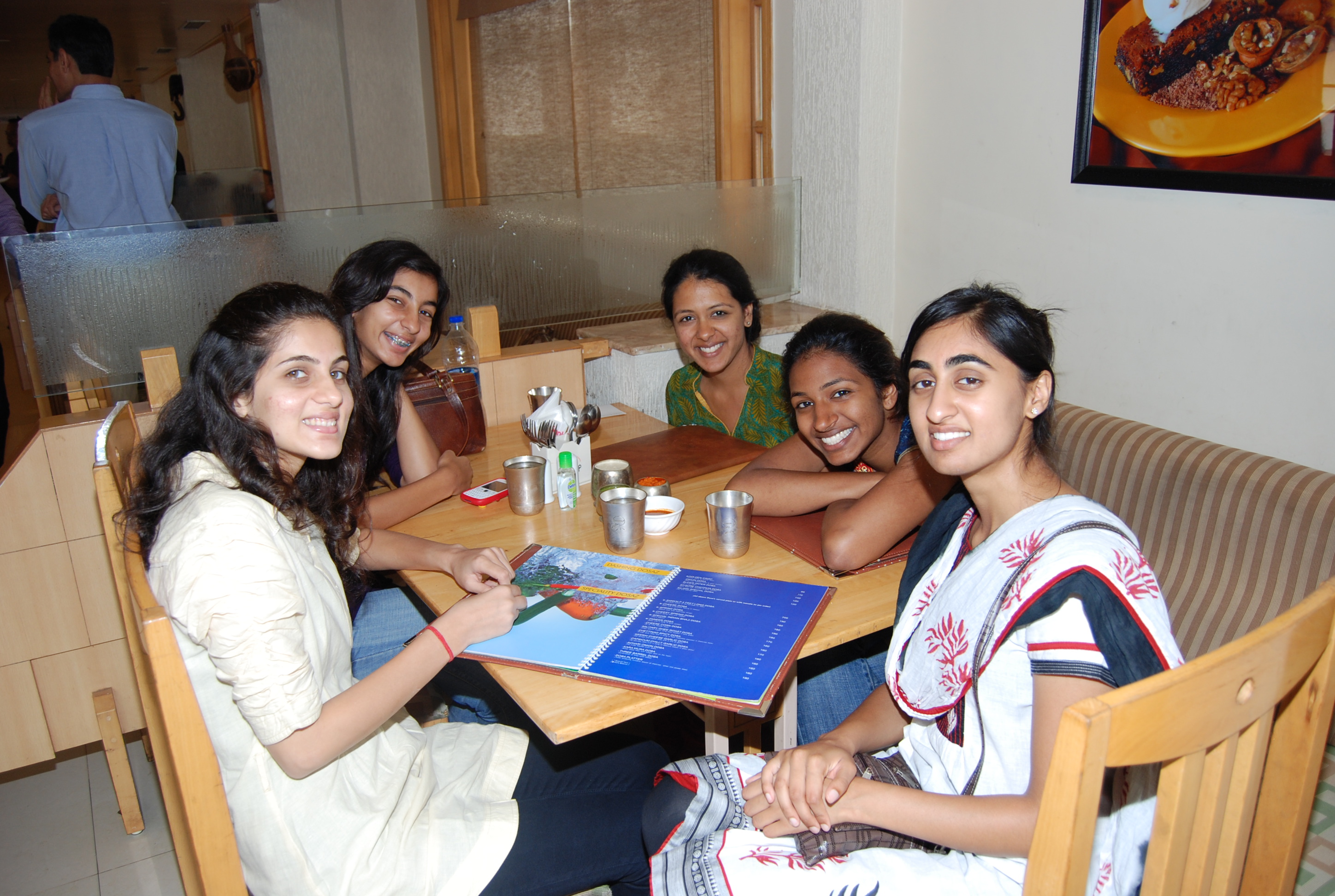
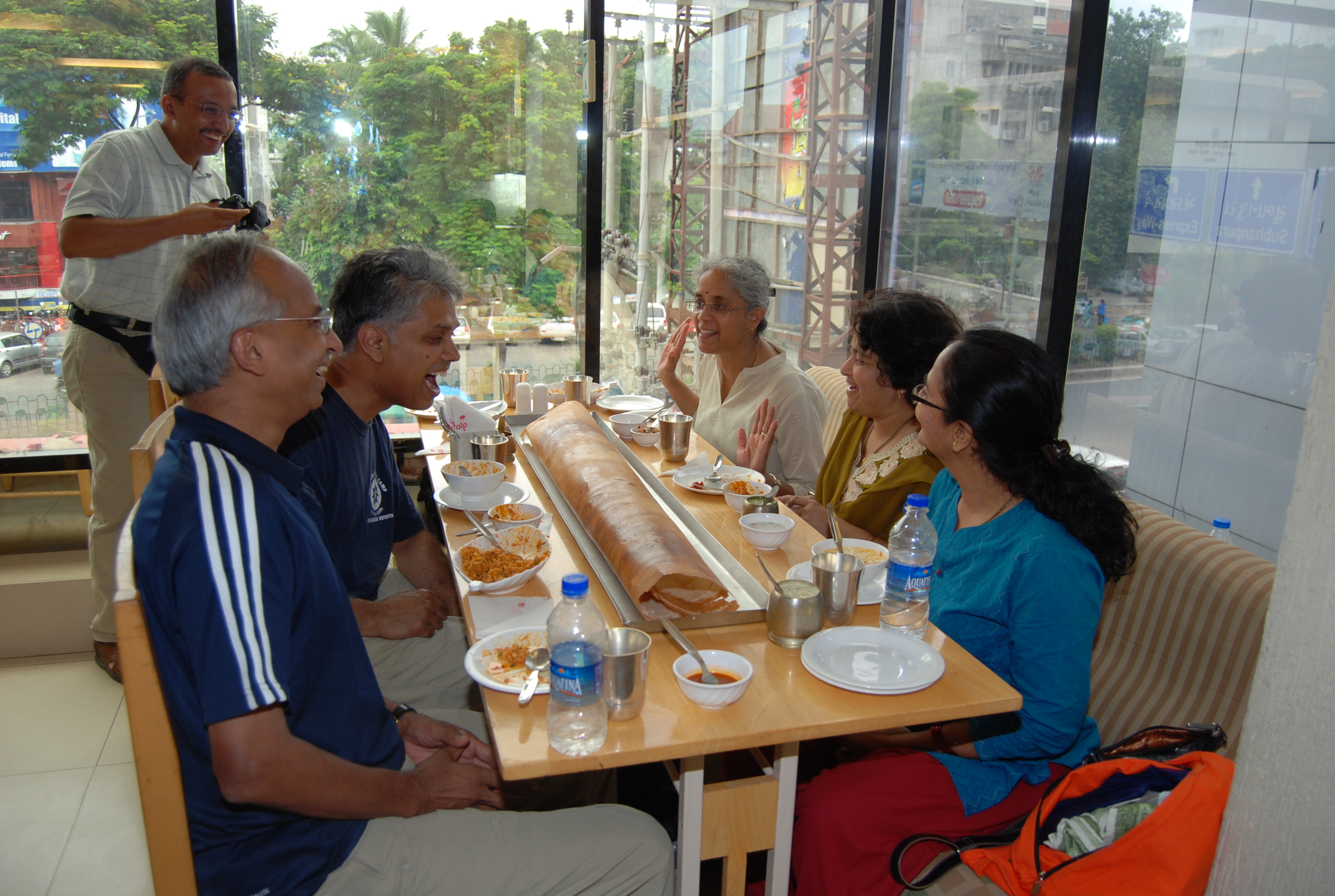
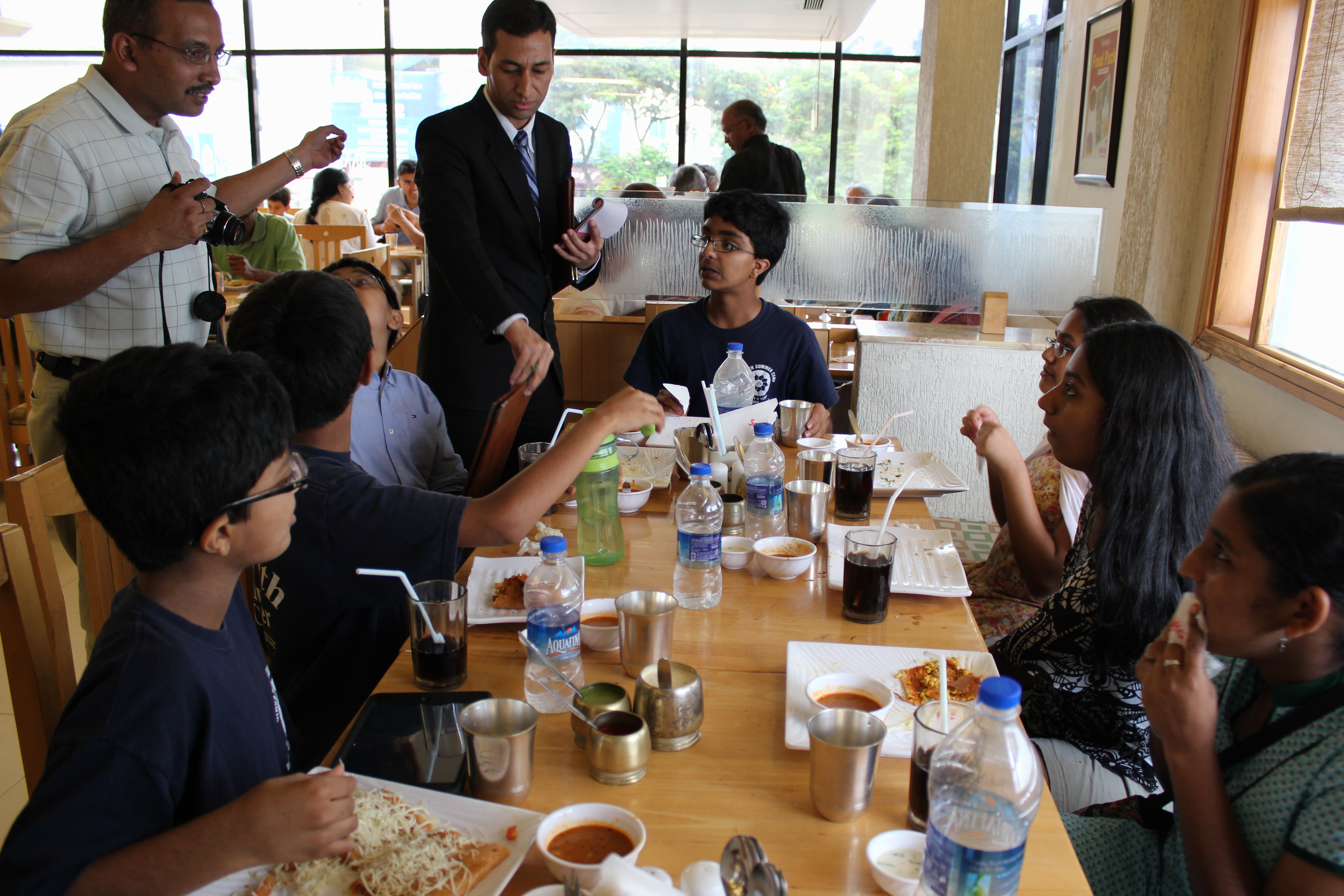
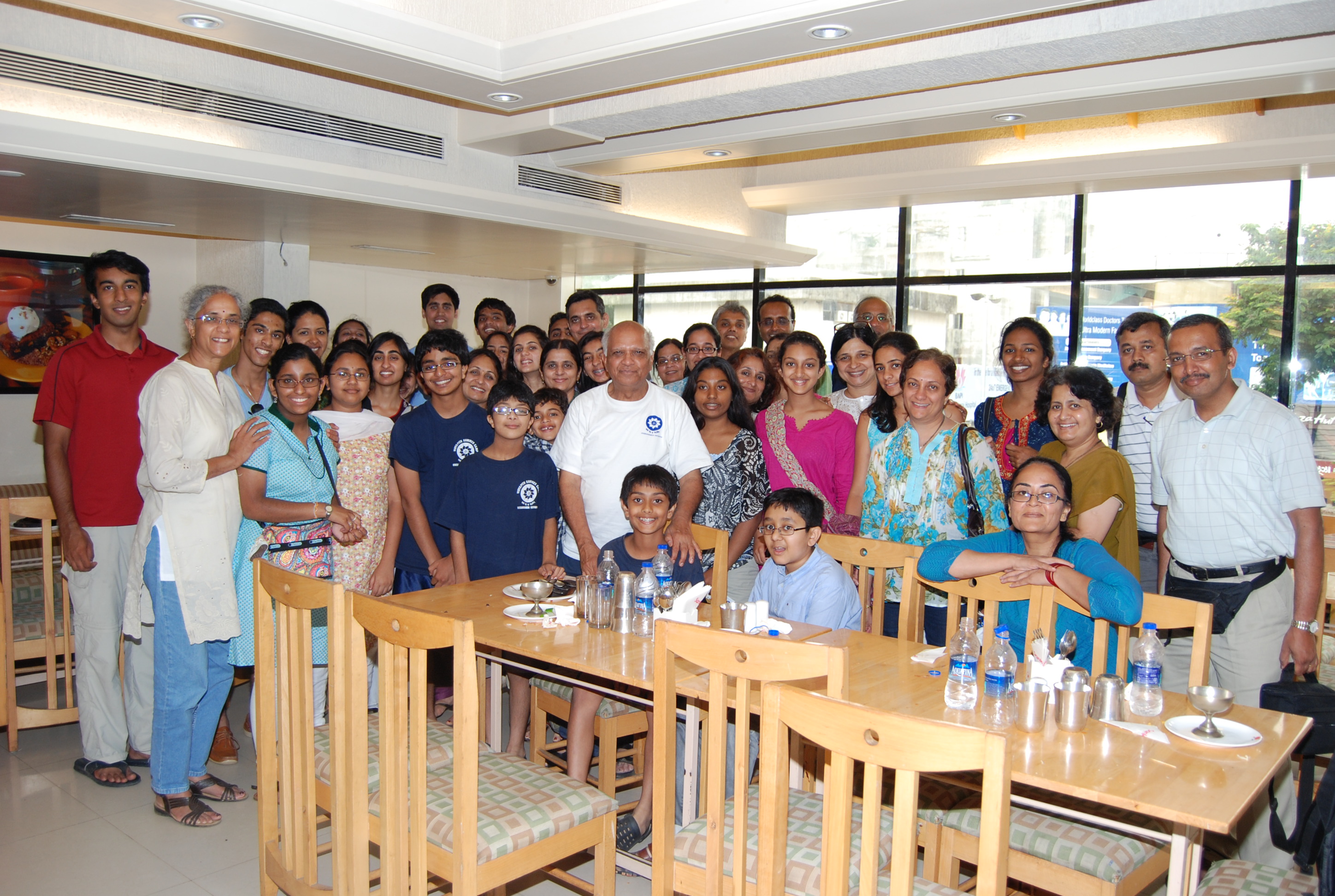
The next stop was the Sankalp restaurant for lunch.  Nimishbhai and family hosted this lunch.  A section was reserved for all of us.  Some people ordered 4-feet long dosa for a table and were amazed to see its length. Sankalp restaurants is a chain.  The Sanklap restaurant of Vijayawada had produced 48-feet long dosa and was in the Guinness world record book.  People ate varieties of things. Almost all the Vidyapith people who came to attend the convention were here. After lunch many ate “paan” and had good deserts.  A group photo was taken at the restaurant.

Entering Sankalp, Alkapuri, Vadodara
Waiting for food
Waiting for food
Nimishbhai, the host
Later on we gave him a handmade card (made by Sneha)
We cannot thank Nimishbhai enough…(all signed it)
Thanking Rasheshbhai (some light moments)
Cousins are together
Delicious food
Delicious food
Look at the length of the dosa
Kids had a great time
Group photo in Sankalp… a joyful memory

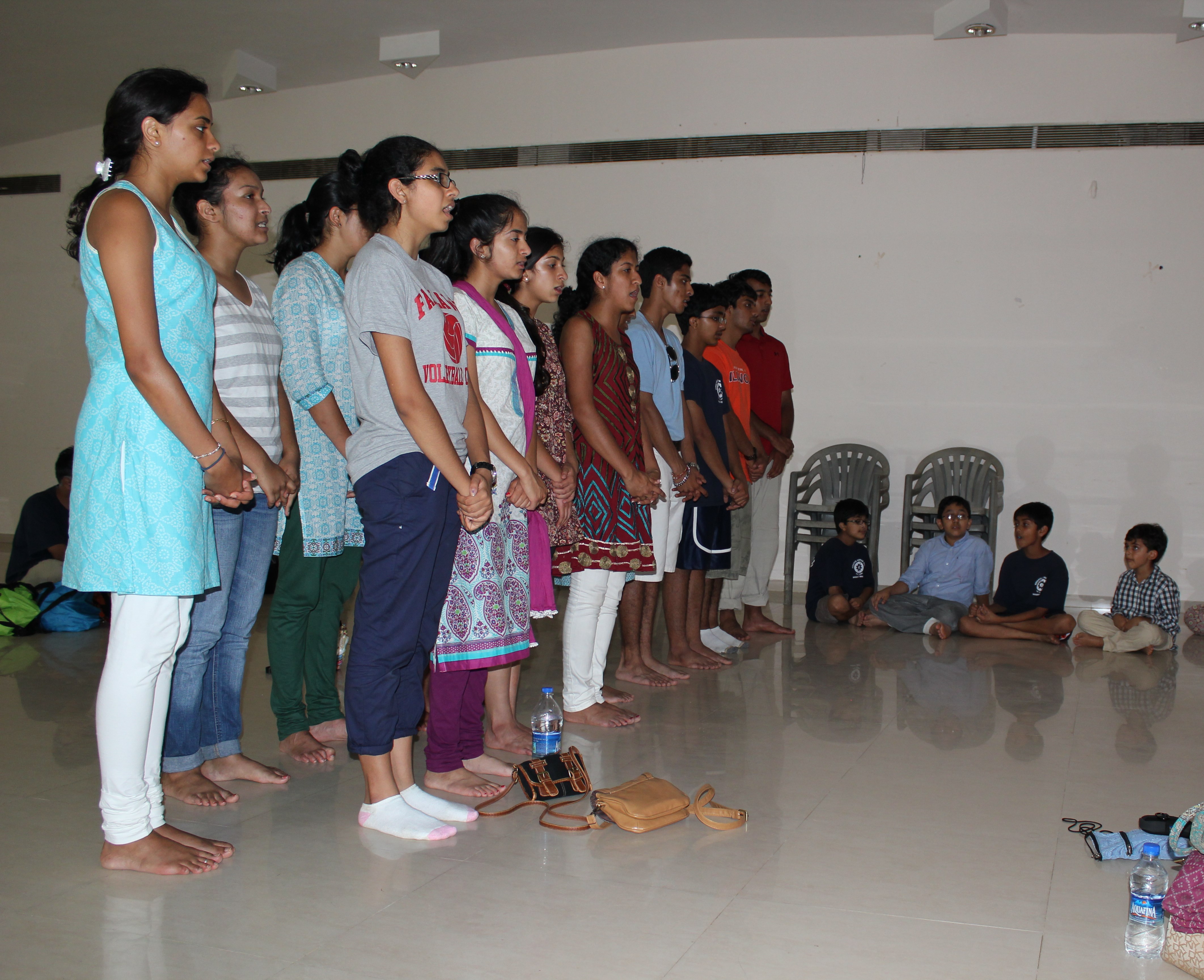
Now, it was the time for practice.  As mentioned before, Nimishbhai found a hall nearby for us.  The bus took us there.  We all gathered in an empty hall and sat on the floor.  It was an air-conditioned room.  We practiced the Shanti Mantras, recitations, Bhajan, dhoon and our “Arise! Awake!…” song.  For more than two hours we practiced.  During the practice there was a very heavy rain storm.  It was about 6:45 p.m. and we had to go to Surya Hotel for dinner.  When we left, rain had almost stopped.

Reciting Shanti Mantras
Practicing bhajan and dhoon

Within half an hour we arrived at the Surya Hotel.  As soon as we entered into a decorative and well-lit reception room, we found a sign that said, “Welcome to delegates of Vidyapith Family, New Jersey.  @5th Avenue Hall (5th floor)” We went to the 5th floor and there was a similar sign at the door.  It was a special dinner.  The dinner was hosted by Mukundbhai and Maltiben & Family.  They welcomed us inside a big banquet room.  Decorative table-cloths, chairs covered with white covers, special lights, and people created a very good mood for dinner.  Some soft drinks were served.  People got some time to talk to each other.  Soon, the room was full of joyful noise.  Nisha introduced the host family members.  People then enjoyed appetizers, the main course menu items, and deserts.  There was a family oriented environment in the hall.  After desert, everyone received a gift of the book, “In Indian Culture, why do we…”  All were very happy by the loving hospitality of the host.   While going home, there was no bus and because of rain it was difficult to get many rickshaws.  So, Nimishbhi and Mukundbhai’s son Kunalbhai gave rides to all of us from the Surya hotel to the Royal Orchid Central hotel.  For this, they had to make several trips between the hotels.

Bus is ready to go to Hotel Surya
Welcome sign
Welcome sign
Sign on the 5th floor
Host family was already there – Hello, How are you?
Sharing the joy
Sharing the joy
Introduction of the Host family
Serving soft drinks
Serving soft drinks
Tanisha & Trisha
Tanisha & Trisha
The appetizers were delicious
Time to chat
Time to chat
We are having good time too!
Let us start eating
Let us start eating
Varieties of things
Varieties of things
Nisha, come on, eat something
We will eat last
We will eat last
So many things to share
It was so funny!
It was so funny!
Host family members
Host family members
Let us eat
Let us eat
What should I take?
What should I take?
Cute Tanisha makes Trupti Aunty happy!
The grand dinner
Maltiben makes sure everything is okay
Uncle, are you okay? Can I get you something?
All are enjoying dinner
Posing for the picture
Having good time
Having good time
We are ready for deserts
It’s fun to bother Smit
Ansh had a funny joke
We are ready for deserts
Am I allowed to have desert?
I am going to reach your hand
Gifts are ready after dinner
Trisha is going to give gifts to all
Thank you Trisha
Thank you Trisha
Everyone loves Tanisha
Some serious discussions
Uncle with Mukundbhai and Maltiben (the host)
Let us see how the picture came out
(From left to right)  Rasheshbhai, Mukundbhai, Uncle, Nimishbhai and his wife Chandaniben
(From left to right) Rasheshbhai, Mukundbhai, Uncle, Nimishbhai and his wife Chandaniben

It was late at night, but a few adults who were in charge of the accounting, sat together and finalized the accounts.  Then, all slept thinking about the two-day International Youth Convention that was starting the next day.  We had planned to reach at the auditorium by 8:15 a.m.

“Even the least work done for others awakens the power within, gradually instills into the heart the strength of a lion.”    – Swami Vivekananda

IYC – Bulletin 1

DSC03604
Going to Baroda with the list of Vidyapith delegates participating in IYC
DSC03605
The first batch arrived to finalize preparations for the trip
DSC03615
IYC posters on the streets of Baroda
DSC03620
With Rev. Swami Nikhileshwarananda at RKMVM in Vadodara

Swami Vivekananda in Gujarat

                  Swami Nikhileshwarananda has written an excellent research article “Swami Vivekananda in Gujarat.”  One who is interested in Swami Vivekananda and/or Gujarat should read this article.  The article brings out various aspects of Swami Vivekananda and makes him more humane.  It also tells us how Swami Vivekananda directly and Sri Ramakrishna indirectly attracted few powerful personalities of Gujarat and played an important role in their lives.  We can see how Swami Vivekananda built loving relationship with all of them.

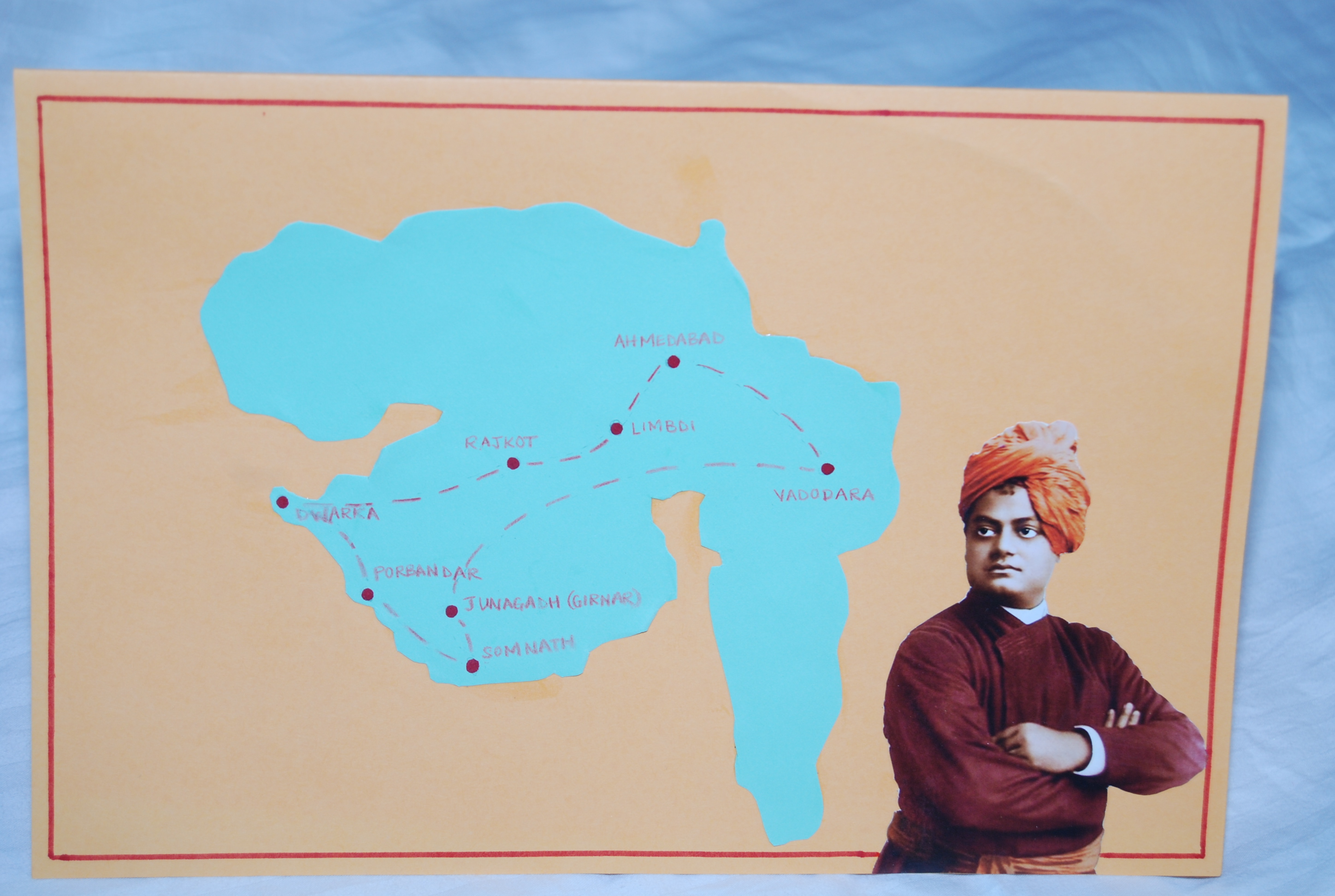
Here I will tell you a few important points from this article that gives an overview of “Swami Vivekananda in Gujarat.”

  • During his ‘wandering monk’ period, July 1890 through May 1893, Swami Vivekananda spent maximum duration of time in Gujarat, from November 1891 through April 26, 1892.
  • During this time,
    • Swami Vivekananda strongly felt that he has a mission of his life.
    • He perceived bright future of India
    • He realized that India is one Huge Temple, as it were with chapels and sanctuaries everywhere. He saw the glory of Mahabharat.
    • He received inspiration for going to West to preach Sanatana Dharma
    • Pandit Shankar Pandurang told Swamiji, “I am afraid you cannot do much in this country. Few will appreciate you here. You ought to go to the West. Surely you can throw a great light on Western culture by preaching the Sanatana Dharma”. Here, probably Swamiji heard for the first about the religious convention that was to be held sometime in the following year at Chicago.
    • He had a wonderful experience of a mirage. In his lecture delivered in New York entitled ‘The Real and the Apparent Man’ Swamiji gave a description of the phenomenon and drew a very important moral from it.
    • He met some of the most prominent princes, Diwans, scholars and eminent personalities of his time. Such as:
      • Thakore Saheb of Limbdi Shri Yashwantsinhji
      • Maharaja of Bhavanagar Shri Takhtsinhji
      • Maharaja of Bhuj Shri Khengarji (III)
      • Maharaja of Porbandar Shri Vikamatji
      • Maharaja Gaekwad Shri Sayaji Rao
      • Shri Haridas Viharidas Desai, Diwan of Junagadh
      • Pandit Shankar Pandurang, Administrator of Porbandar
      • Shri Motichand Lalchand, Diwan of Kutch
      • Shri Manilal Jashbhai, Diwan of Baroda
      • Shri Mansukhram Tripathi & Shri Manibhai N. Dwivedi, the great Gujarati Scholars
      • Shri Lalshankar Umiashankar Trivedi, sub-judge and great philanthropist

All of them became great friends and admirers of Swamiji and some of them became even his disciples.

Ahmedabad

One day when a sub-judge of Ahmedabad was coming out of Ahmedabad Railway Station, he saw a sturdy and stout sannyasi sitting under a pipal tree, who had a look of greatness around him. He went to the monk and talked with him and became so much impressed that he atonce requested him to be his guest. Both got into the waiting tonga and soon arrived at the house of the host – Shri Lalshankar Umiashankar Trivedi – residing at 36 Amritlal’s Pole in Khadia the heart of the city of Ahmedabad.

Soon Shri Lalshankar realized that his guest was an unusual person with a good knowledge of almost everything in the world. The unknown monk was of course, none other, than Swami Vivekananda. Although the house was spacious, it lacked the required tranquility for meditation and reading, so Shri Lalshankar took Swamiji to another house he had in Ellisbridge behind the townhall. The house became a beehive of activity with many people flocking to hear and meet Swamiji, who lectured on several topics including high philosophy.

He stayed in Ahmedabad for 11 days.

Wadhwan

He saw Sati Ranakdevi’s temple.

Limbdi

He had a terrible experience with some evil sadhus, but Swamiji cleverly escaped with the help of a young village boy and the Majaraj of Limbdi.

Swamiji stayed in the beautiful palace of Limbdi for many days and held discussion in Durbar hall of the palace with the maharaja, Thakore Saheb, Shri Yashwantshinji (1859-1907).  He was a brilliant, learned king who had visited England and America. President Cleveland warmly greeted the Maharaja at the White House in Washington DC. Thakore Saheb described in detail what he had learnt from his visits to England and America and requested Swamiji to go to these countries for preaching Sanatana Dharma. Thakore Saheb of Limbdi was the first among the Maharajas to inspire Swamiji to go to the West for preaching work.

A fire in 1906, consumed a major portion of the beautiful Limbdi palace, left untouched the Darbar Hall where Swamiji had stayed. Sixty five years later Shri Chhatrasalji, the present Thakore Saheb of Limbdi, donated the palace to a public body named “Shri Ramakrishna Prarthana Mandir”. And now this trust has handed over the palace alongwith other properties to Ramakrishna Mission.

The Impact of Swami Vivekananda’s Visit to Gujarat

After returning from the West Swamiji sent two of his Gurubhais, Swami Turiyananda and Swami Saradananda to Gujarat to preach and to collect funds. Both of them spent about 3 months in Gujarat (From 22 February to 18 April 1899).

Junagadh & Girnar

Swamiji saw many ancient monuments and ruins – an old fortress called Uparkot, an old Rajput palace, two ancient wells, Khapra Khodia caves dating back to the Buddhist period, perhaps used as monasteries, ‘Ashoka Shilalekh’ in which the edicts of Emperor Ashoka and of the other emperors are inscribed and many other places of historical importance.

Girnar is group of about ten hills, highest of which is Gorakhnath (about 3600 ft.) has been a place of pilgrimage sacred to Buddhists, Jains and Hindus alike before the days of Ashoka (272-231 B.C.). For Swamjji, it must have been of special interest because here Pavahari Baba was initiated into the mysteries of yoga. 26 He sought out a cave and practised meditation for a few days during which Diwan Saheb took all possible care of him.

For a few days Swamiji stayed with Shri Chhaganlal Harilal Pandya (1859-1936), a great scholar and Manager of Diwanji Saheb, who became his staunch admirer. About Swamiji’s stay in his house he gave a delightful account – how he charmed everybody by his personality, vast scholarship, songs and discourses and not the least by his proficiency in the art of cuisine, specially by the ‘excellent rasagollas’ he prepared. In his talks Swamiji spoke of Jesus Christ as also of Shri Ramakrishna.

Swamiji visited Junagadh many times. During one of the trips he had also stayed with Shri Mansukhram Tripathi, the well-known writer and scholar of Gujarat, a man of high character, who preferred higher values of life. We get confirmation about Swamiji’s stay with Shri Mansukhram Tripathi from the account given by Swami Abhedananda in his auto-biography.

“On arrival at Junagadh, I came to hear from people that a Bengali sannyasi with high English education was staying for some days at the house of Mansukhram Suryaram Tripathi, a Gujarati brahmin, who was the Private Secretary of the local Nawab.. Elated with joy I reached the house of Mansukhram and immediately found that my conjecture was true. Narendranath brightened up with joy to see me unexpectedly.. Fortunately when I arrived there Narendranath was discussing some topic of non-dualistic Vedanta with Mr. Tripathi.. I gladly stayed in his house for three or four days in the company of Narendranath and then I got ready to start for Dwarka.”

During his very first visit to Junagadh Swamiji had become a guest of Shri Haridas Viharidas Desai, the Diwan of Junagadh (whom Swamiji used to address as Diwanji Saheb). Diwanji Saheb was so much charmed with the company of Swamiji that every evening with all the State officials he used to meet Swamiji and converse with him until late at night. Swamiji in turn loved and respected him as a son does his father, the difference in their age being 22 years. He wrote from Khetri in May 1893, “Believe me that I love you and respect you like a father and that my gratitude towards you and your family is surely unbounded…”

There are 13 inspiring and important letters of Swamiji addressed to Diwanji Saheb.”A friend in need is a friend indeed”. Like a true friend Swamiji helped Diwanji Saheb to overcome his problems, whenever needed. Once when Diwaniji Saben was in distress, Swamiji wrote an inspiring and powerful letter to him, “Often and often we see that the very best of men even are troubled and visited with tribulations in this world…”

Similarly, when Swamiji was in trouble, while some vested interests in America raised all sorts of scandalous charges against his character and conduct, Diwanji Sabeb, as soon as he came to know about it, wrote on 26.6.1894 to Mr. G. W. Hale in staunch defence of his beloved Swamiji. Swamiji wrote back to him, “your kind note to G.W. Hale has been very gratifying as I owed them that much.”

Diwanji Saheb’s administration of more than a decade in Junagadh was marked by the most important reforms in every department of the State.

Kutch

After spending a few days in Junagadh, Swamiji proceeded towards Kutch with a letter of introduction from Diwanji Saheb to his bosom friend Motichand Lalchand, Diwanji of Bhuj. Bhuj was the capital of Kutch. The Maharaja of Kutch, Khengarji Bahadur, only three years younger than Swamiji, soon formed a very close friendship with him. He was deeply impressed by Swamiji’s magnetic personality and was astonished at his vast knowledge: “Swamiji, as after reading may books the head becomes dazed, even so after hearing your discourses my brain becomes dizzy. How will you utilize this talent? You will never rest until you have done wonderful things!”

Swamji afterwards went to Mandavi.

Swamiji’s journey was not always pleasant or safe. When Swamiji was at Bhuj, his brother – disciple Swami Akhandananda warned him of the dangers of jealous state officers. Some state officers had even poisoned a Bengali sannyasin years ago when this sannyasin had tried to introduce reforms to improve the state.

Somnath

Several times the temple of Somnath was destroyed and several times rebuilt. Swamiji paused by this great ruin and pondered over the greatness that had been India’s in the past. He realized that in India religious life forms the center, the keynote of the whole music of national life. Later (in 1897) he was to address his countrymen, “Some of these old temples of Southern India and those like Somnath of Gujarat will teach you volumes of wisdom, will give you a keener insight into the history of the race than any amount of books.”

Dwarka

After a brief stay in Porbandar reached Dwaraka, holy with innumerable memories and legends of Shri Krishna. But of its glories nothing remains at present. Now the ocean roars in tumult over the place where once the powerful Yadava lived and where once stood a great capital of which Shri Krishna was the reigning prince.

He sat on the shore and yearned ardently to fathom the contents of the future. Then rising as from a dream he went to Sharada Math (a monastery founded by Adi Shankaracharya) where he was assigned a room. There in the silence of his cell, he saw a great light – the resplendent future of India.

From Dwaraka Swamiji went to Bet Dwaraka (Island Dwarka) Mandvi etc.

An interesting chase

Akhandananda heard at Ahmedabad that Swamiji had gone to Wadhwan. At Wadhawan he heard that he had gone to Junagadh; at Junagadh he learnt that Swamiji had left for Dwaraka via Porbandar; at Dwaraka that he had left for Bet Dwaraka; at Bet Dwaraka that at the invitation of the Maharaja of Kutch he had gone to Mandavi; at Mandavi that accompanied by a party of body guards he had gone to Narayan Sarovar, which was eighty miles away.

Swami Akhandananda was warned at Mandavi that the road to Narayan Sarovar was infested with dacoits. But heedless of danger he sped on. On the way he was beaten and robbed by dacoits. At Narayan Sarovar he learnt that the journey to the place, which might have cost him his life, had been fruitless for he was told that Swamiji had left for Mandavi via Ashapura. The road lay through desert wastes and was also infested with dacoits and it meant a journey for a hundred miles, yet he heroically marched on in spite of having fallen sick.

Swamiji was also astonished and no less glad to meet his beloved brother disciple but when he heard the story of his chasing him, he got worried that his brother – disciple would not leave him alone as he had come all the way at the risk of his life. He told Swami Akhandananda, “Look I have become a spoiled man, you leave me.” Swami Akhandananda replied, “what would it matter to me even if you had lost your character ? I love you, and that is not in any way affected by your good or bad character. But I do not wish to be in your way. I had a longing to see you, and now I am satisfied. Now you can go alone.” Swamiji was happy to hear this and next day left for Bhuj, which Swami Akhandananda reached a day later. Both of them then went back to Mandavi and halted for a fortnight. There Swamiji made many friends. From there Swamiji went to Porbandar. Swami Akhandananda joined him at Porbandar after about a week and after spending a few days at Porbandar he went to Jamnagar via Jetpur, Gondal, Rajkot and thus spent about a year in Kathiawad.

Porbandar

One evening while Swamiji was pacing on the roof of the palace of the Maharaja of Porbandar.  He suddenly saw his brother disciple Swami Trigunatitananda coming towards the palace with a group of sadhus. Swamiji was thrilled to see him.

In Porbandar, Swamiji came into contact with Pandit Shankar Pandurang (1840-1894) of Konkan. He was a Sanskrit scholar of eminence. After his return from England in 1874, he was appointed as Oriental Translator in Bombay Government as he was proficient in nine languages.

Swamiji visited Porbandar twice. According to Swami Shivananda, it was the large beautiful library of Panditji that had attracted Swamiji. During his earlier visit to Porbandar, Panditiji had requested him to stay as long as he liked at his place and utilize the library. Thus, Swamiji stayed for about four months.

During his long stay at Porbandar Swamiji became very intimate with Panditji and his family. He used to ride with Panditji on horseback to have a look at the distant villages. Being an artist of the cuisine he taught the wife of Panditji, Ushadevi, various delicious preparations. Two sons of Panditji – Madhav and Vaman played with him, learnt swimming from him and became great friends of Swamiji. Three daughters Tara, Kshama and Bhadra who were at first shy, received greater affection and blessings of Swamiji.

When Swamiji was at Porbandar, Pandit Shankar Pandurang was editing Sayanacharya’s commentary on the ‘Atharva Veda’. Struck with Swamiji’s scholarship, he often asked his help to explain some of the more abstruse passages which Swamiji did with his usual lucidity. Both kept at the work constantly, Swamiji becoming more and more engrossed in it as his perception of the greatness of Vedic thought grew still keener. Swamiji also finished reading of Panini’s ‘Mahabhasya’ at Porbandar. Swamiji told Swami Akhandananda that in the whole of India he had not seen Pandurang’s equal in Vedic learning. 37 Swamiji also learnt French at the instance of Panditiji who said, “It will be of great use to you Swamiji”. He wrote a letter in French to his brother – disciples at Alambazar and gave them a great surprise.

Pandit Shankar Pandurang told Swamiji,

I am afraid you cannot do much in this country. Few will appreciate you here. You ought to go to the West. Surely you can throw a great light on Western culture by preaching the Sanatana Dharma”.

Here, probably Swamiji heard for the first about the religious convention that was to be held sometime in the following year at Chicago.

Humour at Porbandar

Acharya Revashankar Anupram Dave who was a centenarian, used to go to Bhojeswar Bungalow to meet Swamiji with his friend Madhav, while he was himself 18 years of age. Giving his memories of those days he said that one day the students of Sanskrit school were brought to Swamiji who talked to them mostly in Hindi, but at times Bengali and Sanskrit words used to creep in. One of the students Govindaji replied to Swamiji, “I went to Varanasi and have studied the ‘Sama-veda’. I have learnt six Mantras (Shastras ?)” Then Swamiji asked, “Why did you not study further?” Govindaji replied, “I happened to have Karela so I had to come back.” On hearing the word ‘Karela’, Swamiji had a hearty laugh. ‘Karela’ means bitter gourd, but the boy had meant that he had an attack of cholera.

Palitana

From Porbandar Swamiji came to Junagadh and then started for Palitana – a city of temples many of which date back to the eleventh century.  High up on Shatrunjaya mountain sacred to the Jains, is a temple dedicated to Hanuman and a shrine dedicated to Hengar, a Muslim saint. Swamiji climbed to the top of the mountain to enjoy the view that is magnificent.

At Palitana Swamiji drew the attention of people because of his mastery of singing and playing on instruments.

Nadiad

From Palitana Swamiji started for Baroda. On his way he met his friends Shri Haridas Viharidas Desai, Shri Chhaganlal Pandya and Shri Manasukhram Tripathi. He also met Shri Manilal Nabhubhai Dwivedi, the well-known Gujarati writer. Dwivediji’s life (1858-1898) was spent in writing many books in Gujarati, English and Sanskrit including ‘Immitation of Shankara’, ‘Rajayoga’, ‘Siddhanta Sar’, ‘Bhagavad Gita’ etc. He could not go to Chicago Parliament of Religions but his paper was read out there. Dwivediji was one of the pioneers in spreading Advaita Vedanta in Gujarat. Hence Swamiji must have enjoyed his company at Nadiad by holding discussions on Vedanta.

Baroda

From Nadiad, Swamiji came finally to Baroda before leaving Gujarat, with a letter of introduction from Diwanji Saheb addressed to his intimate friend Shri Manibhai J. Diwan of Baroda, who was a man of piety and noble character. Shri Manibhai J. had received the title of Diwan Bahadur from the Government of India along with a medal and gift of Rs. 75,000 while he was the Diwan of Kutch. In Kutch he introduced great and beneficial reform in all departments – collection of revenue, education, sanitation etc.

At Baroda Diwan Shri Manibhai worked hard and there was spectacular progress in the field of education. Swamiji spent sometime with him in discussing about the education system of the State. Swamiji wrote from Baroda on 26th April, 1892 to Diwanji Saheb of Junagadh “I had not the least difficulty in reaching your house from the station of Nadiad. And your brothers, they are what they should be, your brothers. May the Lord shower his choicest blessings on your family. I have never found such a glorious one in all my travels. Your friend Mr. Manibhai has provided every comfort for me but as to his company, I have only seen him twice, once for a minute, the other time for 10 minutes at the most when he talked about the system of education here. Of course, I have seen the library and the pictures by Ravi Varma and that is about all seeable here. So I am going off this evening to Bombay.”

Curiously enough, there is no mention in the above letter about Swamiji’s meeting with Maharaja Sayajirao Gaekwad. Swamiji had told Prince Martand Varma at Trivandrum that “of all the ruling princes he had met, he had been most impressed with the capacity, patriotism, energy and foresight of H.H. the Gaekwad of Baroda.” 40 Swamiji was also perhaps impressed with the Maharani of Gaekwad because he wrote on 17.2.1901 to Miss Macleod from Belur Math “I hope you will go to Baroda and see Maharani” However, the State records reveal that Maharaja was not in Baroda at the time of Swamiji. He had gone to place called Lonavali (Lonavala ?) In all probability Swamiji met him while he was in Mahabaleshwar or Poona. After his return from the West, Swamiji wanted to visit Baroda and meet the Maharaja but it did not materialize.

Most likely, on 26th April, 1892 Swamiji left Gujarat and proceeded to Bombay and thus ended his historical tour of Gujarat.

For the full article see: http://www.rkmvadodara.com/svinguj.htm

International Youth Conference at Vadodara, Gujarat, India

Ramakrishna Mission Vivekananda Memorial at Vadodara is holding an International Youth Convention on August 10th and 11th, 2013 as a part of its celebration of Swami Vivekananda’s 150th Birth Anniversary.  For more information check the link:    http://www.rkmvadodara.com/

I am joining with Vivekananda Vidyapith’s 27 Youth Delegates, 30 Vidyapith’s teachers and parents and 9 children to participate in this convention.  Also, 54 of these participants are going to visit places in Saurashtra which are associated with Swami Vivekananda and Mahatma Gandhi.

For more news about this convention keep checking this blog.

Recognition of Service

Vivekananda Vidyapith Honored by the Passaic County Board of Chosen Freeholders, New Jersey, USA

As a part of Passaic County’s celebration of Asian Pacific American History month, Vivekananda Vidyapith was one of two honorees chosen for outstanding contributions made to the U.S. and the community. Sponsored by the Passaic County Board of Chosen Freeholders (“PCBCF”), the event was held on Tuesday, May 28, 2013, 5:30 p.m. to 6:30 p.m. at the Administration Office in Paterson, New Jersey.

Mr. John W. Bartlett, a Wayne Freeholder, applauded Vidyapith for its dedication to teaching Indian philosophy and great human values to students, and the positive influence it has had on the community at large. Then, Mr. Pasquale “Pat” Lepore, the former Mayor of West Paterson (now Woodland Park) read the proclamation and publicly recognized Vidyapith’s contribution. Thereby, Mr. Bartlett congratulated Dr. Mahendra Jani and Dr. Vandana Jani, co-founders and pioneers of Vivekananda Vidyapith, by presenting them with a beautifully framed plaque and wishing them continued success.

The following are few pictures of the event

GivingTalk
Talk on Swami Vivekananda
ProclamationMay28Y2013
Proclamation