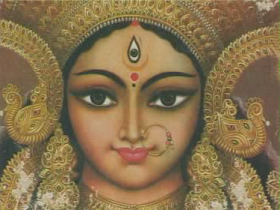
Happy Navaratri to people who are celebrating during October 5-13, Durgashtami on October 12th and Dushera on October 14th.
‘Worshiping God as Mother’ is a wonderful way to think of God and express our love. Most of us have enjoyed love of our mothers.
I asked students (KG-12th graders), “I know why you do not like your mothers. It is because she wakes you up early to go to school, she asks you to keep your room clean, scolds you when you do not behave well, makes sure you study and do not fool around, etc. But, let me ask you, why do you love your mother?” The answers were, “Because she loves us, she takes care of us, she gives us food, she gave us births, and many more reasons.” Now, imagine about a mother who loves all children equally as her own children, young and old, irrespective of their color, creed, culture, religion, power, position, wealth, virtues, or any external thing. Think of this mother, who gave birth to all beings and everything that exists in the universe, and mother who provides us food and all necessities for our growth. This is the Universal Mother who is being worshiped for nine days and nights.
Sri Ramakrishna says that this Universal Mother is the active aspect of God. When the Divine Power is inactive, we call It Brahman or Shiva. When It creates, nourish and dissolves the universe, then we call It as Mother Kali or Durga, or Shakti. Brahman and Shakti are identical. Fire is in wood as unmanifested, but when it burns and cooks our food then it is the manifested fire. Thus, Brahman or God in inactive state is Infinite, and Unmanifested, but in an active state It manifests as Universal Mother, the power of Brahman.
The Universal Mother has a key to open the door of Brahman. Only by her grace we can realize Brahman or God. We cannot negate Her existence. We cannot fight with Her power. If we live a proper life, she showers her blessings and if we live improper life, then she punishes. Mighty Mahishasur ignored Her power and he was punished.
Let us feel the love of the Universal Mother as we feel love of our own mother. Let us sing Her glories and ask Her blessing to realize our true identity which is Atman.
Happy Dushera: Fireworks is fun. But, we have to destroy Ravana (ignorance and impurities of our mind) who had kidnapped our intellect by misguiding us. This intellect as Sitaji, should be with Atman, Rama. Once our intellect is focused on Atman and we realize Atman, then, we will have real peace of mind, satisfaction, fearlessness, and fulfillment of life.
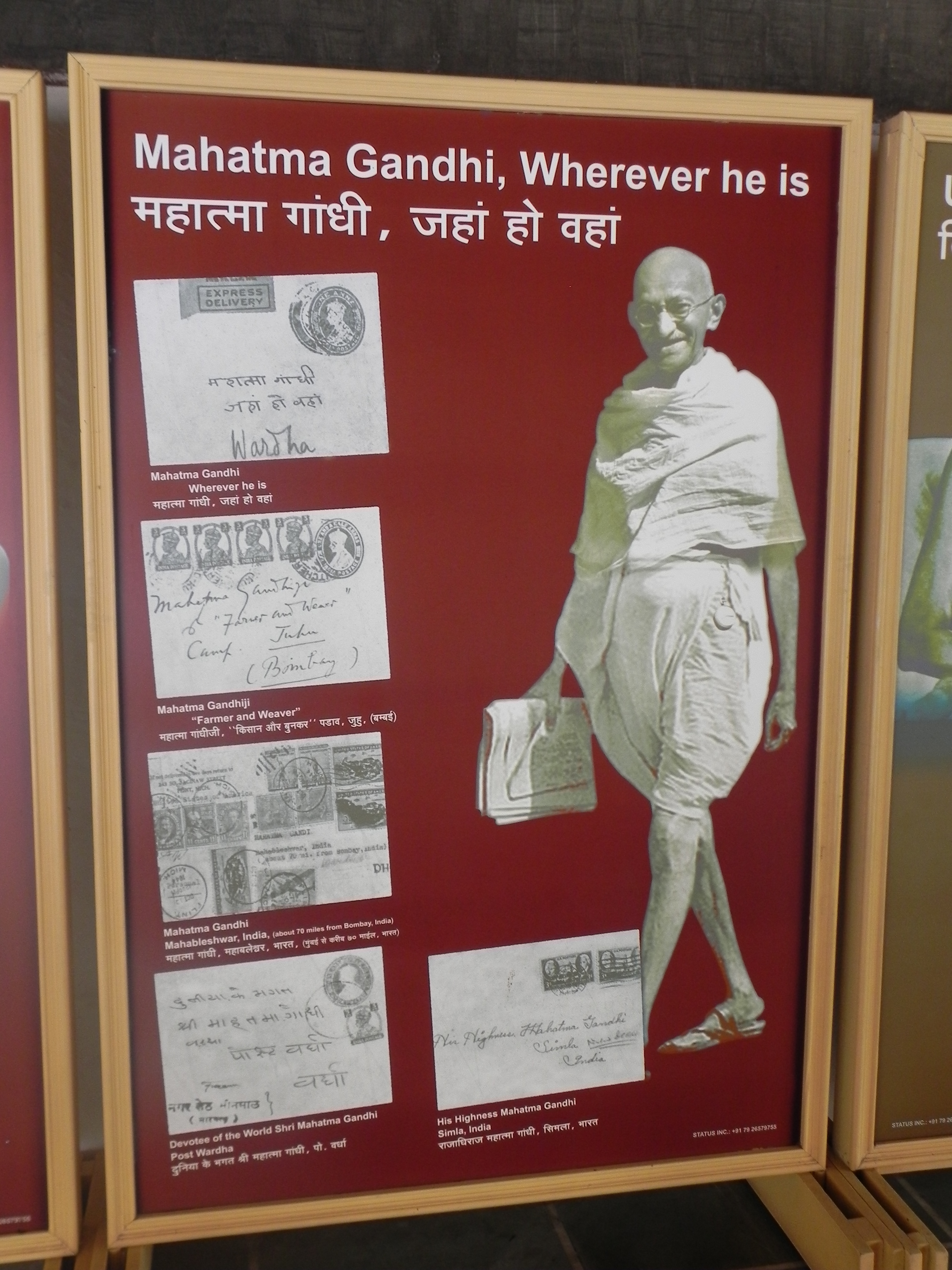
Mahatma Gandhi was born on October 2, 1869. He was six years younger than Swami Vivekananda. We see that many of Swami Vivekananda’s teachings were exemplified in Mahatma Gandhi’s life, especially to love poor and the untouchables, and serve them as God, and treat all human beings equally with respect irrespective of their religions and other external differences.
Mahatma Gandhi at Sabarmati Ashram
The famous scientist Albert Einstein said, “Generations to come, it may be, will scarce believe that such a one as this (Mahatma Gandhi), even in flash and blood, walked upon this earth.”
Great personalities on Mahatma Gandhi
The famous writer and thinker Romain Rolland wrote Mahatma Gandhi’s biography in 1924. At that time Mahatma Gandhi’s launched movement had failed to win its objective. Mahatma Gandhi was in jail atoning, Christ-like, for the failing of his own countrymen. Romain Rolland wrote this biography to fully support Mahatma Gandhi. For him Gandhiji was the dawn of new hope for humanity. They both met in 1931 and then remained friends till end.
Mahatma Gandhi and Romain RollandThe following is a wonderful word-picture of Mahatma Gandhi written by Ramain Rolland.
“… a small frail man, with a thin face and rather large protruding eyes, his head covered with a little white cap, his body clothed in coarse white cloth, barefooted. He lives on rice and fruit, and drinks only water. He sleeps on the floor-sleeps very little, and works incessantly. His body does not seem to count at all. There is nothing striking about him-except his whole expression of “infinite patience and infinite love.”
W.W. Pearson, who met him in South Africa, instinctively thought of St. Francis of Assisi. There is an almost childlike simplicity about him. His manner is gentle and courteous even when dealing with adversaries, and he is of immaculate sincerity. He is modest and unassuming, to the point of sometimes seeing almost timid, hesitant, in making assertion. Yet you feel his indomitable spirit. He makes no compromises and never tries to hide a mistake. Nor is he afraid to admit having been wrong.
Diplomacy is unknown to him; he shuns oratorical effect or, rather, never thinks about it; and he shrinks unconsciously from great popular demonstrations organized in his honor. Literally “ill with the multitude that adores him,” he distrusts majorities and fears “mobocracy,” and the unbridled passions of the populace. He feels at ease only in a minority, and is happiest when, in meditative solitude, he can listen to the “still small voice” within.
This is the man who has stirred three hundred million people to revolt, who has shaken the foundations of the British Empire, and who has introduced into human politics the strongest religious impetus of the last two thousand years.”
A few quotes of Mahatma Gandhi:
“I am giving you a bit of my experience and that of my companions when I say that he who has experienced the magic of prayer may do without food for days together but not a single moment without prayer. For without prayer there is no inward peace.” (January 23, 1930)
“I suggest we are thieves in a way. If I take anything that I do not need for my own immediate use and keep it, I thieve it from somebody else.” (February 19, 1925)
“To me God is Truth and Love; God is ethics and morality; God is fearlessness. God is the source of Light and Life and yet He is above and beyond all these. God is conscience. He is even atheism of the atheist. For in His boundless love God permits the atheist to live.” (March 5, 1925)
“Daridranarayana is one of the millions of names by which humanity knows God, who is unnamable and unfathomable by human understanding and it means God of the poor, God appearing in the hearts of the poor.” (April 4, 1929)
“I venture to suggest, in all humility, that if India reaches her destiny through truth and non-violence, she will have made no small contribution to the world peace for which all the nations of the earth are thirsting and she would also have, in that case, made some slight return for the help that those nations have been freely giving to her.” (March 12. 1921)
Note that these three events happened in 1893:
(1) Swami Vivekananda gave his famous speech in Chicago Parliament of World Religions on September 11, 1893.
(2) In 1893, Mahatma Gandhi as M.K. Gandhi went to South Africa, where he spent 20 years opposing discriminatory legislation against Indians. As a pioneer of Satyagraha, or resistance through mass non-violent civil disobedience, he became one of the major political and spiritual leaders of his time.
(3) In February 1893, Sri Aurobindo arrived in India from England. He started working in Baroda, Gujarat and started taking active interest in the politics of India’s freedom struggle against British rule.
Mahatma Gandhi appealed to people all over the world
I can share couple of incidents which were imprinted in my mind.
(1) It was around December 1982. Our son was in the middle school. I went to his school to give him something. His principal, Mr. Alfred Baumann who was also a mayor of the town, saw me and asked me, “Mr. Jani, would you be able to see me on your way back?” I said, “Okay.” I thought there might be something related to our son. When I was going back, I saw him waiting for me. He then took me inside his office and asked me to take a seat and he sat on his chair on the other side of the table. Without any other formalities, he asked me, “Did you see Gandhi movie?” I was pleasantly surprised. I said, “Yes, I saw it.” He asked, “Did you like it?” I said, “Yes. I liked it. Director Attenborough and the actor Ben Kingsley had done a wonderful job.” Then, Mr. Baumann lean little forward on the table. His face was filled with loving emotions. He said, “Look, I am a Christian. After I saw that movie I was thrilled with the thought that a Christ-like person was living on earth when I was a young boy. In the movie, when a person in South Africa could not burn a passport because he was beaten by a police, I felt like going there and throw the passport in the fire.” Then we talked about Mahatma Gandhi for a while. I was amazed by his reverence for Gandhiji.
(2) This was around early 1970s. With my friends we went to attend a Sunday morning service conducted by a group which was more Vedanta oriented. The organizers, though Caucasians, knew Hindu chanting. After the service, while I was taking some snack which was offered to all, I heard someone was humming a very familiar tune. I recognized that it was the tune of “Raghupati Raghava Raja Ram.” I turned to my right and found that the Minister (who conducted the service) was joyfully humming this tune. I asked him, “Do you know what you are humming?” He calmly said, “Yes, it is ‘Raghupati Raghav Raja Ram’ which was favorit of Mahatma Gandhi.” I was surprised. I asked whether he had met Mahatma Gandhi. He said, “I was not fortunate to meet him. But, whenever Mahatma Gandhi was fasting for protest or for purification in India, we, a group of young boys, used to fast here in USA to support him.”
(3) This incident I have heard from Shri Narayanbhai Desai. He visited Vivekananda Vidyapith and told his reminiscences of Mahatma Gandhi. He said that he was in Canada and one Canadian (non-Indian) person was driving him. Road was clear and he was going with the fastest allowed speed. He was asking Shri Narayanbhai about his association with Mahatma Gandhi. When Shri Narayanbhai said that he was fortunate to sit on the lap of Mahatma Gandhi, immediately this person turned his car to the shoulder and applied break to stop the car. It was a jerky stop. After stopping the car, he turned to Shri Narayanbhai and said, “Can I touch your hands which had touched Mahatma Gandhi?”
These three people were not directly related to Gandhiji, but were deeply impressed by him.
Shri Ganeshay Namah I am sure many have already started celebrating Shri Ganesh Chaturthi from the morning. It is a great day to start anything auspicious and good. Shri Ganesha removes all obstacles and helps bringing success to our genuine efforts for any good work.
Vivekananda Vidyapith was started on Shri Ganesh Chaturthi in 1976. Now Vidyapith is starting its 38th year by the grace of Ganeshji.
Everyday is an auspicious day to start any good work. But, if we start on a special day like Shri Ganesh Chaturthi, then we have an added support and power behind our work. Shri Ganesha is highly intelligent. He listens to everything with full mind and with understanding. That is why Bhagavan Vyas had selected him to write Mahabharata. May we learn to listen with full mind and try to understand what we are listening. This itself will help us in anything we are trying to achieve.
I am happy that we are starting our Monday study classes today.
Om Shri Ganeshay Namah. May Shri Ganesha showers his blessing on all of us.
Happy Janmashtami
Today is Janmashtami. I was thinking of Shri Krishna. One can think of Shri Krishna in many forms; in his baby form, in his cowherd form, with Radhaji, or Shri Krishna of Bhagavad Gita driving Arjun’s chariot and guiding him in the right direction.
All forms are important. According to devotee’s moods or likings one can think of Shri Krishna in various forms. Our likings are different and our moods change. So, Rishis taught us to think God in various forms according to our mind-set. Of course, initially, in order to learn to focus our mind on God, we have to select one form which suits our mind-set. Then, loving this form, learn to focus our mind on God in that form. But, once we know what God is and realize that the Infinite, Imperishable, formless God can take various forms, then we can appreciate and enjoy various forms of God.
Saints say that Shri Krishna was born to teach us how to love God. A relationship with God has to be established. One can think God as our child, or a friend, or father, or mother, or guide, or master. Shri Ramakrishna says that the best relationship is ‘God is my master and I am His servant.’ But, when love for God deepens then one can appreciate and enjoy other relationships.
To love God, means one is committed to develop spiritually. Generally, our thinking, planning, and actions are based on the pleasures of our body and mind. To love God means now I will think from the point of view that ‘My true existence is not in my body and mind, but it is in the Spirit, the Soul. Body and mind are mere instruments of the Soul.’ The form of God is the representation of the Soul or Atman or Brahman.
What happens when we love God? A transformation comes in our lives for good. All the characteristics of a devotee described in the Bhagavad Gita will manifest in our lives. Our lives become blessings to us and to all. We get all the fulfillments of life: we get satisfaction, inner peace, knowledge, fearlessness, and our hearts get filled with unselfish love for all.
Let us think of the Characteristics of a devotee (Gita Chapter 12, shlokas 13-19):
“He who hates none, who is friend of all, who is merciful to all, who has nothing of his own, who is free from egotism, who is even-minded in pain and pleasure, who is forbearing, who is always satisfied, who is ever devoted to Yoga, whose self has become controlled, whose will is firm, whose mind and intellect are given unto Me – such a one is My beloved bhakti.
He from whom comes no disturbance, who cannot be disturbed by others, who is free from joy, fear and anxiety – such a one is My beloved.
He who does not depend on anything, who is pure and active, who does not care whether good comes or evil, and never becomes miserable, who has given up all efforts for himself, who is the same in praise or blame, silent and thoughtful, pleased with what little comes his way, homeless, having the whole world for his home, and steady in his mind – such a one is My beloved bhakta.” (Translated by Swami Vivekananda)
It is not easy to bring such positive transformation in life. We have to work for it. Simple practices are regular prayer, reading inspiring books, reflect upon the teachings of scriptures, think of the ultimate goal of life, practice values, seek holy company and do self-less service as much as possible. This will make our lives worth living. Happy Janmashtami to all. May Shri Krishna showers His blessings on all of us and help us grow spiritually.
Vivekananda Vidyapith Honored by the Passaic County Board of Chosen Freeholders, New Jersey, USA
As a part of Passaic County’s celebration of Asian Pacific American History month, Vivekananda Vidyapith was one of two honorees chosen for outstanding contributions made to the U.S. and the community. Sponsored by the Passaic County Board of Chosen Freeholders (“PCBCF”), the event was held on Tuesday, May 28, 2013, 5:30 p.m. to 6:30 p.m. at the Administration Office in Paterson, New Jersey.
Mr. John W. Bartlett, a Wayne Freeholder, applauded Vidyapith for its dedication to teaching Indian philosophy and great human values to students, and the positive influence it has had on the community at large. Then, Mr. Pasquale “Pat” Lepore, the former Mayor of West Paterson (now Woodland Park)read the proclamation and publicly recognized Vidyapith’s contribution. Thereby, Mr. Bartlett congratulated Dr. Mahendra Jani and Dr. Vandana Jani, co-founders and pioneers of Vivekananda Vidyapith, by presenting them with a beautifully framed plaque and wishing them continued success.



![Rolland-and-Gandhi6[1]](https://mahendrajani.com/wp-content/uploads/2013/10/rolland-and-gandhi61.jpg)
![0909131649a[1]](https://mahendrajani.com/wp-content/uploads/2013/09/0909131649a1.jpg "Happy Ganesh Chaturthi")


 mahendrajani