Category Archives: Brahma Sutras

Brahma Sutras (Lesson – 3: Sutra – 2)

Brahma Sutras – Sutra 2

(Study based on Shri Shankaracharya’s commentary)

Topic – 2: Definition of Brahman (sutra-2)

Sutra-2:
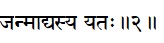
Meaning: From Brahman came the creation, preservation, and the dissolution of the universe.

Comments:

Only nothing comes out of nothing:

This sutra says that the universe did not come out from nothing. Only nothing comes out of nothing.

The Big Bang Theory is the prevailing cosmological description of the development of the Universe. Under this theory, space and time emerged together 13.8 billion years ago and the energy and matter initially present has become less dense as the Universe expanded.

The most widely accepted theory of planetary formation, known as the nebular hypothesis, maintains that, 4.6 billion years ago, the Solar System formed from the gravitational collapse of a giant molecular cloud which was light-years across. Several stars, including the Sun, formed within the collapsing cloud. The gas that formed the Solar System was slightly more massive than the Sun itself. Most of the mass collected in the center, forming the Sun; the rest of the mass flattened into a protoplanetary disc, out of which the planets and other bodies in the Solar System formed.

However, something was there to expand. According to the Rishis, who reflected upon the fundamental questions of life like: (1) What is my true identity? (2) What is the purpose of my life? (3) How this universe came into existence? (4) What is the reality behind this constantly changing universe? (5) Who is preserving this universe? (6) What is the ultimate end of this universe? (7) What is my relationship with the universe? (5) What is my relation to all other beings? and found their answers through their scientific search within. They found with their inner search and reflections that there is only one Ultimate Reality which they call it ‘Brahman’ and the same Ultimate Reality appears as the universe. This conclusion matches the scientific conclusion mentioned above.

In the previous sutra, it has been said that when one has a proper background, then an intense desire comes to inquire into the nature of Brahman.  It was also established that the knowledge of Brahman makes one free from all bondages, destroys all doubts regarding one’s own existence and the universe, brings fearlessness, peace of mind, and fulfillment of life.

Now, in order to know or realize Brahman, one should know ‘What is Brahman?’ and “What are the characteristics of Brahman?”

Doubts and arguments for impossibility to acquire the knowledge of Brahman: Some people say that “Brahman has no characteristics by which It can be defined, and in the absence of definition It cannot be known, and consequently there cannot be any liberation or freedom from all bondages.

Answer: This sutra and its commentary give the answer to this question. It is not easy to describe Brahman, but sincere attempts are made to give as much idea of Brahman as possible. A mother points out a finger to the moon and tells her child, “Look at the moon.” The hand and the pointed finger are not the moon. They just point towards the moon. The child has to see the moon. Thus, Brahma Sutras and all the scriptures just point out to the Brahman. People have to follow the directions given by the scriptures and do appropriate spiritual practices to realize the Brahman. Those who have followed properly, they had realized the Brahman and their experiences match with the experiences of the Rishis who have realized It. Sri Ramakrishna, Holy Mother Sri Sarada Devi, Swami Vivekananda, and many other saints are examples of people who have realized the Brahman.

There are two major definitions of Brahman.

Tatastha Lakshana:

This sutra gives a definition of Brahman: “That which is the cause of the universe is Brahman – where the imagined “cause of the world” is indicative of Brahman.

This is called the ‘Tatastha Lakshnana’, meaning that characteristic of a thing which is distinct from its nature and yet serves to make it known.

In the definition given by this sutra, the origin, sustenance, and dissolution are characteristics of the universe and as such are in no way related to Brahman which is eternal and changeless; yet these indicate Brahman, ; which is imagined to be the cause of the universe. Actually, Maya, the power of Brahman, creates an illusion due to which the Brahman appears as the universe separate from Brahman. It is just like an imagined snake indicates the existence of a rope. One says ‘that which is imagined as a snake is the rope.’

Swaroopa Lakshana:

The scriptures give another definition of Brahman.

Taittiriay Upanishad (2.1.1):

“Truth, Knowledge, Infinity is Brahman.”

This is called the Swaroopa Lakshana, that which defines Brahman in Its true essence.  These words, though they have different meanings in ordinary parlance, yet refer to the one indivisible Brahman. It is like the same man is refer to by the words father, son, brother, husband etc. depending on the relationship with the other individuals.

In the universe grasped by the senses, knowledge comes by various means, like direct perception by the senses, reasoning, inference, and others. But, we have to note that this sutra does not arrive at the fact that ‘The Brahman is the first cause of the universe’ by reasoning, or inference or any other means.

Brahman cannot be so established independently of the scriptures (Shruti).

Cause – effect reasoning: Each effect has a cause. The existence of the universe is an effect and it must have a cause. But, we cannot logically establish with certainty what exactly the nature of that cause is. Since Brahman is not an object of the senses, we cannot say that the Brahman alone is the cause of the universe and nothing else. The relation between the cause and the effect can be established when both the objects are perceived.

Inference and Reasoning: Inference and other means may give only strong suggestions of Brahman’s being the First Cause of the universe. But, a thing established by mere inference, however well thought out, is explained otherwise by greater intellects.  A sound heard from a floor upstairs can be inferred through reasoning, but we cannot say with certainty that it is the only reason for the sound.

The reasoning is also endless according to the intellectual capacity of people and therefore cannot go far in asserting the Truth.

It is a direct experience that carries the weight. Therefore all the scriptures are authoritative in asserting the Truth because they are the records of the direct experience of the masterminds (Rishis) who have come face to face with the Ultimate Reality. This experience can be checked up to a point through reasoning, but the reasoning should be based on the scriptures. Reasoning not based on the scriptures does not lead us anywhere. Therefore the scriptures having the records of the direct experience of the Truth of the Rishis are called ‘Aptavakya’.

Thus, the prime object of this sutra is not to establish Brahman through inference, but to discuss scriptural passages which declare that ‘Brahman is the First Cause of the universe.

Taittiriya Upanishad (3.1):

“Bhrigu, the son of Varuna, approached his father Varuna and said, ‘Venerable Sir, teach me about Brahman.’ Varuna told him, ‘…That from which these beings are born, by which they live after birth and into which they enter (at the time of dissolution) – try to know That. That is Brahman.”

The sutra asks us to collect the Vedanta texts for the full comprehension of Brahman.  Once, the scriptures have declared Brahman to be the First Cause, we have to reason to understand these Vedanta Texts and not to reason to contradict them. We must reason to find out the Truth lying behind these Vedanta texts.

Vedanta Practices:

Vedanta prescribed the following three kinds of practices in order to realize Brahman:

(1) Shravana: We have to listen to or read the scriptures (Shrutis). Listening to scriptures from a person who has realized Brahman or whose goal is to realize Brahman and who is sincerely making efforts to achieve that goal is better than reading the scriptures ourselves. These people tell us the essence of the scriptures and save our time to find this essence. We can then read the scriptures to better understand the essence we had heard.

(2) Manana: After listening to and reading the essence of the scriptures, we have to reflect upon them. Sri Ramakrishna always emphasized to sit in the solitude and reflect on the essence of the scriptures which is, ‘Brahman alone is real and everything else is unreal, meaning impermanent’. We have to reflect upon the reasoning and the elaboration provided to us establishing the Ultimate Truth of the scriptures by the Sages who have realized Brahman.

(3) Nididhyasana: We have to meditate on the nature of the Brahman in order to realize It ourselves. If we have done Shravan and Manana practices properly, then our meditation becomes deeper and focused on the Brahman. We have to continue our meditation practices until we realize the Brahman.

Intuition: Meditation leads us to intuition. By intuition is meant that kind of mental modification (Vritti) of the mind (Chitta) which destroys the ignorance. The main ignorance is to think that ‘I am this body and mind’, ‘I am not Brahman’, and ‘This universe is different from Brahman’. When the ignorance is destroyed by this mental modification in the form of Brahman (called Brahmakara Vritti), then Brahman, which is self-luminous, reveals Itself within.

The difference between ordinary perception and realization of Brahman:

In ordinary perception, first, our senses bring an external object to our mind, then our mind  (Chitta) takes the form of that object, and the consciousness reflected through intellect in this modification of the mind manifests the object. Thus, our ignorance about the object will vanish.

In the case of the realization of Brahman, the mental modification in the form of Brahman (Brahmakara Vritti) destroys the ignorance mentioned above, and the Brahman, being self-luminous, and Pure Consciousness reveals Itself within.

Since the destruction of the ignorance is most important, the scriptures mostly talk about Brahman negatively, saying ‘Neti Neti” (Not this, not this), means ‘body is not Brahman, the mind is not Brahman, intellect is not Brahman, what we perceive through our senses is not Brahman.’

However, Sri Ramakrishna gave an excellent example regarding this. He said that if we are going to the terrace of a house, we climb each step and ask, ‘Is this the terrace?’ and the answer is ‘No’, until we come to the terrace. Thus, we deny all the steps as not being the terrace. But, after reaching the terrace we find that the steps are made out of the same material as the terrace is made out of. This means that after negating everything, when we realize Brahman, then we find that everything is Brahman. There is nothing in this universe that is not Brahman. Only out of ignorance we perceive everything as different from Brahman.

The difference between ‘an inquiry into Brahman’ and ‘a non-Brahman religious inquiry’:

In a non-Brahman religious inquiry, a person usually wants to achieve a worldly thing or wants to go to heaven for enjoyment. In that case, one has to have faith in the scriptures, perform the required rituals, and then wait for the result. In this case, only faith is required to acquire the predicted result. Also, note that one has to wait for the result.

In the inquiry into Brahman, we do not have to wait for the result. As soon as the ignorance vanishes, the Brahman reveals from within. Note that the Brahman has already existed before. We have to make efforts to destroy our ignorance, and not to reveal Brahman. In this process of realization of Brahman, faith, reasoning, and other methods are available to destroy our ignorance.

Brahman also has been described as “Sat-Chit-Ananda”, Existence, Knowledge, Bliss Absolute, and as “Shuddha, Buddha, Nitya Mukta”, Pure, All Knowledge, and Ever Free from all the bondages.

We will know more about Brahman by studying the remaining Brahma Sutras.


Brahma Sutras (Lesson – 2: Sutra – 1)

Brahma Sutras – Sutra 1 

(According to Shri Shankaracharya)

The Advantage of Studying the Brahma Sutras:

By studying the Brahma Sutras, we learn the following:

(1) The Nature of Brahman (the Ultimate Reality or Truth, the One Existence). It can be thought of as Pure Consciousness.

(2) We learn the characteristics of Brahman which have been realized by the Knowers of Truth, called the Rishis.

(3) We find the seeds of the “Vedanta Philosophy” which have been fully developed later on by the great teachers. Especially, we can be familiar with the background of Swami Vivekananda’s lectures on the Vedanta.

(4) We learn some of the important passages from the Upanishads. In particular, we learn the true meaning of those passages of the Upanishads which are unclear or ambiguous.

(5) By knowing correctly the nature of Brahman we can get rid of our spiritual and religious superstitions which could be the obstacles in our spiritual development.

Now, let us start to learn about the Brahma Sutras. It is said that people at least should learn the meanings of the first four Brahma Sutras.

The 555 Brahma Sutras are divided into four chapters. Each chapter has four sections and each section has several topics.

Chapter -1:  “What is Brahman?”

 Topic – 1: The inquiry into Brahman and its pre-requisites (sutra-1)

Sutra-1: 

Meaning: Now, therefore, the inquiry into the real nature of Brahman.

Comments:  Now, means after being prepared to inquire about the Brahman.

How do we prepare ourselves?

To prepare ourselves for the inquiry into Brahman, the following four practices have been mentioned by Shri Shankaracharya in the Viveka-Chudamani:

(1) Viveka – Awareness of what is permanent and what is not permanent. (The word discrimination has other connotations, so I would not use it.) Logically, emotionally, and through experiences we have to come to an understanding that anything that has a beginning and an end is impermanent. Thus, our body, mind, and all the objects of the world which we perceive by our senses are impermanent. The One Reality or One Existence, called Brahman, lies behind all the impermanent things. It is the only permanent reality. It is our true identity and the goal of life is to realize it.

(2) Vairagya – Giving up the cravings for the impermanent.

Shri Ramakrishna said that a child is busy playing with toys. During that time the mother takes care of the cooking and other choirs of the house. But, when the child gets bored by the toys and gets hungry, then the child screams for the mother. At that time, the mother puts away the pots and pans and runs to the child.

Vairagya is like ‘getting bored’ by all the temporary joys of the senses and realizing that the worldly objects cannot give us permanent happiness, satisfaction, and fulfillment of life. When this understanding comes, then naturally one gets withdrawn from the worldly objects and seeks the realization of Brahman which gives infinite bliss and the fulfillment of life.

(3) Shama-Dama-Shada Samppati: The following six practices are important to have:

(i) Shama:  Withdrawing the mind from all the sense objects, meaning giving up all the thoughts related to the sense objects and focusing on Brahman, is called Shama. We need to acquire the control of our mind by constant practice of japa and meditation.

(ii) Dama: In order to have control of the mind, we need control of the senses which is called Dama. We have to practice both the Shama and Dama together. They are inter-connected. The control of the senses can be acquired by practicing austerity. For example, have a daily spiritual schedule to do spiritual practices and strictly follow it for several years, at least twelve years. Then, controlling the senses by various austerities, like fasting, controlling what we watch, listens to, eat, and other sense-related activities. Practicing truthfulness (Satya), non-violence (Ahimsa), celibacy (Brahmacharya), not to be greedy, or envy or jealous (Asteya) and have a simple living (Aparigraha) are also important practices.

(iii) Uparati: Giving up all worldly dependency and being dependent only on the Self (Atman or Brahman) is important. From the devotional point of view, it is surrendering to God. We have to practice to withdraw our minds from the world and focus on Brahman.

(iv) Titiksha: Bear the worldly suffering without any complaint or worry is essential. We have to think that God is the doer of everything. As good-time cones, bad-time also comes. We just have to go through all the situations of life keeping our mind focused only on the goal of life – Self-realization.

(v) Shraddha: Having faith in the words of the scriptures and in the teachings and guidance of Saints, Sages, and our spiritual teachers is a must. In the world, we have faith in the news-media, doctors, plumbers, electricians, accountants, lawyers, airplane-pilots, and others. Many of them are selfish, but we have faith in them and follow their instructions. Then, why cannot we have faith in the words of the scriptures and the Saints who are unselfish and are telling us for our good? Our ego is the main obstacle in having this faith. In the spiritual path, we think we are wiser than the scriptures and the Saints. It is hard for many of us to accept that even though we may be very advanced and knowledgeable in the worldly fields, we are just KG students in the spiritual path.

(vi) Samadhan: Fixing the mind and the intellect on Brahman with a firm conviction that realizing Brahman is the goal of human life and my life’s mission will be fulfilled if I realize It.

4) Mumukshutva – means to have an intense desire to realize Brahman. We can study scriptures and acquire the intellectual grasp of the teachings of the scriptures and Saints, but if we have not developed an intense desire to realize Brahman, then it is of no use. Restlessness and passion have to be developed naturally to realize Brahman. At the end of the day, seeing the sun-set Shri Ramakrishna was rolling on the ground crying profusely saying ‘O Mother! One more day is gone and I have not realized Thee. Would my life go in vain without your vision?”

To realize God or Brahman, Shri Ramakrishna says that one has to combine the intensity of the three attractions: the greedy person’s attraction for wealth, a loving husband’s or wife’s attraction for his/her spouse, and the mother’s attraction for her child.

Note: When we read all the pre-requisites needed even to inquire about the nature of Brahman, we get dishearten and think that we will not be fit for such knowledge in this life. We should not be disheartened because of these pre-requisites.

I think these pre-requisites tell us that God-realization is not possible just by doing casual spiritual practices, performing a few religious rituals, reading a few books, listening to a few spiritual discourses, and occasionally chanting the name of God. God-realization or realization of Brahman is the highest state a human being can attain. It needs a life-time commitment, an intense desire and a readiness to make all possible efforts to achieve this goal.

Actually, the pre-requisites give us a guide-line to achieve this goal. We have to follow this guide-line. It is not the case that we have to fulfill all the pre-requisites first and then inquire into the nature of Brahman. Simultaneously we have to prepare ourselves with proper spiritual practices and inquire into the nature of Brahman. As we make progress in fulfilling the pre-requisites, we also make progress in understanding the nature of Brahman. After some spiritual practices if a question comes to our mind ‘why am I not realizing Brahman?’, then we have to look at the pre-requisites and we will know the reason.

Benefits of realization of Brahman: If we truly understand the importance of the realization of Brahman, then our desire to attain it becomes more intense. Swami Vivekananda says that a genuine thief who is looking for wealth finds that in the next room there is precious jewelry hidden, he/she will make all the efforts to acquire that jewelry.

The benefits of realizing Brahman are unlimited and hard to write down on a piece of paper. But, I will write down a few benefits which I think important to me:

(1) A human being is looking for three things in life: (i) the Ultimate Knowledge which solve all the fundamental questions of life, (ii) Infinite Bliss which does not depend on any worldly object, and (iii) Immortality, becoming fearless by conquering the fear of death and thus all fears of life. The realization of Brahman gives all these three which we cannot attain by any knowledge of the world.

(2)  Removes all the sorrows of life

(3) Brings peace, satisfaction, and fulfillment of life

(4) It makes us feel connected with all. Thus, we develop unselfish love for all. What we give to the world that we receive from the world. Thus, by giving unselfish love to all, our life gets filled with unselfish love. Even we can transform the hatred into love.

(5) All our doubts, confusion, and superstitions will vanish.

Therefore, the inquiry into the nature of Brahman:

People, who have understood the benefits of realizing Brahman plunge into the spiritual practices to realize It. We do not have to wait to enjoy the above-mentioned benefits until we realize Brahman. Shri Ramakrishna says that on a hot summer day when we go towards an ocean, we feel the cool breeze of the water, enjoy listening to the sounds of the waves and the chirping of the birds and other things. Thus, even during the journey to realize Brahman we enjoy all the benefits. Let us just start the journey. We will never regret it.

Let us learn the nature of Brahman and then realize that our true identity is Atman, the support of our body and mind and it is not different from Brahman (Existence-Knowledge-Bliss Absolute).

Brahma Sutras (Lesson – 1: Introduction)

Brahma Sutras 

(This is a part of my notebook that I had prepared during the study of the Brahma Sutras in our Monday classes. We followed the commentary by Shri Adi Shankaracharya. The following two books were used as the references:

  1. “Brahma Sutras, According to Shri Shakara”, Swami Vireswarananda, Advaita Ashrama Publication Department, Kolkata, India, 10th Impression, November 2008
  2. “Brahma Sutras”, Sri Swami Sivananda, The Divine Life Society Publication, Shivanandanagar, India, 6th edition, 2016)

Prasthanatrayi:

The Vedanta Philosophy is based on the principles or the truths taught in the Prashathantrayi.

The word “Prasthana” in Sanskrit has various meanings, for examples – Advent, cause, course, departure, dispatching, dying, inferior kind of drama, journey, march, method, moving, place of origin, proceeding, procession, religious mendicancy, sect, sending, away, setting out, starting-point, system, walking, and way to attain.

The main meaning of “prasthana” is “proceeding”. We can say that “prasthana” means “proceeding towards one’s liberation”.

The word “Trayi” in Sanskrit means a collection of three.

Thus, “Prasthanatrayi” means “three sources of books for liberation”: (1) The Upanishads, (2) The Brahma Sutras, and (3) The Bhagavad Gita.

(1) The Upanishads, known as Upadesha prasthana (injunctive texts), and the Śruti prasthāna (the starting point or axiom of revelation), especially the Principals of the Upanishads. There are more than 108 Upanishads. Among them, the following eleven Upanishads are considered as major ones: Isha, Katha, Kena, Prashna, Mundaka, Mandukya, Aittareya, Taittiriya, Swetaswatar, Chhandogya, and Brihadaranyaka.

(2) The Brahma Sutras, known as Nyaya prasthana or Yukti prasthana (logical text or axiom of logic). The Brahma Sūtras (also known as the Vedānta Sūtras, Bhikshu Sutras or Shariraka Sutras), systematize the doctrines taught in the Upanishads and the Bhagavad Gītā. As mentioned above, Brahma Sutras are also known as Bhikshu Sutras or Shariraka Sutras.  Bhikshu refers to Sanyasins. Thus, there were sutras for the Sanyasins. Shariraka refers to the Atman living in the body. Thus, Shariraka Sutras means the Sutras for the Atman.

(3) The Bhagavad Gita, known as Sadhana prasthana (practical text), and the Smriti prasthāna (the starting point or axiom of remembered tradition) The Bhagavad Gītā is a part of the great epic Mahabhārata.

The meaning of the word “sutra”:

The word “sutra” in Sanskrit means ‘a meaningful condensed sentence written by a qualified person in the field’. It also has other meanings such as a thread, knitting, a symbol, an indication etc.

The great teacher Madhvacharya in his commentary on the “Brahmasutras” quotes the meaning of the word “Sutra” from “Padma Purana” as follows (with the sandhis separated:

“The learned people in “the science of the sutra” say that the “sutra” means a sentence which has the following characteristics: (1) concise, (2) unambiguous, (3) gives the essence of an aspect of a topic or the topic itself, (4) it enlightens from all the possible aspects of the topic, (5) devoid of repetition and (6) faultless.

The author and the time of Brahma Sutras:

It seems that there were Bhikshu Sutras which were known among the Sanyasins. Then, Rishi Badarayana, starting with the Bhikshu Sutras, systematized and summarized the teachings of the Upanishads into the Brahma Sutras.

The Bhagavad Gita was written before the birth of Buddha. The Brahma Sutras were written before the Bhagavad Gita because there is a reference of Brahma Sutras in Bhagavad Gita (13.4):

It says, “This (teaching or the truth) has been sung by the Rishis in various ways and through various hymns and has been established logically and convincingly in the words of the Brahma Sutras.”

This indicates that the time of the Brahma Sutras is before 400 B.C..

Now, surprisingly, there are references of the Bhagavad Gita in the Brahma Sutras (for example 2.3.45 and 4.2.21). This shows that Rishi Vyasa, the writer of the Mahabharata and thus of the Bhagavad Gita, may have re-written these sutras. Hence, Rishi Vyasa’s name is also associated with the Brahma Sutras.

The Number of Brahma Sutras: There are four chapters in Brahma Sutras and each chapter has four sections. There is a total of 555 sutras. The following are the names of the chapters of the Brahma Sutras and the number of sutras in each chapter:

Chapter I: What is Brahman? (“Samanvaya Adhyaya” which has four Sections; 31+32+43+28) 134 SUTRAS

Chapter II: Review of competing theories (“Avirodha Adhyaya” which four Sections; 37+45+53+22) 157 SUTRAS

Chapter III: The means to spiritual knowledge (“Sadhana Adhyaya” which has four Sections; 27+41+66+52) 186 SUTRAS

Chapter IV: The benefit of spiritual knowledge (“Phala Adhyaya” which has four Sections; 19+21+16+22) 78 SUTRAS

Total sutras are 134 + 157 + 186 + 78 = 555

The Well-known Commentators on the Brahma Sutras:

  • There are many commentators who explained the meanings of the Brahma Sutras. Among them, there are five famous commentators, namely, (1) Shri Shankaracharya, (2) Shri Ramanujacharya, (3) Shri Nimbarkacharya, (4) Shri Madhvacharya, and (5) Shri Vallabhacharya, who have established five different schools of thoughts which currently exist and have many followers. These are all called the Schools of the Vedanta Philosophy.
  • It is amazing to see that all these five Acharyas (Teachers) accept the teachings of the Vedas. They all believe that the goal of human life is to realize the Ultimate Reality, Brahman. They differ in their interpretations of the Brahman, an individual soul, the relationship of an individual soul with the Brahman, the idea of the world and the relationship between the world and the Brahman. They all interpret the Brahma Sutras in a way that justifies their own philosophies about the reality. Many times, the same sutra has been interpreted in different ways.

Note: There are two main reasons why there are different interpretations of the same sutra: (1) The sutras are concise and brief, so there is room for interpretations and (2) Brahma Sutras do not establish any philosophy. They just state the truths of the Upanishads and the Bhagavad Gita.

  • The Five Schools:

(1) Shri Shankaracharya (788-820 AD):  The exponent of Monism. (Advaita Vada).

  • Brahman is attribute-less, immutable, and pure intelligence
  • Iswara is a product of Maya – the highest reading of the Nirguna Brahman by the individualized soul.
  • The world is a Virata or apparent transformation through Maya of the Nirguna Brahman but not in reality.
  • The Jiva, in reality, is all-pervading and identical with Brahman, though as individualized by its Upadhi (adjunct), the internal organ, it regards itself as an atomic, as an agent, and as a part of the Lord.
  • The knowers of the Nirguna Brahman attain Brahman directly and have not to go by “the path of the gods”.
  • But, the knowers of the Saguna Brahman go by “the path of gods” to Brahmaloka from where they do not return. They attain Brahman at the end of the cycle.
  • Knowledge is the only means of Liberation.

(2) Shri Ramanujacharya (11th-12th century AD): The exponent of Qualified Monism (Vishitha Adviata Vada).

  • Brahman is a Personal God with attributes. It is endowed with auspicious qualities. Intelligence is its chief attribute. It contains within Itself whatever exists.
  • World and individual souls are essential real constituents of Brahman’s nature.
  • Matter (Achit) and soul (Chit) form the body of the Lord.
  • The universe is not unreal or illusory but is a true manifestation or Parinama of Brahman. Just as milk transformed into curd, so also Brahman has transformed as this universe.
  • Lord Narayana is the Inner Ruler (Antaryamin).
  • The individual soul is really individual. It will remain a personality for ever.
  • The soul remains in Vaikuntha forever in the state of bliss and enjoys the divine Aisvarya of Lord Narayana.
  • Bhakti is the chief means of final emancipation.

(3) Shri Nimbakacharya (11th Century): The exponent of the Theory of Difference and Non-Difference (Bhedabheda Vada OR Dvaitadvaita OR Dvaita-Advaita-Vada).

  • Brahman is both Saguna and Nirguna.
  • Brahman is both the efficient and the material cause of the world.
  • The universe is not unreal or illusory but is a true manifestation or Parinama of Brahman (Similar to Sri Ramanuja).
  • This world is identical with and at the same time different from Brahman just as the wave or bubble is the same and at the same time different from water.
  • The individual souls are the parts of the Supreme Self. They are controlled by the Supreme Being.
  • The final salvation lies in realizing the true nature of one’s own soul.
  • Bhakti is the means for liberation.
  • The individuality of the finite self is not dissolved even in the state of the final emancipation.

(4) Shri Madhvacharya (13th century AD): The exponent of Dualism (Dvaita Vada).

(5) Shri Vallabhacharya (1479-1531): The exponent of Pure Monism (Suddha-Advaita Vada).

There is one more major school formed by Shri Chaitnya Mahaprabhu (1486-1534):

(Achintya-Bheda-Abheda Vada)

Note: These schools look contradictory, but actually they are not contradictory. They are created to suit the mental states of various kinds of people. Even the same person at different times lives in different states of mind and he/she feels comfortable to accept the reality described in one of the schools at that time.

Shri Ramakrishna said that “Jato Mat, tato Path’ (As many opinions, those many paths). Sri Ramakrishna said that a mother cooks verities of dishes to suit the stomachs and the tastes of her children.

Hanumanji’s State of Mind: The following shloka tells how the mind of a devotee remains on different states at different times.

Once Lord Rama asked his devotee and a servant Shri Hanumanji how he looks at him. Shri Hanumanji gave an excellent answer which tells about the minds of all devotees of God. He said the following:

Shri Hanumanji said, “O Lord Rama! When I am aware of my body, then I feel that you are my master and I am your servant. When I am aware of my soul lying behind my body and mind, then I feel that you are infinite consciousness and I am a part of you. When I am aware that I am Pure Consciousness, then I do not see any difference between you and me. This is my firm conviction.”

Thus, all thoughtful interpretations of the Brahma Sutras are useful at the various states of human minds to understand the Reality.

Realization of Brahman: According to the Vedanta Philosophy, the goal of human life is to realize Brahman. It means to realize that each individual’s true identity is divine. It is called Atman, which is the same as Brahman. The nature of Atman or Brahman is Sat-Chit-Ananda (Existence-Knowledge-Bliss Absolute). The following are the three major benefits of realization of Brahman:

(1) Attaining Moksha (Liberation from all bondages and not to be born again and get bounded.)

(2) Atyantika Dukha Nivrutti (Cessation of all the sufferings of the world) and

(3) Paramananda Prapti (Experiencing infinite bliss within which does not depend on any external object and attaining complete fulfillment of life)