All posts by mahendrajani

Shiva Mahimna Stotra – Shloka 14

Shiva Mahimna Stotra

Shloka 14
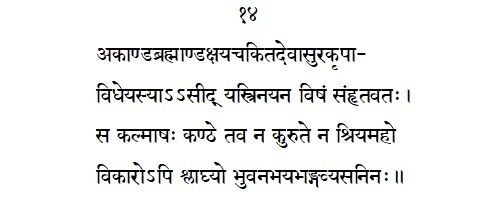
Meaning: O Lord with three eyes (Shiva):  When the Devas and the Danavas (Asuras) were scared to death seeing the untimely destruction of the universe approaching all, you showered your grace on them by drinking the deadly poison. Because of that act, a dark stain appeared on your throat. Doesn’t that stain add to your beauty? Truly, even the deformation is praiseworthy for the one whose hobby is to remove the fear of the universe.

Reflections: Shri Pushpadanta refers to the churning of the ocean story. It is an interesting story, and it brings out Lord Shiva’s compassion for humanity and readiness to help all even at the cost of his life.

The churning of the ocean story:  Once Devas defeated Danavas and then they became arrogant. Danavas are also referred to as the Asuras or the Daityas. Indra, the king of the Devas, was riding on an elephant. At that time Rishi Durvasa gave a garland to Indra. Out of arrogance, he placed the garland on the elephant. The garland attracted bees, so annoyed by the bees, the elephant threw it on the ground and crushed it under its feet. Rishi Durvasa saw this insult of his gift, so he cursed that Indra and all the Devas be bereft of strength and wealth. Thus, they lost their power and Danavas took away their kingdom and obtained control over the three worlds.  

Then, Devas took refuge at the feet of Lord Vishnu, offered Him their prayers, and asked His advice. Lord Vishnu advised them to be friendly with the Danavas and with their help churn the ocean to get the Amruta (nectar) which would make them strong. Devas followed Lord Vishnu’s advice, developed a friendship with the Danavas, and both of them decided to churn the milky ocean.

With the help of Lord Vishnu, they brought Mandara Mountain from its base to the ocean. They requested Vasuki, the king of the serpents, to become a rope to help in churning the ocean. They wrapped Vasuki around the mountain.  Danavas held the mouth part of Vasuki and Devas held its tail part. By Lord Vishnu’s grace, the churning was not harming Vasuki at all. During the churning, the Mandara mountain started sinking into the ocean as it had no solid base to support it. Again, Lord Vishnu in the form of a huge turtle supported the mountain. Now, the churning of the ocean began.       

Due to the churning, the very first thing that came out from the ocean was concentrated deadly poison, called Halahala or Kalakuta. Its fiercely penetrating fatal fumes started spreading all over. No one wanted to drink the poison. All thought that the poison would spread all over and the world would come to an end. Terror-stricken, all the devas ran to the Kailasa where Lord Shiva was staying with Devi Parvati. They started praying to Lord Shiva,

 “O Lord of the Lords! Thou great Divinity, Self, and the protector of the worlds! Save us from the poison that threatens the life of the three worlds. Thou art the master of the destinies of all beings, of their bondage and liberation. Wise people worship Thee as the Great Spiritual Teacher and remover of the sufferings of those who seek Thy shelter.” (Shrimad Bhagavatam 8.7.21-22)

Seeing the miserable condition of the Devas, the merciful Lord Shiva, the friend, and well-wisher of all, felt extremely pained and said to Parvati, “O Bhavani! See the pitiable plight of beings harassed by the poison Kalakuta produced at the churning of the ocean. So, I am going to drink this poison. May all beings be saved by it.” With the approval of the Devi, Lord Shiva drank the poison.

Shrimad Bhagavatam (8.7.43) says, “The deadly poison showed its destructive power even on this Divine Being, the Lord of the worlds. It turned Lord Shiva’s throat blue. But the poison remained only at the neck as a decoration proclaiming Lord Shiva’s passion for the welfare of others.”

Note: Up to this part of the story is relevant to the Shiva Mahimna Shloka-14. But, in order to complete the story of the churning of the ocean, I will summarize its remaining part.

Summary of the remaining part of the ocean churning story:

According to Shrimad Bhagavatam, after the poison Kalakuta, the following nine things came out of the ocean by its churning. Different people kept different things.  

  • Kamadhenu, a celestial cow. Brahma took the cow and then gave it to the Rishis.
  • Ucchaisravas, a horse. The Danava Bali kept it.
  • Airavata, a white four-tusked elephant. Indra took the elephant.
  • Kaustubha, a gem of the species of Padmaraga. Lord Vishnu adorned his neck with that gem.
  • Parijata, a celestial tree. Devas took it to the Indraloka, the abode of Indra.
  • Apsaras, heavenly artists and dancers. They chose Gandharvas as their companions.
  • Ramaa (Mother Lakshmi) emerged from the ocean. She married Lord Vishnu.
  • Varuni, the presiding deity of liquors. Danavas took possession of Varuni.
  • Finally came Dhanvantari with a pot of Amruta (nectar). Dhanvantari was a part of Lord Vishnu who promulgated Ayurveda, the science of health.

            As soon as Danavas saw the pot of nectar, they stole it from Dhanvantari and ran away. Then, they were fighting among themselves regarding who would drink it first. The weaker Danavas wanted to create a problem. They said that Devas also deserve an equal share of the nectar. Meanwhile, Lord Vishnu appeared in the form of a beautiful woman called Mohini and enchanted the Danavas. Infatuated Danavas asked Mohini to settle their quarrel. Mohini took the pot and asked Devas and Danavas to sit in separate lines. She then started pouring Amruta (nectar) into Devas’ containers which Devas drank.

            One Danava Swarbhanu sat among the Devas in disguise. He sat between the Sun and the Moon. When Swarbhanu was drinking the nectar, the Sun and Moon realized who he was. They told Mohini about his cheating. Swarbhanu drank the nectar, but before the nectar went below his throat, Mohini cut his head with a disc. The head became immortal, and it is known as Rahu. His body was known as Ketu. Rahu and Ketu cause eclipses.

            After Devas drank the nectar, the pot was empty. At that time, Mohini revealed to all that she was nothing but Lord Vishnu. Then, Lord Vishnu disappeared. Danavas fought with the Devas to defeat them.  But, with the power of nectar, Devas were much stronger and they defeated the Danavas.        

Back to the Shiva Mahimna Shloka-14:

Churning the ocean is a symbol of our inner struggle.  When we try to realize the Ultimate Reality (our true Divine Identity), then in our spiritual path, churning starts in the form of an inner struggle between our divine and demonic qualities. It is also a struggle between our worldly desires which we have cherished so far and have worked for them and the new desire to make spiritual progress.

In our spiritual path, we may get some initial joy from our spiritual practices, but as we go further, we face terrible resistance that arises from our doubts, our own worldly desires, external obstacles, and the resistance that may come from family members, relatives, and friends, the pain of not making spiritual progress, and our own puny ego. This is like Kalakuta poison. In the life of Lord Buddha, we find that just before Nirvana, Mara attacked him with doubts, questions, and temptations. Lord Buddha defeated Mara with his strong determination and sincerity. We have to overcome this stage as all the realized beings have done. God’s grace and the Knowledge of the Ultimate Reality destroy these poisonous obstacles.

Swami Vivekananda Says that Unselfishness is God. Realization of God means attaining Oneness. In that state, one realizes that the One Existence which Vedanta calls Brahman has become the universe and all its beings.

In the Bhagavad Gita (18.20), Shri Krishna says, “The knowledge by which one indestructible Substance (Brahman) is seen in all beings, undivided in the divided – know that it is the Sattvika (superior) knowledge.”

If we remove the external differences of all beings and things, then what remains is ‘pure existence’, or Atman, or Brahman. At that time the little self which consists of body-mind, disappears. As a consequence, we experience other people’s joy as our joy and other people’s miseries as our misery. 

Shrimad Bhagavatam (8.7.44) says, “Realized beings feel the sufferings of others as their own. Such fellow-feeling is the highest form of worship of the Supreme Being (Brahman), who is the soul (Atman) of all.”

Lord Shiva felt the pain and saw the worries of all the people, and he decided to drink the poison to make them free from their worries. This is the act of Oneness.

We find in the world that where there is love, or attachment, or fulfilment of selfish motives, people swallow the poison of insults and misbehavior of other people.  For example, when children do not get what they want, they get angry at their mothers and little ones even kick them. But the mothers forgive their children and continue to love and serve them. Husbands and wives go through many adjustments and swallow unpleasant verbal exchanges and acts to continue their marriage relationships. In the jobs, employees who have difficulties finding other jobs tolerate and swallow their boss’s misbehavior. Without swallowing the poison of insults and misbehavior, the world cannot go on. When swallowing does not happen, then the anger comes out in a destructive form, and it does bring destruction. However, only a few people, out of their unselfish love for all, swallow insults and misbehavior of other people to do good to them.       

Lors Shiva showed that the sign of unselfish love is to feel the pain of other people’s sufferings and swallow the poison by forgiving and forgetting their inappropriate behavior which came from their ignorance, poor judgments, and lack of self-control. This fellow feeling and swallowing out of love is only possible when one feels Oneness among all. When swallowing is done without feeling Oneness, it brings harmful physical and mental reactions. Let us try to achieve this Oneness.    
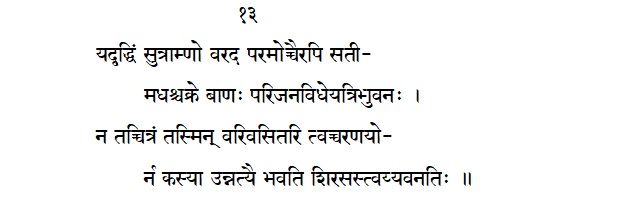
Shiva Mahimna Stotra – Shloka 13

Shiva Mahimna Stotra

Shloka 13

Meaning: O Giver of Boons (Lord Shiva)! Banasura acquired so much wealth that it tarnished even the glories of Indra’s supreme wealth. Also, he brought the three worlds under his control. It is not a surprise for Banasura to acquire this wealth and power because he bowed down at your feet. Who does not rise after taking refuge at your feet?                         

Reflections: Bana has imbibed divine and demonic qualities from his lineage and has nurtured both in his life. Let us look into his lineage.                                                      

Brahma’s son was Marichi. Kashyapa, the son of Marichi, was a great soul. He married Daksha’s daughter Diti. Kashyapa and Diti’s sons were Hiranyakashipu and Hiranyaksha. In Shloka 11, we learned that Hiranyakashipu and Hiranyaksha were the gatekeepers, called Jaya and Vijaya, of Lord Vishnu.

Hiranyakashipu’s son was the great devotee, Prahlada. We know how Hiranyakashipu tried to stop Prahlada from taking the name of God and when Prahlad didn’t obey, he tried to kill his own son. Finally, Lord Narayana came in the form of Narasimha and killed Hiranyakashipu.

Thus, in these stories demonic and divine personalities were intertwined.

Prahlada’s son was Virochana. The kind Virochana was known for his charity. Virochana’s son was Bali. He is also known as Mahabali.  He has given his kingdom of the three worlds and himself to Lord Vishnu who came as a dwarf Brahmin and asked for a land covered by his three steps.

Bana was Bali’s son. Bana was a devotee of Lord Shiva. With his devotion and special worship, he pleased Lord Shiva. When Lord Shiva asked him for a boon, Bana requested him to protect him, and his city, called Shonitapura. Since Lord Shiva protected him, he became invincible. He conquered the three worlds and acquired much more wealth than Indra, the king of devas.    

Shri Pushpadanta says that Bana acquired all this wealth and power because he bowed down to Lord Shiva. This is the glory of Lord Shiva who is very compassionate and gives boons to all who take refuge at his feet.

We all know that wealth and power do not give us infinite bliss, supreme knowledge, fearlessness, and liberation. Wealth, power, and other material gains give us limited happiness and lots of miseries. Happiness and miseries go together. We cannot have happiness without misery. Only Knowledge and Devotion can give us everything that fulfills our life. Therefore, we recite the following mantra at the beginning of our spiritual practices:

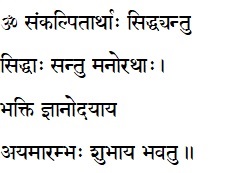
“May my resolves be accomplished. May my good wishes be fulfilled. May I begin this spiritual practice to acquire the knowledge of the Ultimate Reality and devotion to God.”  

One more thing we can learn from this shloka is to surrender ourselves at the lotus feet of God. Our ‘little ego’ is the cause of all our problems. If we surrender that ego and pray to God to reveal Itself in our heart, and we do our spiritual practices, then one day we will achieve the highest that a human being can attain in human life.

Shiva Mahimna Stotra – Shloka 11

Shiva Mahimna Stotra

Shloka 11

Meaning:  O Tripurhara (Lord Shiva)! King Ravana easily conquered the three worlds, destroyed all the enemies, and still, his hands were craving to fight more wars. This is the result of his determined devotion to you out of which he offered a garland of his ten lotus-like heads at your feet.                                                                               

Reflections:  In Shrimad Bhagavata Purana there is a story that four great sages, the sons of Brahma, named Sanaka, Sanandana, Sanatana, and Santkumara, went to Vaikuntha, the abode of Lord Vishnu. Their minds always remain in the Consciousness of Brahman. They had no body consciousness. The gatekeepers, Jaya and Vaijaya, of Vaikuntha, didn’t understand their state of mind and they stopped these sages from entering Vaikuntha, saying that they were not properly dressed.

The sages felt that these gatekeepers had body consciousness and they did not belong in Vaikuntha. They should be born on earth. So, they cursed them saying ‘Go and be born on earth’. The gatekeepers were scared and worried about being separated from Lord Vishnu. They started praying to Lord Vishnu and asked him to nullify the curse. Lord Vishnu appeared and told the gatekeepers that this curse could not be nullified.

However, seeing the sincere repentance of the gatekeepers, Lord Vishnu gave them two choices: You two be born on earth as Lord Vishnu’s devotees and live for seven lives, or be born as Lord Vishnu’s enemies and live for three lives and be killed by the Lord. They thought for a while and decided that it was better to come back to Vaikuntha sooner after only three lives and not seven. This way they spent less time away from Lord Vishnu. Another version says that the sages eased the curse by giving them three lives on earth.

Thus, in their first life, Vijaya was born as Hiranyaksha, and Jaya was born as Hiranyakashipu. Both were killed by Lord Varaha and Lord Narasimha respectively.  In their second life, Jaya was born as Ravana, and Vijaya was born as Kumbhakarna, and both were killed by Lord Rama. In their third life, Jaya was born as Shishupala, and Vijaya was born as Dantavaktra, and both were killed by Lord Krishna.   

Now, we see that Ravana was originally a gatekeeper of Lord Vishnu.  Also, Ravana’s father was a great sage Vishrava who was a son of sage Pulastya, one of the ten Prajapati and one of the mind-born sons of Brahma. Ravana’s mother was from a demonic family. Her name was Kaikesi. Thus, Ravana had both divine and demonic backgrounds.   

There is a story that at a young age, Ravana was attracted by a plane of his stepbrother Kubera. His mother told him that Kubera was the richest man in the world, and he had acquired this wealth by the grace of Lord Shiva. She told him that she would be pleased if he (Ravana) obtained the grace of Lord Shiva and acquired such wealth.  Ravana had this deep desire in his mind. When he grew up, he decided to obtain Lord Shiva’s grace. He took the ‘Shiva Panchaskhara Mantra’ from his grandfather and started severe austerity to please Lord Shiva. After much austerity, Lord Shiva was not pleased. Maybe Lord Shiva knew his intention. Ravana performed a ‘Yajna’, but still Lord Shiva was not pleased. As a final resort, Ravana started offering his heads one by one to Lord Shiva. The story goes that when Ravana was offering his last head, Lord Shiva was pleased and gave him his desired boon.

After that, he attacked all the existing kings and took away their kingdoms. He killed all his enemies, and his hands were craving for more wars. He even took away his stepbrother Kubera’s kingdom Sri Lanka and acquired all his wealth. Shri Pushpadanta says that the root cause of the Ravana’s success was his determined devotion to Lord Shiva.

In the Bhagavad Gita (16.21), Shri Krishna says,

“Lust, anger, and greed are three doors to hell. They ruin the self. Therefore, a person should avoid all these three.”

In the Gospel of Sri Ramakrishna, we find that Sri Ramakrishna again and again warns all the spiritual seekers that ‘lust and greed’ are the two major enemies or the major obstacles in the path of God-realization.  We see what happened to Ravana even after realizing Lord Shiva.

After acquiring wealth and power, Ravana became arrogant. He lost the sense of ‘right’ and ‘wrong’. Being possessed by ego, anger, and lust, he kidnaps Mother Sitaji and brings the destruction of himself, his family, and all the people around him. We will find one of his arrogant acts in the next shloka of Shiva Mahimna Stotra.           

Shiva Mahimna Stotra – Shloka 9

Shiva Mahimna Stotra

Shloka 9

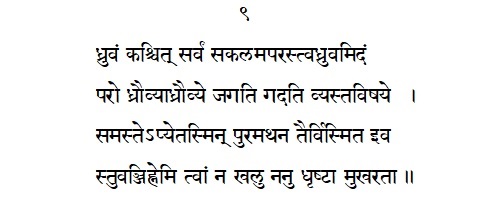
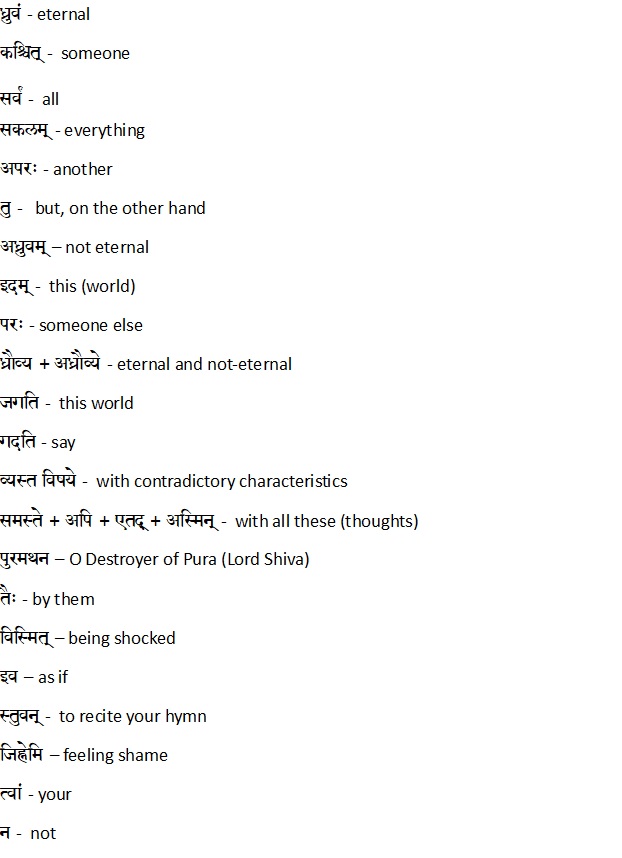
Meaning:  O Puramathana (the destroyer of Pura – Lord Shiva)! Someone says that this universe is eternal. Another person says that this universe is not eternal. While someone else says that this universe is eternal and not eternal, having a contradictory characteristic.  By listening to all this, I am shocked and now, I am not ashamed to sing your glories. Truly, verbosity is shameless.    

Reflections: Shri Pushpadanta tells us how people have different views about the universe. There are various philosophies like Sankhya, Patanjali, Vaisheshika, Naiyayika, Charvaka, Bauddha, Jain’s, and others.  They have their own views about the universe.

Some say that this universe is eternal. The soul (Jiva), universe (Jagat), and God (Ishwara) are eternal. The things of the universe don’t die but are recycled.  

A group of materialists say that this universe is not eternal. When a person dies, that is the end of the person. Similarly, one day this universe will come to an end. There is nothing permanent here.                                

Some people say that in this universe, there are a few things that are permanent and other things are impermanent. Thus, both contradictory things exist in the universe. 

The followers of Buddha say that the universe is constantly changing. Thus, there is nothing permanent. If we tie a light at the end of a small string and we move that string around then it creates a circle of light. In reality, there is no circle of light. The constantly moving thing creates an illusion of a continuous circle. Similarly, this constantly changing world creates an illusion of a continuous eternal world.

Advaita Vedanta says that this universe is an illusion. Just as in the dark, we see a rope as a snake, similarly, due to the darkness of ignorance we see Brahman, the Ultimate Reality, as a universe with names and forms.

Then, many scientists have different views about the universe.  

People live according to their philosophy or views about their lives and the universe. Such philosophy or view develops a faith in those ideas.

Shri Krishna in the Bhagavad Gita (17.3) says:

“O Bharata (Arjuna): The faith of each person is in accordance with his/her disposition. A person is made of his/her faith. As is the faith, so is the person.”

As long as a philosophy is not harmful to oneself and the people and a person sincerely thinks that it is a convincing philosophy to the person, then we cannot say that it is a wrong philosophy. People have different viewpoints according to their mental capacity, surroundings, and time. With mental development, acquiring more knowledge, and a change of surroundings or situations, their view of life and the universe changes. Generally, a person has a different view of oneself, other people, and the universe at the age of five and at the age of fifty. We cannot say that the view of a five-year-old person is wrong. 

These different philosophies or comprehensions of the Truth are like taking photos of a house from various angles and levels. The photos taken from the front, from the sides, from the back, or from the drone look different. We cannot say any photo is wrong. If this happens regarding a small house, what to talk about the view of the universe.

In Bhagavad Gita (15.3), Shri Krishna says,

“Its (Universe’s) true form is not comprehended here, nor its end, nor its origin, and nor even its existence.”

When we read or hear all these views of the universe, we get overwhelmed. Pushpadanta said that he was overwhelmed by people’s various views about the universe and now, he does not feel bad composing this hymn and expressing his feelings.

Scriptures say that when a person gets full comprehension of the Ultimate Truth, then he/she becomes quiet. Sri Ramakrishna gave a wonderful example explaining this fact. He said when a person is fetching water from a well, the pot makes a sound when it is being filled with the water. When the pot gets completely filled with water, it does not make a sound. At that time the person pulls the pot with the rope and brings the pot to the ground. Then, he/she pours it into another pot. At that time the water makes a sound.  Similarly, when one does not have complete knowledge of Brahman, one talks about it a lot. It is like the pot is getting filled with water. When one gets complete knowledge of Brahman one becomes quiet because the words cannot express the infinite bliss and the experience of the Truth. But then that knowledgeable person teaches his/her students. At that time, he/she talks about it. This is similar to pouring water from one pot to the other.

Shri Pushpadanta says, ‘Truly, verbosity is shameless.’  In a way, everyone is expressing their feeling about the Infinite according to one’s own understanding. Those who say, ‘God does not exist.’, they are also expressing their understanding of God. They have some idea of God, and they don’t see it in existence. 

Note: When I was searching for something on the Internet, I found Swami Sarvapriyananda’s talk on Shiva Mahimna, given on February 18, 2023. The following is the link. You may like it.  

Shiva Mahimna Stotra – Shloka 8

Shiva Mahimna Stotra

Shloka 8

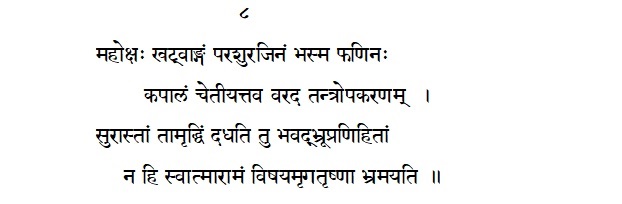
Meaning: O Giver of the Boon (Lord Shiva)! Your household properties include (i) Nandi (Bull), (ii) a club weapon, (iii) an axe, (iv) tiger-skin cloth, (v) ashes, (vi) snakes, and (vii) a human skull. But the devas (gods) enjoy an abundance of wealth given by you out of your grace. Truly, one who enjoys bliss by focusing one’s mind on the Self within never gets deluded by the temptations of worldly pleasures.   

Reflections:

We can learn four things from this shloka: (1) Simple living and high thinking, (2) Remain focused on the Atman lying within, (3) No worldly attractions like wealth, sense-pleasures, power, position can disturb the blissful mind of a person who is established in the Atman, and (4) the interpretations of the symbols of Shiva’s belongings.

(1) Simple living and high thinking:  Lord Shiva’s household belongings are minimal and simple. He looks like a poor God. But that is not the case. Pushpadanta says that when Lord Shiva gets pleased with the prayers of gods and out of pleasure his eyebrows get stretched a little the devas receive tons of wealth. Thus, Lord Shiva can have all the wealth of the world, but he keeps minimum things for his living, and on the other hand, he keeps his mind always focused on Atman or Brahman.

We see in the world that many Saints are capable of acquiring any amount of wealth, power, and high worldly positions, but they do not go after them and remain focused on the Atman.

The householders also can perform their responsibilities following the teachings of the Bhagavad Gita, live a simple life, but keep the mind focused on the goal of realizing the divinity within and manifesting it in their thoughts, speech, and actions and do unselfish service to humanity. Sri Ramakrishna said that when the householders are busy with work, they should hold on to God with one hand and perform responsibilities with the other hand. When they are free, they have to hold on to God with both hands.

(2) Remain focused on the Atman lying within:  We find Lord Shiva is absorbed in meditation in most of his pictures and statues.  His face is serene and beaming with bliss. Pushpadanta used the word “svatmarama” to describe Lord Shiva. He is always focused on the Atman within. Thus, he is a great yogi and encourages us to be a yogi. The following shlokas of the Bhagavad Gita describe yoga and the state of a yogi which gives us a picture of Lord Shiva:

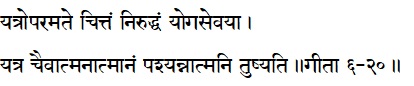
Bhagavad Gita (6.20-21):

Shri Krishna says, “That in which the mind restrained by the practice of concentration; rests calm;

that in which seeing the Self (Atman) through the self (pure intellect), one rejoices in one’s own Self;

that in which one experiences the boundless joy beyond the reach of the senses and grasped only by the understanding (the special knowledge); and

that in which being established, one never departs from Reality;…”

Here is another shloka:

“The yogi, who is happy within, who rejoices within, and who is illumined within attains freedom in Brahman, becoming one with Brahman.” (Bhagavad Gita (5.24))

(3) The Bliss of Atman:                                        

Shri Pushpadanta teaches what we can learn from Lord Shiva. He says, if like Lord Shiva, we remain absorbed in the Atman within, then we will experience infinite bliss, and no worldly temptation will delude our minds.   

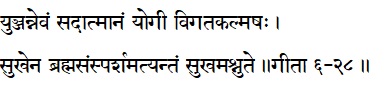
Shri Krishna says in the Bhagavad Gita (6.28):

“Thus (by the practices of meditation) making oneself ever steadfast, the yogi, freed from sins, easily enjoys the touch of Brahman, which is exceeding bliss.”

Scriptures teach us that all the joy of the world combined together is equal to a fraction of the bliss experienced by a realized soul.  

We can see this from the lives of realized souls. I heard an interesting story from a Saint.  He said that a Sadhu was sitting on the bank of a river and enjoying the cool breeze on a hot summer day. One passerby came, saluted him, and said, “I am a diamond merchant and I want to give you a special gift.” He took out two very precious diamonds and gave them to the Sadhu. The merchant said, “You can have all the luxuries of the world from the money you get from these two diamonds.” The Sadhu smiled and started playing with these two diamonds as if he is playing with two small pebbles. After a few minutes, he threw one diamond as far as he could in the river like a child’s play and started laughing. The merchant was shocked, and he said, “Sir! Where did you throw the diamond in the river? I can go and get it back.” The Sadhu took the other diamond and through it in the direction of the first one and said, “There it is.”. The merchant could not believe what he saw, and then he left in dismay. Sadhu taught him that compared to the inner bliss one gets by dwelling on the Atman, the two diamonds are nothing more than two pebbles.      

Sri Ramakrishna wanted to make sure that the money would not deviate his mind from his spiritual goal. So, as a spiritual practice, he took a few coins in one hand and dirt in the other hand, sat at the bank of the river Ganga, and tried to feel that there was no difference between the two. He repeated a few times, ‘money, dirt’, ‘dirt, money’ and when he did not feel any difference between the two, he threw both of them in the river. He knew that money was needed to maintain the living, but it should not deviate the mind from our spiritual pursuit.

One Marwari businessman wanted to give Rs. 10,000 to Sri Ramakrishna. At that time, this amount was huge. But Sri Ramakrishna was happy with what he had, and he didn’t accept the money. Once Mathur Babu, Rani Rasamani’s son-in-law, expressed his wish to transfer an estate to Sri Ramakrishna’s name so that Sri Ramakrishna enjoys the money produced by the land for his entire life. Sri Ramakrishna became angry and chased Mathur Babu out saying, “O Rogue! Do you want to make me a worldly man? Get out of here.”          

Such examples teach us that compared to the inner bliss experienced by being absorbed in the Atman the worldly pleasures are very trifles.  

(4) Symbols and their interpretations:

In the Hindu scriptures, many things are symbolic. Those who cannot make efforts to find the deeper meanings of these symbols, they get confused and think that Hindu gods and goddesses and the things around them are primitive. On the other hand, people make various interpretations of the symbols according to their mindsets. Thus, there is a wide range of interpretations, and we cannot say which one is correct. Actually, the interpretations reflect the spiritual state of the interpreter. A person with a higher spiritual state, a higher consciousness state than the state of only material and body-mind existence, sees spiritually uplifting meanings behind the symbols.  A person bound by the material body-mind existence sees a much lower-level interpretation of the symbols.

It is not that someone sits down one day and makes all the symbols. These symbols have evolved over a period of hundreds or thousands of years from a cultural or a religious tradition. A highly evolved spiritual soul visualizes the Ultimate Reality in a certain way and expresses it in one’s own way to his/her disciples. Then, over a period of time, many followers also had the vision of Ultimate Reality through that expression and this expression became a symbol. From various spiritual souls, these symbols develop in a culture or a religious tradition. To laugh at any symbol reflects our own mental, moral, and intellectual immaturity. If we don’t understand the meaning behind a symbol, it should not matter.   

The symbols help us in our spiritual practices, especially in our meditation to focus and uplift our minds. That is all that matters.      

Lord Shiva’s seven household belongings are also symbolic. Here are a couple of interpretations of the symbols that I have read, heard, or thought about them.  

(1) Nandi (Bull):  Nandi is considered Lord Shiva’s pet. Nandi is always sitting outside Lord Shiva’s temple facing Lord Shiva’s image. Nandi represents devotees of Lord Shiva. It represents Jiva with the ego of body and mind. Shiva rides on the Nandi meaning Shiva controls Jiva.

Another way to look at Nandi (Bull) is to be the most useful animal for farmers in farming. In earlier times, most people had farms and their living was completely dependent on farming. Farmers loved bulls dearly. Thus, Lord Shiva becomes the god of most common people. Shiva’s temples are always open. Many of Shiva’s temples don’t even have doors as there is nothing there to steal like ornaments or any precious things.    

(2) A club weapon: This represents a staff more than a weapon. It symbolizes that Lord Shiva is the controller of the whole universe. By following the command of Lord Shiva, the sun, moon, earth, planets, and all continue to do their jobs. Those who do not follow the command, get punished by the law.

(3) An axe: In earlier times, people used an axe to cut trees. In the fifteenth chapter of the Bhagavad Gita, Lord Krishna describes this universe as an upside-down tree. Actually, it is the universe developed in the minds of people due to attachment created by our ignorance. Lord Krishna says that in order to attain the highest knowledge and to be free from all bondages one should cut this tree with a weapon of detachment. Thus, this axe represents detachment. Lord Shiva is absorbed in meditation and shows us to become detached from the world created out of delusion.          

(4) A tiger-skin cloth: Tiger is a ferocious animal. It represents mainly lust and also all the other five enemies of a spiritual seeker, which are anger, greed, delusion, ego, and jealousy.  Lord Shiva wears tiger-skin cloth and sits on it. This shows that Lord Shiva has total control over all of these six enemies and is teaching devotees to do the same. 

(5) Ashes: Lord Shiva adorns his forehead and the body with ashes gathered in the cremation ground showing us that this body is ultimately going to turn to ashes. Therefore, think about the priorities of life. Don’t spend too much time pampering the body and decorating it. The goal of human life is to acquire the highest knowledge of our true divine identity which will give us everything we are seeking, like fulfillment, infinite bliss, knowledge, freedom from all bondages, and love for all. We have to take care of the body to help us as an instrument to achieve this highest goal. 

(6) Snakes: Lord Shiva adorns himself with snakes. There are a couple of interpretations for this.

(i)  When poison comes out from the churning of the ocean, according to the rule, someone has to drink it. Devas and demons ran away from the poison. No one on earth was ready to drink it. Finally, Lord Shiva agreed to drink the poison to save the world. He drank it and held it on his neck with his yogic power.  The poison remained there which made his neck dark blue (nila) and had a burning sensation. A snake’s body is cool by nature, so the snake gave him some relief. Lord Shiva’s other name is ‘Nilakantha’, a God with a blue neck.

(ii) Snakes represent the worldly pleasures that bite us with their attractions and then we get the poison in the form of the painful consequences. Lord Shiva has total control over these worldly pleasures.

(iii) Except for the snake charmers and the snake controllers, all are afraid of the snakes. Generally, if people see a snake, their natural instinct is to kill it before it kills them. There is a story that King Janmejaya, whose father Parikshita died of a snakebite, was angry at snakes. He held a fire ritual in which he started burning all the snakes of his kingdom. Later, a saintly person convinced him to stop this ritual. Thus, people hate snakes. Lord Shiva welcomes snakes as his adornment. It is a symbol that Lord Shiva loves all, especially those who are neglected and hated by society.        

(7) A human skull: Again, like ashes, the skull reminds the end of a person’s body. Men or women of different colors, cultures, forms, intelligence, and skills look alike as the skulls. Lord Shiva wears a garland of skulls considering all people equal.            

Shiva Mahimna Stotra – Shloka 6

Shiva Mahimna Stotra

Shloka 6

Meaning:  O Supreme Lord! Can the universe made up of various parts be without birth or origin? Can creation happen without the creator? Without the Lord who else even attempts to create the world? Therefore, the people who doubt your existence are really dull-minded.  

(Note: There are two interpretations of the line, “Anisho va kuryat…”.

(1) “If someone else, other than the Lord, had created the universe, then what material that person had used to create it?.”

(2) “Without the Lord who else even attempts to create the world?”

I preferred the interpretation (2)).

Reflections: 

The scriptures teach us that whatever has a name and form is perishable. A thing with name and form has a beginning and an end.

Upanishads clearly say that Brahman is the cause of the creation, preservation, and dissolution of the universe. There are various quotes from the Upanishads, and the Bhagavad Gita stating that the world functions because of the power of Brahman.  

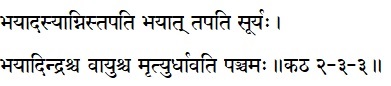
Kathopanishad (2.3.2-3) says:

“Whatever there is – the whole universe – vibrates because it has gone forth from Brahman, which exists as its Gound. That Brahman is a great terror, like a poised thunderbolt. Those who know It becomes immortal.” (Kahtopanishad 2.3.2)

“From the terror of Brahman, fire burns; from the terror of It, the sun shines; from the terror of It, Indra, Vayu, and Death, the fifth, function.” (Kathopanishad 2.3.3)

Kenopanishad Story:

There is a story in the Kenopanishad.  There was a fight between gods and demons. The gods became victorious. They said to themselves, “Verily, this victory is ours; verily, this glory is ours only.”

At that time a mysterious Being appeared at the door. The gods wanted to find out who that Being was. They sent Agni, the fire god, to find it out. The Being asked, “Who are you?”  The fire god said, “I am Agni”. The Being asked, “What power do you have?” Agni said, “I can burn everything.” The Being put a straw before him and said, “Burn this.” Agni tried all his power, but he could not burn it. He went back and said, “I could not find out who that Being is.”

The gods sent Vayu, the wind god, to find out who that mysterious Being was. Vayu went to the Being. The Being asked, “Who are you?”  The wind god said, “I am Vayu”. The Being asked, “What power do you have?” Vayu said, “I can blow away everything.” The Being put a straw before him and said, “Blow this.” Vayu tried all his power, but he could not even move the straw. He went back and said, “I could not find out who that Being is.”

The gods asked their king Indra to find it out. When Indra went to the Being, the Being disappeared, and Indra saw in the very region of the sky a glorious woman Uma. Indra asked her, “Who was that mysterious Being?” Uma said, “That was Brahman. By the victory of Brahman alone you have obtained glory.”

Uma is the Power of Brahman. She taught the gods that only because of the power of Brahman they had won the war. The gods were just the instruments of Brahman. Thus, through the power of Brahman alone, the world is functioning.

Sri Ramakrishna used to say in Hindi:

‘Without God’s will, not even a leaf moves.’

The Alternative:

If skeptical people think that there is no power working in the universe, then the other choice is to think that everything is happening by accident or by chance. For example, we have to accept that our eyes, ears, hands, legs, hearts, digestive systems, and other body functions are happening by chance or by accident. We have to assume that the functions of the sun, moon, earth, planets, etc. are happening accidentally.

Since everything in the universe is working so precisely, to think that it is happening by accident or by chance is really ridiculous.

Creation without the Creator:

The universe didn’t just fall from the sky – there is a creator. To say that there is no creator is like saying that there is a painting on a canvas without a painter, there is a song sung without a singer, there is a book published without a writer, etc. If someone says that a computer can do all of these, but behind the computer there is a human mind.   

Since the universe is working so precisely, nothing other than the Lord is capable of even thinking to create this universe.

Human brains have amazing power. Among them, the power of the brightest brains the world has ever produced and the ones that are going to come in the future are beyond our comprehension. How powerful must be the brain that has created all these brains? 

The Power of God:

Shri Krishna says in the Bhagavad Gita that wherever you see a special power, that is My (Lord’s) Power. He said that the whole world is created by one small fraction of My Power.

“Whatever glorious, or attractive, or powerful thing exists anywhere, know that it is a manifestation of a spark of My (Lord’s) splendor.”  (Bhagavad Gita 10.41)

“Or, O Arjuna, what need is there for you to acquire this detailed knowledge? I support the whole universe with a fraction of Myself.” (Bhagavad Gita 10.42)

Pushpadanta states that those people who don’t think deeper, don’t study scriptures and reflect upon their sayings, but simply deny or doubt the existence of the Lord must be dull-minded. 

Shiva Mahimna Stotra – Shloka 5

Shiva Mahimna Stotra

Shloka 5

Meaning:  O Shiva (Brahman), You and Your Power are beyond the realm of logic. Even though it is impossible and inappropriate, a few people apply their polluted logic regarding You and Your Power by asking questions, like, ‘What was the creator’s desire to create this world?  By which body, material, tools, and support the creator created this universe?’.  Thus, they make themselves verbose to delude the world.   

Reflections: The Vedanta Philosophy, which is based on the Rishis’ words uttered by their direct perception of the Truth, or the Ultimate Reality, says that there is only One Existence. The Vedanta calls it Brahman. Vedanta says that Brahman appears as the universe with names, forms, and qualities, just as clay appears through various toys and things consisting of names, forms, and qualities. Many times, we forget that these toys and things are nothing but clay.

Similarly, by the Power of Brahman, called Maya, in real life, we get overwhelmed by the names, forms, and qualities of the objects and people, we forget that there is only one Reality behind all of them. In particular, we forget that in Reality we are eternal Atman and think that we are limited by our body and mind and then we suffer.

Another simile is of a movie projected on a screen. When we are watching a movie, we get into the drama created by the movie and we laugh, cry, get angry, and react in various ways. We forget that this movie is projected on a movie screen that has no characters or scenes. The movie screen is Reality, and the projection is temporary.

Maya deludes us and does not let us see Reality.  A few people who destroy their delusion and realize this fact become peaceful or blissful within. Maya deludes most of people.

Sri Ramakrishna says that things are not the same as what we perceive. The sky looks blue, but when we go up in the sky, we find that it has no color. The ocean water looks blue or green or grey, but when we take the water in our hands, we find that it has no color.

Shri Shankaracharya’s famous example is that we see a snake in a rope in the dark.  But when we bring light, we find that it is just a rope. Rishis, the Seers of the Truth, says that when we remove our delusion or ignorance, we see that there is only One Existence, and it appears as many.

Shri Shankaracharya describes this Maya in a very poetic way in his Viveka Chudamani (shloka 109) as follows:

“Maya neither exists, nor not-exist, nor both, being exist and not exist.

Maya is neither same, nor not-same, nor both, being same and not-same.

Maya is neither composed of parts, nor indivisible, nor both, being composed of parts and indivisible.

Maya is most wonderful and cannot be described in words.” (Viveka Chudamani 109)

Whatever we describe becomes limited. Maya, the Power of Infinite Brahman is not limited.

Also, the very first assumption of logic is ‘A statement is either ‘true’ or ‘false’. Thus, a statement cannot be neither true, nor false, nor both. Shri Shankaracharya shows that Maya is beyond the realm of logic.

The universe we perceive is within the realm of space, time, and causation. The causation is a chain of ‘cause and effect’. Logic applies to the things which are in the realm of space, time, and causation. Brahman and Its Power Maya are beyond space, time, and causation.  Therefore, logic does not apply to Brahman or Maya.  They are beyond logic.

If deluded people, who think that they are limited by their body and mind, and the world is real as it appears, ask all kinds of questions regarding the creation of the universe, how are they going to get the answers?  A person, who is under the influence of liquor, demands sober people to explain ‘how and when he got into that condition?’, what can they say? They will say that ‘first you become sober, then you will know all the answers’.

Pushpadanta says that those deluded people who ask questions like, ‘What was the creator’s desire to create this world?  By which body, and with what material, tools, and support the creator created this universe?’, are creating more delusion in the minds of others. As long as they are deluded, their questions are irrelevant, and they will never understand the answers. If they get the knowledge of Reality, then they will get their answers.   

Even the world we perceive through our senses has millions of questions that are unanswered. For example, we cannot understand the behavior of the electrons in the nucleus of matter. In 1927, German physicist Werner Heisenberg introduced ‘the uncertainty principle’, which states that the more precisely the position of some particle is determined, the less precisely its momentum can be predicted from initial conditions, and vice versa. That means we cannot determine the position and the momentum of a particle at the same time. It shows how difficult it is to know about the One which is beyond space, time, and causation.

Sri Ramakrishna says that a gallon bottle cannot hold ten gallons of milk. 

A question comes: Should we then not ask questions?

The answer is that we should ask questions to understand the principles presented by the scriptures or by the spiritual teachers. We have to try to understand what Rishis, or the Realized Souls, are trying to tell us. Simultaneously, we should do spiritual practices guided by proper teachers. Then, we will have genuine questions in order to remove our doubts or obstacles or to clarify some unclear ideas. The test of the genuine question is that once we get a proper answer, we will make spiritual progress.

Many people ask questions either to destroy or challenge the presented views or for intellectual entertainment or just for the sake of asking questions and never to learn or remove their doubts. Those kinds of questions will not be helpful. Pushpadanta says that these people make lots of noise to delude other people in the world.

If we do our spiritual practices properly and sincerely, then eventually all our questions will be answered, and all our doubts will be destroyed.

Mundaka Upanishad (2.2.8) says,

“When one realizes Brahman, then the fetters of the hearts get broken, all doubts get resolved, and the consequences of all actions, which are the bondages, get destroyed.” (Mundaka Upanishad 2.2.8)

Sri Ramakrishna explains this with a simple example. He says suppose a person is walking towards a flea market which is filled with shops and customers. Now, from a distance, that person hears noises of people but not clear sentences. When the person goes closer to the market, he/she starts hearing clear sentences like, ‘Give me that pair of shoes’, or ‘The price is five dollars,’ etc. Similarly, if we advance in the spiritual path, we will start understanding the answers given by the scriptures and the realized beings regarding ourselves and the universe.

Shiva Mahimna Stotra – Shloka 4

Shiva Mahimna Stotra

Shloka 4

Meaning:  O Varada (Lord Shiva, the giver of boons)! The three Vedas have established that with your power you create, preserve, and dissolve the universe. This power works through your three forms (Brahma, Vishnu, and Mahesha) which differ by the dominance of the three gunas (Sattva, Rajas, and Tamas). However, to destroy this fact, a few ignorant people with their dull intellect, present baseless theories which seemingly look pleasant to the dull-minded, but in reality, it is unpleasant.      

Reflections:                          

The scriptures establish the fact that Brahman is the cause of the creation, preservation, and dissolution of the universe. The power of Brahman, called Prakriti, or Shakti is made out of three gunas; sattva, rajas, and tamas. Brahman creates the universe through Its form Brahma which is dominated by rajas.  Brahman preserves the universe through Its form Vishnu which is dominated by sattva. Brahman dissolves the universe through Its form Mahesha which is dominated by tamas.

The following are a couple of quotes from the scriptures which establish this fact:

The Brahma Sutra (1.1.2) says that ‘Brahman is the only cause of creation, preservation, and dissolution of the universe’.

Taittiriya Upanishad (3.1) says, “That, from which these beings are born, by which, when born, they live, into which (at the time of dissolution) they enter, they merge – seek to know That. That is Brahman.”

Taittiriya Upanishad (2.1) says, “From that Atman (Brahman) Aakaasha (space) was born; from Aakaasha, Vaayu (air) was born; from Vaayu, Agni (fire) was born; from Agni, Aapa (water) was born; from Aapa, Prithvi (earth) was born; from Pruthivi, Anna (food) was born; from Anna, being was born.”

Brahman is Omnipotent, Omniscient, Infinite, and devoid of any qualities. However, It appears as the universe because of Its delusive power Maya or Shakti.

In Viveka Chudamani, Sri Shankaracharya calls the power of Brahman as Avidya or Maya.

“Avidya or Maya is the power of the Lord. It is Unmanifested when It is inactive. It is beginningless, supreme, and made up of three gunas; sattva, rajas, and tamas. Wise people realize Its existence by Its effects. It brings forth this whole universe.” Viveka Chudamani – 108

In Shri Durga Saptashati (11.11) Rishi says, “O Narayani (All-Pervading Mother)! You are the power to create, preserve, and dissolve the universe. You are the support of the three gunas (sattva, raja, and tamas) and you have all the virtues. I salute you.”

In the Bhagavad Gita (9.7)Shri Krishna said, “O Arjuna! At the end of the cycle of the universe (at the time of dissolution), all beings enter into My Prakriti and at the beginning of a cycle I generate them again.”

People who believe that the Vedas are the highest authority regarding the fundamental truth of the universe accept that Brahman is the cause of its creation, preservation, and dissolution. But a few people present theories and reasons to destroy this fact. These theories and reasons amuse dull-minded people who do not think deeper. Let us reflect on these two sides.  

There are two major theories popular in the world:

Theory 1 (Believers): There is some power that is responsible for the creation, preservation, and dissolution of the universe. People call this power by different names, like Brahman, God, Consciousness, or something else. The Vedas call it Brahman.

Theory 2 (Non-believers): There is NO power working behind the universe. Meaning there is no Brahman, Atman, God, Consciousness, or anything which is the cause of creation, preservation, and dissolution.

About Theory – 1: Among the believers of Theory – 1, there are many philosophies regarding the nature of God. But all the believers agree that there is something beyond this body and mind or the physical universe that we perceive which is the cause of the creation, preservation, and dissolution of the universe. The Vedas are included in this theory.

About Theory – 2: Pushpadanta says that to destroy the assertion of Theory – 1, a few people propose a theory and give reasons to spread the idea that there is no Brahman, or Atman, or God, or Consciousness, or any such thing which is the cause of the creation, preservation, and dissolution of the universe.

From the Vedic time, a group of such people called Charvakas have been trying to destroy the assertion of the believers, especially the assertion of the Vedas. The word ‘Charvakas’ came from the Sanskrit words ‘Chaaru’ and ‘Vaac’. ‘Chaaru’ means pleasant, and ‘Vaac’ means speech. Thus, Charvakas means people whose talks are pleasant. One of the popular ideas of the Charvakas is:

“As long as you live, live happily with all the worldly joys. If you need to borrow money to have all the worldly pleasures (mainly eating, drinking, and sense-pleasures), then just do it. When the body burns to ashes, it is not going to come back.”

The last line implies that there is NO Atman or Brahman. All that we have is a body with a mind.

They even went further to say that those who wrote the Vedas are cheats, fools, and demons.

Pushpadanta says that such talks are very pleasing to few people who are not capable of thinking deeper. But in reality, these thoughts are unpleasant and harmful. A question comes, “Why such thoughts are unpleasant and harmful?”.

Here are a few answers:

(i) Life will be meaningless. If a person is limited to just body and mind, then for many people life will not have any purpose or meaning. They will not be happy to run around and go through many struggles just to maintain the body and to seek material pleasures. These people know that we really feel happy when we forget our body and mind. After deep sleep, one feels great joy. When we forget our little selves by listening to music, seeing beautiful pieces of art, reading engaging material, finding new research results, enjoying the vastness of nature, expressing our unselfish love, doing unselfish service, or any such activity, then we experience joy within which is nowhere near the sense-pleasures.

Also, life is short, and we cannot achieve what we had desired to achieve. Having just one life will not give us an incentive to continue working until the end.   

(ii) Life will be devoid of love.  Let us call the body-mind existence a ‘little self’. If each individual is interested to make his/her little self happy and that is the ultimate goal of life, then love will become selfishness. A person loves another person as long as the other person gives material pleasure to the first person. There will not be the love that we know now in the world. If society becomes truly selfish, then the parents will not be interested in raising the children when the children are not giving them material joy. Each one will be left to work hard to fulfill one’s own little self’s material desires. Even now, when children come to a certain age, selfish parents tell their children to get out of their houses and take care of themselves. If parents want to make their children self-dependent, then it is good. But to stop loving children or hating them because they are obstacles in their parents’ selfish joy is a horrible idea. How do we feel when mothers give birth to children and then parents abandon them to survive on their own? Without love, society will go towards its own destruction.

(iii) No explanations for the discrimination among children:  If there is only one life with this little self, then how can we explain why some children are born in extremely rich families and some are born in extremely poor families? Why some children are very talented in music or some other skills and some are not?      

(iii) Incomplete scientific explanations: The science talks about the Big Bang Theory for the creation of the universe. But there is no explanation for many things, like from where these objects and the force came which made the collision.

Also, some present a theory that in the beginning, only matter existed and at some point, consciousness came out from the matter. How can consciousness which is sentient come out from matter or material combinations which are insentient?

(iv) World is not chaotic: Everything in the universe is working very precisely.  For example, the sun, the earth, and the planets are precisely performing their functions. Our senses, heart, brain, digestive system, etc. are functioning precisely. This suggests that a systematic power with perfect thinking is working behind the universe. The world is not functioning because of random combinations of matters or powers. Our finite brains cannot comprehend infinite power. We can get some feeling about the infinite, but we cannot comprehend it fully.  

(vii) Counter-intuitive: Thinking that we are only little selves consisting of only body and mind is counter-intuitive. Intuitively we all feel that we are not limited to our body and mind, and we are eternal even though our body dies. There is a basic feeling of freedom in all of us. The idea that we are bound suffocates us. Also, we are not our resumes.  No matter how much we write about a person, we cannot describe the person completely. That is the reason why the world has not become completely materialistic even though Charvakas and others were trying to spread their pleasant theories.        

(viii) Not all are materialists: People may get turned off by religions due to the inhuman acts of religious leaders and fanatics, but they are not materialists. When many such non-believers come in touch with genuine spiritual people, they get attracted to spirituality or at least understand that it is a better way of living than a materialistic life.  

Shiva Mahimna Stotra – Shloka 3

Shiva Mahimna Stotra

Shloka 3

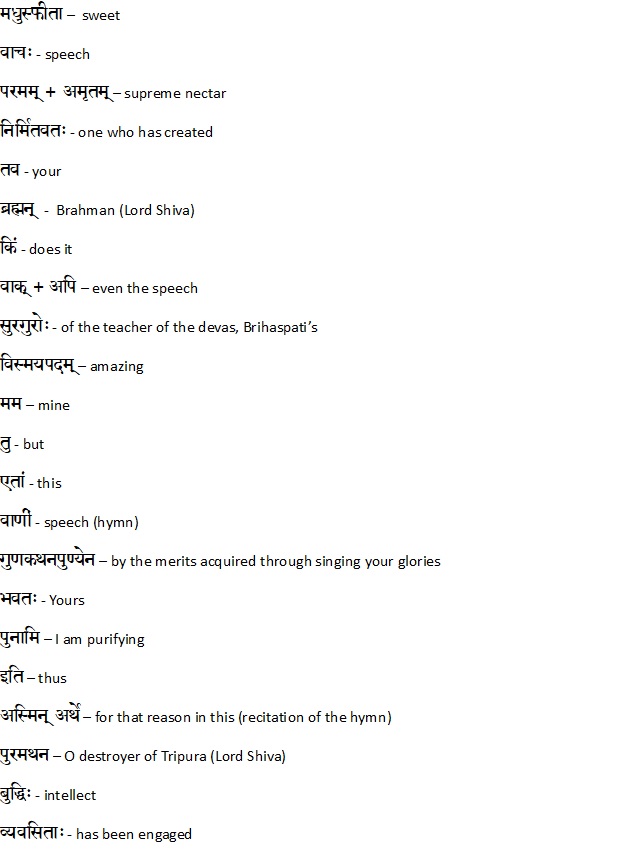
Meaning:  O Lord Shiva! You are the creator of the nectar-like Vedas. Can the speech of even Brihaspati, the teacher of the Devas, amaze you? (Even though I am aware of this fact) O Puramathan! My intellect is engaged in singing this hymn thinking that by the merit of singing your glories I am purifying my speech.     

Reflections: Pushpadanta establishes that Lord Shiva is Brahman who had created the Vedas.

The scriptures tell us that Brahman had created the Vedas:

Brahma Sutra (1.1.3): “Brahman is the source of the scriptures (The Vedas).”

Swetaswatara Upanishad (6.18): “In the beginning, the Lord (Brahman) had created Brahma (Its creator aspect) and revealed the Vedas to him.

Brihadaranyaka Upanishad (2.4.10): “As smoke comes out from a fire kindled with wet fuel, similarly the Rig Veda, the Yajur Veda, the Sama Veda, the Athrvangirasa, history, mythology, various branches of Knowledge, the Upanishads, verses, aphorisms, elucidations, and explanations are like the exhaled breath of this infinite Reality, the Supreme Self, Brahman. Indeed, It breathed forth all of these.”

The Vedas consist of life-giving or life-explaining ultimate truths. These have been expressed in beautiful poetic ways. Pushpadanta is aware of the fact that Lord Shiva as Brahman has created the Vedas, and so no one’s praises of Lord Shiva will amaze Him. Even the glories of Lord Shiva sung by Brihaspati, the teacher of the devas, who is most intelligent, and well-versed in speech, will not amaze Him. But, then why Pushpadanta is engaged in composing this Shiva Mahimna Stotra to describe Lord Shiva’s glories? Definitely, this singing will not amaze Lord Shiva.

Pushpadanta himself gives his reason. He says he was just trying to purify his speech by singing the glories of the Lord. What is the ‘punya’ (merit) of singing Lord’s Glories? To me, it is the result of an effort to fill the mind with positive and uplifting thoughts. It is the result of an acceptance of Ultimate Reality and the humbling surrender of the little ego of the body-mind to that Reality. Whatever we have in our mind, that is what we say, and we act accordingly. If our minds are filled with positive and uplifting thoughts, then our speech and actions also reflect these ideas. This way, we can get rid of impure thoughts, speech, and actions from us. This is the process of purification. Spiritual teachers give an example of an inkpot. Suppose it is filled with old dirty ink. One way to clean it is to keep pouring pure water into the pot and eventually, it will be cleaned. Pushpadanta says that he wants to purify his speech by singing the glories of Lord Shiva and that is the motive he has in his mind for composing this hymn. Indirectly, we also get a hint to purify our speech by singing this Shiva Mahimna Stotra.    

M. asked Sri Ramakrishna, “How can we fix our minds on God?”

Sri Ramakrishna answered, “Repeat God’s name, and sing His/Her glories, and keep holy company; and now and then visit God’s devotees and holy men….” He also told M. to go in solitude and by reflecting upon ‘what is real and what is unreal’, realize that ‘God alone is real, the Eternal Substance and all else is unreal, means impermanent. Then, withdraw the mind from all the impermanent objects of the world.

The very first thing Sri Ramakrishna said is to repeat God’s name and sing God’s glory. It really helps to focus the mind on God. When the mind gets purified, consequently the speech and the actions also get purified.

In Kaivalyashtakam 5, it has been said:

“God is always residing where the devotees sing God’s name with devotion. Therefore, ‘repeating God’s name is enough’.

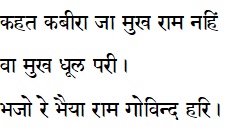
Sant Kabira says:

“The mouth which is not repeating Rama (God’s name), that mouth is filled with dirt. So, O My Brother! Sing Rama, Govinda, Hari (God’s names).”

When we are not repeating God’s name, we are talking about useless things and many times talking trash. When our mind is filled with spiritual consciousness, we are aware of what we are talking about, and we will not say meaningless or harmful words.

Let us sing God’s glories to purify our minds, speech, and actions.

Shiva Mahimna Stotra – Shloka 2

Shiva Mahimna Stotra

Shloka 2

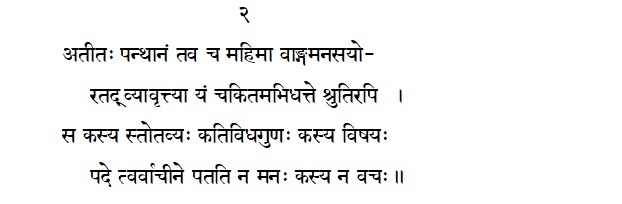
Meaning: (and O Lord Shiva!) Your glories are beyond the reach of the mind and the speech. Even the scriptures, being astonished by Your incomprehensible form, establish You by negating everything else through ‘Neti Neti”. Who can describe Your glories? Who can tell how many virtues You have? Who can make You a subject of comprehension? But, when You manifest with your divine form, whose mind and speech do not get attracted to You?

Reflections: The thoughts of the shloka -1 continue in this one.

Pushpadanta says that the glories of Lord Shiva as Brahman, the Absolute, the Formless and devoid of qualities, the Infinite, are beyond the comprehension of the mind and speech. Even the scriptures are aware that whatever they describe makes the Brahman limited. That is why the scriptures humbly establish Brahman by negating anything that is perceived through the mind and the senses, saying ‘Neti, Neti’, meaning ‘not this, not this’.

Some people think that the Lord is infinite but has virtues, auspicious qualities, called ‘Gunas’. Shri Pushpadanta says that who can even describe the ‘Gunas’ of the Lord. The Lord has infinitely many virtues. No one can sing the full glories of the Lord. 

Brahman cannot be an object of study, because It is the subject. Because I am different from a lamp, I can study the lamp. In that case, I am the ‘subject’ and the lamp is an ‘object’.  But, when I want to know Brahman, the problem arises. In this case, both the subject and the object are the same. Since ‘I’ is Brahman, It cannot separate itself from Brahman to know.

Kenopanishad (1.4-9) says, “Know that That alone is Brahman

“which cannot be expressed by the speech, but by which the speech functions,

“which cannot be apprehended by the mind, but by which the mind apprehends,

“which cannot be perceived by the eye, but by which the eye perceives,                                       

“which cannot be heard by the ear, but by which the ear hears,

“which cannot be activated by the vital forces, but by which the vital forces become active,

“and not the one that people worship.”

Kenopanishad tells that Brahman is not the symbol that people worship.

However, when the same Brahman manifests in the universe with a form, like the form of Lord Shiva, then It naturally attracts the minds and the hearts of the devotees. This divine form is enchanting. Devotees get attracted to the Incarnations of God, the spiritual teachers, and the devotees from whom Brahman manifests.

Sri Ramakrishna used to salute, saying, “Bhagavata, Bhakta, Bhagavan”, meaning, “Scriptures, Devotees, Lord”.  If we read and reflect upon the scriptures, it uncovers our inner divinity that is hidden by ignorance. The Lord dwells in the hearts of the devotees. Thus, when we meet the devotees, we feel the presence of God.  The Incarnations are one hundred percent manifestations of God. Devotees who are around the Incarnations feel that they are living with God.  

Thus, Pushpadanta says that even though Lord Shiva, as Brahman, is infinite and indescribable, his mind, like the other devotees’ minds, gets attracted to Him.

In the next shloka, Pushpadanta gives a reason why he is trying to describe Lord Shiva’s virtues even though they cannot be described.

Shiva Mahimna Stotra – Shloka 43

Shiva Mahimna Stotra

Shloka 43

Meaning: This Shiva Mahimna hymn has been sung by Pushpadanta. It is Lord Shiva’s favorite hymn. It removes all impurities. Lord Mahesha (Shiva) becomes greatly pleased with the person who memorizes this hymn and recites it regularly with a focused mind.

Reflections: This is the last shloka of Shiva Mahimna Stotra. The recitation of this great hymn purifies our minds and gives us an experience of Lord Shiva’s presence.

How do the impurities of our mind go away by the recitation of this hymn?

Impurities are thoughts. For example, hatred is not good. A mind filled with hatred is an impure mind. The root problem of the hatred is an ignorance that there is only One Existences, Brahman, which is manifesting through various forms.

We hate a person or an object in the world because that person or an object is an obstacle, in some sense, in our mental plan of deriving worldly happiness. We forget that whether we like it or dislike it, that person or an object is also Brahman. Only because of my limited mental selfish plan for worldly happiness we had created these divisions of likes and dislikes. By reciting Shiva Mahimna Stotra and reflecting upon its meaning, we establish the fact in our mind that Lord Shiva as Brahman is appearing in various forms. This establishes ‘Oneness’ in our thoughts, speech, and actions. Simultaneously, we understand and accept the fact that hatred is caused because of a lack of awareness of Oneness and also because of our selfish idea of worldly happiness created by this ignorance. The more we advance towards Oneness, the more we develop love and acceptance of all and the hatred will get lesser and lesser. This is how we purify our minds from hatred. Similarly, by reciting Shiva Mahimna Stotra, by the grace of Lord Shiva, we can purify our minds from all other impurities.

Here is another way to look at this process of purity. Impurities are thoughts in the mind created by fundamental ignorance of Ultimate Reality. By reciting Shiva Mahimna Stotra and reflecting on its meaning, we fill our minds with pure thoughts. When we fill our minds with more and more pure thoughts and do not feed the impure thoughts, the impure thoughts will eventually die and go away from our minds. When our minds become pure, Lord Shiva shines in our hearts.

Lord Shiva loves all. But, if we develop a love for Lord Shiva by reciting His hymn, and thinking about His glories, then we can experience Lord Shiva’s love in our life. Through this, our life becomes meaningful and gets filled with inner bliss.   

As a young boy, during my summer vacation, I used to go to our village house in Pij, Gujarat, India. In this village, there was a Shiva temple in a very serene environment having a lake and bilva trees around. I used to go there often in the morning and recite this Shiva Mahimna Stotra eleven times in the temple. It was a very uplifting experience. I have a deep memory of these recitations. The mind easily gets uplifted if we recite it with devotion and reflect upon the meanings of the shlokas.

This concluding shloka encourages us to memorize the hymn and recite it regularly. Once we memorize it, then we don’t need a book to carry with us. We enjoy singing it anytime, anywhere.

May Lord Shiva bless us all and give us knowledge and devotion. Om Namah Shivaya. 

Shiva Mahimna Stotra – Shloka 32

Shiva Mahimna Stotra

Shloka 32

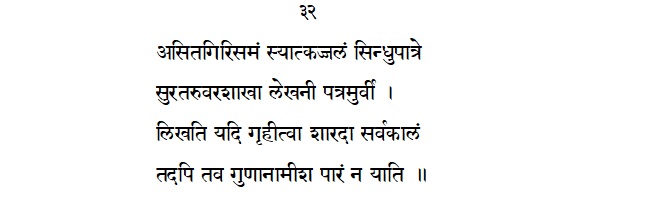
Meaning: O Lord Shiva! If in the inkpot of an ocean, there is an ink equal to the blue mountain and Saraswati, the goddess of knowledge, takes a pen made from a branch of a celestial tree and describes your glories forever on the earth using it as a paper, even then your glories will not come to an end.

Reflections: Pushpadanta’s poetic imagination has fully blossomed in this shloka.

I have mentioned it in the introduction, but I will cite it here again to remember how Sri Ramakrishna’s mind was uplifted by this shloka and made him go into spiritual ecstasy. This was recorded by Swami Saradananda in his book1.

“One day, the Master (Sri Ramakrishna) entered one of the Shiva temples of Dakshineswar and began to recite the Shiva Mahimna, a hymn in praise of the Deity. He was beside himself in ecstasy as he recited the following verse: “O Lord! Imagine if the ink is prepared by dissolving a blue mountain into an ocean, the biggest branch of the celestial tree becomes the pen to write, and the earth the writing paper, and if by taking all these things, Saraswati, the goddess of Learning, writes your glories forever, even then she cannot describe your glories.”

“While the Master was reciting the above verse, he intensely felt the glory of Shiva in his heart, and he lost himself. He forgot the hymn, the Sanskrit language of the hymn, the order of the verses, and so on, and repeatedly cried aloud, “O Lord, how can I express Your infinite glory?” Tears poured down his cheeks, chest, and clothes, finally dampening the floor.”

We generally are so busy with our work, and enjoyment, or our minds are filled with worries that we missed the wonders presented around us. People who focus their minds on the mysteries of life and the world, get filled with awe being touched with the infinite divine power. If we stop running around with our routines, sit quietly for a while in solitude, and reflect upon ‘what makes me see, hear, touch, taste, and smell?’ or ‘how my heart and the digestive system work in the body?’, or ‘what makes me think?’, we will be filled with wonder.

In an article written by Rachel Tompa2, we get an idea of how scientists’ minds realize this wonderful divine power and how limited is our comprehension.

She writes, “If you ask Christof Koch, Ph.D., Chief Scientist and President of the Allen Institute for Brain Science, how close we are to understanding our own brains, he scoffs.

“We don’t even understand the brain of a worm,” Koch said.

The lab roundworm, more technically known as Caenorhabditis elegans, houses 302 neurons and 7,000 connections between those neurons in its microscopic body. Researchers have painstakingly mapped and described all those connections in recent years. And we still don’t fully understand how they all work synergistically to give rise to the worm’s behaviors.

We, humans, have approximately 86 billion neurons in our brains, woven together by an estimated 100 trillion connections, or synapses. It’s a daunting task to understand the details of how those cells work, let alone how they come together to make up our sensory systems, our behavior, our consciousness.”

Let us think about how this earth, sun, and other planets are rotating and creating an environment for us to live. If the sun comes closer to the earth, everything on earth will be burnt. If the sun goes away from the Earth, then everything on Earth will be frozen to death. When we think how this divine power is manifesting itself and functioning through us all, we find it is mind-boggling.   

Anything we touch with our mouth is considered ‘jhutha’ or polluted. Sri Ramakrishna said that Brahman has not become ‘jhutja’ because we cannot describe Brahman. Whatever we describe becomes limited.

Taittiriya Upanishad (2.9) says:

One who realizes Brahman finds that the mind and speech fall short to comprehend or describe Brahman.

Swami Vivekananda reflected this thought in his following line which the devotees of Sri Ramakrishna sing every day:

“I salute again and again the Lord (Brahman) who is beyond the comprehension of the mind and the speech.”

The bottom line is that the glories of the Lord (Brahman) cannot be described fully. They are infinite.

[1. Sri Ramakrishna and His Divine Play by Swami Saradananda, translated by Swami Chetanananda, page 487.

2. Rachel Tompa is Senior Writer at the Allen Institute. She covers news from all scientific divisions at the Institute. Get in touch at rachelt@alleninstitute.org.]

Shiva Mahimna Stotra – Shloka 30

Shiva Mahimna Stotra

Shloka 30

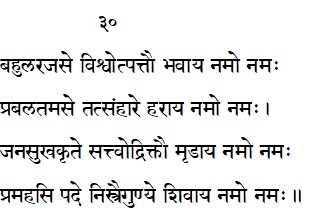
Meaning:  I salute again and again your form of Brahma filled with the abundance of rajas to create the universe, your form of Rudra filled with the abundance of tamas to dissolve the universe, and your form of Vishnu filled with the abundance of sattva to preserve the universe for the happiness of people. I salute again and again to self-luminous Shiva, your serene and peaceful form, who is beyond the three gunas and the final goal of all, which is liberation.

Reflections: According to the Vedanta, Brahman is the Ultimate Reality of the universe. The Power of Brahman is called Maya, Prakriti, Avidya, or Shakti. Technically there are differences between them, but in general, they are fundamentally the same.

Sri Ramakrishna, again and again, said that Brahman and Shakti are the same. When inactive, we refer to It as Brahman, and when It is engaged in the creation, preservation, and dissolution of the universe, we refer to It as Shakti. The same power appears in the form of Brahma (the creator), Vishnu (the preserver), and Mahesha (the dissolver). 

Sri Ramakrishna said that as fire is unmanifested in the wood, Shakti is unmanifested in the Brahman. He also said that as fire and its burning power, milk and its whiteness, a snake and its wriggling movement, and a jewel and its luster are inseparable, so are Brahman and Shakti.  

This Shakti or Prakriti is made of three gunas, namely sattva, rajas, and tamas. When the three gunas are balanced, then Prakriti merges into Brahman and remains unmanifest. The imbalance of the three gunas makes the universe function.

These thoughts have been clearly mentioned in the scriptures. The Brahma Sutra (1.1.2) says that ‘Brahman is the only cause of creation, preservation, and dissolution of the universe’.

Actually, Brahman is Omnipotent, Omniscient, Infinite, and devoid of any qualities. However, It appears as the universe because of Its delusive power Maya.

In Viveka Chudamani, Sri Shankaracharya calls the power of Brahman as Avidya or Maya.

“Avidya or Maya is the power of the Lord. It is Unmanifested when It is inactive. It is beginningless, supreme, and made up of three gunas; sattva, rajas, and tamas. Wise people realize Its existence by Its effects. It brings forth this whole universe.” Viveka Chudamani – 108

In Shri Durga Saptashati (11.11) Rishi says, “O Narayani (All-Pervading Mother)! You are the power to create, preserve, and dissolve the universe. You are the support of the three gunas (sattva, raja, and tamas) and you have all the virtues. I salute you.”

In the Bhagavad Gita, Shri Krishna mentions that Brahman is the cause of the creation, preservation, and dissolution of the universe and Its power is Prakriti.

Shri Krishna said, “My inferior Prakriti consists of eight things: Earth, water, fire, air, space, mind, intellect, and ego.

“O Arjuna! With My superior Prakriti, the Indwelling Spirit, the universe is sustained.

“Know that these two Prakritis of mine are the cause of all beings. I am the origin of the entire universe and also its dissolution.” (Bhagavad Gita 7.4-6)

In the following shloka, Shri Krishna mentions the cyclical nature of the universe; it appears, sustains, dissolves, and appears again and the cycle goes on.

Shri Krishna said, “O Arjuna! At the end (time of dissolution) of the cycle of the universe, all beings enter into My Prakriti and at the beginning of a cycle I generate them again.” (Bhagavad Gita 9.7)

Because of Rajas, people have a desire for progeny, and we have creation. Because of Sattva, parents have love in their hearts, and children are being nourished. Because of Tamas, there is the dissolution of the universe in order to recycle the universe.

The same thing applies to the whole universe. That is why, Pushpadanta wrote in this shloka that with the abundance of Rajas, the power of Shiva as Brahman, creates the universe. He called this power or form of Shiva “Bhava”, and “Bhavaya” means ‘to Bhava’. The Sanskrit root of this word is “Bhu” which means ‘to be born’. He said, ‘I salute to Bhavaya’.

With the abundance of Sattva, the power of Brahman sustains the universe. This power or form is called “Mrida” or “Mruda”, and “Mridaya” means ‘to Mrida’. The Sanskrit root of the word is “Mrida” or “Mruda” and its meaning is ‘one which gives joy’. Out of joy, the power of Brahman preserves the universe. That is why Pushpadanta says, ‘I salute to Mridaya’.

With the abundance of Tamas, the power of Brahman dissolves the universe to create the universe again. This power or form is called, “Haraya”.  The Sanskrit root of the word is “Hara”, one who takes away everything. Pushpadanta says that ‘I salute to Haraya’. Devotees say “Om Namah Parvatipataye Hara, Hara, Mahadeva Hara”. Meaning, “O Lord Shiva, the husband of Parvati, please take away all our problems, sufferings, and ignorance.”

Brahman is beyond the three gunas. When all three gunas are balanced, then the Prakriti merges into Brahman, and so does the universe. Only Self-luminous Brahman remains. In the fourteenth chapter of the Bhagavad Gita, Shri Krishna says that when one goes beyond the three gunas, one merges with the Lord. This is the ultimate goal of all beings. We have to make spiritual efforts to control tamas by rajas, rajas by sattva, and then go beyond the three gunas knowing that ‘I am Atman. I am the witness consciousness, and I am beyond the three gunas.’ Pushpadanta calls this form as “Shiva”,  and “Shivaya” means ‘to Shiva’. The meaning of Shiva is ‘one who is auspicious. Pushpadanta says, ‘I salute to Shiva who is auspicious and beyond the three gunas’.    

We have to see Shiva or Brahman in everything. Also, we have to learn about three gunas and how to go beyond the three gunas from the Bhagavad Gita, especially from chapters 14th, 17th, and 18th.  

Shiva Mahimna Stotra – Shloka 29

Shiva Mahimna Stotra

Shloka 29

Meaning: O Lord who loves to live in the forests (enjoys solitude)! Salutation to thee who is very near and is very far. O destroyer of the god of lust! Salutation to thee who is very subtle and huge. O Lord with three eyes! Salutation to thee who is the oldest and the youngest. Salutation to thee who has become all and salutation to the one who has been addressed indirectly or directly in the form of all.

Reflections: Pushpadanta tells in different ways that Lord Shiva is not limited to His form.  He is infinite Brahman.

Pushpadanta has a mastery over the words and an absolute command of the Sanskrit poetic meters. His thinking is very logical, and his heart is filled with love for Lord Shiva.  This shloka reflects all these talents. He is giving us a convincing visual picture of how Lord Shiva is everything in this universe.  

Pushpadanta says, “I salute to Shiva who is very near to us and is very far.” Lord Shiva is very near to us. As Atman or inner consciousness, Lord Shiva is our true identity. He is the support of our existence. Just as gold is the reality behind any golden ornament, or clay is the reality behind any clay toy, Lord Shiva as Atman is the ultimate reality of our existence. Due to ignorance of our divine nature, we assume that we are finite and made out of body and mind. Thus, Lord Shiva is closer than our body-mind existence.

On the other hand, Lord Shiva is omnipresent and is everywhere in the universe and is beyond the universe. Lord Shiva resides everywhere in the universe which we can perceive through our most powerful telescope and is beyond those boundaries. There is another way to look at the statement ‘Lord Shiva is far’. Because Lord Shiva is so close to us, we don’t realize Him, and we look for Him outside further and further away. Many times, we miss the values of the people and things which are close to us. We take them for granted. Thus, Lord Shiva is far. This way, Brahman covers the span of the mind. Far and near depends on the state of the mind. 

Pushpadanta says, “I salute Lord Shiva who is most subtle and is also huge.” Scientists have shown us that there is tremendous power in an atom. This is the power of Brahman. Also, Brahman is bigger than the universe. Brahman is beyond the boundaries of our telescopes. Pushpadanta is giving us a visual idea of what Brahman is.  This way Brahman covers all of the space and beyond the space.

Pushpadanta says, “I salute Lord Shiva who is the oldest and who is also the youngest.” Brahman is the ultimate cause of the creation, preservation, and dissolution of the universe. Thus, Brahman is beyond the creation of the universe and hence is the most ancient one. On the other hand, Brahman is something that is just born. This way, Brahman covers all the time and beyond the time.

Finally, Pushpadanta says, “I salute Brahman who has become everything.” The highest realization of God is to feel the presence of God inside us and outside us in everything.

In the beginning, it is difficult to see God in something that looks bad, cruel, horrible, impure, unrighteous, etc. That is why, in the beginning, we have to see God in something that is good, unselfish, pure, loving, peaceful, holy, righteous, etc. When we get spiritually mature, then we will realize that God is manifesting through everything. God is manifesting directly through goodness, unselfishness, purity, kindness, righteousness, holiness, etc., and indirectly through bad acts, selfishness, impurity, cruelty, unrighteousness, etc. It is like pristine Ganga water coming out from the Himalayas is Ganga water and the polluted dirty water of Ganga is also Ganga water. When the dirty Ganga water is purified, it will not be different from the pristine Ganga water.

Pushpadanta is telling us that there is only God which is manifesting through everything and there is only one Power of God which is working through all. Pushpadanta calls this God Lord Shiva and salutes Him.

In this shloka, Pushpadanta gave us four names of Lord Shiva:

 Priyadava means Shiva who loves quiet forests. Shiva loves meditation. Hence, He enjoys solitude. He is teaching us to seek solitude. Sri Ramakrishna emphasized going into solitude often and sincerely praying to God for knowledge and devotion. Along with prayer, we have to think about what is permanent in this universe and what is impermanent. Sri Ramakrishna said that God or Brahman is only permanent and everything else is impermanent. Let us learn from Shiva to get absorbed in the meditation focusing our mind on Brahman. Once we learn how to keep our mind focused on Atman or Brahman in solitude, we can do it in the midst of a city street filled with activities and noises.

Smarahara means Shiva who has destroyed the god of lust.  Bhagavad Gita says that lust, anger, and greed are the three doors to hell, meaning the low life. Sri Ramakrishna emphasized getting rid of ‘lust and greed’. Anger follows lust and greed. God created lust for progeny, to continue Its creation. But, beyond that lust brings the mind down to the body and cannot let it think something higher. Lust makes people slaves, and they suffer immensely. Sri Ramakrishna said that after one or two children, the husband and wife should focus their minds on the ultimate goal of life, God-realization, and help each other to attain this goal. This will bring inner peace, bliss, fulfillment, awareness of God in all, love for all, fearlessness, and freedom from all bondages. Lord Shiva taught us to burn lust so that it cannot deviate our mind from our ultimate goal. It is not easy to control lust and one should not boast about controlling it. There are examples of people in the scriptures who thought they had controlled lust and then became victims of it.  We have to pray to God for strength to control lust and keep our minds in the spiritual consciousness.  We read in the scriptures that usually Lord Shiva meditates, but when He is not meditating, He and Mother Parvati spend time in spiritual conversations.   

Trinayana means Shiva with three eyes, having the third eye of Knowledge. With spiritual development one develops a divine intuition. This makes the seeker see the hidden Reality which others cannot see. This intuition also leads the seeker to pure thoughts, speech, and actions which help realize God. With the third eye of Knowledge of Brahman, Lord Shiva burnt the god of lust. It is also called an inner vision of Ultimate Reality.

Sarvasmai means Shiva who is manifesting through all the forms. Tat means ‘that’ which is incomprehensible, and idam means ‘this’ which is comprehensible. Both these are nothing but Lord Shiva (Brahman).  Pushpadanta says ‘I salute to this Shiva who has become everything’.    

This shloka tells us that Lord Shiva is no one else but Brahman, and how we can see Him in everything.

Shiva Mahimna Stotra – Shloka 26

Shiva Mahimna Stotra

Shloka 26

Meaning: Intellectually developed people make you limited by saying that ‘You are sun, moon, wind, fire, water, sky, earth, and soul’. But, in this universe, we do not know anything which is not You.

Reflections:  Hindus know that God is only one, called Brahman, and Brahman is infinite, formless, and free from all qualities. Since it is difficult to meditate on the formless Brahman initially, seekers of God are encouraged to meditate on various forms of Brahman (God) endowed with qualities according to one’s liking. There is total freedom in selecting the forms and qualities of God. That is why the Hindu religion has reached mythology. However, all the seekers of God are reminded again and again that these forms are limited, and they are just the representations of the infinite Brahman. This will prevent them to be fanatics about the particular forms of God. Pushpadanta, in this shloka, addresses this point in a very poetic way.

There are several lists of gods and goddesses available in Hinduism. One of the lists talks about eight manifestations of Brahman, namely, five elements (space, wind, fire, water, and earth), two illumined objects (sun, and moon, which are considered as the eyes of Brahman), and Atman (the inner consciousness). In Bhagavad Gita, Shri Krishna says that wherever one sees special power manifesting through a person or an object, one should know that it is the ‘Power of Lord Krishna’, meaning the power of Brahman. One can meditate first on that manifestation and then develop a way to meditate on the infinite, formless, and qualityless Brahman.        

In this shloka, Pushpadanta poetically says that Lord Shiva as Brahman is not only the eight manifestations, but there is nothing in the universe that is not Brahman. Brahman is what we perceive in the universe and is beyond what we perceive. Actually, one who is searching for Brahman is not different from Brahman. Out of ignorance one separates oneself from Brahman and then looks for Brahman.  

No one can describe Brahman. Whatever we describe becomes limited. Brahman is infinite and unlimited. Sri Ramakrishna says that everything in the universe has become ‘jhutha’ except Brahman. Whatever touches our mouth is considered ‘jhutha’. We think that we can describe all the objects and beings in the universe because they are limited. But Brahman is even beyond our comprehension because our mind is limited. Again, Sri Ramakrishna says that one cannot put ten gallons of milk in a one-gallon container.  

The truth that ‘Brahman has become everything’ has been mentioned all over in the Hindu scriptures. The following are a couple of examples:

Ishopanishad, line 1 of mantra 1, says:

“ALL THIS – whatever exists in this changing universe – should be covered by the Lord.”

Lord Shri Krishna, identifying himself with Brahman, says the following in the Bhagavad Gita:

“O Arjuna! There exists nothing whatever higher than I am. All is strung on Me (Brahman) as a row of gems on a thread.” (Gita 7.7).

“One who sees Me (Brahman) everywhere and sees everything in Me, to that person I am never lost, nor he/she is ever lost to Me.” (Gita 6.30).

 “At the end of many births, the person of wisdom, realizing that ‘Vasudeva (Brahman) is all’, worships Me (Brahman). Rare indeed to find such a great soul.” (Gita 7.19).

Shiva Mahimna Stotra – Shloka 12

Shiva Mahimna Stotra

Shloka 12

Meaning:  The famous Ravana acquired great strength by worshipping Lord Shiva. But, with that strength, he started to shake your abode, Kailash. However, when you gently pressed the tip of your toe (on Ravana’s head), Ravana could not find a place even in Patala, the lowest plane in the universe. Truly, a wicked person loses a sense of right and wrong when he/she acquires wealth and power.

Reflections: Ravana worshipped Lord Shiva and acquired great strength and wealth. But he forgot that all his glories came from Lord Shiva. At one point he wanted to apply the same strength against Lord Shiva and started shaking Kailash, Lord Shiva’s abode. Lord Shiva gently pressed the tip of his toe and with that force, Ravana went down and down in space and became a laughable person. Pushpadanta writes that a wicked person really gets deluded by wealth and strength, and loses the sense of right and wrong. Wicked people have no sense of gratitude, and they learn their lessons the hard way.  

Question: We know that when one realizes God, one gets liberated. Ravana performed severe austerities and realized Lord Shiva, but why then did he bring his own destruction?  

This is my understanding:

Answer:  God is called a “Kalpataru”, the wish-fulfilling tree. Ravana had a desire to conquer the world and acquire all the wealth of the world. With that desire in mind, he intensely performed austerity, much more than any ordinary person can perform. God must fulfill his desire. But that desire led him to destructive ideas which brought destruction of himself, his followers, and his kingdom. 

The theory of Karma says that if we have a desire, then we will act accordingly, and we must go through the consequences of our actions. However, if we have a desire for knowledge of the Ultimate Reality and love for God, then this desire will liberate us from all other worldly desires, and make us free from all our bondages.  

People whose minds are filled with tamas and rajas have desires to harm people or to acquire worldly gain. Many of them pray to God to fulfill their desires. The power which creates, preserves, and dissolves the universe gives strength to these people to fulfill their desires, but then they must suffer the consequences of their actions.  Therefore, if we do not want to suffer anymore, and want to be liberated from all our bondages and experience infinite bliss within, then we must pray to God for Knowledge and Devotion.

One more lesson we learn from this shloka is to recognize all the help we have received and to be thankful to all who have helped us.  Parents help us to grow, teachers help us to learn, and many people and objects of the world help us in various ways to survive, work, and for our achievements. We must recognize this help, be thankful to all, and do our best to return this favor in some way. Even if we live a decent life grounded by morality and spirituality, then all who have helped us will be happy for the sacrifices they have made for us.

The ego is the main obstacle to recognizing other people’s help. It wants to boast thinking that ‘I have done everything by myself’. Developing a sense of gratitude does not make us smaller, but it makes us humble, and it adds up to our self-dignity and awareness of reality.   

Shiva Mahimna Stotra – Shloka 10

Shiva Mahimna Stotra

Shloka 10

Meaning: O Girisha (Shiva)! To measure your glories which appeared as a luminous pillar, Brahma went above, and Vishnu went below. Thus, they made lots of effort. But they could not measure your glories. Then, being filled with devotion and faith, when they sang your glories, you revealed yourself to them. A prayer filled with devotion and faith definitely leads to the realization of the Lord.

Reflections:  This shloka tells us that no one can fully comprehend Brahman, the absolute aspect of God, even the divine forms Brahma, and Vishnu.

The story goes that a dispute arose between Brahma and Vishnu about ‘who is greater’. Each one claimed that he was greater. Brahma said that he is greater because he creates the universe and Vishnu said that he is greater because he preserves the universe and Brahma has been born from his navel. The dispute could not be resolved, and it became intense. Out of anger, each one threw a weapon at the other. Lord Shiva stopped both the weapons and thus stopped great destruction, and He appeared as the infinite luminous pillar.

Brahma had not created that pillar and Vishnu had not seen it before. Both were amazed by its luminosity and infinite nature. Both planned to check out the source of the pillar. Brahma went above and Vishnu went below. But they could not find its end and its source. They felt ashamed of their boasting. They found something higher than them. Finally, both forgot about their fight, their hearts got filled with faith and devotion, and with folded hands, they asked this divine force to reveal itself.  At that time, Brahman appeared in the form of Shiva and told that Brahman is the Ultimate Reality of the universe and It appears as Brahma, Vishnu, and Shiva.   

We can learn from this that we boast about our worldly achievements and think that we are great. But, when we think of the infinite power and glories of God manifesting in the universe, then we look very timid. For example, when we see Himalayas, or an ocean, or Grand Canyon, or think of the infinite sky filled with planets, stars, and galaxies, or the infinite time, then we realize that we are nothing more than an ant or a very tiny creature walking on earth having a big ego which has a very little value.

Here is a practical way to reduce our ego, pain, problems, and quarrels in our life. Suppose I am sitting in a chair in my study room and a camera is showing only me. I occupy the whole picture. Then, the camera moves further away and shows me sitting in the whole room. Then, it keeps moving away showing me in my house, in the whole block, in the city, in the country, on the earth, and so on. Then, the camera goes out into space where the whole earth becomes like a green pea and then may become a small dot. In this infinite space, what is my existence? It is ridiculous that we walked around with a big worldly ego having achieved something which looks trivial in infinite time. In this perspective, our existence, our pain, problems, and quarrels in our life become insignificant, and we realize that we had mentally magnified them more than their actual reality. Thus, we get a proper understanding and inner strength to go through the adversities of life.  

Now, let us look at it from the Vedantic point of view. A being with body and mind is an extremely limited person, but as an Atman, each individual is not different than Brahman. When we realize our true divine Self, Atman, then we become infinite by being one with the whole universe.          

This shloka also teaches us that if we sincerely pray to God with faith and devotion, then God reveals Its nature.   

Shiva Mahimna Stotra – Shloka 7

Shiva Mahimna Stotra

Shloka 7

Note: Last week, in a summer camp, I taught ‘Introduction of Shiva Mahimna Stotra’ to 8th and 9th-grade students along with a few high school seniors and alumni. I had five periods, and each was forty-five minutes long. For the introduction, I selected nine shlokas out of the forty-three shlokas of the Shiva Mahimna Stotra, namely, 1, 7, 10, 12, 26, 29, 30, 32, and 43. Therefore, I have decided to talk about these shlokas first and then fill in the other shlokas later. In the last blog, I covered the ‘Introduction’, ‘Pranam Mantra’, and ‘Shloka 1’ of the Shiva Mahimna Stotra. Here is the Shloka 7 of the stotra.

Meaning: Three Vedas, Sankhya, Yoga, Shaivite sect, Vaishnava’s sect, and others have described several paths to realize God. People say that ‘this path or that path is the best or more helpful’. But, as the ocean is the one destination of all the rivers’ water, all these various religious paths, created to match various likings of the people, straight or difficult they appear, they all lead to You (One God).

Reflections:  There is only one God and people worship It with various names and forms. Sri Ramakrishna says that mothers cook dishes according to the digestive capacity and the liking of the children. Similarly, God has created all these religious paths to suit the needs of the people. It is futile to try to prove that one path is better than the other. I love my mother, but I cannot tell my neighbor that ‘my mother is the best and he/she should love only my mother’. My neighbor will say that he/she loves his/her mother and thinks that she is great. In essence, mothers are different, but the ‘motherhood’ is the same. 

Rig Veda says, “Ekam Sat Vipra Bahuda Vadanti”, Truth is one, sages call It by various names. Sri Ramakrishna says that follow the path you like to realize God, but do not think that your path is the only right path, and all other paths are wrong. If we sincerely follow our path, we can realize God. Even if our path has some mistakes, if we are sincere and open-minded, then God will correct all our mistakes and guide us in the right direction. Only politicians and religious fanatics who are interested in power and other worldly benefits guide people into religious fights and differences. They are not really interested in realizing God. We hope people understand this truth that God is one and all paths lead to the same God. This way we can avoid hatred created in the name of religion.

As I had mentioned in the last blog, Swami Vivekananda, in his famous speech given on September 11, 1893, at the Chicago World Parliament of Religions, quoted this shloka saying:

“I will quote to you, brethren, a few lines from a hymn which I remember to have repeated from my earliest boyhood, which is every day repeated by millions of human beings: ‘As the different streams having their sources in different places all mingle their water in the sea, so, O Lord, the different paths which men take through different tendencies, various though they appear, crooked or straight, all lead to Thee’.”

Shiva Mahimna Stotra – Shloka 1

Shiva Mahimna Stotra

            Shiva Mahimna Stotra is a hymn filled with Lord Shiva’s glories and enlightening thoughts which help us understand the Ultimate Reality and build our character. It was written by Shri Pushpadanta. He was an angel and a devotee of Lord Shiva. He was well-versed in singing and literature.

            There is a story telling us why Shri Pushpadanta wrote this hymn. Being an angel, he could remain invisible to human beings and fly around the world freely. His greatest joy was to offer beautiful flowers to Lord Shiva every day. Once when he was flying over the garden of King Chitraratha, he observed that there were very special and beautiful flowers growing there that he had not seen. He thought of offering these flowers to Lord Shiva. But the garden was protected by high security. He thought that he could be invisible, and he could fly, so he had nothing to worry about stealing the flowers. He invisibly entered the garden, quietly collected the flowers he liked, and offered them to Lord Shiva. This continued for a few days.

The king was also offering flowers to Lord Shiva. But he found that he was not getting the special flowers that he loved to offer. Upon inquiry, he found from the guards that someone was stealing these flowers lately and they were unable to find the thief. The king observed that there was no flow in the security. He was convinced that this was the job of an angel. He had an idea.  He asked the guards to collect respectfully the flowers and the bilva leaves already offered to Lord Shiva in his temple and spread them around those flower plants from which the thief was stealing regularly. The guards did exactly what the king had told them to do and that night they remained awake hiding behind the bushes.  Angel Pushpadanta came invisibly and started stealing the flowers. But he found that he was losing his power to remain invisible and now all can see who he was. The guards caught him and told him that he lost his power because he insulted Lord Shiva by stepping on and going over the offered flowers and bilva leaves to Lord Shiva. Pushpadanta’s heart was filled with pain knowing that he had insulted his beloved Lord Shiva and he was engaged in wrongdoing. In order to please Lord Shiva and regain His love, he started composing a hymn.  With this hymn, Shri Pushpadanta became immortal and one of the most beloved devotees of Lord Shiva.  Over a period of hundreds of years, by reciting this hymn, millions of devotees had a vision of Lord Shiva and their souls have been uplifted. 

In his famous speech given on September 11, 1893, at the Chicago World Parliament of Religions, Swami Vivekananda said the following1:

“I will quote to you, brethren, a few lines from a hymn which I remember to have repeated from my earliest boyhood, which is every day repeated by millions of human beings: ‘As the different streams having their sources in different places all mingle their water in the sea, so, O Lord, the different paths which men take through different tendencies, various though they appear, crooked or straight, all lead to Thee.’” This is the seventh shloka of Shiva Mahimna Stotra.

The following incident from the life of Sri Ramakrishna2 gives us a clear picture of how people had a vision of Lord Shiva by repeating the Shiva Mahimna Stotra.

 “One day, the Master (Sri Ramakrishna) entered one of the Shiva temples of Dakshineswar and began to recite the Shiva Mahimna, a hymn in praise of the Deity. He was beside himself in ecstasy as he recited the following verse: “O Lord! Imagine if the ink is prepared by dissolving a blue mountain into an ocean, the biggest branch of the celestial tree becomes the pen to write, and the earth the writing paper, and if by taking all these things, Saraswati, the goddess of Learning, writes your glories forever, even then she cannot describe your glories.”

“While the Master was reciting the above verse, he intensely felt the glory of Shiva in his heart, and he lost himself. He forgot the hymn, the Sanskrit language of the hymn, the order of the verses, and so on, and repeatedly cried aloud, “O Lord, how can I express Your infinite glory?” Tears poured down his cheeks, chest, and clothes, finally dampening the floor.”

Let us sincerely study this great hymn, Shiva Mahimna, and uplift ourselves spiritually and asked Lord Shiva to give us His vision to bless our life and be free from all bondages. With this vision our life will be meaningful, we will attain great fulfillment, and we will experience infinite bliss which cannot be obtained by any worldly object, person, or pleasure.  

[1: Chicago Address by Swami Vivekananda, Advaita Ashrama, Kolkata, fifth edition, 2015, page 20.

2: Sri Ramakrishna and His Divine Play by Swami Saradananda, translated by Swami Chetanananda, page 487.]

First, we will salute Lord Shiva with the following shloka:

Meaning: I salute Lord Shiva who is peaceful, auspicious, and the cause of the creation, preservation, and dissolution of the universe. O Lord Shiva! I surrender myself to you. May I realize you.

Reflections:  Lord Shiva’s form is serene, peaceful, and auspicious. By meditating on this form, we also acquire the same qualities. Lord Shiva, as Brahman, the Ultimate Reality, is the cause of the creation, preservation, and dissolution of the universe. There is no other cause for these activities. This Brahman is our true identity which we refer to it as Atman.

For our spiritual development, we have to surrender our ego which is formed by our body and mind, and the fundamental ignorance of our true nature. We pray to God to realize that our true nature is not different from God. 

Meaning: This is Shiva Mahimna Stotra composed by Shri Pushpadanta.

(Meaning of Shloka – 1): “O Shiva, the remover of all sufferings, I am ignorant of your infinite glories. If my hymn is improper, then even the hymns sung by Brahma and other knowledgeable people are also improper because no one has completely fathomed your glories. If the hymn sung by each one according to one’s limited intellect is permissible, then my effort to compose this hymn is not an exception.”

Reflections: No one can describe God’s infinite glories. Take, for example, our eyes. Go deeper to understand how the eyes function. The eyes take pictures that are registered inside us as upside-down images. Then the senses encode all the pictures into messages and then send them to the brain. The brain then puts them together as the things look outside and sends messages to the body to react according to the mind’s feelings. Cameras came from studying how the eyes function. Science has studied some parts of the functions of the eyes, but if we ask the experts, they will say that after some point they don’t know many things about the eyes.

The greatest mystery is how life appears in the mother’s womb. Every day several research papers are published. Each one solves a few problems but raises many other questions. As our knowledge grows, so does our awareness of our ignorance. Thus, God’s glories are infinite and our finite minds cannot fathom them.

If we pray to God sincerely, then God listens to our prayer. God will ignore all our imperfections in our language and expressions.