Dwaraka, Sri Krishna’s Place & Nageshwar, Shiva’s Place
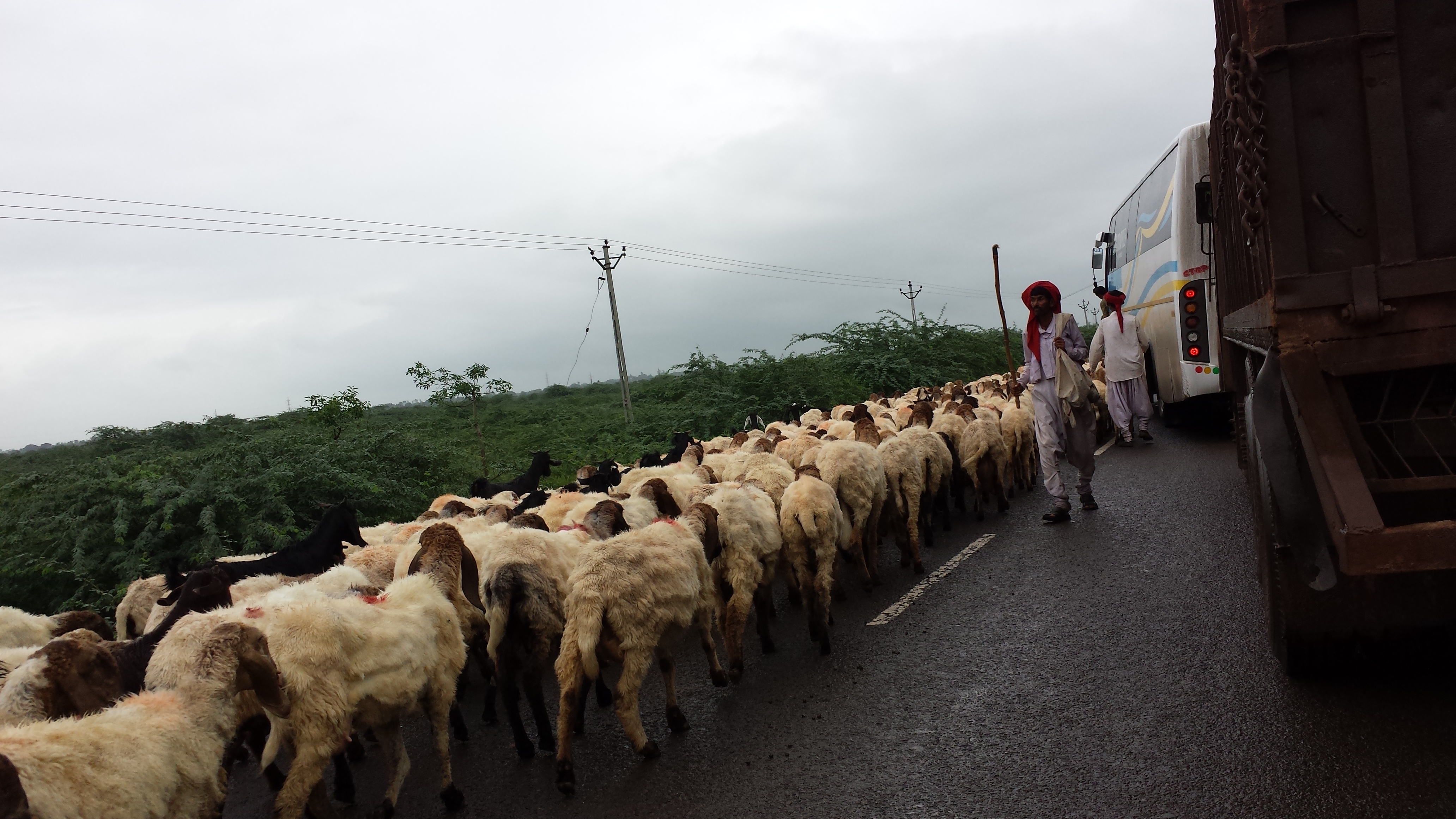
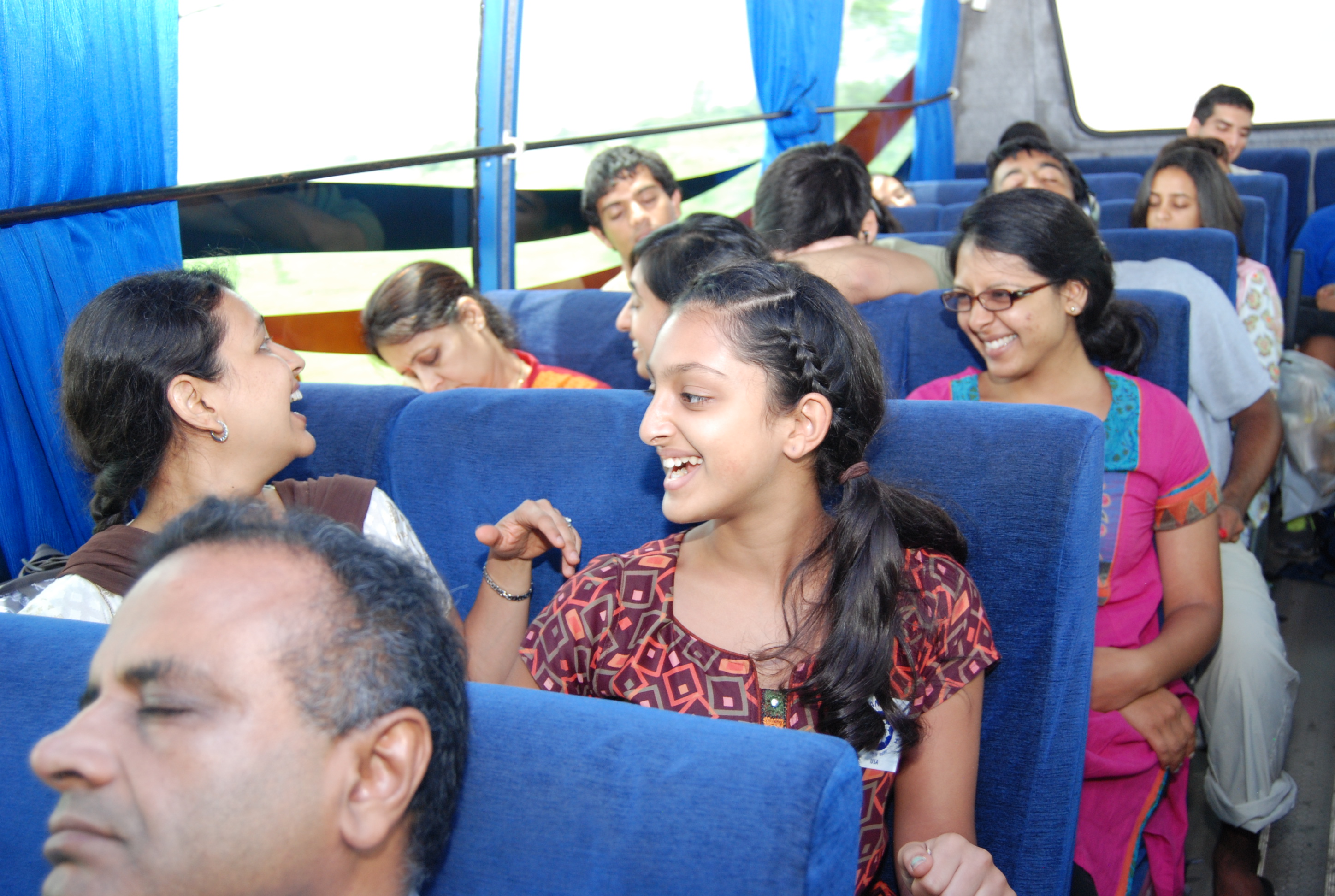
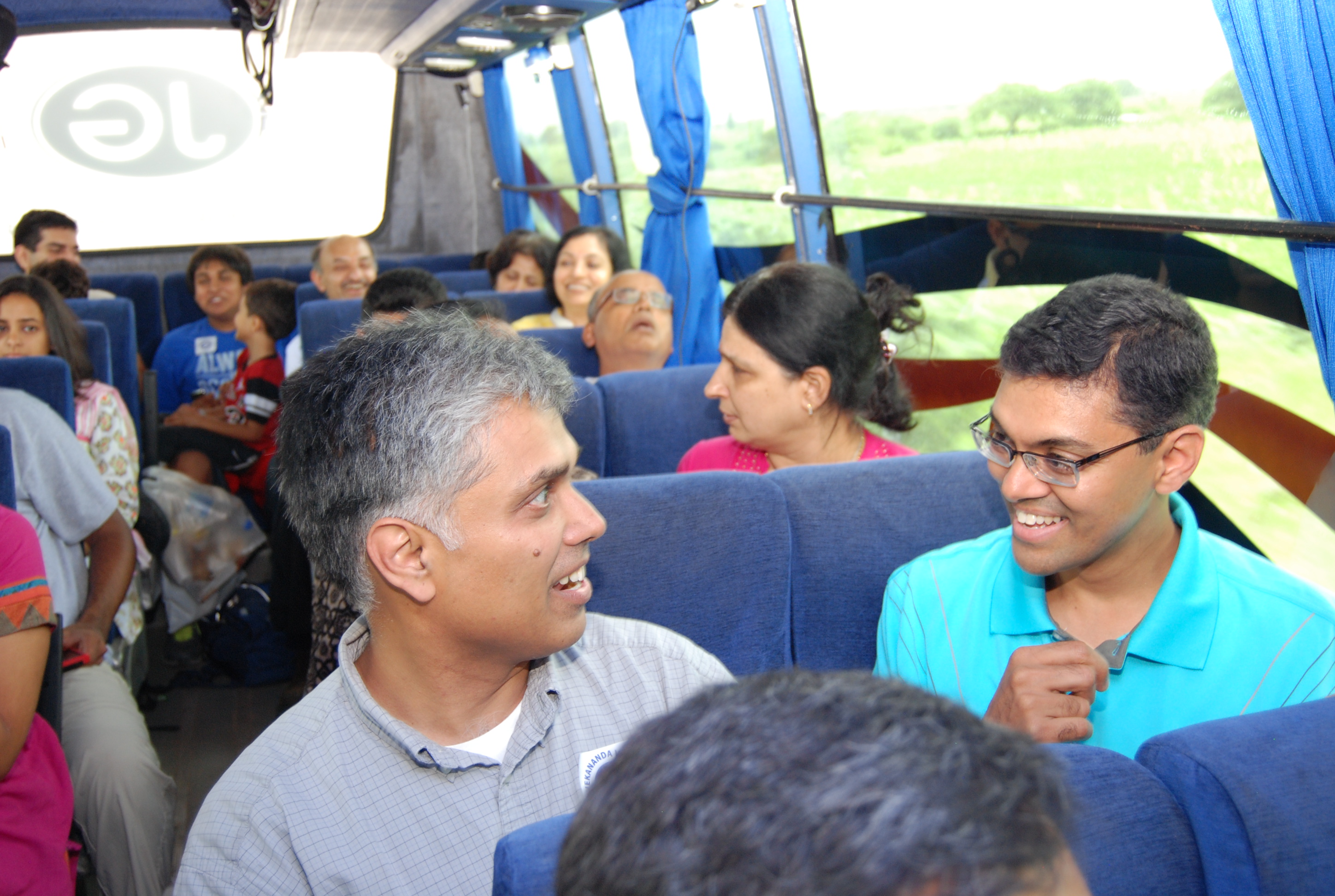
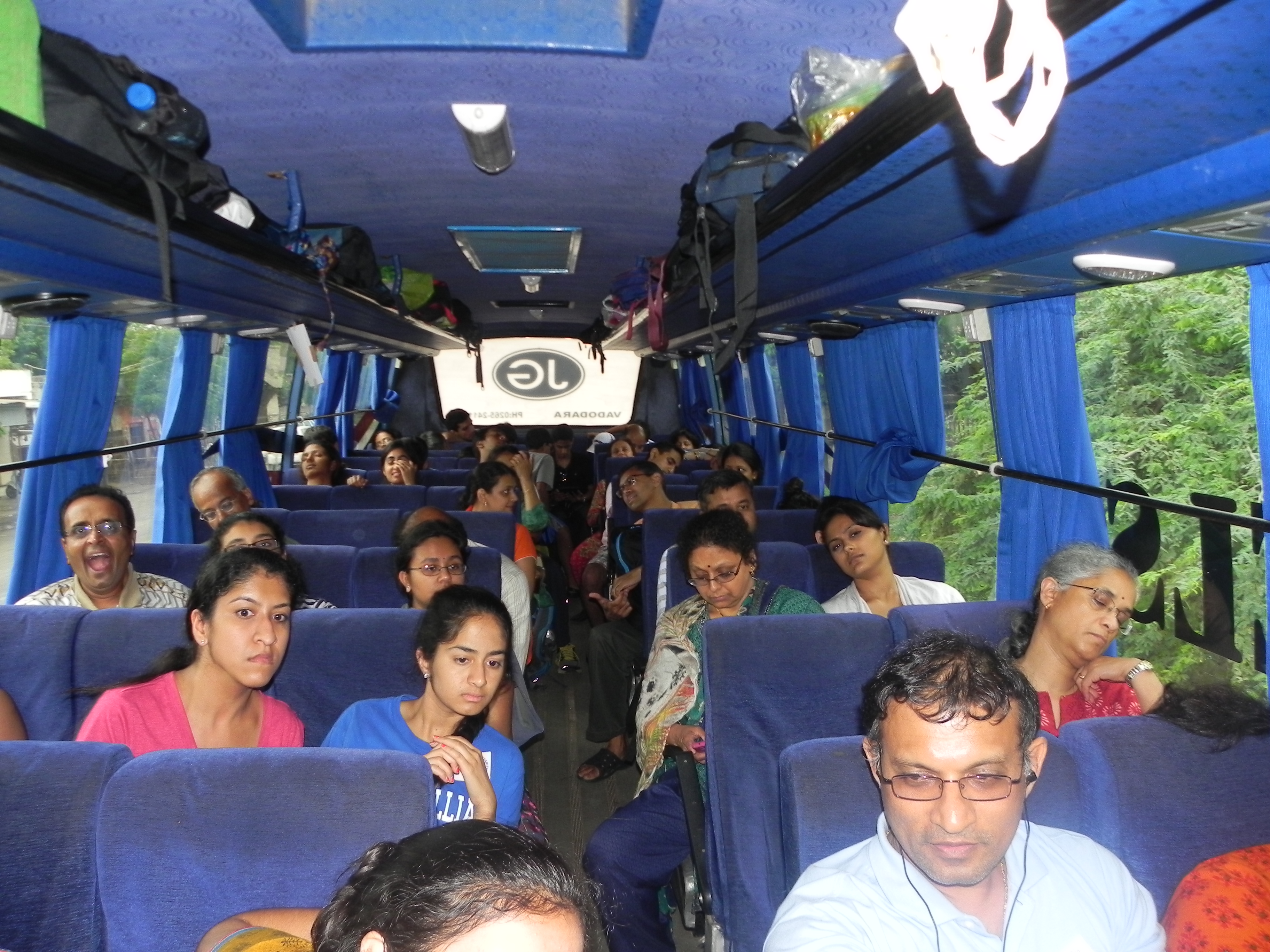
Rajkot to Dwarka was going to be a long drive and we wanted to reach there before 7:00 p.m. to attend the evening arati. We had gotten up early in the morning. So, after a sumptuous lunch, many started to catch up on their sleep. But, the rest of the bus was fully awake–sharing jokes and interesting stories, while others enjoyed observing various things coming on the road.
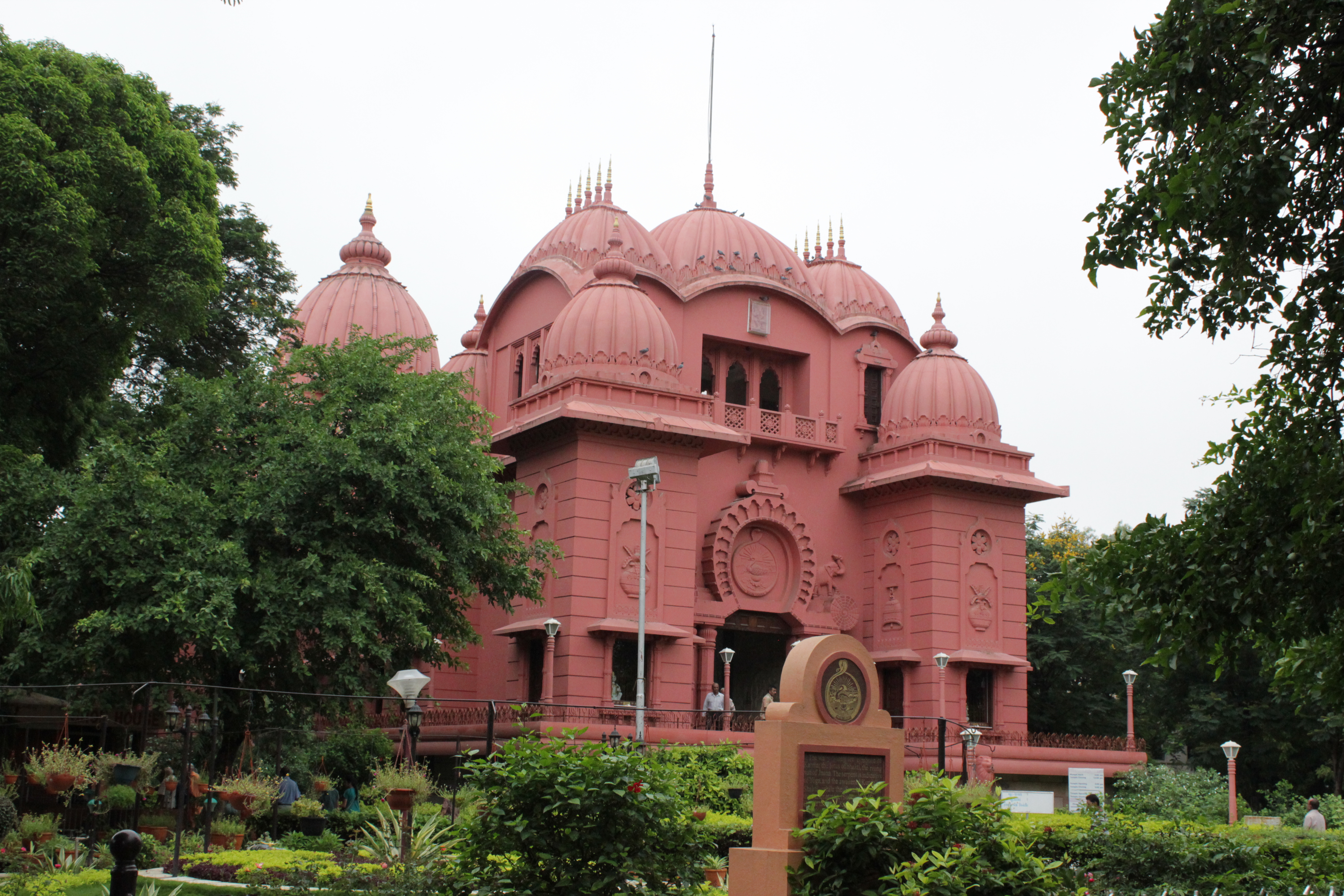
The rain had stopped and the day was bright. We were happy to see many windmills, which were generating natural electricity. When we approached Dwarka, we saw the gorgeous Dwarikadhish Temple from a distance. We were excited to visit the temple. We arrived just on time because of our skillful driver and our planning. Again, thanks to the organizers, the check-in of 54 people in the hotel was smooth and fast. Everyone got ready within a short time and with a guide, we all headed to the famous Dwarakadish Temple. Because of the rain, the roads were filled with mud and water. It was a bit of an adventure. Students, who had come to India for the first time during the monsoon season, learned how to walk on such muddy streets. They also learned how to go around cows and dogs.
As we approached the temple we start hearing joyful cries like “Dwarikadhish ki jai!” Our main concern was to remain together in the crowd. Our guide and adults helped with this. The guide explained the history and mythology behind the main temple and other small temples inside. When the time came for arati, the guide told us to stand in the line for “darshan” of Dwarikadhish Sri Krishna. We saw that some ladies had even stood on the railings to catch a glimpse of the deity. The arati began. People raised their two hands and started chanting Sri Krishna’s names. The environment was filled with devotion. The procedure was that men and women, in separate lines, were to walk one by one, go near the deity, salute and move onward. If you wanted to do “darshan” again, then you had to stand in line again. Some people went two-three times to satisfy their desire to see Dwarikadhishji. When Swami Vivekananda came here in 1891, he wrote that Shri Krishna’s image was beautiful, but the crowd would not let you stand in front of deity for long. One had to look at the deity, then keep it in one’s heart, and close the doors of the eyes.
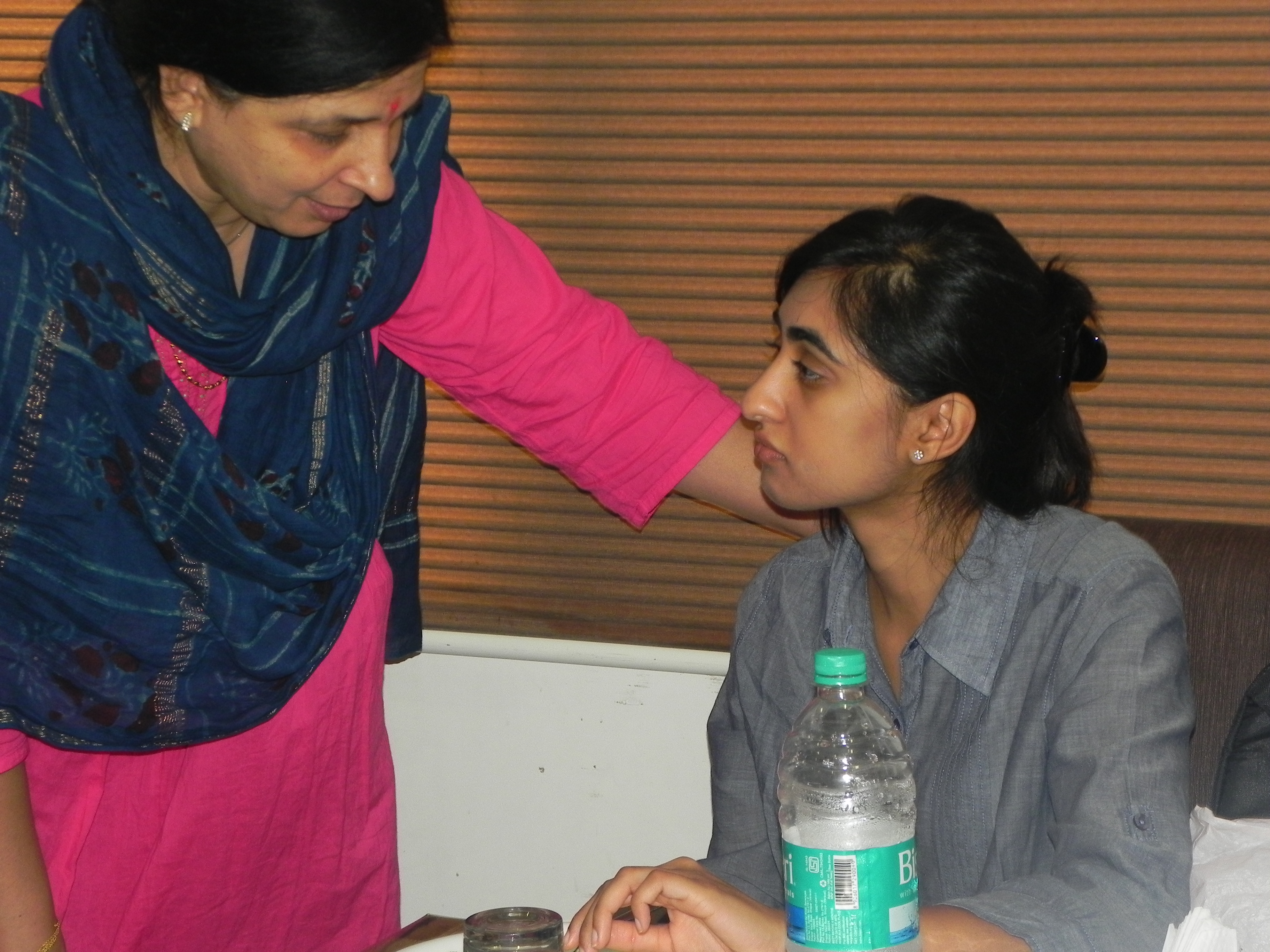
After all had “darshan,” our guide took us to Sri Adi Shankaracharya Pitham, which was next to the temple inside the campus. The current Shankaracharyaji was not there. The guide then took us to several small temples and told us the stories associated with them. Fully satisfied with our visit, we proceeded back to our hotel. Upon arriving back at the hotel, we learned that since we missed our dinner reservation time, we had to wait for an hour before the hotel could accommodate 54 people. So we all sat in the lobby waiting for food. Trupti Aunty and a few students sang Shri Krishna’s dhoons and bhajans in the lobby. After dinner, all wanted to sleep. We were about to retire to our rooms, when some of us heard that the bus had run into a mechanical problem. Our bus driver was trying to find a mechanic. We left it in the driver’s hands.
A few devotees decided to attend the mangala arati at 6:00 a.m. They got up early, got ready, and enjoyed the early morning arati. Their extra reward was that they had a group picture taken by a professional in front of this famous temple for a very reasonable price. As we were finishing breakfast, we waited for news about the bus. We were worried about whether the bus would run. Fortunately, Kalpitbhai and the driver had found a mechanic at night and fixed the problem. We were lucky and ready to go!
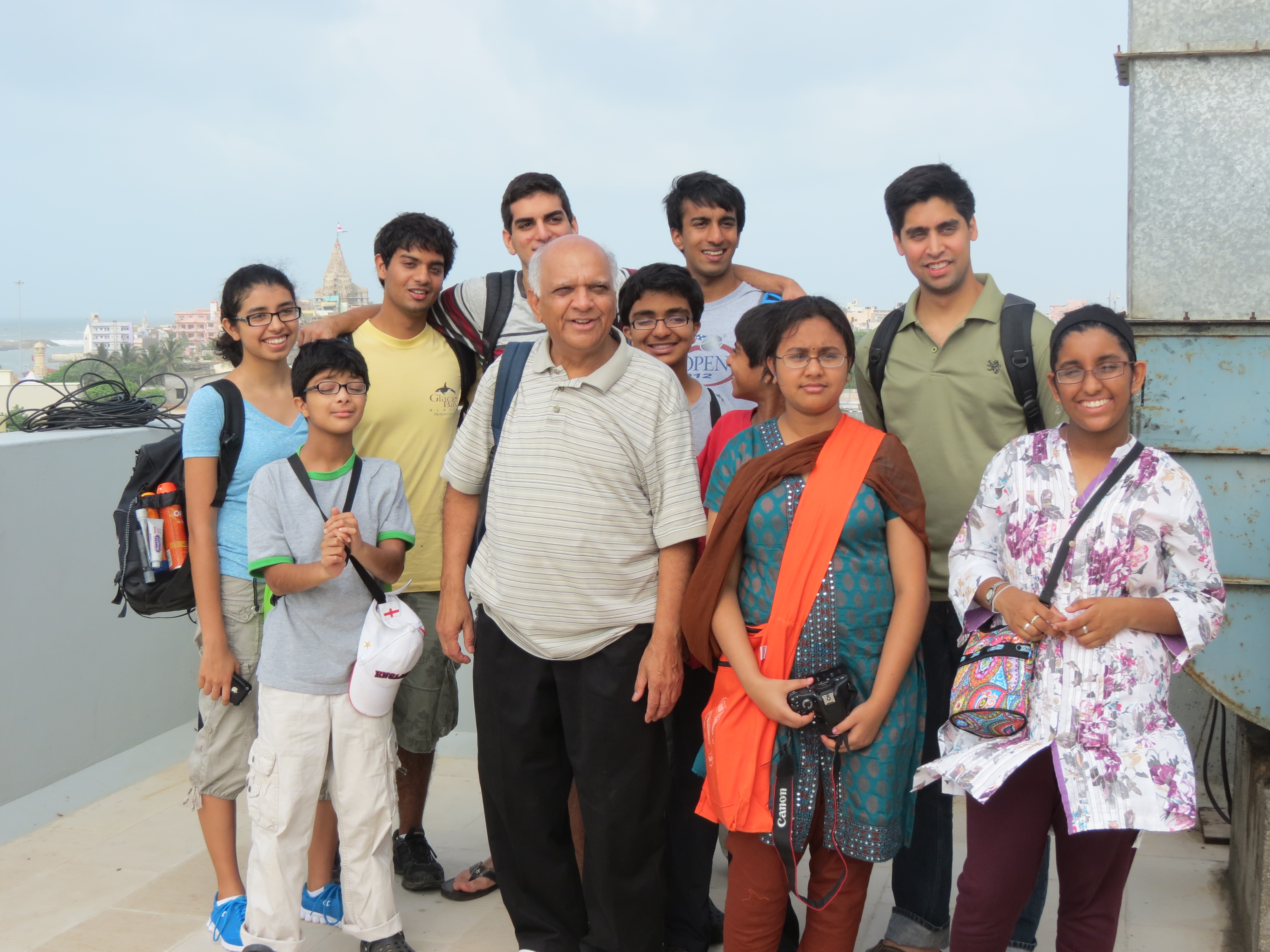
One good thing happened in the morning. Sudhirbhai told us that they could see the ocean from their room windows. We all ran to his room and found a spectacular view of ocean. Then, we found that from the terrace we could get an even better view of the ocean and the temple. The day was bright. We all headed to the terrace where we enjoyed a beautiful view of the rough ocean and a clear view of the temple. This fulfilled the desire of many people who wanted to see the ocean.
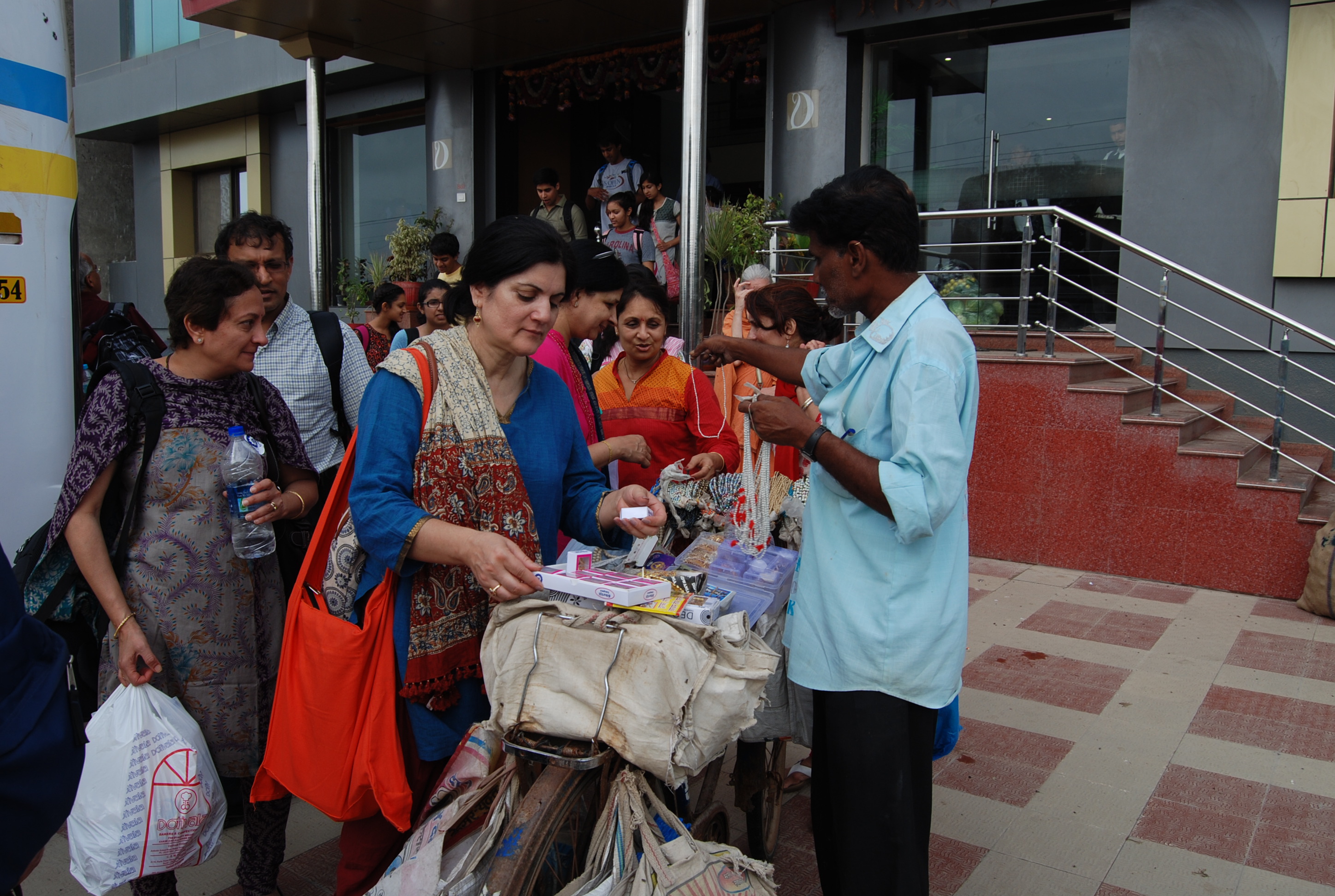
When we started to get into the bus, a smart vendor brought varieties of things to sell. Several people were excited to shop because we did not have any shopping plans in our program. This delayed our bus a little, but seeing the joy of people shopping, others did not mind.
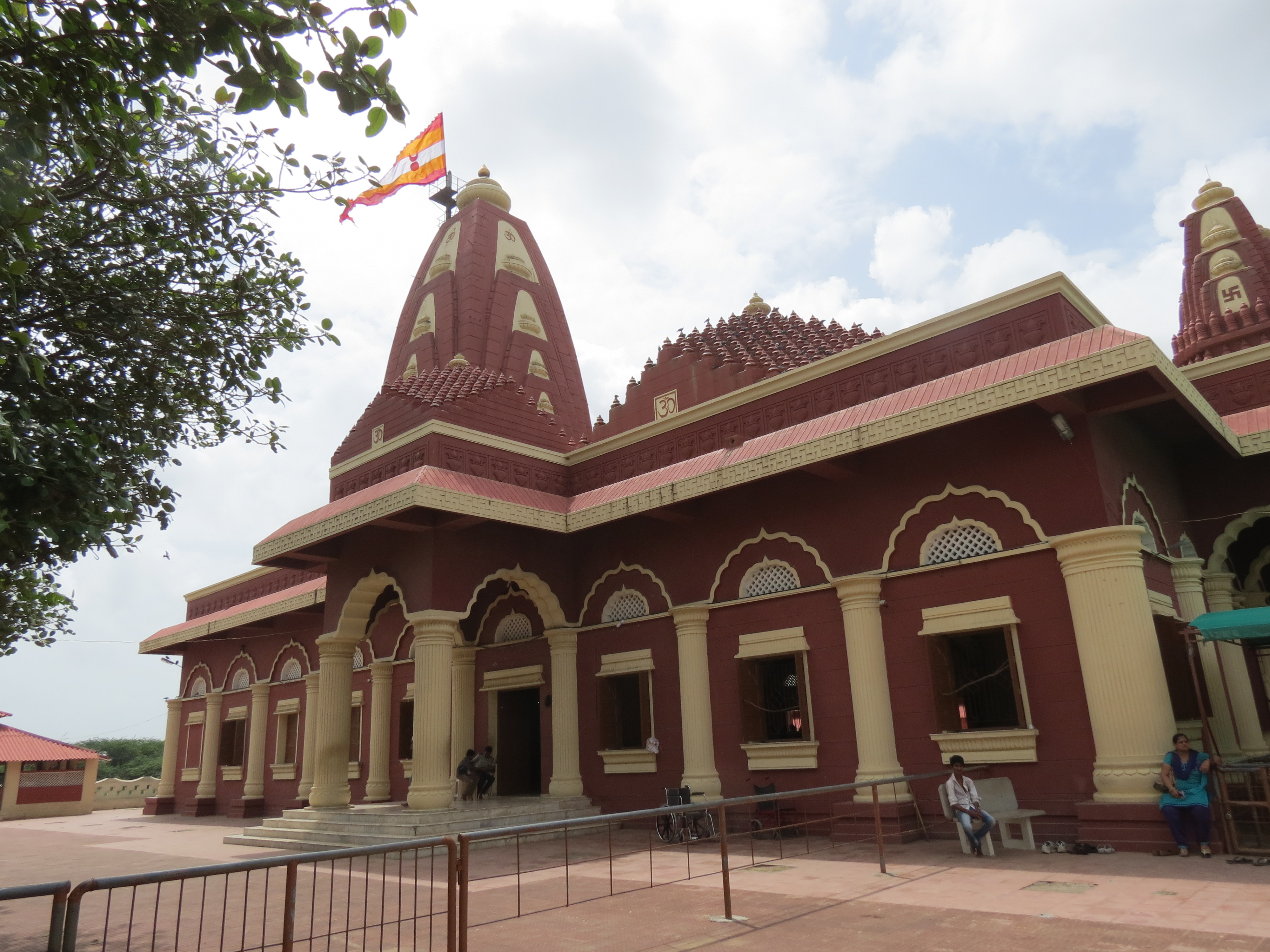
We started to go to Nageshwara. There is a controversy about this temple that whether it is one of the Dwadash Jyotirlingas (12 famous Shivalingam). We heard that Gulshan had taken interest and helped in the development of this temple. So far, we had been thinking of Shri Krishna, now we started thinking of Shiva. In the bus, Nilesh sang and led “Nagendra Haraya…” Some students, who did not know Nilesh, were surprised to see that he could sing so well. All enjoyed the hymn and the dhoon “Namah Shivay…” Nageshwara was only 15 kilometers away from Dwarka. When the bus stopped, all were amazed to see a huge statue of Shiva. It created a divine mood in the minds of all. The entrance to the temple, the clean ground inside, a huge banyan tree, and the temple structure created a very good impression in the minds of all. We entered the temple and found that it was clean and there was an orderly way to go to the shrine. We all saluted and felt like singing the salutation mantra, “Om Namah Shivay Shnatay…” Then all were inspired to sing Shiva’s dhoons and bhajans, especially led by Trupti Aunty. Her melodious voice captured the minds of all. There were many singers in the group, so we had a special Shiva’s celebration for about 45 minutes. We wish we had taped the singing. It was in tune, filled with devotion and sweet in melody.
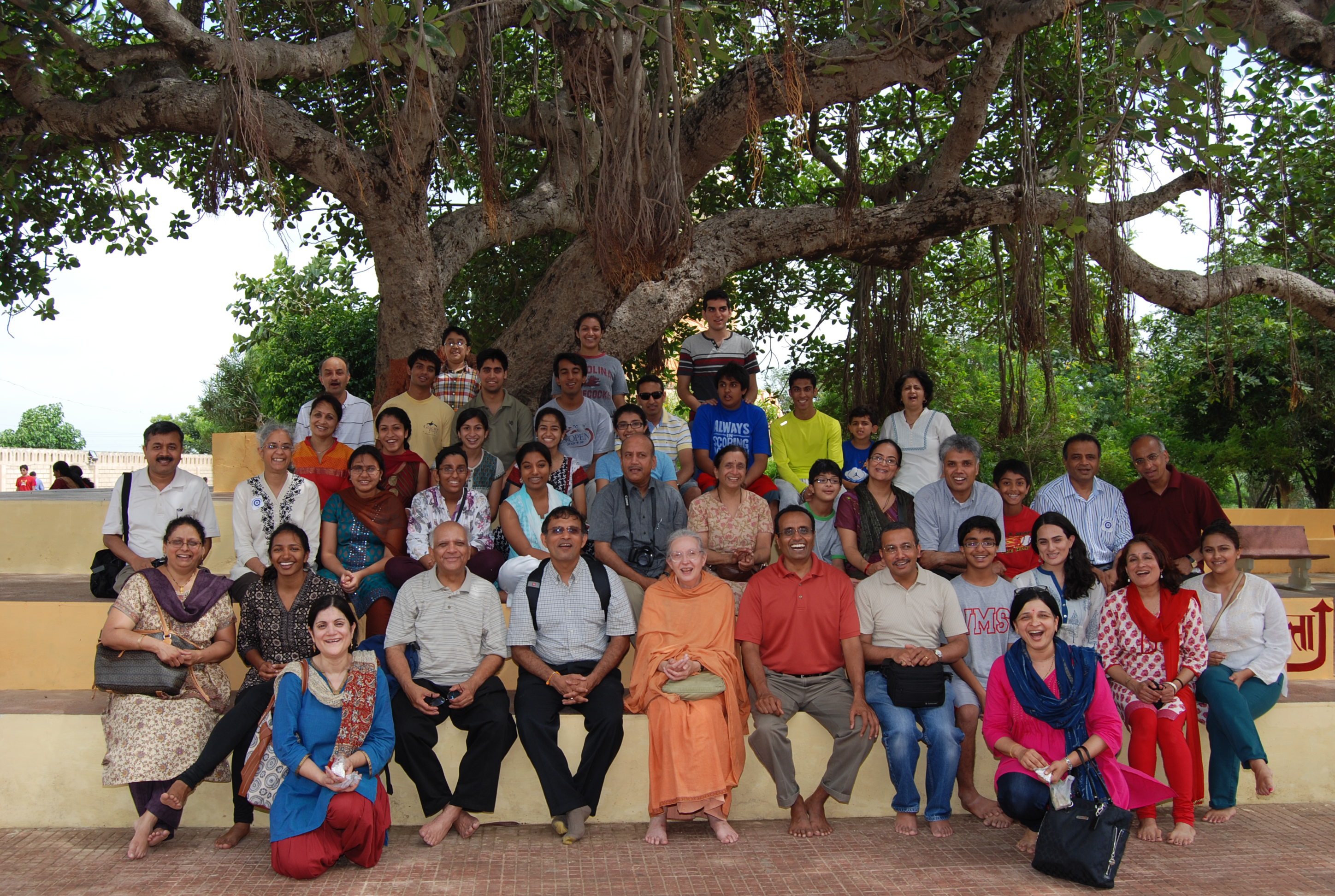
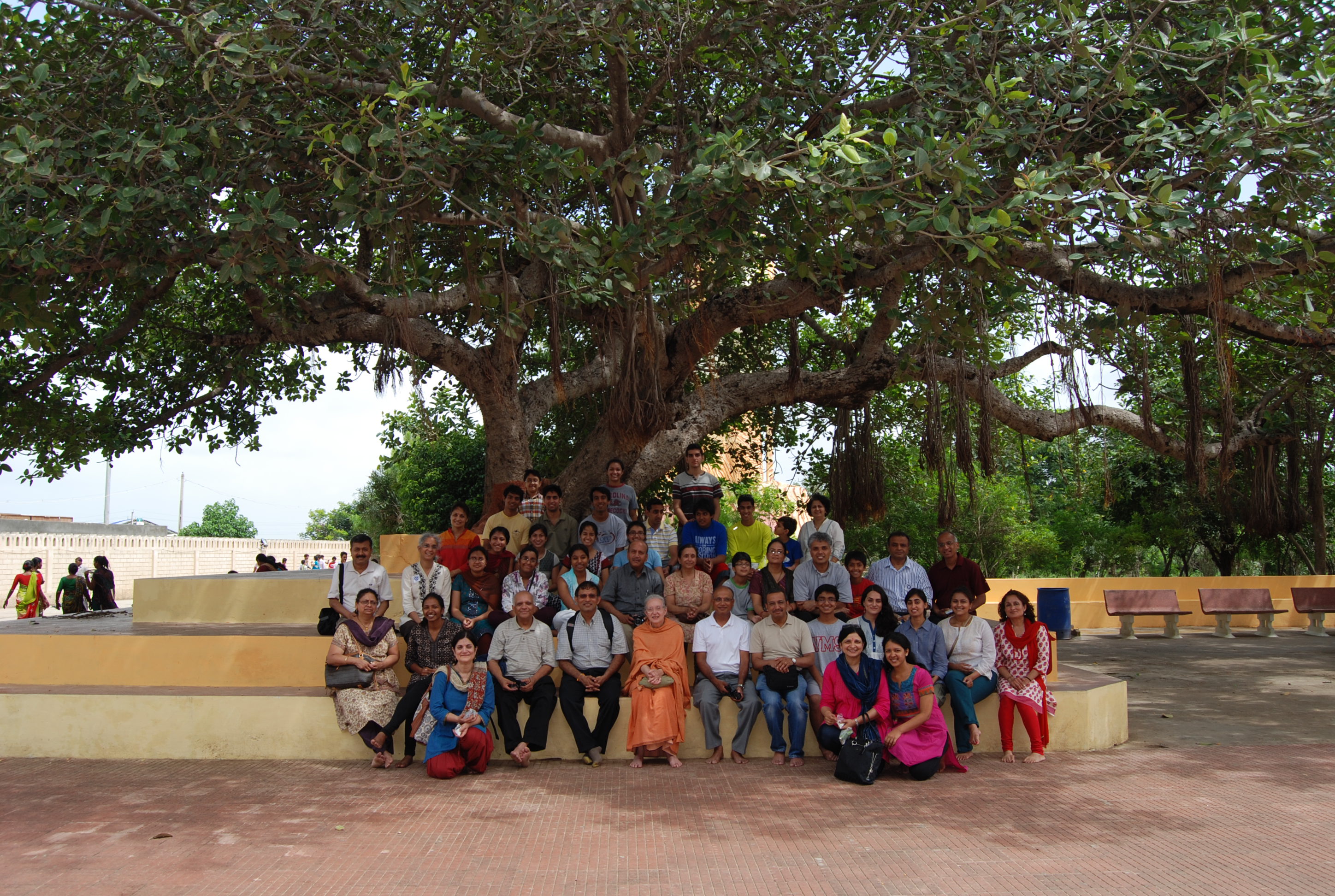
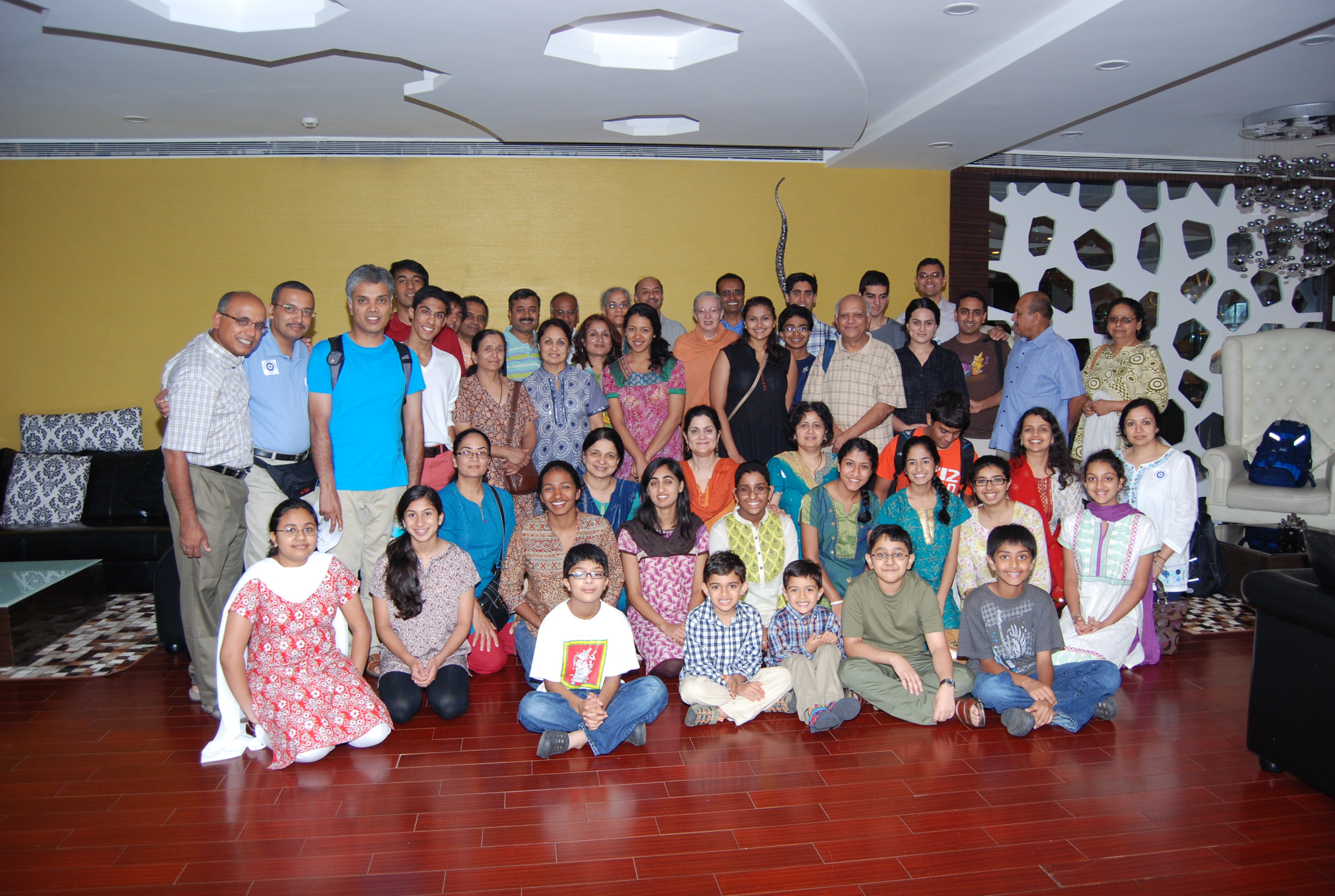
All ladies decided to do Shiva puja. Men were required to wear dhoti for the puja, so they were not very enthusiastic. The priest informed us that only family members could go together, but Trupti Aunty said that this was one family, our Vidyapith family. Somehow they agreed to let most of the ladies & girls go for puja. They all did joint puja of Shiva while singing “Om Namah Shivay..” and “Hara Hara Bhole, Namah Shivay…” I have no doubt that Shiva must have been greatly pleased. Actually, Shiva had arranged this whole thing. After being pleased with the singing and puja, we all came outside and took a group picture under the huge banyan tree. The whole environment was peaceful, serene, and joyful.
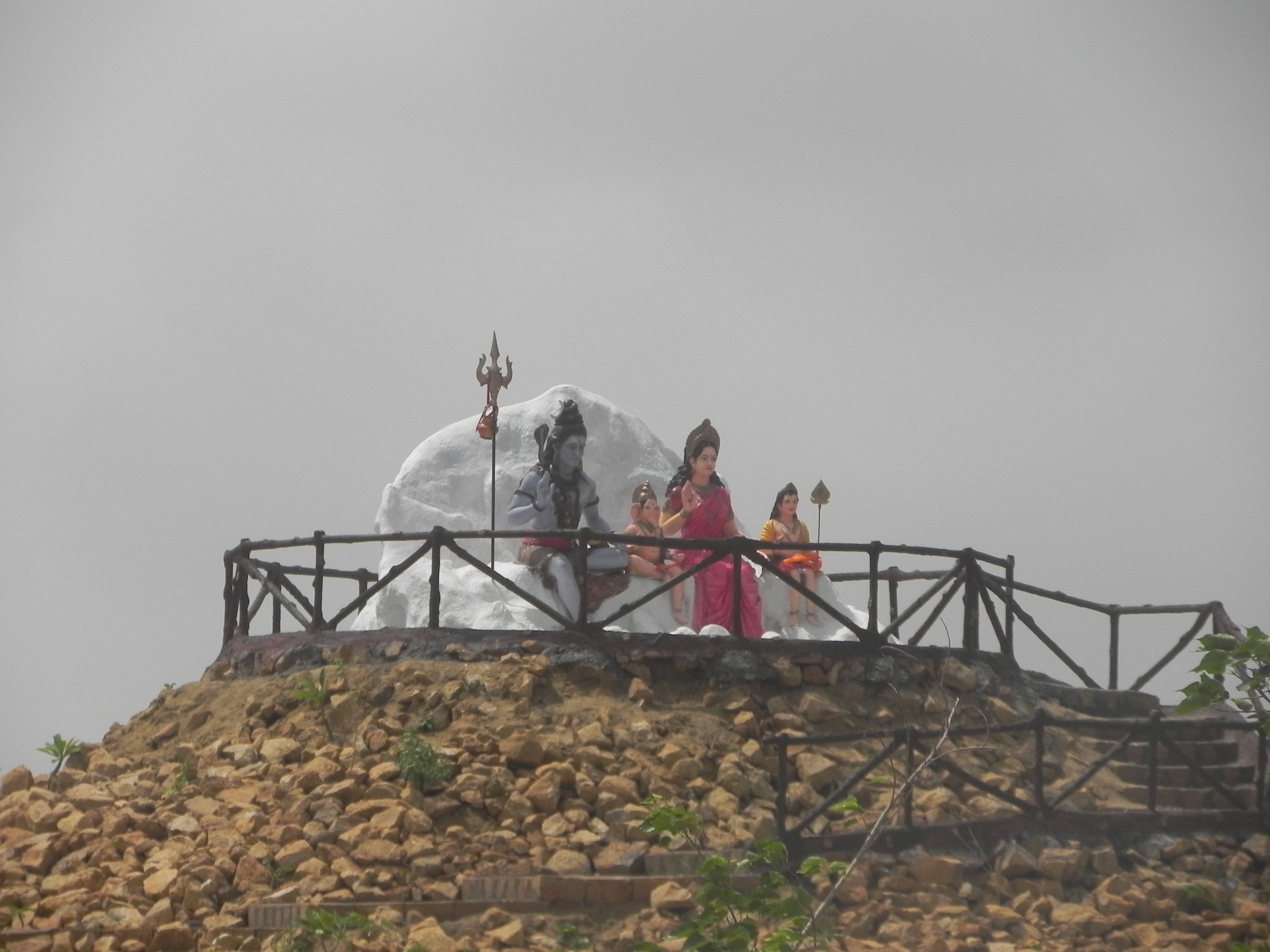
We were getting little late in our schedule and started walking towards the bus. But how could we miss a group picture under the huge statute of Shiva? Again we quickly assembled to take another photo and filed into the bus. Kalpitbhai had told us that nearby, there was a hill on which there were beautiful statues of Shiva and his family. As we passed by them, we saluted from the bus and continued on our journey. Our next stop was Porbandar.
“India’s gift to the world is the spiritual light…Slow and silent, as the gentle dew that falls in the morning, unseen and unheard yet producing a most tremendous result.” – Swami Vivekananda
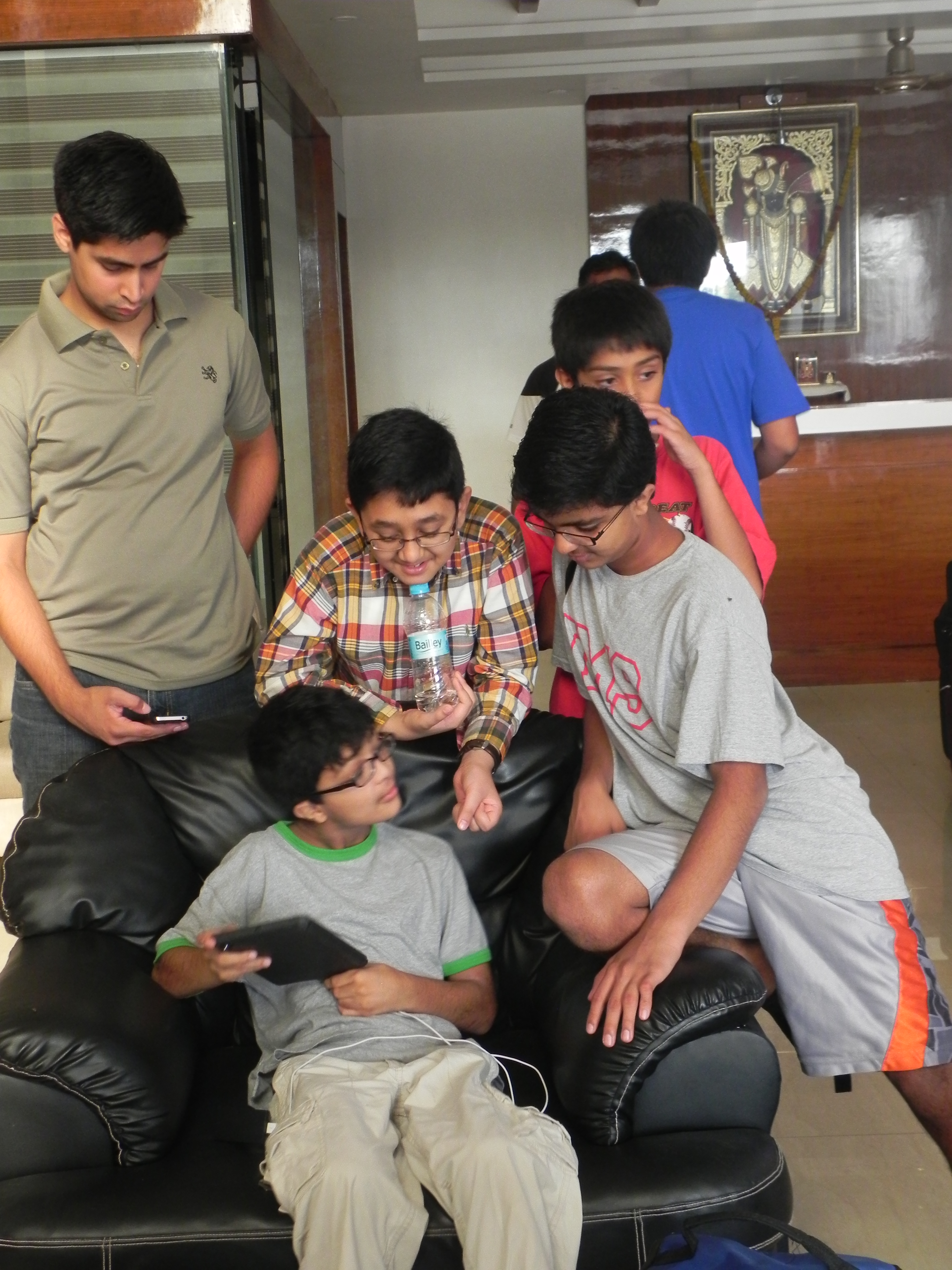
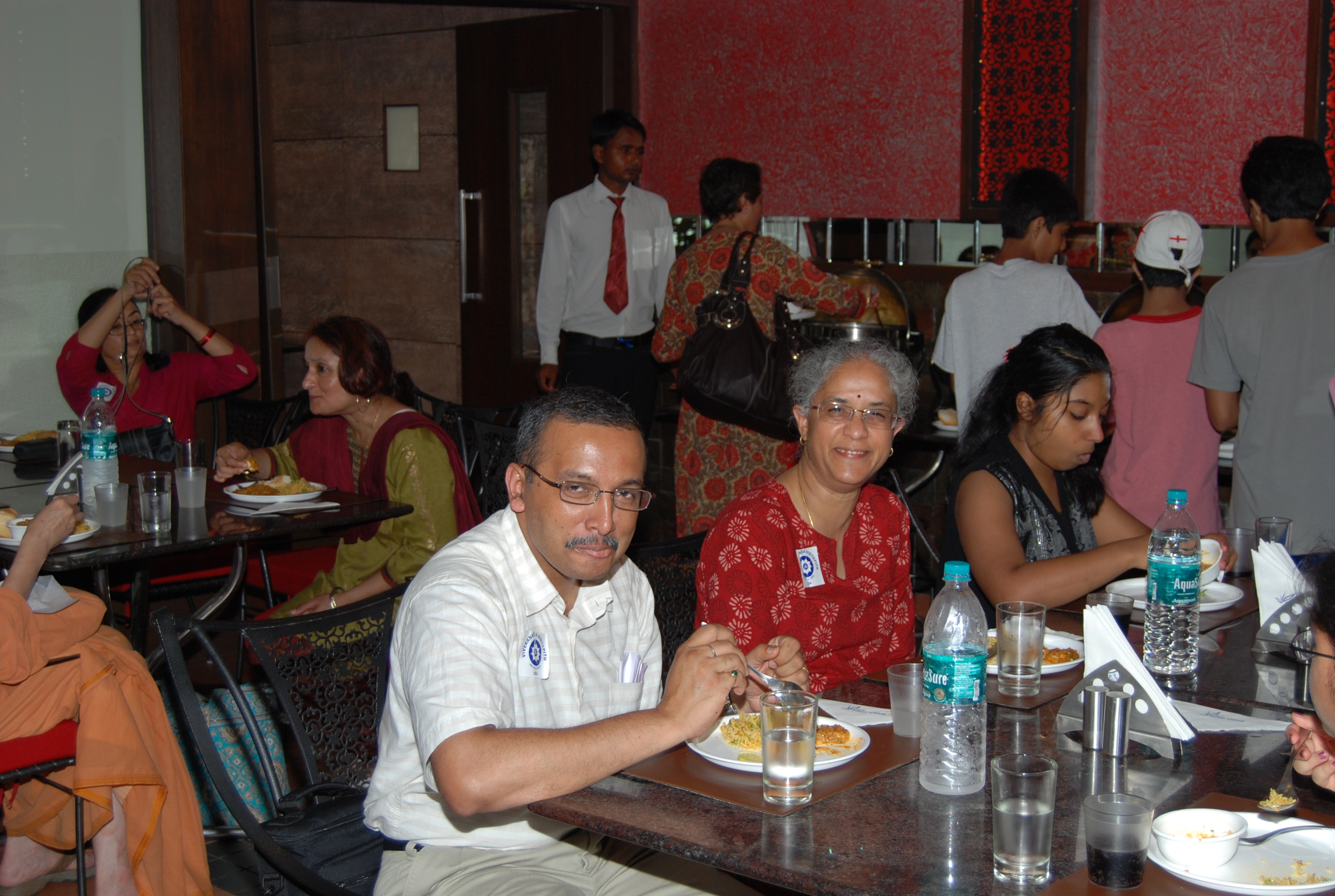
Road is not only for vehiclesCatching up with sleepRelaxing in the busIt is so funny!Oh, Really!Wind-power energyGlimpse of Dwarakadhisha’s TempleAfter Dwaradhisha’s DarshanView of the Temple from the terrace of the HotelGathered on the the terrace for a nice viewDelicious breakfastThere is a problem. What should we do?Can you guess what happened?Electronic devices’ timeOh, Sweet Shopping!Wow! You have brought nice things!God bless you for bringing all of these!“Nagendra Haraya…”We are happy to be hereBeautiful TemplePeaceful place under a banyan treePhotographer should be includedOm Namah ShivayaUnder the shelter of ShivaReady to go to PorabandarShiva’s Family
From Limbdi we headed to Rajkot. It was raining in Limbdi when we were getting into the bus. Later the rain became even heavier. But, inside the bus we were all remembering the experience of the presence of Swami Vivekananda in the Durbar Hall and love of Swami Adibhavanandaji.
We said our “five jai’s” and continued on our way. Since it was evening, all did prayer together. As we joined in prayer, we appreciated that having all Vidyapith people together on this journey made it a unique experience. It gave us all a special joy.
Heavy rain, roads filled with pot-holes, and driving in the dark on Indian highways created some concern. We saw many trucks with no reflectors or red lights in the back. Some did not even have headlights. Drivers seemed to have their own driving logic—logic of a high-risk nature. Our only solace was based on three people: (1) our escort Kalpitbhai, a family friend, who was always in the front with a small van keeping an eye on everything related to transportation. (2) A known, reliable, calm, and skillful bus driver Rafik, who had in his mind the complete dimension of the bus and was fully aware of the whole traffic situation. He was also fixing the bus whenever we ran into mechanical problems. (3) Ketan, a helper of the bus driver who was driving away cows, buffaloes, and sheep from the front of the bus, helpful in making U-turns or reversing the bus, and helpful in giving food to the driver and giving him company. Those who were in the front were a little worried during overtakes when there were about two inches of distance between fast driving vehicles and our bus.
We reached Rajkot around 8:30 p.m., after dark, much later than expected. Anant Maharaj, (Swami Sarvasthananda) head of Rajkot Ashram, had been informed by phone about our estimated time of arrival. With little difficulty the huge 56-seater bus was pulled in the ashram. Swamiji was waiting for us. He asked us to go straight into the shrine before they closed it. With the help of umbrellas and ponchos we protected ourselves and went to the shrine. It was a beautiful shrine. We all quietly saluted Thakur, Maa, and Swamiji, sat down and did some japa. Then, we went to Anant Maharaj to meet him. He received all of us and asked about our plans. He told us to come tomorrow before 8:00 a.m. since buses were not allowed into the city after 8:00 a.m.
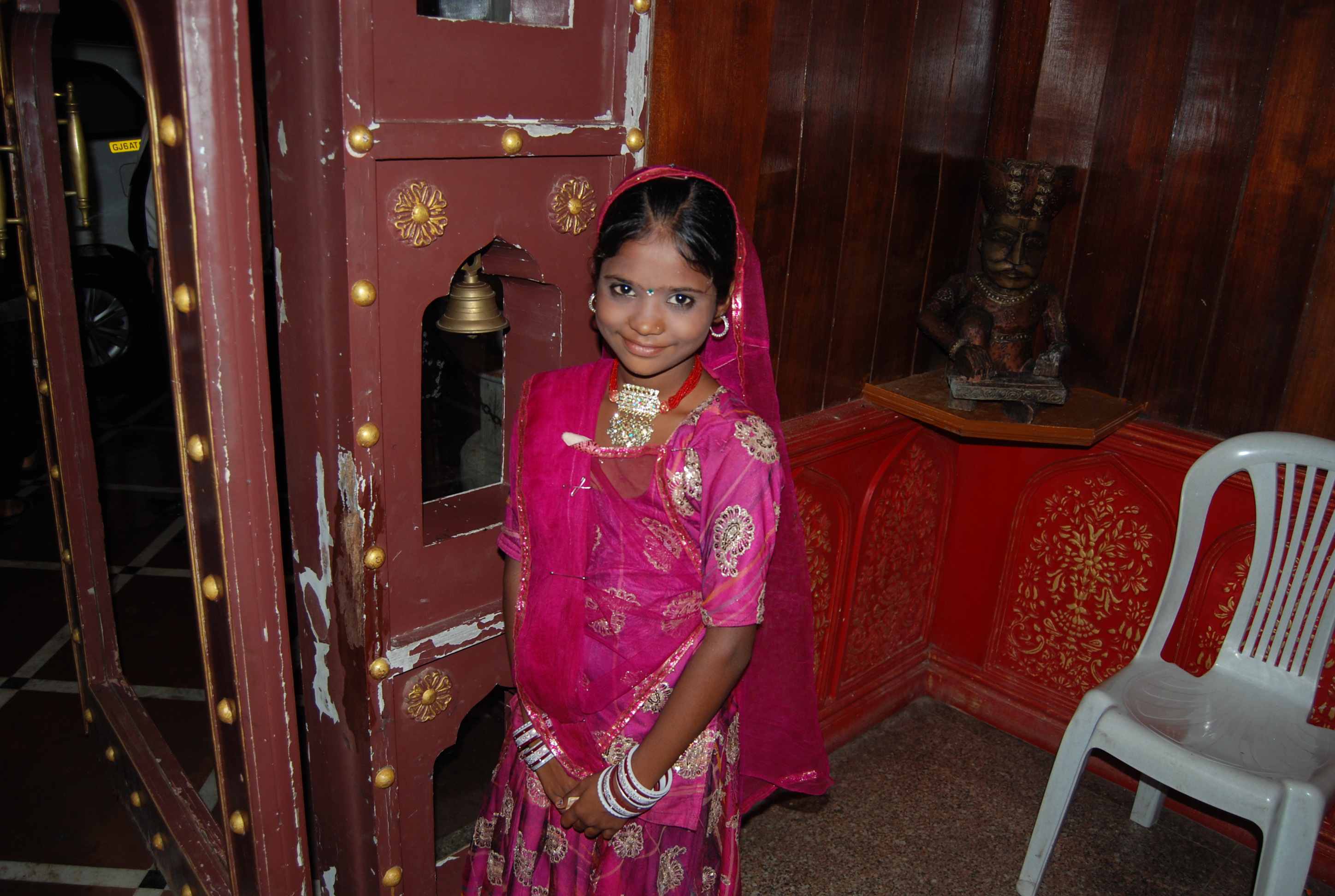
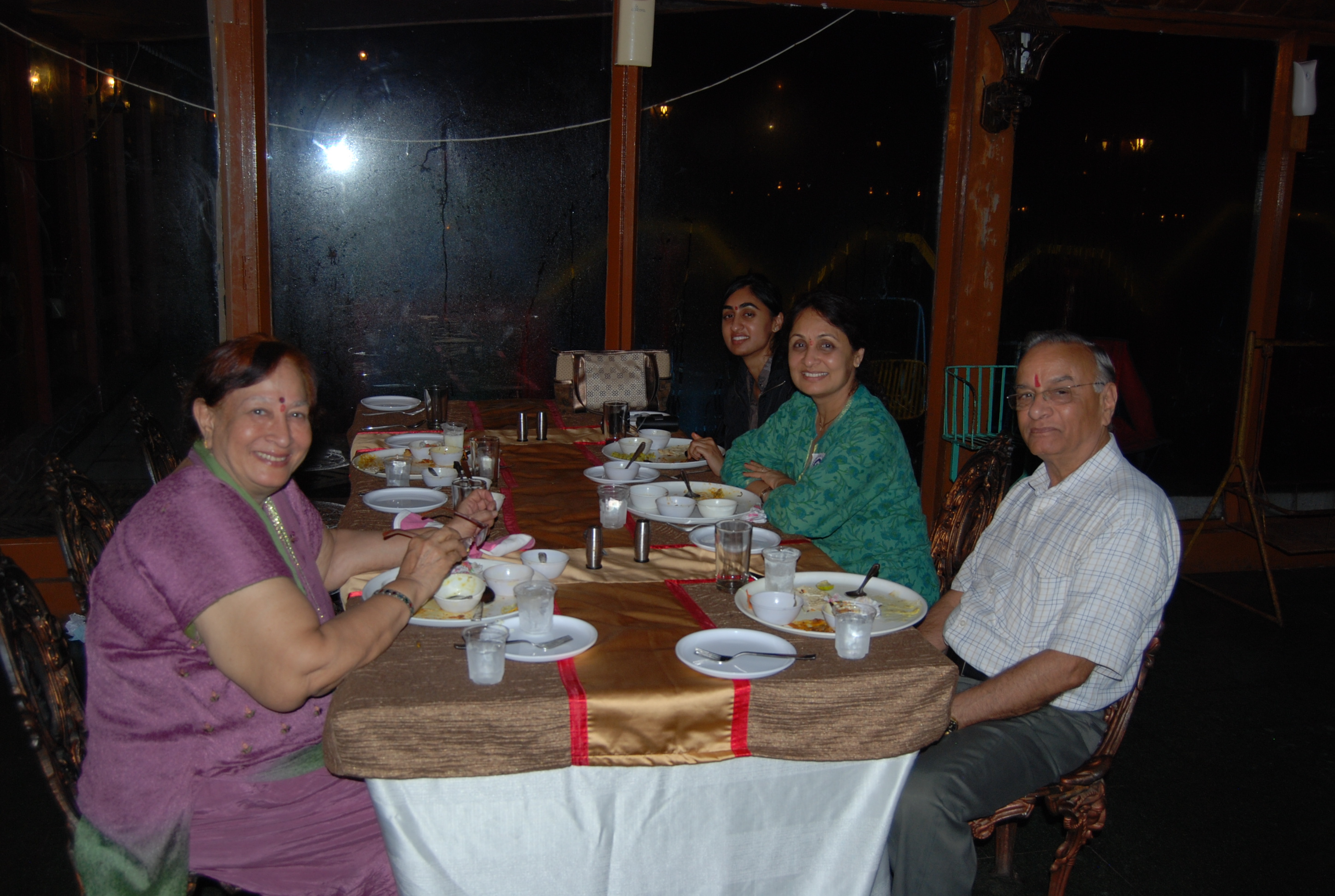
We had a dinner invitation by Mr. Virani. He and his wife were also waiting for our arrival. They took us to a very special Rajasthani Restaurant. Even in the drizzle, a drummer, dressed up in Rajashtani outfit, started playing the drum. A small girl in a beautiful dress welcomed each of us with a tilak of kumkum. Inside there was a huge ground with pillars, statues, plants, and flowers. We entered into a huge, palace-like building. There was a huge room with sofas all around where two musicians were waiting for us. While playing the harmonium, one started singing a Rajasthani song in a melodious voice. He was accompanied by a person on dholak. We all enjoyed their songs. It was late and all were hungry. We went to a nicely decorated dining room and had delicious dinner. We were told that there were dancers waiting to entertain us upstairs. But, we apologized to them and said that we had a long day and we were exhausted. We wanted to check in our hotel and take some rest. We checked in the hotel “The Fern.” It was a very nice hotel and some were amazed to see cricket bats with signatures of famous players. We were a large group of 54 people, but because of some pre-planning, the check-in was very smooth and we soon retired to our rooms.
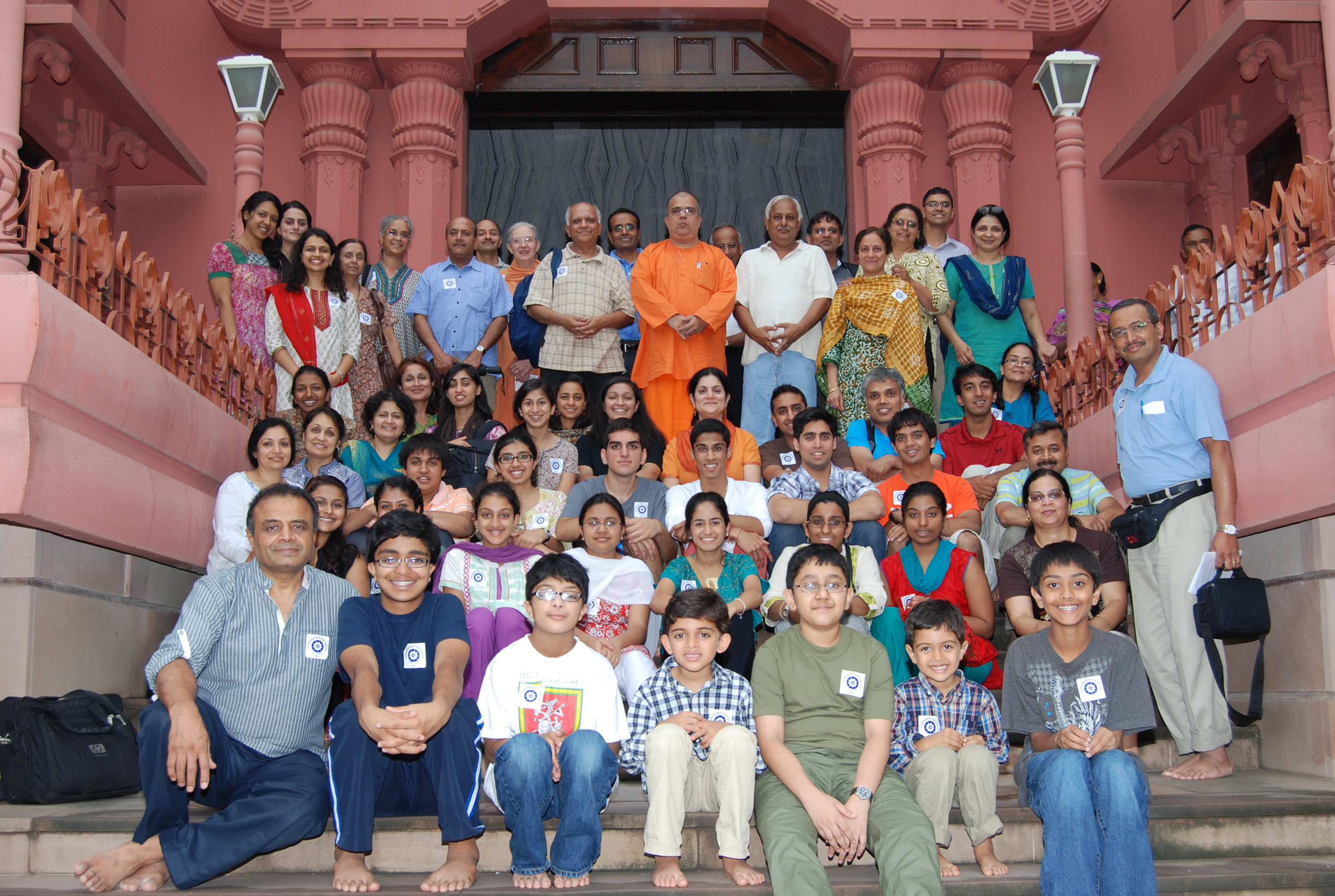
The next day all got up early, had breakfast, and got into the bus. We had to get into the city before 8:00 a.m. We made it on time. Again, we all went to the shrine, quietly sat down, and did japa. After some time, when we started coming out, we found Anant Maharaj waiting to greet us near the entrance. He said, “I have heard that you sing good dhoons and bhajans. Would you like to sing by the shrine? It will be a good memory for all of you.” We were pleasantly surprised by this. I asked him how he found out that we sing dhoon-bhajans. He said that Prafulbhai, uncle of Shyam Gohel (Meera Gohel Aunty’s husband Rajen Gohel’s brother) had told him. Prafulbhai was joyfully standing by Swamiji’s side. We were thrilled by this idea of singing by the shrine. Swamiji asked us to wait a few minutes while some preparations were made for our singing. Meanwhile, I lovingly and joyfully gave a hug to Prafulbhai.
Prafulbhai told me that he regularly comes to the ashrama to do prayer. That day when he came, he saw stickers of “Vivekananda Vidyapith” on all of you. He was so excited that he could not do prayer anymore. He went out and met Anant Maharaj and told him that these people are from Vivekananda Vidyapith. They sing very good dhoons and bhajans and I have listened to their tapes for over the last several years.
Reflecting upon the all of this later, I told everyone that in a billiard-ball game, a player hits one ball, then that ball hits another one and so on and at the end the desired ball goes into the hole. When Nisha’s uncle Nimishbhai made stickers for all of us, he had no idea of this divine opportunity.
In the Prayer Hall two huge carpets were spread. On one carpet there was a harmonium and a pair of tabla. We sat down and sang Pranam Mantras, Sri Ramakrishna Suprabhatam, Tumi Brahma Ramakrishna, Jaya Sri Sarade, and Jaya Vireshwar. The singing was perfectly tuned, melodious, and filled with devotion. Swamiji had taped our singing. He was very much pleased with our singing. We felt as though Thakur wanted to listen to our singing. Indeed Swamiji was right – a life-long memory had been created.
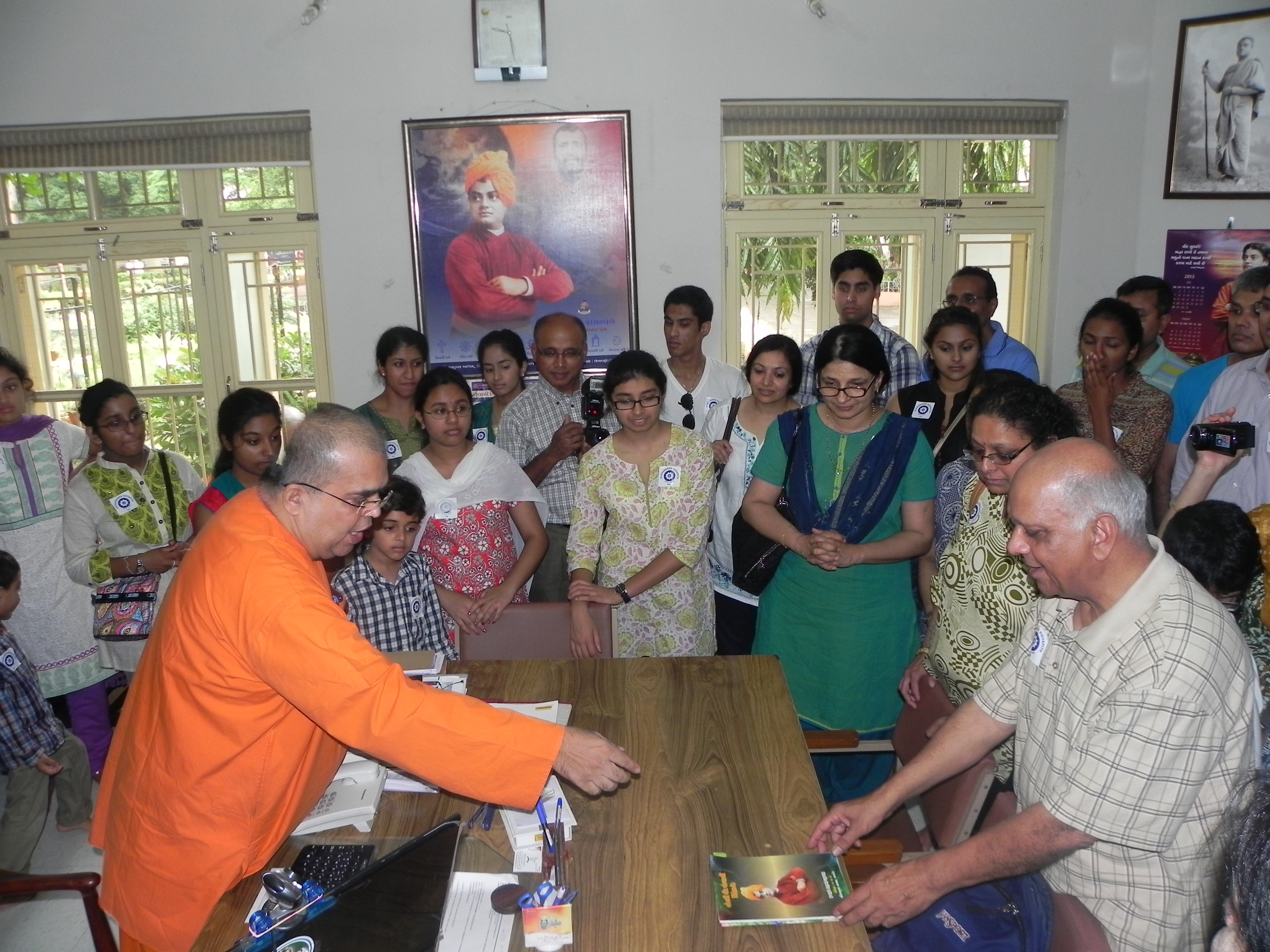
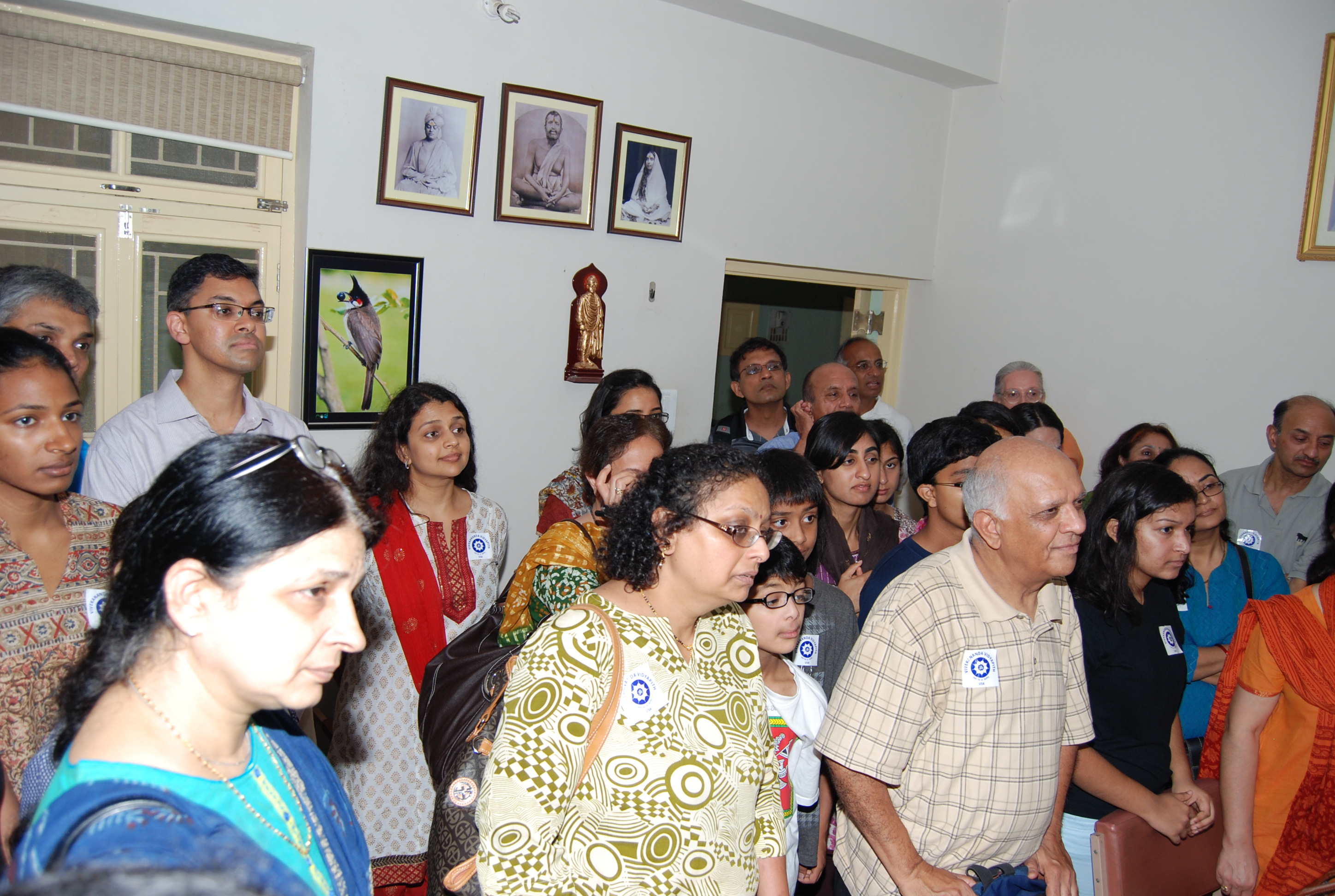
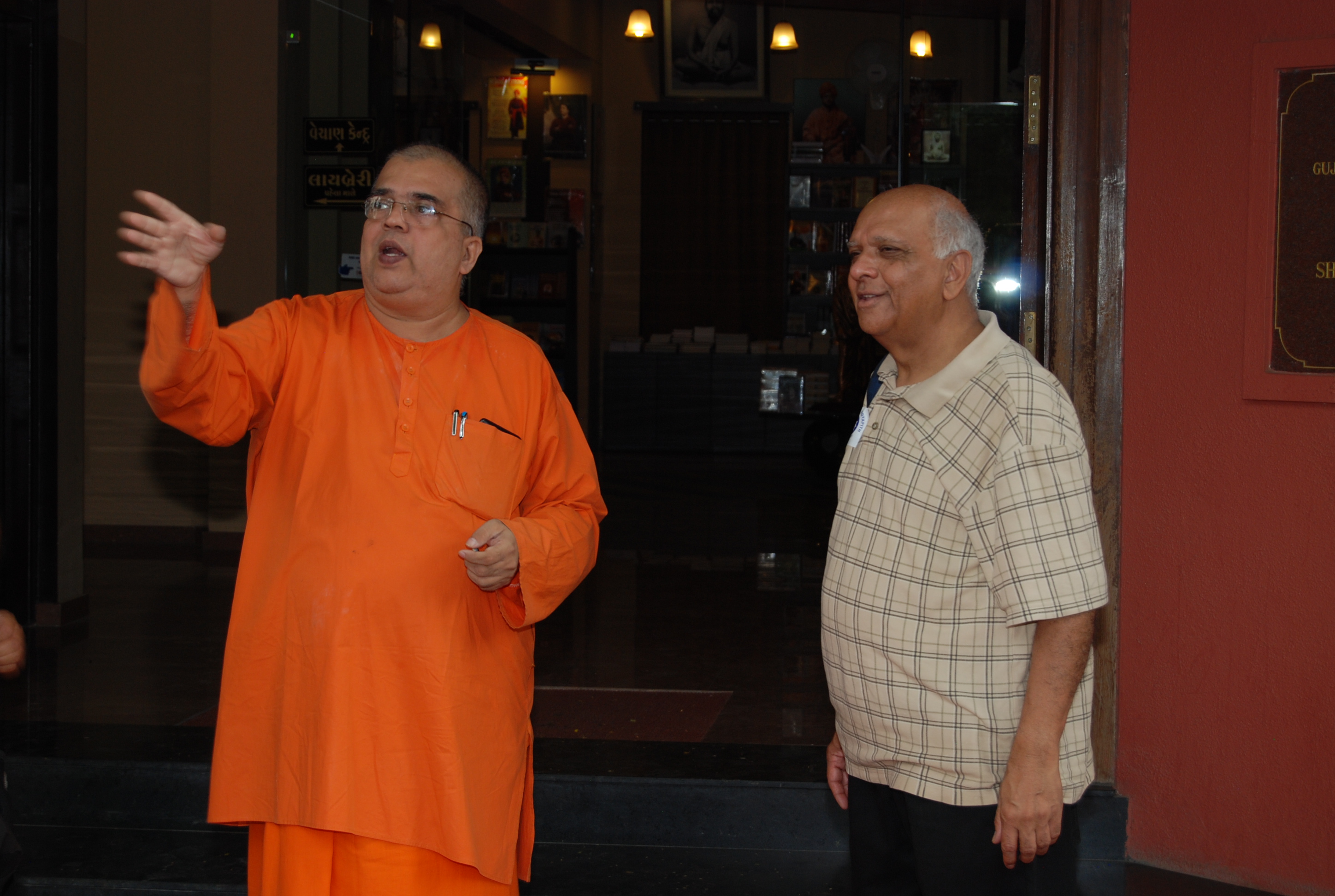
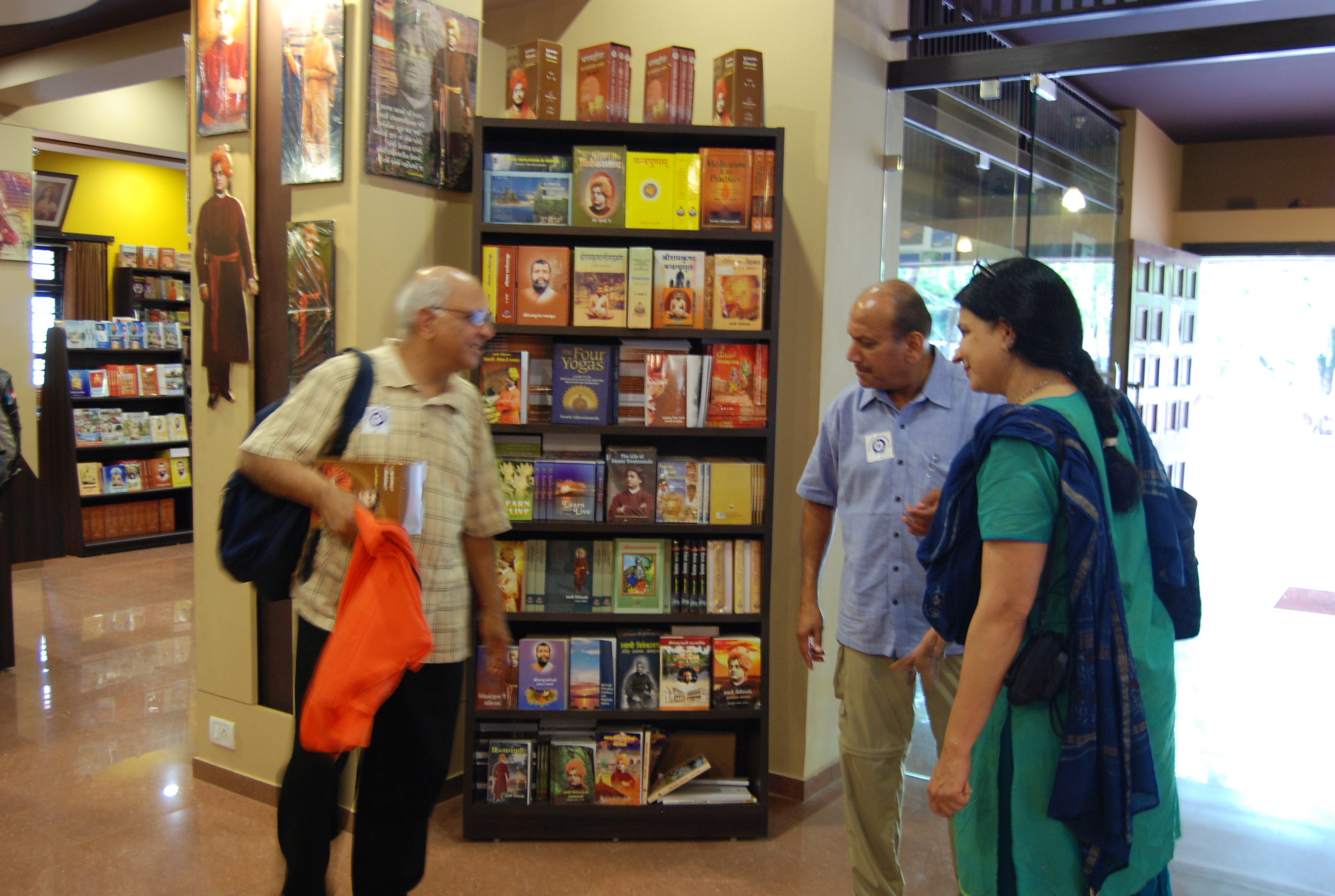
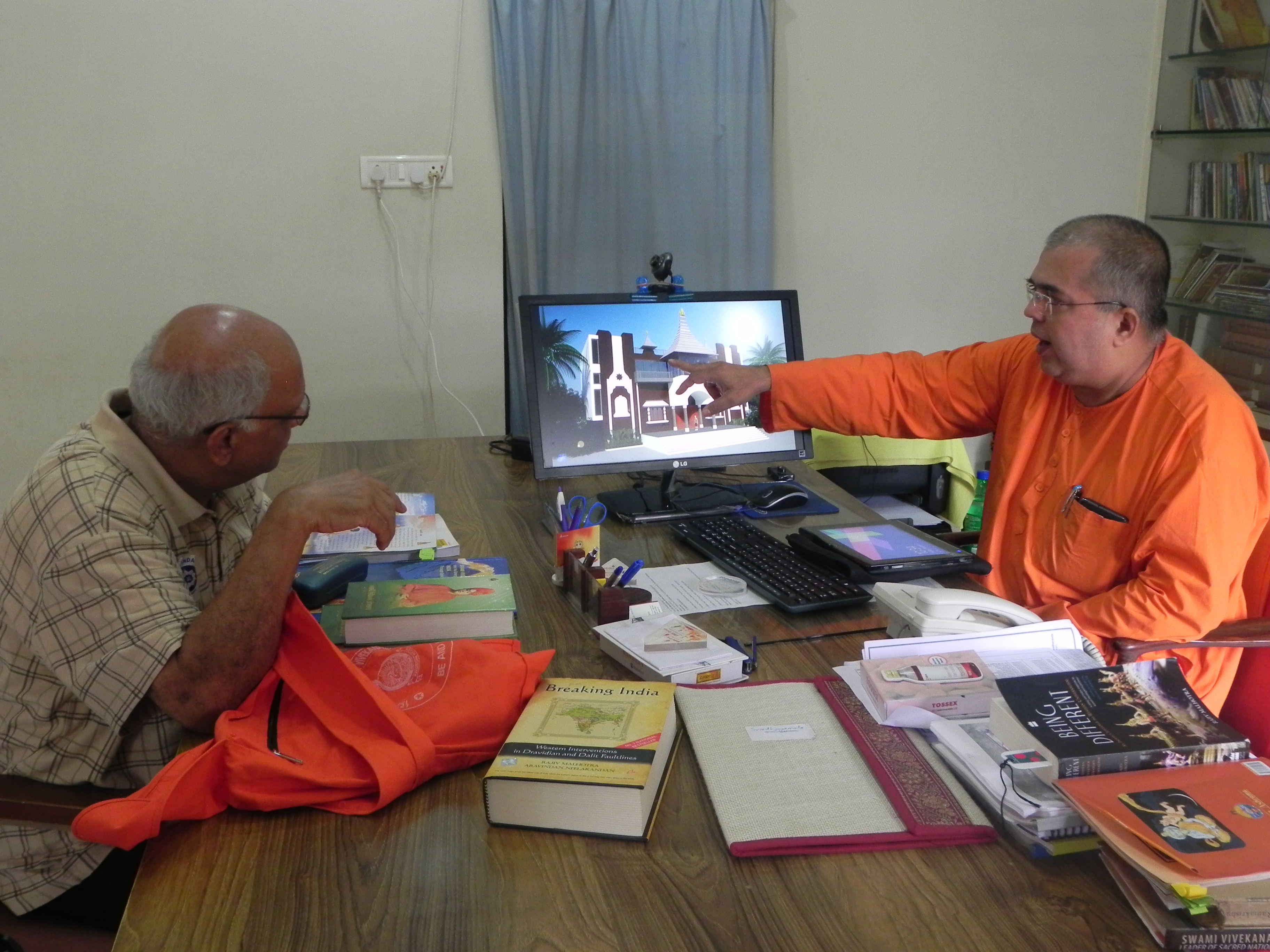
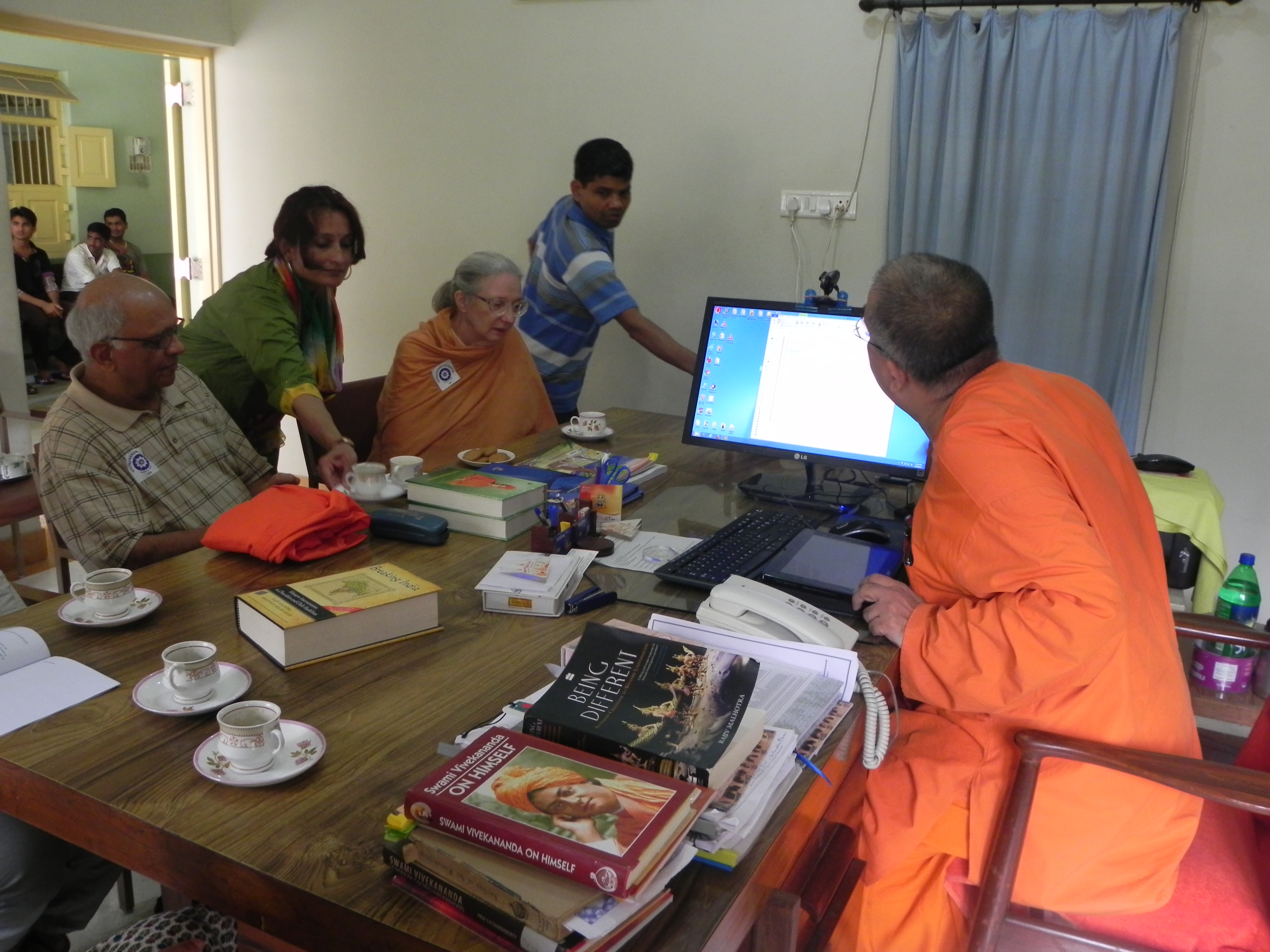
Swamiji then took us to his office and told us about the Rajkot ashram, its “Value Education Program,” and its future building. He also gave us books. He talked about all the recently released DVDs about Swami Vivekananda and an upcoming movie on Swami Vivekananda. After that he showed us the original temple and the bookstore. It was an attractive bookstore. All were crazy to buy books, tapes, bags, and other things. Meanwhile a few people visited the “Sister Nivedita School” and other services run by Mr. Gulabbhai Jani and his wife.
Swami Sarvasthanandaji had offered us lunch. Plates were set on the dining tables for all 54 people. Swamiji himself was waiting to make sure we ate well. All were fed sumptuously. After lunch it was time for us to go. All saluted Swamiji and got into the bus. At the end Prafulbhai and his wife Chitraben handed me a bag filled with tasty “Khakhara” and famous sweet “Rajkot Pendas.”
It was a challenging task to get the huge bus out of the gate and make a U-turn in the busy street. Swamiji himself stood out to make sure we were okay. With the bus driver’s amazing skill and his assistant’s help, the bus was maneuvered successfully. As we pulled out, we waved our hands to say “bye” to Swamiji.
Out next destination was Dwaraka.
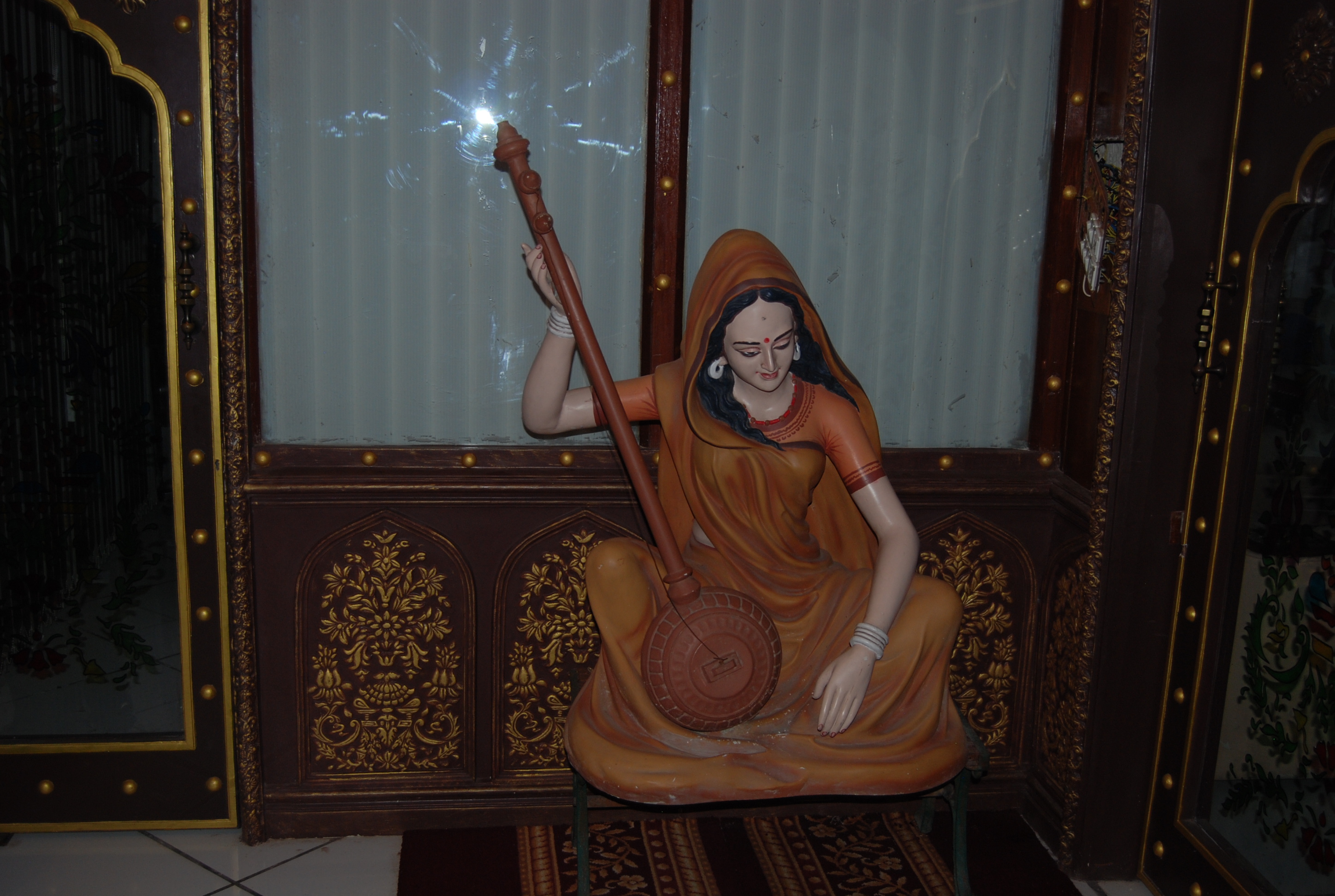
We were prepared for rainSwami Sarvasthanandaji was waiting to receive usWe are here!A girl in Rajashthani dress ready to do tilakIs that a palace?Shri Krishna in an open groundMirabai – beautiful statueThe singersWow! Nice singingWe loved itExcellent foodMr. & Mrs. Virani – The Hosts
We can be statues too!
How impressive!Finally at the Hotel “The Fern”Never miss a group photo opportunityCan you read who signed it?With Prafulbhai and ChitrabenWith Swami SarvasthanandajiTemple in the backgroundWelcome to my officeOur value education programYou must look at this bookAbout Rajkot AshramInteresting TalksCharacter Building Education is importantBooks on Value EducationLet me show you AshramThe place of old templeThe Shrine of Old TempleA bag – 150th Birth Anniversary of Swami Vivekananda souvenirValue Education Building PlanSwami Vivekananda’s DVDTemple in the backgroundExhibition in openSister Nivedita SchoolSwamiji had invited us for lunchLunch“I don’t want my picture”Devotees of Holy MotherPlease! Bring food hereA gift from me!Belur Math Temple’s Small Replica(From R to L) Kalpitbhai, Rafik, and Ketan
Ramakrishna Mission Vivekananda Memorial at Limbdi
From Sabarmati Ashram we went for lunch at the “Silver Cloud” restaurant. Trupti Aunty and Nayana Aunty had worked hard to find good restaurants in all the cities we were to visit on the trip. They had called the managers and fixed the menus and times for all of our meals – breakfasts, lunches and dinners. So in a nice air-conditioned room we all enjoyed a delicious lunch.
We then headed to Ramakrishna Mission at Limbdi. Rain started. The roads had lots of potholes due to heavy rain over the few weeks before we arrived. The bus was sometimes traveling at 5-km/hour and going over bumps. At each bump, all the boys seated in the last row would jump up and down, and the laughter with each jump only grew louder and louder.
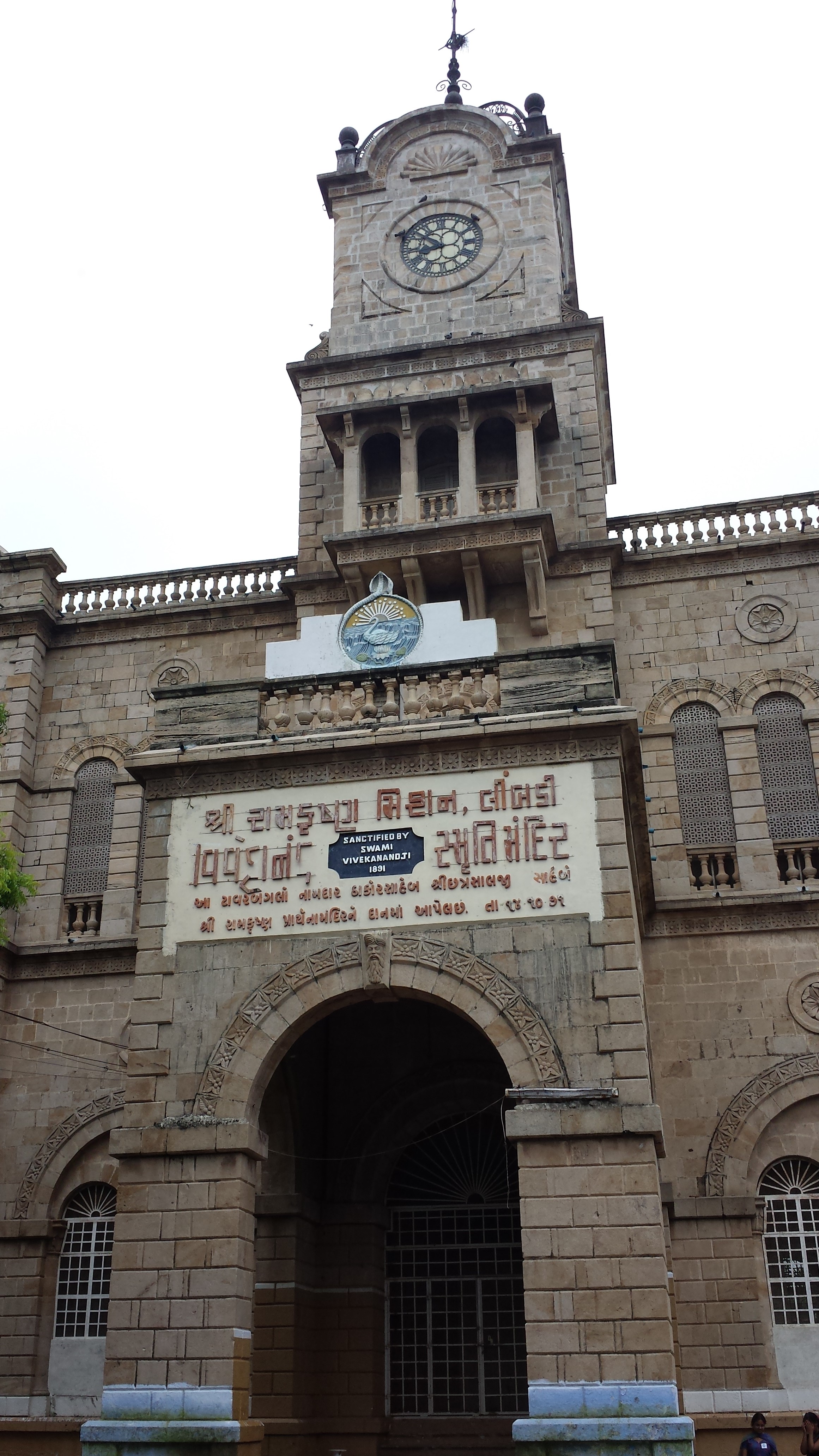
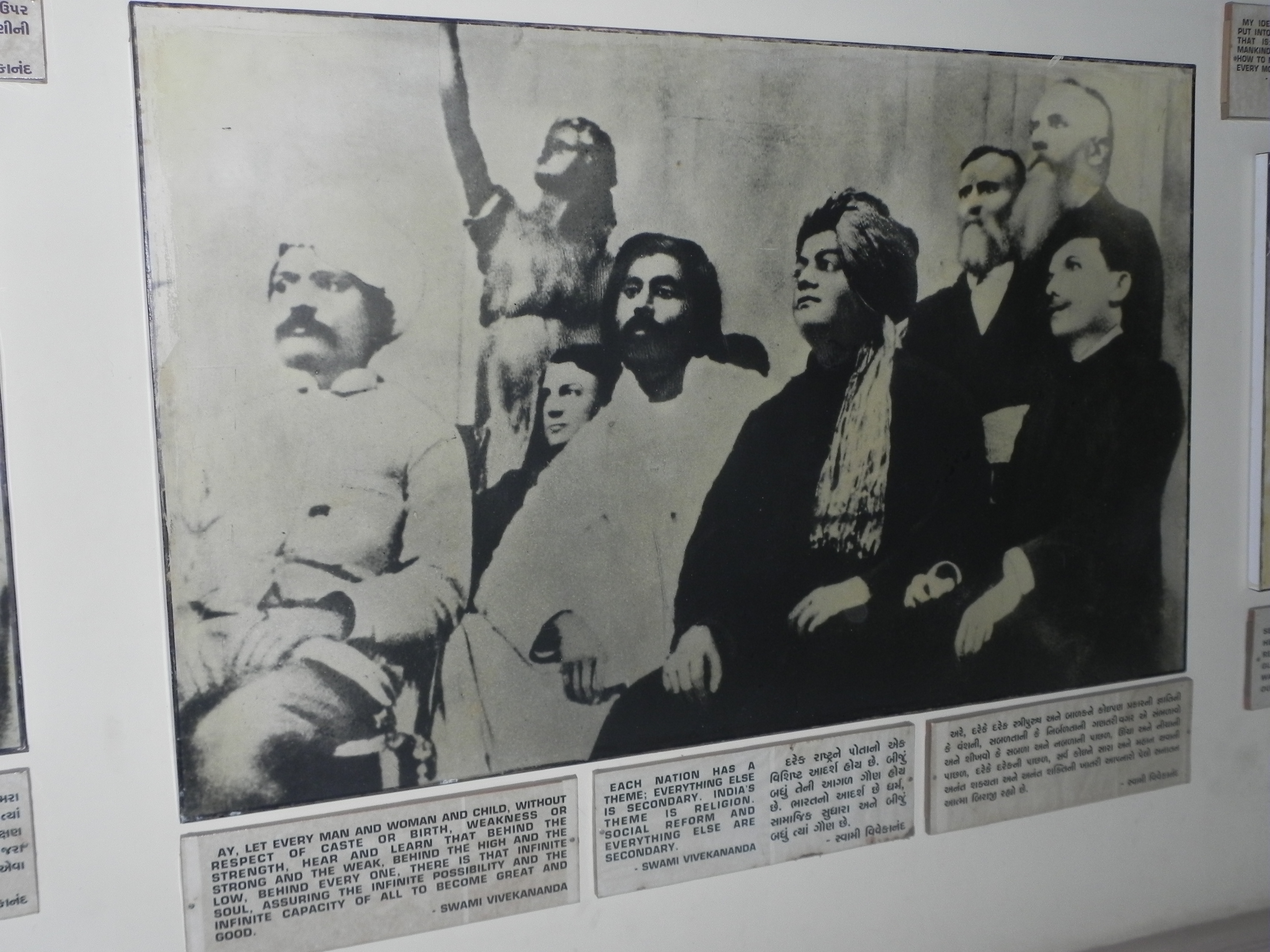
As we were traveling, Swami Adibhavananda of the Limbdi Ashram was eagerly waiting for us and even inquired through phone calls about when we would be reaching there. Finally, we arrived at Limbdi. Swami Adibhavanandaji, whom people lovingly call “Bapa”, sent a young boy on motorcycle to escort us. The boy asked me to get on his motorcycle and I had a chance to ride it. Swami Adibhavanandaji asked us to go to the palace first. On the way, you could see Swami Vivekananda’s statue prominently in the city center with “Arise! Awake!…” written in Gujarati. We then saw the palace. In this small Limbdi town, the palace stands out as a gorgeous structure. It was in this palace that Swami Vivekananda stayed for several days. Swamiji had held spiritual discussions in the “Durbar Hall,” an assembly hall of the palace.
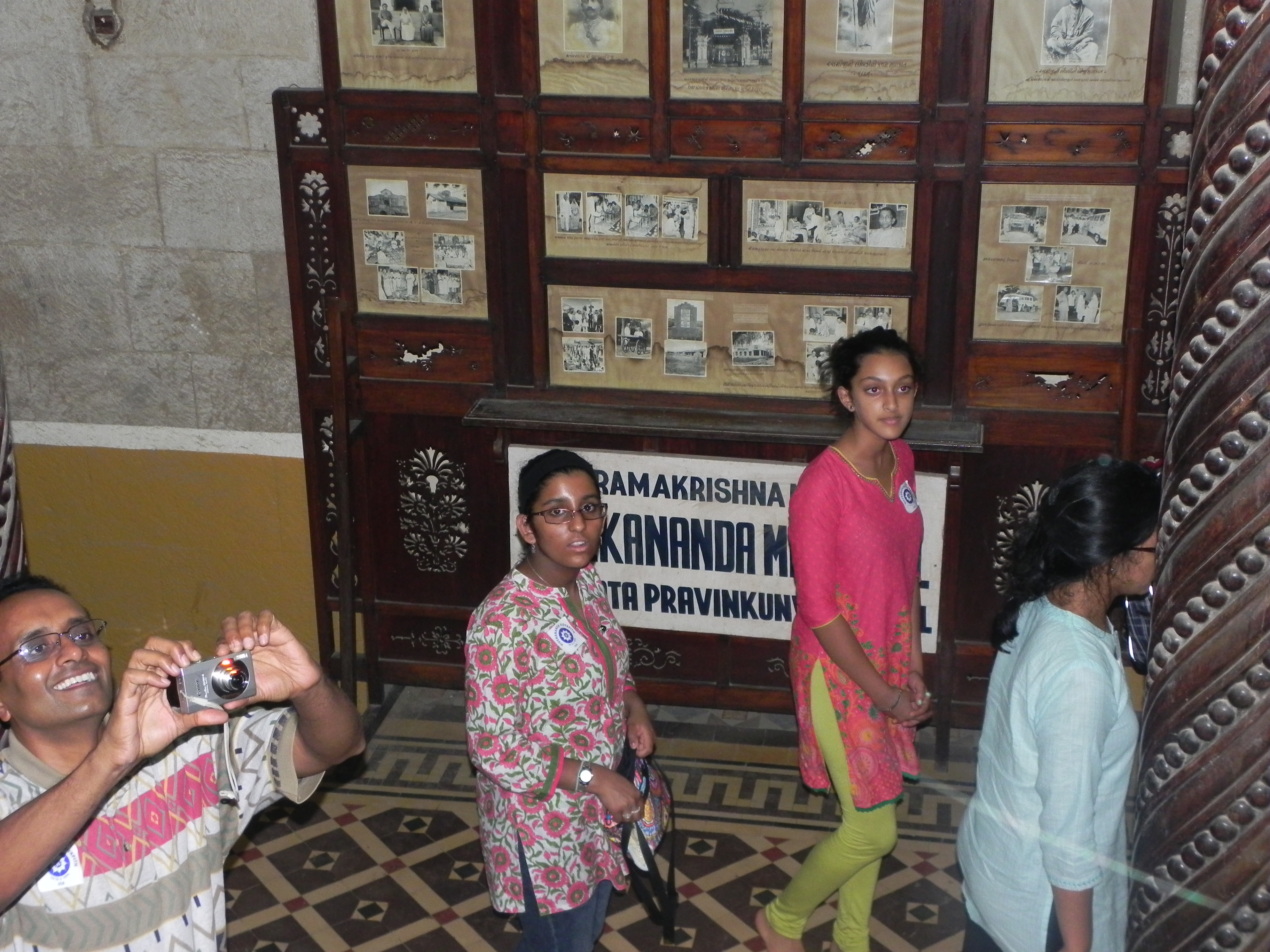
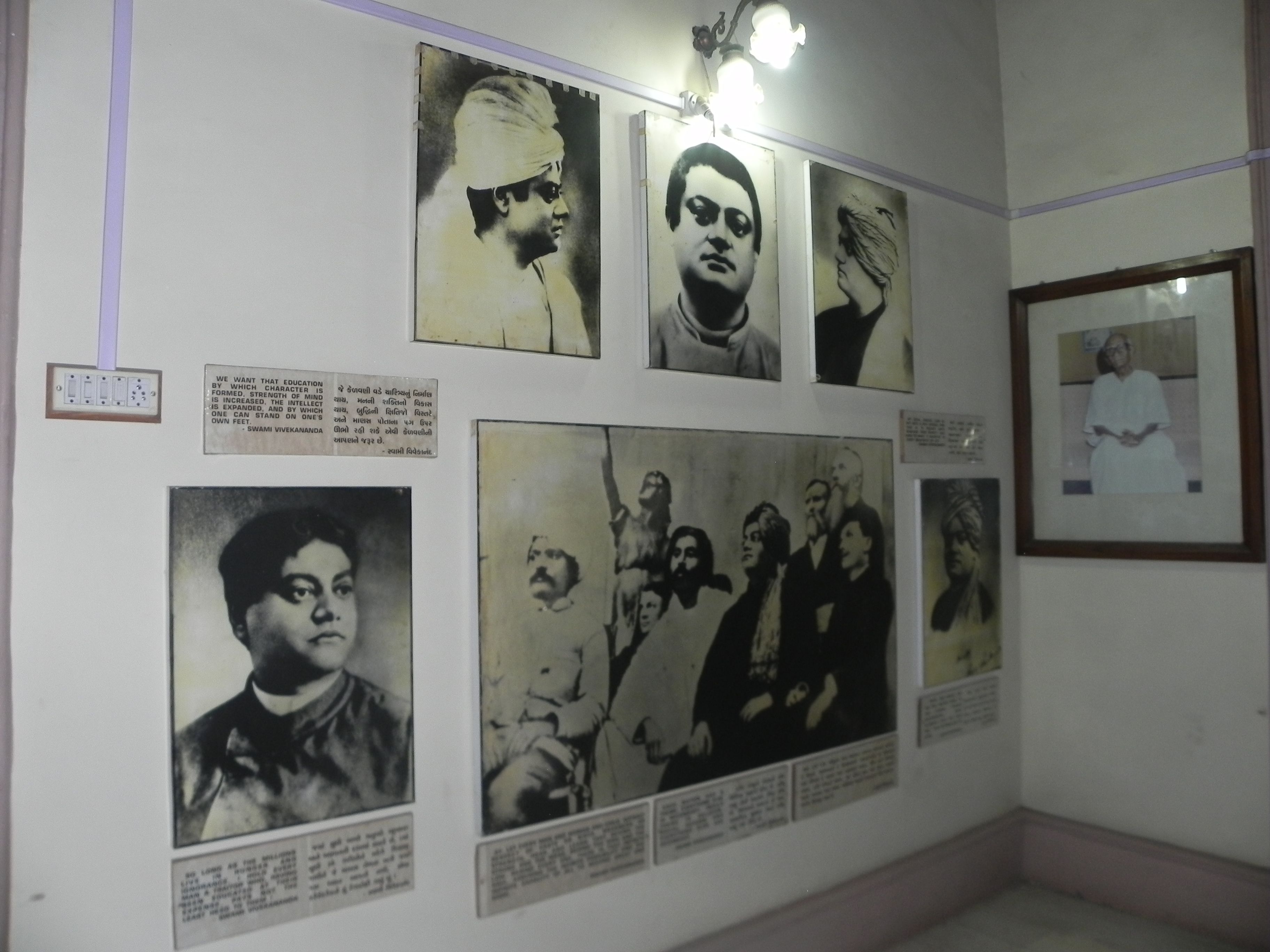
We all climbed several steps to go to the Durbar Hall. While going up we saw an excellent exhibition of Swami Vivekananda’s pictures. One painting of Swami Vivekananda with the Maharaja seemed like it had just been painted. It was amazing to see that the colors had still remained intact over all these years.
It was Maharaja Thakur Saheb of Limbdi Shri Yashwantsinhji who had hosted Swami Vivekananda. He was a very learned and cultured king. He had visited England and America and he advised Swami Vivekananda to go to the west to teach Sanatan Dharma.
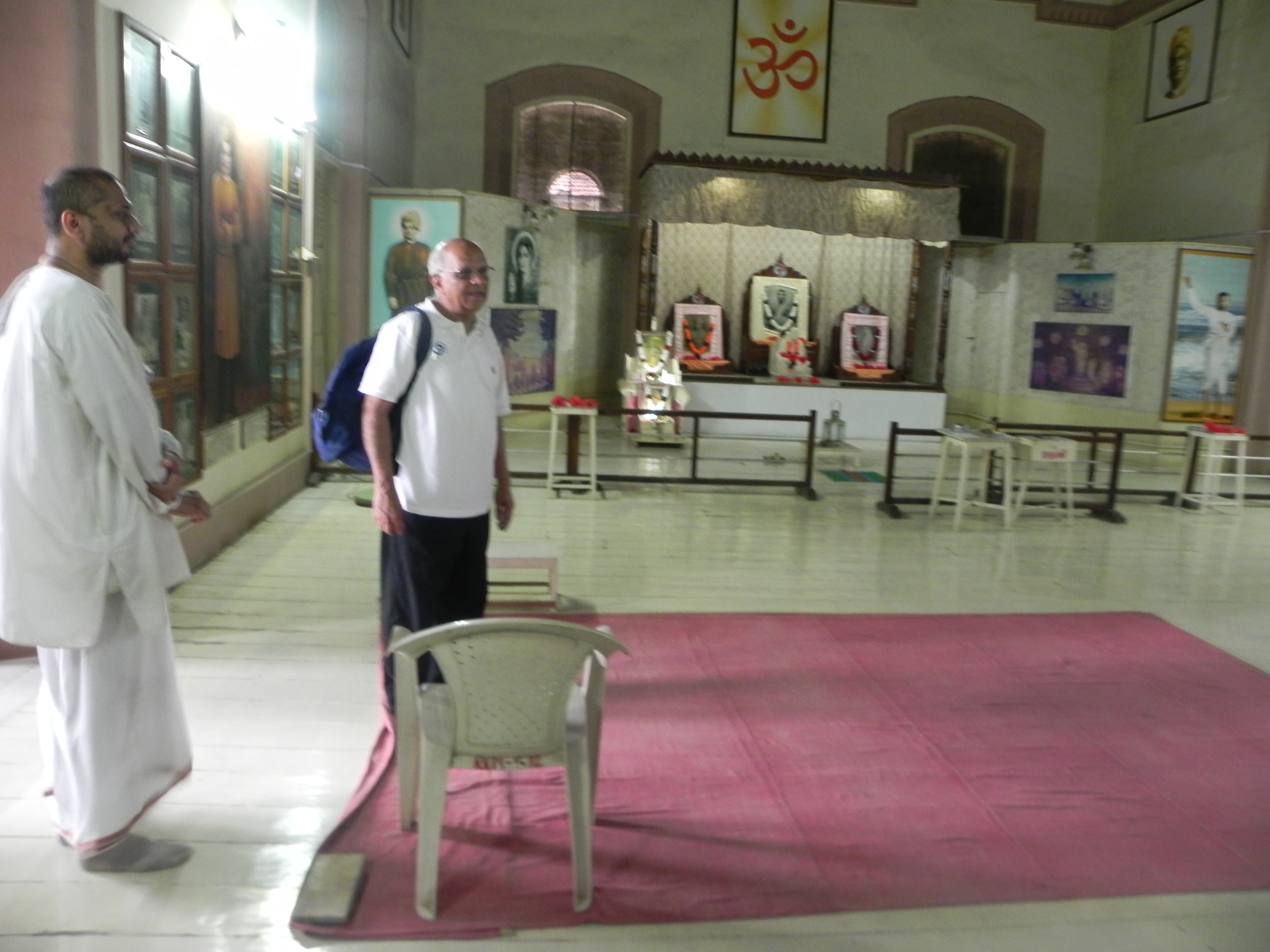
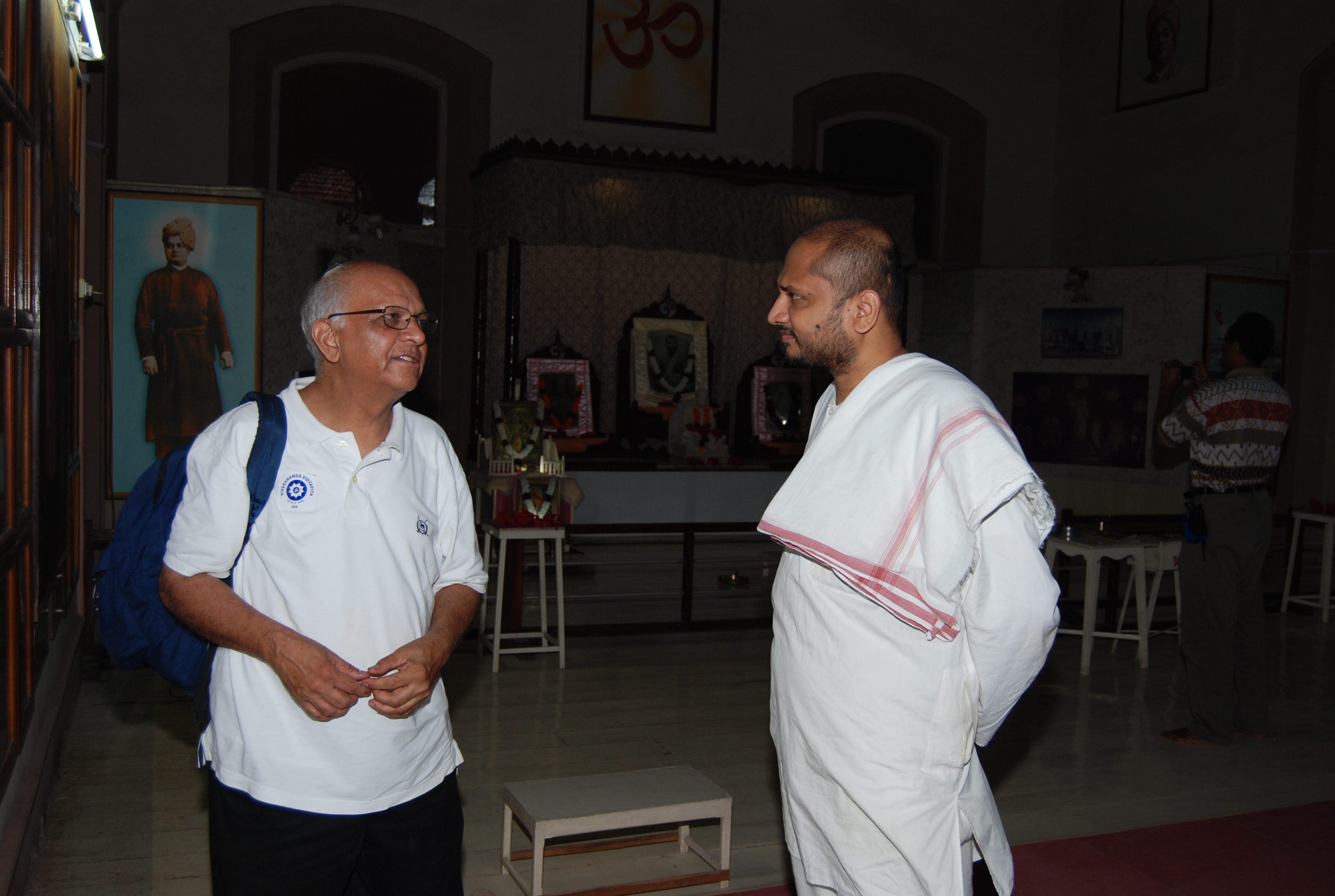
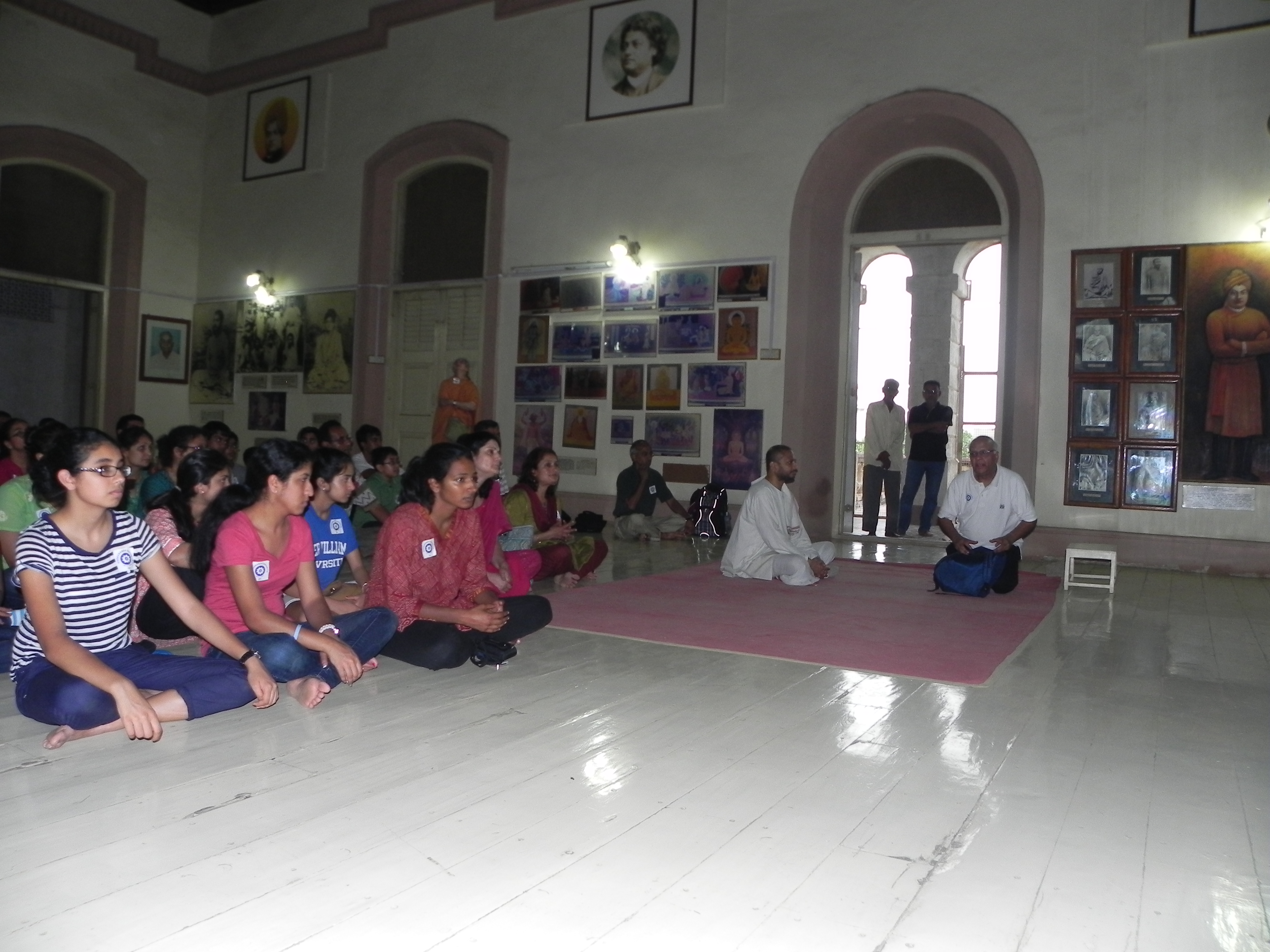
Upstairs, there was a beautiful shrine in the Durbar hall. The experience was sitting in the hall was thrilling. Imagine! Swami Vivekananda held spiritual discussions in this very room. The atmosphere was serene and pleasant. We all sat down in awe and offered our salutations to Thakur, Maa and Swamiji. We sang the bhajan “Jaya Vireshwar” and quietly did japa. The melodious singing of Pranam Mantras in perfect tune and filled with devotion, created a very inspiring atmosphere. All forgot their tiredness.
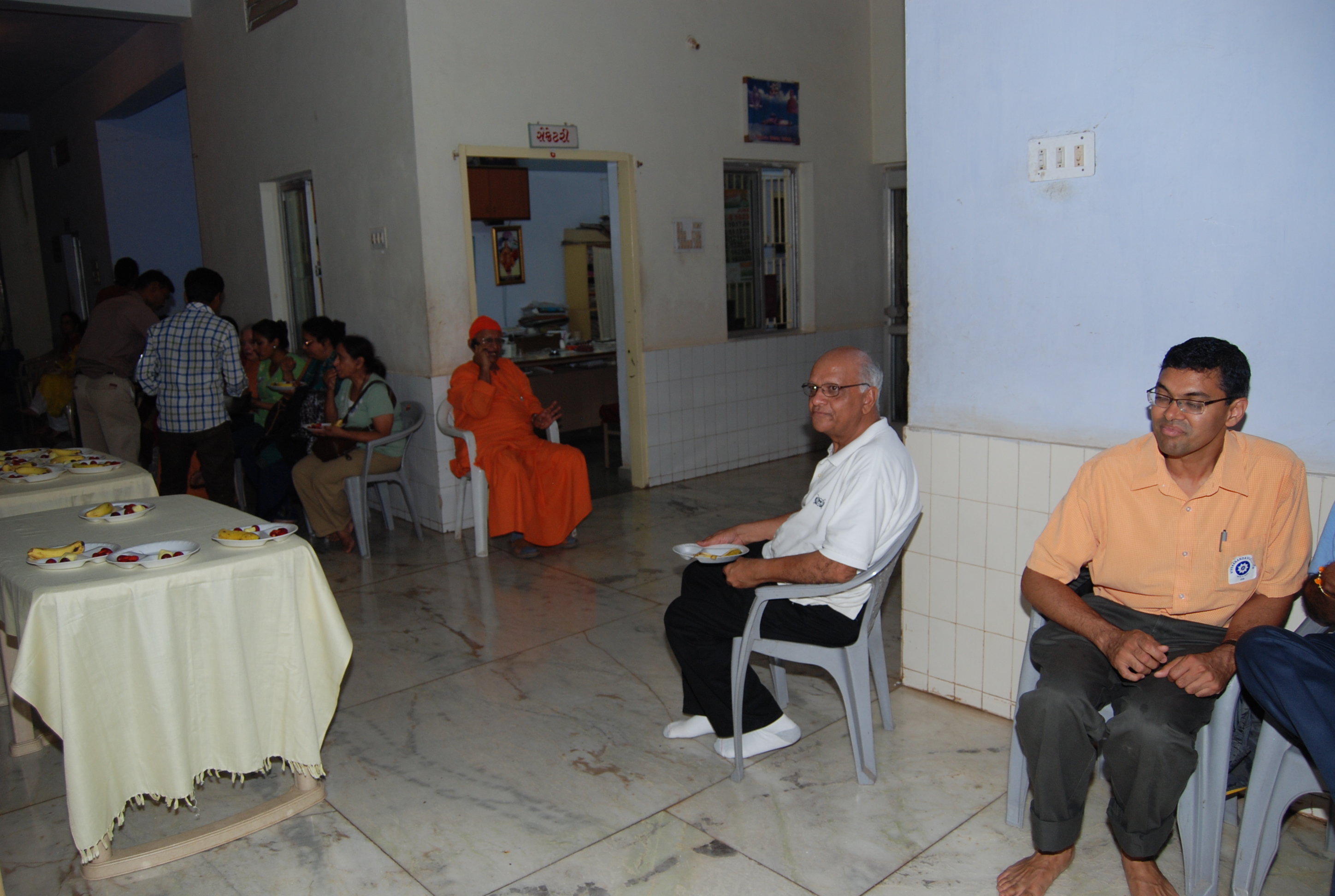
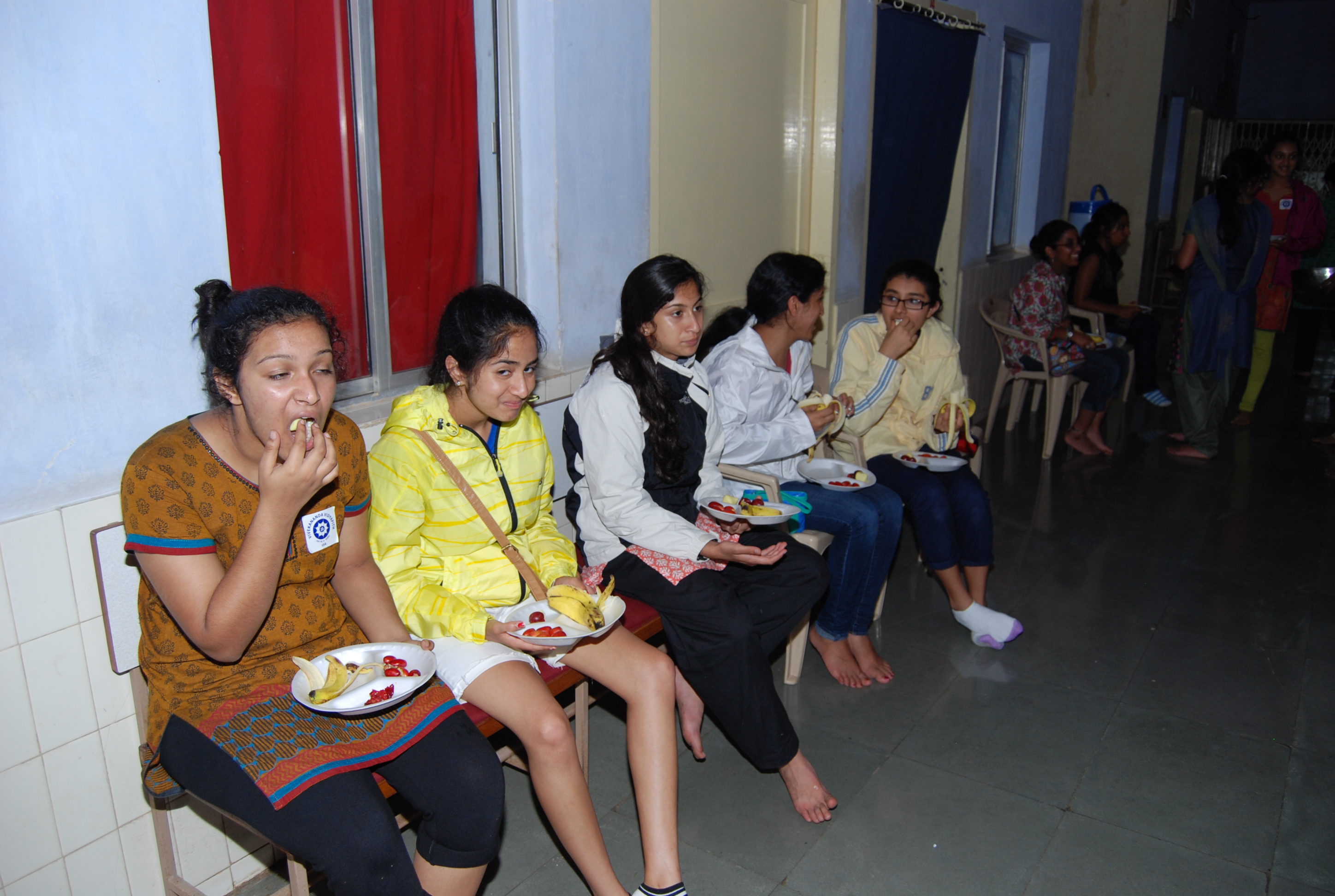
A Brahmachari led us to the Limbdi Ashram where Swami Adibhavanandaji was waiting for us. He had asked devotees to prepare 54 plates filled with a banana, a sweet, and fresh dates. We all enjoyed this loving hospitality. Swami Adibhavanandaji made sure that we enjoyed the snack. A few devotees were serving all of us with love.
It had started to rain again, and the huge bus could not come to the door. Swami was concerned about us getting wet so he asked couple of people to give us rides in the ashram’s cars. The rest of us walked through the muddy road with umbrellas and ponchos. We finally got into our bus and started on our journey to Rajkot. Despite the inconveniences, all were very happy and felt that they were lucky to be in the room in which Swami Vivekananda had stayed.
One student had a stomach problem, but luckily we had four physicians with us. They were ready with all needed medicines, and they immediately took care of him.
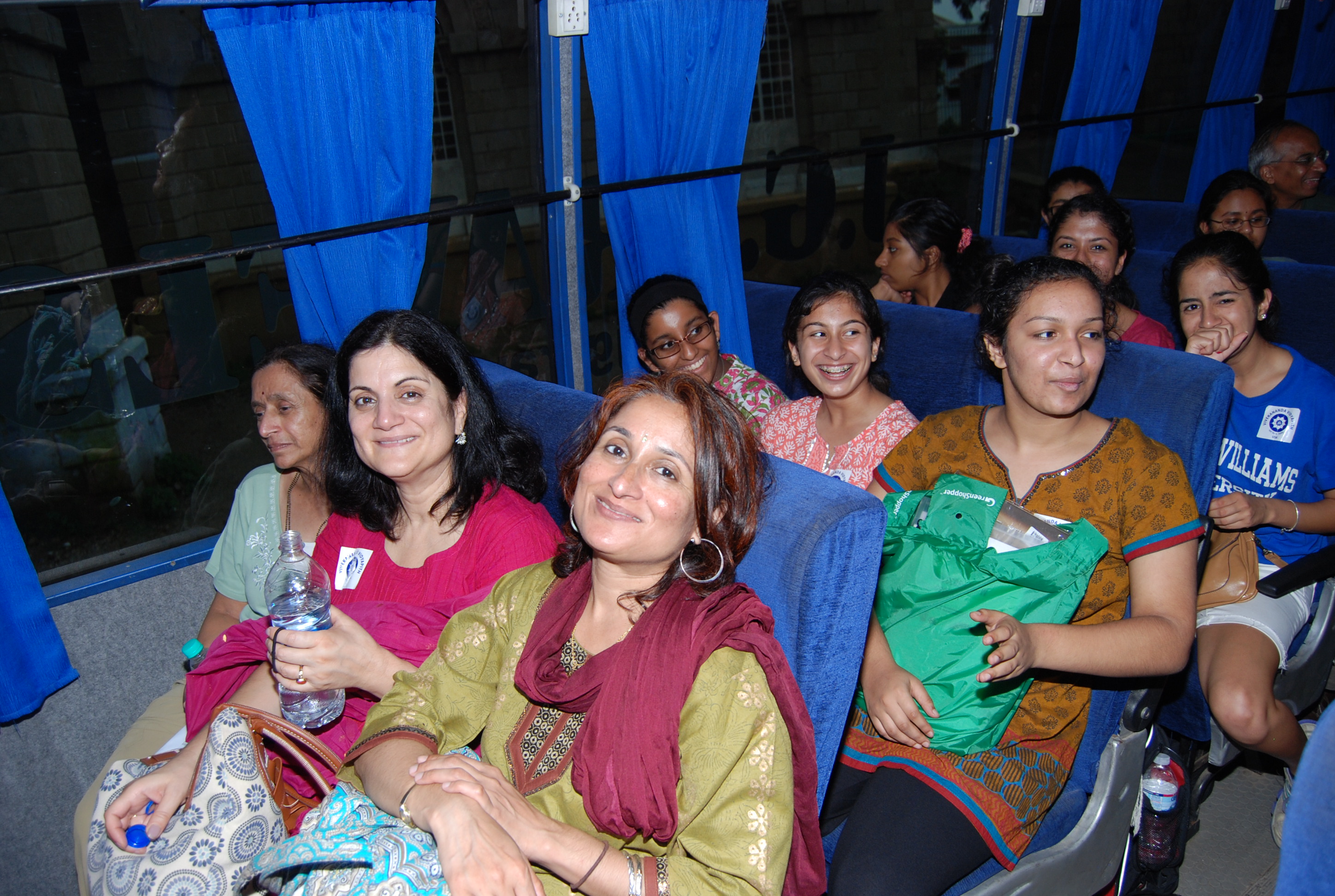
One thing I forgot to mention was that every morning on the bus, we started our journey with saying “Jai,” and then singing “Sri Ramakrishna Suprabhatam” with students and myself leading over the bus’s megaphone. Afterwards, whenever we had the chance, we recited Shanti Mantras, sang dhoons, bhajans and Gita Chapters 12 and 15. With all of the singing, we did not feel the tiredness of the long bus rides. Also, we had delicious snacks, which were brought to us by Jaymeen Uncle, Trupti Aunty, Nayana Aunty, and Apexa Aunty. Thus we filled our stomachs and minds with satisfaction and joy.
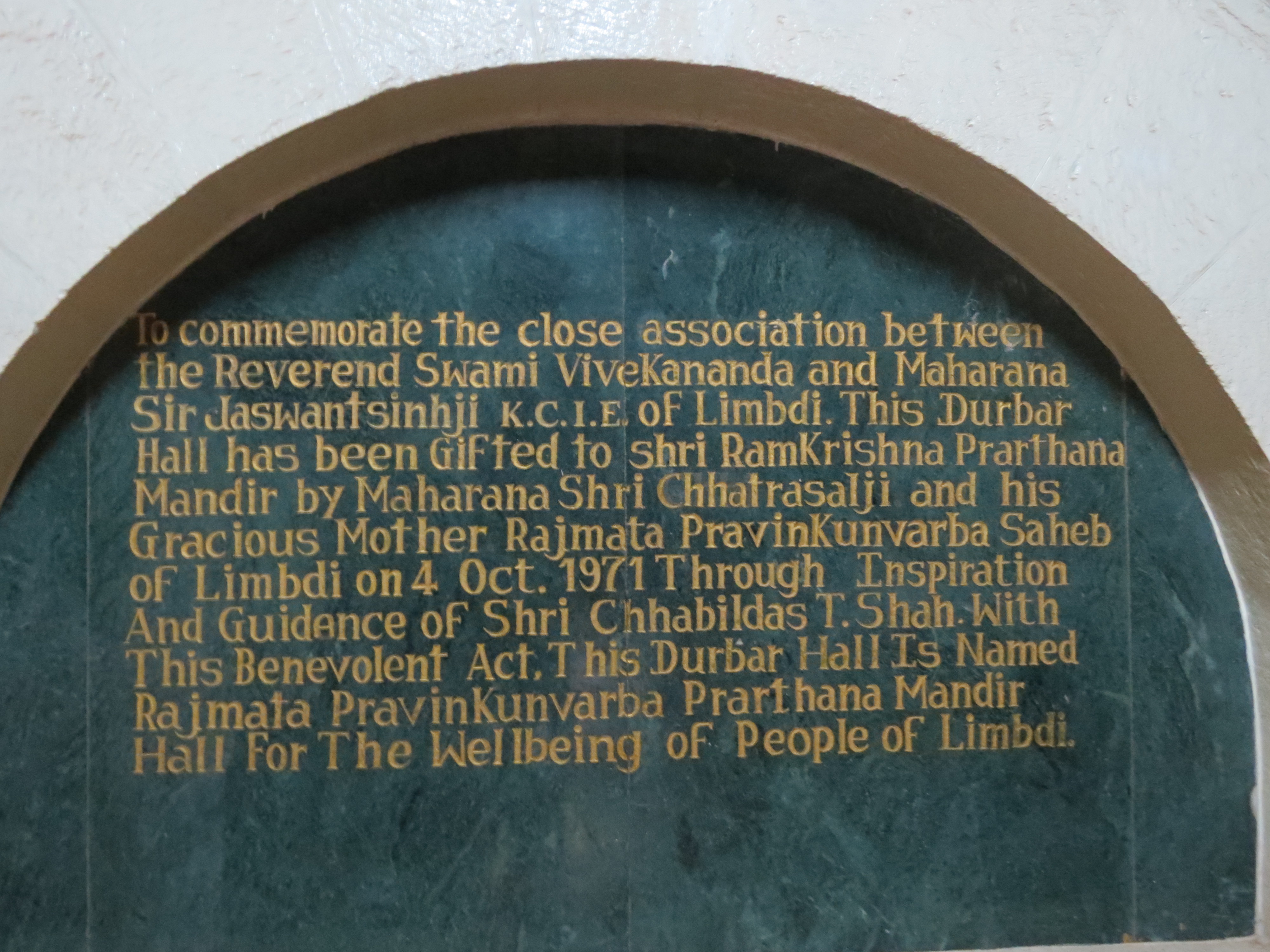
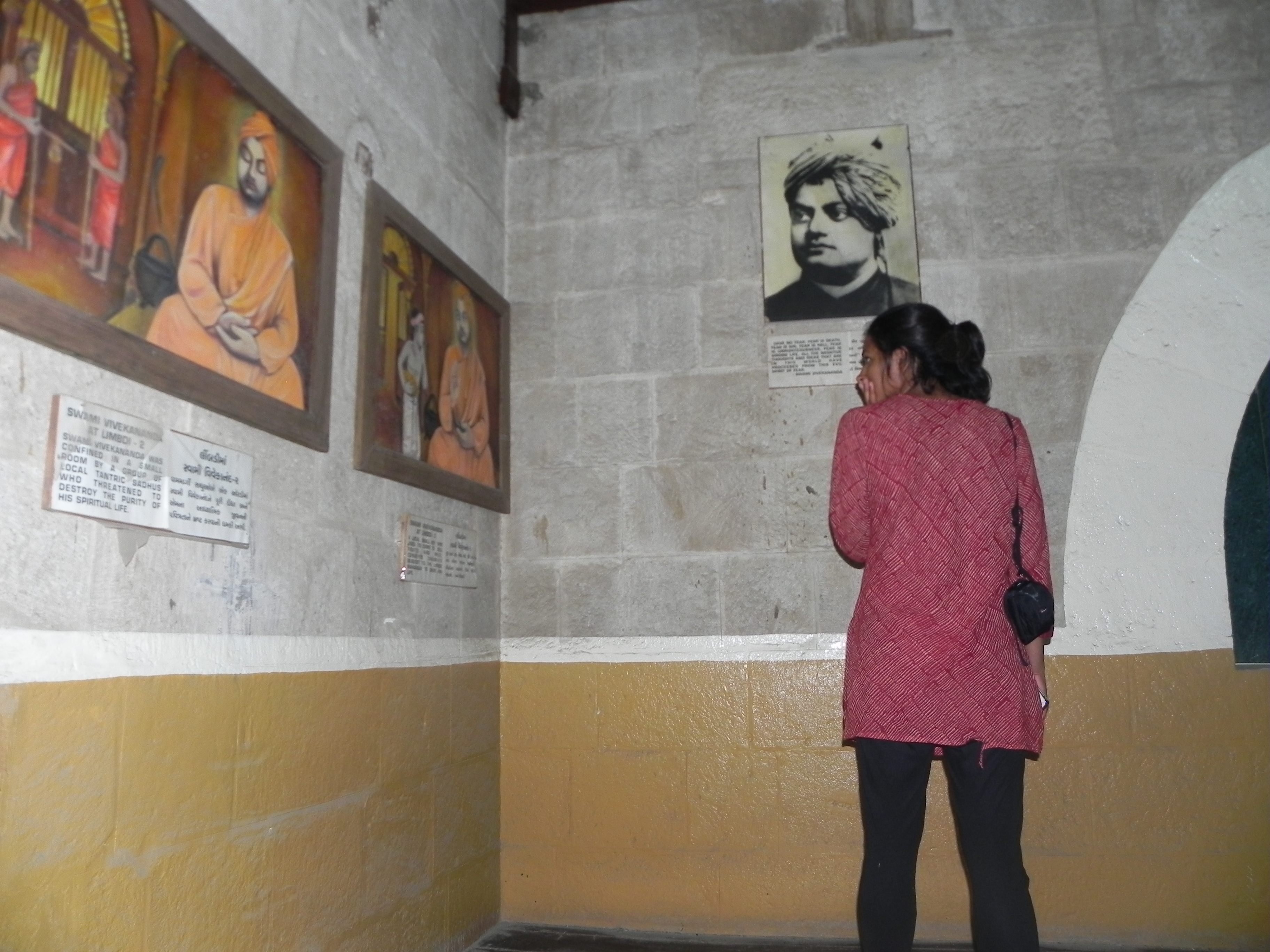
Lunch at Silver Cloud, AhmedabadOh it’s so delicious!It’s time to sing bhajans!Ride to LimdiLost in LimdiRide on a motorcycleCan you find Uncle?Arise! Awake!Arrived at palaceThakur Saheb’s palacePalace dedicated to Ramakrishna MissionTime for a group pictureClimbing up the stairs and looking at the exhibitionDedication plaqueThe Durbar Hall was gifted to Shri Ramakrishna Prathana MandirSo wonderful!The exhibition is amazing!Thakur Saheb with SwamijiBeautiful pictureThe Durbar Hall where Swami Vivekananda held discussionsMeeting BrahmacharijiExcellent exhibitionSwamiji’s various picturesThakur Saheb’s picturesTrue EducationExploringSwamiji and Brother DisciplesMore pictures of SwamijiThe Parliament of ReligionsThe altar in Durbar HallPleasant talkSitting for prayerPreparing for prayerNap timeAt the gate of the palaceOn our way to the Limbdi AshramLimbdi Ashram with Swami AdibhavanandaEnjoying prasad
Going to the shrine roomIt started rainingWe were preparedFound some shelterWe have ponchos!Going to RajkotBuffaloesSo happy in the bus
Sorry to keep you waiting for more Bulletins of our trip. I could not load them immediately for several reasons including having exciting activities from early morning to late night and not having enough sleep or access to Wi-Fi.
Several students, teachers, and parents checked in to the Royal Orchid Central Hotel, Vadodara, on Thursday, August 1st and had dinner at the hotel. It was exciting to see a little Vidyapith in the lobby of the hotel. They were eagerly waiting for the next day to begin. It would be a unique trip and our first Vidyapith trip in India. Also, we were happy that we were going to visit the places that Swami Vivekananda had visited.
Let me take you on a pictorial journey of the places we visited. We had lots of fun and uplifting moments. I wish I could make you feel our fun, joy, and inspiration through some magic. But alas, I do not know magic. You will have to imagine!
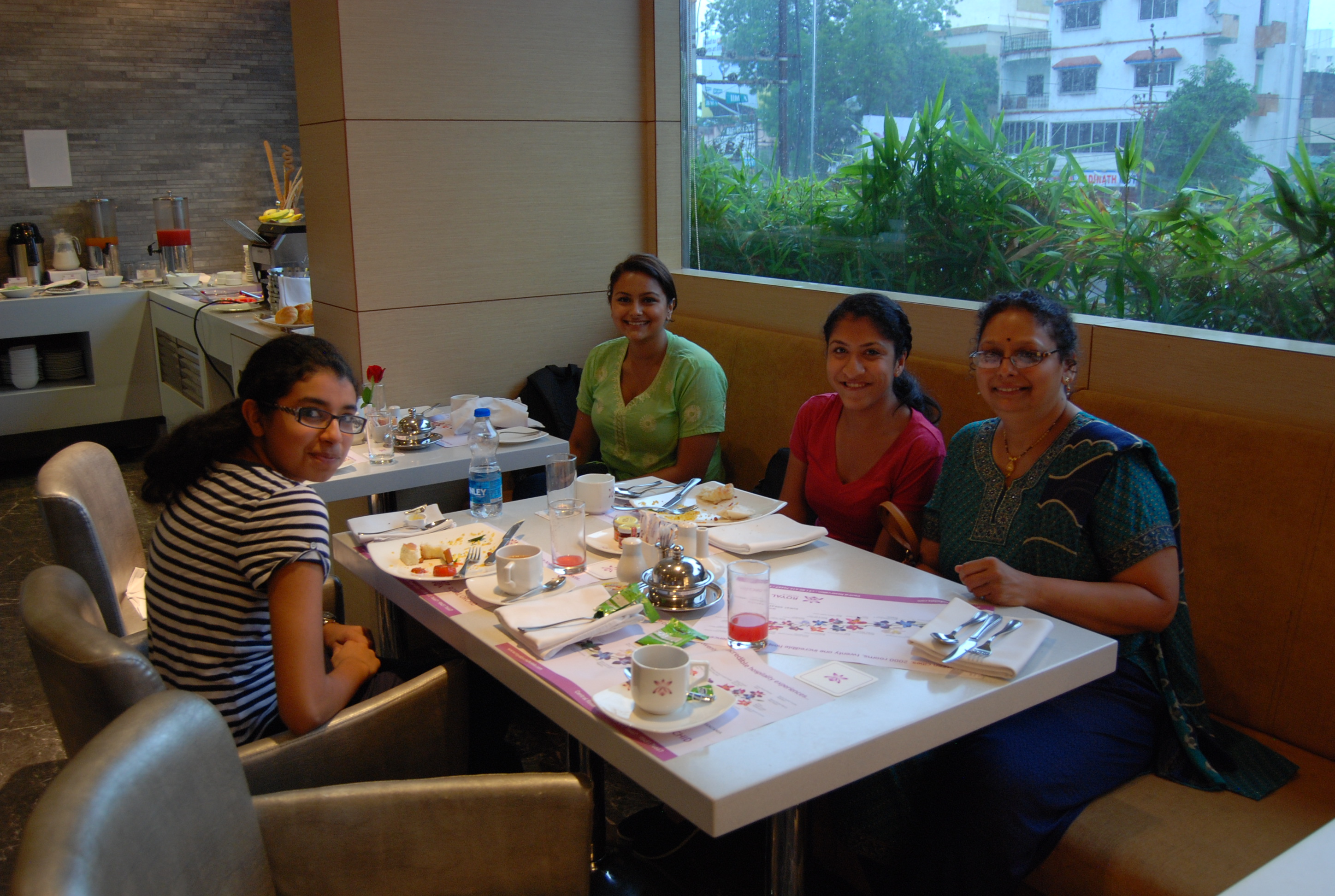
Early morning on Friday, August 2nd, all of the Vidyapith people who were at the Royal Orchid Hotel gathered in the restaurant to enjoy a delicious breakfast. The youngsters were amazed to see the variety of items including cereals, idlies, toasts, etc. Those who were staying in Vadodara came and joined in as well. It was also a divine coincidence that Pravrajika Shuddhatmaprana, who we visited at Ridgely Manor, could also join in our trip. Just couple of days before, Swami Nikhileshwaranandaji asked me if Pr. Shuddhatmaprana could join us. We were all happy about this divine company especially given that we had enjoyed her loving hospitality at Ridgely Manor.
The beginning of our trip was not very exciting as we had very heavy rain in the morning in Vadodara. There was even a power-outage in the early morning, but it paid-off to stay in a good hotel that had a generator which immediately gave us full electric power. I was worried that our trip would be a disaster; many had warned us of keeping this program in the monsoon season. I left everything to Thakur’s wish. People loaded our luggage in the heavy rain while we ran and took our seats. In spite of the rains, Vidaypith people were excited to go on the trip and were ready to go through whatever the future brought.
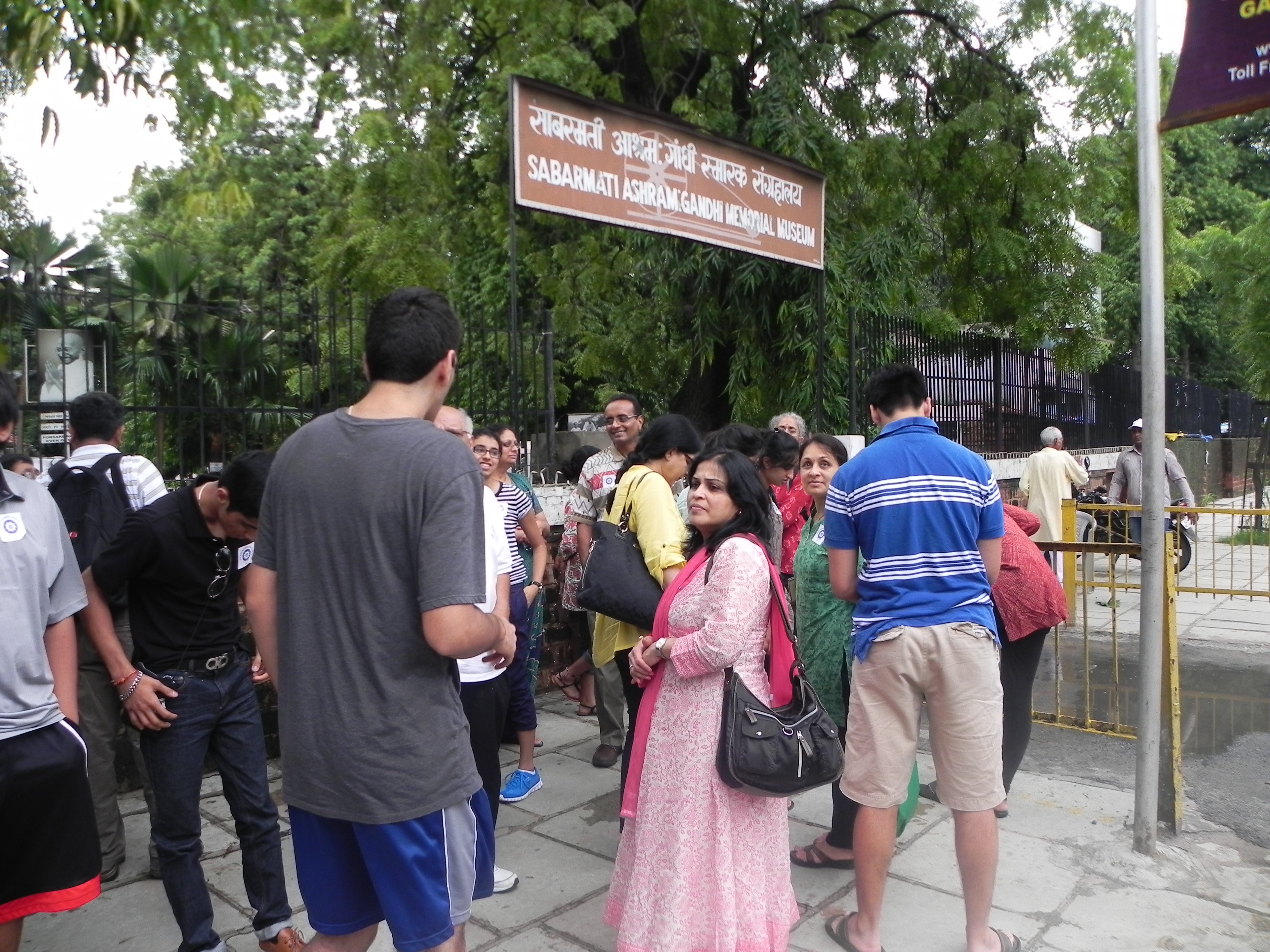
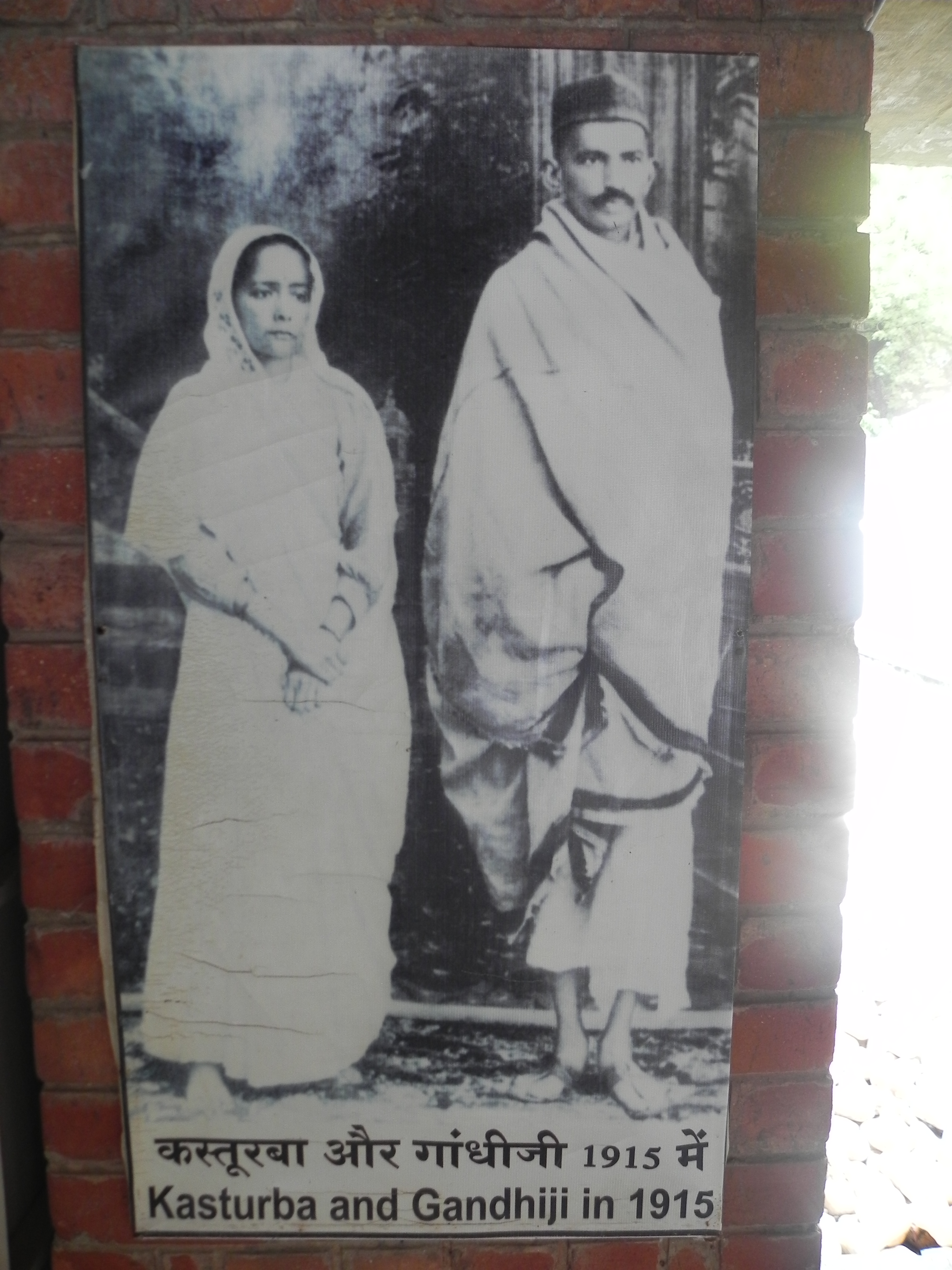
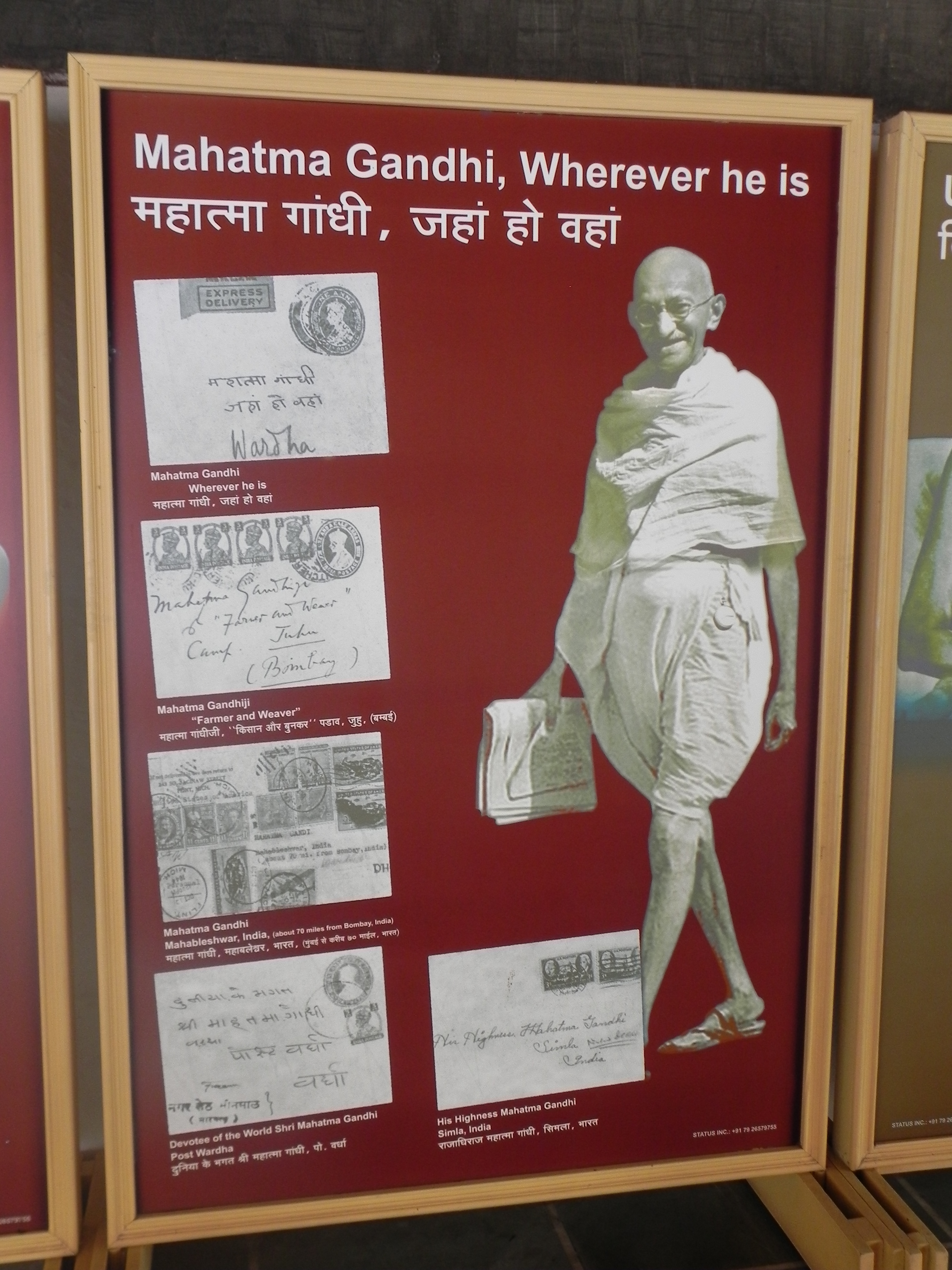
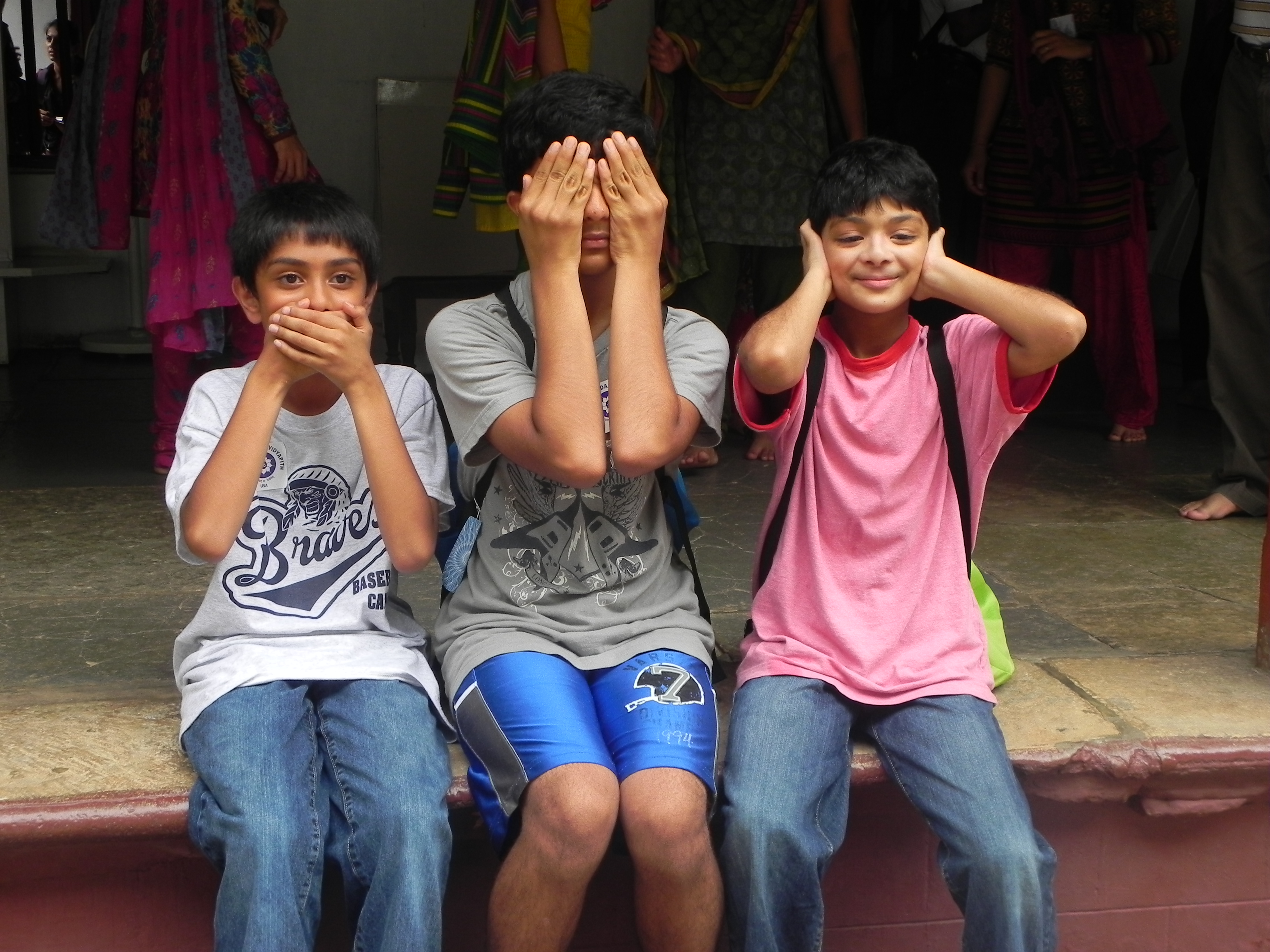
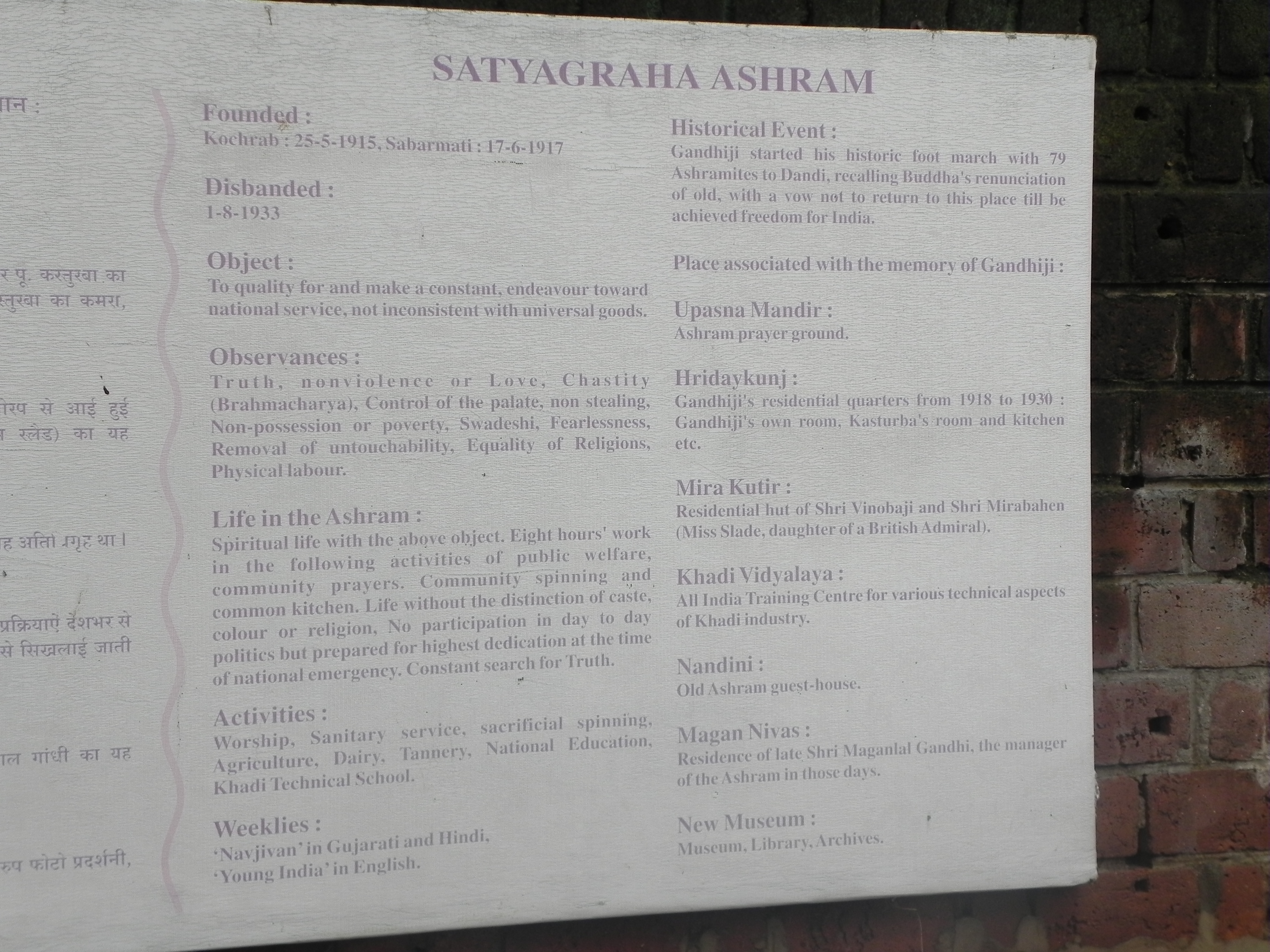
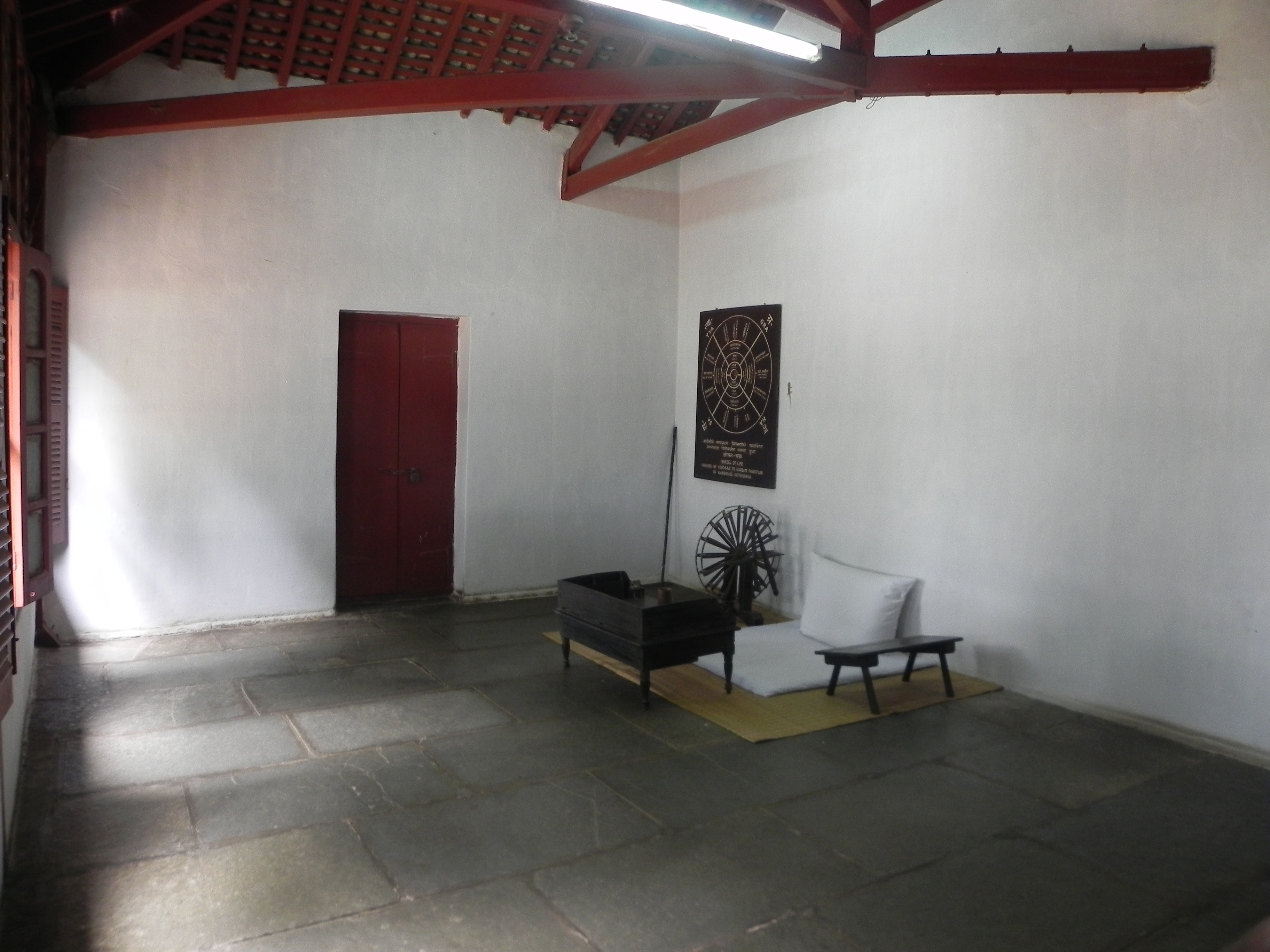
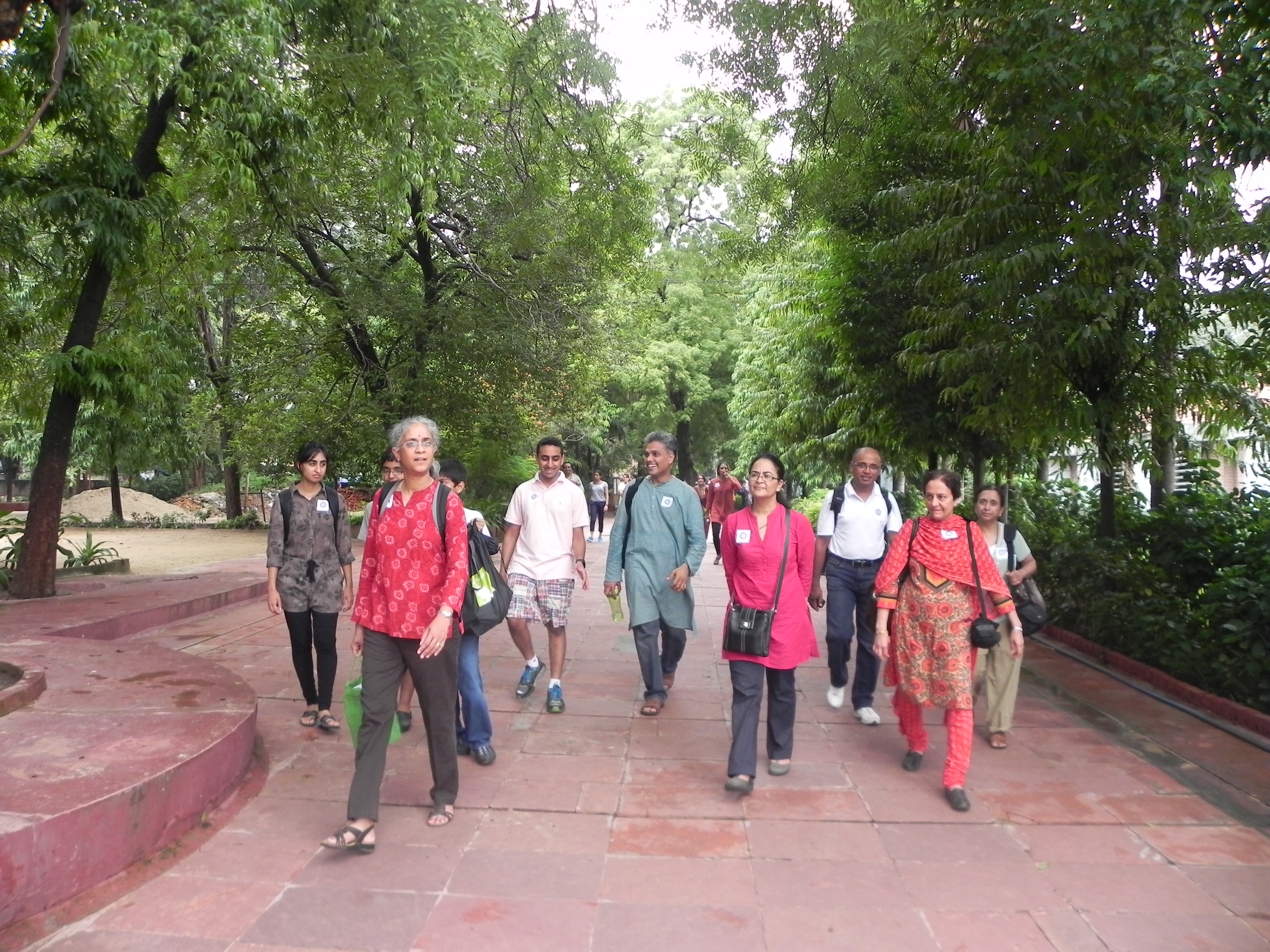
We arrived at Mahatma Gandhiji’s Ashram in Ahmedabad where many Vidyapith people were going to join us. You can only imagine our joy when we met each other. Together, we visited this international historic place and learned many things about the great soul, Mahatma Gandhi. Einstein had once said that after some time people would not even believe that such a great person lived on this earth. People would think that Gandhiji was just a myth. It is remarkable that in 1893 when Swami Vivekananda gave a famous speech at the World Parliament of Religions in Chicago, Mahatma Gandhi had also arrived in South Africa – both events were significant in making these great souls known to the world. Mahatma Gandhi has even said that after reading Vivekananda’s lectures, his love for India multiplied by thousand-fold. In Gandhiji’s works, several teachings of Vivekananda became tangible.
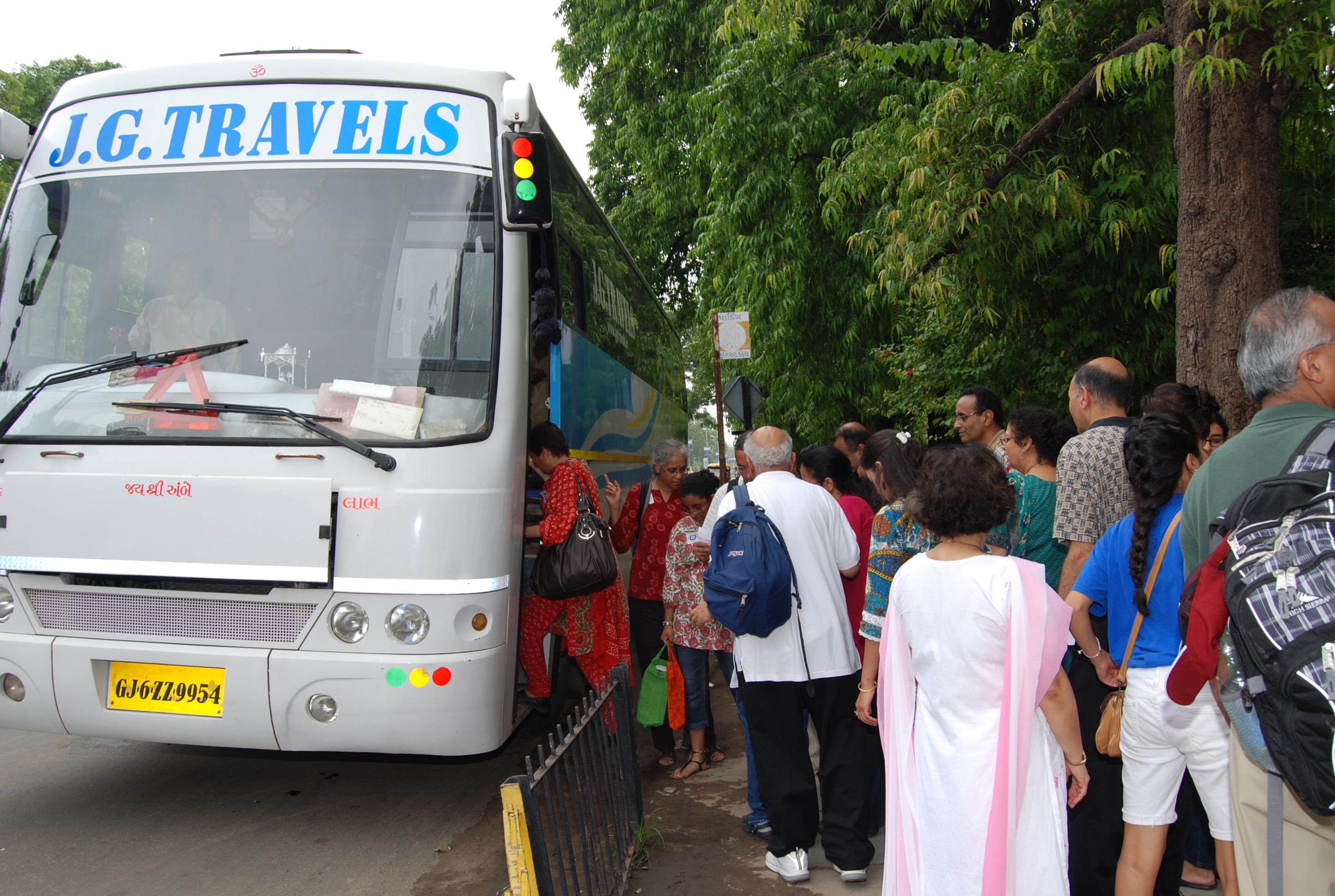
Happy to gather at the Royal Orchid Central Hotel, VadodaraBreakfast before the long journey!Pr. Shudhatmaprana joining us for the tripSummer Camp 5 breakfastHappy Parikh familyBreakfast is delicious!The journey begins in our J.G. Travels busRelaxing in the busThe bus has arrived at Sabarmati AshramHere we are at Gandhiji’s ashram!The groups are reunited at Gandhi ashramA message of truthGreat coupleMuseum in the AshramAbsorbed in reading Gandhiji’s biography“I want world sympathy in this battle of Right against Might”We are happy to be here!Gandhiji’s mailing addressGandhiji’s mailsPeace and serenity is capturedGreat personalities on Mahatma GandhiA famous political cartoon of Mahatma GandhiHappy Vidyapith students in Gandhi AshramThe famous 3 monkeysOur famous 3 monkeysHridaya Kunj – Gandhiji’s residenceVisiting Gandhiji’s living quartersLife at the ashramGandhiji’s famous room where many foreign visitors called on Bapu and where many historical decisions were deliberatedWalking on the beautiful ashram groundsTimeline of Gandhiji’s lifeAt the Hridaya KunjThe entire groupThe ashram’s sacred prayer ground – Upasana MandirOverlooking Sabarmati RiverBoarding the bus to go to lunchIt always takes time to board
Going to Baroda with the list of Vidyapith delegates participating in IYCThe first batch arrived to finalize preparations for the tripIYC posters on the streets of BarodaWith Rev. Swami Nikhileshwarananda at RKMVM in Vadodara
Swami Vivekananda in Gujarat
Swami Nikhileshwarananda has written an excellent research article “Swami Vivekananda in Gujarat.” One who is interested in Swami Vivekananda and/or Gujarat should read this article. The article brings out various aspects of Swami Vivekananda and makes him more humane. It also tells us how Swami Vivekananda directly and Sri Ramakrishna indirectly attracted few powerful personalities of Gujarat and played an important role in their lives. We can see how Swami Vivekananda built loving relationship with all of them.
Here I will tell you a few important points from this article that gives an overview of “Swami Vivekananda in Gujarat.”
During his ‘wandering monk’ period, July 1890 through May 1893, Swami Vivekananda spent maximum duration of time in Gujarat, from November 1891 through April 26, 1892.
During this time,
Swami Vivekananda strongly felt that he has a mission of his life.
He perceived bright future of India
He realized that India is one Huge Temple, as it were with chapels and sanctuaries everywhere. He saw the glory of Mahabharat.
He received inspiration for going to West to preach Sanatana Dharma
Pandit Shankar Pandurang told Swamiji, “I am afraid you cannot do much in this country. Few will appreciate you here. You ought to go to the West. Surely you can throw a great light on Western culture by preaching the Sanatana Dharma”. Here, probably Swamiji heard for the first about the religious convention that was to be held sometime in the following year at Chicago.
He had a wonderful experience of a mirage. In his lecture delivered in New York entitled ‘The Real and the Apparent Man’ Swamiji gave a description of the phenomenon and drew a very important moral from it.
He met some of the most prominent princes, Diwans, scholars and eminent personalities of his time. Such as:
Thakore Saheb of Limbdi Shri Yashwantsinhji
Maharaja of Bhavanagar Shri Takhtsinhji
Maharaja of Bhuj Shri Khengarji (III)
Maharaja of Porbandar Shri Vikamatji
Maharaja Gaekwad Shri Sayaji Rao
Shri Haridas Viharidas Desai, Diwan of Junagadh
Pandit Shankar Pandurang, Administrator of Porbandar
Shri Motichand Lalchand, Diwan of Kutch
Shri Manilal Jashbhai, Diwan of Baroda
Shri Mansukhram Tripathi & Shri Manibhai N. Dwivedi, the great Gujarati Scholars
Shri Lalshankar Umiashankar Trivedi, sub-judge and great philanthropist
All of them became great friends and admirers of Swamiji and some of them became even his disciples.
Ahmedabad
One day when a sub-judge of Ahmedabad was coming out of Ahmedabad Railway Station, he saw a sturdy and stout sannyasi sitting under a pipal tree, who had a look of greatness around him. He went to the monk and talked with him and became so much impressed that he atonce requested him to be his guest. Both got into the waiting tonga and soon arrived at the house of the host – Shri Lalshankar Umiashankar Trivedi – residing at 36 Amritlal’s Pole in Khadia the heart of the city of Ahmedabad.
Soon Shri Lalshankar realized that his guest was an unusual person with a good knowledge of almost everything in the world. The unknown monk was of course, none other, than Swami Vivekananda. Although the house was spacious, it lacked the required tranquility for meditation and reading, so Shri Lalshankar took Swamiji to another house he had in Ellisbridge behind the townhall. The house became a beehive of activity with many people flocking to hear and meet Swamiji, who lectured on several topics including high philosophy.
He stayed in Ahmedabad for 11 days.
Wadhwan
He saw Sati Ranakdevi’s temple.
Limbdi
He had a terrible experience with some evil sadhus, but Swamiji cleverly escaped with the help of a young village boy and the Majaraj of Limbdi.
Swamiji stayed in the beautiful palace of Limbdi for many days and held discussion in Durbar hall of the palace with the maharaja, Thakore Saheb, Shri Yashwantshinji (1859-1907). He was a brilliant, learned king who had visited England and America. President Cleveland warmly greeted the Maharaja at the White House in Washington DC. Thakore Saheb described in detail what he had learnt from his visits to England and America and requested Swamiji to go to these countries for preaching Sanatana Dharma. Thakore Saheb of Limbdi was the first among the Maharajas to inspire Swamiji to go to the West for preaching work.
A fire in 1906, consumed a major portion of the beautiful Limbdi palace, left untouched the Darbar Hall where Swamiji had stayed. Sixty five years later Shri Chhatrasalji, the present Thakore Saheb of Limbdi, donated the palace to a public body named “Shri Ramakrishna Prarthana Mandir”. And now this trust has handed over the palace alongwith other properties to Ramakrishna Mission.
The Impact of Swami Vivekananda’s Visit to Gujarat
After returning from the West Swamiji sent two of his Gurubhais, Swami Turiyananda and Swami Saradananda to Gujarat to preach and to collect funds. Both of them spent about 3 months in Gujarat (From 22 February to 18 April 1899).
Junagadh & Girnar
Swamiji saw many ancient monuments and ruins – an old fortress called Uparkot, an old Rajput palace, two ancient wells, Khapra Khodia caves dating back to the Buddhist period, perhaps used as monasteries, ‘Ashoka Shilalekh’ in which the edicts of Emperor Ashoka and of the other emperors are inscribed and many other places of historical importance.
Girnar is group of about ten hills, highest of which is Gorakhnath (about 3600 ft.) has been a place of pilgrimage sacred to Buddhists, Jains and Hindus alike before the days of Ashoka (272-231 B.C.). For Swamjji, it must have been of special interest because here Pavahari Baba was initiated into the mysteries of yoga. 26 He sought out a cave and practised meditation for a few days during which Diwan Saheb took all possible care of him.
For a few days Swamiji stayed with Shri Chhaganlal Harilal Pandya (1859-1936), a great scholar and Manager of Diwanji Saheb, who became his staunch admirer. About Swamiji’s stay in his house he gave a delightful account – how he charmed everybody by his personality, vast scholarship, songs and discourses and not the least by his proficiency in the art of cuisine, specially by the ‘excellent rasagollas’ he prepared. In his talks Swamiji spoke of Jesus Christ as also of Shri Ramakrishna.
Swamiji visited Junagadh many times. During one of the trips he had also stayed with Shri Mansukhram Tripathi, the well-known writer and scholar of Gujarat, a man of high character, who preferred higher values of life. We get confirmation about Swamiji’s stay with Shri Mansukhram Tripathi from the account given by Swami Abhedananda in his auto-biography.
“On arrival at Junagadh, I came to hear from people that a Bengali sannyasi with high English education was staying for some days at the house of Mansukhram Suryaram Tripathi, a Gujarati brahmin, who was the Private Secretary of the local Nawab.. Elated with joy I reached the house of Mansukhram and immediately found that my conjecture was true. Narendranath brightened up with joy to see me unexpectedly.. Fortunately when I arrived there Narendranath was discussing some topic of non-dualistic Vedanta with Mr. Tripathi.. I gladly stayed in his house for three or four days in the company of Narendranath and then I got ready to start for Dwarka.”
During his very first visit to Junagadh Swamiji had become a guest of Shri Haridas Viharidas Desai, the Diwan of Junagadh (whom Swamiji used to address as Diwanji Saheb). Diwanji Saheb was so much charmed with the company of Swamiji that every evening with all the State officials he used to meet Swamiji and converse with him until late at night. Swamiji in turn loved and respected him as a son does his father, the difference in their age being 22 years. He wrote from Khetri in May 1893, “Believe me that I love you and respect you like a father and that my gratitude towards you and your family is surely unbounded…”
There are 13 inspiring and important letters of Swamiji addressed to Diwanji Saheb.”A friend in need is a friend indeed”. Like a true friend Swamiji helped Diwanji Saheb to overcome his problems, whenever needed. Once when Diwaniji Saben was in distress, Swamiji wrote an inspiring and powerful letter to him, “Often and often we see that the very best of men even are troubled and visited with tribulations in this world…”
Similarly, when Swamiji was in trouble, while some vested interests in America raised all sorts of scandalous charges against his character and conduct, Diwanji Sabeb, as soon as he came to know about it, wrote on 26.6.1894 to Mr. G. W. Hale in staunch defence of his beloved Swamiji. Swamiji wrote back to him, “your kind note to G.W. Hale has been very gratifying as I owed them that much.”
Diwanji Saheb’s administration of more than a decade in Junagadh was marked by the most important reforms in every department of the State.
Kutch
After spending a few days in Junagadh, Swamiji proceeded towards Kutch with a letter of introduction from Diwanji Saheb to his bosom friend Motichand Lalchand, Diwanji of Bhuj. Bhuj was the capital of Kutch. The Maharaja of Kutch, Khengarji Bahadur, only three years younger than Swamiji, soon formed a very close friendship with him. He was deeply impressed by Swamiji’s magnetic personality and was astonished at his vast knowledge: “Swamiji, as after reading may books the head becomes dazed, even so after hearing your discourses my brain becomes dizzy. How will you utilize this talent? You will never rest until you have done wonderful things!”
Swamji afterwards went to Mandavi.
Swamiji’s journey was not always pleasant or safe. When Swamiji was at Bhuj, his brother – disciple Swami Akhandananda warned him of the dangers of jealous state officers. Some state officers had even poisoned a Bengali sannyasin years ago when this sannyasin had tried to introduce reforms to improve the state.
Somnath
Several times the temple of Somnath was destroyed and several times rebuilt. Swamiji paused by this great ruin and pondered over the greatness that had been India’s in the past. He realized that in India religious life forms the center, the keynote of the whole music of national life. Later (in 1897) he was to address his countrymen, “Some of these old temples of Southern India and those like Somnath of Gujarat will teach you volumes of wisdom, will give you a keener insight into the history of the race than any amount of books.”
Dwarka
After a brief stay in Porbandar reached Dwaraka, holy with innumerable memories and legends of Shri Krishna. But of its glories nothing remains at present. Now the ocean roars in tumult over the place where once the powerful Yadava lived and where once stood a great capital of which Shri Krishna was the reigning prince.
He sat on the shore and yearned ardently to fathom the contents of the future. Then rising as from a dream he went to Sharada Math (a monastery founded by Adi Shankaracharya) where he was assigned a room. There in the silence of his cell, he saw a great light – the resplendent future of India.
From Dwaraka Swamiji went to Bet Dwaraka (Island Dwarka) Mandvi etc.
An interesting chase
Akhandananda heard at Ahmedabad that Swamiji had gone to Wadhwan. At Wadhawan he heard that he had gone to Junagadh; at Junagadh he learnt that Swamiji had left for Dwaraka via Porbandar; at Dwaraka that he had left for Bet Dwaraka; at Bet Dwaraka that at the invitation of the Maharaja of Kutch he had gone to Mandavi; at Mandavi that accompanied by a party of body guards he had gone to Narayan Sarovar, which was eighty miles away.
Swami Akhandananda was warned at Mandavi that the road to Narayan Sarovar was infested with dacoits. But heedless of danger he sped on. On the way he was beaten and robbed by dacoits. At Narayan Sarovar he learnt that the journey to the place, which might have cost him his life, had been fruitless for he was told that Swamiji had left for Mandavi via Ashapura. The road lay through desert wastes and was also infested with dacoits and it meant a journey for a hundred miles, yet he heroically marched on in spite of having fallen sick.
Swamiji was also astonished and no less glad to meet his beloved brother disciple but when he heard the story of his chasing him, he got worried that his brother – disciple would not leave him alone as he had come all the way at the risk of his life. He told Swami Akhandananda, “Look I have become a spoiled man, you leave me.” Swami Akhandananda replied, “what would it matter to me even if you had lost your character ? I love you, and that is not in any way affected by your good or bad character. But I do not wish to be in your way. I had a longing to see you, and now I am satisfied. Now you can go alone.” Swamiji was happy to hear this and next day left for Bhuj, which Swami Akhandananda reached a day later. Both of them then went back to Mandavi and halted for a fortnight. There Swamiji made many friends. From there Swamiji went to Porbandar. Swami Akhandananda joined him at Porbandar after about a week and after spending a few days at Porbandar he went to Jamnagar via Jetpur, Gondal, Rajkot and thus spent about a year in Kathiawad.
Porbandar
One evening while Swamiji was pacing on the roof of the palace of the Maharaja of Porbandar. He suddenly saw his brother disciple Swami Trigunatitananda coming towards the palace with a group of sadhus. Swamiji was thrilled to see him.
In Porbandar, Swamiji came into contact with Pandit Shankar Pandurang (1840-1894) of Konkan. He was a Sanskrit scholar of eminence. After his return from England in 1874, he was appointed as Oriental Translator in Bombay Government as he was proficient in nine languages.
Swamiji visited Porbandar twice. According to Swami Shivananda, it was the large beautiful library of Panditji that had attracted Swamiji. During his earlier visit to Porbandar, Panditiji had requested him to stay as long as he liked at his place and utilize the library. Thus, Swamiji stayed for about four months.
During his long stay at Porbandar Swamiji became very intimate with Panditji and his family. He used to ride with Panditji on horseback to have a look at the distant villages. Being an artist of the cuisine he taught the wife of Panditji, Ushadevi, various delicious preparations. Two sons of Panditji – Madhav and Vaman played with him, learnt swimming from him and became great friends of Swamiji. Three daughters Tara, Kshama and Bhadra who were at first shy, received greater affection and blessings of Swamiji.
When Swamiji was at Porbandar, Pandit Shankar Pandurang was editing Sayanacharya’s commentary on the ‘Atharva Veda’. Struck with Swamiji’s scholarship, he often asked his help to explain some of the more abstruse passages which Swamiji did with his usual lucidity. Both kept at the work constantly, Swamiji becoming more and more engrossed in it as his perception of the greatness of Vedic thought grew still keener. Swamiji also finished reading of Panini’s ‘Mahabhasya’ at Porbandar. Swamiji told Swami Akhandananda that in the whole of India he had not seen Pandurang’s equal in Vedic learning. 37 Swamiji also learnt French at the instance of Panditiji who said, “It will be of great use to you Swamiji”. He wrote a letter in French to his brother – disciples at Alambazar and gave them a great surprise.
Pandit Shankar Pandurang told Swamiji,
“I am afraid you cannot do much in this country. Few will appreciate you here. You ought to go to the West. Surely you can throw a great light on Western culture by preaching the Sanatana Dharma”.
Here, probably Swamiji heard for the first about the religious convention that was to be held sometime in the following year at Chicago.
Humour at Porbandar
Acharya Revashankar Anupram Dave who was a centenarian, used to go to Bhojeswar Bungalow to meet Swamiji with his friend Madhav, while he was himself 18 years of age. Giving his memories of those days he said that one day the students of Sanskrit school were brought to Swamiji who talked to them mostly in Hindi, but at times Bengali and Sanskrit words used to creep in. One of the students Govindaji replied to Swamiji, “I went to Varanasi and have studied the ‘Sama-veda’. I have learnt six Mantras (Shastras ?)” Then Swamiji asked, “Why did you not study further?” Govindaji replied, “I happened to have Karela so I had to come back.” On hearing the word ‘Karela’, Swamiji had a hearty laugh. ‘Karela’ means bitter gourd, but the boy had meant that he had an attack of cholera.
Palitana
From Porbandar Swamiji came to Junagadh and then started for Palitana – a city of temples many of which date back to the eleventh century. High up on Shatrunjaya mountain sacred to the Jains, is a temple dedicated to Hanuman and a shrine dedicated to Hengar, a Muslim saint. Swamiji climbed to the top of the mountain to enjoy the view that is magnificent.
At Palitana Swamiji drew the attention of people because of his mastery of singing and playing on instruments.
Nadiad
From Palitana Swamiji started for Baroda. On his way he met his friends Shri Haridas Viharidas Desai, Shri Chhaganlal Pandya and Shri Manasukhram Tripathi. He also met Shri Manilal Nabhubhai Dwivedi, the well-known Gujarati writer. Dwivediji’s life (1858-1898) was spent in writing many books in Gujarati, English and Sanskrit including ‘Immitation of Shankara’, ‘Rajayoga’, ‘Siddhanta Sar’, ‘Bhagavad Gita’ etc. He could not go to Chicago Parliament of Religions but his paper was read out there. Dwivediji was one of the pioneers in spreading Advaita Vedanta in Gujarat. Hence Swamiji must have enjoyed his company at Nadiad by holding discussions on Vedanta.
Baroda
From Nadiad, Swamiji came finally to Baroda before leaving Gujarat, with a letter of introduction from Diwanji Saheb addressed to his intimate friend Shri Manibhai J. Diwan of Baroda, who was a man of piety and noble character. Shri Manibhai J. had received the title of Diwan Bahadur from the Government of India along with a medal and gift of Rs. 75,000 while he was the Diwan of Kutch. In Kutch he introduced great and beneficial reform in all departments – collection of revenue, education, sanitation etc.
At Baroda Diwan Shri Manibhai worked hard and there was spectacular progress in the field of education. Swamiji spent sometime with him in discussing about the education system of the State. Swamiji wrote from Baroda on 26th April, 1892 to Diwanji Saheb of Junagadh “I had not the least difficulty in reaching your house from the station of Nadiad. And your brothers, they are what they should be, your brothers. May the Lord shower his choicest blessings on your family. I have never found such a glorious one in all my travels. Your friend Mr. Manibhai has provided every comfort for me but as to his company, I have only seen him twice, once for a minute, the other time for 10 minutes at the most when he talked about the system of education here. Of course, I have seen the library and the pictures by Ravi Varma and that is about all seeable here. So I am going off this evening to Bombay.”
Curiously enough, there is no mention in the above letter about Swamiji’s meeting with Maharaja Sayajirao Gaekwad. Swamiji had told Prince Martand Varma at Trivandrum that “of all the ruling princes he had met, he had been most impressed with the capacity, patriotism, energy and foresight of H.H. the Gaekwad of Baroda.” 40 Swamiji was also perhaps impressed with the Maharani of Gaekwad because he wrote on 17.2.1901 to Miss Macleod from Belur Math “I hope you will go to Baroda and see Maharani” However, the State records reveal that Maharaja was not in Baroda at the time of Swamiji. He had gone to place called Lonavali (Lonavala ?) In all probability Swamiji met him while he was in Mahabaleshwar or Poona. After his return from the West, Swamiji wanted to visit Baroda and meet the Maharaja but it did not materialize.
Most likely, on 26th April, 1892 Swamiji left Gujarat and proceeded to Bombay and thus ended his historical tour of Gujarat.
Ramakrishna Mission Vivekananda Memorial at Vadodara is holding an International Youth Convention on August 10th and 11th, 2013 as a part of its celebration of Swami Vivekananda’s 150th Birth Anniversary. For more information check the link: http://www.rkmvadodara.com/
I am joining with Vivekananda Vidyapith’s 27 Youth Delegates, 30 Vidyapith’s teachers and parents and 9 children to participate in this convention. Also, 54 of these participants are going to visit places in Saurashtra which are associated with Swami Vivekananda and Mahatma Gandhi.
For more news about this convention keep checking this blog.
Vivekananda Vidyapith Honored by the Passaic County Board of Chosen Freeholders, New Jersey, USA
As a part of Passaic County’s celebration of Asian Pacific American History month, Vivekananda Vidyapith was one of two honorees chosen for outstanding contributions made to the U.S. and the community. Sponsored by the Passaic County Board of Chosen Freeholders (“PCBCF”), the event was held on Tuesday, May 28, 2013, 5:30 p.m. to 6:30 p.m. at the Administration Office in Paterson, New Jersey.
Mr. John W. Bartlett, a Wayne Freeholder, applauded Vidyapith for its dedication to teaching Indian philosophy and great human values to students, and the positive influence it has had on the community at large. Then, Mr. Pasquale “Pat” Lepore, the former Mayor of West Paterson (now Woodland Park)read the proclamation and publicly recognized Vidyapith’s contribution. Thereby, Mr. Bartlett congratulated Dr. Mahendra Jani and Dr. Vandana Jani, co-founders and pioneers of Vivekananda Vidyapith, by presenting them with a beautifully framed plaque and wishing them continued success.
Welcome to my blog. I am going to share my reflections on “personal spiritual development” which I try to practice and the events connected with my reflections and service. I hope they may help you in your spiritual development.