Gita Chapter 12
Shloka 10

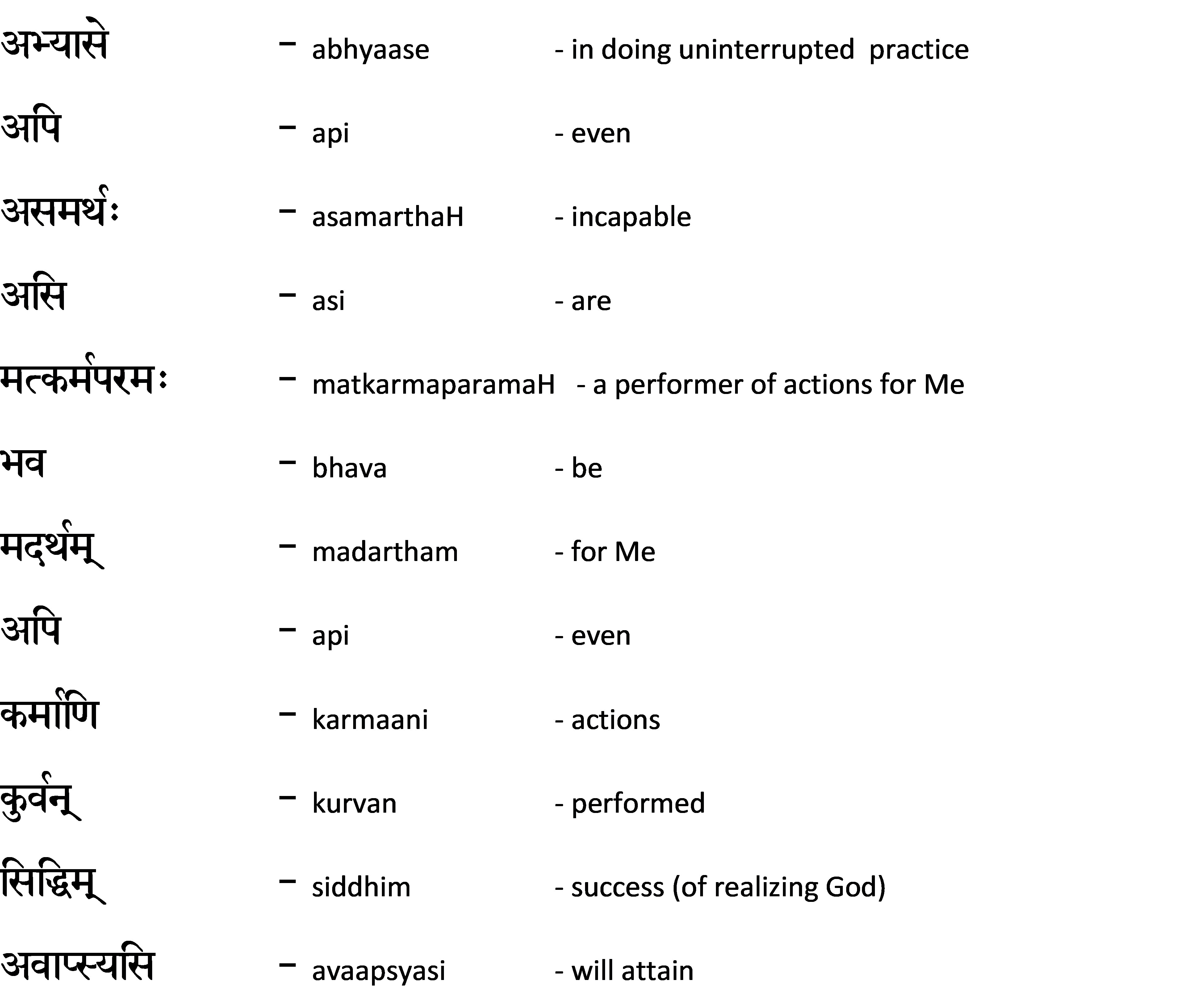
10. If you are incapable of practicing Abhyasa Yoga (Yoga of constant practice), then perform actions for Me. Even by performing actions for Me, you will attain perfection (the realization of God).
“Abhyasa Yoga” is excellent for those who have some control over their minds. But, in reality, not all can control their restless minds, which constantly run towards worldly objects and bring them back to God. Even those who can practice “Abhyasa Yoga” for some time may grow tired of fighting the resistance of their minds. What to do in that case? For those people, Shri Krishna suggests another alternative of ‘performing work for God’.
In the Vedanta spiritual practices, no one is left out. There is a way for everyone to attain the Highest Knowledge, no matter what weaknesses one has. Everyone has some kind of strength. Vedanta encourages all and shows them a way to use their strength to attain the Highest Knowledge. There are ‘work-oriented’ people. They enjoy doing work for some purpose. If they sit down for japa or meditation, their minds start thinking of various works. For such people, Shri Krishna offers this alternative: to do work for God.
Performing work for God includes worship of God; mentally washing the feet of God, offering sandal paste, flowers, incense, lamp, food, and other things. It also includes singing the glories of God, practicing spiritual disciplines like japa and meditation, studying scriptures, practicing values, performing some form of austerities, giving in charity, doing unselfish service, and others.
Performing work for God also includes fulfilling our responsibilities, which are work given by God. Performing work for God is also a way to worship God. Just as father and mother do all the work to raise their children, devotees can do work for God. As parents develop love for children by taking care of their responsibilities, devotees can develop love for God by working for God. We can think that ‘I am a servant of God,’ or ‘I am a son or a daughter of God,’ or, ‘I am a representative of God’, and all my responsibilities in the world are given to me by God by giving me a birth in that environment, which is created due to space, time, and situations. When we sincerely and lovingly perform these responsibilities without any worldly expectations, then this work becomes a worship of God. Through this worship of work, we can attain the perfection, or God-realization, or the Highest Knowledge described in the Vedanta scriptures.
In the Mahabharata, there are stories of a devoted wife who was serving her sick husband, and a butcher who was sincerely taking care of his inherited unpleasant business, both of whom attained the Highest Knowledge that the all-renounced yogi was seeking through meditation. Swami Vivekananda told this story in one of his Karma Yoga lectures, named ‘What is Duty?’ When we perform our responsibilities as doing God’s work, we constantly think of God during our work and feel an inner strength. With such practice, we easily develop concentration of our mind and love for God, which helps us attain God-realization.
But what if one cannot even do this? Is there any hope for such people? Let us listen to Shri Krishna.
 mahendrajani