Monthly Archives: December 2025

Gita Chapter 12 – Part VIII

Gita Chapter 12

Shloka 10

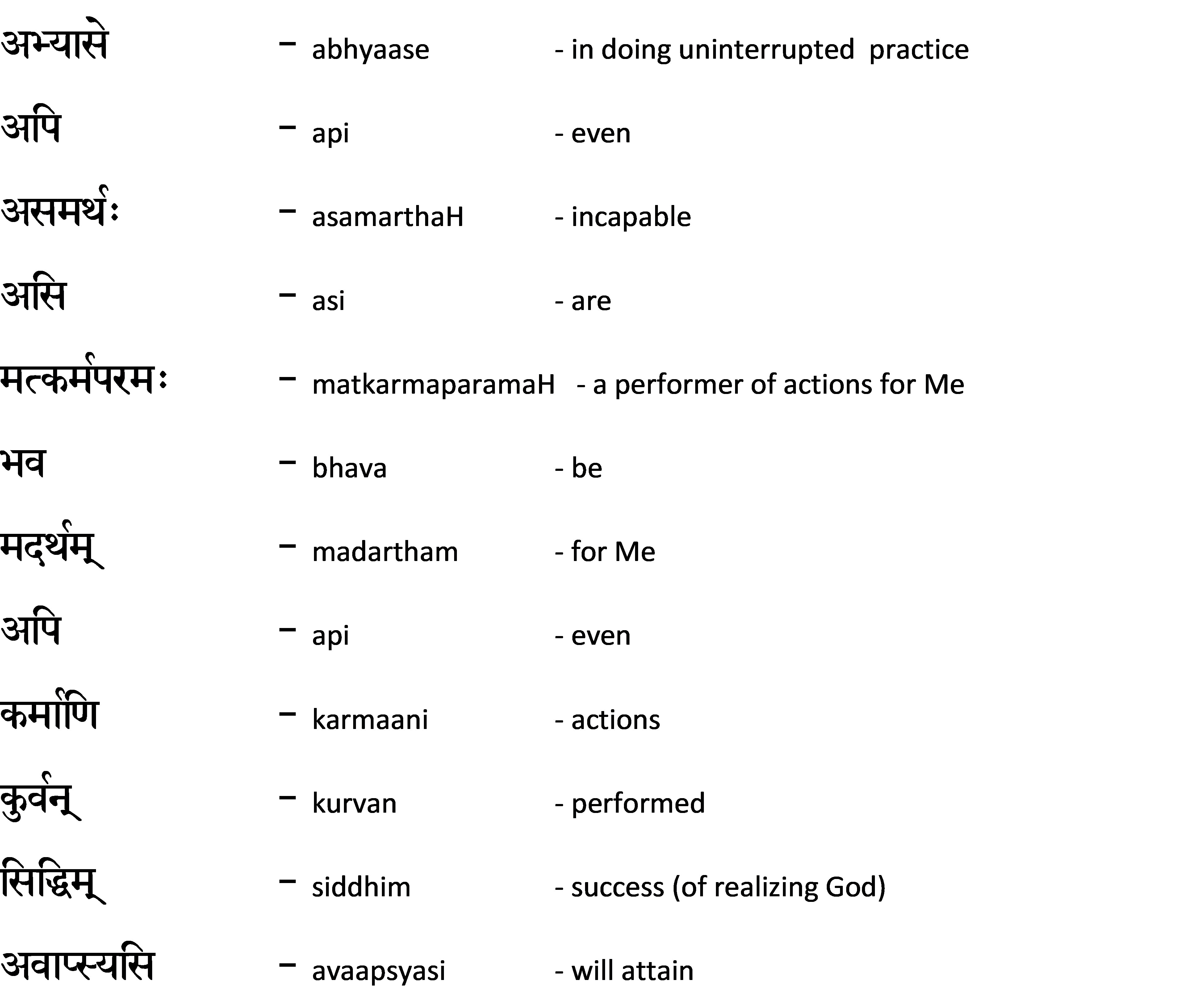
10. If you are incapable of practicing Abhyasa Yoga (Yoga of constant practice), then perform actions for Me.  Even by performing actions for Me, you will attain perfection (the realization of God).

            “Abhyasa Yoga” is excellent for those who have some control over their minds.  But, in reality, not all can control their restless minds, which constantly run towards worldly objects and bring them back to God.  Even those who can practice “Abhyasa Yoga” for some time may grow tired of fighting the resistance of their minds.  What to do in that case?  For those people, Shri Krishna suggests another alternative of ‘performing work for God’.

In the Vedanta spiritual practices, no one is left out. There is a way for everyone to attain the Highest Knowledge, no matter what weaknesses one has. Everyone has some kind of strength. Vedanta encourages all and shows them a way to use their strength to attain the Highest Knowledge. There are ‘work-oriented’ people.  They enjoy doing work for some purpose.  If they sit down for japa or meditation, their minds start thinking of various works. For such people, Shri Krishna offers this alternative: to do work for God.

Performing work for God includes worship of God; mentally washing the feet of God, offering sandal paste, flowers, incense, lamp, food, and other things.  It also includes singing the glories of God, practicing spiritual disciplines like japa and meditation, studying scriptures, practicing values, performing some form of austerities, giving in charity, doing unselfish service, and others.

            Performing work for God also includes fulfilling our responsibilities, which are work given by God. Performing work for God is also a way to worship God.  Just as father and mother do all the work to raise their children, devotees can do work for God. As parents develop love for children by taking care of their responsibilities, devotees can develop love for God by working for God. We can think that ‘I am a servant of God,’ or ‘I am a son or a daughter of God,’ or, ‘I am a representative of God’, and all my responsibilities in the world are given to me by God by giving me a birth in that environment, which is created due to space, time, and situations. When we sincerely and lovingly perform these responsibilities without any worldly expectations, then this work becomes a worship of God. Through this worship of work, we can attain the perfection, or God-realization, or the Highest Knowledge described in the Vedanta scriptures.

In the Mahabharata, there are stories of a devoted wife who was serving her sick husband, and a butcher who was sincerely taking care of his inherited unpleasant business, both of whom attained the Highest Knowledge that the all-renounced yogi was seeking through meditation. Swami Vivekananda told this story in one of his Karma Yoga lectures, named ‘What is Duty?’ When we perform our responsibilities as doing God’s work, we constantly think of God during our work and feel an inner strength. With such practice, we easily develop concentration of our mind and love for God, which helps us attain God-realization.   

            But what if one cannot even do this?  Is there any hope for such people?  Let us listen to Shri Krishna.  

Gita Chapter 12 – Par VII

Gita Chapter 12

Sholka 9

9. If you cannot focus your mind steadily on Me, then O Dhananjaya, desire to attain to Me through the Abhyasa Yoga (Yoga of constant practice).

In the previous shloka, Shri Krishna asked Arjuna to focus his mind and intellect on Him (God or Atman). People who try to focus their minds on God know very well how difficult that task is. In the Gita chapter six (shlokas 33 and 34), Arjuna had already expressed his concerns about the difficulty in focusing his mind. He had said, “O Madhusudan!  Because of the restlessness of the mind, I don’t see I can attain and established in the Yoga of Equanimity.  O Krishna!  The mind is restless, turbulent, powerful, and unyielding.  To control this mind is as difficult as controlling the wind.” 

Arjuna, a mighty warrior who can defeat any powerful enemy on the battlefield through his archery, admits that he has difficulty controlling his mind. Also, remember when Dronacharya was testing all the Pandavas and Kauravas on the required concentration in archery; Arjuna was the only one who passed the test by saying, “he sees only the bird’s eye.” This shows that one can have a full concentration on worldly matters, but it is a different situation when we need to focus our minds on God.

            As we had discussed before, the mind is a reservoir of “samskaras,” the impressions of past thoughts, speech, and actions.  Based upon these “samskaras,” it has desires and plans to be happy, which in reality create obstacles in the spiritual path.  Mind is not going to think of God until it realizes that most of its plans for happiness are futile and will bring untold sufferings and miseries, along with little short-lived happiness.  Through our pure intellect’s ability to analyze and reason, we have to convince our mind that God Realization is the only worthy goal of life in order to attain what we are trying to attain in the world, and for that, we have to focus our mind on God.

Reminding the mind of the futility of the cravings and fulfillments of worldly desires, we have to withdraw the mind again and again from all worldly objects and focus it on God. This is Abhyasa Yoga, which Shri Krishna asks us to practice. When we realize that our life will be futile without God Realization, then intense longing develops, and our mind easily gets focused on God.    

            Also, whenever the mind runs away from God and starts thinking about other things, we should not join with it.  We should not identify ourselves with our minds, but step aside as an intellect and observe its activities.  Many times, when the mind finds that it is being observed, it gets embarrassed and stops running around.  Mind goes where its treasure is.  Tracking down our mind we find what worldly desires and objects we cherish.  Once we know these desires and objects, then we can work on our mind through intellect to reduce the unnecessary desires and convince it to stop running after them.

            As we read in the great epic Ramayana, when Rishis were performing Yajnas (special worship of God), the demons used to come and throw filthy and disgusting things to create problems and interrupt the worship.  Similarly, the deluded mind creates disturbances when one tries to focus it on God.  Here, the obstacles are our own distracting thoughts.  We have to follow the great Rishi Vishwamitra’s example to stop the obstructions and disturbances.  He asked Sri Rama and Lakshmana (two great archers) to guard his worship.  Similarly, Shri Krishna is advising us to keep two great archers, namely Abhyasayoga (constant practice) and Vairagya (renunciation of distracting thoughts, speech, and actions), ready to support our spiritual efforts.  These two can definitely remove all our obstacles in focusing our minds on God.                     

            Shri Krishna’s solution shows great understanding of the human mind and tells us proven techniques to control the mind, an impossible job for many.  Abhyasa Yoga is a path of repeated efforts of focusing the mind on God.  As tiny drops constantly falling on a stone make a hole in the stone, similarly, bringing the mind again and again to God tames our mind by developing a habit.  We find that children learn a new thing by repeating it several times.  In kindergarten, all children look alike.  But, after several years of study and practice, some become medical doctors, some engineers, some teachers, some athletes, some artists, and other professionals.  Similarly, by proper guidance and repetition of God’s name, the mind develops love for God, and it can be focused on God.  In order to make spiritual progress, Sri Ramakrishna repeatedly mentioned the following spiritual practices: repeating God’s name and glories, holy company, regular prayers, going into solitude, and sincerely praying to develop love for God. 

            When our desire to attain God becomes intense, then we make sincere efforts.  Then, we are ready to renounce whatever obstacles come in our way, and our minds get more focused.  We have to use various methods to teach the mind how to develop love for God, as loving parents raise their children and try to teach them good habits.  We should not exert too much force and break the mind either.  Mind is a delicate thing, and we have to handle it as carefully as we handle a beautiful, delicate flower vase.  Through our minds only, we are going to realize God.  Mind is a powerful thing.  When it focuses on God, we acquire the highest knowledge and experience the infinite bliss.           

            In Mundaka Upanishad (2.2.4), Rishi says, “Om is the bow; the mind is the arrow; the Brahman (God) is its target.  Hit the target with a focused mind and become one with Brahman as the arrow-head merges into its target.”