Gita Chapter 12
Shloka 5
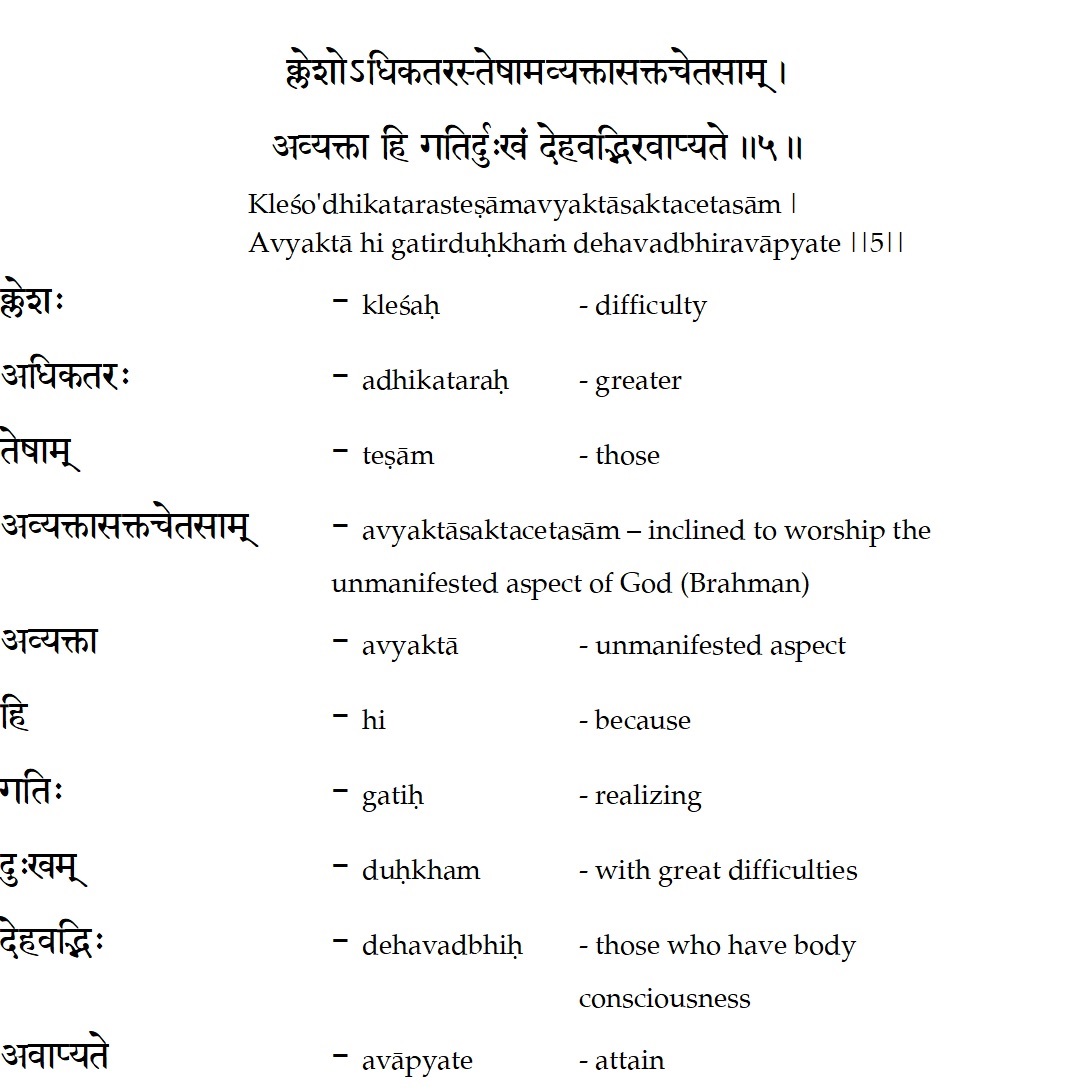
5 However, the path of devotees inclined towards worshipping the Unmanifest God is more difficult. Those who are conscious of their bodies have greater difficulties realizing the Unmanifest God (Brahman).
Reflections:
The Path of Knowledge (Jnana Yoga):
In the previous shloka, Shri Krishna described infinite Brahman with eight epithets and three characteristics of a Jnana Yogi. The path of Jnana Yoga is direct. One has to think that one’s true identity is the Self or the Atman. The body, mind, and intellect are ignorantly projected on the Atman. This Atman and the Infinite form of God, Brahman, are the same. Along with the eight epithets, Brahman is considered Sat-Chit-Ananda, Existence-Knowledge-Bliss Absolute. It is also described as Truth-Knowledge-Infinite. With these convictions about Atman and Brahman, one has to reflect and meditate on the Atman and realize that ‘I am Atman.’ After realizing one’s true nature as Atman, one lives in the world with the awareness that Brahman has become everything.
However, Shri Krishna says that those who wish to follow this path of worshipping the formless God face more difficulties than those who follow Bhakti yoga, the path of devotion in which they worship God with form. He further says that making progress in the Path of Knowledge is almost impossible for those who have body consciousness. Why is that? Let us reflect on the major difficulties of the followers of Jnana Yoga.
Difficulties in the Path of Knowledge:
(1) Comprehension: It is very difficult to focus the mind on God, who does not have any name, form, or quality. This God is Infinite, Unmanifested, Incomprehensive, and Omnipresent. Whatever we think of, it becomes limited and finite. Our highest idea of the infinite is the sky. But it is manifested and comprehensible. Mind cannot be focused on ‘nothing.’
(2) Self-control: Since the mind has nothing tangible to focus on, it is difficult to control it. On the other hand, the senses run after worldly objects for pleasure, and the uncontrolled restless mind naturally joins the senses and runs after the worldly objects. This makes it difficult to make any spiritual progress.
(3) Discrimination and Dispassion: In the Jnana Yoga, ‘Viveka’ and ‘Vairagya’ are two important practices. ‘Viveka’ is an ability to separate ‘what is Brahman’ and ‘what is not Brahman,’ meaning ‘what is permanent’ and ‘what is not permanent.’ Whatever is perishable is not Brahman. Thus, seekers of the formless God reject everything in the world, saying ‘not this,’ ‘not this.’ Many times, for such seekers, nothing remains after the discrimination. This makes it harder to progress in this path.
‘Vairagya’ is the capacity of the mind to renounce what is not Brahman. In the initial stages of this path, having no concrete idea of Brahman, seekers have difficulty renouncing the world, especially those attached to their bodies. For most people, the attachment to the body and cravings for worldly desires do not go away easily.
(4) Will-power and self-efforts: In this path, one needs tremendous willpower to control the restless and turbulent mind and the senses. Not many people have such willpower. They need an outside help. Seekers of this path need undaunted faith in the words of the scriptures and spiritual teachers. They have to hold on to the belief in the existence of Brahman. Such seekers are like baby monkeys who hold on to their mothers when mothers jump from one branch of a tree to another. If they lose their grips, they fall.
By meditating on the Formless, Infinite, Omnipresent Brahman, a Jnana Yogi must inspire himself/herself to continue on the Path of Knowledge. Compared to Bhakti Yoga, a Jnana Yogi has fewer supportive practices to draw inspiration and motivation.
A Jnana Yogi has to purify one’s mind through self-effort. A mind can fool itself and make compromises. Without purification of the mind, one cannot advance in the spiritual path. Therefore, a Jnana Yogi must take the help of a competent teacher.
(5) False ego: A Jnana Yogi who thinks that ‘I am Brahman’ develops a false ego, a major obstacle in this path. Generally, a person cannot even comprehend that one’s true identity is not one’s body, mind, and intellect, but it is their substratum. The difficulty is that our identities are deeply rooted in our bodies, minds, and intellect.
Only in the highest state of Samadhi (the Nirvikalpa Samadhi) does a person completely merge with the Atman, losing almost total body consciousness. Rare people attain such a stage. People witnessed Sri Ramakrishna going into this stage. In that state, he used to lose the awareness of his body, the place, and the time. When his mind was rising to that state, he used to keep a desire, like ‘I want to drink water’ or ‘I want to eat something.’ Through that desire, he said that his mind used to return to the body-consciousness. This shows how hard it is for most people to attain that state.
If a person has body consciousness and still says, “I am Atman or Brahman,” then great harm comes to the person. Such a person not only falls from the spiritual path, but many times, he/she becomes unethical and immoral, deludes oneself and others, and drags down other people to live a low-level life.
(6) Illusory reality: The Jnana Yoga says, ‘ Brahman is the only Reality, and the universe is a delusion.’ It is very difficult for a person with body consciousness to say that his/her body and the universe are an illusion. Sri Ramakrishna’s Advaita teacher, Sri Totapuri, was established in Jnana Yoga. One day, he developed a stomach pain. He told himself many times that ‘He is not a body. He is Atman, which has no pain or pleasure.’ But the pain continued. He was disgusted with himself and wanted to drown himself in the Ganga. Finally, he accepted that as long as there is body consciousness, he must accept the illusory universe as ‘true.’
The advantages of the Path of Devotion (Bhakti Yoga):
The title of this chapter is Bhakti Yoga. Shri Krishna wanted to point out that it is hard for most people to go beyond their body consciousness, and therefore, Jnana Yoga will be more difficult for them. Hence, for most people, Bhakti Yoga is a relatively easier path. Let us reflect on the major advantages of Bhakri Yoga.
(1) God as a human being: It is natural for a human being to think of God as a human being. As long as a person has a body, God also has a body. In his book ‘Bhakti Yoga,’ Swami Vivekananda says, “Talk as you may, try as you may, you cannot think of God except as a man (human being). You may deliver great intellectual discourses on God and all things under the sun, become great rationalists, and prove to your satisfaction that all these accounts of the Avataras (Incarnations) of God as men are nonsense. But let us come for a moment to practical common sense. What is there behind this kind of remarkable intellect? Zero, nothing, simply so much froth….By our present constitution, we are limited and bound to see God as a man. If, for instance, the buffaloes want to worship God, they will, in keeping with their own nature, see Him as a huge buffalo; if the fish want to worship God, they will have to form an idea of Him as a big fish; and men have to think of Him as a man. And these various conceptions are not due to a morbidly active imagination. Man, buffalo, and fish all may be supposed to represent so many different vessels, so to speak. All these vessels go to the sea of God to get filled with water, each according to its own shape and capacity. In the man, the water takes the shape of a man; in the buffalo, the shape of a buffalo; and in the fish, the shape of a fish. Each of these vessels has the same water of the Sea of God. When men see Him, they see Him as a man, and the animals, if they have any conception of God at all, must see Him as an animal, each according to his own ideal. So, we cannot help seeing God as a man; therefore, we are bound to worship Him as a man. There is no other way.”
Therefore, it is easy for a human being to think of God as a human being. That is why Hinduism provides various forms of God. The devotees choose the forms they like, and it becomes easy for them to focus their minds on them. The Infinite God appears to the devotee in the form of the God he/she worships.
(2) Control of the mind and the senses: In the Path of Devotion (Bhakti Yoga), it is easy to focus the mind on the form of God, which one likes. Also, worshiping God with form helps control one’s senses. The senses find something divine to focus on rather than worldly objects. For example, the eyes want to see God’s form, the mouth wants to sing God’s name and glory, the ears want to listen to God’s name and glories, the hands want to worship God by offering flowers, incense, naivedya, etc., and legs want to visit the places of pilgrimage or Holy People.
(3) Eradication of ego: By thinking of God as Father, Mother, or Master and oneself as God’s child or a servant, one easily eradicates one’s ego. A human relationship with God makes it easy for a devotee to surrender to God completely.
A devotee thinks, ‘ God is everything, and I am nothing.’ ‘Everything belongs to God. Nothing belongs to me.’ Thus, ‘Me and Mine’ turns into ‘Thee and Thins.’
Thinking that ‘I am an instrument in the hands of God,’ a devotee gets rid of ‘doer-ship.’
(4) Incarnations of God: For beginners on the spiritual path, it is easy to get an idea of God through the Incarnations of God. An Incarnation of God exhibits all the qualities of God in human life through his/her words and actions. Shri Krishna says (Gita 4.7-8), “O Bharat (Arjuna)! Whenever there is the decline of righteousness and a rise of unrighteousness, I incarnate Myself. I am born in every age for the protection of the good people, the destruction of the wicked, and the establishment of righteousness.” Humanity needs a human being to guide and show the path of righteousness. Seeing a person who day and night thinks of God and lives a God-centered life inspires us to follow his/her example and mold our lives accordingly. The lives of Incarnations provide concrete examples or role models to which devotees can connect and follow.
The scriptures describe the characteristics of people who have realized God. For example, the Bhagavad Gita describes the characteristics of people with steady intellects, beloved devotees of God, people who have gone beyond the three gunas, and others. The lives of Incarnations provide living examples of these characteristics. It is difficult to believe these states are attainable without seeing such living examples. By imitating them, the devotees develop devotion to God. Also, it is easy to focus one’s mind on the life incidents of the Incarnations. Their lives provide high ethical standards for the devotees, which helps them make spiritual progress.
(5) Grace and Assurance: When a devotee sincerely struggles to make spiritual progress, God showers His/Her grace on the devotee, removes his/her obstacles, and smooths the progress. Saints say that when a devotee goes one step towards God, God moves ten steps towards the devotee. From the Absolute Vedanta point of view, the help comes from within, but the devotee thinks it came from God. However, the devotee’s love for God becomes more intense when he/she feels God showered His/Her grace on him/her.
In the Bhagavad Gita (9.22), Shri Krishna says, “Those who worship Me without thinking of anything else, and are ever devoted to Me, I provide them what they lack and preserve what they have.” With this assurance, a devotee becomes free from any worry. A devotee is sure that the way a father or mother takes care of his/her child, God takes care of me. If a child makes a mistake, the mother worries for the child’s welfare more than punishing the child. A devotee (the worshiper of God with form) is like a kitten whom the mother holds and moves around. There is less danger of falling. Because of the devotee’s love for God, God removes the impurities of the devotee out of compassion.
A devotee is sure that God will provide what he/she needs. Sri Ramakrishna used to say that the Universal Mother can even give me the knowledge of Brahman if she will.
Problems with the Bhakti Yoga:
Most people find the Path of Devotion (Bhakti Yoga) relatively easy. However, people are of various kinds. Some people have analytical minds. They like to reason and accept answers that convince their intellect. They ask questions regarding God with form: ‘Who is God? Is God a man or woman? Where does God live? If God is compassionate, why is there so much misery in the world? Does God favor some and punish other people? How can a God with form be infinite or eternal? Were Rama, Sita, Krishna, Radha, Shiva, and Parvati born in the past, or are they just people’s imaginations? People make pictures or statues of gods and goddesses from their imaginations. The different parts of India have different kinds of pictures or statues of Rama, Sita, Krishna, Radha, Shiva, Parvati, and others. Thus, many questions come to the minds of people who like to reason. Analytic-minded people need convincing answers before they accept God with form.
Also, people get turned off from the Bhakti Yoga for several reasons. The following are a few examples of followers of Bhakti Yoga, who turn off rational-minded people. (i) People wear external spiritual marks and make a big show, but their characters don’t match the characteristics of the devotees described in the scriptures. (ii) People become fanatics about the forms of God they worship and try to convince other people that their forms of God are superior, and all must accept them as superior. Fanatics even kill people in the name of religion. (3) People mix up emotions and devotion. They lose their ability to separate what is right and what is wrong. They even lose rational thinking and common sense. For example, in one place, from early morning, a saint’s devotees were celebrating his 90th birthday with extended worship of the saint’s photo. It was 1:00 p.m., and the worship was still going on. The saint was hungry and wanted to eat. The devotees said they would give him food after the picture’s concluding worship, ‘arati.’ (iv) People with temporary sentiments have no lifelong commitment to realizing God. They feel that a temporary emotion is devotion. (v) God loves all, but priests of some temples discriminate and prohibit certain people from entering the temples.
The Path of Devotion mixed with Knowledge:
Sri Ramakrishna encouraged devotees to have devotion mixed with Knowledge of Atman. When devotees develop such devotion, they do not become fanatics. They know that they are worshipping the Absolute Formless God in the form of their ‘Ishta Deva,’ their chosen ideal. Different forms of God are representing the same Brahman, the Formless God. Therefore, there is no need to quarrel comparing various forms of God trying to prove ‘my God is superior.’ A devotee knows very well that it is easy to start focusing one’s mind on God with form. That is why one selects a form of God one likes to worship and starts his/her spiritual practices. As the devotee advances in the spiritual path, his/her body consciousness becomes less and less, and he/she becomes qualified to realize the formless God. Also, when a devotee develops devotion with the Knowledge of Brahman, he/she can understand and follow Bhakti Yoga properly and does not deviate from the path by wrong interpretations.
Sri Ramakrishna showed from his life how to combine devotion with the Knowledge of Brahman. Sri Ramakrishna first realized God as Mother Kali, and then he experienced the Omnipresent, Infinite, and Formless God. Sri Ramakrishna described this experience in his own words: “Tota Puri (Advaita Vedanta teacher) taught me to detach my mind from all objects and plunge it into the heart of Atman. But, despite all my efforts, I could not cross the realm of name and form and lead my spirit to the Unconditional state. I had no difficulty in detaching my mind from all objects, with the one exception of the too-familiar form of the radiant Mother (Kali), the essence of pure knowledge, who appeared before me as a living reality. She barred the way to the beyond. I tried on several occasions to concentrate on the precepts of the Advaita Vedanta, but each time, the form of the Mother intervened. I said to Tota Puri in despair: ‘It is no good. I shall never succeed in lifting my spirit to the “unconditioned” state and find myself face to face with the Atman.’ He replied severely: ‘What! You say you cannot? You must!’ Looking around him, he found a piece of glass. He took it and stuck the point between my eyes. I began to meditate with all my might, and as soon as the glorious form of the Divine Mother appeared, I used my discrimination as a sword, and I clove Her in two. The last barrier fell, and my spirit immediately precipitated beyond the plane of the ‘conditioned’; I lost myself in Samadhi.”
After merging with the Brahman, the Formless aspect of God, Sri Ramakrishna again engaged himself in singing the glories of Mother Kali. He showed that as long as there is body consciousness, one should think of God with form. The experience of Formless God is possible only in Samadhi.
Sri Ramakrishna provided a nice analogy to combine these two views. He said that when we climb a staircase to reach the roof, at each step, we say, ‘This step is not the roof.’ When we reach the roof, we find that all the steps are made of the same material by which the roof is made. Similarly, initially, we deny everything in the universe as not Brahman, saying, ‘Neti, Neti – Not this, not this.’ After realizing Brahman, we see that Brahman has become everything in the universe. In particular, Brahman is manifesting through all the forms of God.
Different States of Mind:
Swami Vivekananda says that all the various philosophies of God are not contradictory. They represent various states of human minds. Hanumanji and Sant Kabir have expressed it in simple language.
Once, Lord Rama asked his devotee Hanumanji, “How do you look at Me?” Hanumanji replied, “O Rama, when I have body consciousness, I see that ‘Thou art the Master and I am your servant.’ When I am aware of my soul, then I see that ‘Thou art the Whole, and I am your part.’ But, when I am aware that ‘I am Pure Consciousness (Atman),’ I see that “Thou art I and I am Thou.’ This is my firm conviction.
Saint Kabir also showed us how to combine God’s two aspects: formless and endowed with form. He said, “The formless Absolute is my Father and God with form is my Mother.” We love both, and both are needed.
A question:
A question comes to mind: Shri Krishna said (Gita 12.4) that a Jnana Yogi comes to Me and becomes one with God. Then, what happens to those who think of God with form? We find the answer in the following shlokas.
 mahendrajani