Shiva Mahimna Stotra
Shloka 37
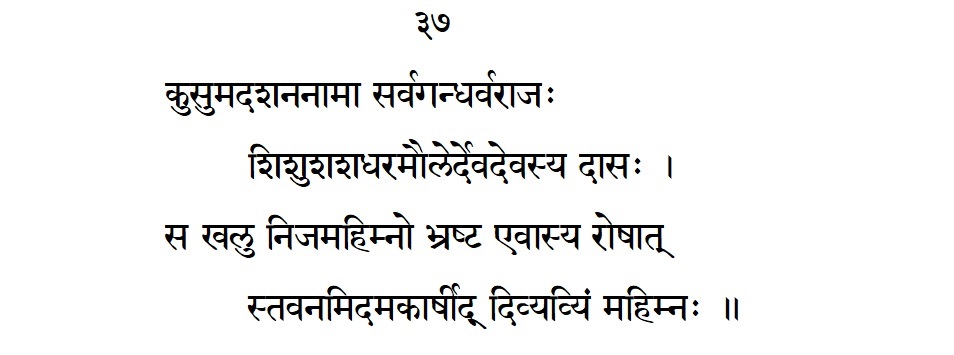

Meaning: Pushpadanta, the king of Gandharvas, was a servant of the supreme Lord Shiva who wears the crescent moon on his head. Because of Lord Shiva’s anger, he lost all his power, and he composed this supremely divine hymn, called Shiva Mahimna.
Reflections: This shloka reminds the story of Pushpadanta and the reason why he composed the Shiva Mahimna hymn.
Pushpadanta, the king of the Gandharvas, had the power to be invisible and move around anywhere he desired. Once, he saw a beautiful garden of King Chitraratha having varieties of flowers. He thought to offer these flowers to Lord Shiva. Even though the garden was guarded by the security people, Pushpadanta, with his power, went inside the garden at night and collected flowers of his choice without being noticed. When in the morning the King came to pick up his flowers for his worship of Lord Shiva, he found that the good flowers were already plucked. Upon inquiry, he found from the guards that no one had plucked the flowers, and no one had entered the garden at night. This stealing continued for a couple of days. King Chitraratha was puzzled. Then, he came up with an idea. He knew that anyone who stepped on the bilva leaves and the flowers offered to Lord Shiva would incur sin and must face Lord Shiva’s anger.
He asked guards to spread such leaves and flowers without stepping on them. Pushpadanta unaware of these leaves and flowers stepped on them and immediately lost his power of invisibility. The guards caught him and brought him to the king. As a punishment, the king put him in jail. To please Lord Shiva and to obtain His grace, Pushpadanta composed the Shiva Mahimna Hymn. By Lord Shiva’s grace, he received his power back and was released from jail.
Since the Shiva Mahiman Shlokas 33 – 43 describe the story of the Pushpadanta and the glories of the hymn, it is not clear whether he composed these shlokas or they were added by some other people. Common sense tells us that this shloka might not have been composed by him. However, the shloka is well-composed, and no harm in singing it.
 mahendrajani