Monthly Archives: July 2024

Shiva Mahimna Stotra Shloka 42

Shiva Mahimna Stotra

Shloka 42

Meaning:  A person, who recites Shiva Mahimna Stotra once, twice, or thrice every day, becomes free from all sins and gets worshipped in the abode of Lord Shiva.                                         

Reflections: A spiritual seeker tries to keep his/her mind absorbed in spiritual consciousness. Shri Krishna, in the Bhagavad Gita (12.14), says that one who offers his/her mind and intellect to Me, is my most beloved devotee. We have to use our intellect to keep our minds focused on God. The easy way to focus our mind on God is to repeat God’s name or recite God’s glory.

We can learn from Holy Mother Sri Sarada Devi about the importance of repeating God’s name. A disciple wrote to the Holy Mother, ‘I cannot calm my mind and concentrate’ and so on. Holy Mother became agitated at these words and said, “It can be done if one repeats God’s names fifteen or twenty thousand times each day. I have seen it actually happen. Let him do that first and talk afterward if it fails. One must put one’s mind to it.”

Singing God’s glory is also an effective spiritual practice for our spiritual growth. Shiva Mahimna Stotra is filled with Lord Shiva’s glories.  Every day, if one recites it once, twice, or thrice, thinking of Lord Shiva, he/she will definitely uplift his/her mind to a higher level of spiritual consciousness. When our mind remains in spiritual consciousness more often, our impurities go away from our minds.                                                                        

Definitely, we have to recite this hymn with faith, a focused mind, and humility, and we must reflect upon its meaning. By Lord Shiva’s grace, when we develop love for Him, then, our mind goes to the abode of Lord Shiva and ultimately merges into Lord Shiva.

Om Namah Shivaya! May Lord Shiva bless us all.

Note:  By the grace of Lord Shiva, with this shloka, I completed my reflections on the Shiva Mahimna Stotra. I posted my reflections on the Shloka 43 earlier. Writing my reflections on this divine hymn was my spiritual practice and a spiritual journey. I offer this collection of reflections at the feet of Lord Shiva.

Thank you all for joining me on this spiritual journey. Om Namah Shivaya!
Shiva Mahimna Stotra Shloka 41

Shiva Mahimna Stotra

Shloka 41

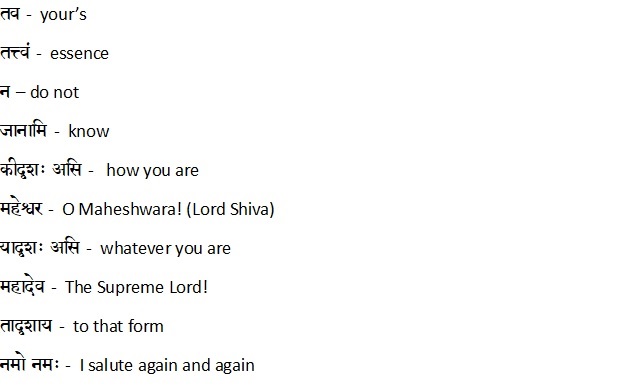
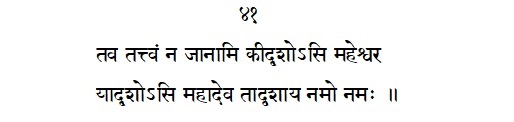
Meaning:  O Maheshwara (the Supreme Lord)! I don’t know your essential form. O Mahadeva (the God of gods)!  Whatever is your form, I salute you again and again.

Reflections:  As we evolve spiritually, our idea of God also evolves.  As Swami Vivekananda expressed through “Namo namo  Prabhu vakya-manatita…”, meaning, “I salute to God who is beyond the comprehension of our speech and mind, but, on the other hand, who is the support of our speech and mind.” In the final stage, one realizes that God has become everything. There is nothing in the universe that is not God. However, out of ignorance, we see things and people having different names, forms, characteristics, and their own separate existence.

Only by God’s grace, we can realize God’s true form. People who have realized God become quiet. They know that whatever they say will not describe God completely.

It seems that keeping this in mind, Pushpadanta says ‘I don’t know your essential form. But whatever is your form, I salute you again and again.’

We have to begin with whatever form of God we have in our mind. Then, as we sincerely do our spiritual practices described by the spiritual teachers and the scriptures, we get a better and better understanding of God, and ultimately, by the grace of God, we get the ultimate realization of God.

Shiva Mahimna Stotra Shloka 40

Shiva Mahimna Stotra

Shloka 40

Meaning: Thus, I have offered this worship in the form of speech at the feet of Lord Shiva. May the ever-auspicious Supreme Lord be gracious to me. 

Reflections: ‘Thus’ here means after the completion of the composition of the Shiva Mahimna Stotra.  Pushpadanata says that this hymn was his worship of Lord Shiva through the words. He knew that Lord Shiva was ever auspicious, and He would definitely be pleased with this offering.

As we love God, God also loves us.  Shri Krishna says in the Bhagavad Gita (9.26):

“If a devotee, out of devotion, offers to me even a simple thing, such as a leaf, a flower, a fruit, or water, I greatly accept it and enjoy it since it is a pious offering of the pure in heart.”

If we recite this Shiva Mahimna with love and devotion as an offering, Lord Shiva will be pleased with us.

Shiva Mahimna Stotra Shloka 39

Shiva Mahimna Stotra

Shloka 39

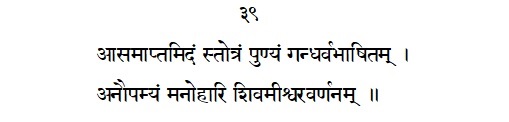
Meaning: From the beginning to the end, this (Shiva Mahimna) hymn, composed by a Gandharva (Pushpadanta), is pure, wonderful, pleasing to the mind, and auspicious. It describes the glories of the Lord (Shiva).                                                                                              

Reflections:  The poetic beauty of the Shiva Mahiman Stotra and the descriptions of Lord Shiva’s glories attract our minds easily. When we recite this Stotra with devotion and focused mind and reflect upon its meaning, we purify our mind and uplift it spiritually.                                                                      

Shiva Mahimna Stotra – Shloka 38

Shiva Mahimna Stotra

Shloka 38

Meaning:  The Shiva Mahimna Stotra has been composed by Pushpadanta, praised by great Devas and Munis, and sung by the Gandharvas. It is the main cause of attaining heaven and liberation and its effect never fails.  One, who recites this hymn with folded hands and with a focused mind, goes closer to Lord Shiva.                                                                                             

Reflections:  This is another shloka that glorifies the Shiva Mahimna Stotra and the sure effect of its recitation.  Folded hands signify the faith, devotion, and humility of a devotee who recites this hymn. A focused mind is most important during the recitation. When one is reciting this hymn, one should think of its meaning and feel the presence of Lord Shiva to get closer to Him.                                                                      

Recitations of such hymns are easy and effective means for spiritual development.

Shiva Mahimna Strotra – Shloka 37

Shiva Mahimna Stotra

Shloka 37

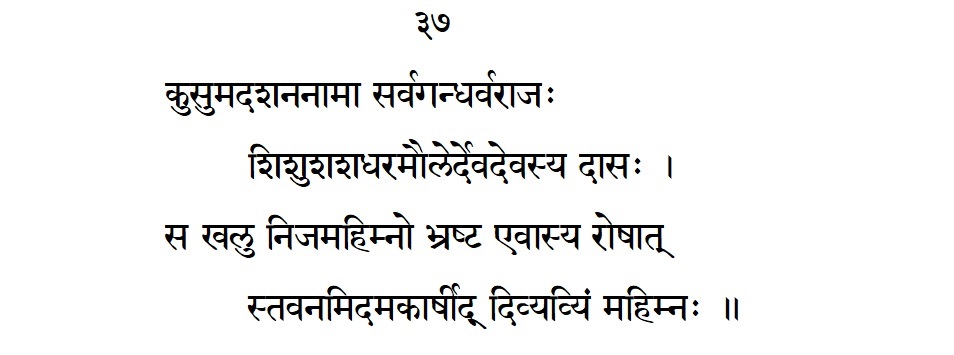
Meaning:  Pushpadanta, the king of Gandharvas, was a servant of the supreme Lord Shiva who wears the crescent moon on his head. Because of Lord Shiva’s anger, he lost all his power, and he composed this supremely divine hymn, called Shiva Mahimna.                                                                                            

Reflections: This shloka reminds the story of Pushpadanta and the reason why he composed the Shiva Mahimna hymn.                                                                     

Pushpadanta, the king of the Gandharvas, had the power to be invisible and move around anywhere he desired. Once, he saw a beautiful garden of King Chitraratha having varieties of flowers. He thought to offer these flowers to Lord Shiva. Even though the garden was guarded by the security people, Pushpadanta, with his power, went inside the garden at night and collected flowers of his choice without being noticed. When in the morning the King came to pick up his flowers for his worship of Lord Shiva, he found that the good flowers were already plucked. Upon inquiry, he found from the guards that no one had plucked the flowers, and no one had entered the garden at night. This stealing continued for a couple of days. King Chitraratha was puzzled. Then, he came up with an idea. He knew that anyone who stepped on the bilva leaves and the flowers offered to Lord Shiva would incur sin and must face Lord Shiva’s anger.

He asked guards to spread such leaves and flowers without stepping on them. Pushpadanta unaware of these leaves and flowers stepped on them and immediately lost his power of invisibility. The guards caught him and brought him to the king. As a punishment, the king put him in jail. To please Lord Shiva and to obtain His grace, Pushpadanta composed the Shiva Mahimna Hymn. By Lord Shiva’s grace, he received his power back and was released from jail.

Since the Shiva Mahiman Shlokas 33 – 43 describe the story of the Pushpadanta and the glories of the hymn, it is not clear whether he composed these shlokas or they were added by some other people. Common sense tells us that this shloka might not have been composed by him. However, the shloka is well-composed, and no harm in singing it.