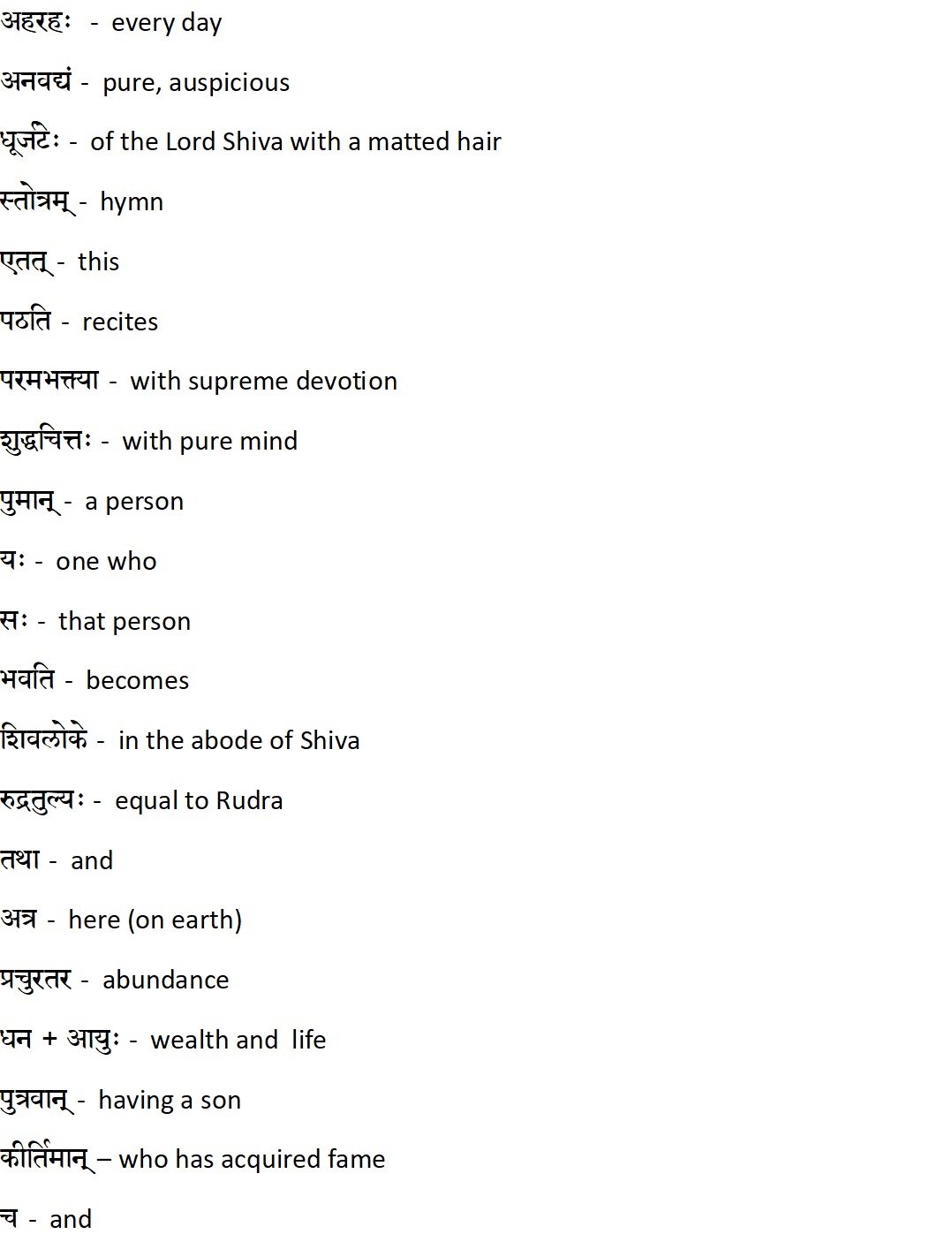
Meaning: One who recites every day this auspicious hymn of Dhurjati (Lord Shiva with matted hair) with supreme devotion and pure mind, acquires fame, abundance of wealth, and long life, and be blessed with a child in this life, and after death goes to the abode of Lord Shiva and becomes like Shiva.
Reflections: To attract worldly-minded people to the spiritual path and to encourage them to recite hymns, like Shiva Mahimna Stotra, poets add such shlokas which tell them what worldly benefits they get by reciting the hymns. Most worldly-minded people will not think of their spiritual progress until their worldly desires are extinguished either by fulfillment or by bitter experiences. Usually, people want money, a long life, children, and name and fame. Therefore, these benefits are mentioned in this shloka.
After promising worldly pleasures, Pushpadanta reminds the devotees that after their deaths, they achieve their higher goal of life, namely, going to the Shivaloka (the abode of Lord Shiva) and becoming like Shiva.
A sincere devotee wants the Ultimate Knowledge and devotion by reciting Shiva Mahimna Stotra. If people recite his hymn for Knowledge and devotion, then they become like Shiva in this very life and experience real fulfillment and bliss.
Meanng: Lord Chandrasekhara (Shiva) has been worshipped by devas, danavas (demons), and sages, and His glories have been described in the Vedas. He is a God with form and without form. The most virtuous Pushpadanta composed a wonderful hymn for Lord Chandrasekhara in various long Sanskrit poetry meters.
Reflections: Lord Shiva is filled with compassion and love for all. He can be easily pleased. That is why he is also known as ‘Bholanath’, a simple-minded God who can be easily pleased. Because of his love for all, people with different mindsets, like devas, danavas, and sages, worship Lord Shiva.
Three important things have been mentioned in this shloka: (i) Lord Shiva has a crescent moon on his head, (ii) Shiva Mahimna Stotra has been composed in long Chandas, meaning in long Sanskrit Poetic Meters, and (iii) The Shiva is God with form and God without form. Let us look into these things.
(i) Why Lord Shiva is called ‘Indumaule’, ‘Chandramauli’, or ‘Chandrasekhara’?
Chandra (Moon) was married to twenty-seven daughters of Daksha Prajapati. (This is symbolic. There are 27 Nakshatras or Constellations, connected to the Chandra (Moon)).
Over some time, Chandra was more attracted to Rohini, one of the twenty-seven wives. The other twenty-six wives complained to their father Daksha about this unfair treatment. Daksha sat down a couple of times with Chandra and requested him to treat all his wives equally, but Chandra turned a deaf ear to Daksha’s request.
Finally, Daksha got angry and cursed Chandra ‘You will have the tuberculosis disease and you will wane. You will slowly lose your luster and disappear’. Chandra started decreasing and losing his luster. All devas and Rishis were worried because Chandra (Moon) was needed for the juice in the vegetation. Chandra also did not want to die. He went to all the devas and requested them to go to Brahma, the Creator, and find the solution. Brahma told them that Chandra should go to the sacred place called Prabhasa with all the devas, establish a Shivalinga there, offer worship to Lord Shiva, and try to please Lord Shiva with the ‘Japa of the Mrutunjaya Mantra’.
Chandra did everything that Brahma had told him to do and with his severe austerity, he pleased Lord Shiva. When Lord Shiva asked Chandra what he wanted, Chandra said to make him free from the tuberculosis disease. Lord Shiva said that Daksha’s curse would remain, and because of that he would wane for 15 days, but after 15 days he would grow again to his normal form. This is how the waxing and waning of Chandra (moon) started.
Then, the devas and Rishis were very happy and requested Lord Shiva to stay at that place. Lord Shiva blessed all and said that his presence would be felt at that place. This place is nothing but one of the famous Twelve Jyotirlingas (luminous emblems of Lord Shiva), called Somanath Temple in Saurashtra, Gujarat, India. ‘Soma’ means Chandra. Thus, Lord Shiva glorified Chandra.
People say that to glorify Chandra more, Lord Shiva wears Chandra, a crescent moon, on his head. It could be symbolic indicating that Lord Shiva is the controller of the time, and this cycle of birth, growth, and death is eternal. Because of all these events Lord Shiva is known as ‘Indumaule’, ‘Chandramauli’, and ‘Chandrasekhara’.
(ii) Chanda (Sanskrit Poetry Meters) in Shiva Mahimna Stotra:
It has been mentioned that Siva Mahimna Stotra has been composed in long Chandas. The following is the list of these Chandas used in this Stotra.
Shlokas 1 – 29: Shiva Mahimna Stotra’s shlokas 1 through 29 are composed in ‘Shikharini” chanda. It consists of 17 syllables. There is a pause after the 6th syllable. The 2nd – 6th, 12th, 13th, and 17th syllables are long and the others are short. One has to learn about the long and the short syllables.
Shloka 30: This shloka has been composed in ‘Harini’ Chanda. It also contains 17 syllables but has a pause after the 8th syllable. However, in this chanda, the 6th – 10th, 12th, 15th, and 17th syllables are long and the others are short.
Shlokas 31st – 34th, 37th and 38th: These shlokas are composed in ‘Malini’ chanda. It consists of 15 syllables and has a pause after the 8th syllable. The 7th – 9th, 11th, 12th, 14th, and 15th syllables are long, while the others are short.
Shlokas 35th, 36th, and 39th – 42nd: These shlokas are composed in ‘Anushtupa’ chanda. Most of the Bhagavad Gita’s shlokas are in this chanda. It contains 8 syllables in the half line. The full line has 16 syllables. In this Chanda, the 5th syllable is short, the 6th syllable is long, and the 7th syllable is alternately long and short.
Shloka 43: The last shloka has been composed in ‘Vasantatilaka’ or ‘Vasantatilakam’ Chanda. It contains 14 syllables. The pause comes after the 8th syllable. The 1st, 2nd, 4th, 8th, 11th, 13th, and 14th syllables are long and others are short. However, in the 13th and 14th syllables, the poet takes the liberty to keep it long or short.
Thus, we can see that the great poet Pushpadanta has beautifully composed Shiva Mahimna Stotra in these long Chandas with the restrictions of long and short syllables and still it has deeper meanings, is filled with devotion, and has wonderful poetry.
(iii) Lord Shiva is a God with form, and also a God without a form: In most of the hymns of Hindu gods and goddesses, there are indications that these gods and goddesses have form, but they represent the formless God, called Brahman, which is only one. For most of the people, it is difficult to think of God without any form. In the universe we constantly perceive things with forms and qualities, therefore it is easy for most people to think of God with forms having virtues. This shloka reminds us that Shiva Mahimna Stotra praises Lord Shiva with form and without form.
Meaning: O Giver of Boons (Lord Shiva): I cannot imagine that on one hand I have my mind with limited knowledge, strength, and grasping power, and it is filled with five kinds of troubles, and on the other hand there are Your eternal infinite glories which surpass all the boundaries of the virtues. I was bewildered by this contrast. But, being compelled by my devotion to you, I have offered these flowers of shlokas at Your feet.
Reflections: Pushpadanta offered the flowers of the Shiva Mahimna Shlokas at the feet of Lord Shiva.
Three important things about flowers:
The flowers have three important things: honey, fragrance, and beauty.
Those who enjoy the poetic aspects of the hymn, they are appreciating the beauty of the hymn.
Those who go a little deeper into the meaning of the shlokas of the hymn, they are enjoying the beauty and the fragrance.
Those who have gone much deeper into spirituality, enjoy the subtle meanings of these shlokas, and due to their devotion, they experience the presence of the Saguna and the Nirguna aspects of Lord Shiva and get immersed in it. This is like drinking the honey of this hymn. They enjoy the beauty, fragrance, and the honey.
The Contrast:
Shri Pushpadanta, in the initial shlokas of the Shiva Mahimna Stotra, has said that even Brahma cannot describe Lord Shiva’s infinite glories. He said that if each one is describing His glories according to one’s limited perception, his attempt to write this hymn is not an exception. Pushpadanta said that even Brahma’s description of Lord Shiva’s glories cannot amaze Him. Hence, through the composition of Shiva Mahimna Shlokas, he is not trying to please Lord Shiva, but simply trying to purify his speech.
After composing several shlokas of the Shiva Mahimna Stotra, Shri Pushpadanta realizes the contrast between Lord Shiva’s infinite glories and virtues and his own mind with limited capacity and various agitations. Actually, Shri Pushpadanta, by talking about his mind, is talking about the minds of most of the devotees. He points out the five agitations or five causes of suffering described in the Patanjali Yoga Sutras (2.3 – 9).
The Five Kleshas:
Patanjali Yogasutra (2.3) says:
“The five ‘kleshas’ or the causes of suffering are (i) Ignorance, (ii) Ego, (iii) Attachment, (iv) Aversion and, (v) Clinging to life.
(i) Ignorance: Not knowing that an individual’s true identity is Atman (Existene-Knowledge-Bliss Absolute) is ignorance. It is the cause of all our suffering. Actually, it is the only cause of all our suffering. Atman is blissful. Still, we feel miserable because of our ignorance, hallucinations, and delusions.
(ii) Ego: Because of ignorance, one thinks that ‘I am only this body and mind’. This develops an ego, an existence of an individual consisting of only body and mind separate from the Atman. This is a ‘second-level cause’ of our suffering.
(iii) Attachment: The ego brings attachment to the sense-objects which give pleasures to the senses and the deluded mind. The deluded mind thinks that the sense-pleasures alone can give happiness. Hence it craves for the sense-pleasures. These desires become the cause of many sufferings.
(iv) Aversion: Attachment and aversion or hatred go together. The deluded mind likes the objects that give joy and dislikes or hates the ones that don’t give joy or give suffering. Both attachment and aversion cause suffering.
(v) Clinging to life: Out of ignorance, one thinks that ‘I am a person with this body-mind frame. There is nothing like Atman.’ Then, one thinks that only sense-pleasures make me happy and therefore the only goal of my life is to get as many sense-pleasures as possible. This brings clinging to the body, mind, and worldly objects. This clinging to life creates fear of losing body, mind, and worldly objects, which is the fear of death. This fear of death constantly causes pain to the person.
Love overpowers Thinking:
Pushpadanta compares Lord Shiva’s serene and peaceful mind which is mainly absorbed in meditation with his limited mind with five agitations. Thinking about this contrast he feels ashamed about his attempt to compose a hymn to describe the infinite glories of Lord Shiva. Upon reflection, he finds that he is neither trying to describe Lord Shiva’s glories nor trying to please Him. He is just expressing his love for Lord Shiva. His love for Lord Shiva compelled him to write these shlokas to offer at His feet as flowers.
It seems that the next shloka-32 concludes the Shiva Mahimna Stotra stating how difficult it is to describe the infinite glories of Lord Shiva. The remaining shlokas (32 – 43) are either added later or written to glorify this Stotra.



 mahendrajani