Monthly Archives: April 2024

Shiva Mahimna Stotra – Shloka 28

Shiva Mahimna Stotra

Shloka 28

Meaning: O Deva (Lord Shiva)!  Bhava, Sharva, Rudra, Pashupati, Ugra, Sahamahana, Bhima, and Ishana are your eight names.  Shruti (scriptures) establishes that each of your eight names is noteworthy.  You are the most beloved and refuge of all. I salute you with my heart and soul.                                                                   

Reflections: In this shloka, Pushpadanta refers to the eight names and forms of Lord Shiva which have been mentioned in the Shiva Purana.  Each of the eight names represents a special form of Lord Shiva. All the eight forms combined become the manifested form of Lord Shiva which is the whole universe. Let us learn the meaning and the significance of each name and form.

(1) Bhava (Water-Form):  This name signifies the creation of the universe. Scientists also say that if there is water in a planet, then there is a possibility of a creation of life. Scriptures mention that the earth came out from the water. The Sanskrit word for the water is ‘Jala’. The ‘ja’ represents the creation of the universe and ‘la’ represents the dissolution of the universe. Thus, the word ‘jala’ tells us that the universe comes from the water and merges in the water. Therefore, the Lord Shiva’s name ‘Bhava’ represents the Water element of the universe.

(2) Sharva (Earth-Form):  One who is a refuge of all or an abode of all is Sharva. The Earth holds us all and it is an abode of all of us. It gives us food and thus nourishes us. That is why, the Lord Shiva’s name ‘Sharva’ represents the Earth element of the universe.

(3) Rudra (Fire-Form): Rudra creates terror and punishes the wrong-doers. We find in the Shri Shuklayajurvediya Rudrashtadhyayi (5.1) the following:

“O Rudra! I salute you and your ‘manyu’. I salute to your mighty arms and your arrows.”    

The literary meaning of ‘manyu’ is anger.  Here the meaning is the punishment to the wrongdoers.  The calamities of nature are the arrows of the Rudra. Since anger is like a fire that destroys everything, the Lord Shiva’s name Rudra represents the Fire element of the universe.                                      

(4) Pashupati (Consciousness-Form): The word ‘pashu’ literally means animal. Our senses and the projected characteristics or all the material existence (kshetra) are also referred to as ‘pashu’. All the things which are bounded by ignorance are included in the category of ‘pashu’.

The Sanskrit word for bondage is ‘pasha’. Sri Ramakrishna used to say that ‘Pashabaddha Jiva’ and ‘Pashamukta Shiva’; meaning one who is bounded by ignorance and desires is called ‘jiva’ and one who is free from all the bondages is called ‘Shiva’.

When the Jiva becomes free from all its bondages, then It realizes its own divine nature as ‘Atman’ which is the same as Brahman. Lord Shiva is Brahman or Pure Consciousness. Thus, Lord Shiva is called ‘Pashupati’, the Lord of Pashus, or the Ultimate goal of Pashus. 

(5) Ugra (Wind-Form): The word ‘Ugra’ represents the wind-form of Lord Shiva which supports us from inside and outside. It is vibrant and mighty.

(6) Sahamahana or Mahadeva (Moon-Form): ‘Mahana’ means supreme. ‘Sahamahana’ means along with the supreme. Thus, ‘Sahamahana’ reminds Lord Shiva’s another name ‘Mahadeva’, one who dwells with supreme power. The scriptures connect Mahadeva with the mighty mind and the mighty mind with the moon. Thus, ‘Sahamahana’ or ‘Mahadeva’ represents the Moon-Form of Lord Shiva.

(7) Bhima (Space-Form): The word ‘Bhima’ refers to something huge which covers everything. The sky is all pervading. Therefore, ‘Bhima” represents the ‘Space-Form’ of Lord Shiva. 

(8) Ishana (Sun-Form): The word ‘Ishana’ stands for something that is luminous. It also means the controller or the supporter of all. It also refers to the intellect through which we get knowledge.

Thus, these eight names and forms of Lord Shiva cover 5 elements, mind, intellect, and Jiva. Each individual consists of these eight forms.

In the Bhagavad Gita, we find similar eight parts of Prakriti.

In Shrimad Bhagavad Gita (7.4), Shir Krishna says, “Earth, water, fire, wind, space, mind, intellect, and ego – these are My Eight-fold Prakriti.”

Shri Pushpadanta says that Lord Shiva, the Manifested Brahman, is most beloved to His devotee and the devotee salutes Him with his/her heart and soul.

Shiva Mahimna Stotra – Shloka 27

Shiva Mahimna Stotra

Shloka 27

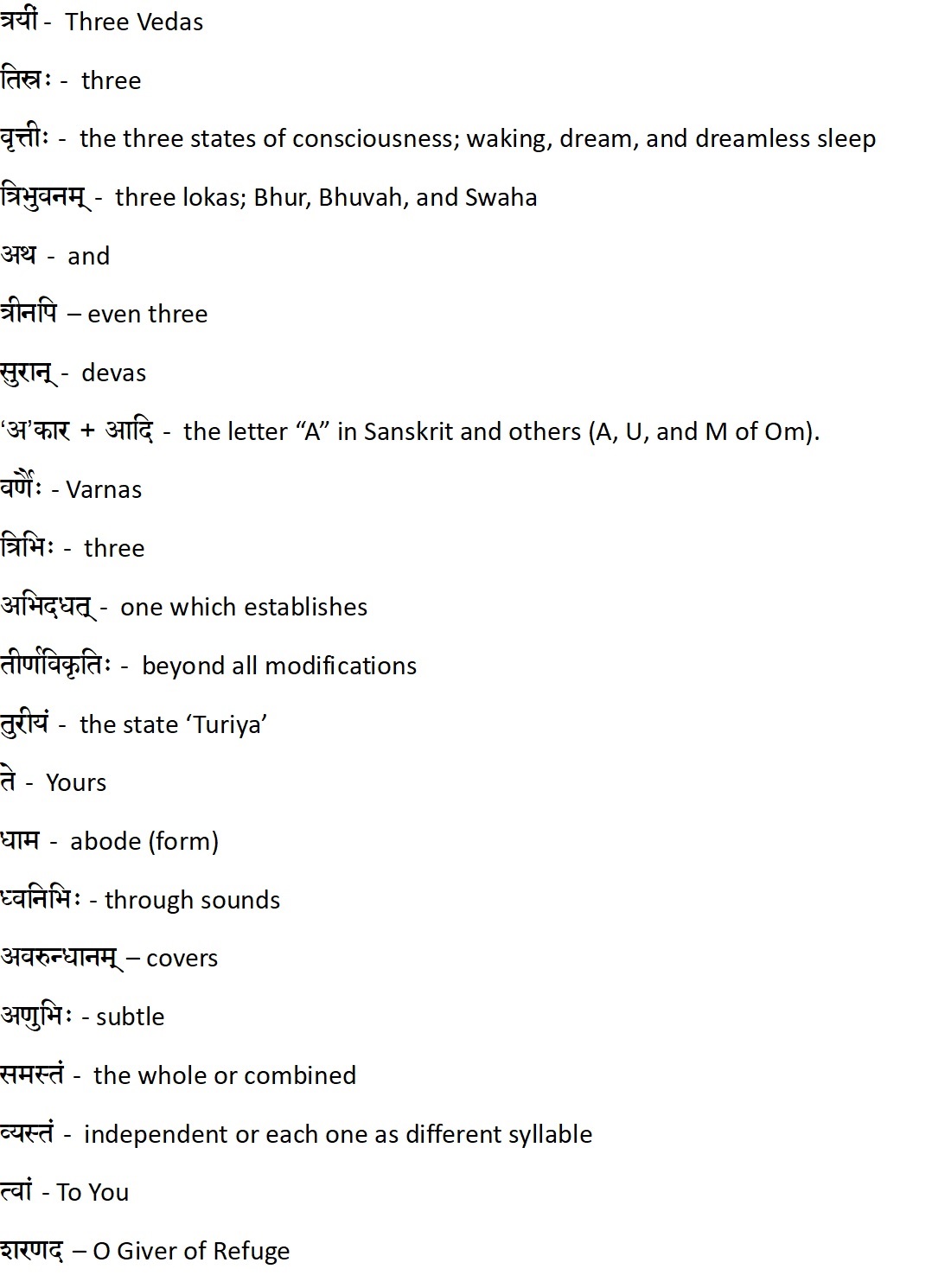
  • Meaning: O Giver of Refuge (Lord Shiva)! Om consists of three letters A, U, and M. As separate letters, Om refers to the three Vedas (Rig, Yajur, and Sama), three states of Consciousness (Jagrata (waking), Svapna (dreaming), and Sushupti (dreamless sleep), three worlds (Bhur, Bhuvah, and Svaha), and the three gods (Brahma, Vishnu, and Mahesh). Thus, as separate letters, Om refers to You as the Saguna Brahman. On the other hand, as combined sound of Om (anahata nada), refers to You as the omnipresent absolute Nirguna Brahman which is represented by the Turiya, the fourth state of Consciousness.                                                                                          

Reflections: In this shloka, Pushpadanta brings out the essential part of the Vedas, namely Om or Pranava. He then mentioned that Lord Shiva is Om, the Saguna, and the Nirguna Brahman.

Shri Krishna in the Bhagavad Gita (7.8) said: “I am Pranava (Om) in all the Vedas.” Upanishads clearly state that Om is the Saguna and the Nirguna Brahman. Om is the first manifestation of the Absolute Brahman, so going backward from the manifested Brahman to the Unmanifested Brahman, Om is the final step before merging with the Absolute Unmanifested Brahman.

Sri Ramakrishna says that as a seeker of God advances in the spiritual path, his/her rituals like sandhya and others merge into the Gayatri Mantra, meaning he/she just recites the Gayatri Mantra.  When the seeker advances further, the Gayari merges into Om. Then, the seeker merges with the Brahman.

Many seekers who follow the teachings of the Upanishads, just recite Om to realize Brahman. The following are a few quotations from the major Upanishads regarding Om.                                                              

Kathopanishad:

Upon being asked by Nachiketa, when Yama started to impart the knowledge of Brahman to him, this is what he said at first:

Yama said, “I will tell you the one which has been declared by all the Vedas as their goal, which is the aim of all austerities, and by desiring which people lead the life of celibacy. This is Om. (Kathopanishad 1.2.15)

“This syllable Om is indeed Brahman. It is the Supreme. Whosoever knows this Om obtains all that one desires.  (Kathopanishad 1.2.16)

“Om is the best support. It is the final support. Whosoever knows this support is adored in the world of Brahma.” (Kathopanishad 1.2.17)

Mundakopanishad:

The essence of the Upanishads is Brahman, and the symbol of Brahman is Om.

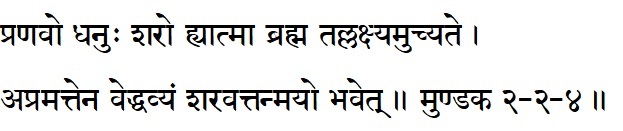
Maharshi Angira instructs Shaunaka that by contemplating the meaning of Om and repeating its sound, one realizes that one’s self is the reflection of Brahman. The meditation on the Atman as such is denoted by the placing of the arrow upon the bow. The realization that the reflected consciousness is identical with Pure Consciousness is described as striking the mark. Thus, the beginners are advised to meditate on Brahman through the symbol Om.

Maharshi Angira tells Shaunaka the following:

“Om is the bow; the Atman is the arrow; Brahman is said to be the target. It is to be struck by an undistracted mind. Then the Atman becomes one with Brahman, as the arrow with the target.” (Mundakopanishad 2.2.4)

Om is the cause of Atman becoming one with Brahman. By constant repetition of Om, the mind gets purified, and one realizes that the Atman and Brahman are one.

Mandukya Upanishad:

The very first Mantra of the Mandukya Upanishad says the following:

“Om, the Word, is all this (i.e. the whole universe). A clear explanation of it is as follows: All that is past, present, and future is, indeed, Om. And whatever else there is, beyond the three-fold division of time – that also is truly OM.” (Mnadukya Upanishad, Manra 1).

Prashnopanishad:

“Then, Satyakama, the son of Sibi, asked Pippalada: Sir, if among people someone should here meditate on the syllable Om until death, which world, verily, would that person win hereby?” (Prashnopanishad 5.1)

“Pippalada replied: O Satyakama, the syllable Om is the Supreme Brahman and also the other Brahman (the first manifestation of the Absolute). Therefore, one who knows it, attains the one or the other, with its support.” (Prashnopanishad 5.2)

Shwetashwatar Upanishad:

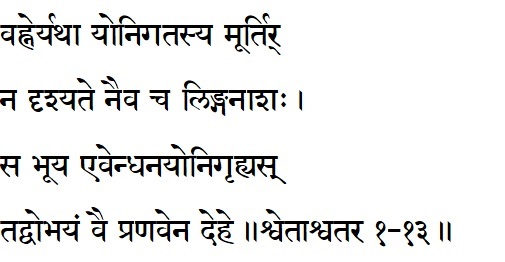
“The (visible) form of fire, while it lies latent in its source (the firewood), is not perceived; yet there is no destruction of its subtle form. That very fire can be brought out again by means of (persistent) rubbing of the wood, its source. In like manner, Atman, which exists in two states, like fire, can be grasped in this very body by means of Om.” (Shwetashvatara Upanishad 1.13)

“By making the body the lower piece of wood, and Om the upper piece, and through the practice of the friction of meditation, one perceives the luminous Self, hidden like the fire in the wood.” (Shwetashvatara Upanishad 1.14)

Bhagavad Gita:

In the Bhagavad Gita, Shri Krishna mentions the three epithets of Brahman, namely Om, Tat, and Sat.

Shri Krishna said (Bhagavad Gita 17.23 and 24): “”Om Tat Sat” – this has been declared as the three-fold designation of Brahman. At the beginning of the universe, the Brahmins, the Vedas, and the Sacrifices were created by Brahman.”

“Therefore, the followers of the Vedas always utter “Om” when they begin the acts of sacrifice (Yajna), charity (Dana), and austerity (Tapa) enjoined by the scriptures.”

Sri Ramakrishna:

Sri Ramakrishna from his direct experience reveals the significance of Om in his own way.

He says, “The Absolute and the Relative belong to one and the same Reality. What is beyond speech and mind is born in the flesh, assuming various forms and engaging in various activities. From that one Om has sprung ‘Om Shiva’, ‘Om Kali’, and ‘Om Krishna’. Suppose the master of a house has sent out a small boy of the family to invite people to a feast. All look on the boy with great fondness and affection because he is the son or grandson of a prominent man.”

Sri Ramakrishna mentions that Om is the final stage before becoming one with Brahman. He says, “One who has realized God no longer performs religious duties such as the sandhya. In his case, the sandhya merges in the Gayatri. When that happens, it is enough for a person to repeat just the Gayatri mantra. Then the Gayatri merges in Om. After that, one no longer chants even the Gayatri; it is enough then to chant simply Om.

In this quote, he talks about the sound of Om. He says, “The sound Om is Brahman. The Rishis and Sages practiced austerity to realize that Sound-Brahman…’What will you gain’, some sages ask, ‘by merely hearing this sound?’ You hear the roar of the ocean from a distance. By following the roar, you can reach the ocean. As long as there is the roar, there must also be the ocean. By following the trail of Om you attain Brahman, of which the Word is the symbol. That Brahman has been described by the Vedas as the ultimate goal. But such a vision is not possible as long as you are conscious of your ego. A man realizes Brahman only when he feels neither “I” nor ‘you’., neither ‘one’ nor ‘many’.”

In the following quote, Sri Ramakrishna describes his own direct experience. He says, “(To Mahima) You explain Om with reference to A (creation), U (preservation), and M (dissolution) only.  But, I give the illustration of the sound of a gong: ‘tom’, t—o—m. It is the merging of the Lila in the Nitya: the gross, the subtle, and the causal merge in the Great Cause; waking, dream, and the deep sleep merge in Turiya. The striking of the gong is like the falling of a heavy weight into a big ocean. Waves begin to rise; the Relative rises from the Absolute; the causal, subtle, and gross bodies appear out of the Great Cause; from Turiya emerge the states of deep sleep, dream, and waking. These waves arising from the Great Ocean merge again in the Great Ocean. From the Absolute to the Relative, and from the Relative to the Absolute…. I have clearly perceived all these things. It has been revealed to me that there exists an Ocean of Consciousness without limit. From It come all things of the relative plane, and in It, they merge again. Millions of Brahmandas rise in that Chidakasha and merge in It again.”

Pushpadanta says that Lord Shiva is Om and thus He is the Saguna as well as the Nirguna Brahman. Om Namah Shivaya.