Meaning: O Tripurhara (Lord Shiva)! King Ravana easily conquered the three worlds, destroyed all the enemies, and still, his hands were craving to fight more wars. This is the result of his determined devotion to you out of which he offered a garland of his ten lotus-like heads at your feet.
Reflections: In Shrimad Bhagavata Purana there is a story that four great sages, the sons of Brahma, named Sanaka, Sanandana, Sanatana, and Santkumara, went to Vaikuntha, the abode of Lord Vishnu. Their minds always remain in the Consciousness of Brahman. They had no body consciousness. The gatekeepers, Jaya and Vaijaya, of Vaikuntha, didn’t understand their state of mind and they stopped these sages from entering Vaikuntha, saying that they were not properly dressed.
The sages felt that these gatekeepers had body consciousness and they did not belong in Vaikuntha. They should be born on earth. So, they cursed them saying ‘Go and be born on earth’. The gatekeepers were scared and worried about being separated from Lord Vishnu. They started praying to Lord Vishnu and asked him to nullify the curse. Lord Vishnu appeared and told the gatekeepers that this curse could not be nullified.
However, seeing the sincere repentance of the gatekeepers, Lord Vishnu gave them two choices: You two be born on earth as Lord Vishnu’s devotees and live for seven lives, or be born as Lord Vishnu’s enemies and live for three lives and be killed by the Lord. They thought for a while and decided that it was better to come back to Vaikuntha sooner after only three lives and not seven. This way they spent less time away from Lord Vishnu. Another version says that the sages eased the curse by giving them three lives on earth.
Thus, in their first life, Vijaya was born as Hiranyaksha, and Jaya was born as Hiranyakashipu. Both were killed by Lord Varaha and Lord Narasimha respectively. In their second life, Jaya was born as Ravana, and Vijaya was born as Kumbhakarna, and both were killed by Lord Rama. In their third life, Jaya was born as Shishupala, and Vijaya was born as Dantavaktra, and both were killed by Lord Krishna.
Now, we see that Ravana was originally a gatekeeper of Lord Vishnu. Also, Ravana’s father was a great sage Vishrava who was a son of sage Pulastya, one of the ten Prajapati and one of the mind-born sons of Brahma. Ravana’s mother was from a demonic family. Her name was Kaikesi. Thus, Ravana had both divine and demonic backgrounds.
There is a story that at a young age, Ravana was attracted by a plane of his stepbrother Kubera. His mother told him that Kubera was the richest man in the world, and he had acquired this wealth by the grace of Lord Shiva. She told him that she would be pleased if he (Ravana) obtained the grace of Lord Shiva and acquired such wealth. Ravana had this deep desire in his mind. When he grew up, he decided to obtain Lord Shiva’s grace. He took the ‘Shiva Panchaskhara Mantra’ from his grandfather and started severe austerity to please Lord Shiva. After much austerity, Lord Shiva was not pleased. Maybe Lord Shiva knew his intention. Ravana performed a ‘Yajna’, but still Lord Shiva was not pleased. As a final resort, Ravana started offering his heads one by one to Lord Shiva. The story goes that when Ravana was offering his last head, Lord Shiva was pleased and gave him his desired boon.
After that, he attacked all the existing kings and took away their kingdoms. He killed all his enemies, and his hands were craving for more wars. He even took away his stepbrother Kubera’s kingdom Sri Lanka and acquired all his wealth. Shri Pushpadanta says that the root cause of the Ravana’s success was his determined devotion to Lord Shiva.
In the Bhagavad Gita (16.21), Shri Krishna says,
“Lust, anger, and greed are three doors to hell. They ruin the self. Therefore, a person should avoid all these three.”
In the Gospel of Sri Ramakrishna, we find that Sri Ramakrishna again and again warns all the spiritual seekers that ‘lust and greed’ are the two major enemies or the major obstacles in the path of God-realization. We see what happened to Ravana even after realizing Lord Shiva.
After acquiring wealth and power, Ravana became arrogant. He lost the sense of ‘right’ and ‘wrong’. Being possessed by ego, anger, and lust, he kidnaps Mother Sitaji and brings the destruction of himself, his family, and all the people around him. We will find one of his arrogant acts in the next shloka of Shiva Mahimna Stotra.
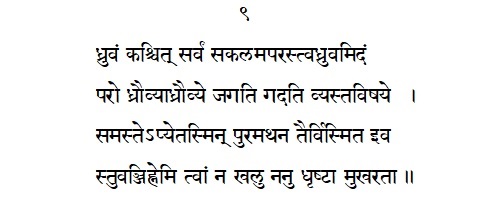
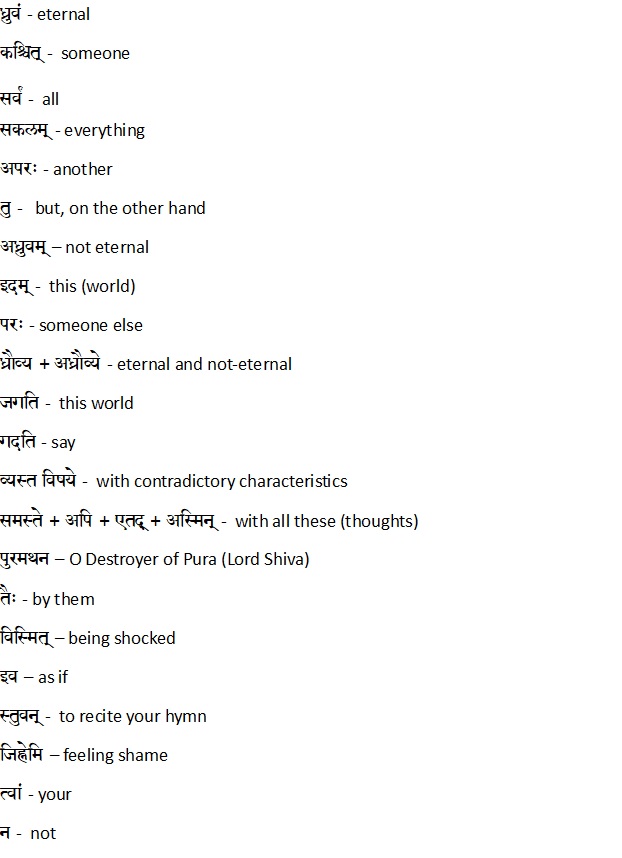
Meaning: O Puramathana (the destroyer of Pura – Lord Shiva)! Someone says that this universe is eternal. Another person says that this universe is not eternal. While someone else says that this universe is eternal and not eternal, having a contradictory characteristic. By listening to all this, I am shocked and now, I am not ashamed to sing your glories. Truly, verbosity is shameless.
Reflections: Shri Pushpadanta tells us how people have different views about the universe. There are various philosophies like Sankhya, Patanjali, Vaisheshika, Naiyayika, Charvaka, Bauddha, Jain’s, and others. They have their own views about the universe.
Some say that this universe is eternal. The soul (Jiva), universe (Jagat), and God (Ishwara) are eternal. The things of the universe don’t die but are recycled.
A group of materialists say that this universe is not eternal. When a person dies, that is the end of the person. Similarly, one day this universe will come to an end. There is nothing permanent here.
Some people say that in this universe, there are a few things that are permanent and other things are impermanent. Thus, both contradictory things exist in the universe.
The followers of Buddha say that the universe is constantly changing. Thus, there is nothing permanent. If we tie a light at the end of a small string and we move that string around then it creates a circle of light. In reality, there is no circle of light. The constantly moving thing creates an illusion of a continuous circle. Similarly, this constantly changing world creates an illusion of a continuous eternal world.
Advaita Vedanta says that this universe is an illusion. Just as in the dark, we see a rope as a snake, similarly, due to the darkness of ignorance we see Brahman, the Ultimate Reality, as a universe with names and forms.
Then, many scientists have different views about the universe.
People live according to their philosophy or views about their lives and the universe. Such philosophy or view develops a faith in those ideas.
Shri Krishna in the Bhagavad Gita (17.3) says:
“O Bharata (Arjuna): The faith of each person is in accordance with his/her disposition. A person is made of his/her faith. As is the faith, so is the person.”
As long as a philosophy is not harmful to oneself and the people and a person sincerely thinks that it is a convincing philosophy to the person, then we cannot say that it is a wrong philosophy. People have different viewpoints according to their mental capacity, surroundings, and time. With mental development, acquiring more knowledge, and a change of surroundings or situations, their view of life and the universe changes. Generally, a person has a different view of oneself, other people, and the universe at the age of five and at the age of fifty. We cannot say that the view of a five-year-old person is wrong.
These different philosophies or comprehensions of the Truth are like taking photos of a house from various angles and levels. The photos taken from the front, from the sides, from the back, or from the drone look different. We cannot say any photo is wrong. If this happens regarding a small house, what to talk about the view of the universe.
In Bhagavad Gita (15.3), Shri Krishna says,
“Its (Universe’s) true form is not comprehended here, nor its end, nor its origin, and nor even its existence.”
When we read or hear all these views of the universe, we get overwhelmed. Pushpadanta said that he was overwhelmed by people’s various views about the universe and now, he does not feel bad composing this hymn and expressing his feelings.
Scriptures say that when a person gets full comprehension of the Ultimate Truth, then he/she becomes quiet. Sri Ramakrishna gave a wonderful example explaining this fact. He said when a person is fetching water from a well, the pot makes a sound when it is being filled with the water. When the pot gets completely filled with water, it does not make a sound. At that time the person pulls the pot with the rope and brings the pot to the ground. Then, he/she pours it into another pot. At that time the water makes a sound. Similarly, when one does not have complete knowledge of Brahman, one talks about it a lot. It is like the pot is getting filled with water. When one gets complete knowledge of Brahman one becomes quiet because the words cannot express the infinite bliss and the experience of the Truth. But then that knowledgeable person teaches his/her students. At that time, he/she talks about it. This is similar to pouring water from one pot to the other.
Shri Pushpadanta says, ‘Truly, verbosity is shameless.’ In a way, everyone is expressing their feeling about the Infinite according to one’s own understanding. Those who say, ‘God does not exist.’, they are also expressing their understanding of God. They have some idea of God, and they don’t see it in existence.
Note: When I was searching for something on the Internet, I found Swami Sarvapriyananda’s talk on Shiva Mahimna, given on February 18, 2023. The following is the link. You may like it.
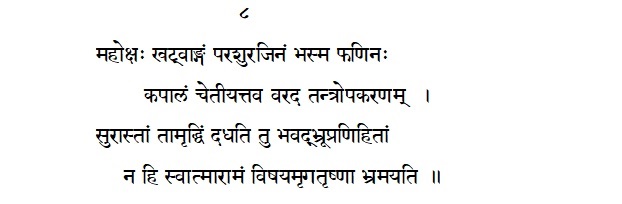
Meaning: O Giver of the Boon (Lord Shiva)! Your household properties include (i) Nandi (Bull), (ii) a club weapon, (iii) an axe, (iv) tiger-skin cloth, (v) ashes, (vi) snakes, and (vii) a human skull. But the devas (gods) enjoy an abundance of wealth given by you out of your grace. Truly, one who enjoys bliss by focusing one’s mind on the Self within never gets deluded by the temptations of worldly pleasures.
Reflections:
We can learn four things from this shloka: (1) Simple living and high thinking, (2) Remain focused on the Atman lying within, (3) No worldly attractions like wealth, sense-pleasures, power, position can disturb the blissful mind of a person who is established in the Atman, and (4) the interpretations of the symbols of Shiva’s belongings.
(1) Simple living and high thinking: Lord Shiva’s household belongings are minimal and simple. He looks like a poor God. But that is not the case. Pushpadanta says that when Lord Shiva gets pleased with the prayers of gods and out of pleasure his eyebrows get stretched a little the devas receive tons of wealth. Thus, Lord Shiva can have all the wealth of the world, but he keeps minimum things for his living, and on the other hand, he keeps his mind always focused on Atman or Brahman.
We see in the world that many Saints are capable of acquiring any amount of wealth, power, and high worldly positions, but they do not go after them and remain focused on the Atman.
The householders also can perform their responsibilities following the teachings of the Bhagavad Gita, live a simple life, but keep the mind focused on the goal of realizing the divinity within and manifesting it in their thoughts, speech, and actions and do unselfish service to humanity. Sri Ramakrishna said that when the householders are busy with work, they should hold on to God with one hand and perform responsibilities with the other hand. When they are free, they have to hold on to God with both hands.
(2) Remain focused on the Atman lying within: We find Lord Shiva is absorbed in meditation in most of his pictures and statues. His face is serene and beaming with bliss. Pushpadanta used the word “svatmarama” to describe Lord Shiva. He is always focused on the Atman within. Thus, he is a great yogi and encourages us to be a yogi. The following shlokas of the Bhagavad Gita describe yoga and the state of a yogi which gives us a picture of Lord Shiva:
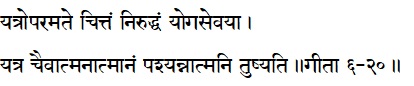
Bhagavad Gita (6.20-21):
Shri Krishna says, “That in which the mind restrained by the practice of concentration; rests calm;
that in which seeing the Self (Atman) through the self (pure intellect), one rejoices in one’s own Self;
that in which one experiences the boundless joy beyond the reach of the senses and grasped only by the understanding (the special knowledge); and
that in which being established, one never departs from Reality;…”
Here is another shloka:
“The yogi, who is happy within, who rejoices within, and who is illumined within attains freedom in Brahman, becoming one with Brahman.” (Bhagavad Gita (5.24))
(3) The Bliss of Atman:
Shri Pushpadanta teaches what we can learn from Lord Shiva. He says, if like Lord Shiva, we remain absorbed in the Atman within, then we will experience infinite bliss, and no worldly temptation will delude our minds.
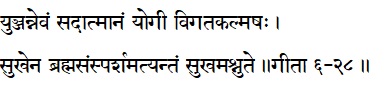
Shri Krishna says in the Bhagavad Gita (6.28):
“Thus (by the practices of meditation) making oneself ever steadfast, the yogi, freed from sins, easily enjoys the touch of Brahman, which is exceeding bliss.”
Scriptures teach us that all the joy of the world combined together is equal to a fraction of the bliss experienced by a realized soul.
We can see this from the lives of realized souls. I heard an interesting story from a Saint. He said that a Sadhu was sitting on the bank of a river and enjoying the cool breeze on a hot summer day. One passerby came, saluted him, and said, “I am a diamond merchant and I want to give you a special gift.” He took out two very precious diamonds and gave them to the Sadhu. The merchant said, “You can have all the luxuries of the world from the money you get from these two diamonds.” The Sadhu smiled and started playing with these two diamonds as if he is playing with two small pebbles. After a few minutes, he threw one diamond as far as he could in the river like a child’s play and started laughing. The merchant was shocked, and he said, “Sir! Where did you throw the diamond in the river? I can go and get it back.” The Sadhu took the other diamond and through it in the direction of the first one and said, “There it is.”. The merchant could not believe what he saw, and then he left in dismay. Sadhu taught him that compared to the inner bliss one gets by dwelling on the Atman, the two diamonds are nothing more than two pebbles.
Sri Ramakrishna wanted to make sure that the money would not deviate his mind from his spiritual goal. So, as a spiritual practice, he took a few coins in one hand and dirt in the other hand, sat at the bank of the river Ganga, and tried to feel that there was no difference between the two. He repeated a few times, ‘money, dirt’, ‘dirt, money’ and when he did not feel any difference between the two, he threw both of them in the river. He knew that money was needed to maintain the living, but it should not deviate the mind from our spiritual pursuit.
One Marwari businessman wanted to give Rs. 10,000 to Sri Ramakrishna. At that time, this amount was huge. But Sri Ramakrishna was happy with what he had, and he didn’t accept the money. Once Mathur Babu, Rani Rasamani’s son-in-law, expressed his wish to transfer an estate to Sri Ramakrishna’s name so that Sri Ramakrishna enjoys the money produced by the land for his entire life. Sri Ramakrishna became angry and chased Mathur Babu out saying, “O Rogue! Do you want to make me a worldly man? Get out of here.”
Such examples teach us that compared to the inner bliss experienced by being absorbed in the Atman the worldly pleasures are very trifles.
(4) Symbols and their interpretations:
In the Hindu scriptures, many things are symbolic. Those who cannot make efforts to find the deeper meanings of these symbols, they get confused and think that Hindu gods and goddesses and the things around them are primitive. On the other hand, people make various interpretations of the symbols according to their mindsets. Thus, there is a wide range of interpretations, and we cannot say which one is correct. Actually, the interpretations reflect the spiritual state of the interpreter. A person with a higher spiritual state, a higher consciousness state than the state of only material and body-mind existence, sees spiritually uplifting meanings behind the symbols. A person bound by the material body-mind existence sees a much lower-level interpretation of the symbols.
It is not that someone sits down one day and makes all the symbols. These symbols have evolved over a period of hundreds or thousands of years from a cultural or a religious tradition. A highly evolved spiritual soul visualizes the Ultimate Reality in a certain way and expresses it in one’s own way to his/her disciples. Then, over a period of time, many followers also had the vision of Ultimate Reality through that expression and this expression became a symbol. From various spiritual souls, these symbols develop in a culture or a religious tradition. To laugh at any symbol reflects our own mental, moral, and intellectual immaturity. If we don’t understand the meaning behind a symbol, it should not matter.
The symbols help us in our spiritual practices, especially in our meditation to focus and uplift our minds. That is all that matters.
Lord Shiva’s seven household belongings are also symbolic. Here are a couple of interpretations of the symbols that I have read, heard, or thought about them.
(1) Nandi (Bull): Nandi is considered Lord Shiva’s pet. Nandi is always sitting outside Lord Shiva’s temple facing Lord Shiva’s image. Nandi represents devotees of Lord Shiva. It represents Jiva with the ego of body and mind. Shiva rides on the Nandi meaning Shiva controls Jiva.
Another way to look at Nandi (Bull) is to be the most useful animal for farmers in farming. In earlier times, most people had farms and their living was completely dependent on farming. Farmers loved bulls dearly. Thus, Lord Shiva becomes the god of most common people. Shiva’s temples are always open. Many of Shiva’s temples don’t even have doors as there is nothing there to steal like ornaments or any precious things.
(2) A club weapon: This represents a staff more than a weapon. It symbolizes that Lord Shiva is the controller of the whole universe. By following the command of Lord Shiva, the sun, moon, earth, planets, and all continue to do their jobs. Those who do not follow the command, get punished by the law.
(3) An axe: In earlier times, people used an axe to cut trees. In the fifteenth chapter of the Bhagavad Gita, Lord Krishna describes this universe as an upside-down tree. Actually, it is the universe developed in the minds of people due to attachment created by our ignorance. Lord Krishna says that in order to attain the highest knowledge and to be free from all bondages one should cut this tree with a weapon of detachment. Thus, this axe represents detachment. Lord Shiva is absorbed in meditation and shows us to become detached from the world created out of delusion.
(4) A tiger-skin cloth: Tiger is a ferocious animal. It represents mainly lust and also all the other five enemies of a spiritual seeker, which are anger, greed, delusion, ego, and jealousy. Lord Shiva wears tiger-skin cloth and sits on it. This shows that Lord Shiva has total control over all of these six enemies and is teaching devotees to do the same.
(5) Ashes: Lord Shiva adorns his forehead and the body with ashes gathered in the cremation ground showing us that this body is ultimately going to turn to ashes. Therefore, think about the priorities of life. Don’t spend too much time pampering the body and decorating it. The goal of human life is to acquire the highest knowledge of our true divine identity which will give us everything we are seeking, like fulfillment, infinite bliss, knowledge, freedom from all bondages, and love for all. We have to take care of the body to help us as an instrument to achieve this highest goal.
(6) Snakes: Lord Shiva adorns himself with snakes. There are a couple of interpretations for this.
(i) When poison comes out from the churning of the ocean, according to the rule, someone has to drink it. Devas and demons ran away from the poison. No one on earth was ready to drink it. Finally, Lord Shiva agreed to drink the poison to save the world. He drank it and held it on his neck with his yogic power. The poison remained there which made his neck dark blue (nila) and had a burning sensation. A snake’s body is cool by nature, so the snake gave him some relief. Lord Shiva’s other name is ‘Nilakantha’, a God with a blue neck.
(ii) Snakes represent the worldly pleasures that bite us with their attractions and then we get the poison in the form of the painful consequences. Lord Shiva has total control over these worldly pleasures.
(iii) Except for the snake charmers and the snake controllers, all are afraid of the snakes. Generally, if people see a snake, their natural instinct is to kill it before it kills them. There is a story that King Janmejaya, whose father Parikshita died of a snakebite, was angry at snakes. He held a fire ritual in which he started burning all the snakes of his kingdom. Later, a saintly person convinced him to stop this ritual. Thus, people hate snakes. Lord Shiva welcomes snakes as his adornment. It is a symbol that Lord Shiva loves all, especially those who are neglected and hated by society.
(7) A human skull: Again, like ashes, the skull reminds the end of a person’s body. Men or women of different colors, cultures, forms, intelligence, and skills look alike as the skulls. Lord Shiva wears a garland of skulls considering all people equal.









 mahendrajani