Because of ignorance, we see the world

Meaning: The Vedas say that there is a universal rule applicable to all, from the creator Brahma to an individual: ‘Because of ignorance we see the world and when we realize Atman (or Brahman), the world disappears’. Because of illusion we see silver in the nacre, but when we know ‘it is nacre’, the silver merges into the nacre. Actually, there was no silver at all. Similarly, in the state of ignorance, Brahman merges in the world, and after the realization of Brahman, the world merges in Brahman.
Reflections:
From the beginning of our human awareness, there is a search to find the units out of which all the things are made. Simple examples are: (1) 0 and 1 form the set of the whole numbers, (2) all the colors are made out of three primary colors; red, yellow, and blue, (3) all the music came out from the major seven notes; Sa, Re, Ga, Ma, Pa, Dha and Ni in Indian Music and do–re–mi–fa–sol–la–si in the Western Music.
In ancient times, in India, the seekers of Truth called the Rishis, searched for something from which the whole universe came. Swami Vivekananda, in his paper on Hinduism, which he presented in the Chicago World Parliament of Religions on September 19, 1893, expressed this thought eloquently.
Swami Vivekananda said, “Science is nothing but the finding of unity. As soon as science would reach perfect unity, it would stop further progress, because it would reach the goal. Thus chemistry could not progress further when it would discover one element out of which all others could be made. Physics would stop when it would be able to fulfill its services in discovering one energy of which all the others are but manifestations, and the science of religion become perfect when it would discover Him (Brahman) who is the one life in a universe of death, Him who is the constant basis of an ever-changing world, One who is the only Soul of which all souls are but delusive manifestations. Thus is it, through multiplicity and duality, that the ultimate unity is reached. Religion can go no farther. This is the goal of all science.”
In the Mudakopanishad (1.1.3-6), “Shaunaka, the great householder, approached Rishi Angirasa with reverence and humility and asked:

“Revered Sir, what is it by knowing which all this becomes known?”
Angirasa said to Shaunaka:
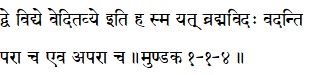
“Knowers of the Brahman tell us that two kinds of knowledge must be known. They are Higher Knowledge and the lower knowledge.”

“Of these two, the lower knowledge is the knowledge of Rig-Veda, the Yajur-Veda, the Sama-Veda, the Atharva-Veda, Siksha (phonetics), Kalpa (rituals), Vyakarana (grammar), Nirukta (etymology). Chhanda (meter), and Jyotish (astronomy); and the Higher Knowledge is the one by which the imperishable Brahman is attained.”
What is Brahman? Rishi Angirasa describes it briefly; in the first line negatively and in the second line positively:

“By means of the Higher Knowledge, the wise behold everywhere Brahman, which otherwise cannot be seen or seized, which has no root or attributes, no eyes or ears, no hands or feet; which is eternal and omnipresent, all-pervading and extremely subtle; which is imperishable and the source of all beings.”
Thus, through introspections and analysis, the Rishis of the Upanishads had realized that ‘there is only one Ultimate Reality’, which they referred to as Brahman. They realized that from Brahman the whole universe came, it sustains in Brahman, and it dissolves in Brahman. Actually, Brahman, the Ultimate Reality, appears as the universe. Just as formless water of ocean appears as waves with form, the formless and quality-less Brahman appears with various forms of the universe. If we remove names and forms of all the objects of the universe, what remains is ‘pure consciousness,’ which is Brahman.
This pure consciousness is our true nature. A person is not his/her body and mind having consciousness within, but a person is infinite formless consciousness which thinks that ‘I have a body and mind’. Body and mind are matter and they cannot produce consciousness. On the other hand, consciousness can produce many bodies and minds.
This wrong thinking that ‘I am my body and mind having consciousness within’ limits our true identity and becomes the cause of all our problems and miseries. When we realize that my true identity is ‘pure consciousness’ (Atman) and it can create many bodies and minds to experience the universe, then we become free from all our bondages, we become a witness consciousness and go through the joys and sorrows of life as is we are watching movies or actors and actresses performing their roles in a drama.
What happens in the micro-levels happens in the macro-level. As an individual, my true identity is ‘infinite formless pure consciousness’ (Atman) in and through I perceive my body and mind, similarly, this universe is nothing but ‘One Pure Consciousness’, called Brahman, but we perceive it made out of various objects with names, forms, and qualities.
Note that Atman and Brahman are the same. When we refer to Brahman, the ‘Pure Consciousness’ with respect to an individual, we call it ‘Atman’. Suppose a pot has ocean water inside and is floating in the ocean. There is no difference between the water inside the pot and water outside the pot. Here, the water inside the pot is like Atman and the water outside the pot is like Brahman. Thus, Atman and Brahman are the same. Upanishad says, “That Thou Art” (Tatvamasi).
In the Bhagavad Gita (6.30), Shri Krishna says that one who has realized Brahman will never get deluded. He identifies Himself with Brahman and says:
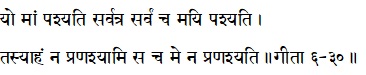
“One who sees Me everywhere and sees everything in Me, to that person I am never lost, nor this person ever lost to Me.”
Upanishads also tell us that there is only one Ultimate Reality.
Chhandogya Upanishad (6.2.1):

“In the beginning, my dear, this (universe) was Being (Sat) alone, one only without a second.”
‘In the beginning’ means prior to the manifestation of names and forms. Before the creation, all that existed was Pure Being (Brahman). After the creation also the universe is Pure Being; but it is differentiated by names and forms.
Chhandogya Upanishad (3.14.1):

“All this is Brahman.”
Ishopanishad (Mantra 1):

“Whatever exists in this universe is covered by the Lord (Brahman)”.
A question may come: ‘If everything in this universe is Brahman, why don’t I see it?’ Because we perceive this universe through our limited senses and minds and think that that is the real universe. Those who think further, reflect upon their perceptions, and analyze them, they find that there is only one unchanging ‘Ultimate Reality’ which appears as objects which are constantly changing their names and forms having various qualities. The perceptions through our senses and minds create delusions.
This shatashloki shloka-22 tells us this fact. There are several delusions we experience created by our sensory and mental perceptions. Here are a few examples: (1) in the dim light a curly rope appears as a snake, (2) in a desert, the hot sun creates mirage (a delusion of water), (3) some times, while driving or rowing a boat, we feel moon or its reflection is moving with us, (4) in the sunlight from a distance nacre appears like silver.
When we look more closely, we find that the snake is a rope, water is sand, the moon is not moving with us, but it has its own movement, and silver is a nacre.
Coming and going are also relative. People who are waiting at the Ahmedabad railway station say that ‘a train is coming’ and the passengers in the train say that ‘Ahmedabad station is coming’. The same thing happens at the airport. People waiting at Newark airport say that ‘the plane came’ while the passengers inside the plane say that ‘Newark airport came’.
Those people, who go through proper spiritual disciplines and reflections on Reality, realize the Ultimate Reality (Brahman) and they live a sane human life. They go through joys and sorrows of life, but remain undisturbed and calm within. They constantly experience the Bliss of Brahman within knowing that they are ‘Pure Consciousness’, or ‘Sat-Chit-Ananda’, meaning, Existence-Knowledge-Bliss Absolute.
Those, who think that the world they perceive through their senses and minds is real and they are nothing more than their bodies and minds, sail through their lives being tossed up and down by the joys and sorrows of life, having little worldly joy followed by lots of suffering and live a life filled with greed, anger, jealousy, hatred, fear, false sense of accomplishments, frustration with unfulfilled desires and lack of proper understanding of themselves and others.
One thing we should know is that the realization of Brahman happens in Samadhi. It happens when in meditation the mind of an individual completely merges with Brahman (Pure Consciousness) and one loses body-consciousness. When such a person’s mind comes down from the Samadhi and becomes aware of the body and mind, one perceives the world with the senses as all others do. But, the impact of the experience lingers in the mind of the realized being and most of the mind remains filled with inexplicable Bliss and the awareness of Reality. The words and acts of such realized people guide others towards this realization. They help remove people’s ignorance about Reality and with it all the sufferings of life.
Swami Vivekananda has said that one cannot perceive the world of names and forms and Brahman at the same time. If we are aware of Brahman, we are not aware of objects of the world with names and forms, and when we are aware of the world of names and forms we are not aware of Brahman. The shatashloki shloka-22 says it clearly that at the time of realization the world merges into Brahman, and at the time of delusion, Brahman merges into the world.
Let us realize that what appears as silver is in reality nacre, the world we grasp through our senses and minds is not the Ultimate Reality. The Ultimate Reality is Brahman, Pure Consciousness. Our true identity is ‘Pure Consciousness’ in and through which we perceive our mind and body and the world of plurality due to delusion.
 mahendrajani