“Shatashloki” of Shri Shankaracharya – XIV (Shloka – 19)
Four causes of freedom and four causes of bondage

Meaning:
The following are four practices to attain freedom from all bondages:
(i) Charity: Money or things given to a deserving person or an institution as an offering to God, without having any selfish motive. In a broader sense, it includes any form of unselfish service rendered to people or institutions.
(ii) Forgiveness: Forgiving a person without keeping any anger or hatred for that person in the mind. It also includes continuing to perform our responsibilities without getting agitated with people or situations, and keeping our mind calm and serene. We perform our responsibilities as an offering to God.
(iii) Faith: Having a firm faith that the words of the scriptures and my Guru are true and helpful in my spiritual path. To have a firm faith in the existence of God, or the Ultimate Reality, or the supreme power which creates, preserves, and dissolves this universe.
(iv) To follow the Path of Truth: Making efforts to understand and realize that there is only One Truth, or One Reality, or One Existence in the universe. In the Vedanta, that reality is called Brahman (Sat-Chit-Ananda; Existence-Knowledge-Bliss Absolute). With reference to an individual, we call it Atman. Atman and Brahman are same. It also includes speaking the truth and practice to maintain our thoughts, speech, and actions in unison.
The opposites of the above four are the causes of bondage. Because we have to overcome them to realize Brahman (the Ultimate Reality), they are called ‘a Setu’ or a bridge. The following are these four opposites:
(i) Greed: Wanting more and more worldly possessions and pleasures, and not being satisfied with what we have.
(ii) Anger: Getting angry when we don’t get what we want and do get what we hate. It includes not forgiving people who had made mistakes. Hating people who we think are the obstacles in our path of fulfilling our worldly desires. The thought of vengeance is another form of anger.
(iii) Having lack of faith and cherishing doubts: Doubting or being skeptical about the words of the scriptures and the spiritual teachers including our Guru without much thinking is a big obstacle in the spiritual path.
(iv) To follow the path of lies or falsehood: A path of falsehood is to disregard the Ultimate Reality that our true identity is Atman, and to live with the idea that ‘I am only body and mind’. A person with this ideology remains engaged in acquiring short-lived pleasures of body and mind. Such ideology leads a person to a stage when he/she will not have any shame to lie or cheat for selfish reasons.
If a person avoids the above mentioned four causes of bondage and practice the first four – charity, forgiveness, faith, and following the path of Truth – attains heaven, and immortality. Also, having realized the effulgent Ultimate Reality (Brahman), he/she becomes free from all the bondages of the world.
Reflections:
(1) Charity Vs Greed: While talking about renunciation, Shri Krishna told Arjuna in the Bhagavad Gita (18.5), “One should not renounce Yajna(offering), Dana (charity – giving money, knowledge, or any kind of help to others without any selfish motive), and Tapa(austerity – spiritual practices and self-control). But one should perform them because they purify the wise people.” When mind becomes pure, one can realize one’s true divine identity (Atman).
In the Bhagavad Gita (17.20-22) three kinds of charity (Dana) have been mentioned; sattvika (superior), rajasika (mediocre), and tamasika (inferior).
When charity is performed (1) with the spirit that ‘I must give’, (2) without expecting any worldly return, and (3) done at the right time, right place, and to a worthy person, then it is held to be of the sattvika (superior) nature.
When charity is performed (1) expecting some worldly return, (2) to fulfil one’s selfish motive, and (3) done with reluctance or grudge, then it is considered to be of rajasika (mediocre) nature.
When charity is performed (1) without respect or with disdain, (2) done at an improper place, and time, and (3) for an unworthy person and cause, then it is of the tamasika (inferior) nature.
Definitely, we must perform sattvika charity.
On the other hand, greed makes us selfish. It limits our vision to our little limited self. Also, greed cannot be satisfied. It is like fire. If we try to feed the fire, it increases more. Greed makes our life more miserable.
The gist of all our spiritual practices is to go from selfishness to unselfishness, from the ‘little-self’ bounded by the body-mind to the true Absolute Self (Atman) which is eternal, and free from all bondages.
(ii) Forgiveness Vs Anger and hatred:
There is a saying that ‘To err is human, but to forgive is divine’. Forgiveness comes out of love for all and from a deeper understanding of life. An egotistic and selfish person hardly forgives.
Mahatma Gandhi said, “The weak never forgive. Forgiveness is the attribute of the strong.”
A compassionate and thoughtful person thinks that ‘I make mistakes; similarly other people also can make mistakes. Why should I get upset when other people make mistakes?’
Anger and hatred are our thoughts. If we change our thoughts, then our anger or hatred can go away. For example, if someone comes and criticizes us or tells harsh words, then our usual reaction is to criticize that person by telling all his/her wrong-doing or to tell him/her harsher words. Then, we feel good by our retaliation. We usually react and do not act.
From the following famous story related to Lord Buddha, we can learn a great lesson about how love and understanding can overcome anger and hatred.
Once, a young man came to Lord Buddha with anger and hatred. He then criticized and ridiculed Buddha in an inappropriate language. Buddha listened to him quietly with his usual serene face. After the young man had finished, Buddha asked him, “Suppose you bought a gift to give it to a person and the person does not take it, with whom the gift remains?” The young man was puzzled by the calmness of Buddha and his question. Anyway, he replied, “Of course it remains with me.” Buddha said, “Look my son! You bought this gift of anger, hatred, insults, and falsehood. I am not accepting it. Hence, all these remain with you. This way you are hurting yourself.”
The young man understood the greatness of Lord Buddha. He learned a valuable lesson that day. He bowed down to Buddha.
Lord Buddha also teaches us how to act and not to react. I was thinking about this topic and ‘AAA – practice’ came to my mind.
Absorb: The first ‘A’ stands for ‘to Absorb the situation’. Buddha absorbed the situation. He understood the motive of the young man.
Analyze: The second ‘A’ stands for ‘to Analyze the situation’. Buddha must have thought about the best way to handle this situation.
Act: The third ‘A’ stands for ‘to Act properly’. By asking a question and making the young man realize the situation, Buddha acted properly. The result was the transformation of the young man. We all have goodness within us. Ignorance and impure thoughts cover our goodness. As soon as ignorance and impurity go away, our goodness shines from within.
I am sure we can find tons of such examples in the lives of great personalities, especially in the life of Saints.
Anger, hatred, and vengeance are like terminal cancers. They destroy the person who cherishes them in the mind. Also, we must remember that when we hate someone, we are giving a special place to that person in our mind. When we forgive someone, the matter is over, and our mind will be free from the person and the situation. The goal of a spiritual seeker is to realize that God has become everything.
Regarding mistakes, the difference between an egotistic person and a wise person is the following:
An egotistic person sees once own mountain-like mistake as a muster-seed like mistake, and other people’s muster-seed like mistake as a mountain-like mistake. While the wise person sees the opposite.
(iii) Faith Vs Doubt:
Shri Shankaracharya in his “Viveka Chudamani” book (25 or 26 shloka depending on the book-version) describes ‘faith’ as follows:

“’Accepting the words of the scriptures and one’s spiritual teacher (Guru) as ‘true’’ is called ‘faith’ by the wise people by which one can realize the Ultimate Reality (Atman or Brahman).”
We have faith in the words of plumbers, electricians, doctors, air-pilots, and others, but our mind creates doubts in the words of the saints and scriptures.
The words of the scriptures are the collections of the words of the seers of God. The words of the saints also are based on their direct experience of God and they agree with the words of the scriptures. In many cases, the words of the saints explain the words of the scriptures in our contemporary language. Saints and seers of God are unselfish. We have to do spiritual practices according to our Guru’s (spiritual teacher’s) guidance. If we don’t have a Guru or any other guide, then initially, we can sincerely practice the way we understand the scriptures and pray to God for the guidance. If we are sincere, we will get the proper spiritual guidance. Sri Ramakrishna says that if we are sitting in a wrong bus, someone will tell us that ‘My friend, you are sitting in a wrong bus.’ Then, they guide us to a right bus.
All saints tell us the importance of faith.
Sri Ramakrishna said that from time to time we should live in the company of holy people and go into solitude to meditate on God. Furthermore, we should practice discrimination (thinking about what is good and bad for me) and pray to God, “Please give me faith and devotion”. He said that, “Once a person has faith, he has achieved everything. There is nothing greater than faith”.
In a lighter tone Sri Ramakrishna said that Lord Rama has to build a bridge to cross the ocean, but Shri Hanuman, having faith in the name of ‘Lord Rama’, jumped over the ocean. He didn’t need a bridge.
Doubts can destroy a person. Genuine questions to understand the spiritual instructions in order to make spiritual progress are most welcomed by all saints. When a person does not want to do spiritual practices and wants to continue to fulfill his/her worldly cravings, then he/she creates purposeless doubts to find excuses.
In the Bhagavad Gita, at the end of the Chapter 4, we find a very clear message about the faith and doubts.
First we look at the shlokas (4.39) regarding the importance of faith.

Meaning of Gita (4.39): Shri Krishna said, “A person who is full of faith, has intense desire to realize Brahman and has a complete control on one’s senses attains the Highest Knowledge. Having attained the Highest Knowledge, this person immediately attains the Supreme Peace.”
Attaining the Highest Knowledge is realizing Atman or Brahman. The Highest Knowledge destroys all our bondages and makes us free. Note that the faith has been mentioned here first.
Now, let us see how Shri Krishna gave clear instructions to Arjuna about the doubts.

Meaning of Gita (4.40): Shri Krishna said, “One who is ignorant, without faith, and always doubting ruins oneself. For a doubting person, there is no happiness in this world or the world beyond.”
A fate of a doubting person has been very clearly mentioned here. We have to destroy our doubts by proper knowledge. Also, by performing our responsibilities properly, we can destroy our bondages.

Meaning of Gita (4.41): Shri Krishna said, “O Dhananjaya (Arjuna)! Actions do not bind a person (1) who has offered the results of all actions to the Lord, (2) who has destroyed all the doubts by the knowledge of the Self, and (3) who has total self-control.”
Selfish actions or the actions performed for the worldly pleasures bind a person. One has to suffer the consequences of one’s own actions. Bhagavad Gita is teaching us how to perform our actions as a practice of Karma Yoga to attain the Highest Knowledge which makes us free from all the consequences.
The following is the final command of Shri Krishna to Arjuna regarding the doubts.

Meaning of Gita (4.42): Shri Krishna said, “Therefore with the sword of Knowledge destroy your doubt about the Self, the doubt that is born out of ignorance and resides in your heart. Then, arise O Bharata (Arjuna) and devote yourself to the Karma Yoga.”
(iv) Truth Vs Falsehood:
Sri Ramakrishna says that in this time and age if one follows the truth then one can realize God.
In the “Shiksha Vally” of Taittiriya Upanishad the spiritual teacher gives the final commands to the graduating students who had completed their study of the Vedas. The very first command is “Satyam Vada”, meaning ‘speak the truth’. Further, he emphasized again by saying “Satyaanna Pramaditavyam”, meaning ‘don’t deviate from the truth’.
Thus, speaking the truth and not deviating from the truth is most important in our life. Also, we have to be sensitive when we speak the truth. We have to be polite, respectful, and try not to hurt people in speaking the truth. It doesn’t mean that we have to lie to please people. If we have love for all people then we will find a way to present the truth without hurting people.
There is a ‘subhashita’ which says that wise people’s thoughts, speech, and actions are in alignment. They speak what they think and do what they say. We call it honesty and sincerity. We find honesty and sincerity in the life of all saintly people. Sri Ramakrishna was very keen about following any promise he had made to himself or to others. Truthfulness is very important in the spiritual path. A hypocrite cannot make any spiritual progress.
Mahatma Gandhi gave a title ‘Satyana Prayogo’ to his autobiography in Gujarati, and it is translated in English as “The Story of My Experiments with Truth”. The following quote reveals his deep introspection on the truth and God.
Mahatma Gandhi said, “The word Satya (Truth) is derived from Sat, which means ‘being’. Nothing is or exists in reality except Truth. That is why Sat or Truth is perhaps the most important name of God. In fact it is more correct to say that Truth is God, than to say that God is Truth.”
It seems that Mahatma Gandhi was referring to the following definition of the Ultimate Reality (Brahman) given in the Taittiriya Upanishad.
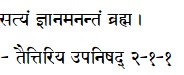
Meaning: Brahman is ‘Satyam’ (Reality or Existence), ‘Jnanam’ (Knowledge or Consciousness) and ‘Anantam’ (Infinite).
Satyam: ‘Sat’ stands for Truth. Existence or Reality is the Ultimate Truth. Anything that changes is not the truth. Thus, the Ultimate Reality or the Existence which is unchangeable is addressed by the Upanishads as Brahman. An example is given that in all the golden ornaments like ring, necklace, and earrings etc. the gold is real. The gold is appearing as the ring, or necklace, or an earring.
Jyanam: Brahman is Knowledge itself. It is Awareness or the Consciousness. This shows that Brahman is not matter. As in the light of the sun we can see things and perform our actions but the sun is unaffected by our thoughts and actions, similarly, due to Brahman, as the Witness Consciousness, we are aware of everything.
Anatam: Brahman is Infinite. There are no limitations on Brahman.
Thus, Brahman is an Infinite Existence and Awareness or Consciousness which appears as varieties of the things in the universe.
Actually, Brahman is beyond the comprehension of the mind and the senses. Brahman is indescribable. Whatever words describe becomes limited. Tons of books have been written and tons of lectures have been given on Brahman. These are mere attempts to give an idea of Brahman. Brahman has to be experienced directly. Rishis and great saints have experienced Brahman.
There is another important mantra of the Mundakopanishad regarding the Truth.

Meaning: Truth alone prevails, not falsehood. By truth the path is laid out, the Way of the Gods, on which the seers, having satisfied all their desires, proceed to the Highest Abode of the True.
The shloka-19 of the Shatashloki says that realizing Brahman as Truth we can remove all our bondages. If we don’t accept this Truth and follow the idea that we are just body and mind, then we add more bondage on ourselves and live like a slave of the senses. Falsehood is not accepting the Truth that there is only One Existence, or One Reality.
Note that the first two practices are simple in nature like giving in charity, and forgiving. Then, the next two practices, namely faith and following the Truth are subtle and deeper. Following these, we make progress from our ‘little self’ to our absolute true ‘Self’. As a result, we get rid of all our bondages, become free, and enjoy the Infinite Bliss and attain the fulfilment in life.
In order to avoid the miseries and the bondage of life, we must avoid the opposites of the above four.
 mahendrajani