The last word on listening to spiritual discourses

Thinking about the Bhagavad Gita, the following shloka came to my mind:

After the dialogue between Shri Krishna and Arjuna, which is contained in most of the 694 shlokas of the Bhagavad Gita, Arjuna told Sri Krishna, “O Krishna! My delusion is gone. Through Your grace, I have regained my memory (of my true identity, Atman). All my doubts have been destroyed. My mind is clear and I have a firm conviction about my responsibility. I will follow your command.” (Gita 18.73)
These are the last words of Arjuna in the Bhagavad Gita. The dialogue between Sri Krishna and Arjuna ends with these words. Sri Krishna answered the many questions of Arjuna and explained to him that the goal of life is to realize his true divine identity as the Atman, and how he can face the unpleasant and sorrowful situation that was forced on him by his cousins. Shri Krishna showed Arjuna how each of his responsibilities can be turned into spiritual practice, which can help to realize the Atman. The remaining 5 shlokas are the thoughts and expressions of Sanjaya.
Through this shloka, Arjuna shows us what should be the final outcome after listening to a spiritual discourse or having a spiritual dialogue. Each word of this shloka is important.
Let us review the meaning of each word of the shloka and reflect upon it.

– My delusion is gone.
What is the delusion here? The greatest delusion of life is to think that we are nothing but our body and mind. We forget that our true identity is Atman, which is birthless and deathless. It is infinite, omnipresent and omnipotent. Limiting our self to the body and mind is the cause of all suffering and all delusion in life. We block the Reality of life and therefore, we suffer. Thus, after listening to spiritual discourses, this delusion must go.

– I have regained my memory.
Deep within each of us there is awareness that ‘My true identity is divine. It is infinite and not limited by my body and mind.’ The Upanishads and Bhagavad Gita refer to this identity as the Atman (or Brahman in the context of the universe) and its nature is Sat-Chit-Ananda (Existence-Knowledge-Bliss Absolute).
‘Existence Absolute’ means ‘I am the Pure Consciousness from which the whole universe came (including my body and mind), which is nourished by It, into which the universe ultimately dissolves.
‘Knowledge Absolute’ means that the Self-Luminous Pure Consciousness illumines my intellect because of which I can think and perceive the universe.
‘Bliss Absolute’ means all my joy, inner (experienced, but not caused by the senses) and outer (which arises from the contact of my senses with worldly objects), is due to the presence of this Pure Consciousness (my true identity).
Arjuna says that he has regained this fundamental memory, that he is nothing but the Atman.
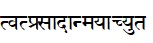
– O Krishna! Through your grace I have attained all these.
When the fundamental delusion is removed, the knowledge or the awareness of our true identity as Atman is revealed from within. This knowledge does not come from outside. However, we need help from the outside to remove our fundamental delusion. The idea that ‘I am nothing but this body and mind’ has been deeply ingrained in every fiber of our being; therefore, for most of us, it is difficult to remove this idea by our own efforts. Arjuna found that Shri Krishna’s teachings helped him remove this delusion and he is recognizing this help.

– I am firm.
This means that ‘I am clear in my mind. My intellect is steady. I know what I am supposed to do’. At the end of the second chapter of the Bhagavad Gita, Shri Krishna describes the characteristics of a person with steady intellect. The Sanskrit word for such a person is ‘Sthitaprajna.’ Arjuna is stating that his intellect is steady now.

– All my doubts are gone.
After listening to spiritual discourses, having spiritual dialogues, and doing spiritual practices accordingly, we have to come to a stage when all our doubts are removed. First, intellectual doubts have to be removed and then after realization of Atman, all our doubts are resolved. Suppose the Sun is covered by the clouds and we cannot see it. Then, doubts come to our mind about whether or not the Sun exists. But, when the clouds are removed and we see the Sun directly, we feel its warmth, and in the sunlight we see everything clearly, then all our doubts about the existence of the Sun go away. At that time, we do not need any further proof of whether the Sun exists. In fact, we realize that the clouds were perceived only because of the presence of the Sun.
After listening to Shri Krishna’s teachings and having visions of both forms of Shri Krishna, the human and the Infinite, all of Arjuna’s doubts were gone.

– I will follow your command.
These words show that Arjuna was not interested in intellectual knowledge. He had to face a sorrowful situation and he was confused about the right thing to do. He needed a clear-cut answer and a clear-cut way to perform his responsibility. He stated his thoughts in the first chapter and the beginning of the second chapter. Based on these thoughts he initially decided not to fight. But deep down in his heart, he had a feeling that he was not thinking right. He had tremendous faith in Shri Krishna. That is why he said that ‘I surrender to you. Please tell me what is good for me.’
Shri Krishna first rebuked Arjuna for becoming a victim of his cowardliness. He said to Arjuna that this kind of behavior does not fit him. Then, Shri Krishna told Arjuna the essence of the Upanishads, explained to him that the goal of life is to realize Atman, and described the four Yogas (the four paths to attain this goal). Shri Krishna told him that by properly performing one’s own responsibilities one can realize one’s true identity as the Atman.
Arjuna did not swallow whatever had been said without understanding. Whenever he had questions, he did not hesitate to ask them to Shri Krishna. A couple of times it seemed that he was being blunt. Once he said, “O Krishna! You say that knowledge of the Atman is superior to actions. Then, why are you trying to encourage me to perform these horrible actions? You are confusing me with contradictory thoughts. Please tell me one thing which is good for me.” Another place he said, “O Krishna! You praise renunciation of actions, and then you talk about performing actions unselfishly. Please tell me which one is better.” When Shri Krishna said that he had taught this Karma Yoga to Vivasvata, Arjuna pointed out to him that he (Shri Krishna) had been born now and Vivasvata was born long ago, so how should he (Arjuna) believe that Shri Krishna had taught this Yoga to Vivasvata.
Shri Krishna was a great teacher. In his presence Arjuna did not have any fear to ask any question he had. After explaining in various ways why Arjuna should perform his responsibility, at the end, Shri Krishna gave Arjuna the freedom to do what he thought was right.
Arjuna was a great disciple. He reasoned to understand what Shri Krishna wanted to tell him. He reflected upon Shri Krishna’s teachings. With Shri Krishna’s grace he was able to realize the Ultimate Reality (Brahman) and finally with a clear mind, free from all doubts, and a firm conviction, he said, “I will follow your Command.” He was ready to implement what he had learned.
After realization of one’s true identity (Atman), all the desires of the realized person are fulfilled. Then he/she has nothing remaining to attain to be happy or any desire to accomplish anything further. But, many realized persons continue to work for the good of humanity. They set up ideal examples of saints and/or householders for people to follow and thus they inspire people to realize their true identity.
Sri Ramakrishna encouraged Narendra (Swami Vivekananda) to be such a person. It is good to remember the famous incident in Narendra’s life. Narendra asked Sri Ramakrishna to give him a boon to remain merged in Samadhi for three to four consecutive days with a few interruptions now and then for a bite of food. Sri Ramakrishna said, “You are a fool. There is a state higher than that. It is you who sings: ‘O Lord! Thou art all that exists.’” On another occasion, in response to a similar request from Narendra, Sri Ramakrishna said, “Shame on you! You are asking for such an insignificant thing. I thought that you would be like a big banyan tree, and that thousands of people would rest in your shade.” Thus scolded, Narendra shed profuse tears. He realized the greatness of Sri Ramakrishna’s heart. Thus, Sri Ramakrishna encouraged Narendra and all disciples to serve all beings, seeing God in them before and after the realization of God (Atman).
Sri Rama’s devotee Hanumanji had also set an example. He jumped over the ocean to cross it to find Mother Sitaji. A Mainak mountain asked Hanumanji to take some rest and then go forward. But, Hanumanji just touched the mountain recognizing the mountain’s love for him and said, “Until I finish Sri Rama’s work, how can I take any rest?”
Thus, many realized beings continue to serve humanity unselfishly.
Conclusion: Arjuna’s words are the last word on listening to spiritual discourses and dialogue. He showed us that when we listen to spiritual discourses: (1) we should make sure that we learn about the goal of our life – realizing God or our true identity as the Atman (the Ultimate Reality). (2) We have to reflect upon the spiritual discourses and respectfully ask questions in order to understand the teachings presented to us. (3) Following the teachings, ultimately our fundamental delusion should go away. (4) We have to realize Atman. (5) We respectfully and with humility recognize the valuable contribution of our spiritual teachers. (6) We have to acquire a state of having a ‘steady intellect’. (7) All our doubts must go away, and (8) We perform our responsibility unselfishly and serve humanity.
(Thanks to Rushil Desai and Sonali Tatapudi for editing this post.)
 mahendrajani
Excellent! I haven’t read this interpretation except here. Very practical and easy to understand.
Loved reading it
Krishnan
Dear Krishnan! Thank you for your comments. Thinking about Bhagavad Gita, it occurred to me that Arjuna’s every word in that shloka is important and appropriate. Also, this is where the dialogue between Shri Krishna and Arjuna ends. For each of us it is a great lesson from Arjuna about what should be the outcome of listening to a spiritual discourse or having a spiritual dialogue. I am glad you caught this point and expressed it in your comments.
Very good
I love your each post. deeply understanding knowledge required to write such post. Really appreciate.
I assume that your name is Keyur Raval. Thank you Keyur ji for your comments. I really appreciate your open mindedness and generosity. I was fortunate to learn from many saintly people. They taught me to reflect upon their teachings and sincerely practice the teachings that I have understood. In this world, there are lots of things to learn, practice, and uplift our life. Thank you again.