Four Questions and Their Answers
from The Gospel of Sri Ramakrishna

Mahendranath Gupta, known as “M.,” met the God-man Sri Ramakrishna in February 1882 (137 years ago). He was the Principal of the Vidyasagar High School at Syambazar. He recorded in his diary Sri Ramakrishna’s conversation with his devotees, including himself. Most people know that from his notes he wrote in Bengali, the famous book Sri Ramakrishna Kathamrita, which Swami Nikhilananda translated into English as The Gospel of Sri Ramakrishna.
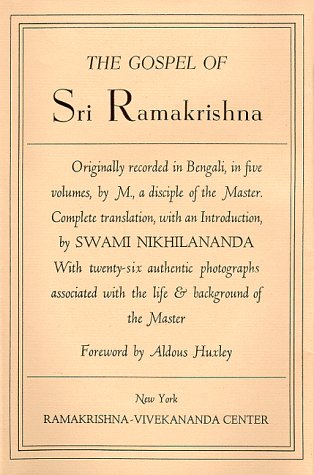
Sri Ramakrishna Kathamrita has been translated into all Indian languages and probably all major languages of the world. When we read this book, we sit face-to-face with Sri Ramakrishna and enjoy his inspiring conversations. We wonder how Sri Ramakrishna explained the deepest truths of spirituality in simple words with parables and perfect analogies.
At the beginning of this book, M. asked four fundamental questions to Sri Ramakrishna regarding spirituality and spiritual practices. I reflect on these four questions and their answers again and again. One must read these questions and answers in Sri Ramakrishna’s words from the book “The Gospel of Sri Ramakrishna, translated by Swami Nikhilananda (pages 81-83). I am writing and commenting on these questions and answers as a part of my own study. One can think of it as my notebook about these pages.
————————————————————————————————————————-
Question – 1: “How, Sir, may we fix our minds on God?”
Sri Ramakrishna said to do two things:
(1) Repeat God’s name (do japa) and sing His/Her glories, and
(2) Keep holy company (now and then visit God’s devotees and holy men)
Why cannot we fix our minds on God?
Sri Ramakrishna reasoned, “The mind cannot dwell on God if it is immersed day and night in worldliness, in worldly duties and responsibilities.”
What should we do?
We should do japa and meditation in solitude.
Sri Ramakrishna said, “It is most necessary to go into solitude now and then and think of God. To fix the mind on God is very difficult in the beginning unless one practices meditation in solitude. When a tree is young it should be fenced all around; otherwise, it may be destroyed by cattle (cattle means worldly or distracting thoughts and influences).”
How should one meditate?
Sri Ramakrishna said, “To meditate, you should withdraw within yourself or retire to a secluded corner or to the forest (mone, kone, and bone in Indian language). And you should always discriminate between the Real and the unreal. God alone is Real, the Eternal Substance; all else is unreal, that is impermanent. By discriminating thus, one should shake off impermanent objects from the mind.”
Note: Impermanent objects cannot give us permanent happiness. They give a little pleasure and lots of sufferings because of our false hopes created by our ignorance. On the other hand, God, the Ultimate Reality, our true identity whose nature is Sat-Chit-Ananda (Existence-Knowledge-Bliss Absolute), removes all our sufferings and gives us Infinite bliss. It destroys all our ignorance about ourselves and the universe.
————————————————————————————————————————-
Question – 2: “How ought we to live in the world?”
Sri Ramakrishna said, “Do all your duties but keep your mind on God. Live with all-with wife and children, father and mother- and serve them. Treat them as if they were very dear to you, but know in your heart of hearts that they do not belong to you.”
Sri Ramakrishna gave two excellent examples:
Example 1: “A maidservant in the house of a rich man performs all the household duties, but her thoughts are fixed on her own home in her native village. She brings up her master’s children as if they were her own. She even speaks of them as ‘my Rama’ or ‘my Hari.’ But, in her own mind, she knows very well that they do not belong to her at all.”
Note: I understood as follows: God has given us our parents, family members, relatives, and friends. We love them as our own and serve them. But, we should be aware that we have no control over them. God had created them, nourishes them, and when the time comes, takes them away from us. With this awareness, we can keep our mind on God while serving them.
Example 2: “The tortoise moves about in the water. But, can you guess where her thoughts are? They are on the bank, where her eggs are lying.”
Sri Ramakrishna emphasized: “Do all your duties in the world, but keep your mind on God.”
Why do we have to think of God while living in the world?
Sri Ramakrishna gave a very clear answer. He said, “If you enter the world without first cultivating love for God, you will be entangled more and more. You will be overwhelmed with its danger, its grief, and its sorrows. And the more you think of the worldly things, the more you will be attached to them.”
Note: By sincerely praying to God, we develop inner spiritual strength which helps us face grief, sorrows, and dangers of life. We have to be attached with all through God. If we attach ourselves to all, without God, selfishness comes and creates many problems.
Example 3: (Sri Ramakrishna gave a wonderful example to enhance his point.) First, rub your hands with oil and then break open the jack-fruit otherwise they (your hands) will be smeared with its sticky milk. First, secure the oil of divine love, and then set your hands to the duties of the world.”
Note: When we have developed divine love for God, our mind will be calmer, more thoughtful, and more aware of what is good and helpful and also what is not good and harmful. After that, we will be able to perform our responsibilities with sanity, devoid of weaknesses like ego, expectations, hatred, and others.
How to attain divine love?
Sri Ramakrishna said, “But, one must go into solitude to attain this divine love.”
Note: Sri Ramakrishna emphasized again to go into solitude, discriminate or analyze the Real and the unreal and do japa and meditation to develop the love for God. He gave the following example to illustrate this thought.
Example 4: Sri Ramakrishna said, “To get butter from milk you must let it set into curd in a secluded spot: if it is too much disturbed, milk would not turn into curd. Next, you must put aside all other duties, sit in a quiet spot, and churn the curd. Only then do you get the butter.”
Note: The human mind has an amazing capacity if it is focused on a higher goal. The energy of the mind can be wasted by engaging in trifle things. With this mind, we can realize God or get the highest knowledge.
Sri Ramakrishna said, “Further, by meditating on God in solitude the mind acquires knowledge, dispassion, and devotion. But, the very same mind goes down if it dwells in the world. In the world, there is only one thought: ‘lust and greed’.
Note: Sri Ramakrishna gave another wonderful example to make this point clear.
Example 5: Sri Ramakrishna said, “The world is water and the mind milk. If you pour milk into the water they become one; you cannot find pure milk anymore. But turn the milk into curd and churn it into butter. Then, when that butter is placed in water, it will float. So, practice spiritual discipline in solitude and obtain the butter of knowledge and love. Even if you keep that butter in the water of the world the two will not mix. The butter will float.”
A Question: A genuine question may come: ‘I do not have knowledge of God and have not acquired the love for God. In this situation, what should I do? Should I not perform my responsibilities?’
My Answer: This is a valid question and it comes to all sincere beginners in the path of spirituality. I will write what I have understood about this teaching and how to practice it. First of all, we have to accept Sri Ramakrishna’s teaching in principle: ‘We cannot perform the worldly responsibilities in the best possible way without developing love for God and acquiring knowledge of God.’ Now, we have to start doing spiritual practices which he had mentioned before (go in solitude, analyze, do prayer, japa and meditation, seek holy company and others) daily at least in the morning and in the evening. After the morning spiritual practice, we develop a sense of detachment and try as much as possible to perform our responsibilities with detachment, meaning with the idea that everything belongs to God and I am just a caretaker. I perform these responsibilities as an offering to God to develop the love for God and to feel God’s presence in everything. Slowly, by God’s grace, we develop the love for God and acquire knowledge about God, our responsibilities will be performed with a proper state of mind and we do not get affected by the dangers, and sorrows of life.
How to discriminate in solitude?
Sri Ramakrishna emphasized that lust and greed are the two weaknesses of a human being, which bring his/her mind down to the body-mind level and will not let the person’s mind rise to the inner Self (Atman) or God. We have to train our mind to rise beyond lust and greed. Sri Ramakrishna teaches us how to prepare our mind for this.
Sri Ramakrishna said, “Together with this, you must practice discrimination. ‘Lust and greed’ is impermanent. God is the only eternal substance. What does a man get with money? You get food, clothes, and a dwelling-place; nothing more. You cannot realize God with its help. Therefore money can never be the goal of life. That is the process of discrimination. Do you understand?…. What is there in money or a beautiful body?”
Sri Ramakrishna said that when one discriminates, then one finds that even a beautiful body consists of bones, flesh, fat, and other disagreeable things. Why a person should give up God and directs one’s mind to such things, like lust and greed? Why a person should forget God for their sake?
————————————————————————————————————————-
Question – 3: “Is it possible to see God?”
Sri Ramakrishna said, “Yes, certainly. Living in solitude now and then, repeating God’s name and singing His glories, and discriminating between the Real and the unreal – these are the means to employ to see Him.”
Note: Wow! Sri Ramakrishna emphatically said that ‘God can be realized’. It is a great assurance. He also told the spiritual practices through which one can realize God.
————————————————————————————————————————-
Question – 4: “Under what conditions does one see God?”
Sri Ramakrishna said, “Cry to the Lord with an intensely yearning heart and you will certainly see Him. People shed a whole jug of tears for wife and children. They swim in tears for money. But, who weeps for God? Cry to Him with a real cry.”
Sri Ramakrishna sang a song:
Cry to your Mother Shyama with a real cry, O mind!
And how can she hold Herself from you?
How can Shyama stay away?
How can your Mother Kali hold Herself away?
O mind, if you are in earnest, bring Her an offering
Of bel-leaves and hibiscus flowers;
Lay at Her feet your offering
And with it mingle the fragrant sandal-paste of Love.
Sri Ramakrishna continued, “Longing is like the rosy dawn. After the dawn out comes the sun. Longing is followed by the vision of God.”
Note: Sri Ramakrishna clearly described the state of a person’s mind that is ready to realize God. There is no ambiguity in this. With spiritual practices, we hope to develop intense desire and a need to realize God. Sri Ramakrishna gives more examples to give a clear picture of intense longing.
Example 6: Sri Ramakrishna said, “God reveals Himself to a devotee who feels drawn to Him by the combined force of these three attractions: (1) the attraction of worldly possessions for the worldly man, (2) the child’s attraction for its mother, and (3) the husband’s attraction for the chaste wife. If one feels drawn to Him by the combined force of these three attractions, then through it one can attain Him.
“The point is, to love God even as the mother loves her child, the chaste wife her husband, and the worldly person his wealth. Add together these three forces of love, these three powers of attraction, and give it all to God. Then you will certainly see Him.”
Note: Again, a very clear picture of the force of the longing has been given. People are familiar with these three forces of love. Now, we have to combine these three forces of love and give it all to God. In order to attain a worldly thing like degree, money, position, power etc. people give up so many other distractions and focus their mind to attain that thing. Sri Ramakrishna says that seeing God is not impossible if we apply our full mind and heart to realize God. Whatever yoga we practice, whether Jnana Yoga, Bhakti Yoga, Karma Yoga, or Raja Yoga, one needs intense longing to realize the ultimate goal of the four yogas, namely God-realization.
The Final Word – Surrender
Example 7: Sri Ramakrishna concludes his answer with the following: “It is necessary to pray to Him with a longing heart. The kitten knows only how to call its mother, crying, ‘Mew, mew!’ It remains satisfied wherever its mother puts it. And the mother cat puts the kitten sometimes in the kitchen, sometimes on the floor, and sometimes on the bed. When it suffers it cries only, ‘Mew, mew!’ That’s all it knows. But as soon as the mother hears this cry, wherever she may be, she comes to the kitten.”
Note: One can relate to this example more when one gets familiar with the Asian Indian atmosphere where the doors and the windows of a house are mostly open and street cats carry kittens into the houses. Cats carry kittens holding them in their mouths, put them at various places and look for their food. Cats know that at different timings, different places of the house are safer. The point is that one has to completely surrender to God with an understanding that ‘God is my father and mother and will take care of me.’ We have to go through various situations in life, good or bad; no matter what, hold on to God and intensely pray to God. Especially during the suffering, we have to bear the pain of life and call on God. If our prayer is intense, God will definitely come.
Note that Sri Ramakrishna had developed an intense longing to realize God, had a vision of Mother Kali, and then throughout his life, he remained in the God-consciousness state. He had also completely surrendered himself to Mother Kali.
(Thanks to Rushil Desai and Sonali Tatapudi for editing this post.)
 mahendrajani