What is the name of the flower?
The following post is based on a story I heard from Swami Adiswarananda, the Spiritual Leader of the Ramakrishna Vivekananda Center in New York from 1973 to 2007.
In a park, an elderly couple was sitting on a bench enjoying the fresh air. At that time, the husband’s friend came and asked him for the name of the institution that offers a “Memory-Enhancing Course” that the couple had previously taken.
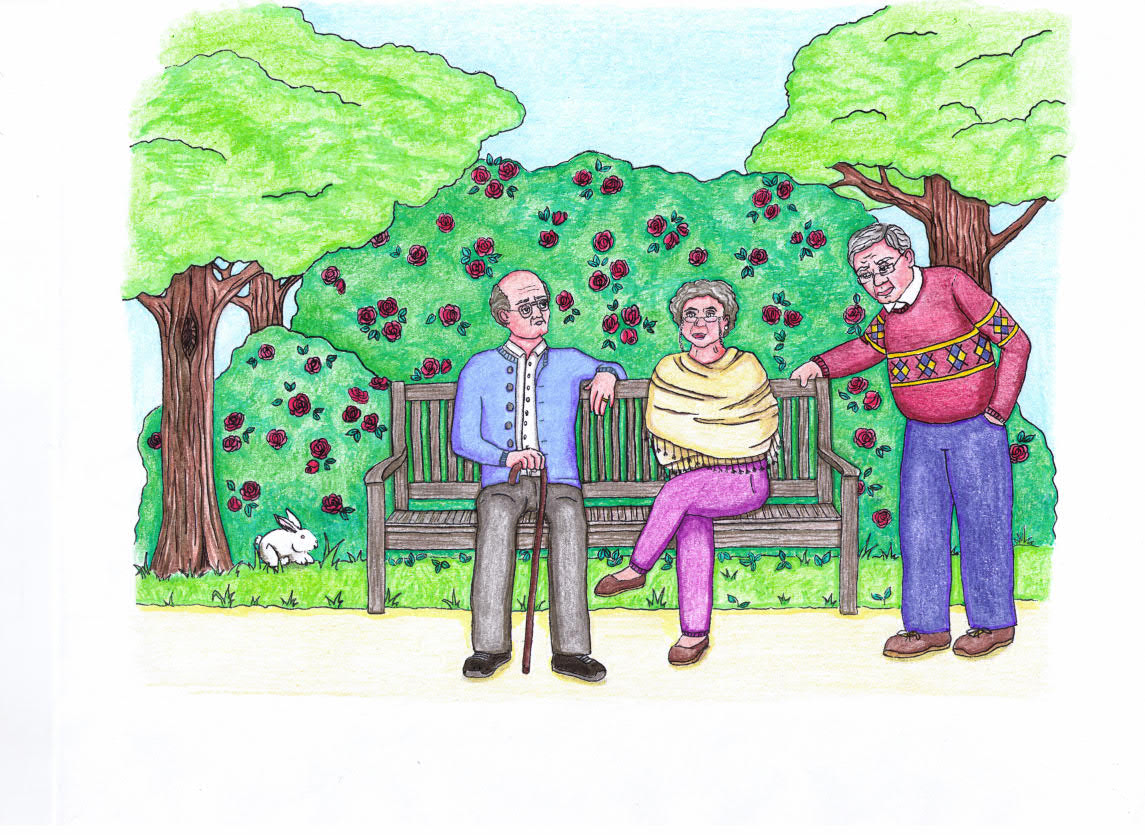
It seemed that the husband was trying to remember something. After a couple of minutes, the husband pointed to the red flowers and asked his friend, “What is the name of the beautiful, red flowers that grow on thorny plants?”
The friend was confused, but after some thought, he said, “Are you talking about roses?”
The husband was very happy. He then turned to his wife and asked, “Hey Rose! What is the name of the institution that offers the ‘Memory-Enhancing Course’ that we had taken?” 
———————————————————————————————————————
Reflections:
Forgetting things is a sad thing, but it is also a blessing. Whatever we forget does not bother us anymore. We wish we could forget many unpleasant experiences. We do not hope for unpleasant experiences, but they have their reasons. Swami Vivekananda says that unpleasant experiences teach us more than pleasant experiences.
In a conversation, Swami Sarvapriyananda recounted the following incidents regarding the loss of memory. Swamiji was talking to an elderly scholar. In the talk, the scholar could not remember a reference because of aging. He tried hard, but he could not remember. He was very sad as if his life had become meaningless. In a similar situation, a sadhu who was well-versed in the scriptures did not remember a reference. After some efforts to remember, he just smiled and said, “Oh! I don’t remember. It is okay. Maybe it is not needed for me.” The sadhu was happy taking the name of God and not remembering the scholarly information did not bother him at all.
Even at young ages, people forget many things. It is good that we do not remember everything. Just like cache memory is needed to open and run a computer, not all memories are needed to make the mind function at a time. If we remember everything all the time, we would probably go crazy.
At some point in his life, young Swami Vivekananda wished that he knew of medicine with the power to make him forget what he had learned thus far. He could then start re-learning things in a systematic order and learn only things which were needed.
Swami Tyagananda, in one of his lectures, asked us to forget two things: (1) What good we have done to others and (2) what bad things other people have done to us. If we do this, then we will be free from many mental conflicts and will experience peace within.
In the Srimad Bhagavad Gita,  (to forgive) has been considered a divine quality. To forgive and forget are important spiritual practices.
I have heard from Swami Adiswarananda about the difference between a “Worldly person” and a “Godly person.” He said that if you have done 99 good things and one bad thing to a “Worldly person,” he/she will forget the 99 good things and will remember the one bad thing. On the other hand, a “Godly person” will forget the 99 bad things we have done to him/her and will remember the one good thing.
One of the obstacles to practicing forgiveness is our ego. An egoistic person has a really hard time forgetting and forgiving. Sri Ramakrishna explained that if a thief steals $10 from an egoistic person and suppose that man catches the thief, then he will take away the $10, beat the thief with the help of others, and finally call the police saying, “I will see that you go to jail for stealing my $10. Do you know whose $10 you have stolen?”
The mind can be trained in the way we want it to be. Through proper practices, the ego can be reduced and we can train our mind to forget all the bad things people have done to us and remember all the good things people have done to us.
(Thanks to Pallavi Tatapudy for editing the post and Sneha Shah for the illustration)
 mahendrajani