The Basics of Vedanta
The Search for the Self
Lesson – 2
Teacher: Can you please summarize what we learned in lesson one?
Student: I learned lots of things. Let me try to recall the main points.
As colors are made out of primary colors, all music is made out of seven notes, all sounds are combined in the sound of OM, and all positive integers are made out of 1 (0 is the absence of 1). Rishis, the scientists of the inner truth, searched for ‘something’ from which all people and the objects of the world are made out of. Through inner search, logic, and direct realization of the Ultimate Truth, they found that everything in the universe is made out of “Pure Consciousness” which they call “Brahman”.
As golden ornaments, though different in names and forms are made out of gold, clay images are made out of clay, and all different waves of an ocean are nothing but water, all various beings and objects of the world are made out of “Pure Consciousness” or Brahman. Rishis, sages, saints, as well as other people, have realized this Ultimate Truth. Anyone who follows this well-researched path described by these Rishis, Sages, and Saints can realize this Ultimate Truth. When we realize this Truth, we become connected with all beings and objects of the world as one entity.
Teacher: Do you recall anything else about what we discussed?
Student: Yes, I remember more. You have said that all the spiritual laws (findings related to the Ultimate Truth) were compiled into “Vedas.” The Rishis did not claim that they had created these laws. But they said they had realized these truths.
Oh, I also have something more to say.
Teacher: Please go ahead.
Student: The philosophical parts of the Vedas (related to the existence and functions of our life and the universe) were compiled into Upanishads. Sage Badarayana had composed 555 sutras or formulas to systematize the revelations and the realizations of the Rishis on a rational basis. The book that consists of these sutras is called the “Brahma Sutras”. And the practical expressions and applications of these truths have been written in the form of a dialogue between Shri Krishna and Arjuna in The Bhagavad Gita, a part of the great epic Mahabharata. We can also learn these truths from the lives and teachings of the realized souls.
Teacher: Anything else?
Student: Yes. “Pure Consciousness” or Brahman cannot be described in words as words are incapable of expressing infinity. But, the closest description of the nature of Brahman has been expressed through the word Sat-Chit-Ananda (Existence, Knowledge, and Bliss Absolute). Brahman is the support of our Existence, the basis of our awareness (which gives us knowledge), and the source of our happiness.
Teacher: Excellent. In the spiritual path, it is always good to go back and remember what we have learned and reflect upon it. The more we do that, the more we understand these fundamental thoughts of Vedanta. The books of the Vedanta Philosophy are not like the kinds of novels that we read once and know their stories and then need not read again. We must realize the Ultimate Truth by repetitively reading, reflecting, and practicing these thoughts as described in the Vedanta books.
Student: Does that mean that the spiritual knowledge is not an intellectual knowledge?
Teacher: Exactly. You understand the point.
Remember one more thing I had said in the last lesson. I mentioned that Shri Shankaracharya wrote commentaries on the Upanishads, Brahma Sutras, and the Bhagavad Gita. Then, based upon the truths described in these books and his own direct experiences, he taught his disciples “Advaita Philosophy.” Later, based on the life and teachings of Sri Ramakrishna and Holy Mother Sri Sarada Devi, as well as his own studies and revelations, Swami Vivekananda expounded upon these truths through his lectures and writings. This is what most people consider to be the foundation of the Vedanta Philosophy that we know today. We can also find many other books in the literature based on the experiences and teachings of Saints and Sages which are also helpful to learn about the Vedanta Philosophy.
Student: Thank you for reminding me of that point. I have a question: Besides Sat-Chit-Ananda are there any other names or expressions that are used to describe Brahman?
Teacher: Good question. In the Bhagavad Gita, Upanishads, and Brahma Sutras, various words and expressions are used to provide the reader with some understanding of Pure Consciousness or Brahman.
You know that the Bhagavad Gita is considered to be the essence of all Upanishads. I will cite a few of them from the Bhagavad Gita.
In Chapters two and twelve of the Bhagavad Gita, Pure Consciousness or Brahman has been described as follows:

Student: It seems that several of these expressions can be interpreted as having a negative connotation, like birth-less, does not perish, does not move, cannot be burnt, cut, or drowned, or Indefinable.
Teacher: You are right. Initially, one tries to understand “what is not Brahman.” It is called the process of elimination. In Sanskrit it is called “Neti, Neti” – not this, not this. For example, whatever perishes is not Brahman. Thus, the body and mind cannot be Brahman. Whatever is subject to change is not Brahman. We look around and find that everything is changing. We do not perceive anything that is permanent. Ultimately we find that whatever we perceive through our senses is not Brahman.
Student: But, through this process, we will then eliminate everything in the universe and ultimately nothing will remain that can be called Brahman!
Teacher (with a smile): That is not the case. At the end of the elimination, the One who inspired the search definitely remains.
See, in a process of searching three things are needed: (1) The subject: the person who searches, (2) the object: the objective or goal of the search and (3) the process: the act itself of searching. In this case, the Pure Consciousness is guiding the mind of a person (subject) to the search for Itself. Then, how can it find Itself? Here, the subject is looking for itself as an object!
Suppose a king named Bhimsing forgot that he is the king Bhimsing.

Now, suppose he begins to ask everyone “Are you king Bhimsing?” Everyone will definitely say ‘no, he or she is not’. Ultimately, when the king realizes that ‘he himself is king Bhimsing,’ then his search ends, and he is happy with himself. Thus, by eliminating everything that is not Brahman, we ultimately realize our true identity which is Pure Consciousness and the search ends. Then, the subject, the object, and the process of the search all become one.
Student: Is it then true that whatever has been denied is not Brahman?
Teacher: Good question. In this case, there are three steps: (1st) One denies that everything that is grasped by the senses is Brahman, (2nd) One realizes the “Pure Consciousness” or Brahman by becoming one with It, and (3rd) After realizing Brahman, one finds that everything that has been denied was also Brahman, but one was not aware of it.
For example, when we are so aware of various names and forms of people with their different personalities, we forget that there is one life force behind them all. When we become aware of the same life force, the outer differences start melting away.
It is the same with the golden ornaments. When we are aware of the gold, then the names and shapes of the ornaments fade away, and we realize that everything is gold. It is same with clay images.
Sri Ramakrishna explained this in a very simple way. He said that in a house there is a staircase which takes one to the terrace. We climb on the first step and ask, ‘Is this the terrace?’ The answer is ‘no’. Then, we go on the second step and ask, “Is this the terrace?’ The answer is ‘no’. Thus, denying all the steps we finally reach to the terrace. Then, we find out that the terrace is made out of the same material that the steps have been made out of. Similarly, in the beginning, we negate that which does not appear to be Pure Consciousness. After negating everything, when we do finally realize Pure Consciousness, then we understand that everything actually is Pure Consciousness. The only difference is that before this realization, we saw all these things as various, separate objects.
Student: This is great. The names and forms of people divide us all. In order to realize the life force behind every being, we have to go beyond their names and forms. Once we realize the common life force behind everything, we start seeing all things connected by a common thread.
Teacher: Excellent. That is the goal of the spiritual search for the Ultimate Truth or Ultimate Reality, also known as Pure Consciousness or Brahman.
Let us go back to the words I cited from Bhagavad Gita which refer to Brahman. They are all inter-connected. One that is imperishable should be birth-less because anything that has a beginning must also have an end, and therefore, it cannot be imperishable.
The imperishable should be infinite and omnipresent, or all-pervading. That which is omnipresent is unique. Thus, there can be no two Brahmans. Infinite cannot manifest because whatever manifests is, by definition, finite. Thus, the infinite is un-manifested. It is also unchangeable and immovable.
Student: I have a question. If Brahman or Pure Consciousness moves through all beings, then how can It be immovable?
Teacher: I admire your thinking and your question. Let me tell you an incident from my life. Once I was traveling in a New York Subway. It was a rush hour. The subway car was packed with people. I was standing in the middle of the car surrounded by people. The train makes turns on its way and the riders get thrown around. I was holding a strap which was a short distance away. I had to stretch my hand out to hold onto it, and so my hand was hitting the faces of several people. One passenger told me to let the strap go. I said, “If I let go, I will fall.” The passenger smiled and asked me, “Where are you going to fall?” I then understood the situation. In order to fall, I needed a room. But I had no room to move, so, how could I fall? This analogy taught me about Brahman being immovable. In order for Brahman to move, it needs some space where Brahman does not exist. But, Brahman is everywhere. Therefore, It has no room to move, and as such, Brahman is immovable as a whole.
Student: That was a good explanation of how Brahman is immovable. A similar question comes to my mind about how to understand Brahman being un-changeable even though all things in the universe are changing.
Teacher: Changes are relative. I told you in lesson one, if you have several photographs taken from your childhood up until now at various stages of your life, they will surely all look different. But you feel that you are the same person in all of those pictures. Who is ‘you’? Your body and mind keep changing, but, the one ‘you’ who see all changes is not changing. There is something behind your body and mind which does not change. Relative to that unchanging personality, you perceive all changes.
The same thing holds true for movement. I move my hand and you see the movement of my hand because behind my hand something is not moving. Imagine that I am standing in an elevator of a 500 story building. The elevator is at 500th floor and it is going down to the 1st floor. Now, suppose the machinery of the elevator breaks and the elevator car falls with gravitational force. During that time, if I hold a pencil in my hand and let it go in the air, the pencil will not fall on the ground until the elevator hits the ground. The pencil floats in the air because the pencil in the air and floor of the elevator are going down with the same speed. Thus, we do not see the pencil moving because the elevator and the pencil are moving together at the same speed. If the background against which the pencil fell remained steady, then we would see the pencil moving.
Student: It is amazing to know that several hundred years ago when the Bhagavad Gita was written, all these appropriate words were selected to describe Brahman. The Rishis and Lord Vyas must have been very thoughtful and deeply research-minded.
Teacher: The Rishis were research-minded and also very poetic in their expressions. A Rishi told a story in the Kena Upanishad in order to express that Brahman or Pure Consciousness cannot be destroyed by any weapon, fire, water, or wind.
Once, the gods and demons had a war. The gods won the war and they were boasting about their powers. Among the gods, there was the fire-god, the wind-god, and Indra, the king of all gods. At that time, Brahman appeared in a celestial form called a Yaksha and presented a straw to the fire-god to burn it. The fire-god tried with all his might, but he could not burn the straw. Similarly, when the piece of straw was presented to the wind-god, he could not move the straw. The fire-god and the wind-god were embarrassed by their defeat. They asked Indra to go and find out who that Yaksha was. When Indra went to find out, the celestial being disappeared and he saw a divine goddess Uma in its place. When Indra inquired about the celestial being, Uma told him that it was Brahman, who came in that form to inform people that because of the power of Brahman, the gods had won the war. The gods were just the instruments of Brahman.
Student: That is a very interesting story. I am amazed to hear that it was told several thousand years ago. It really highlights the message that Brahman is indestructible, and cannot be burnt by a fire or blown away by the wind.
I think I am finally getting an idea about Pure Consciousness or Brahman. You have explained to me that Brahman is infinite and our finite mind cannot comprehend it. But I cannot help but wonder: ‘Why can Brahman not be known? Within the last several thousand years, we have learned so much and advance so far, so one day we will be able to know Brahman. Is that true?’
Teacher: Is there a limit to knowledge? The sky is the limit for learning.
For example, look at the bottom chart.
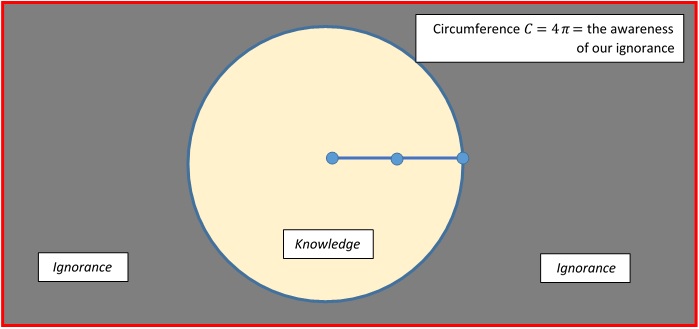
The area inside the circle represents all the knowledge that exists between all human beings on the earth. The area outside the circle represents our ignorance. Suppose the radius of the circle is 2 units. Then, the circumference will be C = 2 x (Pi) x (2) = 4 (Pi).
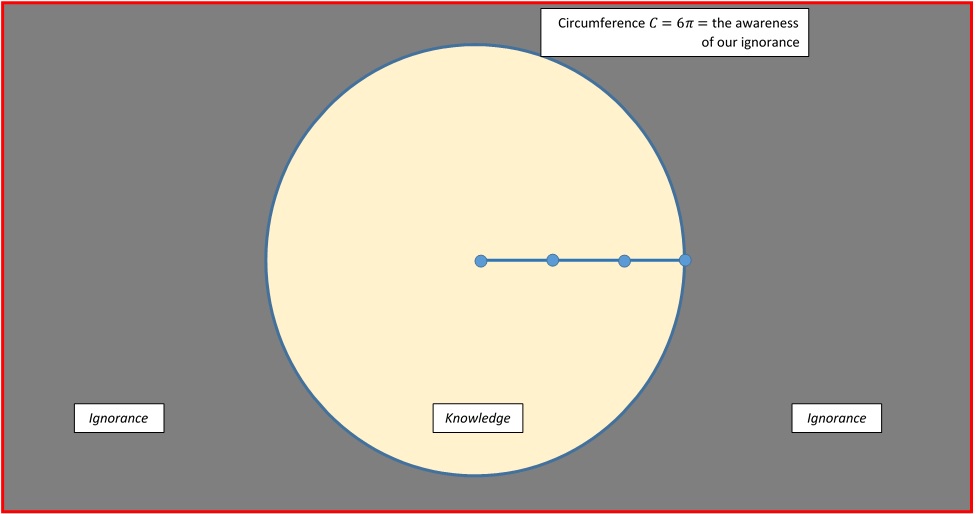
Suppose after some time, through research and learning, we acquire more knowledge. Then the area of the circle of knowledge increases. Now suppose this new circle has a radius of 3 units. Then, its circumference will be C = 2 x (Pi) x (3) = 6 (Pi).
Do you agree that 6 (Pi) is bigger than 4 (Pi)? What do you see? As our knowledge increases, the circumference of the circle of knowledge also increases. This is actually the awareness of our ignorance. Thus, the more we know, the more we are aware of our ignorance.
Student: This is wonderful. I never thought it that way. I figured we just know more and more every day so that one day we will know everything that we are supposed to know. But, it is not true.
Teacher: You know that tons of research papers are being published every day. If you look at a few scientific research papers more closely, you will find that they solve one problem, but create more questions or inquiries. It is good. It shows that the awareness of our ignorance is increasing with our increase in knowledge.
Student: I remember that the wise man Socrates said a similar thing. If someone claimed that he/she had some knowledge about any subject, then Socrates would start asking questions of that person until a point came when the person was forced to admit that he/she did not know the subject. I think Socrates’ intention was not to insult that person but to help him/her realize that there is a limit to one’s knowledge.
I also remember another thing about Socrates. He once said that some respectable person had been going around saying to others “Socrates is the wisest person around.”Socrates began to wonder why a respectable person would say such a thing. Socrates knew that many people knew more about many subjects than he did. But, upon pondering this more deeply, he realized that many people claimed that they knew more than they actually knew, while he himself was actually aware of what he knew and what he did not know.
From this, we can conclude that the sign of a wise person is that he/she is fully aware of what he/she knows and does not know.
Teacher: That is a very nice connection you made.
Student: But, I find it depressing to know that we are limited in our abilities such that we cannot know everything. It makes me feel helpless.
Teacher: Let me tell you a few important things the Upanishads teaches us about knowledge
The first point is from the Chhandogya Upanishad (7.1.1 – 3).

A great sage Narada went to another Sage and Teacher named Sanatkumar and told him, “I came to learn from you. Please guide me.”
Sanatkumar asked Narada, “Please tell me what you already know. After knowing it, I will have a better idea what I have to tell you.”
Narada said, “I know all the four Vedas, the Puranas, Grammar, Mathematics, Economics, Logic, Ethics, the Science of Archery, Astronomy, the Performing Arts, and much more. I know all these things, but I have not overcome my dissatisfaction and sorrows. I think to myself, ‘I am only Mantra-Vit (the Knower of the Mantras) and not Atma-Vit (the Knower of Atman).’ That is why I am not fully satisfied and happy within. I have heard that an Atma-Vit person has obtained complete satisfaction and experiences bliss within. So, please guide me in obtaining the Knowledge of Atman.”
So the Great Sage and Teacher, Sanatkumar, taught Narada the Knowledge of Atman.
There is another similar but more important teaching we find in the Mudaka Upanishad (1.1.3-5) about knowledge.
Once, Sage Shaunaka, who was the head of a large university, went to another great Sage, Angira, and respectfully asked him, “O Respectable Sage, what is it by knowing which everything is known?”
Sage Angira said, “The Knowers of Brahman say that there are two kinds of knowledge: The Inferior Knowledge (Apara Vidya) and The Superior Knowledge (Para Vidya). The Inferior Knowledge (Apara Vidya) includes, but is not limited to the knowledge of all four Vedas, Chanting, Rituals, Grammar, Poetry, the Planets and Stars, and others. The Superior Knowledge (Para Vidya) is the one by which the Imperishable Brahman is realized.”
Student: Wow! So, both the Upanishads say the same thing! I keep wondering again, and again, how, several thousand years ago, these great Rishis thought to attain the highest knowledge that a human being ought to attain?
Teacher: Yes, it is amazing. More importantly, these thoughts and the truths these Sages realized are not bound by time and space. As the laws of science are true in all countries, for all people and for all the time, these truths of the Upanishads, the Bhagavad Gita, and the Brahma Sutras are true for all people everywhere and for all of the time.
The Rishis tell us that the knowledge of worldly objects or materials is limited. The knowledge of “I,” the One who is inquiring, Pure Consciousness (Brahman), is most important. When we realize Brahman, our true divine identity, then we find that our life and the world become meaningful, and all our fundamental questions of life are answered. We acquire a clear understanding of ourselves and our relationship to others, attain fearlessness and fulfillment in life, and experience infinite bliss within. This does not depend on any object in the world.
Student: After knowing this, I wonder who would not want to try to realize one’s true divine identity. Thank you for sharing these wonderful eternal truths with me.
Teacher: My pleasure.
(Thanks to Sheela Krishnan and Ben Baker for editing this post.)

 mahendrajani