The Problem of a parishioner
The following post is based on a story I heard from Swami Adiswarananda, the Spiritual Leader of the Ramakrishna Vivekananda Center in New York from 1973 to 2007.
In a church, a father used to come with his 10-year-old son. They would come regularly and sit in the first row. The priest found that after five minutes of his sermon, the father would fall asleep until the end of the lecture. Sometimes the father used to snore a little bit and his snoring would wake him up. But, again he would fall asleep.

The priest thought to himself, how he could stop this father from falling asleep. He tried to change his voice pattern in the middle of his talk. Sometimes he raised his voice to heighten the emotions and sometimes he talked very softly when appealing for love for God. But, nothing worked. The father sometimes opened his eyes for a few seconds and again would go back to sleep.
Finally, the priest had a brilliant idea. After the sermon, when the father was deeply engaged in talking to few parishioners, the priest called the son to his side and told him, “This is a secret. It is only between us. Please do not tell your father. Next time when you come to the Church’s service, I will give you $1 if you wake your father up whenever he sleeps during my sermon.” The son was happy that the priest considered him to be special, and was happy at the prospect of getting a $1 each time he would come to church. He said, “Okay, I will do my best.” The priest gave him $1 in advance.
The following Sunday, the father and son came and sat in the first row. The sermon began and within a few minutes the father started sleeping. The priest looked at the son and the son politely elbowed the father. The father woke up. It happened three to four times. Then, the father felt bad and he tried to focus his mind on the sermon. After the sermon, the priest was very happy and found a moment when he slipped another $1 to the son.
This went on for some time. The priest was happy about his brilliant idea. Then, one Sunday, the same thing happened. The father and the son came, sat in the first row, and as soon as the sermon began, within a few minutes the father started sleeping. The priest looked at the son, but the son was not waking his father up. The son was totally ignoring the priest’s eye signals to wake his father up. Finally, the sermon was over. The priest found time to talk to the son and asked him why he didn’t wake his father up. The son replied that his father gave him $5 for not trying to wake him up! 🙂 🙂 🙂
———————————————————————————————
Reflection:
We find that students sleep in the classrooms and in libraries, people sleep while watching certain T.V. shows or listening to music, and most people sleep on a car, bus, train, plane, or boat journey. In the same way, many people sleep during prayers, sermons, spiritual talks or lectures. I think this is true for any religion and in every religious place of worship.
In one church, after the Sunday service, a lady went to the priest and said that he should not be offended by her husband who walked out in the middle of the service. She said that her husband has a habit of walking in his sleep. 🙂 🙂 🙂
I have found that many people who regularly attend prayers and spiritual discourses develop a habit of falling asleep at some point during the prayers, japa, meditation, and talks. If they do not completely fall asleep, at the very least their eyes start closing and then they have to try hard to keep themselves awake. It is understandable that due to a lack of sleep or being exhausted by the whole day’s intense work, people fall asleep. However, many times exhaustion is not the reason and sleeping actually becomes a habit. Initially, when people start doing japa, meditation, or listening to spiritual discourses, they are excited and remain active, but then something happens. After some time, they start developing this habit of sleeping during spiritual practices. Many times people feel that they have had a great meditation when in reality it is not due to spiritual upliftment but because of having deep sleep during meditation.
Swami Adiswarananda used to say that this sleeping habit during spiritual practices, technically known as ‘Laya,’ is a major obstacle in the spiritual path. When a person with a restless mind sits for regular spiritual practices, then he/she unknowingly develops a kind of ‘rut’ which takes the mind to sleep. During the spiritual practices whether it is a prayer, japa, meditation, reading scriptures, or listening to a spiritual discourse, the mind naturally gets quiet and for most people when the mind becomes quiet, it knows only one thing – to sleep. A sincere seeker of the Highest Truth or the Ultimate Reality has to be very careful about this obstacle. If we do not make conscious effort to stay away from this sleeping habit during spiritual practices, then we do not get any benefit from the practices and we would be wasting the most important resource of our life –time.
There are four states of our mind: Tamasika, Rajasika, Sattvika, and Turiya (beyond the three gunas).
In the Tamasika state of mind, the mind becomes lazy, wants to sleep and remain dull, and gets dominated by inertia and lethargy. It does not want to work or learn anything. There is no desire to achieve anything. It wants to remain in ignorance. There is a darker side of tamas, which is rajasika tamas in which the mind yields to harmful activities like hurting oneself and others.
In the Rajasika state of mind, the mind is filled with thousands of worldly desires. It wants millions of things to achieve and has millions of dreams. Such a mind is filled with ego, arrogance, selfishness, lust, greed, anger, jealousy, delusion, and hatred. It thinks about its own joy, happiness, and benefits and its mantra is ‘Me’, ‘Me’, and ‘Me.’ The sattvika-rajasika state of mind makes helpful plans, looks for one’s own inner development and engages in ideas to help all unselfishly.
In the Sattvika state of mind, the mind limits desires and activities to the most necessary ones. It thinks highly of virtues like truth, honesty, integrity, compassion, self-discipline, self-control, forgiveness, humility, love for all and others. It also makes efforts to practice these values. A mind in this state looks for knowledge, especially the knowledge of one’s true divine identity. It seeks peace within and without. It wants to serve all unselfishly.
In the Turiya (beyond the three gunas) state of the mind, the mind is in communion with the Ultimate Reality, the true divine identity of oneself. It realizes that there is One Brahman (Pure Consciousness) which has become everything. It is a state of Sat-Chit-Ananda (Existence-Knowledge-Bliss Absolute). In this state, the mind has no awareness of its own. It merges with the Ultimate Reality. The mind cannot remain in that state for a long time. In order to survive, it has to come down to the body-mind-level, to the awareness of an individual as a separate existence.
Through spiritual practices, one can control the tamas and rajas to the minimum-needed level, establish oneself in the sattvika state, and desire to go beyond the three gunas. When we develop a sleeping-habit during spiritual practices, we keep ourselves in the tamas state and never allow ourselves to rise to a higher level. Many times when a high-achieving person with the rajasika state of mind, starts doing spiritual practices, in the name of God he/she becomes a lazy, less productive and a low-achieving person. Spiritual practices should make us more efficient, productive, alert, sharp, self-controlled and joyful. They help one develop a clear understanding of oneself and others, and his/her dealings with others become more friendly and loving. Therefore, we have to watch out for this obstacle called ‘Laya’.
Main reasons for sleeping during spiritual practices:
(1) Lack of spiritual interest
(2) Lack of understanding of the importance of spiritual development
(3) Craving for worldly desires and thinking that worldly objects give us real happiness
(4) Engaging in too many worldly activities which make the body and mind exhausted
(5) Getting into a rut (Laya)
(6) Not acquiring inspiration from spiritual practices
(7) Not experiencing any bliss
What to do?
(1 – 2 – 3): When we do not understand the importance of spiritual development, then we do not develop spiritual interest. Sages and saints have realized that everyone sooner or later is going to realize the importance of spiritual development in life. The world is made in such a way that it eventually makes us think, “What is the goal of our life?”.
The world presents various goals in front of us: Is money-making our goal of life? Is it collecting name and fame? Is it experiencing the maximum intellectual pleasure and/or bodily-pleasures? Is it acquiring any worldly achievement? Is it in making a family? People in the past, as will be the case in the future, have learned, from various experiences of the world, that none of these worldly goals give us longer lasting happiness, a sense of security, fearlessness, a sense of fulfilment in life, a deeper understanding of ourselves and others, and love for all. Sages and saints have realized that only in realizing our true identity as a divine being, do we attain everything we are seeking in life. When we understand this, then and then only will we develop genuine spiritual interest in our life. We have to realize that worldly joy is limited. We pay a high price for worldly joy, and ultimately we find that in seeking this joy, our sufferings increase a thousand fold.
(4) When the importance of spiritual development is realized and our spiritual interest develops, then automatically our useless worldly activities become reduced.
(5) During our spiritual practices we have to keep an eye on ourselves so that we do not fall into a ‘rut’ and instead let our mind remain focused on what we are doing. If we are doing japa or meditation, then our mind should feel the presence of our chosen form of God or our true divine identity (Atman). If we are reading a spiritual book, then we have to try to grasp the essence of the content of the book and try to learn ideas or practices that help us in our spiritual development. If we are doing prayer, then we can should keep our mind on the meaning of the prayer and try to feel the presence of the one to whom we are praying.
Sometimes, people think that the same prayer may develop a ‘rut’, so they keep changing the prayer. But, this is not a good idea. Swami Adiswarananda said, “If you want to enjoy the (spiritual) fruits, then take care of the (spiritual) roots.” If we keep one prayer, one mantra, and one chosen form of God, then we develop spiritual roots. Sri Ramakrishna said that if we keep digging a little bit at lots of places in the earth, we do not get water. To get water, first we consult experts, find a possible place from where we can get water, and then keep digging until water comes. Every now and then we may consult our progress with the experts. Similarly, in our spiritual path, we have to keep doing our regular spiritual practices until we get the results.
(6 – 7) After doing spiritual practices regularly and sincerely for a while with love and avoiding slackness, by God’s grace a time comes when we start deriving inspiration from our spiritual practices. It may not happen every time, but many times after our spiritual practice, we acquire new thoughts, new ideas, and new directions for improvement. We become clear about our strengths and weaknesses, and ways to overcome our obstacles. I have been reading the Gospel of Sri Ramakrishna from my childhood, but still many times the teachings become clearer and sometimes I feel ‘why didn’t I notice this wonderful or helpful thought before?’ This is because our state of mind changes due to more experiences or change in our life.
At some point we all wish, by the grace of God, to experience the divine bliss. Sages and saints say that once we experience this bliss, then we will not want to deviate from our spiritual path and will continue to work hard until we reach our spiritual goal – the realization of our true divine identity (Atman) and to do selfless service.
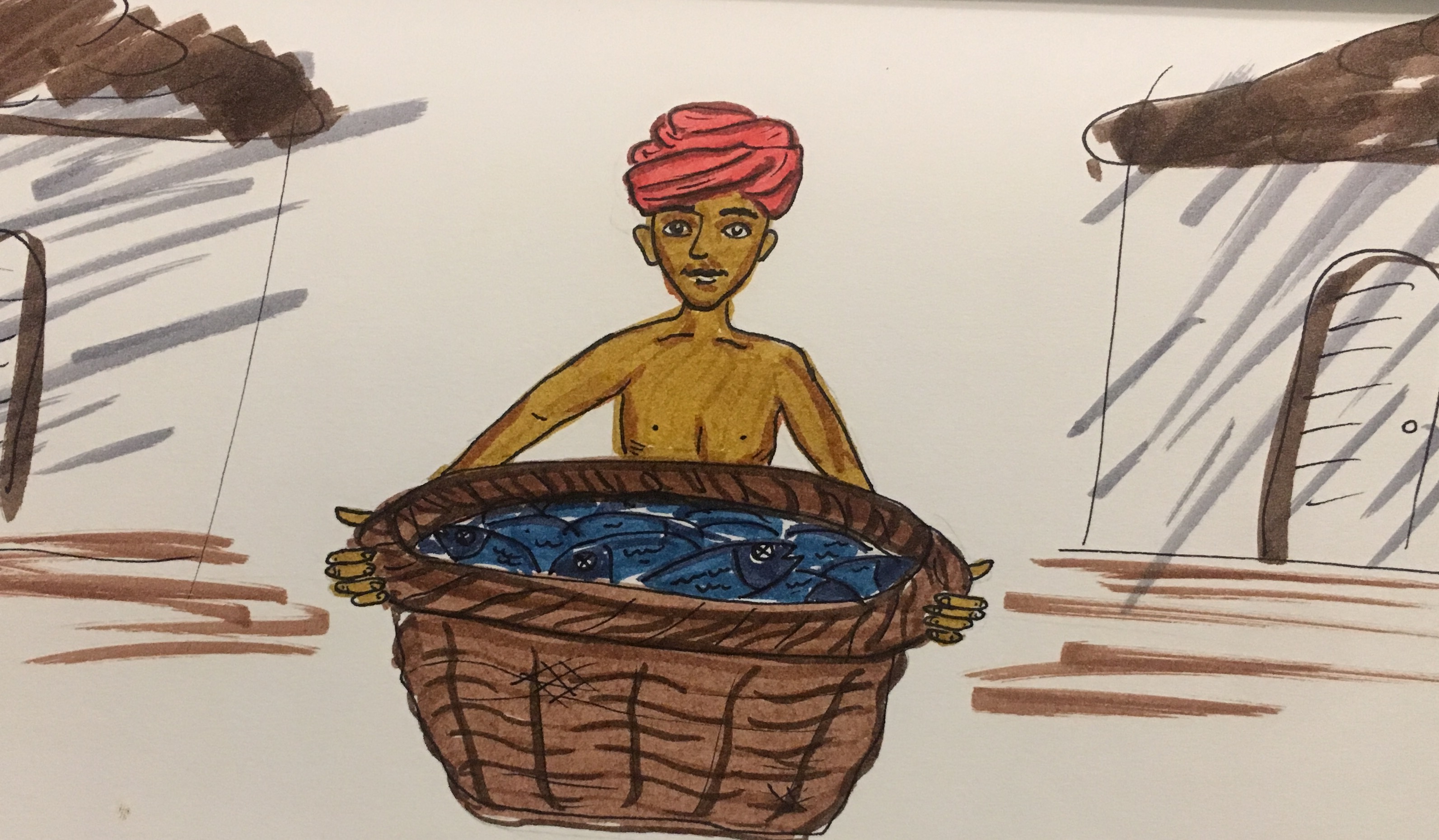
(Thanks to Nisha Parikh for editing this post and Arundhati Johri for the illustration.)







 mahendrajani