Monthly Archives: December 2013

“The Magic Flute”

Christmas break is an occasion when family members can spend time together.  Most of the people are off from their work or schools.  During that time New York City offers great shows to entertain families. We enjoyed “The Magic Flute,” a famous opera by the great musician Mozart at the Metropolitan Opera in New York.  We, along with our son, daughter-in-law and two young grand-daughters had a great time.

The Magic Flute-1
Papageno, the bird-catcher

Even though this was an abridged kids-friendly version of 100-minutes opera, the music, the performance, the dialogues, the dances, the costumes, and the stage settings were superb and most enjoyable.  Who was Mozart?

Wolfgang Amadeus Mozart (1756 – 1791) lived only for 35 years, but he was a prolific and influential composer of the Western Classical Music.  Within a short span of his life he composed over 600 works, many acknowledged as pinnacles of symphonic, concert-ante, chamber, operatic, and choral music.  The famous musician Beethoven composed his early works in the shadow of Mozart.  Another great musician Joseph Haydn wrote about Mozart that “posterity will not see such a talent again in 100 years.”   Haydon wrote to Mozart’s father in 1785, “I tell you before God, and as an honest man, your son is the greatest composer known to me by person and repute, he has taste and what is more the greatest skill in composition.”

Mozart
Wolfgang Amadeus Mozart

Mozart showed prodigious ability from his earliest childhood.  He composed at the age of 5 and he performed his composition before European royalty.  At the age of 17 he was a court musician in Salzburg.  During his final years in Vienna, he composed many of his best-known symphonies, concertos, and operas.

The Magic Flute:  Mozart experienced great satisfaction in the public success of some of his work.  “The Magic Flute” opera is one of these works which was performed several times between its premiere (September 30, 1791) and his death (December 5, 1791).  Mozart conducted the premiere of “The Magic Flute.”  This opera is in a popular form (called Singspiel) that includes both singing and spoken dialogue.

On the reception of the opera, Mozart scholar Maynard Solomon Write, “Although there were no previews of the performances, it was immediately evident that Mozart and Schikaneder (the main actor in the premier and followed up performances) had achieved a great success, the opera drawing immense crowds and reaching hundreds of performances during 1790s.”  The opera celebrated its 100th performance in November 1792, but unfortunately Mozart did not live long enough to witness it.  An expert says that since its premiere “The Magic Flute” has always been one of the most beloved works in the operatic repertoire and is presently the fourth most frequently performed opera worldwide.

The Magic Flute-2
The entrance of the Metropolitan Opera
The Magic Flute-3
Looking outside from the Metropolitan Opera – Decorated Christmas Tree & Chandelier

The plot of “The Magic Flute”:   The story takes place in a mythical land between the sun and the moon.  The Queen of the Night sends a handsome prince Tamino to free her daughter Pamina who was enslaved by the king Sarastro.  A bird-catcher Papageno accompanies Tamino.  Three ladies, helpers of the Queen, give a magic flute to Tamino and silver bells to Papageno to ensure their safety on the journey.

They encounter Sarastro’s slave Monostatos who wanted to marry Pamina.  The magic flute and the siver bells help Tamino and Papageno in several critical life-threatening occasions.  Sarastro punishes Monostatos and tells Pamina that he will eventually set her free.  Sarastro tells Pamina that he is only wishing her happiness and he does not want to return her to her mother who is a proud, headstrong woman, and a bad influence in the society.

Tamino learns from the priests of the temple of Sarastro that the Queen of the Night is evil and not Sarastro.   Actually, Sarastro wanted Tamino to go through “the trials of wisdom” to become a worthy husband of Pamina and wanted the couple (Tamino & Pamina) to eventually take over from him as rulers of the temple.  The priests test Tamino and Papageno.  Tamino takes the challenges of the trials and proves that he can control his senses and his mind, he is fearless, and he wants wisdom and unselfish love.  Papageno reluctantly accepts the trials but fails to control his mind and senses.

The priests congratulate Tamino for successfully passing the tests.  Meanwhile the Queen of the Night attacks Sarastro, but she gets defeated.  Sarastro does not believe in revenge and he pardens the Queen.  At the end, Sarastro announces the sun’s triumph over the night.  Everyone praises the courage, self-control, patience, fearlessness, and wisdom of Tamino and Pamina and ask goddess Isis and god Osiris to bless this couple.

Note:  The huge Metropolitan Opera House of New York was full.  There was not a single dull moment in the performance.  Several Papageno’s dialogues were hilarious.  Singing was enchanting.  One can read the words of the singing and the dialogues in the small screen set at the back of the front seat.

The Magic Flute-4
Inside the Metropolitan Opera – the sold-out show

Opera singers’ range of singing and the swiftness were amazing, especially the singing and the pitch range of the Queen of the Night.  It seems she had swallowed piano!  The Queen of the Night’s song “The vengeance of Hell boils in my heart” reaches a high F6 and at the low end, the part of Sarastro includes a conspicuous F in few locations.

Striking points of “The Magic Flute”:

The following are few thoughts which came to my mind while watching the performance of “The Magic Flute.”

1.  The story of “The Magic Flute” portrays the education of mankind, going from religious superstition to rationalistic enlightenment.  The ultimate goal is to make “the Earth a heavenly kingdom and mortals like the gods.”  This is a couplet in a song.  Swami Vivekananda used to say that each person has to be divine.  When a person realizes one’s divinity and expresses it in one’s speech and actions, then the kingdom of heaven comes on the earth for him/her.

2.  We find that virtues and virtuous people are important all over the world at all times.  The priests’ testing of Tamino’s patience, love for wisdom, self-control, and fearlessness emphasizes the importance of virtues needed to be a worthy person and a leader.

3.  Tamino represents an ideal of a human being.  While Papageno represents a common man.  Papageno was reluctant to go through the “trials of wisdom.”  When he was asked, “Don’t you want wisdom?, he said, “I am a simple man.  I just want food, water, wine and wife.”  Papageno could not control himself.  He broke all the vows.  Having him on the side, Tamino’s character shined more.  Papageno showed that the trials were not easy.  One who succeeds has much stronger mind and a divine power.

4.  Personally, the magic flute of Tamino reminded me of Lord Shri Krishna playing his flute. With his flute all people and animals around him used to get charmed.  Simultaneously, the silver bells reminded me of Shri Radha.  The bells of her anklets used to bring joy and happiness around.

5.  Music really calms down the mind.  It even changes the mind of evil people and ferocious animals.  Music brings happiness and hope in life.

6.  The light of the sun is considered the wisdom.  In the last scene, due to the light effects and stage-setting you can feel that the sun is shining brightly in the auditorium and illumines everything.  In Bhagavad Gita, Shri Krishna says that, “As the sun illumines the whole world, the Soul (Atman) illumines the whole body and the mind of a person.”  (Gita 13.33).  Similarly, Brahman, the Source of Life, illumines everything in the universe.

7.  I realize the greatness of Mozart.  Shri Krishna says in Bhagavad Gita, “Whatever is glorious or beautiful or wherever a mighty being exists, know that it has sprung from but a spark of My (God’s) splendor.”  (Gita 10.41).  God’s power manifests more through great personalities.

Merry Christmas & Happy New Year

Merry Christmas and Happy New Year to all of you!

Because of Christ we have Christmas.  Over the Christmas, we easily get carried away into buying and giving gifts, decorating houses, having parties and other fun and not remembering Jesus Christ’s life and teachings.  We have to remind ourselves that Jesus Christ gave us his life for what he believed in.  He taught to be humble, to give, to sacrifice and live a simple life, not to run after money, to love and serve all and many other things.

300px-Gerard_van_Honthorst_001
“Adoration of the Shepherds” by Gerard van Honthorst 1622.

Sri Ramakrishna had a vision of Jesus Christ.  After sincerely practicing various religions and branches of Hindu faith he realized that all religions and sects are different paths leading to the same God.  All prophets teach the same fundamental things of life which are good for humanity.  Their styles and language might be different, but the message is the same.  For example, no religion teaches that a person who hates all is good, a person who is a lire or a cheater is good, a person who is egotistic or arrogant is good etc.

 On this day, let me share the teachings of Jesus Christ which I like most.  These are part of “The Sermon on the Mount,” which we find in the Gospel of Matthew, chapters 5 – 7. The students of Vedanta find these teachings very familiar.

Who will see God?  Who are beloved of God?  Now when Jesus saw the crowds, he went up on a mountainside and sat down. His disciples came to him, and he began to teach them.

“Blessed are the poor in spirit, for theirs is the kingdom of heaven.

Blessed are those who mourn, for they will be comforted.
Blessed are the meek, for they will inherit the earth.
Blessed are those who hunger and thirst for righteousness, for they will be filled.
Blessed are the merciful, for they will be shown mercy.
Blessed are the pure in heart, for they will see God.

Blessed are the peacemakers, for they will be called children of God.

Blessed are those who are persecuted because of righteousness, for theirs is the kingdom of heaven.”

Resist evil with love and not by vengeance:  Usually, people want to take revenge.  But, prophets do not teach that.  Mahatma Gandhi said that an eye for an eye makes the whole world blind.  People who love humanity and who have inner strength resist evil with love.  The path of vengeance is for the weak people.

Jesus Christ says, “You have heard that it was said, ‘Eye for eye, and tooth for tooth. But I tell you, do not resist an evil person. If anyone slaps you on the right cheek, turn to them the other cheek also.  And if anyone wants to sue you and take your shirt, hand over your coat as well.  If anyone forces you to go one mile, go with them two miles.  Give to the one who asks you, and do not turn away from the one who wants to borrow from you.”

Depend on God and do Spiritual Practices; then we will succeed:  We should have faith in God and do our spiritual practice.  God is our father and mother and He/She will fulfill all our desires.

Jesus Christ says, “Ask and it will be given to you; seek and you will find; knock and the door will be opened to you.  For everyone who asks receives; the one who seeks finds; and to the one who knocks, the door will be opened.

“Which of you, if your son asks for bread, will give him a stone?  Or if he asks for a fish, will give him a snake?  If you, then, though you are evil, know how to give good gifts to your children, how much more will your Father in heaven give good gifts to those who ask him!  So in everything, do to others what you would have them do to you, for this sums up the Law and the Prophets.”

Do not find faults of others.  Find first our own faults and remove them: Remember Holy Mother’s teaching of not finding faults of others.

Jesus Christ says, “Do not judge, or you too will be judged.  For in the same way you judge others, you will be judged, and with the measure you use, it will be measured to you.

 “Why do you look at the speck of sawdust in your brother’s eye and pay no attention to the plank in your own eye?How can you say to your brother, ‘Let me take the speck out of your eye,’ when all the time there is a plank in your own eye? You hypocrite, first take the plank out of your own eye, and then you will see clearly to remove the speck from your brother’s eye.”

How to pray?  Bhagavad Gita says that genuine devotees pray to God quietly without making any show, mediocre people pray to gain worldly pleasures, name and fame, and inferior people pray whimsically without knowing what they are doing and what they are doing.

Jesus Christ says, “And when you pray, do not be like the hypocrites, for they love to pray standing in the synagogues and on the street corners to be seen by others. Truly I tell you, they have received their reward in full.  But when you pray, go into your room, close the door and pray to your Father, who is unseen. Then your Father, who sees what is done in secret, will reward you.  And when you pray, do not keep on babbling like pagans, for they think they will be heard because of their many words.  Do not be like them, for your Father knows what you need before you ask him.”

There are other inspiring teachings of Jesus Christ about controlling lust and greed, giving to the needy not for name and fame, building life on a good character like building house on a rock and others.

 Happy New Year to all of you! 

Happy New Year
All the best wishes for Year 2014

For the New Year I am thinking of the following possible spiritual resolutions:

1.  Do japa and meditation regularly every day at a fixed time.

2.  Read inspiring books to get guidance, to intensify our desire to make spiritual progress and to remove our doubts

3.  Select one virtue from the shlokas 13-19, chapter-12 of Bhagavad Gita and practice to acquire it.

4.  Try to memorize chapters of Bhagavad Gita.  Learn, practice, and sing dhoons, bhajans and hymns to increase love for God

5.   Do some unselfish service to purify the mind.

6.  Seek Holy Company to strengthen the spiritual motivation and faith in God.


Happy 160th Birth Anniversary of Holy Mother Sri Sarada Devi

Holy Mother 002
Holy Mother Sri Sarada Devi

According to Hindu Moon Calendar Holy Mother Sri Sarada Devi’s birthday is on December 24, 2013.  On this day, all over the world devotees of Holy Mother are offering special worship to her and thinking about her life and teachings.

Holy Mother Sri Sarada Devi was born on December 22, 1853 in a village called Jayrambati, Bengal, India.  Her father Ramachandra Mukherjee and mother Shyamasubdari Devi were very simple and pious people.  They both were kind, loving, and eager to serve people who were in need.  Little Sarada was very active and helping her family in various choirs.

She got married to Sri Ramakrishna.  Since Sarada was young, she was staying with her parents and was waiting to join her husband at a proper age.  Later on when rumors spread that Sri Ramakrishna has become insane,  Sarada decided to go to see her husband in Kolkata  and to be with him.  After going to Kolkata, she found out that her husband was not insane, but he was a saint.  When Sri Ramakrishna asked her whether she came to drag him down to the world or to support him in his spiritual path, Sarada Devi said that she came to help him.  Sarada Devi learned everything about spirituality from Sri Ramakrishna and started doing spiritual practice herself.  She had visions of God.  She used to say that she could see God at her wish as one see an apple in one’s hand.

On the auspicious day for worship of Universal Mother, June 5, 1872, Sri Ramakrishna asked Sarada Devi to take a seat at the altar prepared for the worship.  Sarada Devi was very shy, but at that time in the intense spiritual environment she followed what Sri Ramakrishna asked her to do.  She sat on the altar and Sri Ramakrishna worshiped her as a Universal Mother.  Thus, he raised the spiritual consciousness of Sarada Devi, invoked the Universal Motherhood in her, and gave the highest honor to womanhood.  Sri Sarada Devi showed from her life that a person born in a small village, deprived of education, living in a small room for years, and fulfilling one’s responsibilities could become a great inspiring person.  Holy Mother Sri Sarada Devi inspired millions of devotees during her lifetime and afterwards.

Holy Mother 005
Holy Mother – The Universal Mother

Swami Vivekananda wrote to his brother disciple Swami Shivananda regarding Holy Mother Sri Sarada Devi in a letter from USA in 1894, “You have not yet understood the wonderful significance of Mother’s life — none of you.  But gradually you will know.  Without Shakti (Power) there is no regeneration for the world.  Why is it that our country is the weakest and the most backward of all countries?– because Shakti is held in dishonor there.  Mother has been born to revive that wonderful Shakti in India; and making her the nucleus, once more will Gargis and Maitreyis be born into the world.  Dear brother, you understand little now, but by degrees you will come to know it all.  Hence it is her Math that I want first. . . . Without the grace of Shakti nothing is to be accomplished.  What do I find in America and Europe?– the worship of Shakti, the worship of Power.  Yet they worship Her ignorantly through sense – gratification.  Imagine, then, what a lot of good they will achieve who will worship Her with all purity, in a Sattvika spirit, looking upon Her as their mother!  I am coming to understand things clearer every day, my insight is opening out more and more.  Hence we must first build a Math for Mother.  First Mother and Mother’s daughters, then Father and Father’s sons — can you understand this? . . . To me, Mother’s grace is a hundred thousand times more valuable than Father’s.  Mother’s grace, Mother’s blessings are all paramount to me. . . . Please pardon me. I am a little bigoted there, as regards Mother.  If but Mother orders, her demons can work anything.  Brother, before proceeding to America I wrote to Mother to bless me.  Her blessings came, and at one bound I cleared the ocean.

Upanishads and Bhagavad Gita says that when one attains same-sighted-ness, meaning one sees same God in all and serve them with love, then one has attained the highest knowledge.  We see how naturally this was happening in Holy Mother’s life.  Once when Holy Mother’s niece Nalini was serving lunch to a Muslim bandit Amjad by throwing food from a distance Holy Mother was upset.  She told Nalini that how one can enjoy food when it is thrown from a distance.  Holy Mother served Amjad with great love and then cleaned his plate.  Nalini shrieked, “Aunt, you have lost your caste!”  Holy Mother said, “As Sarat (Swami Saradananda) is my son, exactly so is Amjad.”  It is amazing to see that Holy Mother has surpassed all the differences of castes, countries, religions, and high or low.  For her all were her children.  She loved all equally.

Holy Mother’s teachings were very practical.  She emphasized that japa is a very important spiritual practice.  She said that as the clock is continuously ticking one should continuously repeat God’s name.  Japa purifies the mind.  She herself was doing japa for many hours.  She said that if one does japa regularly at a fixed time for few years  then definitely one makes spiritual progress.

HolyMoterBiography
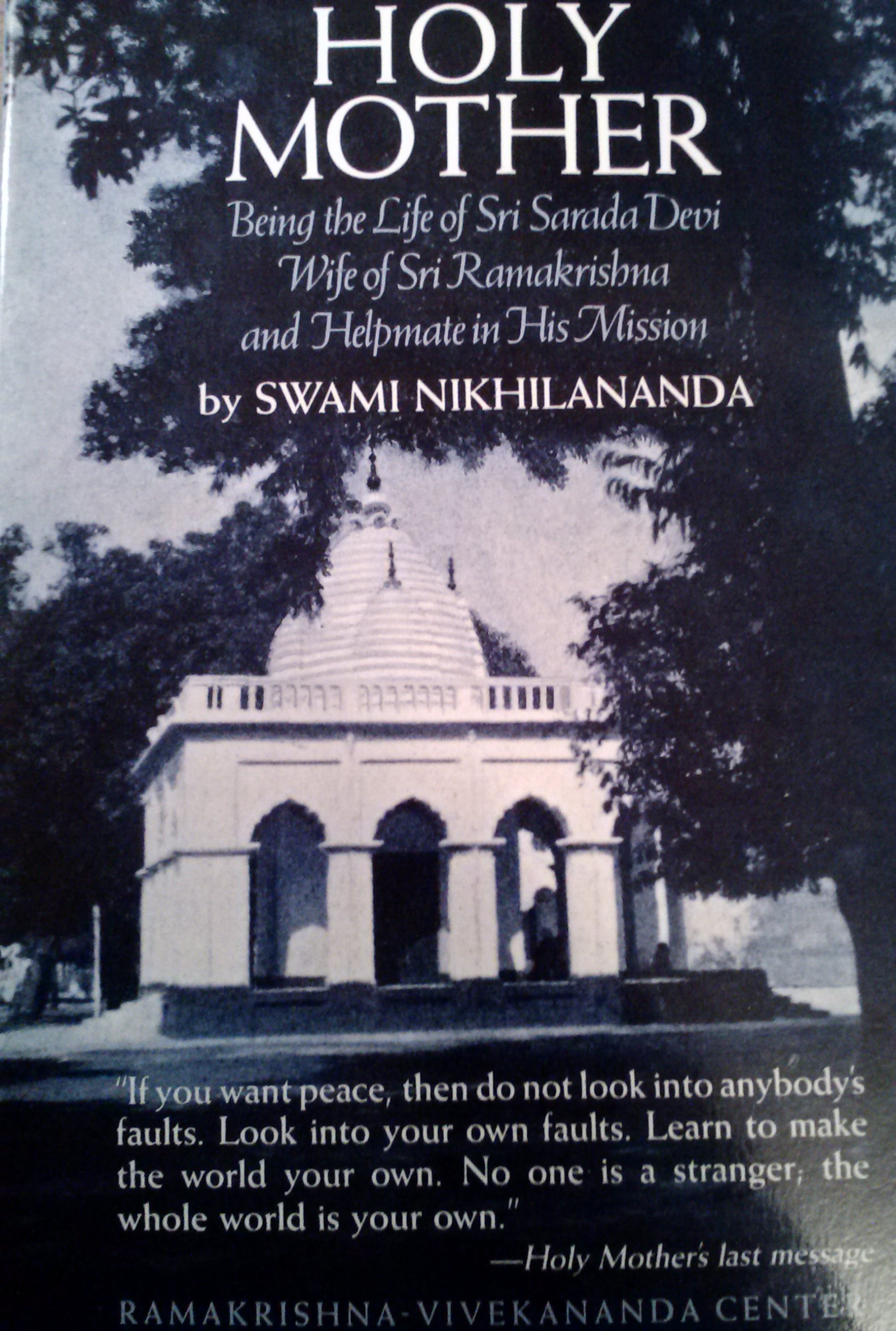
Holy Mother’s Biography – Swami Nikhilananda

Swami Nikhilananda who was blessed by Holy Mother in person and who was the spiritual head of Ramakrishna Vivekananda Center, New York, USA, during 1933-1973 wrote an excellent biography of Holy Mother.  On the cover page of this biography he selected the following teaching of Holy Mother:

If you want peace, then do not look into anybody’s faults.  Look into your own faults.  Learn to make whole world your own.  No one is a stranger; the whole world is your own.                                                                                                                           – Holy Mother’s last message.

This is a simple but a profound message.  Fault-finding causes all the problems and pain in our life.  I think a person finds others’ faults to satisfy one’s own ego.  This way one thinks that he/she is superior to others.  It ultimately harms the fault-finder.  A person with fault-finding nature tries to cover one’s own faults and does not let him/her to improve.  When we look into ourselves, we will find many faults in us.  If we are sincere about our spiritual development, then we find our faults and try to get read of them.   Swami Vivekananda says that we see outside whatever we have inside.  We see jealousy in others because we have jealousy in our own mind.  Similarly it is true for other weaknesses.  When our mind is filled with divinity, then we will see divinity in others.  When we see God within us, then we see God in all.  Then the whole world becomes our own.

Happy Gita Jayanti – 2013

“When doubts haunt me, when disappointments stare me in the face, and I see not one ray of hope on the horizon, I turn to Bhagavad-Gita and find a verse to comfort me; and I immediately begin to smile in the midst of overwhelming sorrow. Those who meditate on the Gita will derive fresh joy and new meanings from it every day”  – Mahatma Gandhi  

Image
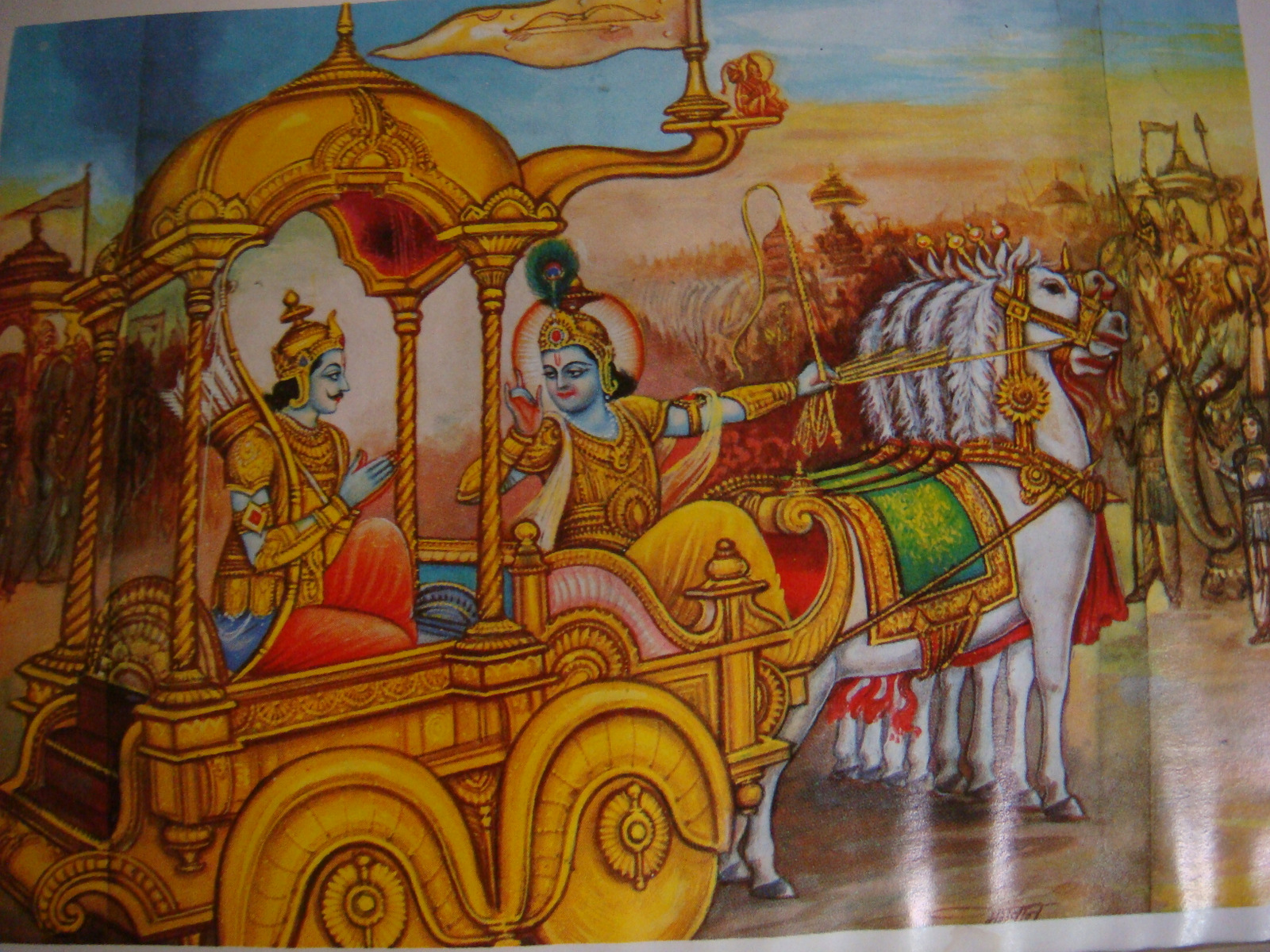
Shri Krishna & Arjuna
Image
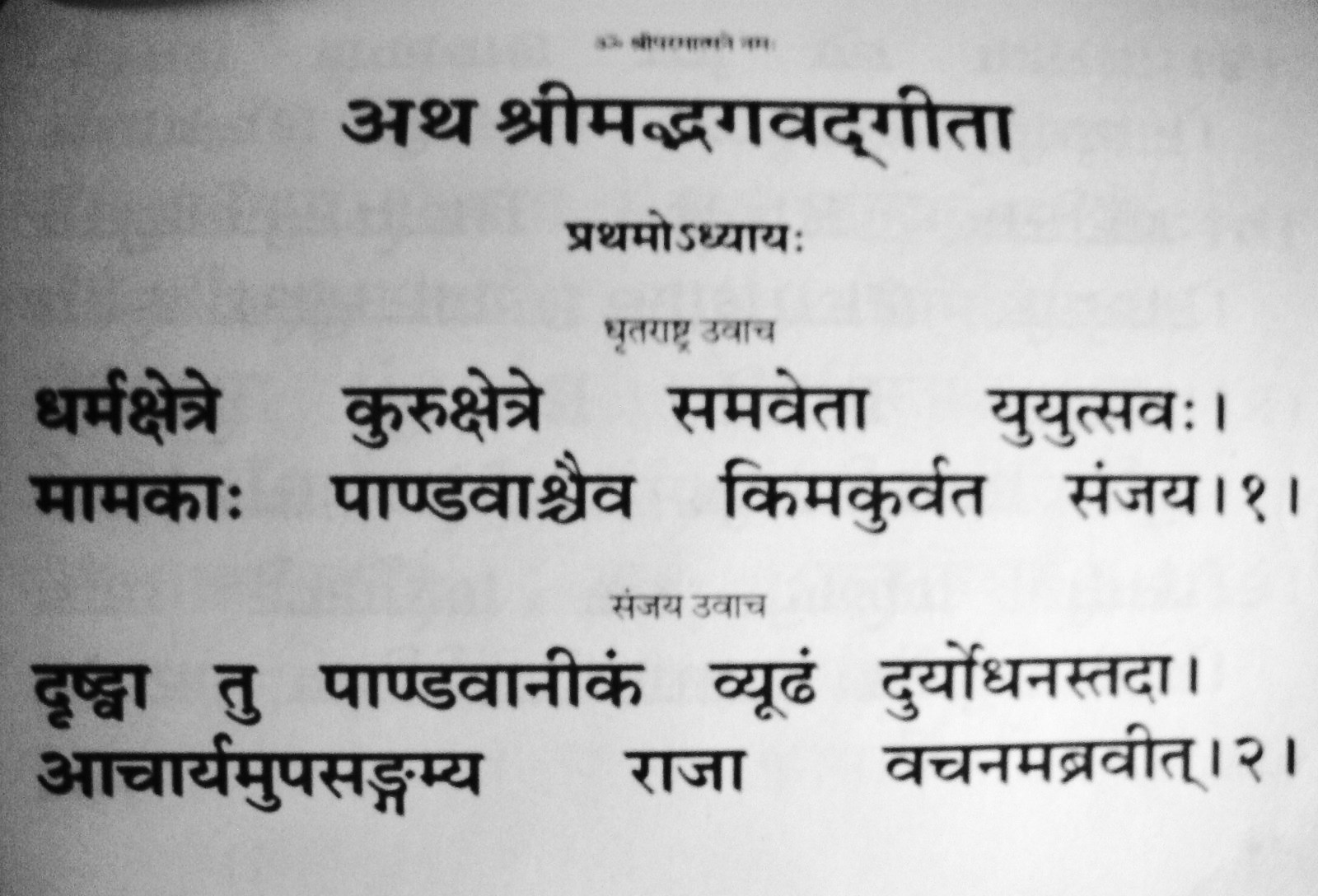
……………Beginning of Bhagavad Gita………..

This year, on December 13th, all over the world devotees and lovers of Bhagavad Gita are celebrating Gita Jayanti by reciting its 700 verses or couple of chapters and/or thinking about their meaning.  For intellectuals Bhagavad Gita is a wonderful book.  For devotees these are the words of Lord Shri Krishna.  Bhagavad Gita had inspired innumerable Saints, Sages, Spiritual teachers, Scholars, Great leaders, and common people who are struggling to live a decent life.

There are innumerable commentaries, books, and articles written on Bhagavad Gita.  Many spiritual teachers and scholars have lived their entire lives talking and elaborating the meanings of the verses of Bhagavad Gita.

At Vivekananda Vidyapith, on December 7th we recited all the eighteen chapters of Bhagavad Gita.   Many verses or shlokas appealed to my mind while reciting them.  It was an uplifting experience.  We cannot agree any more with Sanjay who told at the end of the Bhagavad Gita, “I heard this wonderful dialogue between Shri Krishna and Arjuna which created goose bumps due to excessive joy.  As I remember this amazing dialogue again and again an upsurge of bliss fills my heart.”

Bhagavad Gita is an ocean of wisdom.  Even taking a little of its water in our palms and drinking it makes our life blessed.  Meaning that taking even one of Bhagavad Gita’s teachings and practicing it in our life makes our life happy and it fills our heart with satisfaction of living a good life.

I will share one thought which overpowered many other thoughts about the teachings of Bhagavad Gita.  We love God and we want God to love us.  A question comes: what kind of a person should we become so that God loves us?

It is amazing that Shri Krishna himself describes who is most beloved to God.  More amazing is that He did NOT say, one who goes to temples every day, or performs rituals or offers various things to Me or spend hours in singing and meditating on Me or does any external practice is My most beloved!  It is not that these practices are not good.  But, from Shri Krishna’s answer it seems that these things are not sufficient.  Shri Krishna describes the qualities of His most beloved devotee in shlokas Gita 12.13 – 12.19.  After spiritual practices these qualities must manifest from the devotees.  The following are few of these qualities:

(Note:  Swami Vivekananda liked these qualities so much that he included an English translation of these shlokas into his lectures on Raja Yoga.)       

– One who hates none:  Very first quality is not to hate anyone!  Why?  When we hate a person or an object, then we give that person or an object a special place in our mind.  Giving a part of our mind to that person or an object, we block our mind to think something beneficial to us.

– Who is a friend of all:  As a result of our spiritual practices unselfish love for all should develop naturally.

– Compassionate towards all:  One who understands sufferings and pain of others and does whatever he/she can to remove or ease them.

– Devoid of possessiveness:  One who understands that we did not bring anything in this world when we were born and we will not be able to take anything from this world when we die.   A devotee has  a firm conviction that everything belongs to God and we are just care-takers.

– Egoless:  Ego blocks Reality and contaminates it.  With ego, I see the world only from ‘my point of view’ and not from the ‘others point of view.’  I see my big mistake as a small one and another’s small mistake as a big one.  As true knowledge comes, then ego reduces and humility develops.

– A person’s mind is balanced in joys and sorrows:  There are many examples in which people have lost their heads when they were happy and have committed harmful mistakes.  Also, people fall apart in sorrows.  A devotee remains balanced in joys and sorrows.  When happiness comes, a devotee thanks God for giving happiness and keeps mind alert for not getting carried away.  When sorrows come a devotee clings to God to go through the painful time.

– Forgiving:  A devotee has a big heart and forgives others for their mistakes and misbehavior.  He/she thinks that he/she makes mistakes and so do others.  Also, people misbehave because of ignorance.  Keeping grudge against someone develops hatred which is not good.

– Satisfied:  A devotee works hard to fulfill one’s responsibilities and remain satisfied with whatever he/she gets as rewards (God’s prasad).

– Ever devoted to Yoga:  For a devotee the spiritual practice is a 24-365(6) commitment.  One who wants to attain spiritual goal has to integrate all activities which leads one towards that goal.

– Posses Self-control:  For spiritual progress one has to slowly develop self-control.   Upanishads and Bhagavad Gita ask us to control senses by mind, the mind by pure intellect and the pure intellect by Atman (Self).  One cannot have spiritual progress without self-control.

– Determined:  Many worldly things deviates a devotee from the spiritual path.  One needs a strong determination to stick to the spiritual path and make spiritual progress.

Gives mind and intellect to God:  Swami Vivekananda says that both head and heart are needed in spiritual path.  We have to engage intellect to think about the goal, the path, the obstacles and ways to remove the obstacles.  Also, through various practices one has to develop love for God, like singing hymns, bhajans, dhoons, reading inspiring books and biographies, holy company etc.

– One who does not become a cause of suffering:  A devotee is careful not to create any problem to other people.  He/she lives cautiously.  Sometimes people out of ego or jealousy think that a devotee is a problem, but a devotee has no intention to create any problem.

– One who is not disturbed by the others:  Because of lack of hatred, being a friend of all, and having a forgiving nature a devotee does not get disturbed by people’s behavior.  A devotee learns how to work lovingly with others.

– Free from fear and anxieties:  A devotee thinks that God has created me and takes care of me.  With that attitude he/she is free from fear and anxieties just as a child is free from them having parents around.

– Have no expectations from others:   A devotee is completely dependent on God.  He/she lives in the world having no expectations from anyone.  He/she tries to give more than receives.   If a person  cannot give something in return, then one does sincere prayers for the good of the people from whom one has to receive something.

– Pure:  Shri Ramakrishna said that pure mind, pure intellect and Atman (Self) are same.  Through pure mind Atman reflects from within.  A devotee is always working hard to remove impurities from one’s mind.

– Skillful:  Shri Ramakrishna said that a devotee is not a dumb person.  He/she skillfully performs every action.  A devotee puts one’s full mind and heart into every action. Even if the action is small, he/she tries to do it in a perfect possible way.  Saints say that if you want to know how a person’s meditation is then see how he/she performs small actions.

– Unbiased:  A devotee does not take a side.  He/she looks a situation from all sides.  He/she does not try to cover a friend’s mistake or a wrong-doing and never fails to admire a good thing of any person, friend or a foe.

– Never initiates any action with worldly desire:  A devotee’s attitude is “Seek not, avoid not.”  He/she takes care of whatever responsibilities come to him/her with full mind and heart.  He/she knows that there is no need to add more work which he/she does not have to do it.  This way he/she has time and energy to do spiritual practices.

– Even minded in honors and insults:  A devotee has Self-dignity, but his/her mind does not get disturbed by the external honors and insults given by people.   He/she knows that one who honors now may insults him/her later and vice a versa.  Many times people honor because of the fulfillment of their selfish desires and insults when they are not fulfilled.  In a football, cricket or any game people cheer a player when he/she does good and boo the same player later when he/she does not do good.  Lord Buddha said that when a person insults you and if you do not take it then it remains with the person.  A devotee offers praises to God thinking that God gave good qualities which were praised.  When someone insults, then a devotee thinks ‘do I have to learn something from this, then learn it, and if there is nothing to learn from it then simply drop it.’

– Detached:  Detached means attached to God.  If we think that ‘everything belongs to God and I am only a care-taker’ then real detachment comes.  Detachment does not mean a person becomes rough or heartless or careless.  It is completely opposite.  A detached person has true love for all and cares for all thinking that he/she is taking care of God’s children and God’s things.

– Has Steady Intellect:  The characteristics of a person with steady intellect have been defined at the end of Bhagavad Gita chapter 2.  Mahatma Gandhi loved these qualities.  A devotee cannot be whimsical.  His/her mind and intellect are steady.  He/she has a fixed spiritual goal and does everything to reach that goal.  His/her character is very strong and does not change by the whims of the mind.

– Whose home is the whole world:  For a devotee the whole world is God’s.  Thus he/she is content wherever he/she resides.  He/she is always with God.

Wow!  So many qualities!  I am sure each one of us thinks that it is not possible to have all these qualities.  Thus, it is not possible to become a God’s beloved devotee.  Well, many did become God’s beloved devotees.  Why should I think that I cannot?  Little children go to KG.  It is very difficult to imagine looking at them that few years later one of them becomes a professor, a writer, a musician, a medical doctor, an engineer, a pilot, a scientist, or a responsible person in the society.  Similarly, if we work for these qualities properly, then we may acquire them to some extent.

One more important point is that these qualities are inter-connected.  If we take one quality and start practicing it, then all other qualities come with it. Saints say that if we sincerely make attempt and pray to God, then by God’s grace all these qualities manifest in us.  It is worth trying.  Even fractions of these qualities make us a decent human being.